Death and the Maiden — Dorothea Tanning

Screenshot 2018-04-03 at 3.18.30 PM

Death and the Maiden, 1953 by Dorothea Tanning (1910-2012)

Screenshot 2018-04-03 at 3.19.31 PM

Screenshot 2018-04-03 at 3.19.58 PM

City View — Girolamo Marchesi

bf55f0ed945ff0aca8054c0c6d42cef3

Veduta di Città (City View), 1520 by Girolamo Marchesi (1471-1550)

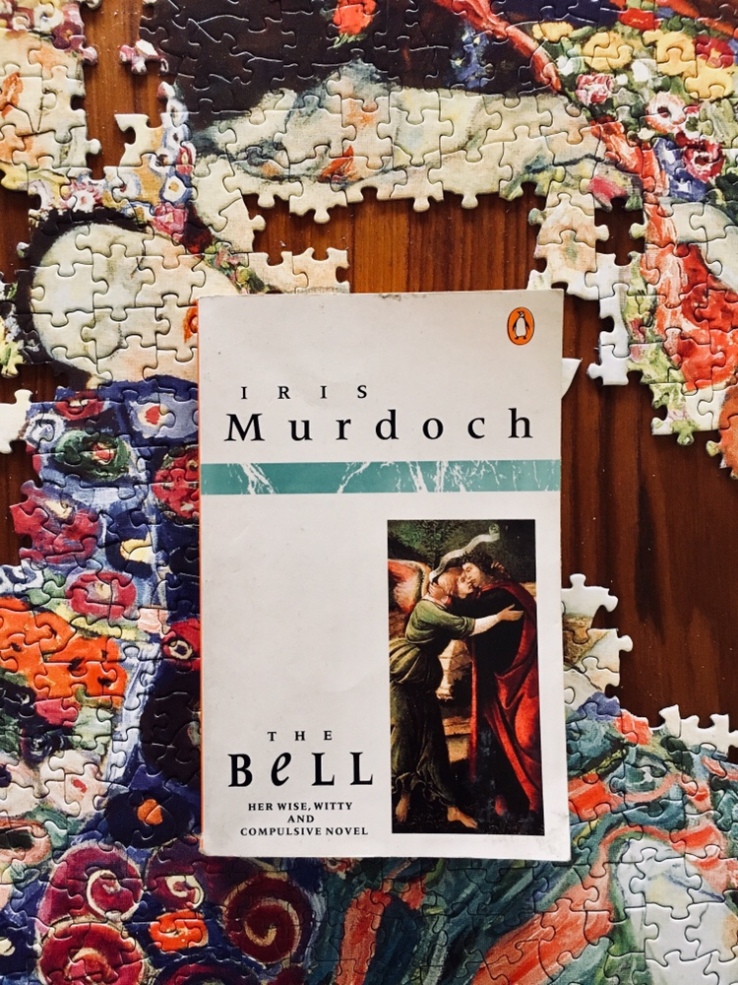
Blog about Iris Murdoch’s novel The Bell

img_9112

I have just finished Iris Murdoch’s 1958 novel The Bell. This is the first novel I have read by Murdoch and I now want to read more novels by Murdoch, which I suppose is the best praise I can offer the novel.

The Bell is set primarily in Imber House, a large old mansion in the English countryside. Imber House adjoins a Benedictine abbey; this nunnery is essentially closed off to the outside world. The residents of Imber House form a “brotherhood,” a laity of would-be acolytes who strive to find spiritual meaning in the commercial and often venal world of the postwar era. Various conflicts between these characters drive the plot of The Bell.

One of these conflicts, especially notable for a novel published in 1958, involves Michael, the leader of the Imber House community. A former schoolmaster who dreamed of joining the clergy, Michael lost his job in a small scandal for “seducing” one of his students, Nick, a teenage boy at the time. Over a decade later, circumstance brings Nick to Imber House, where his twin sister Katherine is staying. Katherine plans to join Imber Abbey; in the meantime, her family hopes that the religious solitude at Imber House will help Nick recover from his alcoholism. The conflict between Michael and Nick becomes further charged when the youngest member of Imber House, a teenager named Toby, befriends both of them.

I could go on about Michael and Nick and Toby and Katherine and etc., but the real star of The Bell is Dora Greenfield, a wonderfully complicatedly simple unassuming unpretentious flighty former art student who has recently left her demanding husband Paul. Through Murdoch’s precise free indirect style, we get to inhabit Dora’s constantly vacillating mind. Like many people, Dora does not know what she is going to do, and even when she thinks through a plan, she often ends up doing the opposite of what she had intended to do. There is a hilarious passage in the novel’s first chapter when Dora goes through a lengthy imaginative exercise about giving up her train seat to an elderly woman. Dora’s thought experiment ends like this:

She decided not to give up her seat.

She got up and said to the standing lady ‘Do sit down here, please. I’m not going very far, and I’d much rather stand anyway.’

The blank space between those sentences highlights a radical gap between contemplation and action.

The train-seat passage is one of many humorous episodes in The Bell, but Murdoch’s humor is underwritten by a deeper menacing anxiety, which can be neatly summed up in the novel’s opening sentences:

Dora Greenfield left her husband because she was afraid of him. She decided six months later to return to him for the same reason.

Those opening lines basically summarize the big thematic plot of The Bell—the conflict between controlling and ultimately abusive Paul and his much younger wife. (“She married him a little for his money,” Murdoch writes just a few paragraphs in, wedging the detail between more positive aspects of Paul’s character–the “a little” is just genius there, the slightest omission from Dora’s consciousness slipping into the third-person narrator for the briefest of moments). The opening lines of The Bell also showcase Murdoch’s rhetorical powers. Her comic precision here reverberates with a hazardous undertone.

Will Dora really return to her husband? Or will she become her own person—whatever that means? The Bell satisfies these questions with complex answers. The novel has every opportunity to veer toward pat conclusions. Murdoch fills her novel with images that suggest a conventional tragic conclusions, and then surpasses these conventions, turning them into something else. A death by drowning might be foreshadowed, but someone will learn to swim; an epiphany achieved in an art museum might not meet its achievement outside of aesthetic response; the Blakean contraries of innocence and experience might be synthesized into a new, original viewpoint. There’s something real about The Bell—it offers a realism that points outside of its own literary contours. The English novelist A.S. Byatt puts it far better than I can in her essay “Shakespearean Plot in the Novels of Irish Murdoch”:

 …The Bell seems to me arguably Miss Murdoch‘s most successful attempt at realism, emotional and social—the tones of voice of the members of the religious community are beautifully caught, the sexual, aesthetic and religious passions and confusions of the three main characters, Dora, Michael, and, to a lesser extent, Toby, are delicately analysed with the combination of intellectual grasp and sensuous immediacy of George Eliot.

Byatt’s comparison to Eliot reminds me that I had intended to read Middlemarch some time this year—but to be fair to myself, I put The Bell on the same list. I won’t be reading Middlemarch next though; The Bell, with its story of a would-be utopian community, strongly reminded me of Nathaniel Hawthorne’s The Blithedale Romance, which I haven’t read in ages. And after I read that, I’d like to read another one by Iris Murdoch. Any recommendations?

Five Angora Rabbits — Theo van Hoytema

3db0ff3706524bdc8e56eab5db3c13ff

Blog about Blog about

img_9457

For a few years now I’ve tallied the absence of words I write myself on this website, this blog, with a kind of apprehensive anxiety I don’t know how to name, let alone measure.

I used the word write in the sentence above, but the word I suppose I want, the right verb, or righter verb I want, is the blogging verb post. See, I write things—posts, riffs, bits of riffs, rants—and then I delete these things, or let them languish in a drafts folder for whatever small eternity they might be afforded. I write a bit and then decide that the world doesn’t need my (half-assed) opinion or impression or interpretation or whatever on, say—

—Don DeLillo’s novel The Names (his real 9/11 novel), or the aesthetics of breakfast in Claire-Louise Bennett’s story-novel-thing Pond, or the cinematography in Sofia Coppola’s reinterpretation of The Beguiling, or my inability to get through the first 100 pages of William H. Gass’s The Tunnel, or Transcendentalism in the Predator films, or finally reading Eudora Welty’s short story “The Death of a Traveling Salesman” and being utterly stunned by its strangeness, or having to suspend all my cynicism and ironic impulses to find a spark of joy in Ava DuVernay’s film A Wrinkle in Time, or the small connections I note between Iris Murdoch’s The Bell and Nathaniel Hawthorne’s The Blithedale Romance, or watching Hayao Miyazaki’s film Ponyo in the theater with my children, or my strange joy in the “steamed hams” microgenre, or etc.—

—so, I guess what I’m saying is—

I’m going to try to blog on this stupid blog more, in a freer way, without the pretense of applying any kind of strong critical acumen to what I’m blogging about. For years I thought of this blog as a sketchpad. Then I started taking the reviews I wrote more seriously, then too seriously. This blog has been an excuse for me to learn about things—a kind of mixtape of quotes and art and etc.—but the more I’ve learned the more I realize that I really know almost nothing about literature and art, and that I usually cannot say what I mean to say (about how I think and feel about what I do know and don’t know about literature art) clearly, so I should do better to pass over in silence (etc.). But this silence mutates into an applied anxiety; it hangs like a big non-attempt in the shallow back of my mind—this silence is its own kind of pretension, or cowardice even, if I’m feeling cruel towards myself.

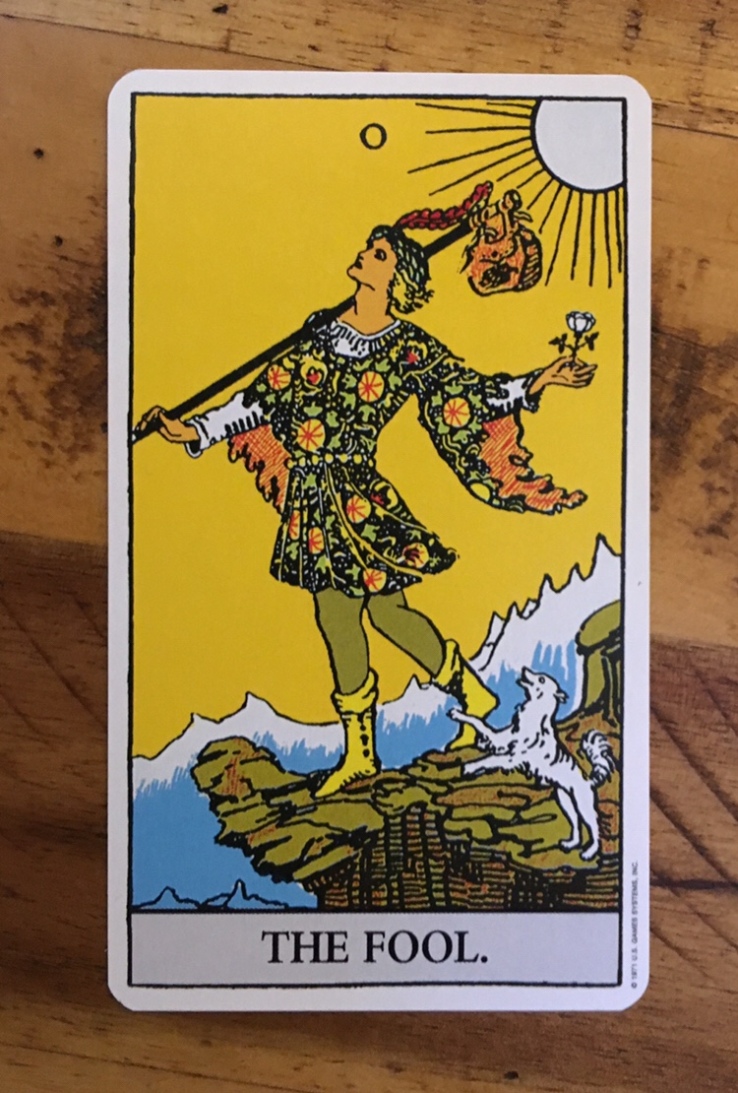
So like let’s try a Thing on this blog. What if I try to, like, just blog about something every day this month? I could title each post “Blog about X” (let X stand for any old thing—a Gordon Lish sentence that I kept tripping over, or a ditty on light in certain George Frederic Watts, or maybe my recipe for caramelized onions and peppers). How many days are in April? 30 I think? I’ll look it up later. I guess I’ll try to commit to post 30 of these things and see how that feels, although it might feel terrible and I might even let myself fall way short of that goal. This particular Easter Sunday/April Fool’s Day seems like a good day to start a bad project though—an earnest hope for fresh newness as a sort of fool’s errand. So I’ll be the fool.

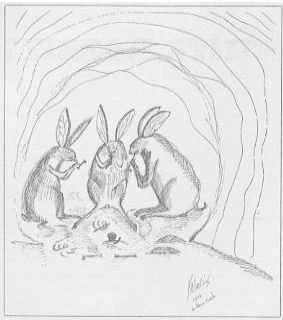
“White Rabbits,” a short tale by Leonora Carrington

rabbit

“White Rabbits”

by

Leonora Carrington

THE TIME has come that I must tell the events which began in 40 Pest St. The houses which were reddish-black looked as if they had survived mysteriously from the fire of London. The house in front of my window, covered with an occasional wisp of creeper, was as blank and empty looking as any plague-ridden residence subsequently licked by flames and saliv’d with smoke. This is not the way that I had imagined New York.

It was so hot that I got palpitations when I ventured out into the streets—so I sat and considered the house opposite and occasionally bathed my sweating face.

The light was never very strong in Pest Street. There was always a reminiscence of smoke which made visibility troubled and hazy—still it was possible to study the house opposite carefully, even precisely; besides my eyes have always been excellent.

I spent several days watching for some sort of movement opposite but there was none and I finally took to undressing quite freely before my open window and doing breathing exercises optimistically in the thick Pest Street air. This must have blackened my lungs as dark as the houses. One afternoon I washed my hair and sat out on the diminuitive stone crescent which served as a balcony to dry it. I hung my head between my knees ¡and watched a blue-bottle suck the dry corpse of a spider between my feet. I looked up through my lank hair and saw something black in the sky, ominously quiet for an airplane. Parting my hair I was in time to see a large raven alight on the balcony of the house opposite. It sat on the balustrade and seemed to peer into the empty window, then poked its head under its wing apparently searching for lice. A few minutes later I was not unduly surprised to see the double windows open and and admit a woman onto the balcony—she carried a large dish full of bones which she emptied onto the floor. With a short appreciative squawk, the raven hopped down and picked about amongst its unpleasant repast.

The woman, who had hemp-long black hair, wiped out the dish, using her hair for this purpose.

Then she looked straight at me and smiled in a friendly fashion. I smiled back and waved a towel. This seemed to encourage her for she tossed her head coquettishly and gave me a very elegant salute after the fashion of a queen.

“Do you happen to have any bad meat over there that you don’t need?” she called.

“Any what?” I called back, wondering if my ears had deceived me.

“Any stinking meat? Decomposed flesh … meat?”

“Not at the moment,” I replied, wondering if she was trying to be funny.

“Won’t you have any towards the end of the week? If so, I would be very grateful if you would bring it over.”

Then she stepped back into the empty window and disappeared. The raven flew away. Continue reading ““White Rabbits,” a short tale by Leonora Carrington”

Bosch Bunny

Field with Two Rabbits — Vincent van Gogh

“Easter Eve” — Anton Chekhov

“Easter Eve”

by

Anton Chekhov


I was standing on the bank of the River Goltva, waiting for the ferry-boat from the other side. At ordinary times the Goltva is a humble stream of moderate size, silent and pensive, gently glimmering from behind thick reeds; but now a regular lake lay stretched out before me. The waters of spring, running riot, had overflowed both banks and flooded both sides of the river for a long distance, submerging vegetable gardens, hayfields and marshes, so that it was no unusual thing to meet poplars and bushes sticking out above the surface of the water and looking in the darkness like grim solitary crags.

The weather seemed to me magnificent. It was dark, yet I could see the trees, the water and the people. . . . The world was lighted by the stars, which were scattered thickly all over the sky. I don’t remember ever seeing so many stars. Literally one could not have put a finger in between them. There were some as big as a goose’s egg, others tiny as hempseed. . . . They had come out for the festival procession, every one of them, little and big, washed, renewed and joyful, and everyone of them was softly twinkling its beams. The sky was reflected in the water; the stars were bathing in its dark depths and trembling with the quivering eddies. The air was warm and still. . . . Here and there, far away on the further bank in the impenetrable darkness, several bright red lights were gleaming. . . .

A couple of paces from me I saw the dark silhouette of a peasant in a high hat, with a thick knotted stick in his hand.

“How long the ferry-boat is in coming!” I said.

“It is time it was here,” the silhouette answered.

“You are waiting for the ferry-boat, too?”

“No I am not,” yawned the peasant—”I am waiting for the illumination. I should have gone, but to tell you the truth, I haven’t the five kopecks for the ferry.”

“I’ll give you the five kopecks.”

“No; I humbly thank you. . . . With that five kopecks put up a candle for me over there in the monastery. . . . That will be more interesting, and I will stand here. What can it mean, no ferry-boat, as though it had sunk in the water!”

The peasant went up to the water’s edge, took the rope in his hands, and shouted; “Ieronim! Ieron—im!” Continue reading ““Easter Eve” — Anton Chekhov”

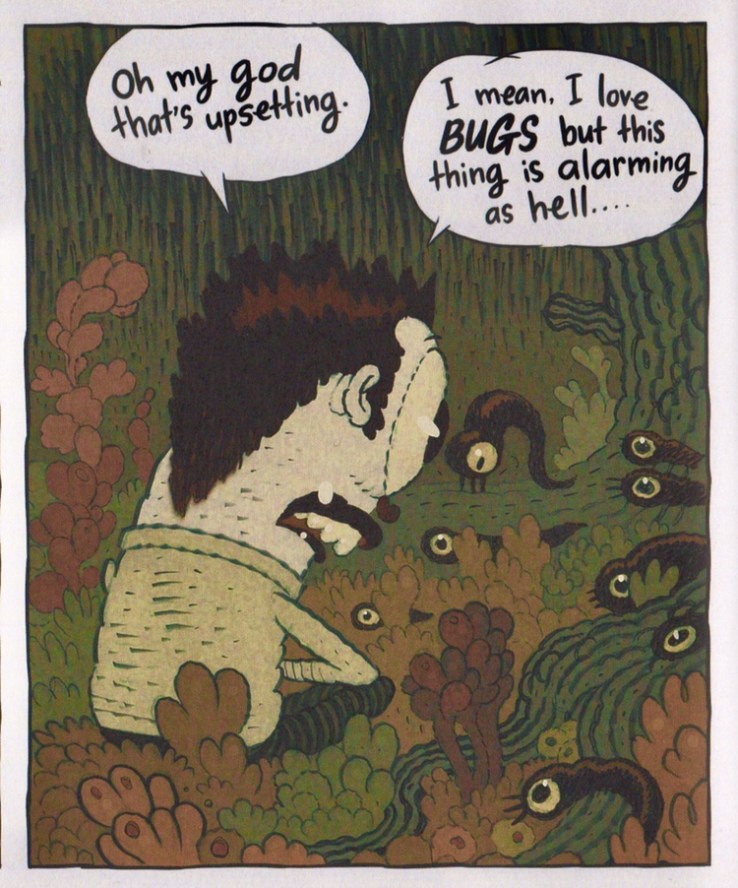
Dave Cooper’s Mudbite (Book acquired, 28 March 2018)


img_9439

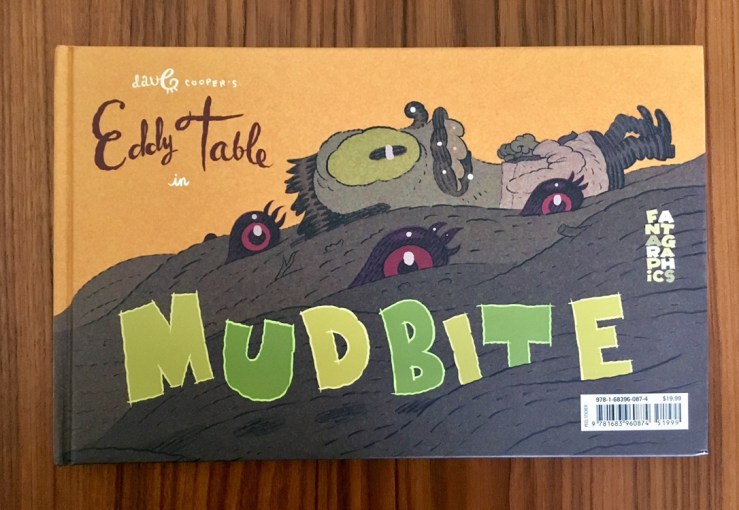
Dave Cooper’s Mudbite is new in glorious full-color hardback from Fantagraphics. Here is the front cover:

img_9437

And here is the other front cover (Mudbite is a tête-bêche):

img_9438

I hope to post a review of Mudbite at The Comics Journal soon, but for now, here’s Fantagraphics’ blurb:

Eddy Table, the star of Mudbite, first appeared the early ’90s in Cooper’s award-winning underground comics series, Weasel. His stories were based on baffling dreams and reveled in a unique sort of logical nonsense. Mudbitecompiles two all-new Eddy Table stories, “Mud River” and “Bug Bite,” in which Eddy returns to his roots, acting as Dave’s alter ego in these dreamlike narratives.

In “Mud River,” Eddy makes a foolish mistake, causing a sweet, innocent Amazon to bonk her head, turning her into a very impressionable automaton. Of course, Eddy can’t resist taking advantage of this unexpected development, even as a river of mud approaches. In “Bug Bite,” Eddy has brought his family on a vacation to Europe, but he’s soon distracted by a series of manifestations of his own obsessions  — voluptuous women, mysterious and collectible “microdevices,”  and a strange, impromptu jam session. When he loses his family entirely, he’s led into a dark, slimy corridor inhabited by shiny black eels. What is their connection to the microdevices? And how will all this impact his family?

Mudbite marks the first new graphic novel by fan favorite Dave Cooper in more than 15 years, marking a welcome return to the medium that he made his name in before focusing on fine art and television, where he has focused most of his creative energy since.

Calvary (Crucifixion) — Ilya Repin

calvary-crucifixion-study-1869

Calvary (Crucifixion), 1869 by Ilya Repin (1844-1930)

A very short riff on a compelling Stephen Crane character (and six marvelous paragraphs of Crane’s prose)

I took a few paperback books with me when I went camping two weeks ago, but I didn’t actually read from them. Instead, I wound up reading (or rereading in some cases) a few of the tales in Stephen Crane’s collection The Open Boat and Other Stories, which I downloaded from Project Gutenberg onto my iPad thanks to a data connection from my phone. Rain was pouring down on my tent and for some reason, I want to reread “The Bride Comes to Yellow Sky,” popped into my head, so I made it happen. I don’t know how these details are germane to anything I am trying to say here.

What I am trying to say here is that I didn’t read “The Bride Comes to Yellow Sky” right away. Instead, I read a story I’d never read before, “A Man and Some Others.” This tale contains some of the most fantastic sentences I’ve read in ages. (This is what I’m trying to say here: That “A Man and Some Others” contains some magical fucking prose).

Here is the opening paragraph:

Dark mesquit spread from horizon to horizon. There was no house or horseman from which a mind could evolve a city or a crowd. The world was declared to be a desert and unpeopled. Sometimes, however, on days when no heat-mist arose, a blue shape, dim, of the substance of a spectre’s veil, appeared in the south-west, and a pondering sheep-herder might remember that there were mountains.

I confess that I might have had some beers and Bushmills that evening, but I read and reread the opening sentences of “A Man and Some Others” in a little loop, hypnotized by the way Crane’s prose collapses human agency into an overwhelming naturalism—a naturalism with just the slightest Romantic touch of “a spectre’s veil.” (In “The Open Boat,” Crane demonstrates a more masterful and more complete grappling of naturalism resisting (and perhaps ultimately synthesizing) the Romantic traces of his transcendentalist forebears. But that’s a topic for another riff).

“A Man and Some Others” is about a cowboy named Bill. Threatened off a range that he claims as his own by Mexican ranchers who see otherwise, Bill retaliates. Along the way he meets a stranger—a stand-in for Crane, perhaps—who bears witness to the whole fandango. As a story, “A Man and Some Others” is slight, a thin premise that exists primarily as a space for Bill to swagger around in for a few pages. Sure, there could be a critique of Manifest Destiny somewhere in there, but Crane’s tale never coheres into a fully realized allegory or satire (as the poet John Berryman pointed out in his study of Crane, “Crane‘s humor, finally, and his irony are felt as weird or incomprehensible.” Berryman was referring to War Is Kind, but the description fits here as well).

Crane’s humor and irony are on vivid display in the six paragraphs that make up the second short chapter of “A Man and Some Others.” In this section, we get the improbable and wild life story of Bill, which reads on the one hand as a hyperbolic archetype of American machoism, a kind of fabulous legend of Manifest Destiny. On the other hand, Bill’s bio strikes the reader as so thoroughly and lovingly true that it seems Crane must have wholly plagiarized the life of a real individual (or at least combined a few wild but true stories from a handful of folks).

I won’t comment any further, but instead offer those six paragraphs, which I simply could never improve upon:

Bill had been a mine-owner in Wyoming, a great man, an aristocrat, one who possessed unlimited credit in the saloons down the gulch. He had the social weight that could interrupt a lynching or advise a bad man of the particular merits of a remote geographical point. However, the fates exploded the toy balloon with which they had amused Bill, and on the evening of the same day he was a professional gambler with ill-fortune dealing him unspeakable irritation in the shape of three big cards whenever another fellow stood pat. It is well here to inform the world that Bill considered his calamities of life all dwarfs in comparison with the excitement of one particular evening, when three kings came to him with criminal regularity against a man who always filled a straight. Later he became a cow-boy, more weirdly abandoned than if he had never been an aristocrat. By this time all that remained of his former splendour was his pride, or his vanity, which was one thing which need not have remained. He killed the foreman of the ranch over an inconsequent matter as to which of them was a liar, and the midnight train carried him eastward. He became a brakeman on the Union Pacific, and really gained high honours in the hobo war that for many years has devastated the beautiful railroads of our country. A creature of ill-fortune himself, he practised all the ordinary cruelties upon these other creatures of ill-fortune. He was of so fierce a mien that tramps usually surrendered at once whatever coin or tobacco they had in their possession; and if afterward he kicked them from the train, it was only because this was a recognized treachery of the war upon the hoboes. In a famous battle fought in Nebraska in 1879, he would have achieved a lasting distinction if it had not been for a deserter from the United States army. He was at the head of a heroic and sweeping charge, which really broke the power of the hoboes in that country for three months; he had already worsted four tramps with his own coupling-stick, when a stone thrown by the ex-third baseman of F Troop’s nine laid him flat on the prairie, and later enforced a stay in the hospital in Omaha. After his recovery he engaged with other railroads, and shuffled cars in countless yards. An order to strike came upon him in Michigan, and afterward the vengeance of the railroad pursued him until he assumed a name. This mask is like the darkness in which the burglar chooses to move. It destroys many of the healthy fears. It is a small thing, but it eats that which we call our conscience. The conductor of No. 419 stood in the caboose within two feet of Bill’s nose, and called him a liar. Bill requested him to use a milder term. He had not bored the foreman of Tin Can Ranch with any such request, but had killed him with expedition. The conductor seemed to insist, and so Bill let the matter drop.

He became the bouncer of a saloon on the Bowery in New York. Here most of his fights were as successful as had been his brushes with the hoboes in the West. He gained the complete admiration of the four clean bar-tenders who stood behind the great and glittering bar. He was an honoured man. He nearly killed Bad Hennessy, who, as a matter of fact, had more reputation than ability, and his fame moved up the Bowery and down the Bowery.

But let a man adopt fighting as his business, and the thought grows constantly within him that it is his business to fight. These phrases became mixed in Bill’s mind precisely as they are here mixed; and let a man get this idea in his mind, and defeat begins to move toward him over the unknown ways of circumstances. One summer night three sailors from the U.S.S. Seattle sat in the saloon drinking and attending to other people’s affairs in an amiable fashion. Bill was a proud man since he had thrashed so many citizens, and it suddenly occurred to him that the loud talk of the sailors was very offensive. So he swaggered upon their attention, and warned them that the saloon was the flowery abode of peace and gentle silence. They glanced at him in surprise, and without a moment’s pause consigned him to a worse place than any stoker of them knew. Whereupon he flung one of them through the side door before the others could prevent it. On the sidewalk there was a short struggle, with many hoarse epithets in the air, and then Bill slid into the saloon again. A frown of false rage was upon his brow, and he strutted like a savage king. He took a long yellow night-stick from behind the lunch-counter, and started importantly toward the main doors to see that the incensed seamen did not again enter.

The ways of sailormen are without speech, and, together in the street, the three sailors exchanged no word, but they moved at once. Landsmen would have required two years of discussion to gain such unanimity. In silence, and immediately, they seized a long piece of scantling that lay handily. With one forward to guide the battering-ram, and with two behind him to furnish the power, they made a beautiful curve, and came down like the Assyrians on the front door of that saloon.

Mystic and still mystic are the laws of fate. Bill, with his kingly frown and his long night-stick, appeared at precisely that moment in the doorway. He stood like a statue of victory; his pride was at its zenith; and in the same second this atrocious piece of scantling punched him in the bulwarks of his stomach, and he vanished like a mist. Opinions differed as to where the end of the scantling landed him, but it was ultimately clear that it landed him in south-western Texas, where he became a sheep-herder.

The sailors charged three times upon the plate-glass front of the saloon, and when they had finished, it looked as if it had been the victim of a rural fire company’s success in saving it from the flames. As the proprietor of the place surveyed the ruins, he remarked that Bill was a very zealous guardian of property. As the ambulance surgeon surveyed Bill, he remarked that the wound was really an excavation.

Illustration for Frankenstein — Bernie Wrightson

596de571d9ea5a0f6fcb1cc0d4562bea

Yard Sale — Robin F. Williams

2015YardSale

Yard Sale, 2015 by Robin F. Williams (b. 1984)

“Murnane has not made the selling of himself an easy task”

01murnane5-extra-superjumbo

This week’s New York Times Magazine offers a compelling profile of Gerald Murnane. The profile, by Mark Binelli, is an expansive and engaging look at the Australian author, whose cult will undoubtedly grow larger after this exposure. From Binelli’s piece:

Murnane’s books are strange and wonderful and nearly impossible to describe in a sentence or two. After his third novel, “The Plains,” a fable-like story reminiscent of Italo Calvino published in 1982, Murnane largely turned away from what might be called conventional narrative pleasures. Dispensing almost entirely with plot and character, his later works are essayistic meditations on his own past, a personal mythology as attuned to the epic ordinariness of lost time as Proust, except with Murnane it’s horse races, a boyhood marble collection, Catholic sexual hang-ups and life as a househusband in the suburban Melbourne of the 1970s.

Murnane has not made the selling of himself an easy task. Even by the standards of the solitary writer, his eccentricities are manifest. He has never flown on an airplane; in fact, he has barely traveled outside of Victoria. In a 2001 speech that has become legend among Murnanophiles, he informed an audience at the University of Newcastle of his longstanding belief that “a person reveals at least as much when he reports what he cannot do or has never done.”

A lovely section from later in Binelli’s essay touches on Murnane’s archives:

Murnane began keeping the archives more than 50 years ago, both for posterity and to satisfy his own meticulous sense of order, and he has left strict instructions regarding their contents, which are not to be made public until after his own death and the death of his surviving siblings. (He has one brother, a Catholic priest, and a sister; another brother, who was born with an intellectual disability and was repeatedly hospitalized, died in 1985.) Nonetheless, Murnane opened the cabinets to give me a sense of their contents. His so-called Chronological Archive is stuffed with hanging files covering each period of his life and featuring headings like “I rebuff a wealthy widow,” “I fall out with an arrogant student of mine,” “Two women bother me,” “I decide that most books are crap,” “Hoaxes! How I love them!” and “Peter Carey exposed at last.” He also has multiple drafts of his 13 books; letters addressed, as in a time capsule, to a future Murnane scholar, whom he imagines as a young woman, and whom he addresses in the letters as “Fc,” for “future creature”; a notebook of 20,000 words titled “My Shame File”; a 40,000-word report on miraculous or unexplained events in his life; and a 75,000-word account of his dealings with everyone he has ever courted romantically or considered courting.

Read the profile at The New York Times Magazine.

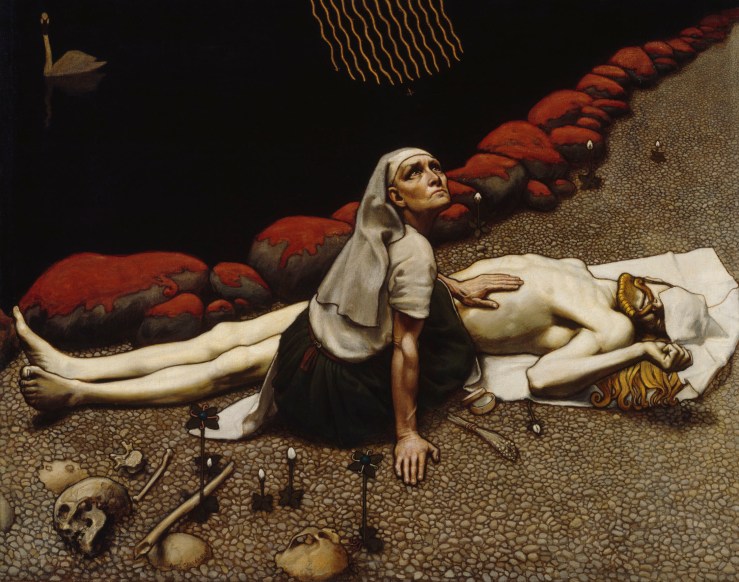
Lemminkäinen’s Mother — Akseli Gallen-Kallela

gallen_kallela_lemminkainens_mother

Lemminkäinen’s Mother, 1897 by Akseli Gallen-Kallela (1865-1931)


“Lemminkainen’s Restoration”

Rune XV of The Kalevala

in English translation by

John Martin Crawford


Lemminkainen’s aged mother
Anxious roams about the islands,
Anxious wonders in her chambers,
What the fate of Lemminkainen,
Why her son so long has tarried;
Thinks that something ill has happened
To her hero in Pohyola. Continue reading “Lemminkäinen’s Mother — Akseli Gallen-Kallela”

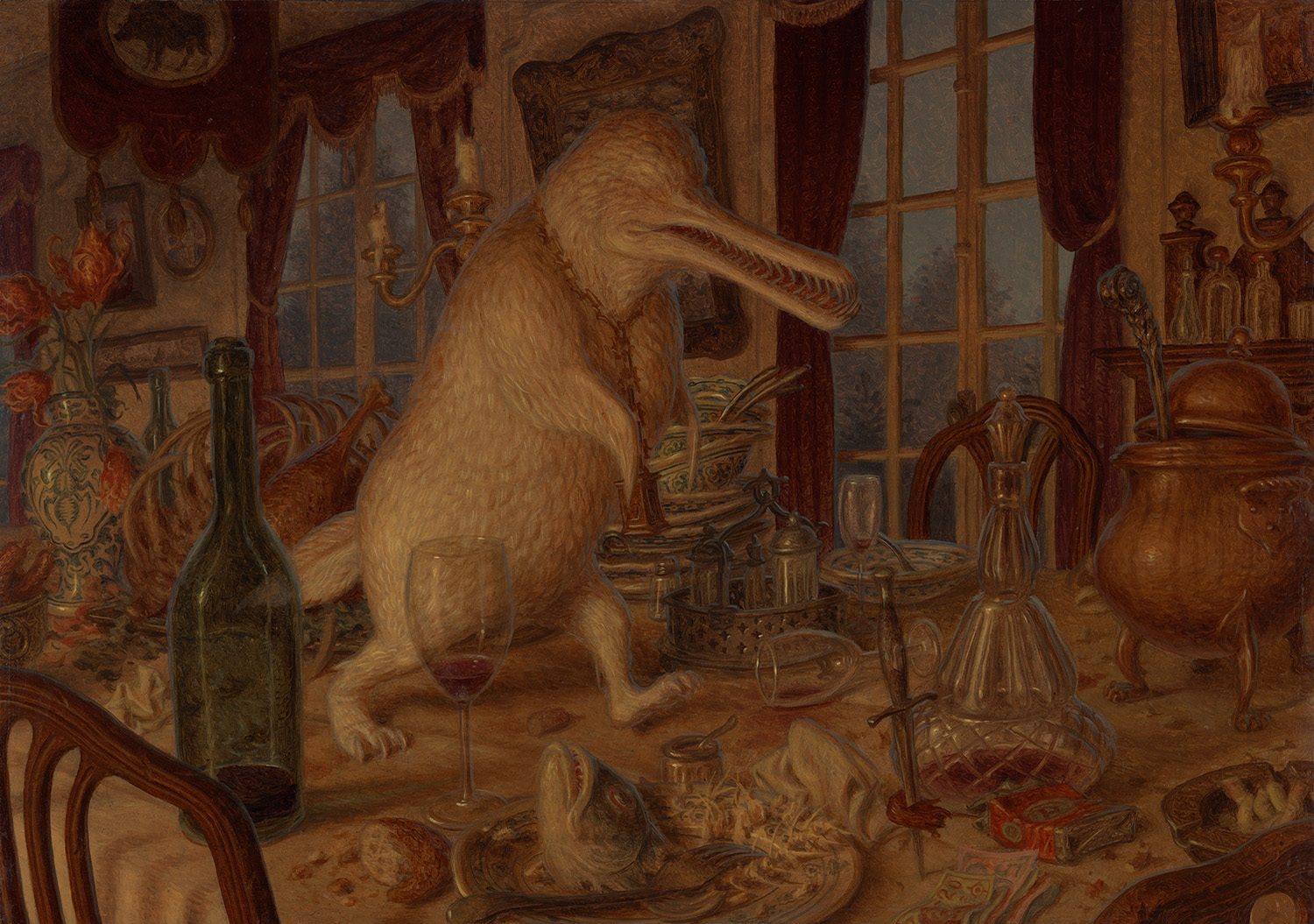
Thieves’ Reckoning — Peter Ferguson

thieves-reckoning-final-lo

Thieves’ Reckoning by Peter Ferguson (b. 1968)