Overhead, on the molded plaster ceiling, Methodist versions of Christ’s kingdom swarm: lions cuddle with lambs, fruit spills lushly and without pause into the arms and about the feet of gentlemen and ladies, swains and milkmaids. No one’s expression is quite right. The wee creatures leer, the fiercer beasts have a drugged or sedated look, and none of the humans have any eye-contact at all 1. The ceilings of “The White Visitation” aren’t the only erratic thing about the place, either. It is a classic “folly,” 2 all right. The buttery was designed as an Arabian harem in miniature, for reasons we can only guess at today, full of silks, fretwork and peepholes. One of the libraries served, for a time, as a wallow, the floor dropped three feet and replaced with mud up to the thresholds for giant Gloucestershire Old Spots to frolic, oink, and cool their summers in 3, to stare at the shelves of buckram books and wonder if they’d be good eating 4. Whig eccentricity 5 is carried in this house to most unhealthy extremes. The rooms are triangular, spherical, walled up into mazes 6. Portraits, studies in genetic curiosity, gape and smirk at you from every vantage. The W.C.s contain frescoes of Clive and his elephants stomping the French at Plassy 7, fountains that depict Salome with the head of John (water gushing out ears, nose, and mouth)8, floor mosaics in which are tessellated together different versions of Homo Monstrosus, an interesting preoccupation of the time—cyclops, humanoid giraffe, centaur repeated in all directions 9. Everywhere are archways, grottoes, plaster floral arrangements, walls hung in threadbare velvet or brocade. Balconies give out at unlikely places, overhung with gargoyles whose fangs have fetched not a few newcomers nasty cuts on the head. Even in the worst rains, the monsters only just manage to drool—the rainpipes feeding them are centuries out of repair, running crazed over slates and beneath eaves, past cracked pilasters, dangling Cupids, terra-cotta facing on every floor, along with belvederes, rusticated joints, pseudo-Italian columns, looming minarets, leaning crooked chimneys—from a distance no two observers, no matter how close they stand, see quite the same building 10 in that orgy of self-expression 11, added to by each succeeding owner, until the present War’s requisitioning. Topiary trees line the drive for a distance before giving way to larch and elm: ducks, bottles, snails, angels, and steeplechase riders they dwindle down the metaled road into their fallow silence, into the shadows under the tunnel of sighing trees. The sentry, a dark figure in white webbing, stands port-arms in your 12 masked headlamps, and you 13 must halt for him. The dogs, engineered and lethal, are watching you from the woods. Presently, as evening comes on, a few bitter flakes of snow begin to fall 14.
From pages 82-83 of Thomas Pynchon’s 1973 novel Gravity’s Rainbow.
1 This strikes me as a description of Gravity’s Rainbow.
2 An architectural folly, but another description of Gravity’s Rainbow. (Perhaps ironic. Certainly ironic. Meta-ironic).
3 Late in the novel Our Hero Tyrone Slothrop will take up the mantle of “Plechazunga, the Pig-Hero” — one of many Circean (Odyssean?) transformations.
Gustav-Adolf Mossa
4 Bibliophagy, baby. Another meta-description of the novel itself.
5 A reference to the Neo-Palladian baroque style that swept Britain in the 18th century?
6 Another description of Gravity’s Rainbow, a self-describing novel…you see where I’m going with this.
7 Clive of India is a very very minor character in Pynchon’s novel Mason & Dixon.
8 See the Solario painting above; you know this old saw of course. The femme fatale, etc. The lines of leakage from ears nose and mouth point to Gravity’s Rainbow’s themes of abjection and dissolution—of unbecoming from the inside out.
9 Another description of Gravity’s Rainbow (disputed). Monster men populated the undiscovered country. Do you know Gaspar Schott?
10 “…no two observers, no matter how close they stand, see quite the same building” — strike building and replace with novel, and we have, perhaps, another meta-description of Gravity’s Rainbow.
11 You know by this point I’m going to say that “orgy of self-expression” is another meta-description of the novel itself, right?
There is, of course, a real orgy (by which I mean non-metaphorical, orgy-orgy) later in Gravity’s Rainbow, on the Anubis.
12 …your? Wha? Whence this narrative shift?
13You!? And hold on who’s this fellow, this dark figure in white webbing (a sorta kinda oxymoron, maybe)—a sentry sure, a watcher, maybe—a statue? The martial imagery prefigures, perhaps, black and white, Enzian and Tchitcherine, the White Visitation (prefigures? This whole passage is set there!) and the Counterforce…(you’re stretching, dude).
14 Our paragraph begins with “Overhead” and ends with “begin to fall”—the descent of the rocket, the arc of the rainbow, the decline of the human condition. (And curves in other directions too).
I can’t remember where or how I read about Marian Engel’s 1976 novel Bear, but I was intrigued. In lieu of the blurb, here’s Sara Bynoe at Hazlitt on Bear:
The first thing you need to know about Marian Engel’s 1976 novel Bear is that it is about a woman who has sex with a giant bear. Not a metaphorical, figurative, concept-within-a-creature bear: a real, furry, wild brown bear. There’s more to it than that, but why bury the lead?
The second thing you need to know, however, is that this is not some fringe underground chapbook: it won the Governor General’s award—the highest Canadian honour for the literary arts—in a year in which the jury included Mordecai Richler, Margaret Laurence, and Alice Munro.
We’re talking about Bear right now, though, because someone recently posted its cover and some particularly raunchy sections of the book to Imgur under the title, “WHATTHEACTUALFUCK, CANADA?” There was even a little boost in e-book sales after the book’s cover—an illustration of a lithe, topless woman with flowing brunette locks being embraced from behind by a bear standing on its hind legs—went viral. It looks like a Harlequin romance novel: ursine Fabio and his eager human companion, lost together, alone in a world that will never understand the depths of their potentially life-threatening interspecies love.
Elena Ferrante’s Neapolitan Novel Quartet, which I guess actually counts as four novels, but whatever
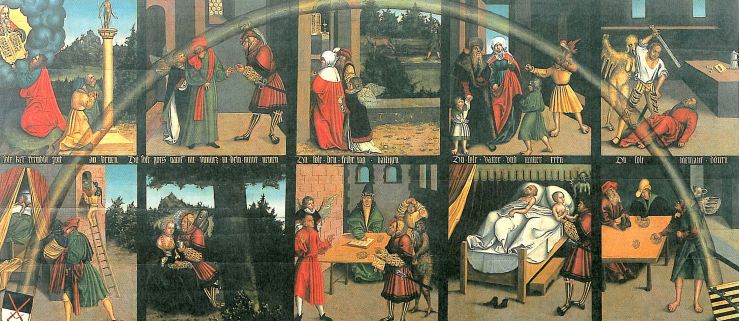
Ten Commandments, Lucas Cranach the Elder
Ten books I want to read soonish:
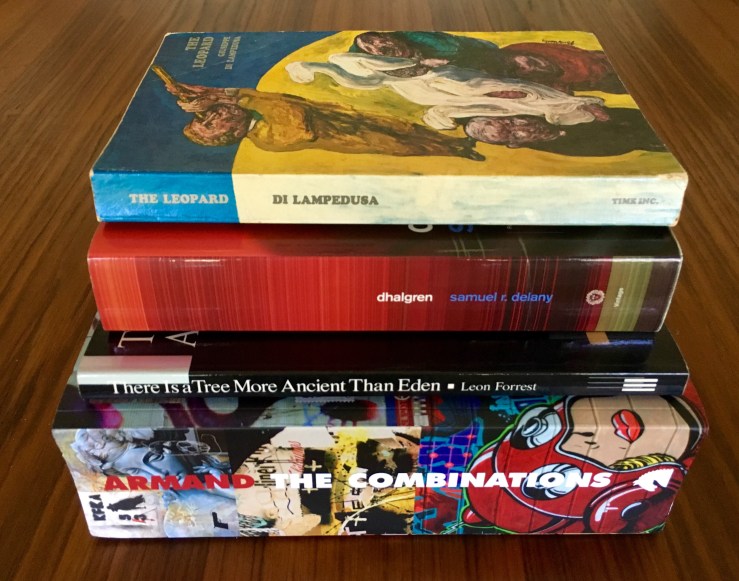
There Is a Tree More Ancient Than Eden, Leon Forrest, a novel I’m actually reading now so I’m not sure if it counts
Bear, Marian Engel
The Tunnel, William Gass
The Last Days of Louisiana Red, Ishmael Reed
99 Stories of God, Joy Williams
Antigonick, Anne Carson
Vineland, Thomas Pynchon
The Lime Twig, John Hawkes
The Magic Kingdom, Stanley Elkin
The Passenger, Cormac McCarthy—drop the album, Cormac!
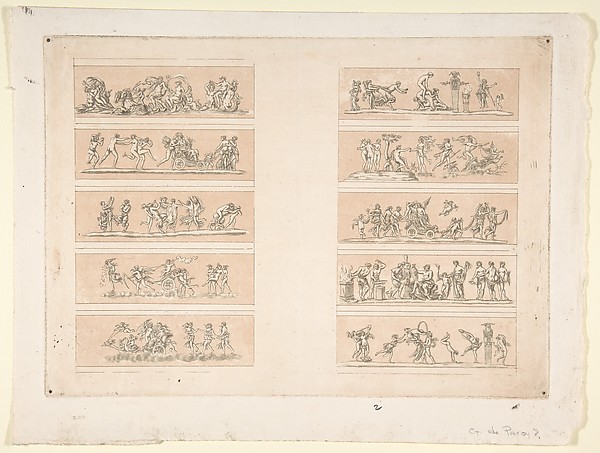
Ten Bacchanal Scenes, Jean Philippe Guy Le Gentil
Ten reviews of books (perhaps underrated or under-remarked upon, at least–the books, I mean, not the reviews) by authors whose last names begin with B:
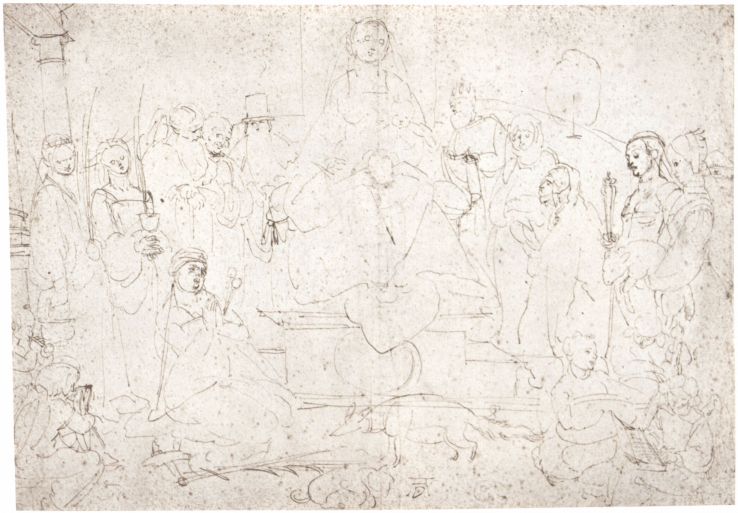
Sketch with Ten Saints (etc.), Albrecht DurerTen Panels of a Scholars Books, unidentified early 20th c. Korean artist
Ten books I aim to re-read sooner rather than later:
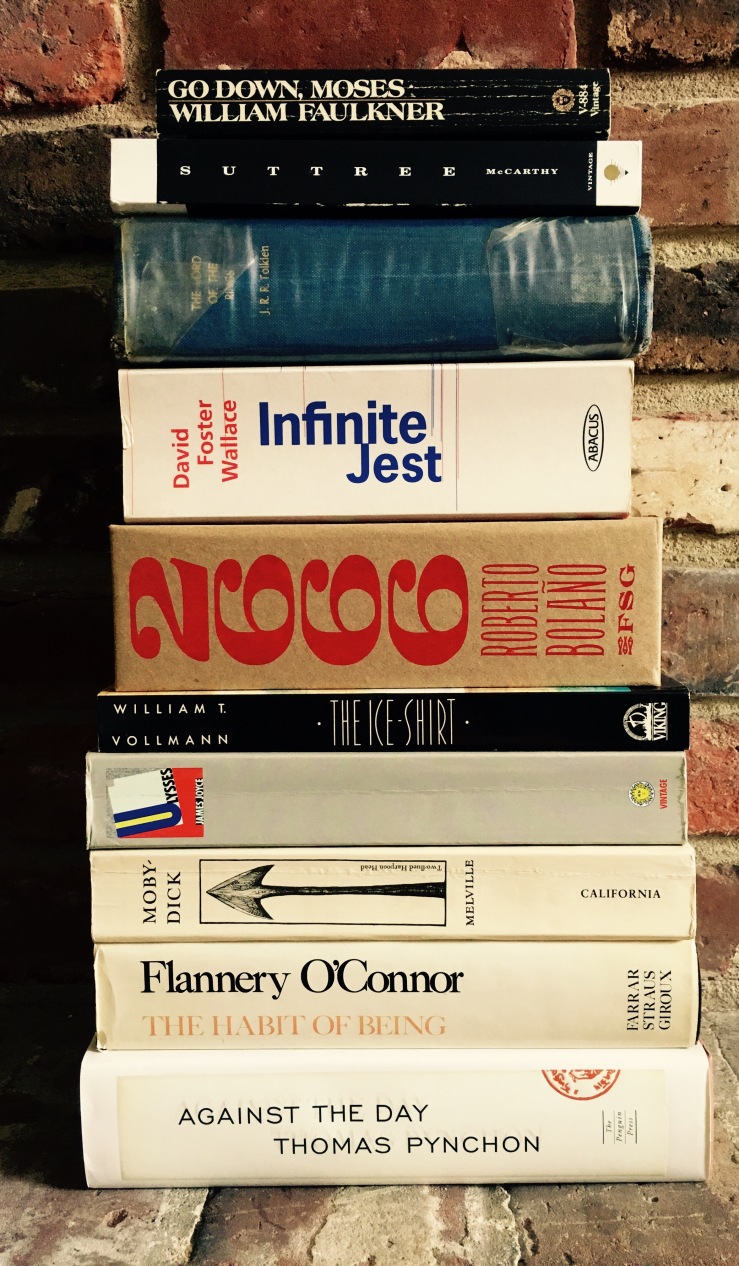
Gravity’s Rainbow, Thomas Pynchon
The Pale King, David Foster Wallace
2666, Roberto Bolaño
Moby-Dick, Herman Melville
The Confidence-Man, Herman Melville
The House of Seven Gables, Nathaniel Hawthorne
Autobiography of Red, Anne Carson
Blood Meridian, Cormac McCarthy (2015 is the first time I didn’t reread it)
Native Son, Richard Wright
The Earthsea Cycle, Ursula K. Le Guin (hopefully with my daughter, who’s just a bit younger than this blog, and with whom I’ve been reading the Harry Potter books way.too.long.).
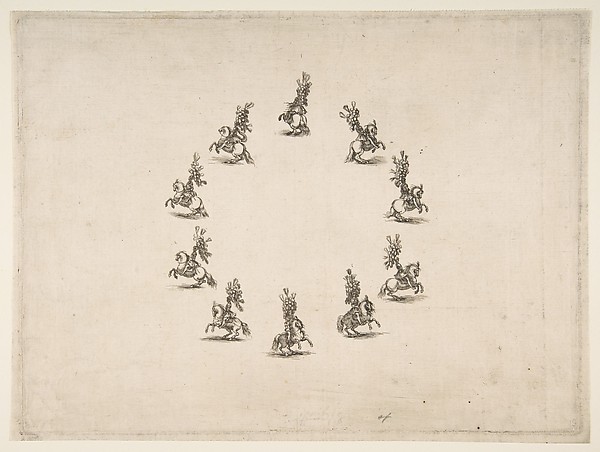
Ten Cavaliers Forming a Circle, Stefano della Bella
I got to page 258 (of 801 pages, in the 2001 Vintage paperback edition).
On that page, the visiting poet (Visiting Poet?)—he’s visiting the post-apocalyptic city of Bellona, which is I guess the central character of Dhalgren (I guess?)—on that page, Ernest Newboy (go ahead and groan at that name), declares:
There’s no reason why all art should appeal to all people.
I took that as a sign that I could go ahead and quit Dhalgren.
Delany’s cult novel initially appealed to me, but: No.
I’m trying, right now, to think of a novel I’ve wanted to like more but didn’t like than Dhalgren. (Thomas Disch’s 334, maybe, which Dhalgren resembles? Ballard’s Millenium People, which suggests that somewhere out there there’s a better Delany novel I need to read—like I read the wrong one, the famous one?).
I wanted to like Dhalgren because it’s weird and messy and post-apocalyptic and discursive and shambling and tripping and plotless and vibe vibe vibe…but mostly I found it boring. And the prose was often, uh, bad.
(I just read William Gibson’s foreword to the thing, in which he declares it a “prose-city…a literary singularity…executed by the most remarkable prose stylist to have emerged from the culture of American science fiction.” Nah. (Gibson’s intro has this real awful Baby Boomer you-had-to-be-there-man tone to it too)).
There are bits and pieces of Dhalgren that were interesting enough to make me keep wading through the rubbish: tree sex, hologram gangs, the unnamed apocalypse, the specter of violence, the drugs, the weapons…but to give you an idea of this novel’s rhythm, the central protagonist, Kid, spends a sizable chunk of the novel’s third chapter moving furniture from one apartment to another.
The Kid also wants to be a poet, and Delany spends a lot of time dipping into our boy’s notebook. It’s bad stuff, cringeworthy, and not in an Isn’t-he-a-bad-writer? way. Delany’s own prose veers hippy dippy too—a mirror. (Mirrors and lenses and prisms and recursion images twist through the 250 pages I read. Reality’s an illusion, man. Or not. Or memory. Or something).
I’ve had every kind of warning that Delany’s novel is plotless and will refuse to cohere (Gibson: “Dhalgren does not answer”). I fucking love those kinds of novels. But they have to have something else: Good sentences, one after another. Humor that’s actually, uh, funny. A point of feeling or message beyond the kind of apocalypse vibe I absorbed by reading comics (and comix) when I was 11, 12, 13. Less furniture moving.
Anyway, I’m unconvinced that anything wonderful’s going to pop out in the next 550 or so pages. And I’m fine, at this point, of being wrong, and ready to move on to something else.
After a few years of false starts, I finally read Giuseppe Tomasi di Lampedusa’s 1958 novel The Leopard this August. Then I read it again, immediately (It’s one of only two novels I can recall rereading right away—the other two were Blood Meridian and Gravity’s Rainbow). The Leopard tells the story of Prince Fabrizio of Sicily, who witnesses the end of his era during the Risorgimento, the Italian reunification. Fabrizio is an enchanting character—by turns fiery and lascivious, intellectual and stoic—The Leopard takes us through his mind and through his times. He’s thoroughly complex, unknown even to himself, perhaps. The novel is impossibly rich, sad, electric, a meditation on death, sex, sensuality—pleasure and loss. More mood than plot, The Leopard glides on vibe, its action framed in rich set pieces—fancy balls and sumptuous dinners and games of pleasure in summer estates. But of course there is a plot—several strong plots, indeed (marriage plots and death plots, religious plots and political plots). Yet the narrative’s viewpoint characters keep the plots at bay, or mediate them, rather than propel them forward. Simply one of the better novels I’ve read in years, its final devastating images inked into my memory for as long as I have memory. (English translation by Archibald Colquhoun, by the way).
Dhalgren, Samuel Delany
I think The Leopard initially landed on my radar a few years ago after someone somewhere (where?) described it as a cult novel. Samuel Delany’s Dhalgren (1975) really is a cult novel. I’m about 200 pages into its 800 pages, and I’m ready to abandon the thing. Delany often evokes a fascinating vibe here, conjuring the post-apocalyptic city of Bellona, which is isolated from the rest of America after some unnamed (and perhaps unknown) disaster—there are “scorpions,” gangs who hide in holographic projections of dragons and insects; there is a daily newspaper that comes out dated with a different year each day; there are two moons (maybe). And yet Delany spends more time dwelling on the mundane—I’ve just endured page after page of the novel’s central protagonist, Kid, clearing furniture out of an apartment. I’m not kidding—a sizable chunk of the novel’s third chapter deals with moving furniture. (Perhaps Delany’s nodding obliquely to Poe here?). Dhalgren strives toward metafiction, with the Kid’s attempts to become a poet, but his poetry is so bad, and Delany’s prose is, well, often very, very bad too. Like embarrassingly bad in that early seventies hippy dippy way. If ever a novel were screaming to have every third or second sentence cut, it’s Dhalgren. I’m not sure how much longer I can hold out.
There Is a Tree More Ancient Than Eden, Leon Forrest
I had never heard of Forrest until a Twitter pal corrected that. I started Tree (1973) this weekend; its first chapter “The Lives” is a rush of time, memory, color, texture…religion and violence, history, blood…I’m not sure what’s happening and I don’t care (like Faulkner, it is—I mean, each sentence makes me want to go to the next sentence, into the big weird tangle of it all). Maybe let Ralph Ellison describe it. From his foreword:
As I began to get my bearings in the reeling world of There Is a Tree More Ancient Than Eden, I thought, What a tortured, history-wracked, anguished, Hound-of-Heaven-pursued, Ham-and-Oedipus-cursed, Blake-visioned, apocalypse-prone projection of the human predicament! Yet, simultaneously, I was thinking, Yes, but how furiously eloquent is this man Forrest’s prose, how zestful his jazz-like invention, his parody, his reference to the classics and commonplaces of literature, folklore, tall-tale and slum-street jive! How admirable the manner in which the great themes of life and literature are revealed in the black-white Americanness of his characters as dramatized in the cathedral-high and cloaca-low limits of his imaginative ranging.
Typing this out, I realize that I’m bound to put away Dhalgren and continue on into Forrest.
The Combinations, Louis Armand
I read the “Overture” to Armand’s enormous so-called “anti-novel” The Combinations (2016)…the rush of prose reminded me of any number of post-postmodern prose rushers—this isn’t a negative criticism, but I’ll admit a certain wariness with the book’s formal postmodernism—it looks (looks) like Vollmann—discursive, lots of different fonts and forms. I’ll leap in later.
September 7th.–In a wood, a heap or pile of logs and sticks, that had been cut for firewood, and piled up square, in order to be carted away to the house when convenience served,–or, rather, to be sledded in sleighing time. But the moss had accumulated on them, and leaves falling over them from year to year and decaying, a kind of soil had quite covered them, although the softened outline of the woodpile was perceptible in the green mound. It was perhaps fifty years–perhaps more–since the woodman had cut and piled those logs and sticks, intending them for his winter fires. But he probably needs no fire now. There was something strangely interesting in this simple circumstance. Imagine the long-dead woodman, and his long-dead wife and family, and the old man who was a little child when the wood was cut, coming back from their graves, and trying to make a fire with this mossy fuel.











 Biblioklept