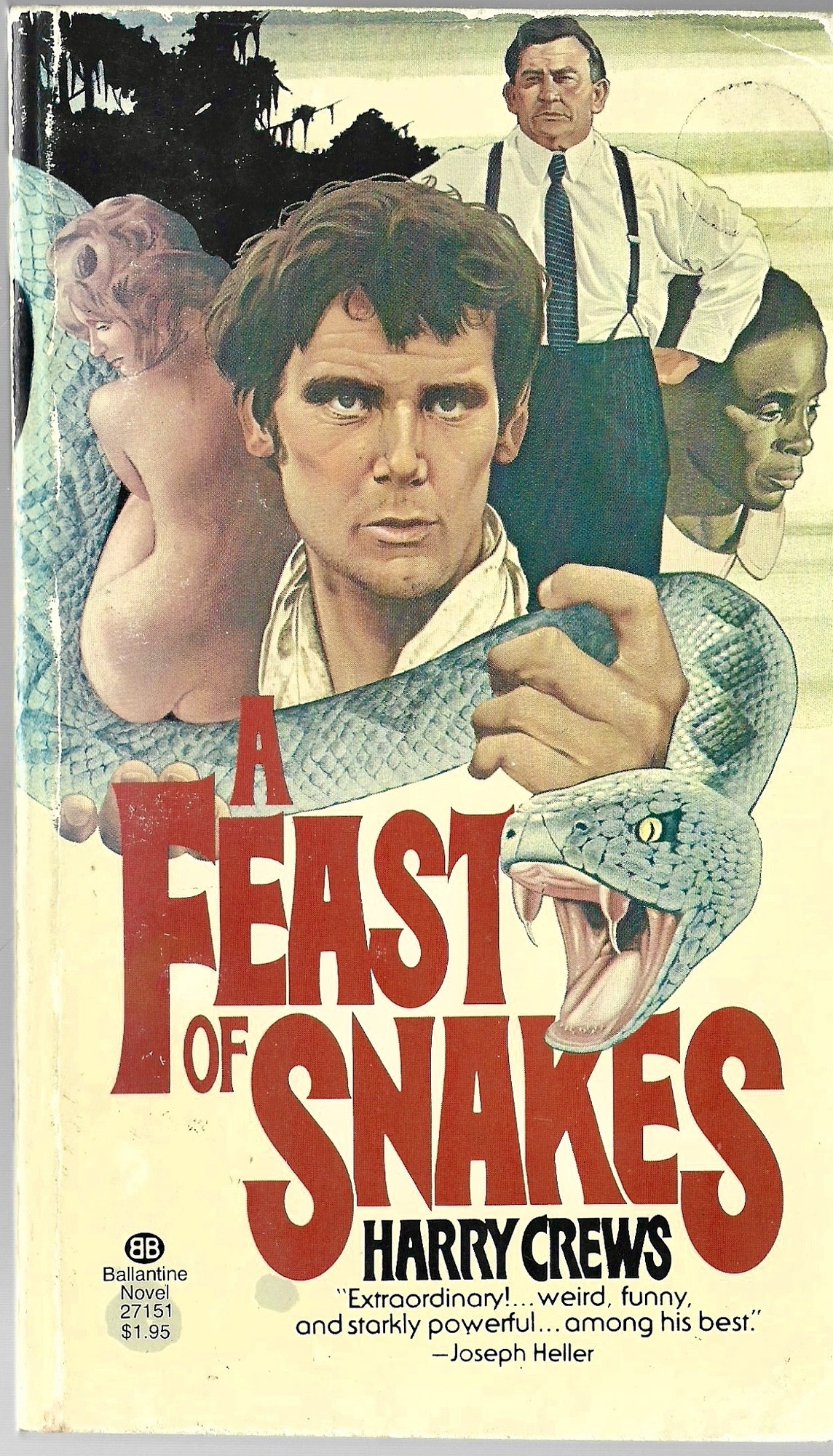
A Feast of Snakes, Harry Crews. Ballantine Books, first edition, first printing (1978). No cover artist credited. 165 pages.
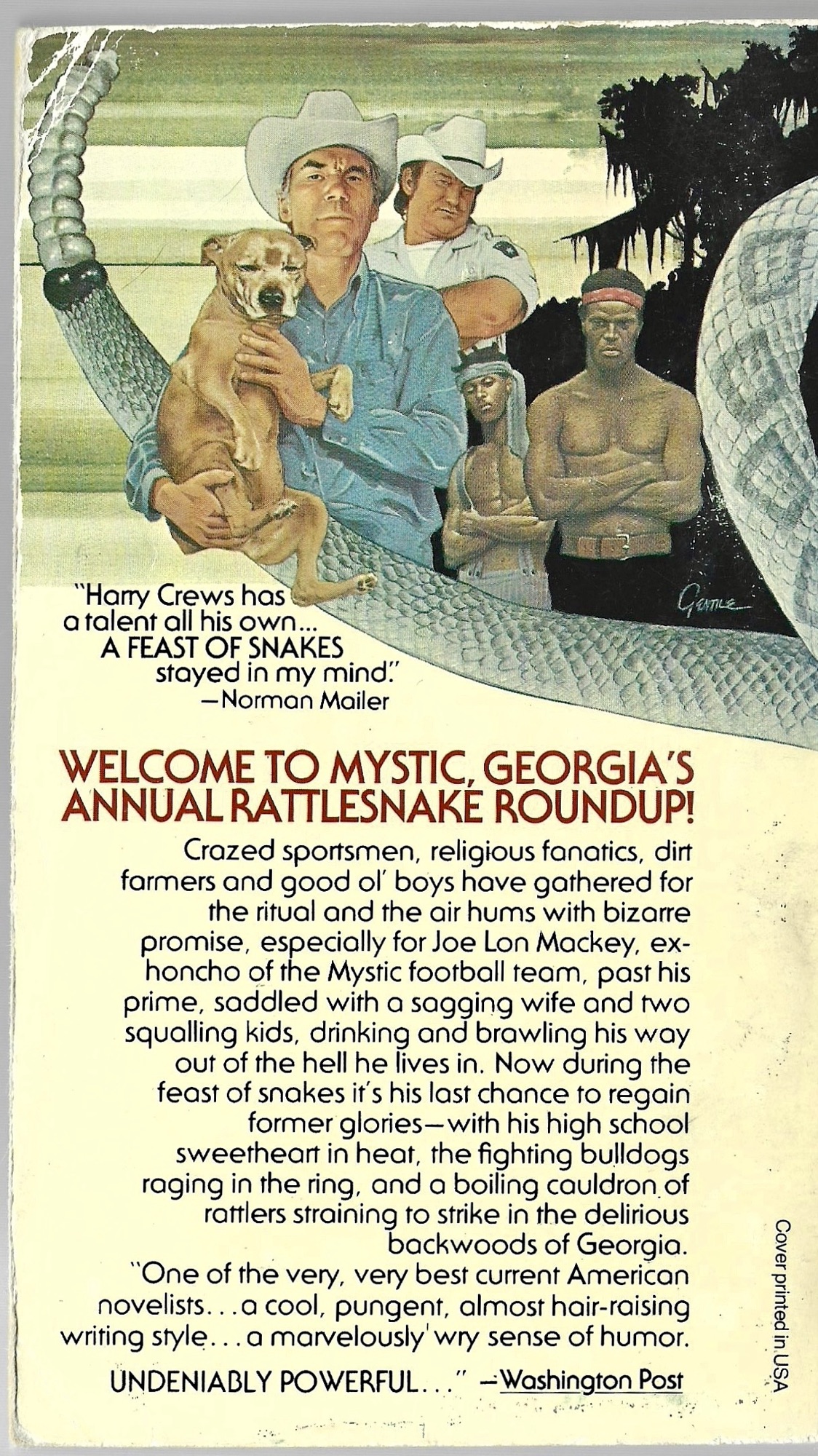
While the cover designer and artist aren’t credited, there is a signature on the back which I believe is “Gentile.” If anyone has a guess as to the artist’s full name I’d be happy to hear it.
From the novel: not quite a recipe for snakes:
When they got to his purple double-wide, Joe Lon skinned snakes in a frenzy. He picked up the snakes by the tails as he dipped them out of the metal drums and swung them around and around his head and then popped them like a cowwhip, which caused their heads to explode. Then he nailed them up on a board in the pen and skinned them out with a pair of wire pliers. Elfie was standing in the door of the trailer behind them with a baby on her hip. Full of beer and fascinated with what Joe Lon could feel—or thought he could—the weight of her gaze on his back while he popped and skinned the snakes. He finally turned and looked at her, pulling his lips back from his teeth in a smile that only shamed him.
He called across the yard to her. “Thought we’d cook up some snake and stuff, darlin, have ourselves a feast.”
Her face brightened in the door and she said: “Course we can, Joe Lon, honey.”
Elfie brought him a pan and Joe Lon cut the snakes into half-inch steaks. Duffy turned to Elfie and said: “My name is Duffy Deeter and this is something fine. Want to tell me how you cook up snakes?”
Elfie smiled, trying not to show her teeth. “It’s lots of ways. Way I do mostly is I soak’m in vinegar about ten minutes, drain’m off good, and sprinkle me a little Looseanner redhot on’m, roll’m in flour, and fry’m is the way I mostly do.”
The early inhabitants of this continent
passed through a valley of ice two miles deep
to get here, passed from creature to creature
eating them, throwing away the small bones
and fornicating under nameless stars
in a waste so cold that diseases couldn’t
live in it. Three hundred million
animals they slaughtered in the space of two centuries,
moving from the Bering isthmus to the core
of squalid Amazonian voodoo, one
murder at a time; and although in the modern hour
the churches’ mouths are smeared with us
and all manner of pleading goes up from our hearts,
I don’t think they thought the dark and terrible
swallowing gullet could be prayed to.
I don’t think they found the smell of baking
amid friends in a warm kitchen anything to be revered.
I think some of them had to chew the food
for the old ones after they’d lost all their teeth,
and that their expressions
were like those we see on the faces
of the victims of traffic accidents today.
I think they threw their spears with a sense of utter loss,
as if they, their weapons, and the enormous animals
they pursued were all going to disappear.
As we can see, they were right. And they were us.
That’s what makes it hard for me now to choose one thing
over all the others; and yet surrounded by the aroma
of this Mexican baking and flowery incense
with the kitchen as yellow as the middle
of the sun, telling your usually smart-mouthed
urchin child about the early inhabitants
of this continent who are dead, I figure
I’ll marry myself to you and take my chances,
stepping onto the rock
which is a whale, the ship which is about to set sail
and sink
in the danger that carries us like a mother.
At Reed, Dunn began work on “Attic,” her first novel, a fictionalization of a stint in a Kansas City jailhouse when she was eighteen and was arrested for trying to cash a fraudulent check.
In “Attic,” Dunn introduced an early version of the sinister magic realism she would later make famous in “Geek Love.” The book’s narrator, K. Dunn, describes a carrousel [sic] in which, to gain entry, young boys have to shoot arrows into their mothers’ vaginas and young girls have to throw hoops over their father’s erections. “If they don’t make it in four tries they can’t ride the merry-go-round so the Mommies spread their legs wider and wider and the Daddies sweat to rub up a good one.” But the book is largely a realist work in which Dunn emphasizes the trauma of her protagonist’s childhood. “Attic” is filled with potent flashbacks about K. Dunn’s mother shaming her, like this one: “. . . she looked at me very closely there and said you’ve been playing with yourself again haven’t you . . . and she said show me show me how you do it and I just lay there and she got angry and she said if a bitch dog did that they’d have to kill her . . . and I couldn’t help it I started to cry . . .” K. Dunn experiences some liberation in prison, where no one cares if she masturbates, but is thrust back into shame after she agrees to pleasure a male benefactor who helps get her out. Some of the book’s best parts read like a neurotic’s guide to prison life, in which Dunn uses what she learned from Thoreau to describe the vagaries of sharing a toilet with a cellmate. “I could piss over her piss but I can’t piss over her shit, much less shit over it and have them mix. It would be terrible if mine came out lighter or darker than hers—you could tell whose they were. Even worse if they were the same.”
Jean-Baptiste Del Amo’s latest novel The Son of Man takes place almost entirely over a three seasons in a dilapidated manor somewhere in rural France, sometime near the end of the 20th century. The plot is deceptively simple: A father returns to his young wife and nine-year-old son after a six-year absence, only to immediately drag them away to his remote childhood home, a place in the mountains called Les Roches. The father desires to refurbish the ancestral manse and restore his family. Complicating matters is the mother’s new pregnancy and frequent migraines and the son’s ambivalence about his relationship with his long-absent father. As the slim novel progresses, the oppressive isolation the mother and son endure tips over into dread and then horror. The Son of Man is ultimately a novel about the atavistic transmission of violence from generation to generation.
Del Amo’s writing, conveyed in Frank Wynne’s limpid translation, is precise and cinematic. Del Amo gives us phenomena and response to that phenomena, but withholds the introspective logic of cause-and-effect or analysis that often dominates novels. Instead, he allows us to see what his characters see and to take from those sights our own interpretations. Consider the following simple passage, where, a few days after arriving at the crumbling old house, the father and mother argue:
The faint voices of the father and mother reach the boy as a confused murmur. He walks to the gable door and looks at the landscape below, at the slow, solemn, hypnotic swaying of the larches and the tall pines on the edge of the forest.
He sees the mother and father standing facing each other.
The mother stands, left hand gripping her right arm, right hand on her hip in a gesture of utter defiance. While the father is speaking, she is shaking her head as though refusing to listen to what he is saying or dismissing his words, while, for his part, the father is nodding in an attempt to convince her or make her see reason.
The father gestures wildly as he speaks, pointing to the house, the grasslands, the mountain peaks that rise into the impassive sky. When he turns towards him, the son suppresses a shudder. Blood drains from his hands, his fingers prickle with pins and needles; if the father sees him standing in the gable window, he might think he has been watching, spying on them, trying to make sense of the words carried on the wind in fits and snatches.
The son cannot fully read the signs and signals in front of him. He’s left with “fits and snatches” and gestures and movements that are, in a certain sense, part of the same material as everything else he can presently behold—the pines, the larches, the wind. And yet the boy intuits in his witnessing an “irrefutable proof of his [own] transgression, perhaps even of his [own] guilt.”
Del Amo conjures a dark, oppressive world where his titular son of man is born into a prelingual state of guilt, a strange inheritance that yields violence. We see much of the novel’s action through the son’s perspective–or not really his perspective, but rather we see the action as through a powerful invisible camera set close to the boy’s head, but never fully inside it. We see the son seeing his mother, whom he loves and understands, in his own way, and seeing his father, who is frightening and likely unknowable:
On the father’s left side, the son notices a scar tracing a line some twenty centimetres long across the skin slantwise towards the shoulder blade, as though the father had been stabbed and the blade had struck a bone and deviated its course. The scar tissue looks smooth, like the skin of a newborn baby or a burn victim.
Spellbound, the boy cannot tear his eyes away, and when the father stops to wipe his forehead with the back of his hand and light a cigarette, he sees the child staring at the scar but says nothing.
The accretion of concrete details coheres into slow burning dread. Del Amo shows us images and gives us details that allow us to infer an explanation for the father’s previous six-year absence that the son cannot yet comprehend. At the same time, we see the father and the mother each moving along separate poles of manic despair. The mother dreams of an impossible escape; the father dreams of an impossible inheritance. The father does not possess the material, tools, or skill to properly restore Les Roches:
He seems to have decided to do battle with this plot of land whose obstructiveness is an affront, to remove anything and everything that would thwart his plan, or to give free rein, with every swing of the pickaxe, to a blind fury for reasons the child cannot fathom. …
He casts a strangely distended shadow, a vision of disproportionate limbs, an evil doppelgänger that emanates from him, dogging his steps, aping his every gesture, every swing of the axe, every throw of a stone, in a way that is monstrous and terrifying.
In time, through hints and implications, we come to understand that the father’s monomaniacal restoration project has resulted from his own terrible childhood. These hints and implications explode late in the book into a fifteen-page monologue from the father, a bitter screed like something out of a Thomas Bernhard novel. The monologue climaxes in the father’s realization that he has repeated his own awful father’s ways. He declares that buried memories are “simply waiting for someone to come and dredge them from their deep torpor, so that they can resurface and endlessly repeat the same failures, the same disasters.”
It’s true that The Son of Man emanates a startling claustrophobic horror. And yet it also glitters at times with moments of strong beauty. If Del Amo’s lucid, cinematic prose evokes something like Kubrick’s The Shining, it also is capable of something like Malick’s Days of Heaven. There are idyllic moments, such as when the boy and his mother bathe in the plunge pool under the weir of a waterfall, the rumbling of which, from a distance, the son had “first thought was the voice of the mountain.” The son also makes his own adventures into the forest, meeting a family of wild horses, one of which is missing an eye.
Through such encounters, the son achieves a brief moment of transcendence late in the novel. His fleeting epiphany balances his father’s bitter declaration that humans are “born with this void inside, this dizzying void they desperately strive to fill throughout their brief, inconsequential, pitiful time in this world, paralyzed as they are by their transience, their own absurdity, their own vanity…” For the father, this “dizzying void” is something that must be filled — “Just like you might try to fill a grave with a shovelful of earth.”
Let us contrast the father’s dizzy void with the son’s epiphany:
He sits far away from the nimbus of soft light that radiates from the house, gazing at the inky vault where fires that existed before the world was world still shine, and feeling the presence of the earth, the vastness beneath him. Dizzily, he thinks of the lives simultaneously played out everywhere across its surface, knowing that somewhere a child is walking barefoot, another is falling asleep in a soft bed, that a dog lies dying in the dust in the shade of a sheet of metal, that a city in some far-flung country is shimmering in the darkness, that innumerable creatures are moving about, animated by this mysterious and insistent force that is life, which courses through each of them.
Puzzlingly, he can also feel the great movement – imperceptible yet vertiginous – that carries everything, including him, through time and space, all lives, human and animal, and with them the rocks, the trees, the blazing stars.
Of these moments, he will retain the memory of an epiphany, of being struck by the true nature of things, which no language, no words can communicate; but what lingers will be little more than the trace of a dream, the sense of something being granted and instantly revoked.
The beauty of the first two paragraphs sinks into the reality of the final paragraph. Epiphanies don’t last; we can catch the memories, maybe, but even then, what was granted was “instantly revoked.” We remain trapped in language, outside “the true nature of things.” Will the son then “endlessly repeat the same failures, the same disasters” as his father (and his father and his father and…)? The novel seems to suggest that this will likely be the case, even if it opens other, more optimistic avenues.
In this light, it’s difficult to interpret the novel’s mythic overture. The first fifteen pages of The Son of Man focus on a troop of prehistoric hunter-gatherers. The episode culminates in a hunt scene in which an adolescent son makes his first kill—a doe—and then seems to be fully initiated by his father, who marks him in the deer’s blood. The overture ends with the son fantasizing about “abandoning the group” and laying down in the humus to be swallowed up by the earth. This is, in a sense, a version of the same fantasy the contemporary son will have in the forest around Les Roches tens of thousands of years later.
It’s unclear how Del Amo would have us read the prehistoric overture. On one hand, it suggests a time of idyllic balance–of humanity in, and not apart from, nature. And on the other hand, it concludes with the same desire to escape civilization that, millennia later, the father will inherit.
Perhaps a second reading of The Son of Man might yield a more conclusive answer, or a second reading of Frank Wynne’s translation of Del Amo’s previous novel, Animalia, a visceral, naturalistic, and very precise rendering of humans as animals that takes on an epic scope. English-only readers interested in Del Amo’s writing couldn’t go wrong with either of these novels, which, unless I’m mistaken, are the only two on the market in English translation. I look forward to reading more of Del Amo’s novels in the future. Until then, I highly recommend The Son of Man.
—The Left Hand of Darkness is amazing. Perfect in its strange imperfections and crammed with fables and myths and misunderstandings, it is the apotheosis of Le Guin’s synthesis of adventure with philosophy. Darkness is about shadows and weight. About pulling weight—literally, figuratively. It’s also the story of an ice planet. (A stranger comes to the ice planet!). It’s a political thriller. It’s a sexual thriller. But the impression that lingers strongest: The Left Hand of Darkness is one of the better literary evocations of friendship (its precarious awful strange wonderful tenuous strength) that I’ve ever read.
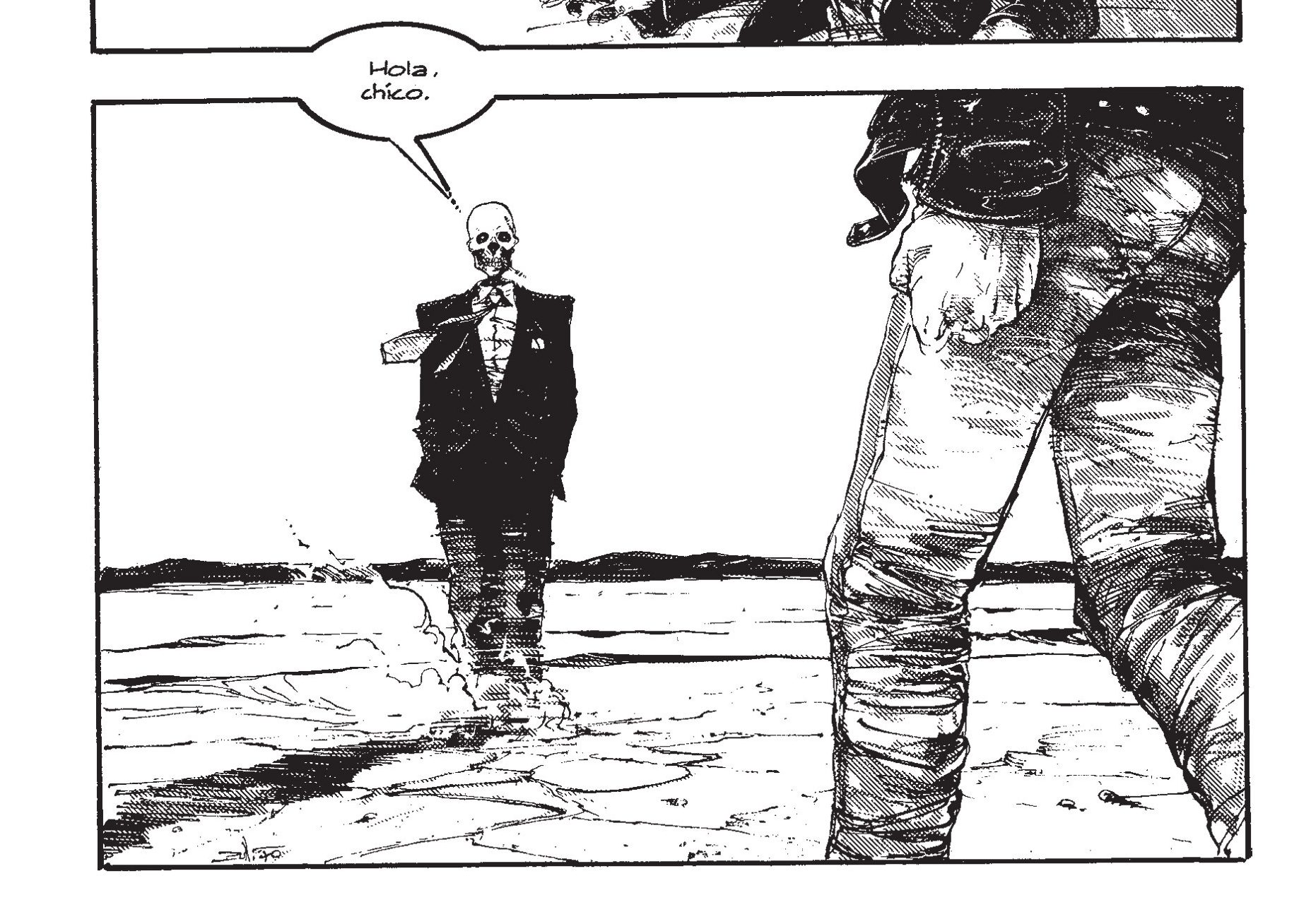
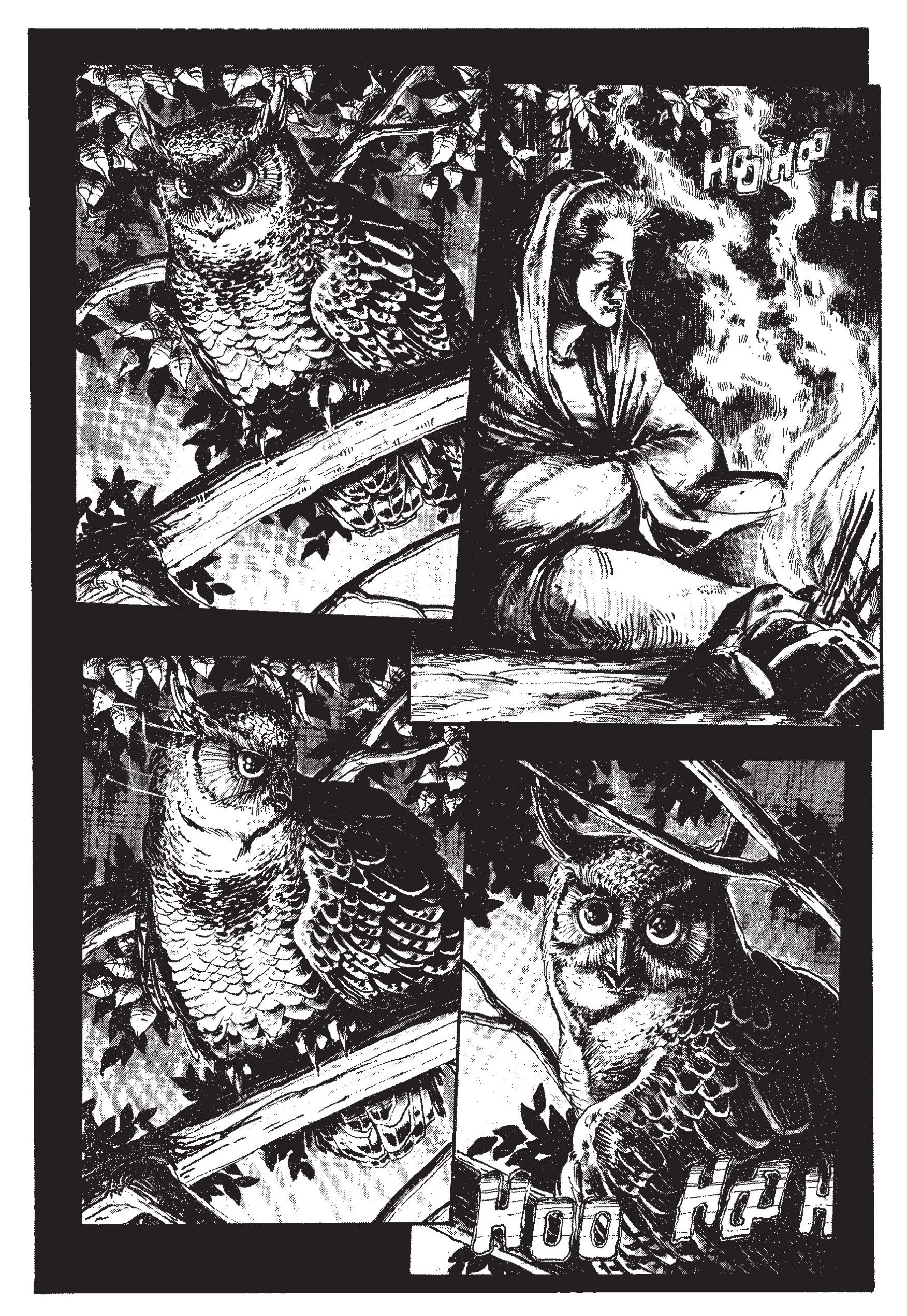
Comics artist Michael Zulli passed away this week at the age of 71. While Zulli was likely most known for his work on Neil Gaiman’s The Sandman comic (as well as an unpublished comic where Swamp Thing meets Jesus Christ), it was his work on The Puma Blues that really sank into my spirit as a kid.
I came to The Puma Blues in the very early nineties via the proselytizing of Dave Sim in Cerebus comics; I managed to a hold of a handful of back issues from very late in the comic’s run. I of course had no idea what was going on, but that didn’t matter. Working from Stephen Murray’s enigmatic script, Zulli crafted a post-apocalyptic dreamscape, an evocation in black and white. His wild animals always seemed more detailed, more pure, more real than the humans who walked through the world he’d conjured in black and white.
I quit regularly visiting comic shops by the mid-nineties, but if I ever happened to be adjacent to one I’d pop in to look for back issues of The Puma Blues (and a handful of other indie titles). It wasn’t until a decade or so later that (with the extralegal help of the internet) I was able to read the entire series. Great stuff—baffling, evocative, Zulli and Murray’s series ran on its own aesthetic logic.
In a 2016 interview at The Comics Journal to mark the publication of a complete volume of The Puma Blues, Zulli spoke on the work as an act of ecological witnessing:
The nature drawings in Puma especially, but so much of the detail in the book feels like an act of witness.
It is. It’s an idea that we’re surrounded in what scientists call the ecosphere, for lack of a better word. It’s this incredibly beautiful and sophisticated system and somehow we think we’re separate from it? I don’t think so. We are not superior to it, we are a part of it and we should take care of it because in doing so we take care of ourselves as a species, too. If not for nature and the earth’s own sake, do it at least for your sake and your children’s sake. That’s all we have got. One day somebody could stop your electricity. What are you going to do? You’re completely unprepared to think about life without your support systems. I don’t mean to be excessively grim. I see a lot of hope. I cling tenaciously to it, but at the same time, Puma is sort of a shot across the bow to wake the fuck up. Take a real good look around you and see what’s really there. Participate in it. Because like it or not you are part of it.
His novitiate was almost completed. Tomorrow he would be confirmed, tomorrow he would achieve that complete mystical union with the Lord, which he had so passionately desired. In his studious youth he had been led to expect it daily; he had hoped to attain it through confession, through talk with those who seemed to have it; through living a purging and a self denial until the earthly fires which troubled him had burned themselves out with time. He passionately desired a surcease and an easing of the appetites and hunger of his blood and flesh, which he had been taught to believe were
harmful: he expected something like sleep, a condition to which he would attain in which those voices in his blood would be stilled. Or rather, chastened. Not to trouble him more, at least: an exalted plane wherein the voices would be lost, sounding fainter and fainter, soon to be but a meaningless echo among the canyons and majestic heights of the glory of God.
But he had not gotten it. After talk with a father in his seminary he could return to his dormitory in a spiritual ecstasy, an emotional state in which his body was but the signboard bearing a flaming message to shake the world. His doubts were then allayed; he had neither doubt nor thought. The end of life was clear: to suffer, to use his blood and bone and flesh as a means for attaining eternal glory—a thing magnificent and astounding, forgetting that history and not the age made Savonarolas and Thomas a Beckets. To be of the chosen despite the hungers and gnawings of flesh, to attain a spiritual union with Infinite, to die—how could physical pleasure toward which his blood cried, be compared with this?
But, once with his fellow candidates, how soon was this forgotten! Their points of view, their callousness, were enigma to him. How could one be of the world and not of the world at the same time? And the dreadful doubt that perhaps he was missing something, that perhaps after all life was only what one could make of his short three score and ten of time, might be true. Who knows? who could know? There was Cardinal Bembo living in Italy in an age like silver, like an imperishable flower, creating a cult of love beyond the flesh, purged of all torturings of flesh. And was not this but an excuse, a palliation for this terrible fearing and doubting? was not the life of that long dead, passionate man such a one as his own: a fabric of fear and doubt and a passionate grasping after something beautiful and fine? Even something beautiful and fine meant to him a Virgin not calm with sorrow and fixed like a watchful benediction in the western sky; but a creature young and slender and helpless and (somehow) hurt, who had been taken by life and toyed with and tortured—a little ivory creature reft of her first born and raising her arms vainly upon a dying evening. In other words, a woman, with all of woman’s passionate grasping for today, for the hour itself; knowing that tomorrow may never come and that today alone signifies, because today alone is hers. They have taken a child and made of her a symbol of man’s old sorrows, he thought; and I too am a child reft of his childhood. Continue reading “Read “The Priest,” a very early short story by William Faulkner”→
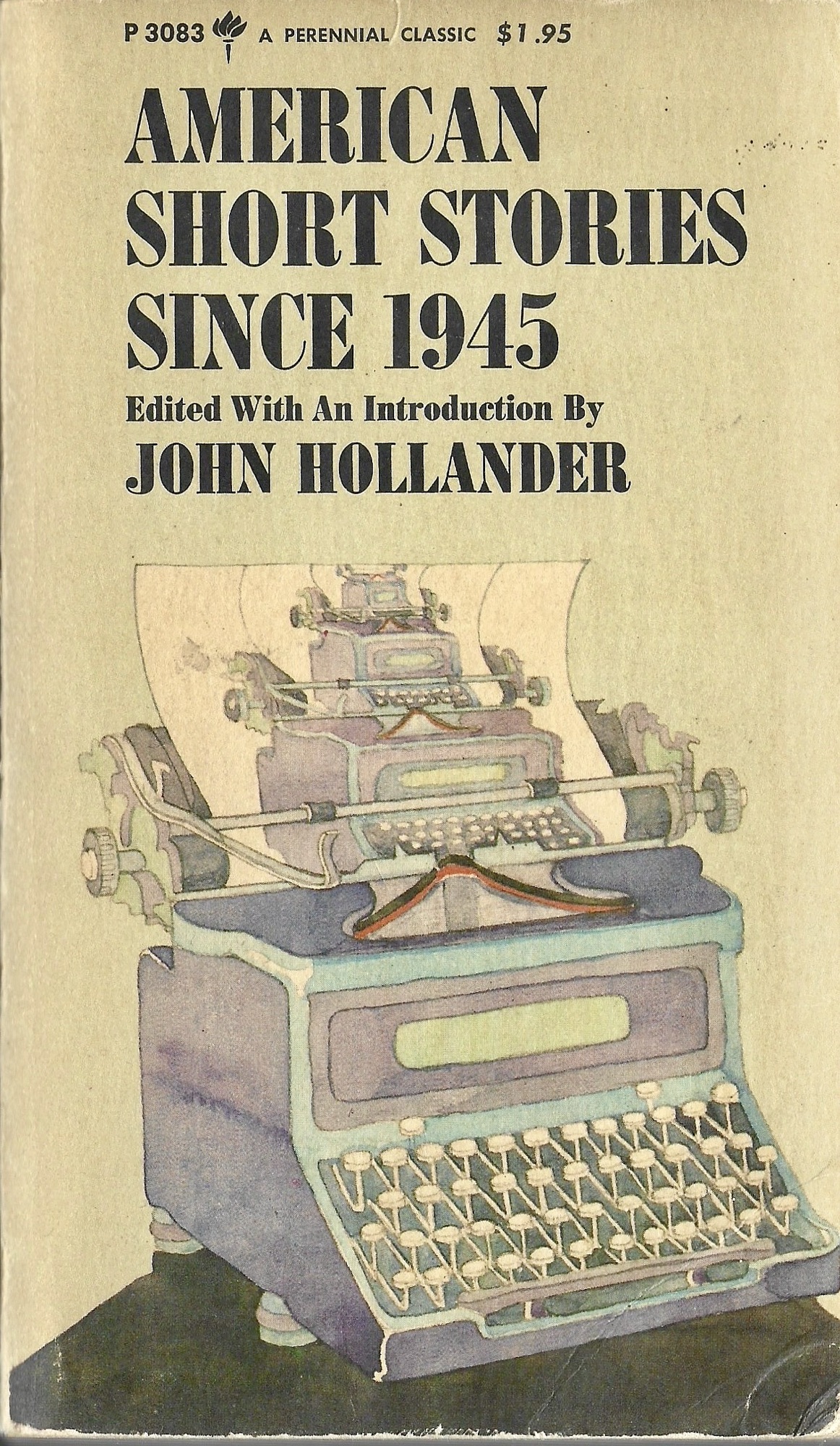
American Short Stories since 1945, edited by John Hollander. Perennial Classics, first edition, 1968. Cover design by Emanuel Schongut. 525 pages.
I think it was the title and the spine that first intrigued me when I pulled American Short Stories since 1945 from the shelf of a used book store: What would the selections be? How many years does the collection span? If Emanuel Schongut’s exquisite cover didn’t sell me on the book (which it did, all two dollars of it!), then the track list on the back certainly would have. And not so much for the authors I’d already read–Gass, Pynchon, Barthelme, O’Connor, Baldwin, and so on—but for the ones I hadn’t heard of, or at least didn’t think I’d heard of. Paul Goodman? Gilbert Rogin? Jeremy Larner? George P. Elliott? The poet who compiled the collection, John Hollander, writes in his introduction that it “aims to show the major shapes taken by shorter fiction in America since the end of World War II.” It’s the sort of book I wish I’d found when I was much, much younger, the kind of mixtape that would have sent me a lot of strange, wonderful directions.
[Editorial note: The following citations come from one-star Amazon reviews J.G. Ballard’s novel Crash. I’ve preserved the reviewers’ original punctuation and spelling. More one-star Amazon reviews.].
Honestly.
massive car wrecks
I like Ballard’s work
nearly killing his wife
I can’t wrap my brain around the idea
I don’t consider myself to be socially conservative, but
Also won’t the police be keeping track of the guy’s driving record?
I find it gross that wounds from these car wrecks would turn women on
talked extensively of the steering column, instrument panel, and bonnet
Contrary to this book’s classification as a social technological fiction,
having sex with any women he can find
and lots of masturbating
messed up fetish
hard to believe
crashing it
unrealistic
gratuitous
assigned reading
required for a college course
hated every twisted minute of it
I wish I could scrub it from my brain
one must debate the author’s motives
“Heavy Groin,” “Scarred Mouth” and “Semen”
an obsession which could only be satisfied by having sex in car
the perverse inner workings of the author, J.G. Ballard’s, mind
automobiles, sex, and death
perverse and sick fantasies
fuel his obsession
so disturbing
Poppycock.
lewd, dark, introvert
driven by his own libido
mind is completely altered
His sexual relations were not sincere
scars and disfigurements
truly fails on all levels
conniving ways
obsessing
obsessive
minions
mangled leftovers
mere marionettes
perverse sexuality
increasingly disturbing
perverse way of thinking
hardly worth a sexual climax
It was written in 1973 and seems to take place in 1973
Just some perverts lobbing semen around car wrecks.
a radical depiction of society’s addiction to technology
It is hard for me to make a connection between cars and sex.
sexual obsession of the body stamped by the technology of the car
What’s the commentary, car wrecks are bad?
savage appetite for car crashes and victims
riddled with atrocious sexual fantasies
hard to follow and digest
void of any substance
surprisingly disgusting
spreading his semen
collision course
Elizabeth Taylor
scars and fantasies
former sports car
invalid car
braces
acid trip
scars and divots
the average reader
It elicits the response it is written to do so.
Read it for class, but would never read again.
Anyone reading this for its erotic content will be as disappointed
I understand books are written to prompt a question, to get somebody thinking. But
on a list of some guy’s “best science fiction” on the internet
Five years ago, I was fortunate enough to interview Margaret Carson about her translation of a collection of the artist Remedios Varo’s written work. Margaret has since expanded on that collection, adding new material from her dive into Varo’s archives, resulting in On Homo rodans and Other Writings, new this summer from Wakefield Press.On Homo rodans and Other Writings offers readers a fascinating trip through Varo’s imagination. Brimming with impossible images, surreal jokes, and dreamy fragments, the work is more than just an addendum to Varo’s career as an artist. I highly recommend it to those interested in surrealist writing in general. Margaret was kind (and patient!) enough to talk with me again over the course of a few weeks via email. I am grateful for her generosity and for her work in bringing Varo’s words to monoglots such as myself.
In addition to her Varo books, Margaret Carson’s translations include Sergio Chejfec’s Baroni, A Journeyand My Two Worlds. She is Associate Professor in the Modern Languages Department at Borough of Manhattan Community College, The City University of New York.
Photograph of Margaret Carson by Beowulf Sheehan.
Biblioklept: Margaret, congratulations on the publication of On Homo rodans and Other Writings, the expanded edition of your English translation of Remedios Varo’s writings! Many of our readers might be familiar with Varo’s wonderful paintings but not know about her writing. How would you characterize the prose collected in On Homo rodans and Other Writings?
Margaret Carson: Thanks, it’s great to have the translation back in print! It’s mainly writings found after Remedios Varo’s death in notebooks and on loose pages. The writings are quite varied: several odd and delightful stories (three of them new to this edition), a fairy tale, letters to friends and strangers, her famous recipe “To Provoke Erotic Dreams,” a poem that invokes the moon, dream narratives, and a few other gems, such as the title piece, “On Homo rodans,” a faux anthropological treatise that accompanied her sculpture of a human-like torso on a giant wheel, made out of chicken, turkey and fish bones.
Homo rodans sculpture in its glass case. Photograph by Margaret Carson.
Varo’s extraordinary creativity and weird sense of humor come across just as much in her writings as in her paintings. I think readers fascinated by Varo, the artist, will also be won over by her gifts as a writer. Simply put, she’s as clever a writer as she is a painter.
Biblioklept: So, let’s get into the stories and other material new to this edition and how you came to translate it into English. Some of this material hasn’t been published before, even in Spanish. If my understanding is correct, Walter Gruen, Varo’s last life partner, donated a significant collection of her works to the Museo de Arte Moderno in Mexico City in 2000. In 2018—after the publication of your translated collection Letters, Dreams & Other Writings—the Varo estate bequeathed more of Varo’s writings to the Museo de Arte Moderno. Is that right?
MC: Yes. In the early 2000s Walter Gruen and his wife Anna Alexandra Varsoviano (a friend of Varo’s who he married after the artist’s death) donated about thirty-eight of her works to the Museo de Arte Moderno (MAM), making it the largest repository of paintings by Varo in the world. Walter Gruen died in 2008, and Anna Alexandra Varsoviano in 2015. (I was lucky enough to meet them both in person: Walter Gruen in 2000 and Anna Alexandra Varsoviano some years later.) In her will, Anna Alexandra bequeathed a trove of Varo’s notebooks, letters, preparatory drawings, photos, and other items to MAM, many of which were displayed in 2018 in an exhibition celebrating the donation: Adictos A Remedios Varo: Nuevo Legado 2018. It was at that exhibition that I first saw Varo’s notebooks, open to pages containing narratives, letters and other pieces, in Varo’s own handwriting. I could instantly recognize them because I’d translated the same texts for Letters, Dreams and Other Writings, except for that book I used a collection of Varo’s writings published in Mexico in the 1990s, Cartas, sueños y otros textos, edited by the Spanish scholar Isabel Castells.
Because the new Wakefield edition mostly uses archival materials as its source, and isn’t a direct translation of texts from an existing book, the estate requested that we give it a new title. So, thinking about Varo’s tour-de-force anthropological spoof, we renamed it On Homo rodans and Other Writings.
A page from the Homo rodans manuscript. Photograph by Margaret Carson.
Biblioklept: What kind of access did the museum give you to the manuscript materials?
MC: When I requested an appointment to consult the archive at MAM, I indicated my area of interest: Varo’s notebooks and any stray papers relating to her writings. So when I visited for a few days in July 2022, an archivist assisted me by bringing out her notebooks one at a time as well as folders containing loose papers. You can’t imagine how excited I was not only to see but to touch these old, faded composition books and to turn their pages to discover what Varo had written or drawn on them. There are about a dozen notebooks in all, mostly school composition books for children. I was snapping photos right and left! I’m very grateful to the Museo and to their archivists for guiding me through the notebooks and for their interest in the project.
Cover of one of Varo’s notebooks. Photograph by Margaret Carson.
Biblioklept: Varo was born in Spain, and her painting career sparked in earnest in France, but she really flourished as a painter in Mexico. Her work seems to find a growing audience in the USA; do you have a sense of her reputation in Mexico?
MC: Remedios Varo came into her own as an artist in Mexico City; when she began to exhibit, she was an immediate success. Her first solo show, in 1956 at the Galería Diana, was a sell-out, as was a subsequent solo show in 1961. Sadly, Varo suddenly died in 1963. Her posthumous reputation is in large part due to Walter Gruen and his efforts to keep her in the public eye. The first catalog of her work, whose publication was overseen by Gruen and funded by Varo’s friend and patron Eva Sulzer, came out just three years after her death, in 1966, with contributions by some heavy hitters: the poet Octavio Paz, the French intellectual Roger Caillois, and the Mexican philosopher Juliana González, a personal friend of Varo’s. Since then, four editions of Varo’s catalogue raisonné have been published in Mexico, the last in 2008. (Alas, all are now out of print but available in many research libraries.) People are deeply fascinated by Varo’s paintings. Special exhibitions of her work at the Museo de Arte Moderno always draw record crowds (as they do in other cities as well, for example, the recent Remedios Varo: Science Fictions exhibition in Chicago, which was one of their best attended shows ever).
Biblioklept: Gruen seems to have led a fascinating life.
MC: Yes, but not without its tragedies. The little I know comes from Janet Kaplan’s biography of Varo, his obituary in the Mexican daily La Jornada, and from the Adictos a Remedios Varo catalog. Like Varo, he was fortunate to get out of war-torn Europe, but only after he experienced the worst. He was born in Austria, started medical school in the 1930s, got kicked out because he was Jewish, was arrested by the Gestapo and sent to Dachau and then Buchenwald. After liberation, he made his way to Mexico City with his wife Klari Willner and it was there that he met Varo and others in the European refugee community. His wife died in Mexico in a drowning accident in the late 1940s, while Varo was living in Venezuela. It was some time after Varo’s return to Mexico that she and Gruen got together. Gruen had established his record store by then, the Sala Margolín, which for decades was the essential go-to place for classical music fans in Mexico City.
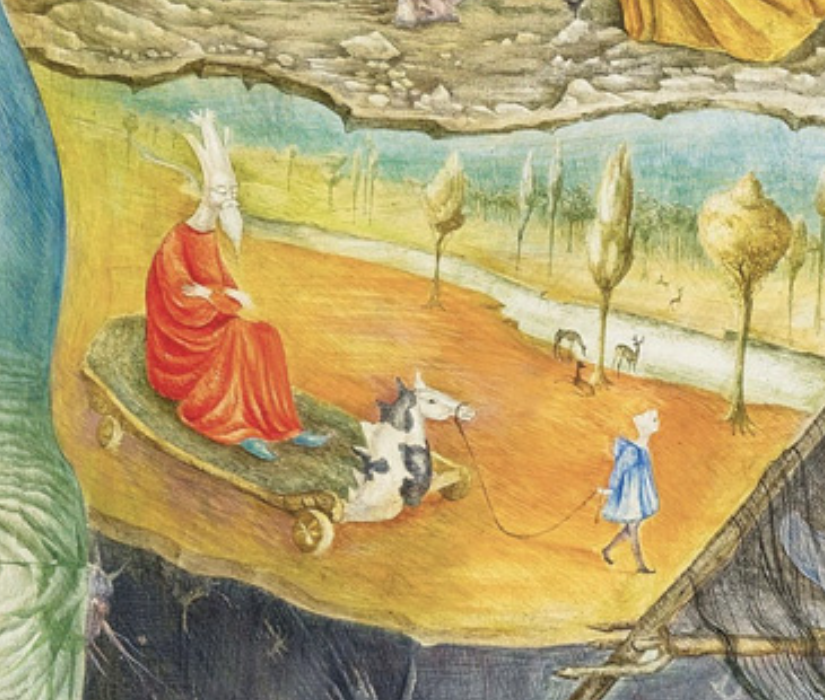
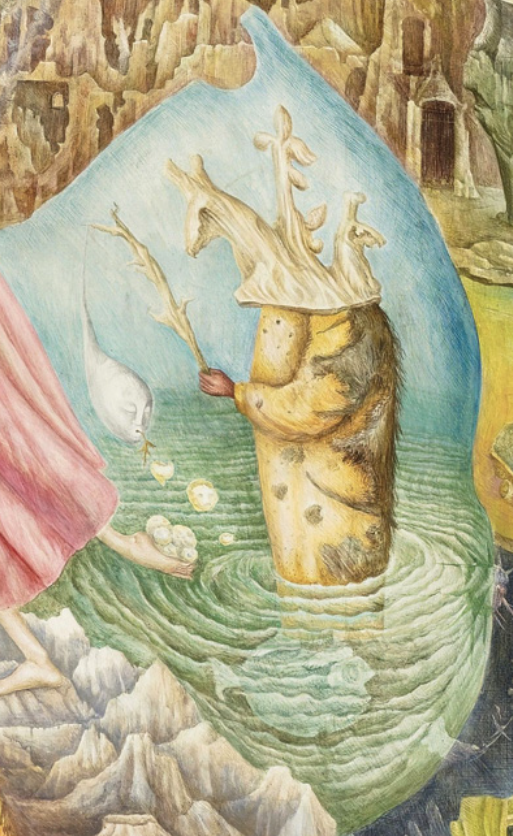
A year after Varo’s death, in 1964, Gruen organized an exhibition of her work at the Palacio de Bellas Artes, and it’s at that show that Thomas Pynchon, on a trip to Mexico City, saw Embroidering the Earth’s Mantle /Bordando el manto terrestre, which was immortalized in the novel The Crying of Lot 49. Together with Anna Alexandra Varsoviano, Gruen worked to secure Varo’s legacy as an artist and to safeguard what she left behind. From the perspective of Varo’s writings, it was crucial that her notebooks and papers remain as a single cache of documents and not dispersed. After Varsoviano’s death, the entire archive including this collection of writings passed to the Museo de Arte Moderno.
Embroidering the Earth’s Mantle, 1961, Remedios Varo
Biblioklept: This new edition of Varo’s writings includes three stories that were previously unpublished, even in Spanish. Do you know why they weren’t published before now?
MC: No, I don’t know why. The stories are unquestionably in Varo’s handwriting, and they’re marvelous. It would be a good question to ask Walter Gruen or Anna Alexandra.
Biblioklept: Speaking of her handwriting—did you revise any of the material you’d already translated after seeing it in her manuscript?
MC: To some extent, yes. As I mentioned before, for Letters, Dreams …. (2018), I used as my source text a collection that had already been published in Mexico. As I was translating, I’d occasionally come across bracketed ellipses [. . .], and I wasn’t sure what was being signaled. Had a word or sentence in the original been cut, or was it illegible at that point? I found no editorial explanation, so I simply carried over the bracketed ellipses into the English.
In preparing this new edition, I made sure to look for those same bracketed passages in the manuscripts to see if I could discover what Varo had actually written. I found some wonderful things. All the ellipses in the Mistress Thrompston story, for example, were places where Varo had drawn weird mathematical formulas meant to be read as proper names. So now, instead of “[. . .] Magazine,” you’ll see that its name is “WTrons – X√yl Magazine.” The Marquis of Ornitobello’s daughter, whose name had been dropped completely, returns to the story: she’s called √Ax8. These are the little touches where you see Varo being Varo. She loved playing with math. In Disobedient Plant/Planta insumisashe even painted mathematical formulas into the hair of the scientist and into the tendrils of the plants. Happily, Wakefield Press was able to incorporate Varo’s mathematical doodles and other hand-drawn whimsies into the published book.
Disobedient Plant, 1958, Remedios Varo
Another kind of revision I made after seeing the manuscripts may seem trivial, but in all instances Varo wrote “etc.” not “et cetera,” so I restored “etc.” And in “On Homo rodans” she used the ligature “æ” in her invented Latin, so I restored that as well.
Something that surprised me on reading the original manuscripts was that Varo often wrote super-long sentences—what writing instructors would call “comma splices” or “run-ons.” I initially wanted to restore these sentences to their original length because in their raw state there’s a kind of fast-forward momentum. You get pulled along as she adds one thing after another to her narratives, almost breathlessly. But in the end, for the sake of readability, I normalized the punctuation a bit by breaking up some of the enormously long sentences.
There were maybe only one or two times when I changed the translation of a word after seeing that Varo had written something different from what the editor of the previous volume had transcribed. Nothing major. Of course, like all translators, I’m an obsessive reviser, so in preparing this new edition I couldn’t help but look over the previous translation to polish and tweak. I didn’t need the manuscripts for that. As they say, a translation is never finished….
Biblioklept: I’m curious if your “editor’s voice” clashed at all with your “translator’s voice” when it came to revising Varo’s comma splices and fused sentences. And were there clashes elsewhere, when it came to, say, new word choices?
MC: Hmm, I haven’t thought of the two roles clashing before. I think we worked pretty harmoniously together. The editor would have probably liked more time to revise the introduction and endnotes, and to think about the best way to order the texts within the book, while the translator, eager to get the translation back into print, was more like, “Let’s wrap up!”
Biblioklept: One section new to this edition are a handful of brief poemish texts collected as “Images in Words.” A few of these word-image-poem-texts (?!) contain strikethroughs and doodles, as you mentioned before. Many of these pieces feature phrases that correspond to motifs we see in Varo’s visual art (trees, pulleys, stars, knitters, etc.). To your knowledge, do these image fragments correspond to any of Varo’s paintings? Do you have a sense that these were “plans” for paintings–pieces of visual art that started in language first?
MC: It’s difficult to know with any certainty, but they do seem like plans for paintings that started off in language first. They could be Varo’s earliest ideas: flashes of images, possibly from dreams, that she developed as preliminary drawings and eventually, fully fleshed out in paintings.
When Varo was once asked if she was a writer as well as a painter, she replied, “I sometimes write as if I were making a sketch” (“A veces escribo como si trazase un boceto”).A lot has been made of that one sentence because it’s the only time we know of that Varo speaks of her writing. I used to think she was very modestly describing her writing as a whole, including her creative writing, but now I believe she was referring specifically to these poem-like fragments, these sketches in words. When an idea came to her, I imagine her grabbing her notebook and opening it to a blank page, sometimes to make a quick sketch, other times to jot down a few words. Sometimes she did both on the same page.
Do the fragments correspond to any paintings? Yes, if you’re familiar with her work, you can immediately make connections. For example, from the bottom of p. 131:
character from peeling wall participating in something with another character who is real
Metamorphosis
Mimicry
The abandoned room, someone inside the table, inside the armchair
as well, perhaps inside the wall — — — —
The first two lines seem to describe the painting Harmony / Armonía, in which there’s an ethereal figure emerging from a peeled-back wall to play with an object on a musical staff (a snail?). The other “real” character sits at a table across from the apparition and plays with a polyhedron-like object on the staff. Why did Varo cross the lines out? Walter Gruen speculated that it was because she had finished the painting.
Harmony, 1956, Remedios Varo
The next two lines refer to the well-known painting Mimesis / Mimetismo, in which she depicts a woman undergoing a metamorphosis – she’s taking on the characteristics of the chair she’s sitting in. (Side note: Varo’s catalogue raisonné translates the title of this painting as Mimesis, which isn’t wrong, but it makes me think more of the Erich Auerbach book and literary mimesis. I believe a better English translation would be “Mimicry,” as in insect mimicry, a phenomenon of particular interest to the surrealists. See Roger Caillois’s 1935 essay “Mimétisme et psychasthénie légendaire,” in the surrealist journal Minotaure).
They represent just one moment in the evolution of an artist’s idea. It’s said that Varo was very private in her studio practice. No one knows for sure, but it’s likely she used her notebooks (which also doubled as sketchbooks) at the earliest stages of a painting, when her ideas were hatching.
Biblioklept: Can you expand on how Varo was private in the studio?
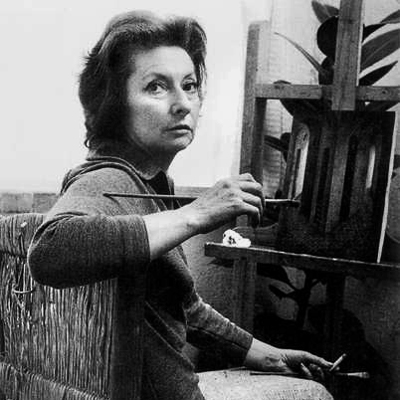
MC: I can only talk about her studio in a limited way, from clues provided in photos and in a few accounts. I also talked a bit about Varo’s apartment-studio with Xabier Lizarraga Cruchaga, her godson, who as a boy used to visit Varo in her studio quite often (so she didn’t completely exclude visitors). Her studio was a room on the top floor of the building she lived in, accessible by a private flight of stairs. A wide doorway in the studio opened to a small, north-facing terrace where she kept plenty of plants. You can see the studio in a series of photos Kati Horna took of Varo for a magazine article that appeared in 1960. In the article, two photos show Varo at work, one at a drafting table and the other at her easel. The painting on the easel is Farewell /La despedida, with only the architectural elements of the painting in place (she would later add the departing lovers, their shadows, and the cat that looks on). Observe the white lump on the left side of the easel. That’s a piece of quartz. She apparently used quartz to incise fine lines into her paintings to expose the gesso underneath. Quartz comes up a few times in her writings as well. Let’s say she had an affinity for quartz and its mysterious qualities.
She also mentions her studio in one of her dream narratives, which begins like this:
“I dreamed I was asleep in my bedroom and a loud noise woke me up. The noise came from upstairs, from the studio, and it was as if someone were dragging a chair. I thought that this meant someone was trying to get in from the terrace and was pushing the armchair that was against the door.” (p. 100)
She goes on to narrate a terrifying dream, but note that she’s indirectly giving the basic layout of her apartment-studio.
As to her practices while at work in her studio, more and more is being written in English. In fact, for the first time ever, an in-depth investigation of her paintings by art conservators was done in connection with the recent Remedios Varo: Science Fictionsexhibition at the Art institute of Chicago. For an excellent overview of Varo’s approaches as an artist, and for descriptions of some of her techniques, check out this blog post by members of the AIC curatorial team.
Biblioklept: Varo didn’t strongly pursue exhibiting her art, and she didn’t publish any of her writing in her lifetime, right? Why do you think that was?
MC About her artwork, that’s not true. Varo was totally out there as an artist and very much interested throughout her career in exhibiting her work. As an emerging artist in the 1930s, she didn’t sit back and wait for things to happen. In the 1930s she moves to Barcelona, the home of the avant-garde in Spain, and joins artists who were radically breaking with whatever the conventions were back then. She’s on the map as an artist of note as early as 1936, when her paintings are included in the landmark Exposició Logicofobista in Barcelona. Later, after the Spanish Civil War breaks out and she moves to Paris, she’s in the 1938 Exposition Internationale du Surréalisme and images of her work are published in important Surrealist journals such as Minotaure and Trajectoire du rêve. After the Nazi invasion of France, she flees Europe for Mexico City in 1941 and there’s a pause in her exhibitions (she turned to commercial art to make a living) until 1955, when she exhibits new paintings in a group show of women artists that includes Leonora Carrington and Alice Rahon.
Announcement for “Seis pintoras.” Photograph by Margaret Carson.
This is Varo’s breakthrough show in Mexico City. The following year she is offered her first solo show, which is a great success, leading to new commissions and to (among other things) the magazine article I mentioned above with photos by Kati Horna. In no way did she have a secret life as a painter.
Remedios Varo Wearing a Mask by Leonora Carrington, 1957. Photograph by Kati Horna.
We don’t know as much about her ambitions as a writer, but she wasn’t secretive about that, either. She definitely collaborated with Leonora Carrington on some writings—for example, they have a collaborative play, El santo cuerpo grasoso, not translated yet into English. In this new edition there’s Varo’s part of what I believe was an exquisite corpse novel written with Carrington. Another “public” writing is the title piece of the collection, On Homo rodans. It’s a handwritten manuscript that was never published in the marketplace sense of the word. But Varo certainly intended for others to read it, if only a small audience of friends. (After her death On Homo rodans would be published in a small facsimile edition of 250 copies, put out by a small press in Mexico City in 1970.)
The surprise is that Varo’s excellence as a writer and storyteller still goes unmentioned. It’s a small body of writings, but some of these stories are remarkable. For example, the first three: “In a field in the state of Morelos…,” “Dear friend, I believe it’s necessary to tell you…” “One day when Maria was coming back from school…” (They have no titles, so they’re identified by their opening lines.) I was astounded, amused, captivated when I first read them….talk about the pleasures of the text! Who knew she was such a talented writer? I’m hoping that people who are passionate about Varo, the artist, will be curious about her writings and will find some powerful connections there to her art—and that they’ll also stay with her for her writing alone.
A calendar is a necrology, in the parlance, though the ornament of the seventeenth century—as here: various monstrosities arrayed in the bottom margin—may suggest otherwise. Stated more plainly: earlier versions perform the slaughter in a courtly manner, in red letters, these resembling a pattern of stains on the skin—or so one annotation explains it, alert to the keenest features of certain medieval diseases. The feasts appear on the left side, and the saints on the right. The Egyptian days are thought unlucky. In the statute book: a month is twenty-eight days, but sometimes fewer, each week shortened in accordance with the mourning period, for which the days are renamed—and later replaced with daggers. The renderings of the death scenes, centuries hence—a drowning chair, its legs splendidly embellished; a gallows imagined as a velvet hat—must await a less cursory interpretation. The gentleman, in any event, survives ninety days in his sickbed, trembling at the center of the room. But the insects are quite tranquil in disposition, while—elsewhere in the house—a blade attends to an untoward portion of mutton. In the child’s calendar: some pages display only four days—the four corners, as it were, of a boy’s disappointment—each square fashioned as a polite little room, within which the villain has hidden your possessions: hats, garments, shoes. And now the child’s device, a red X, blots out the line—just as the stock collar, his father’s, obscures the most prominent lesions and scars. No doubt the comparison is too extravagant—and yet the postscript explains the afternoon as a pane of glass, or as ashes in the hands of the family. They stand on the front lawn—not long ago the scene of a strangling—and then repair to the gallery, where the celebration begins, per tradition, at three o’clock: a choice of soups—brown or white—followed by cod’s head and buttered turnips, and then a cake of some considerable distinction.
Detail from Night float: alternative sequence for witches, 2023 by Michael McGrath









 Biblioklept