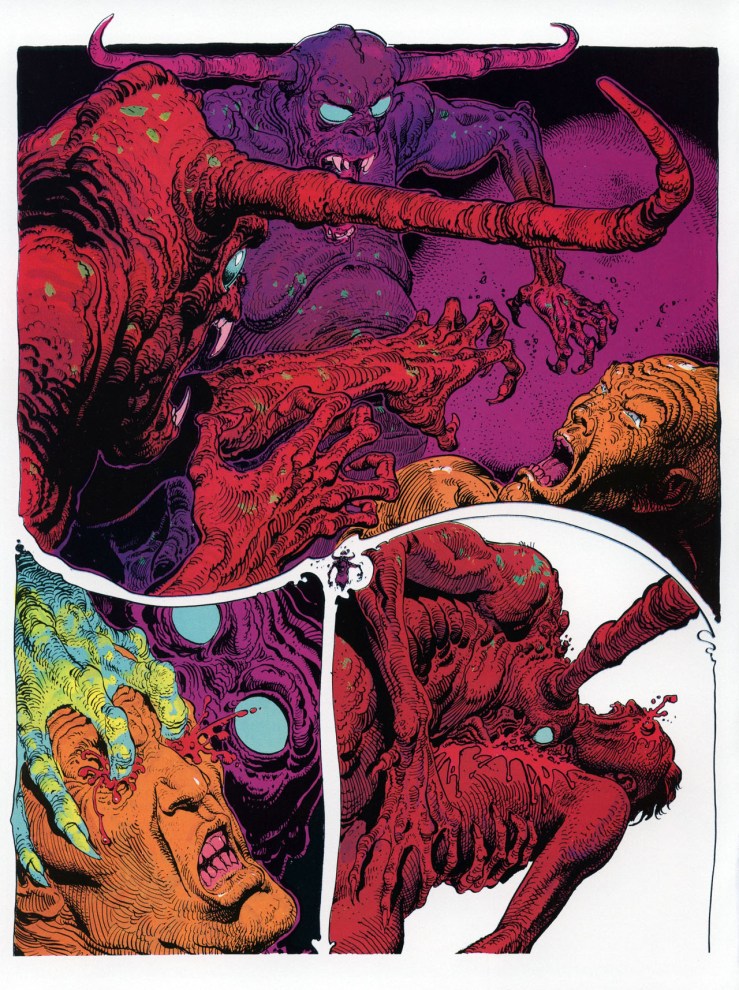
Untitled (From Approaching Centauri) — Moebius

A page from Approaching Centauri by Moebius (Jean Giraud, 1938–2012)

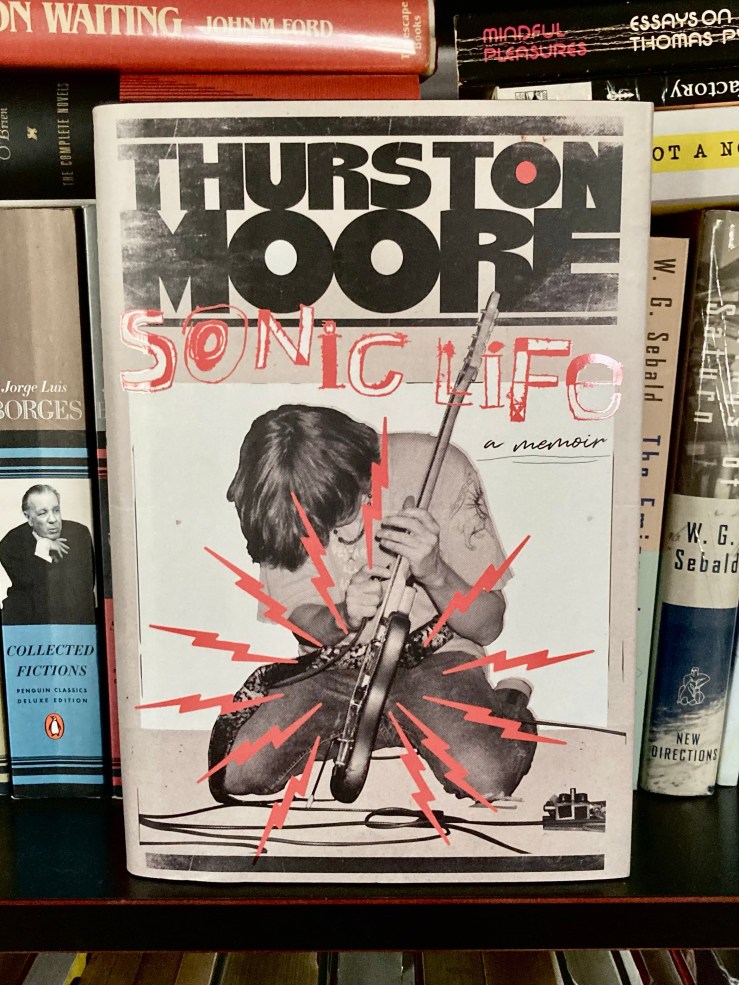
Thurston Moore’s memoir Sonic Life (Book acquired, 27 Oct. 2023)

I picked up Thurston Moore’s mammoth memoir Sonic Life yesterday afternoon, started reading it, and kept reading it. I was a huge Sonic Youth fan in my youth, introduced to the band in 1991 via a decent soundtrack to a mediocre film called Pump Up the Volume. Throughout the nineties and early 2000s, I bought all the Sonic Youth records I could get my hands on, and repeatedly watched their 1991 tour diary film The Year Punk Broke more times than I could count. Thurston Moore was a goofy avant hipster, ebullient, verbose, annoying, and endearing, the nexus of a band that were themselves a nexus of nascent bands and artists. (In his chapter on Sonic Youth in his 2001 history Our Band Could Be Your Life, Michael Azerrad repeatedly argues that DGC Records signed the band so that they would reel in the indie groups that majors wanted so badly after Nirvana et al. exploded.) When Thurston Moore and his wife and bandmate Kim Gordon separated in 2011, essentially ending Sonic Youth, I recall being strangely emotionally impacted, like my punk god parents were getting divorced. While I didn’t expect or want dishy answers from Gordon’s 2015 memoir Girl in a Band, I was still disappointed in the book, finding it cold and ultimately dull. So far, Moore’s memoir is richer, denser, sprawls more. It’s written in an electric rapid fire style loaded with phrasing that wouldn’t be out of place in the lyrics of an old SY track. I ended up reading the first 150 or so of the pages last night and this morning, soaking up Moore’s detailed account of the end of the New York punk rock scene and the subsequent birth of  No Wave. Moore’s intense love of music is what comes through most strongly. Chapter titles take their names from song titles or song lyrics, and I’ve started to put together a playlist, which I’ll add to as I read:


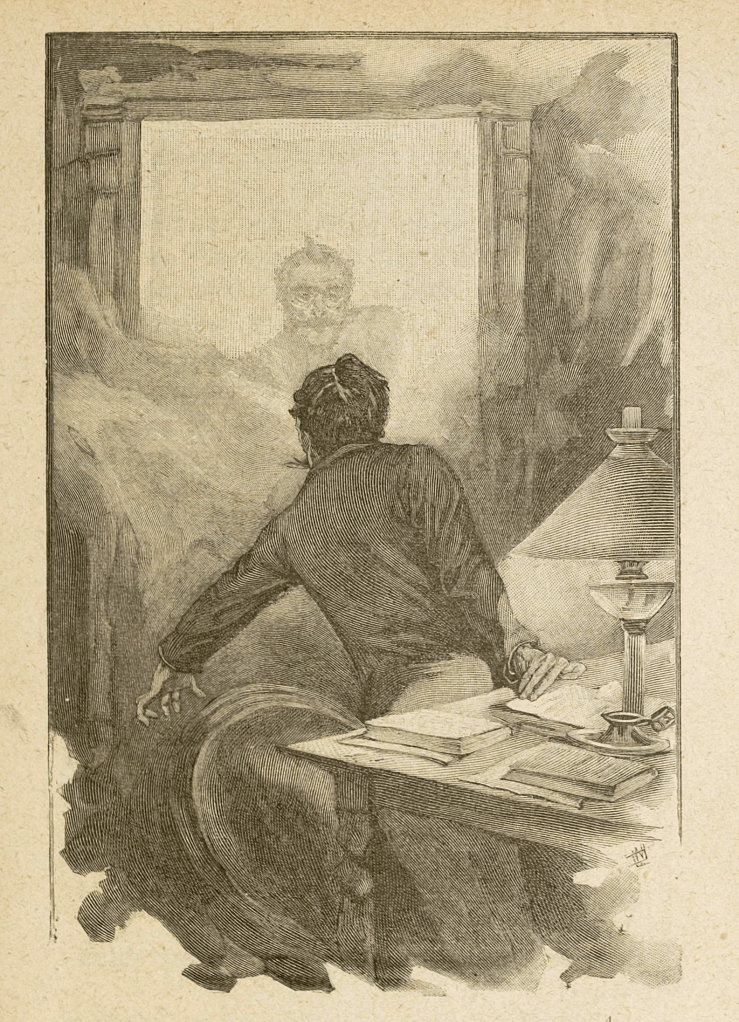
Read “The Horla,” a psychological horror story by Guy de Maupassant

Illustration of Maupassant’s short story, “The Horla.” Wood engraving by Georges Lemoine after a drawing by William Julian-Damazy (1865-1910).

“The Horla”

by

Guy de Maupassant

Published in English in A Selection from the Writings of Guy de Maupassant

The volume includes a critical preface by Paul Bourge and an introduction by Robert Arnot, but fails to credit a translator.


May 8. What a lovely day! I have spent all the morning lying on the grass in front of my house, under the enormous plantain tree which covers and shades and shelters the whole of it. I like this part of the country; I am fond of living here because I am attached to it by deep roots, the profound and delicate roots which attach a man to the soil on which his ancestors were born and died, to their traditions, their usages, their food, the local expressions, the peculiar language of the peasants, the smell of the soil, the hamlets, and to the atmosphere itself.

I love the house in which I grew up. From my windows I can see the Seine, which flows by the side of my garden, on the other side of the road, almost through my grounds, the great and wide Seine, which goes to Rouen and Havre, and which is covered with boats passing to and fro.

On the left, down yonder, lies Rouen, populous Rouen with its blue roofs massing under pointed, Gothic towers. Innumerable are they, delicate or broad, dominated by the spire of the cathedral, full of bells which sound through the blue air on fine mornings, sending their sweet and distant iron clang to me, their metallic sounds, now stronger and now weaker, according as the wind is strong or light.

What a delicious morning it was! About eleven o’clock, a long line of boats drawn by a steam-tug, as big a fly, and which scarcely puffed while emitting its thick smoke, passed my gate.

After two English schooners, whose red flags fluttered toward the sky, there came a magnificent Brazilian three-master; it was perfectly white and wonderfully clean and shining. I saluted it, I hardly know why, except that the sight of the vessel gave me great pleasure.

May 12. I have had a slight feverish attack for the last few days, and I feel ill, or rather I feel low-spirited.

Whence come those mysterious influences which change our happiness into discouragement, and our self-confidence into diffidence? One might almost say that the air, the invisible air, is full of unknowable Forces, whose mysterious presence we have to endure. I wake up in the best of spirits, with an inclination to sing in my heart. Why? I go down by the side of the water, and suddenly, after walking a short distance, I return home wretched, as if some misfortune were awaiting me there. Why? Is it a cold shiver which, passing over my skin, has upset my nerves and given me a fit of low spirits? Is it the form of the clouds, or the tints of the sky, or the colors of the surrounding objects which are so change-able, which have troubled my thoughts as they passed before my eyes? Who can tell? Everything that surrounds us, everything that we see without looking at it, everything that we touch without knowing it, everything that we handle without feeling it, everything that we meet without clearly distinguishing it, has a rapid, surprising, and inexplicable effect upon us and upon our organs, and through them on our ideas and on our being itself.

How profound that mystery of the Invisible is! We cannot fathom it with our miserable senses: our eyes are unable to perceive what is either too small or too great, too near to or too far from us; we can see neither the inhabitants of a star nor of a drop of water; our ears deceive us, for they transmit to us the vibrations of the air in sonorous notes. Our senses are fairies who work the miracle of changing that movement into noise, and by that metamorphosis give birth to music, which makes the mute agitation of nature a harmony. So with our sense of smell, which is weaker than that of a dog, and so with our sense of taste, which can scarcely distinguish the age of a wine!

Oh! If we only had other organs which could work other miracles in our favor, what a number of fresh things we might discover around us!

May 16. I am ill, decidedly! I was so well last month! I am feverish, horribly feverish, or rather I am in a state of feverish enervation, which makes my mind suffer as much as my body. I have without ceasing the horrible sensation of some danger threatening me, the apprehension of some coming misfortune or of approaching death, a presentiment which is no doubt, an attack of some illness still unnamed, which germinates in the flesh and in the blood.

May 18. I have just come from consulting my medical man, for I can no longer get any sleep. He found that my pulse was high, my eyes dilated, my nerves highly strung, but no alarming symptoms. I must have a course of shower baths and of bromide of potassium.

May 25. No change! My state is really very peculiar. As the evening comes on, an incomprehensible feeling of disquietude seizes me, just as if night concealed some terrible menace toward me. I dine quickly, and then try to read, but I do not understand the words, and can scarcely distinguish the letters. Then I walk up and down my drawing-room, oppressed by a feeling of confused and irresistible fear, a fear of sleep and a fear of my bed. Continue reading “Read “The Horla,” a psychological horror story by Guy de Maupassant”

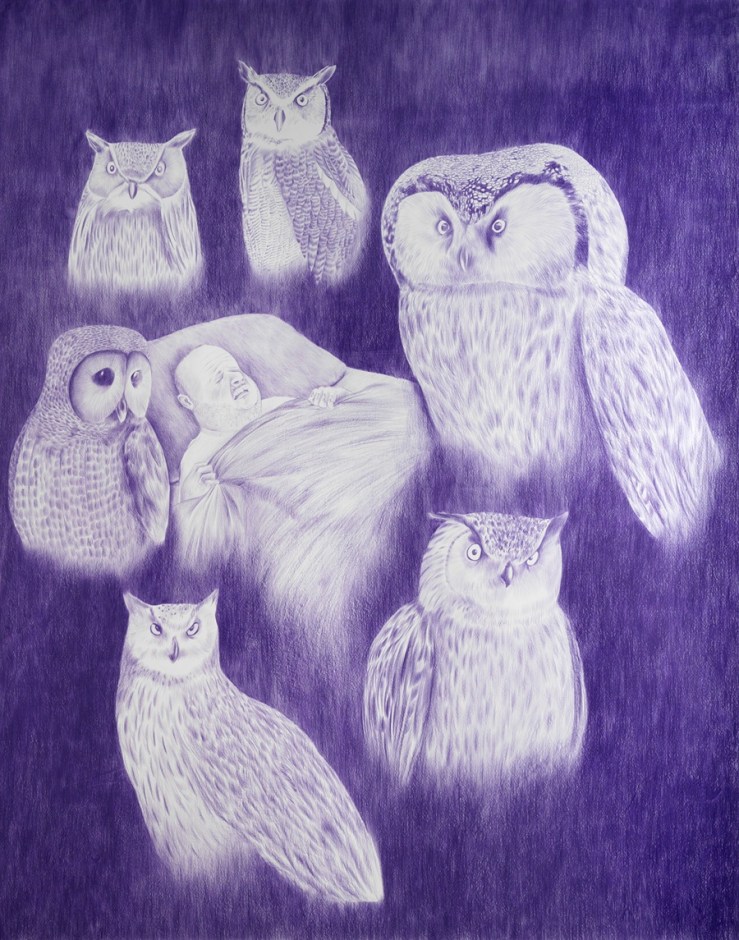
Whilst The Master Weeps — Dennis Tyfus

Whilst The Master Weeps, 2022 by Dennis Tyfus (b. 1979)

Illustration for Cormac McCarthy’s All the Pretty Horses — Marshall Arisman

An illustration by Marshall Arisman (1937-1922) that accompanied a March 1992 excerpt of Cormac McCarthy’s novel All the Pretty Horses that appeared in Esquire.

“Court Rules: Lion Is a Wild Animal” — Charles Portis

November 24, 1960

Court Rules: Lion Is a Wild Animal

A young Brooklyn longshoreman fought a spirited but losing battle in a Brooklyn courtroom yesterday for the right to keep a pet lion at his home.

After the drawn-out, somewhat tongue-in-cheek proceedings at Flatbush Magistrate’s Court, Magistrate Matthew P. Fagan resolved the issue with a concise decision: “I take judicial notice that the lion is a wild animal. I find the defendant guilty.”

The sentence was a $25 fine or ten days in jail. Anthony Ortolano, twenty-six, of 581 Carroll St., Brooklyn, the defendant, asked for ten days in which to raise the $25 and the magistrate granted the request, noting that Mr. Ortolano’s care of the lion had been exemplary.

The specific charge was Section 197 of the city’s Penal Law which makes harboring a wild animal capable of inflicting bodily harm a misdemeanor.

Mr. Ortolano’s troubles with the law began Friday night when Patrolman Thomas Higgins and another officer stopped a car at Union St. and Seventh Ave. to check on the automobile registration. In the car were Mr. Ortolano, three other men and Cleo, a four-month-old male lion, three and a half feet tall and weighing 125 pounds. Mr. Ortolano has since corrected the name to Leo in light of the discovery made over the weekend.

Leo and Mr. Ortolano were hustled off to the Bergan St. police station, where they cooled their heels while a summons was issued. Leo was taken to the Brooklyn shelter of the American Society For the Prevention of Cruelty to Animals.

The trial began yesterday with Mr. Ortolano’s attorney, William Kunstler of Manhattan, asking the judge if the lion could be brought in the courtroom as evidence that he was friendly and tame.

“Oh hell no,” said Magistrate Fagan. “All these people in here would start running. And I wouldn’t blame them.” About 150 persons were in the room.

Then he turned to some officers and asked if they had the
ir guns ready. “Don’t bring him in under any circumstances,” said the judge, “I will conduct this case outside.”

The judge, attorneys, witnesses, defendant and newsmen repaired to an alley outside the court where Leo had been brought in an ASPCA panel truck. The flap was let down to expose the lion, which was beating his head against the wire netting.

The judge opened court in the alley and read the complaint. Mr. Ortolano allowed Leo to lick his fingers through the cage. Then a noisy group of students from nearby Erasmus Hall High School joined the spectators and Magistrate Fagan decided to take the trial back inside. “I’ll take judicial note that I’ve seen the lion,” he said.

The testimony of witnesses followed.

Patrolman Higgins told of the Friday night arrest. He said that Ortolano had told the police that he had bought the lion two weeks ago for $350 from an animal dealer.

Mr. Ortolano said he had a leash on the lion at the time of the arrest and that the windows of the car were up. He said he had a steel cage for Leo in the backyard at his home.

To prove that the animal was tame, said Mr. Kunstler, he would call as witnesses two animal experts.

The first was Mrs. Helen Martini, of 1026 Old Kingsbridge Road, the Bronx, who said she had been an animal trainer for twenty years. Leo was not ferocious, but “very nervous,” she said. But when she was cross-examined by Irving Singer, Assistant District Attorney, she conceded that the animal belonged in a zoo.

Next came Bob Dietc, a zoo-keeper at Fairlawn, N.J., who said that he had trained Leo himself and that he was safe. “He’s only a baby, you could put him in your vest pocket,” he said.

Asked if it wasn’t true that the animal was unpredictable, Mr. Dietc said, “It’s my opinion that all animals are unpredictable, from chickens to birds.”

After the holidays the ASPCA will turn Leo over to Mr. Dietc who will keep him until he can sell him for Mr. Ortolano. Mr. Ortolano, who has been paying $3.15 a day for horsemeat for Leo, is busy getting together $25.


An article by Charles Portis in The New York Tribune. Portis worked for the Tribune for four years in the 1960s before turning to a career as a novelist. The story above is collected in a miscellany of his non-novels, Escape Velocity.

“Under the Young” — Tom Clark

IMG_3223

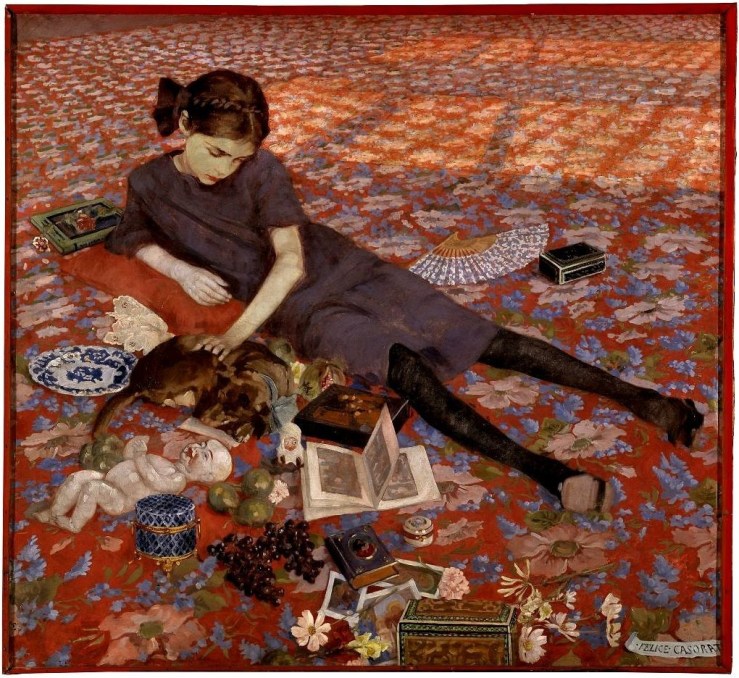
Girl on a Red Carpet — Felice Casorati

Girl on a Red Carpet, c. 1912 by Felice Casorati (1883-1963)

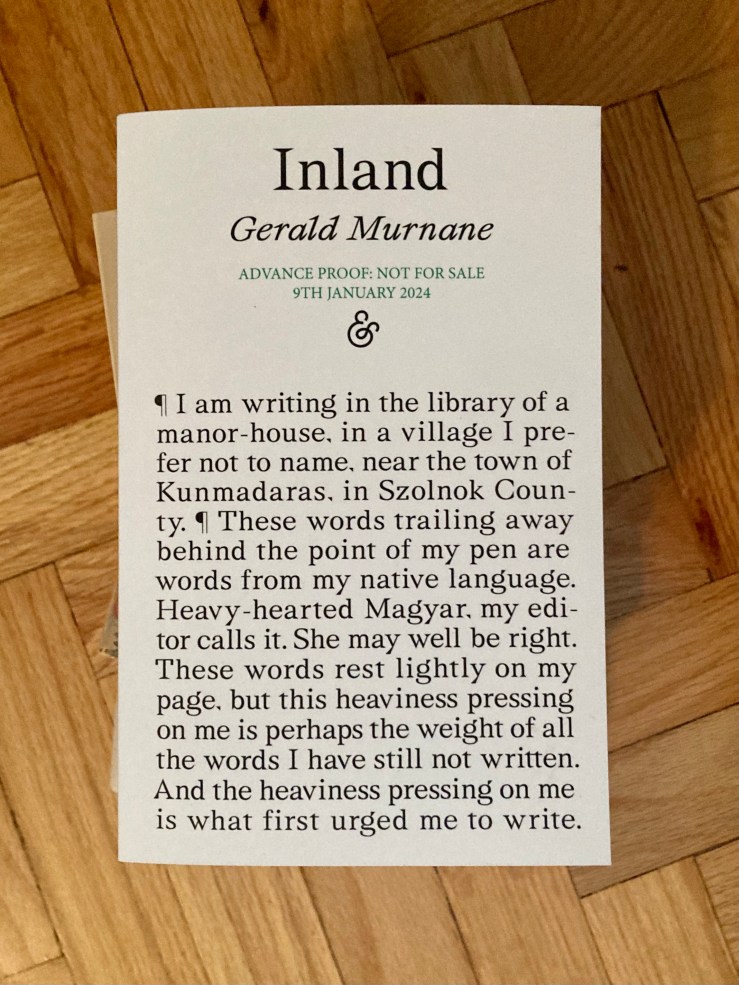
Gerald Murnane’s Inland (Beautiful book acquired some time last week, like maybe 11 Oct. 2023)

I love the new And Other Stories covers that just start, and I’m psyched on their edition of Gerald Murnane’s 1988 novel Inland. Their blurb:

Inland is a work which gathers in emotional power as it moves across the grasslands of its narrator’s imagination – from Szolnok County on the great plains of Hungary where a man writes in the library of his manor house, to the Institute of Prairie Studies in Tripp County, South Dakota, where the editor of the journal Hinterland receives his writing, to the narrator’s own native district in Melbourne County, between Moonee Ponds and the Merri, where he recalls the constant displacements of his childhood. ‘No thing in the world is one thing,’ he declares; ‘some places are many more than one place.’ These overlapping worlds are bound by recurring motifs – fish pond, fig-tree, child-woman, the colours white, red and green – and by deep feelings of intimacy and betrayal, which are brought to full expression as the book moves to its close.

My review closer to publication; in the meantime, read an excerpt.

Read one-time Biblioklept contributor Ryan Chang on Inland back in 2013.

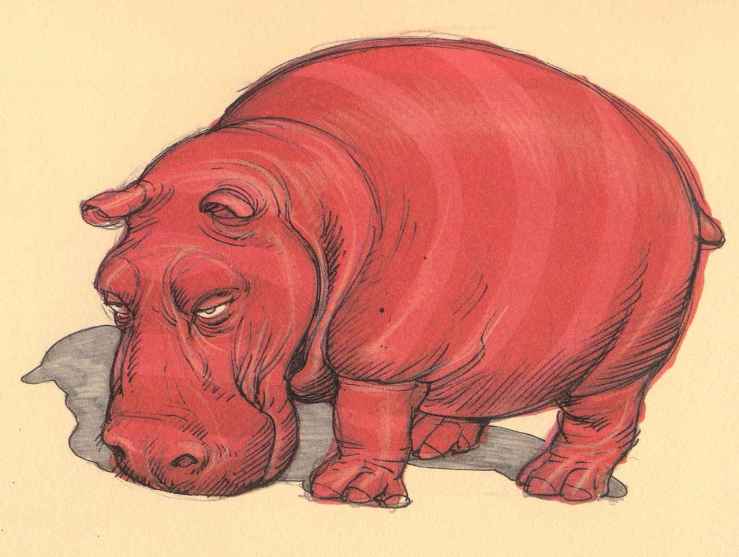
Untitled (Kaba) — Katsuhiro Otomo

Untitled (Kaba (Hippo)), c. 1989 by Katsuhiro Otomo (b. 1954)

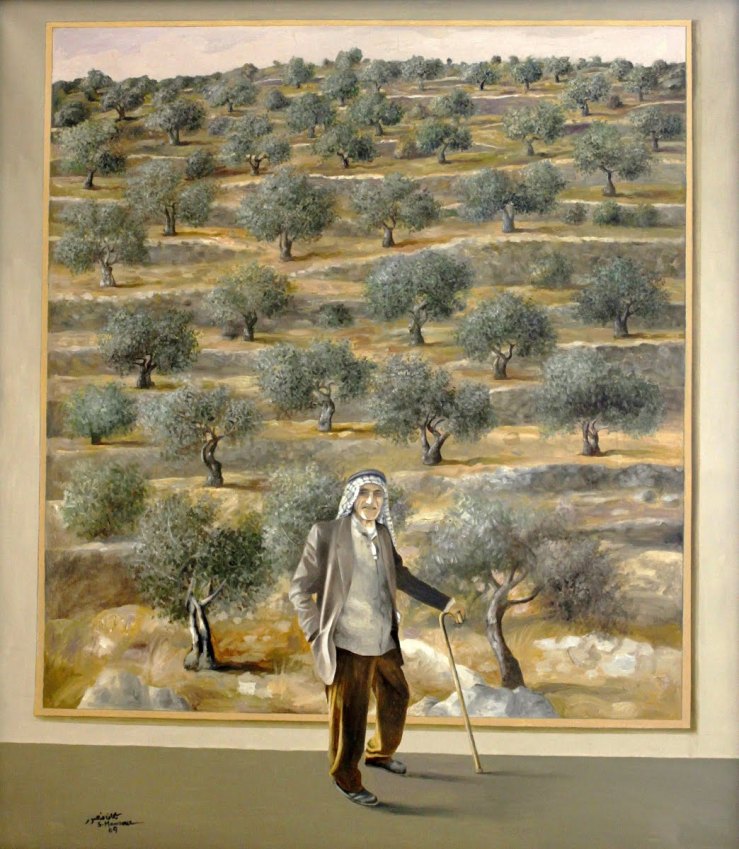
Memory of Places — Sliman Mansour

Memory of Places, 2009 by Sliman Mansour (b. 1947)

A moth goes into a podiatrist’s office | Norm Macdonald

A moth joke from Norm Macdonald’s memoir Based on a True Story


A moth goes into a podiatrist’s office. The podiatrist says, “What’s the problem?”

The moth says, “Where do I begin with my problems? Every day I go to work for Gregory Vassilievich, and all day long I toil. But what is my work? I am a bureaucrat, and so every day I joylessly move papers from one place to another and then back again. I no longer know what it is that I actually do, and I don’t even know if Gregory Vassilievich knows. He only knows that he has power over me, and this seems to bring him much happiness. And where is my happiness? It is when I awake in the morning and I do not know who I am. In that single moment I am happy. In that single moment, before the memory of who I am strikes me like a cane. And I take to the streets and walk, in a malaise, here and then there and then here again. And then it is time for work. Others stopped asking me what I do for a living long ago, for they know I will have no answer and will fix my empty eyes upon them, and they fear my melancholia might prove so deep as to be contagious. Sometimes, Doc, in the deepest dark of night, I awake in my bed and I turn to my right, and with horror I see some old lady lying on my arm. An old lady that I once loved, Doc, in whose flesh I once found splendor and now see only decay, an old lady who insults me by her very existence.

“Once, Doc, when I was young, I flew into a spiderweb and was trapped. In my panic, I smashed my wings till the dust flew from them, but it did not free me and only alerted the spider. The spider moved toward me and I became still, and the spider stopped. I had heard many stories from my elders about spiders, about how they would sink their fangs into your cephalothorax and you would be paralyzed but aware as the spider slowly devoured you. So I remained as still as possible, but when the spider again began moving toward me, I smashed my wing again into my cage of silk, and this time it worked. I cut into the web and freed myself and flew skyward. I was free and filled with joy, but this joy soon turned to horror: I looked down and saw that in my escape I had taken with me a single strand of silk, and at the end of the strand was the spider, who was scrambling upward toward me. Was I to die high in the sky, where no spider should be? I flew this way, then that, and finally I freed myself from the strand and watched as it floated earthward with the spider. But days later a strange feeling descended upon my soul, Doc. I began to feel that my life was that single strand of silk, with a deadly spider racing up it and toward me. And I felt that I had already been bitten by his venomous fangs and that I was living in a state of paralysis, as life devoured me whole.

“My daughter, Alexandria, fell to the cold of last winter. The cold took her, as it did many of us. And so my family mourned. And I placed on my countenance the look of grief, Doc, but it was a masquerade. I felt no grief for my dead daughter but only envy. And so I have one child now, a boy, whose name is Stephan Mikhailovitch Smokovnikov, and I tell you now, Doc, with great and deep shame, the terrible truth. I no longer love him. When I look into his eyes, all I see is the same cowardice that I see when I catch a glimpse of my own eyes in a mirror. It is this cowardice that keeps me living, Doc, that keeps me moving from place to place, saying hello and goodbye, eating though hunger has long left me, walking without destination, and, at night, lying beside the strange old lady in this burlesque of a life I endure. If only the cowardice would abate for the time needed to reach over and pick up the cocked and loaded pistol that lies on my bedside table, then I might finally end this façade once and for all. But, alas, the cowardice takes no breaks; it is what defines me, it is what frames my life, it is what I am. And yet I cannot resign myself to my own life. Instead, despair is my constant companion as I walk here and then there, without dreams, without hope, and without love.”

“Moth,” says the podiatrist, “your tale has moved me and it is clear you need help, but it is help I cannot provide. You must see a psychiatrist and tell him of your troubles. Why on earth did you come to my office?”

The moth says, “Because the light was on.”

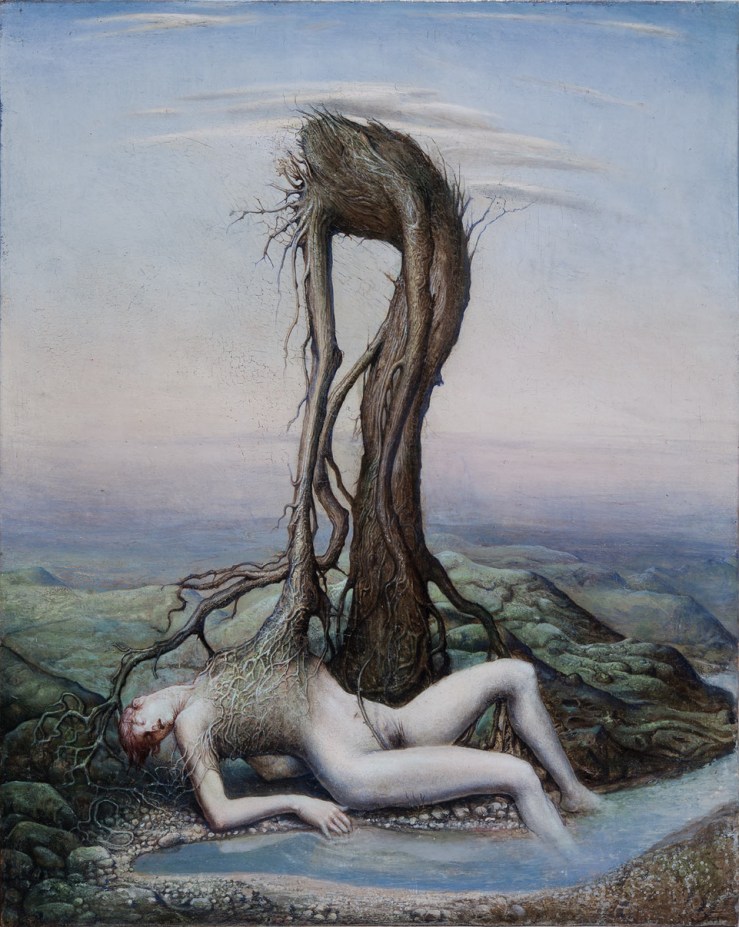
Sementi — Agostino Arrivabene

Sementi (Seeds), 2023 by Agostino Arrivabene (b. 1967)

Books acquired, 13 Oct. 2023

I couldn’t pass on a used copy of the second edition of Steven Weisenburger’s A Gravity’s Rainbow Companion even though it ate up most of my trade credit. I used the first edition of the Companion when I reread Gravity’s Rainbow about eight years ago and then gave it to a friend I had been encouraging to read GR. He still hasn’t read it.

I also picked up a hardcover first edition of Cormac McCarthy’s The Road and a pristine 1946 hardback edition of Joyce’s Ulysses. I’ll probably trade in the Gabler edition of Ulysses I have, but I think I’m too sentimental to let go of the copy of The Road I read in the hospital over a few days when my daughter was born.

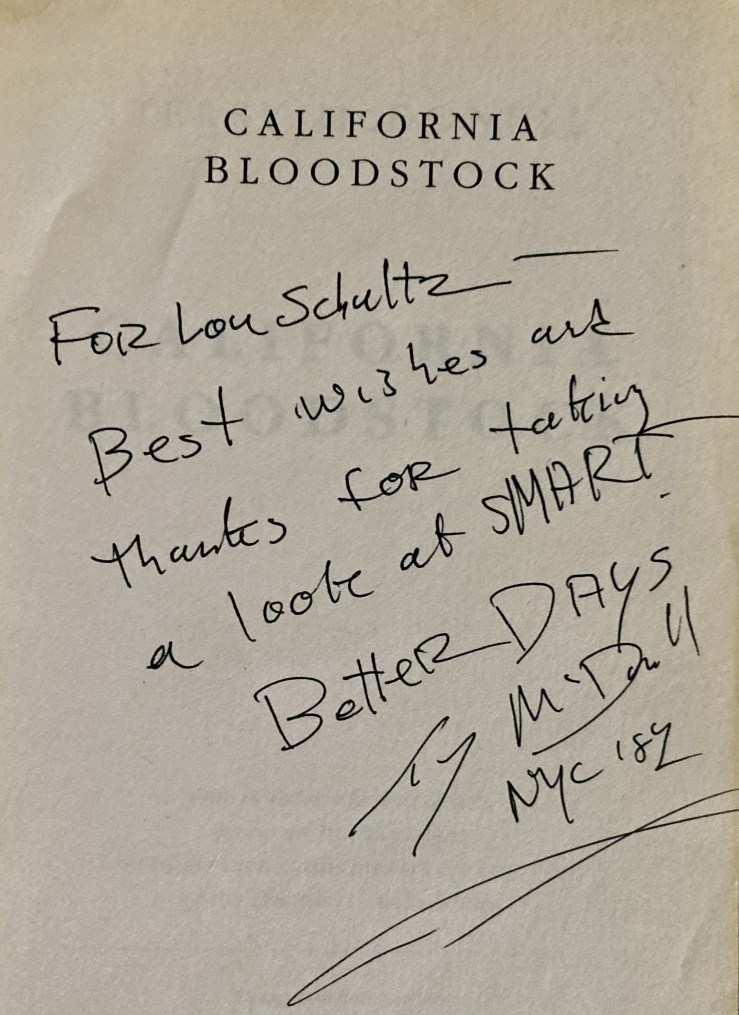
I’m a big fan of Vintage Contemporaries, but I’d never seen Terry McDonell’s California Bloodstock. I pulled it out because of its spine, and found the cover intriguing–it reminded me of these weird paintings that hang in a decrepit hotel in St. Augustine Beach that we stay at for a few nights every year. The blurb from H.S. Thompson didn’t hurt either.


I opened it to find that the novel is inscribed:

Anyone know Lou Schultz? Or what SMART might be?

(This is not a review of) The Dragon Waiting, John M. Ford’s lost classic of fantastical history

So what’s this book you liked so much?

It’s called The Dragon Waiting. It’s a 1983 novel by a guy named John M. Ford. It’s this erudite historical fantasy, or maybe fantastical history, that—

Wait, it’s called The Dragon Waiting? It’s like about dragons and shit? Dungeons and dragons?

There are dungeons, or really towers—the whole medieval motif of hostage-taking is part of the novel—but no, no dragons. Or, there is a dragon at the very end of the novel, but it’s essentially a shared illusion manifested by the dreams of an approaching army. The dragon manifests as this illusory spectacle, a spectacle based on lack and imagination—it’s kinda Lacanian, really, because—

Okay, so, is it a fantasy novel or not? I mean are there wizards and monsters and shit?

There are wizards. But really, they operate more like, I dunno, spies or chemists or thieves. One of the four main protagonists is a Welsh wizard named Hywel Peredur, and he isn’t like, doing sorcery so much as he’s trying to shape events by aligning personalities, throwing out political and personal gambits, heroic scheming, and—

Like Gandalf.

Yeah, like Gandalf I guess. Or Merlyn. But really, the stuff in The Dragon Waiting is like, reality-based, by which I mean history-based, or at least historical-fantasy-based.

So there aren’t any orcs or trolls or elves or whatever and the dragon is just a shared illusion? 

There are monstrous people. Oh, there are also vampires, but they’re not all bad.

So it’s a vampire novel? A horror novel?

No, not a horror novel, although it has some gothic tinges, and definitely not a “vampire novel,” whatever that is—although one of the four protagonists is afflicted with vampirism. He’s a German engineer named Gregory von Bayern who specializes in artillery.

So he’s a vampire who makes guns and bombs?

Kind of, but that makes it sound silly.

And so he kills people?

Yeah, but not to feed on them, and not like, in general. He’s one of the heroes of the story, enlisted by Hywel to—

Hywel is the Gandalf?

Not a great analog but sure, Hywel is your Gandalf. And he kinda puts together this squad whose long-term goals are never really stated clearly, but they are essentially forming a Western resistance to the Byzantine Empire.

The Byzantine Empire?

Yeah. So, in the alternate reality of The Dragon Waiting, the Byzantine Empire is the great unified force in the East. And because of this, Christianity never emerges as a major religion, so instead there’s this plurality of all kinds of Gods worshipped—Egyptian, Greek, Roman, and son on. And the sort of background action of the novel is Byzantium encroaching into Europe, threatening Italy, which is a bunch of disunified city states, so even if the Medici are powerful, they still have their own internal opponents, that’s one of the major themes of the novel—political infighting. We see the political scheming thing most strongly in the novel’s dominant plot, which is Hywel’s gang’s attempt to get Richard the Duke of Gloucester on the English throne.

Richard the Duke of Gloucester—that was a real guy, right?

Lots of the characters in The Dragon Waiting are real guys from history, yes.

So what do I know Richard the Duke of Gloucester from?

He was Richard the III of England.

The hunchback guy? The winter of our discontent guy? The guy who killed his nephews?

That’s how Shakespeare depicted him in the play, yes. But Ford’s novel takes a different approach. He’s very human, and he has flaws, but he’s not a Machiavellian child-killing prick.

Okay, so all of this is taking place in like Byzantium and Italy and England and like, when? When is Richard III? 1600 something?

No, not Byzantium—that Empire is trying to spread west. No, the action takes place in Western Europe—Wales, Italy, France, Switzerland, England, and so on. And the dates would cover a few decades, but a lot of the prime action is happening at the end of the fifteenth century. Richard III was coronated in the summer of 1483, if that helps. But because Christianity never really takes off, the whole AD thing never happens, so those numbers don’t really show up in the book.

This sounds really complicated. Do I need to know a lot of European history, world history to understand what’s happening?

Oh, I think even if you knew a lot of the historical background very well you’d have a hard time understanding what’s happening.

Great. So why are you into this dragon book?

I love how it’s written; I love its themes, its layering, its construction. It’s a dense book that feels light; it’s serious and erudite but also psychologically drawn. Ford eschews exposition. In fact, at times he even sets the reader up to look the wrong way. And this fits with a lot of the themes and motifs and bits of the novels—illusionists, forgers, secret agents, disguises, spies, thieves, and so on. So it’s not just happening in the plot; it’s also happening at the rhetorical level. Like, for example, okay, so we get this kind of overture in the first three chapters, which establish three of our four protagonists: Hywel the Welsh wizard, Dimitrios Ducas, an exiled Greek mercenary, and Cynthia Ricci, an Italian doctor initially in the service of the Medici. And Ford’s camera sits close to their perspective, we get into their heads, get to know them a bit. And then all of a sudden we get to the book’s second section, and all of the characters are in disguise in this remote mountain inn, way up in the snow, using false names. And Ford never shows his hand, we just have to figure out what happens, who the characters really are, and how they relate to each other. And he sort of wedges this neat little murder mystery in there (in the snow in a hotel no less—reminded me of Crane’s “The Blue Hotel” or Tarantino’s The Hateful Eight). And Ford does this again and again, but in new ways—misdirection, disguise, illusion. I ended up having to read each chapter twice.

I bet the vampire did the murder!

Okay.

But so like there are vampires in this book, but that’s not, like, a thing?

The novel treats vampirism as a disease, not as a supernatural thing, and like many diseases, there is folklore and superstition that develops around the disease, some in common with our own concept of “vampirism.” The vampires in The Dragon Waiting are sensitive to light and they do have to consume blood, but they aren’t necessarily immortal, and to a large extent, they are shunned and feared. Although some of them become powerful.

And the vampire Gregory is good?

I guess. The motivations for the four main characters aren’t necessarily good or evil, per se, although the four of them are generally sympathetic to decency, humanity, and compassion over violence and raw power. But ultimately, they seem mostly motivated by the strange friendships they forge with each other.

That sounds corny.

It’s not.

Ok. So you like the writing, but what about the subject matter? I mean, I didn’t really think you were into historical fantasy fiction? Does a body have to know a lot of European history to get into this? I tried to ask you earlier and you deflected.

I think I answered just fine: No, not really. There’s a lot of English history in there, and a lot of it will be familiar (but strangely so) if you know Shakespeare’s plays on the Plantagenet kings—a cycle that ends with Richard III, obviously.

Obviously.

I think Ford knows his history really, really well, but part of his rhetorical technique is withholding certain clues, baiting and switching, reshuffling the deck, moving the cups quickly in a shell game…the story is really about shifting identities, shifting names, shifting allegiances, and so on. I suppose it might be easy to compare it to George R.R. Martin’s A Song of Ice and Fire books, but, like better written, smarter, and trimmed of all the fat.

Rude.

That’s not what I meant. It’s sort of like Gene Wolfe’s New Sun novels. Although I’d really compare The Dragon Waiting to something like Thomas Pynchon’s Against the Day or V.—those are historical fantasies too—or fantastical histories?—encyclopedic ones that frequently defer meaning and stun or bewitch the reader. There’s like a specter there in the prose, pushing out an illusion that the reader has to chase—

The reader has to chase the dragon?

Shush.

So you’re saying this dragon book is Pynchonian?

No, no. But many things I like in Pynchon—the paranoia, the showing of the parts while withholding the revelation of the whole, the dazzling encyclopediaism—I find that in The Dragon Waiting too. Ford’s style also reminds me a bit of Cormac McCarthy, who’s so good at simply showing actions while refusing to tell the reader what they mean—either to the characters or to the narrator or whomever. Things just happen and the reader has to sort it out.

But won’t I get confused?

I was confused but not frustrated. I was confused, but then I’d reread the chapter and realize I had been looking in the wrong direction or following the wrong thread. Again, rhetorical misdirection doubles the novel’s themes of political/magical misdirection.

But the history might get me all confused.

Okay, so, the names can cause confusion. Pretty much every character has multiple names or titles, and they all use aliases as well. And lots of the historical background characters, particularly the English ones, have the same names. Lots of Richards and Elizabeths and Edwards and Henrys in here. Ford provides a little overture of historical personages, and Wikipedia is always there. Oh, and there’s this really cool site called Draco Concordans which is a series of annotations on the novel.

Wait, I have to read annotations on a website to follow this book? Is this fucking Finnegans Wake or something?

No, and I only found the site after I finished the book. I might have liked to have used it when I reread each chapter though. But I would definitely recommend reading it the first time cold. I think the pleasure in the book is looking back to realize where you lost the thread, where you were misdirected. I’m sure I’ll consult the Concordans when I read The Dragon Waiting again.

So you’ll read it again?

Oh yeah, definitely. Loved it.

That sounds like a recommendation then.

It is. I highly recommend it.
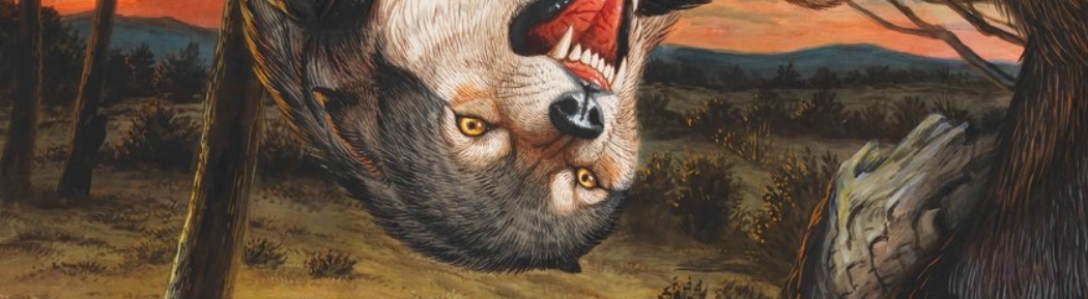
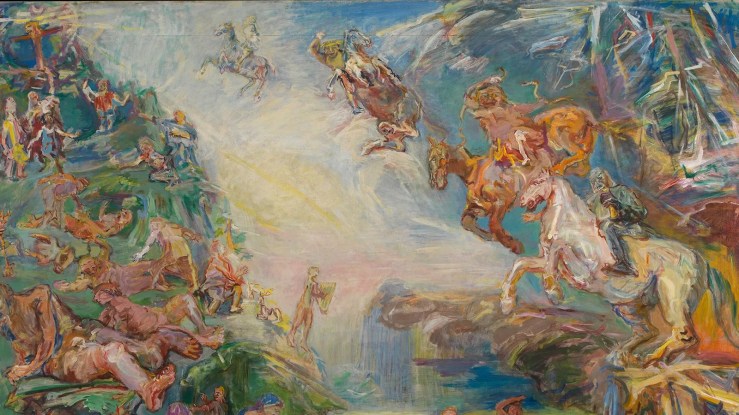
Apocalypse — Oskar Kokoschka

Apocalypse, 1950 by Oskar Kokoschka (1886-1980)

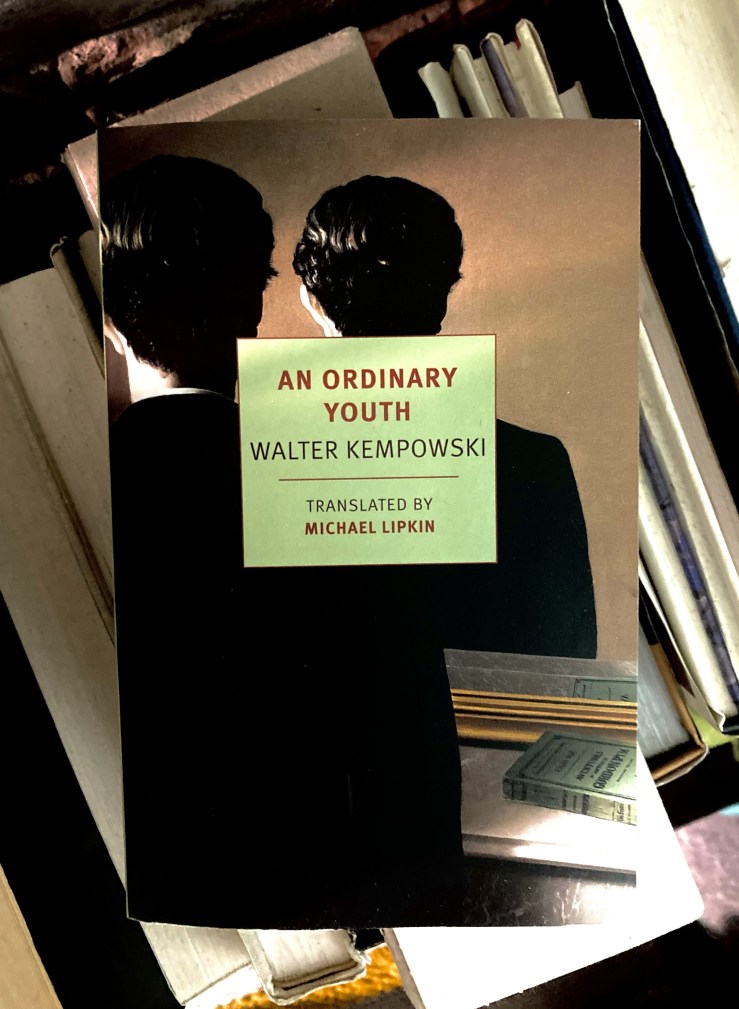
Walter Kempowski’s An Ordinary Youth (Book acquired, 2 Oct. 2023)

Walter Kempowski’s An Ordinary Youth gets its first published English translation thanks to Michael Lipkin. The book is new in print from NYRB. Their blurb—

An Ordinary Youth is a novel drawn directly from the author’s boyhood in Nazi Germany. Nine-year-old Walter’s family is moving house when the novel opens, but Walter’s main concerns are his tin soldiers and his older brother’s jazz records, his father’s fluctuating moods, and his mother’s ministrations and anxieties. While Walter is absorbed by his private life, the extraordinary accumulation of contemporary idioms that accompany his point of view—dialogue, song, literary quotations, commercials, and political slogans—tell a different story.  Through this echo chamber of voices, Kempowski shows a hugely turbulent and murderously intolerant nation racing toward disaster. An immediate bestseller when it was first published in Germany in 1971 (as Tadellöser & Wolff) and the best known of Kempowski’s novels in Germany, An Ordinary Youth is now available in English for the first time.