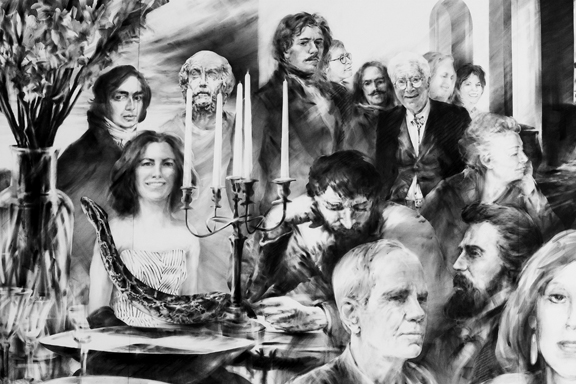
Multi-Vortex National Disaster — Hilary Harkness

Multi-Vortex National Disaster, 2020 by Hilary Harkness (b. 1971)

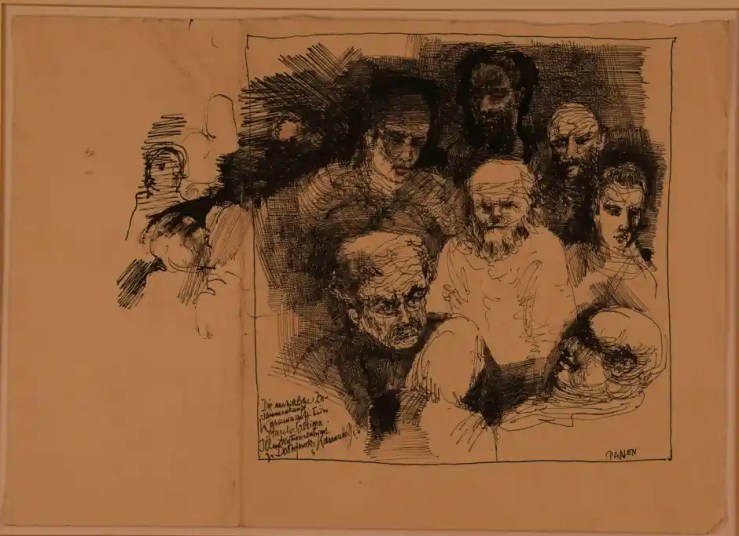
Illustration for Dostoevsky’s Karamazov — Wolfgang Paalen

Illustration for Dostoevsky’s Karamazov, 1923 by Wolfgang Paalen (1905-1959)

“Sex and/or Mr. Morrison” — Carol Emshwiller

Sex and/or Mr. Morrison

by

Carol Emshwiller


I can set my clock by Mr. Morrison’s step upon the stairs, not that he is that accurate, but accurate enough for me. 8:30 thereabouts. (My clock runs fast anyway.) Each day he comes clumping down and I set it back ten minutes, or eight minutes or seven. I suppose I could just as well do it without him but it seems a shame to waste all that heavy treading and those puffs and sighs of expending energy on only getting downstairs, so I have timed my life to this morning beat. Funereal tempo, one might well call it, but it is funereal only because Mr. Morrison is fat and therefore slow. Actually he’s a very nice man as men go. He always smiles.

I wait downstairs sometimes looking up and sometimes holding my alarm clock. I smile a smile I hope is not as wistful as his. Mr. Morrison’s moonface has something of the Mona Lisa to it. Certainly he must have secrets.

“I’m setting my clock by you, Mr. M.”

“Heh, heh . . . my, my,” grunt, breath. “Well,” heave the stomach to the right, “I hope . . .”

“Oh, you’re on time enough for me.”

“Heh, heh. Oh. Oh yes.” The weight of the world is certainly upon him or perhaps he’s crushed and flattened by a hundred miles of air. How many pounds per square inch weighing him down? He hasn’t the inner energy to push back. All his muscles spread like jelly under his skin.

“No time to talk,” he says. (He never has time.) Off he goes. I like him and his clipped little Boston accent, but I know he’s too proud ever to be friendly. Proud is the wrong word, so is shy. Well, I’ll leave it at that.
Continue reading ““Sex and/or Mr. Morrison” — Carol Emshwiller”

Swinging Monkey — Brett Whiteley

Swinging Monkey, 1965 by Brett Whiteley (1939-1992)

Jim Dodge/Steve Erickson (Books acquired, 22 June 2023)

I picked up my daughter’s assigned summer reading today — Steven King’s On Writing and Strunk & White’s The Elements of Style. It’s not exactly clear to me if she’s supposed to, like, read, the Strunk & White, although I recall actually reading it when I was around her age, but I also enjoyed reading the thesaurus. The bookstore had a used copy of Penguin’s hardback edition with illustrations by Maira Kalman for only a few bucks more than the cheap paperback copies, so I got it for my daughter. I have the same edition at my office.

wcs

I finally found a copy of Jim Dodge’s 1990 novel Stone Junction. I’d been looking casually looking for it for a few years now, and was pleased to find it in a Canon edition (although the big sticker over the tarot card on the cover is kinda bewildering). If you’re interested in Pynchon’s intro you can read it here. There’s an excerpt from the beginning of the novel here.

I didn’t really mean to pick up Steve Erickson’s third novel, Tours of the Black Clock (1989) but then I did. I mean I went to the Erickson books, picked this one out, started to read the back cover, read the sentence “Cutting a terrifying path from a Pennsylvania farm to the Europe of the 1930s, Banning Jainlight becomes the private pornographer of the world’s most evil man,” and decided I wanted to read it.” I finished Erickson’s second novel, Rubicon Beach (1986) a few days ago and his first, Days Between Stations (1985) a few weeks ago and I guess I want more of that particular flavor.

“Happiness” — Sylvia Townsend Warner

“Happiness”

by

Sylvia Townsend Warner


‘The bathroom’s the awkwardest feature,’ said Mr. Naylor, of Elwes & Sons, house agents, ‘being situated on the ground floor. People don’t like ground-floor bathrooms. You might say, they just won’t hear of them.’

‘No, I suppose not. Yet …’ Lavinia Benton broke off.

‘I know what you were going to say, Mrs. Benton. You were going to say, Why not convert the dressing room upstairs, leaving the bathroom for what one might call a playroom, or a children’s lounge, or a study, if there happened to be no family. Once we’d got the bath out, it could be called ideal for that, being so inordinately large for a bathroom. But then the pipes would have to be carried upstairs. Think of the plumbing, Mrs. Benton! Prohibitive! No buyer would contemplate it, not for this class of residence—it isn’t as if this were one of those old oak jobs. And I understand you don’t want to let the estate in for any extra expense. So there we are, I’m afraid. Back where we started from!’

Mr. Naylor had, in fact, scotched a snake that wasn’t there. Lavinia’s ‘Yet’ had been provoked by the reflection that an increasingly large acreage of southern England was occupied between 7.30 and 8.30 a.m. by people resignedly bathing on ground level. Not so resignedly, either, since there are always buyers for bungalows. Both Mr. Petherick, of Petherick, Petherick & Sampson, and Mr. Cox, of Ransom & Titters, had already explained that Aller Lodge, the late Miss Esther Jeudwine’s brick-built, two-storey residence in sound repair, would have been easy enough to sell if only it had been a bungalow. All a matter of social psychology, thought Lavinia who, as a columnist on superior Women’s Pages, was accustomed to making something out of not much; a mass apprehension of being surprised with no clothes on, which if not primitive, since primitive man had other and more pressing things to be surprised by, must certainly go a long way back, being later reinforced by class distinction—the wealthy are draped, the poor go bare—and Christianity’s insistence on modesty; for though a fakir can be venerable in a light handful of marigolds, an archdeacon can scarcely leave off his gaiters. In short, the discomposure of being surprised with no clothes on is, like the pleasurability of possessing a virgin, one of the things long taken for granted—and really even more of an idée reçue‚ being subscribed to by both sexes alike. Yet here was this mass apprehension, fortified by tradition, smoothed by acceptance, part of the British way of life, suddenly ceasing to function when brought into bungalows, where the hazards that might justify it—housebreakers, mad dogs, cars out of control, voyeurs, private detectives, almost anything, in fact, except the atom bomb—would be much more on the cards. But one must remember that bathrooms being so recent an introduction, public opinion could not have made up its mind about them yet, and was bound to be rather hypothetical.

Lavinia became aware that Mr. Naylor was observing her with sympathy, but at the same time giving little coughs. Of course. The poor man wanted to go.
Continue reading ““Happiness” — Sylvia Townsend Warner”

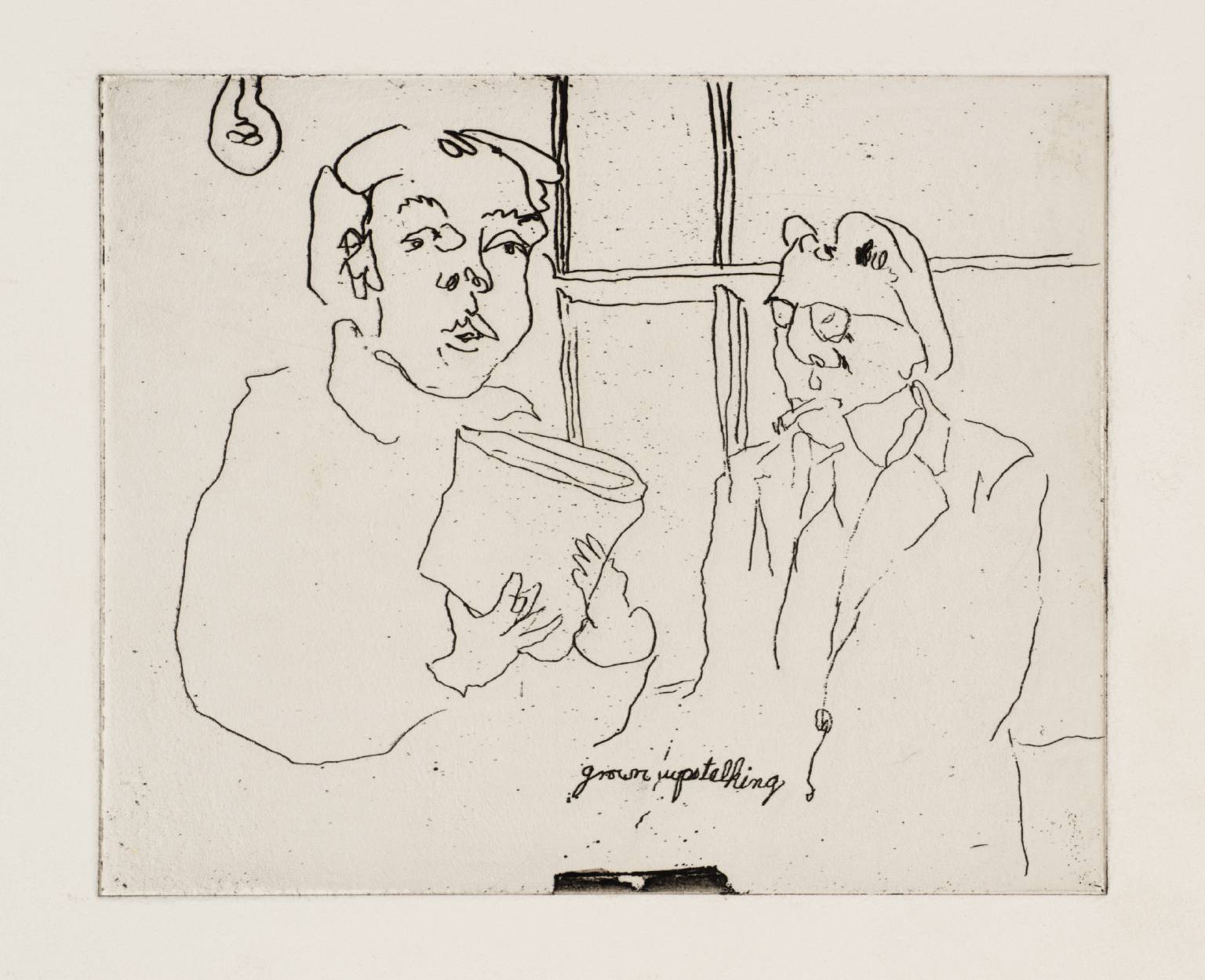
Grown Upstalking — Barry Flanagan

Grown Upstalking, 1972 by Barry Flanagan (1941-2009)

Nooly Nostrildamus — Basil Wolverton

Nooly Nostrildamus, the back cover illustration from Plop! #4, 1974 by Basil Wolverton (1909-78)

City of Tells (Detail) — James Drake

Detail from City of Tells, 2004 by James Drake

Riff on the death of Cormac McCarthy

We were about an hour north of the border, driving a rented car from Quebec City to a hiker hostel our friends own in Maine, when I got a text from my uncle: “It seems your favorite author has died…” (The ellipses were part of his text.)

At first, I thought he meant Thomas Pynchon, who is 86, which is pretty old. I opened Twitter and realized he meant Cormac McCarthy, who is also my favorite author, who died at the age of 89 about a week ago.

It may be unseemly to bring up another author, Pynchon, in an ostensible eulogy for McCarthy (to be clear, this is not a eulogy, this is a riff)—but I found my reactions to the non-news of Pynchon’s non-death and the true-news of McCarthy’s true-death revealing, insomuch as my reactions revealed how I thought about these two writers’ latest and last works. Simply put, I felt a sharp, ugly pang at the thought that there might not be one last Pynchon novel in the author’s lifetime, one last big, baggy, flawed, majestic synthesis of the artist’s oeuvre to capstone the grand career.

Cormac McCarthy published his big, baggy, flawed, majestic capstone last year and titled it The Passenger. It confused and irritated many reviewers and readers, who were likely expecting something other than a sprawling and elliptical summation of the philosophical and aesthetic preoccupations of McCarthy’s previous work. (I made an indirect argument for The Passenger as the elliptical summation of the philosophical and aesthetic preoccupations of McCarthy’s previous work in a series of riffs.) The subsequent release of Stella Maris, a short, spare novella composed entirely in dialogue further befuddled many readers. Neither sequel nor coda, Stella Maris is a cold satellite orbiting The Passenger’s strange sun. Or maybe Stella Maris is The Passenger’s incestuous sibling; the very nature of its publication as a separate text deliberately invites us to read the novels intertextually. And then to read the sibling novels intertextually with/against the McCarthy family of novels.

A proper eulogy (which this riff is not) would remark at some length on the McCarthy family of novels. Such a eulogy might demarcate the novels by both time and location, perhaps separating the early Southern novels (The Orchard Keeper, 1965; Outer Dark, 1968; Child of God, 1973; Suttree, 1978) from the later Westerns (1985’s Blood Meridian up through No Country for Old Men, 2005). Such a eulogy might also point to the commercial success and film adaptations of All the Pretty Horses (1992), No Country for Old Men, and 2006’s The Road. There’s even a segue there, I suppose, to mention McCarthy’s own efforts at screenwriting (The Gardener’s Son, 1976; The Counselor, 2013) and stage writing (The Stonemason, 1995; The Sunset Limited, 2006). Another segue presents itself: one might suggest that these screen and stage efforts need not be situated in McCarthy’s oeuvre. The eulogist might then attend himself to sorting McCarthy’s work into tiers: Blood Meridian and Suttree; The Crossing and The Passenger; everything else. But this riff is not a eulogy.

A eulogy, which this riff is not, should ideally contain a kernel of grief. Like most of his readers, I did not know Cormac McCarthy except through his work, and I feel gratitude for that work—for Blood Meridian and Suttree in particular, but also for The Passenger, which, as I’ve stated above, serves as a perfectly imperfect final marker for a fantastic and rightfully-lauded career. There’s no grief then; McCarthy wrote everything he could possibly write.

He was still writing at the time of his death, of course. Director John Hillcoat revealed just a few weeks ago that he was co-writing the screenplay for a Blood Meridan adaptation with McCarthy. Hillcoat, who adapted The Road into a 2009 film, did know McCarthy, and was working with him, again, and thus might feel a grief personal and professional, a grief and love that licensed him to author a eulogy for his friend, which he did here. I have no such license.

As my wife finished the drive from Quebec to Maine, I scrolled through Twitter, where readers and authors shared their thoughts on McCarthy’s passing. We soon arrived at our friends’ hostel, a large, comfortable old house not too far from the Appalachian Trail’s northern terminus. Years ago, one of these friends became infected with Blood Meridian, obsessed with its bombastic language. I spied his worn copy on the shelf, next to the copy of Suttree I had given him, which he still hasn’t finished. I vaguely recall toasting “Cormac” over some too-strong IPAs that night.

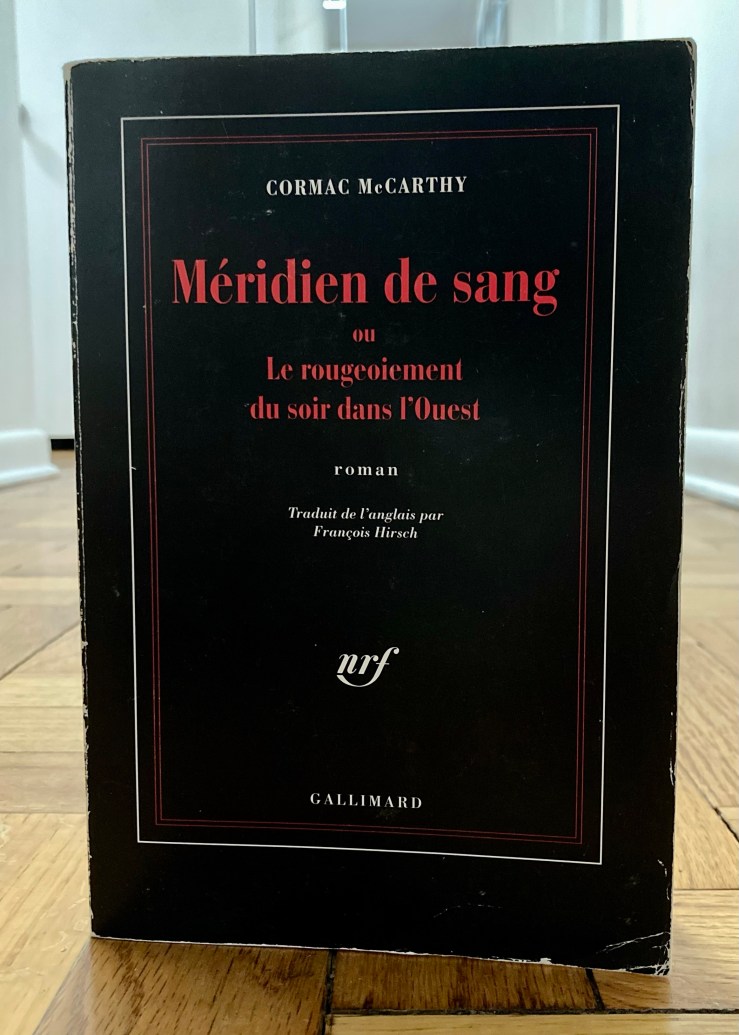
We drove back to Quebec City the following afternoon. (It is nice to visit one’s friends and see the hiker hostel they operate, but a hiker hostel is not a comfortable place for a family who is not hiking.) A day or two later we strolled Rue Saint-Jean outside of the Old City, where I visited four used bookstores. I can’t really read French, but I enjoy looking at book covers and simply looking at what’s in stock at a particular place. I ended up buying a used copy of François Hirsch’s French translation of Blood Meridian that I found for about eight U.S. dollars. I read the “legion of horribles” passage in Hirsch’s translation, and while my French vocabulary is awful, I know the book well enough to have enjoyed the experience. “Oh mon Dieu, dit le sergent” even made me crack up.

I was far from Florida and my home and my laptop in my home, so I did not write any riff on the death of Cormac McCarthy. I recycled old posts I’d written, reading and editing them from my phone, finding some of my early reviews pretty callow. My 2008 first-read review of Blood Meridian is particularly bad; the book clearly overwhelmed me. I’ve read it many, many times since then. The “review” I wrote of No Country back in 2007 is so bad I won’t even link to it. Like most great writers, McCarthy’s work is best reread, not read.

And I reread so much of his work this year. The Passenger left me wanting more McCarthy–not in an unsatisfied way, but rather to confirm my intimations about its status as a career capstone. I reread All the Pretty Horses in the lull before Stella Maris arrived. I went on to reread The Crossing (much, much stronger than I had remembered), Cities of the Plain (weaker than I had remembered), The Road (about exactly as I remembered), Child of God (ditto), and The Orchard Keeper (as funny as I had remembered but also much sadder than I had remembered).

This riff has been too long and too self-indulgent; it was not (as I promised it would not be) a eulogy for the great dead writer, but rather blather on my end—a need to get something out of my own system. If I were younger and more full of foolish energy, I’d probably take the time to rebut McCarthy’s detractors, critics who take to task both his baroque style and dark themes. The truth is I don’t care—I’ve got the books, I’ve read them and reread them, and I know what’s there and how it rewards my attention.

I’ll end simply by inviting anyone interested in McCarthy’s work to read him. And then I’ll really end, here, now, end this riff, with a Thank you to the void.

“The Father,” a very short story by Raymond Carver

“The Father”

by

Raymond Carver


The baby lay in a basket beside the bed, dressed in a white bonnet and sleeper. The basket had been newly painted and tied with ice-blue ribbons and padded with blue quilts. The three little sisters and the mother, who had just gotten out of bed and was still not herself, and the grandmother all stood around the baby, watching it stare and sometimes raise its fist to its mouth. He did not smile or laugh, but now and then he blinked his eyes and flicked his tongue back and forth through his lips when one of the girls rubbed his chin.

The father was in the kitchen and could hear them playing with the baby.

“Who do you love, baby?” Phyllis said and tickled his chin.

“He loves us all,” Phyllis said, “but he really loves Daddy because Daddy’s a boy too!”

The grandmother sat down on the edge of the bed and said, “Look at its little arm! So fat. And those little fingers! Just like its mother.”

“Isn’t he sweet?” the mother said. “So healthy, my little baby.” And bending over, she kissed the baby on its forehead and touched the cover over its arm. “We love him too.”

“But who does he look like, who does he look like?” Alice cried, and they all moved up closer around the basket to see who the baby looked like.

“He has pretty eyes,” Carol said.

“All babies have pretty eyes,” Phyllis said.

“He has his grandfather’s lips,” the grandmother said. “Look at those lips.”

“I don’t know . . .” the mother
said. “I wouldn’t say.”

“The nose! The nose!” Alice cried.

“What about his nose?” the mother asked.

“It looks like somebody’s nose,” the girl answered.

“No, I don’t know,” the mother said. “I don’t think so.”

“Those lips . . .” the grandmother murmured. “Those little fingers . . .” she said, uncovering the baby’s hand and spreading out its fingers.

“Who does the baby look like?”

“He doesn’t look like anybody,” Phyllis said. And they moved even closer.

“I know! I know!” Carol said. “He looks like Daddy!” Then they looked closer at the baby.

“But who does Daddy look like?” Phyllis asked.

“Who does Daddy look like?” Alice repeated, and they all at once looked through to the kitchen where the father was sitting at the table with his back to them.

“Why, nobody!” Phyllis said and began to cry a little.

“Hush,” the grandmother said and looked away and then back at the baby.

“Daddy doesn’t look like anybody!” Alice said.

“But he has to look like somebody,” Phyllis said, wiping her eyes with one of the ribbons. And all of them except the grandmother looked at the father, sitting at the table.

He had turned around in his chair and his face was white and without expression.

“It was a lone tree burning on the desert” | Blood Meridian’s Moral Core

Cormac McCarthy’s Blood Meridian begins as a strange, violent picaresque bildungsroman, detailing the adventures of a teenage runaway known only as “the kid.” When the Kid falls in with John Glanton’s marauders, the narrative lens expands and pulls back; Glanton’s gang essentially envelopes the Kid’s personality. The pronoun “they” dominates the Kid’s own agency, for the most part, and the massive figure of Judge Holden usurps the narrative’s voice. The effect is that the Glanton gang’s killing, raping, and scalping spree becomes essentially de-personalized, and, to a certain extent, amoralized.

The Kid, and perhaps the ex-priest Tobin and the Kid’s erstwhile partner Toadvine, are the only major characters who bear any semblance of conventional morality in the narrative. The Kid exhibits a willingness to help others early on when he agrees to stitch one of Tobin’s wounds; later, he removes an arrowhead from a wounded man when no other member of the company will (Tobin chides him for caring, declaring that the wounded man would have killed the Kid had the Kid’s efforts been unsuccessful). For most of the central narrative though, the Kid’s individual actions are consumed into the gang’s “they.” However, at the beginning of chapter 15 the narrative focuses again on the Kid, who is charged with killing a wounded man named Shelby to “spare” him from the approaching Mexican army (this is a bizarre version of mercy in Blood Meridian). Shelby pleads to live and the Kid allows it, even giving the man some water from his own canteen. After he leaves he catches up with a man named Tate whose horse is wounded. Tate remarks on the boy’s foolishness for helping him, but the Kid does so nonetheless, sharing Tate’s burden as they try to make their way back to the rest of their party. Tate is soon killed by Mexican scouts. In both cases, the outcome of the Kid’s moral actions–the will to help, to save, to preserve life–are negated by the book’s narrative outcomes, but I would argue that his intentions in the face of violence somehow secure his humanity.

His journey alone to rejoin the Glanton gang is figured as a kind of vision quest, a strange echo of Christ in the desert, perhaps. At its core–and perhaps the moral core of the book–is the following strange passage–

It was a lone tree burning on the desert. A herladic tree that the passing storm had left afire. The solitary pilgrim drawn up before it had traveled far to be here and he knelt in the hot sand and held his numbed hands out while all about in that circle attended companies of lesser auxiliaries routed forth into the inordinate day, small owls that crouched silently and stood from foot to foot and tarantulas and solpugas and vinegarroons and the vicious mygale spiders and beaded lizards with mouths black as a chowdog’s, deadly to man, and the little desert basilisks that jet blood from their eyes and the small sandvipers like seemly gods, silent and the same, in Jedda, in Babylon. A constellation of ignited eyes that edged the ring of light all bound in a precarious truce before the torch whose brightness had set back the stars in their sockets.

The burning tree alludes to YHWH’s appearance to Moses as a burning bush, and also the tree of smoke that led the Israelites through the desert. Significantly, all the strange, terrible creatures of the desert come to meet around it in a “precarious truce.” The burning tree inverts the natural, inescapable violence that dominates the novel and turns it into a solitary, singular moment of peace. When the Kid awakes–alone–the tree is merely a “smoldering skeleton of a blackened scrog.” God is not in the permanence of the object but rather in the witnessing of the event–Blood Meridian locates (a version of a) god in the natural violence of burning and consumption. There is a strong contrast here, I believe, with the book’s other version of god, the Judge’s proclamation that “War is god.” The Judge, a cunning, devilish trickster, wants to reduce (or enlarge) war to all contest of wills, to pure violence–to divorce it from any ideological structure. Yet the burning tree episode reveals natural violence divorced from ideology. The animals (and the man, the Kid) suspend their Darwinian animosities in order to witness the sublime. The episode is silent, outside of language, order, ideology. This silence is echoed in the novel’s final confrontation between the Judge and the Kid, who retorts simply “You ain’t nothin'” to the Judge’s barrage of grandiose language. While the rejoinder may not save the Kid, its rejection perhaps saves his soul (if such a thing exists in the novel, which I believe it does). So, while larger-than-life Judge Holden may dominate the novel, Cormac McCarthy has nonetheless given us another moral road to follow, should we choose.

[Ed. note—Biblioklept first published a version of this post in October, 2010.]

Four panels from the June 16, 1957 edition of Charles M. Schulz’s strip Peanuts

A life obscene | On Cormac McCarthy’s early novel Child of God

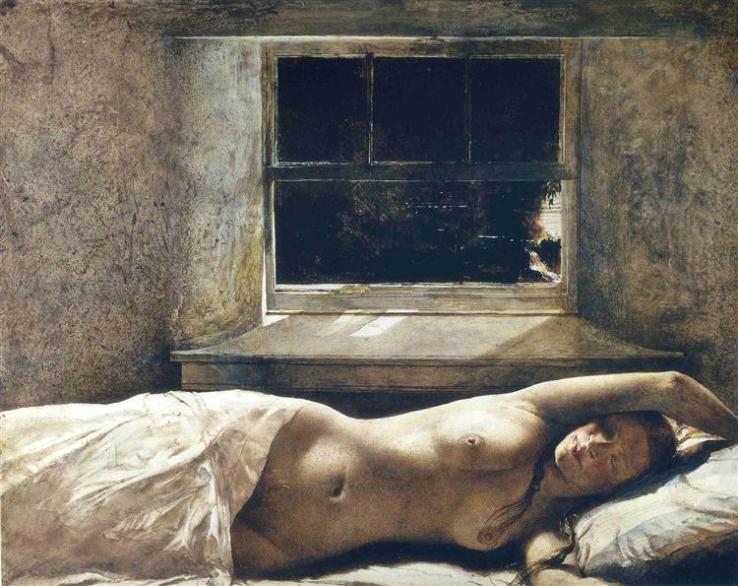
Overflow, 1978, Andrew Wyeth

In ancient Greek drama, acts of violence or sex were “ob skena,” relegated to offstage. Thus, the horrific violence of Oedipus gouging out his eyes is not shown, but rather reported by a messenger. We see the same tradition in Shakespeare, of course, as well as the modern novel. And while many writers elide scenes too taboo or offensive to the sensibilities of the general reading public, books like Ulysses, Lolita, and Tropic of Capricorn, demonstrate that novels are often the site of debate over what can and cannot be shown or described or articulated plainly in our culture. Our concept of “the obscene” (the Greek “ob skena” simply translates to “off stage”) demands that certain actions might only be referred to or implied, but not graphically depicted, that the offensive action takes place out of our vision. The great lie or paradox of the obscene then is that in pushing the offensive action off stage, the author necessitates that the audience must envision that very action that was removed, that they must privately articulate their own understanding or schema or representation of what is taboo.

While this strategy can often be quite effective and affecting (think of Tarantino pulling the camera away as Mr. Blonde cuts off the cop’s ear in Reservoir Dogs), in a character-centered novel it can also lead to a larger denial, a larger exclusion. What if one’s entire life was obscene? In his third novel, Child of God, Cormac McCarthy tells the story of a man who has been pushed from life’s stage, who exists in the uncanny and indigent margins of society.

The ersatz protagonist of Child of God, Lester Ballard, is a poor, stooped, abject wretch of a man. The book opens with Ballard losing his house in a humiliating debacle. From there, he wanders the earth, finding an abandoned shack and barely eking out the means to leave. Ballard is an outsider, literally, always looking in at the lives of more normal, more stable people. His voyeurism leads him to creep up to parked cars to spy on the lovers inside. Wanting some connection or sense of love–or perhaps just out of general dejected weirdness–he masturbates against the cars, watching the people inside. His identity as voyeur is magnified in his only apparent skill. Ballard is an ace sharpshooter who carries his rifle almost everywhere he goes, surreptitiously spying on the normal folks through its lethal scope.

As the book develops in McCarthy’s spare, terse prose, Ballard becomes more and more unhinged. Everywhere he goes he is slighted or outright rejected and cheated by his fellow man. The indignities and affronts against Ballard range from being falsely accused of rape to simply being ignored by his neighbors. At the same time, Ballard is a creep, a loser, and seems largely deserving of this treatment. And yet, as McCarthy points out early in the novel, he is a “child of God, much like yourself perhaps.” This early call to identify with Ballard as a fellow human being is constantly strained by his wildly antisocial behavior, and yet it’s McCarthy’s genius as a writer that anchors the novel in some measure of sympathy for such a wretched anti-hero. When a young girl rejects Ballard’s advances, she taunts him, saying, “You ain’t even a man. You’re just a crazy thing.” In many ways, this is the major question of the novel: Is Ballard a man, or a thing? What makes a person a person, and not simply an object estranged from the human race? To test this question, McCarthy has Ballard plumb almost every conceivable taboo, from murder to arson to necrophilia. However, Ballard isn’t the only one in these Tennessee backwoods who behaves despicably: there’s the father who rapes his daughter, the gangster behavior of the Ku Klux Klan, and the mob justice of the townspeople as a whole. Still, Ballard’s descent into violence and madness–graphically portrayed by McCarthy–is the central action in this compelling novel.

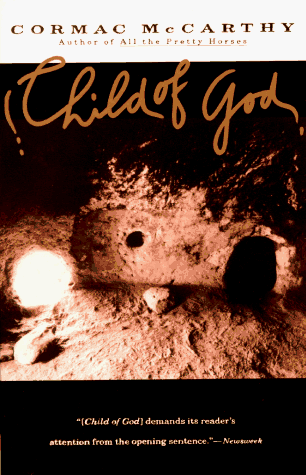
child-of-godReaders looking for redemptive story arcs or tales of heroism will likely be turned off by Child of God, and squeamish readers will probably not get past the first fifty pages. Those interested in McCarthy’s fiction will find more in common here with the visceral grit of The Road or Blood Meridian than the reflective romanticism of his “Border Trilogy” novels (including crowd-pleaser All the Pretty Horses). Child of God continues the Gothicism of Carson McCullers and William Faulkner, bearing a favorable comparison to those writers’ works. And like those writers’ works, McCarthy’s novel has faced its challengers. Those who see the book as obscene are perhaps right, in the sense that the word implies “that which must be shown off stage.” However, one of the legal definitions of obscenity necessitates that the work “lacks serious literary, artistic, political or scientific value,” a claim that I do not think can be seriously substantiated against Child of God. Don’t believe me? Read it for yourself.

[Ed. note–Biblioklept first published a version of this review in 2009. I recently reread the novel in January of 2023, as part of a big McCarthy reread prompted by the publication of his final novels, Stella Maris and The Passenger, and I found Child of God much funnier and sadder than I had remembered.]

“Books are made out of books” | Blood Meridian and Samuel Chamberlain

In his 1992 interview with The New York Times, Cormac McCarthy said, “The ugly fact is books are made out of books. The novel depends for its life on the novels that have been written.” McCarthy’s masterpiece Blood Meridian, as many critics have noted, is made of some of the finest literature out there–the King James Bible, Moby-Dick, Dante’s Inferno, Paradise Lost, Faulkner, and Shakespeare. While Blood Meridian echoes and alludes to these authors and books thematically, structurally, and linguistically, it also owes much of its materiality to Samuel Chamberlain’s My Confession: The Recollections of a Rogue.

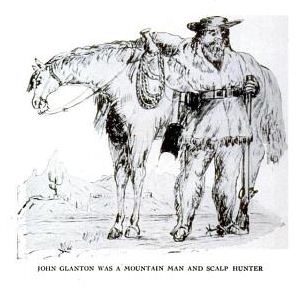
Chamberlain, much like the Kid, Blood Meridian’s erstwhile protagonist, ran away from home as a teenager. He joined the Illinois Second Volunteer Regiment and later fought in the Mexican-American War. Confession details Chamberlain’s involvement with John Glanton’s gang of scalp-hunters. The following summary comes from the University of Virginia’s American Studies webpage

According to Chamberlain, John Glanton was born in South Carolina and migrated to Stephen Austin’s settlement in Texas. There he fell in love with an orphan girl and was prepared to marry her. One day while he was gone, Lipan warriors raided the area scalping the elderly and the children and kidnapping the women- including Glanton’s fiancee. Glanton and the other settlers pursued and slaughtered the natives, but during the battle the women were tomahawked and scalped. Legend has it, Glanton began a series of retaliatory raids which always yielded “fresh scalps.” When Texas fought for its independence from Mexico, Glanton fought with Col. Fannin, and was one of the few to escape the slaughter of that regiment at the hands of the Mexican Gen. Urrea- the man who would eventually employ Glanton as a scalp hunter. During the Range Wars, Glanton took no side but simply assassinated individuals who had crossed him. He was banished, to no avail, by Gen. Sam Houston and fought as a “free Ranger” in the war against Mexico. Following the war he took up the Urrea’s offer of $50 per Apache scalp (with a bonus of $1000 for the scalp of the Chief Santana). Local rumor had it that Glanton always “raised the hair” of the Indians he killed and that he had a “mule load of these barbarous trophies, smoke-dried” in his hut even before he turned professional.
Chamberlain’s Confession also describes a  figure named Judge Holden. Again, from U of V’s summary–

Glanton’s gang consisted of “Sonorans, Cherokee and Delaware Indians, French Canadians, Texans, Irishmen, a Negro and a full-blooded Comanche,” and when Chamberlain joined them they had gathered thirty-seven scalps and considerable losses from two recent raids (Chamberlain implies that they had just begun their careers as scalp hunters but other sources suggest that they had been engaged in the trade for sometime- regardless there is little specific documentation of their prior activities). Second in command to Glanton was a Texan- Judge Holden. In describing him, Chamberlain claimed, “a cooler blooded villain never went unhung;” Holden was well over six feet, “had a fleshy frame, [and] a dull tallow colored face destitute of hair and all expression” and was well educated in geology and mineralogy, fluent in native dialects, a good musician, and “plum centre” with a firearm. Chamberlain saw him also as a coward who would avoid equal combat if possible but would not hesitate to kill Indians or Mexicans if he had the advantage. Rumors also abounded about atrocities committed in Texas and the Cherokee nation by him under a different name. Before the gang left Frontreras, Chamberlain claims that a ten year old girl was found “foully violated and murdered” with “the mark of a large hand on her throat,” but no one ever directly accused Holden.

It’s fascinating to note how much of the Judge is already there–the pedophilia, the marksmanship, the scholarship, and, most interesting of all, the lack of hair. Confession goes on to detail the killing, scalping, raping, and raiding spree that comprises the center of Blood Meridian. Chamberlain even describes the final battle with the Yumas, an event that signals the dissolution of the Glanton gang in McCarthy’s novel.

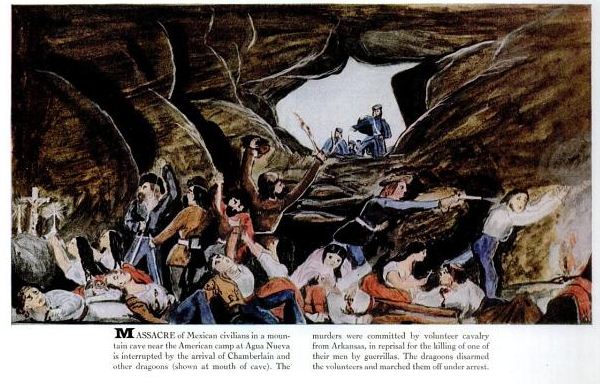
Content aside, Chamberlain’s prose also seems to presage McCarthy’s prose. In his book Different Travelers, Different Eyes, James H. Maguire notes that, “Both venereal and martial, the gore of [Chamberlain’s] prose evokes Gothic revulsion, while his unschooled art, with its stark architectural angles and leaden, keen-edged shadows, can chill with the surreal horrors of the later Greco-Italian painter Giorgio de Chirico.” Yes, Chamberlain was an amateur painter (find his paintings throughout this post), and undoubtedly some of this imagery crept into Blood Meridian.

You can view many of Chamberlain’s paintings and read an edit of his Confession in three editions of Life magazine from 1956, digitally preserved thanks to Google Books–here’s Part I, Part II, and Part III. Many critics have pointed out that Chamberlain’s narrative, beyond its casual racism and sexism, is rife with factual and historical errors. He also apparently indulges in the habit of describing battles and other events in vivid detail, even when there was no way he could have been there. No matter. The ugly fact is that books are made out of books, after all, and if Chamberlain’s Confession traffics in re-appropriating the adventure stories of the day, at least we have Blood Meridian to show for his efforts.
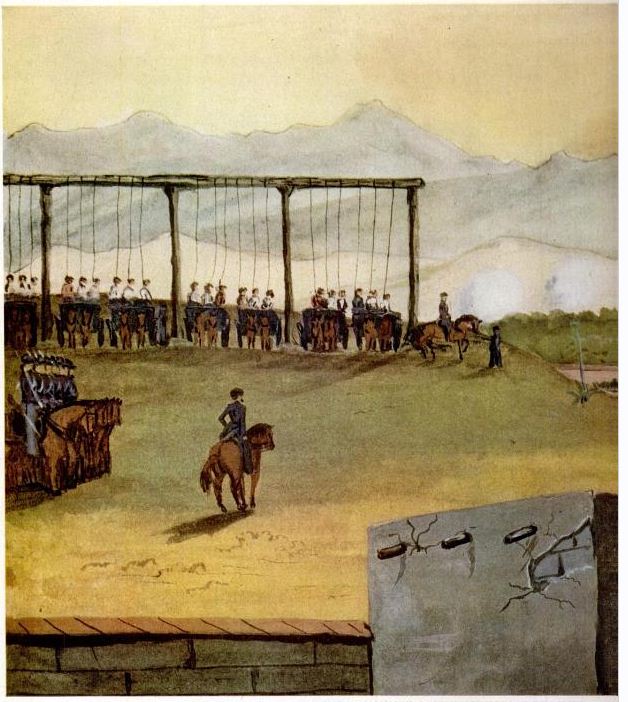
[Ed. note–Biblioklept first ran this post in September of 2010.]

Selections from One-Star Amazon Reviews of Cormac McCarthy’s Blood Meridian

[Editorial note: The following citations come from one-star Amazon reviews Cormac McCarthy’s novel Blood MeridianI’ve preserved the reviewers’ original punctuation and spelling. More one-star Amazon reviews.].


It may be art.

Damn McCarthy.

I find him boring.

unrelenting nihilism

The story is thin at best.

Are we supposed to enjoy it?

I felt abused by Blood Meridian

not a traditionally enjoyable book

this book is simply just not “all that”

wordy, over the top speechy dialogue

endless streams of dependent clauses

I am a devout fan of Cormac McCarthy.

The characters are not really sympathetic

He is obviously a sick man psychologically.

all about violence and no plot what so ever.

if I was a trained geologist I might like it better.

too many words that are not in standard dictionary

I guess people think he is cool because he writes so violent.

This one guy peed on some clay stuff to create a bomb like thing

murder, slaughter, killing, massacre, beating, stabbing, shooting, scalping

It consists of a series of almost unconnected scenes of unspeakable violence.

Esoteric words, eccentric expressions, pedantic philosophizing, arcane symbolism

I have to believe that he must be embarrassed to have this book back on the market.

A bunch of guys ride around Mexico killing everyone they come across for no particular reason

If you’re a fan of babies, quotation marks, and native americans, then avoid this book like the plague.

The reception he has had shows how tone deaf America has become to moral values, any moral values.

This book was written long before McCarthy had mastered the style that has brought him so much fame and credit.

the unrelenting amount of violence and cruelty in Blood Meridian strikes me as having crossed the line to pornography

It seemed like Cormac McCarthy wrote this with a dictionary in his lap trying to find words that he had never used before

Many of the words have to have been made up or are contractions of words and/or non-words, including much Spanish dialogue

Eliminate five words from the English language (“They rode on” and “He spat”)and this book would have been about 25 pages long

In this book, one sees him trying hard to hone his now-extraordinary powers of observation and description, and failing badly.

The standards for writing have clearly fallen far if all the praise heaped upon this inchoate, pompous mess of a novel is to be taken seriously.

Everything died: mules, horses, chickens, plants, rivers, snakes, babies, toddlers, boys, girls, women, men, ranchhands, bartenders, cowboys, good guys, bad guys…

I dont think the writer knows very much about AMERICAN history, the way he makes all the scalping get done by the AMERICANS and never by the indians, nor do I think he a PATRIOT

Wherein a company of men wander northern Mexico and the West killing, maiming, raping, and/or torturing everyone they meet, all described in gory, endless detail, led by the symbolic characters Glanton and his advisor, ‘the judge’, and supposedly illustrating that war and bloodletting are the only things that count, and the rest of life is just a meaningless dance.

Some kid with a few guys and a spattering of mans rambling through some part of the US or Mexico or a post-apocalyptic Australian desert seeing scores of gruesome, pointless scenes of violence, inhumanity, and death.

Holden is the sort of overt child defiling character who in real life wouldn’t last a month in a state penitentiary, because someone would rightly dispatch him as soon as possible.

Self-consciously faux-baroque linguistic stylings make this fetus-hurtin’ Treatise a feast for weakest link readers fascinated by the mark of the beast.

This book has some wonderful flowery language, and some beautiful descriptions of the southwest countryside.

They say that this book contains BIBLICAL themes, but I’ve read it and I don’t see how that could be so.

The author seems as if he is somehow trying to make some kind of “statement” about AMERICA

In a well ordered society McCarthy would be serving a life term or he would not exist at all.

there are times when it even seems as though English were not McCarthy’s first language

this book cannot be called a novel because it does not have character development

Would you let Cormac McCarthy look after your child for the night?

McCarthy is the most evil person because he is a talented writer

the author likes to use pronouns without establishing a subject

Who are the good guys and the bad guys, everyone is bad.

read Lonesome Dove instead, it’s a hundred times better

rampant nonstop mindless violence and depravity

I can’t dislike a book more than I dislike this one

This is a great writer being lazy and skating

good if you enjoy violence and nonsense

Theres lots of scalping of indians

Was there a quota on similes?

this booked scarred me

sociopath killers

It’s pure bunk.

a moral blight

utter trash

Ugh

Suttree, Cormac McCarthy’s Grand Synthesis of American Literature

In his 1992 interview with The New York Times, Cormac McCarthy said, “The ugly fact is books are made out of books. The novel depends for its life on the novels that have been written.” McCarthy’s fourth novel, 1979’s Suttree is such a book, a masterful synthesis of the great literature — particularly American literature — that came before it. And like any masterful synthesis, Suttree points to something new, even as it borrows, lifts, and outright steals from the past. But before we plumb its allusions and tropes and patterns, perhaps we should overview the plot, no?

The novel rambles over several years in the life of Cornelius Suttree. It is the early 1950s in Knoxville, Tennessee, and Suttree ekes out a mean existence on the Tennessee River as a fisherman, living in a ramshackle houseboat on the edge of a shantytown. This indigent life is in fact a choice: Suttree is the college-educated son of an established, wealthy family. His choice is a choice for freedom and self-reliance, those virtues we like to think of, in our prejudicial manner, as wholly and intrinsically American. Suttree then is both Emersonian and Huck Finnian, a reflective and insightful man who finds his soul via a claim to agency over his own individuality, an individuality poised in quiet, defiant rebellion against the conforming forces of civilization. These forces manifest most pointedly in the Knoxville police, a brutal, racist organization, but we also see social constraint in the form of familial duty. One thinks of the final lines of Huckleberry Finn: “I reckon I got to light out for the Territory ahead of the rest, because Aunt Sally she’s going to adopt me and sivilize me and I can’t stand it. I been there before.”

Like Huck, Suttree aims to resist all forces that would “sivilize” him. His time on the river and in the low haunts of Tennessee (particularly the vice-ridden borough of McAnally) brings him into close contact with plenty of other outcasts, but also his conscience, which routinely mulls over its place in the world. Suttree is punctuated by–perhaps even organized by–several scenes of hallucination. Some of these psychotrips result from drunkeness, one comes from accidentally ingesting the wrong kind of mushrooms (or, the right kind, if that’s your thing), and the final one, late in the novel, sets in as Suttree suffers from a terrible illness. In his fever dream, a small nun–surely a manifestation of the guilt that would civilize us–accuses him–

Mr. Suttree it is our understanding that at curfew rightly decreed by law in that hour wherein night draws to its proper close and the new day commences and contrary to conduct befitting a person of your station you betook yourself to various low places within the shire of McAnally and there did squander several ensuing years in the company of thieves, derelicts, miscreants, pariahs, poltroons, spalpeens, curmudgeons, clotpolls, murderers, gamblers, bawds, whores, trulls, brigands, topers, tosspots, sots and archsots, lobcocks, smellsmocks, runagates, rakes, and other assorted and felonious debauchees.

The passage is a marvelous example of McCarthy’s stream-of-consciousness technique in Suttree, moving through the various voices that would ventriloquize Suttree, into the edges of madness, strangeness, and the sublimity of language. The tone moves from somber and portentous into bizarre imagery that blends humor and pathos. This is the tone of Suttree, a language that gives voice to transients and miscreants, affirming the dignity of their humanity even as it details the squalor of their circumstance.

It is among these criminals and whores, transvestites and gamblers that Suttree affirms his own freedom and humanity, a process aided by his comic foil, Gene Harrogate. Suttree meets Harrogate on a work farm; the young hillbilly is sent there for screwing watermelons. After his release, Harrogate moves to a shantytown in Knoxville. He’s the country mouse determined to become the city rat, the would-be Tom Sawyer to Suttree’s older and wiser Huck Finn. Through Harrogate’s endless get-rich-quick schemes, McCarthy parodies that most-American of tales, the Horatio Alger story. Simply put, the boy is doomed, on his  “way up to the penitentiary” as Suttree constantly admonishes. In one episode, Harrogate tries to buy arsenic from “a grayhaired and avuncular apothecary” to poison bats he hopes to sell to a hospital (don’t ask)–

May I help you? said the scientist, his hands holding each other.

I need me some strychnine, said Harrogate.

You need some what?

Strychnine. You know what it is dont ye?

Yes, said the chemist.

I need me about a good cupful I reckon.

Are you going to drink it here or take it with you?

Shit fire I aint goin to drink it. It’s poisoner’n hell.

It’s for your grandmother.

No, said Harrogate, craning his neck suspectly. She’s done dead

Suttree, unwilling father-figure, eventually buys the arsenic for the boy against his better judgment. The scene plays out as a wonderful comic inversion of William Faulkner’s “A Rose for Emily,” from which it is so transparently lifted. McCarthy borrows liberally from Faulkner here, of course, most notably in the language and style of the novel, but also in scenes like this one, or a later episode that plays off Faulkner’s comic-romantic story of a man and a woman navigating the aftermath of a flood, “Old Man.” Unpacking the allusions in Suttree surpasses my literary knowledge or skill, but McCarthy is generous, if oblique, with his breadcrumb trail. Take, for example, the following sentence: “Suttree with his miles to go kept his eyes to the ground, maudlin and muttersome in the bitter chill, under the lonely lamplight.” The forced phrase “miles to go” does not immediately present itself as a reference to Robert Frost’s famous poem, yet the direction of the sentence retreats into the history of American poetry; with its dense alliteration and haunted vowels, it leads us into Edgar Allan Poe territory. Only a few dozen pages later, McCarthy boldly begins a chapter with theft: “In just spring the goatman came over the bridge . . .” The reference to e.e. cummings explicitly signifies McCarthy’s intentions to play with literature. Later in the book, while tripping on mushrooms in the mountains, Suttree is haunted by “elves,” the would-be culprits in Frost’s poem “Mending Wall.” The callback is purposeful, but tellingly, McCarthy’s allusions are not nearly as fanciful as their surface rhetoric might suggest: the goatman does not belong in Knoxville–he’s an archaic relic, forced out of town by the police; the elves are not playful spirits but dark manifestations of a tortured psyche.

Once one spots the line-lifting in Suttree it’s hard to not see it. What’s marvelous is McCarthy’s power to convert these lines, these riffs, these stories, into his own tragicomic beast. An early brawl at a roadhouse recalls the “Golden Day” episode of Ralph Ellison’s Invisible Man; a rape victim’s plight echoes Hubert Selby’s “Tralala”; we find the comic hobos of John Steinbeck’s Cannery Row–we even get the road-crossing turtle from The Grapes of Wrath. A later roadhouse chapter replays the “Circe/Nighttown” nightmare in James Joyce’s Ulysses. Ulysses is an easy point of comparison for Suttree, which does for Knoxville what Joyce did for Dublin. Suttree echoes Ulysses’s language, both in its musicality and appropriation of varied voices, as well as its ambulatory structure, its stream-of-consciousness technique, its rude earthiness, and its size (nearly 600 pages). But, as I argued earlier, there’s something uniquely American about Suttree, and its literary appropriations tend to reflect that. Hence, we find Mark Twain, Herman Melville, Ernest Hemingway, Walt Whitman, Emerson and Thoreau, Emily Dickinson, and William Carlos Williams, to name just a few writers whose blood courses through this novel (even elegant F. Scott Fitzgerald is here, in an unexpected Gatsbyish episode late in the novel).

Making a laundry list of writers is weak criticism though, and these sources–all guilty of their own proud plagiarisms–are mentioned only as a means to an end, to an argument that what McCarthy does in Suttree is to synthesize the American literary tradition with grace and humor, while never glossing over its inherent dangers and violence. So, while it appropriates and plays with the tropes of the past, Suttree is still pure McCarthy. Consider the following passage, which arrives at the end of a drunken, awful spree, Suttree locked up for the night–

He closed his eyes. The gray water that dripped from him was rank with caustic. By the side of a dark dream road he’d seen a hawk nailed to a barn door. But what loomed was a flayed man with his brisket tacked open like a cooling beef and his skull peeled, blue and bulbous and palely luminescent, black grots his eyeholes and bloody mouth gaped tonguless. The traveler had seized his fingers in his jaws, but it was not alone this horror that he cried. Beyond the flayed man dimly adumbrate another figure paled, for his surgeons move about the world even as you and I.

Suttree’s dark vision points directly toward the language of McCarthy’s next novel, 1985’s Blood Meridian, roundly considered his masterpiece. Critics who disagree tend to point to Suttree as the pinnacle of McCarthy’s writing. I have no interest at this time in weighing the books against each other, nor do I think that doing so would be especially enlightening. For all of their sameness, they are very different animals: Suttree provides us intense access to its hero’s consciousness, where Blood Meridian always keeps the reader on the outside of its principals’ souls (if those grotesques could be said to have souls). And while Blood Meridian does display some humor, it is the blackest and driest humor I’ve ever read. Suttree is broader and more compassionate; it even has a fart joke. Blood Meridian, at least in my estimation (and many critics will contend this notion) has no flawed episodes; much of this results from the book’s own internal program–it resists love, compassion, and even human dignity. In contrast, Suttree is punctuated by two deaths the audience is meant to read as tragic, yet I found it impossible to do so. The first is the death of Suttree’s child, whom he has abandoned, along with its mother. As such, he is not permitted to take part in the funeral, observing the process rather from its edges. The second tragedy is the death of Suttree’s young lover in a landslide. The book begs us to empathize with Suttree, just as he often empathizes with the marginal figures in the novel, but ultimately these tragedies are a failed ploy. They underwrite a sublime encounter with death for Suttree, an encounter that deepens and enriches his character while paradoxically freeing him from the burdens of social duty and familial order. McCarthy is hardly alone in such a move; indeed, it seems like the signature trope of American masculine literature to me. It’s the move that Huck Finn wishes to make when he promises to light out for the Territory to escape the civilizing body of Aunt Sally; it’s the ending that Hemingway was compelled to give to Frederic Henry at the end of A Farewell to Arms; it’s all of Faulkner, with his mortification of fatherhood and the dramatic responsibility fatherhood entails. It is a cost analysis that neglects any potential benefits.

But these are small criticisms of a large, beautiful, benevolent novel, a book that begs to be reread, a rambling picaresque of comic and tragic proportions. “I learned that there is one Suttree and one Suttree only,” our hero realizes, but this epiphany is set against a larger claim. Near the end of the novel, Suttree goes to check on an old ragman who he keeps a watchful eye on. He finds the man dead, his shack robbed, his body looted. Despairing over the spectacle’s abject lack of humanity, Suttree cries, “You have no right to represent people this way,” for “A man is all men. You have no right to your wretchedness.” Here, Suttree’s painful epiphany is real and true, an Emersonian insight coded in the darkest of Whitman’s language. If there is one Suttree and one Suttree only, he is still beholden to all men; to be anti-social or an outcast is not to be anti-human. Self-hood is ultimately conditional on others and otherness. To experience the other’s wretchedness is harrowing; to understand the other’s wretchedness and thus convert it to dignity is life-affirming and glorious. Suttree is a brilliant, bold, marvelous book. Very highly recommended.

[Ed. note—Biblioklept originally published a version of this review on November 27, 2010].