Mail call | Thomas Pynchon

A great shout went up near the doorway, bodies flowed toward a fattish pale young man who’d appeared carrying a leather mailsack over his shoulder.

“Mail call,” people were yelling. Sure enough, it was, just like in the army. The fat kid, looking harassed, climbed up on the bar and started calling names and throwing envelopes into the crowd. Fallopian excused himself and joined the others.

Metzger had taken out a pair of glasses and was squinting through them at the kid on the bar. “He’s wearing a Yoyodyne badge. What do you make of that?”

“Some inter-office mail run,” Oedipa said.

“This time of night?”

“Maybe a late shift?” But Metzger only frowned. “Be back,” Oedipa shrugged, heading for the ladies’ room.

On the latrine wall, among lipsticked obscenities, she noticed the following message, neatly indited in engineering lettering:

“Interested in sophisticated fun? You, hubby, girl friends. The more the merrier. Get in touch with Kirby, through WASTE only. Box 7391. L. A.”

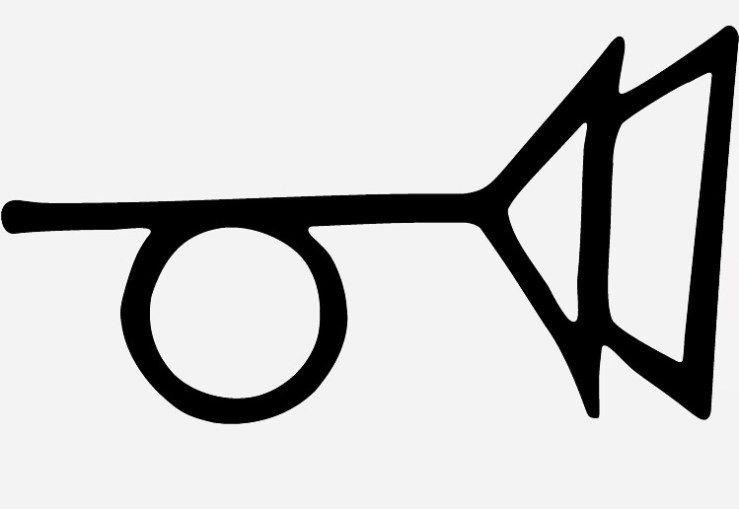
WASTE? Oedipa wondered. Beneath the notice, faintly in pencil, was a symbol she’d never seen before, a loop, triangle and trapezoid, thus:

img_5980

It might be something sexual, but she somehow doubted it. She found a pen in her purse and copied the address and symbol in her memo book, thinking: God, hieroglyphics. When she came out Fallopian was back, and had this funny look on his face.

“You weren’t supposed to see that,” he told them. He had an envelope. Oedipa could see, instead of a postage stamp, the handstruck initials PPS.

“Of course,” said Metzger. “Delivering the mail is a government monopoly. You would be opposed to that.”

Fallopian gave them a wry smile. “It’s not as rebellious as it looks. We use Yoyodyne’s inter-office delivery. On the sly. But it’s hard to find carriers, we have a big turnover. They’re run on a tight schedule, and they get nervous. Security people over at the plant know something’s up. They keep a sharp eye out. De Witt,” pointing at the fat mailman, who was being hauled, twitching, down off the bar and offered drinks he did not want, “he’s the most nervous one we’ve had all year.”

“How extensive is this?” asked Metzger.

“Only inside our San Narciso chapter. They’ve set up pilot projects similar to this in the Washington and I think Dallas chapters. But we’re the only one in California so far. A few of your more affluent type members do wrap their letters around bricks, and then the whole thing in brown paper, and send them Railway Express, but I don’t know . . .”

“A little like copping out,” Metzger sympathized.

“It’s the principle,” Fallopian agreed, sounding defensive. “To keep it up to some kind of a reasonable volume, each member has to send at least one letter a week through the Yoyodyne system. If you don’t, you get fined.” He opened his letter and showed Oedipa and Metzger.

Dear Mike, it said, how are you? Just thought I’d drop you a note. How’s your book coming? Guess that’s all for now. See you at The Scope.

That’s how it is,” Fallopian confessed bitterly, “most of the time.”

“What book did they mean?” asked Oedipa.

Turned out Fallopian was doing a history of private mail delivery in the U. S., attempting to link the Civil War to the postal reform movement that had begun around 1845. He found it beyond simple coincidence that in of all years 1861 the federal government should have set out on a vigorous suppression of those independent mail routes still surviving the various Acts of ’45, ’47, ’51 and ’55, Acts all designed to drive any private competition into financial ruin. He saw it all as a parable of power, its feeding, growth and systematic abuse, though he didn’t go into it that far with her, that particular night. All Oedipa would remember about him at first, in fact, were his slender build and neat Armenian nose, and a certain affinity of his eyes for green neon.

So began, for Oedipa, the languid, sinister blooming of The Tristero.


From The Crying of Lot 49 by Thomas Pynchon.

In which I read Playboy for the Thomas Pynchon article

A few years ago I posted a brief excerpt from Jules Siegel’s March 1977 Playboy profile “Who is Thomas Pynchon… And Why Did He Take Off With My Wife?” The excerpt came from an excerpt posted on the Pynchon-L forum, but most of the article had been removed at the (apparent) request by Siegel. A few people sent me the whole article though (thanks!) and I read it.

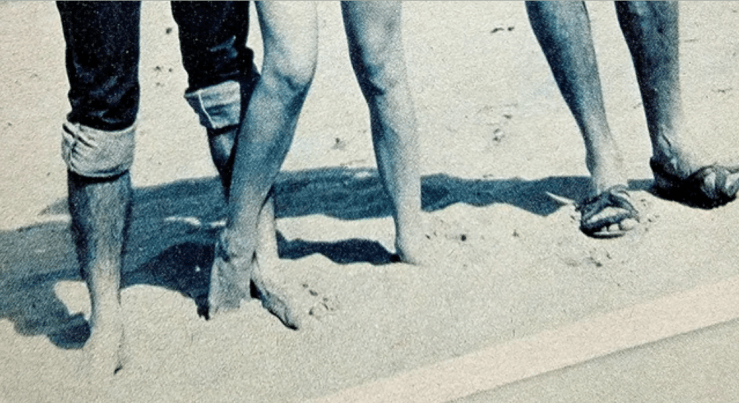
Pick Pynchon’s feet. Or don’t!

Jules Siegel was briefly a Cornell classmate of Pynchon’s in 1954, and they remained friends (in Siegel’s recollection) for at least two decades after. During this time, Siegel claims that Pynchon wrote him dozens of letters, which were ultimately sold at auction (along with much of Siegel’s property) to help pay for a hip replacement. Material from the letters soak into Siegel’s sketch of Pynchon’s progress, along with several stoned/drunken adventures that would not be out of place in V. or Mason & Dixon or Gravity’s Rainbow, or really, any person’s young life.

A competitive anxiety reverberates under the piece. “We were friends, maybe at some points best friends, very much alike in some important ways,” Siegel writes. “We were both writers,” he boldly writes. Siegel reminds us that “In Mortality and Mercy in Vienna, Pynchon’s first published short story, the protagonist is one Cleanth Siegel,” but protests he doesn’t see himself in that hero.

The competitive anxieties culminate in the big reveal that (spoiler!) Thomas Pynchon had an affair with Siegel’s second wife Chrissie. There’s probably a Freudian reading we can append to the details that Siegel offers about Pynchon’s sexual prowess: “He was a wonderful lover, sensitive and quick, with the ability to project a mood that turned the most ordinary surroundings into a scene out of a masterful film—the reeking industrial slum of Manhattan Beach would become as seen through the eye of Antonioni, for example.”

Or maybe these unsexy details are just a sign of Playboy’s editorial hand. Wedged gracelessly between ads for vibrators and nude greeting cards, Siegel’s lines often reek of 1970’s Playboy’s rhetorical house style, a kind of frank-but-(attempted)-sensual glossiness that contrasts heavily with Pynchon’s own sex writing. At times I found myself reading Siegel’s prose in one of Will Ferrell’s more pompous accents.

Even worse is the casual sexism of the piece—which again, may be attributable to Playboy’s editors. Siegel, on his first wife (sixteen when he married her): “She was so wonderful a lover, generous and easily aroused, but I was too callow then to appreciate her.” Of his second wife: “It is easy to underestimate her intelligence, but it is a mistake. She is obviously too pretty to be serious, conventional wisdom would have you believe.” Of one of Pynchon’s girlfriends: “Susan has red hair and is breathtakingly beautiful, with the voluptuous body of a showgirl. Like Chrissie, she is much brighter than she looks.”

More interesting, obviously, are the (supposedly) real-life details that inform Pynchon’s fiction. Siegel notes some of the contents of Pynchon’s Manhattan Beach apartment: “A built-in bookcase had rows of piggy banks on each shelf and there was a collection of books and magazines about pigs.” Pigs, of course, are a major motif of Gravity’s Rainbow. Another detail that seems to connect to GR: “On the desk, there was a rudimentary rocket made from one of those pencil-like erasers with coiled paper wrappers that you unzip to expose the rubber. It stood on a base twisted out of a paper clip.” Siegel lets us know that he knocked the rocket down. Pynchon puts it back together; Siegel knocks it down again.

(Parenthetically: Siegel’s evocation of Pynchon’s Manhattan Beach days fits neatly into my picture of Inherent Vice).

In accounting details of Pynchon’s alleged affair with his wife, Chrissie, Siegel shares the following:

Once, out on the freeway, she told him that we had all gone naked at the commune, he professed to find that incredible and dared her to take off her blouse right there. She did. A passing truck hooted its horn in lewd applause. He loved her Shirley Temple impersonations—On the Good Ship Lollipop sung and danced like a kid at a birthday party. They talked about running away together.

It is hardly possible here not to recall the episode early in Gravity’s Rainbow wherein Jessica Swanlake removes her blouse in the car on a dare from Roger Mexico. Is Siegel daring the reader to extrapolate further? Extrapolation, paranoid connections—isn’t this part of Pynchonian fun?

In that spirit, I’ll close with my favorite moment from the article.

“You know the W.A.S.T.E. horn in The Crying of Lot 49? The symbol of the secret message service? Every weirdo in the world is on my wave length. You cannot understand the kind of letters I get. Someone wrote to tell me that the very same horn was the symbol of a private mail system in medieval times. I checked it out at the library. It’s true. But I made it up myself before the book was ever published, before I ever got that letter.”

The lines are supposedly from Pynchon himself. Siegel even puts them in quotation marks—so they must be real, right?

[Ed. note: Biblioklept ran a version of this post in 2015. Enjoy Pynchon in Public Day tomorrow!]

“Solid Objects” — Virginia Woolf

“Solid Objects”

by

Virginia Woolf


The only thing that moved upon the vast semicircle of the beach was one small black spot. As it came nearer to the ribs and spine of the stranded pilchard boat, it became apparent from a certain tenuity in its blackness that this spot possessed four legs; and moment by moment it became more unmistakable that it was composed of the persons of two young men. Even thus in outline against the sand there was an unmistakable vitality in them; an indescribable vigour in the approach and withdrawal of the bodies, slight though it was, which proclaimed some violent argument issuing from the tiny mouths of the little round heads. This was corroborated on closer view by the repeated lunging of a walking-stick on the right-hand side. “You mean to tell me . . . You actually believe. . .” thus the walking-stick on the right-hand side next the waves seemed to be asserting as it cut long straight stripes upon the sand.

“Politics be damned!” issued clearly from the body on the left-hand side, and, as these words were uttered, the mouths, noses, chins, little moustaches, tweed caps, rough boots, shooting coats, and check stockings of the two speakers became clearer and clearer; the smoke of their pipes went up into the air; nothing was so solid, so living, so hard, red, hirsute and virile as these two bodies for miles and miles of sea and sandhill.
Continue reading ““Solid Objects” — Virginia Woolf”

The Letter — Agnes Goodsir

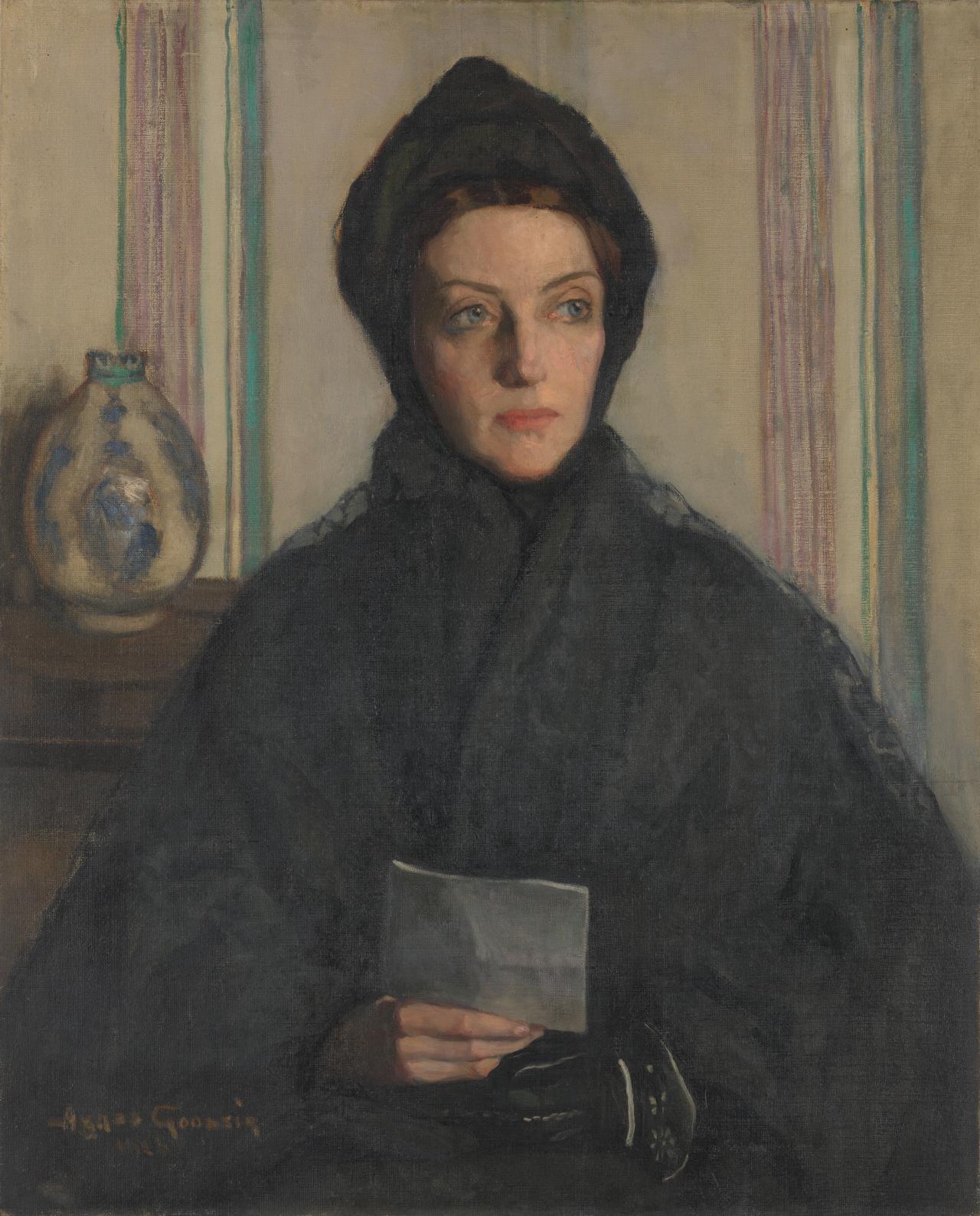
The Letter, 1926 by Agnes Goodsir (1864-1939)

Lords and Ladies — Gluck

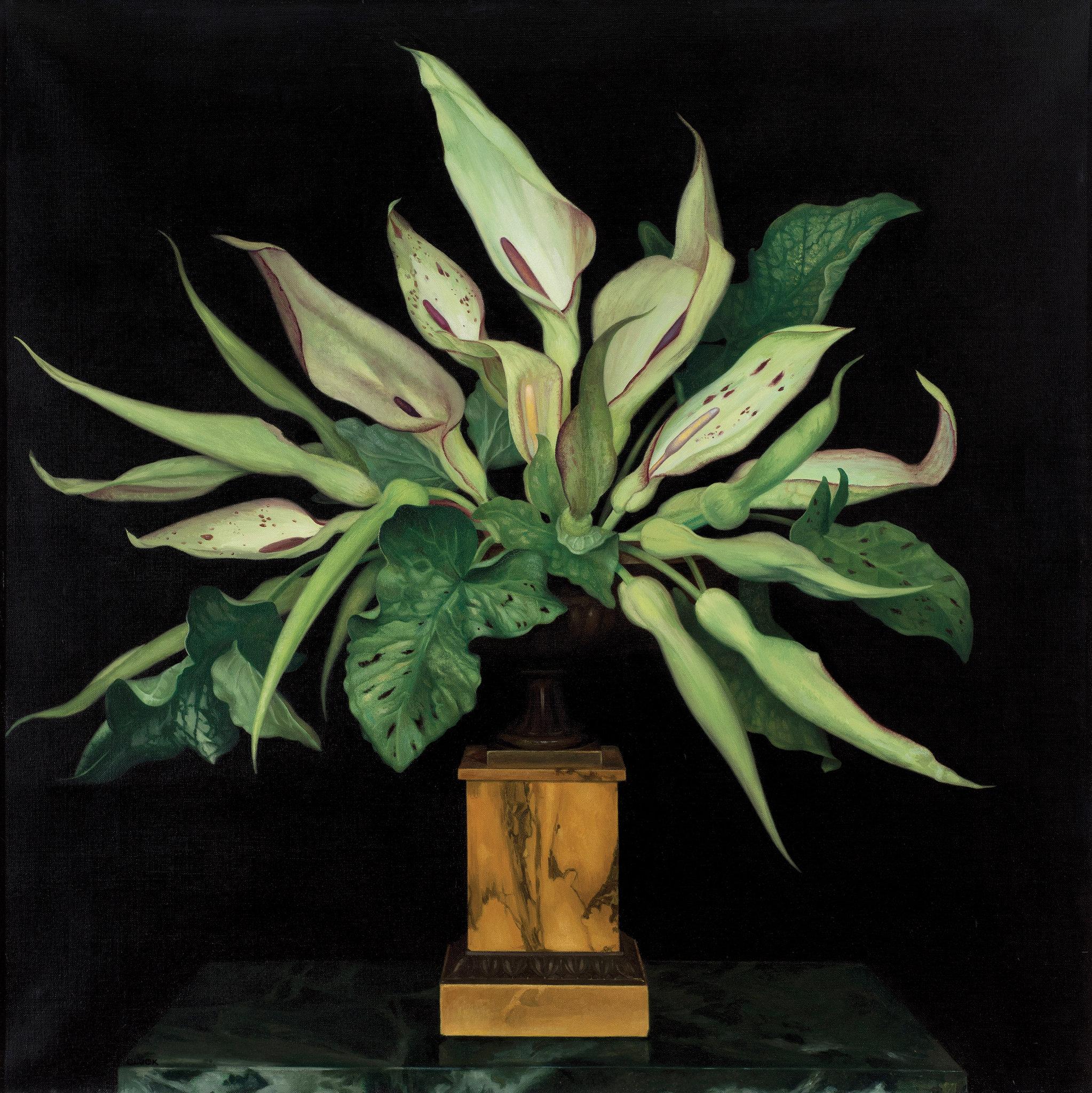
Lords and Ladies, 1936 by Gluck (Hannah Gluckstein, 1895-1978)

Blog about some recent reading

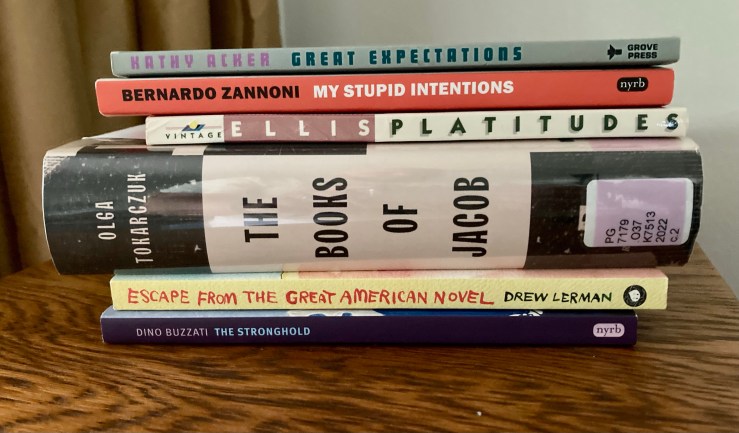
With the end of the spring term (and, frankly, a renewed commitment to weeknight sobriety), I’ve been reading a lot more and a lot faster the past few weeks. Top to bottom:

I pulled Kathy Acker’s Great Expectations out a few nights ago and ended up reading all of it over two nights and two mornings. Not the best starting point for Acker but strangely super, super readable.

Bernardo Zannoni’s My Stupid Intentions: I actually haven’t even done one of those silly “book acquired” posts for this one: I picked it up and just kept reading. Totally zapped me, fantastic stuff: a brash, sharp, sardonic animal rant against god his own self. Loved loved loved it.

I’ve got about a third left of Trey Ellis’s first 1988 novel Platitudes, and it’s really good—reminds me a lot of Ishmael Reed’s middle period stuff, Fran Ross’s Oreo, David Foster Wallace’s early fiction, and even Bret Easton Ellis. Platitudes is a send up of coming-of-age novels conveyed through linguistic channel surfing.

I finished the audiobook of Olga Tokarczuk’s novel The Books of Jacob (translated by Jennifer Croft) this afternoon. I’d been switch-hitting between the novel and audiobook, but gave over to my earplugs during a week of long commutes and longer chores—but returning to the print version for the images, maps, and, uh names. This is a novel larded with names and names and names. The Books of Jacob is a (and I don’t use this hackneyed bookworld word lightly) kaleidoscopic biopic of the 18th-c. messianic cult leader Jacob Frank. Close to 1000 pages/36 hours, The Books of Jacob is exhaustive, exhilarating, and exhaustive. Best of all, at the end of all, we don’t really know Jacob—we just get picture after perspective after point of view on the self-proclaimed savior.

I wrote about Drew Lerman’s Escape from the Great American Novel yesterday, right?

I also managed to get out a review of Lawrence Venuti’s new English translation of Dino Buzzati’s novel The Stronghold, which is strong holding the bottom of the stack above.

Electric Chair — Eric Fischl

Electric Chair, 1979 by Eric Fischl (b. 1948)

Read “The Three Castles” an Italian folktale retold by Italo Calvino

“The Three Castles”

an Italian folktale retold by Italo Calvino

translated by George Martin


A boy had taken it into his head to go out and steal. He also told his mother.

“Aren’t you ashamed!” said his mother. “Go to confession at once, and you’ll see what the priest has to say to you.”

The boy went to confession. “Stealing is a sin,” said the priest, “unless you steal from thieves.”

The boy went to the woods and found thieves. He knocked at their door and got himself hired as a servant.

“We steal,” explained the thieves, “but we’re not committing a sin, because we rob the tax collectors.”

One night when the thieves had gone out to rob a tax collector, the boy led the best mule out of the stable, loaded it with gold pieces, and fled.

He took the gold to his mother, then went to town to look for work. In that town was a king who had a hundred sheep, but no one wanted to be his shepherd. The boy volunteered, and the king said, “Look, there are the hundred sheep. Take them out tomorrow morning to the meadow, but don’t cross the brook, because they would be eaten by a serpent on the other side. If you come back with none missing, I’ll reward you. Fail to bring them all back, and I’ll dismiss you on the spot, unless the serpent has already devoured you too.”

To reach the meadow, he had to walk by the king’s windows, where the king’s daughter happened to be standing. She saw the boy, liked his looks, and threw him a cake. He caught it and carried it along to eat in the meadow. On reaching the meadow, he saw a white stone in the grass and said, “I’ll sit down now and eat the cake from the king’s daughter.” But the stone happened to be on the other side of the brook. The shepherd paid no attention and jumped across the brook, with the sheep all following him.

The grass was high there, and the sheep grazed peacefully, while he sat on the stone eating his cake. All of a sudden he felt a blow under the rock which seemed to shake the world itself. The boy looked all around but, seeing nothing, went on eating his cake. Another blow more powerful than the first followed, but the shepherd ignored it. There was a third blow, and out from under the rock crawled a serpent with three heads. In each of its mouths it held a rose and crawled toward the boy, as though it wanted to offer him the roses. He was about to take them, when the serpent lunged at him with its three mouths all set to gobble him up in three bites. But the little shepherd proved the quicker, clubbing it with his staff over one head and the next and the next until the serpent lay dead.

Then he cut off the three heads with a sickle, putting two of them into his hunting jacket and crushing one to see what was inside. What should he find but a crystal key. The boy raised the stone and saw a door. Slipping the key into the lock and turning it, he found himself inside a splendid palace of solid crystal. Through all the doors came servants of crystal. “Go
od day, my lord, what are your wishes?”

“I wish to be shown all my treasures.”

So they took him up crystal stairs into crystal towers; they showed him crystal stables with crystal horses and arms and armor of solid crystal. Then they led. him into a crystal garden down avenues of crystal trees in which crystal birds sang, past flowerbeds where crystal flowers blossomed around crystal pools. The boy picked a small bunch of flowers and stuck the bouquet in his hat. When he brought the sheep home that night, the king’s daughter was looking out the window and said, “May I have those flowers in your hat?”

“You certainly may,” said the shepherd. “They are crystal flowers culled from the crystal garden of my solid crystal castle.” He tossed her the bouquet, which she caught.

When he got back to the stone the next day, he crushed a second serpent head and found a silver key. He lifted the stone, slipped the silver key into the lock and entered a solid silver palace. Silver servants came running up saying, “Command, our lord!” They took him off to show him silver kitchens, where silver chickens roasted over silver fires, and silver gardens where silver peacocks spread their tails. The boy picked a little bunch of silver flowers and stuck them in his hat. That night he gave them to the king’s daughter when she asked for them.

The third day, he crushed the third head and found a gold key. He slipped the key into the lock and entered a solid gold palace, where his servants were gold too, from wig to boots; the beds were gold, with gold sheets, pillows, and canopy; and in the aviaries fluttered hundreds of gold birds. In a garden of gold flowerbeds and fountains with gold sprays, he picked a small bunch of gold flowers to stick in his hat and gave them to the king’s daughter that night.

Now the king announced a tournament, and the winner would have his daughter in marriage. The shepherd unlocked the door with the crystal key, entered the crystal palace and chose a crystal horse with crystal bridle and saddle, and thus rode to the tournament in crystal armor and carrying a crystal lance. He defeated all the other knights and fled without revealing who he was.

The next day he returned on a silver horse with trappings of silver, dressed in silver armor and carrying his silver lance and shield. He defeated everyone and fled, still unknown to all. The third day he returned on a gold horse, outfitted entirely in gold. He was victorious the third time as well, and the princess said, “I know who you are. You’re the man who gave me flowers of crystal, silver, and gold, from the gardens of your castles of crystal, silver, and gold.”

So they got married, and the little shepherd became king.

And all were very happy and gay,

But to me who watched they gave no thought nor pay.

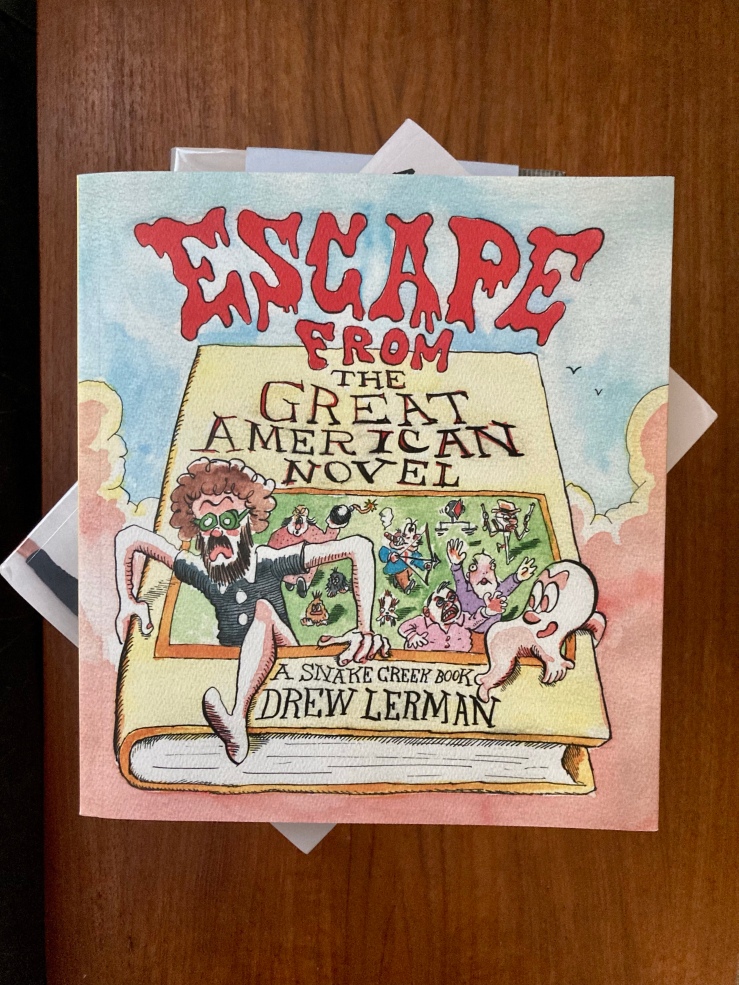
Drew Lerman’s Escape from the Great American Novel (Book acquired, end of April 2023)

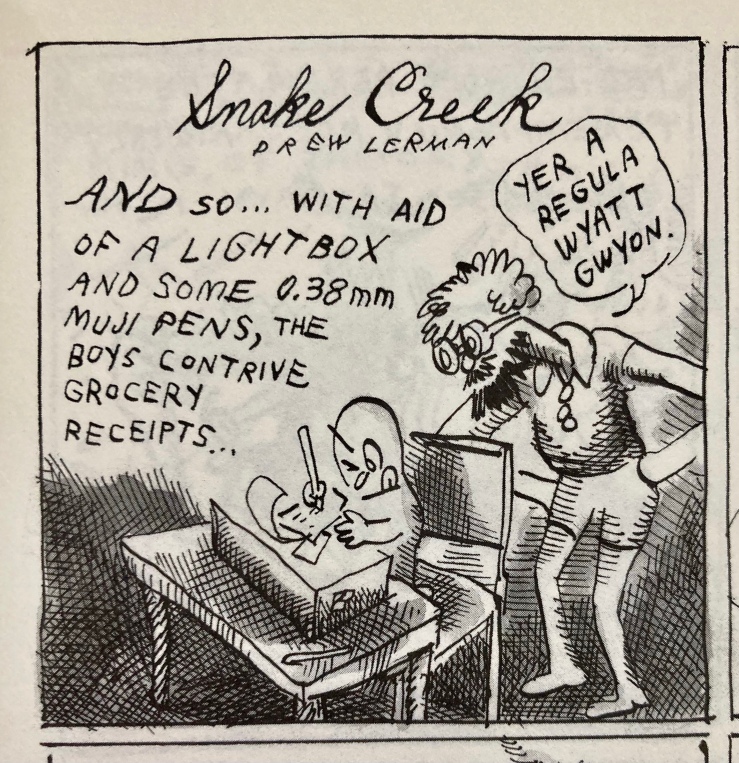
I’ve long been a fan of Drew Lerman’s Snake Creek strip, and eagerly look forward to each new collection. The latest is Escape from the Great American Novel, which I’ve tried not to read all at once. I should have a full review in the next few weeks, but so far, Great Stuff—Escape is funny, erudite without being precious, and soulful. It also shows an expansion of Lerman’s narrative development (without sacrificing the kind of gags and send ups that one wants out of a great strip).

Here’s publisher Radiator Comics’ description:

Escape from the Great American Novel by Drew Lerman follows best friends, Roy and Dav, as they find themselves on opposite sides of a battle between apocalyptic oil barons and bomb-chucking anarchists. But Dav just wants to write the Great American Novel, while Roy wonders what the big deal is—after all, their world is only another fiction.

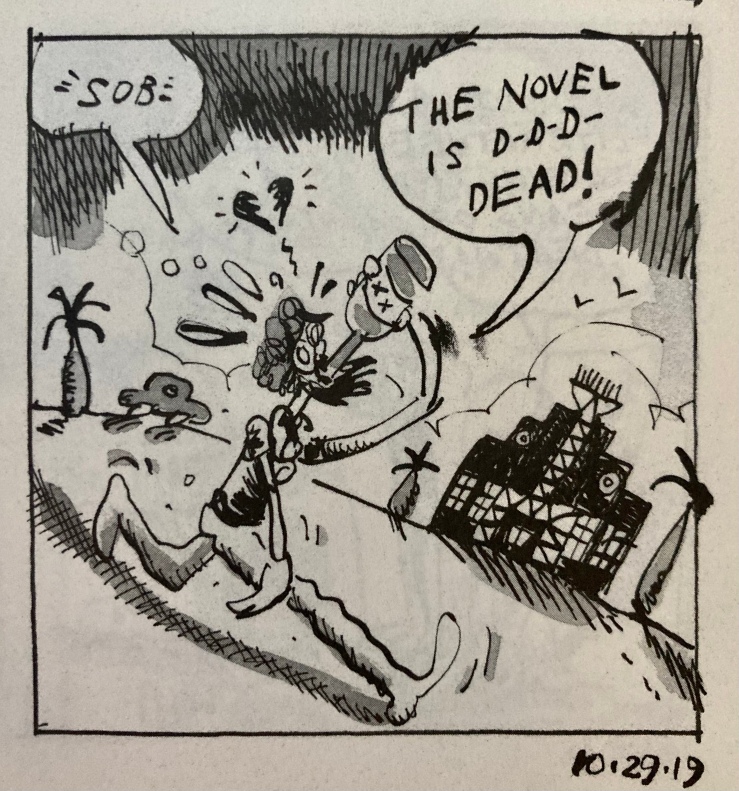
And here’s a nice little throwaway Gaddis gag:

Neo-Cubist Calvin

Ballard/Colquhoun/Gray (Books acquired, 28 April 2023)

After an early spring purge n’ clean, I took a few boxes of books to my local used bookstore. I had intended to browse just a bit and not pick up anything (apart from a few Jeff VanderMeer novels my son had asked for), but I wound up getting three books: a pristine first U.S. edition of J.G. Ballard’s The Unlimited Dream Company, Alasdair Gray’s Unlikely Stories, Mostly, and surrealist artist Ithell Colquhoun’s ostensible biography of the occultist Samuel Liddell MacGregor Mathers (of the Golden Dawn).

I had never heard of Colquhoun’s book, but I’m a fan of her paintings and the cover struck me. The book seems to be a history of the occult organization the Golden Dawn, or, more to the point, the roots of that organization. It’s filled with photographs and diagrams and charts. Like this one:

Alasdair Gray’s collection Unlikely Stories, Mostly is also crammed with illustrations—Gray’s own, like this one:

Like Gray’s 1984 novel 1982, Janine, the collection is filled with typographic experiments, a kind of concrete poetry in prose I guess. The “About the Author” blurb on the flap is great stuff (still can’t top the blurb for 1982, Janine though):

On the Contrary — Kay Sage

On the Contrary, 1952 by Kay Sage (1898-1963)

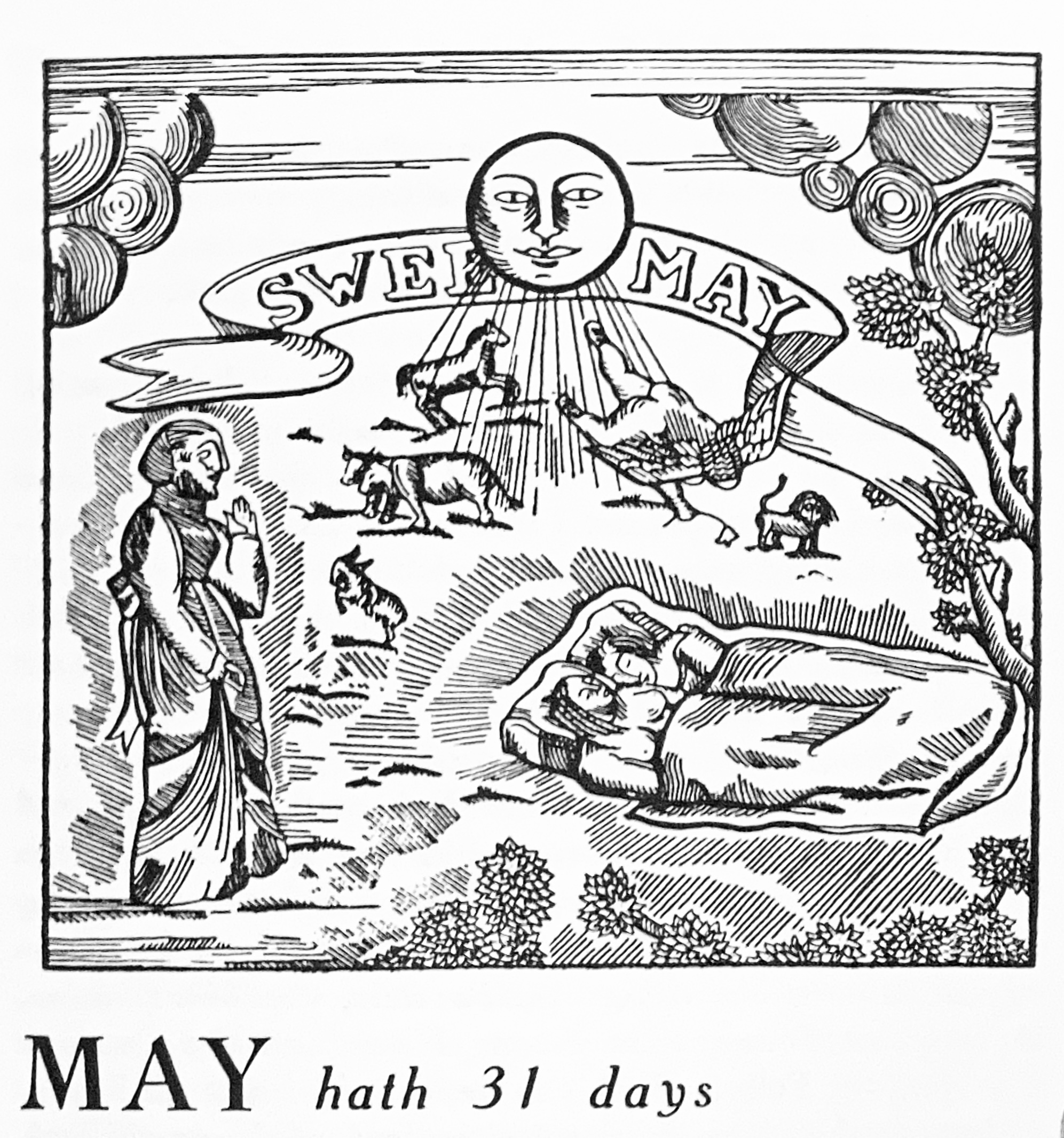
May hath 31 days | Djuna Barnes

A/B (Panic Fables) — Alejandro Jodorowsky

A review of The Stronghold, Dino Buzzati’s novel of deferred hope and ecstatic boredom

Dino Buzzati’s 1940 novel Il deserto dei Tartari (retitled The Stronghold in Lawrence Venuti’s new English translation) takes place in an unidentified time in an unidentified country. Our protagonist is Giovanni Drogo, freshly graduated from an unspecified military academy and ready for a thrilling life of combat and adventure at his new post, Fortezza Bastiani, a fortress at the border of the Tartar steppe. He and his fellow soldiers wait in the hope of attaining glory.

And they continue to wait.

The nebulous Tartars repeatedly fail to appear, offering only the vaguest hints of their alien existence. The soldiers of Fortezza Bastiani live a life of anxious monotony, their desires and hopes for the heroics of war flattened by the boredom of day to day life. It’s all very existentialist.

From the opening pages of The Stronghold, Buzzati conjures a strange but familiar world, usually telegraphed in brisk, unadorned prose (a style he honed in his career as a journalist). Everything is slightly off, slightly anxious. Initially, a reader might chalk the disquieting style up to our viewpoint-character Drogo’s own hesitancy as he enters into a new life as a military officer, but we soon find ourselves in an uncanny realm.

The world of the fortezza is somehow simultaneously dull and enthralling. Consider Drogo’s first glimpse of the fortress:

Fortezza Bastiani was neither imposing, with its low walls, or beautiful in any  way. Its towers and ramparts weren’t picturesque. Absolutely nothing alleviated its starkness or recalled the sweet things of life. Yet Drogo gazed at it, hypnotized, as on the previous night at the base of the gorge. And an inexplicable ardor penetrated his heart.

This “inexplicable ardor” is nevertheless ambiguous in its penetration; after learning he is nominally free to choose a different, perhaps more invigorating post, Drogo elects to transfer from the fort. However, his commanding officer suggests that he stay for four months to avoid bureaucratic problems with the higher ups. That four-month season of waiting turns into a lifetime of waiting. And then waiting some more.

Drogo and his fellow soldiers hunger for the glory of contesting the Tartars, an enemy they know utterly nothing about. Like almost every sociopolitical, cultural, and even technological detail in The Stronghold, the specific nature of the Tartar enemy is collapsed into something closer to a fairy tale or a rumor. Vague and dreamlike, the Tartars are not a geopolitical entity; they are not even an other, but rather the figment of an other, the kernel of a dream that promises action. And this dim promise keeps the soldiers waiting at the Fortezza:

From the northern desert would arrive their fortune, the occasion of their exploits, the miraculous hour that befalls everyone at least once. Because of this vague eventuality, which grew increasingly uncertain with time, grown men wasted the best part of their lives there.

The narrator, hovering in Drogo’s consciousness, imagines an interlocutor explaining to one of these soldiers that his “entire life will be the same, utterly the same, till the very last moment” — and then imagines the hypothetical soldier’s response: “Something else must come to pass, something truly worthy.” Drogo here believes he has grasped the “transparent secret” of the soldiers of the Fortezza, but also imagines himself an “uncontaminated onlooker.” But it’s too late. Drogo too has committed to waiting for something else to come to pass.

Nothing comes to pass—or nearly nothing. (One might read The Stronghold as an extended riff on Kafka’s wonderful parable “Before the Law.“) However, this is not to say though that Buzzati’s portraiture of tedium is itself tedious. The boredom he conjures is an ecstatic boredom, anxious and writhing, exploding in strange, magical moments of hallucinations and night terrors.

In one of the novel’s most extraordinary sequences, “fragile apparitions, quite like fairies” enter Drogo’s dreams, bearing away to some spectacular land Drogo’s fallen comrade who is now converted to a child dressed in a rich velvet suit. In another episode, a mysterious horse appears from the desert, sending the men into fits of hope and despair culminating in a horrific incident that underscores the absurdities of military rigor. Late in the novel, a much-older Drogo’s desire for action, for something to come to pass, tips into near-comic paranoia, as he and a younger officer fool around with a telescope to no avail.

After all this waiting in hope, The Stronghold concludes with a devastating Kafkaesque punchline which I shall not spoil here.

It will be clear to most seasoned readers that Kafka was an influence on Buzzati even without Venuti’s afterword, which details Buzzati’s admiration for the Bohemian writer. Buzzati does not ape the older master so much as evoke the same state of anxious alterity we find in texts like “The Great Wall of China” and The Castle. Stepping into The Stronghold, one is reminded of other branches of the Kafka tree, like Kazuo Ishiguro’s The Unconsoled, Kobo Abe’s The Woman in the Dunes, Alasdair Gray’s Lanark, and Albert Camus’ The Stranger, among many others.

Like many Kafkaesque works, one might be inclined to fob his own allegorical readings onto The Stronghold. In his afterword, Venuti points out that early English-language readings of Buzzati’s novel tended to interpret Il deserto dei Tartari as an anti-totalitarian tract. Il deserto dei Tartari was first translated as The Tartar Steppe by Stuart Hood in 1952, and many of its contemporary critics read the novel against the backdrop of the Cold War.

While praising the “remarkable accomplishment” of Hood’s translation, Venuti differentiates his own “historically oriented interpretation” of the novel; namely, his attempt to more emphatically underline Il deserto dei Tartari’s “latent critique” of fascism. Venuti points out that “Hood had twice rendered the generic ‘stivali’ (boots) with the politically marked term ‘jackboots,'” adding, “I tripled its use.”

Venuti also discusses at some lengths his choice to change Hood’s title. He writes that Buzzati initially wanted to title the book La fortezza, but this name was rejected by the novel’s publisher who worried it might be misunderstood by the reading public. In his attempt to further historicize his translation (and differentiate it from Hood’s), Venuti elected to remove Steppe from the title fearing it “might be taken as an anachronistic reference to the Soviet Union.” He also avoided The Fort or The Fortress as a possible titles, worried they might underscore Buzzati’s “debt to Kafka’s The Castle.” Venuti eventually settled on The Stronghold, suggesting that this title helps to emphasize the “cult of virility championed during the Fascist period” while also “conveying the sheer tenaciousness of the soldier’s heroic fantasies, as well as their inability to escape their debilitating obsession.”

I haven’t read Hood’s translation of Il deserto dei Tartari, but I appreciated Venuti’s, which, as I pointed out above, takes place in an unidentified time in an unidentified country. The novel’s eerie, fable-like quality—a quality that resists historicity—is what most engages me. Buzzati’s book captures the paradox of a modern life that valorizes the pursuit of glory (or at least happiness) while simultaneously creating a working conditions that crush the human spirit. We can find this paradox in Herman Melville’s Bartleby or Mike Judge’s Office Space; we can find it in Antonio di Benedetto’s Zama or Mike Judge’s Enlightened; we can find if in David Foster Wallace’s The Pale King or Dan Erickson’s recent show Severance. I could go on of course.

Some of these boredom narratives seek to assuage us, or make us laugh or cry—in recognition, spite, pity, despair, or hope. Some of these boredom narratives find resistance in art, or in just plain resistance. Buzzati’s novel offers something more like a warning. It is not possible to be an “uncontaminated onlooker” in one’s own life. It’s not enough to wait forever, even if we wait in hope.

The Stronghold is available now from New York Review Books.
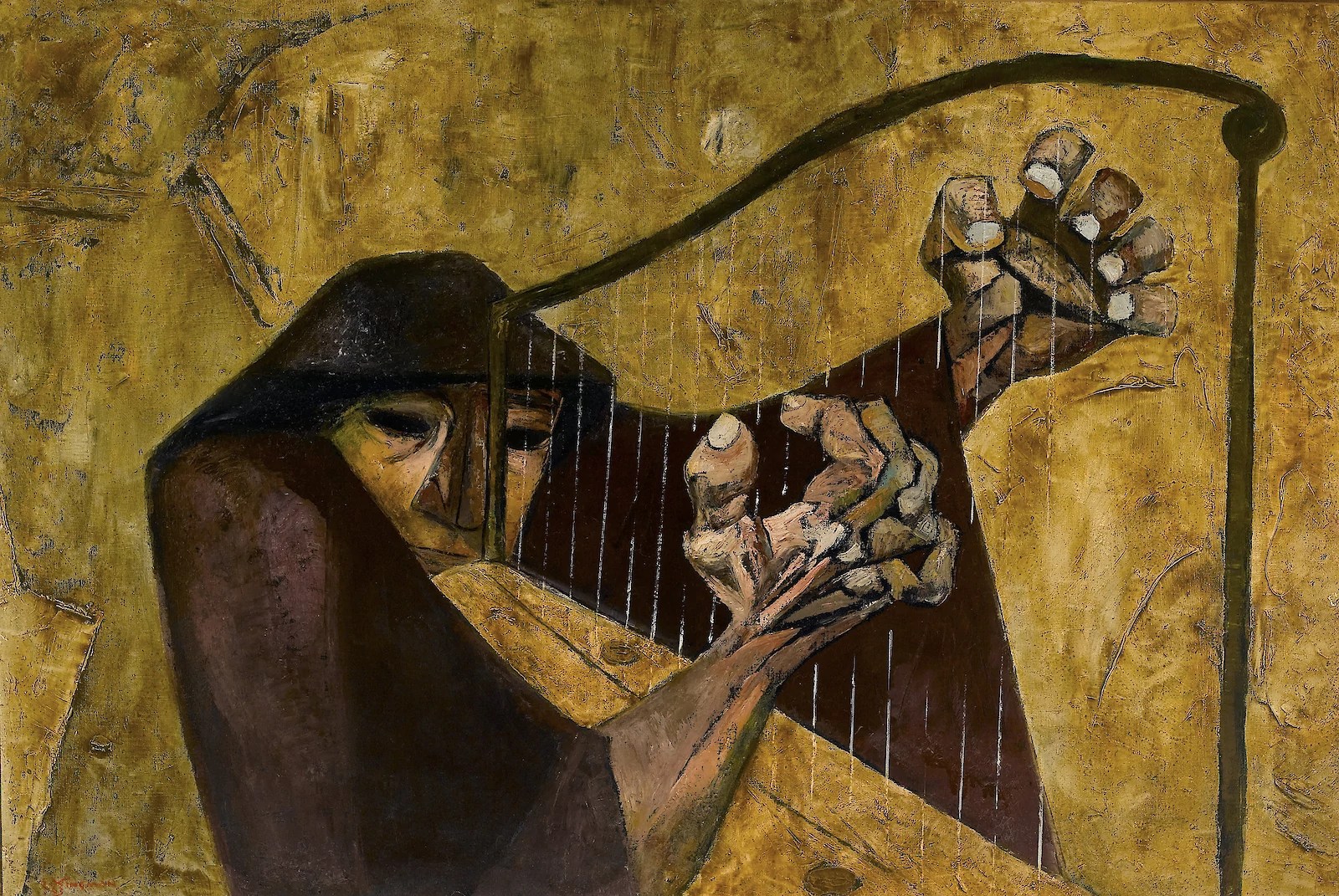
Harpist — Eduardo Kingman

Harpist, 1963 by Eduardo Kingman (1913-1997)

Read “The Flight of Pigeons from the Palace,” a very short story by Donald Barthelme

“The Flight of Pigeons from the Palace”

by

Donald Barthelme


In the abandoned palazzo, weeds and old blankets filled the rooms. The palazzo was in bad shape. We cleaned the abandoned palazzo for ten years. We scoured the stones. The splendid architecture was furbished and painted. The doors and windows were dealt with. Then we were ready for the show.

The noble and empty spaces were perfect for our purposes. The first act we hired was the amazing Numbered Man. He was numbered from one to thirty-five, and every part moved. And he was genial and polite, despite the stresses to which his difficult métier subjected him. He never failed to say “Hello” and “Goodbye” and “Why not?” We were happy to have him in the show.

Then, the Sulking Lady was obtained. She showed us her back. That was the way she felt. She had always felt that way, she said. She had felt that way since she was four years old.

We obtained other attractions—a Singing Sword and a Stone Eater. Tickets and programs were prepared. Buckets of water were placed about, in case of fire. Silver strings tethered the loud-roaring strong-stinking animals.

The lineup for opening night included:

A startlingly handsome man

A Grand Cham

A tulip craze

The Prime Rate

Edgar Allan Poe

A colored light

We asked ourselves: How can we improve the show?

We auditioned an explosion.

There were a lot of situations where men were being evil to women—dominating them and eating their food. We put those situations in the show.

In the summer of the show, grave robbers appeared in the show. Famous graves were robbed, before your eyes. Winding-sheets were unwound and things best forgotten were remembered. Sad themes were played by the band, bereft of its mind by the death of its tradition. In the soft evening of the show, a troupe of agoutis performed tax evasion atop tall, swaying yellow poles. Before your eyes.

The trapeze artist with whom I had an understanding . . . The moment when she failed to catch me . . .

Did she really try? I can’t recall her ever failing to catch anyone she was really fond of. Her great muscles are too deft for that. Her great muscles at which we gaze through heavy-lidded eyes . . .

We recruited fools for the show. We had spots for a number of fools (and in the big all-fool number that occurs immediately after the second act, some specialties). But fools are hard to find. Usually they don’t like to admit it. We settled for gowks, gulls, mooncalfs. A few babies, boobies, sillies, simps. A barmie was engaged, along with certain dumdums and beefheads. A noodle. When you see them all wandering around, under the colored lights, gibbering and performing miracles, you are surprised.

I put my father in the show, with his cold eyes. His segment was called My Father Concerned about His Liver.

Performances flew thick and fast.

We performed The Sale of the Public Library.

We performed Space Monkeys Approve Appropriations.

We did Theological Novelties and we did Cereal Music (with its raisins of beauty) and we did not neglect Piles of Discarded Women Rising from the Sea.

There was faint applause. The audience huddled together. The people counted their sins.

Scenes of domestic life were put in the show.

We used The Flight of Pigeons from the Palace.

It is difficult to keep the public interested.

The public demands new wonders piled on new wonders.

Often we don’t know where our next marvel is coming from.

The supply of strange ideas is not endless.

The development of new wonders is not like the production of canned goods. Some things appear to be wonders in the beginning, but when you become familiar with them, are not wonderful at all. Sometimes a seventy-five-foot highly paid cacodemon will raise only the tiniest frisson. Some of us have even thought of folding the show—closing it down. That thought has been gliding through the hallways and rehearsal rooms of the show.

The new volcano we have just placed under contract seems very promising . . .