Steve Reich Looks at a Cake

Nemesis — Albrecht Dürer

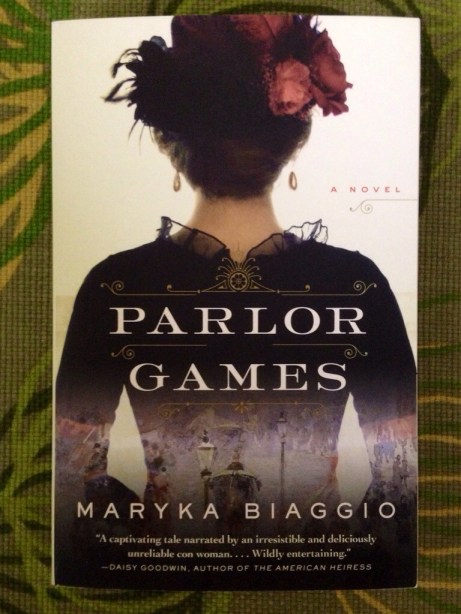
Parlor Games (Book Acquired, 9.15.2013)

20131006-154302.jpg

Parlor Games by Maryka Biaggio. Publisher Random House’s blurb:

It’s 1887, and eighteen-year-old May Dugas has ventured to Chicago in hopes of earning enough money to support her family. Yet when circumstances force her to take up residence at the city’s most infamous bordello, she chooses to use her feminine wiles to extract not only sidelong looks but also large sums of money from the men she encounters. Insinuating herself into high society, May lands a well-to-do fiancé—until, that is, a Pinkerton detective named Reed Doherty intervenes.

Reed has made it his mission to bring May to justice, and he pursues her across the world, from Shanghai to London and back, until he makes one last daring attempt to corner her. But May still has a few tricks up her sleeve, tricks that just might prove she’s one tough woman to catch.

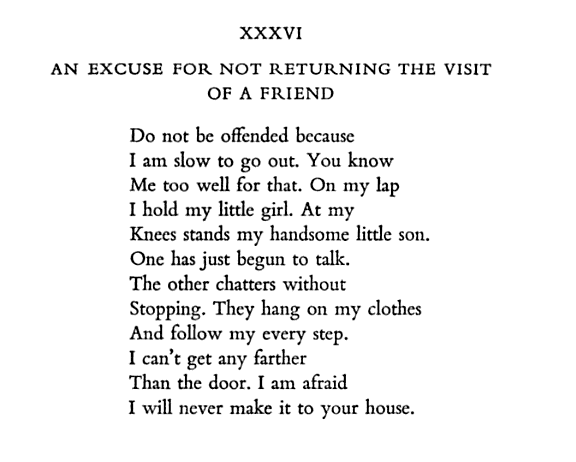
“An Excuse for Not Returning the Visit of a Friend” – Mei Yao Ch’en

AnExcuse
Translated by Kenneth Rexroth.

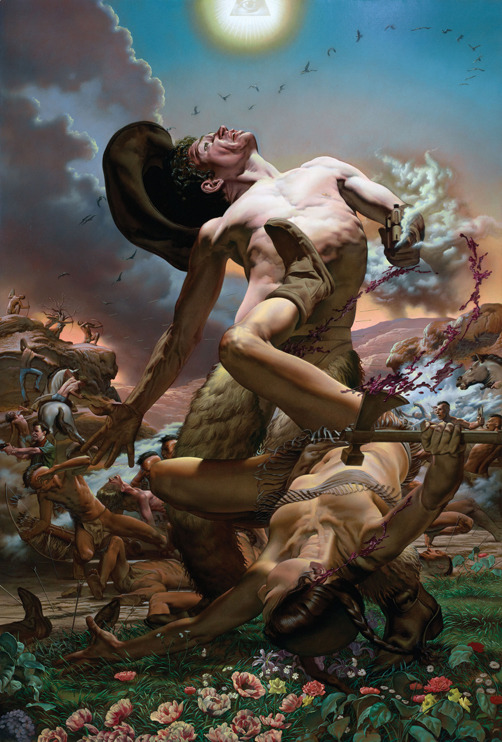
Conquest of the West — Nicola Verlato

Conquest-of-the-west

Read “Fiction,” a Short Story by Carl Shuker

“Fiction” by Carl Shuker

So there was a US novelist, permanently relocated to the UK some years back for an MFA, now mid-list, mid-career and “between books”, thirty-mid-something, author of two well-received novels and a less-well-received book of short stories, product of a labor of ten years on and off, and thus at the quintessential time and place to stall, creatively, who was that kind of writer who worked from emotion thence into intellect and, if he was successful, back once again into emotion, “evoked.“

And he came to the Lebanon looking to be bitten by the dragonfly.

Emotion > intellect > emotion. From the dream to the text to the dream. In practice this meant the not-so-youngish writer knew his subject when it hurt his heart, when it obsessed him and seemed too painful and the hardest thing at which to look. Then the writer knew he would have the dark, acidic energy it took to compose, edit, destroy, recompose, re-edit, polish and eventually finish, after years, a novel something like the kind of novels he loved and aspired to create, the books that made him want to become a writer in the first place. This method, which he fell into rather than chose, in the messy process of finding one’s way as a writer in his twenties, meant that by his early thirties the writer had published first one deliberately thinly veiled book of first-person late-adolescent horror, which counted, for its relative success, on the frisson of a patchwork of à clef-ish links with his own life and on making his own weaknesses—inexperience and naiveté—part of the material, and had published second one semi-immense “follow-up” or “sophomore effort”, as critics who hadn’t read the first book always wrote, a terrific shambling thing that during the long three years of its composition veered in his imagination from being a bloated, confused, constant evasion of a real book, a shadow of the kind of book it aspired to be, to being sometimes briefly the most amazing thing he’d ever read, like, ever; structured, strong, urgent, inevitable; the writer being thrilled and dazzled it’d come out of himself, then brutally depressed and miserable at its derivativeness and the puniness of his talent and by extension his soul, his self. And so how he’d done it (coming back to the MO thing), how he’d surmounted the hugeness and endlessness of the task and this bipolar crippling self-doubt and corresponding occasional massively inflated sense of self-importance was with the choice of a subject so tough, so big and hard, so new, that he had a kind of duty to it; a duty that transcended his own comfort and his own ego. A duty to the world. A subject that humbled and steeled. The second book was published to polite notices but bigger papers and a year or so of peace for the writer, and then the award of a one-year fellowship slash residency at a red-brick university like the one he’d graduated from (in crea writ, natch; the MFA) wherein the writer was immediately expected to write again. Having drawn on his childhood and his adolescence, having spent most of his twenties writing or thinking about writing while not publishing anything, the writer was immediately wary of being seen, by imagined peers, by his remembered brutal adolescent reading self with its impossible but definitive demands, of having sold out or trying to be commercially big, not cool or hard or true or essential, so he carved out a book of singular and odd semifuturistic short stories and a novella that linked them all, in a hazy darkness of second-novel-hangover and fellowship-paid-for Scotch, a clutch of one-night-stands compared to the love affairs of the first books, and worked really hard while never really, really loving these new small strange things, never adoring them like he did the books he’d had to summon forth forces for that were old and presymbolic and frightening. He had an office and stuff, and people knew he was a writer. This hadn’t happened before.

And then he got a job teaching creative writing.

Continue reading “Read “Fiction,” a Short Story by Carl Shuker”

Old Woman Reading at Window — Abraham van Strij

Sansho the Bailiff — Kenji Mizoguchi (Full Film)

How to Escape from Home — Simon Evans

EVANS_How_to_Escape_from1

Three Books with Stickers on Them (Books Acquired, Sometime Last Month)

My daughter, six, brought home some books from the library a few weeks ago. “These are good,” she reported, showing them to me. “They have medals on them.”

In the last weeks of last month, I got behind three bemedaled or bestickered books (okay, these aren’t really stickers anymore, but I don’t know what to call the stickers—blazons? Emblems? Medals?)—here they are:

20131006-154010.jpg

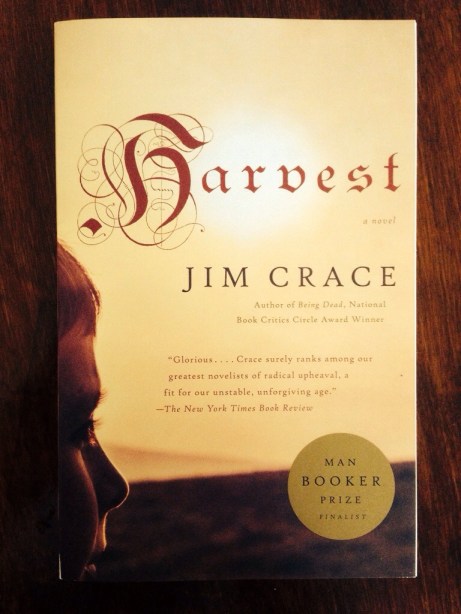
Jim Crace’s Harvest, beblazoned with a Man Booker Finalist blazon. From The New York Times’s review earlier this year:

In its poetry of the precarious hereafter, “Harvest” calls to mind J. M. Coetzee’s finest and most allegorical novel, “Waiting for the Barbarians.” Like Coetzee, Crace asks large questions: How will ordinary people behave when ripped from their mundane routines, cut adrift from comforting old verities? What suppressed capacity for cruelty may surface? What untested gift for improvised survival?

20131006-154019.jpg

Next: Ayana Mathis’s The Twelve Tribes of Hattie, bemedaled with an Oprah’s Book Club 2.0 medal. I don’t know what 2.0 means here, but the sticker I’ll admit is immediately off-putting. I also originally read the title as The Twelve Tribes of Hottie, also off-putting. The actual premise of the book seems really good though. From The New York Times again:

When the country was too distracted to notice, caught up as it was with two world wars and the Depression, a great movement of people, of some six million African-Americans fleeing the Jim Crow South, was upending the social geography of the country itself. The Great Migration would figure into much of the literature and music of 20th-century urban life — Wright, Ellison, Baldwin and Coltrane — and, decades after it ended, it still lives in myth and shadow, casting a spell upon race relations to this day and captivating the lives and imaginations of its descendants.

Still, there has been no novel like “The Grapes of Wrath” that looks squarely at this migration, which might have been the promise and yet not the purpose of so raw and intimate a book as “The Twelve Tribes of Hattie,” the debut novel of ­Ayana Mathis. The story it tells works at the rough edges of history, residing not so much within the migration itself as within a brutal and poetic allegory of a family beset by tribulations. The narrative opens in 1925, as Hattie Shepherd, a 17-year-old wife and mother newly ­arrived in Philadelphia from Georgia, ­administers mustard poultices and droplets of ipecac to save her infant twins from the pneumonia that has crept into their limp bodies. Because of her desperate circumstances in the cold of the North, she loses her twins “in the order in which they were born.”

20131006-154027.jpg

Finally, Olen Steinhauer’s An American Spy, bestickered with A New York Times Notable Book sticker. You know what? Im just gonna go ahead and borrow from The New York Times review again:

Not since John le Carré has a writer so vividly evoked the multilayered, multifaceted, deeply paranoid world of espionage, in which identities and allegiances are malleable and ever shifting, the mirrors of loyalty and betrayal reflecting one another to infinity. In this intensely clever, sometimes baffling book, it’s never quite clear who is manipulating whom, and which side is up.

So three books, all from major houses, all garnering accolades (in the form of stickers!), and all prominently and favorably reviewed by The New York Times. I’m sure there’s nothing troubling in this at all.


“The Crescent Moon” – Mei Yao Ch’en

TheCrescentMoon

Translated by Kenneth Rexroth.

William Burroughs’s Writing Bunker

burroughs desk writing room

“Disagreement” — Lydia Davis

disagreement

Girl Reading — Francisc Sirato

Bergman’s Dreams, A Video Essay from Criterion Collection

The Complete Short Stories of J.G. Ballard (Second Riff: Stories of 1960)

jgb_complete_ss400 PREVIOUSLY:

Introductions + stories 1956-1959

IN THIS RIFF:

Stories published in 1960:

“The Sound-Sweep”

“Zone of Terror”

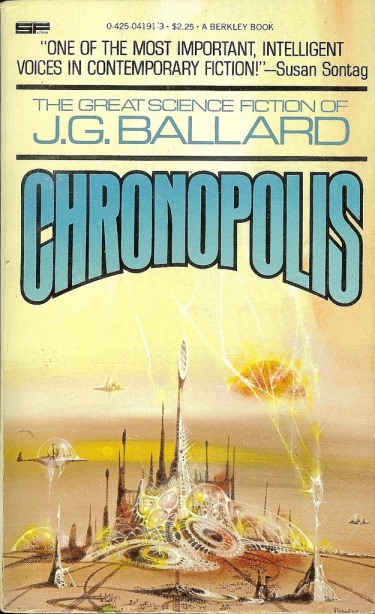
“Chronopolis”

“The Voices of Time”

“The Last World of Mr. Goddard”

1. “The Sound-Sweep” (1960)

Ballard’s strong suit isn’t characterization. In his later writing, he transcends this apparent weakness, employing a style and rhetoric that dispenses with—or nakedly accepts, in some cases—the flatness of his characters. Ballard works in types: the scientist, the madman, the artist, the detective, the ingenue, the explorer, the has-been. Most of his characters are driven by very basic desires—curiosity, madness, revenge. There’s a thin line though between archetypal placeholders and hackneyed stereotypes, and Ballard occasionally stumbles over it in some of these early stories. “The Sound-Sweep” is one such story, plodding along over too many pages, asking its readers to care about characters that lack emotional or psychological depth. And while I don’t think we read Ballard for emotional depth, necessarily, we do read Ballard’s best work because it plumbs the contours of human psychology colliding into nascent technological changes that affect the most basic human senses.

As its title suggests, “The Sound-Sweep” is another early Ballard tale that takes on the sense of sound. The short version: This is a story about noise pollution, and also about how we might sacrifice an artistic way of listening in favor of apparent convenience. As is often the case in these early stories, Ballard constructs the tale to explore the fallout of one particular idea. In this case, that’s “ultrasonic music”:

Ultrasonic music, employing a vastly greater range of octaves, chords and chromatic scales than are audible by the human ear, provided a direct neural link between the sound stream and the auditory lobes, generating an apparently sourceless sensation of harmony, rhythm, cadence and melody uncontaminated by the noise and vibration of audible music. The re–scoring of the classical repertoire allowed the ultrasonic audience the best of both worlds. The majestic rhythms of Beethoven, the popular melodies of Tchaikovsky, the complex fugal elaborations of Bach, the abstract images of Schoenberg – all these were raised in frequency above the threshold of conscious audibility. Not only did they become inaudible, but the original works were re–scored for the much wider range of the ultrasonic orchestra, became richer in texture, more profound in theme, more sensitive, tender or lyrical as the ultrasonic arranger chose.

To tease out this idea, Ballard employs a washed-up opera singer, Madame Giaconda (a heavy base of Sunset Boulevard’s Norma Desmond with a heavy dash of Miss Havisham and cocaine), and Mangon, a mute orphan, the titular sound-sweep (should I wax on the Blakean undertones here? No? Okay).

“The Sound-Sweep” plods along over far too many pages, even divvying up the plot into chapters, asking us to care about the relationship between Giaconda and Mangon. The story would probably have made an excellent episode of The Twilight Zone, where performers might give life to some of the flat dialogue here and the constraints of television might compress the plot. The most interesting thing about “The Sound-Sweep”: The tale in some ways anticipates the mp3 and the ways in which music will be consumed:

But the final triumph of ultrasonic music had come with a second development – the short–playing record, spinning at 900 r.p.m., which condensed the 45 minutes of a Beethoven symphony to 20 seconds of playing time, the three hours of a Wagner opera to little more than two minutes. Compact and cheap, SP records sacrificed nothing to brevity. One 30–second SP record delivered as much neurophonic pleasure as a natural length recording, but with deeper penetration, greater total impact.

2. “Zone of Terror” (1960)

Edgar Allan Poe’s “William Wilson” is a much better doppelganger story. “Zone of Terror” reads like a very rough sketch for some of the stuff Ballard will do in his 1962 novel The Drowned World. (Both “Chronopolis” and “The Voices of Time” also clearly anticipate The Drowned World, each with much stronger results).
chronopolis

3. “Chronopolis” (1960)

“Chronopolis” offers an interesting central shtick: Clocks and other means of measuring and standardizing time have been banned. But this isn’t what makes the story stick. No, Ballard apparently tips his hand early, revealing why measuring time has been banned—it allows management to control labor:

‘Isn’t it obvious? You can time him, know exactly how long it takes him to do something.’ ‘Well?’ ‘Then you can make him do it faster.’

But our intrepid young protagonist (Conrad, his loaded name is), hardly satisfied with this answer, sneaks off to the city of the past, the titular chronopolis, where he works to restore the timepieces of the past. “Chronopolis” depicts a technologically-regressive world that Ballard will  explore in greater depth with his novel The Drowned World, but the details here are precise and fascinating (if perhaps ultimately unconvincing if we try to apply them as any kind of diagnosis for our own metered age). Ending on a perfect paranoid note, Ballard borrows just a dab of Poe here, synthesizing his influence into something far more original, far more Ballardian. Let’s include it in something I’m calling The Essential Short Stories of J.G. Ballard.

4.  “The Voices of Time” (1960)

“The Voices of Time” is easily the best of the early stories in the collection. Ballard allows himself to dispense almost entirely with plot, or at least the kind of plot he’s been thus-far constrained by. Instead of the neat concision of his nineteenth century forebears (Chekhov and Poe), Ballard moves to something far more Ballardian (excuse the repetition), opening his text to a range of images and phrases that will repeat throughout his career—the word terminal, drained vessels, cryptic designs and sequences, a kind of psychic detritus the reader is left to account for and monitor. The loose threads in “The Voices of Time” are too many to enumerate. There’s a mutant armadillo and a girl named Coma. Mass narcolepsy and cacti that absorb gold from the earth as a shield against radiation. And sleep. And de-evolution:

…thirty years ago people did indeed sleep eight hours, and a century before that they slept six or seven. In Vasari’s Lives one reads of Michelangelo sleeping for only four or five hours, painting all day at the age of eighty and then working through the night over his anatomy table with a candle strapped to his forehead. Now he’s regarded as a prodigy, but it was unremarkable then. How do you think the ancients, from Plato to Shakespeare, Aristotle to Aquinas, were able to cram so much work into their lives? Simply because they had an extra six or seven hours every day. Of course, a second disadvantage under which we labour is a lowered basal metabolic rate – another factor no one will explain. …

… It’s time to re–tool. Just as an individual organism’s life span is finite, or the life of a yeast colony or a given species, so the life of an entire biological kingdom is of fixed duration. It’s always been assumed that the evolutionary slope reaches forever upwards, but in fact the peak has already been reached, and the pathway now leads downward to the common biological grave. It’s a despairing and at present unacceptable vision of the future, but it’s the only one. Five thousand centuries from now our descendants, instead of being multi–brained star–men, will probably be naked prognathous idiots with hair on their foreheads, grunting their way through the remains of this Clinic like Neolithic men caught in a macabre inversion of time. Believe me, I pity them, as I pity myself. My total failure, my absolute lack of any moral or biological right to existence, is implicit in every cell of my body…

I harped on Ballard’s lack of characterization earlier, and “The Voices of Time” makes no strong case for its author’s ability to create deep, full characters. What Ballard does very very well though is harness, express, and communicate the intellect of his smart, smart characters—something many if not most other writers (contemporary or otherwise) can’t do, despite any technical prowess they may possess. “The Voices of Time” doesn’t just tell you that its heroes and antiheroes are brilliant (and/or mad)—it shows you.

Marvelous stuff. Include it in The Essential Short Stories of J.G. Ballard

5. “The Last World of Mr. Goddard” (1960)

More Twilight Zone stuff. God-dard. Lilliput, sort of. Doll’s house. Etc. A one-note exercise that I doubt is worth your time. Skip it.

6. On the horizon:

Ballard anticipates how hollow and stale contemporary writing will become in “Studio Five, The Stars.”