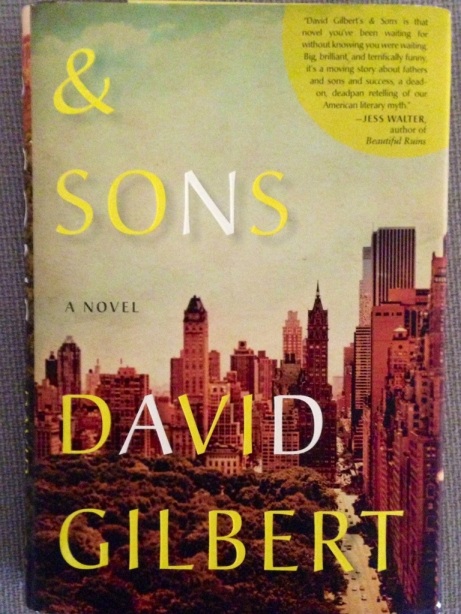
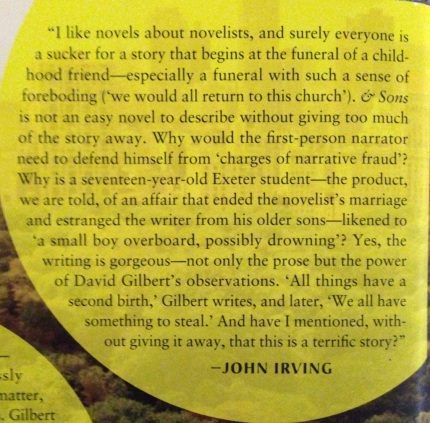
The funeral of Charles Henry Topping on Manhattan’s Upper East Side would have been a minor affair (his two-hundred-word obit in The New York Times notwithstanding) but for the presence of one particular mourner: the notoriously reclusive author A. N. Dyer, whose novel Ampersand stands as a classic of American teenage angst. But as Andrew Newbold Dyer delivers the eulogy for his oldest friend,he suffers a breakdown over the life he’s led and the people he’s hurt and the novel that will forever endure as his legacy. He must gather his three sons for the first time in many years—before it’s too late.
So begins a wild, transformative, heartbreaking week, as witnessed by Philip Topping, who, like his late father, finds himself caught up in the swirl of the Dyer family. First there’s son Richard, a struggling screenwriter and father, returning from self-imposed exile in California. In the middle lingers Jamie, settled in Brooklyn after his twenty-year mission of making documentaries about human suffering. And last is Andy, the half brother whose mysterious birth tore the Dyers apart seventeen years ago, now in New York on spring break, determined to lose his virginity before returning to the prestigious New England boarding school that inspired Ampersand. But only when the real purpose of this reunion comes to light do these sons realize just how much is at stake, not only for their father but for themselves and three generations of their family.
In this daring feat of fiction, David Gilbert establishes himself as one of our most original, entertaining, and insightful authors. & Sons is that rarest of treasures: a startlingly imaginative novel about families and how they define us, and the choices we make when faced with our own mortality.
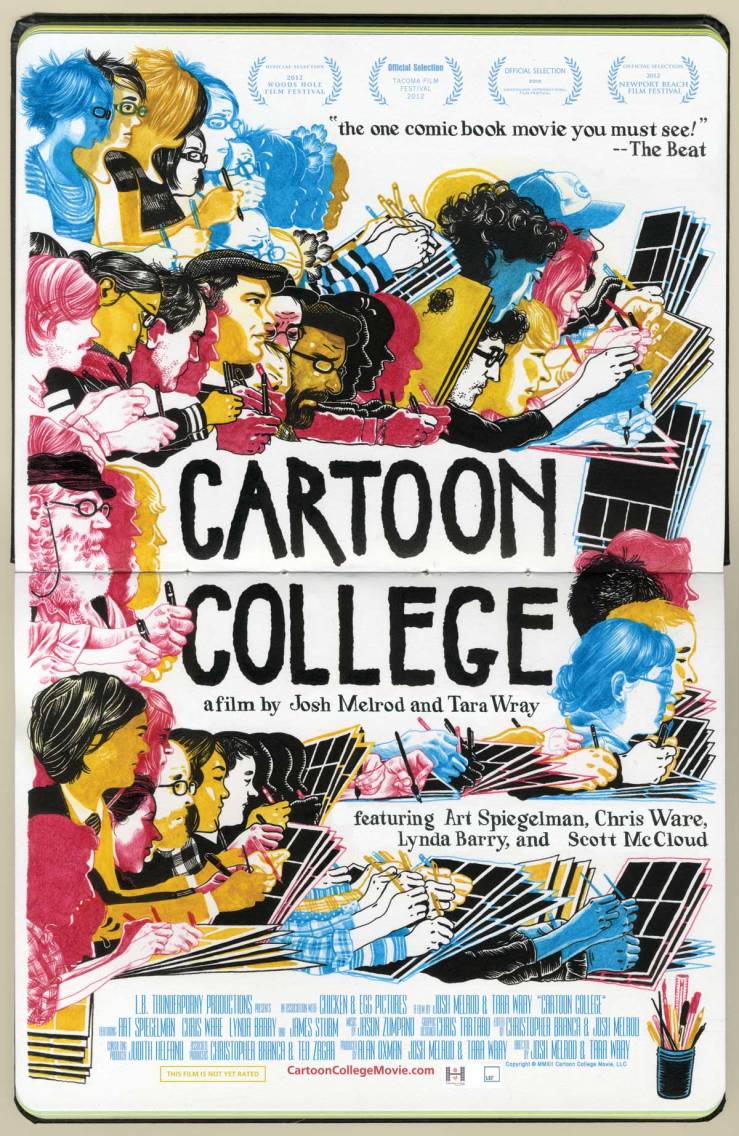
In the opening scene of Josh Melrod and Tara Wray’s new documentary Cartoon College, aspiring cartoonist Ryland Ianelli lays out the reality that, despite all the progress the medium has made as an art form worthy of respect, comic books are still outré: “It’s gotten easier to talk to people who are open to the idea of comics being worthwhile—but at the point you say, Yes I’m going to school for comics, they’re completely ready to dismiss you.”
Cartoonists have always been outsiders—even in art schools, a traditional gathering spot for outsiders—and it’s this feeling of alienation and displacement that undergirds the emotional platform of Cartoon College. The film is not just about the Center for Cartoon Studies (CSS), a highly-selective two year MFA program founded in 2005 in White River Junction, Vermont, or the cadre of master cartoonists who inspired the school, and, in some cases teach there. For plenty of comix nerds (like me), it’s enough to see masters like Art Spiegelman, Charles Burns, Lynda Barry, and Chris Ware talk about the art, medium, and business of cartooning. But this documentary offers more. Cartoon College succeeds because it tells the genuinely moving and engaging story of its students, self-described outcasts who find a sense of community and even family in the program.
Melrod and Wray take us into the extreme demands of the CSS program. In the first year (“boot camp”), students practice fundamentals—drawing, theory, writing, history. In the second year, the students produce a thesis—a finished work of some kind—to determine if they pass the program and receive an MFA. All this work is to ensure that students “will be ready to face the uncertainty of a career in one of the most labor-intensive, drudgery inducing art forms,” as the film puts it.
The faculty (all distinguished cartoonists, including Stephen Bissette, James Sturm, and Alec Longstreth, who are featured prominently in the film) repeatedly remind students and audience alike that most of cartooning is labor-intensive drudgery: it’s not really that fun, it requires lots of discipline, and most people can’t cut it. The CSS, like most art schools, employs a workshop technique to help students grow, get feedback—and also, implicitly, as a means of maintaining quality control. Workshop scenes and other critiques are often some of the most painful moments in the film, as they highlight the very personal stakes for the aspiring cartoonists, who quite literally put their lives into their work.
Melrod and Wray wisely compose their narrative around just a few of these students, while giving us enough scenes with others to flesh out the film. Blair Sterrett gives the film a definitive arc. He’s clearly a troubled, struggling artist, trying to channel his former experiences as a Mormon missionary into a thesis, but as the deadline approaches, it’s clear his book’s unfinished. Sterrett’s scenes (particularly an early critique) are very moving, and—a bit of a spoiler—there’s a triumphant feeling when he returns to the CSS to finish his MFA.
We find another arc in Jen Vaughn, who has too many jobs and too many ideas. Of all the student artists, she seems the most open to the camera, and her self-assured posture by turns belies a greater vulnerability and depth. In one illuminating scene at the MoCCA Fest, Vaughn tries to pique a muted festival goer’s interest in her project Menstruation Station; when he walks away without seeming to say anything we catch a glimpse of weariness bordering on desperation.
There’s also Al Wesolowsky, who at 61 is the oldest student. An archaeologist at Boston University, Wesolowsky tries his hand at the CSS program despite his self-admitted limitations as a draftsman. In some ways he’s the soul of the film. At one point he delivers a brief monologue wherein he describes the loneliness he feels at having no family, but the pleasure he’s found in a makeshift family at CSS.
Loneliness and alienation are perhaps the bedrock themes of comix and cartooning, as anyone who’s read Spiegelman or Ware or Burns—or really any of the master cartoonists interviewed in Cartoon College—can attest. Spiegelman is the first professional to pop up in the film, after the filmmakers have already introduced us to the students, and one of the first comments he makes is that comix allows cartoonists to come into contact with “a bunch of other outcasts.” This sentiment is repeated again and again, by students, teachers, and masters alike; we learn that Ryland Ianelli was voted Prom Queen by the cruel students of his high school; student Casey Bohn tells us that everyone in his small town thought he was “gay or British”; Lynda Barry puts it plain: “Childhood seemed to me like it lasted too long.”
Of all the master cartoonists on screen, I was most captivated by Chris Ware, who comes across as reflective, cerebral, and even philosophical. He points out that cartoonists are always “sifting through generations”,” handing down tropes, skills, ideas. Ware, chronicler of loneliness, perhaps makes the strongest case for cartoonists-as-community.
The idea that the students need to foster a community is reinforced by Bissette, who tells the that they must share contacts, share ideas, and be colleagues. Bissette and the other CSS instructors repeatedly emphasize the publishing dimension of cartooning, paying special attention to the idea that these cartoonists can self-publish. Cartoon College is larded with shots of students hand-crafting their art, and Bissette likens what they are doing to Warhol and his Factory. He also points out that this new generation’s desire is not to draw Spider-Man or Batman but their own creations.
An energetic scene at the MoCCA Fest shows this cottage industry at work, as artists buy and trade for each other’s work. But the instructors and pros are very clear—or try to be clear—about the economic realities most cartoonists will face. Ware and Burns point out that commercial illustration is a necessity to feed their other projects. Juxtaposed with these moments, our students describe their dreams of a comfortable retirement and book deals, a moment undercut by Lynda Barry gleefully pointing out that she makes most of her moeny selling “shit on E-bay.”
It might have been tempting for Melrod and Wray to cram all the footage they had of famous cartoonists like Barry, Françoise Mouly, Scott McCloud, and others into Cartoon College, but to the filmmakers’ credit they use the masters sparingly. Art Spiegelman tells us at one point that “We think in bursts of language, not in long Jamesian sentences…the number of words that might be able to fit in a speech balloon are the core of a linguistic thought.” The insight is intended for cartooning, but the filmmakers apply it to their medium, letting the camera do much of the work for them, offering only the most essential moments (like when Charles Burns completes a sketch and the student audience breaks into applause). Cartoon College is at its best when it shows us the difficult experiences of the students intercut with commentary by the seasoned, successful professionals, who understand precisely the pain these people are undergoing.
Before I started watching Cartoon College, I wondered who it was for. My interest in Spiegelman, Ware, Burns, et al. was enough to prod my interest (and the soundtrack featuring Archers of Loaf, Portastatic, and Tortoise didn’t hurt)—but would the film appeal to, uh, non-geeks? Ultimately, I think the documentary is about the drive toward art and self-expression, and the ways that communities and relationships can form around this drive. Cartoon College offers an intriguing story about real people trying to do something that they love, and I enjoyed that. This is a film about the impetus, motivation, and hard, hard work that goes into the creative process. Great stuff.
Political democracy, as it exists and practically works in America, with all its threatening evils, supplies a training school for making first-class men. It is life’s gymnasium, not of good only, but of all. We try often, though we fall back often. A brave delight, fit for freedom’s athletes, fills these arenas, and fully satisfies, out of the action in them, irrespective of success. Whatever we do not attain, we at any rate attain the experiences of the fight, the hardening of the strong campaign, and throb with currents of attempt at least. Time is ample. Let the victors come after us. Not for nothing does evil play its part among us. Judging from the main portions of the history of theworld, so far, justice is always in jeopardy, peace walks amid hourly pitfalls, and of slavery, misery, meanness, the craft of tyrants and the credulity of the populace, in some of the protean forms, no voice can at any time say, They are not. The clouds break a little, and the sun shines out-but soon and certain the lowering darkness falls again, as if to last forever. Yet is there an immortal courage and prophecy in every sane soul that cannot, must not, under any circumstances, capitulate. Vive, the attack–the perennial assault! Vive, the unpopular cause–the spirit that audacious]y aims–the never-abandoned efforts, pursued the same amid opposing proofs and precedents.
Once, before the war (alas! I dare not say how many times the mood has come!) I, too, was filled with doubt and gloom. A foreigner, an acute and good man, had impressively said to me, that day-putting in form, indeed, my own observations: “I have traveled much in the United States, and watched their politicians, and listened to the speeches of the candidates, and read the journals, and gone into the public-houses, and heard the unguarded talk of men. And I have found your vaunted America honeycombed from top to toe with infidelism, even to itself and its own program. I have marked the brazen hell-faces of secession and slavery gazing defiantly from all the windows and doorways. I have everywhere found, primarily, thieves and scalliwags arranging the nominations to offices, and sometimes filling the offices themselves. I have found the north just as full of bad stuff as the south. Of the holders of public office in the Nation or the States or their municipalities, I have found that not one in a hundred has been chosen by any spontaneous selection of the outsiders, the people, but all have been nominated and put through by little or large caucuses of the politicians, and have got in by corrupt rings and electioneering, not capacity or desert. I have noticed how the millions of sturdy farmers and mechanics are thus the helpless supple-jacks of comparatively few politicians. And I have noticed, more and more, the alarming spectacle of parties usurping the government, and openly and shamelessly wielding it for party purposes. Continue reading ““Democratic Vistas” — Walt Whitman”→
I don’t know how I missed this—the teaser came out a few weeks ago—but a new Miyazaki is always promising. The Wind Rises is out in Japan in two weeks, out in the rest of the world, who knows when…but I’ve never minded watching his films sans subtitles or dubbing. Read more about The Wind Rises here; read my review of Ponyo, the last Studio Ghibli film that Miyazaki directed.
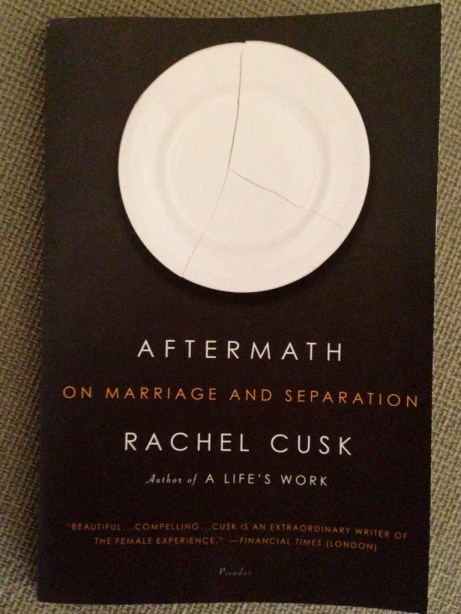
When a review copy of Rachel Cusk’s memoir Aftermath: On Marriage and Separation (new in trade paperback from Picador) showed up the other day, a dim bulb went off—where did I know Cusk’s name? I’m not generally a fan of the memoir, so I doubt I’d read it. And then! Aha! Yes—it was a review of Cusk’s memoir that won Camilla Long this year’s “Hatchet Job of the Year” award.
From Long’s review (originally published in The Sunday Times):
The book is crammed with mad, flowery metaphors and hifalutin creative-writing experiments. There are hectic passages on Greek tragedy and the Christian concept of family, as well as fragments of ghost stories, references to the Anglo-Saxon heptarchy, and heavy Freudian symbolism, including a long description of the removal of a molar, “a large tooth,” she writes portentously, “of great…personal significance”. The final chapter is an out-of-body experience — her situation seen through the eyes of her pill-popping Eastern European au pair. Oddly, I read the whole thing in a Bulgarian accent.
I don’t know, that sounds pretty weird. Kinda intrigues me.
difference between a reformist and a revolutionary period: in a reformist period, global revolution remains a dream which, if it does anything, merely lends weight to attempts to change things locally; in a revolutionary period, it becomes clear that nothing will improve without radical global change.
Žižek continues:
Where do we stand today with respect to this difference? Are the problems and protests of the last few years signs of an approaching global crisis, or are they just minor obstacles that can be dealt with by means of local interventions? The most remarkable thing about the eruptions is that they are taking place not only, or even primarily, at the weak points in the system, but in places which were until now perceived as success stories. We know why people are protesting in Greece or Spain; but why is there trouble in such prosperous or fast-developing countries as Turkey, Sweden or Brazil? With hindsight, we might see the Khomeini revolution of 1979 as the original ‘trouble in paradise’, given that it happened in a country that was on the fast-track of pro-Western modernisation, and the West’s staunchest ally in the region. Maybe there’s something wrong with our notion of paradise.
If the examples in the above paragraph seem too concrete for a Žižekian riff, don’t worry. Our philosopher addresses what he takes to be the ideological underpinnings of protest:
It is also important to recognise that the protesters aren’t pursuing any identifiable ‘real’ goal. The protests are not ‘really’ against global capitalism, ‘really’ against religious fundamentalism, ‘really’ for civil freedoms and democracy, or ‘really’ about any one thing in particular. What the majority of those who have participated in the protests are aware of is a fluid feeling of unease and discontent that sustains and unites various specific demands. The struggle to understand the protests is not just an epistemological one, with journalists and theorists trying to explain their true content; it is also an ontological struggle over the thing itself, which is taking place within the protests themselves. Is this just a struggle against corrupt city administration? Is it a struggle against authoritarian Islamist rule? Is it a struggle against the privatisation of public space? The question is open, and how it is answered will depend on the result of an ongoing political process.
And an answer, perhaps, to some of these questions:
Only a politics that fully takes into account the complexity of overdetermination deserves to be called a strategy. When we join a specific struggle, the key question is: how will our engagement in it or disengagement from it affect other struggles? The general rule is that when a revolt against an oppressive half-democratic regime begins, as with the Middle East in 2011, it is easy to mobilise large crowds with slogans – for democracy, against corruption etc. But we are soon faced with more difficult choices. When the revolt succeeds in its initial goal, we come to realise that what is really bothering us (our lack of freedom, our humiliation, corruption, poor prospects) persists in a new guise, so that we are forced to recognise that there was a flaw in the goal itself. This may mean coming to see that democracy can itself be a form of un-freedom, or that we must demand more than merely political democracy: social and economic life must be democratised too. In short, what we first took as a failure fully to apply a noble principle (democratic freedom) is in fact a failure inherent in the principle itself. This realisation – that failure may be inherent in the principle we’re fighting for – is a big step in a political education.
“The study of life not to be neglected for the sake of books” by Samuel Johnson
On life, on morals, be thy thoughts employ’d;
Leave to the schools their atoms and their void.
IT is somewhere related by Le Clerc, that a wealthy trader of good understanding, having the common ambition to breed his son a scholar, carried him to an university, resolving to use his own judgment in the choice of a tutor. He had been taught, by whatever intelligence, the nearest way to the heart of an academick, and at his arrival entertained all who came about him with such profusion, that the professors were lured by the smell of his table from their books, and flocked round him with all the cringes of awkward complaisance. This eagerness answered the merchant’s purpose: he glutted them with delicacies, and softened them with caresses, till he prevailed upon one after another to open his bosom, and make a discovery of his competitions, jealousies, and resentments. Having thus learned each man’s character, partly from himself, and partly from his acquaintances, he resolved to find some other education for his son, and went away convinced, that a scholastick life has no other tendency than to vitiate the morals and contract the understanding: nor would he afterwards hear with patience the praises of the ancient authors, being persuaded that scholars of all ages must have been the same, and that Xenophon and Cicero were professors of some former university, and therefore mean and selfish, ignorant and servile, like those whom he had lately visited and forsaken.
Envy, curiosity, and a sense of the imperfection of our present state, incline us to estimate the advantages which are in the possession of others above their real value. Every one must have remarked, what powers and prerogatives the vulgar imagine to be conferred by learning. A man of science is expected to excel the unlettered and unenlightened even on occasions where literature is of no use, and among weak minds, loses part of his reverence, by discovering no superiority in those parts of life, in which all are unavoidably equal; as when a monarch makes a progress to the remoter provinces, the rustics are said sometimes to wonder that they find him of the same size with themselves. Continue reading ““The study of life not to be neglected for the sake of books” — Samuel Johnson”→





 Biblioklept