Man Reading a Newspaper — Rene Magritte

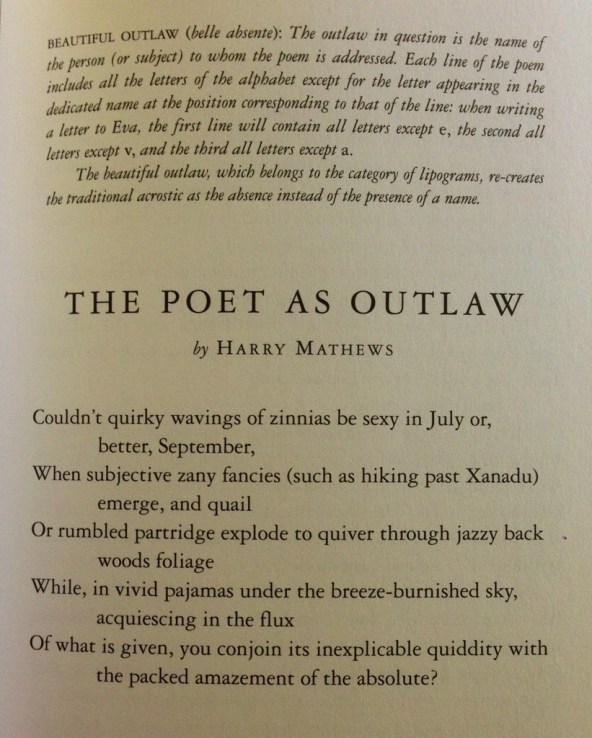
“The Poet as Outlaw” — Harry Mathews

20130527-113327.jpg

Barbecue — Eric Fischl

A Summer Reading List

20130527-122151.jpg

Okay:

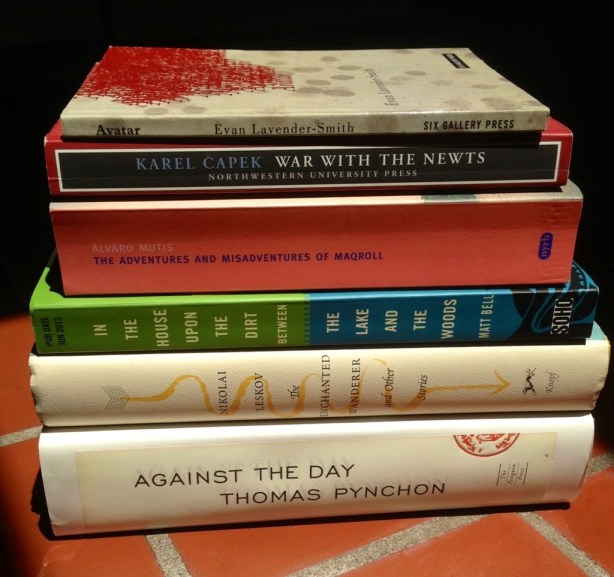
Prospective reading list for the summer.

First, I’ll finish Mikhaíl Bulgakov’s The Master & Margarita, not pictured here because I’m reading it on the Kindle. No new novels until I finish this novel! (Will break this rule).

I just finished another trip through Ulysses, again via audiobook plus tandem-rereading on the Kindle. I like big audiobooks (and I cannot lie), so I’ll get into Against the Day on mp3.

This weekend I read “The Lady Macbeth of Mtsenk,” the first story in a freshly translated collection from Nikolai Leskov. The Enchanted Wanderer is new in translation by Richard Pevear and Larissa ­Volokhonsky. I’ll be reading it in chunks this summer.

Speaking of reading in chunks: I devoured the first three novellas in Álvaro Mutis’s Maqroll series and then took a break to get some other stuff in. Break over.

Also: Matt Bell’s novel In the House Upon the Dirt Between the Lake and the Woods.

And I still haven’t read Karel Čapek’s War with the Newts, so I’ll try to fix that this summer.

I also plan to read Evan Lavender-Smith’s Avatar, but I’d like to do it in one sitting, which means I need to free up a few hours.

Finally: Who knows. Reading lists are kind of ridiculous.

“Dirge for Two Veterans” — Walt Whitman

ww

The Veteran in a New Field — Winslow Homer

“Decoration Day” — Sarah Orne Jewett

“Decoration Day” by Sarah Orne Jewett

I.

A week before the thirtieth of May, three friends—John Stover and Henry Merrill and Asa Brown—happened to meet on Saturday evening at Barton’s store at the Plains. They were ready to enjoy this idle hour after a busy week. After long easterly rains, the sun had at last come out bright and clear, and all the Barlow farmers had been planting. There was even a good deal of ploughing left to be done, the season was so backward.

The three middle-aged men were old friends. They had been school-fellows, and when they were hardly out of their boyhood the war came on, and they enlisted in the same company, on the same day, and happened to march away elbow to elbow. Then came the great experience of a great war, and the years that followed their return from the South had come to each almost alike. These men might have been members of the same rustic household, they knew each other’s history so well.

They were sitting on a low wooden bench at the left of the store door as you went in. People were coming and going on their Saturday night errands,—the post-office was in Barton’s store,—but the friends talked on eagerly, without being interrupted, except by an occasional nod of recognition. They appeared to take no notice at all of the neighbors whom they saw oftenest. It was a most beautiful evening; the two great elms were almost half in leaf over the blacksmith’s shop which stood across the wide road. Farther along were two small old-fashioned houses and the old white church, with its pretty belfry of four arched sides and a tiny dome at the top. The large cockerel on the vane was pointing a little south of west, and there was still light enough to make it shine bravely against the deep blue eastern sky. On the western side of the road, near the store, were the parsonage and the storekeeper’s modern house, which had a French roof and some attempt at decoration, which the long-established Barlow people called gingerbread-work, and regarded with mingled pride and disdain. These buildings made the tiny village called Barlow Plains. They stood in the middle of a long narrow strip of level ground. They were islanded by green fields and pastures. There were hills beyond; the mountains themselves seemed very near. Scattered about on the hill slopes were farmhouses, which stood so far apart, with their clusters of out-buildings, that each looked lonely, and the pine woods above seemed to besiege them all. It was lighter on the uplands than it was in the valley, where the three men sat on their bench, with their backs to the store and the western sky.

“Well, here we be ‘most into June, an’ I ‘ain’t got a bush-bean above ground,” lamented Henry Merrill.

“Your land’s always late, ain’t it? But you always catch up with the rest on us,” Asa Brown consoled him. “I’ve often observed that your land, though early planted, was late to sprout. I view it there’s a good week’s difference betwixt me an’ Stover an’ your folks, but come first o’ July we all even up.”

“‘Tis just so,” said John Stover, taking his pipe out of his mouth, as if he had a good deal more to say, and then replacing it, as if he had changed his mind.

“Made it extry hard having that long wet spell. Can’t none on us take no day off this season,” said Asa Brown; but nobody thought it worth his while to respond to such evident truth.

“Next Saturday’ll be the thirtieth o’ May—that’s Decoration Day, ain’t it?—come round again. Lord! how the years slip by after you git to be forty-five an’ along there!” said Asa again. “I s’pose some o’ our folks’ll go over to Alton to see the procession, same’s usual. I’ve got to git one o’ them small flags to stick on our Joel’s grave, an’ Mis’ Dexter always counts on havin’ some for Harrison’s lot. I calculate to get ’em somehow. I must make time to ride over, but I don’t know where the time’s comin’ from out o’ next week. I wish the women folks would tend to them things. There’s the spot where Eb Munson an’ John Tighe lays in the poor-farm lot, an’ I did mean certain to buy flags for ’em last year an’ year before, but I went an’ forgot it. I’d like to have folks that rode by notice ’em for once, if they was town paupers. Eb Munson was as darin’ a man as ever stepped out to tuck o’ drum.” Continue reading ““Decoration Day” — Sarah Orne Jewett”

Blossoming Almond Branch in a Glass with a Book — Vincent van Gogh

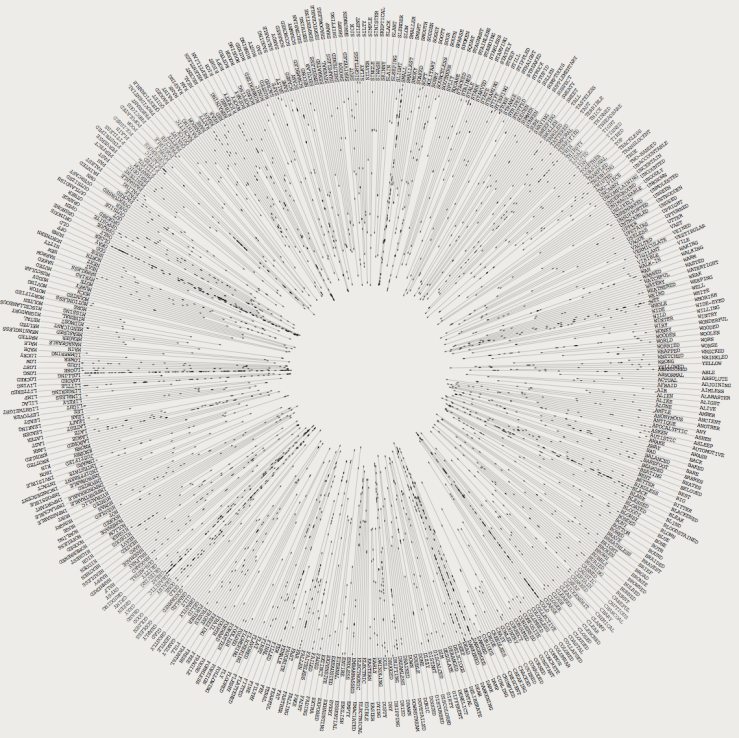
The Adjectives of Cormac McCarthy’s Road

the-road


(By/via).

Rooms by the Sea — Edward Hopper

Yellow Zine #3 (Books, Comix, Etc. Acquired 5.13.2013)

20130526-120127.jpg

Got a sweet bundle from Roman Muradov a few weeks ago: Yellow Zine #3 plus some other comix, including a take on Italo Calvino’s If on a Winter’s Night. Love the Joyce bookmark.

The comix themselves are funny, weird, and strangely heartfelt (why “strangely” — I suppose because there’s this weird cerebral/linguistic bent to them + literary allusion — these aren’t  sad boy emo comics — but emotion and feeling comes through in Roman’s clean, expressive style).

Check out Roman’s site for more. I’m hoping for a graphic novel one day…

20130526-120140.jpg


Elmore Leonard Talks About His Writing Process

List with No Name #25

  1. Barry Lyndon
  2. Paths of Glory
  3. 2001: A Space Odyssey
  4. Dr. Strangelove
  5. The Shining
  6. A Clockwork Orange
  7. Eyes Wide Shut
  8. Spartacus
  9. Full Metal Jacket
  10. Lolita


Coloring Page of Dali’s The Persistence of Memory

Memory-by-Salvador-Dali-coloring-page

“Casablanca, or, the Clichés Are Having a Ball” — Umberto Eco

“Casablanca, or, the Clichés Are Having a Ball” by Umberto Eco


When people in their fifties sit down before their television sets for a rerun of Casablanca, it is an ordinary matter of nostalgia. However, when the film is shown in American universities, the boys and girls greet each scene and canonical line of dialogue (“Round up the usual suspects,” “Was that cannon fire, or is it my heart pounding?”–or even every time that Bogey says “kid”) with ovations usually reserved for football games. And I have seen the youthful audience in an Italian art cinema react in the same way. What then is the fascination of Casablanca?

The question is a legitimate one, for aesthetically speaking (or by any strict critical standards) Casablanca is a very mediocre film. It is a comic strip, a hotch-potch, low on psychological credibility, and with little continuity in its dramatic effects. And we know the reason for this: The film was made up as the shooting went along, and it was not until the last moment that the director and script writer knew whether Ilse would leave with Victor or with Rick. So all those moments of inspired direction that wring bursts of applause for their unexpected boldness actually represent decisions taken out of desperation. What then accounts for the success of this chain of accidents, a film that even today, seen for a second, third, or fourth time, draws forth the applause reserved for the operatic aria we love to hear repeated, or the enthusiasm we accord to an exciting discovery? There is a cast of formidable hams. But that is not enough.

Here are the romantic lovers–he bitter, she tender–but both have been seen to better advantage. And Casablanca is not Stagecoach, another film periodically revived. Stagecoach is a masterpiece in every respect. Every element is in its proper place, the characters are consistent from one moment to the next, and the plot (this too is important) comes from Maupassant–at least the first part of it. And so? So one is tempted to read Casablanca the way T. S. Eliot reread Hamlet. He attributed its fascination not to its being a successful work (actually he considered it one of Shakespeare’s less fortunate plays) but to something quite the opposite: Hamlet was the result of an unsuccessful fusion of several earlier Hamlets, one in which the theme was revenge (with madness as only a stratagem), and another whose theme was the crisis brought on by the mother’s sin, with the consequent discrepancy between Hamlet’s nervous excitation and the vagueness and implausibility of Gertrude’s crime. So critics and public alike find Hamlet beautiful because it is interesting, and believe it to be interesting because it is beautiful.

On a smaller scale, the same thing happened to Casablanca. Forced to improvise a plot, the authors mixed in a little of everything, and everything they chose came from a repertoire of the tried and true. When the choice of the tried and true is limited, the result is a trite or mass-produced film, or simply kitsch. But when the tried and true repertoire is used wholesale, the result is an architecture like Gaudi’s Sagrada Familia in Barcelona. There is a sense of dizziness, a stroke of brilliance. Continue reading ““Casablanca, or, the Clichés Are Having a Ball” — Umberto Eco”

Self Portrait — Gerrit Dou

Little Goblins — Goya