Woman Reading (1920) — Pablo Picasso

Book Shelves #27, 7.01.2012

20120701-115719.jpg

Book shelves series #27, twenty-seventh Sunday of 2012

There are 27 Sundays in 2012, so today’s post is the half way mark for this series, I guess.

This is an obscure little shelf on the side of a piece of furniture that holds the TV in our den. These are travel books, phrase books, etc., which I’m not sure if people still buy—I mean, I don’t buy them anymore, at least not if I’m going to go somewhere. I use the internet, or iPhone apps. Maybe I need to go to some place without 3G or wireless coverage.

There are some other relics here, too, on the shelf above this one—CDs and DVDs.

I Audit Hilary Mantel’s Bring Up the Bodies (Part 3 of 3)

Portrait of Thomas Cromwell, Hans Holbein the Younger

(Parts one and two for those who care).

I suppose one sign of a great book is that it leaves you wanting more, and as Bring Up the Bodies arrived smoothly and precisely to its end, I found myself wanting more—more of those impeccable period details, more shots of London crowds gathering to ogle corpses, more of Henry VIII’s pretzel logic—but most of all, more time in Thomas Cromwell’s mind, which is the supreme pleasure of the book. Mantel’s restraint pays off, although a glance at Bring Up the Bodies hardly seems restrained: it’s 432 pages in hardback, or 24 hours in the audiobook version I listened to. I usually shudder when a review copy of 400 pages shows up at Biblioklept World Headquarters. It seems to me that most books of 400 pages could be improved dramatically if the author cut 200 pages—or added 600 more. And surely Mantel could have added 600 or 700 pages to the story of Henry’s offing the Boleyn siblings. The material is just that rich. But Mantel knows what she’s doing here, and the book she delivers is balanced and thorough and engaging and, as I said, leaves the reader wanting more, leaves us anticipating the trilogy’s conclusion, The Mirror and the Light.

Mantel’s ability to express Cromwell’s keen intelligence reanimates the Tudor saga, which I frankly could give a rat’s ass about on its own. Okay, the plot is fascinating, but much of history fascinates. What’s remarkable is the manner by which Mantel channel’s Cromwell’s mind. His brain is always at work, and Mantel shows us that brain at work. It would be a mistake to suggest that Bring Up the Bodies has no prose style, but it’s difficult to describe the style—Mantel elides authorial intrusion; her free indirect style stays close to Cromwell’s perceptions, but she knows when to move her camera out, knows when to show her audience a shot of his face or a gesture of his hand when he receives some piece of information or imparts some command. She rarely tells us what Cromwell is thinking, instead allowing us to go through the cognitive process with him.

And that cognitive process never rests. There’s a remarkable passage near the end of the book that ties together so many of the book’s themes and images. I would quote in full but I listened to the audio, so I’ll have to paraphrase (forgiveness, please). Cromwell is busy making arrangements for the executions of Boleyn and the men accused of sleeping with her, and his mind turns somehow to imagery of gristle and bone and fat—and he wonders what the ancient Greek pagans and Hebrews of the bible did with the meat from their sacrifices—Surely they didn’t waste the meat, surely they gave it to the poor, he thinks. Cromwell figures Boleyn as a sacrifice and then converts that sacrifice into a concern for the common people of the commonwealth.

Of course, it’s a mistake to see Cromwell’s motivations as absolutely pure. The revenge plot of Bring Up the Bodies unfolds so smoothly that the reader (okay, this reader) is slow to catch on, to see how delicately and expertly Cromwell snares those who brought down his beloved mentor Cardinal Wolsey. His control is so precise (Mantel’s control is so precise) that he refuses to tip his hand to himself, let alone the schemers around him, let alone the reader.

Still, Bring Up the Bodies concludes with an uneasy Cromwell, a man already looking for solace in grandchildren, in some kind of futurity, in a life (in a rare metatextual gesture on Mantel’s part) on paper, a figure marked in ink and words. He’s too perceptive—too sharp a reader—not to see the writing on the wall, even if that wall is some years out, even if that writing is still malleable and undefined. Cromwell has controlled the myriad political, familial, and personal circumstances that surround the wishes of his prince, King Henry, but he knows that it’s only a matter of time before his favor falls.

Bring Up the Bodies is a fantastic sequel to Wolf Hall, picking up the reins in media res, yet never resting on that first book’s tropes (“Choose your prince”; “Arrange your face”), but rather absorbing them and then adding to them. Mantel has given those of us not particularly interested in historical fiction a great reason to read some, although dithering about genre seems silly here. Ultimately, she gives us a powerful, character-driven story, a story that we think we already know, but understand anew in her retelling. Recommended.

“Jiffy Squid” (Mystery Train)

Lydia Reading on a Divan — Mary Cassatt

Chess Lesson (The Wire)

Melting Ice Cream — Norman Rockwell

“The Solider Who Sold His Soul to God” — An Excerpt from Roberto Bolaño’s Novel 2666

A standalone excerpt from Roberto Bolaño’s novel 2666. This is from the final section, “The Part About Archimboldi”:

During the train trip Hans heard an odd story about a soldier of the 79th who had gotten lost in the tunnels of the Maginot Line. The section of tunnel he was lost in, as far as the soldier could tell, was called the Charles Sector. The soldier, of course, had nerves of steel, or so it was told, and he kept searching for a way to the surface. After walking some five hundred yards underground he came to the Catherine Sector. The Catherine Sector, it goes without saying, was in no way different from the Charles Sector, except for the signs. After walking half a mile, he got to the Jules Sector. By now the soldier was nervous and his imagination had begun to wander. He imagined himself imprisoned forever in those underground passageways, with no comrade coming to his aid. He wanted to yell, and although at first he restrained himself, for fear of alerting any French soldiers still hiding nearby, at last he gave in to the urge and began to shout at the top of his lungs. But no one answered and he kept walking, in the hope that at some point he’d find the way out. He left behind the Jules Sector and entered the Claudine Sector. Then came the Emile Sector, the Marie Sector, the Jean-Pierre Sector, the Berenice Sector, the Andre Sector, the Sylvie Sector. When he got to the Sylvie Sector, the soldier made a discovery (which anyone else would’ve made much sooner). He noticed the curious neatness of the nearly immaculate passageways. Then he began to think about the usefulness of the passageways, that is their military usefulness, and he came to the conclusion that they were of absolutely no use and there had probably never been soldiers here.

At this point the soldier thought he’d gone mad or, even worse, that he’d died and this was his private hell. Tired and hopeless, he lay down on the floor and slept. He dreamed of God in human form. The soldier was asleep under an apple tree, in the Alsatian countryside, and a country squire came up to him and woke him with a gentle knock on the legs with his staff. I’m God, he said, and if you sell me your soul, which already belongs to me anyway, I’ll get you out of the tunnels. Let me sleep, said the soldier, and he tried to go back to sleep. I said your soul already belongs to me, he heard the voice of God say, so please don’t be a fool, and accept my offer.

Then the soldier awoke and looked at God and asked where he had to sign. Here, said God, pulling a paper out of the air. The soldier tried to read the contract, but it was written in some other language, not German or English or French, of that he was certain. What do I sign with? asked the soldier. With your blood, as is only proper, God answered. Immediately the soldier took out a penknife and made a cut in the palm of his left hand, then he dipped the tip of his index finger in the blood and signed.

“All right, now you can go back to sleep,” God said.

“I’d like to get out of the tunnels soon,” the soldier pleaded.

“All will proceed as ordained,” said God, and he turned and started down a little dirt path toward a valley where there was a village of houses painted green and white and light brown.

The soldier thought it might be wise to say a prayer. He joined his hands and raised his eyes to the heavens. Then he saw that all the apples on the tree had dried up. Now they looked like raisins, or prunes. At the same time he heard a noise that sounded vaguely metallic.

“What is this?” he exclaimed.

From the valley rose long plumes of black smoke that hung in the air when they reached a certain height. A hand grabbed him by the shoulder and shook him. It was soldiers from a company that had come down the tunnel into the Berenice Sector. The soldier began to weep with joy, not much, but enough to find relief.

That night, as he ate, he told his best friend about the dream he’d had in the tunnels. His friend told him it was normal to dream nonsense when one found oneself in such situations.

“It wasn’t nonsense,” the soldier answered, “I saw God in my dreams, I was rescued, I’m back among friends again, but I can’t quite be easy.”

Then, in a calmer voice, he corrected himself:

“I can’t quite feel safe.”

To which his friend responded that in war no one could feel entirely safe. The friend went to sleep. Silence fell over the town. The sentinels lit cigarettes. Four days later, the soldier who had sold his soul to God was walking along the street when he was hit by a German car and killed.

“Without Her” — Nilsson

The Virgin and Child Reading — Jan van Eyck

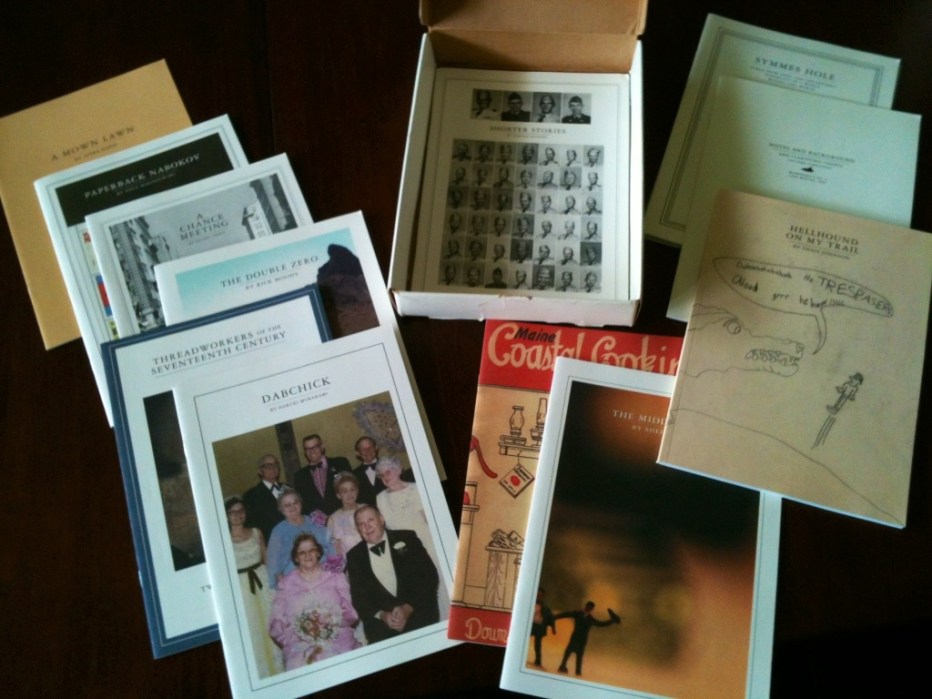
McSweeney’s #4 (Box of Books Acquired 6.14.2012)

20120626-095248.jpg

The novelist John Warner (The Funny Man), in an act of incredible kindness, sent me a copy of McSweeney’s #4, which he helped to put out years ago. In one of our emails, John offers the following:

It could be the best issue ever, a kind of platonic ideal of the McSweeney’s aesthetic before people started saying that things had a McSweeney’s aesthetic, a more innocent time if you will. My memory is that we were selling them at a live event at the Ethiopian Diamond restaurant in Chicago that we set up to help promote Neal Pollack’s book, and somehow the leftovers wound up in my trunk and I’ve been hauling them place to place ever since. . .

It’s a sort of fun artifact of the early/carefree days of McSweeney’s before Dave was DAVE, and the whole thing was still very haphazard.

It’s difficult to overstate the range of writers here: Lydia Davis, Jonathan Lethem, George Saunders, Rick Moody, Haruki Murakami, a three-act play by Denis Johnson, and much, much more:

20120626-100530.jpg

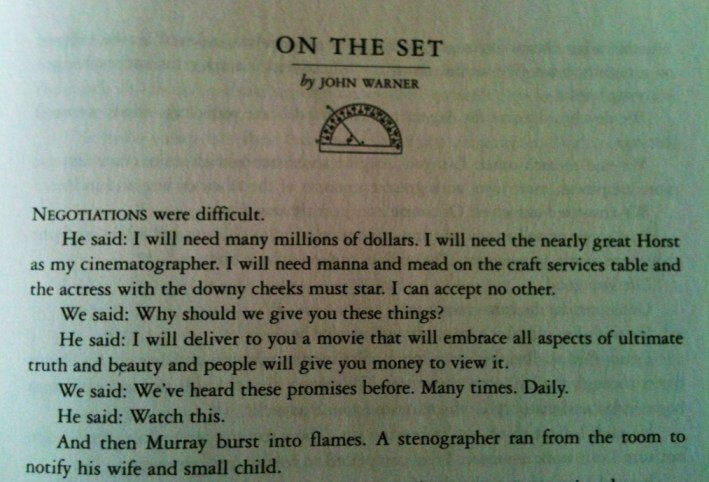
 There are also many short stories, including “On the Set” by John Warner, his second published story:

20120626-100545.jpg

It’s wonderfully absurd.

To read something hilarious and absurd and ultimately kind of touching, read John’s interview with critic Kevin Morris, who hated The Funny Man.

Summer Morning — Konstantin Somov

“Gut Feeling”/Zissou

This Certainly Is Reading — Francisco Goya

Summer — Giuseppe Arcimboldo

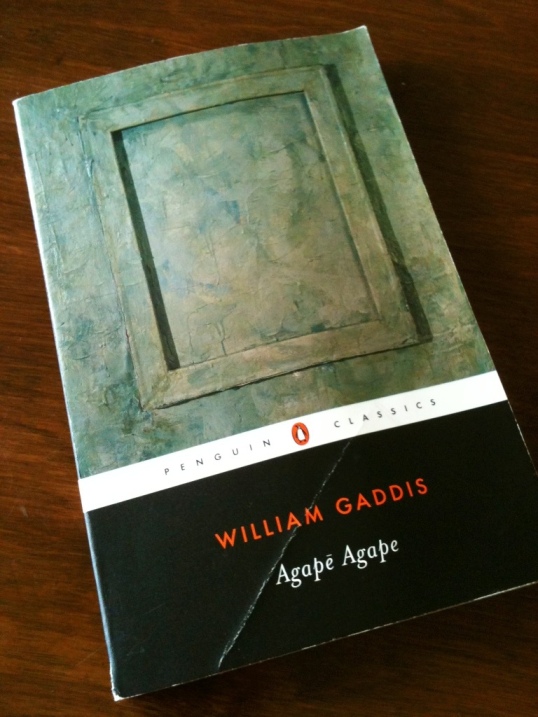
Some Annotations on the First Sentence of William Gaddis’s Last Novel, Agapē Agape

20120627-145321.jpg

1. Let’s start with the what:

Agapē Agape is the last novel by William Gaddis, that underread titan who gave us The Recognitions and J R. Agapē Agape was published in 2002, four years after Gaddis’s death. Agapē Agape is 96 pages in my Penguin Classics edition (the font is rather large, too)—almost exactly one-tenth the length of The Recognitions in my Penguin Classics edition, which is 956 pages (and in a smaller font).

2. And why?

Let’s say I’ve struggled with this review, perhaps more than I struggled with writing about J R (which I did here and here) or The Recognitions (which I did here and here), which seems nonsensical because those books are so big and this one is so short. But that’s a surface argument.

See, Agapē Agape is dense. It seems to compact and condense all of Gaddis’s themes and ideas and motifs into this little book that’s uranium heavy, too dense to allow for line breaks or paragraph breaks or indentations, let alone chapters. It’s one big block of text.

3. And so—

After reading the book twice I’ve marked every page (which is exactly like marking no pages), and at this point the only way that I can find to discuss it (I know there must be others) is to annotate the opening paragraph, its first sentence, really—which of course isn’t really a paragraph or a sentence in the traditional grammatical sense—I mean, there are a set of clauses, some fused sentences, perhaps a comma splice or two—but what marks it as a discrete sentence is that it’s punctuated by a question mark, a tiny caesura before the next onslaught of words. (Some of Agapē Agape’s sentences go on for pages).

4. The style of Agapē Agape recalls Thomas Bernhard, who Gaddis’s narrator accuses of having plagiarized the book that the narrator has yet to write. The accusation (ironic, purposefully, of course) points to Agapē Agape’s concern for synthesis, for transmitting some clear thesis statement out of the muddle of Western culture. Agapē Agape tries to suss out that muddle and as such is larded with discussions of Plato, Nietzsche, Melville, Hawthorne, Byron, Freud (“Sigi”!), Bach, Caesar, Joyce, Pulitzer, Tolstoy, Frankenstein, Huizinga, Pound, Philo T. Farnsworth, player-pianos . . . It overwhelms the narrator; it overwhelms the reader. But enough dithering—

5. —here is the opening sentence:

No but you see I’ve got to explain all this because I don’t, we don’t know how much time there is left and I have to work on the, to finish this work of mine while I, why I’ve brought in this whole pile of books notes pages clippings and God knows what, get it all sorted and organized when I get this property divided up and the business and worries that go with it while they keep me here to be cut up and scraped and stapled and cut up again my damn leg look at it, layered with staples like that old suit of Japanese armour in the dining hall feel like I’m being dismantled piece by piece, houses, cottages, stables orchards and all the damn decisions and distractions I’ve got the papers land surveys deeds and all of it right in this heap somewhere, get it cleared up and settled before everything collapses and it’s all swallowed up by lawyers and taxes like everything else because that’s what it’s about, that’s what my work is about, the collapse of everything, of meaning, of values, of art, disorder and dislocation wherever you look, entropy drowning everything in sight, entertainment and technology and every four year old with a computer, everybody his own artist where the whole thing came from, the binary system and the computer where technology came from in the first place, you see?

6. “No but you see I’ve got to explain all this because I don’t, we don’t know how much time there is left and I have to work on the, to finish this work of mine while I,”

Ulysses ends with a “Yes”; Agapē Agape begins with a “No.” This is a deeply negative book, cruel almost, bitter, caustic, acidic, but also erudite, funny, and even charming. We see right away the narrator—surely a version of Gaddis himself—concerned with the ancient problem of communication, the problem that occupied Plato and every philosopher since: “I’ve got to explain all this.” We also see here the same stream-of-consciousness technique here that Joyce used so frequently in Ulysses (putting aside Gaddis’s denials of a Joyce influence)—the suspended referent, the unnamed (the unnameable?): “I have to work on the, to finish this work of mine while I”—while I what? Still can? Still live? From the outset, Agapē Agape is a contest against time, death, and entropy.

7. “why I’ve brought in this whole pile of books notes pages clippings and God knows what, get it all sorted and organized”

Synthesis, synthesis, synthesis. Making books out of other books. Plugging literature into other literature. I am quite content to go down to posterity as a scissors-and-paste man, said someone once. And then others said it again. And then I cited it here, now.

I’m reminded here of a list that Gibbs (erstwhile Gaddis stand-in in J R) keeps in his pocket, a scrap paper crammed with ideas, fragments, citations:

Is it possible to get it sorted?

Recall now Gaddis’s hero Ezra Pound. From Tom McCarthy’s essay on synthesis, “Transmission and the Individual Remix”:

With the Cantos, he kept up this furious enterprise for five whole decades, ramping its intensity up and up until the overload destroyed him, blew his mind to pieces, leaving him to murmur, right toward the end: “I cannot make it cohere.”

It is the reader’s job to make Agapē Agape cohere.

8. “when I get this property divided up and the business and worries that go with it”

Agapē Agape may be said to have a few formalizing plots beyond its object of synthesizing Western culture vis-à-vis art and entertainment.

One of these formalizing elements is the idea of an old man divvying up his property to his daughters. Oh, hey, King Lear anyone? What’s most interesting to me about this plot (okay, more of a motif really) is that it’s the only allusive device that the narrator doesn’t remark upon. We have a narrator who’s trying to control all these notes and clippings, all these scraps of culture, a narrator with a sharp (if distracted intelligence) who nevertheless fails to remark upon the fact that his personal circumstances echo the great dismal swan song of English literature. King Lear: madness, unraveling, degeneracy, death, entropy.

9. “while they keep me here to be cut up and scraped and stapled and cut up again my damn leg look at it, layered with staples like that old suit of Japanese armour in the dining hall feel like I’m being dismantled piece by piece,”

Another formalizing element in Agapē Agape are the health issues the narrator faces, presumably a series of surgeries that involve at least one of his legs. The motif of surgeries, of transplants, and implants runs throughout The Recognitions and J R as well. In The Recognitions we get poor Stanley’s mother’s amputated leg, another strange reliquary trace floating through the text. In J R, we get Cates prepped for a heart transplant, yet another organ transferral for this massive man. There’s the idea here of borrowed parts, that humans might not be “natural,” cohesive entities but rather a collection of parts that may be swapped out. Again, synthesis in the face of break down; the surgeon as entropy repairman.

10. “houses, cottages, stables orchards and all the damn decisions and distractions I’ve got the papers land surveys deeds and all of it right in this heap somewhere, get it cleared up and settled before everything collapses and it’s all swallowed up by lawyers and taxes like everything else because that’s what it’s about,”

Here, the personal, the concrete, the immediate, and the real tips into what Gaddis took to be the grand subject of his corpus—collapse, chaos, entropy. Spelled out clearly in the next line:

11. “that’s what my work is about, the collapse of everything, of meaning, of values, of art, disorder and dislocation wherever you look, entropy drowning everything in sight,”

I don’t think commentary from me is necessary here. Instead, let me share a quote from Gibbs in J R, ranting to his young students:

Before we go any further here, has it ever occurred to any of you that all this is simply one grand misunderstanding? Since you’re not here to learn anything, but to be taught so you can pass these tests, knowledge has to be organized so it can be taught, and it has to be reduced to information so it can be organized do you follow that? In other words this leads you to assume that organization is an inherent property of the knowledge itself, and that disorder and chaos are simply irrelevant forces that threaten it from the outside. In fact it’s the opposite. Order is simply a thin, perilous condition we try to impose on the basic reality of chaos . . .

12. “entertainment and technology and every four year old with a computer, everybody his own artist where the whole thing came from, the binary system and the computer where technology came from in the first place, you see?”

The age of the amateur. Paint-by-numbers. Everyone wants to write a novel but no one wants to read one. Etc. When the narrator grumbles “where technology came from in the first place,” he means entertainment. That’s one thesis in Agapē Agape: that the technological progress we so value, that so underwrites the march of our grand civilization has its roots in toymaking and child’s play.

13. The novel that follows this addled, rattled opening line is remarkable for its brilliance, its cruelty, but most of all its sheer verbal force. Gaddis showed a mastery of voice in J R, a heteroglossic novel of speech, speech, speech, a grand dare to any reader, I suppose. Agapē Agape is even more stripped down, the monologue of a dying voice, a voice that’s been too-long ignored and under-appreciated. I don’t know if something so sad, so personally sad can be called perfect, but I can’t think of a more appropriate or fitting final statement from Gaddis.

Woman Reading (1935) — Pablo Picasso