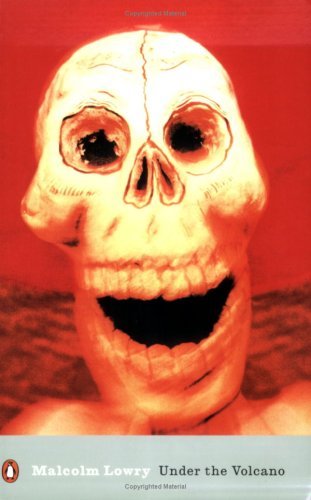
Most of Malcolm Lowry’s dense, depressing novel Under the Volcano takes place over the course of November 2nd, 1938, the Mexican Day of the Dead. Like a reticent, dour Virgil, Lowry guides the reader through the day’s tragic arc, floating between the minds of his novel’s three protagonists: Geoffrey Firmin, his half-brother Hugh, and Geoffrey’s estranged wife Yvonne. Geoffrey is British Consul to Mexico — ex-Consul, really, as British-Mexican relations sour against the backdrop of Spanish fascism and the rise of nationalism in Mexico — but he is almost always referred to as “the Consul,” a blackly ironic title. See, the Consul bears little authority aside from an extreme expertise on how to stay drunk (or “drunkly sober un-drunk”) 24/7. He’s ambassador to bar stools, a manager of mescal and little else (certainly not his own life; certainly not diplomatic affairs). The Consul is a wreck, an alcoholic to put Hemingway and Fitzgerald’s (and even Bukowski’s) alter-egos to shame.
After a first chapter that seems to derail all but the most patient readers, the narrative conflict arrives when Yvonne returns to Quauhnahuac, Mexico, a year after leaving (and divorcing) the Consul. She arrives to find the Consul (“Geoffrey,” as he’s called when the free indirect style inhabits her mind) drinking whiskey in a hotel bar in order to sober up (yep). It’s not immediately clear why Yvonne has returned to the Consul, but it seems that she hopes to save him from drowning in a drunken downward spiral. As the pair walks to the Consul’s house, they pass numerous advertisements for a boxing match; a child’s funeral proceeds down the avenue. These motifs of fighting, death, and futility permeate the novel.
During the walk we learn that Yvonne is not the only one concerned about the Consul’s health; his (much) younger brother Hugh has come to stay with him in the hopes of sobering him up. (Hugh employs a revolting and unsuccessful “strychnine cure”). That Hugh has also returned doubly complicates the plot. Much of Under the Volcano remains implicit, unnamed, hinted at, and this seems especially true of the implication that Yvonne cheated on the Consul with Hugh in the recent past (this implication may have been stated conclusively at some point in the novel, but I’ve only read the book once, which is perhaps like not having read it at all). What’s certainly clear is that Yvonne cheated on the Consul with a French filmmaker, Jacques Laruelle, a man whom the Consul, through sheer bizarre coincidence (but of course it isn’t sheer bizarre coincidence), spent a childhood summer with, and experience which bonded them as brothers in an Edenic holiday that eventually (inevitably) soured.
Despite her infidelities, Yvonne is generally present (I choose the verb “present” over “presented as” to highlight Lowry’s impeccable Modernist style) as a sympathetic character. Still, it is hard not to identify with the Consul (with “Geoffrey,” I suppose, if we are going to be familiar), the dark soul of this novel, and his complicated, painful feelings for Yvonne form the core of Volcano’s tragedy. He longs for her, pines for a complete life with her, yet resents her, cannot forgive her, hates her. For what? For leaving him. For betraying him. But perhaps foremost, he despises her inability to understand his alcoholism (he is particularly upset when she refuses to share a morning libation with him when they meet for the first time in a year). I’ll quote a passage at length now, one that showcases Lowry’s free indirect style, and one that reveals the strange indignities of the Consul’s sense of his own alcoholism. For context, dear reader, you must only know that Yvonne has suggested that she and the Consul might make long-term plans when he is sober “in a day or two”—
The Consul sat perfectly still staring at the floor while the enormity of the insult passed into his soul. As if, as if, he were not sober now! Yet there was some elusive subtlety in the impeachment that still escaped him. For he was not sober. No, he was not, not at this very moment he wasn’t! But what had that to do with a minute before, or half an hour ago? And what right had Yvonne to assume it, assume either that he was not sober now, or that, far worse, in a day or two he would be sober? And even if he were not sober now, by what fabulous stages, comparable indeed only to the paths and spheres of the Holy Cabbala itself, had he reached this stage again, touched briefly once before this morning, this stage at which alone he could, as she put it, “cope,” this precarious precious stage, so arduous to maintain, of being drunk in which alone he was sober! What right had she, when he had sat suffering the tortures of the damned and the madhouse on her behalf for fully twenty-five minutes on end without having a decent drink, even to hint that he was anything but, to her eyes, sober? Ah, a woman could not know the perils, the complications, yes, the importance of a drunkard’s life! From what conceivable standpoint of rectitude did she imagine she could judge what was anterior to her arrival? And she knew nothing whatever of what all too recently he had gone through, his fall in the Calle Nicaragua, his aplomb, coolness, even bravery there—the Burke’s Irish whiskey! What a world! And the trouble was she had now spoiled the moment.
The “fall in the Calle Nicaragua” the Consul references is quite literally a drunkard’s blackout (followed by the aforementioned fortifying whiskey, courtesy of a tourist), but it — falling — is perhaps the dominant motif in a novel crammed with motifs. In allegorical terms, if we want to ruin a good book (I don’t recommend this, of course), Volcano is pure Faust-stuff: end of innocence, fall of man, intractability of the human condition, ethical peril, moral inertia. While the Consul’s fall dominates the novel, Lowry brings this decline into dramatic relief in a late, climactic episode when his (anti-)heroic trio encounter a dying (dead?) man on the side of the road. Hugh tries to help, but the Darwinian venality of Mexican commonplace law makes his attempt impotent. Yvonne and the Consul are basically paralyzed.
Hugh’s attempt to save the man is a desperate call to action, an endeavor to perform some good in a world dominated by war and fascism. Hugh’s character fascinates. We learn of his past in one of the novel’s most intriguing episodes, a mini-bildungsroman that finds young Hugh working in the merchant marine as a calculated ploy to lend romance to his persona — he longs to prevail as a songwriter. He returns to find that no one cares about — has even heard — his guitar compositions; his publicity stunt fails. Although Hugh is only twenty-nine, he already seems himself as a failure, a fallen hero; he obsesses over the Battle of Ebro, daydreaming of helming a ship laden with hidden arms that he will deliver to the Loyalists who oppose the Fascists. Hugh’s greatest pain — and perhaps (only perhaps) Lowry’s greatest cruelty — is the awareness that the idealism of romantic heroism is intrinsically bound to a kind of selfish egoism. Hugh, perhaps with the visceral signal of his half-brother as a kind of radical prescience, can already see his own fall; his parts in Volcano are in a sense a constant meditation on falling. Hugh tries to save the dying man on the road, the cold double of his brother, whom he also tries to save — and yet it is all to little avail.
In Lowry’s world, in the volcano-world, there is only expulsion from the Eden. Lowry spells out this theme near the middle of his novel in a strange episode. The Consul wanders into his neighbor’s garden and reads a sign —
¿LE GUSTA ESTE JARDÍN?
¿QUE ES SUYO?
¡EVITE QUE SUS HIJOS LO DESTRUYAN!
The Consul stared back at the black words on the sign without moving. You like this garden? Why is it yours? We evict those who destroy! Simple words, simple and terrible words, words which one took to the very bottom of one’s being, words which, perhaps a final judgement on one, were nevertheless unproductive of any emotion whatsoever, unless a kind of colourless cold, a white agony, an agony chill as that iced mescal drunk in the Hotel Canada on the morning of Yvonne’s departure.
Significantly, either the sign is posted with improper punctuation, or (and?) the Consul’s translation is wrong — in either case a meaningful misreading occurs. We later receive the “proper” version of the sign: “¿Le gusta este jardín, que es suyo? ¡Evite que sus hijos lo destruyan! – “Do you like this garden that is yours? See to it that your children do not destroy it!” The Consul’s first reading is a corruption, a cruel misreading that questions humanity’s right to happiness, and, tellingly, he connects the sign to the end of his relationship with Yvonne. The second version of the sign, while still foreboding, perhaps signals a kernel of hope in Lowry’s bleak work — the idea that a garden might be preserved, might be tended to; that children might be raised who do not kill, cheat, steal, rape, enslave, or otherwise prey on each other. Still, Lowry refuses to imagine what such a world might look like for us. Did I mention that Volcano is really, really sad?
For all its bleak, bitter bile, Volcano contains moments of sheer, raw beauty, especially in its metaphysical evocations of nature, which always twist back to Lowry’s great themes of Eden, expulsion, and death. Lowry seems to pit human consciousness against the naked power of the natural world; it is no wonder then, against such a grand, stochastic backdrop, that his gardeners should fall. The narrative teems with symbolic animals — horses and dogs and snakes and eagles — yet Lowry always keeps in play the sense that his characters bring these symbolic identifications with them. The world is just the world until people walk in it, think in it, make other meanings for it.
In many ways, Under the Volcano is an antipodal response to Joyce’s Ulysses. Both novels stream through a number of consciousnesses over the course of one day; both novels invert and subvert mythical frameworks against diurnal concerns; both novels point to the ways that the smallest meannesses — and kindnesses — can color and affect our lives. And while there are many divergences (chiefest, I believe, the spirit of redemption in Ulysses that seems entirely absent from Volcano), the greatest similarity may be their difficulty. Simply put, Lowry, like Joyce, throws his readers into the deep end. The first chapter of the novel inhabits the mind of Jacques Laruelle and takes place exactly one year after the events of the rest of the novel. It is both overture and context for all that follows, and yet it is radically alienating; indeed, it only fully makes sense after one finishes the novel and goes back and reads it again, realizing it is the rightful coda, the sad epilogue of a sad story. Lowry leads with his conclusion, show us the fall-out up front, the splinters and shards of the narrative to come. Picking up these pieces is hardly easy and never joyful, but it is a rewarding experience. Very highly recommended.