“Pissing in the Snow”

The Ozark folktale “Pissing in the Snow,” as told to Vance Randolph by Frank Hembree in 1945. Hembree first heard the tale in the 1890s. From Randolph’s indispensable collection, Pissing in the Snow & Other Ozark Folktales

One time there was two farmers that lived out on the road to Carico. They was always good friends, and Bill’s oldest boy had been a-sparking one of Sam’s daughters. Everything was going fine till the morning they met down by the creek, and Sam was pretty goddam mad. “Bill,” says he, “from now on I don’t want that boy of yours to set foot on my place.”

“Why, what’s he done?” asked the boy’s daddy.

“He’s pissed in the snow, that’s what he done, right in front of my house!”

“But surely there ain’t no great harm in that,” Bill says.

“No harm!” hollered Sam. “Hell’s fire, he pissed so it spelled Lucy’s name, right there in the snow!”

“The boy shouldn’t have done that,” says Bill. “But I don’t see nothing so terrible bad about it.”

“Well, by God, I do!” yelled Sam. “There was two sets of tracks! And besides, don’t you think I know my own daughter’s handwriting?”

Henry Miller on Surrealism, Lewis Carroll, and Dada

Henry Miller, in a 1962 Paris Review interview, speaks about surrealism, dada, and his love for Lewis Carroll

INTERVIEWER

In “An Open Letter to Surrealists Everywhere” you say, “I was writing surrealistically in America before I ever heard the word.” Now, what do you mean by surrealism?

MILLER

When I was living in Paris, we had an expression, a very American one, which in a way explains it better than anything else. We used to say, “Let’s take the lead.” That meant going off the deep end, diving into the unconscious, just obeying your instincts, following your impulses, of the heart, or the guts, or whatever you want to call it. But that’s my way of putting it, that isn’t really surrealist doctrine; that wouldn’t hold water, I’m afraid, with an André Breton. However, the French standpoint, the doctrinaire standpoint, didn’t mean too much to me. All I cared about was that I found in it another means of expression, an added one, a heightened one, but one to be used very judiciously. When the well-known surrealists employed this technique, they did it too deliberately, it seemed to me. It became unintelligible, it served no purpose. Once one loses all intelligibility, one is lost, I think.

INTERVIEWER

Is surrealism what you mean by the phrase “into the night life”?

MILLER

Yes, there it was primarily the dream. The surrealists make use of the dream, and of course that’s always a marvelous fecund aspect of experience. Consciously or unconsciously, all writers employ the dream, even when they’re not surrealists. The waking mind, you see, is the least serviceable in the arts. In the process of writing one is struggling to bring out what is unknown to himself. To put down merely what one is conscious of means nothing, really, gets one nowhere. Anybody can do that with a little practice, anybody can become that kind of writer.

INTERVIEWER

You have called Lewis Carroll a surrealist, and his name suggests the kind of jabberwocky which you use occasionally . . .

MILLER

Yes, yes, of course Lewis Carroll is a writer I love. I would give my right arm to have written his books, or to be able to come anywhere near doing what he did. When I finish my project, if I continue writing, I would love to write sheer nonsense.

INTERVIEWER

What about Dadaism? Did you ever get into that?

MILLER

Yes, Dadaism was even more important to me than surrealism. The Dadaist movement was something truly revolutionary. It was a deliberate conscious effort to turn the tables upside down, to show the absolute insanity of our present-day life, the worthlessness of all our values. There were wonderful men in the Dadaist movement, and they all had a sense of humor. It was something to make you laugh, but also to make you think.

Dinner with Henry Miller

Vodpod videos no longer available.

Via Ubuweb

Dinner With Henry is a rare, 30-minute documentary about Henry Miller. It is exactly what the title implies: footage of Henry having dinner. With him at the table is the film crew, and actress/model Brenda Venus, to whom Henry was enamoured in the final years of life. Henry – at age 87 – spends the majority of his time speaking on a number of subjects, the most persistent of which is Blaise Cendrars. Occasionally, he complains about the food. That is all. It may not be of much interest to a general audience, but is a curious “slice of life” for any Miller fan who likes to imagine being at the table with him.

Jonathan Safran Foer Talks About His New Book, Tree of Codes

Jonathan Safran Foer’s new book, Tree of Codes, is a cut-up — or cut-out, rather — of Bruno Schulz’s The Street of Crocodiles. More here.

“To Bertholt Brecht” — William Meredith

“To Bertholt Brecht” by William Meredith— 

I’ve heard that you said, when a scene you had revised
Still didn’t suit a man you used to know,
“But I am not Kafka!” What artist hasn’t sized
Himself in the dwindling lacquer row
Of chinese dolls that, with no loss of face,
Can be out back inside one another now
And only a fool quarrel about his place.
There are such ranks; and yet I quarrel with
Those who have put a price on mere despair,
Ranking a man as he can fetch up death
And senselessness, and finding you famous so.
You called your foe by name: a naive faith.
It is a naive disillusion, everywhere
Fudging the good and bad, we must call foe.
The truth is hidden as cunningly from one
Time as another; what they change is the decoys,
And it takes a wily man to use the gun.
I think you would not be fooled by our bully-boys
Who say, “As Brecht said, I live in an age of blood.”
You might stop with an oath their shrill, untimely noise:
Evil is nothing until it touches good.

My Year of Flops — Nathan Rabin

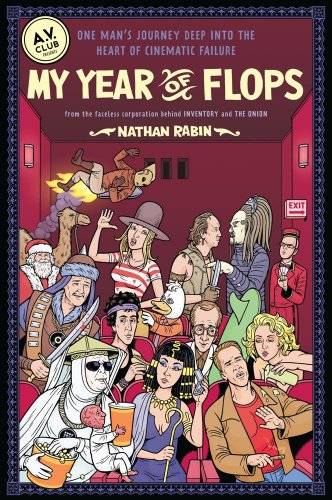
Let me admit biases up front: for the past few years, I’ve looked forward every Wednesday to Nathan Rabin’s regular column at the AV Club,“My Year of Flops,” where he reviews–and reappraises–some of the worst-received films of all time. I’m also a fan of Rabin’s other columns, “THEN! That’s What They Called Music!” and “Nashville or Bust,” as well as the general tone of the AV Club, which he no doubt helps set as its head writer. I also thought Rabin’s memoir The Big Rewind was pretty good. So, I’m probably not the most objective person to review Rabin’s new book My Year of Flops, which comprises 35 of Rabin’s past columns, 15 new entries, and interview snippets with some of the actors who had the (mis)fortune to turn up in these flops. I’ll do my best to assess how well these columns–most of which were written for the internet–hold up as a book.

So, what, exactly, constitutes a flop?  There are the biggies here, of course, infamous studio-busting career-killers like Heaven’s Gate, Battlefield Earth, and Ishtar;  the batshit crazy weirdfests that were destined to become cult classics, like Southland Tales, Howard the Duck, and The Apple; the disposable movies made to be forgotten, like Bratz: The Movie; there are forgotten and overlooked oddballs, like Robert Altman’s teen sex comedy, O.C. and Stiggs, and Gospel Road, where Johnny Cash tells the life story of Jesus. All of these films share disappointing (or non-existent) box office results as well as general critical disapproval (or at least bewilderment). As part of his revisionist project, Rabin ends each entry by declaring the re-appraised film a “Secret Success,” a “Fiasco,” or a “Failure.” Tellingly, most of the time Rabin finds his subject to be a “Fiasco.” He’s willing to take each film on its own terms; he’s also incredibly open to viewing each film in a way that transcends the trappings of its marketing to an intended audience.

Take, for example Tough Guys Don’t Dance, a film macho novelist Norman Mailer thought it would be a totally sound idea to not only write but direct. Rabin’s initial analysis derides the film for its cardboard characters, debased gimmickry, and embarrassing dialog. By the end of his reassessment, however, Rabin has given the would-be thriller a new life as “a darkly comic, horror-tinged melodrama about the emptiness of excess and the soul-crushing costs of pursuing endless pleasure.” His review rests not on a personal ironic vision, but rather on a willingness to see Mailer’s own ironic vision at work behind (and in front of) the camera.

In the same way, Rabin is able to put aside–even while acknowledging–the dreadful reputations surrounding films like Ishtar and Heaven’s Gate. Even though the latter film essentially destroyed both its studio and the maverick filmmaking style of the 1970s, Rabin finds in it more than a slight redemption–he finds a flawed masterpiece, a gorgeous treatise on Manifest Destiny that doesn’t deserve its reputation. Similarly, Rabin would have us believe that Istar actually is funny. Both of these entries are remarkable not just in their clear revisionist goal, but also for how instructive they are. In both write-ups, Rabin reveals much of how movies are made, and how movies are made flops–the ways that infighting, firings, and studio expectations can damn a film before it even premieres.

While My Year of Flops is instructive in its criticism, it’s also very entertaining. Rabin has a keen sense of satire, and if he occasionally tips into snark, it’s always earned (and if you have a problem with a writer being snarky at the expense of Battlefield Earth, well, you’re probably a prig anyway). A great illustration of how Rabin combines his sense of humor with his instructive criticism in his coinage of the term “Manic Pixie Dream Girl”–

The Manic Pixie Dream Girl exists solely in the fevered imaginations of sensitive writer-directors, who use them to teach broodingly soulful young men to embrace life. The Manic Pixie Dream Girl serves as a means to an end, not a flesh-and-blood human being. Once life lessons have been imparted, the Manic Pixie Dream Girl might as well disappear in a poof! for her life’s work is done.

Cameron Crowe is particularly guilty of employing the MPDG trope, but you can find her pretty much everywhere you look–at least in the domain of rom-coms. Rabin proposes the term in his first entry in the series (also the first entry in the book) a review of Crowe’s much maligned Elizabethtown. Rabin finds it to be a Fiasco. In a move that sums up both Rabin’s program and his generous spirit, Rabin concludes My Year of Flops by re-reassessing Elizabethtown–he now dubs it a Secret Success. While I don’t subscribe to the idea that a critic should-be a starry-eyed optimist who finds the best of all possible worlds in each work, I do think that it has become far too easy to outright dismiss someone’s hard work. We live in a hyper-mediated age that moves too fast: all propositions are disposable, including the arts. Rabin, in taking each work on its own terms, does a service to both criticism and creativity.

Rabin’s own columns might, of course, fall prey to this disposable age. Today’s columns and blog posts are meant to be consumed quickly; although the best might find a life of new clicks in cyberspace, most are tomorrow’s virtual bird-cage liners. The blog-book is thus a tenuous grasp at some permeability–or at least respectability. My Year of Flops is fun, energetic, and insightful, but it does not bear sustained reading. The entries are best consumed one at time, probably between other tasks (or other books). It’s a great book for the john. Still, in an ideal library, My Year of Flops would stand squarely along side any other work of film criticism (it’s certainly sharper than anything by Leonard Maltin or Gene Shalit). Ultimately, Rabin does here what all great critics do–he makes a case for the works he’s appraising. He makes you want to see his Secret Successes and even the Fiascos (and, at times, even the Failures). I’ll even forgive him for making me watch The Apple. Recommended.

N. Took the Dice–Alain Robbe-Grillet

Vodpod videos no longer available.

More info here.

“His Face All Red” — Em Carroll

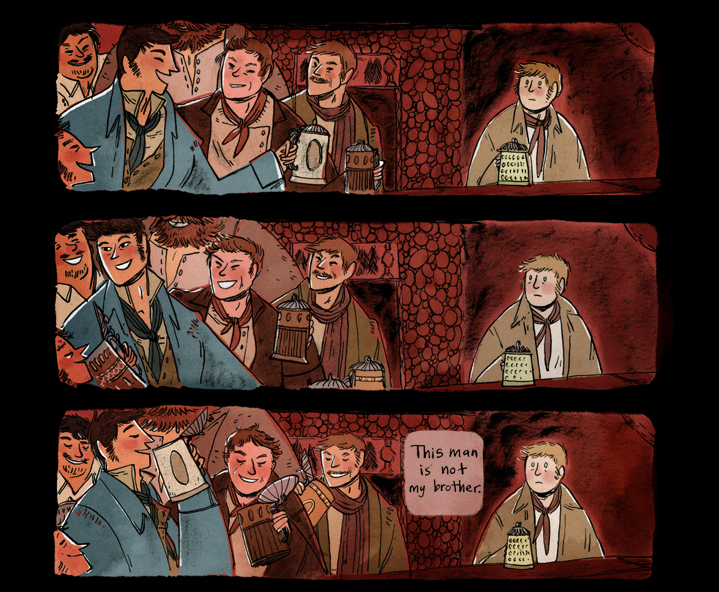
“His Face All Red” is a lovely, disturbing little self-contained webcomic by Em Carroll. Fratricide, an American gothic setting, and a horrifyingly ambiguous conclusion: what’s not to love? Read it here.

Silly CNN Report on Thomas Pynchon

George Bernard Shaw’s Death Mask

Timothy Leary Just Wanted to Meet Thomas Pynchon

Roland Barthes on Alain Robbe-Grillet

From Roland Barthes’s essay Objective Literature: Alain Robbe-Grillet

Robbe-Grillet’s purpose . . . is to establish the novel on the surface: once you can set its inner nature, its “interiority,” between parentheses, then objects in space, and the circulations of men among them, are promoted to the rank of subjects. The novel becomes man’s direct experience of what surrounds him without being able to shield himself with a psychology, a metaphysic, or a psychoanalytic method in his combat with the objective world he discovers. The novel is no longer a chthonian revelation, the book of hell, but of earth–requiring that we no longer look at the world with the eyes of a confessor, of a doctor, or of God himself (all significant hypostases of the classical novelist), but with the eyes of a man walking in his city with no other horizon than the scene before him, no other power than that of his own eyes.

The Collected Stories of Lydia Davis

The Collected Stories of Lydia Davis compiles all 198 of Davis’s short stories in one handsome volume. That’s all four of Davis’s exceptional short story collections: Break It Down, Varieties of Disturbance, Samuel Johnson Is Indignant, and Almost No Memory. FS&G debuted the hardback edition a year ago, and this month Picador offers up a lovely (and more affordable) trade paperback version; it sports deckle edge pages and French flaps, and runs over 700 pages.

I front-load my review with this data to make it obvious that, if you have any interest in Lydia Davis, this is a book to pick up. It’s a wonderful collection, a tidy brick of words that begs for immersion, the kind of book you float around in, flipping pages at random to find and enjoy yet another strange little gem. Go get it.

If you’re not sure why you should be interested in Davis, read on.

Most of Davis’s stories are very short; many are just a paragraph or two, and some a mere sentence in length. They are not stories in the traditional sense: don’t look for sweeping character development or grand plot arcs. These stories thrive rather on tone, a keen sense of inspection, perception, and mood, and an intensity of observation on matters large and small. They are tales, fables, riffs, annotations, skits, jokes, japes, anecdotes, journals, thought experiments, epigrams, half-poems, and would-be aphorisms.

“In a House Besieged,” from her first collection Break It Down (1986) reveals much about the Davis program. Here it is in full–

In a house besieged lived a man and a woman. From where they cowered in the kitchen the man and woman heard small explosions. “The wind,” said the woman. “Hunters,” said the man. “The rain,” said the woman. “The army,” said the man. The woman wanted to go home, but she was already home, there in the middle of the country in a house besieged.

“In a House Besieged” illustrates a number of the themes and motifs that run throughout Davis’s oeuvre: unnamed protagonists identified only as “the man” and “the woman” (later stories might call them “the husband” and “the wife”) who are at once allegorical placeholders and at the same time singular individuals; a domestic setting (with family members as protagonists); an unknowable and perhaps unidentifiable threat; a pervasive sense of alienation balanced by an ironic sense of humor. The story’s brevity also shows that, from the outset of her publishing career, Davis was already working toward something wholly different from the Carveresque stories that dominated MFA fiction in the 80s.

The domestic settings of Break It Down–spaces often haunted by mothers and fathers–rear up again and again throughout the collection. 1997’s Almost No Memory kicks off with “Meat, My Husband,” a story about a wife who is trying to get her husband to eat healthier–a difficult prospect considering his affection for beef. The tale should be utterly banal, but instead it is humorous and even oddly moving; the wife, who narrates the piece, concludes by realizing that her husband would really just prefer to cook for himself. The insight transcends the particular domestic scenario: it seems applicable to the reader’s own life (or to this reader’s, anyway). “How He Is Often Right,” also from the same collection, is a short paragraph where the narrator concludes that the titular “he” is often wrong, “but wrong for circumstances different from the circumstances as they actually were, while [his decision] was right for circumstances I clearly did not understand.” The story captures the way that we impart great meaning to the smallest arguments, dwelling on them, connecting them to our sense of identity. We see the same analysis at work in “The Outing” (also from Almost No Memory). In full–

An outburst of anger near the road, a refusal to speak on the path, a silence in the pine woods, a silence across the old railroad bridge, an attempt to be friendly in the water, a refusal to end the argument on the flat stones, a cry of anger on the steep bank of dirt, a weeping among the bushes.

Davis’s sentence might be telescopic, but it also, paradoxically, puts the relationship in the story under a microscope. The reader can fill in the gaps with his or her own background: we’ve all experienced this anger, this silence, this refusal. We’ve been there. The story is real. It’s true.

The truth of Davis’s stories is what unites them; it’s the reader’s recognition of their truth that makes them so pleasurable. Take “Boring Friends” from 2001’s Samuel Johnson Is Indignant (again, in full)–

We know only four boring people. The rest of our friends we find interesting. However, most of the friends we find interesting find us boring: the most interesting find us the most boring. The few who are somewhere in the middle, with whom there is reciprocal interest, we distrust: at any moment, we feel, they may become too interesting for us, or we too interesting for them.

Davis’s treatment on friendship consistently penetrates facades, exposes our competitive cores, and, at the same time, celebrates the joys we might take in others. This precarious line also evinces in Davis’s stories about taking care of young children. The short scene “Child Care” focuses on a grumpy father who’d rather watch TV than take his turn with the baby. Solution: “Together they watch The Odd Couple.” And perhaps it is because I have two young children, but I can’t recall a more accurate depiction of the simultaneous wonder and boredom of taking care of a new baby than “What You Learn About the Baby” (a lengthy treatise at six pages).

Not all of Davis’s stories focus on family and friends. There’s much here about academia: troubles with translation, grappling with tenure, the perils of teaching, and so on. There are at least three entries on grammar here. If not all readers can connect with these stories (although I certainly did), they need not worry–part of the joy of the book is its diversity. If a story doesn’t catch right away, flick to the next one, or one a hundred pages down the line. Perhaps you will alight on one of the collection’s imaginative historical biographies, like “Kafka Cooks Dinner” or “Marie Curie, So Honorable Woman,” positively epic at 18 pages. Davis’s histories fascinate; they seem utterly real and true and absurd and improbable, all at the same time.

Indeed, discursive movement is the core of Davis’s, but her digressions all point to a thematic analysis of truth, of an individual’s attempt to understand the world in terms other than the individual herself. They dwell on problems of self-consciousness, often employing literary distortion as an analytical tool. Davis’s literary distortions always point to a concrete reality, a livable, experiential reality; the fact that we should experience the real as surreal or absurd only makes her work more truthful.

It would be easy to park Davis with the postmodernist counter-tradition, but I think her work looks to something else, something post-postmodernist (I write this, I know, at the risk of falling into an abyssal loop).  Davis’s work presages contemporary “flash fiction”; her stories’ brevity reflect the simultaneous contraction of our attention spans and the expansion of our diverse interests. Her story “Samuel Johnson Is Indignant:” reads like a Facebook update. Here it is in full — “that Scotland has so few trees.” Davis transmutes an amusing annotation into a story that somehow brings the great critic back to life. The title of the story is also the title of the book; what follows then is a kind of meta-joke on reader expectations, subverting our expectations of Dr. Johnson’s (supposed) meta-commentary on the book-proper. But I fear I’m headed into a lit-crit navel-gazing snoozefest (in what has already been a long review). Far better to wrap things up, I think, by simply noting again how joyful it is to move through the book, to open at random and read. Very highly recommended.

“Time Piece” — Jim Henson

(Via).

“The Discharged Soldier” — William Wordsworth

“The Discharged Soldier” is William Wordsworth’s moving poem about the pain of a war veteran returning home.

No living thing appeared in earth or air,
And, save the flowing water’s peaceful voice,
Sound there was none–but, lo! an uncouth shape,
Shown by a sudden turning of the road,
So near that, slipping back into the shade
Of a thick hawthorn, I could mark him well,
Myself unseen. He was of stature tall,
A span above man’s common measure, tall,
Stiff, lank, and upright; a more meagre man
Was never seen before by night or day.
Long were his arms, pallid his hands; his mouth
Looked ghastly in the moonlight: from behind,
A mile-stone propped him; I could also ken
That he was clothed in military garb,
Though faded, yet entire. Companionless,
No dog attending, by no staff sustained,
He stood, and in his very dress appeared
A desolation, a simplicity,
To which the trappings of a gaudy world
Make a strange back-ground. From his lips, ere long,
Issued low muttered sounds, as if of pain
Or some uneasy thought; yet still his form
Kept the same awful steadiness–at his feet
His shadow lay, and moved not. From self-blame
Not wholly free, I watched him thus; at length
Subduing my heart’s specious cowardice,
I left the shady nook where I had stood
And hailed him. Slowly from his resting-place
He rose, and with a lean and wasted arm
In measured gesture lifted to his head
Returned my salutation; then resumed
His station as before; and when I asked
His history, the veteran, in reply,
Was neither slow nor eager; but, unmoved,
And with a quiet uncomplaining voice,
A stately air of mild indifference,
He told in few plain words a soldier’s tale–
That in the Tropic Islands he had served,
Whence he had landed scarcely three weeks past;
That on his landing he had been dismissed,
And now was travelling towards his native home.
This heard, I said, in pity, “Come with me.”
He stooped, and straightway from the ground took up
An oaken staff by me yet unobserved–
A staff which must have dropped from his slack hand
And lay till now neglected in the grass.
Though weak his step and cautious, he appeared
To travel without pain, and I beheld,
With an astonishment but ill suppressed,
His ghostly figure moving at my side;
Nor could I, while we journeyed thus, forbear
To turn from present hardships to the past,
And speak of war, battle, and pestilence,
Sprinkling this talk with questions, better spared,
On what he might himself have seen or felt.
He all the while was in demeanour calm,
Concise in answer; solemn and sublime
He might have seemed, but that in all he said
There was a strange half-absence, as of one
Knowing too well the importance of his theme,
But feeling it no longer. Our discourse
Soon ended, and together on we passed
In silence through a wood gloomy and still.
Up-turning, then, along an open field,
We reached a cottage. At the door I knocked,
And earnestly to charitable care
Commended him as a poor friendless man,
Belated and by sickness overcome.
Assured that now the traveller would repose
In comfort, I entreated that henceforth
He would not linger in the public ways,
But ask for timely furtherance and help
Such as his state required. At this reproof,
With the same ghastly mildness in his look,
He said, “My trust is in the God of Heaven,
And in the eye of him who passes me!”

The cottage door was speedily unbarred,
And now the soldier touched his hat once more
With his lean hand, and in a faltering voice,
Whose tone bespake reviving interests
Till then unfelt, he thanked me; I returned
The farewell blessing of the patient man,
And so we parted. Back I cast a look,
And lingered near the door a little space,
Then sought with quiet heart my distant home.

Kurt Vonnegut Talks Cat’s Cradle

“I Wanna Know Why We Didn’t Get the Two Kegs of Beer You Promised Us” — Hunter S. Thompson vs. The Hell’s Angels