Language, Politics, Elitism, and Sarah Palin’s Horrendous Pronunciation

It wasn’t so much Governor Palin’s fumbling toward a semblance of specificity in her recent Katie Couric interview that made me cringe. It wasn’t her misapprehension that Putin is still the president of Russia (an honest mistake, I’m sure) that raised my hackles. It wasn’t her neocon-lite reduction of global politics to “good guys” vs “bad guys” that so irritated me. Even her ignorance of Henry Kissinger’s foreign policy philosophy re: Iran didn’t bother me. If anything, I delighted in watching Gov. Palin blather incoherently, especially after this fiasco two weeks ago. No, what really raised the hairs on the back of my neck was this exchange:

Couric: You recently said three times that you would never, quote, “second guess” Israel if that country decided to attack Iran. Why not?

Palin: We shouldn’t second guess Israel’s security efforts because we cannot ever afford to send a message that we would allow a second Holocaust, for one. Israel has got to have the opportunity and the ability to protect itself. They are our closest ally in the Mideast. We need them. They need us. And we shouldn’t second guess their efforts.

But, you see, it wasn’t what she said so much as it was how she said it. Or mispronounced it, rather.

Let me admit it. I’m an elitist, something of a snob I guess. I can’t help it. Although I didn’t go to five colleges, I did attend two universities to earn two degrees–nothing as prestigious as Palin’s hard-earned MS in communications, of course–but I do have some linguistic standards and expectations for our executive leadership. You see, Gov. Palin didn’t say “second guess,” as the CBS News transcript so generously credits her. No, Gov. Palin distinctly says “second guest.”

Now, we already know that Palin has had some difficulty with one of Bush’s biggest stumbling blocks, that oh-so daunting word “nuclear” (as in “nü-klē-ər” not “nyoo-kyoo-lar”). Observe:

Unfortunately, as of right now there’s no full footage of tonight’s interview up on a site that WordPress will allow me to embed here, and most of the posted clips focus on Palin’s rambling knowledge of basic geography (even Miss Teen South Carolina still managed to get more specific than Palin — “They don’t have maps”).

VIDEO UPDATE–Palin mispronounces “second guess” as “second guest” at 00:17:

If you go to CBS News and wait patiently, Palin’s redneck phrasing pops up at 8:55, wedged neatly amid a vague heap of rhetorically empty catchphrases that the neo-cons and Bush administration have been excreting for the past decade.

In the best assessment I’ve read on Palin yet, Roger Ebert points out that most middle-class Americans would brag if their kids went to Harvard on scholarship; that most of us honor travel as a form of education and the signal of intellectual curiosity. How did we get here? When, exactly, did we decide that our president needs to have the qualities of a good drinking buddy? In short, why do we think that provincialism and ignorance, so summarily captured in Palin’s groan-inducing “second guest,” are the signs of a “real,” “true” American? If we’re going to elect smug, hypocritical leaders, is it too much to ask that they exhibit a modicum of intelligence, or, at the very least, don’t trip over their words?
Wabi Sabi–Mark Reibstein and Ed Young

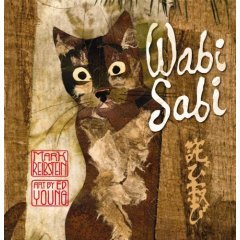
Wabi Sabi tells the story of of a cat from Kyoto named, uh, Wabi Sabi, who goes on a journey of self discovery in order to find out the elusive meaning of her name. Mark Reibstein’s simple but lovely script effectively incorporates haiku poems (including three haiku composed by Wabi Sabi herself, who finds artistic freedom at Ginkaku-ji) that can stand on their own as a simple story. Artist Ed Young brings Reibstein’s story to vivid, shimmering life. Not enough praise will do justice to Young’s rich, dense collage illustrations, which evoke the luxurious complexity one associates with masterpieces of ukiyo-e. Young’s kinetic yet peaceful art resonates with the book’s theme of finding beauty in the incomplete or imperfect, and is probably the best reason to buy this book. Wabi Sabi reads up-and-down as opposed to left-to-right, evoking a traditional scroll, allowing Young to utilize the depth and motion of the full space. The book also features short but detailed (and aesthetically-pleasing) endnotes explain the history of wabi sabi, haiku, and haibun. This short appendix also includes an English translation of the 14 haiku poems by Basho and Shiki that show up in the margins (in kanji, no less) on each of the pages.

Wabi Sabi was too long for my fifteen-month old daughter’s precious attention, and the scroll-style layout made it almost impossible to read with her on my lap (the book is also pretty much impossible for my scanner to handle, unfortunately for you dear reader). Also, I think the illustrations were a little too nuanced and complex for her–very young children tend to like strong, defined lines and bright primary colors. I’m convinced, however, that Wabi Sabi isn’t so much a children’s book as it is an art book for aesthetes with an interest in traditional Japanese culture–and I enjoyed it very much. Recommended.

Wabi Sabi is now available from Little, Brown.

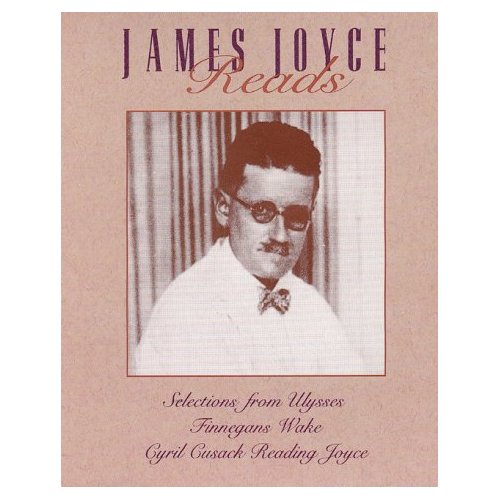
James Joyce Reads, You Listen!

Check out these mp3s of James Joyce reading selections from his novels (that word, “novel,” it doesn’t seem right…) Ulysses and Finnegans Wake. Lovely lilting rhythm. Mostly, it’s just cool to hear his voice. From the original liner notes by Sylvia Beach to the 1924 album (courtesy The Modern World):

In 1924 I went to the office of His Master’s Voice in Paris to ask them if they would record a reading by James Joyce from ULYSSES. But they would agree only if it were done at my expense. The record would not have their label on it, nor would it be listed in their catalogue. I accepted the terms: thirty copies of the recording to be paid for on delivery.

Joyce himself was anxious to have this recording made. He had made up his mind, he told me, that this would be his only reading from ULYSSES. Recording was done in a rather primitive manner in those days. All the same, I think the ULYSSES recording is a wonderful performance. I never hear it without being deeply moved.

James Joyce reads from Finnegans Wake (part I)

James Joyce reads from Finnegans Wake (part II)

Jams Joyce reads from Ulysses (from the “Aeolus” episode)

Or, if you prefer, check out Jim Norton reading the first few pages of Finnegans Wake (from the audio book version, which who knows if listening to counts as reading the thing–but it’s pretty cool to hear an adult man make these noises and think that such a thing might be Great Literature).

No Conclusion Could Be More Horrible than Solipsism

Okay. This is it. I promise.

This is the last post (for now, anyway, of course, I mean of course it’s not going to be the last post on him, of course) about David Foster Wallace. I’ll get back to reviews and whatnot next week. Swear. But I need to transition here, comment on the past week, move on–

–I’ve always despised the word closure. It’s a pop-psychobabble concept used to denote a social-cultural imposition of order and telos upon an individual’s right to experience the world (and all the loss and violence and ugliness experiencing the world entails) as ambiguous and chaotic and open-ended. But I guess in all likelihood, for anyone who’s endured personal tragedy, there must be some comfort in organizing the loss, fitting it into the narrative of their life, etc. This is the traditional project of literature, is it not–turning loss and tragedy into a plot, into something meaningful and productive? (At least that’s what Aristotle said . . .)–

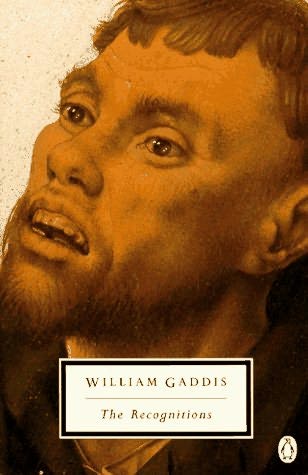
But I’m already off to a rambling start. I’ve spent the past week obsessing over eulogies and elegies, memories and anecdotes, notes and ephemera (an no real information). I’ve read old reviews that angered me. Trolls have gotten my goat. I’ve realized that the easiest charge for an anonymous dick to make about an author they haven’t bothered to read is that that author is overrated. I’ve felt the slightest sting of jealousy that I never got to hear DFW read personally. I’ve been derailed, permanently it seems, or at least for quite a while, from Roberto Bolaño’s novel The Savage Detectives (this is particularly painful, as I was over 200 pages in to the thing). I’ve initiated a third attempt at a second complete reading of Infinite Jest. I’ve spent every lunch of my work week discussing po-mo lit with the only colleague of mine who’s actually read Wallace. He made me get a copy of Gaddis’s The Recognitions: when the hell will I have time to read it? It’s like, a 1000 pages long!

Most of all, though, I’ve felt shocked; shocked in a thoroughly Wallacian way; shocked in a way-too self-aware mode of shocked behavior: I’m shocked and saddened at how shocked and saddened I am. I did not know that I had the capacity to feel so upset about the death of someone who I did not know, and I feel silly, even embarrassed about this shock, even as I write about it here, publicly, for no real reason. This is the worst kind of solipsism of course. But right now, I feel unable to comment on how Wallace translated the pain and loneliness of life into the language of empathy–all while pointing out how such empathy was, like, impossible (it’s all just language, y’know?). Wallace’s writing always went beyond the sort of navel-gazing and arch irony often identified with other writers of postmodern meta-fiction–he always communicated with his audience. He once stated that “no conclusion could be more horrible than solipsism” (he was referring to his hero Wittgenstein here, arguing that language was a “game” to be played, and thus required more than one “player”; hence, something must exist beyond one’s own mind–there is connection, something beyond the self). If Wallace realized this, that communication, and thus community was possible, at least in his fiction (much of it, yes, is very dark, even morose at times), why did he kill himself? This seems an unproductive question to ask. I take it back (even while I leave it there).

It is maddening. The question arises again and again: “Did he leave a note?” Did David Foster Wallace write something, you ask, that might tell us why he killed himself? Ahem. Ahem. “The Depressed Person.” “Good Old Neon.” James Orin Incandenza aka Himself (and all the other characters who attempt, explicitly or tacitly, to off themselves in IJ). The answer to the question, then, is he left a lot of notes. But none of them will satisfy. None of them will explicate. They can’t (that was the whole point of Infinite Jest, the point missed by critics who thought the book had no conclusion). And it is maddening. And it provides no closure. But at least we have the books, the words, the ideas. Thanks.

An Intellectual Seed Crystal Dropped into the Supersaturated Solution of American Motorsports

Of all the David Foster Wallace obituaries and appreciations floating around the internet–many of them moving and insightful–today’s feature at The Onion, “NASCAR Cancels Remainder Of Season Following David Foster Wallace’s Death” strikes me as the strangest. The conceit of the piece, that NASCAR drivers are keenly attuned, even motivated by the literary world, is frankly some of the basest, dumbest, most obvious irony ever, and possibly the kind of contrived situation at which Wallace might’ve cringed. Yet there’s something sweet in The Onion elegy’s clumsiness. Consider this analysis of Infinite Jest they attribute to Greg Biffle:

I first read Infinite Jest in 1998 when my gas-can man gave me a copy when I was a rookie in the Craftsman Truck Series, and I was immediately struck dumb by the combination of effortlessness and earnestness of his prose. Here was a writer who loved great, sprawling, brilliantly punctuated sentences that spread in a kind of textual kudzu across the page, yet in every phrase you got a sense of his yearning to relate and convey the importance of every least little thing.

Well said. Or Jimmie Johnson‘s beautiful critique of DFW’s style:

David Foster Wallace could comprehend and articulate the sadness in a luxury cruise, a state fair, a presidential campaign, anything. But empathy, humanity, and compassion so strong as to be almost incoherent ran through that same sadness like connective tissue through muscle, affirming the value of the everyday, championing the banal yet true, acknowledging the ironic as it refused to give in to irony.

And so well here we are then–an ironic piece acknowledging Wallace’s ability to acknowledge and yet resist irony in his own work. The Onion simply can’t unpack the thoroughly Wallacian conundrum that results. But what I think they do is better–they eulogize a writer I think they love in the only way the mission of their site allows. And unlike their previous jibes at Wallace, “Girlfriend Stops Reading David Foster Wallace Breakup Letter at Page 20,” and the Weekender edition pictured above, it seems that The Onion staffers are too sad to make the piece funny–which, I think, is appropriate.

Death of the Author

“[O]nce I’m done with the thing, I’m basically dead, and probably the text’s dead: it becomes simply language, and language lives not just in but through the reader” — David Foster Wallace, quoted in Marshall Boswell’s Understanding David Foster Wallace

In the quote above, DFW illustrates why, when writing at his best, he was able to transcend the cold irony and post-modern goofiness of forbears (and, to some extent, contemporaries) like DeLillo and Pynchon. Wallace understood language as a game, and understood that the game was cooperative. He knew that it wasn’t enough to be clever–readers need to care about that cleverness. If the author is dead, and the text is dead, then the language has to live on through voices, through perspectives, through a series of interior identifications: this is where DFW excelled and dazzled. The myriad voices that lard Infinite Jest testify the power of walking in another’s shoes and seeing through another pair of eyes–in caring for the other. This is the power of literature, and this is why Wallace was such a powerful writer. And this is why we’ll miss him so much.

Wallace’s work went past the post-modern (counter)tradition of meta-textuality and self-referentiality, and commented–sometimes with a painful awareness and acuity–on the emotional deadening produced by contemporary irony and consumerist culture. His characters weren’t just placeholders to be pushed around in the hopes of proving a point, but real, achieved voices who lived through the reader. DFW’s project was not to simply repeat the postmodern realization of the indecidability of textuality, but to work through that realization into a new realm of connection and meaning and identification with his readers despite a cold, ironic, and sometimes meaningless world. In both his groundbreaking fiction and his brilliant essays, DFW delivered what matters the most in any piece of writing–subjects and characters you care about (often despite yourself). Postmodernist thought declares there’s nothing outside the text, a supposition many contemporary authors explore and expound upon in chilly irony or silly wordplay. Even when he was negotiating problems of meaning, signification, and communication in the face of alienation, fragmentation, and despair, David Foster Wallace gave us fully-realized worlds populated with characters we could care about.

There are any number of reports out there right now that mischaracterize DFW as an author who hid behind wordplay and irony. Consider Guy Adams ridiculous lead in The Independent: “For a writer who elevated irony to an art form, and whose infinite jesting co-existed with an all-too-apparent dark side, it felt grimly appropriate that David Foster Wallace should have chosen suicide as the means by which to end his own life story.” Did it feel “grimly appropriate”? Why? What was “grimly appropriate,” about David Foster Wallace’s suicide, Guy? Adams reinforces both his ignorance of his subject as well as his lack of literary understanding with this tidbit: “For all his natural ability, and occasional brilliance, Wallace never lived-up to the fullness of his talent, or the haunting reach of his possibilities.” Adams’s dismissive-yet-inflated rhetoric is exactly the kind of verbal posturing that needs to be shouted down right now by those who’ve actually read Wallace and can testify that his brilliance was anything but “occasional.” And that, I guess, is my only real goal here. Adams is wrong. It’s not true that “Wallace never lived-up to the fullness of his talent”–that phrase doesn’t even mean anything. Who measured the fullness of Wallace’s talent? When did that measurement take place, and in what units was said-talent measured? The measure of DFW’s talent can only be assessed by actually reading his work, and that’s what you should do–especially if you’ve been putting it off. Our author may be dead, but he lives on in a language game played with his readers via the act of reading, and this is a game where everyone stands to win.

David Foster Wallace mp3s

Update: Go to the David Foster Wallace Audio Project for DFW audio needs.

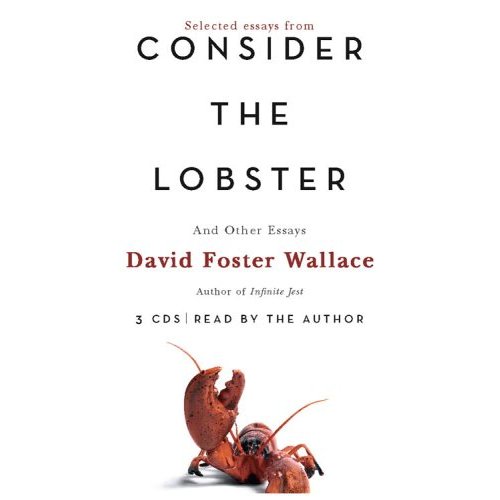
What follows are some of the better recordings I’ve collected over the years of DFW reading his work and being interviewed. Links take you to a site where you can download the mp3s. You can find most of these recordings dispersed over the net, but I thought I’d try to collate it all here. If you like what you hear, get a hold of DFW reading his own work in the audiobook version of Consider the Lobster (his handling of footnotes is pretty cool). Enjoy.

David Foster Wallace reads some unpublished stuff. December 6, 2000, Lannan Foundation. The middle section, beginning around 12:50 is particularly fantastic.

John O’Brien interviews DFW. December 6, 2000, Lannan Foundation.

DFW reads “A Series of Remarks on Kafka’s Funniness from Which Not Enough Has Been Removed.” March, 1998. Part of “Metamorphosis: A New Kafka,” a symposium sponsored by the PEN American Center in New York City. Text here. Republished in Consider the Lobster.

Michael Silverblatt interviews DFW about Consider the Lobster on KCRW’s Bookworm show. March 2, 2006.

Michael Goldfarb’s radio interview with DFW for The Connection. June 25, 2004.

Of course, the March 27, 1997 Charlie Rose interview is pretty well known to DFW fans, but if you haven’t seen it, it’s well worth checking out.

Also, if you feel like parsing through The Howling Fantods collection of audio links, I’m sure some of them are still working.

For DFW

This post will be full of typos and rhetorical slips and just generally bad writing. I’m just gonna write and post and I won’t bother editing. Sorry.

This morning, after BLTs with wife and child I checked my email. My buddy Damon sent me this article from the New York Times. Damon’s subject line, “David Foster Wallace dead at 46 (suicide)” kinda blew my mind. I didn’t get past the first lines of the Times report before tears started coming out of my eyes.

I’ve read all of DFW’s books, and, as corny as it sounds, the majority of them spoke so directly to me, so intimately, that I feel as if I’ve lost someone I knew. I’m sure that this isn’t the case at all, because he’s a writer and I’m his audience. He’s not friends or family. But reading him doesn’t feel that way. I would describe his style as a really, really good friend sitting on the couch with you, telling you stories that were both painfully funny and painfully sad. Infinite Jest provided a world of escape–a world I became addicted to–when I felt lonely in a foreign country I’d moved to. Girl with Curious Hair changed forever the way I thought about writing and reading–it opened me up to a whole new bank of authors and styles. But it’s probably DFW’s essays that hit me most directly.

Anyone who’s read the title essay from A Supposedly Fun Thing I’ll Never Do Again, or “Getting Away from Already Being Pretty Much Away from It All” from that same collection knows just how funny and insightful and analytical Wallace could be–all without any of the caustic meanness a lesser writer might employ. DFW’s essays–and fiction–are always negotiating the razor line between earnest emotion and ironic detachment. He hated the latter but understood it was part of a cultural mode, part of the counter-tradition of post- or meta- fiction that he was continuing and responding to with his own writing. The two essays that probably best exemplify this are a Fun Thing‘s “E Unibus Pluram: Television and U.S. Fiction” (this should be required reading for every thinking person) and “Authority and  American Usage,” DFW’s take on who-decides-what-is-proper-grammar-and-diction (collected in Consider the Lobster). I was re-reading the essay last Thursday and last night, with the intention to finish it today, with the intention to use it as part of something else I had planned to write. It will be impossible to finish it with the same reading schema in mind.

Just last week I listened to DFW reading from some as-yet-unpublished stuff; one section, on an overachieving boy that everyone hates is hilarious. The crowd is sometimes laughing too hard for DFW to maintain his rhythm and he has to slow down. In the interview that follows the reading, DFW seems like a really sweet, honest guy.

I remember distinctly my cousin calling me, well over a decade ago now, to tell me that Kurt Cobain had shot himself. I felt nothing then–it seemed perfectly logical. I was a huge Nirvana fan; they were my first concert and a big musical/cultural determiner in my young life. But his suicide seemed normal, natural even to me. I remember thinking “Of course.” When Hunter S. Thompson committed suicide, it seemed strange to me that he’d taken so long to do it. And when one of my favorite writers of all time, Kurt Vonnegut, passed away last year, I felt sad, but not so sad. So it goes.

This, this devastates me though. How could he hang himself? Why? I feel selfish and sad. Will we get another novel? Is it wrong to feel this way? I’m pretty sure that it’s wrong. I think about his body, hanged, and it makes me sick. I honestly felt close to this person. Unlike DeLillo or Pynchon or Barth, there was no veil or mediation in Wallace’s greatest work, no distance between his voice, or his speakers’ voices and my own burning internal ear. I have no pithy statement or philosophical wax for this piece, I have no way of summing up here. I feel sick.

Etymology for Republicans

Conservative Republicans seem to be having an awfully tough time with their vocabulary lately. They keep misusing words, poor old dears. In particular, these confused politicos keep using words that have traditionally had a positive connotation in a pejorative sense. Therefore, we present a little gloss that might help them with their sorry diction.

1. Liberal

“c.1375, from O.Fr. liberalbefitting free men, noble, generous,” from L. liberalisnoble, generous,” lit. “pertaining to a free man,” from liber “free,” from PIE base *leudheros (cf. Gk. eleutheros “free”), probably originally ‘belonging to the people'” (Online Etymological Dictionary)

From the Indo-European root “leudh,” meaning “grow, rise,” as in progressive (Joseph T. Shipley, The Origins of English Words)

2. Elite

“1823, from Fr. éliteselection, choice,” from O.Fr. fem. pp. of elire, elisre “pick out, choose,” from L. eligere “choose” (see election). Borrowed in M.E. as “chosen person,” esp. a bishop-elect, died out c.1450, re-introduced by Byron’s “Don Juan.” (Online Etymological Dictionary)

“1a singular or plural in construction : the choice part. 1b singular or plural in construction : the best of a class” (Merriam-Webster)

A Tender Hug Betwixt Mavericks

3. Maverick

“1867, “calf or yearling found without an owner’s brand,” in allusion to Samuel A. Maverick (1803-70), Texas cattle owner who was negligent in branding his calves. Sense of “individualist, unconventional person” is first recorded 1886, via notion of ‘masterless.'” (Online Etymological Dictionary)

Samuel A. Maverick refused to brand his cattle, ostensibly claiming that the practice was cruel. However, by not branding his cattle, he was able to claim any stray cows as his own property. What a devious genius! How’s that for laissez-fair?

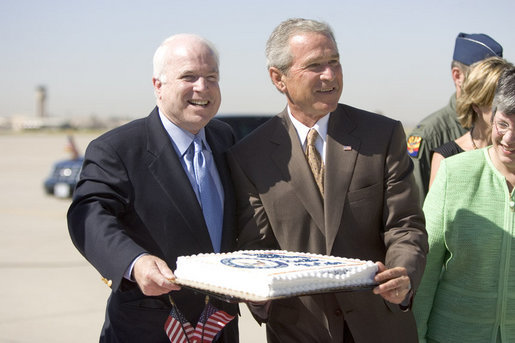
Clearly, a maverick would never let himself be branded with someone else’s label. He’d cut his own path, forge his own trail, create his own hackneyed metaphor, and not, f’r’instance, vote with the President 95% of the time.

4. Conservative

“Conservative, n. A statesman who is enamored of existing evils, as distinguished from the Liberal, who wishes to replace them with others.” ( Ambrose Bierce, Devil’s Dictionary)

5. Change

“From the Indo-European root “(s)kamb: bend, change; exchange, barter . . . Fr, change, exchange. Gc, change, changeable, unchanging, etc. . . . This root is related to camp, campus, campaign, etc.” (Joseph T. Shipley, The Origins of English Words)

Synonyms for “change” include: modification, variation, transformation, revolution, conversion, adjustment, amendment, difference, and alteration.

When used in politics, the word connotes a dramatic shift in ideology from the previous regime to its successors (e.g. “The idea that a new set of Republicans would be a change from the old set was both a paradox and a misuse of language”)

Let Them Eat Cake!
Let Them Eat Cake! W and Mav McCain Enjoy A Tasty Treat as Katrina Drowns New Orleans

Caged Bedouins, Uruguayan Cannibals, Mr. Max Tundra, Absent Adventurer Anniversary, and a Few Morsels of Hurricane Lit

Attention:

1. Friends of the ‘klept have embarked on a new culinary adventure. Read all about it at brand new blog Confined Nomad. Their mission:

The goal of this journey is to find cuisines from every United Nations member state, within New York City limits, in alphabetical order. We realize that there are a few flaws to this logic, and will make every attempt to handle these wisely when we reach a questionable issue. For instance, cuisines are not defined by the UN. There are regional specialties, there are countries not internationally recognized, there are border disputes, and new countries are being formed all the time . . . This blog will serve as documentation of the adventure, in which we will do our best to describe not only the food we eat, but also things we learn about its nation of origin, culture, and the immigrant communities here in New York City. We hope this will be much more than a food blog.

The virgin entries on Afghanistan and Albania are tasty fare (sorry!) and we’re looking forward to plenty more delectable treats (yikes! sorry again!).

2. We finally saw Frank Marshall’s 1993 film Alive this weekend. Alive, based on Piers Paul Read’s book of the same name, tells the true story of the Uruguayan Air Force Flight 571 crash of October 13, 1972, in which a Uruguayan rugby team’s chartered flight crashes in the Andes. The survivors eventually resort to cannibalizing the dead to survive (let’s see what happens when Confined Nomad gets to ‘U’ on their list). Despite plenty of strange flaws, including egregious over-acting, the film is oddly great. An intense, chest-tightening narrative that offers few moments of relief, Alive is a real-life horror movie masquerading as an adventure tale. Recommended.

3. With distinguished Englishman Max Tundra’s new album Parallax Error Beheads You ready to drop any day now (glowing review forthcoming), we thought we’d bring up the greatness of his last CD, Mastered by Guy at the Exchange. Max’s MBGATE was easily one of our favorite albums of the early aughties. Weird and tuneful and splendid and frenetic, MBGATE is a neglected classic, perhaps due to its unclassifiable sound. Max programs old Amigas, plays dozens of instruments, and sings along with his sister on a strange group of songs about Michel Gondry, delivery jobs, amino acids, the break up of Don Caballero (with Storm & Stress as consolation prize), and, uh, girls. We love it and so should you. His website is awesome, by the way.

4. Today marks the one-year anniversary of gazillionaire adventurer Steve Fossett disappearing along with his single-engine Bellanca Super Decathlon airplane. We don’t think Fossett is dead, and neither, apparently, does Chris Irvine, who speculated in the Telegraph that Fossett faked his own death. We now invite our readers, again, to speculate on the whereabouts of Mr. Fossett. Check out our Steve Fossett Fan Fiction Contest blog for all the details!

5. Down here in The Florida, we continue to have hurricane concerns. And, because this blog likes to masquerade as a a literary affair, we offer a few lines from books on the subject:

In Shakespeare’s King Lear, Act 3 scene 2, we find one of the earliest usages of the word hurricane in the English language:

Blow, winds, and crack your cheeks! rage! blow!
You cataracts and hurricanoes, spout
Till you have drenched our steeples, drowned the cocks!
You sulphurous and thought-executing fires,
Vaunt-couriers to oak-cleaving thunderbolts,
Singe my white head! And thou, all-shaking thunder,
Strike flat the thick rotundity o’ the world!
Crack nature’s molds, all germens spill at once
That make ingrateful man!

Bit of a drama queen, Lear, what with all these apocalyptic fantasies. Speaking of drama queens, how about the opening lines of Walt Whitman’s “With Husky-haughty Lips, O Sea!”:

With husky-haughty lips, O sea!
Where day and night I wend thy surf-beat shore,
Imaging to my sense thy varied strange suggestions,
(I see and plainly list thy talk and conference here,)
Thy troops of white-maned racers racing to the goal,
Thy ample, smiling face, dash’d with the sparkling dimples of the sun,
Thy brooding scowl and murk–thy unloos’d hurricanes,
Thy unsubduedness, caprices, wilfulness

Fanciful stuff. For a less romanticized description, might we suggest the end of Zora Neale Hurston’s Their Eyes Were Watching God, where a massive hurricane turns Lake Okeechobee into a “monstropolous beast,” a monster that floods the streets and destroys homes. Stay away, Hannah.

Tree of Smoke — Denis Johnson

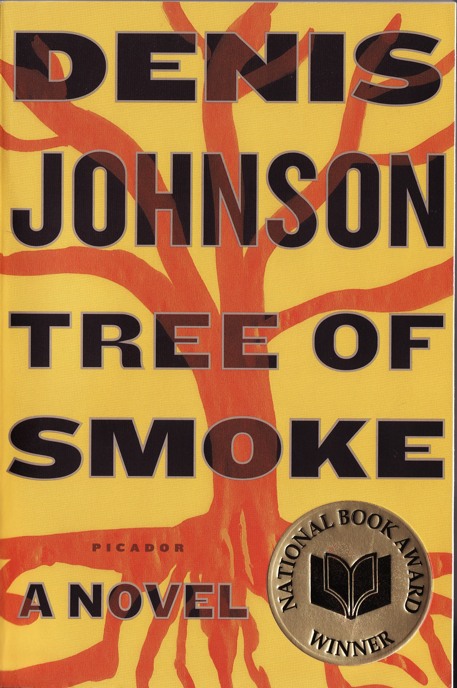
One year after it topped book critics’ best-of 2007 lists everywhere (including ours), Denis Johnson’s Vietnam War epic Tree of Smoke is finally available in a handsome trade-paperback. Picador’s edition retains the original orange and yellow cover, only now affixed with the proud blazon “National Book Award Winner.” However, that Tree of Smoke won this prestigious award no doubt ruffled a few feathers. It still remains an urgently divisive work.

Although plenty of critics and readers loved the novel, including The New York Times‘s Jim Lewis (who cautiously called it “something like a masterpiece”) and Michiko Kakutani, it has had more than its fair share of haters. Consider B.R. Myers’s downright mean review, “A Bright Shining Lie” in The Atlantic. Here, Myers displays the worst kind of vitriol. He’s the critic who feels the need not only to trumpet his hatred of the work he’s assessing, but also to lambaste the dignity, taste, and intellect of anyone who would disagree with him. Myers specifically attacks Johnson’s rhetorical style, his diction and syntax, and concludes that those idiots who would praise such inane, base, and clichéd language (idiots like me, that is) are clearly the cause of all current social and political problems and “have no right to complain about incoherent government.” Uh, sure. Myers’s baseless zealotry aside, it’s worth looking at the popular reception of Tree of Smoke, and what better place to do so than scouring Amazon reviews, right?

A cynic might say that Amazon reviews are the bottom-barrel of literary criticism, yet it’s still worth considering the almost perfectly mathematical split between 5- and 4-starred reviews of the book and 1- and 2-starred reviews (although none of the negative reviews I read on Amazon suggested that praising Johnson’s novel disenfranchised one from political opinions). Put simply, most people tend to either hate or love Tree of Smoke, which, I believe, is a sign of great art. And, were I inclined to inflate my rhetoric to a grandiose level like Myers, I might here wax philosophical about opinion, perspective, history, and the value of great art to ignite debate and discussion within the marketplace of ideas. However, I don’t think a book review is necessarily the best venue to make grand sweeping statements. At best, such writing presents a shallow or hollow endorsement of a collective truth (e.g. “Everyone assesses literature from their own perspective and therefore everyone values books differently”); at worst–in the case of Myers’s grotesque review–we get a pompous, overblown, self-important declaration (here, praising Tree of Smoke = losing the ability to authoritatively comment on society or politics) that can only be supported within the limited rhetorical bounds created the sophist has constructed (i.e. Myers’s review). But I’ve made a long digression, and, worse, I’ve failed to really discuss the book at all.

My initial review of Tree of Smoke last year was really a review of Will Patton’s masterful audio-recording of the novel (I was reading Ulysses for graduate school at the time and simply did not have the time to read both). I loved the experience; Patton did a great job, and I found myself wholly addicted to the narrative. When the advance copy of Tree showed up in the mail earlier this week, I immediately re-read the coda of the book in a single sitting. I would say the measure of a great narrative is not its core, its climax, or its beginning, but how well the conclusion is able to deliver the promises established throughout the book. Tree of Smoke delivers, and its ending continues to haunt the reader well after the book has been set aside. Readers like Myers may not get the payoff–he claims that “Johnson’s failure to understand [his character’s] faith is such that when he uses it to end the novel on an uplifting note, the reader feels nothing.” However, I hardly think that a watery Hallmark-word like “uplifting” properly connotes the weight, pathos, and sheer pain that Johnson conveys and addresses at the end of the book (Myers’s shallow diagnosis leads me to believe he merely skimmed the novel). Ethics of literary criticism aside, the real triumph of Tree of Smoke is simply that Johnson manages to comment in a new way on a subject that, by 2007, had been done to death. Who knew that we needed another story about the Vietnam War? Denis Johnson, apparently. Read the book for yourself. Very highly recommended.

Tree of Smoke is available in paperback from Picador on 2 September, 2008.

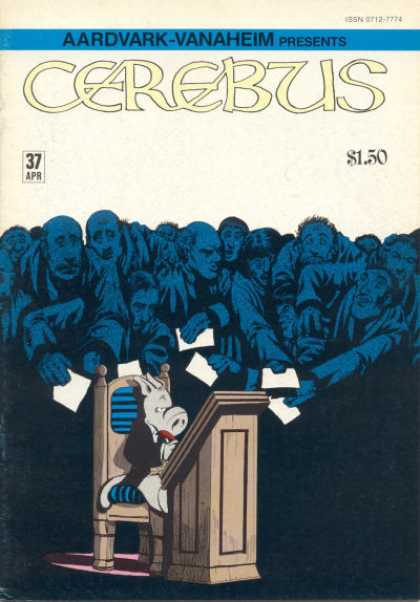
High Society–Dave Sim

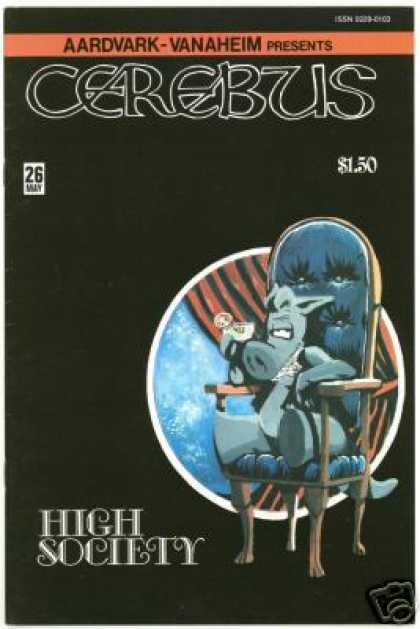
If you’re at all interested in reading any of Dave Sim’s epic 300-issue comic book Cerebus, a book chronicling the life–and death–of a misanthropic mystical barbarian aardvark, High Society is the best (and possibly only) starting point. High Society tells the story of Cerebus’s political adventures in Iest, the largest cosmopolitan city-state of Estarcion. Guided (or perhaps manipulated) by Machiavellian Astoria, Cerebus undertakes a strange, comic odyssey of political ascendancy, culminating in an election for Prime Minister (against Groucho Marx stand-in Lord Julius’s goat, of all things). Sim has a deft ear for political satire and the volume holds up particularly well to a rereading against the backdrop of the current American electoral process. While High Society conveys a certain cynical contempt for the cronyism, deal-making, and the general nasty malfeasance that underwrites politics, there’s also a reconciling of democracy, liberty, and art here that you could never find from a CNN analyst or a Fox News hack. By this point, the crude art and flubbed pacing that hampered the first few years of Cerebus are nowhere to be found. High Society is tightly-plotted, full of smart gags expressed in Sim’s keen lines, without an over-reliance on bubbles overstuffed with exposition.

The book is funny without ever being light, and rereading it again, I was surprised at how moved–and exhilarated–I was by the conclusion. Although the parody of Marvel’s forgotten Batman ripoff Moon Knight doesn’t hold up very well, and the “sideways” issues at the end are an annoying (but interesting) experiment, High Society continues to deliver both laughs and insight about the political process over twenty years after its single-volume publication. Very good stuff, and highly recommended (read it along with/against the 2008 election).

(Strange aside that I couldn’t work into the piece–remember Ken Jennings? That guy who won Jeopardy! like, a year straight? According to his blog he’s a huge Cerebus fan).

Writing in the Ellipses

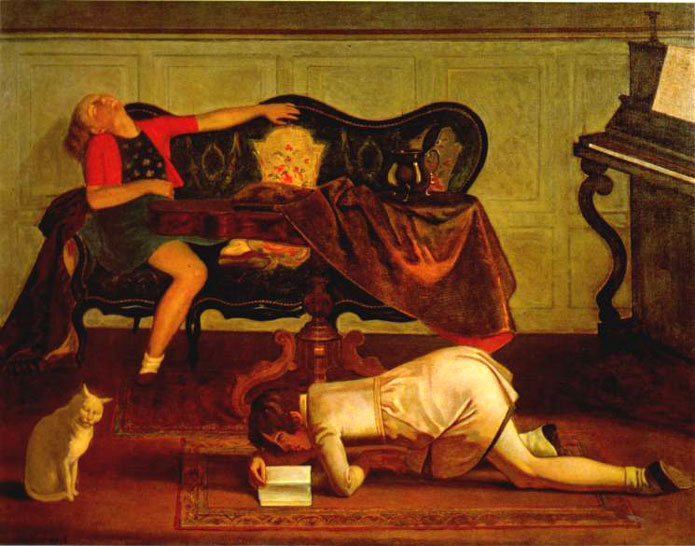
Balthus--The Living Room
Balthus–The Living Room

Flipping through Balthus‘s digressive, discursive, elliptical memoir Vanished Splendors, I came across this notation:

I deeply believe in the genius of painting, which parallels that of childhood. I’ve used painting as a language without really having decided to do so, because it suits me better than writing. Writing tries to be too explicit and go directly to meaning. That’s why I could never be a writer like many of my friends. Some aspects of my life might be clarified by the present short texts, similar to letters. . . . For me, writing can only be in the ellipses, where I express myself; painting conveys this magnificently, sometimes unbeknownst to the painter himself.

Elsewhere, Balthus lists the writers and texts he loves, and gives us (what I believe to be) a great definition for reading:

I often paint young girls who are reading. It’s surely because I saw the act of reading as a way to enter life’s deeper secrets. Reading is the great means of access to myths. Green, Gracq, Char, Jouve, Michaux, and Artuad were frequent passageways, as well as the great holy writings of the Bible and initiates like Dante, Rilke, the Pléiade poets, the great Chinese writers, the mystics John of the Cross and Teresa of Avila, not to mention Carroll, the pure German poet Ludwig Tieck, and Indian epics. All these texts and authors were landmarks in my life, and gave me another dimension of time to which I soon felt myself summoned. My young girls who read in dreaming poses are escaping from fleeting, harmful time . . . Fixing them in the act of reading or dreaming prolongs a privileged, splendid, and magic glimpsed-at time. A suddenly opened curtain sheds light from a window and is seen only by those who know how. Thus a book is a key to open a mysterious trunk containing childhood scents. .

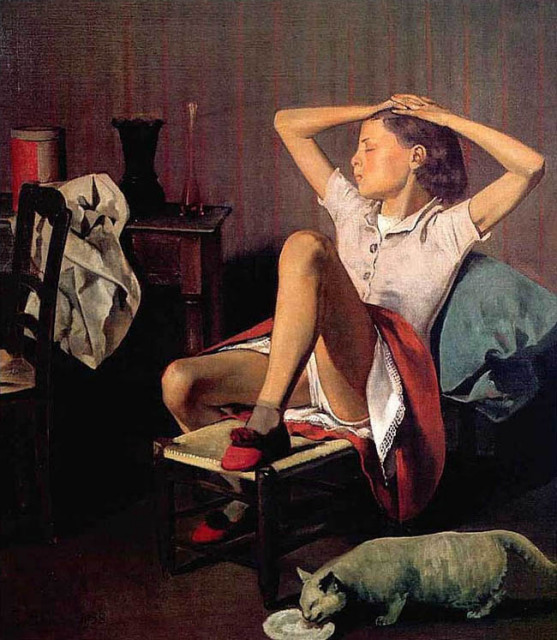
Balthus--Girl with Cat

But, my favorite lines in the book come at the end of the following passage:

Painting is something both embodied and spiritualized. It’s a way of attaining the soul through the body. . . . Being too cerebral and jokey can obstruct an artisan’s manual labor, and impede the ascent to the soul. Believing that my young girls are perversely erotic is to remain on the level of material things. It means understanding nothing about the innocence of adolescent languor, and the truth of childhood.

Exactly. Whenever I look at Girl with Cat, I think, man, that’s not perversely erotic at all…that’s just the innocence of adolescent languor–the real truth of childhood, actually. Nice try, Count Balthasar.

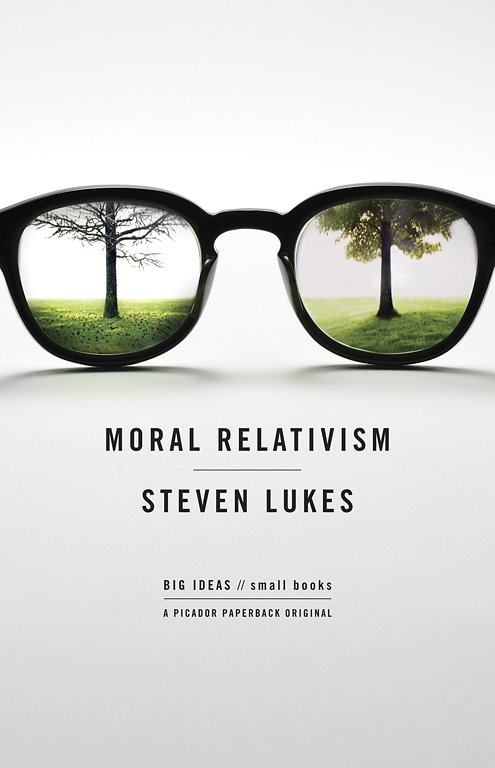
Moral Relativism — Steven Lukes

Moral relativism is the belief that ideals of right and wrong and good and bad are contextually determined by one’s local culture, as opposed to a theory of morality that holds that good and bad exist as absolute, metaphysical values existing cross-culturally, values intrinsic to one’s humanness. At the same time, individuals, even those (sometimes especially those) who see moral relativism as the overwhelmingly rational, sensical position, nonetheless are inextricably tied to their own sense of right and wrong, and this sense often leads them into a position of judgment–and perhaps action–against, over, and/or in reaction to the perceived wrongs of other cultures and societies.

In his new book Moral Relativism, NYU sociology professor Steven Lukes employs an interdisciplinary approach to tackle one of the biggest sticking points of contemporary thought. Using a variety of methods including philosophy, anthropology, history, and literature, Lukes addresses the fundamental conflict of moral relativism: that what’s right and good in one’s own culture may not be right and good in another’s culture, yet a will remains to believe in ideals of universal human rights. Lukes uses a number of timely concrete examples, including female genital circumcision, Islamic fundamentalism, and mass immigration, to assess the costs and payoffs of holding a view that says that no absolute morality exists. Perhaps the most fascinating part of Moral Relativism is Lukes’s negotiation of Western (or globally Northern, as he saliently points out) human rights actions as an extension of colonialism, with the one-time colonists imposing their values–again–upon the one-time colonized.

Lukes concludes that “the question Who are we to judge other cultures? is a bad question.” Arguing that the “postcolonial and multicultural contexts of our time do not require us to see the discourse and practice of human rights as ethnocentric,” Lukes takes up a position–well-argued–that a moral fundamentalist might claim is simply a liberal humanist wanting to have his cake and eat it too. Which, of course, is the problem with the book. It’s a fantastic argument for moral relativism, one that points out that no one–no one–is absolutely relativist, and that, in fact, being a moral relativist entails recognizing that within cultures certain perceived absolutes exist. The idea that right and wrong are relative doesn’t mean that right and wrong are arbitrary or don’t exist–it simply means that ideals of right and wrong have to be reconstituted within different systems of social and cultural order. Yet Lukes’s book isn’t going to convince the types that need convincing. Still, those of us who think that moral relativism is simple common sense will find plenty of concrete, contemporary, real world ammunition here in case we feel like arguing with a–gasp–moral fundamentalist.

Moral Relativism, available now, is part of the new BIG IDEAS // small books series from Picador Books.

In the Land of No Right Angles — Daphne Beal

In the Land of No Right Angles tells the story of Alex, an American college student backpacking in Nepal for a year. Alex’s overseas adventure becomes complicated when she meets fellow American Will. Will prompts Alex to help bring a poor Nepalese girl named Maya to the capital city of Kathmandu, and the three move in to an apartment together. Awkwardness ensues, including a failed threesome, a bad drug trip, and some major cultural misunderstandings. Alex leaves on a sour note, returning eight years later as a professional photojournalist to expose the horrors of human trafficking, only to find Maya embroiled in Bombay’s seedy sex trade.

The novel reads at a rapid clip, propelled by lots of dialog, and Beal certainly shows a complex knowledge of Nepali culture. Still, there’s something pervasively shallow, even troubling about Alex’s interactions with and reactions to her experience with this alien culture that the novel doesn’t quite resolve. The reader is meant to identify with Alex, the privileged American on her adventure to the exotic East. At one point, Alex states, “I wanted to come home different from what I’d been–bolder, wiser, happier.” This desire to find one’s self far away from home is nothing uncommon, of course, yet Alex’s–and Will’s–professed altruism toward their subject, poor little Maya, ultimately comes off as paternalistic and demeaning, culminating in the older Alex’s quest to “save” Maya. It’s hard to feel the empathy or sympathy that Beal wishes to evoke for Alex’s dilemma: in spite of all her questing, she still falls prey to the illusion of her own power as an educated Westerner to control the outcomes of alien others. To take a cue from Edward Said’s work revealing Orientalism in Western thinking, Alex’s East–and the people in it–exist mostly to reify and stabilize her own identity, give her her the adventure she needs to “come home different” with plenty of great stories to share.

Orientalist critique aside, Alex does have a pretty good story to tell. Beal’s descriptions are vivid and the novel has the compressed vitality of a good memoir coupled with a tone of immediacy that makes it easy and enjoyable to read. In the Land of No Right Angles will no doubt end up in more than a few book clubs this fall, and it’s certainly your smarter than average beach read–and there’s still plenty of summer left.

In the Land of No Right Angles is available August 12th from Anchor Books.

Violence — Slavoj Žižek

Slavoj Žižek describes Violence as “six sideways glances” examining how our preoccupation with subjective violence (that is, the personal, material violence that we can see so easily in crime, racism, etc.) masks and occludes our understanding of the systemic and symbolic violence that underwrites our political, economic, and cultural hierarchies. Žižek believes that a dispassionate “step back enables us to identify a violence that sustains our very efforts to fight violence and promote tolerance,” and that a rampant “pseudo-urgency” to act instead of think currently (detrimentally) infects liberal humanitarian efforts to help others. This is where the fun comes in. Žižek delights here in pointing out all the ways in which we fool ourselves, all the ways in which we believe we’ve gained some kind of moral edge through our beliefs and actions.

I use the words “fun” and “delight” above for a reason: Violence is fun and a delight to read. Žižek employs a rapid, discursive method, pulling examples from contemporary politics, psychoanalysis, films, poetry, history, jokes, famous apocryphal anecdotes, and just about every other source you can think of to illustrate his points. And while it would be disingenuous to suggest that it doesn’t help to have some working knowledge of the philosophical tradition and counter-traditions to best appreciate Violence, Žižek writes for a larger audience than the academy. Yet, even when he’s quoting Elton John on religion or performing a Nietzschean reading of Children of Men, Žižek’s dalliances with pop culture always occur within the gravest of backdrops. Within each of Violence‘s six chapters, there’s a profound concern for not only the Big Questions but also the big events: Žižek frequently returns to the Iraq War, the 9/11 attacks, and the Israeli-Palestinian conflict as major points of consideration. This concern for contemporary events, and the materiality of contemporary events, is particularly refreshing in a work of contemporary philosophy. Undoubtedly some will pigeonhole Žižek in the deconstructionist-psychoanalytical-post-modernist camp (as if it were an insult, of course)–he clearly has a Marxist streak and a penchant for Lacanian terminology. Yet, unlike many of the writers of this philosophical counter-tradition, Žižek writes in a very clear, lucid manner. There’s also a great sense of humor here, as well as any number of beautiful articulations, like this description of the “dignity and courage” of atheism:

[A]theists strive to formulate the message of joy which comes not from escaping reality, but from accepting it and creatively finding one’s place in it. What makes this materialist tradition unique is the way it combines the humble awareness that we are not masters of the universe, but just a part of a much larger whole exposed to contingent twists of fate, with a readiness to accept the heavy burden of responsibility for what we make out of our lives. With the threat of unpredictable catastrophe looming from all sides, isn’t this an attitude needed more than ever in our own times?

I’m inclined to answer, “Yes.” Highly recommended.

Violence, part of the new BIG IDEAS // small books series from Picador Books, is available August 1st.

Chemical Chords — Stereolab

When “Valley Hi!” pops up roughly half way through Chemical Chords, Stereolab’s ninth studio album, the realization sinks in that on just about any new group’s new album the song would be a great achievement, a perfectly constructed pop song, fun, bouncy, a little sly even, with sexy lead vocals, effervescent harmonies, and tight but lush instrumentation. However, wedged into Stereolab’s nearly two-decade-long oeuvre, the song barely stands out, and that’s the problem. The band consistently delivers material like this, to the point that it all kinda sounds the same–a charge that’s been leveled at them by critics and fans alike for a few years now, starting more or less with 1999’s Cobra and Phases Group Play Voltage in the Milky Night, a record that some (maybe many) thought failed to live up to the radical revisionist pop tendencies of 1996’s Emperor Tomato Ketchup (it’s hard to top a perfect album, folks!) or the digital experiments of 1997’s Dots and Loops (my least favorite Stereolab album; sounds like marbles rolling on ice). I happen to like Cobra a lot: it’s warm (and literally fuzzy) and masterfully played–and kinda anonymous, a trend that Stereolab continues with Chemical Chords.

From the outset of the new album, Stereolab establishes a metronomic motortik pop vibe from which they rarely deviate. Opener “Neon Beanbag” flows into first single “Three Women” without much to differentiate the two besides a two second gap and a key change, and the third track, “One Finger Symphony,” only stands out due to its throwaway brevity. It isn’t until Sean O’Hagan’s slinky strings announce the title track that the album grabs onto something new. “Chemical Chords” approaches a ’70s blaxploitation vibe–think Curtis Mayfield or Bobby Womack here–but ends up being (you guessed it) just another Stereolab song, beautifully polished and meticulously executed with little or no risk to band or audience. The next track, “The Ecstatic Static” slides right into the same groove, and it becomes apparent that Stereolab have released yet another perfect ambient soundtrack for any polite social gathering. The rest of the album follows this mode of flawless and ultimately forgettable songwriting.

There are moments of exception, of course, but only moments. The countryfied swagger that initiates the penultimate track, “Daisy Click Clack,” is pretty great, if only for simply hitting a different rhythm and sound, and the song’s lyrics are about making music, which is always cool. It’s on “Pop Molecule (Molecular Pop 1),” where Stereolab employ backmasked drones and triumphant chugging guitars that recall the glory days of tracks like “Crest,” from ’93’s Transient Random-Noise Bursts with Announcements (or anything off of ’92’s dreampop singles collection, Switched On), that the band finally gets its hands a little dirty–with great results. Too bad they only play it out for about two minutes; the old groop would’ve droned those two chords for at least six–the listener doesn’t ever get a chance to get hypnotized.

It seems like I’m bashing the album, but I’m not. I love Stereolab. Really. And Chemical Chords is pretty good — it will hang out in my stereo for a month, maybe two, and then I’ll forget about it. Ultimately, it’s too polished, too precise, and too meticulous to make any long-term impact. We know Stereolab are fantastic arrangers and musicians, and their taste is impeccable, but when bands fail to take risks, the music gets stale.

Chemical Chords is available from 4AD Records in the US on August 19th.