Gertrude Stein on Football

In a 1934 radio interview, Gertrude Stein talks American football:

INTERVIEWER: You saw the Yale-Dartmouth game a week ago Saturday didn’t you? Did you understand that in the American way or the football way or how?

STEIN: IN the American way. The thing that interested me was that the Modern American in his movements and his actions in a football game so resembled the red Indian dance and it proves that the physical country that made the one made the other and that the red Indian is still with us. They just put their heads down solemnly together and then double over, while on the sidelines the substitutes move in a jiggly way just like Indians. Then they all get down on all fours just like Indians.

INTERVIEWER: But those jiggles are just warming-up exercises.

STEIN: It doesn’t make any difference what they are doing it for, they are just doing it, like the way the Indian jiggles in the Indian dance and then there is that little brown ball they all bend down and worship.

INTERVIEWER: But the ideas in that is to get the ball across the goal line.

STEIN: But don’t you suppose I know that, and don’t you suppose the Indians had just as much reason and enjoyed their dancing just as much?

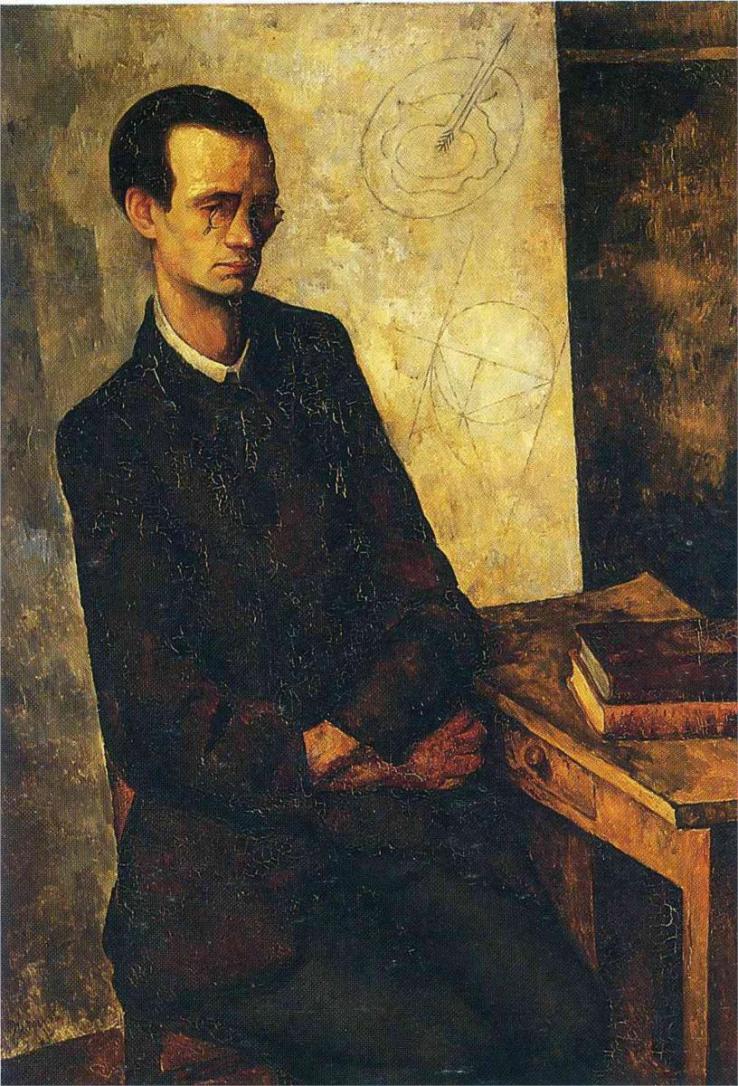
The Mathematician — Diego Rivera

the-mathematician-1918.jpg!HD

See Rainer Werner Fassbinder’s Early Film, Love Is Colder Than Death

(Thanks Giovanni–had never seen this before).


“Desiree’s Baby” — Kate Chopin

“Desiree’s Baby” by Kate Chopin

As the day was pleasant, Madame Valmonde drove over to L’Abri to see Desiree and the baby.

It made her laugh to think of Desiree with a baby. Why, it seemed but yesterday that Desiree was little more than a baby herself; when Monsieur in riding through the gateway of Valmonde had found her lying asleep in the shadow of the big stone pillar.

The little one awoke in his arms and began to cry for “Dada.” That was as much as she could do or say. Some people thought she might have strayed there of her own accord, for she was of the toddling age. The prevailing belief was that she had been purposely left by a party of Texans, whose canvas-covered wagon, late in the day, had crossed the ferry that Coton Mais kept, just below the plantation. In time Madame Valmonde abandoned every speculation but the one that Desiree had been sent to her by a beneficent Providence to be the child of her affection, seeing that she was without child of the flesh. For the girl grew to be beautiful and gentle, affectionate and sincere – the idol of Valmonde.

It was no wonder, when she stood one day against the stone pillar in whose shadow she had lain asleep, eighteen years before, that Armand Aubigny riding by and seeing her there, had fallen in love with her. That was the way all the Aubignys fell in love, as if struck by a pistol shot. The wonder was that he had not loved her before; for he had known her since his father brought him home from Paris, a boy of eight, after his mother died there. The passion that awoke in him that day, when he saw her at the gate, swept along like an avalanche, or like a prairie fire, or like anything that drives headlong over all obstacles.

Monsieur Valmonde grew practical and wanted things well considered: that is, the girl’s obscure origin. Armand looked into her eyes and did not care. He was reminded that she was nameless. What did it matter about a name when he could give her one of the oldest and proudest in Louisiana? He ordered the corbeille from Paris, and contained himself with what patience he could until it arrived; then they were married. Continue reading ““Desiree’s Baby” — Kate Chopin”

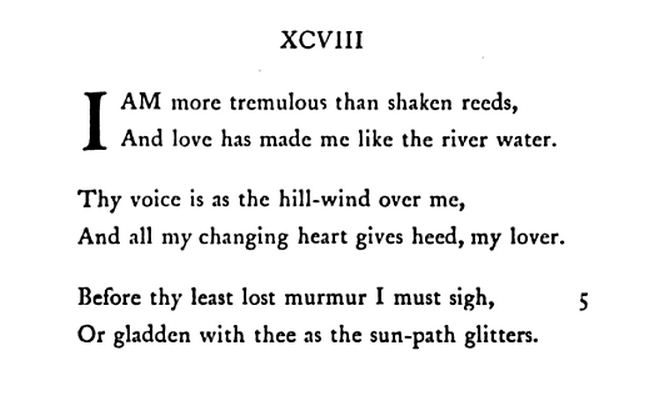
“I am more tremulous than shaken reeds” — Sappho

saph

Woman Reading in a Garden — Mary Cassatt

Read “A Baby Tramp,” A Short Story by Ambrose Bierce

“A Baby Tramp” by Ambrose Bierce

If you had seen little Jo standing at the street corner in the rain, you would hardly have admired him. It was apparently an ordinary autumn rainstorm, but the water which fell upon Jo (who was hardly old enough to be either just or unjust, and so perhaps did not come under the law of impartial distribution) appeared to have some property peculiar to itself: one would have said it was dark and adhesive — sticky. But that could hardly be so, even in Blackburg, where things certainly did occur that were a good deal out of the common.

For example, ten or twelve years before, a shower of small frogs had fallen, as is credibly attested by a contemporaneous chronicle, the record concluding with a somewhat obscure statement to the effect that the chronicler considered it good growing-weather for Frenchmen.

Some years later Blackburg had a fall of crimson snow; it is cold in Blackburg when winter is on, and the snows are frequent and deep. There can be no doubt of it — the snow in this instance was of the colour of blood and melted into water of the same hue, if water it was, not blood. The phenomenon had attracted wide attention, and science had as many explanations as there were scientists who knew nothing about it. But the men of Blackburg — men who for many years had lived right there where the red snow fell, and might be supposed to know a good deal about the matter — shook their heads and said something would come of it.

And something did, for the next summer was made memorable by the prevalence of a mysterious disease — epidemic, endemic, or the Lord knows what, though the physicians didn’t — which carried away a full half of the population. Most of the other half carried themselves away and were slow to return, but finally came back, and were now increasing and multiplying as before, but Blackburg had not since been altogether the same.

Of quite another kind, though equally ‘out of the common,’ was the incident of Hetty Parlow’s ghost. Hetty Parlow’s maiden name had been Brownon, and in Blackburg that meant more than one would think.

Continue reading “Read “A Baby Tramp,” A Short Story by Ambrose Bierce”

Read “The Oval Portrait,” a Short Short Story by Edgar Allan Poe

Edgar Allan Poe’s tale “The Oval Portrait” —

The chateau into which my valet had ventured to make forcible entrance, rather than permit me, in my desperately wounded condition, to pass a night in the open air, was one of those piles of commingled gloom and grandeur which have so long frowned among the Appennines, not less in fact than in the fancy of Mrs. Radcliffe. To all appearance it had been temporarily and very lately abandoned. We established ourselves in one of the smallest and least sumptuously furnished apartments. It lay in a remote turret of the building. Its decorations were rich, yet tattered and antique. Its walls were hung with tapestry and bedecked with manifold and multiform armorial trophies, together with an unusually great number of very spirited modern paintings in frames of rich golden arabesque. In these paintings, which depended from the walls not only in their main surfaces, but in very many nooks which the bizarre architecture of the chateau rendered necessary- in these paintings my incipient delirium, perhaps, had caused me to take deep interest; so that I bade Pedro to close the heavy shutters of the room- since it was already night- to light the tongues of a tall candelabrum which stood by the head of my bed- and to throw open far and wide the fringed curtains of black velvet which enveloped the bed itself. I wished all this done that I might resign myself, if not to sleep, at least alternately to the contemplation of these pictures, and the perusal of a small volume which had been found upon the pillow, and which purported to criticise and describe them.

Long- long I read- and devoutly, devotedly I gazed. Rapidly and gloriously the hours flew by and the deep midnight came. The position of the candelabrum displeased me, and outreaching my hand with difficulty, rather than disturb my slumbering valet, I placed it so as to throw its rays more fully upon the book.

But the action produced an effect altogether unanticipated. The rays of the numerous candles (for there were many) now fell within a niche of the room which had hitherto been thrown into deep shade by one of the bed-posts. I thus saw in vivid light a picture all unnoticed before. It was the portrait of a young girl just ripening into womanhood. I glanced at the painting hurriedly, and then closed my eyes. Why I did this was not at first apparent even to my own perception. But while my lids remained thus shut, I ran over in my mind my reason for so shutting them. It was an impulsive movement to gain time for thought- to make sure that my vision had not deceived me- to calm and subdue my fancy for a more sober and more certain gaze. In a very few moments I again looked fixedly at the painting.

That I now saw aright I could not and would not doubt; for the first flashing of the candles upon that canvas had seemed to dissipate the dreamy stupor which was stealing over my senses, and to startle me at once into waking life.

The portrait, I have already said, was that of a young girl. It was a mere head and shoulders, done in what is technically termed a vignette manner; much in the style of the favorite heads of Sully. The arms, the bosom, and even the ends of the radiant hair melted imperceptibly into the vague yet deep shadow which formed the back-ground of the whole. The frame was oval, richly gilded and filigreed in Moresque. As a thing of art nothing could be more admirable than the painting itself. But it could have been neither the execution of the work, nor the immortal beauty of the countenance, which had so suddenly and so vehemently moved me. Least of all, could it have been that my fancy, shaken from its half slumber, had mistaken the head for that of a living person. I saw at once that the peculiarities of the design, of the vignetting, and of the frame, must have instantly dispelled such idea- must have prevented even its momentary entertainment. Thinking earnestly upon these points, I remained, for an hour perhaps, half sitting, half reclining, with my vision riveted upon the portrait. At length, satisfied with the true secret of its effect, I fell back within the bed. I had found the spell of the picture in an absolute life-likeliness of expression, which, at first startling, finally confounded, subdued, and appalled me. With deep and reverent awe I replaced the candelabrum in its former position. The cause of my deep agitation being thus shut from view, I sought eagerly the volume which discussed the paintings and their histories. Turning to the number which designated the oval portrait, I there read the vague and quaint words which follow:

“She was a maiden of rarest beauty, and not more lovely than full of glee. And evil was the hour when she saw, and loved, and wedded the painter. He, passionate, studious, austere, and having already a bride in his Art; she a maiden of rarest beauty, and not more lovely than full of glee; all light and smiles, and frolicsome as the young fawn; loving and cherishing all things; hating only the Art which was her rival; dreading only the pallet and brushes and other untoward instruments which deprived her of the countenance of her lover. It was thus a terrible thing for this lady to hear the painter speak of his desire to pourtray even his young bride. But she was humble and obedient, and sat meekly for many weeks in the dark, high turret-chamber where the light dripped upon the pale canvas only from overhead. But he, the painter, took glory in his work, which went on from hour to hour, and from day to day. And be was a passionate, and wild, and moody man, who became lost in reveries; so that he would not see that the light which fell so ghastly in that lone turret withered the health and the spirits of his bride, who pined visibly to all but him. Yet she smiled on and still on, uncomplainingly, because she saw that the painter (who had high renown) took a fervid and burning pleasure in his task, and wrought day and night to depict her who so loved him, yet who grew daily more dispirited and weak. And in sooth some who beheld the portrait spoke of its resemblance in low words, as of a mighty marvel, and a proof not less of the power of the painter than of his deep love for her whom he depicted so surpassingly well. But at length, as the labor drew nearer to its conclusion, there were admitted none into the turret; for the painter had grown wild with the ardor of his work, and turned his eyes from canvas merely, even to regard the countenance of his wife. And he would not see that the tints which he spread upon the canvas were drawn from the cheeks of her who sate beside him. And when many weeks bad passed, and but little remained to do, save one brush upon the mouth and one tint upon the eye, the spirit of the lady again flickered up as the flame within the socket of the lamp. And then the brush was given, and then the tint was placed; and, for one moment, the painter stood entranced before the work which he had wrought; but in the next, while he yet gazed, he grew tremulous and very pallid, and aghast, and crying with a loud voice, ‘This is indeed Life itself!’ turned suddenly to regard his beloved:- She was dead!

List with No Name #11

  1.  The Sailor Who Fell From Grace With the Sea
  2. The Big Sleep
  3. The Way of All Flesh
  4. Woodcutters
  5. The Melancholy of Resistance
  6. Aurelia and Other Writings
  7. The Hearing Trumpet
  8. The Invention of Morel
  9. The Narrow Road to the Deep North and Other Travel Sketches
  10. Today I Wrote Nothing
  11. The Red and the Black

Read “Bobok,” a Short Story by Fyodor Dostoevsky

“Bobok,” a short story by Fyodor Dostoevsky:

Bobok — From Somebody’s Diary

Semyon Ardalyonovitch said to me all of a sudden the day before yesterday: “Why, will you ever be sober, Ivan Ivano- vitch? Tell me that, pray.”

A strange requirement. I did not resent it, I am a timid man; but here they have actually made me out mad. An artist painted my portrait as it happened: “After all, you are a literary man,” he said. I submitted, he exhibited it. I read: “Go and look at that morbid face suggesting insanity.”

It may be so, but think of putting it so bluntly into print. In print everything ought to be decorous; there ought to be ideals, while instead of that…

Say it indirectly, at least; that’s what you have style for. But no, he doesn’t care to do it indirectly. Nowadays humour and a fine style have disappeared, and abuse is accepted as wit. I do not resent it: but God knows I am not enough of a literary man to go out of my mind. I have written a novel, it has not been published. I have written articles – they have been refused. Those articles I took about from one editor to another; everywhere they refused them: you have no salt they told me. “What sort of salt do you want?” I asked with a eer. “Attic salt?”

They did not even understand, For the most part I translate from the French for the booksellers. I write advertisements for shopkeepers too: “Unique opportunity! Fine tea, from our own plantations… ” I made a nice little sum over a panegyric on his deceased excellency Pyotr Matveyitch. I compiled the “Art of pleasing the ladies”, a commission from a bookseller. I have brought out some six little works of this kind in the course of my life. I am thinking of making a collection of the bons mobs of Voltaire, but am afraid it may seem a little flat to our people. Voltaire’s no good now; nowadays we want a cudgel, not Voltaire. We knock each other’s last teeth out nowadays. Well, so that’s the whole extent of my literary activity. Though indeed I do send round letters to the editors gratis and fully signed. I give them all sorts of counsels and admonitions, criticise and point out the true path. The letter I sent last week to an editor’s office was the fortieth I had sent in the last two years. I have wasted four roubles over stamps alone for them. My temper is at the bottom of it all.

I believe that the artist who painted me did so not for the sake of literature, but for the sake of two symmetrical warts on my forehead, a natural phenomenon, he would say. They have no ideas, so now they are out for phenomena. And didn’t he succeed in getting my warts in his portrait – to the life. That is what they call realism.

Continue reading “Read “Bobok,” a Short Story by Fyodor Dostoevsky”

Does Bret Easton Ellis Consider Himself a Serious Novelist?

INTERVIEWER

Do you not consider yourself a serious novelist?

ELLIS

I recently got into one of those weird, terrible fights writers can find themselves in with a friend who has for a long time been writing novels he can’t get published. For twenty-five years I’ve been trying to help him. He can’t rise to the occasion. He can’t write a novel because he doesn’t have the passion to write a novel. He’s writing a novel to make the money, get the film rights, become famous, whatever—all the wrong reasons. When he asked me to read the latest one, I told him, “Look, if this novel is superpassionate, and it really is about shit you’re going through, and pain, and it means the fucking world to you, by all means send it to me.” He said, “Yeah, it’s totally all those things,” and he sent it to me, and it was absolutely like all the others. I flipped out. I went ballistic on him. I said, “You never took this seriously! From the time you were twenty-three, it was always some kind of sterile exercise, like an imitation of a novel. And you never talk passionately about writers. I never hear you talk about books you’re reading. You just saw that a young writer in the eighties could make some cash from a literary novel. It was moneymaking to you.” And my friend was shocked, or pretended to be. “You know, it’s really amazing to hear you say that, Bret, because looking at your career and reading your books, I never thought you actually took it seriously. I saw your books as trendy knockoffs. I saw you as kind of a hack. I never thought you were really serious.” I mean, he’s not representative of the kind of person anyone should take seriously in literary matters, but when my friend said that, I’ll admit it gave me pause. I thought, What does it mean to be a “serious” novelist? Regardless of how my books have turned out, or how some people might have read them, I clearly don’t think I write trendy knockoffs. My books have all been very deeply felt. You don’t spend eight years of your life working on a trendy knockoff. In that sense I’ve been serious. But I don’t do lots of things that other serious ­writers do. I don’t write book reviews. I don’t sit on panels about the state of the novel. I don’t go to writer conferences. I don’t teach writing seminars. I don’t hang out at Yaddo or MacDowell. I’m not concerned with my reputation as a writer or where I stand relative to other writers. I’m not competitive or professionally ambitious. I don’t think about my work and my career in an overarching or systematic way. I don’t think about myself, as I think most writers do, as progressing toward some ideal of greatness. There’s no grand plan. All I know is that I write the books I want to write. All that other stuff is meaningless to me.

From Ellis’s Paris Review interview.

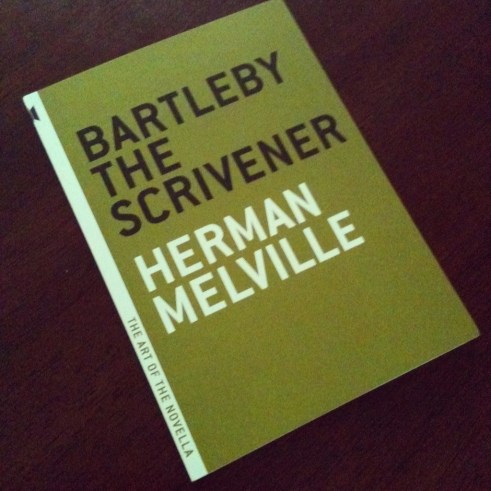
Bartleby the Scrivener (Book Acquired, 9.25.2012)


20120925-164256.jpg

The good people at Melville House sent me their edition of Melville’s classic novella Bartleby the Scrivener. I’ve read it at least half a dozen times since the 10th grade, but the Melville House version is part of their Hybrid Books series, which features digital illuminations. I shall report in full in a week or two, focusing on what the illuminations add to the book, and what the reading experience is like.


Modernism at the Barricades (Book Acquired, Some Weeks Ago)


20120924-140107.jpg

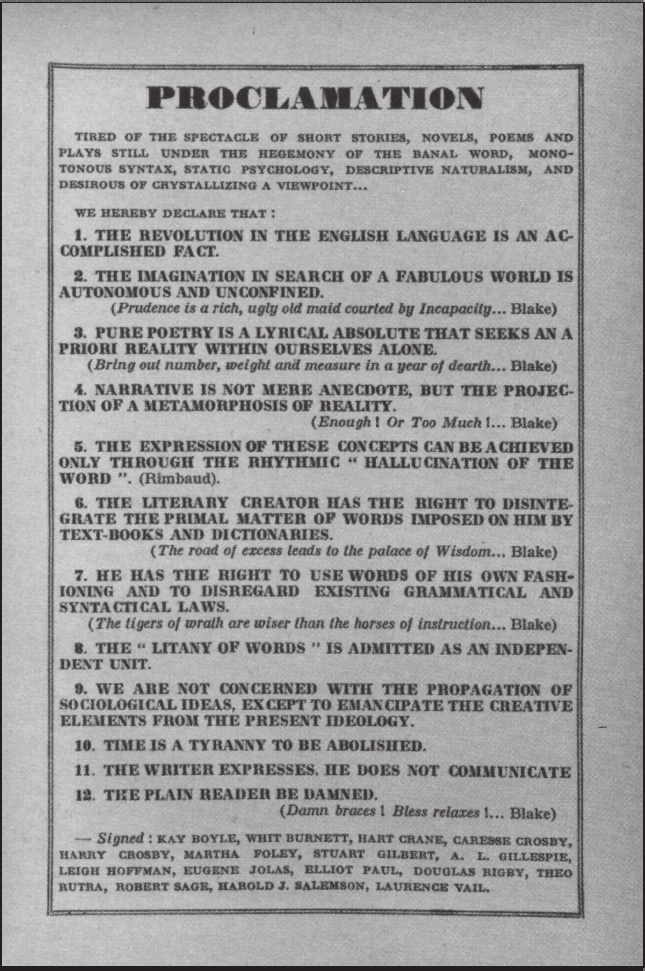
I’ve been digging Stephen Eric Bronner’s tight synthesis of modernism, Modernism at the Barricades, which traces the historical rise of expressionism, futurism, surrealism and more against the political, social, and historical backdrop of the emerging 20th century. Bronner’s book is a sharp but concise primer of sorts, using examples like the correspondence between Schoenberg and Kandinsky and the paintings of Emil Nolde to illuminate the big concepts and cultural aims of different modernist movements. Photographs, prints, and posters (like the proclamation below) help to illustrate Bronner’s chapters as well.

The Revolution of the World Proclamation — Eugene Jolas (1929)

Bronner’s book would make a handy starting point to any student beginning a study of modernism. It doesn’t try to exhaustively account for each and every modernist, but neither does it forsake specificity in favor of a broad overview. Best of all, Bronner is clear and concise, an attribute which unfortunately is all too rare in academic writing. There’s a lucid sensibility that seems to govern the book, which we can see from its earliest chapter. Here Bronner delineates modernism’s cultural project and at the same time points out some of modernism’s own shortsightedness:

Modernism would call into question every aspect of modern life, from the architecture through which our apartments are designed, to the furniture in which we sit, to the comic books our children read, to the films we watch and the museums we visit, to the experience of time and individual possibility that mark our lives. Modernists may have believed that they were contesting modernity, but their efforts and their hopes were shaped by it. Their activities legitimated what they intended to oppose. Their critique, in short, presupposed its object. Modernists believed that they were contesting tradition in the name of the new and the constraints of everyday life in the name of multiplied experience and individual freedom. These artists were essentially anarchists imbued with what Georg Lukács termed “romantic anti-capitalism.”

They opposed the “system” without understanding how it worked or what radical political transformation required and implied. Oddly, they never understood how deeply they were enmeshed in what they opposed. Modernists envisioned an apocalypse that had no place for institutions or agents generated within modernity. Theirs was less a concern with class consciousness than an opposition to the alienating and reifying constraints of modernity. Unfettered freedom of expression and a transformation in the experience of everyday life were the modernists’ goals. Even when seduced by totalitarian movements, whether of the left or the right, most of them despised what Czeslaw Milosz called the“captive mind.” Not all the problems that they uncovered—sexual repression and generational conflicts, among others—required utopian solutions. But their utopian inclinations were transparent from the beginning. Modernists believed that the new would not come from within modernity, but would appear as an external event or force for which, culturally, the vanguard would act as a catalyst.

Good stuff. Modernism at the Barricades is new in hardback from Columbia University Press.


“The modern novel should be largely a work of reference” (Flann O’Brien)


In reply to an inquiry, it was explained that a satisfactory novel should be a self-evident sham to which the reader could regulate at will the degree of his credulity. It was undemocratic to compel characters to be uniformly good or bad or poor or rich. Each should be allowed a private life, self-determination and a decent standard of living. This would make for self-respect, contentment and better service. It would be incorrect to say that it would lead to chaos. Characters should be interchangeable as between one book and another. The entire corpus of existing literature should be regarded as a limbo from which discerning authors could draw their characters as required, creating only when they failed to find a suitable existing puppet. The modern novel should be largely a work of reference. Most authors spend their time saying what has been said before – usually said much better. A wealth of references to existing works would acquaint the reader instantaneously with the nature of each character, would obviate tiresome explanations and would effectively preclude mountebanks, upstarts, thimble-riggers and persons of inferior education from an understanding of contemporary literature. Conclusion of explanation.

—From Flann O’Brien’s novel At Swim-Two-Birds (1939).


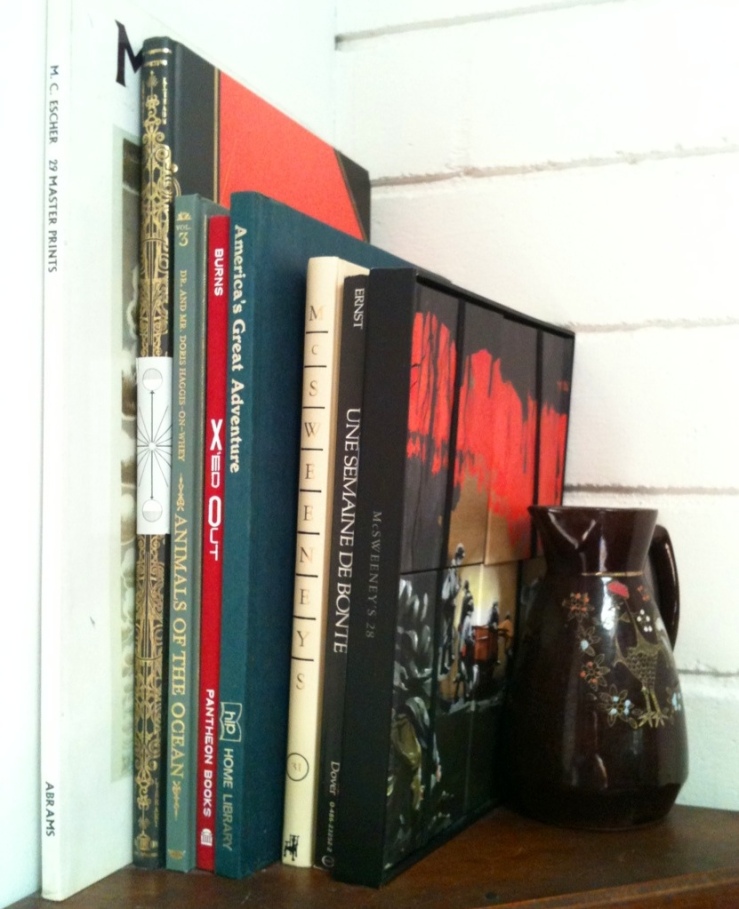
Book Shelves #38, 9.16.2012

20120916-133140.jpg

Book shelves series #38, thirty-eighth Sunday of 2012

The final entry on this corner piece.

What have these volumes in common? They are all aesthetically pleasing.

They are all too tall to fit elsewhere comfortably.

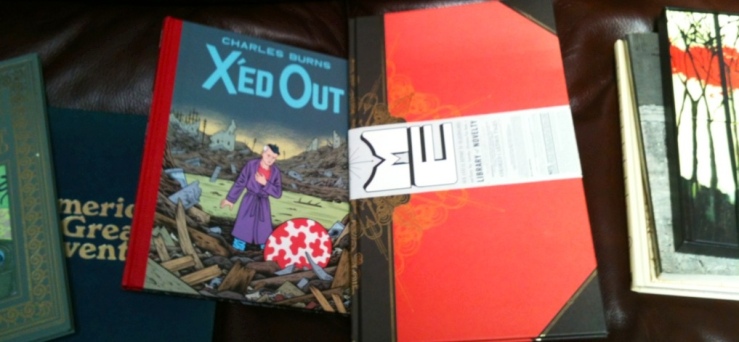
Several issues of McSweeney’s, some art books, and some graphic novels:

20120916-133146.jpg

I’ve already expressed my strong enthusiasm for Charles Burns’s X’ed Out. The Acme Library pictured is part of Chris Ware’s series, and is beautiful and claustrophobic.

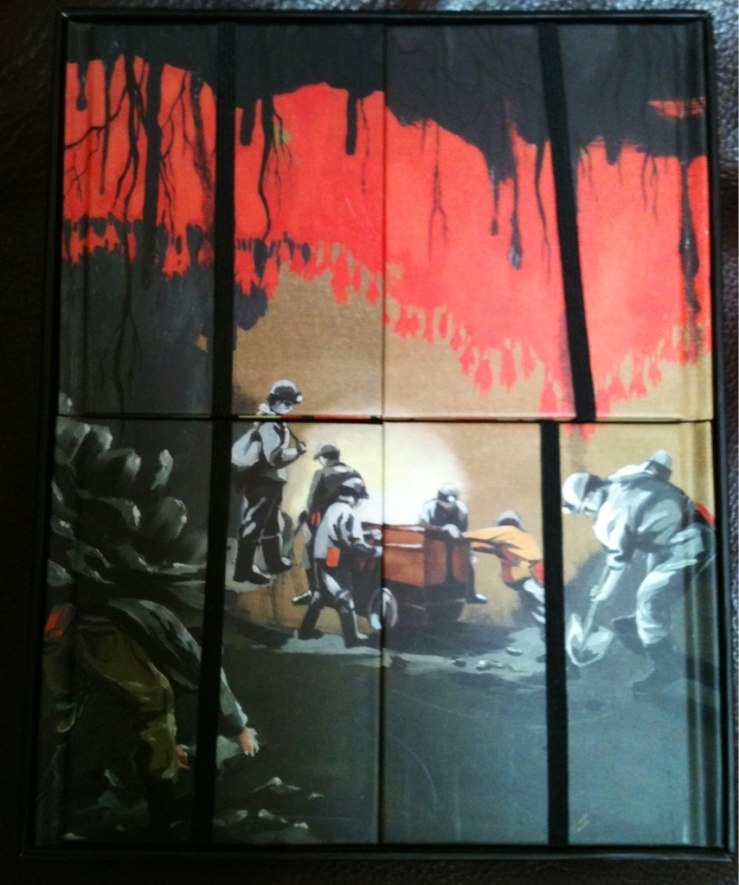
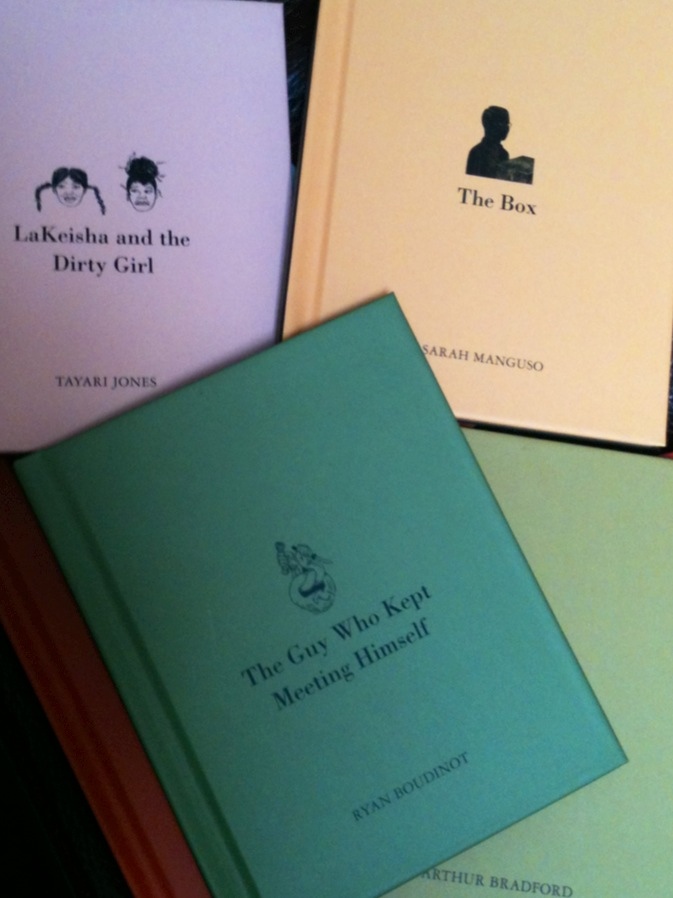
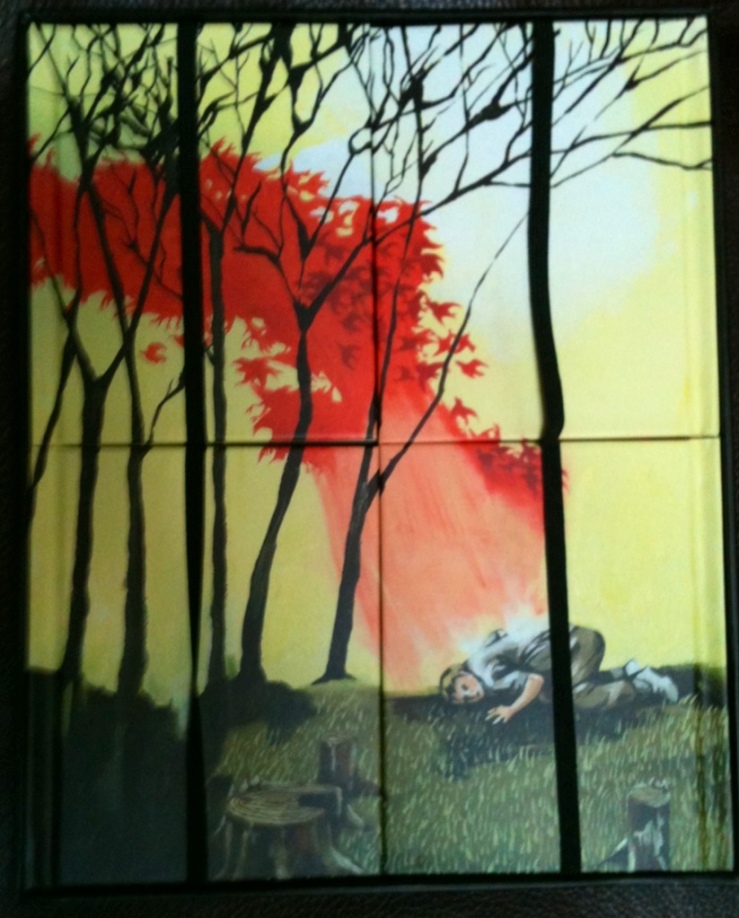
McSweeney’s #28 comprises eight little hardbacked fables that arrange into two “puzzle” covers:

20120916-133153.jpg

20120916-133200.jpg

20120916-133207.jpg

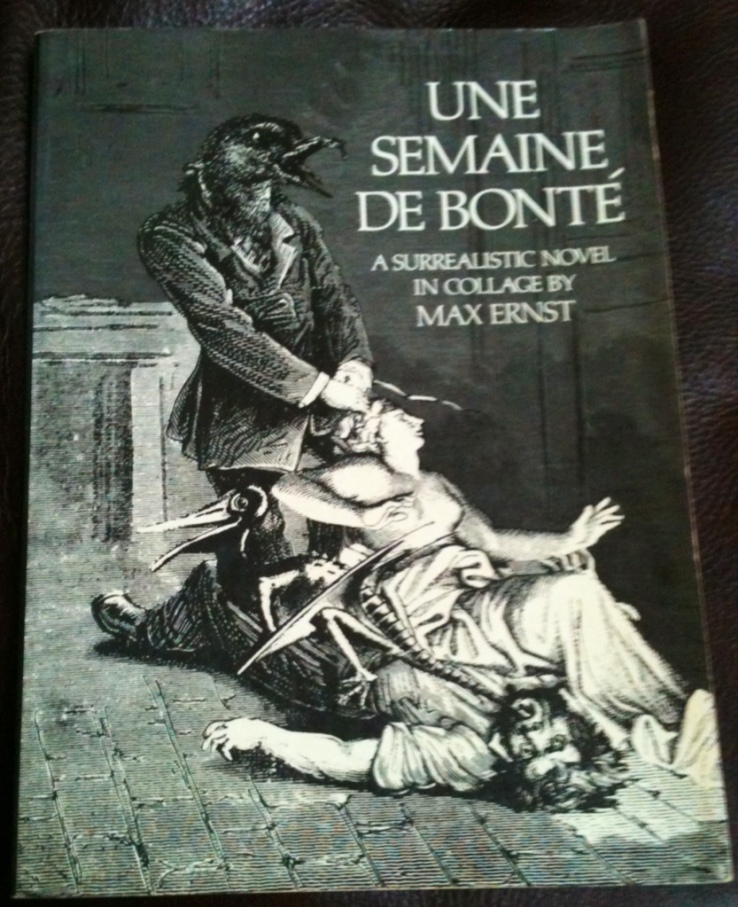
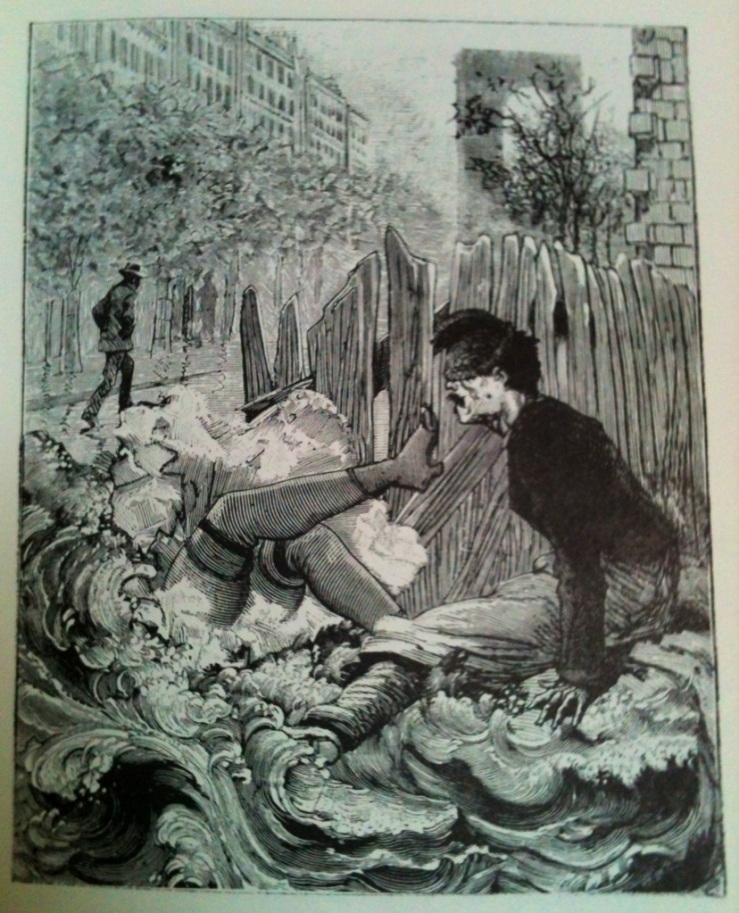
I’ve also written enthusiastically about Max Ernst’s surreal graphic novel, Une Semaine de Bonte:

20120916-133214.jpg

20120916-133221.jpg

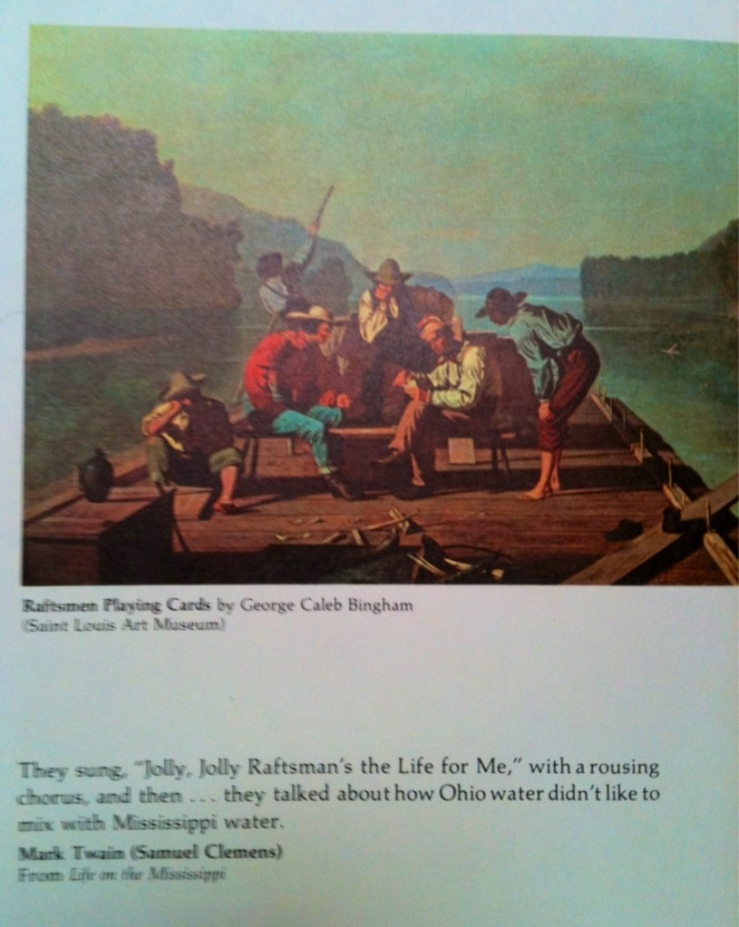
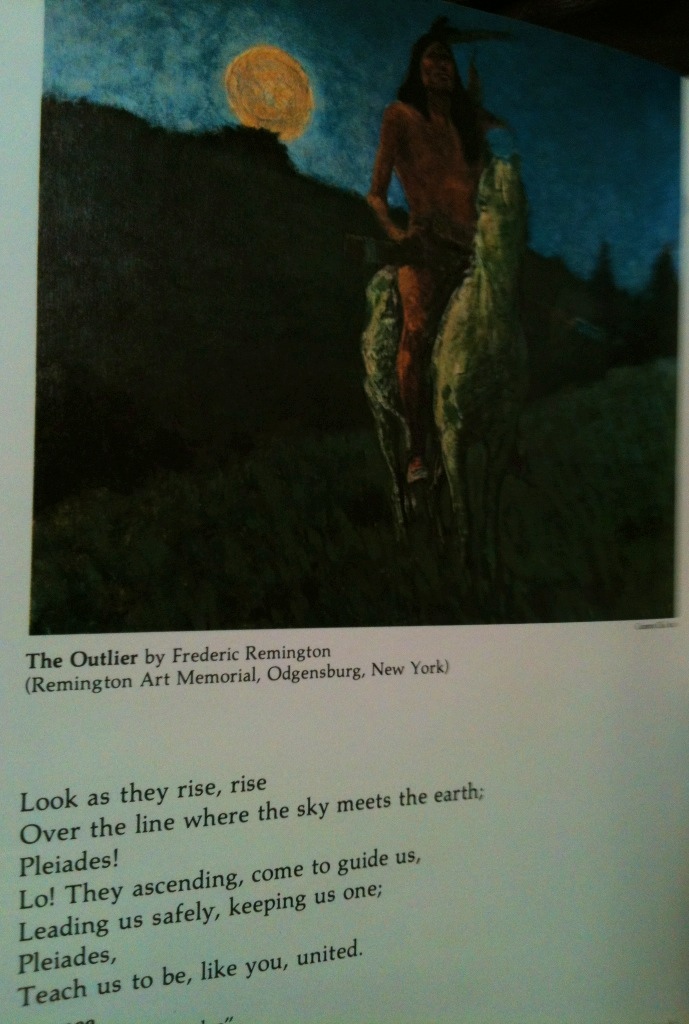
America’s Great Adventure is this wonderful book that pairs American writing (poems, songs, excerpts from novels and journals) with American paintings to tell a version of American history:

20120916-133230.jpg

20120916-133238.jpg

20120916-133244.jpg

It probably deserves its own review. Short review: It’s a wonderful book if you can find it.

Read “Clara,” a Short Story by Roberto Bolaño


“Clara,” a short story by Roberto Bolaño:

She had big breasts, slim legs, and blue eyes. That’s how I like to remember her. I don’t know why I fell madly in love with her, but I did, and at the start, I mean for the first days, the first hours, it all went fine; then Clara returned to the city where she lived, in the south of Spain (she’d been on vacation in Barcelona), and everything began to fall apart.

One night I dreamed of an angel: I walked into a huge, empty bar and saw him sitting in a corner with his elbows on the table and a cup of milky coffee in front of him. She’s the love of your life, he said, looking up at me, and the force of his gaze, the fire in his eyes, threw me right across the room. I started shouting, Waiter, waiter, then opened my eyes and escaped from that miserable dream. Other nights I didn’t dream of anyone, but I woke up in tears. Meanwhile, Clara and I were writing to each other. Her letters were brief. Hi, how are you, it’s raining, I love you, bye. At first, those letters scared me. It’s all over, I thought. Nevertheless, after inspecting them more carefully, I reached the conclusion that her epistolary concision was motivated by a desire to avoid grammatical errors. Clara was proud. She couldn’t write well, and she didn’t want to let it show, even if it meant hurting me by seeming cold.

(Read the rest at The New Yorker)


A Rambling Riff on the Age of the Amateur, Book Review Ethics, and Adam Johnson’s The Orphan Master’s Son

1.There’s been a lot of hubbub (at least in my particular echo chamber) the past few weeks about book reviews and the ethics of book reviews:

Too nice?

Too mean?

Just fine?

What about straight-up buying a book review?

And what about when authors get involved, via social media, in calling out reviewers?

2. A sloppy synthesis of what I’ve linked to above might be:

The traditional position of the serious book critic is perhaps being undermined via social media in the hands of well-meaning amateurs.

3. I’m not sure that I exactly agree with the statement above.

4. Still, we live in the Age of the Amateur.

(Saturday Night Live parodied this phenomena in a sketch called “You Can Do Anything!” that hits nail on head).

5. (SNL also unintentionally documented what happens when an amateur is given a forum beyond her untested abilities).

6. I suppose I could spend a few paragraphs parsing the delicate distinctions between literary criticism and book reviews and awarding fucking stars on Amazon or Goodreads, but I think you, gentle reader, probably get all that already.

7. (I consider myself an amateur book reviewer with an interest in but no pretension to literary criticism. I don’t intend to write about myself, but I do feel like I should clarify this).

8. (I know I just said that I don’t intend to write about myself, but again, perhaps germane:

I don’t read a lot of book reviews, especially contemporary book reviews. I mean, I hardly ever read contemporary book reviews. If I’m planning to review the work, a contemporary review may poison any pretense of objectivity I have.

With the occasional new major release, it’s almost impossible not to get a fix on some critical consensus—and I always scan of course.

I usually read a handful of reviews of a book I’m reading after I’ve drafted a review.

And I read lots of old reviews. Lots.

Again, maybe germane to all of this).

9.  But I’m riffing out all over the place. Let me get to the point. Let’s return to the second part of Point 2:

The traditional position of the serious book critic is perhaps being undermined via social media in the hands of well-meaning amateurs.

Is this true? I don’t know, exactly. A few points to consider:

Literary criticism has existed via two more-or-less stable forms for about a century now: Academic scholarship and popular media.

Academic scholarship tends to be highly-specialized and literally inaccessible for most people. I think academic scholarship and research about literature is important and I don’t want to knock it all—but most of it simply isn’t exposed to, let alone absorbed by, a reading public.

Popular media—magazines and newspapers—is clearly in a transitional phase. A lot of this boils down to the dissemination of new technologies, the advent of the so-called “citizen journalist,” and the oligarchization of mass media. Journalism, as taught in journalism school, prescribed a set of methods and ethics that seem frankly quaint when set against the internet and 24hr cable networks. How book reviews fit—if they fit at all—into the emerging paradigm of popular media is hard to say.

10. Obviously, one model for how book reviews/lit crit fits into the emerging paradigm of popular media  is Goodreads, which I really don’t know much about to be honest. Another is Amazon, which has so many problems I don’t even begin to know how to start. Both of these sites use star ratings though, which has always struck me as probably the worst critical model available.

11. (I got an email recently about Riffle, a new service “powered by the Facebook social graph and loaded with expert curated recommendations.” I mean, how’s that for a shudder down the metaphorical spine?)

12. (Re: Point 11—What is it with this term “curator”? Is it synonymous with: “I produce no original content”?)

13. So, to return to the pretense that I have a point:

I’ve written about 300 reviews on this site. Most for books, some movie reviews, and a few other things as well (uh, malt liquor). I didn’t really know what I was doing in the beginning—I mean, I wasn’t even intending to review books. I was just writing about books I’d pilfered, pinched. Stolen. (The name of the site was its mission statement).  At some point I started making critical judgments, trying to, you know, recommend books that I loved to people who I hoped would love them also.

And at some point I came across John Updike’s rules for reviewing books.

I’m not an Updike fan—wasn’t then, amn’t now—but his rules resonated with me, and I made a point of reading his criticism, which is generally excellent.

In short, I’ve tried to follow his rules.

14. (To clarify: A simple thesis for this whole riff: I think book reviewers need to follow some kind of aesthetic, ethical rubric, one that accounts for subjectivity in an objective way—and I think Updike’s list is great).

15. Updike’s first rule is his best:

Try to understand what the author wished to do, and do not blame him for not achieving what he did not attempt.

This one seems fairly straightforward, but is abused all the time, whether it’s Kakutani at the NYT pretending YA is not YA, or a reviewer at Book Kvetch lamenting that a metaphor-laced experimental novel isn’t a science textbook.

(I might have abused Updike’s first rule myself, but I’m not going to ransack the archives for self-incrimination).

16. Updike’s first rule is so graceful because it allows for a sliding scale of sorts, a range of possibilities beyond the critic’s own highly-subjective taste.

Put another way, it’s very easy to say, “I loved it” or “I hated it,” but Updike’s first rule places the onus of critical imagination on the reviewer. The responsible reviewer has to understand his or her audience (or at least has to try to understand his or her audience).

17. The subjective can’t be removed from reviews of course—nor should it be. I think the balancing act here might be described as taste.

18. I’ve occasionally broken some of Updike’s rules, especially when I super hated a book (usually #s 2 &3–didn’t bother to cite text—actually, I’ve done this repeatedly),

19. Sometimes a book confuses my approach to criticism.

20. Hence, Adam Johnson’s novel The Orphan Master’s Son, which I reviewed in hardback a few months ago, and which is now available in trade paperback, and which I will use now as some sort of loose illustration for whatever point there is in this ramble:

20120724-194425.jpg

21. (Okay. So, normally I photograph reader copies (and other books I obtain) and run a little blurb—usually the publisher’s copy or another review—and I was gonna do this with The Orphan Master’s trade paperback (citing my own review in this case), but the post lingered, thoughts accrued around it as I glommed onto all the ideas reverberating around my little echo chamber re: this whole riff. I bring this up in the recognition that a post purporting to address in some way the ethics of book reviewing should point out that the publisher in question (e.g. this blog, e.g. me) regularly posts what amounts to a kind of advertisement for forthcoming books).

22. So why The Orphan Master’s Son?

I use it as example (barring info re: Point 21 for a moment) of a book that didn’t do what I wanted the book to do.

Here’s the end of my review:

 Toward the end of The Orphan Master’s Son, I began imagining how the novel might read as a work divorced from historical or political reality, as its own dystopian blend—what would The Orphan Master’s Son be stripped of all its North Korean baggage? (This is a ridiculous question, of course, but it is the question I asked myself). I think it would be a much better book, one that would allow Johnson more breathing room to play with the big issues that he’s ultimately addressing here—what it means to tell a story, what it means to create, what it means to love a person who can not just change, but also disappear. These are the issues that Johnson tackles with aplomb; what’s missing though, I think, is a genuine take on what it means to be a North Korean in search of identity.

I think my review of The Orphan Master’s Son was/is fair, but it didn’t—couldn’t—exactly capture how I felt about the book: a mix of disappointment and admiration.

23. To be clear, I took pains to clarify that I thought highly of Johnson’s prose and that I thought most readers would really dig his book.

I gave it, I suppose, a mixed review, which is almost like giving it a negative review.

24. But I didn’t give it a mixed review to be nice—I tempered my criticisms with the knowledge that any attack I made on The Orphan Master’s Son was really a way of defining my own aesthetic tastes. Let me cite Updike’s fifth rule:

 If the book is judged deficient, cite a successful example along the same lines, from the author’s ouevre or elsewhere. Try to understand the failure. Sure it’s his and not yours?

Ultimately, my problem with The Orphan Master’s Son boils down to me wanting Johnson to have written a different book. I feel like I have plenty of reasonable reasony reasons for wanting a different book—first and foremost Johnson’s prowess as proser and storyteller—but that’s no way to review a book. From my review:

I should probably clarify that I think many people will enjoy this novel and find it very moving and that the faults I found in its second half likely have more to do with my taste as a reader than they do Johnson’s skill as a writer, which skill,  again I’ve tried to demonstrate is accomplished.

25. Let me end here in repetition (and, perhaps, here in the safety of these parentheses point to how riffing in a rambling wine-soaked list somehow frees me from actually coherently writing about any of the things I promised to—or maybe it doesn’t—which is of course its own ethical ball of worms) by restating a basic answer to some of the basic problems of amateurism:

Book reviewers need to follow some kind of aesthetic, ethical rubric, one that accounts for subjectivity in an objective way.