Woman Reading (1935) — Pablo Picasso

Woman Reading — Camille Corot

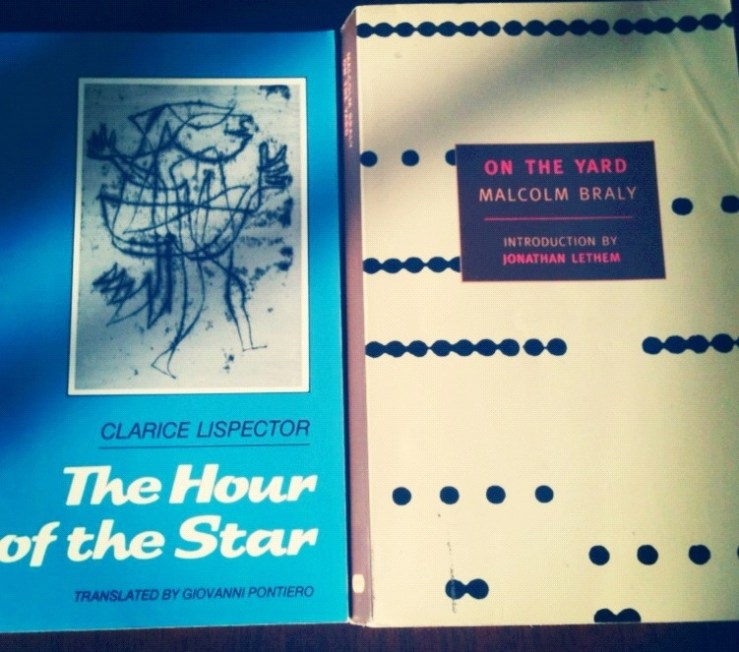
Clarice Lispector/Malcolm Braly (Books Acquired 6.22.2012)

20120622-184839.jpg

It’s a sickness. Should I explain that the bookstore is like 1.1 miles from my house? And that it holds somewhere between one and two million books? (No exaggeration). That it’s like three or four buildings  cobbled together in snaking passages, all said passages lined by books? It’s also like .2 miles from the grocery store I/we usually shop at. Which I had to go by to get mozzarella. For make your own pizza night. But of course, I had to stop off and browse. (Is it weird I set the timer on my iPhone? Gave myself 17 minutes?).

Anyway. Picked up these two.

The Lispector comes via recommendation of Scott Esposito, although this New Directions edition is not the latest translation, but, I dunno. It’s short. The Braly, well, I’d never heard of it, honestly, but it’s an NYRB edition, and the spines of those books always standout, and Lethem introduces it, and even though I haven’t liked Lethem’s last few books, well, he’s still a tastemaker par excellence, and Kurt Vonnegut blurbs it on the back, calling it, “Surely the great American prison novel.” And I just finished “The Part About the Crimes” in 2666 (yet again, more on that to come) and maybe a prison novel seems especially intriguing.

St. Jerome Reading — Giovanni Bellini

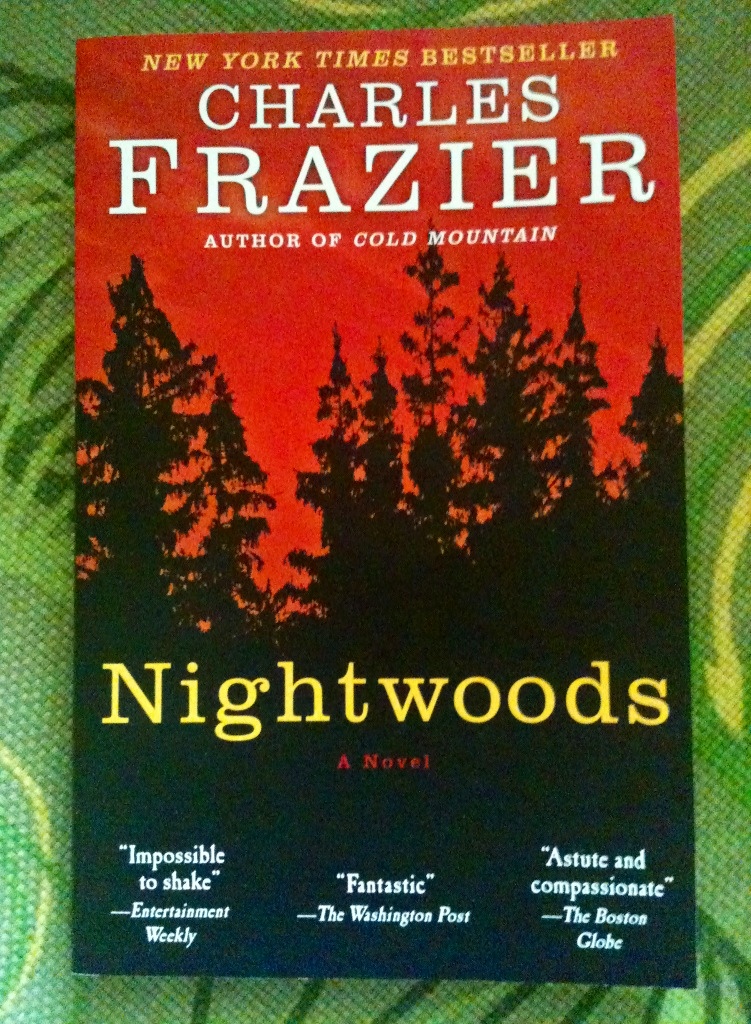
Charles Frazier’s Nightwoods (Book Acquired, 6.14.2012)

20120622-100218.jpg

Charles Frazier’s Nightwoods, new in trade paperback. From Randy Boyagoda’s NY Times review:

“Nightwoods,” Frazier’s new novel, is a departure from its predecessors in some respects. It’s set in the early 1960s rather than the 19th century, and it involves no literary or historical elements of comparable grandeur and gravity. Indeed, based on its premise, the new book feels remarkably stripped down: a young woman named Luce, the caretaker of an old lodge in small-town North Carolina, becomes the guardian of the twin children of her murdered sister. In turn, she must defend them from Bud, their former stepfather, who killed their mother while they watched, and who believes the traumatized children know the location of some stolen money. As a setup, this promises suspense and mystery, to which Frazier adds family tension (when Luce’s lawman-cum-drug-addict father buddies up with Bud) and romance (after the shy, handsome grandson of the lodge’s deceased owner visits his inheritance and falls for Luce).

Denis Johnson’s Train Dreams Is a Perfect Audiobook

Going West (Express Train) — Thomas Hart Benton

A few weeks ago on this blog, I declared Denis Johnson’s Train Dreams a perfect novella, a claim that I feel even more certain about after listening to Macmillan audio’s new production of the book, read by Will Patton.

Precise, funny, and moving, Train Dreams tells the story of Robert Grainier, a laborer (and eventual hermit of sorts) who makes a life in (and against) the strange wilderness of the Idaho panhandle. The book somehow measures the first half of the twentieth century in the US without overreaching; instead, through Grainier’s human (but anti-social) presence, Johnson traces the end of Manifest Destiny, the last strands of the wild frontier. Train Dreams, poised tautly on a line that divides the mythic and metaphysical from the concrete and real, shows us a world where we might catch a glimpse of wolf-children and angels—the real thing, not just the sham show, not just a pale suggestion.

Moving through the book again via Patton’s expert narration, I was struck by how constructed yet seamless Johnson’s narrative is. Johnson gets so much credit for the precision of his syntax, but a rereading of Train Dreams reveals how tight and layered, yet never obvious, his plot is—how he lays out his themes repeatedly without brazenly calling attention to them. (One of the joys of reading is rereading; one of the joys of a novella is that its brevity allows us to easily reread). The book is a gem.

Will Patton’s reading perfectly matches the tone, pacing, and depth of Train Dreams. He understands the restraint of Johnson’s prose, never tripping over into bombast or ghastly over-emoting. Patton’s wry, not-quite-dusty, not-quite-dulcet tone brings Johnson’s small cast to vivid life. In particular, he breathes energy into the humorous dialogues. I found myself laughing aloud over a discourse between Grainier and a man who’s been shot by his own dog. Patton understands the material and brings the same sensitivity, pathos, and wit to it that he brought to his reading of Johnson’s 2007 opus, Tree of Smoke.

A good reader makes all the difference of course. In the wrong hands—excuse me, wrong voice—a book we thought we knew can come across stifled, squashed; the reader can actually hurt the book, impose the wrong tone: misread. A reader like Patton (and I should credit his director and production team too, of course) can enlarge a book for its audience, shining light on the subtle nuances we might overlook, or even clouding phrases we thought we fully understood, empowering the language with a new ambiguity that enriches the overall reading experience. Highly recommended.

Here’s Patton reading the first part of Train Dreams:

The Magdelene Reading — Rogier van der Weyden

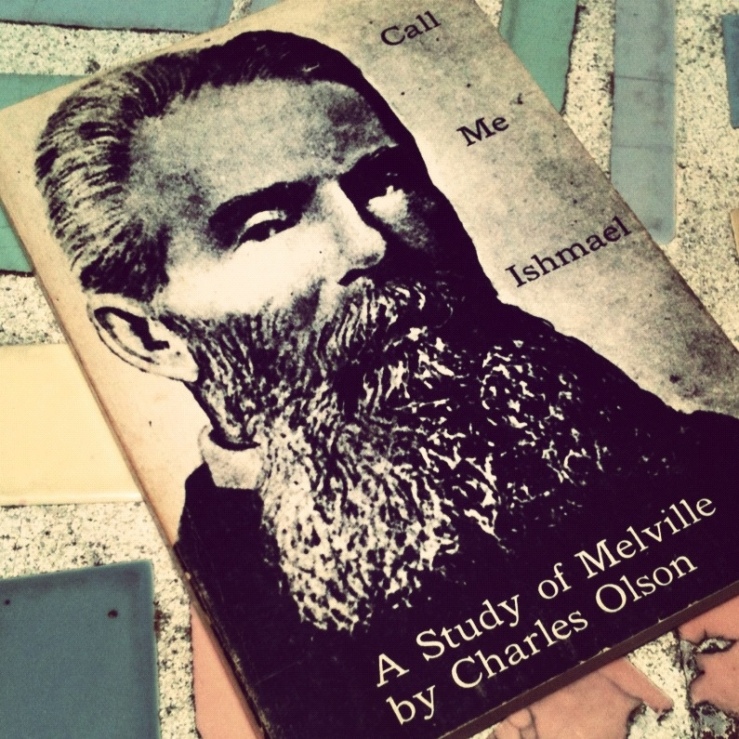
“Half Horse Half Alligator” — I Review Charles Olson’s Inimitable Melville Study, Call Me Ishmael

20120616-141629.jpg

The classical Greeks understood that literature is a form of competition. The eminent literary critic Harold Bloom folded a bit of Freudian psychology into this insight, describing the “anxiety of influence” that lurks beneath the impetus to write, the motivation to enter into an agon with the history of letters, to Oedipally assassinate—or at least assimilate—one’s literary forebears. To put this another way: What does it take to write after, say, The Odyssey? How does one answer to The Book of Job? The gall to write after Don Quixote, after Shakespeare, after Dostoevsky, after George Eliot . . .

What about Moby-Dick? What are the possibilities of even writing about Moby-Dick? (One thinks here of Ishmael’s own futile attempts to measure whales). How could Melville write after Job? After Lear? After Moby-Dick? How did Melville assimilate the texts that presented the strongest anxieties of influence in his opus? Could Melville survive the wreckage of The Pequod? These are the questions that poet-critic Charles Olson tackles—sometimes directly, sometimes obliquely, and always with brisk, sharp language—in Call Me Ishmael, his study of Melville and Moby-Dick.

Here’s one answer to my list of questions. It comes early in Olson’s book:

The man made a mess of things. He got all balled up in Christ. He made a white marriage. He had one son die of tuberculosis, the other shoot himself. He only rode his own space once—Moby-Dick. He had to go fast, like an American, or he was all torpor. Half horse half alligator.

Melville took an awful licking. He was bound to. He was an original, aboriginal. A beginner. It happens that way to the dreaming men it takes to discover America . . . Melville had a way of reaching back through time until he got history pushed back so far he turned time into space. He was like a migrant backtrailing to Asia, some Inca trying to find a lost home.

We are the last “first” people. We forget that. We act big, misuse our land, ourselves. We lose our own primary.

Melville went back, to discover us, to come forward. He got as far as Moby-Dick.

This passage illustrates Olson’s forceful, often blunt prose, the kind of language that cracks directly at Melville’s own impossible prose in Moby-Dick. I think here of the critic James Wood’s notation in his essay “Virginia Woolf’s Mysticism” that

The writer-critic, or poet-critic, has a competitive proximity to the writers she discusses. The competition is registered verbally. The writer-critic is always showing a little plumage to the writer under discussion. If the writer-critic appears to generalize, it is because literature is what she does, and one is always generalizing about oneself.

Olson may generalize as he shows a little plumage to master Melville, cutting through huge swaths of history and making poetic leaps into strange similes, but Call Me Ishmael is ultimately keenly attenuated to detail, to the processes of Melville’s constructions at the historical, economic, psychological, religious, and, yes, literary level. Although a slim 119 pages in my 1947 City Lights edition, Call Me Ishmael nevertheless vividly conveys the sources Melville synthesized to create Moby-Dick.

The book begins with an unsourced account of the whaleship Essex, attacked and destroyed by a sperm whale in the Pacific in 1820, a year after Melville’s birth. Olson trusts his readers to connect The Essex to The Pequod. Unlike so much literary scholarship, Olson’s Ishmael doesn’t torture every element of the text into overwrought explications. He provides an overview of the importance of whaling-industry-as-world’s-fuel source in a chapter that reads more like a prose poem than a stuffy history book, and then, in a chapter appropriately titled “Usufruct,” offers up entries from Melville’s own journals as primary evidence of the material that led to Moby-Dick. Olson rarely sticks his nose in here, letting the reader synthesize the selections.

Olson then plumbs Moby-Dick’s literary roots, delving into Shakespeare, particularly Lear and Antony and Cleopatra. He attends to Melville’s own annotations to Shakespeare, and then points out Melville’s literary/political condensation:

As the strongest force Shakespeare caused Melville to approach tragedy in terms of the drama. As the strongest social force America caused him to approach tragedy in terms of democracy.

It was not difficult for Melville to reconcile the two. Because of his perception of America: Ahab . . .

Ahab is the FACT, the Crew the IDEA. The Crew is where what America stands for got into Moby-Dick. They’re what we imagine democracy to be. They’re Melville’s addition to tragedy as he took it from Shakespeare. He had to do more with the people than offstage shouts in a Julius Caesar. This was the difference a Declaration of Independence made.

The Shakespeare section of Call Me Ishmael marvels: Olson’s perceptive powers simultaneously enlighten and make seemingly-familiar territory dark, strange. He then moves into a discussion of post-Moby Melville, a man perhaps crushed by his own achievement—not by any financial success, no, definitely no, but the metaphysical success. Like a Moses, Melville had found the god he so desperately needed:

Melville wanted a god. Space was the First, before time, earth, man. Melville sought it: “Polar eternities” behind “Saturn’s gray chaos.” Christ, a Holy Ghost, Jehovah never satisfied him. When he knew peaces it was with a god of Prime. His dream was Daniel’s: the Ancient of Days, garment white as snow, hair like the pure wool. Space was the paradise Melville was exile of.

When he made his whale he made his god. Ishmael once comes to the bones a Sperm whale pitched up on land. They are massive, and his struck with horror at the “antemosaic unsourced existence of the unspeakable terrors of the whale.”

When Moby-Dick is first seen he swims a snow-hill on the sea. To Ishmael he is the white bull Jupiter swimming to Crete with ravished Europa on his horns: a prime, lovely, malignant white.

Olson agrees with an 1856 journal entry by Nathaniel Hawthorne that he cites at length: Melville “can neither believe, nor be comfortable in his unbelief.” In Olson’s analysis, after having found god-in-the-whale, Melville plummets into an existential crisis. He gives over to his inner-alligator, torpid, enervated, numb, but still fierce and potent and monstrous. “He denied himself in Christianity,” writes Olson, linking the downward spiral of Melville’s career and family life to this religion.

To this end, Olson is too dismissive of Melville’s later work; when he can find nothing of the “old Melville” to praise in Benito Cereno, Bartleby, or Billy Budd, it’s almost as if he’s willfully ignoring evidence that contradicts his thesis. These are marvelous books, and if they can’t win a contest against Moby-Dick, it’s worth pointing out that little of what’s been written after that book can.

And yet we can write after Melville; we can even write on Melville. The will and vitality of Olson’s forceful, intelligent prose opens a way, or at least exemplifies a way. At the same time, paradoxically, a reading of Call Me Ishmael seems to foreclose the need, if not the possibility, of reading another study of Moby-Dick. This statement is not meant to be a knock against Melville scholarship. Here’s the thing though: life is short, time is limited, and if one plans to read a book about Moby-Dick, it should be Olson’s Call Me Ishmael. It’s great, grand stuff.

Book Shelves #25, 6.17.2012

20120616-143021.jpg

Book shelves series #25, twenty-fifth Sunday of 2012: Cookbooks and some photo albums.

We’ve moved out of the living room and looped into the kitchen/eat-in dining room. Cookbooks and photo albums occupy a little-built in under the eat-in counter.

There’s a shelf of cookbooks at the bottom of a buffet-thing. In the good old days it held vinyl LPs.

Five Favorite Fictional Fathers

Literature seems to have an ambivalence toward fatherhood that’s too complex to address in a simple blog post–so I won’t even try. But before I riff on a few of my favorite fathers from a few of my favorite books, I think it’s worth pointing out how rare biological fathers of depth and complexity are in literature. That’s a huge general statement, I’m sure, and I welcome counterexamples, of course, but it seems like relationships between fathers and their children are somehow usually deferred, deflected, or represented in a shallow fashion. Perhaps it’s because we like our heroes to be orphans (whether it’s Moses or Harry Potter, Oliver Twist or Peter Parker) that literature tends to eschew biological fathers in favor of father figures (think of Leopold Bloom supplanting Stephen Dedalus in Ulysses, or Merlin taking over Uther Pendragon‘s paternal duties in the Arthur legends). At other times, the father is simply not present in the same narrative as his son or daughter (think of Telemachus and brave Odysseus, or Holden Caulfield wandering New York free from fatherly guidance). What I’ve tried to do below is provide examples of father-child relationships drawn with psychological and thematic depth; or, to put it another way, here are some fathers who actually have relationships with their kids.

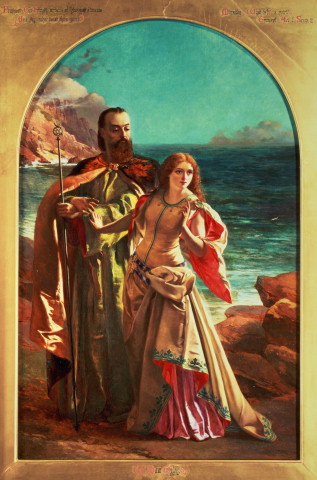
Prospero and Miranda--William Maw Egley
Prospero and Miranda–William Maw Egley

1. Prospero, The Tempest (William Shakespeare)

Prospero has always seemed to me the shining flipside to King Lear’s dark coin, a powerful sorcerer who reverses his exile and is gracious even in his revenge. Where Lear is destroyed by his scheming daughters (and his inability to connect to truehearted Cordelia), Prospero, a single dad, protects his Miranda and even secures her a worthy suitor. Postcolonial studies aside, The Tempest is fun stuff.

2. Abraham Ebdus, The Fortress of Solitude, (Jonathan Lethem)

Like Prospero, Abraham Ebdus is a single father raising his child (his son Dylan) in an isolated, alienating place (not a desert island, but 1970’s Brooklyn). After Dylan’s mother abandons the family, the pair’s relationship begins to strain; Lethem captures this process in all its awkward pain with a poignancy that never even verges on schlock. The novel’s redemptive arc is ultimately figured in the reconciliation between father and son in a beautiful ending that Lethem, the reader, and the characters all earn.

3. Jack Gladney, White Noise (Don DeLillo)

While Jack Gladney is an intellectual academic, an expert in the unlikely field of “Hitler studies” (and something of a fraud, to boot), he’s also a pretty normal dad. Casual reviewers of White Noise tend to overlook the sublime banality of domesticity represented in DeLillo’s signature novel: Gladney is an excellent father to his many kids and step-kids, and DeLillo draws their relationships with a realism that belies–and perhaps helps to create–the novel’s satirical bent.

4. Oscar Amalfitano, 2666 (Roberto Bolaño)

Sure, philosophy professor Amalfitano is a bit mentally unhinged (okay, more than a bit), but what sane citizen of Santa Teresa wouldn’t go crazy, what with all the horrific unsolved murders? After his wife leaves him and their young daughter, Amalfitano takes them to the strange, alienating land of Northern Mexico (shades of Prospero’s island?) Bolaño portrays Amalfitano’s descent into paranoia (and perhaps madness) from a number of angles (he and his daughter show up in three of 2666‘s three sections), and as the novel progresses, the reader slowly begins to grasp the enormity of the evil that Amalfitano is confronting (or, more realistically, is unable to confront directly), and the extreme yet vague danger his daughter is encountering. Only a writer of Bolaño’s tremendous gift could make such a chilling episode simultaneously nerve-wracking, philosophical, and strangely hilarious.

5. The father, The Road (Cormac McCarthy)

What happens when Prospero’s desert island is just one big desert? If there is a deeper expression of the empathy and bonding between a child and parent, I have not read it. In The Road, McCarthy dramatizes fatherhood in apocalyptic terms, positing the necessity of such a relationship in hard, concrete, life and death terms. When the father tells his son “You are the best guy” I pretty much break down. When I first read The Road, I had just become a father myself (my child was only a few days old when I finished it), yet I was still critical of McCarthy’s ending, which affords a second chance for the son. It seemed to me at the time–as it does now–that the logic McCarthy establishes in his novel is utterly infanticidal, that the boy must die, but I understand now why McCarthy would have him live–why McCarthy has to let him live. Someone has to carry the fire.


Woman Reading — Georges Braque

Woman Reading — Fernand Leger

Charles Olson/Conrad Aiken (Books Acquired, 6.09.2012)

20120611-143045.jpg

Charles Olson’s Selected Writing (New Directions): In all seriousness, why don’t more publishers go for simple covers like this one? Love it.

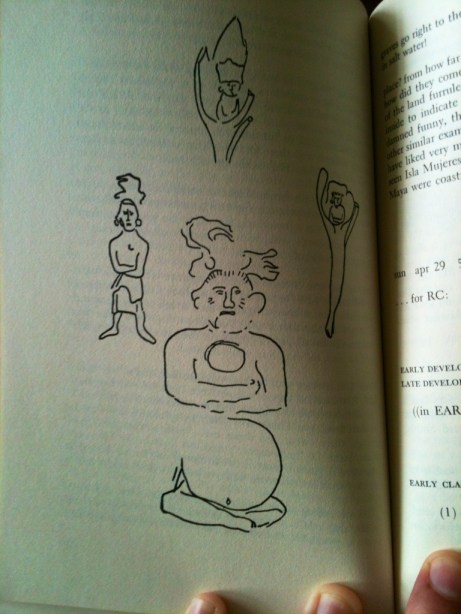
A scribbling:

20120611-143050.jpg

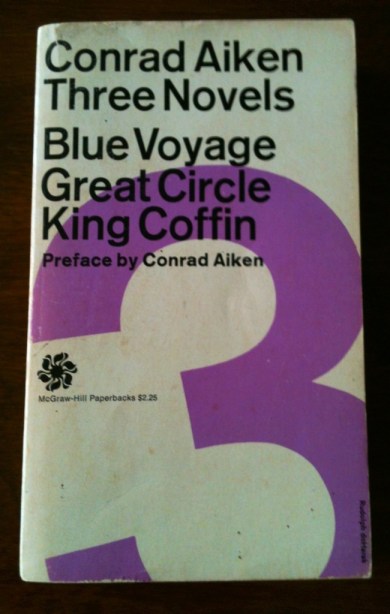
Also, had to pick up something by Conrad Aiken after reading about his influence on Malcolm Lowry:

20120611-143056.jpg

Reading (1921) — Pablo Picasso

Steve Kemper Talks to Biblioklept About A Labyrinth of Kingdoms, His New Book About Explorer Heinrich Barth

Steve Kemper’s latest book A Labyrinth of Kingdoms tells the story of Heinrich Barth, a German scientist who led a British-backed expedition into the central Sudan. While Barth’s name is not nearly as well-known as Livingstone or Stanley, Kemper makes a solid argument for a reappraisal of Barth’s neglected work. Barth explored Bornu and Sokoto, learned the ways of the nomadic Tuareg people, traveled to Timbuktu, and filled in many of the missing gaps that had been previously left to the guesswork of European geographers. Perhaps most importantly, Barth made numerous cultural connections in his time in Africa.

Barth’s story comes alive in Kemper’s capable hands; A Labyrinth of Kingdoms is erudite but never stuffy—at its core, the book is an excellent adventure story. Kemper’s first book, Code Name Ginger, traced the arc of invention and commerce by telling the story of the creation of the Segway transport. His work has also appeared journals like Smithsonian and National Geographic. To find out more about A Labyrinth of Kingdoms, check out Kemper’s blog .

Kemper was kind enough to talk to me about his book and Barth’s life in a series of emails.

A Labyrinth of Kingdoms is new in hardback from W.W. Norton on June 25th, 2012.

Biblioklept: What drew you to the story of Heinrich Barth? What made you want to write A Labyrinth of Kingdoms?

Steve Kemper: I got interested in Barth when I read a couple of paragraphs about him in Ryszard Kapuścińksi’s The Shadow of the Sun, a book of dispatches about Africa. In Timbuktu, Kapuścińksi notices a plaque on a house where Barth spent many months in 1853-1854, and he calls the explorer “one of the greatest travelers in the world” for his five years exploring the Sahara. He says that Barth survived death many times, including once by drinking his own blood. Kapuścińksi added that despite Barth’s accomplishments, he died young, unappreciated and almost forgotten. All of that sounded like the bones of a great story.

Biblioklept: Obviously, Barth’s tale is a great adventure story—but what are his greatest accomplishments?

SK: One of the reasons Barth isn’t better known is that he didn’t return with a headline accomplishment—the source of the Nile, a traverse of the continent, the location of a lost explorer. He did “discover” the Benue River and showed that it flowed into the Niger (that river’s major tributary) rather than into Lake Chad, and he settled the exact location of Timbuktu. But the reason that his work remains important to scholars is that he came back with reams of invaluable information and data about geography, anthropology, ethnography, and languages. He traveled across an immense territory and spent time with the major peoples of north-central Africa—Hausas, Kanuris, Tuaregs, Arabs, Songhais, Fulanis. The material he collected is still relevant. That can’t be said of most of Barth’s more famous peers. But then as now, headlines are more likely than scholarship to capture the public’s attention.

Biblioklept: North Africa, and the Islamic world in-general have captured more of the Western public’s attention in recent years though—what can we learn from Barth’s travels and experiences?

SK: Many things. First, that the region and the religion are not monolithic. Barth’s work (and my book) are full of a tremendous variety of peoples and cultures. Most Westerners—and I include myself in this, prior to writing this book—have a vague, fuzzy, and simplified image of the region that distorts everything about it—its many cultures, its complicated history, its complexity. Barth returned convinced that Islam was a great religion—not a popular view, then as now—but added that in some places it had been hijacked by thugs who used it as an excuse to pillage non-Muslims, or by fanatics, who used it as an excuse to kill or enslave non-Muslims. This still sounds familiar. But he also added that Islam wasn’t much different in this way from Christianity, another great religion sometimes hijacked by the greedy or the self-righteous. Barth met Muslim scholars and Muslim thieves, and tried to be clear about both. I could keep typing on this subject for a while but I don’t want the answer to get too long. I plan to write a couple of op-eds on the subject in time for the book’s pub date.

Biblioklept: In A Labyrinth of Kingdoms, you point out that Barth’s open-minded ideas were not well-received by his contemporaries, in part because these ideas conflicted with the emerging age of imperialist Europe. Is this also one of the reasons he hasn’t been canonized like other explorers?

SK: The short answer is yes, I believe so, though there are not straight lines connecting the two. But it seems clear that Barth’s ideas at least contributed to the reception of his work, along with Britain’s changing commercial and political goals, the interests of the public, and Barth’s own difficult personality.

Biblioklept: In what ways was Barth a difficult personality?

SK: During his journey and afterwards in England, Barth occasionally felt that he was being slighted by the British government or that his honor was being questioned (especially by one tormentor at the Royal Geographical Society). He was often right, but he reacted to these things with the touchiness of an anemone. An anemone’s touchiness is pretty to see; Barth’s was blunt and haughty and could even verge into petulance. His own strict sense of honor and proper conduct left him appalled at some of the machinations against him in England (and also in Germany). Barth’s brother-in-law and close friend wrote about him, “Heinrich is always too gruff and unyielding, and yet too modest and too imprudent. His pride doesn’t permit him to give in at the right moments. In the river of life he is a bold and persevering swimmer, but not a very agile one.”

Some of Barth’s difficulties stemmed from the fact that he was German, and the British liked their heroes home-grown. Some people in England couldn’t gracefully accept that the success of a British expedition had depended almost solely on a foreigner. (The British government funded the expedition, which began with an English leader. Barth was contracted as an independent scientist.)

Another part of Barth’s difficult personality stemmed from his sense of high calling. He truly did devote his life to science and the pursuit of truth, and he could be harsh when lesser mortals fell short of his standards.

It interests me that when he was in Africa, Barth showed far more patience and diplomacy than he did when back in Europe. In Africa, patience and diplomacy were often necessary to accomplish what he wanted and even to survive, but in Europe I think he expected better conduct and sometimes reacted poorly when he was disappointed.

Biblioklept: Barth’s story is one of culture and discovery, but it’s also an adventure story—can you share a favorite anecdote about Barth the adventurer?

SK: Tough question, since there are so many good ones, including death threats and narrow escapes. But I prefer the ones that reveal something about Barth. So: early in the journey, when he still considered himself nearly indestructible, he foolishly set off on foot one morning, with little water and no food, to climb a distant mountain. He soon ran out of water, got lost, and began to die of dehydration. Eventually he cut his arm and drank his own blood, which didn’t help. The following morning, at the caravan, the Tuareg guides told the expedition’s leader that no man could have survived the long Saharan day and night without water, but they agreed to search for him. Late that afternoon they found him, nearly comatose. The Tuaregs were amazed at his survival. They were also amazed the next day when, even though he couldn’t eat or speak, he rode seven hours with the caravan. This close call was a tough lesson, but Barth took it to heart and learned from it.

Another favorite, because it epitomizes how understated Barth always is about his adventures, occurred when he entered Kabara, a village on the Niger River not far from Timbuktu. Barth took up lodgings and was eating supper when a Tuareg warrior entered, glaring, and attempted to intimidate Barth into giving him a fine gift. Barth said he was eating and to go away. The Tuareg replied that he was a very dangerous man who was about to do something terrible. Barth writes, “After a very spirited altercation, I got rid of him.” I love the dry modesty of that. Imagine how Burton or Stanley would have handled it. After Barth expelled the warrior, 200 other men came in and silently eyed the stranger. Barth responded by staring back while lying across his smaller bags and protecting the bigger ones behind him. Very cool. Very Barth.

Biblioklept: I ran a blurb of your book the other day and a reader asked if the theologian Karl Barth might be a descendant of Heinrich’s. Any clue?

SK: I wondered the same thing, but haven’t come across anything that suggests they were related.

Biblioklept: You provide a fairly extensive set of end notes as well as a large bibliography for Labyrinth–clearly a lot of reading and research went into the book. Can you describe how you synthesized the information? What were some of your most important sources?

The principal source, of course, was Barth’s colossal book, Travels and Discoveries in North and Central Africa, which was originally published in five volumes and covered nearly 3500 pages. Other crucial primary sources were the extensive Foreign Office files in the British National Archives, which include dispatches from consuls, receipts, letters, and all the thorough bureaucratic documentation of the Victorian age. Barth’s brother-in-law and close friend, Gustav von Schubert, wrote a biography that I had translated; it provided many private glimpses of Barth.

The scholarship, of course, was invaluable, and I immersed myself in it to understand the era. Remember, I’ve spent the last 30 years as a journalist, writing about living people. I knew how to write narrative, but I had to learn how to do that with history. My goal with the book was to write an exciting, informative narrative that put readers inside the expedition with Barth, so all the scholarship is all folded into the action. I don’t quote many scholars in the text proper, because I didn’t want to intrude on the readers’ experience of the expedition. That’s all writer’s talk about technique and is probably more than your readers want to know.

Biblioklept: Actually, our readers seem to enjoy insights about writing technique, so I’m sure they’ll be interested in this stuff. (I’m interested, anyway). How long did it take to research and write the book?

SK: It’s hard to say, because I was also working on smaller jobs while researching and writing the book. The research just for the proposal was time-consuming, starting with Barth’s 3500 pages. Because I’m not a scholar of 19th century Africa or Europe, the background research took many months. The writing, including interruptions from other jobs, took about 9 months—probably 7 months net.

Biblioklept: What’s your next big project?

SK: I’m working on another book for W. W. Norton about another undeservedly obscure adventurer whom I stumbled across in my reading. An American this time, who lived the sort of epic life that’s no longer possible, on frontiers in several countries. I think I’ll keep his name to myself for the time being.

Biblioklept: Have you ever stolen a book?

SK: Yes, once, while in college—a paperback of several Sean O’Casey plays. It was also a library book, which I later realized compounded the crime, since I deprived others who could have gotten pleasure from it. I’ve since donated hundreds of dollars’ worth of books to libraries. Maybe I’ve subconsciously been seeking atonement.

The Abdication (Book/Ero(t)icomic Epic Aquired, Sometime Last Week)

20120606-120115.jpg

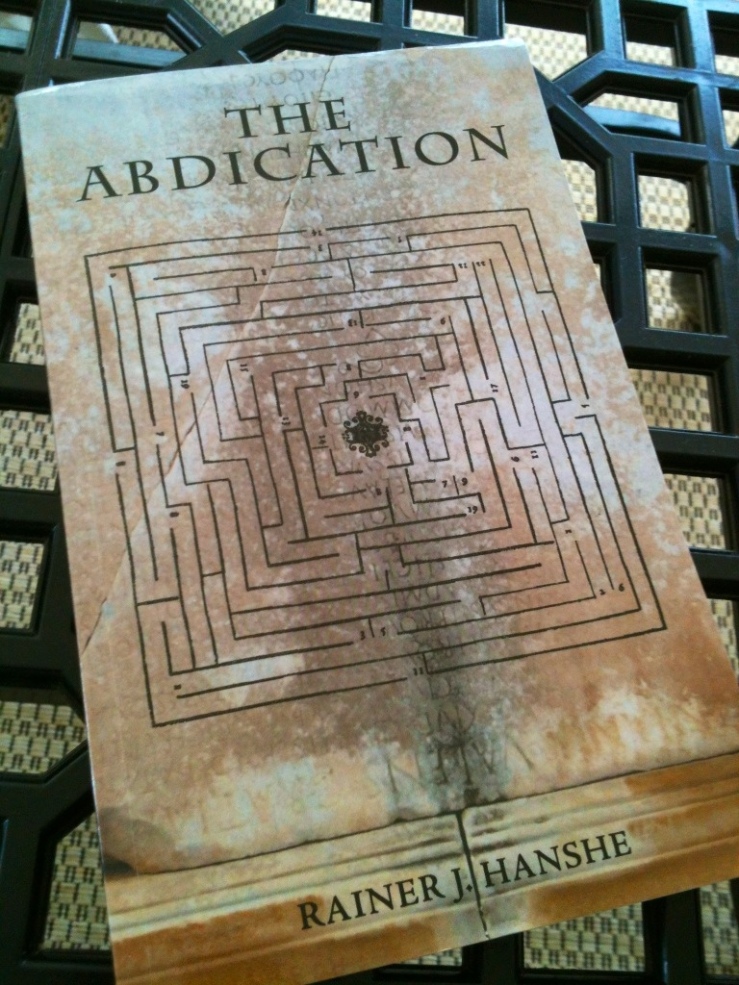
Rainer J. Hanshe’s The Abdication. Started this one the yesterday. Very weird, very cool. More thoughts to come, but here’s the blurb:

Spring 2032: an enigmatic bandleader named Triboulet arrives by helicopter in Rome, where his carnivalesque troupe awaits with a legion of animals and unruly kids. When provoking states of joyous panic through their ritualistic frenzies, the troupe’s arrival proves restorative, for the world is beset with famines, plagues, and religious conflicts, which Triboulet seeks to neutralize with freeing laughter. As he and his troupe begin constructing strange edifices in the Eternal City, sacred sites around the world suffer terrible, often beguiling forms of vandalism, and rumors abound that the Christ has actually finally returned.
Although radical Islamic sects claim responsibility for the vandalism, the culprits remain unknown: is it the Jihadists, anarcho-atheist intellectuals, or eco-terrorists? Religious and political authorities grow leery of the troupe and suspicious of Triboulet, whose true identity remains a mystery. The very future of the world is at stake, and while touring Israel during Christmas, Triboulet and his raucous band of pranksters bear witness to the world’s pivotal crossing into a new reality.
Albert Camus noted that ‘the metaphysics of the worst’ expresses itself in a literature of damnation and argued that ‘we have still not yet found the exit’ from such literature. With his second novel, Hanshe has found the way out, offering in fact something not only promising, but astounding, a pathway that is into a new reality, into a ‘physics of the best.’ The Abdication is a true ero(t)icomic epic.

Leo Tolstoy Reading — lya Repin