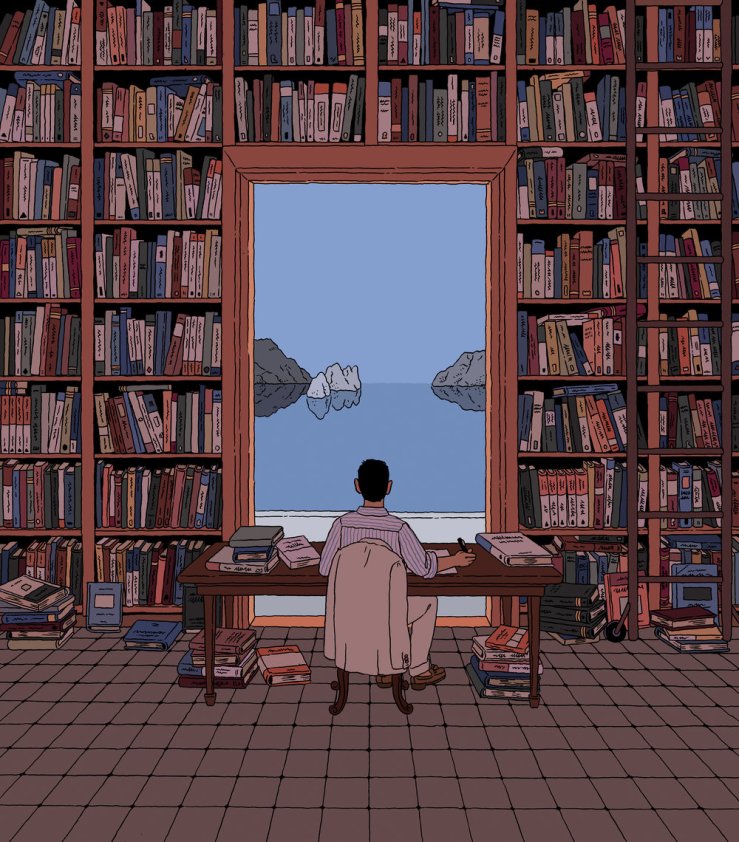
Dreaming in Umbria — William Bailey

684ff475173b350dc5c9c44382d85242

Dreaming in Umbria, 2015 by William Bailey (b. 1930)

I saw only one tower standing to the south, and that one ringed with fire | Denis Johnson

At the moment, I was heading anywhere at all for breakfast, but when I heard the desk clerk’s radio playing news that an aircraft, I assumed a sightseeing plane, had struck Tower Two of the World Trade Center, I decided to jump on the number 3 subway half a block west, and go have a look.

As I headed toward Eighth Avenue I tried calling Mark Ahearn about lunch, but my cellphone only hammered out a rapid-fire beep. Please don’t ask me how this can be true: I traveled through the busy lobby and walked for half a long block on a crowded Manhattan street and then boarded the World Trade Center subway completely unaware that I was participating in a citywide disaster, and moving toward its center.

The World Trade Center station came a few stops south of Twenty-Third Street, but we didn’t get there. After Christopher Street the train halted in the tunnel and waited, humming. It gave a screech, lurched backward slightly, and stopped again. Somehow the general news had infiltrated the sealed subterranean environment that something historically enormous was happening very nearby, and it got quiet in our compartment, and almost everybody entered into a small, desperate battle with a worthless cellphone. The train moved forward and gained speed, but began braking long before Houston Street, the next station, where it halted with several rear cars sticking out behind into the tunnel. For a tense minute, whoever spoke only whispered. Then came a shout—“Tell us what’s going on!” and others raised the same cry until we heard the conductor’s PA saying something about the tracks, the tracks…“Due to the catastrophe, this train will not go farther. Please exit out the forward cars onto the platform. Do not go onto the tracks.” We were all on our feet, maneuvering selfishly, angling for the doors. But the doors didn’t open. The engine stopped. “Open the doors! Open the doors!” The engine started. A man shouted, “Just everybody stand still!” People from the car behind had pried their way into ours, and somebody almost went down. A woman said, “Stop that, you fool!” A man in front of me pushed a teenage boy beside him. With the meat of his fist he began beating the back of the boy’s head. And I jumped into the fray, didn’t you, Harrington, like a monkey, yes you did, and got yourself an elbow in the eye. The doors to the compartment flew open and people clambered out onto the station’s platform, where a dreadlocked man in a crimson athletic suit jumped up and down on a bench as if it were a trampoline, screaming “God, see what we’re doing to each other down here.” When I came up into the street, dizzy and one-eyed, I couldn’t get my bearings. I saw only one tower standing to the south, and that one ringed with fire. I asked a man nearby—“Where are we? I can’t see the other tower.” He said, “It fell” and I said, “No it didn’t.” He didn’t argue. We stood in the middle of the street with thousands of other people, all of us motionless, like a frozen parade, all silent. I began to believe the man. We watched the flames spreading through the building’s upper stories over the course of about twenty minutes, and then the eighteen-hundred-foot structure seemed to curtsy and dip left, and then it went down.

I turned around and looked at the people behind me. I saw shocked laughter, weeping, horror, bewilderment. The young man next to me bawled at the top of his lungs. I was afraid to ask him if he had a loved one in the buildings afraid to talk to him at all, but he raised his agonized, Christly face to me and suddenly laughed, saying, “Buddy, you are working on one heck of a black eye.” We stood far from the buildings—at least a mile, I’d say—far enough that we didn’t feel the ground shake, and we heard nothing but sirens, and official-sounding voices screaming, “Get out of the street! Stay out of the street!” and others too—“They’re attacking the Capitol!—the Pentagon!—the White House!”

Cop cars and ambulances heaped with dust and chunks of concrete came at us out of the south. I started walking that direction, I don’t know why, but I soon realized I was the only person heading downtown, and then the tide of panic pressing toward me was too heavy to go against, and I turned around and let it take me north.

From Denis Johnson’s short story “Doppelgänger, Poltergeist.” Collected in  The Largesse of the Sea Maiden, 2017.


About the time the Spy and the Fanny sailed | Nathaniel Hawthorne’s journal entry for September 10th, 1852

September 10th.–Here is another beautiful morning, with the sun dimpling in the early sunshine. Four sail-boats are in sight, motionless on the sea, with the whiteness of their sails reflected in it. The heat-haze sleeps along the shore, though not so as quite to hide it, and there is the promise of another very warm day. As yet, however, the air is cool and refreshing. Around the island, there is the little ruffle of a breeze; but where the sail-boats are, a mile or more off, the sea is perfectly calm. The crickets sing, and I hear the chirping of birds besides.

At the base of the light-house yesterday, we saw the wings and feathers of a decayed little bird, and Mr. Thaxter said they often flew against the lantern with such force as to kill themselves, and that large quantities of them might be picked up. How came these little birds out of their nests at night? Why should they meet destruction from the radiance that proves the salvation of other beings?

Mr. Thaxter had once a man living with him who had seen “Old Bab,” the ghost. He met him between the hotel and the sea, and describes him as dressed in a sort of frock, and with a very dreadful countenance.

Two or three years ago, the crew of a wrecked vessel, a brigantine, wrecked near Boon Island, landed on Hog Island of a winter night, and found shelter in the hotel. It was from the eastward. There were six or seven men, with the mate and captain. It was midnight when they got ashore. The common sailors, as soon as they were physically comfortable, seemed to beperfectly at ease. The captain walked the floor, bemoaning himself for a silver watch which he had lost; the mate, being the only married man, talked about his Eunice. They all told their dreams of the preceding night, and saw in them prognostics of the misfortune.

There is now a breeze, the blue ruffle of which seems to reach almost across to the mainland, yet with streaks of calm; and, in one place, the glassy surface of a lake of calmness, amidst the surrounding commotion.

The wind, in the early morning, was from the west, and the aspect of the sky seemed to promise a warm and sunny day. But all at once, soon after breakfast, the wind shifted round to the eastward; and great volumes of fog, almost as dense as cannon-smoke, came sweeping from the eastern ocean, through the valley, and past the house. It soon covered the whole sea, and the whole island, beyond a verge of a few hundred yards. The chilliness was not so great as accompanies a change of wind on the mainland. We had been watching a large ship that was slowly making her way between us and the land towards Portsmouth. This was now hidden. The breeze is still very moderate; but the boat, moored near the shore, rides with a considerable motion, as if the sea were getting up.

Mr. Laighton says that the artist who adorned Trinity Church, in New York, with sculpture wanted some real wings from which to imitate the wings of cherubim. Mr. Thaxter carried him the wings of the white owl that winters here at the Shoals, together with those of some other bird; and the artist gave his cherubim the wings of an owl.

This morning there have been two boat-loads ofvisitors from Rye. They merely made a flying call, and took to their boats again,–a disagreeable and impertinent kind of people.

The Spy arrived before dinner, with several passengers. After dinner, came the Fanny, bringing, among other freight, a large basket of delicious pears to me, together with a note from Mr. B. B. Titcomb. He is certainly a man of excellent taste and admirable behavior. I sent a plateful of pears to the room of each guest now in the hotel, kept a dozen for myself, and gave the balance to Mr. Laighton.

The two Portsmouth young ladies returned in the Spy. I had grown accustomed to their presence, and rather liked them; one of them being gay and rather noisy, and the other quiet and gentle. As to new-comers, I feel rather a distaste to them; and so, I find, does Mr. Laighton,–a rather singular sentiment for a hotel-keeper to entertain towards his guests. However, he treats them very hospitably when once within his doors.

The sky is overcast, and, about the time the Spy and the Fanny sailed, there were a few drops of rain. The wind, at that time, was strong enough to raise white-caps to the eastward of the island, and there was good hope of a storm. Now, however, the wind has subsided, and the weather-seers know not what to forebode.

From Nathaniel Hawthorne’s journal entry for September 10th, 1852. From Passages from the American Note-Books.

Biblioklept turns twelve today, so here are twelve books I’ll try to read some time in the next twelve years

Biblioklept is twelve today.

Here are twelve books that I’ve never read before that I’ll try to read some time in the next twelve years.

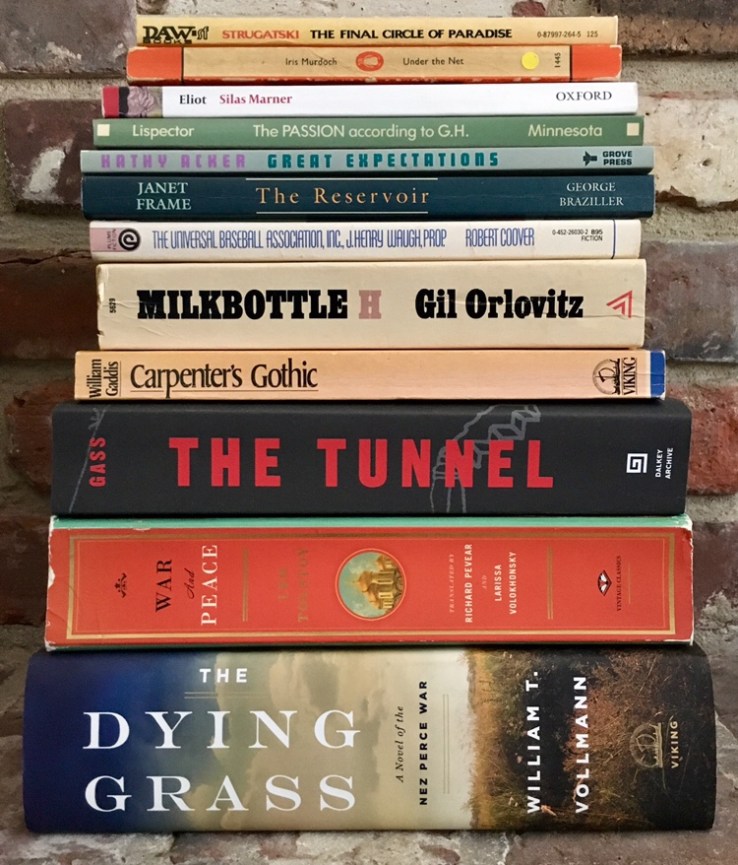
img_1014

From top to bottom, with no real hierarchy other than the physical heft involved in composing the photograph above—

The Final Circle of Paradise by Arkady and Boris Strugatsky (trans. by Leonid Renen)

I snatched up this Daw mass market paperback of this Strugatsky brothers novel a few years ago; they aren’t as easy to find as you might think (although Chicago Review Press is slowly reissuing new translations).

Chance I’ll get to it soon: High. I’ve been on a Strugatsky kick the last two years and this is one that I physically own, so.

The Net by Iris Murdoch

I picked up a slim Penguin edition of The Net when I couldn’t find The Bell (not realizing that the “Iris Murdoch” section extended in my used bookshop and that there were plenty of copies of The Bell). I loved The Bell, and want to read more Murdoch. Folks told me not to do The Net next, but I own it. So maybe let’s call it a placeholder.

Chance I’ll get to it soon: The chance that I get to another Murdoch novel sometime later this year is very high.

Silas Marner by George Eliot

I finally read Middlemarch in 2018. I loved it but good lord it was longSilas Marner is much shorter.

Chance I’ll get to it soon: Very high. It’s on deck after I finish up a few of the shorter novels and short story collections I’m reading now.

The Passion According to G.H. by Clarice Lispector (trans. by Ronald W. Sousa)

Like seemingly every book blogger, I went through a Lispector jag in the early part of this decade, gobbling up The Hour of the Star and Near to the Wild Heart. I had thought that I’d read The Passion According to G.H., but when I pulled it out earlier this year to look for something in it, I realized I hadn’t finished it—I probably hadn’t even gotten a third of the way through, if the idle bookmark (a charming doodle by my daughter) is any indication. Furthermore, the selection I was looking for, a passage on abjection, wasn’t even in Passion—it was in Wild Heart.

Chance I’ll get to it soon: Not extraordinarily high, but it’s unshelved, loose in the wilds now.

Great Expectations by Kathy Acker

I picked this one up a few weeks ago, and started in on it a bit—it’s short and has this kind of dark wild surreal icky sexy beach read vibe to it.

Chance I’ll get to it soon: I should’ve taken it camping with me next week. It’s the kind of book I want to read in a specific place that’s not, like, my couch or whatever. What I’m saying is that I’ll read this on the beach or in a tent or like, maybe you invite me down to stay at your place for a weekend but your house is so full of other guests, but, Guess what? There’s a wonderful little bedroom on your catamaran, which is docked gently right here. So after a night of good wine and good conversation, I’ll sneak off to the catamaran and read Kathy Acker before falling into wavy slumbers.

The Reservoir by Janet Frame 

I read the first few of the stories in The Reservoir a few years ago and loved them but then got absorbed in something else. I was looking for a story by her to use in class, and I pulled this collection out, but it wasn’t in there. I think it’s in The New Yorker though.

Chance I’ll get to it soon: Again–I pulled it out of rotation, so who knows? I’m in the midst of another short story collection (which is frankly turning into a hate read at this point), so maybe a few of these Frames will be an antidote to the Very Clever Author Whose Work I Keep Wincing At.

The Universal Baseball Association, Inc., J. Henry Waugh, Prop. by Robert Coover

When I picked up The Universal Baseball Association, I knew that I wasn’t going to read it anytime soon, but I also knew that I’d regret not having picked up a copy for three bucks when I had the chance. I was finishing up Going for a Beer, Coover’s recent collection of greatest hits, and was frankly exhausted with the man (the stories in A Night at the Movies can, uh, be repetitive).

Chance I’ll get to it soon: Not very high. I downloaded a copy of his novel The Origin of the Brunists one night on a lark and I don’t know if I’ll get to it any time soon either.

Milkbottle H by Gil Orlovitz

A somewhat rare cult novel with no real visible cult, Olrovitz’s Milkbottle H has been described as “the Ulysses of Philadelphia.” I found it a few weeks ago in the miscellaneous O section of my local used bookstore for three bucks. The book is long and seems to employ a mix of modernist techniques that makes it, uh, confusing at first.

Chance I’ll get to it soon: Not high. Right now it’s more like a thing I want to do, but it looks like a project that will require its own special time.

Carpenter’s Gothic by William Gaddis

I hate that I still haven’t gotten past page 30 of Carpenter’s Gothic. I gave it a second shot a few years ago and then wound up rereading J R instead.

Chance I’ll get to it soon: Should I prioritize this one after Silas Marner? I’m sure some new novel/review copy will get in the way, mucking things up…but should I commit to Carpenter’s Gothic? (I recently wrote about wanting to reread The Recognitions, so…).

The Tunnel by William H. Gass

I made a Serious Attempt earlier this year and stalled out.

Chance I’ll get to it soon: I will make a Serious Attempt earlier next year (and likely stall out).

War and Peace by Leo Tolstoy

War and Peace is one of those big books that I can’t believe I haven’t read. Earlier this year I said I’d give it a shot and then I never did (I tried The Tunnel and then settled into Middlemarch).

Chance I’ll get to it soon: Can anyone suggest a good audiobook version?

The Dying Grass by William H. Vollmann

The Dying Grass is almost 1,400 pages. I tried reading the ebook when it came out but the page breaks were weird (Vollmann has a Whitmanesque style on the page). I downloaded the audiobook which is 54 hours long, but I kept losing the thread. I picked up a used copy of the hardback for six bucks and it’s a goddamn monster.

Chance I’ll get to it soon: Try holding your breath.


Camus, Eliot, and Kuper’s Kafka (Books acquired, 31 Aug. 2018)

img_0894

I went to my favorite used bookshop on Friday afternoon to browse, order another Gerald Murnane novel, and pick up a copy of George Eliot’s Silas Marner.

I spied a late fifties mass market copy of Albert Camus’ novel Exile and the Kingdom from Vintage Books. I fell in love with the cover (by George Giusti) and ended up picking it up, although I’ll admit I haven’t read a Camus novel since college (it was The Plague if memory serves).

Browsing copies of Silas Marner, I found this monstrosity:

img_0892

I don’t even know where to start with this cover. I mean, even the colors seem to clash. It doesn’t really come across in the photo, but this hardback has a cheap greasy feel to it. I initially assumed that it was some kind of TV or film tie in, but as far as I can tell…no. Horrifying. I ended up going with the Oxford edition with Ferdinand Hodler’s painting Unemployed on the cover.

When I got home, the mail had come. It included a copy of Peter Kuper’s Kafkaesque, which collects 14 of Kuper’s illustrated Kafka translations. Publisher Norton’s blurb:

Award-winning graphic novelist Peter Kuper presents a mesmerizing interpretation of fourteen iconic Kafka short stories.

Long fascinated with the work of Franz Kafka, Peter Kuper began illustrating his stories in 1988. Initially drawn to the master’s dark humor, Kuper adapted the stories over the years to plumb their deeper truths. Kuper’s style deliberately evokes Lynd Ward and Frans Masereel, contemporaries of Kafka whose wordless novels captured much of the same claustrophobia and mania as Kafka’s tales. Working from new translations of the classic texts, Kuper has reimagined these iconic stories for the twenty-first century, using setting and perspective to comment on contemporary issues like civil rights and homelessness.

Longtime lovers of Kafka will appreciate Kuper’s innovative interpretations, while Kafka novices will discover a haunting introduction to some of the great writer’s most beguiling stories, including “A Hunger Artist,” “In The Penal Colony,” and “The Burrow.” Kafkaesque stands somewhere between adaptation and wholly original creation, going beyond a simple illustration of Kafka’s words to become a stunning work of art.

“Quite an original” (From Herman Melville’s novel The Confidence-Man)

“Quite an original:” A phrase, we fancy, rather oftener used by the young, or the unlearned, or the untraveled, than by the old, or the well-read, or the man who has made the grand tour. Certainly, the sense of originality exists at its highest in an infant, and probably at its lowest in him who has completed the circle of the sciences.

As for original characters in fiction, a grateful reader will, on meeting with one, keep the anniversary of that day. True, we sometimes hear of an author who, at one creation, produces some two or three score such characters; it may be possible. But they can hardly be original in the sense that Hamlet is, or Don Quixote, or Milton’s Satan. That is to say, they are not, in a thorough sense, original at all. They are novel, or singular, or striking, or captivating, or all four at once.

More likely, they are what are called odd characters; but for that, are no more original, than what is called an odd genius, in his way, is. But, if original, whence came they? Or where did the novelist pick them up?

Where does any novelist pick up any character? For the most part, in town, to be sure. Every great town is a kind of man-show, where the novelist goes for his stock, just as the agriculturist goes to the cattle-show for his. But in the one fair, new species of quadrupeds are hardly more rare, than in the other are new species of characters—that is, original ones. Their rarity may still the more appear from this, that, while characters, merely singular, imply but singular forms so to speak, original ones, truly so, imply original instincts.

In short, a due conception of what is to be held for this sort of personage in fiction would make him almost as much of a prodigy there, as in real history is a new law-giver, a revolutionizing philosopher, or the founder of a new religion.

In nearly all the original characters, loosely accounted such in works of invention, there is discernible something prevailingly local, or of the age; which circumstance, of itself, would seem to invalidate the claim, judged by the principles here suggested.

Furthermore, if we consider, what is popularly held to entitle characters in fiction to being deemed original, is but something personal—confined to itself. The character sheds not its characteristic on its surroundings, whereas, the original character, essentially such, is like a revolving Drummond light, raying away from itself all round it—everything is lit by it, everything starts up to it (mark how it is with Hamlet), so that, in certain minds, there follows upon the adequate conception of such a character, an effect, in its way, akin to that which in Genesis attends upon the beginning of things.

For much the same reason that there is but one planet to one orbit, so can there be but one such original character to one work of invention. Two would conflict to chaos. In this view, to say that there are more than one to a book, is good presumption there is none at all. But for new, singular, striking, odd, eccentric, and all sorts of entertaining and instructive characters, a good fiction may be full of them. To produce such characters, an author, beside other things, must have seen much, and seen through much: to produce but one original character, he must have had much luck.

There would seem but one point in common between this sort of phenomenon in fiction and all other sorts: it cannot be born in the author’s imagination—it being as true in literature as in zoology, that all life is from the egg.

From Herman Melville’s novel The Confidence-Man.

Some sentences on some books I’ve read or have been reading

img_0857

I finished Gerald Murnane’s 1982 novel The Plains last week. The Plains is quite short—it’s a novella really—and is divided into three parts. I read Part I in two sittings, gulping down the first-person narrator’s description of an Australia that exists in some alternate universe, where aristocratic plainsmen of Inner Australia keep grand houses populated by every kind of artisan. The novel’s first 70 pages or so move at a brisk pace, brimming with hints of a mythology that Murnane’s narrator keeps always just outside the frame. I read Parts II and III (much shorter than Part I) at a much slower pace. Murnane’s prose condenses here, his sentences tangling out into thick knots of consciousness. I’m still not sure what to make of the novel’s conclusion.

I’m absolutely crawling through Mario Benedetti’s The Truce (in English translation by Harry Morales). Subtitled The Diary of Martín Santomé, this Uruguayan novel is told in lucid prose. Santomé’s journal entries track his day to day life as a man with three children—the youngest approaching adulthood—who was widowed early in life. He’s just now started up a love affair with a younger colleague (an affair that he doesn’t want to call an affair and an affair which I think is like hey a very bad idea, Martin!). It reminds me a bit of John Williams’ novel Stoner. I’ve been reading one or two of the diary entries a day, usually in the morning before I leave for work. It’s a different way to read a book (at least for me anyway).

Herman Melville’s The Confidence-Man is my big re-read right now. I’m having a lot more fun with it the second time. I think the first time taught me how to read it. I’m moving pretty slowly but that’s fine.

I read most of Antoine Volodine’s Post-Exoticism in 10 Lessons, Lesson 11 in two sittings. I want to write a proper review of the novel, or novella, really, or really it’s something besides a novel or novella—anyway, I want to write a proper review on the thing, but I need to go back and finish his novel Minor Angels, which I started earlier in the summer but lost track of (I think I was trying to plow through the end of Eliot’s Middlemarch at the time).

I’ve read the first and third (but not the second) stories in Helen DeWitt’s new collection Some Trick and…I don’t know. There’s a part of me that doesn’t trust my reaction so far. I know that what she’s doing here would’ve flipped any wig I was wearing ten or twelve years ago, but I find myself not particularly persuaded to keep going. I skipped to the third story because it had a bunch of footnotes, a la DF Wallace and that intrigued me. It’s a bit clever, yes?

I’ve only read two of the stories in Tadao Tsuge’s collection of “alternative manga” (mostly from the sixties and seventies) Slum Wolf (in English translation by Ryan Holmberg), but there’s definitely a different flavor here—rough, weird, and a bit chilling. I hope to post a review of Slum Wolf at The Comics Journal next month.

Not pictured above because I read it on an iPad: The first two chapters of Anders Nilsen’s graphic novel Tongues, which is a loose retelling of the story of Prometheus and a few other myths (maybe). There’s a lot going on it. The art is gorgeous—a bit reminiscent of Geof Darrow, but more not as sprawly. Again, I hope to do a review at TCJ soon on these.

img_0635

Also not pictured because also an e-book: Provisional Biography of Mose Eakins, a two-act play by Evan Dara. You can download the play here without paying upfront: The site instead gives this somewhat cryptic message on payment: “If you please, reciprocation accepted only after reading. Thank you.” The message actually makes sense after you’ve read the play, which is very much about paying for language—literally utterances as commodities. Mose Eakins is “imparlent” — he cannot communicate with those around him. The play is often funny, but also very sad, and it’s impossible not to read it as an allegory for the limitations of real communication in the age of late capitalism. I read it all at once last night. Speaking of which, I need to reciprocate now.


What fictional character would Italo Calvino like to be?

Mercutio. Among his virtues, I admire above all his lightness in a world of brutality, his dreaming imagination – as the poet of Queen Mab – and at the same time his wisdom, as the voice of reason amid the fanatical hatreds of Capulets and Montagues. He sticks to the old code of chivalry at the price of his life, perhaps just the sake of style, and yet he is a modern man, skeptical and ironic – a Don Quixote who knows very well what dreams are and what reality is, and he lives both with open eyes.

From The New York Times 1985 obituary of Italo Calvino. The obituary is here citing an interview Calvino did with The New York Times Book Review in late 1984.

The Reader — Edouard Manet

25c32589douard2bmanet2bart2b25281092529

The Reader, 1861 by Edouard Manet (1832-1883)

Read “The Policemen’s Ball,” a short story by Donald Barthelme

“The Policemen’s Ball”

by

Donald Barthelme


Horace, a policeman, was making Rock Cornish Game Hens for a special supper. The Game Hens are frozen solid, Horace thought. He was wearing his blue uniform pants.

Inside the Game Hens were the giblets in a plastic bag. Using his needlenose pliers Horace extracted the frozen giblets from the interior of the birds. Tonight is the night of the Policemen’s Ball, Horace thought. We will dance the night away. But first, these Game Hens must go into a three-hundred-and-fifty-degree oven.

Horace shined his black dress shoes. Would Margot “put out” tonight? On this night of nights? Well, if she didn’t– Horace regarded the necks of the birds which had been torn asunder by the pliers. No, he reflected, that is not a proper thought. Because I am a member of the force. I must try to keep my hatred under control. I must try to be an example for the rest of the people. Because if they can’t trust us. . .the blue men. . .

In the dark, outside the Policemen’s Ball, the horrors waited for Horace and Margot.

Margot was alone. Her roommates were in Provincetown for the weekend. She put pearl-colored lacquer on her nails to match the pearl of her new-bought gown. Police colonels and generals will be there, she thought. The Pendragon of the Police himself. Whirling past the dais, I will glance upward. The pearl of my eyes meeting the steel gray of high rank.

Margot got into a cab and went over to Horace’s place. The cabdriver was thinking: A nice-looking piece. I could love her.

Horace removed the birds from the oven. He slipped little gold frills, which has been included in the package, over the ends of the drumsticks. Then he uncorked the wine, thinking: This is a town without pity, this town. For those whose voices lack the crack of authority. Luckily the uniform. . . Why won’t she surrender her person? Does she think she can resist the force? The force of the force?

“These birds are delicious.”

Driving Horace and Margot smoothly to the Armory, the new cabdriver thought about basketball.

Why do they always applaud the man who makes the shot?

Why don’t they applaud the ball?

It’s the ball that actually goes into the net.

The man doesn’t go into the net.

Never have I seen a man going into the net.

Twenty thousand policemen of all grades attended the annual fete. The scene was Camelot, with gay colors and burgees. The interior of the Armory had been roofed with lavish tenting. Police colonels and generals looked down on the dark uniforms, white gloves, silvery ball gowns.

“Tonight?”

“Horace, not now. This scene is so brilliant. I want to remember it.”

Horace thought: It? Not me?

The Pendragon spoke. “I ask you to be reasonable with the citizens. They pay our salaries after all. I know they are difficult sometimes, obtuse sometimes, even criminal sometimes, as we often run across in our line of work. But I ask you despite all to be reasonable. I know it is hard. I know it is not easy. I know that for instance when you see a big car, a ’70 Biscayne hardtop, cutting around a corner at a pretty fair clip, with three in the front and three in the back, and they are all mixed up, ages and sexes and colors, your natural impulse is to– I know your first thought is, All those people! Together! And your second thought is, Force! But I must ask you in the name of force itself to be restrained. For force, that great principle, is most honored in the breach and the observance. And that is where you men are, in the breach. You are fine men, the finest. You are Americans. So for the sake of America, be careful. Be reasonable. Be slow. In the name of the Father and the Son and of the Holy Ghost. And now I would like to introduce Vercingetorix, leader of the firemen, who brings us a few words of congratulation from that fine body of men.”

Waves of applause for the Pendragon filled the tented area.

“He is a handsome older man,” Margot said.

“He was born in a Western state and advanced to his present position through raw merit,” Horace told her.

The government of Czechoslovakia sent observers to the Policemen’s Ball. “Our police are not enough happy,” Colonel-General Cepicky explained. “We seek ways to improve them. This is a way. It may not be the best of all possible ways, but. . . Also I like to drink the official whiskey! It makes me gay!”

A bartender thought: Who is that yellow-haired girl in the pearl costume? She is stacked.

The mood of the Ball changed. The dancing was more serious now. Margot’s eyes sparkled from the jorums of champagne she had drunk. She felt Horace’s delicately Game Hen-flavored breath on her cheek. I will give him what he wants, she decided. Tonight. His heroism deserves it. He stands between us and them. He represents what is best in society: decency, order, safety, strength, sirens, smoke. No, he does not represent smoke. Great billowing oily black clouds. That Vercingetorix has a noble look. With whom is Vercingetorix dancing, at present?

The horrors waited outside patiently. Even policemen, the horrors thought. We get even policemen, in the end.

In Horace’s apartment, a gold frill was placed on a pearl toe.

The horrors had moved outside Horace’s apartment. Not even policemen and their ladies are safe, the horrors thought. No one is safe. Safety does not exist. Ha ha ha ha ha ha ha ha ha ha!

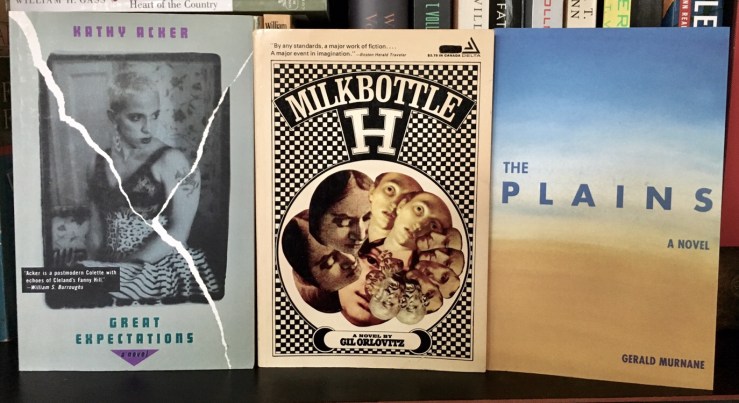
Novels by Acker, Orlovitz, and Murnane (Books acquired 1 and 6 Aug. 2018)

img_0786-1

I went by my favorite used bookshop to purge a bunch of books I’ll never read again and order Gerald Murane’s 1982 novel The Plains. I had finished most of Murnane’s collection Stream System, leaving only the longest story in the collection (“Velvet Waters”) unread.

I browsed the store a bit too, of course, and found a used copy of Kathy Acker’s Great Expectations, which I’ve never read. Years ago, this particular book store had almost every Acker book used and I didn’t pick any up, which I’ve regretted for awhile. So.

I also picked up Gil Orlovitz’s 1967 novel Milkbottle H, which I’d never heard of until I saw @PierreMenard tweet about it last month—

The book is 500+ pages. I found the first 10 utterly bewildering. You can read more about Milkbottle H here.

My copy of The Plains came in a few days later so my son and I went and picked it up (he got an Asterix comic). I read Part I this week and really got a strange thrill out of it. The Plains is a kind of speculative fiction with mythological touches. The slim novel reimagines an Australia the plainsmen of the interior define themselves (aesthetically, above all else) against the coastal areas of “Outer Australia.” The narrator is a (would-be) film director who wants to a make a movie called The Interior that will capture the essence of the plains (a task that is plainly impossible). The Plains is a very strange and I’m really digging it so far.

A Library by the Tyrrhenian Sea — Ilya Milstein

finalcopy

A Library by the Tyrrhenian Sea, 2018 by Ilya Milstein

Seven (Long) Books I’ll Read Again

img_0775

Life is too short not to reread. Chosen somewhat randomly but also sincerely, seven books I’d love to read again sometime soon:

Mason & Dixon by Thomas Pynchon

I read Mason & Dixon a few years back and then started to immediately reread it before getting sidetracked with something else. Unlike Gravity’s Rainbow, I think that M&D coheres on a first read, but it’s so rich and full and crammed with life that it deserves another go through. In my completely subjective and thoroughly unnecessary ranking of Pynchon’s novels, I wrote,

Pynchon’s zany/sinister tonal axis, comic bravado, and genre-shifting modes rarely result in what folks narrowly think of as literary realism. His characters can be elastic, cartoonish even—allegorical sometimes (and even grotesque). Mason & Dixon takes two historically real (and historically famous) characters as its subject, and, in a wonderfully hyperbolic 18th-century style, takes the duo on a fantastic journey to measure the world. How does one measure the world though? Pynchon takes on seemingly every subject under the sun in Mason & Dixon, and the novel is very much about the problems and limitations of measuring (and describing, and knowing) itself. But what comes through most strongly in all of Pynchon’s fantasia is the weight of Mason and Dixon’s friendship. It’s the most real thing in a wonderfully unreal novel.

The Complete Stories by Flannery O’Connor

A bit of a cheat maybe to put short stories on this list, but I’d love to set aside time to go through all of them at once.

Middlemarch by George Eliot

I finished Middlemarch last month. Eliot’s novel captures consciousness in action in a remarkably deft, often ironic, but also very sweet way—particularly the consciousness of her hero Dorothea Brooke, who is one of my favorite characters in literature. I wrote about Dorothea in a post earlier this year:

So far, my favorite character in Middlemarch is Dorothea Brooke. In part my allegiance to her is simply a matter of the fact that she initially appears to be the novel’s central character—until Eliot swerves into new narratives near the end of Book I (Book I of VIII, by the way). But beyond traditional formal sympathies, it’s the way that Eliot harnesses Dorothea’s consciousness that I find so appealing. Eliot gives us in Dorothea an incredibly intelligent yet palpably naive young woman who feels the world around her a smidge too intensely. Dorothea is brilliant but a bit blind, and so far Middlemarch most interests me in the way that Eliot evokes this heroine’s life as a series of intellectual, emotional, and aesthetic revelations. We see Dorothea seeing—and then, most remarkably, we see Dorothea seeing what she could not previously see.

The Lost Scrapbook by Evan Dara

I read Dara’s cult debut in a dizzy rush about five years ago, and have meant to reread it again since then. Like Middlemarch, Dara’s novel is very much about consciousness and how consciousness operates. From a blog post a few years back:

I am really loving this book so far, this novel that moves through consciousnesses in a (yes, I’ll use that cliché that book reviewers so often grab for) dazzling performance, shifting through minds, monologues, dialogues, always a few steps (or more) ahead of its reader, beckoning though, inviting, calling its reader to participate in discussions (or performances) of art, science, politics, psychology, education, loneliness, ecology, family, fireflies, radio plays, alienation, voting trends, Chomskyian linguistics, Eisensteinian montage, theft, Walkman Personal Stereos, semiotics, one-man shows, drum sets, being ventriloquized—a novel that takes ventriloquism as not just a theme (as we can see in the citation above) but also as a rhetorical device, a novel that ventriloquizes its reader, throws its reader into a metaphorical deep end and then dramatically shifts the currents as soon as the reader has learned to swim, a novel of othernesses, a novel that offers content through conduits, patterns that coalesce through waves, a novel composed in transfer points, each transfer point announcing the limitations of first-person perspective, the perspective that the reader is logically and spiritually and psychologically beholden to—and then, perhaps, transcending (or at least producing the affective illusion of transcendence of) first-person perspective, and this (illusion of) transcendence, oh my, what a gift, what a gift . . .

The Recognitions by William Gaddis

I had a false start with The Recognitions maybe 10 years ago, and then made it through a few years after that. I’ve since read Gaddis’s novel J R twice, and I think it’s the superior novel—but I’d like to revisit The Recognitions to see how accurate that assessment is. In my review I wrote:

The Recognitions is the work of a young man (“I think first it was that towering kind of confidence of being quite young, that one can do anything,” Gaddis says in his Paris Review interview), and often the novel reveals a cockiness, a self-assurance that tips over into didactic essaying or a sharpness toward its subjects that neglects to account for any kind of humanity behind what Gaddis attacks. The Recognitions likes to remind you that its erudition is likely beyond yours, that it’s smarter than you, even as it scathingly satirizes this position.

I think that JR, a more mature work, does a finer job in its critique of contemporary America, or at least in its characterization of contemporary Americans (I find more spirit or authentic humanity in Bast and Gibbs and JR than in Otto or Wyatt or Stanley). This is not meant to be a knock on The Recognitions; I just found JR more balanced and less showy; it seems to me to be the work of an author at the height of his powers, if you’ll forgive the cliché.

2666 by Roberto Bolaño

Bolaño’s opus is the kind of literary masterpiece that survives they hype that surrounds it. I’ve read it straight through three times and will read it through three more given the chance. I’ve written at least seven “reviews” of 2666 on this site, but this one on the novel’s intertextual structure is probably my best effort.

Moby-Dick by Herman Melville

Moby-Dick forever!

Seven Books I’ll Never Read

  1. A General History of Labyrinths by Silas Haslam
  2. Things That Can Happen In European Politics by Ernest Pudding
  3. The Leather Mask by Benno von Archimboldi
  4. The Grasshopper Lies Heavy by Hawthorne Abendsen
  5. Old Custer by Eli Cash
  6. Outside the Town of Malbork by Tazio Bazakbal
  7. Encounter with the Infanta by Bogdan Tarassiev

Helen DeWitt’s Some Trick (Book acquired 27 July 2018)

img_0767

I spent a week in Charleston, SC at the end of July. The city’s veneer of “historical charm” doesn’t quite cover over a past that it recognizes but seems not wholly reconciled to, but the grits were very good.

img_0503-1

I visited Blue Bicycle Books while I was there, where I was allowed to fondle a signed Faulkner with my unwashed hands. I picked up Helen DeWitt’s Some Trick in hardback there, despite not really liking Lightning Rods. I would’ve picked up her cult novel The Last Samurai instead, but they didn’t have it—and anyway, I’ve been reading mostly short stories and short novels (Murnane, Volodine, Melville) since getting through Eliot’s big fat novel Middlemarch last month.

Here’s publisher New Direction’s blurb—

For sheer unpredictable brilliance, Gogol may come to mind, but no author alive today takes a reader as far as Helen DeWitt into the funniest, most yonder dimensions of possibility. Her jumping-off points might be statistics, romance, the art world’s piranha tank, games of chance and games of skill, the travails of publishing, or success. “Look,” a character begins to explain, laying out some gambit reasonably enough, even if facing a world of boomeranging counterfactuals, situations spinning out to their utmost logical extremes, and Rube Goldberg-like moving parts, where things prove “more complicated than they had first appeared” and “at 3 a.m. the circumstances seem to attenuate.” In various ways, each tale carries DeWitt’s signature poker-face lament regarding the near-impossibility of the life of the mind when one is made to pay to have the time for it, in a world so sadly “taken up with all sorts of paraphernalia superfluous, not to say impedimental, to ratiocination.”

Biblioklept on Instagram

I made an Instagram account for Biblioklept. (The handle is @bibliokleptogram — somebody already snagged “Biblioklept”).

The content for Biblokleptogram is not the same as the blog’s content (although the feed is integrated into the blog—it’s down on the bottom right).

Most of the time I’ll post photographs of book covers, poems, prose, etc. My only “rule” is that I’ll only post photographs I’ve taken myself. I don’t plan on using Instagram to write.

This is the first post from the account, a poem by Roberto Bolaño:

View this post on Instagram

Nothing can happen here and yet here I am.

A post shared by biblioklept (@bibliokleptogram) on

And here is a post from yesterday, which happened to be Herman Melville’s 199th birthday:

Selections from One-Star Amazon Reviews of Melville’s Moby-Dick

[Ed. note: The following citations come from one-star Amazon reviews of Herman Melville’s novel Moby-Dick. To be very clear, I think Moby-Dick is fantasticbut I also enjoy seeing what people compelled to write negative reviews of the book on Amazon had to say. What follows are selections of one-star Amazon reviews; I’ve preserved the reviewers’ unique styles of punctuation and spelling].


Yechh.

It made for a smashing movie.

If you want to read lots of meaningless whale trivia read the book.

Boy gets whale. Boy loses whale. Boy gets whale. Spawns yawns

I think if you made it into a short comic strip, you would have liked it.

I bought this book for a friend in jail. Alas, he was unable to read it because the font was too small.

Ray Bradbury, who wrote the screenplay for this novel, (a la Gregory Peck) couldn’t even finish the damn thing!

If you like a story with nonessential information and an author that is entirely to verbose, then this book is for you.

I am quite the fan of stories which involve man eating sea creatures, such as Jaws. Moby Dick is nothing compared to such classics, I fear.

Throughout the book, you may read one chapter with some action only to be followed by 5 or 6 chapters of tangents that are not necessary to understand the story.

Moby Dick, was a horrible waiste of time. Along with its wordy paragraphs, it also talked about uninteresting issues. It is also to long, and you don’t hear of them encountering the whale until the end of the book.

The only people who like this book are english teachers who derive a feeling of moral superiority from forcing others to read this incredibly bad novel.

First of all, classiflying it as fiction is a mistake. Probably a good 60% of the book is non-fiction – chapter after chapter dedicated to every imaginable detail of the biology of the whale and every imaginable nuance of whaling.

I love literatur just as much as the next guy but we must face it 100 years or so ago American literature was reall weak and lagging from the rest of the world, perhaps now they’re starting to catch up with writers like Ann Rice and them.

I have seen better writing in a Hallmark card! Boring! Give me a good ole copy of Elvis and Me! A true story that really tugs at your heart strings! I sleep with that one under my pillow! Keep Moby Dick away from my bed!

Those chapters about Ishmael sleeping with whatever his name was and Ishamel had such a good time with the other guy’s arm over him and leg over him that he didn’t know if he was straight or gay any more.

i personally didn’t enjoy the philosophical or deep side of the book, i have read much much better books in that regard.

There is no suspense, and I find the idea of people hunting whales offensive. Offensive with a capital O.

Honestly, Over 400 pages devoted to killing a whale because it ate your hand? Come on.

It is hard to read. like work. Doubt he could get published today.

What is the whales motivation? You dont know.

It is 540somepages of boring whaling details.

No wonder Melville flopped as a writter.

OMG, this is tedious and torture to read.

I HATE this book. Why? It’s BORING!

Moby Ick’s more like it.