A year in reading | Annotations on a probably incomplete list of books I read or reread in full in 2018

img_2002

Boring preamble you’ll likely skim if not outright skip:

I was never going to get a full year end list thing together. Yesterday I put together a list of books I read in full this year, or at least books I remember reading in full. In full and books are terms that should be placed under suspicion. For example, it took me far longer to get eighty pages into William H. Gass’s The Tunnel—a novel I soon after abandoned—than it did to read Robert Coover’s micronovella The Enchanted Prince or Dave Cooper’s graphic novel Mudbite. Etc. As usual I abandoned more novels than I finished, and read more short stories than I could or should bother listing.


Annotations on a probably incomplete list of books I read or reread in full in 2018:

Barracoon by Zora Neale Hurston (2018)

A sad and important book, too long unpublished. I reviewed it here.

Conversations with Gordon Lish edited by David Winters and Jason Lucarelli (2018)

One of the best things I read in 2018. Lish performing Lish throughout the end of the twentieth century and the beginning of the twenty-first. As good, if not better, than his short fiction.

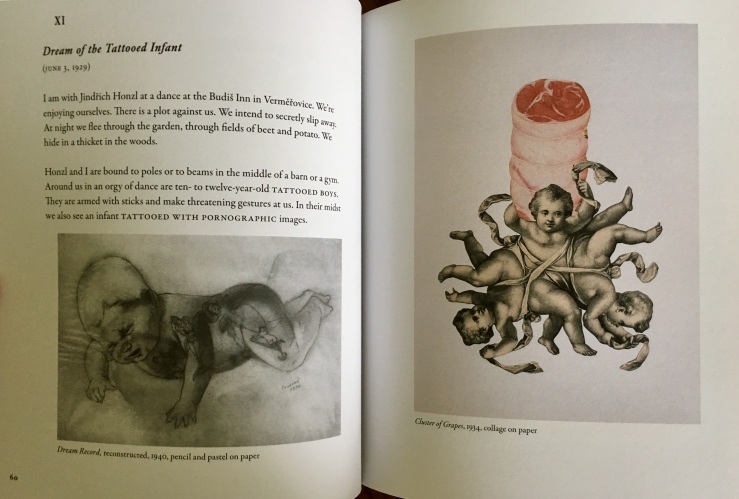
Dreamverse by Jindřich Štyrský (2018 English translation by Jed Slast; original Czech-language publication in 1970)

Abject horny surrealist art and poetry. I wrote about it here.

The Enchanted Prince by Robert Coover (2018)

Going for a Beer: Selected Short Fictions by Robert Coover (2018)

The Enchanted Prince is a quick read, and wouldn’t be out of place in an extended edition of Going for a Beer. I failed to write about Going for a Beer, after mucking around with several drafts. I had a big thing on “The Babysitter” that I was working on—it being a perfect nexus of horror and comedy, a writhing, icky pop opera of channel changing. I kept thinking of “The Babysitter” during the Brett Kavanaugh hearing, and managed to write absolutely nothing in my disgust. Going for a Beer is a perfect starting place for Coover, although some of the moves in it grow tiresome. The metamagician takes us aside a bit too often to show us how he did the trick, only to tell us that his showing us how he did the trick was actually the trick itself.

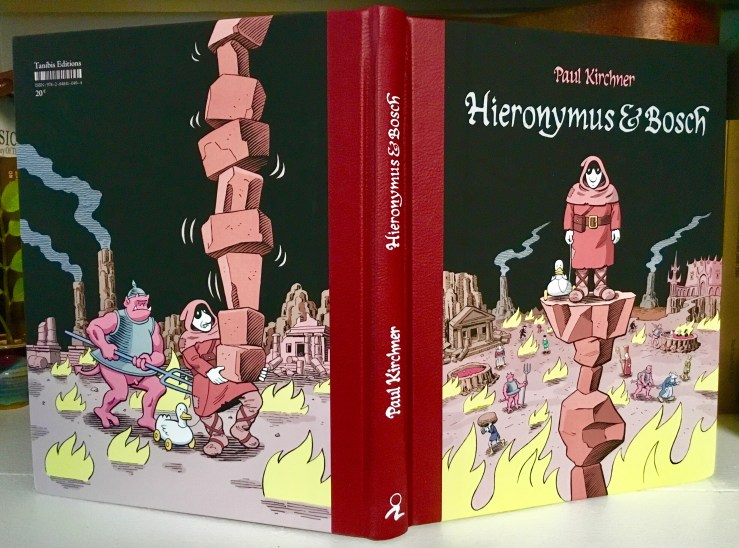
Hieronymus & Bosch by Paul Kirchner (2018)

The Labyrinth by Saul Steinberg (2018; originally published in 1960)

Both wonderful “graphic novels,” or not really “novels,” but something else. I should have reviews of these posted at The Comics Journal in early 2019.

The Largesse of the Sea Maiden by Denis Johnson (2018)

A perfect farewell to Johnson. I read it twice, and wrote about the title story,  second story, “The Starlight on Idaho,” and the third,“Strangler Bob.”

Letter to the Author of the Letter to the Father by Tristan Foster (2018)

Great stuff. I finished a bigass novel yesterday so now I can reread Foster’s strange fictions and write a proper review.

Moderan by David R. Bunch (2018; originally published in incomplete form in 1971)

I’ll admit I’d never heard of Bunch’s dystopian cult Moderan stories until NYRB reprinted them in a complete volume this year. Moderan works as a post-nuke dystopian satire on toxic masculinity. The tropes here might seem familiar—cyborgs and dome homes, caste systems and ultraviolence, a world of made and not born ruled by manunkind (to steal from E.E. Cummings)—it’s the way that Bunch conveys this world that is so astounding. Moderan is told in its own idiom; the voice of our narrator Stronghold-10 booms with a bravado that’s ultimately undercut by the authorial irony that lurks under its surface. The book seems equal to the task of satirizing the trajectory of our zeitgeist in a way that some contemporary satirists have failed to.

Mudbite by Dave Cooper (2018)

Lurid, abject, horny, gross. I dug it. I reviewed it at The Comics Journal.

Narcotics by Stanisław Ignacy Witkiewicz (2018 English translation by Soren Gauger)

Another oddball from the good folks at Twisted Spoon Press. I reviewed it here.

On Doing Nothing by Roman Muradov (2018)

Muradov’s riffs on literature, art, and philosophy to add to the American tradition of leaning and loafing at one’s ease, observing a summer spear of etc.

Provisional Biography of Mose Eakins by Evan Dara (2018)

An overlooked work by an overlooked writer, Provisional Biography isn’t quite as persuasive as its predecessor, Flee, but it’s nevertheless a strong argument for communication in/against the age of late capitalism. I reviewed it here.

Slum Wolf by Tadao Tsuge (2018 English translation by Ryan Holmberg)

This collection of “alternative manga” (from The New York Review of Books’ NYRC imprint) showcases nine rough and seedy stories focused on the kimin, the “abandoned people” who live on the margins of Japanese society. Under Tsuge’s mean humor is a diamond-sharp kernel of pathos for all humanity, rendered in spare, even rushed art. Tsuge draws as if his ink and paper might be snatched away at any moment by some civilizing agent who would keep his slum wolves away from respectable eyes. His world isn’t pretty but it is somehow beautiful.

The Snail on the Slope by Arkady and Boris Strugatsky (2018 English translation by Olena Bormashenko; original Russian-language translation, 1972)

An impossibly strange book, an utter revelation, just so astoundingly weird. I wrote about it here.

Stream System by Gerald Murnane (2018)

Murnane made a dent into an American mainstream audience this year with Stream System (complete with a fascinating feature in The New York Times). The early stories are particularly affecting. I wrote about one here.

Pond by Claire-Louise Bennett (2015)

Pond was one of the best things I read this year. I wrote about it here.

The Truce by Mario Benedetti (2015 English translation by Harry Morales; original Spanish-language publication, 1960)

Benedetti’s The Truce is good old fashioned mannered modernism. I couldn’t really get into it, although the novel’s voice is authentic. It reminded me of Williams’ Stoner a bit.

Post-Exoticism in Ten Lessons, Lesson Eleven by Antoine Volodine (2015 English translation by J. T. Mahany; original French-language publication, 1998)

Definitely Maybe by Arkady and Boris Strugatsky (2014 English translation by Antonina Bouis; original Russian-language translation, 1974)

Writers by Antoine Volodine (2014 English translation by Katrina Rogers; original French-language publication, 2010)

Minor Angels by Antoine Volodine (2008 English translation by Jordan Stump; original French-language publication, 2004)

I’ve arranged this list by year, and the Volodines are almost grouped together, with the Strugatskys interposing. Definitely Maybe is okay but not excellent—it’s a fun and ultimately tense read, evocative of hot drunken times and philosophical murders.

Antoine Volodine wrote some of the best stuff I read this year. Post-Exoticism or Writers would make excellent starting places for anyone interested in his grim, stark (and often unexpectedly funny) world. I wrote about Writers here and here.

The Last Samurai by Helen DeWitt (2000)

I didn’t really like Lightning Rods and I wished I hadn’t paid twenty bucks for Some Trick in hardback, but enough people I respect have been telling me (directly and indirectly) to read DeWitt’s cult novel debut that I didn’t hesitate to pick up a copy when I found it used in my favorite bookshop. I read The Last Samurai faster than any book I can remember. For a book often described as “experimental” or “formally challenging” it’s extraordinarily accessible and very “readable.” DeWitt’s rhetoric teaches the reader how to read the book; she creates a formula, essentially (Lighting Rods did the same, come to think of it). The Last Samurai has moments that are as transcendent as any of the other great books I read this year, but I’m not sure that it adds up to more than the sum of its parts. I enjoyed the reading experience though.

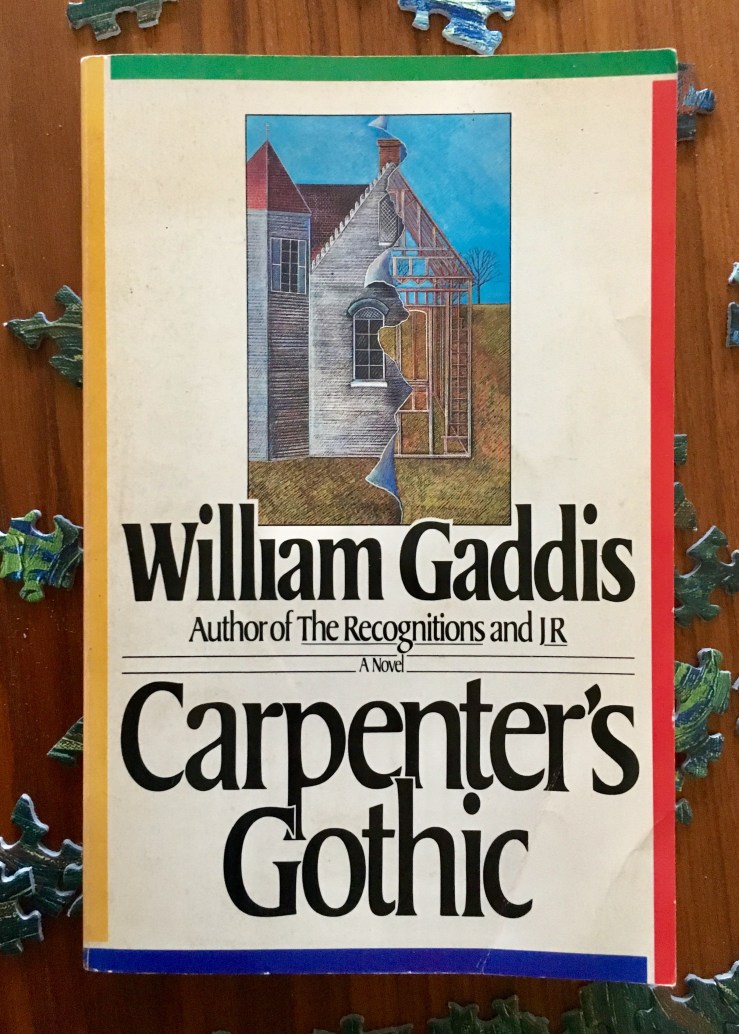
Carpenter’s Gothic by William Gaddis (1985)

I had never read Carpenter’s Gothic until this year (I still need to read A Frolic of His Own). I reread The Recognitions, and while its certainly a richer, denser, and frankly more overwhelming work, it isn’t as formally neat as Carpenter’s Gothic, which I think is ultimately the better book. I wrote about it here, here, and here.

The Names by Don DeLillo (1982)

Only a few fragments stick with me now—the end in particular—but also, the general impression that Don DeLillo wrote the first post-9/11 novel way back in 1982. I wrote about it here.

The Plains by Gerald Murnane (1982)

The first fifty or so pages of The Plains was as good as anything I read this year. I felt like I was hungry for more at the end though, but good authors sometimes leave us unsatisfied.

77 Dream Songs by John Berryman (1964)

I needed these.

The Bell by Iris Murdoch (1958)

This book has some excellent sentences, and Dora Greenfield is one of the more memorable characters I read this year. The Bell also prompted me to reread Hawthorne’s The Blithedale Romance, and I’m thankful to it for that. My first Murdoch. I’ll read more of hers in 2019. I wrote about The Bell here.

The Recognitions by William Gaddis (1955)

Reread the thing in tandem with an audiobook recording; the audiobook is pretty good, but mostly useful in the sense that it allows you to reread (or first read) as you go through. I think The Recognitions can’t be read—it can only be reread. I wrote about it here and here and here and here and here.

Middlemarch by George Eliot (1871)

A reading highlight of 2018. Dorothea Brooke is the most memorable character of my 2018 reading. I wrote about Middlemarch here and here.

Silas Marner by George Eliot (1861)

I liked this one a lot. I reviewed it here.

The Confidence-Man by Herman Melville (1857)

Benito Cereno by Herman Melville (1855)

The Confidence-Man remains a novel that I think I won’t ever fully “get.” Rereading it this year it seemed as puzzling as ever. We’ll see what happens when I read it again. Benito Cereno might have been my favorite reread of 2018; I wrote a long thing on it here. 2019 seems like a good year to go through Moby-Dick again.

The Blithedale Romance by Nathaniel Hawthorne (1852)

Another really enjoyable reread, with correspondences to Middlemarch and The Bell. I wrote a lot about Blithedale, including this post.
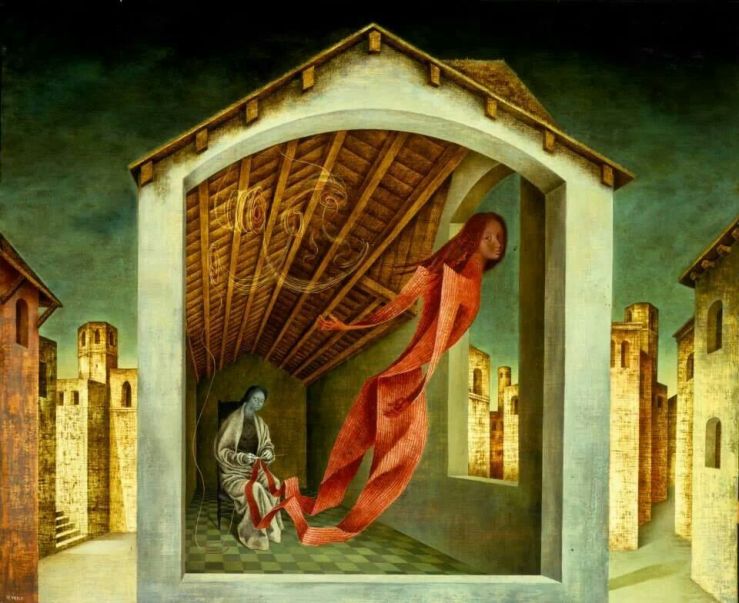


What is happening here is obvious: that lady who is knitting fisherman’s rib is making animated characters who leave through the window.

1626b8e5d94a5f4016cb8a169ae53428

What is happening here is obvious: that lady who is knitting fisherman’s rib is making animated characters who leave through the window.

Remedios Varo’s description of her painting The Knitting Woman of Verona (1956). From the collection Letters, Dreams & Other Writings. Translated by Margaret Carson. From Wakefield Press.

A Mason & Dixon Christmastide (Thomas Pynchon)

They discharge the Hands and leave off for the Winter. At Christmastide, the Tavern down the Road from Harlands’ opens its doors, and soon ev’ryone has come inside. Candles beam ev’rywhere. The Surveyors, knowing this year they’ll soon again be heading off in different Directions into America, stand nodding at each other across a Punch-bowl as big as a Bathing-Tub. The Punch is a secret Receipt of the Landlord, including but not limited to peach brandy, locally distill’d Whiskey, and milk. A raft of long Icicles broken from the Eaves floats upon the pale contents of the great rustick Monteith. Everyone’s been exchanging gifts. Somewhere in the coming and going one of the Children is learning to play a metal whistle. Best gowns rustle along the board walls. Adults hold Babies aloft, exclaiming, “The little Sausage!” and pretending to eat them. There are popp’d Corn, green Tomato Mince Pies, pickl’d Oysters, Chestnut Soup, and Kidney Pudding. Mason gives Dixon a Hat, with a metallick Aqua Feather, which Dixon is wearing. Dixon gives Mason a Claret Jug of silver, crafted in Philadelphia. There are Conestoga Cigars for Mr. Harland and a Length of contraband Osnabrigs for Mrs. H. The Children get Sweets from a Philadelphia English-shop, both adults being drawn into prolong’d Negotiations with their Juniors, as to who shall have which of. Mrs. Harland comes over to embrace both Surveyors at once. “Thanks for simmering down this Year. I know it ain’t easy.”
“What a year, Lass,” sighs Dixon.
“Poh. Like eating a Bun,” declares Mason.”

The last paragraphs of Ch. 52 of Thomas Pynchon’s novel Mason & Dixon.

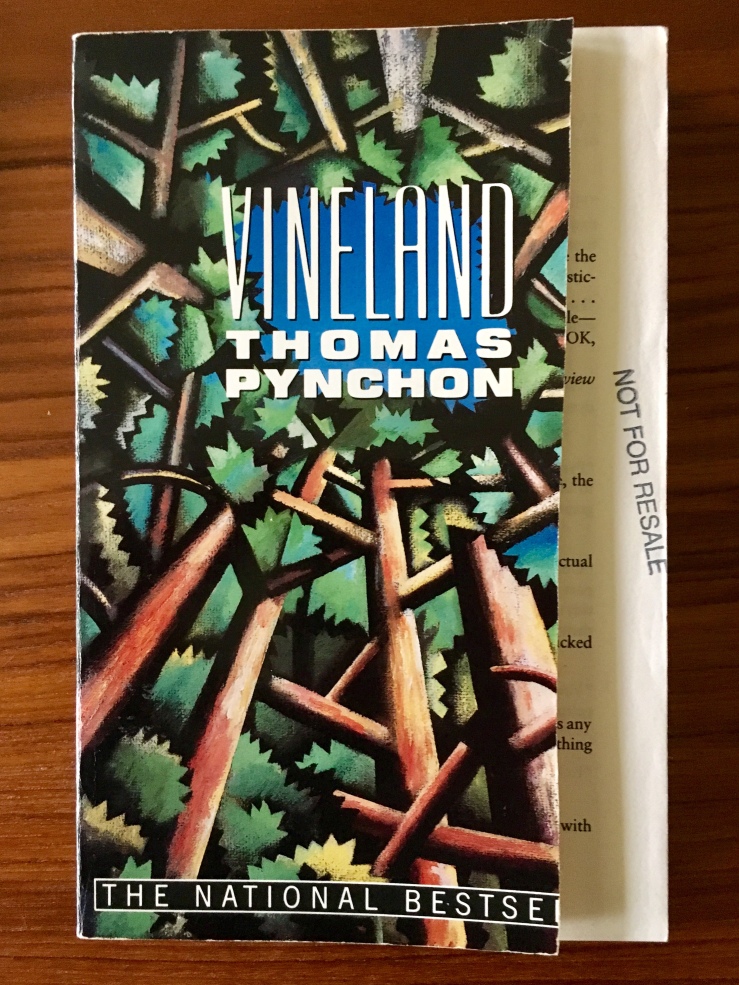
(Another copy of) Thomas Pynchon’s Vineland (Book acquired, 18 Dec. 2018)

img_1899

I’m not exactly sure why I picked up a hardback first edition of Thomas Pynchon’s 1990 novel Vineland the other day. I was killing a spare hour in a used bookstore, and I started handling the thing—started skimming again. I’ve made a few attempts at Vineland but it’s never fully hooked me. I can’t get past page 92. But so well anyway I ended up getting it (for five bucks), perhaps as a means to motivate myself to finally finishing it next year. Vineland and Bleeding Edge are the only Pynchon novels I haven’t finished—I still don’t own Bleeding Edge, actually, having checked it out from the library twice and failed to make anything like a dent in it. The copy of Vineland I tried on before a few times is Penguin’s 1991 paperback. The cover is ugly as hell, and my copy is cut cover remainder; I found it in an inventory room in the high school I used to work at. There were at least a dozen remaindered copies of Vineland there. I doubt anyone misses this one:

img_1900

A review of Ishmael Reed’s Christmas satire, The Terrible Twos

Christmas approaches, so let me recommend a Christmas novel for you: Ishmael Reed’s The Terrible Twos (1982). I read it back in unChristmasy August and dipped into it a bit again today, looking for a passage or two to share. Maybe the bit where Santa Claus starts an anti-capitalist riot in Times Square?, or where the First Lady is electrocuted while lighting the White House Christmas tree?, or where the idiot U.S. President meets Harry Truman in A Christmas Carol tour of hell? I scrounged for a big fat citation that works on its own, but I kept wanting to build a frame, set a stage, and ended up with this instead, a “review,” a recommendation. A stage setting.  Of course, Ishmael Reed’s novels create their own stages, their own contexts and rhythms, and each paragraph, each sentence, each note fits into that context, blaring or humming or blasting the reader. Reed’s satire is simultaneously bitter and salty and sweet and sharp sharp sharp, the sort of strange rich dish you gobble up too fast and then, Hell!, it gives you weird dreams. For months.

But nice fat slices of Reed’s prose can be served on their own, as John Leonard’s 1982 NYT  review of The Terrible Twos shows. Leonard’s review is ten paragraphs long and he quotes Reed in full for two of those paragraphs, including this one, the longest paragraph in the piece:

Two-year-olds are what the id would look like if the id could ride a tricycle. That’s the innocent side of 2, but the terrible side as well. A terrible world the world of 2-year-olds. The world of the witch’s door you knock on when your mother told you not to go near the forest in the first place. Pigs building houses of straw. Vain and egotistic gingerbread men who end up riding on the nose of a fox. Nightmares in the closet. Someone is constantly trying to eat them up. The gods of winter crave them – the gods of winter who, some say, are represented by the white horse that St. Nicholas, or St. Nick, rides as he enters Amsterdam, his blackamoor servant, Peter, following with his bag of switches and candy. Two-year-olds are constantly looking over their shoulders for the man in the shadows carrying the bag. Black Peter used to carry them across the border into Spain.

Leonard (who describes the paragraph as “a kind of jive transcendence”— I’ll settle for “transcendence”) offers up this nugget as a condensation of Reed’s themes and mythologies. The paragraph neatly conveys the central idea of Reed’s novel, that American capitalism refuses to allow its subjects to Grow Up. It’s a tidyish paragraph. Tidyish. Reed always sprawls into some new mumbo jumbo. The anarchic energy of his prose digs up old mythologies, boots skeletons out closets, and makes all the old ghosts of Western history sing and dance.

So there’s a lot going in The Terrible Twos’ not-quite 200 pages. Should I take a stab at unjumbling the plot? Okay, so: Reagan is elected president. Things are bad. Rough for, like, the people. Fast forward a few terms, to the early/mid-nineties (Reed’s future…this is a sci-fi fantasy). Former fashion model Dean Clift ascends to the Presidency. Only he’s just a puppet for his cabinet, a cabal of war-profiteering zealots secretly planning a genocidal operation that would not only destroy a nuclear-armed African nation, but also “rid America of surplus people.” Surplus = poor. After Clift’s wife dies in a freak (not-really-freak) Christmas-tree-lighting accident, his life changes, and Saint Nicholas (like, the real Santa) comes to visit him. Santa takes the President on a Dantean-cum-Dickensian trip through the hell of American past. The poor dumb idiot President transforms his soul. Hearing Truman lament the bombing of Hiroshima might do that (not that that’s the only horror that haunts this novel—but a nuclear winter is not a winter wonderland, and Reed’s characters, despite their verve, are all suffering from Cold War Blues). Clift goes on TV and advocates a Christmas Change—but too late. The conspiracy cabinet hits him with the 25th Amendment to the United States Constitution. Reed gives a history lesson to the highest office of the land, changes the man’s life, and then imprisons him in a sanatorium. Satire at its cruelest.

But hell, what am I doing here, foregrounding President Clift? Or even Santa? There’s so much more going on in The Terrible Twos: the secret sect of Nicolites who worship Saint Nick; devotees of Black Peter (a version of the Dutch tradition of “Zwarte Piet”); the North Pole syndicate; secret agents, thugs, and sundry assassins; punk rioters; a rasta dwarf (um, Black Peter). And somehow I’ve left out the novel’s semi-hapless hero, Nance Saturday…

Look, the plot—the picaresque, mumbo-jumbo, always-mutating plot of The Terrible Twos is, yes, fun—but it’s the prose, the energy, the commentary, and, yes, the prescience of the novel that makes it so engrossing and fun and terrifying. This is a book that begins: “By Christmas, 1980, the earth had had enough and was beginning to send out hints,” a book that has the American President meeting with the American Nazi Party in the Oval Office, a book that has one character comment to another, on the election of Reagan, that “It feels good to be a white man again with him in office.” The satire’s prescience is painful, but Reed’s wisdom—the ballast of this ever-shifting picaresque—anchors the commentary in a deeper condemnation: It has always been this way. Ishmael Reed seems so prescient because we keep failing the past. Same as it ever was. Thus The Terrible Twos plays out in a series of plots and schemes, retaliations and riots—but also wry comments and righteous resistance. And so if Reed’s analysis of American history is unbearably heavy, it also points towards a negation of that heavy history, towards a vision of something better.

I shall give the last words to Reed’s Santa:

Two years old, that’s what we are, emotionally—America, always wanting someone to hand us some ice cream, always complaining, Santa didn’t bring me this and why didn’t Santa bring me that…Nobody can reason with us. Nobody can tell us anything. Millions of people are staggering about and passing out in the snow and we say that’s tough. We say too bad to the children who don’t have milk….I say it’s time to pull these naughty people off their high chairs and get them to clean up their own shit. Let’s hit them where it hurts, ladies and gentlemen. In their pockets. Let’s stop buying their war toys, their teddy bears, their dolls, tractors, wagons, their video games, their trees. Trees belong in the forest.

A riot ensues.

Very highly recommended.

[Editorial note: Biblioklept ran a version of this review in December, 2017].

Read an excerpt from Antoine Volodine’s novel Lisbon, Last Frontier

5

The latest issue of The Evergreen Review features a long excerpt from Antoine Volodine’s novel Lisbon, Last Frontier. The excerpt is translated by Andrew Wilson and features some pretty cool art by Billy Jacobs. Here are the first six paragraphs:

On the Rua do Arsenal, in Lisbon, gallows abound.

“What?” he asked, startled. “What did you say?”
“Gallows,” she confirmed, with a provocative movement of her shoulder.
And: I’ve always wanted to start my novel that way, with a sentence that slaps them in the face. And him: Your novel? You aren’t seriously going to write it? And anyway who is slapping whom? And her: It just hauls off and slaps them, all of them, the overfed slaves of Europe, pudgy little slaves and their tie wearing masters, and all the managers, militarized by America, and the employers’ serfs and all those pathetic types, subjugated by everyone, and the social-traitors and their bulldogs, and you as well, my bulldog, you as well.

He sensed she was drifting, on the verge of hysteria again, and if that happened she was liable to lose the fundamental sense of things, attracting the not necessarily indulgent attention of the passers-by, and creating a scene and, in the wake of that scene, a disaster; for herself certainly, but also for him, for he was up to his neck in this affair. “A slap to the snout of the Western pig,” she hissed playfully. “Please don’t tell me you’re going to ruin everything by writing a book riddled with information,” he countered, “where anyone who cares in the German police will find all he needs to pluck you from your hiding-place, not to mention plucking me from my not so hiding-place and breaking me, dismantling in turn what’s left of your network of nutjobs? Don’t forget I’m up to my neck in this thing.” And her: Would you get a hold of yourself, my brave bulldog, I’d never rat on you. I wouldn’t rat on you for anything in the world. And him: Again happy. And her: Nevertheless, my novel will open with a vision of gallows. And him: That’s absurd. Don’t write anything. And her: I remind you that we are in fact on the Rua do Arsenal, in Lisbon, and gallows do abound. As throughout Europe, I might add. And him: Darling, let me just say: you’re fucking nuts.

He hastily examined the messages being sent by her pupils, diving immediately for the shadows and light, which conveyed, from the other end of this tunnel, her intellect. She’d turned toward him, her sunglasses perched atop her head, as if to hold back abundant curls, but for the past two weeks she’d worn her hair short; it was the face of a young woman sunning, only tormented and hard; her features ravished by passions, hatreds and fear. An arid veil was morphing the transparent blue-green of her eyes; darkening the silver glints, until recently so bright: a wind carrying charred dust across an age-old steppe, where presently everything alive was tempted to rave. She’s going mad, he thought. Despondency rose in him. Her mind is fading, she’s drowning. A cynical mistrust had sunk its claws into him, and already he was drawing up contingency plans, already he was preparing emergency measures, sirens wailing. Their joint survival rested on a ruse. If Ingrid were to crack, she would take him down with her. And he, Kurt, had no intention of stumbling into the void just to keep her company.

As he stared her down, she reigned in her smile, and then broke free, joyous. She nodded with her chin towards the clumps of dried cod hanging in front of the markets.

And: You see, I’m not lying, all around us it’s nothing but disfigured corpses. And him: I’m sorry, I misunderstood. I thought you were sinking into madness. And her: Oh don’t worry I sank ages ago, now I’m just pretending. My bulldog was the only one to realize, such a clever bloodhound. And him: Forget about writing this book. The trail will be too visible. And what’s the point of leaving clues? Forget about literature. And her: First I give up my machine gun, and now black ink; is that how it is, my bulldog?

Read the rest of the excerpt at The Evergreen Review (the last paragraph is, uh, really something).

João Gilberto Noll’s Lord (Book acquired, 5 Nov. 2018)

drq8kxbvyaatsec

João Gilberto Noll’s novel Lord is new in English translation (by Edgar Garbeletto) from Two Lines Press. I really enjoyed the last two I read by Noll, Atlantic Hotel and  Quiet Creature on the Corner, so I’m looking forward to carving out time for Lord. In the meantime, Two Lines’ blurb:

As Lord begins, a Brazilian author is arriving at London’s Heathrow airport for reasons he doesn’t fully understand. Only aware that he has been invited to take part in a mysterious mission, the Brazilian starts to churn with anxiety. Torn between returning home and continuing boldly forward, he becomes absorbed by fears: What if the Englishman who invited him here proves malign? Maybe he won’t show up? Or maybe he’ll leave the Brazilian lost and adrift in London, with no money or place to stay? Ever more confused and enmeshed in a reality of his own making, the Brazilian wanders more and more through London’s immigrant Hackney neighborhood, losing his memory, adopting strange behaviors, experiencing surreal sexual encounters, and developing a powerful fear of ever seeing himself reflected in a mirror.

A novel about the unsettling space between identities, and a disturbing portrait of dementia from the inside out, Lord constructs an altogether original story out of the ways we search for new versions of ourselves. With jaw-dropping scenes and sensual, at times grotesque images, renowned Brazilian author João Gilberto Noll grants us stunning new visions of our own personalities and the profound transformations that overtake us throughout life.

Curse of the genuine article (William Gaddis’s The Recognitions)

dqx3nv9u0aaq8m4

—Taste changes, he went on in an irritating monotone. —Most forgeries last only a few generations, because they’re so carefully done in the taste of the period, a forged Rembrandt, for instance, confirms everything that that period sees in Rembrandt. Taste and style change, and the forgery is painfully obvious, dated, because the new period has discovered Rembrandt all over again, and of course discovered him to be quite different. That is the curse that any genuine article must endure.

From The Recognitions by William Gaddis.

Tristan Foster’s Letter to the Author of the Letter to the Father (Book acquired, 29 Oct. 2018)

dqsvys2vsaaengd

Attempting to fictionalise things that happened to me or that I observed, even from afar, can be like trying to slip through a gap in a wire fence: shirtsleeves are snagged and threaten to unspool—so bear with me.

From “Music for Church Organs.”

Tristan Foster’s Letter to the Author of the Letter to the Father is new from Transmission Press.

“What does one wear to one’s death? What does the sheep think of the sky? Wrap the disc of soap in the washer. Draw it slow across the flesh, up the arm, up the arm, across the belly. Flesh of the living becomes flesh of the dead. Open the cupboard, doorknob squealing. Finger through coathangers, coats and throwovers and dresses. Pull a skirt out to see, imagine it on the hips, around the legs, hang the hanger back and look for death-clothe again. The water hot brings out the soap’s smell soft and light as feathers. That day on the corner the boys threw eggs. Egg in the hair and ran home. Egg on face means a smile now. Water down back down legs.

From “What the Sheep Thinks of the Sky.”

There are 28 stories in Letter to the Author of the Letter to the Father.

I met the dead man in the only place appropriate: underground. I was in Cappadocia, Turkey, in a tunnel dug more than a millennium ago by Byzantines hiding with their faith. I was—I admit this only reluctantly—lost; I’d separated from the tour group soon after the smiling guide had explained that the network of tunnels stretched out under the countryside for kilometers, and was alone in the ancient hallways for long enough to imagine being trapped in them forever.

From “The Deadest Man in the Underworld.”

I have not read all of the stories in Letter to the Author of the Letter to the Father yet.

While on holiday in Europe you go to a Courbet exhibition with a friend but you are so distracted by the scratching of your shirt’s tag on the base of your neck that later, after you’ve left the gallery, all that will remain with you are memories of idyllic, woodland scenes. A deer maybe. Only when you exit the exhibition do you go into a toilet cubicle, wrestle the back of the shirt around to the front and pluck off the tag, tearing a hole in the collar.

From “Stories About You.”

Some of the stories in Letter to the Author of the Letter to the Father are microfictions; some are not. Most are what could lazily be called experimental, but I don’t think Foster is experimenting. I think he knows what he’s doing. The reader is the one who gets experiment.

To be specific: fire-burnt fingers.

From “Hellhole.”

Tristan Foster’s Letter to the Author of the Letter to the Father is new from Transmission Press.


Inherent Vice (William Gaddis’s The Recognitions)

img_1462

From page 182 of my copy of William Gaddis’s The Recognitions. (See also and also).

Paul Kirchner’s Hieronymus & Bosch (Book acquired, 17 Oct. 2018)

img_1398

This afternoon, I started putting together a review of Biblioklept fave Paul Kirchner’s latest, Hieronymus & Bosch, and I realized that although I’d written a bit about it recently, I hadn’t put together one of these book acquired posts for it. So this is that post.

l

I really dig the book. It’s goofy and funny and has a lot of soul to it. Kirchner’s hapless hero Hieronymus seems like an extension—with difference—of the commuter, the hero of Kirchner’s bus strips. I hope to have a review up at The Comics Journal soon (where I reviewed Kirchner’s last collection, Awaiting the Collapse), but for now,  here’s publisher Tanibis’s blurb:

Meet the medieval miscreant Hieronymus and his wooden duck Bosch. When Hieronymus commits yet another petty crime, things go badly wrong and both are catapulted into a cartoonish version of Hell. There, lakes are made of lava (or, more often, poop) and an army of mischievous spiky-tailed devils bully the inmates and play impish pranks. Despite many gag-filled attempts at escaping this literal hell, Hieronymus and Bosch always end up being the butt of their trident-wielding guards’ most humiliating and painful jokes.

This book puts together about a hundred one-pagers filled with hilariously surrealistic and scatological gags by American comic book artist Paul Kirchner. Kirchner drew his inspiration from the medieval depictions of Hell by Dante and Hieronymus Bosch (duh!) as well as from the zany, almost sadistic humor of Warner Bros. cartoons like the Road Runner Show. Some of the stories published in this book originally appeared on the Adult Swim website.

Hieronymus & Bosch also evokes Kirchner’s famous comic strip series the bus. However, the bus‘ main character always got out from the practical jokes played on him unharmed, even if a bit confused. Hieronymus & Bosch‘s two heroes get burnt by lava, stabbed with tridents, used as a Q-tip by Satan himself, or just covered in a torrent of poop gushing down from above. Yet they carry on, finding fun where they can and refusing to abandon all hope.

Still Life with Books — Aad Hoffman

boekenstilleven-24-x-30-cm-olieverf-op-paneel

Boekenstilleven (Still Life with Books), 2017 by Aad Hoffman (b. 1944)

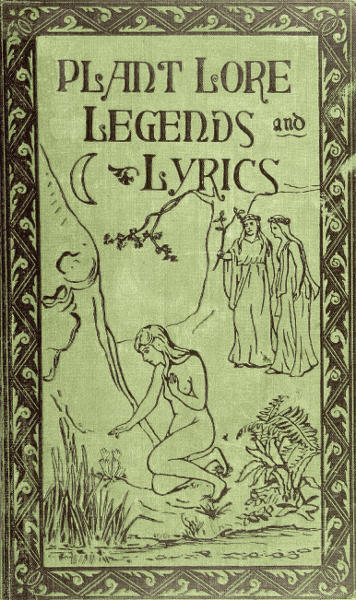
“Plants of the Witches” — Richard Folkard

cover-preview

“Plants of the Witches”

by

Richard Folkard

from

Plant Lore, Legends, and Lyrics: Embracing the Myths Traditions, Superstitions, and Folk-Lore of the Plant Kingdom (1884)


HECATE, the Grecian goddess of the infernal regions, presided over magic and enchantment, and may fairly be styled the goddess, queen, and patroness of Witches and sorcerers. She was acquainted with the properties of every herb, and imparted this knowledge to her daughters Medea and Circe. To this trio of classical Witches were specially consecrated the following herbs:—The Mandrake, the Deadly Nightshade, the Common Nightshade, the Wolfs-bane, the Pontic Azalea, the Cyclamen, the Cypress, Lavender, Hyssop-leaved Mint, the Poley or Mountain Germander, the Ethiopian Pepper, the Corn Feverfew, the Cardamom, the Musk Mallow, the Oriental Sesame, the rough Smilax, the Lion’s-foot Cudweed (a love philtre), and Maidenhair, a plant particularly dear to Pluto. Medea was specially cognisant of the qualities of the Meadow Saffron, Safflower, Dyer’s Alkanet, the clammy Plantain or Fleawort, the Chrysanthemum, and the brown-berried Juniper. All these plants are, therefore, persistently sought for by Witches, who have not only the power of understanding and appreciating the value of herbs, but know also how to render harmless and innocuous plants baleful and deadly. Thus we find that an Italian Witch, condemned in 1474, was shown to have sown a certain noxious powder amidst the herbage near her dwelling, and the unfortunate cows, stricken at first with the Evil Eye, were at length attacked with a lingering but deadly malady. So, again, in the ‘Tempest,’ Shakspeare tells us that in the magic rings traced on the grass by the dance of the Elves, the herbage is imbued with a bitterness which is noisome to cattle. These rings, which are often to be met with on the Sussex Downs, are there called Hag-tracks, because they are thought to be caused by hags and Witches who dance there at night.

It is recorded that, during the period of the Witch persecutions, whoever found himself unexpectedly under an Elder-tree was involuntarily seized with such horror, that he in all probability fell into an ecstatic or hysterical state. Although not one of the trees dedicated to Hecate and her Witch progeny, the Elder appears to have invariably possessed a certain weird attraction for mischievous Elves and Witches, who are fond of seeking the shelter of its pendent boughs, and are wont to bury their satanic offspring, with certain cabalistic ceremonies, beneath its roots.

These satanic children of Witches are elfish creatures, sometimes butterflies, sometimes bumble bees, sometimes caterpillars or worms. They are called good or bad things—Holds or Holdikens. The Witches injure cattle with them; conjure them into the stem of a tree; and, as we have seen, bury them under the Elder-bushes; then, as the caterpillars eat the foliage of the tree, the hearts of those people are troubled of whom the Witches think.

The ill-omened Cercis Siliquastrum, or Judas Tree, is reputed to be specially haunted by Witches, who experience a grim pleasure in assembling around the tree on which the traitorous disciple is said to have hung himself. Perhaps it is they who have spread the tradition that death overtakes anyone who is unfortunate enough to fall into one of these trees.

The Witches of the Tyrol are reputed to have a great partiality for Alder-trees.

Witches are fond of riding about through the air in the dead of night, and perform long journeys to attend their meetings. Matthison tells us that

“From the deep mine rush wildly out

The troop of Gnomes in hellish rout:

Forth to the Witches’ club they fly;

The Griffins watch as they go by.

The horn of Satan grimly sounds;

On Blocksberg’s flanks strange din resounds,

And Spectres crowd its summit high.” Continue reading ““Plants of the Witches” — Richard Folkard” →

Blog about Jindřich Štyrský’s Dreamverse

img_1161

I have to admit that I had never heard of the Czech artist Jindřich Štyrský (1899-1942) until a review copy of something called Dreamverse arrived at Biblioklept World Headquarters a week or so ago. I was excited when I saw the package though—the book is from Twisted Spoon Press, and their books are always gorgeous and strange and fascinating. Dreamverse is no exception, collecting Štyrský’s paintings, collages, sketches, poems, essays, and prose in a baffling (and yet simultaneously accessible) compendium translated by Jed Slast. Here is Twisted Spoon’s blurb:

Published posthumously in 1970 as Dreams, Štyrský’s dream journal spanning the interwar years comprises prose, sketches, collages, and paintings. The present volume includes the complete series of texts and full-color and halftone images based on Štyrský’s layout for its publication in the 1940s, his sole volume of poetry (also published posthumously), as well as a selection of his most important essays, articles, manifestos, and assorted other texts. This edition presents in English for the first time the broad range of Štyrský’s contribution to the interwar avant-garde and Surrealism.

Dreamverse begins with an (overly academic) introduction by the Czech avant garde artist Karel Teige dated from 1948, which argues that the Štyrský is deeply underappreciated. Teige describes Štyrský’s gradual artistic shift into surrealism, an excursion Štyrský shared with his partner Toyen.

Teige writes like an art historian, fussily constructing a place for a displaced artist. Dreamverse really takes off when we get to Štyrský’s prose. Dreams (1925-1940) comprises about half of the book, and begins with this lucidly surreal self-description:

Work birthed in the wellsprings of hypnagogic mental models, via faithful representations of dream objects and authentic dream records.

Štyrský then offers a brief introduction in which he dedicates the work to “my CHIMERA, my PHANTOM OBJECT.” This particular chimera is a Freudian’s fantasy: Štyrský begins by discussing his prepubescent infatuation with “the image of a woman’s head, exquisite with golden hair” which he sees in a cheap magazine. This image somehow transmogrifies into “the head of Medusa, the whole of it in a pool of blood,” its hair a “cluster of vipers, erect, ready to penetrate the woman through her mouth, nose, and ears.” Štyrský then tells us that this “ghastly horror,” this “alluring horror” haunts his dreams, and he tries to “place the head” on his mother and sister. The head fits his sister: “So I was madly in love with her.” Štyrský then details his sister’s death in strange, alarmingly sensual language. (She died in 1905 when he was a young boy). His muse then, his chimera, foregrounds the dreamverse he creates: we get a mass media image reconverted into a mythological figure, then reconverted again, through creative imagination, into a sister, who is in turn transformed again into a mythic trope of some kind—a figure like Eurydice for Štyrský to play Orpheus to. Štyrský’s dreamverse is a writhing collage of contradictions. Hope and despair, sex and death, the beautiful and the lurid are all collapsed into surrealist expression.

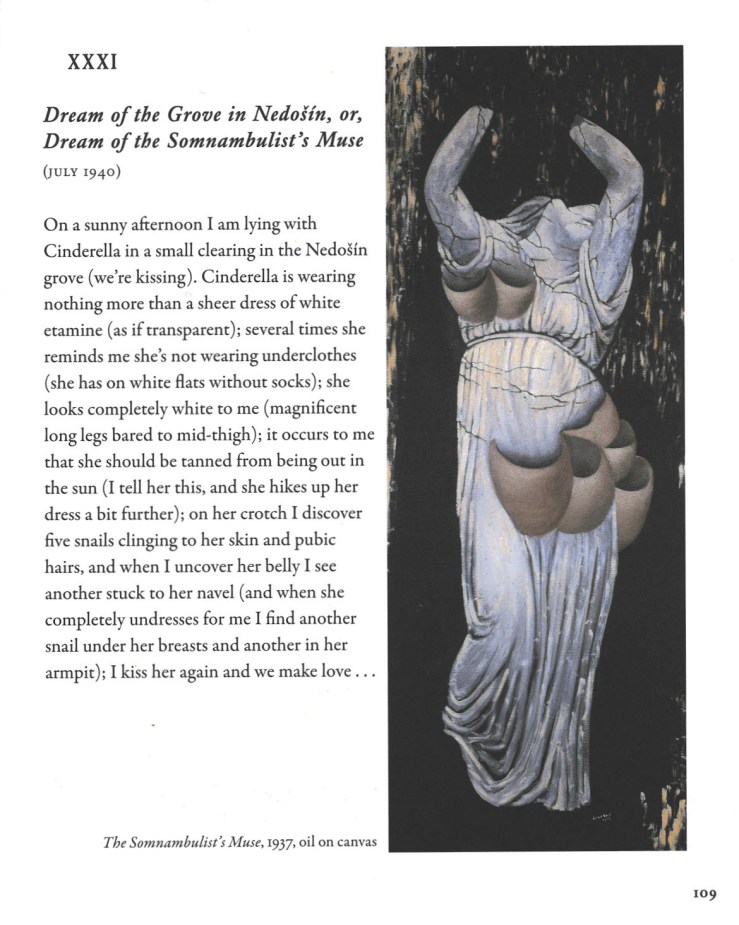
Take, for example, Dream XXXI:a

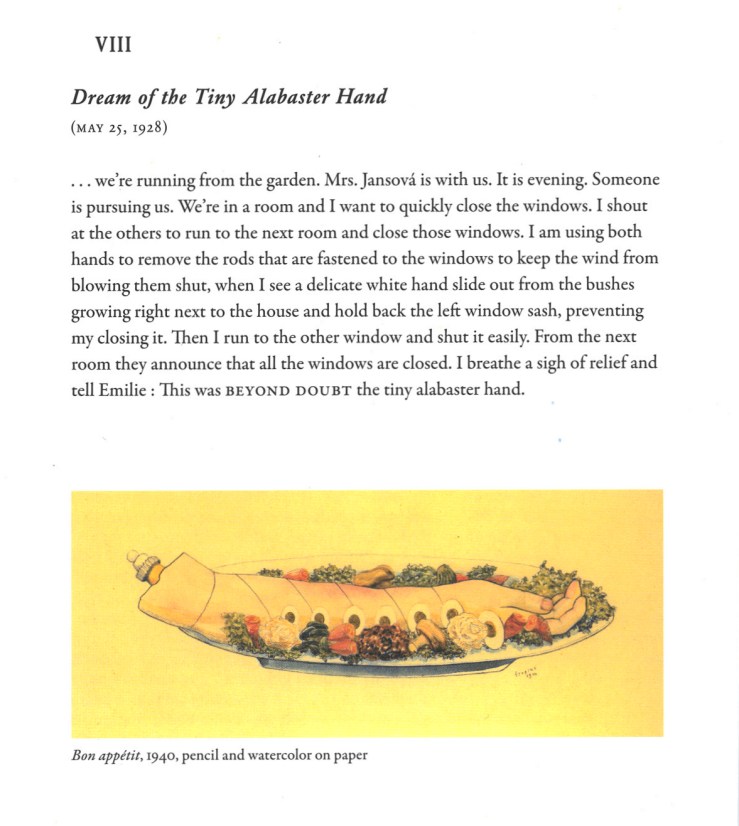
Štyrský’s dream—and its expression—excavates the sexuality suppressed just beneath the surface of our fairy tales. And while sexual abjection is typical in both Dreams (and in many of the poems collected in the Verse section of Dreamverse, sex is not always the dominant motif. Consider Dream VIII:


c

The vignette is a perfect slice of dread an horror, and the accompanying illustration—humorous and grotesque—is nightmare fuel.

I’ve been reading the Dreams somewhat slowly, a handful at a time, and then dipping deeper in the book, into the Verse, reading the Dreamverse as a sort of push-pull of image and word.

Štyrský’s writing is abject, evocative of a world that decays and regenerates at the same moment. A poem with the title “In the Swamps” of course stands out to me, a Florida boy always on the look out for abject images:

b

Štyrský’s imagery here is wonderful: The “fortune of blackcaps” pops out as an invented form of venery. Are the “blackcaps” actually little warblers—or just a surreal transformation of moorhens, the birds we would expect to find in the swamps? In either case, they are merely prey for “compassionate hunters,” susceptible to the arms of unseen brunettes and hunting dogs. The end of the poem is beautifully abject. The “horde of black swine” rumble in, neatly parallel to the “fortune of blackcaps” in the poems’s first line. These pigs slough through the swamp for “Sodden sacks of gold,” some kind of treasure there in the abject muck. Above it all is a speaker—a poet? Language hovers over the swamp.

Jed Slast deserves much praise for his translation, which seems tonally perfect and consistent over both the Dreams and the Verse sections. I’ll admit I haven’t gotten into any of the Writings at the end, which include lectures, essays, manifestos, and other fragments, but that gives me something to look forward to. So far though, Dreamverse has been an unexpected and strange joy, a dark and often perverse collection that plants its own dreamseeds in its reader.

A patchwork of conceits, a hodgepodge of good intentions, another blog about William Gaddis’s novel Carpenter’s Gothic

img_1155

In its sixth (and penultimate chapter), William Gaddis’s 1985 novel Carpenter’s Gothic includes a rare scene. Our heroine Elizabeth Booth exits the house she spends most of the book confined in and actually looks at it from the outside. With her is the house’s owner, the mysterious Mr. McCandless:

—I’ve never really looked at it.

—At what… looking where she was looking.

—At the house. From outside I mean.

Carpenter’s Gothic is a novel of utter interiority—the reader never makes it but a few feet out of the house, and only then on rare occasions. This postmodern Gothic novel tingles with a smothering claustrophobia, its insularity underscored by continual references to other spaces outside the house. The possibility of an outside world waiting for Elizabeth is realized through dialogue with her husband Paul, her brother Billy, and mysterious Mr. McCandless, as well as the non-stop (and, from the reader’s perspective, one-sided) telephone conversations that make up so much of the novel’s material. And yet with all its references to traveling away to California, Africa, New York City, Acapulco, etc., Carpenter’s Gothic keeps Elizabeth locked away in the old house, tethered to the umbilical phone cord at the novel’s center.

McCandless is off in his own interior space—the shifting tortured howl of his own consciousness—when Elizabeth remarks that she has never really seen the house from the outside. Her observation raises him “to the surface” of concrete reality:

—Oh the house yes, the house. It was built that way yes, it was built to be seen from outside it was, that was the style, he came on, abruptly rescued from uncertainty, raised to the surface —yes, they had style books, these country architects and the carpenters it was all derivative wasn’t it, those grand Victorian mansions with their rooms and rooms and towering heights and cupolas and the marvelous intricate ironwork.

The house is built in the Carpenter Gothic style (sometimes called Rural Gothic style), which essentially amounts to an American imitation of European Gothic’s forceful elegance. McCandless continues:

That whole inspiration of medieval Gothic but these poor fellows didn’t have it, the stonework and the wrought iron. All they had were the simple dependable old materials, the wood and their hammers and saws and their own clumsy ingenuity bringing those grandiose visions the masters had left behind down to a human scale with their own little inventions, those vertical darts coming down from the eaves? and that row of bull’s eyes underneath?

McCandless, stand-in for Gaddis, performs a metatextual interpretation for the reader. The Carpenter Gothic is Carpenter’s Gothic, the American postGothic reinterpreation of the European form—namely, the Gothic novel. The materials Gaddis uses to build his book are the materials of mass media and mass textuality. He condenses high literature, lurid newspaper clippings, mail, textbook pages, scraps of illegible notes, pornographic centerfolds, and every other manner of paper into a postGothic synthesis. And not just paper, but also the telephone (always ringing) and the radio (always on, always tuned to inhuman human voices). And the television too, tuned to Orson Welles as Mr. Rochester in Jane Eyre (dir. Robert Stevenson, 1943),  a film which weaves its way in and out of Elizabeth’s consciousness in the beginning of the novel, planting seeds of romance and locked rooms and secrets and fire.

But I’ve cut off McCandless, who was just about to give us another neat description of the Carpenter Gothic, which is to say another neat description of Carpenter’s Gothic:

He was up kicking leaves aside, gesturing, both arms raised embracing —a patchwork of conceits, borrowings, deceptions, the inside’s a hodgepodge of good intentions like one last ridiculous effort at something worth doing even on this small a scale, because it’s stood here, hasn’t it, foolish inventions and all it’s stood here for ninety years…

 Carpenter’s Gothic is more than just a hodgepodge or patchwork; it is more than a ridiculous effort; it is more than the sum of its foolish inventions. Gaddis gives us something new, a postmodern Gothic analysis of the end of the American century.

McCandless, Gaddis’s stand-in, wants to put all the pieces together. He echoes Jack Gibbs, the (anti-)hero (and fellow Gaddis stand-in) of J R, and he prefigures the narrator of Gaddis’s last novel, Agapē Agape, who, like Gibbs, strives to stitch together something from the atomized scraps and remnants of the 20th century.  Gaddis’s protagonists contend with entropy and attempt to get the detritus of the modern world “sorted and organized.” The push-pull of hope and despair drives these protagonists, but often drives them too far.

And McCandless’s reverie takes him too far, again into the interiority of his skull:

…breaking off, staring up where her gaze had fled back with those towering heights and cupolas, as though for some echo: It’s like the inside of your head McCandless, if that was what brought him to add —why when somebody breaks in, it’s like being assaulted, it’s the…

In a moment of self-speech, McCandless realizes that the Carpenter Gothic is “like the inside of [his] head,” underscoring his connection to his creator, Gaddis, as well as the connection between the house and the novel.

The (always) ringing phone punctures the scene:

—Listen! The phone had rung inside and she started up at the second ring, sank back with the third. —All I meant was, it’s a hard house to hide in…

Elizabeth’s lines here emphasize Carpenter’s Gothic’s central Gothicism—the Carpenter Gothic and Carpenter’s Gothic is a hard place to hide in. Secrets will out.

And so well where does our hodgepodge of good intentions lead?

Blog about Blog about 4

img_1220

On 1 Oct. 2018 on this foolish blog I foolishly wrote about my foolish “good intent to blog about something—books, film, art—every day or nearly every day.” I added, ” I’m not sure how it will go,” although I was a little bit sure about how it would go, which was, not great. Like, I knew that I would stumble in writing every day this month, which I have. October has snuck up (or sneaked up) on me like a thief or a serpent or a hobbit or a pick-your-simile—I even somehow missed taking my kid to her dentist appointment yesterday, and will almost surely get a bill from them over that. October sneaked/snuck up on me, and here we are 16 of 31 days in, and I have only managed 10 of these posts (including this one), which is like, 10 of 16, or 62.5%. (10/16 is also today’s date though, so like, uh, so like nothing).

Anyway.

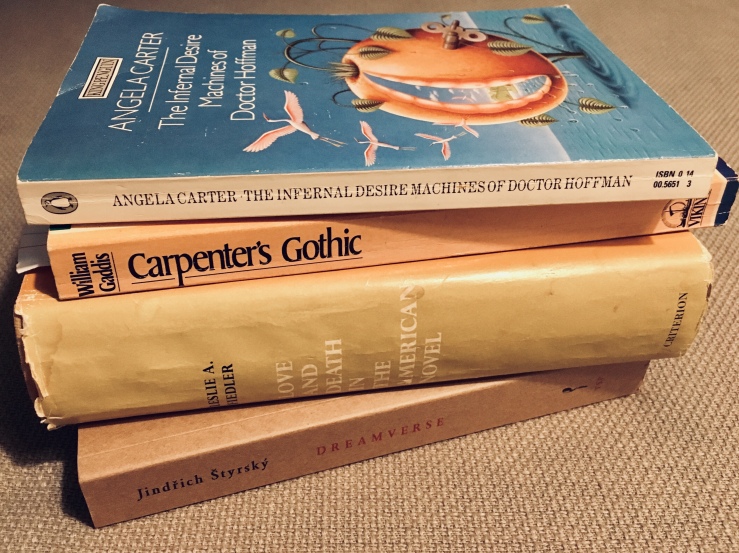
I have been reading, and the initial blog I wrote about even included some specific goals, along with this picture, which semi-summarized those goals:

From bottom to top—

I did, as I promised I would, return (and not steal) the Ravel book, Irony and Sound, which was frankly over my head.

I have not returned to Hoffman’s Poe book, but I haven’t shelved it.

I’ve been reading the Gordon Lish interviews. Like, the book is good—it’s sort of almost like a book of Lish stories. I blogged about it a bit even.

I’ve absolutely loved reading William Gaddis’s third novel Carpenter’s Gothic. It’s turned out to be a perfect Halloween novel, too. I’ll finish the last of its seven chapters tonight—I would’ve finished last night, but I got sidetracked by some lines that reminded me of Leslie Fiedler’s 1960 analysis of American literature, Love and Death in the American Novel. Gaddis’s book in many ways performs a similar analysis to Fiedler’s—they both trace the weight of American guilt. As if anticipating Gaddis’s postmodern postGothic Gothic novel, Fiedler writes, a quarter century before Carpenter’s Gothic’s publication,

…in the United States, certain special guilts awaited projection in the gothic form. A dream of innocence had sent Europeans across the ocean to build a new society immune to the compounded evil of the past from which no one else in Europe could ever feel himself free. But the slaughter of the Indians, who would not yield their lands to the carriers of utopia, and the abominations of the slave trade, in which the black man, rum, and money were inextricably entwined in a knot of guilt, provided new evidence that evil did not remain with the world that had been left behind—but stayed alive in the human heart, which had come the long way to America only to confront the horrifying image of itself.

(I have stalled out on writing a stupid “Blog about” blog post these past few days because I have been cobbling together notes on something about Fiedler and Gaddis. But, like, really—I need to finish Gaddis’s book first).

No dent in the Pirandello.

I’ll return to David Bunch’s Moderan after finishing Carpenter’s Gothic. Bunch’s work is, so far, a perfectly-pitched pitch black satire of toxic (like nuclearly-toxic) masculinity. Horror-as-comedy, weird and undelightful.

I finished George Eliot’s Silas Marner pretty quickly in October, and enjoyed it. I’m glad I read Middlemarch first though. What Eliot next, reader?

So—what next? The picture at the top is the stack I’ve been stacking and unstacking and restacking. Gaddis and Fiedler feel like the thing I really want to write about—gender roles, Gothic promises, domesticity vs. adventure, the house vs. the frontier, the collapse of self into fragments of language, etc. I’m also loving Dreamverse, a collection of poems, art, and prose by Jindřich Štyrský’ that Twisted Spoon Press has put together.  Its insides look like this, at least in one place—

img_1162

I think the next novel I will read will be Angela Carter’s The Infernal Machines of Doctor Hoffman.

Set up a mirror on Alpha Centauri then sit right here with your telescope watching yourself (William Gaddis)

—but did you ever think? She was up on that elbow again, turned to him so his hand fell still on the white of the sheet, —about light years?

—About what?

—I mean if you could get this tremendously powerful telescope? and then if you could get far enough away out on a star someplace, out on this distant star, and you could watch things on the earth that happened a long time ago really happening? Far enough away, he said, you could see history, Agincourt, Omdurman, Crécy… How far away were they she wanted to know, what were they, stars? constellations? Battles he told her, but she didn’t mean battles, she didn’t want to see battles, —I mean seeing yourself… Well as far as that goes he said, get a strong enough telescope you could see the back of your own head, you could —That’s not what I meant. You make fun of me don’t you.

—Certainly not, why would…

—I mean seeing what really happened back when…

—All right, set up a mirror on Alpha Centauri then, you’d sit right here with your telescope watching yourself four, about four and a half years ago is that what you…

—No.

—But I thought…

—Because I don’t want to see that! She pulled away, pulled up the sheet, staring up at the ceiling. —But you’d just see the outside though, wouldn’t you. You’d just see the mountain you’d see it go down and you’d see all the flames but you wouldn’t see inside, you wouldn’t see those faces again and the, and you wouldn’t hear it, a million miles away you wouldn’t hear the screams… What screams, he wanted to —No, no that one’s too close, find one further away… and he subsided, looking at the sheet clenched to her throat and the length of her gone under it, recommending Sirius, setting up business on the Dog Star, the brightest of them all, watching what happened eight and a half? nine years ago? —I told you what happened… the sheet clenched firm, —I told you last night no, twenty, twenty five years away when it was all still, when things were still like you thought they were going to be?

From the beginning of the fifth chapter of William Gaddis’s 1985 novel Carpenter’s Gothic. I’d never heard of this thought experiment until now.

img_1155