Blog about Evan Dara’s two-act play Provisional Biography of Mose Eakins

Screenshot 2018-10-06 at 1.38.52 PM

Evan Dara’s latest work is a two-act play called Provisional Biography of Mose Eakins. Set “c. 2015” on a stage “As bare as you can stand it,” Dara’s play follows Mose Eakins, “35-ish and spry,” as he becomes afflicted with a condition that “has come to be known as imparlence.”

Mose’s imparlence erodes his ability to communicate with others. He loses his job, his home, and eventually his girlfriend Zina, from whom he initially hides his condition. Though his life deteriorates, Mose eventually lands a job as the maitre d’ of an overpriced French restaurant. Here, his sympathies extend to the overworked kitchen staff, and he takes a stand against the unjust working conditions, trying to make meaning through his actions, even as his words fail to communicate.

Dara keeps Provisional Biography spare but active, using a device he calls “the swirl” as a kind of Greek Chorus to keep the play shuttling along, even as the narrative threatens to fall apart. And because Mose is our viewpoint character, and because Mose is afflicted with “imparlence,” the narrative of Provisional Biography is under constant threat of its own linguistic erasure. As the swirl helpfully informs the audience, “people with imparlence lose the capacity to infuse their words with intelligible significance.”

Provisional Biography’s opening lines are an especially baffling affront to “intelligible significance.” When we meet Mose, he’s already imparlent, although he does not know it yet. Consider the play’s opening lines:

MOSE: Tell me something, Jeff. Those numbers convincing to you?

(to someone else)

Bring me the swordfish. Not blackened. You got that? Not blackened. Go.

(to someone else, jauntily)

Well, you know what they say…

(to someone else)

Nice, Zina – the chart is really good. Zina, your students will love it!

(to someone else, laughing)

Tell him that and he’s totally going to have a kitten!

The first few pages of the play continue in this line, Mose’s utterances disconnected from any context that might anchor their meaning. A swirl member eventually appears on stage to push the narrative into more traditional territory:

SWIRL MEMBER 1: Hear it here! Mose Eakins (born June 10, 1978) is an American
field-risk analyst working for Concord Oil. Specializing in mid-level hard-soil
extractions, he won the Kamden Prize for his research into adjacent fauna protection and occasionally lectures in his field.

As Mose’s imparlence worsens, the tension between Mose and the world he cannot communicate with increases, erupting in moments both tragic and comic (and farcical and tragicomic). The swirl is often there to assuage him (and the audience), armed with a humorous (and occasionally ironic) quiver of quotes from the likes of Melanie Klein, William H. Gass, Jean Jacques Rousseau, St. Augustine, and television personality Doctor Oz.

The swirl advises our poor hero, suggesting treatments and support groups—and also offering up punchlines when there’s no real hope in sight:

SWIRL MEMBER: There is no known cure. Imparlence is untreatable—

MOSE: But the doctor – the doctor recommended medicine!

(Mose pulls out the paper given by Doctor Mazlane, shows it to the swirl.)

He told me to take this and come see him again! It’s a prescription…

(reads the paper)

…a prescription…to pay him five hundred and twenty dollars… And I thought bleeding patients went out in the nineteenth century.

SWIRL MEMBER: There’s been a strong return to traditional medicine.

(Other jokes don’t land so neatly—in a segment mocking TV drug commercials, a swirl member offers up an absolute groaner with the phrase “irregular vowel movements.” Who knows though? Maybe the joke plays well on the stage).

With all of its humor, Provisional Biography is ultimately a sad, even tragic story, and nowhere is it sadder than in Mose’s revelation that he can communicate to other humans through one medium: economic exchange. He takes to desperately buying Tic Tacs from street vendors simply to communicate intelligibly, and eventually resorts to buying phrases from a fellow homeless person.

And yet these purchased utterances are not true linguistic exchanges—they do not mean outside of their inherent economic content. Mose Eakins despairs:

MOSE: So – so that’s it? That’s it for me? I can only just flapgaggle by myself for the
rest of my days – flapgaggle and hope?

SWIRL MEMBER: Perhaps inevitable. According to Robert Nozick of Harvard, imparlence is just the latest expression of the ownership society.

SWIRL MEMBER: Meaning has been privatized. It’s been made part of the private
sphere.

SWIRL MEMBER: Significance is no longer a publicly-owned utility, a service
provided by a command and control center.

SWIRL MEMBER: This will vastly increase our linguistic productivity—

SWIRL MEMBER: —liberate our potential as creators of meaning—

SWIRL MEMBER: —freeing us from the restrictions and inefficiencies of the nanny
dictionary!

MOSE: But…

The swirl here satirizes the newspeak of late capitalism, imagining language—a thing that makes us inherently human—as yet another commodity to be consumed and sold back to us by a dehumanizing system that seems to operate on its own inscrutable logic. While there’s humor in the little scene, it’s also quite painful.

The idea that late capitalism reduces linguistic exchange to only an economic (and thus inauthentic) exchange is repeated again in a far more painful scene later in the play. Mose pleads for “Something real…A real response – something that speaks from the heart!” from the homeless man he has been buying phrases from, to which the man simply puts out his hand for a coin. “Is that the only thing left?” cries Mose. The swirl is there to offer an out to this existentialist despair: “Salvation–only through action! Guided by further philosophical slivers proffered by the swirl, Mose converts his despair into radical action by the end of the play. The conclusion is fittingly moving and movingly strange.

Provisional Biography of Mose Eakins, in showing a human communication dissolve, follows Dara’s 2013 novel Flee, which shows a town dissolve. Flee is an oblique but devastating address to the 2008 economic collapse in America, and Provisional Biography is a fitting follow-up, continuing Dara’s critique of the human position in the late-capitalist landscape.

Significantly, Dara’s critique of the relationship between language and commerce extends to accessing his play, which can be downloaded for free at his publisher Aurora’s website.  You simply have to give them your email address. Under the “Download” button and above the PayPal button is the following message:

“If you please, reciprocation accepted only after reading. Thank you.”

And what would “reciprocation” mean, in the end? Write your own two-act play about the relationship between language and commerce in the early 21st century and send it to Evan Dara?

I PayPal’d Aurora $11.11.

Blog about George Eliot’s Silas Marner, a novel of not knowing

img_1146

I have just now finished George Eliot’s novel Silas Marner, which I enjoyed. The novel is set in England at the beginning of the nineteenth century, and its plot goes something like this:

As a young man, Silas Marner, a weaver, is a member of a nonconformist church with Calvinist tendencies. Falsely accused of theft, he is excommunicated from his church. Divided from the only community he knows, he loses faith in humanity and religion, leaves his “native place” Lantern Yard in Northern England, and moves to Raveloe, a village in the Midlands.

(Lantern Yard and Raveloe are both Eliot’s inventions, like Middlemarch in Middlemarch. And while Silas Marner is much shorter than Middlemarch, the world Eliot conjures in Raveloe is nevertheless similarly rich and full and detailed, a real fake place, a spot in the Eliotverse).

Silas’s technological prowess at the loom finds him plenty of customers in Raveloe, and while he amasses a wealth in gold coins, testifying to his weaving’s popularity, he nevertheless remains isolated from the community. For a decade and a half he hoards his gold coins, counting them late into the night alone at home, and cementing his reputation as an eccentric with the Raveloe folk. He’s always the Stranger.

In the meantime, Raveloe’s wealthiest family, the Casses, continue their lives as obnoxious rich assholes. The elder son Godfrey harbors a shameful secret, the younger son Dunstan is an alcoholic ne’er-do-well, and Papa Cass—excuse me, Squire Cass—is a pompous prick. There’s a ruined horse, an opium-addicted wife, a Christmas Party ruined by a visit from big-A Anxiety. Etc.

Through a series of skillful plot-moves, Eliot meshes the Cass story line with Marner’s story weaving the two together around the novel’s central conceit: Silas Marner’s hoard of gold is stolen. Soon after, he finds a baby girl, whose golden curls he takes as a kind of symbolic exchange for his golden coins. The girl saves his life in the sense that she saves his soul. Eliot gives us this moving exchange between adopted father and daughter near the end of the novel:

“But I know now, father,” said Eppie. “If it hadn’t been for you, they’d have taken me to the workhouse, and there’d have been nobody to love me.”

“Eh, my precious child, the blessing was mine. If you hadn’t been sent to save me, I should ha’ gone to the grave in my misery. The money was taken away from me in time; and you see it’s been kept—kept till it was wanted for you. It’s wonderful—our life is wonderful.”

There is nothing like a character declaring something like “It’s wonderful–our life is wonderful” to signal an impending moment of the unwonderful, of course, and Godfrey Cass barges into the life of Silas Marner on queue. Old secrets come to light, etc.

But there is a happy ending, a classically comic ending, with a wedding and a garden and laughter and everything.

I do not think my plot summary spoils too much, or at least I very much hope it spoils nothing. I went into Silas Marner not knowing anything about the plot, and, after writing my little summary, I can see how the novel might be misinterpreted as a tad, uh, sentimental. And it does earn its emotional ending, that’s true. But, as in Middlemarch, it’s really the way that Eliot captures emotion—psychology, intention, bewilderment—-that so compels me.

Silas Marner is a novel about conscience and consciousness, anxiety and isolation, strangers and community. It is a novel about knowing, but it is also very much a novel about not knowing. The novel’s strange hero Silas Marner is a weaver, a symbolic doubling for an author, sure, but Silas Marner is a novel that points to its own loose threads.

This theme of not knowing is most evident in the final paragraphs of the novel’s final numbered chapter. There is a chapter titled “Conclusion” after the final numbered chapter, and this chapter “Conclusion” gives us the classical comedic ending of a wedding in a garden and, you know, happily ever after. This “Conclusion” gives the text a sense of resolution that the novel’s final numbered chapter withholds. I find Eliot’s evocation of not knowing in the final numbered chapter a far more persuasive indicator of the emerging modernism I read in her novels.

In this final numbered chapter (Chapter XXI), Silas takes his daughter Eppie to the North, to Lantern Yard. He wants to show his daughter his “native place,” but he also wants to confront Mr. Patson the minister of the church that excommunicated him. He wants to demonstrate his innocence to the minister. He wants this member of his old community to know himself the way he knows himself; he wants to know that the minister knows what he himself knows.

Silas and Eppie are aghast at Lantern Yard though—the place looks awful and smells bad; none of it is as Silas had known it. It is a new place, an industrialized place. Even the church where he had worshiped is gone, replaced by a factory. And his detective work does not pay off:

But neither from the brush-maker, who had come to Shoe Lane only ten years ago, when the factory was already built, nor from any other source within his reach, could Silas learn anything of the old Lantern Yard friends, or of Mr. Paston the minister.

When Silas returns to Raveloe, he confides in his friend Dolly Winthrop, who serves as kind of leveling conscience in the novel, telling her:

The old home’s gone; I’ve no home but this now. I shall never know whether they got at the truth o’ the robbery, nor whether Mr. Paston could ha’ given me any light about the drawing o’ the lots. It’s dark to me, Mrs. Winthrop, that is; I doubt it’ll be dark to the last.

Silas has reconciled himself to the darkness of not knowing; there’s no teleological neatness in this conclusion. Teleological neatness is reserved for “Conclusion” —for the wedding, the garden, the laughter. And it’s in those human moments, moments that serve to counter his early years of isolation, that Silas finds “light enough to trusten” the human race he once rejected. Silas weaves the dark loose ends of his old life into something new and bright, and in this way, preserves his soul.

Front — Peter Martensen

pmar_20160520_090-600x450

Front, 2016 by Peter Martensen (b. 1953)

Conversations with Gordon Lish (Book acquired, 19 Sept. 2018)

dnei093vsaafypf

I’ve been reading somewhat at random the “interviews” with Gordon Lish collected in Conversations with Gordon Lish over the past two weeks and really enjoying them. The suspicious quotation marks around “interviews” are there to suggest that these pieces are often something closer to essays or post-fictions or metafictions—Lish extemporizing, lucidly ranting, self-interviewing himself, and just generally performing Gordon Lish. (I wasn’t at all surprised to learn that Lish briefly had a career as a radio personality in the early fifties on a show called “The Gordo Lochwood Show”).

More to come, but for now here’s the blurb for Conversations with Gordon Lish, which is edited by David Winters and Jason Lucarelli:

Known as “Captain Fiction,” Gordon Lish (b. 1934) is among the most influential–and controversial–figures in modern American letters. As an editor at Esquire (1969-1977), Alfred A. Knopf (1977-1994), and The Quarterly (1987-1995) and as a teacher both in and outside the university system, he has worked closely with many of the most pioneering writers of recent times, including Raymond Carver, Don DeLillo, Barry Hannah, Amy Hempel, Sam Lipsyte, and Ben Marcus. A prolific author of stories and novels, Lish has also won a cult following for his own fiction, earning comparisons with Gertrude Stein and Samuel Beckett.

Conversations with Gordon Lish collects all of Lish’s major interviews, covering the entire span of his extraordinary career. Ranging from 1965 to 2015, these interviews document his pivotal role in the period’s defining developments: the impact of the Californian counterculture, the rise and decline of so-called literary “minimalism,” dramatic transformations in book and magazine publishing, and the ongoing growth of creative writing instruction. Over time, Lish–a self-described “dynamic conversationalist”– forges an evolving conversation not only with his interviewers, but with the central trends of twentieth-century literary history.


Poe Poe Poe Poe Poe Poe Poe (Book acquired, 21 Sept. 2018)

img_1111

After flirting with the thing after first spying it a few weeks ago, I finally broke down and picked up Daniel Hoffman’s 1972 biography Poe Poe Poe Poe Poe Poe Poe. It is too weird not to be mine. Here is a good review of the book.

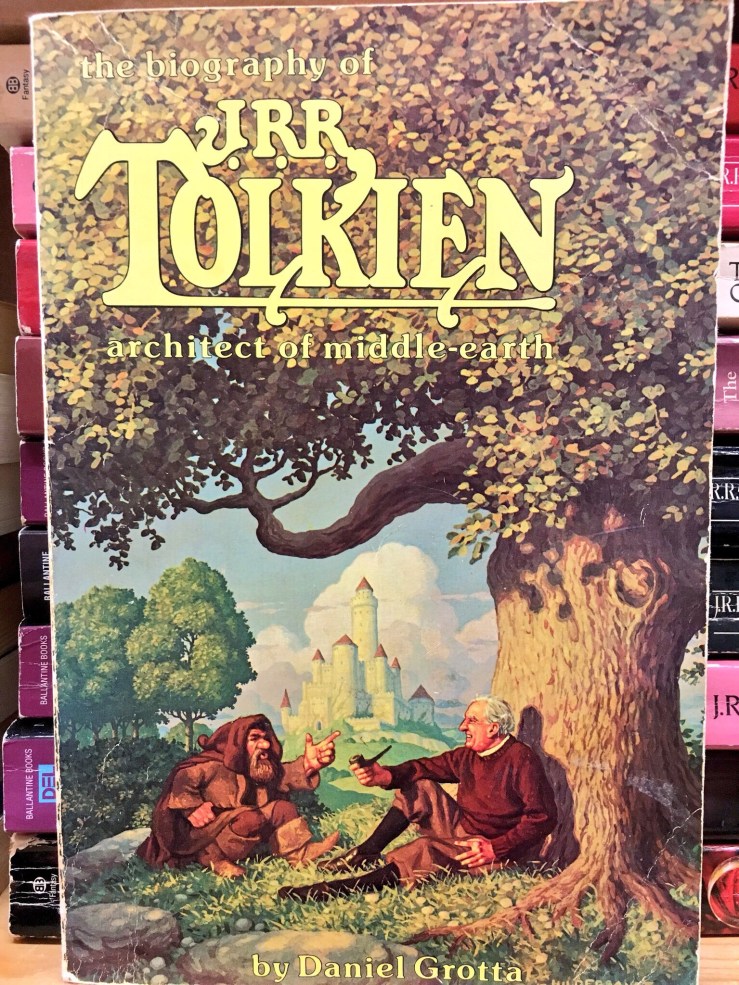
I spied but did not pick up this biography of JRR Tolkien, but its cover is utterly charming.

img_1101

Notes on Vulture’s “Premature Attempt at the 21st Century Canon”

Last year, Vulture put together a list of “100 Great Works of Dystopian Fiction,” and I wrote about it on my blog. The list was good fun, and there are a handful of novels on it I’m still keeping an eye out for (feel free to send me a copy of David Ohle’s Motorman, people).

Today, Vulture published another list of 100 books, this one ambitiously but cautiously titled, “A Premature Attempt at the 21st Century Canon.” The list begins with a nearly-900 word prefatory essay called “Why Now?” that isn’t bad but is perhaps unnecessary; the sentence, “We thought it might be fun to speculate (very prematurely) on what a canon of the 21st century might look like right now” is fine enough. I mean, look: List-making is fun. Putting together a syllabus or anthology or “canon” is fun. It generates conversation and maybe pisses folks off. And Vulture racked up a range of ringers to make their list—I have a lot of respect for many of the critics and writers who contributed here.

But ultimately, I think we all know that this canon is not a canon; it cannot be a canon because a canon evolves over time, and then evolves (or devolves or implodes or mutates or pick your verb) more. We don’t know what the most important books of the past eighteen years are yet, and most of us won’t be alive to know what they turn out to be. We would be better suited, really, to naming the canonical novels of 1900-1918 I suppose. But again, I think we all know that. Lists are fun. I take Vulture’s list to be a lovely set of reading recommendations from a set of smart folks.

I’ve already prefaced too much. I will go through the list, fairly quickly, in the order that Vulture prepared it, making comments or making none, occasionally recommending an alternative. I will write quickly without much reflection and I will undoubtedly forget a ton of books.

The Last Samurai, by Helen DeWitt (September 20, 2000)

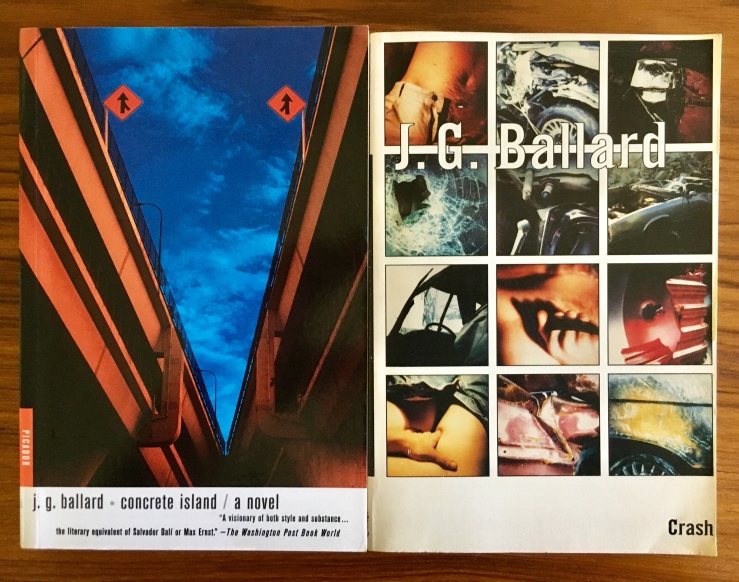
For a few years now, almost every single reader whose taste I greatly admire has recommended DeWitt’s debut novel to me. I’ll admit that I didn’t care for her novel Lightning Rods at all, which seemed like the premise for a Ballard story stretched too thin over 200 or so pages. I am close to giving up on her short story collection Some Trick. I may be entirely misreading her. However, I admire the critic Christian Lorentzen, who helmed Vulture’s essay on The Last Samurai, and the fact that it came in number one on the list means that I’ll almost certainly give it a shot.

The Corrections, by Jonathan Franzen (September 1, 2001)

I recall chuckling at the part where the one son was drunk and doing some business with the lawn clippers. I suspect there’s some nostalgia at work with this one. Should I recommend a different book so early? Sure: Open City, by Teju Cole  (February 8, 2011) is somehow absent.

Never Let Me Go, by Kazuo Ishiguro (March 3, 2005) 

I can’t quibble. Reminds me that I want to read The Unconsoled

How Should a Person Be?, by Sheila Heti (September 25, 2010) 

Autofiction! Maybe I should read it. In the meantime, may I recommend Writers, by Antoine Volodine (August 5th, 2016)?

The Neapolitan Novels, by Elena Ferrante (2011-2015)

Are these autofiction, too? I love these books. I would read a fifth one. And a sixth one. Etc.

The Argonauts, by Maggie Nelson (May 5, 2015)

I downloaded the audiobook of this this summer but kept stalling, which is weird because it’s pretty short (Nelson reads it herself, too). Give it another shot.

2666, by Roberto Bolaño (November 11, 2008) 

What can I say? There are seven review of 2666 posted on Biblioklept. I would’ve picked this as number one. Ten years after a hype cycle that could’ve withered a lesser book, 2666 seems as prescient as ever—not only in its content, but in its form—or really the welding of content and form, into one big dark dark big labyrinth-poem.

The Sellout, by Paul Beatty (March 3, 2015) 

Another reminder that I don’t read enough contemporary fiction.

The Outline Trilogy (OutlineTransit, and Kudos), by Rachel Cusk (2014–2018) 

Somehow Against the Day, by Thomas Pynchon (November 21, 2006) is not on this list, a fact that has nothing whatsoever to do with Cusk’s books, which I have not read.

Atonement, by Ian McEwan (September 2001) 

I found it a slog and an utter bore. Europe Central, by William T. Vollmann (2005) is somehow not on Vulture’s list.

The Year of Magical Thinking, by Joan Didion (September 1, 2005) 

I remember reading it when it came out but I really don’t remember anything other than the premise.  A Mercy, by Toni Morrison (November 11, 2008) is not on Vulture’s list

Leaving the Atocha Station, by Ben Lerner (August 23, 2011)

I hated 10:04 (Lerner’s follow up to Atocha Station) so much that I doubt I will ever read another book by the man. I loved loved loved Flee, by Evan Dara (2013) though.

The Flamethrowers, by Rachel Kushner (April 2, 2013) 

Luc Sante is recommending The Flamethrowers, so maybe I should finally make time to read it.

Erasure, by Percival Everett (August 1, 2001)

Haven’t read any Everett; is this a good starting place?

Middlesex, by Jeffrey Eugenides(September 4, 2002)

A thoroughly passable entertainment that has no business on a list. Did you know that Jimmy Corrigan, the Smartest Kid on Earth, by Chris Ware (2000) was published in the last 18 years also?

Platform, by Michel Houellebecq (September 5, 2002) 

Houellebecq writes fascinating stuff, and his follow up The Possibility of an Island (2005) would fit in here too.

Do Everything in the Dark, by Gary Indiana (June 1, 2003)

Lorentzen’s write up of this one made me add it to a little note I keep on my iPhone of books to look out for.

The Known World, by Edward P. Jones (August 14, 2003)

Haven’t heard of it.

The Plot Against America, by Philip Roth (September 30, 2004)

I tried with Roth, I really did, and it just didn’t stick, none of it, just not for me. Point Omega, by Don DeLillo (February 2, 2010), is, in my estimation, one of the better novels of the post-9/11 zeitgeist (and really underrated as a DeLillo novel).

The Line of Beauty, by Alan Hollinghurst (October 1, 2004)

A really fantastic book that’s not on this list is Asterios Polyp, by David Mazzucchelli (July 7, 2009).

Veronica, by Mary Gaitskill (October 11, 2005)

I’ve enjoyed some of her short stories a lot.

The Road, by Cormac McCarthy (September 26, 2006)

It’s good. No Country for Old Men (2005) is probably better, but not as zeitgeisty.

Ooga-Booga, by Frederick Seidel (November 14, 2006)

Ooga-Booga is a fantastic name for a book.

The Brief Wondrous Life of Oscar Wao, by Junot Díaz (September 6, 2007)

I recalled enjoying it fine, but it’s hardly canonical stuff, is it?

Wolf Hall, by Hilary Mantel (April 30, 2009)

I loved Bring Up the Bodies (May 8, 2012) very much too.

The Possessed, by Elif Batuman (February 16, 2010)

Always meant to read this and then never followed through.

The Particular Sadness of Lemon Cake, by Aimee Bender (June 1, 2010)

Mr. Fox, by Helen Oyeyemi (June 1, 2011)

Lives Other Than My Own, by Emmanuel Carrère (September 13, 2011)

Zone One, by Colson Whitehead (October 6, 2011) 

Gone Girl, by Gillian Flynn (May 24, 2012)

NW, by Zadie Smith (August 27, 2012)

White Girls, by Hilton Als (January 1, 2013)

Mr. Fox looks good—but is it fantastic? I read Zone One but I guess it didn’t make a huge impression on me, because I don’t recall much besides the premise. White Teeth didn’t persuade me to read another of Smith’s books, but many smart people say they are good so.

My Struggle: A Man in Love, by Karl Ove Knausgaard (May 13, 2013)

Where are my Never Knuasgaards?

The Goldfinch, by Donna Tartt (September 23, 2013)

Is this any good?

Dept. of Speculation, by Jenny Offill (January 28, 2014)

All My Puny Sorrows, by Miriam Toews (April 11, 2014)

Citizen: An American Lyric, by Claudia Rankine (October 7, 2014)

consent not to be a single being, by Fred Moten (2017–2018)

I’ve been copying and pasting the titles, authors, and dates from Vulture’s sites, and each time I have to remove their Amazon links.

The Amazing Adventures of Kavalier & Clay, by Michael Chabon (September 19, 2000)

I will never understand the acclaim for this one. Never.

Also: Hey: If this Vulture list came out in, say, 2008, how many Jonathan Lethem books would be on it? How many Dave Eggers books?

The Amber Spyglass, by Philip Pullman(October 10, 2000)

Great stuff.

True History of the Kelly Gang, by Peter Carey (January 9, 2001)

I’m beginning to get tired of this post and I wished that I hadn’t started and I apologize to you, reader. Gerald Murnane seems like a writer to put on a list.

The Beauty of the Husband: A Fictional Essay in 29 Tangos, by Anne Carson (February 6, 2001)

I don’t know this one! Autobiography of Red came out in 1998 so it can’t go on the list, and thus proves lists are only foolish fun.

The Last Report on the Miracles at Little No Horse, by Louise Erdrich (April 3, 2001)

This list is a huge reminder to me that I don’t read enough women. I try, but I think I don’t try hard enough.

Austerlitz, by W.G. Sebald (October 2, 2001)

A challenging book, and not the best starting place for Sebald, but also very rewarding. (Start with The Rings of Saturn (1995)).

Fingersmith, by Sarah Waters (February 4, 2002)

The Time of Our Singing, by Richard Powers (October 3, 2002)

The Book of Salt, by Monique Truong (April 7, 2003)

Mortals, by Norman Rush (May 27, 2003)

Home Land, by Sam Lipsyte (February 16, 2004)

I recall liking Home Land a lot, but canonical it ain’t. I tried with Richard Powers but it did not take.

Oblivion, by David Foster Wallace (June 8, 2004)

I’m tempted to write a whole mini-essay here in the middle of this damn thing about how Wallace’s literary stock seems to have fallen, at least to a broader audience, over the last few years. He seems like a target for handwringers to wring their hands over—and he (and, more importantly, his work) doesn’t even seem like the target—it’s his reputation and his fans that seem like the target. Anyway. I mean:

“Good Old Neon” is in Oblivion, and it belongs on the list.

Honored Guest, by Joy Williams (October 5, 2004)

Suite Française, by Irène Némirovsky (October 31, 2004)

The Sluts, by Dennis Cooper (January 13, 2005)

Voices From Chernobyl, by Svetlana Alexievich (June 28, 2005)

Magic for Beginners, by Kelly Link (July 1, 2005)

The Afterlife, by Donald Antrim (May 30, 2006)

Winter’s Bone, by Daniel Woodrell (August 7, 2006)

Wizard of the Crow, by Ngũgĩ wa Thiong’o (August 8, 2006)

American Genius, A Comedy, by Lynne Tillman (September 25, 2006)

Eat the Document, by Dana Spiotta (November 28, 2006)

Many casual readers may not know that Herman Melville’s Moby-Dick (1851) was both a commercial and a critical flop—it essentially ended his writing career. The book found its audience among the modernist critics, writers, and readers of the 1920s though, and by the 1940s was generally esteemed as a canonical classic.

The Harry Potter novels, by J.K. Rowling (1997–2007) 

Oh.

Sleeping It Off in Rapid City, by August Kleinzahler (April 1, 2008)

The White Tiger, by Aravind Adiga (April 22, 2008)

The Lazarus Project, by Aleksandar Hemon (May 1, 2008)

Home, by Marilynne Robinson (September 2, 2008)

Fine Just the Way It Is, by Annie Proulx (September 9, 2008)

Scenes From a Provincial Life: Boyhood, Youth, and Summertime, by J.M. Coetzee (1997–2009)

Notes From No Man’s Land, by Eula Biss (February 3, 2009)

Spreadeagle, by Kevin Killian (March 1, 2010)

There are 100 books on this list and somehow The Last Novel, by David Markson (2007) is not one of them.

Super Sad True Love Story, by Gary Shteyngart (July 27, 2010)

I genuinely hate this novel.

Seven Years, by Peter Stamm (March 22, 2011)

The Sense of an Ending, by Julian Barnes (August 4, 2011)

1Q84, by Haruki Murakami (October 25, 2011)

The Gentrification of the Mind, by Sarah Schulman (January 7, 2012)

Billy Lynn’s Long Halftime Walk, by Ben Fountain (May 1, 2012)

Capital, by John Lanchester (June 11, 2012)

I’ve finally given in and admitted to myself that Haruki Murakami is Not For Me.

The MaddAddam Trilogy (Oryx and CrakeThe Year of the Flood, and MaddAddam), by Margaret Atwood (2003-2013)

MaddAddam wasn’t especially good but Atwood’s first two are pretty good zeitgeisty affairs (and fun quick reads).

A Constellation of Vital Phenomena, by Anthony Marra (May 7, 2013)

Taipei, by Tao Lin (June 4, 2013)

Men We Reaped, by Jesmyn Ward (September 17, 2013)

Family Life, by Akhil Sharma (April 7, 2014)

How to Be Both, by Ali Smith (August 28, 2014)

A Brief History of Seven Killings, by Marlon James (October 2, 2014)

I’ll admit I’ve stopped reading even the blurbs at this point.

Preparation for the Next Life, by Atticus Lish (November 11, 2014)

A tremendous novel. The sort of thing that if you described the plot to me I’d, like, wave my hand as if to say, “Pass” — but, no, it’s so, so, so very good.

The Sympathizer, by Viet Thanh Nguyen (April 7, 2015)

The Light of the World, by Elizabeth Alexander (April 21, 2015)

The Broken Earth trilogy, by N.K. Jemisin (2015-2017)

What Belongs to You, by Garth Greenwell (January 19, 2016)

Collected Essays & Memoirs (Library of America edition), by Albert Murray (October 18, 2016)

The Needle’s Eye, by Fanny Howe (November 1, 2016)

Ghachar Ghochar, by Vivek Shanbhag (February 7, 2017)

The Hate U Give, by Angie Thomas (February 28, 2017)

All Grown Up, by Jami Attenberg (March 7, 2017)

The Best We Could Do: An Illustrated Memoir, by Thi Bui (March 7, 2017)

Tell Me How it Ends, by Valeria Luiselli (March 13, 2017)

Priestdaddy, by Patricia Lockwood (May 2, 2017)

Red Clocks, by Leni Zumas (January 16, 2018)

Asymmetry, by Lisa Halliday (February 6, 2018)

The Largesse of the Sea Maiden, by Denis Johnson (January 16, 2018)

Johnson’s novel isn’t last on the list—Halliday’s is—(and I don’t think “last” is anything but chronology for the authors near the end of the list)—but I’ve read it and I love it (and it’s another write up from Lorentzen)—but it’s not a canonical work. It’s great, and it somehow manages to match Johnson’s best early stuff, but again—not canonical. Although of course I could be wrong.

What I think is this:

For a while, we’ll see the canon, or The Canon if you prefer—and just as significantly, the idea of a literary canon–increasingly atomized, interrogated, personalized, and deconstructed (and perhaps neglected, at least from an academic standpoint). It doesn’t matter. The work of today’s literary darlings may be the foamy flotsam and jetsam of tomorrow. But of course you’ll be dead—I mean I’ll be dead—what I’m saying is we’ll be dead, so it doesn’t matter. We could pretend to be, like, Stewards of the Canon or something—hope for a cultural continuity (or discontinuity) that preserves (or disrupts) Certain Literary Values (Ours!)—or maybe just accept that reading is a bit of pleasure, a bit of fun, and that we antecede those who will decide, a hundred years from now, what the 21st-century canon really is.


Dreaming in Umbria — William Bailey

684ff475173b350dc5c9c44382d85242

Dreaming in Umbria, 2015 by William Bailey (b. 1930)

I saw only one tower standing to the south, and that one ringed with fire | Denis Johnson

At the moment, I was heading anywhere at all for breakfast, but when I heard the desk clerk’s radio playing news that an aircraft, I assumed a sightseeing plane, had struck Tower Two of the World Trade Center, I decided to jump on the number 3 subway half a block west, and go have a look.

As I headed toward Eighth Avenue I tried calling Mark Ahearn about lunch, but my cellphone only hammered out a rapid-fire beep. Please don’t ask me how this can be true: I traveled through the busy lobby and walked for half a long block on a crowded Manhattan street and then boarded the World Trade Center subway completely unaware that I was participating in a citywide disaster, and moving toward its center.

The World Trade Center station came a few stops south of Twenty-Third Street, but we didn’t get there. After Christopher Street the train halted in the tunnel and waited, humming. It gave a screech, lurched backward slightly, and stopped again. Somehow the general news had infiltrated the sealed subterranean environment that something historically enormous was happening very nearby, and it got quiet in our compartment, and almost everybody entered into a small, desperate battle with a worthless cellphone. The train moved forward and gained speed, but began braking long before Houston Street, the next station, where it halted with several rear cars sticking out behind into the tunnel. For a tense minute, whoever spoke only whispered. Then came a shout—“Tell us what’s going on!” and others raised the same cry until we heard the conductor’s PA saying something about the tracks, the tracks…“Due to the catastrophe, this train will not go farther. Please exit out the forward cars onto the platform. Do not go onto the tracks.” We were all on our feet, maneuvering selfishly, angling for the doors. But the doors didn’t open. The engine stopped. “Open the doors! Open the doors!” The engine started. A man shouted, “Just everybody stand still!” People from the car behind had pried their way into ours, and somebody almost went down. A woman said, “Stop that, you fool!” A man in front of me pushed a teenage boy beside him. With the meat of his fist he began beating the back of the boy’s head. And I jumped into the fray, didn’t you, Harrington, like a monkey, yes you did, and got yourself an elbow in the eye. The doors to the compartment flew open and people clambered out onto the station’s platform, where a dreadlocked man in a crimson athletic suit jumped up and down on a bench as if it were a trampoline, screaming “God, see what we’re doing to each other down here.” When I came up into the street, dizzy and one-eyed, I couldn’t get my bearings. I saw only one tower standing to the south, and that one ringed with fire. I asked a man nearby—“Where are we? I can’t see the other tower.” He said, “It fell” and I said, “No it didn’t.” He didn’t argue. We stood in the middle of the street with thousands of other people, all of us motionless, like a frozen parade, all silent. I began to believe the man. We watched the flames spreading through the building’s upper stories over the course of about twenty minutes, and then the eighteen-hundred-foot structure seemed to curtsy and dip left, and then it went down.

I turned around and looked at the people behind me. I saw shocked laughter, weeping, horror, bewilderment. The young man next to me bawled at the top of his lungs. I was afraid to ask him if he had a loved one in the buildings afraid to talk to him at all, but he raised his agonized, Christly face to me and suddenly laughed, saying, “Buddy, you are working on one heck of a black eye.” We stood far from the buildings—at least a mile, I’d say—far enough that we didn’t feel the ground shake, and we heard nothing but sirens, and official-sounding voices screaming, “Get out of the street! Stay out of the street!” and others too—“They’re attacking the Capitol!—the Pentagon!—the White House!”

Cop cars and ambulances heaped with dust and chunks of concrete came at us out of the south. I started walking that direction, I don’t know why, but I soon realized I was the only person heading downtown, and then the tide of panic pressing toward me was too heavy to go against, and I turned around and let it take me north.

From Denis Johnson’s short story “Doppelgänger, Poltergeist.” Collected in  The Largesse of the Sea Maiden, 2017.


About the time the Spy and the Fanny sailed | Nathaniel Hawthorne’s journal entry for September 10th, 1852

September 10th.–Here is another beautiful morning, with the sun dimpling in the early sunshine. Four sail-boats are in sight, motionless on the sea, with the whiteness of their sails reflected in it. The heat-haze sleeps along the shore, though not so as quite to hide it, and there is the promise of another very warm day. As yet, however, the air is cool and refreshing. Around the island, there is the little ruffle of a breeze; but where the sail-boats are, a mile or more off, the sea is perfectly calm. The crickets sing, and I hear the chirping of birds besides.

At the base of the light-house yesterday, we saw the wings and feathers of a decayed little bird, and Mr. Thaxter said they often flew against the lantern with such force as to kill themselves, and that large quantities of them might be picked up. How came these little birds out of their nests at night? Why should they meet destruction from the radiance that proves the salvation of other beings?

Mr. Thaxter had once a man living with him who had seen “Old Bab,” the ghost. He met him between the hotel and the sea, and describes him as dressed in a sort of frock, and with a very dreadful countenance.

Two or three years ago, the crew of a wrecked vessel, a brigantine, wrecked near Boon Island, landed on Hog Island of a winter night, and found shelter in the hotel. It was from the eastward. There were six or seven men, with the mate and captain. It was midnight when they got ashore. The common sailors, as soon as they were physically comfortable, seemed to beperfectly at ease. The captain walked the floor, bemoaning himself for a silver watch which he had lost; the mate, being the only married man, talked about his Eunice. They all told their dreams of the preceding night, and saw in them prognostics of the misfortune.

There is now a breeze, the blue ruffle of which seems to reach almost across to the mainland, yet with streaks of calm; and, in one place, the glassy surface of a lake of calmness, amidst the surrounding commotion.

The wind, in the early morning, was from the west, and the aspect of the sky seemed to promise a warm and sunny day. But all at once, soon after breakfast, the wind shifted round to the eastward; and great volumes of fog, almost as dense as cannon-smoke, came sweeping from the eastern ocean, through the valley, and past the house. It soon covered the whole sea, and the whole island, beyond a verge of a few hundred yards. The chilliness was not so great as accompanies a change of wind on the mainland. We had been watching a large ship that was slowly making her way between us and the land towards Portsmouth. This was now hidden. The breeze is still very moderate; but the boat, moored near the shore, rides with a considerable motion, as if the sea were getting up.

Mr. Laighton says that the artist who adorned Trinity Church, in New York, with sculpture wanted some real wings from which to imitate the wings of cherubim. Mr. Thaxter carried him the wings of the white owl that winters here at the Shoals, together with those of some other bird; and the artist gave his cherubim the wings of an owl.

This morning there have been two boat-loads ofvisitors from Rye. They merely made a flying call, and took to their boats again,–a disagreeable and impertinent kind of people.

The Spy arrived before dinner, with several passengers. After dinner, came the Fanny, bringing, among other freight, a large basket of delicious pears to me, together with a note from Mr. B. B. Titcomb. He is certainly a man of excellent taste and admirable behavior. I sent a plateful of pears to the room of each guest now in the hotel, kept a dozen for myself, and gave the balance to Mr. Laighton.

The two Portsmouth young ladies returned in the Spy. I had grown accustomed to their presence, and rather liked them; one of them being gay and rather noisy, and the other quiet and gentle. As to new-comers, I feel rather a distaste to them; and so, I find, does Mr. Laighton,–a rather singular sentiment for a hotel-keeper to entertain towards his guests. However, he treats them very hospitably when once within his doors.

The sky is overcast, and, about the time the Spy and the Fanny sailed, there were a few drops of rain. The wind, at that time, was strong enough to raise white-caps to the eastward of the island, and there was good hope of a storm. Now, however, the wind has subsided, and the weather-seers know not what to forebode.

From Nathaniel Hawthorne’s journal entry for September 10th, 1852. From Passages from the American Note-Books.

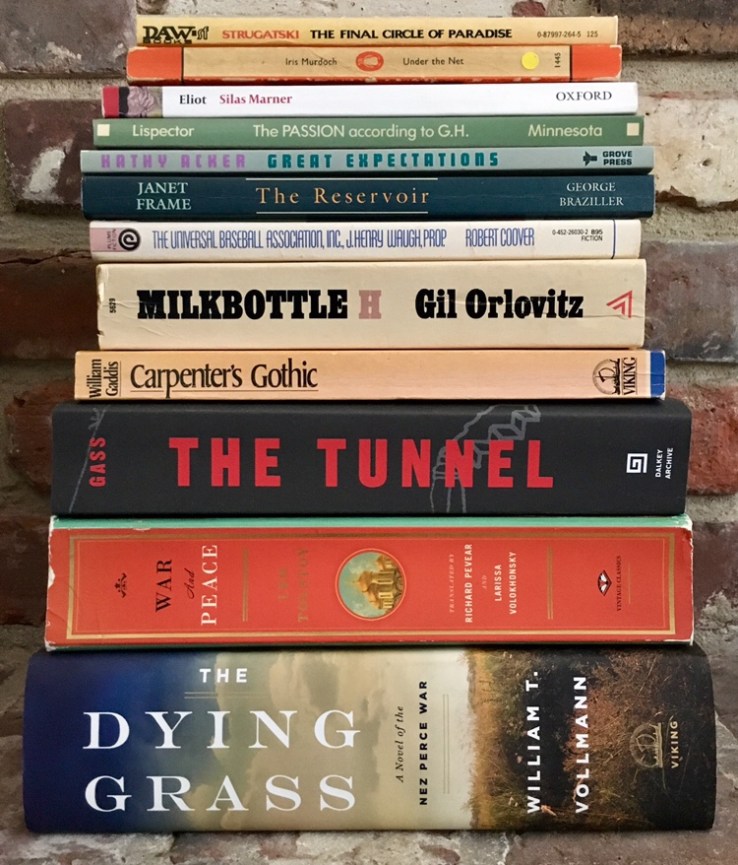
Biblioklept turns twelve today, so here are twelve books I’ll try to read some time in the next twelve years

Biblioklept is twelve today.

Here are twelve books that I’ve never read before that I’ll try to read some time in the next twelve years.

img_1014

From top to bottom, with no real hierarchy other than the physical heft involved in composing the photograph above—

The Final Circle of Paradise by Arkady and Boris Strugatsky (trans. by Leonid Renen)

I snatched up this Daw mass market paperback of this Strugatsky brothers novel a few years ago; they aren’t as easy to find as you might think (although Chicago Review Press is slowly reissuing new translations).

Chance I’ll get to it soon: High. I’ve been on a Strugatsky kick the last two years and this is one that I physically own, so.

The Net by Iris Murdoch

I picked up a slim Penguin edition of The Net when I couldn’t find The Bell (not realizing that the “Iris Murdoch” section extended in my used bookshop and that there were plenty of copies of The Bell). I loved The Bell, and want to read more Murdoch. Folks told me not to do The Net next, but I own it. So maybe let’s call it a placeholder.

Chance I’ll get to it soon: The chance that I get to another Murdoch novel sometime later this year is very high.

Silas Marner by George Eliot

I finally read Middlemarch in 2018. I loved it but good lord it was longSilas Marner is much shorter.

Chance I’ll get to it soon: Very high. It’s on deck after I finish up a few of the shorter novels and short story collections I’m reading now.

The Passion According to G.H. by Clarice Lispector (trans. by Ronald W. Sousa)

Like seemingly every book blogger, I went through a Lispector jag in the early part of this decade, gobbling up The Hour of the Star and Near to the Wild Heart. I had thought that I’d read The Passion According to G.H., but when I pulled it out earlier this year to look for something in it, I realized I hadn’t finished it—I probably hadn’t even gotten a third of the way through, if the idle bookmark (a charming doodle by my daughter) is any indication. Furthermore, the selection I was looking for, a passage on abjection, wasn’t even in Passion—it was in Wild Heart.

Chance I’ll get to it soon: Not extraordinarily high, but it’s unshelved, loose in the wilds now.

Great Expectations by Kathy Acker

I picked this one up a few weeks ago, and started in on it a bit—it’s short and has this kind of dark wild surreal icky sexy beach read vibe to it.

Chance I’ll get to it soon: I should’ve taken it camping with me next week. It’s the kind of book I want to read in a specific place that’s not, like, my couch or whatever. What I’m saying is that I’ll read this on the beach or in a tent or like, maybe you invite me down to stay at your place for a weekend but your house is so full of other guests, but, Guess what? There’s a wonderful little bedroom on your catamaran, which is docked gently right here. So after a night of good wine and good conversation, I’ll sneak off to the catamaran and read Kathy Acker before falling into wavy slumbers.

The Reservoir by Janet Frame 

I read the first few of the stories in The Reservoir a few years ago and loved them but then got absorbed in something else. I was looking for a story by her to use in class, and I pulled this collection out, but it wasn’t in there. I think it’s in The New Yorker though.

Chance I’ll get to it soon: Again–I pulled it out of rotation, so who knows? I’m in the midst of another short story collection (which is frankly turning into a hate read at this point), so maybe a few of these Frames will be an antidote to the Very Clever Author Whose Work I Keep Wincing At.

The Universal Baseball Association, Inc., J. Henry Waugh, Prop. by Robert Coover

When I picked up The Universal Baseball Association, I knew that I wasn’t going to read it anytime soon, but I also knew that I’d regret not having picked up a copy for three bucks when I had the chance. I was finishing up Going for a Beer, Coover’s recent collection of greatest hits, and was frankly exhausted with the man (the stories in A Night at the Movies can, uh, be repetitive).

Chance I’ll get to it soon: Not very high. I downloaded a copy of his novel The Origin of the Brunists one night on a lark and I don’t know if I’ll get to it any time soon either.

Milkbottle H by Gil Orlovitz

A somewhat rare cult novel with no real visible cult, Olrovitz’s Milkbottle H has been described as “the Ulysses of Philadelphia.” I found it a few weeks ago in the miscellaneous O section of my local used bookstore for three bucks. The book is long and seems to employ a mix of modernist techniques that makes it, uh, confusing at first.

Chance I’ll get to it soon: Not high. Right now it’s more like a thing I want to do, but it looks like a project that will require its own special time.

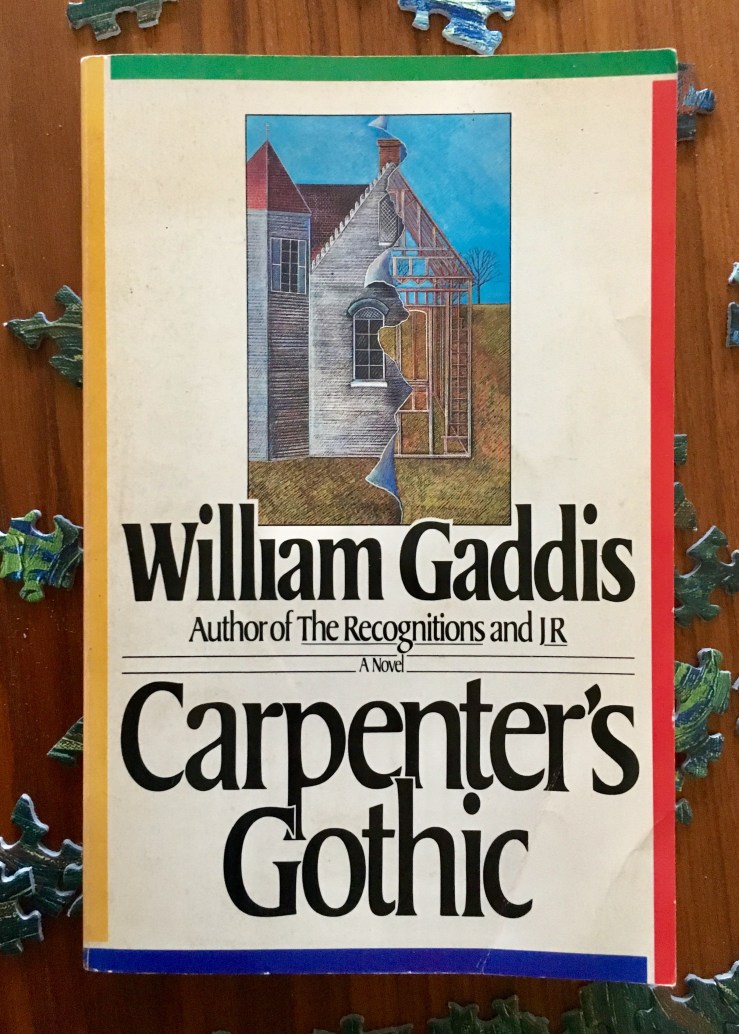
Carpenter’s Gothic by William Gaddis

I hate that I still haven’t gotten past page 30 of Carpenter’s Gothic. I gave it a second shot a few years ago and then wound up rereading J R instead.

Chance I’ll get to it soon: Should I prioritize this one after Silas Marner? I’m sure some new novel/review copy will get in the way, mucking things up…but should I commit to Carpenter’s Gothic? (I recently wrote about wanting to reread The Recognitions, so…).

The Tunnel by William H. Gass

I made a Serious Attempt earlier this year and stalled out.

Chance I’ll get to it soon: I will make a Serious Attempt earlier next year (and likely stall out).

War and Peace by Leo Tolstoy

War and Peace is one of those big books that I can’t believe I haven’t read. Earlier this year I said I’d give it a shot and then I never did (I tried The Tunnel and then settled into Middlemarch).

Chance I’ll get to it soon: Can anyone suggest a good audiobook version?

The Dying Grass by William H. Vollmann

The Dying Grass is almost 1,400 pages. I tried reading the ebook when it came out but the page breaks were weird (Vollmann has a Whitmanesque style on the page). I downloaded the audiobook which is 54 hours long, but I kept losing the thread. I picked up a used copy of the hardback for six bucks and it’s a goddamn monster.

Chance I’ll get to it soon: Try holding your breath.


Camus, Eliot, and Kuper’s Kafka (Books acquired, 31 Aug. 2018)

img_0894

I went to my favorite used bookshop on Friday afternoon to browse, order another Gerald Murnane novel, and pick up a copy of George Eliot’s Silas Marner.

I spied a late fifties mass market copy of Albert Camus’ novel Exile and the Kingdom from Vintage Books. I fell in love with the cover (by George Giusti) and ended up picking it up, although I’ll admit I haven’t read a Camus novel since college (it was The Plague if memory serves).

Browsing copies of Silas Marner, I found this monstrosity:

img_0892

I don’t even know where to start with this cover. I mean, even the colors seem to clash. It doesn’t really come across in the photo, but this hardback has a cheap greasy feel to it. I initially assumed that it was some kind of TV or film tie in, but as far as I can tell…no. Horrifying. I ended up going with the Oxford edition with Ferdinand Hodler’s painting Unemployed on the cover.

When I got home, the mail had come. It included a copy of Peter Kuper’s Kafkaesque, which collects 14 of Kuper’s illustrated Kafka translations. Publisher Norton’s blurb:

Award-winning graphic novelist Peter Kuper presents a mesmerizing interpretation of fourteen iconic Kafka short stories.

Long fascinated with the work of Franz Kafka, Peter Kuper began illustrating his stories in 1988. Initially drawn to the master’s dark humor, Kuper adapted the stories over the years to plumb their deeper truths. Kuper’s style deliberately evokes Lynd Ward and Frans Masereel, contemporaries of Kafka whose wordless novels captured much of the same claustrophobia and mania as Kafka’s tales. Working from new translations of the classic texts, Kuper has reimagined these iconic stories for the twenty-first century, using setting and perspective to comment on contemporary issues like civil rights and homelessness.

Longtime lovers of Kafka will appreciate Kuper’s innovative interpretations, while Kafka novices will discover a haunting introduction to some of the great writer’s most beguiling stories, including “A Hunger Artist,” “In The Penal Colony,” and “The Burrow.” Kafkaesque stands somewhere between adaptation and wholly original creation, going beyond a simple illustration of Kafka’s words to become a stunning work of art.

“Quite an original” (From Herman Melville’s novel The Confidence-Man)

“Quite an original:” A phrase, we fancy, rather oftener used by the young, or the unlearned, or the untraveled, than by the old, or the well-read, or the man who has made the grand tour. Certainly, the sense of originality exists at its highest in an infant, and probably at its lowest in him who has completed the circle of the sciences.

As for original characters in fiction, a grateful reader will, on meeting with one, keep the anniversary of that day. True, we sometimes hear of an author who, at one creation, produces some two or three score such characters; it may be possible. But they can hardly be original in the sense that Hamlet is, or Don Quixote, or Milton’s Satan. That is to say, they are not, in a thorough sense, original at all. They are novel, or singular, or striking, or captivating, or all four at once.

More likely, they are what are called odd characters; but for that, are no more original, than what is called an odd genius, in his way, is. But, if original, whence came they? Or where did the novelist pick them up?

Where does any novelist pick up any character? For the most part, in town, to be sure. Every great town is a kind of man-show, where the novelist goes for his stock, just as the agriculturist goes to the cattle-show for his. But in the one fair, new species of quadrupeds are hardly more rare, than in the other are new species of characters—that is, original ones. Their rarity may still the more appear from this, that, while characters, merely singular, imply but singular forms so to speak, original ones, truly so, imply original instincts.

In short, a due conception of what is to be held for this sort of personage in fiction would make him almost as much of a prodigy there, as in real history is a new law-giver, a revolutionizing philosopher, or the founder of a new religion.

In nearly all the original characters, loosely accounted such in works of invention, there is discernible something prevailingly local, or of the age; which circumstance, of itself, would seem to invalidate the claim, judged by the principles here suggested.

Furthermore, if we consider, what is popularly held to entitle characters in fiction to being deemed original, is but something personal—confined to itself. The character sheds not its characteristic on its surroundings, whereas, the original character, essentially such, is like a revolving Drummond light, raying away from itself all round it—everything is lit by it, everything starts up to it (mark how it is with Hamlet), so that, in certain minds, there follows upon the adequate conception of such a character, an effect, in its way, akin to that which in Genesis attends upon the beginning of things.

For much the same reason that there is but one planet to one orbit, so can there be but one such original character to one work of invention. Two would conflict to chaos. In this view, to say that there are more than one to a book, is good presumption there is none at all. But for new, singular, striking, odd, eccentric, and all sorts of entertaining and instructive characters, a good fiction may be full of them. To produce such characters, an author, beside other things, must have seen much, and seen through much: to produce but one original character, he must have had much luck.

There would seem but one point in common between this sort of phenomenon in fiction and all other sorts: it cannot be born in the author’s imagination—it being as true in literature as in zoology, that all life is from the egg.

From Herman Melville’s novel The Confidence-Man.

Some sentences on some books I’ve read or have been reading

img_0857

I finished Gerald Murnane’s 1982 novel The Plains last week. The Plains is quite short—it’s a novella really—and is divided into three parts. I read Part I in two sittings, gulping down the first-person narrator’s description of an Australia that exists in some alternate universe, where aristocratic plainsmen of Inner Australia keep grand houses populated by every kind of artisan. The novel’s first 70 pages or so move at a brisk pace, brimming with hints of a mythology that Murnane’s narrator keeps always just outside the frame. I read Parts II and III (much shorter than Part I) at a much slower pace. Murnane’s prose condenses here, his sentences tangling out into thick knots of consciousness. I’m still not sure what to make of the novel’s conclusion.

I’m absolutely crawling through Mario Benedetti’s The Truce (in English translation by Harry Morales). Subtitled The Diary of Martín Santomé, this Uruguayan novel is told in lucid prose. Santomé’s journal entries track his day to day life as a man with three children—the youngest approaching adulthood—who was widowed early in life. He’s just now started up a love affair with a younger colleague (an affair that he doesn’t want to call an affair and an affair which I think is like hey a very bad idea, Martin!). It reminds me a bit of John Williams’ novel Stoner. I’ve been reading one or two of the diary entries a day, usually in the morning before I leave for work. It’s a different way to read a book (at least for me anyway).

Herman Melville’s The Confidence-Man is my big re-read right now. I’m having a lot more fun with it the second time. I think the first time taught me how to read it. I’m moving pretty slowly but that’s fine.

I read most of Antoine Volodine’s Post-Exoticism in 10 Lessons, Lesson 11 in two sittings. I want to write a proper review of the novel, or novella, really, or really it’s something besides a novel or novella—anyway, I want to write a proper review on the thing, but I need to go back and finish his novel Minor Angels, which I started earlier in the summer but lost track of (I think I was trying to plow through the end of Eliot’s Middlemarch at the time).

I’ve read the first and third (but not the second) stories in Helen DeWitt’s new collection Some Trick and…I don’t know. There’s a part of me that doesn’t trust my reaction so far. I know that what she’s doing here would’ve flipped any wig I was wearing ten or twelve years ago, but I find myself not particularly persuaded to keep going. I skipped to the third story because it had a bunch of footnotes, a la DF Wallace and that intrigued me. It’s a bit clever, yes?

I’ve only read two of the stories in Tadao Tsuge’s collection of “alternative manga” (mostly from the sixties and seventies) Slum Wolf (in English translation by Ryan Holmberg), but there’s definitely a different flavor here—rough, weird, and a bit chilling. I hope to post a review of Slum Wolf at The Comics Journal next month.

Not pictured above because I read it on an iPad: The first two chapters of Anders Nilsen’s graphic novel Tongues, which is a loose retelling of the story of Prometheus and a few other myths (maybe). There’s a lot going on it. The art is gorgeous—a bit reminiscent of Geof Darrow, but more not as sprawly. Again, I hope to do a review at TCJ soon on these.

img_0635

Also not pictured because also an e-book: Provisional Biography of Mose Eakins, a two-act play by Evan Dara. You can download the play here without paying upfront: The site instead gives this somewhat cryptic message on payment: “If you please, reciprocation accepted only after reading. Thank you.” The message actually makes sense after you’ve read the play, which is very much about paying for language—literally utterances as commodities. Mose Eakins is “imparlent” — he cannot communicate with those around him. The play is often funny, but also very sad, and it’s impossible not to read it as an allegory for the limitations of real communication in the age of late capitalism. I read it all at once last night. Speaking of which, I need to reciprocate now.


What fictional character would Italo Calvino like to be?

Mercutio. Among his virtues, I admire above all his lightness in a world of brutality, his dreaming imagination – as the poet of Queen Mab – and at the same time his wisdom, as the voice of reason amid the fanatical hatreds of Capulets and Montagues. He sticks to the old code of chivalry at the price of his life, perhaps just the sake of style, and yet he is a modern man, skeptical and ironic – a Don Quixote who knows very well what dreams are and what reality is, and he lives both with open eyes.

From The New York Times 1985 obituary of Italo Calvino. The obituary is here citing an interview Calvino did with The New York Times Book Review in late 1984.

The Reader — Edouard Manet

25c32589douard2bmanet2bart2b25281092529

The Reader, 1861 by Edouard Manet (1832-1883)

Read “The Policemen’s Ball,” a short story by Donald Barthelme

“The Policemen’s Ball”

by

Donald Barthelme


Horace, a policeman, was making Rock Cornish Game Hens for a special supper. The Game Hens are frozen solid, Horace thought. He was wearing his blue uniform pants.

Inside the Game Hens were the giblets in a plastic bag. Using his needlenose pliers Horace extracted the frozen giblets from the interior of the birds. Tonight is the night of the Policemen’s Ball, Horace thought. We will dance the night away. But first, these Game Hens must go into a three-hundred-and-fifty-degree oven.

Horace shined his black dress shoes. Would Margot “put out” tonight? On this night of nights? Well, if she didn’t– Horace regarded the necks of the birds which had been torn asunder by the pliers. No, he reflected, that is not a proper thought. Because I am a member of the force. I must try to keep my hatred under control. I must try to be an example for the rest of the people. Because if they can’t trust us. . .the blue men. . .

In the dark, outside the Policemen’s Ball, the horrors waited for Horace and Margot.

Margot was alone. Her roommates were in Provincetown for the weekend. She put pearl-colored lacquer on her nails to match the pearl of her new-bought gown. Police colonels and generals will be there, she thought. The Pendragon of the Police himself. Whirling past the dais, I will glance upward. The pearl of my eyes meeting the steel gray of high rank.

Margot got into a cab and went over to Horace’s place. The cabdriver was thinking: A nice-looking piece. I could love her.

Horace removed the birds from the oven. He slipped little gold frills, which has been included in the package, over the ends of the drumsticks. Then he uncorked the wine, thinking: This is a town without pity, this town. For those whose voices lack the crack of authority. Luckily the uniform. . . Why won’t she surrender her person? Does she think she can resist the force? The force of the force?

“These birds are delicious.”

Driving Horace and Margot smoothly to the Armory, the new cabdriver thought about basketball.

Why do they always applaud the man who makes the shot?

Why don’t they applaud the ball?

It’s the ball that actually goes into the net.

The man doesn’t go into the net.

Never have I seen a man going into the net.

Twenty thousand policemen of all grades attended the annual fete. The scene was Camelot, with gay colors and burgees. The interior of the Armory had been roofed with lavish tenting. Police colonels and generals looked down on the dark uniforms, white gloves, silvery ball gowns.

“Tonight?”

“Horace, not now. This scene is so brilliant. I want to remember it.”

Horace thought: It? Not me?

The Pendragon spoke. “I ask you to be reasonable with the citizens. They pay our salaries after all. I know they are difficult sometimes, obtuse sometimes, even criminal sometimes, as we often run across in our line of work. But I ask you despite all to be reasonable. I know it is hard. I know it is not easy. I know that for instance when you see a big car, a ’70 Biscayne hardtop, cutting around a corner at a pretty fair clip, with three in the front and three in the back, and they are all mixed up, ages and sexes and colors, your natural impulse is to– I know your first thought is, All those people! Together! And your second thought is, Force! But I must ask you in the name of force itself to be restrained. For force, that great principle, is most honored in the breach and the observance. And that is where you men are, in the breach. You are fine men, the finest. You are Americans. So for the sake of America, be careful. Be reasonable. Be slow. In the name of the Father and the Son and of the Holy Ghost. And now I would like to introduce Vercingetorix, leader of the firemen, who brings us a few words of congratulation from that fine body of men.”

Waves of applause for the Pendragon filled the tented area.

“He is a handsome older man,” Margot said.

“He was born in a Western state and advanced to his present position through raw merit,” Horace told her.

The government of Czechoslovakia sent observers to the Policemen’s Ball. “Our police are not enough happy,” Colonel-General Cepicky explained. “We seek ways to improve them. This is a way. It may not be the best of all possible ways, but. . . Also I like to drink the official whiskey! It makes me gay!”

A bartender thought: Who is that yellow-haired girl in the pearl costume? She is stacked.

The mood of the Ball changed. The dancing was more serious now. Margot’s eyes sparkled from the jorums of champagne she had drunk. She felt Horace’s delicately Game Hen-flavored breath on her cheek. I will give him what he wants, she decided. Tonight. His heroism deserves it. He stands between us and them. He represents what is best in society: decency, order, safety, strength, sirens, smoke. No, he does not represent smoke. Great billowing oily black clouds. That Vercingetorix has a noble look. With whom is Vercingetorix dancing, at present?

The horrors waited outside patiently. Even policemen, the horrors thought. We get even policemen, in the end.

In Horace’s apartment, a gold frill was placed on a pearl toe.

The horrors had moved outside Horace’s apartment. Not even policemen and their ladies are safe, the horrors thought. No one is safe. Safety does not exist. Ha ha ha ha ha ha ha ha ha ha!

Novels by Acker, Orlovitz, and Murnane (Books acquired 1 and 6 Aug. 2018)

img_0786-1

I went by my favorite used bookshop to purge a bunch of books I’ll never read again and order Gerald Murane’s 1982 novel The Plains. I had finished most of Murnane’s collection Stream System, leaving only the longest story in the collection (“Velvet Waters”) unread.

I browsed the store a bit too, of course, and found a used copy of Kathy Acker’s Great Expectations, which I’ve never read. Years ago, this particular book store had almost every Acker book used and I didn’t pick any up, which I’ve regretted for awhile. So.

I also picked up Gil Orlovitz’s 1967 novel Milkbottle H, which I’d never heard of until I saw @PierreMenard tweet about it last month—

The book is 500+ pages. I found the first 10 utterly bewildering. You can read more about Milkbottle H here.

My copy of The Plains came in a few days later so my son and I went and picked it up (he got an Asterix comic). I read Part I this week and really got a strange thrill out of it. The Plains is a kind of speculative fiction with mythological touches. The slim novel reimagines an Australia the plainsmen of the interior define themselves (aesthetically, above all else) against the coastal areas of “Outer Australia.” The narrator is a (would-be) film director who wants to a make a movie called The Interior that will capture the essence of the plains (a task that is plainly impossible). The Plains is a very strange and I’m really digging it so far.