(Another) Moby-Dick (Book acquired, 26 March 2018)

img_9433

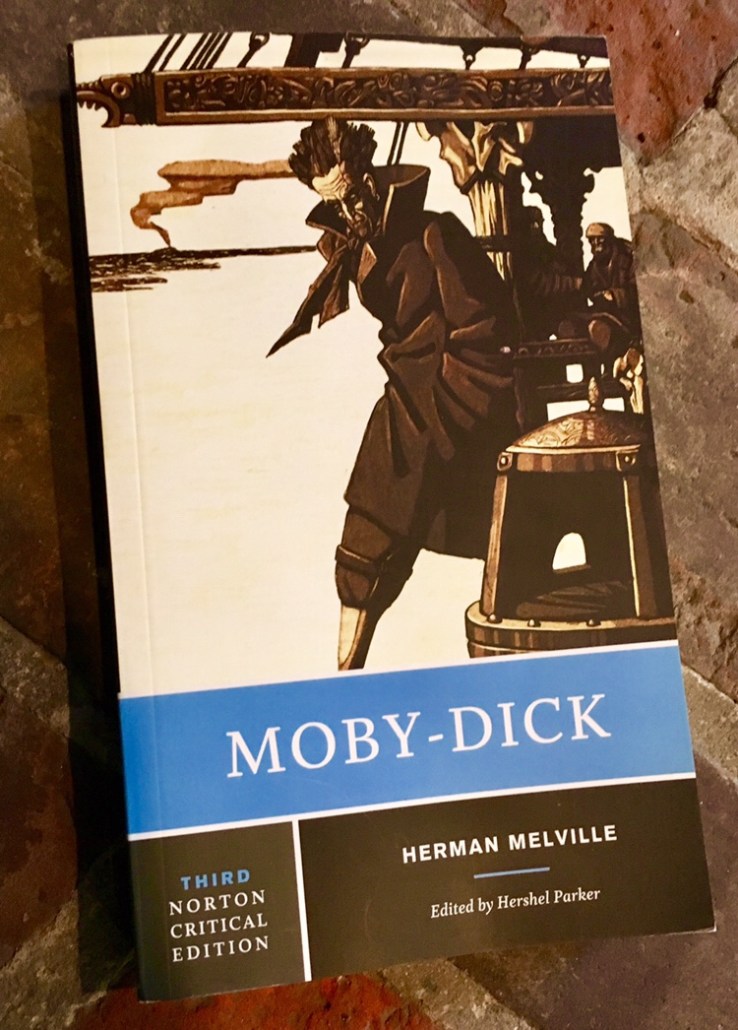
While I wasn’t thrilled to return to work after a pleasant Spring Break, I was very happy to find a copy of Herman Melville’s Moby-Dick in the campus mail today. A Norton book rep visited our campus before the break and asked what my favorite book was. It was kind of her to send me their new critical edition.

I wrote a post almost five years ago about the various versions of Moby-Dick that I’ve accumulated (including a Norton Critical Edition). Since that post, I’ve picked up two more illustrated children’s versions, another comic book version, as well as an edition illustrated by Barry Moser. I will almost certainly reread the book this year.

You tell a story because a statement would be inadequate (Flannery O’Connor)

When you can state the theme of a story, when you can separate it from the story itself, then you can be sure the story is not a very good one. The meaning of a story has to be embodied in it, has to be made concrete in it. A story is a way to say something that can’t be said any other way, and it takes every word in the story to say what the meaning is. You tell a story because a statement would be inadequate. When anybody asks what a story is about, the only proper thing is to tell him to read the story. The meaning of fiction is not abstract meaning but experienced meaning, and the purpose of making statements about the meaning of a story is only to help you experience that meaning more fully.

From Flannery O’Connor’s essay “Writing Short Stories.” Collected in Mystery and Manners.

Here was something which her consciousness could not wretchedly devour | From Iris Murdoch’s novel The Bell

the-painter-s-daughters-chasing-a-butterfly-1759
The Painter’s Daughters Chasing a Butterfly, c. 1756, Thomas Gainsborough

Dora had been in the National Gallery a thousand times and the pictures were almost as familiar to her as her own face. Passing between them now, as through a well-loved grove, she felt a calm descending on her. She wandered a little, watching with compassion the poor visitors armed with guide books who were peering anxiously at the masterpieces. Dora did not need to peer. She could look, as one can at last when one knows a great thing very well, confronting it with a dignity which it has itself conferred. She felt that the pictures belonged to her, and reflected ruefully that they were about the only thing that did. Vaguely, consoled by the presence of something welcoming and responding in the place, her footsteps took her to various shrines at which she had worshipped so often before: the great light spaces of Italian pictures, more vast and southern than any real South, the angels of Botticelli, radiant as birds, delighted as gods, and curling like the tendrils of a vine, the glorious carnal presence of Susanna Fourment, the tragic presence of Margarethe Trip, the solemn world of Piero della Francesca with its early-morning colours, the enclosed and gilded world of Crivelli. Dora stopped at last in front of Gainsborough’s picture of his two daughters. These children step through a wood hand in hand, their garments shimmering, their eyes serious and dark, their two pale heads, round full buds, like yet unlike.

Dora was always moved by the pictures. Today she was moved, but in a new way. She marvelled, with a kind of gratitude, that they were all still here, and her heart was filled with love for the pictures, their authority, their marvellous generosity, their splendour. It occurred to her that here at last was something real and something perfect. Who had said that, about perfection and reality being in the same place? Here was something which her consciousness could not wretchedly devour, and by making it part of her fantasy make it worthless. Even Paul, she thought, only existed now as someone she dreamt about; or else as a vague external menace never really encountered and understood. But the pictures were something real outside herself, which spoke to her kindly and yet in sovereign tones, something superior and good whose presence destroyed the dreary trance-like solipsism of her earlier mood. When the world had seemed to be subjective it had seemed to be without interest or value. But now there was something else in it after all.

These thoughts, not clearly articulated, flitted through Dora’s mind. She had never thought about the pictures in this way before; nor did she draw now any very explicit moral. Yet she felt that she had had a revelation. She looked at the radiant, sombre, tender, powerful canvas of Gainsborough and felt a sudden desire to go down on her knees before it, embracing it, shedding tears.

From Iris Murdoch’s novel The Bell.

Books acquired, 15 March 2018

img_9396

Our campus library had a few tables piled down with books—mostly ones that came through donations, but also some discards. I tried not to be too greedy and snapped up these five. Virginia Woolf’s A Writer’s Diary was the one I was probably most interested in, as well as John Gardner’s , which I’ve read parts of before. Colette has always struck me as one of those authors whose prolific output is daunting, and I’m not sure if her Claudine novels are the best place to start…but…free book. Hellman’s memoir of her HUAC testimony, Scoundrel Time, interested me with its simple, dynamic cover. And I’ve wanted to read more Lessing since The Golden Notebook. I’m not sure if I’ll get to any of these soon, but again…free books. 

A passage from (and a short riff on) Iris Murdoch’s The Bell

img_9112

Dora got into the train. It was now very full indeed and people were sitting four a side. Before she sat down she inspected herself quickly in the mirror. In spite of all her awful experiences she looked good. She had a round well-formed face and a large mouth that liked to smile. Her eyes were a dark slaty blue and rather long and large. Art had darkened but not thinned her vigorous triangular eyebrows. Her hair was golden brown and grew in long flat strips down the side of her head, like ferns growing down a rock. This was attractive. Her figure was by no means what it had been.

She turned towards her seat. A large elderly lady shifted a little to make room. Feeling fat and hot in the smart featureless coat and skirt which she had not worn since the spring, Dora squeezed herself in. She hated the sensation of another human being wedged against her side. Her skirt was very tight. Her high-heeled shoes were tight too. She could feel her own perspiration and was beginning to smell that of others. It was a devilish hot day. She reflected all the same that she was lucky to have a seat, and with a certain satisfaction watched the corridor fill up with people who had no seats.

Another elderly lady, struggling through the crush, reached the door of Dora’s carriage and addressed her neighbour. ‘Ah, there you are, dear, I thought you were nearer the front.’ They looked at each other rather gloomily, the standing lady leaning at an angle through the doorway, her feet trapped in a heap of luggage. They began a conversation about how they had never seen the train so full. Dora stopped listening because a dreadful thought had struck her. She ought to give up her seat. She rejected the thought, but it came back. There was no doubt about it. The elderly lady who was standing looked very frail indeed, and it was only proper that Dora, who was young and healthy should give her seat to the lady who could then sit next to her friend. Dora felt the blood rushing to her face. She sat still and considered the matter. There was no point in being hasty. It was possible of course that while clearly admitting that she ought to give up her seat she might nevertheless simply not do so out of pure selfishness. This would in some ways be a better situation than what would have been the case if it had simply not occurred to her at all that she ought to give up her seat. On the other side of the seated lady a man was sitting. He was reading his newspaper and did not seem to be thinking about his duty. Perhaps if Dora waited it would occur to the man to give up his seat to the other lady? Unlikely. Dora examined the other inhabitants of the carriage. None of them looked in the least uneasy. Their faces, if not already buried in books, reflected the selfish glee which had probably been on her own a moment since as she watched the crowd in the corridor. There was another aspect to the matter. She had taken the trouble to arrive early, and surely ought to be rewarded for this. Though perhaps the two ladies had arrived as early as they could? There was no knowing. But in any case there was an elementary justice in the first comers having the seats. The old lady would be perfectly all right in the corridor. The corridor was full of old ladies anyway, and no one else seemed bothered by this, least of all the old ladies themselves! Dora hated pointless sacrifices. She was tired after her recent emotions and deserved a rest. Besides, it would never do to arrive at her destination exhausted. She regarded her state of distress as completely neurotic. She decided not to give up her seat.

She got up and said to the standing lady ‘Do sit down here, please. I’m not going very far, and I’d much rather stand anyway.’

‘How very kind of you!’ said the standing lady. ‘Now I can sit next to my friend. I have a seat of my own further down you know. Perhaps we can just exchange seats? Do let me help you to move your luggage.’

Dora glowed with delight. What is sweeter than the unhoped-for reward for the virtuous act?

From Iris Murdoch’s 1958 novel The Bell.

Iris Murdoch’s novel The Bell hooked me with its astonishing opening sentences: “Dora Greenfield left her husband because she was afraid of him. She decided six months later to return to him for the same reason.”

Those two simple, precise sentences foreground one of the major conflicts of The Bell, and also point towards the novel’s anxiety/comedy axis. There’s a comic beat to Murdoch’s rhythm that, paradoxically, simultaneously belies and highlights the terror under those two sentences. The rest of The Bell’s first chapter fills in the gaps between sentence one and sentence two, detailing the relationship between young Dora and her older husband Paul. The details of their troubled marriage reverberate with the same radical ambiguity we see in the first two sentences, a constant push-pull of desire and repulsion.

What’s most compelling for me here is Murdoch’s command of irony and free indirect speech. Murdoch inhabits Dora’s consciousness in a way that shows how the conflict between thought and emotion germinates, mutates, terminates, and often blooms into actions quite divorced from initial intention or desire. When Paul decides to send his departed wife an “allowance,” we get a wonderful syntactic example of how Murdoch captures the ambiguous disjunctions of thought and action: “Dora decided to refuse the money but accepted it.” Murdoch gives us one complete thought here, tacking on the key idea (“but accepted it”) in a dependent clause.

The long passage I’ve excerpted above (part of Chapter One, by the way) shows the same disjunction of thought and action, but at greater length. Not only did it make me laugh aloud, it also made me recognize part of myself in Dora—the extreme social anxiety, the narcissistic sense that others do not see what is happening within a social setting, the sense of selfish entitlement, etc.

The punchline in the episode is worth repeating: “She decided not to give up her seat. She got up and said to the standing lady ‘Do sit down here, please. I’m not going very far, and I’d much rather stand anyway.'” But that punchline is followed by a second punchline—the woman already has a seat. The episode culminates in a kind of callow but sincere moral victory.

I’m about half way through The Bell right now and loving it. As Murdoch layers the novel with perspective characters other than Dora, the overall picture gains depth, breadth, and complexity. Her sentences convey a psychological complexity that seems both raw and truthful, and yet those sentences are polished, refined, and quite funny. More thoughts to come.

The Big Love (Book acquired, 13 March 2018)

img_9237

Uh….

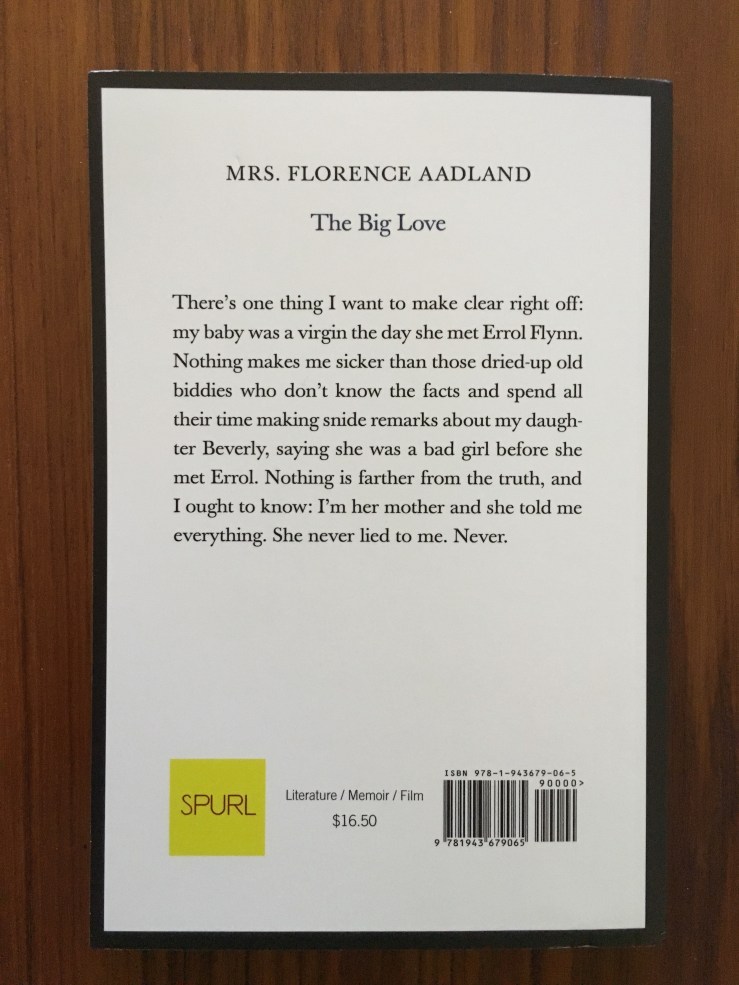
This one looks like a fascinating case of memoir-as-fiction. Florence Aadland’s The Big Love is new from Spurl. Here’s the back cover:

img_9239

And here’s Spurl’s blurb:

The Big Love is a Hollywood nightmare. It tells the story of Errol Flynn – a fading, alcoholic movie star – and the underage dancer-actress Beverly Aadland. The narrator? Beverly Aadland’s fame-worshiping mother Mrs. Florence Aadland, who spurs the relationship on. There is nothing subtle or sympathetic about this memoir: It is outrageous, grotesque, surreal, notorious – an intimate look at Hollywood exploitation and decay.

On the one hand, The Big Love depicts the deterioration of Errol Flynn, an actor who is quickly losing relevance after years of playing irresistible swashbucklers in films such as Captain Blood (1935) and The Adventures of Robin Hood (1938). He is riddled with medical problems, drinking himself to death. On the other hand, there is Mrs. Florence Aadland, also an alcoholic, an uncultured stage mother psychotically pushing her daughter Beverly forward even at the cost of her own marriage.

A bizarre, seedy time capsule of the 1950s, The Big Love is the long-lost literary sister of Barbara Payton’s I Am Not Ashamed. After languishing out of print for years, it is ready to shock brand new audiences with its absurd humor, villainous characters, and sickly dissipation.

Mrs. Florence Aadland was born on September 21, 1909, in Van Zandt County, Texas. She moved to Southern California and subsequently lost her right foot in a car accident. She married bartender Herbert Aadland and gave birth to her daughter Beverly on September 16, 1942, in Los Angeles. The affair between her adolescent daughter and actor Errol Flynn became tabloid news with his death from a heart attack on October 14, 1959. Her account of the relationship between her daughter and Errol Flynn, The Big Love, was “told to” writer Tedd Thomey and originally published in 1961. Mrs. Aadland died from alcohol-related causes in a Los Angeles hospital on May 10, 1965, at the age of fifty-five.

A review of Stanisław Ignacy Witkiewicz’s Narcotics

dvsfm7rvwaaoolo

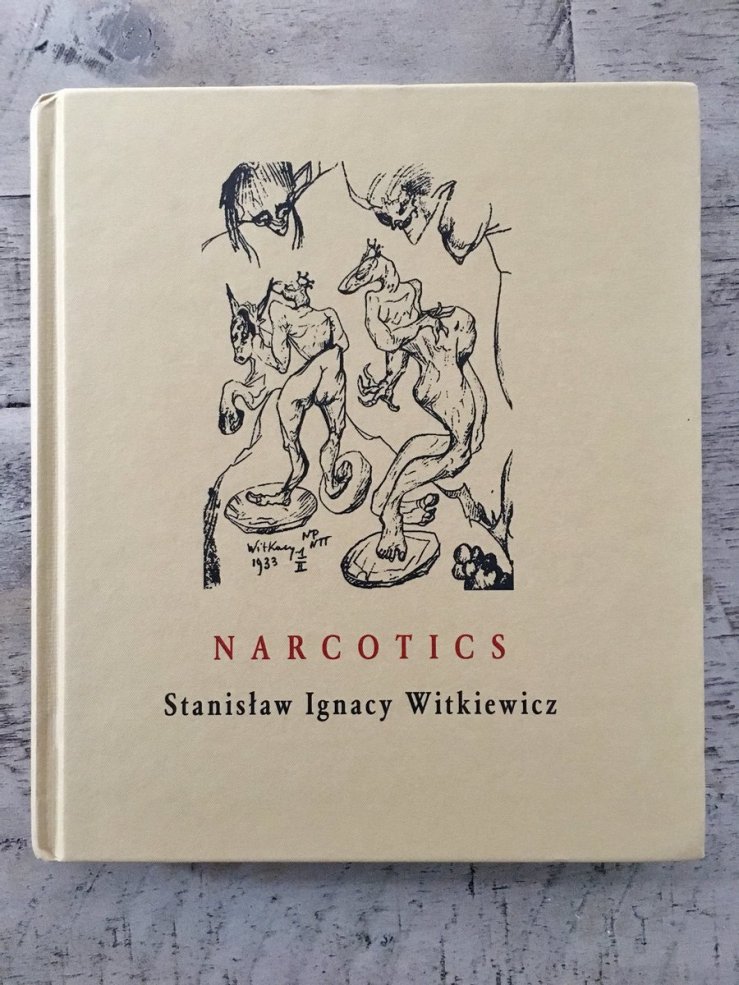
“The main difficulty with Stanisław Ignacy Witkiewicz,” writes Soren Gauger in his translator’s note for Narcotics, “is that no matter what he was writing, it seems he wished he were writing something else.” Witkiewicz’s playful (and occasionally frustrating) discursive style is on vivid display in the six essays that comprise most of Narcotics (new in hardback from Twisted Spoon Press)Witkiewicz’s stylistic twists are one of the joys of Narcotics. A moralizing diatribe might veer into medical discourse; private anecdotes might shift into a rant on class theory or a patchy precis of a book about physiognomy. (All delivered in a semi-ironic-yet-wholly-sincere tone). In the case of Witkiewicz’s essay “Peyote,” we go from “Elves on a seesaw. (Comedic number)” to “A battle of centaurs turned into a battle between fantastical genitalia.” This last note is preceded by the observation that “Goya must have known about peyote.”

img_9138

“Peyote” is the most vivid and surreal of the essays in Narcotics. Unlike the other sections, this chapter most closely resembles a conventional drug diary. “Peyote” begins with Witkiewicz taking his first of seven (!) peyote doses at six in the evening and culminating around eight the following morning with “Straggling visions of iridescent wires.” In increments of about 15 minutes, Witkiewicz notes each of his surreal visions. The wild hallucinations are rendered in equally surreal language: “Mundane disumbilicalment on a cone to the barking of flying canine dragons” here, “The birth of a diamond goldfinch” there. Gauger’s translation conveys not just the wild imagery, but also the wild linguistic spirit of Witkiewicz’s prose.

img_9142

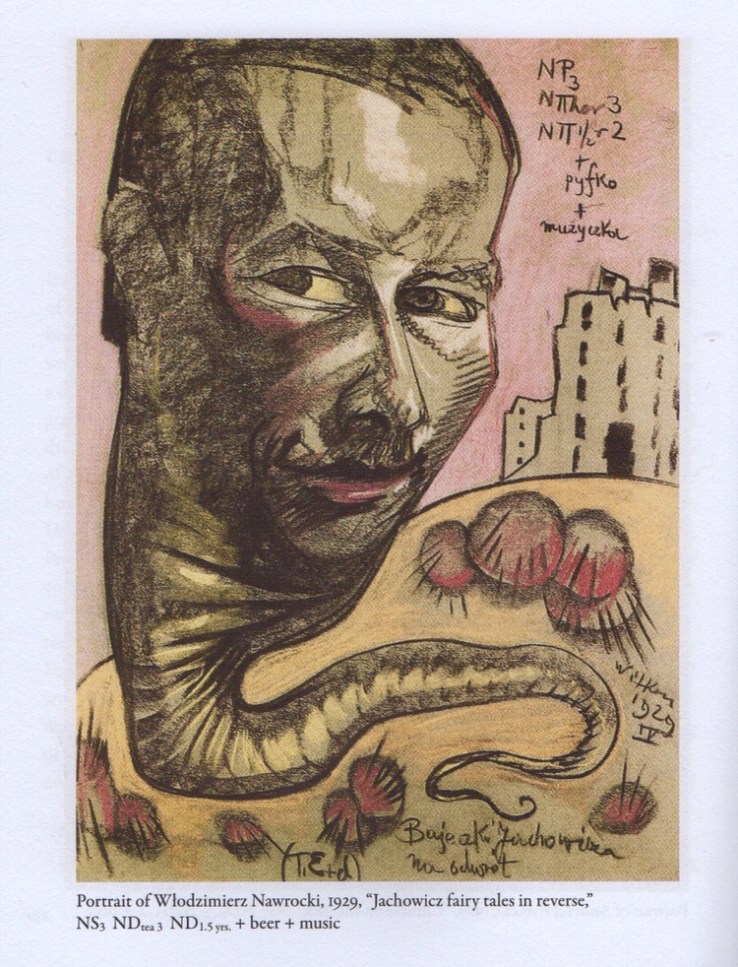
The prose in “Peyote” most closely approximates the spirit of Witkiewicz’s wonderful paintings. Narcotics includes 34 full-color reproductions of Witkiewicz’s art, which is reason enough to pick up this volume. According to Narcotics’ blurb, Witkiewicz (or Witkacy as he is commonly known) “established rules and types for his portrait work, marking the paintings and pastels with corresponding symbols and abbreviations of the substances he had either taken or, in the case of alcohol and nicotine, not taken at the time.”

For example, we see that Witkiewicz has noted that he had ingested cocaine and eucodal (a semi-synthetic opioid) in order to paint the Portrait of Michal Jagodowski (below). Narcotics includes a helpful “List of Symbols” as a glossary for the shorthand Witkiewicz used both in the text of his writings and in his paintings. (Although “her (herbata): tea” is included in the gloss, this vice regretfully does not merit its own essay).

img_9139

In addition to peyote, we get essays on nicotine, alcohol, cocaine, morphine, and ether (a list that may remind you of a certain Queens of the Stone Age jam). In “Nicotine,” Witkiewicz despairs that “A person deadened by tobacco and alcohol…seeks even more mind-numbing entertainment to relax,” whether that be the “utterly depraved cinema with its vacuous attempts at artistry,” or the “sensory narcotization through music” achieved by “station surfing” on the radio. (Even worse is “chronic and brainless dancing, that most monstrous of modern society’s unacknowledged plagues”).

In “Alcohol,” Witkiewicz concedes that “alcohol lets you perform actions at a particular moment that otherwise would not have been possible right then,” before launching into a sustained attack on alcohol as a creative crutch. His most convincing (and depressing) line here is “alcohol is boring. Anyone who has abused it even mildly knows this to be true.” (If this were a different sort of review, I might riff here a bit on the fact that I drank no fewer than three glasses of Cabernet Sauvignon while writing about Narcotics).

Witkiewicz, despite his exorbitant indulgences, is a bit of a snob—a modernist snob though. From frenzied, enthusiastic experience he warns us that “cocaine is one of the worst kinds of filth,” before plugging his cocaine novel Farewell to Autumn and offering a synopsis of one of the novel’s chapters, a so-called “cocaine orgy.” (The editors of Narcotics graciously include a brief selection from Farewell to Autumn, as well as additional essays by Witkiewicz on hygiene and other matters).

In the last two essays, Wietkiewicz hands the reins over to friends (designated drivers?). In “Morphine,” Bohdan Filipowski warns that, “before you can taste the sweets of narcotic paradises you must first be miserable, you must first travel through all manner of hell and suffering in life, only then to find yourself in addled stupefaction, which ultimately is all there is.” The essay “Ether” — a drug that packs a “powerful metaphysical wallop” is attributed to “Dr. Dezydery Prokopowicz,” a pseudonym for Wietkiewicz’s friend, poet Stefan Glass.

img_9141

The admonition that “before you can taste the sweets of narcotic paradises you must first be miserable” is pretty much the thesis for Narcotics, a book that simultaneously celebrates and reviles drug use. Misery is the byword here, a word we find repeated in in Henri Michaux’s 1956 collection Miserable Miracle. Published a quarter century after Narcotics, the two volumes share much in common. Too, Narcotics picks up some of the threads that we find in Thomas De Quincey’s Confessions of an English Opium-Eater(1821)–that foregrounding of suffering, even if it also anticipates the (exhaustive) drug literature of the 1960s, which wasn’t nearly so reticent about banging the narcotic gong. And yet Witkiewicz seems to wink at us through all the moralizing and apologia, suggesting that, yes, narcotics, are, like, bad—they are a crutch, a shortcut, a substitute for true artistic inspiration—but he also shows how utterly modern the process of consuming mind-and-body-altering substances is. Witkiewicz comprehends the dangers of narcotics. He’s out there on the ledge, dancing around a bit, his foot wagging over the precipice, while he grins and says, “Hey, don’t try this at home.”

Try this at home. Stanisław Ignacy Witkiewicz’s Narcotics, translated from the Polish by Soren Guager is new in hardback from Twisted Spoon Press. Just Say Yes.

Max Frisch’s Bluebeard (Book acquired, 3 March 2018)

img_9131

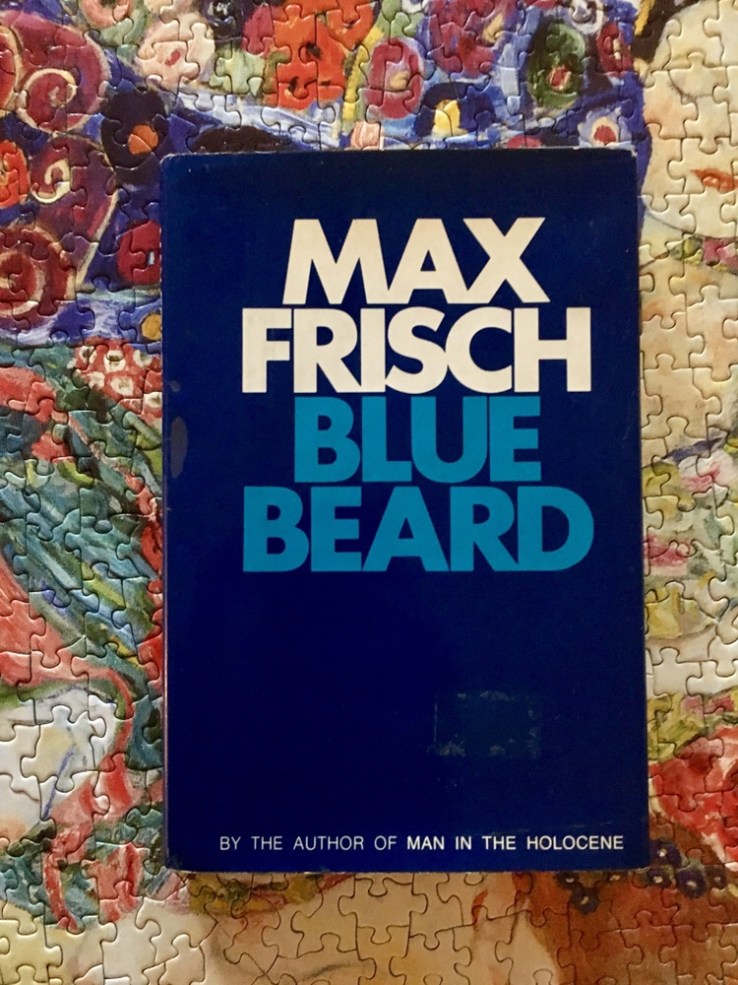
When I saw a hardback copy of Max Frisch’s 1982 novel Bluebeard (in English translation by Geoffrey Skeleton) the other week at my favorite used bookstore, I picked it up and started reading. I loved the cover and was attracted by its slimness—under 150 pages and written almost entirely in Beckettian dialog—but more than anything it was the title. Is it creepy to admit that I have a slight obsession with the Bluebeard narrative? Yes? Chalk it up to a formative memory: When I was around five, a cousin, ten years older than I am, read an illustrated book of Charles Perrault fairy tales to me to tuck me in one night. He read read a few before getting to “Bluebeard,” a story both he and I were unfamiliar with. I know he didn’t know the story because I can vividly recall the shock it produced in him as it progressed, the sense of horror. I remember that he kept going through the story even after the awful violent secret at its core was revealed, simply in the hope that some kind of justice might happen. I remember him telling me, “That wasn’t a children’s story.” He’s right, of course—sample a few paragraphs from Andrew Lang’s translation of Perrault’s version:

Having come to the closet door, she made a stop for some time, thinking about her husband’s orders, and considering what unhappiness might attend her if she was disobedient; but the temptation was so strong that she could not overcome it. She then took the little key, and opened it, trembling. At first she could not see anything plainly, because the windows were shut. After some moments she began to perceive that the floor was all covered over with clotted blood, on which lay the bodies of several dead women, ranged against the walls. (These were all the wives whom Blue Beard had married and murdered, one after another.) She thought she should have died for fear, and the key, which she, pulled out of the lock, fell out of her hand.

After having somewhat recovered her surprise, she picked up the key, locked the door, and went upstairs into her chamber to recover; but she could not, so much was she frightened. Having observed that the key to the closet was stained with blood, she tried two or three times to wipe it off; but the blood would not come out; in vain did she wash it, and even rub it with soap and sand. The blood still remained, for the key was magical and she could never make it quite clean; when the blood was gone off from one side, it came again on the other.

It wasn’t so much the story but an older person’s reaction to the story that impacted me so much. I’m not sure if the book included an illustration that pertains to the images above, but I know that I remember an image of the scene, perhaps one I conjured all by myself—of a closet full of corpses.

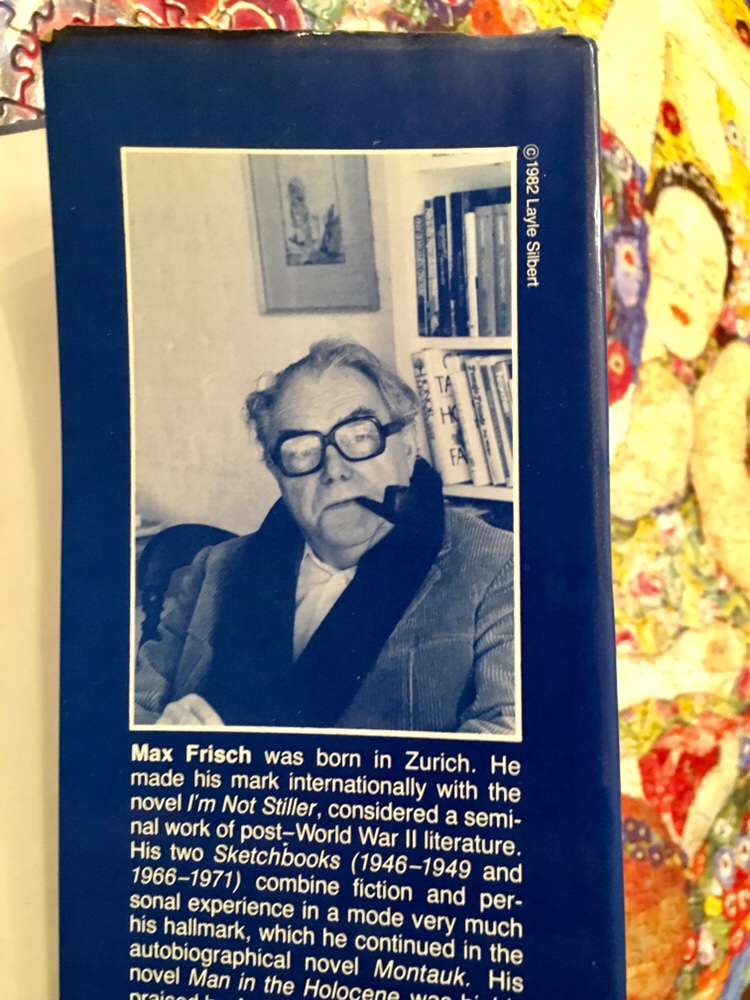
The Bluebeard story seems to have largely fallen out of the canon of children’s “fairy tales”; it’s one of those stories that I remember trying to bring up to others as a reference point when I was young. The reference never seemed to land. My students have no knowledge of it. And yet it’s still soaked into the culture—the recent film Ex Machina was a take on Bluebeard, and elements of HBO’s Westworld also allude to the tale. Over the years I’ve read plenty of versions of the story: Kurt Vonnegut’s Bluebeard, Donald Barthelme’s “Bluebeard,” Edna St. Vincent Millay’s “Bluebeard,” Anne Sexton’s “The Golden Key,” Angela Carter’s “The Bloody Chamber,” Margaret Atwood’s “Bluebeard’s Egg” — but I’d never heard of Max Frisch’s until I saw it in the store the other day. I didn’t pick it up then—I was committed to getting and reading Iris Murdoch’s The Bell, and I didn’t want to pile up too many books—but the blue cover wormed around in the back of my brain and I gave in the other day. Plus, dig this author photo:

Instead of the blurb, here are a few paragraphs from Richard Gilman’s contemporary review in The New York Times:

“Bluebeard” is an extremely short “tale,” as Mr. Frisch calls it, even shorter than “Man in the Holocene.” Like Samuel Beckett, Mr. Frisch seems to be paring away his stock of expressiveness, moving toward a purer means as he nears his mid-70’s. The book is made up in large part of remembered excerpts from the transcript of a fictional murder trial, interspersed with remarks, comments and reflections by the accused man.

He is a 54-year old Zurich physician named Felix Schaad, who was charged with strangling one of his former wives with a necktie. She had been the sixth of his seven wives, and after their divorce, she had become a high-priced call girl whom he would sometimes visit, although apparently not for sexual purposes. At the time of her murder, Schaad had been married for a year to his seventh wife, and it was she who gave him the nickname Bluebeard, as a term of endearment. “He once said that he already had six wives in the cellar,” she said on the witness stand.

The press had siezed on this bit of testimony. The doctor remembers the headlines – “NO ALIBI FOR SCHAAD/BLUEBEARD IN COURT/DOCTOR’S SEVEN MARRIAGES” – and recalls how “I looked it up in the library: the tale of the knight who had killed his seven wives and concealed their corpses in the cellar was written by a Frenchman, Charles Perrault, in the seventeenth century.”

Hell is the place we don’t know we’re in (Don DeLillo)

“Singh remarked to me once, his conspiratorial aspect, fixing those flat heavy eyes on me, ‘Hell is the place we don’t know we’re in.’ I wasn’t sure how to take the remark. Was he saying that he and I were in hell or that everyone else was? Everyone in rooms, houses, chairs with armrests. Is hell a lack of awareness? Once you know you’re there, is this your escape? Or is hell the one place in the world we don’t see for what it is, the one place we can never know? Is that what he meant? Is hell what we say to each other or what we can’t say, what is beyond our reach? The sentence defeated me. I was afraid of the desert but drawn to it, drawn to the contradiction. Men will come to fill this empty place. This place is empty in order that men may rush in to fill it.”

From Don DeLillo’s novel The Names.

“In other words, I stole from a kid” | Don DeLillo and Atticus Lish

Like ”Ratner’s Star,” a book in which Mr. DeLillo says he tried to ”produce a piece of mathematics,” ”The Names” is complexly structured and layered. It concludes with an excerpt from a novel in progress by Axton’s 9-year-old son, Tap. Inspiration for the ending came from Atticus Lish, the young son of Mr. DeLillo’s friend Gordon Lish, an editor.

”At first,” Mr. DeLillo says, ”I had no intention of using excerpts from Tap’s novel. But as the novel drew to a close I simply could not resist. It seemed to insist on being used. Rather than totally invent a piece of writing that a 9-year-old boy might do, I looked at some of the work that Atticus had done when he was 9. And I used it. I used half a dozen sentences from Atticus’s work. More important, the simple exuberance of his work helped me to do the last pages of the novel. In other words, I stole from a kid.”

Young Atticus is given ample credit in the book’s acknowledgments, but creative borrowing from life is not a new technique for Mr. DeLillo, who has been praised for his ear for dialogue. ”The interesting thing about trying to set down dialogue realistically,” he says, ”is that if you get it right it sounds stylized. Why is it so difficult to see clearly and to hear clearly? I don’t know. But it is, and in ‘Players’ I listened very carefully to people around me. People in buses. People in the street. And in many parts of the book I used sentences that I heard literally, word for word. Yet it didn’t sound as realistic as one might expect. It sounded over-refined even.”

From a 1982 profile of Don DeLillo in The New York Times

Atticus Lish’s 2014 novel Preparation for the Next Life was one of the best novels I read last year, and one of the best contemporary American novels I’ve read in ages.

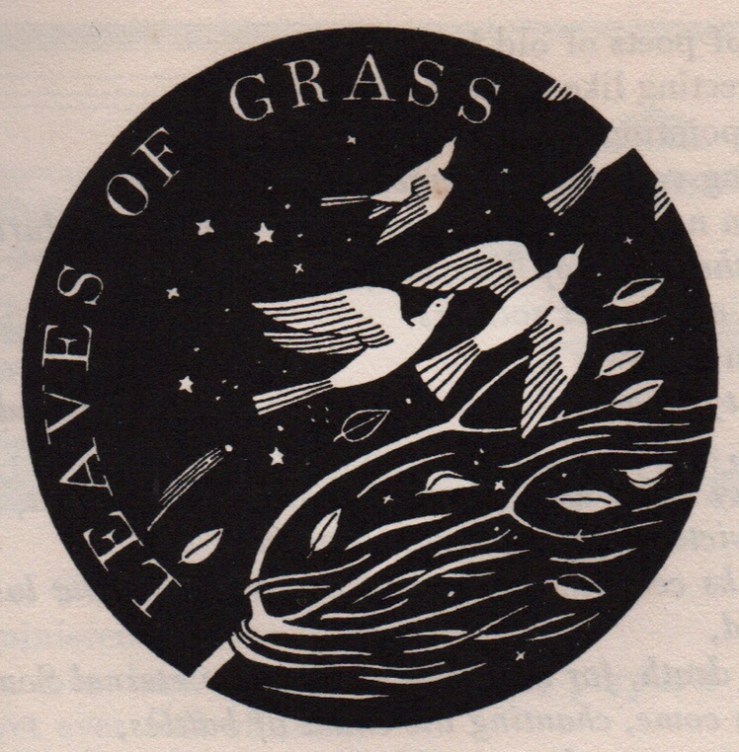
Walt Whitman’s Leaves of Grass, Illustrated by Rockwell Kent (Book acquired, 3 Feb. 2018)

img_9012

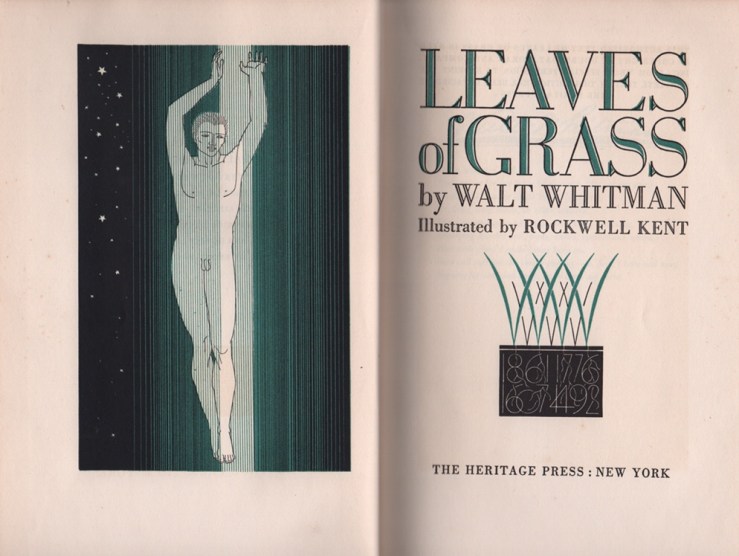
I couldn’t pass up on this illustrated Heritage Press copy of Leaves of Grass. I’m not sure of the exact date of publication, but this nice long post on the book suggests it was likely published in 1950 and designed in the mid-thirties.

img_9011

My daughter and I were browsing the poetry section of our favorite used bookshop—quite randomly actually—and she pulled this volume of Leaves of Grass downward like a lever, pretending it might open a secret passage. It didn’t open a secret passage, but when she pushed it back again, I saw Kent’s name on the spine. I love Kent’s work, and I’m a huge Whitman fan, and my copy of Leaves of Grass is literally falling apart. Plus only $10 and I had plenty of store credit…so…

img_9013

I’ll share some of the illustrations and verses over the next few months—a nice excuse to go through Leaves of Grass again.

img_9019

Selections from One-Star Amazon Reviews of Virginia Woolf’s Mrs. Dalloway

[Editorial note: The following citations come from one-star Amazon reviews Virginia Woolf’s novel Mrs. DallowayI’ve preserved the reviewers’ original punctuation and spelling. More one-star Amazon reviews.].


I had been warned about Woolf

written, I believe, to impress rather than to relate.

I don’t appreciate her writing and keep coming back for more

I may not be giving it a fair review since I only made it to page 65

pages and pages of surreal metaphors that go on for 10 paragraphs

Woolf had a huge obsession with semi-colons

The book just does not make any sense

I really liked the movie “the Hours”

nonsensical semi-flashbacks

Groundbreaking prose?

I tried, I really did

describing nothing

Written by a lesbian

Kind of like F. Scott Fitzgerald’s works

DO read “The Hours”, you will be impressed

I kept losing track of which character was musing about nothing

I suppose Woolf is considered a genius since she was apparently a cavalier writer of her generation

Let us listen to an old farty woman stream her consciousness to us to hear, pointless thoughts that go nowhere

I’m grateful that contemporary writers can at least string together 2 sentences that follow one another in a logical sequence

Lets burn every sentence she ever penned to end all the unneccesary suffering that curious readers have to go through when they first pick up “Mrs. Dalloway.”

My suggestion: just watch The Hours – you’ll get all the beauty and none of the confusion

the person responsible, Virginia Wolf, has been dead for quite some time now

i have no interest in reading about that lifestyle

am stuck in her growling semicolons

slower than a tortoise

ramblings of a lunatic

As bad as Faulkner

So much language

dreadfully boring

run-on sentences

“literary” drivel

terribly written

so many words

and never getting to a plot

Stream of conscience you say?

I normally enjoy stream of consciousness

The narrative reads like the inner thoughts of a sugar crazed autistic kid with ADD in the middle of a carnival

everyone i know who likes this book only does so because he or she was told by some professor that it’s supposed to be good and can provide no evidence to confirm it

This book certainly shows the depravity of man and a self-centered life and the meaningless found amongst those who think of none but themselves.

The absence of spacing to differentiate between each character’s thought process makes for unnecessary confusion

I really liked the idea of the story taking place over the course of one day

THIS BOOK IS WORSE THAN AIDS!

meandering and repetetive

will suffice as kindling

The party! The party!

VW was mentally-ill

“Dense”

put me off

definitley not a fun read

pretty gross hair and stuff on it/ in it

I had had to read it, or was supposed to

haven’t been able to get past the first chapter

lovely idea, virginia and i applaud you for your creativity

I felt like I was reading some writing student’s homework assignment

The Hours is better, despite its inspiration

this story line is too depressing for me

Descriptions were beaten to death

Not one thing uplifting

I am an avid reader!

the book failed

hyphens

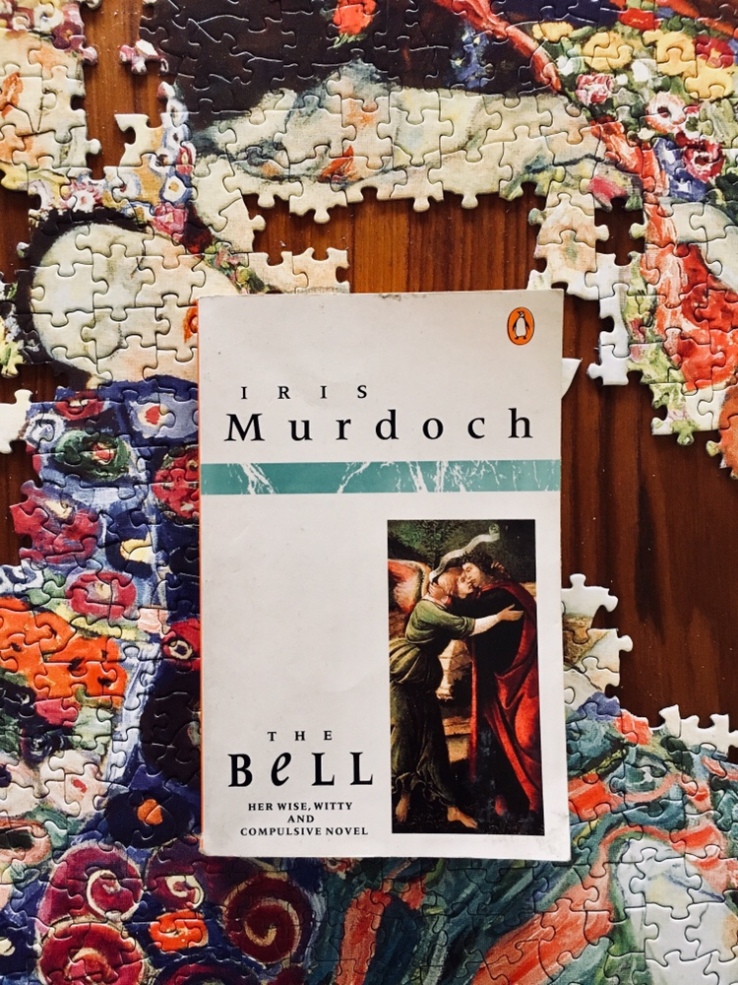
Eliot’s Middlemarch, Murdoch’s Net (Books acquired, 2 Jan. 2018)

img_8860

I put George Eliot’s Middlemarch and Irish Murdoch’s The Bell on my 2018 Good Intentions Reading List. I didn’t own either of these novels, which necessitated a trip to my friendly neighborhood bookstore (a labyrinthine maze comprised of, like, 2 million books. I’m not exaggerating). Improbably, I couldn’t find a copy of The Bell, so I picked up a nice Penguin edition of Under the Net. I also couldn’t find William Gass’s big novel The Tunnel—another of the books I put on my 2018 list that I don’t own—but I knew it wasn’t there because I’ve been checking for its fat spine for over a year. I’m gonna have to buy it elsewhere, alas. (I saw a copy there a few years ago and held off buying it because I was buying William Gaddis’s The Recognitions at the time, and buying two great big novels like that seemed too indulgent. Alas). My beloved store did of course have like a gajillion copies of War and Peace (which it’s weird I don’t have a copy), but my internet pal BLCKDGRD told me he’d send me one, so I held off. Plus—like, Middlemarch is already pretty damn long. I picked up the Norton Critical Edition, just out of habit, and then downloaded the e-book to my iPad via Project Gutenberg. My Norton Critical Edition of Adventures of Huckleberry Finn lists “Samuel Langhorne Clemens” as the author, and not “Mark Twain”—why does this Norton list “George Eliot” and not “Mary Anne Evans”? I actually don’t really care that much.

So who else is reading Middlemarch this year?


Happy New Year (And some books I’ll try to read in 2018)

img_8840

Happy 2018.

Around the New Year, I usually dig out some shelved books (or books in tbr stacks) to make a good-intentions reading list for the forthcoming year. Here are those books, from top to bottom in the pic above:

Philip K. Dick and Roger Zelazny’s Deus Irae: I picked up the old Daw paperback a few months ago—a habit I’ve gotten into with any old Dick—and haven’t gotten to it yet. I read a lot of PKD in 2017 though, so that mood may carry over into early 2018. Curious about the co-authorship—we’ll see.

I’ll admit that I bought Hugh Trevor-Roper’s Hermit of Peking for its Arcimboldosque cover, but dipping into it back in October intrigued me.

I tried to read Elizabeth Hardwick’s Sleepless Nights a few years ago and got distracted by something else, but a lot of folks I admire have praised it, so I’ll give it another shot this year.

I read, “Cutting It Short,” the first novella in Bohumil Hrabal’s The Little Town Where Time Stood Still, but saved the titular second novella for later. Later is now, or nowish, or down the linish. 2018ish.

I stumbled getting into DeLillo’s The Names a few times last year, so maybe I’ll stumble again, but maybe not.

Aberrant, the début novel by Czech author Marek Šindelka, showed up at Biblioklept World Headquarters at the end of my spring semester when I was swamped with term papers, so it sort of got shuffled aside, but it looks so wonderfully weird that I’ll need to carve out space for it this year.

Svetlana Lavochkina’s Zap is new from Whiskey Tit. More to come.

Leon Forrest’s Two Wings to Veil My Face was on last year’s good intentions reading list (I went 6 of 13 by the way).

I read a lot of Paul Bowles in 2016 and 2017, but fizzled out—too much at once. But I want to read The Spider’s House this year.

Four novels that I want to read that I don’t actually own and will thus have to go buy:

Wish me luck. Or not. Either way, I hope your 2018 is the good good stuff.

Christmas bugs (Gravity’s Rainbow)

Later, toward dusk, several enormous water bugs, a very dark reddish brown, emerge like elves from the wainscoting, and go lumbering toward the larder—pregnant mother bugs too, with baby translucent outrider bugs flowing along like a convoy escort. At night, in the very late silences between bombers, ack-ack fire and falling rockets, they can be heard, loud as mice, munching through Gwenhidwy’s paper sacks, leaving streaks and footprints of shit the color of themselves behind. They don’t seem to go in much for soft things, fruits, vegetables, and such, it’s more the solid lentils and beans they’re into, stuff they can gnaw at, paper and plaster barriers, hard interfaces to be pierced, for they are agents of unification, you see. Christmas bugs. They were deep in the straw of the manger at Bethlehem, they stumbled, climbed, fell glistening red among a golden lattice of straw that must have seemed to extend miles up and downward—an edible tenement-world, now and then gnawed through to disrupt some mysterious sheaf of vectors that would send neighbor bugs tumbling ass-over-antennas down past you as you held on with all legs in that constant tremble of golden stalks. A tranquil world: the temperature and humidity staying nearly steady, the day’s cycle damped to only a soft easy sway of light, gold to antique-gold to shadows, and back again. The crying of the infant reached you, perhaps, as bursts of energy from the invisible distance, nearly unsensed, often ignored. Your savior, you see… .

From Thomas Pynchon’s novel Gravity’s Rainbow.

Some favorite books, 2017

Hi! Did anyone else experience 2017 as an overlong, poorly-conceived, cartoonishly bad, poorly-written dystopian novel?

With that out of the way, a few notes on some of my favorite reading experiences this year—a year I abandoned more books than I stuck with, a year I wrote fewer reviews on this site than ever, a year that I failed to write in full on some of the books I loved best. So, from the top of the pic to the bottom:

I read Ishmael Reed’s Neo-HooDoo Western revenge satire, Yellow Back Radio Broke-Down, at the beginning of the year, and his Christmas/plutocracy satire, The Terrible Twos, near the middle. Even though the novels were published in 1969 and 1982 (respectively), they capture, pin down, and tickle and torture everything that’s wrong about our current zeitgeist. Reed’s awful prescience shows that we repeatedly fail to learn from the past.

I read, reread, or audited over half a dozen Philip K. Dick novels this year. The Transmigration of Timothy Archer is in the stack because the blog actually reviewed it—and it was maybe my favorite, along with VALIS and Ubik.

The Complete Stories of Leonora Carrington has been a replenishing gift all year—something to dip into between novels, between projects and papers, a kind of surrealist palate cleanser. I still have about a dozen unread tales to savor later.

Yuri Herrera’s Kingdom Cons is not in the pic above, because I read a digital review copy. I included Signs and Bodies as visual placeholders though; as I wrote in my review:

I can’t help but think of Kingdom Cons as the third part of a loose trilogy that also includes Herrera’s previous novellas Signs Preceding the End of the World and The Transmigration of Bodies. All three are published by And Other Stories and all three are translated by Lisa Dillman, who conjures magic in translating Herrera’s neologisms, slang, and mythical tone. Kingdom Cons extends the mythic-noir mode that Signs initiated and Bodies continued. Herrera is a writer with a voice and a viewpoint, an author whose archetypal approach shows the deep significance to contemporary life’s concrete contours.

Herrera’s novel is, come to think of it, one of only two contemporary novels on this list that was actually published this year—and even then it’s a work in translation.

Also not in the picture (because I loaned it to someone who never returned it!), and ed in 2017 is Robert Coover’s novel Huck Out West a critique of Manifest Destiny that’s as timely as ever.

Also not in the picture because I read it as a (samizdat) ebook: Thomas S. Klise’s 1974 cult novel The Last Western. Any indie press that brings The Last Western back into print will find plenty of readers and champions for the book.

And also not in the stack picture because it’s an audiobook is my favorite audiobook I audiobooked in 2017, Arkady and Boris Strugatsky’s Roadside Picnic, translated by Olena Bormashenko, and read by Robert Forster. I audited it during Hurricane Irma—and then again, after.

Continuing down the stack: I’ve been going back through Ursula K. Le Guin’s Earthsea novels via audiobook. Sort of like literary comfort food.

Atticus Lish’s 2014 novel Preparation for the Next Life was the best novel I read in 2017. I sort of semi-reviewed it as I was reading it, writing:

Lish’s prose is amazingly concrete. He renders New York City (and the other settings) with seemingly effortless thoroughness; the evocation of place is vivid and refined in its attention to detail, but reads raw somehow. There’s a flavor of prime Denis Johnson or Don DeLillo here, but these comparisons aren’t fair: Lish is original—the prose reads thoroughly real, real to and from the author. The novel…strikes me as one of the most authentic “post-9/11” novels I’ve read. There’s almost something sci-fi to Preparation—Lish shows us our world through alien eyes that suck in every detail. I wish I’d read it sooner.

I read a lot of Barry Hannah over the summer, sucking it up like bourbon or grits or eggs but mostly like bourbon. Long Last Happy rehashes some greatest hits, and is a great place for anyone interested—but it also led me to his last stuff, which ended up being darker, danker, richer than I would have imagined. So then I read his last novel, Yonder Stands Your Orphan, which, fuck…

Gisèle Prassinos’ posthumous collection surreal poem-stories The Arthritic Grasshopper was another weird revelation in 2017, a thing I didn’t know I didn’t know about. In my review, I wrote:

 Prassinos’s anti-fables offer ways of reading a mind that doesn’t know what it knows, of singing along with the free faceless astonishing voice.

At the bottom of the stack is Paul Kirchner’s Awating the Collapse. Peer closely enough at that back cover and you’ll get the whole mood of this post.

Anyway, I hope you read some good books this year, and I hope your 2018 is merry and bright and etc.

Reviews, riffs, anti-reviews, and interviews of 2017 (and seventeen roosters)

I read fewer books in 2017 than I have in years, and wrote a lot less on this blog than in the past. There are (uninteresting) reasons. There were lots of books and films that I wish I’d written about—maybe I’ll squeeze them into a post in the next week—but for now, mostly as a means of archiving and organizing (and a reminder to update the reviews page), these are the longer things I wrote on this blog this year (and, uh, some roosters):

garden-with-roostershd
Garden with Roosters, 1917 by Gustav Klimt

A review of Ishmael Reed’s Christmas satire, The Terrible Twos

RIP William H. Gass

23b74a1f073859d49aae780188dcec50-the-rooster-roosters
Th Rooster, 1966 by Ivan Generalic

Not a review of Laurent Binet’s novel The Seventh Function of Language

Eddie Campbell’s canon of great graphic novels, 1977-2001

8gxuuq64jk
Sparring Cockerels by Charles Tunnicliffe

A review of Blade Runner 2049

On Philip K. Dick’s novel A Maze of Death

10_f4dyu
Two Roosters, 1905 by Pablo Picasso

Hurricane Irma reading riff

A review of Gisèle Prassinos’s collection of surreal anti-fables, The Arthritic Grasshopper

rooster-and-hen-with-hydrangeas
Rooster and Hen with Hydrangeas by Ito Jakuchu

A riff on rereading Carson McCullers’ novel The Heart Is a Lonely Hunter

This is not a review of Shattering the Muses, a strange hybrid “novel” by Rainer J. Hanshe and Federico Gori

sa112bthe2brooster2bgoes2bon2ba2btrip2bmichaelsowa2bsqs
The Rooster Goes on a Trip by Michael Sowa

Yuri Herrera’s Kingdom Cons condenses myth into vibrant narco noir

Lost in The Vorrh

rooster-and-chicks
Rooster and Chicks by Ohara Koson

“Translation is an act of risk” | An interview with Rainer J. Hanshe on translating Baudelaire’s My Heart Laid Bare

Not a review of Han Kang’s novel The Vegetarian

rooster-1900
Rooster, 1900 by Ivan Bilibin

On Margaret Atwood’s The Handmaid’s Tale, a story about storytelling

A quick note on Mikhail Bulgakov’s novel The Heart of a Dog

dp205535
Cock on Drum, 1882 by Shibata Zeshin

Let me recommend Antonio di Benedetto’s overlooked novel Zama

The Cock Fighters 1950 by André Fougeron 1913-1998
The Cock Fighters, 1950 by André Fougeron

At any moment they could could swell and become something other than what they were | A riff on Paul Bowles

Helen DeWitt’s novel Lightning Rods just wasn’t for me

the-cock-fight-1882
The Cock Fight, 1882 by Emile Claus

A review of Yellow Back Radio Broke-Down, Ishmael Reed’s syncretic Neo-HooDoo revenge Western

A review of Robert Coover’s excellent new novel Huck Out West

dead-cock-1660
Dead Cock, 1660 by Gabriel Metsu