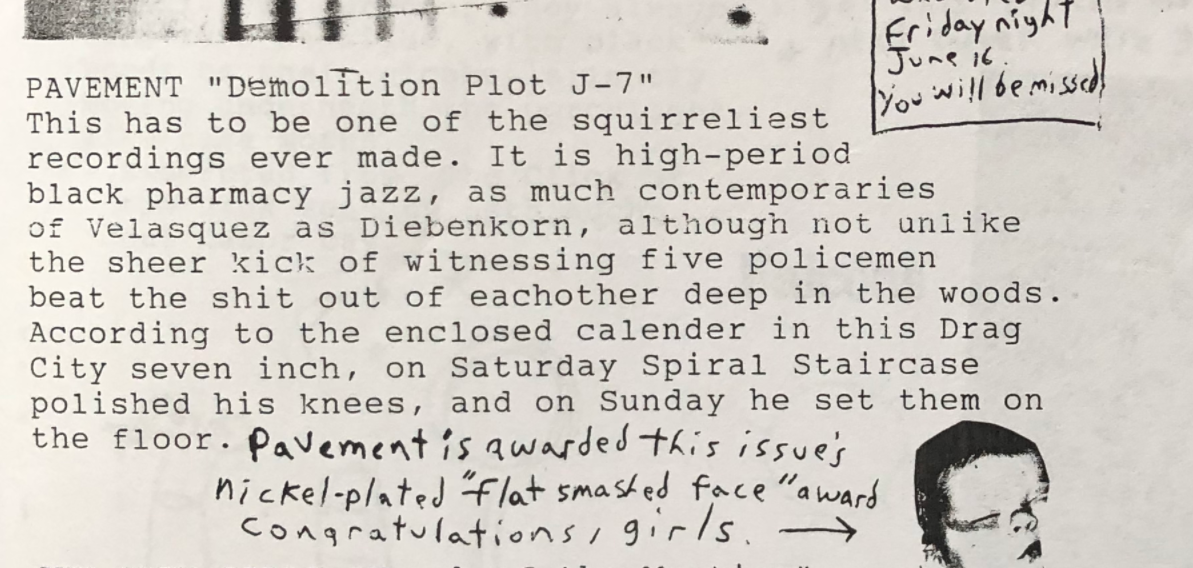
From The Minus Times #29, as republished in The Minus Times Collected.
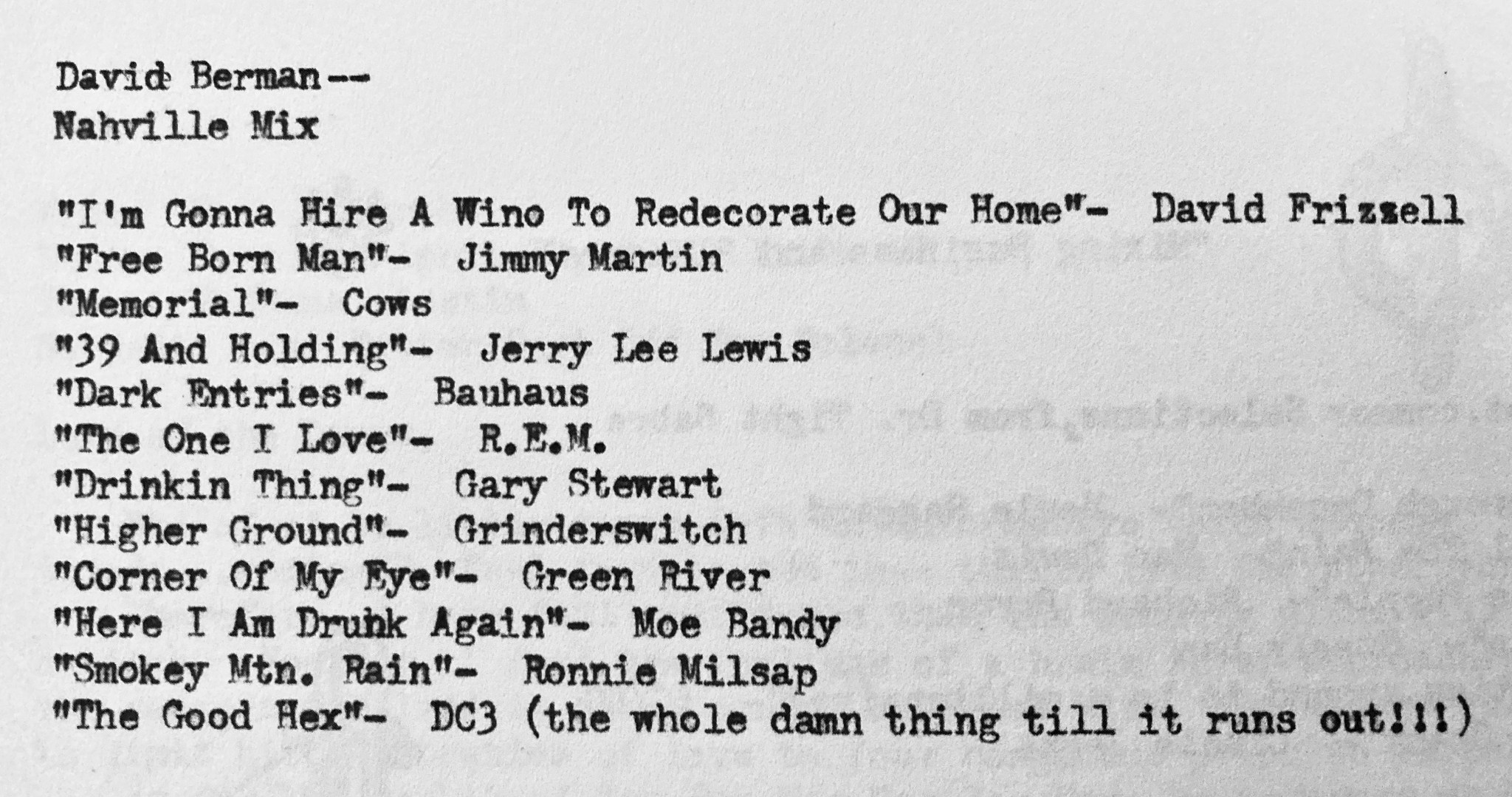
I made as much of the mix I could—D.C.3’s second record The Good Hex isn’t streaming or even on YouTube. Here is David Berman’s “Nashville Mix” mixtape:

From The Minus Times #29, as republished in The Minus Times Collected.
I made as much of the mix I could—D.C.3’s second record The Good Hex isn’t streaming or even on YouTube. Here is David Berman’s “Nashville Mix” mixtape:

From The Minus Times #29, as republished in The Minus Times Collected.
“Classic Water”
by
David Berman
I remember Kitty saying we shared a deep longing for
the consolation prize, laughing as we rinsed the stagecoach.
I remember the night we camped out
and I heard her whisper
“think of me as a place” from her sleeping bag
with the centaur print.
I remember being in her father’s basement workshop
when we picked up an unknown man sobbing
over the shortwave radio
and the night we got so high we convinced ourselves
that the road was a hologram projected by the headlight beams.
I remember how she would always get everyone to vote
on what we should do next and the time she said
“all water is classic water” and shyly turned her face away.
At volleyball games her parents sat in the bleachers
like ambassadors from Indiana in all their midwestern schmaltz.
She was destroyed when they were busted for operating
a private judicial system within U.S. borders.
Sometimes I’m awakened in the middle of the night
by the clatter of a room service cart and I think back on Kitty.
Those summer evenings by the government lake,
talking about the paradox of multiple Santas
or how it felt to have your heart broken.
I still get a hollow feeling on Labor Day when the summer ends
and I remember how I would always refer to her boyfriends
as what’s-his-face, which was wrong of me and I’d like
to apologize to those guys right now, wherever they are:
No one deserves to be called what’s-his-face.
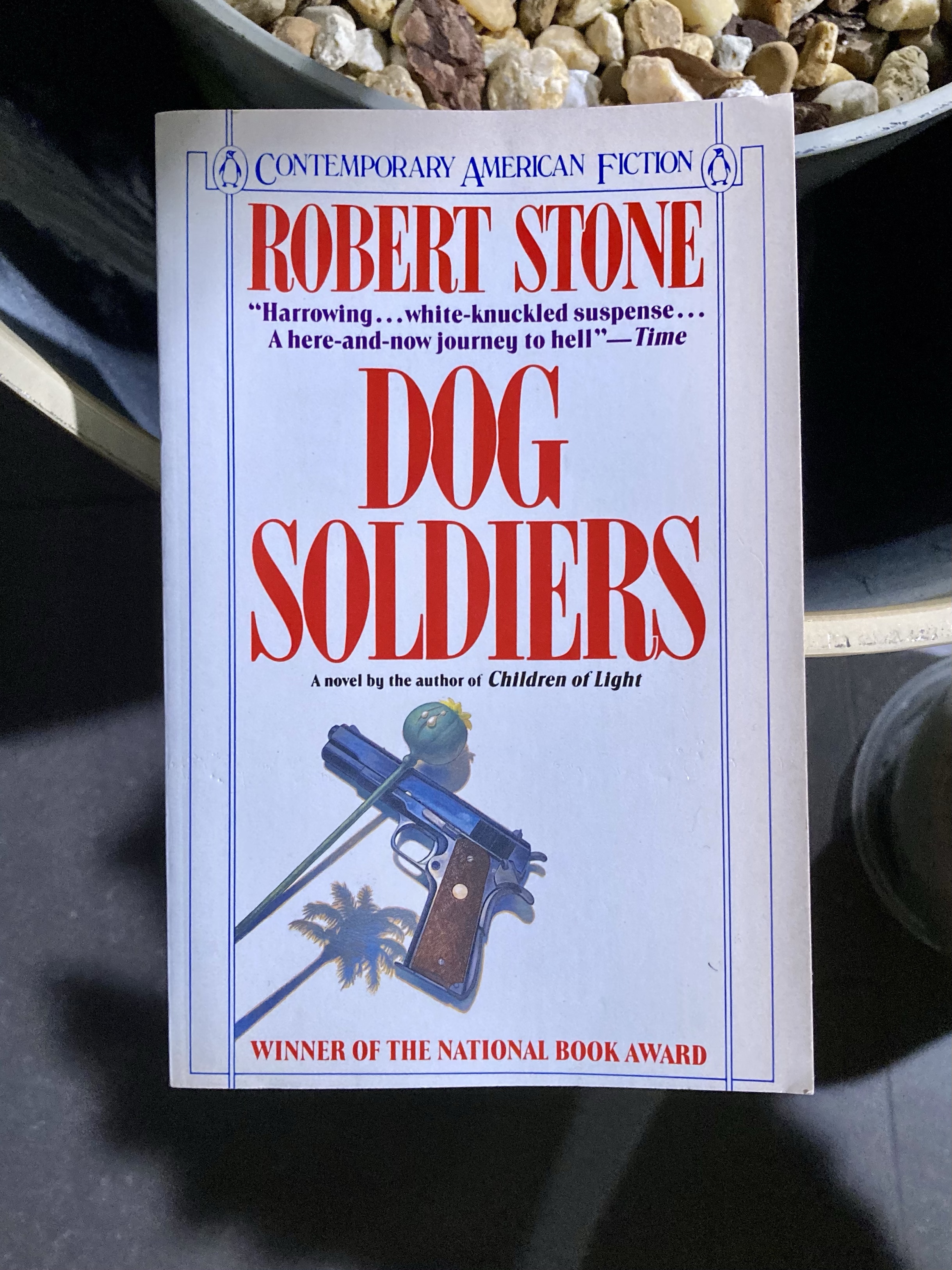
I’ve been looking for a copy of Robert Stone’s 1974 novel Dog Soldiers for a little over a year now. By looking I mean scanning over the Robert Stone section (dude has his own little placard) of my beloved used bookshop, seeing literally dozens of copies for pretty much every Stone book except Dog Soldiers.
My interest in the novel I owe to the late great freight date David Berman, who reportedly repeatedly said it was his favorite novel. The guitarist William Tyler–whom I did not get to see play with Steven Gunn earlier this year, way back in March, way back in early COVID days—attests that Berman “told me his favorite novel was Dog Soldiers by Robert Stone.” I think I also heard that Dog Soldiers was Berman’s fave from the writer John Lingan, probably on twitter, although the detail is not included in his fantastic 2019 profile of Berman. And Berman mentioned the book in his Reddit AMA as part of his answer to book recommendations for someone starting college:
Poetics of Space by Gaston Bachelard
Dog Soldiers by Robert Stone
Anatomy of Melancholy by Robert Burton
Complete Emily Dickinson
Anyway…I found Dog Soldiers, finally, today. I stopped in quickly to pick up two novels for my son, whose reading virility is through the roof now—dude reads like 600 pages a week—and I had a few minutes before I needed to attend my carpool duties and, finally, today, I read Dog Soldiers. I think I’ll read it next, and maybe write something about it here—something not about Berman, but who knows.

From The Minus Times #29, as republished in The Minus Times Collected.
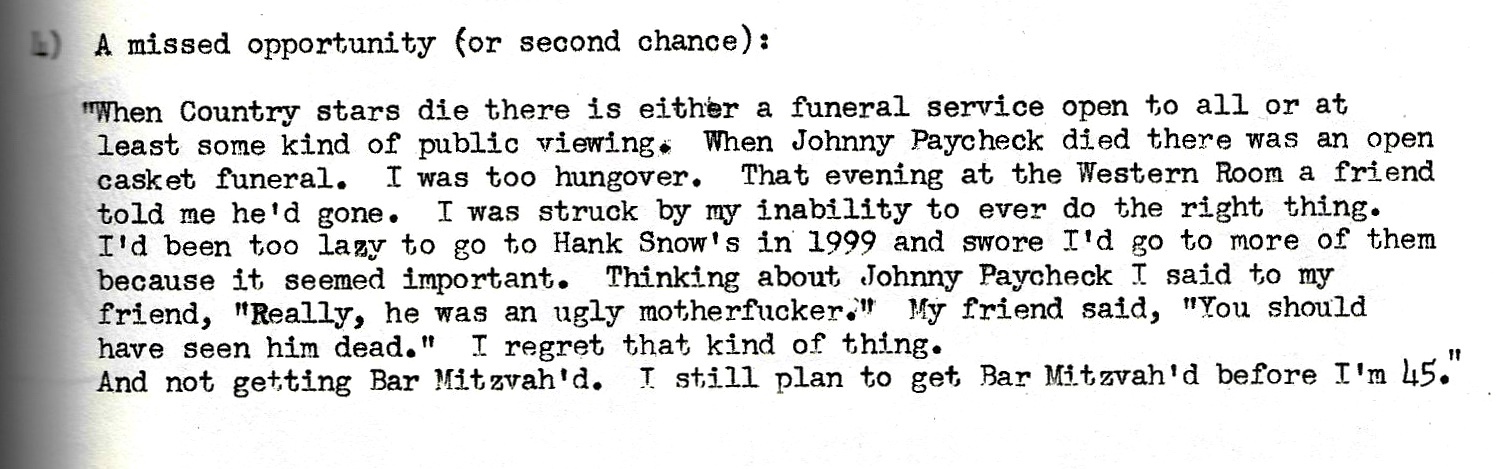
From The Minus Times #29, as republished in The Minus Times Collected.

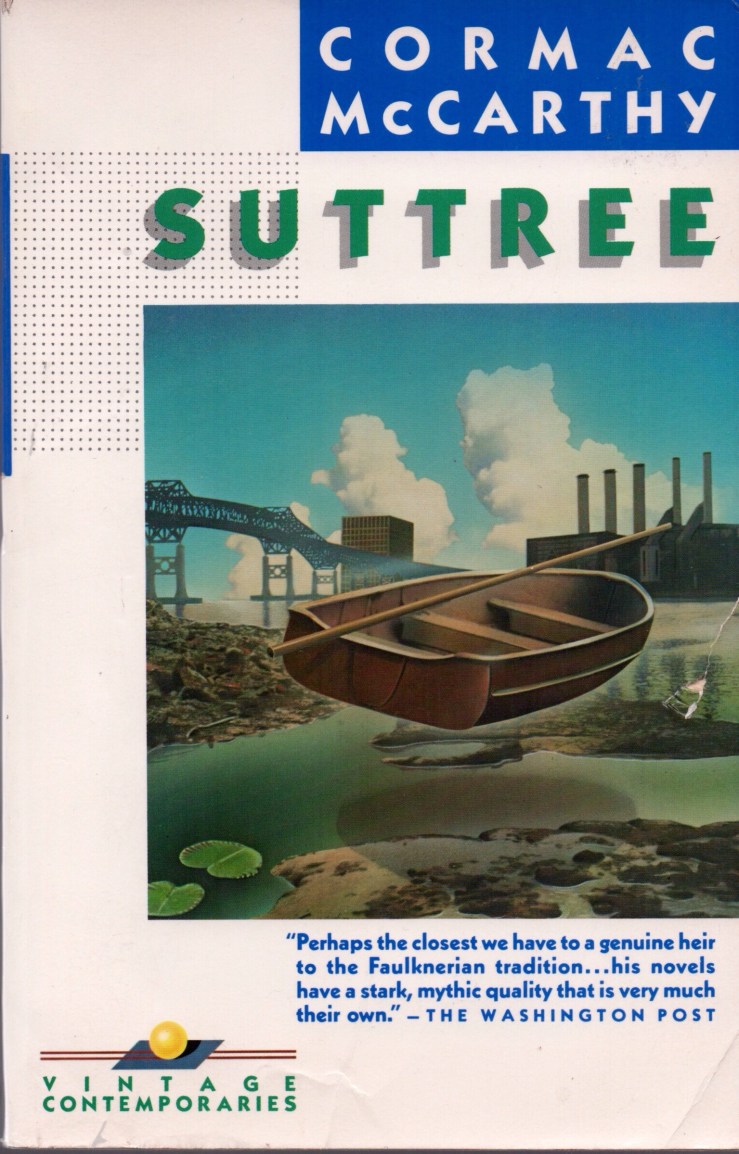
I’ve been a big fan of the Vintage Contemporaries 1980s series for ages now. The books were easily available, cheap and used, in the nineties, and I first read Raymond Carver and Jay McInerney in VC editions, later adding novels by Denis Johnson, Don DeLillo, Jerzy Kosinski to the burgeoning collection. I was thrilled to find a VC copy of Cormac McCarthy’s Suttree years ago; I wasn’t looking for it in particular, but the spine of a Vintage Contemporaries edition is hard to miss in a used bookstore. I picked it up of course, and gave the Vintage International edition I’d read to a friend who’d just finished Blood Meridian. The dark, moody Vintage International covers strongly contrast the bright, vivid VC edition (with a surreal painting by Marc Tauss):
In time, I’d unshelve at least one or two VC editions when browsing a used bookstore, especially if it was an author I’d been meaning to read. I ended up reading and loving Joy Williams’ first collection, Taking Care, that way, as well as Charles Portis’s Norwood (which led to me reading every Portis novel I could get my hands on).
The one I really, really wanted though was the Vintage Contemporaries edition of Barry Hannah’s collection Airships. I must have seen it first–just the spine–in this great write up of VC designs at Talking Covers, and then added it to a mental list of titles to check for. There’s absolutely nothing wrong with the Grove Press copy I have of Airships; indeed, I really dig its photorealistic cover by Hannah’s contemporary Glennray Tutor—but I guess at this point I have to admit I’m collector (of cheap eighties paperbacks).

I read them, books, too, of course. Here’s the intro to my 2011 review of Airships:
In his 1978 collection Airships, Barry Hannah sets stories in disparate milieux, from the northern front of the Civil War, to an apocalyptic future, to the Vietnam War, to strange pockets of the late-twentieth century South. Despite the shifts in time and place, Airships is one of those collections of short stories that feels somehow like an elliptical, fragmentary novel. There are the stories that correspond directly to each other — the opener “Water Liars,” for instance, features (presumably, anyway), the same group of old men as “All the Old Harkening Faces at the Rail.” The old men love to crony up, gossip, tell tall tales. An outsider spoils the fun in “Water Liars” by telling a truth more terrible than any lie; in “Harkening,” an old man shows off his new (much younger) bride. These stories are perhaps the simplest in the collection, the homiest, anyway, or at least the most “normal” (whatever that means), yet they are both girded by a strange darkness, both humorous and violent, that informs all of Airships.
Well so and anyway:
Yesterday, browsing my beloved used bookstore, I found, while not really looking for it, the Vintage Contemporaries edition of Airships. I was in the “H” section of General Fiction, looking for something by Chester Himes (which I found, but in the Mysteries section, which I really have never browsed before), and there it was, its spine singing to me from a low shelf. I was happy to note the cover is by Rick Lovell, who’s responsible for my favorite VC editions (along with, obviously, series designer Lorraine Louie). As a sort of cherry on top, my edition has a little gold sticker at the top of the inside cover, proclaiming “Square Books on the Square, Oxford Mississippi.” Hannah taught at Ole Miss for nearly three decades. Square Books is still there.
I was excited with my find and I’m a dork so I tweeted about it. The next tweet I saw in my timeline was this tweet by Christopher DeWeese (retweeted by the writer John Lingan):
(I love the blurb by Thomas Pynchon.)
David Berman was a poet, musician, and singer (and more) who died almost exactly a  year ago. He was kind of a hero of mine, as far as these things go, and as such I never made an attempt to contact him, even when he linked to this blog on his blog, Menthol Mountains. I absolutely love the cover he made—or did he make it? I don’t actually know—but I know that he loved Vintage Contemporaries, that they were important to him. I recall John Lingan tweeting about having to cut some of his discussion about the series with Berman in his fantastic profile of the then-not-late artist. I couldn’t find the tweet, but I reached out to John, and he told me I remembered right; he also told me he recalled seeing a copy of Harold Brodkey’s First Love and Other Sorrows in Berman’s room.
I wonder if Berman and I had the same VC edition of First Love and Other Sorrows? The one with the Rick Lovell cover of butterflies on a sandcastle? Or maybe he had the one with the purple cover? I gave my copy to a good friend years ago, and have never seen one with the Lovell cover since.
I also wonder if Berman read the VC edition of Airships. I know he met Hannah, who apparently read Berman’s work. I recall now too that both men show up in The Minus Times Collected, which I never picked up. I’m going to order it now.


Copies of Dmitry Samarov’s latest books, Soviet Stamps and Music to My Eyes showed up at Biblioklept World Headquarters the other week. I started in on Music to My Eyes, a kind of fragmentary memoir told in sketches (both verbal and literal) of the Chicago music scene. The determiner “the” in the previous sentence is wrong, of course, as is the singular noun “scene” — Samarov’s book shows the diversity of the city’s music, even if fans will be able to connect the dots between bands like Eleventh Dream Day, Mekons, and Brokeback. There are stories that float around Nick Cave, Arto Lindsay, Neko Case, and many, many others. Samarov’s brief chapter on the Silver Jews ends with an anecdote about not getting to meet Berman in 2018. The final lines are heartbreaking: “Maybe there’ll be more songs. Then I could stop being mad at him for walking away too soon.”
Here’s Samarov on U.S. Maple, who made some of the strangest music ever during that weird slice of time from the mid-nineties to the mid-aughts. U.S. Maple is by far the most confounding live band I’ve ever seen; it’s easy to throw around the word deconstruction, but their live performances were deconstructions of rocknroll:

This video was shot by Craig Giffen on January 4, 2020 (David Berman’s 53rd birthday).
Tracks:
“Secret Knowledge of Back Roads”
“Buckingham Rabbit”
“Advice to the Graduate”
“Random Rules”
“Welcome To The House of the Bats”
“Trains Across the Sea”

From The Portable February, 2009, Drag City.

From Actual Air (Open City, 1999)

From Actual Air (Open City, 1999).
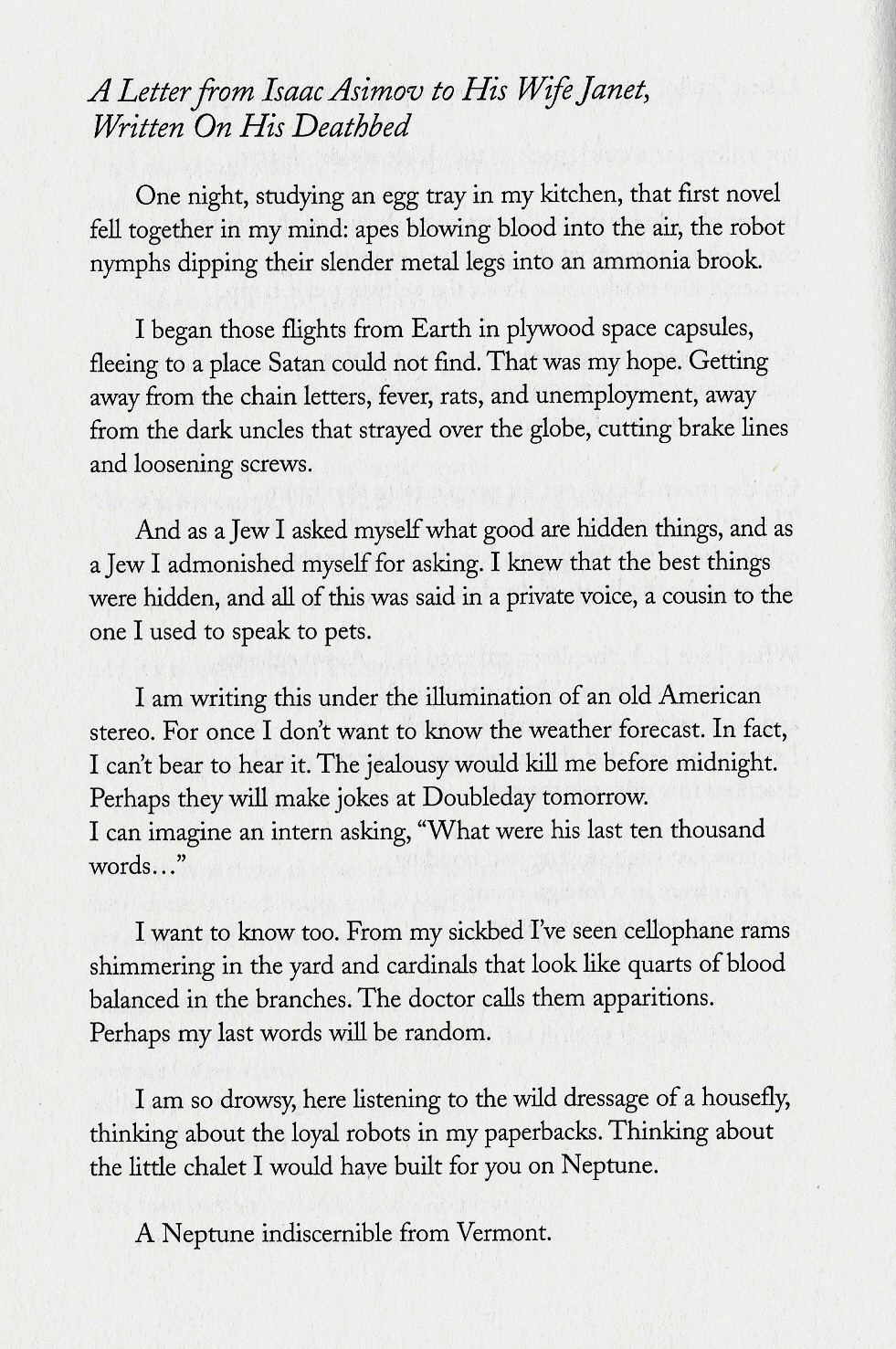
From Actual Air (Open City, 1999)

From Actual Air (Open City, 1999)