A Riff on William Gaddis’s The Recognitions

20120325-143631.jpg

  1. I finished reading William Gaddis’s enormous opus The Recognitions a few days ago. I made a decent first attempt at the book in the summer of 2009, but wound up distracted not quite half way through, and eventually abandoned the book. I did, however, write about its first third. I will plunder occasionally from that write-up in this riff. Like here:

In William Gaddis‘s massive first novel, The Recognitions, Wyatt Gwyon forges paintings by master artists like Hieronymous Bosch, Hugo van der Goes, and Hans Memling. To be more accurate, Wyatt creates new paintings that perfectly replicate not just the style of the old masters, but also the spirit. After aging the pictures, he forges the artist’s signature, and at that point, the painting is no longer an original by Wyatt, but a “new” old original by a long-dead genius. The paintings of the particular artists that Wyatt counterfeits are instructive in understanding, or at least in hoping to understand how The Recognitions works. The paintings of Bosch, Memling, or Dierick Bouts function as highly-allusive tableaux, semiotic constructions that wed religion and mythology to art, genius, and a certain spectacular horror, and, as such, resist any hope of a complete and thorough analysis. Can you imagine, for example, trying to catalog and explain all of the discrete images in Bosch’s triptych, The Garden of Earthly Delights? And then, after creating such a catalog, explaining the intricate relationships between the different parts? You couldn’t, and Gaddis’s novel is the same way.

I still feel the anxiety dripping from that lede, the sense that The Recognitions might be a dare beyond my ken. Mellower now, I’m content to riff.

  1. I read this citation in Friedrich Nietzsche’s Human, All Too Human, Part II the other night, mentally noting, “cf. Gaddis”:

188. The Muses as Liars. —“We know how to tell many lies,” so sang the Muses once, when they revealed themselves to Hesiod.—The conception of the artist as deceiver, once grasped, leads to important discoveries.

  1. The Recognitions: crammed with poseurs and fakers, forgers and con-men, artists and would-be artists.
  2. To recognize: To see and know again. Recognition entails time, experience, certitude, authenticity.

  3. Who would not dogear or underline or highlight this passage?:

That romantic disease, originality, all around we see originality of incompetent idiots, they could draw nothing, paint nothing, just so the mess they make is original . . .

  1. In many ways The Recognitions, or rather the characters in The Recognitions whom we might identify with genuine talent, genius, or spirit (to be clear, I’m thinking of Wyatt/Stephan, Basil Valentine, Stanley, Anselm, maybe, and Frank Sinisterra) are conservative, reactionary even; this is somewhat ironic considering Gaddis’s estimable literary innovations.

  2. Esme: A focus for the novel’s masculine gaze, or a critique of such gazes?

  3. The central problem of The Recognitions (perhaps): What confers meaning in a desacralized world?

Late in the novel, in one of its many party scenes, Stanley underlines the problem, working in part from Voltaire’s (in)famous quote that, “If there were no God, it would be necessary to invent him”:

. . . even Voltaire could see that some transcendent judgments is necessary, because nothing is self-sufficient, even art, and when art isn’t an expression of something higher, when it isn’t invested you might even say, it breaks up into fragments that don’t have any meaning . . .

Here we think of Wyatt: Wyatt who rejects the ministry, contemporary art, contemporary society, sanity . . .

  1. Wyatt’s quest: To find truth, meaning, authenticity in a modern world where the sacred does not, cannot exist, is smothered by commerce, noise, fakery . . .
  • The Recognitions conveys a range of tones, but I like it best when it focuses its energies on comic irony and dark absurdity to detail the juxtapositions and ironies between meaning and noise, authenticity and forgery.

  • (I like The Recognitions least when its bile flares up too much in its throat, when its black humor tips over into a screed of despair. A more mature Gaddis handles bitterness far better in JR, I think—but I parenthesize this note, as it seems minor even in a list of minor digressions).

  • Probably my favorite chapter of the book — after the very first chapter, which I believe can stand on its own — is Chapter V of Part II. This is the chapter where Frank Sinisterra reemerges, setting into motion a failed plan to disseminate his counterfeit money (“the queer,” as his accomplice calls it). We also meet Otto’s father, Mr. Pivner, a truly pathetic figure (in all senses of the word). This chapter probably contains more immediate or apparent action than any other in The Recognitions, which largely relies on implication (or suspended reference).

  • More on Part II, Chapter V: Here we find a savagely satirical and very funny discussion of Dale Carnegie’s How to Win Friends and Influence People, a book that seems to stand as an emblem (one of many in The Recognitions) of the degraded commercial world that Gaddis repeatedly attacks. The entire discussion of Carnegie’s book is priceless — it begins on page 497 of my Penguin edition and unfurls over roughly 10 pages—and the book is alluded to enough in The Recognitions to become a motif.

  • I’ll quote from page 499 a passage that seems to ironically situate How to Win Friends and Influence People against The Recognitions itself (this is one of the many postmodern moves of the novel):

    It was written with reassuring felicity. There were no abstrusely long sentences, no confounding long words, no bewildering metaphors in an obfuscated system such as he feared finding in simply bound books of thoughts and ideas. No dictionary was necessary to understand its message; no reason to know what Kapila saw when he looked heavenward, and of what the Athenians accused Anaxagoras, or to know the secret name Jahveh, or who cleft the Gordian knot, the meaning of 666. There was, finally, very little need to know anything at all, except how to “deal with people.” College, the author implied, meant simply years wasted on Latin verbs and calculus. Vergil, and Harvard, were cited regularly with an uncomfortable, if off-hand, reverence for their unnecessary existences . . . In these pages, he was assured that whatever his work, knowledge of it was infinitely less important that knowing how to “deal with people.” This was what brought a price in the market place; and what else could anyone possibly want?

    1. I’m not sure if Gaddis is ahead of his time or of his time in the above citation.

    The Recognitions though, on the whole, feels more reactionary than does his later novel JR, which is so predictive of our contemporary society as to produce a maddening sense of the uncanny in its reader.

    1. Even more on Part II, Chapter V (which I seem to be using to alleviate the anxiety of having to account for so many of the book’s threads): Here we find a delineation of (then complication of, then shuffling of) the various father-son pairings and substitutions that will play out in the text. (Namely, the series of displacements between Pivner, Otto, and Sinisterra, with the subtle foreshadowing of Wyatt’s later (failed) father-son/mentor-pupil relationship with Sinisterra).
  • Is it worth pointing out that the father-son displacements throughout the text are reminiscent of Joyce’s Ulysses, a book that Gaddis pointedly denied as an influence?

  • Ignorant of Gaddis’s deflections, I wrote the following in my review almost three years ago:

    Gaddis shows a heavy debt to James Joyce‘s innovations in Ulysses here (and throughout the book, of course), although it would be a mistake to reduce the novel to a mere aping of that great work. Rather, The Recognitions seems to continue that High Modernist project, and, arguably, connect it to the (post)modern work of Pynchon, DeLillo, and David Foster Wallace. (In it’s heavy erudition, numerous allusions, and complex voices, the novel readily recalls both W.G. Sebald and Roberto Bolaño as far as I’m concerned).

    1. But, hey, Cynthia Ozick found Joyce’s mark on The Recognitions as well (from her 1985 New York Times review of Carpenter’s Gothic):

    When ”The Recognitions” arrived on the scene, it was already too late for those large acts of literary power ambition used to be good for. Joyce had come and gone. Imperially equipped for masterliness in range, language and ironic penetration, born to wrest out a modernist masterpiece but born untimely, Mr. Gaddis nonetheless took a long draught of Joyce’s advice and responded with surge after surge of virtuoso cunning.

    1. We are not obligated to listen to Gaddis’s denials of a Joyce influence, of course. When asked in his Paris Review interview if he’d like to clarify anything about his personality and work, he paraphrases his novel:

    I’d go back to The Recognitions where Wyatt asks what people want from the man they didn’t get from his work, because presumably that’s where he’s tried to distill this “life and personality and views” you speak of. What’s any artist but the dregs of his work: I gave that line to Wyatt thirty-odd years ago and as far as I’m concerned it’s still valid.

    1. And so Nietzsche again, again from Human, All Too Human, Part II:

    140. Shutting One’s Mouth. —When his book opens its mouth, the author must shut his.

    1. And if I’m going to quote German aphorists, here’s a Goethe citation (from Maxims and Reflections) that illustrates something of the spirit of The Recognitions:

    There is nothing worth thinking but it has been thought before; we must only try to think it again.

    1. And if I’m going to quote Goethe, I’ll also point out then that Gaddis began The Recognitions as a parody of Goethe’s Faust. Peter William Koenig writes in his excellent and definitive essay “Recognizing Gaddis’ Recognitions” (published in the Winter Volume Contemporary Literature, 1975):

    To understand Gaddis’ relationship to his characters, and thus his philosophical motive in writing the novel, we are helped by knowing how Gaddis conceived of it originally. The Recognitions began as a much smaller and less complicated work, passing through a major evolutionary stage during the seven years Gaddis spent writing it. Gaddis says in his notes: “When I started this thing . . . it was to be a good deal shorter, and quite explicitly a parody on the FAUST story, except the artist taking the place of the learned doctor.” Gaddis later explained that Wyatt was to have all talent as Faust had all knowledge, yet not be able to find what was worth doing. This plight-of limitless talent, limited by the age in which it lives-was experienced by an actual painter of the late 1940s, Hans Van Meegeren, on whom Gaddis may have modeled Wyatt. The authorities threw Van Meegeren into jail for forging Dutch Renaissance masterpieces, but like Wyatt, his forgeries seemed so inspired and “authentic” that when he confessed, he was not believed, and had to prove that he had painted them. Like Faust and Wyatt, Van Meegeren seemed to be a man of immense talent, but no genius for finding his own salvation.

    The Faust parody remained uppermost in Gaddis’ mind as he traveled from New York to Mexico, Panama and through Central America in 1947, until roughly the time he reached Spain in 1948. Here Gaddis read James Frazer’s The Golden Bough, and the novel entered its second major stage. Frazer’s pioneering anthropological work demonstrates how religions spring from earlier myths, fitting perfectly with Gaddis’ idea of the modern world as a counterfeit-or possibly inspiring it. In any case, Frazer led Gaddis to discover that Goethe’s Faust originally derived from the Clementine Recognitions, a rambling third-century theological tract of unknown authorship, dealing with Clement’s life and search for salvation. Gaddis adapted the title, broadening the conception of his novel to the story of a wandering, at times misguided hero, whose search for salvation would record the multifarious borrowings and counterfeits of modern culture.

    1. Is Wyatt the hero of The Recognitions? Here’s Basil Valentine (page 247 of my ed.):

    . . . that is why people read novels, to identify projections of their own unconscious. The hero has to be fearfully real, to convince them of their own reality, which they rather doubt. A novel without a hero would be distracting in the extreme. They have to know what you think, or good heavens, how can they know that you’re going through some wild conflict, which is after all the duty of a hero.

    1. If Wyatt is the hero, then what is Otto? Clearly Otto is a comedic double of some kind for Wyatt, a would-be Wyatt, a different kind of failure . . . but is he a hero?

    When I first tried The Recognitions I held Otto in special contempt (from that earlier review of mine):

    Otto follows Wyatt around like a puppy, writing down whatever he says, absorbing whatever he can from him, and eventually sleeping with his wife. Otto is the worst kind of poseur; he travels to Central America to finish his play only to lend the mediocre (at best) work some authenticity, or at least buzz. He fakes an injury and cultivates a wild appearance he hopes will give him artistic mystique among the Bohemian Greenwich Villagers he hopes to impress. In the fifth chapter, at an art-party, Otto, and the reader, learn quickly that no one cares about his play . . .

    But a full reading of The Recognitions shows more to Otto besides the initial anxious shallowness; Gaddis allows him authentic suffering and loss. (Alternately, my late sympathies for Otto may derive from the recognition that I am more of an Otto than a Wyatt . . .).

    1. The Recognitions is the work of a young man (“I think first it was that towering kind of confidence of being quite young, that one can do anything,” Gaddis says in his Paris Review interview), and often the novel reveals a cockiness, a self-assurance that tips over into didactic essaying or a sharpness toward its subjects that neglects to account for any kind of humanity behind what Gaddis attacks. The Recognitions likes to remind you that its erudition is likely beyond yours, that it’s smarter than you, even as it scathingly satirizes this position.

    I think that JR, a more mature work, does a finer job in its critique of contemporary America, or at least in its characterization of contemporary Americans (I find more spirit or authentic humanity in Bast and Gibbs and JR than in Otto or Wyatt or Stanley). This is not meant to be a knock on The Recognitions; I just found JR more balanced and less showy; it seems to me to be the work of an author at the height of his powers, if you’ll forgive the cliché.

    I’ll finish this riff-point by quoting Gaddis from The Paris Review again:

    Well, I almost think that if I’d gotten the Nobel Prize when The Recognitions was published I wouldn’t have been terribly surprised. I mean that’s the grand intoxication of youth, or what’s a heaven for.

    (By the way, Icelandic writer Halldór Kiljan Laxness won the Nobel in lit in 1955 when The Recognitions was published).

    1. Looking over this riff, I see it’s lengthy, long on outside citations and short on plot summary or recommendations. Because I don’t think I’ve made a direct appeal to readers who may be daunted by the size or reputation or scope of The Recognitions, let me be clear: While this isn’t a book for everyone, anyone who wants to read it can and should. As a kind of shorthand, it fits (“fit” is not the right verb) in that messy space between modernism and postmodernism, post-Joyce and pre-Pynchon, and Gaddis has a style and approach that anticipates David Foster Wallace. (It’s likely that if you made it this far into the riff that you already know this or, even more likely, that you realize that these literary-historical situations mean little or nothing).

    26.Very highly recommended.

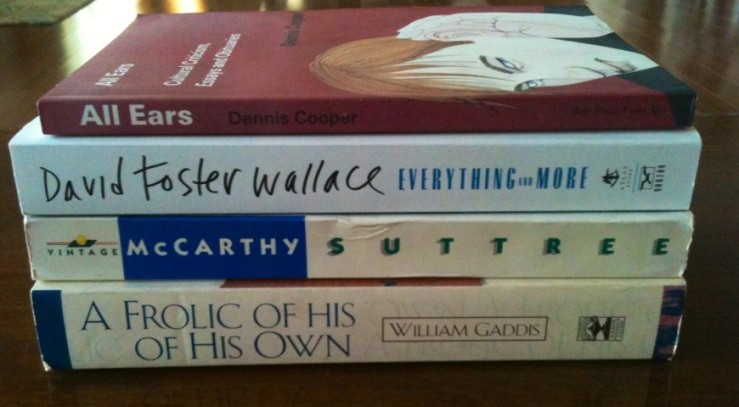
    Gaddis, Wallace, McCarthy, Cooper (Books Acquired, 3.02.3012)

    20120302-173432.jpg

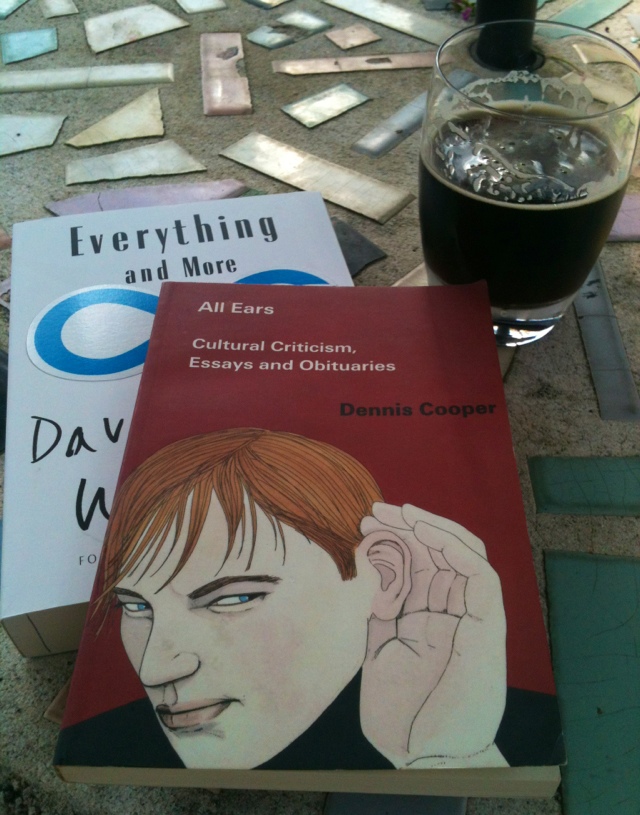
    Picked up these four yesterday afternoon during my weekly visit to the bookshop (can’t help said visit; I live too close). Spent the afternoon reading Neal Stephenson’s introduction to David Foster Wallace’s Everything and More and a few of the pieces in All Ears, a collection of essays and interviews by Dennis Cooper. I read the interviews with Stephen Malkmus and Leonardo diCaprio. There’s something so nineties about the book.

    20120302-173439.jpg

    A nice afternoon of reading with a few homebrews.

    Everything and More, DFW’s history of infinity, is one of the only books I haven’t read by him (I even got to read a big chunk of his rare early work Signifying Rappers years ago because a friend found it in a library book sale). Anyway, to the point: None of the DFW editions I owned, up to this point were posthumous (they were, uh humous (?))—so it was a little weird to see this on the back of the book:

    20120302-173455.jpg

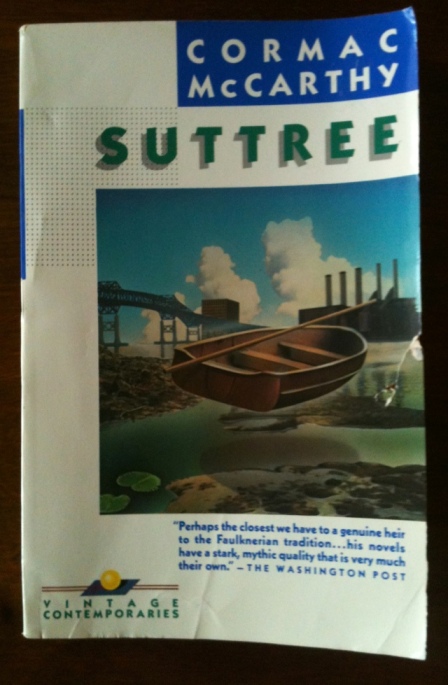
    Finally: No, I didn’t need another copy of Cormac McCarthy’s Suttree (let me plug my review), but I’m a huge fan of these awful 1980s Vintage Contemporaries editions, so when I found a first ed. of Suttree, I couldn’t pass it up (I’m pretty sure this is the same edition DFW owned):

    20120302-173509.jpg

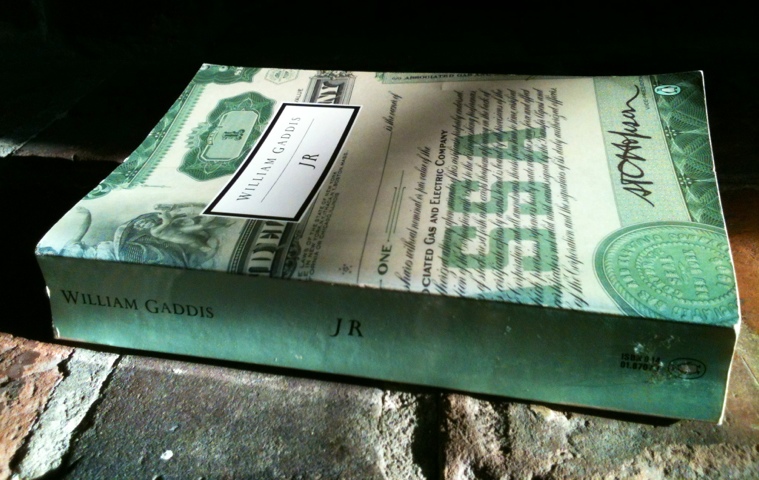
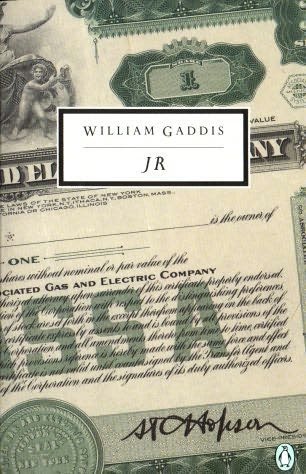
    I Riff–Again–on William Gaddis’s Enormous Novel JR (This Time After Finishing It)

    20120208-170956.jpg

    1. Let me point those of you who may care to my first riff on William Gaddis’s J R, which I wrote about half way into the book, and which will likely provide more context than I’m prepared to offer here. Also, there might be spoilers ahead.

    2. The end of J R is heartbreaking. We find some of our principal characters—Bast, Gibbs, and JR—in nebulous spaces, their plans and dreams and hopes crumbling or smoking or fizzing out or jettisoned (pick your verb as I’m too lazy or unequipped).

    3. The final face-to-face scene between Bast and JR, the one that begins with them riding in a limousine and ends with Bast’s psycho breakdown—heartbreaking. Little JR, we realize, is most motivated by his intense need for human connection, his desire for family, perhaps, or place, at least. Bast’s rejection of JR—really a rejection of contemporary consumer culture—is almost horrific, even more so because the reader (this reader, anyway) so readily identifies with Bast and JR simultaneously.

    4. Here’s Gaddis on his character JR (from The Paris Review interview):

    The boy himself is a total invention, completely sui generis. The reason he is eleven is because he is in this prepubescent age where he is amoral, with a clear conscience, dealing with people who are immoral, unscrupulous; they realize what scruples are, but push them aside, whereas his good cheer and greed he considers perfectly normal. He thinks this is what you’re supposed to do; he is not going to wait around; he is in a hurry, as you should be in America—get on with it, get going. He is very scrupulous about obeying the letter of the law and then (never making the distinction) evading the spirit of the law at every possible turn. He is in these ways an innocent and is well-meaning, a sincere hypocrite. With Bast, he does think he’s helping him out.

    5. And again:

    INTERVIEWER

    Which is the novel you care most for?

    GADDIS

    I think that I care most for JR because I’m awfully fond of the boy himself.

    6. In that same interview, Gaddis contends that JR is motivated by “good-natured greed,” which is probably true (see above re: letter vs. spirit). Despite his predatory capitalism, his willingness to strip company employees of basic safety nets, JR remains sympathetic.

    7. Why is JR a sympathetic character? He’s just a child, one who lives in a world without adult supervision let alone love and care. In a touching scene that telegraphs the bizarre black humor that runs through the novel, JR suggests that the Eskimos on display at a museum are the work of a taxidermist: That is, said Eskimos were once, like, alive, and are now on display. Amy Joubert, his social studies teacher (and the object of Gibbs’s and possibly Bast’s affection) is moved to both pity and terror by JR’s confusion, and clutches him to her breast.

    8. While we’re on Eskimos, which is to say Native Americans, which is to say, perhaps, Indians: The Indian plot in JR fascinates; it recapitulates a bloody, awful past, pointing to the brutal way the quote unquote invisible hand of the market might sweep entire people away and then come back (in a cheap costume) to offer modernity at a price.

    9. Ethnic minorities in general find themselves displaced in JR, or at least displaced in the language of JR (and is there a novel that is more language than JR, if such a statement might be permitted to exist (at least metaphorically)? No, I don’t think there is, or at least I don’t know of one). The casual racism of 1%ers like Zona Selk and Cates is ugly and bitter, but the PR man Davidoff is somehow worse—he sees race as something to use, to manipulate, to control.

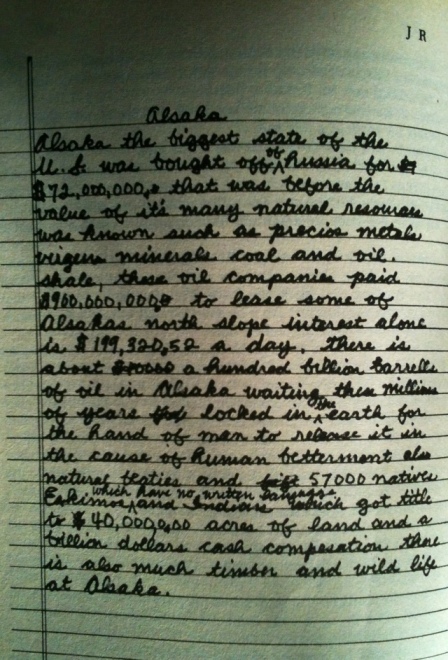
    10. And, of course, JR’s infamous “Alsaka Report,” a connection to Manifest Destiny, to the valuation of our ecosystem in the most base and short-sighted terms (there’s a perhaps overlooked streak of environmentalism to JR):

    20120208-171005.jpg

    11. Sci-fi elements to JR: The Frigicom process, which promises to freeze noise. The Teletravel transmission process.

    12. At the end of JR, we learn that poor diCephalis is lost in Teletravel transmission.

    13. I couldn’t help but be reminded—repeatedly—of David Foster Wallace’s work during JR (diCephalis stuck in Teletravel recalls poor Orin in the giant glassjar at the end of Infinite Jest). In general, the loose threads of JR recall Wallace’s loose threads (other way round, I know).

    14. The phone motif alone might have led me to compare Wallace to Gaddis—but there’s also all that, y’know, thematic unity.

    15. And clearly, too, style. I’m sure that longtime readers of Gaddis have likely made the comparisons already, but throughout his work, Wallace repeatedly uses chapters or sections that comprise only dialogue. A good example is §19 of The Pale King (which I riffed on a bit this summer), a conversation between three IRS agents stuck in an elevator. In some ways, the scene, set only a few years after the publication of JR feels like a strange little sequel, or an echo of a shadow of a chapter of a sequel (or maybe not—just riffing here). Wallace’s concerns about civics, ethics, and compassion seem more straightforward than Gaddis’s angry vision of a desacralized world, a world where symphonies must be chopped into three minute segments to allow for commercial interruptions (or, rather, that symphonies must interrupt commercials). Wallace is obviously writing after the victory of Pop Art, of populism, of the slow sprawling stripmalling of America . . . but I’ve riffed off track (there is no track).

    16. ” . . . I mean they never lose these banks don’t, I mean where we’re getting screwed . . . ” — JR laments on page 653 of my Penguin Twentieth-Century Classics edition.

    17. The above quote as the briefest illustration that, published in 1975, JR is more relevant than ever.

    18. To wit, Gaddis again, again from The Paris Review interview, commenting on hollow, false values:

    . . . I’d always been intrigued by the charade of the so-called free market, so-called free enterprise system, the stock market conceived of as what was called a “people’s capitalism” where you “owned a part of the company” and so forth. All of which is true; you own shares in a company, so you literally do own part of the assets. But if you own a hundred shares out of six or sixty or six hundred million, you’re not going to influence things very much. Also, the fact that people buy securities—the very word in this context is comic—not because they are excited by the product—often you don’t know what the company makes—but simply for profit: The stock looks good and you buy it. The moment it looks bad you sell it. What had actually happened in the company is not your concern.

    19. Gaddis’s take on the “art” of capitalism: design mock ups for a potential logo for the JR Family of Companies:

    20120208-171016.jpg

    20. JR is one of the most prescient novels I’ve ever read—and not just in its illustration of the the chaos at the intersection of corporatism, Wall Street, government, and military, but also in its handling and treatment of education. Gaddis is way ahead of an ugly curve, showing us an educational system largely disinterested in intellectual, aesthetic, or even athletic development. Instead we get a storehouse for children, reliant on programmed lessons delivered via technology and assessment by standardized testing. It’s ugly and it’s more real than ever now.

    21. And here’s Gibb’s railing against it, in a way, in (what’s likely a half-drunken or at least hung-over) rant to his students:

    Before we go any further here, has it ever occurred to any of you that all this is simply one grand misunderstanding? Since you’re not here to learn anything, but to be taught so you can pass these tests, knowledge has to be organized so it can be taught, and it has to be reduced to information so it can be organized do you follow that? In other words this leads you to assume that organization is an inherent property of the knowledge itself, and that disorder and chaos are simply irrelevant forces that threaten it from the outside. In fact it’s the opposite. Order is simply a thin, perilous condition we try to impose on the basic reality of chaos . . .

    (That’s from page 20 of my Penguin Twentieth-Century Classics edition, by the bye).

    22. There are no happy families in JR. Just broken families.

    23. I said this at the top of the riff, but again–-heartbreaking.

    24. This is probably a direction out of this riff—to resuscitate the emotional dimension of the novel, which is too easily overlooked, perhaps, because Gaddis’s manipulations (and all novelists manipulate their audience) require so much active participation from the reader. JR is without exposition, without the overt imposition of the novelist telling us how to feel: instead there’s a thickness to it, a building of buzz and clatter, yes, but music under all that noise: even a kernel of love (and hope!) under the heavy folds of anger.

    25. Very highly recommended.

    I Riff on William Gaddis’s Enormous Novel J R (From About Half Way Through)

    1. I want to write about William Gaddis’s novel J R, which I am about half way through now.

    2. I’ve been listening to the audiobook version, read with operatic aplomb by Nick Sullivan. I’ve also been rereading bits here and there in my trade paperback copy.

    3. What is J R about? Money. Capitalism. Art. Education. Desperate people. America.

    4. The question posed in #3 is a fair question, but probably not the right question, or at least not the right first question about J R. Instead—What is the form of J RHow is J R?

    5. A simple answer is that the novel is almost entirely dialog, usually unattributed (although made clear once one learns the reading rules for J R). These episodes of dialogue are couched in brief, pristine, precise, concrete—yet poetic—descriptions of setting. Otherwise, no exposition. Reminiscent of a movie script, almost.

    6. A more complex answer: J R, overstuffed with voices, characters (shadows and doubles), and motifs, is an opera, or a riff on an opera, at least.

    7. A few of the motifs in J R: paper, shoes, opera, T.V. equipment, entropy, chaos, novels, failure, frustration, mechanization, noise, hunting, war, music, commercials, trains, eruptions of nonconformity, advertising, the rotten shallowness of modern life . . .

    8. Okay, so maybe that list of motifs dipped into themes. It’s certainly incomplete (but my reading of J R is incomplete, so . . .)

    9. Well hang on so what’s it about? What happens?—This is a hard question to answer even though there are plenty of concrete answers. A little more riffage then—

    10. Our eponymous hero, snot-nosed JR (of the sixth grade) amasses a paper fortune by trading cheap stocks. He does this from a payphone (that he engineers to have installed!) in school.

    11. JR’s unwilling agent—his emissary into the adult world—is Edward Bast, a struggling young composer who is fired from his teaching position at JR’s school after going (quite literally) off script during a lesson.

    12. Echoes of Bast: Thomas Eigen, struggling writer. Jack Gibbs, struggling writer human. Gibbs, a frustrated, exasperated, alcoholic intellectual is perhaps the soul of the book. (Or at least my favorite character).

    13. Characters in J R tend to be frustrated or oblivious. The oblivious characters tend to be rich and powerful; the frustrated tend to be artistic and intellectual.

    14. Hence, satire: J R is very, very funny.

    15. J R was published over 35 years ago, but its take on Wall Street, greed, the mechanization of education, the marginalization of art in society, and the increasing anti-intellectualism in America is more relevant than ever.

    16. So, even when J R is funny, it’s also deeply sad.

    17. Occasionally, there’s a histrionic pitch to Gaddis’s dialog: his frustrated people, in their frustrated marriages and frustrated jobs, explode. But J R is an opera, I suppose, and we might come to accept histrionics in an opera.

    18. Young JR is a fascinating study, an innocent of sorts who attempts to navigate the ridiculous rules of his society. He is immature; he lacks human experience (he’s only 11, after all), and, like most young children, lacks empathy or foresight. He’s the perfect predatory capitalist.

    19. All the love (whether familial or romantic or sexual) in J R (thus far, anyway) is frustrated, blocked, barred, delayed, interrupted . . .

    20. I’m particularly fascinated by the scenes in JR’s school, particularly the ones involving Principal Whiteback, who, in addition to his educational duties, is also president of a local bank. Whiteback is a consummate yes man; he babbles out in an unending stammer of doubletalk; he’s a fount of delicious ironic humor. Sadly though, he’s also absolutely real, the kind of educational administrator who thinks a school should be run like a corporation.

    21. The middlebrow novelist Jonathan Franzen, who has the unlikely and undeserved reputation of being a literary genius, famously called Gaddis “Mr. Difficult” (in an essay of the same name).

    22. Franzen’s essay is interesting and instructive though flawed (he couldn’t make it through the second half of J R). From the essay:

    “J R” is written for the active reader. You’re well advised to carry a pencil with which to flag plot points and draw flow charts on the inside back cover. The novel is a welter of dozens of interconnecting scams, deals, seductions, extortions, and betrayals. Between scenes, when the dialogue yields briefly to run-on sentences whose effect is like a blurry handheld video or a speeded-up movie, the images that flash by are of denatured, commercialized landscapes — trees being felled, fields paved over, roads widened — that recall to the modern reader how aesthetically shocking postwar automotive America must have been, how dismaying and portentous the first strip malls, the first five-acre parking lots.

    23. Franzen, of course, is not heir to Gaddis. If there is one (and there doesn’t need to be, but still), it’s David Foster Wallace. Reading J R I am constantly reminded of Wallace’s work.

    24. But also Joyce. J R is thoroughly Joycean, at least in its formal aspects: that friction between the deteriorated language of commerce and the high aims of art; the sense and sound and rhythms of the street. (Is there a character more frustrated in Western literature than Stephen Dedalus? Surely he finds some heirs in Gibbs, Bast, and Eigen . . .)

    25. Gaddis denied (or at least deflected) a Joycean influence. Better to say then that they were both writing the 20th century, only from different ends of said century.

    26. And then a question for navel-gazing lit major types, a question of little import, perhaps a meaningless question (certainly a dull one for most decent folks): Is J R late modernism or postmodernism? Late-late modernism?

    27. Gaddis shows a touch of the nameyphilia that we see (out of control) in Pynchon: Hence, Miss Flesch, Father Haight, the diCephalis family, Nurse Waddams, Stella Angel, Major Hyde, etc.

    28. To return to the plot, or the non-plot, of J R: As I’ve said, I’m only half way through the thing, but I can’t see its shape. That sentence might need a “yet” at the end; or, J R might be so much chaos.

    29. In any case, I will report again at the end, if not sooner.

    Riff on Recent Reading, 1.09.2012 (Gaddis, Vollmann, Dragons, Nausicaä, Patti Smith)

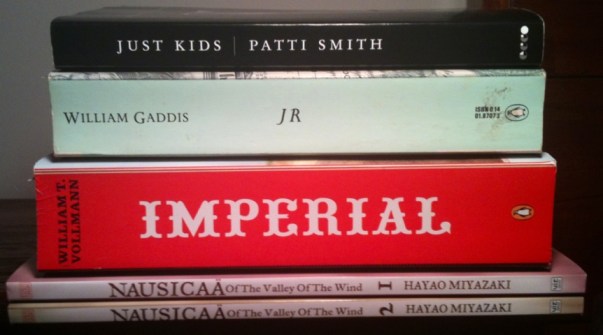
    20120110-181813.jpg

    1. Just Kids, Patti Smith

    Really slowed down on this one, mostly because the spring semester hath begun, wreaking all sorts of destabilizing tasks on me. Momentum and reading habits will inevitably return. Anyway, Smith’s book is more or less a litany of famous meetings and infamous moments with lots and lots of descriptions of talismanic objects. The scene where she meets Allen Ginsberg is pretty cool. Smith presents herself as earnest, passionate, but also somehow at odds (or at least outs) with the whole Chelsea Hotel scene.

    2. Nausicaä of the Valley of the Wind, Vol 1, Hayao Miyazaki

    Completed the first volume of Miyazaki’s groundbreaking manga and started the second. The art is well crafted and distinct, but often extremely busy and even frenetic. It sometimes feels squashed in the panels, like it needs room to breathe. I can’t help but compare it to the film that followed, which is visually richer and more expansive. The film, in a sense, helps me to fill out the scope signaled in Miyazki’s inky illustrations.

    The story in the manga so far differs subtly but significantly from the film; without adding spoilers (I think fans of the film will enjoy the book), the political dimension of the plot is heightened and gender roles are explored with greater concern. Nausicaä’s initial rashness is also presented with greater intensity (read: violent consequences). More to come.

    3. Imperial, William T. Vollmann

    Chapter 3 of Imperial, “The Water of Life,” is some of the best gonzo journalism I’ve ever read. Vollmann (along with an improbably game ex-Marine/hotel clerk) takes a raft—a cheap rubber dinghy, really—down the infamous New River, purportedly one of the most polluted waterways in North America. This river is filled with dead birds, dead fish, probably dead humans, lots and lots of garbage, industrial runoff, and lots and lots of human shit.

    Of course, Vollmann can find beauty and strangeness and ugliness all at once:

    The chapter does everything one wants from the book, and if you’re at all intrigued, there’s a version in the excellent Vollmann reader Expelled from Eden, which is a good starting point for his work.

    The next chapter, “Sublineations: Lovescapes,” is this awful emo exploration of a bad breakup and the following heartbreak Volls feels after. It was torturous to get through, the sort of thing that screams for an editor. It also underscores how deeply deeply deeply personal the book is to him, though. More to come.

    4. A Dance with Dragons, George R. R. Martin (audiobook read by Roy Dotrice)

    Well goddam if I didn’t finally finish it. As I’ve lamented elsewhere in these e-pages, Martin’s fourth and fifth books in the A Song of Ice and Fire series (I hate that name, by the way: Game of Thrones (without the indefinite article) is way cooler sounding) are bloated, sagging, overfilled beasts sorely in need of an enema. Still, Dragons picks up in its final third, and ends with some shockers that, if I remember them 12 years from now when he finally finishes the next one, I may want to read it. Roy Dotrice = a very gifted reader. A great audiobook (still, I can’t believe this one topped so many year end lists).

    5. JR, William Gaddis  (tandem reading with audiobook read by Nick Sullivan)

    Big thanks to Dwight at A Common Reader for suggesting the audiobook of JR read by Sullivan. I’m a few hours in; I’ve also been rereading bits immediately when I get home (I listen mostly in the car or on walks), retracing the lines that I’ve mentally underlined. Sullivan is a gifted voice actor who brings the many, many voices of JR to vivid life (that line seems hackneyed but it is in no way insincere. If I weren’t riffing I’d revise. If I weren’t riffing I’d edit parenthetical excuses. I’m gonna drink more red zin now). I’m reminded in some ways of RTE’s full-cast unabridged recording—performance really—of Joyce’s Ulysses. I’d read Ulysses twice before, but I feel like the full-cast production was an equally definitive version to the one in my head. Like Ulysses—especially the Sirens episode—JR is extremely aural; it’s mostly dialogue.

    I’ve laughed out loud several times so far—had no idea the book would be this funny. Also, reading/hearing it, I can’t help but see how profoundly David Foster Wallace was influenced by Gaddis here: the bizarre corporate-speak, the disjunctive rhythms, the absurd humor, the satire on modernity, the ironic-earnest axis—even the passages of naturalistic description.

    On deck: The Orphan Master’s Son by Adam Johnson, Open City by Teju Cole, Smut by Alan Bennett and more more more.

    Read (And Not Read) in 2011

    [Our West Coast correspondent A King at Night weighs in on the books he read—and didn’t read—in 2011. Where they fit, I’ve linked book titles to my own reviews, or Noquar’s, our Brooklyn correspondent. –Ed.]

    All of the books I did read in 2011:

    1. The Recognitions – William Gaddis

    If more people were able/interested in surmounting this 960 page giant I think it would be roundly considered possibly the best American novel. But as it is Gaddis sabotaged himself by writing a book that is almost literally too good.

    2. City of Glass – Paul Auster

    I think this one was my favorite of the New York Trilogy, except that I didn’t think of separating them until I made this list. So really I read three books as three parts of the same novel. One which I loved and adored fully. It was my first Auster and a the beginning of a beautiful friendship.

    3. Ghosts – Paul Auster

    See above.

    4. The Locked Room – Paul Auster

    See above.

    5. Bright Lights Big CityJay McInerny

    Not sure why I read this one. I think I just had it sitting around and it read fast enough to keep me engaged. I’m also not sure why this was as apparently popular as it was upon release. I know he was friends with Bret Ellis, but it just seems like Ellis but kind of declawed. So maybe that’s a good thing for some people. The use of second person narration was cool, I guess you don’t see that very often.

    6. Blood Meridian  – Cormac McCarthy

    There is almost literally nothing I can say about this that will have any value. I should mention that it fully lived up to the years and years of personal hype I had built up for it.

    7. Powr Mastrs vol. 2, 3  – C.F.

    This is a weird comic book series a friend introduced me to. Apparently it is ongoing and I think I would like to continue reading it.

    8. Point Omega – Don DeLillo

    This was my first attempt at DeLillo and I’m pretty sure I chose it because of its minuscule length and awesome cover art. I was totally enthralled and blown away. So much so in fact that Point Omega gets the distinction of the being, so far, the first and only book I have actually read twice in a row. As in I finished it and then flipped back to page one and read it a second time and it was brilliant again.

    9. In The Country of Last Things – Paul Auster

    I didn’t fully love this as much as I did the NY Trilogy, but I think that is due to a certain lack of detectives and the New York setting. This book kind of reminds me of a big, sad Terry Gilliam movie. Auster is in my opinion the unquestioned master of that meta-text device where what you are reading is actually being written by the character in the book. (I’m sure there is a name for that, but I don’t know it).

    10. The Pale King – David Foster Wallace

    I’ll try and cut the hyperbole on this one. I don’t care what any people are saying about this book or the man who wrote it. My enjoyment of this and other DFW books is entirely a personal experience. He may in fact be the smartest novelist who ever lived or whatever but I’m not going to browbeat you into believing me, and somehow trying to make myself look good by extension. This book did things for me that no book (including Infinite Jest) has ever done and for that I am grateful. I’ll say no more.

    11. Day of The Locust – Nathaniel West

    What a weird, dark, little book this is. And why have I never been told that the name Homer Simpson is used prominently throughout? The end of this book was basically jaw-dropping and could be the best sequence Fellini never filmed. I hear there was a movie made based on this, but I think it supposedly wasn’t very good.

    12. The Time Machine Did It – John Swartzwelder

    This is the first book in a series written following Detective Frank Burly. And the ONLY reason I haven’t immediately read each and every one of them is because they are self-published by the author and therefore impossible to find used. And since I almost never buy books new it would be a huge price adjustment for me. So I’ll take them slow, but if the rest are as fun as this is I predict I will love all of them.

    13. Ubik – Phillip K. Dick

    Very enjoyable, packed full of ideas (as usual for Dick) and with a pretty engaging plot to tie it all together.

    14. Carpenter’s Gothic – William Gaddis

    Last time I was home visiting my family I discovered that a copy of this book in my mom’s bathroom. Apparently she had seen me post about Gaddis on Facebook and decided to take my word for it. She was about a third of the way through this relatively slim book but confessed to having a hard time reading it. She asked what about it appealed to me so much and I told her that I view Gaddis as maybe the greatest American writer who ever lived, but that of the three books I’ve read of his Carpenter’s Gothic is the weakest, (or the least amazing, maybe) but that, you know, good luck telling anyone to read a 700 page book written entirely in unattributed dialogue (JR) or a 960 pager about classical art. So yeah CG is more of a little experiment in storytelling (the goal was to tell a massive sociopolitical epic, but done entirely in one location, a house in the country outside new york) than it is an essential work. But if you want to wet yr feet in regards to Gaddis but won’t/can’t commit to his larger, better books, then this is a decent starting point.

    15. Child of God – Cormac McCarthy

    Totally awesome. I started reading it late at night after finishing the previous book and ended up sitting on the couch until 4:30am and did the whole thing in one sitting. That doesn’t happen too often with me and I can’t really account for why it happened this time . . . but yeah this is the most readable McCarthy I’ve read since The Road.

    16. The Transmigration of Timothy Archer – Phillip K. Dick

    This is the (sort of) conclusion to PKD’s VALIS trilogy, which I started reading last year. It was the last book he wrote and is I think a pretty wonderful swan song for a guy as freakishly imaginative as him. It isn’t even really sci-fi even, but more like “spi-fi” (the term I just made up for Spiritual Fiction) which is sort of what all of his latter work was I guess, and is a thing that really resonates with me personally.

    17. Leviathan – Paul Auster

    My fifth Auster of the year: I picked this up because it had a cool cover and I read it mostly on flights to and from a wedding I attended in Wisconsin. This is totally wonderful and probably my second favorite Auster novel (behind NY3). I think if I were to write a longer piece on PA I would probably use this book to talk about his interest in choosing protagonists who are frequently less interesting than a supporting character whom they idolize. And also his interesting views on marriage and adultery. It’s worth noting that the book is dedicated to Don DeLillo and upon seeing that I was inspired to pick up some more of his books and finally some of the others that were piling up on my shelf.

    18. White Noise – Don DeLillo

    I’ve had a copy for this for like ten years and somehow could never make it past the first two pages, even though they are a really good two pages. Honestly in this case I think it was the edition. I had one of those scholarly ones with all the annotation and stuff that make the book look twice as long and 10x more boring. And then I found the newly printed Penguin paperback and burned through it in like a week. It’s one of the funniest things I’ve read and was really a gateway drug into a binge of DeLillo that was incredibly fulfilling.

    19. Running Dog – Don DeLillo

    This was probably the least mind-blowing (and the earliest) of the DeLillo I read this year. But still a good time, slightly Pynchonian (Pynchonesque?) probably as a result of DD still finding his own voice at that point. I probably wouldn’t recommend it to anyone who wasn’t already pretty well-into DeLillo but for fans of his I think it would be a good read.

    20. Libra – Don DeLillo

    Two things in life constantly threaten to destroy me: The Zodiac Killer and JFK. There is always this looming sense that if I were to ever really, fully commit to researching either case I would be entering rabbit-hole I’d never find my way out of. This book was simultaneously the most tempting experience but also the most satisfying. Because even if DD had to invent some of this he still presents a version of the story that is totally plausible. So maybe it’s a placebo but at least I can sleep at night.

    21. Underworld – Don DeLillo

    It was all a rehearsal for this one though. This big guy had been taking up space on my night stand for months and I’d had a number of friends basically begging me to read it for years. When I finally got around to reading it I was pleased to discover that it is NOT difficult at all, it’s just long. There is a sort of genre of these “big, complex, post-modern(?)” type of books. It’s a thing that I have a weakness for: Gravity’s Rainbow, Mason & Dixon, Against The Day, The Tunnel, The Recognitions, JR, Infinite Jest, etc. And I mean while Underworld has some things in common with these books I would actually characterize it as almost more like a Norman Mailer book or something. Yeah, I’d put it somewhere between a more-sober Thomas Pynchon and a less-horny Norman Mailer. Does that make sense at all?

    22. The Orchard Keeper – Cormac McCarthy

    I was hoping for a repeat of my Child of God experience with this one. And while that didn’t quite happen I still enjoyed this book a lot. Major props to McCarthy for mentioning Melungeons in the first chapter, being descended from that obscure ethnic group myself, with my dad’s family from east Tennessee, I can tell you that that is exactly the type of super-esoteric, colloquial reference that he later got a lot of praise for utilizing in his more-celebrated western novels. I guess it’s just neat to see that as a part of his style so early and is further proof that he is not in fact a writer of westerns at all, but just possibly the best writer of any region, just wherever he decides to dedicate his interest.

    23. Train Dreams – Denis Johnson

    I love Denis Johnson so much. I don’t usually buy hardback books but when I saw this cute little book I knew I had to have it. It reads super fast and is really just a great little character piece, telling basically the whole life of this one particular guy. Johnson could write two dozen of these things and I would read every one of them. But he won’t because he’s busy doing whatever other random thing he decides to write brilliantly—-

    24. Nobody Move  – Denis Johnson

    —-Like this little crime novel he wrote. I don’t think anyone who was around when his first few books would ever have thought he would end up trying to write a pulp novel. I certainly wouldn’t have. But boy am I glad he did. This book was so totally fun to read, with some of the most enjoyable dialogue I’ve ever read in my life. It isn’t as tightly plotted as any of the Coen bros. movies that it reminds me of, but for sentence-by-sentence writing it was one of the best things I read all year.

    25. Wild at Heart – Barry Gifford

    I had seen the movie a few times and knew I wanted t try the book. I heard that Lynch wrote the script in six days and having read it now I can say that I completely believe that is true. It’s probably one of the closest adaptations I’ve ever seen and really I’m just stunned by how Lychian Gifford’s book already was. It makes so much sense that these two collaborated on Lost Highway and my only wish is that they would work together again sometime.

    26. Travels in The Scriptorium – Paul Auster

    So I guess with this one Auster officially beat DeLillo for the most-read author of the year prize. I wasn’t even intending to buy another one until I saw the cover of this and instantly knew I had to. Anything that is this visually reminiscent of Twin Peaks has to be good right? It ended up being a great, easy read, which I am learning is typical of PA.

    27. The Bailbondsman – Stanley Elkin

    This is the first novella is book of three called Searches and Seizures that I just bought the other day. I was sold when I saw that William Gass had a blurb on the back cover saying something like “the three books contained in this volume are among the greatest in our literature” to which I mentally responded “well jeez Bill, I guess we’re going for the hard sell today, fine, I’ll buy it, say no more.” So I’m not ready to agree or disagree with Gass on this one, but I can see why he would like Elkin’s style, which sort of reminds me of a funnier more playful version of what Gass does.

    28. The Making of Ashenden – Stanley Elkin

    The second novella in Searches and Seizures is shorter and packs a bigger punch than the first. It’s one of these things where if I told you what happens in the story you would probably want to read it, but knowing what happens would reduce the impact when it does happen, so just trust me and read it. The writing is just terrific and it’s really funny. Humor isn’t really a quality that I value in visual entertainment as much, but when someone can write literary fiction that actually has me laughing out loud I tend to think it’ s worth mentioning.

    29. No One Belongs Here More Than You – Miranda July

    So I was fully ready to finish the third novella in that Elkin collection until I found myself at a friend’s apartment cat-sitting on Christmas Eve and this book was sitting on the shelf. So in keeping with the name of this blog I just went ahead and stole it. I proceeded to read it very quickly and I laughed out loud more than I expected to (remember when I mentioned literary fiction that elicits laughter? This was like that too). I confess that I don’t read a ton of short stories, (a truth this list will generally attest to) but I found this whole collection just wonderful. It might also be that this is the only book written by a woman that I read all year. In the past few years I have generally been on a strict diet of books that fit loosely to the idea of “American Post-Modern Novels” but generally means “Books published after the 60s by white guys mostly from new york.” And while I am proud of the big reading accomplishments this focus has helped me attain, (how else does one read Gaddis if not through sheer force of will?) this slight, sad, funny, collection of contemporary short fiction written by a young-ish female writer has shown me that I definitely need to broaden my palate.

    Some of the books I did not read in 2011:

    1. Freedom – Jonathan Franzen

    Yeah yeah yeah yeah yeah yeah blah blah blah blah blah blah glasses glasses glasses glasses glasses smug smug smug smug smug smug smug. I think I’ll let this one age a bit more before I attempt to read it. Granted his short “Breakup Stories” may literally be my favorite piece of fiction to appear in the new yorker in the past ten or twenty years… but, I have read the first page of The Corrections on three separate occasions (in three different sized editions, so now I know the physical copy is in fact NOT the problem) and each time I woke up in the spring, without having read the book. If I ever did decide to crack this one it would probably be in audio form, and maybe as part of a long road trip alone, specifically without a cell phone or cigarettes so that I would have nothing else I could possibly do.

    2. 2666 – Roberto Bolano

    I’m sorry Ed. I really am. It will happen, I swear it. But every time I pick this book up I am baraged by random four-part spanish sounding names that are indistinguishable for me, sample sentence: “What Jaun-Carlos Hernandez Jr. admired most about the poetry of Jullio Valdez-Herrara was the tactility of words. They leapt off the page with such precision and style that Jaun-Carlos was transported from the dusty villa where he sat to candlelit hut with a thatched roof, where revolutions are planned. He tried in vain to explain the power of the work to his professor Guillermo-Carlos Nunez but he scoffed at the work of Veldez-Herrara, calling it unworthy of the literary crown of the great Gabriell Marco San Flores.”

    3. Suttree – Cormac McCarthy

    After all the other McCarthy I read this year, I kind of thought I might just push on through with this one. I’ve been told by a number of people that it is one of his best. But the first page just stopped me dead in my tracks and I instantly knew it wasn’t the right time. No big deal, I’ll get around to it and then the border trilogy afterward.

    4. Ulysses – James Joyce

    Yes another year busy not-reading Ulysses. I feel I’m in good company on this though so oh well. It can’t really be that difficult can it? I enjoyed both Gravity’s Rainbow and Infinite Jest so my hope is that when I finally do get around to this big guy it will somehow seem quaint and easy. I’m sure that’s an exaggeration though.

    5. Anything by David Mitchell

    Because seriously fuck this guy. That Cloud Atlas movie adaptation is going to be a huge pile of shit too.

    6. Middlesex – Jeffrey Euginides

    This book has been haunting me for years, seemingly begging to be read and for some reason I am just 100% uninterested. But it has this weird habit of managing to show up on the bookshelves of people I like and trust, oftentimes sitting very close to other books I like. And sometimes these people tell me to read it. But it never seems very dire does it? No one is rapterous about this book and that makes me think that the Whatever-Prize sticker on the front is causing more people to read it than the actual urgency of the content. Somehow though last year Middlesex managed to get itself into a thrift store in the 50 cent bin, atop a pile of romance novels and pamphlets about Mormons. So now it sits on my shelf, tucked away on that hard to reach, shitty corner next to Cloud Atlas and whatever Dave Eggers books people insist I borrow but that I will never read (because: fuck that guy too). Sometimes though I hear a noise at night and when I wake up Middlesex is lying next to me on the pillow. So I’m pretty much going to have to read it at some point . . . not this year though.

    7. Zodiac – Robert Greysmith

    Bought it at the Farmer’s Market book stand and held it like a dark version of Willy Wonka’s golden ticket or some kind of box that when opened unleashes Chaos and Evil into the otherwise peaceful world. Right now I have a wife and an apartment and two cats, but I’m pretty sure I would somehow lose all of that the moment I cracked this book. Part of me is delusionally convinced that if I just dedicate my life to the cause that I could solve the Zodiac mystery. NOT reading this book has kept me from indulging that dark obsession for another year.

    8. The Beckett Trilogy

    Read ten pages or so and just felt like I wasn’t smart enough. Give me a few years and I’ll try it again.

    9. Anything by Dennis Cooper

    This dude sounds intense and disturbing, but also maybe really awesome. I heard about him first while googling interviews with the band Whitehouse and found Cooper’s blog and a massive post he did on them. Anyone who likes Whitehouse has to be okay right? Well at least I can’t say I wasn’t warned. I plan to get ahold of some of his books but I have no idea where to start, or where to find a bookstore that will give them to me in a plain brown paper bag so I don’t feel weird taking the bus home, as though by holding a Dennis Cooper book I’m sending some strange signal to all the secret sexual deviants around me every day.

    10. Crime Wave – James Ellroy

    Because I thought it was a novel when I bought it and since I have never read Ellroy I didn’t want to start with a collection of essays.

    11. Paradise – Donald Barthelme

    I am thrilled to still have a rainy day Barthelme novel left. So as much as it sounds hilarious I am going to hold off reading it for as long as I can.

    12. Infinite Jest – David Foster Wallace

    Granted I read it three years ago, but every year that I don’t re-read it I get sort of sad. I live vicariously through the one friend every year who reads it for the first time, and every time I listen to them rave for an hour I get it in my head that I’ll snatch it up and give it a quick once over. But when faced with the actual commitment involved I never do it. One day, one day.

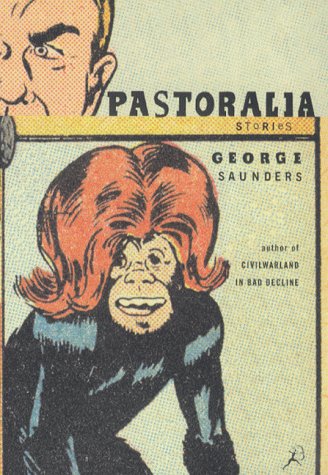
    Pastoralia — George Saunders

    I read Pastoralia, George Saunders’s 2000 collection of stories very quickly, consuming one or two of the book’s six stories a night, usually wedged between other readings. There was a flavor of respite to these readings, a sense of ease or relaxation or—dare I say it—simple pleasure. Frankly, I’m suspicious of any book that I’m able to read very quickly; perhaps I’m prejudiced against any book that doesn’t pose (or impose) its own learning curve on the reader.
    I’m perhaps off to a very bad start in this review, veering on the appearance of condescension (when, to be clear, I think that Pastoralia is sharp and wise and wicked and well-written and very, very funny)—but I feel like I have to get this out of the way up front: George Saunders’s prose, plots, and dialogue all reminded me very much of the prose, plots, and dialogue of David Foster Wallace.

    A bit of objective data: DFW and Saunders are/were of a similar age (born in ’62 and ’58, respectively) and Infinite Jest and Saunders’s first collection, CivilWarLand in Bad Decline were published the same year (’96). But, because of the simple mechanical truth that I read Wallace much, much earlier than Saunders, I find his influence unduly there. No doubt that when I detect Wallacian curves and contours and rhythms in Saunders—the coupling of officialese with imaginary slang, the depiction of a postmodern America which is slightly (but only slightly) not our own, the analyses of power and fear and duty—when I find these points of comparison, what I am really finding is the shared influences of Wallace and Saunders (no doubt postmodernists like Pynchon, Barth, Barthelme, et al). In short, if I find a suspicious ease or comfort in Saunders, it’s because Wallace already taught me to read him. But like I said before, this is not a great start. I should just review the book.

    Short review: the six tales in Pastoralia are hilarious, tender, and depressingly predictive of the decade that came after their composition (not to mention the strange dark horizon ahead of us). The long opener “Pastoralia” features a hapless man who works long hours apart from his wife and children in a failing history park. His job is to simulate a caveman, but his partner, an older woman with a troubled son, makes the job difficult to perform with any level of, uh, historical accuracy. When employees must be downsized, one of the managers tries to convince the narrator to rat out his partner’s shortcomings. “Pastoralia”  is a study in how corporate power uses dehumanizing tactics to exploit workers. The communications the narrator receives from a nebulous plurality of managers are both hilarious and horrific, each one a contortion of logic that serves to strip the rights (and self-worth) of the workers. The story, depressingly, is more relevant than ever. (Readers familiar with CivilWarLand in Bad Decline will recognize “Pastoralia” as a revision of sorts to that earlier collection’s title story).

    The next tale, “Winky,” moves along the same lines, exploring the clash between the Darwinian drives of self-protection and self-satisfaction set against the needs of others. In this story, the protagonist attends a self-help seminar (the scene is something so contemporaneous with Wallace that I’s tempted to write “straight out of DFW”), where the psychobabble and rationalizing of the speaker persuades him to ditch his weird, needy sister. Like the complex and funny managerial rhetoric we find in “Pastoralia,” the motivational lingo lulls and persuades not just the protagonist, but also the reader, into the easy trap of contemporary consumerism that centers the self as the ultimate telos of existence.

    “Sea Oak” is the possible high point in the collection. It depicts an ersatz family living in a housing project that at one point we might have described as “on the margins of America” — only in Saunder’s vision (a vision increasingly realized) such housing projects are the reality for the majority of Americans. The middle class is not the norm. The (male) narrator strips to help bring money into the crappy apartment he shares with his aunt and two cousins and their two kids. A sample—

    Sea Oak’s not safe. There’s an ad hoc crackhouse in the laundry room and last week Min found some brass knuckles in the kiddie pool. If I had my way I’d move everybody up to Canada. It’s nice there. Very polite. We went for a weekend last fall and got a flat tire and these two farmers with bright red faces insisted on fixing it, then springing for dinner, then starting a college fund for the babies. They sent us stock certificates a week later, along with a photo of all of us eating cobbler at a diner.

    The hyperbolic vision of a Canada that cares for all of its citizens stands in sharp relief to the predatory Darwinism of the Sea Oak projects. As the story unfolds, Saunders uses his characters to examine just what exactly economic struggle in American is for—what does the American Dream mean when subsistence living alone is so difficult?

    “The End of FIRPO in the World” is perfection, a sad, funny, rambling stream of consciousness that plumbs the mind of an alienated boy who imagines his future glories and the revenge that he will have for all the slights done him. “FIRPO,” sitauted in the middle of collection, moves the book from the familial and corporate to the individual, as the last few tales (“The Barber’s Unhappiness” and “The Falls”) inhabit the strange sad consciousness of ordinary, awful people. These are beautiful portraits, ones that explore the gravity of failure and the small glowing sparks of redemption that might be available to us.

    If, as I remarked earlier, there’s a comfort in Saunders’s prose, it’s the strange uncomfortable comfort that there’s a perceptive and wise intelligence out there that can apprehend and satirize the sheer horrific injustice that pervades the modern condition. Pastoralia is great, and I picked up CivilWarLand in Bad Decline right after finishing it, so there’s an endorsement. Recommended.

    “A Strange Kind of Slavery” — David Foster Wallace on Individuality, Corporatism, and Civic Responsibility

    “Imagine You’re a Hyper-Educated Avant Gardist” — David Foster Wallace on David Lynch (Video)

    Begins at 4:oo. (Transcript).

    “Entering The Pale King Is Like Entering a Familiar Room, Now Stripped Bare”

    At Seven Steps Back, there’s a marvelous series of posts—a long essay, really, broken down into digestible blog chunks—about David Foster Wallace’s The Pale King. The piece is easily one of the better analyses I’ve read about Wallace’s last book, well researched and well written through an intertextual lens. A taste, a riff on Wallace’s names—

    Entering The Pale King is like entering a familiar room, now stripped bare, but with the footprints of its former occupant, your departed friend, still visible in the dust on the floor. For example, the good old names are back, strange and unharmonious, vaguely Germanic, Latinate, French, at root un-American; names like Lotwis and Glendenning and Bondurant and Henzke, not zany and humorous like Pynchon’s (it seems to me that the names and the scope of his books are the only reasons he has been called an epigone to Pynchon, nothing else), but rather like clothes one cannot find it in himself to feel at ease in, even though they aren’t tight or loose, but just right. They also seem like they were once normal, everyday names –names like George Smith and Janet Cooper– but at some point were taken apart and reconstructed by a neurotic tinkerer, in order to establish how long they can go on working before exploding.

    Time, Space, Distortion: Falling Toward a 9/11 Literature

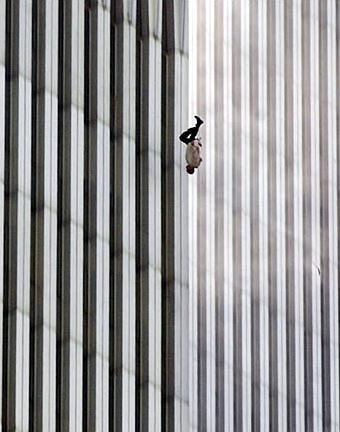
    The_Falling_Man

    In his essay In the Ruins of the Future,” published in December of 2001, Don DeLillo wrote this about the 9/11 attacks: “The writer wants to understand what this day has done to us. Is it too soon?” His question was both profound and at the same time utterly banal—of course it was too soon to measure the effects of the 9/11 attacks. But could time’s distance somehow sharpen or enrich perspective? DeLillo continues: “We seem pressed for time, all of us. Time is scarcer now. There is a sense of compression, plans made hurriedly, time forced and distorted.”

    In retrospect—what with the Bush administration’s ludicrous invasion of Iraq and the power-grab of the Patriot Act—DeLillo’s notation of “plans made hurriedly” seems downright scary. Still, I remember that immediate, overwhelming shock, that paralyzing inertia that had to be overcome. DeLillo wanted—needed—to grapple with this spectacular destruction immediately. David Foster Wallace responded with similar immediacy; the caveat that prefaces his moving essay The View from Mrs. Thompson’s states that the piece was “Written very fast and in what probably qualifies as shock.” The same caveat would also apply neatly to Art Spiegelman’s big, brilliant, messy attempt at cataloging his impressions immediately post-9/11, In the Shadow of No Towers.

    In contrast, the trio of 9/11 stories at the heart of Chris Adrian’s short story collection, A Better Angel, all employ distance and distortion—both temporal and spatial—as a means to address the disaster (or inability to address the disaster) of the attacks on the World Trade Center. Adrian’s 9/11 tales (and his works in general, really), ask how one can grieve or attest to death on such a massive, spectacular scale. The victims of the 9/11 attacks forever haunt his protagonists, literally possessing them, demons that can’t let go, forcing the living to wallow in grief. In “The Changeling,” for example, the grief of the attacks is literally measured in blood, as a father repeatedly maims himself as the only means to assuage the terror and confusion of his possessed son. Adrian sets one of the collection’s most intriguing tales, “The Vision of Peter Damien,” in nineteenth-century rural Ohio. This temporal distortion veers into metaphysical territory as the titular Damien, along with other children in his village, become sick, haunted by the victims of 9/11. Adrian’s displaced milieu creates a bizarre cognitive dissonance for his readers, a response that DeLillo also articulated in his 2007 novel Falling Man.

    DeLillo initiates the novel as a sort of creation story: “It was not a street anymore but a world, a time and space of falling ash and near night.” The demarcation of this new world recapitulates DeLillo’s initial concern with time and space, but his novel seems ultimately to suggest an inertia, a meaninglessness, or at least the hollow ambiguity of any artistic response. This stands, of course, in sharp contrast to his sense of urgency in his earlier essay. Like the performance artist in the novel who is repeatedly sighted hanging suspended from a harness, there’s a sad anonymity in the background of Falling Man: the artist hangs as static witness to disaster, but looking for comfort, or even perhaps meaning, in the gesture is impossible.

    David Foster Wallace’s short story “The Suffering Channel,” (from his 2004 collection Oblivion) is in many ways a far more satisfying take on 9/11, although to be fair, the majority of the story’s events take place in July of 2001. The story (or novella, really; it’s 90 pages) centers around a magazine headquartered in the World Trade Center that plans to run an article—on September 10th, 2001—about a man who literally shits out pieces of art. Wallace’s critique of American culture (shit as art, commerce as style, advertising as language) is devastating against the context of the looming disaster to which his characters are so oblivious. As the novella reaches its close (culminating in the shit artist producing an original work for a live audience), we learn more about “The Suffering Channel,” a cable channel devoted to broadcasting only images of human beings suffering intense and horrible pain. Wallace seems to suggest that The Suffering Channel’s audience watches out of Schadenfreude or morbid fascination, that modern American culture so disconnects people that genuine suffering cannot be witnessed with empathy, but only as a form of spectacular, disengaged entertainment. And yet even as Wallace critiques American culture, the specter of the 9/11 attacks ironically inform his story. With our awful knowledge of what will happen the day after the shit artist article is published, we are able to see the ridiculous and ephemeral nature of the characters’ various concerns. At the same time, Wallace’s tale reveals that empathy for suffering is possible, but also that it comes at a tremendous price.

    To contrast the journalistic immediacy of pieces like “In the Ruins of the Future” and “The View from Mrs. Thompson’s” with their respective writers attempts to measure 9/11 in literary fiction is perhaps a bit unfair. Still, Wallace’s and DeLillo’s essays transmit something of the ineffable, visceral quality of that terrible day, as well as the strange ways we sought comfort through human connection. In contrast, the distance and distortion of their literary efforts lose something. I apologize—I don’t have a word for this “something” that the essays have that the novel and novella lack (perhaps the absence is purposeful; perhaps not). It’s not clarity, but perhaps it’s a clarity of distortion that the essays convey, the duress, or to return to Wallace’s own notation, the pieces were “Written very fast and in what probably qualifies as shock.” It’s that shock, I suppose, that I’m trying to name, to say that it’s still there, accessible in those early responses (I realize now I’ve unfairly neglected Spiegelman’s book, which is a great example of immediacy). And to relive that shock is important, because, as Wallace reveals in both of his pieces, the cathartic power of shared tragedy makes us human, allows us to really live, and to be thankful that we do live.

    Looking over this piece, I realize that it’s overly long and really says nothing, or at least nothing much about 9/11, or literature, or whatever. But I don’t want to be negative. I highly encourage you to read (or re-read) The View from Mrs. Thompson’s” and In the Ruins of the Future.” And I’ll leave it at that.

    [Editorial note: We ran a (somewhat sloppier) version of this essay on 9.11.2009]

    “Just Asking” — David Foster Wallace’s 9/11 Thought Experiment

    Here’s David Foster Wallace’s “Just Asking,” from the November, 2007 issue of The Atlantic

    Are some things still worth dying for? Is the American idea* one such thing? Are you up for a thought experiment? What if we chose to regard the 2,973 innocents killed in the atrocities of 9/11 not as victims but as democratic martyrs, “sacrifices on the altar of freedom”?* In other words, what if we decided that a certain baseline vulnerability to terrorism is part of the price of the American idea? And, thus, that ours is a generation of Americans called to make great sacrifices in order to preserve our democratic way of life—sacrifices not just of our soldiers and money but of our personal safety and comfort?

    In still other words, what if we chose to accept the fact that every few years, despite all reasonable precautions, some hundreds or thousands of us may die in the sort of ghastly terrorist attack that a democratic republic cannot 100-percent protect itself from without subverting the very principles that make it worth protecting?

    Is this thought experiment monstrous? Would it be monstrous to refer to the 40,000-plus domestic highway deaths we accept each year because the mobility and autonomy of the car are evidently worth that high price? Is monstrousness why no serious public figure now will speak of the delusory trade-off of liberty for safety that Ben Franklin warned about more than 200 years ago? What exactly has changed between Franklin’s time and ours? Why now can we not have a serious national conversation about sacrifice, the inevitability of sacrifice—either of (a) some portion of safety or (b) some portion of the rights and protections that make the American idea so incalculably precious?

    In the absence of such a conversation, can we trust our elected leaders to value and protect the American idea as they act to secure the homeland? What are the effects on the American idea of Guantánamo, Abu Ghraib, Patriot Acts I and II, warrantless surveillance, Executive Order 13233, corporate contractors performing military functions, the Military Commissions Act, NSPD 51, etc., etc.? Assume for a moment that some of these measures really have helped make our persons and property safer—are they worth it? Where and when was the public debate on whether they’re worth it? Was there no such debate because we’re not capable of having or demanding one? Why not? Have we actually become so selfish and scared that we don’t even want to consider whether some things trump safety? What kind of future does that augur?

    FOOTNOTES:
    1. Given the strict Gramm-Rudmanewque space limit here, let’s just please all agree that we generally know what this term connotes—an open society, consent of the governed, enumerated powers, Federalist 10, pluralism, due process, transparency … the whole democratic roil.

    2. (This phrase is Lincoln’s, more or less)

    Biblioklept’s Favorite Books of the Summer

    With Memorial Day ’11 just a memory and Labor Day warning off the wearing of white, I revisit some of the best books I read this summer:

    Although I posted a review of Roberto Bolaño’s collection Between Parentheses two weeks before Memorial Day, I continued to read and reread the book over the entire summer. It was the gift that kept giving, a kind of blurry filter for the summer heat, a rambling literary dictionary for book thieves. For example, when I started Witold Gombrowicz’s Trans-Atlantyk a week or two ago, I spent a beer-soaked midnight tracing through Bolaño’s many notations on the Polish self-exile.

    Trans-Atlantyk also goes on this list, or a sub-list of this list: great books that I’ve read, been reading (or in some cases, listened to/am listening to) but have not yet reviewed. I finished Trans-Atlantyk at two AM Sunday morning (surely the intellectual antidote to having watched twelve hours of college football that day) and it’s one of the strangest, most perplexing books I’ve ever read—and that’s saying something. Full review when I can process the book (or at least process the idea of processing the book).

    I also read and absolutely loved Russell Hoban’s Kleinzeit, which is almost as bizarre as Trans-Atlantyk; like that novel (and Hoban’s cult classic Riddley Walker), Kleinzeit  is written in its own idiom, an animist world where concepts like Death and Action and Hospital and even God become concrete characters. It’s funny and sad. Also funny and sad: Christopher Boucher’s How to Keep Your Volkswagen Alive (new from Melville House). Like Trans-Atlantyk and Kleinzheit, Volkswagen is composed in its own language, a concrete surrealism full of mismatched metaphorical displacements. It’s a rare bird, an experimental novel with a great big heart. Full reviews forthcoming.

    I’ll be running a review of Evelio Rosero’s new novel Good Offices this week, but I read it two sittings at the beginning of August and it certainly belongs on this list. It’s a compact and spirited satire of corruption in a Catholic church in Bogotá, unwinding almost like a stage play over the course of a few hours in one life-changing evening for a hunchback and his friends. Good stuff.

    On the audiobook front, I’ve been working my way through George R. R. Martin’s A Song of Ice and Fire series; I finished the first audiobook, A Game of Thrones, after enjoying the HBO series, and then moved into the second book, A Clash of Kings, which I’m only a few hours from completing. I think that the HBO series, which follows the first book fairly faithfully, is much closer to The Wire or Deadwood than it is to Peter Jackson’s Tolkien films—the story is less about fantasy and magic than it is about political intrigue during an ongoing civil war. This is a world where honor and chivalry, not to mention magic and dragons, have disappeared, replaced by Machiavellian cunning and schemers of every stripe. Martin slowly releases fantastic elements into this largely desacralized world, contesting his characters’ notions of order and meaning. There are also beheadings. Lots and lots of beheadings. The books are a contemporary English department’s wet dream, by the by. Martin’s epic concerns decentered authority; it critiques power as a constantly shifting set of differential relations lacking a magical centering force. He also tells his story through multiple viewpoints, eschewing the glowing third person omniscient lens that usually focuses on grand heroes in fantasy, and concentrates instead, via a sharp free indirect style, on protagonists who have been relegated to the margins of heroism: a dwarf, a cripple, a bastard, a mother trying to hold her family together, a teenage exile . . . good stuff.

    Leo Tolstoy’s final work Hadji Murad also depicts a world of shifting power, civil war, unstable alliances, and beheadings (although not as many as in Martin’s books). Hadji Murad tells the story of the real-life Caucasian Avar general Hadji Murad who fought under Imam Shamil, the leader of the Muslim tribes of the Northern Caucuses; Shamil was Russia’s greatest foe. This novel concerns Murad’s attempt to defect to the Russians and save his family, which Shamil has captured. The book is a richly detailed and surprisingly funny critique of power and violence.

    William Faulkner’s Light in August might be the best book I read this summer; it’s certainly the sweatiest, headiest, and grossest, filled with all sorts of vile abjection and hatred. Faulkner’s writing is thick, archaeological even, plowing through layers of Southern sediment to dig up and reanimate old corpses. The book is somehow both nauseating and vital. Not a pleasant read, to be honest, but one that sticks with you—sticks in you even—long after the last page.

    Although David Foster Wallace’s posthumous novel The Pale King was released in the spring, I didn’t start reading it until June; too much buzz in my ears. If you’ve avoided reading it so far because of the hype, fair enough—but don’t neglect it completely. It’s a beautiful, frustrating, and extremely rewarding read.

    Speaking of fragments from dead writers: part two of Roberto Bolaño’s The Third Reich, published in the summer issue of The Paris Review, was a perfect treat over the July 4th weekend. I’m enjoying the suspense of a serialized novel far more than I would have imagined.

    Wayne Koestenbaum’s Humiliation is probably the funniest, wisest, and most moving work of cultural studies I’ve ever read.  Unlike many of the tomes that clutter academia, Humiliation is accessible, humorous, and loving, a work of philosophical inquiry that also functions as cultural memoir. Despite its subject of pain and abjection, it repeatedly offers solutions when it can, and consolation and sympathy when it cannot.

    So the second posthumously published, unfinished novel from a suicide I read this summer was Ernest Hemingway’s The Garden of Eden, the sultry strange tale of a doomed ménage à trois. (I’m as humiliated by that last phrase as you might be, dear reader. Sorry). Hemingway’s story of young beautiful newlyweds drinking and screwing and eating their way across the French Riviera is probably the weirdest thing he ever wrote. It’s a story of gender reversals, the problems of a three-way marriage, elephant hunting, bizarre haircuts, and heavy, heavy drinking. The Garden of Eden is perhaps Hemingway at his most self-critical; it’s a study in how Hemingway writes (his protagonist and stand-in is a rising author) that also actively critiques his shortcomings (as both author and human). The Garden of Eden should not be overlooked when working through Hemingway’s oeuvre. I’d love to see a critical edition with the full text someday (the novel that Scribner published pared down Hemingway’s unfinished manuscript to about a third of its size).

    Also fragmentary fun: F. Scott Fitzgerald’s Notebooks. Like Twitter before Twitter, sort of.

    These weren’t the only books I read this summer but they were the best.

    “It’s No Accident that Civics Isn’t Taught Anymore” — More from §19 of David Foster Wallace’s The Pale King

    (Help yourself to some context (or not)).

    Let’s look at some more of  §19 of David Foster Wallace’s The Pale King. Our interlocutors, all IRS agents, stuck in an elevator (methinks), direct their attention toward the decline of civics education (“‘Civics is the branch of political science that quote concerns itself with citizenship and the rights and duties of US citizens,’” we learn) in America and link this decline to the 1960s—

    ‘I think it’s no accident that civics isn’t taught anymore or that a young man like yourself bridles at the word duty.’

    ‘We’ve gotten soft, you’re saying.’

    ‘I’m saying that the sixties—which God love them did a lot for raising people’s consciousness in a whole lot of areas, such as racism and feminism—‘

    ‘Not to mention Vietnam.’

    ‘No, mention it, because here was a whole generation where most of them now for the first time questioned authority and said that their individual moral beliefs about the war outweighed their duty to go fight if their duly elected representatives told them to.’

    ‘In other words that their highest actual duty was to themselves.’

    And down a bit—

    ‘The sixties were America’s starting to decline into decadence and selfish individualism—the Me generation.’

    ‘There was more decadence in the twenties than there was in the sixties though.’

    ‘You know what I think? I think the Constitution and Federalist Papers of this country were an incredible moral and imaginative achievement. For really the first time in a modern nation, those in power set up a system where the citizens’ power over their own government was to be a matter of substance and not mere symbolism. It was utterly priceless, and will go down in history with Athens and the Magna Carta. The fact that it was a utopia which for over two hundred years actually worked makes it beyond priceless—it’s literally a miracle. And—and I’m speaking of Jefferson, Madison, Adams, Franklin, the real church Fathers—what raised the American experiment beyond great imagination and made it very nearly work was not just these men’s intelligence but their profound moral enlightenment—their sense of civics. The fact is that they cared more about the nation and the citizens than about themselves. They could have just set America up as an oligarchy where powerful eastern industrialists and southern landowners controlled all the power and ruled with an iron hand in a glove of liberal rhetoric. Need I say Robespierre, or the Bolsheviks, or the Ayatollah? These Founding Fathers were geniuses of civic virtue. They were heroes. Most of their effort went into restraining the power of the government.’

    ‘Checks and balances.’

    ‘Power to the people.’

    ‘They knew the tendency of power to corrupt—’

    As I said in some earlier posts about  §19, I don’t really have any great thesis to share about it: I really just want folks to read it. I think it’s a thoughtful and sometimes funny discussion that seems especially relevant against the backdrop of current American politics, which seem to be infected by a terrible case of the reactionaries, a very vocal contingent that does not seem to believe in civic duty.

    Most reviewers have remarked (rightly) upon Wallace’s grand theme of boredom in The Pale King, but I don’t know how much attention has been paid to the way the book tries to measure the costs of existence (namely, death and taxes). Wallace squares boredom as both symptom and affect of a postindustrial existence, a post-democratic existence, an existence that has the leisure, or at least the means and the common vocabulary, to hash out the finnicky sinews between rights and duties—or, in turn, the leisure and means (and entertainments) to psychologically deflect or otherwise ignore those costs. His characters in The Pale King—and not just these guys stuck in the elevator, but, hey, their colloquy is especially instructive—his characters are in many ways are trying to find meaning, a sense of duty, against terrible, soul-crushing boredom, a boredom that capitalist culture fosters and with one hand and then assuages with the other, like a heroin dealer stringing along a junkie for all he’s worth. (There’s an intersection here with Infinite Jest, of course).

    It seems that “civics” is a dirty word now, or even worse, a word unattached to any real concept in the American hivemind. It’s pretty much a given (and “given” in the sense of, like, “submission”) that our politicians are wholly corrupted by power, part and parcel of a corporatocracy that thrives on manufactured desire, on the promotion of “lack,” constantly feeding into the basest instincts of a populace easily motivated by xenophobia, paranoia, and the sense that a creeping dark “other” is destabilizing America’s “natural” progress to some great grand glowing telos in the sky. The great lie of the past few decades has been to perpetuate the ideal of a cost-free existence, a metaphysical out, an endless deflection of our rapid consumption. We live in a world where the leading Republican candidates for the 2012 election race are basically cartoons. We live in a world where headlines from The Onion seem more the work of prescient prescription than outright satire. We live in a world where an honest assessment of who-pays-what-taxes can only come from a comedy show.

    Perhaps I’m ranting; perhaps this post is too hyperbolic. Sorry. I’ll return to Wallace’s language and that opening line: “‘I think it’s no accident that civics isn’t taught anymore or that a young man like yourself bridles at the word duty.'” Americans are being told that they have no duty to other Americans, that they should not have to have any relationship with other Americans, that, essentially, there is no civic duty to one’s country, to one’s fellow Americans—there is only a duty to one’s ruggedly individual self, only a duty to one’s bootstraps, which you must always pull up by yourself. The corporate-advertising-entertainment-industrial complex perpetuates the illusion of rugged individualism and politicians reinforce it with their empty rhetoric, blasting at any element of a public, civic corpus that isn’t part of the American war machine (which remains of course untouchable; perhaps the greatest signal of cognitive dissonance I regularly see on my commute to and from work are the cars in front of me that somehow bear anti-tax bumper stickers right next to calls to “Support Our Troops”).

    Wallace perhaps rightly links the genesis of this cognitive dissonance when it comes to civic rights and civic duties to the 1960s, when the baby boomers, finding power in sheer numbers, were able to assert a generational agency unseen in this country’s history. His elevator talkers here are at the precipice of the Reagan ’80s, post-Watergate disenchantment, but also post-Carter malaise, a time when the boomers are oiled and primed for the complete ideological failure that should forever mark their generation.

    There’s more rant in me, of course, but I’ll save it for more excerpts from  §19.

    David Foster Wallace Describes the Reading Process

    I Watch The Decemberists’ David Foster Wallace Video

    I’ll be upfront: I don’t care for the music of The Decemberists. I’ve tried, after being told repeatedly how “deep” or “clever” or “literate” the lyrics are, and how good the music is—but it all strikes me as awfully bland stuff, like someone’s shitty take on R.E.M.

    Anyway, I do very much like David Foster Wallace’s novel Infinite Jest, the “inspiration” (yes, I’ll put the word in suspicious quotation marks) behind The Decemberists’ new music video for “Calamity Song.” Here’s their singer/songwriter Colin Meloy (via NPR)—

    I wrote “Calamity Song” shortly after I’d finished reading David Foster Wallace’s epic Infinite Jest. The book didn’t so much inspire the song itself, but Wallace’s irreverent and brilliant humor definitely wound its way into the thing. And I had this funny idea that a good video for the song would be a re-creation of the Enfield Tennis Academy’s round of Eschaton — basically, a global thermonuclear crisis re-created on a tennis court — that’s played about a third of the way into the book. Thankfully, after having a good many people balk at the idea, I found a kindred spirit in Michael Schur, a man with an even greater enthusiasm for Wallace’s work than my own. With much adoration and respect to this seminal, genius book, this is what we’ve come up with. I can only hope DFW would be proud.

    I’m not going to conjecture whether Wallace would be proud or not. That seems like total asshole move. But, I am interested in seeing a filmed version of Eschaton, and I do like Michael Schur’s show Parks and Recreation. So I’m going to watch the video now—unmuted and everything—and then post a reaction. Here’s the vid—

    Okay. Nice production values, I guess. I think that’s the band, right? I like it when bands are in their own videos and “act.” I guess they’re playing the older ETA kids who are watching the game this Interdependence Day. The singer is Pemulis, that seems clear. It snows in the Escahton episode, but it looks like only some rain here. I like the Otis P. Lord kid, but I don’t know if the other kids look right. This is weak criticism, I know. Hmmm. The song . . . well, I’m not into this song, but I guess it’s pleasant enough. It’s terribly competent. Bits of it sound like a sped up version of R.E.M.’s “Talk About the Passion.” Some of the lyrics seem to reference or play off of Infinite Jest maybe—like “Year of the Something Something”  or something.

    I don’t know. What can I say here? I hope no one tries to make a movie out of Infinite Jest. It was all I could do to fast forward through most of Jim from The Office’s movie of Hideous Men.

    A List of Things Roberto Bolaño Discussed with His Friend Rodrigo Fresán

    From the entry “All Subjects with Fresán,” in Bolaño’s collection Between Parentheses, a list of stuff the late writer talked about with his good friend, which includes (as usual) plenty of references to writers, poets, directors—and some funny jokes as well. Read part of Fresán’s essay “The Savage Detective” — it was the piece that first got me to go pick up a Bolaño. Here’s the list—

    1) The Latin American hell that, especially on weekends, is concentrated around some Kentucky Fried Chicken or McDonald’s.

    2) The doings of Buenos Aires photographer Alfredo Garofano, childhood friend of Rodrigo and how a friend of mine and of anyone with the least bit of discernment.

    3) Bad translations.

    4) Serial killers and mass murders.

    5) Prospective leisure as the antidote to prospective poetry.

    6) The vast number of writers who should retire after writing their first book or their second or their third or their fourth or their fifth.

    7) The superiority of the work of Basquiat to that of Haring, or vice versa.

    8 ) The works of Borges and the works of Bioy.

    9) The advisability of retiring to a ranch in Mexico near a volcano to finish writing The Turkey Buzzard Trilogy.

    10) Wrinkles in the space time continuum.

    11) The kind of majestic women you’ve never met who come up to you in a bar and whisper in your ear that they have AIDS (or that they don’t).

    12) Gombrowicz and his conception of immaturity.

    13) Philip K. Dick, whom we both unreservedly admire.

    14) The likelihood of a war between Chile and Argentina and its possible and impossible consequences.

    15) The life of Proust and the life of Stendhal.

    16) The activities of some professors in the United States.

    17) The sexual practices of titi monkeys and ants and great cetaceans.

    18) Colleagues who must be avoided like limpet mines.

    19) Ignacio Echevarria, whom both of us love and admire.

    20) Some Mexican writers liked by me and not by him, and some Argentine writers like by me and not by him.

    21) Barcelonan manners.

    22) David Lynch and the prolixity of David Foster Wallace.

    23) Chabon and Palahniuk, whom he likes and I don’t.

    24) Wittgenstein and his plumbing and carpentry skills.

    25) Some twilit dinners, which actually, to the surprise of the diner, become theater pieces in five acts.

    26) Trashy TV game shows.

    27) The end of the world.

    28) Kubrick’s films, which Fresán loves so much that I’m beginning to hate them.

    29) The incredible war between the planet of the novel-creatures and the planet of the story beings.

    30) The possibility that when the novel awakes from its iron dreams, the story will be there.