Malcolm Lowry’s “Big Books,” as Reported by David Markson


From “Malcolm Lowry: A Remininiscence,” the final chapter of David Markson’s Malcolm Lowry’s Volcano, a study of Under the Volcano:

His big books, however, would at the moment remain these: Moby-DickBlue Voyage, the Grieg, Madame Bovary, Conrad (particularly The Secret Agent), O’Neill, Kafka, much of Poe, Rimbaud, and of course Joyce and Shakespeare. The Enormous Room is a favorite, as is Nightwood. Kierkegaard and Swedenborg are the philosophers most mentioned, and in another area William James and Ouspensky. Also Strindberg, Gogol, Tolstoy.

Lifting a Maupassant from the shelf (nothing has been said of the man before this): “He is a better writer than you think.”


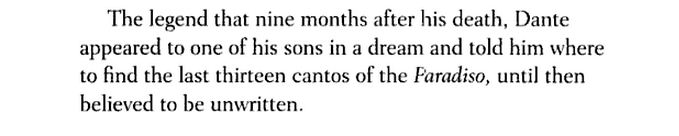
Dante Legend, as Reported by David Markson

“Have I ever mentioned that Michelangelo practically never took a bath in his life, by the way?” — A Riff from David Markson’s Wittgenstein’s Mistress

A riff on Michelangelo from David Markson’s novel Wittgenstein’s Mistress (the ellipses indicate my edit, not Markson’s):

Have I ever mentioned that Michelangelo practically never took a bath in his life, by the way?

And even wore his boots to bed?

On my honor, it is a well known item in the history of art that Michelangelo was not somebody one would particularly wish to sit too close to.

Which on second thought could very well change one’s view as to why all of those Medici kept telling him don’t bother to get up, as a matter of fact.

. . .

I have just wrapped my head into a towel.

Having gone out for some greens, for a wet salad, this would be because of.

And in the meantime the more I have thought about it, the more sorry I have gotten about what I said.

I mean about Michelangelo, not about Herodotus.

Certainly I would have found it more than agreeable to shake Michelangelo’s hand, no matter how the pope or Louis Pasteur might have felt about this.

In fact I would have been excited just to see the hand that had taken away superfluous material in the way that Michelangelo had taken it away.

Actually, I would have been pleased to tell Michelangelo how fond I am of his sentence that I once underlined, too.

Perhaps I have not mentioned having once underlined a sentence by Michelangelo.

I once underlined a sentence by Michelangelo.

This was a sentence that Michelangelo once wrote in a letter, when he had lived almost seventy-five years.

You will say that I am old and mad, was what Michelangelo wrote, but I answer that there is no better way of being sane and free from anxiety than by being mad.

On my honor, Michelangelo once wrote that.

As a matter of fact I am next to positive I would have liked Michelangelo.

List of Fictional Suicides (From David Markson’s Reader’s Block)

Emma Bovary.

Anna Karenina.

Othello.

Jocasta.

Brunnhilde.

Hedda Gabler.

Romeo and Juliet.

Werther.

Dido.

Cio-Cio-San.

Antigone and Haemon.

Miss Julie.

Axel Heyst.

Quentin Compson.

Aida.

Inspector Javert.

Mynheer Peeperkorn. Leo Naphta.

Smerdyakov.

Rudolf Virag.

Edna Pontellier.

Hero.

Manrico’s Leonora.

Cheri.

Goneril.

Richard Cory.

McWatt.

Tosca.

Stravrogin. Kirillov.

Martin Eden.

Hurstwood.

Pyramus and Thisbe.

Roithamer.

Pierre Glendinning.

Winnie Verloc.

George Wilson.

Hedvig Ekdal.

Christine Mannon. Orin Mannon.

Willy Loman.

Senta.

Maggie Johnson.

Peter Grimes.

Bess, the landlord’s black-eyed daughter.

Svidrigailov.

James O. Incandenza.

Konstantin Treplev.

Bartleby.

Septimus Smith.

Deirdre.

Seymour Glass.

Ophelia.

Samson.

Eustacia Vye.

Phaedra.

Alcetis.

Launcelot.

From David Markson’s Reader’s Block.  By my count, Markson references throughout the book 149 suicides (or near-suicides, or presumed suicides) of real, actual persons (i.e., not including the list above). This count does not include Markson’s reference to “Nine hundred and sixty Jews” who “committed suicide at Masada, in 73 A.D., rather than surrender to the Roman legions that had lately sacked Jersusalem.” It’s entirely possible I miscounted.

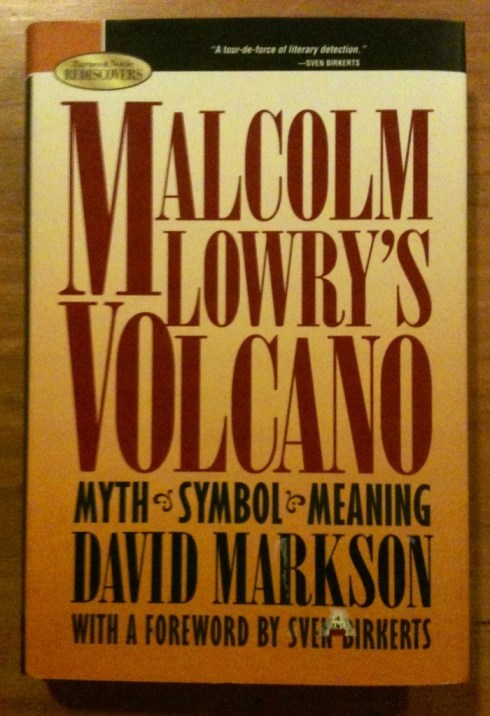
David Markson’s Malcolm Lowry Study (Book Acquired, 6.05.2012)

20120607-133715.jpg

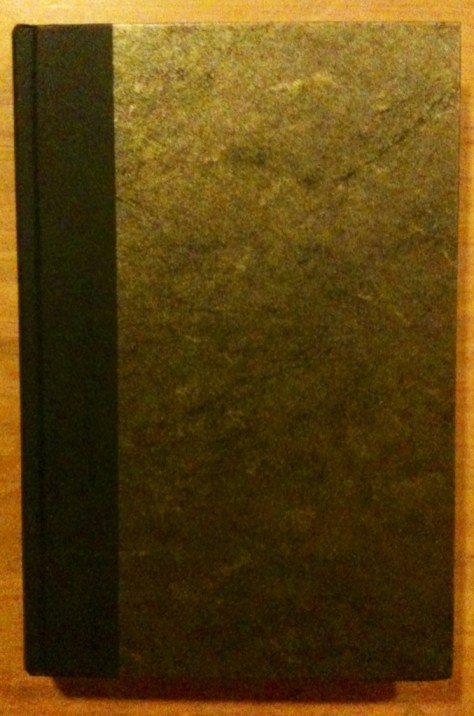
Yet another Markson book with a hideous cover. The cover for Markson’s study of Lowry’s Under the Volcano is truly terrible though: it looks like a fucking diet book or something. Great work, Barnes & Noble! Obviously I’ll shed the dust jacket; here’s what’s underneath:

20120607-133722.jpg

Much better. Anyway, what really counts is what’s inside, of course. I could probably have used this last year when I was reading Under the Volcano, but I feel I handled it okay. I’m more interested in Markson, and even more interested in Markson’s relationship with Lowry, chronicled in a brief chapter in the back that I’ve already read and will report on in more detail in the future.

Ben Marcus on David Markson’s Reader’s Block

 . . . when, for example, David Markson, an expository novelist who fired the starting gun for fictions of information and proved that pure exposition can be alarmingly moving, who purposefully tells instead of shows, is dismissed in The New York Times for failing to provide a story in his novelReader’s Block, no discussion follows about why, exactly, fiction must have one (at 150 words in the book review, how could any discussion follow?). Nor do we learn what a story might have looked like in such an exquisitely felt book that, to summarize, catalogs the various ways historical figures have hated whole races of people and/or died by their own hands. (Yes, you should read this book.)

Markson should have presumably, under the fiction-must-have-a-story criteria, zeroed in on one of his hundreds of characters and gone deep, doing that good old-time psychological work, the person-making stuff, dramatizing how such an interesting fellow had gone on to hate Jews and/or kill himself. Markson should have used more words like “then.” He should have sequenced. He seems to have forgotten that literature is supposedly a time-based art.

Markson’s amnesia is one of the happy accidents of the last decade of fiction writing. By eschewing a fetishistic, conventional interest in character, or a dutiful allegiance to moment creation, to occurrence itself, Markson accomplishes what a story, slogging through time and obedient to momentum, arguably could not: a commanding, obsessive portrait of single behaviors throughout history, a catalog of atrocity that overwhelms through relentless example. In truth, it’s a novel that can be read as an essay, but unlike most essays, it’s lyrically shrewd, poetry in the form of history, and it’s brave enough to provide creepy, gaping holes where we normally might encounter context (the burden of the conventional essayist).

From Ben Marcus’s essay “The Genre Artist,” published in a 2003 issue of The Believer.

“La Dama de Elche. Persephone’s thigh where Pluto clutches it in the Bernini. The right hand of Michelangelo’s David. The Ecstasy of St. Teresa.”

This slideshow requires JavaScript.

La Dama de Elche. Persephone’s thigh where Pluto clutches it in the Bernini. The right hand of Michelangelo’s David. The Ecstasy of St. Teresa.

–David Markson, Reader’s Block.

“Diagetic, dialogic, hegemonic” — David Markson Weighs in on Contemporary Literary Criticism

Diagetic, dialogic, hegemonic. Privilege, as a verb. Foreground, as a verb. Valorize. Praxis, Simulacra. Metafiction. Logocentrism. Phallocentrism. Discourse. Signifier/signified.

Aporia.

Late capitalism. Gynophobia.

Text.

None of the above.

From David Markson’s novel Reader’s Block.

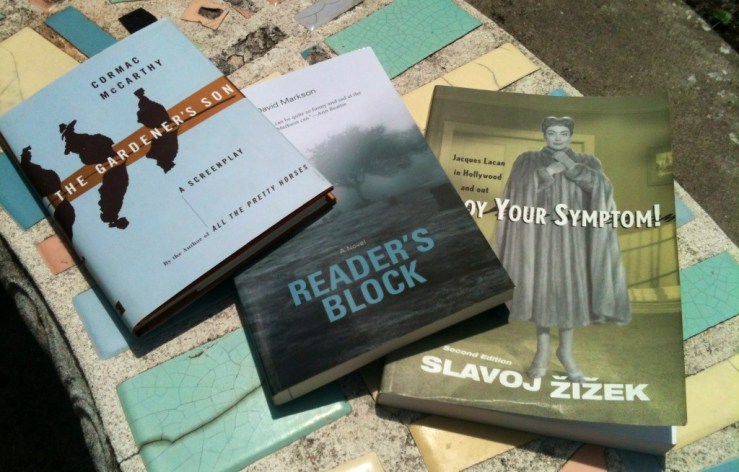
David Markson, Cormac McCarthy, Slavoj Žižek (Books Acquired, 5.19.2012)

20120521-122339.jpg

I ordered David Markson’s Reader’s Block from my local book shop, and intended to get it—and only it—this Saturday. Somehow I took a detour through the film section and picked up the Žižek and didn’t put it back; in the same section I also picked up McCarthy’s screenplay The Gardener’s Son, which is the only thing I haven’t read by him to date, so I picked it up too. So there you go.

Denis Johnson, Malcolm Lowry, Ben Marcus (Books Acquired, 4.18.2012)

20120418-144738.jpg

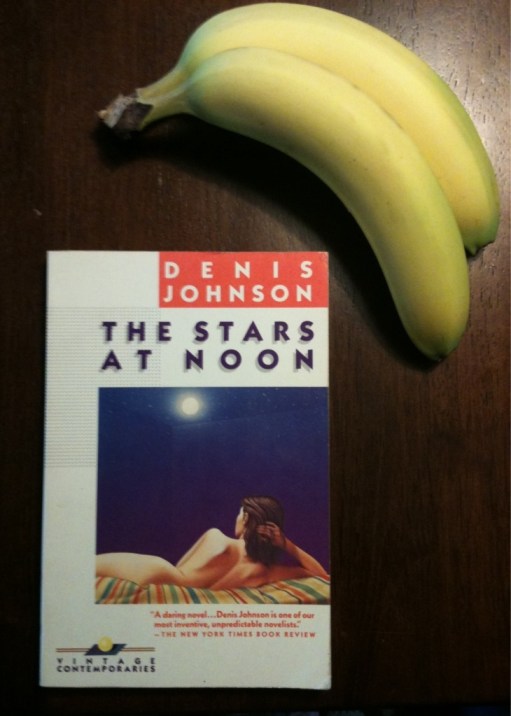
I went to the bookstore to pick up a graduation present and then spent too much time wandering the stacks. While looking for Mat Johnson’s Pym, I found a first printing paperback of Denis Johnson’s The Stars at Noon and had to have it—haven’t read it yet, and it makes a nice sister for my copy of Angels—but honestly, I’m just in love with these 1980s Vintage Contemporary editions with awful, awful covers.

20120418-144806.jpg

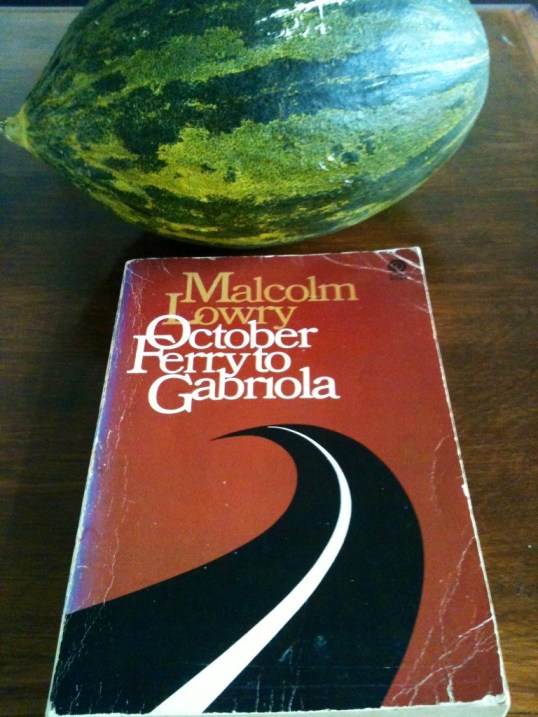
Malcolm Lowry’s last novel, the posthumously published October Ferry to Gabriola. Kind of a hideous cover.

20120418-144816.jpg

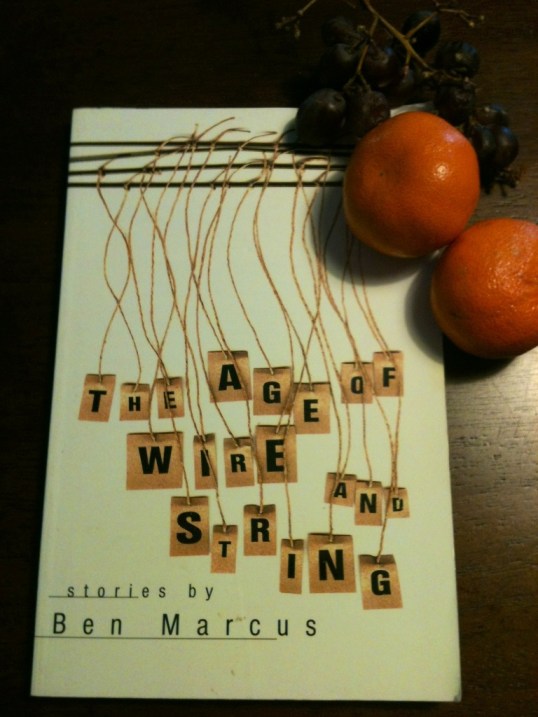
 I was looking for something by David Markson (no dice) when I came across The Age of Wire and String by Ben Marcus; I’ve been meaning to check out Marcus’s stuff, and a few minutes with the volume sold me—short vignettes, sort of like Lydia Davis or DFW or Dennis Cooper or William Burroughs (but probably not; I’m just using these as a short hand reference).

21 Citations on Pablo Picasso — David Markson

Pablo Picasso, Les Demoiselles d'Avignon, oil on canvas, 1907 (MoMA)

Painting is not done to decorate apartments –PICASSO

People speak of naturalism in opposition to modern painting.
Where and when has anyone ever seen a natural work of art?
Asked Picasso.

Depressed at the apparent lack of interest in one of his early still lifes, Matisse visited his dealer to retrieve it, only to learn that it had been purchased after all.
By Picasso.

The interrelationship of Picasso and Braque during Cubism:
Like being roped together on a mountain, Braque said.

The oddity that Velazquez and Picasso, surely two of the three greatest Spanish-born painters, each used his mother’s name rather than his father’s.

Among the many paintings in her Paris flat, Gertrude Stein had two exceptional Picassos.
If there were a fire, and I could save only one picture, it would be those two. Unquote.

The Bateau-Lavoir, the legendary former Montmartre piano factory broken up into artists’ studios, where Picasso contrived any number of his early masterpieces — while living with no running water and only one communal toilet.

The so-called anarchist artist who in 1988 smeared a large X in his own blood on a wall in the Museum of Modern Art — and in the process splattered an adjacent Picasso.

Picasso. Cézanne. Matisse. Braque. Bonnard. Renoir.
All of whom painted portraits of Ambroise Vollard.

Cartier-Bresson. Brassaï. Man Ray. Lee Miller. Robert Doisneau. Robert Capa. David Douglas Duncan. Cecil Beaton.
All of whom photographed Picasso.

Picasso’s play, Desire Caught by the Tail — which could be performed for the first time only privately, because of the Nazi occupation of Paris.
But avec Camus, Sartre, Michel Leiris, Raymond Queneau, Dora Maar, Pierre Reverdy, Simone de Beauvoir.

There is no such thing as abstract art, said Picasso.
You always have to start somewhere or other.

Gertrude Stein once delighted Picasso by reporting that a collector had been dumbfounded, years afterward, to hear that Picasso had given her her portrait as a gift, rather than asking payment.
Not understanding that that early in Picasso’s career, the difference had been next to negligible.

You never paint the Parthenon; you never paint a Louis XV armchair. You make pictures out of some little house in the Midi, a packet of tobacco, or an old chair.
Said Picasso.

Future generations will regard Bob Dylan with the awe reserved for Blake, Whitman, Picasso and the like.
Said an otherwise seemingly rational writer named Jonathan Lethem.

Picasso, avec laughter, after being asked if he had used models for Les Demoiselles d’Avignon:
Where would I have found them?

Picasso’s admiration for Charlie Chaplin.
Diego Rivera’s.
Stalin’s.

Kees van Dongen’s admission that there were occasions during his own early Montmartre years when he was forced to filch milk and/or bread from neighborhood doorsteps — with an accomplice named Picasso.

Picasso, in Paris during the Nazi occupation and learning that someone had accused him of having Jewish blood:
I wish I had.

A rejection of all that civilization has done.
Said the London Times of a first Post-Impressionist exhibition, in 1910 — which included Cézanne, van Gogh, Gauguin, Matisse, Picasso, others.

My old paintings no longer interest me. I’m much more curious about those I haven’t done yet.
Said Picasso, at seventy-nine.

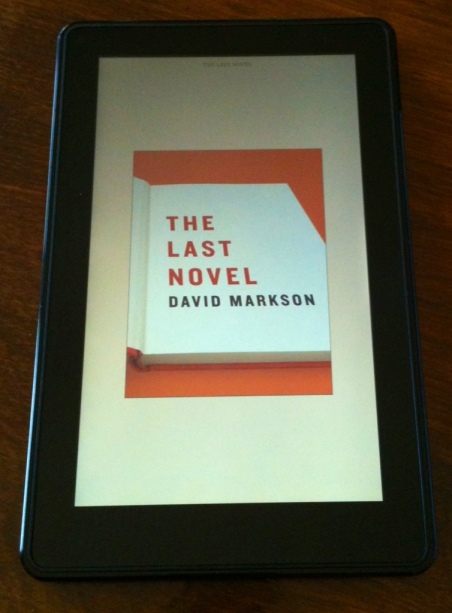
From David Markson’s The Last Novel

A Review of David Markson’s The Last Novel (Composed Mostly in Citations from Said Novel)

20120318-143327.jpg

Unsure of how to “review” David Marson’s last novel The Last Novel, I here provide a series of citations from said novel with my own brief comments. The citations are organized not by theme or idea, but rather simply by the order in which they appear in the book, from first to last. My intention is to provide a clear picture of Markson’s method with some brief commentary on his themes.

By way of recommendation: The Last Novel engrossed and obsessed me, commanding most of my attention for four days, during which time I read it twice and then picked at again and again, as one might return to the generous leftovers of a Thanksgiving meal.

I hope I have not strained the limits of copyright law with my citations of Markson’s citations. To wit, from the colophon:

Copyright © 2007 by David Markson

All rights reserved. No part of this book may be used or reproduced in any manner whatsoever without written permission from the Publisher, except in the case of brief quotations embodied in critical articles and reviews.

Library of Congress Cataloging-in-Publication Data

Markson, David.

The last novel / David Markson.

p. cm.

ISBN-13: 978-1-59376-143-1

ISBN-10: 1-59376-143-0

1. Novelists—Fiction. 2. Fiction—Authorship—Fiction.

3. Psychological fiction. I. Title.

Is The Last Novel fiction? Does this question matter? “Fiction–Authorship–Fiction” — this seems like a fair descriptor.

Our author, by way of summary, announces his themes, his name, and his prophetic conclusion:

Old. Tired. Sick. Alone. Broke.

All of which obviously means that this is the last book Novelist is going to write.

And now his method, followed by two examples of said method:

Nonlinear. Discontinuous. Collage-like. An assemblage.

I do not see why exposition and description are a necessary part of a novel.

Said Ivy Compton-Burnett.

I am quite content to go down to posterity as a scissors and paste man.

Said Joyce.

And a comment on that method, and Novelist’s textual place in it:

A novel of intellectual reference and allusion, so to speak minus much of the novel.

And thus in which Novelist will say more about himself only when he finds no way to evade doing so, but rarely otherwise.

On the first theme announced, “Old”:

Rereading a Raymond Chandler novel in which Philip Marlowe stops in for a ten-cent cup of coffee.

Old enough to remember when the coffee would have cost half that.

A citation that seems to hold all the themes, but especially “Sick” and “Broke”—-and then a Renard citation that fits Markson (or “Novelist,” if you prefer) into a grand tradition of starving artists:

The bleak image Novelist is granted of himself as he asks a question of a local pharmacist — and becomes aware of the woman contemplating the conspicuously threadbare and even ragged ends of his coat sleeves.

Writing is the only profession where no one considers you ridiculous if you earn no money.

Said Jules Renard.

On aging:

Moments in which Novelist does something like leaving his desk to retrieve a book from across the room — and finding himself staring vacantly into the refrigerator.

Or tossing his keys into a drawer — without having opened the drawer

Markson instructs us how to read his work, and at the same time makes a grand grab at glory; he then moves to reflect on death, and perhaps a fear of going unread, before pointing out the sublime powers of art :

Novelist’s personal genre. For all its seeming fragmentation, nonetheless obstinately cross-referential and of cryptic interconnective syntax.

Wondering why one is surprised to realize that Thoreau was dead at forty-five.

A lament of Schopenhauer’s:

Over how frequently the mere purchase of a book is mistaken for the appropriation of its contents.

Two pages of The Mill on the Floss are enough to start me crying.

Said Proust.

The intersection of commerce and art and madness (or, really, I just like this citation):

Because bookshops are among the very few places where one can spend time without spending any money, George Orwell noted, any number of practically certifiable lunatics are guaranteed to be regularly found in most of them.

My least favorite reading experience of all time is Clarissa:

The endless commentary, and analysis, and even retelling, in Clarissa. Anyone reading it just for the story would hang himself, Johnson said.

A good definition, but also a sideways description of entering The Last Novel:

Thinking with someone else’s brain.

Schopenhauer called reading.

Markson is fond of the dependent clause as a stand-alone thought. He often lets the reader complete the sentence, or, as below, responds perhaps obliquely with another citation—his synthesis is subtle but always in play:

Reviewers who have accused Novelist of inventing some of his anecdotes and/or quotations — without the elemental responsibility to do the checking that would verify every one of them.

Asking a working writer what he thinks about critics is like asking a lamppost what it feels about dogs.

Said John Osborne.

The Last Novel is in part a work of canon-formation, one that situates Markson’s place in arts and letters; it is often angry or bitter, as he tries to situate being “Alone” and “Broke” into a historical tradition of suffering writers:

Another of Novelist’s economic-status epiphanies:

Walking four or five blocks out of his way, and back, to save little more than nickels on some common household item.

While needing to stop to rest at least two or three times en route.

Writers are the beggars of Western society.

Said Octavio Paz.

There is no way of being a creative writer in America without being a loser.

Said Nelson Algren.

Markson repeatedly reveals his anxiety of influence: Where and how will he be remembered when he dies?:

Old enough to have started coming upon likenesses on postage stamps of other writers he had known personally or had at least met in passing.

Occasionally in The Last Novel, because he doesn’t always attribute his citations, it’s unclear to me if a string of sentences are original to Markson or not. Markson describes his method again:

A seminonfictional semifiction.

And with its interspersed unattributed quotations at roughest count adding up to a hundred or more.

A note on book theft, germane to (the original mission of) this website:

Please return this book. I find that though many of my friends are poor mathematicians, they are nearly all good bookkeepers.

Read Walter Scott’s bookplate.

A dependent clause:

Reviewers who protest that Novelist has lately appeared to be writing the same book over and over.

Again, the intersection of economics, art, and how we honor and remember genius (with the implicit underlying anxiety over Markson’s own fate):

Before the Euro, the portrait of Yeats on Ireland’s twenty-pound note.

America’s Whitman twenty-dollar bill, when?

The Melville ten?

I think the Melville ten is a grand idea. I’d put Hawthorne on the twenty and Emerson on the penny.

On death-dialing:

A quirky new impulse of Novelist’s, at news of several recent deaths — Dialing the deceased, in the likelihood that no one would have yet disconnected their answering machines — and contemplating their voices one eerie final time.

The voice of an agitated colleague? Friend? Student? Is the quote a composite of complaints? Is it verbatim?:

Listen, I bought your latest book. But I quit after about six pages. That’s all there is, those little things?

Many of us have wondered:

Why did Harper Lee never write another novel?

It is possible she never wrote that first one.

Again, money and writers:

America’s Emily Dickinson dime?

We could put Thoreau on the nickel and Poe on the fifty.

Conclusions as a kind of interception; the author offstage, off scene, ob skena — obscene:

Novelist’s personal genre. In which part of the experiment is to continue keeping him offstage to the greatest extent possible — while compelling the attentive reader to perhaps catch his breath when things achieve an ending nonetheless.

Conclusions are the weak point of most authors.

George Eliot said.

If you know what you’re doing, you don’t get intercepted.

Said Johnny Unitas.

I feel like I’ve skated over the book, failed to plumb it at all: But I also protest that the book is a work of autocriticism, a work that decenters its themes, bats them around, analyzes them, tosses them back to the reader, sometimes bitter, sometimes melancholy, always erudite and engaging.

I cite from the end now. Can the end be spoiled? Markson tells us this is his last, that he will die (“Old. Tired. Sick. Alone. Broke.”). He dies a few years after the publication of The Last Novel. (He dies on the day my son is born, or, rather, his body is found on the day my son is born. He is very much alone. The New York Times publishes his obituary on my birthday). The novel ends with a series of citations that mull on death:

Dispraised, infirm, unfriended age.

Sophocles calls it.

Unregarded age in corners thrown.

Shakespeare echoes.

And what it means to be an artist, a writer, a critic, to write in and on and through others’ books:

The worn copy of Donne’s verses, inked throughout with notes in Coleridge’s handwriting. And at the rear:

I shall die soon, my dear Charles Lamb, and then you will not be sorry that I bescribbled your book.

Life as pain, death as transcendence:

Then come kiss me, sweet-and-twenty,Youth’s a stuff will not endure. Be patient now, my soul, thou hast endured worse than this.

Odysseus once says.

Mais où sont les neiges d’antan? Is it true then, what they say — that we become stars in the sky when we die?

Asks someone in Aristophanes.

Banal signage or access to ascension?:

Access to Roof for Emergency Only.

Alarm Will Sound if Door Opened.

To reiterate and move on:

Old. Tired. Sick. Alone. Broke.

The old man who will not laugh is a fool.

Als ick kan.

“Als Ich Kan”

Portrait of a Man in a Turban -- Jan van Eyck

David Markson on Harold Bloom

From David Markson’s The Last Novel:

Where the synecdoche of tessera made a totality, however illusive, the metonymy of kenosis breaks this up into discontinuous fragments.

Somewhere declareth Harold Bloom.

It may be essential to Harold Bloom that his audience not know quite what he is talking about.

Commenteth Alfred Kazin — pointing out other immortal phrasings altogether.

All of David Markson’s References in The Last Novel to Walt Whitman

All of David Markson’s references in The Last Novel to Walt Whiman:

I am he that aches with amorous love.            Wrote Whitman.

Walter, leave off.

Wrote D. H. Lawrence.

Walt Whitman’s claim — never in any way verified — that he had fathered at least six illegitimate children.

Gerard Manley Hopkins, on realizing that he feels a certain kinship with Whitman:

As he is a very great scoundrel this is not a very pleasant confession.

A writer of something occasionally like English — and a man of something occasionally like genius.

Swinburne called Whitman.

Future generations will regard Bob Dylan with the awe reserved for Blake, Whitman, Picasso and the like.

Said an otherwise seemingly rational writer named Jonathan Lethem.

Before the Euro, the portrait of Yeats on Ireland’s twenty-pound note.

America’s Whitman twenty-dollar bill, when?

The Melville ten?

Twenty-five years after his death, Poe’s remains were disinterred from what had been little better than a pauper’s grave and reburied more formally.

Walt Whitman, who made the journey from Camden to Baltimore in spite of being disabled from a recent stroke, was the only literary figure to appear at the ceremonies.

Gertrude Stein Next to Her Portrait (Portrait by Picasso; Photo by Man Ray; Commentary by David Markson)

In The Last NovelDavid Markson offers the following citations re: Picasso, Stein, Man Ray (citations not in Markson’s (anti-)order):

Gertrude Stein once delighted Picasso by reporting that a collector had been dumbfounded, years afterward, to hear that Picasso had given her her portrait as a gift, rather than asking payment.

Not understanding that that early in Picasso’s career, the difference had been next to negligible.

Among the many paintings in her Paris flat, Gertrude Stein had two exceptional Picassos.

If there were a fire, and I could save only one picture, it would be those two. Unquote.

Picasso. Cézanne. Matisse. Braque. Bonnard. Renoir.

All of whom painted portraits of Ambroise Vollard.

Cartier-Bresson. Brassaï. Man Ray. Lee Miller. Robert Doisneau. Robert Capa. David Douglas Duncan. Cecil Beaton.

All of whom photographed Picasso.

Two Short David Markson Citations on Contemporary Art

From David Markson’s The Last Novel:

People who actually believe that Christo’s tangerine-colored bedsheets fluttering about in New York’s Central Park had something even remotely to do with art.

People who actually believe that Damien Hirst’s fourteen-foot shark in a tank of formaldehyde has something even remotely to do with art.