The Complete Short Stories of J.G. Ballard (Second Riff: Stories of 1960)

jgb_complete_ss400 PREVIOUSLY:

Introductions + stories 1956-1959

IN THIS RIFF:

Stories published in 1960:

“The Sound-Sweep”

“Zone of Terror”

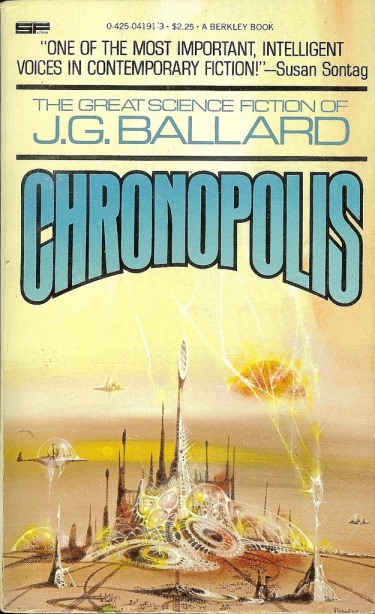
“Chronopolis”

“The Voices of Time”

“The Last World of Mr. Goddard”

1. “The Sound-Sweep” (1960)

Ballard’s strong suit isn’t characterization. In his later writing, he transcends this apparent weakness, employing a style and rhetoric that dispenses with—or nakedly accepts, in some cases—the flatness of his characters. Ballard works in types: the scientist, the madman, the artist, the detective, the ingenue, the explorer, the has-been. Most of his characters are driven by very basic desires—curiosity, madness, revenge. There’s a thin line though between archetypal placeholders and hackneyed stereotypes, and Ballard occasionally stumbles over it in some of these early stories. “The Sound-Sweep” is one such story, plodding along over too many pages, asking its readers to care about characters that lack emotional or psychological depth. And while I don’t think we read Ballard for emotional depth, necessarily, we do read Ballard’s best work because it plumbs the contours of human psychology colliding into nascent technological changes that affect the most basic human senses.

As its title suggests, “The Sound-Sweep” is another early Ballard tale that takes on the sense of sound. The short version: This is a story about noise pollution, and also about how we might sacrifice an artistic way of listening in favor of apparent convenience. As is often the case in these early stories, Ballard constructs the tale to explore the fallout of one particular idea. In this case, that’s “ultrasonic music”:

Ultrasonic music, employing a vastly greater range of octaves, chords and chromatic scales than are audible by the human ear, provided a direct neural link between the sound stream and the auditory lobes, generating an apparently sourceless sensation of harmony, rhythm, cadence and melody uncontaminated by the noise and vibration of audible music. The re–scoring of the classical repertoire allowed the ultrasonic audience the best of both worlds. The majestic rhythms of Beethoven, the popular melodies of Tchaikovsky, the complex fugal elaborations of Bach, the abstract images of Schoenberg – all these were raised in frequency above the threshold of conscious audibility. Not only did they become inaudible, but the original works were re–scored for the much wider range of the ultrasonic orchestra, became richer in texture, more profound in theme, more sensitive, tender or lyrical as the ultrasonic arranger chose.

To tease out this idea, Ballard employs a washed-up opera singer, Madame Giaconda (a heavy base of Sunset Boulevard’s Norma Desmond with a heavy dash of Miss Havisham and cocaine), and Mangon, a mute orphan, the titular sound-sweep (should I wax on the Blakean undertones here? No? Okay).

“The Sound-Sweep” plods along over far too many pages, even divvying up the plot into chapters, asking us to care about the relationship between Giaconda and Mangon. The story would probably have made an excellent episode of The Twilight Zone, where performers might give life to some of the flat dialogue here and the constraints of television might compress the plot. The most interesting thing about “The Sound-Sweep”: The tale in some ways anticipates the mp3 and the ways in which music will be consumed:

But the final triumph of ultrasonic music had come with a second development – the short–playing record, spinning at 900 r.p.m., which condensed the 45 minutes of a Beethoven symphony to 20 seconds of playing time, the three hours of a Wagner opera to little more than two minutes. Compact and cheap, SP records sacrificed nothing to brevity. One 30–second SP record delivered as much neurophonic pleasure as a natural length recording, but with deeper penetration, greater total impact.

2. “Zone of Terror” (1960)

Edgar Allan Poe’s “William Wilson” is a much better doppelganger story. “Zone of Terror” reads like a very rough sketch for some of the stuff Ballard will do in his 1962 novel The Drowned World. (Both “Chronopolis” and “The Voices of Time” also clearly anticipate The Drowned World, each with much stronger results).
chronopolis

3. “Chronopolis” (1960)

“Chronopolis” offers an interesting central shtick: Clocks and other means of measuring and standardizing time have been banned. But this isn’t what makes the story stick. No, Ballard apparently tips his hand early, revealing why measuring time has been banned—it allows management to control labor:

‘Isn’t it obvious? You can time him, know exactly how long it takes him to do something.’ ‘Well?’ ‘Then you can make him do it faster.’

But our intrepid young protagonist (Conrad, his loaded name is), hardly satisfied with this answer, sneaks off to the city of the past, the titular chronopolis, where he works to restore the timepieces of the past. “Chronopolis” depicts a technologically-regressive world that Ballard will  explore in greater depth with his novel The Drowned World, but the details here are precise and fascinating (if perhaps ultimately unconvincing if we try to apply them as any kind of diagnosis for our own metered age). Ending on a perfect paranoid note, Ballard borrows just a dab of Poe here, synthesizing his influence into something far more original, far more Ballardian. Let’s include it in something I’m calling The Essential Short Stories of J.G. Ballard.

4.  “The Voices of Time” (1960)

“The Voices of Time” is easily the best of the early stories in the collection. Ballard allows himself to dispense almost entirely with plot, or at least the kind of plot he’s been thus-far constrained by. Instead of the neat concision of his nineteenth century forebears (Chekhov and Poe), Ballard moves to something far more Ballardian (excuse the repetition), opening his text to a range of images and phrases that will repeat throughout his career—the word terminal, drained vessels, cryptic designs and sequences, a kind of psychic detritus the reader is left to account for and monitor. The loose threads in “The Voices of Time” are too many to enumerate. There’s a mutant armadillo and a girl named Coma. Mass narcolepsy and cacti that absorb gold from the earth as a shield against radiation. And sleep. And de-evolution:

…thirty years ago people did indeed sleep eight hours, and a century before that they slept six or seven. In Vasari’s Lives one reads of Michelangelo sleeping for only four or five hours, painting all day at the age of eighty and then working through the night over his anatomy table with a candle strapped to his forehead. Now he’s regarded as a prodigy, but it was unremarkable then. How do you think the ancients, from Plato to Shakespeare, Aristotle to Aquinas, were able to cram so much work into their lives? Simply because they had an extra six or seven hours every day. Of course, a second disadvantage under which we labour is a lowered basal metabolic rate – another factor no one will explain. …

… It’s time to re–tool. Just as an individual organism’s life span is finite, or the life of a yeast colony or a given species, so the life of an entire biological kingdom is of fixed duration. It’s always been assumed that the evolutionary slope reaches forever upwards, but in fact the peak has already been reached, and the pathway now leads downward to the common biological grave. It’s a despairing and at present unacceptable vision of the future, but it’s the only one. Five thousand centuries from now our descendants, instead of being multi–brained star–men, will probably be naked prognathous idiots with hair on their foreheads, grunting their way through the remains of this Clinic like Neolithic men caught in a macabre inversion of time. Believe me, I pity them, as I pity myself. My total failure, my absolute lack of any moral or biological right to existence, is implicit in every cell of my body…

I harped on Ballard’s lack of characterization earlier, and “The Voices of Time” makes no strong case for its author’s ability to create deep, full characters. What Ballard does very very well though is harness, express, and communicate the intellect of his smart, smart characters—something many if not most other writers (contemporary or otherwise) can’t do, despite any technical prowess they may possess. “The Voices of Time” doesn’t just tell you that its heroes and antiheroes are brilliant (and/or mad)—it shows you.

Marvelous stuff. Include it in The Essential Short Stories of J.G. Ballard

5. “The Last World of Mr. Goddard” (1960)

More Twilight Zone stuff. God-dard. Lilliput, sort of. Doll’s house. Etc. A one-note exercise that I doubt is worth your time. Skip it.

6. On the horizon:

Ballard anticipates how hollow and stale contemporary writing will become in “Studio Five, The Stars.”

“Von Kempelen and His Discovery ” — Edgar Allan Poe

“Von Kempelen and His Discovery ” by Edgar Allan Poe

AFTER THE very minute and elaborate paper by Arago, to say nothing of the summary in ‘Silliman’s Journal,’ with the detailed statement just published by Lieutenant Maury, it will not be supposed, of course, that in offering a few hurried remarks in reference to Von Kempelen’s discovery, I have any design to look at the subject in a scientific point of view. My object is simply, in the first place, to say a few words of Von Kempelen himself (with whom, some years ago, I had the honor of a slight personal acquaintance), since every thing which concerns him must necessarily, at this moment, be of interest; and, in the second place, to look in a general way, and speculatively, at the results of the discovery.

It may be as well, however, to premise the cursory observations which I have to offer, by denying, very decidedly, what seems to be a general impression (gleaned, as usual in a case of this kind, from the newspapers), viz.: that this discovery, astounding as it unquestionably is, is unanticipated.

By reference to the ‘Diary of Sir Humphrey Davy’ (Cottle and Munroe, London, pp. 150), it will be seen at pp. 53 and 82, that this illustrious chemist had not only conceived the idea now in question, but had actually made no inconsiderable progress, experimentally, in the very identical analysis now so triumphantly brought to an issue by Von Kempelen, who although he makes not the slightest allusion to it, is, without doubt (I say it unhesitatingly, and can prove it, if required), indebted to the ‘Diary’ for at least the first hint of his own undertaking.

The paragraph from the ‘Courier and Enquirer,’ which is now going the rounds of the press, and which purports to claim the invention for a Mr. Kissam, of Brunswick, Maine, appears to me, I confess, a little apocryphal, for several reasons; although there is nothing either impossible or very improbable in the statement made. I need not go into details. My opinion of the paragraph is founded principally upon its manner. It does not look true. Persons who are narrating facts, are seldom so particular as Mr. Kissam seems to be, about day and date and precise location. Besides, if Mr. Kissam actually did come upon the discovery he says he did, at the period designated—nearly eight years ago—how happens it that he took no steps, on the instant, to reap the immense benefits which the merest bumpkin must have known would have resulted to him individually, if not to the world at large, from the discovery? It seems to me quite incredible that any man of common understanding could have discovered what Mr. Kissam says he did, and yet have subsequently acted so like a baby—so like an owl—as Mr. Kissam admits that he did. By-the-way, who is Mr. Kissam? and is not the whole paragraph in the ‘Courier and Enquirer’ a fabrication got up to ‘make a talk’? It must be confessed that it has an amazingly moon-hoaxy-air. Very little dependence is to be placed upon it, in my humble opinion; and if I were not well aware, from experience, how very easily men of science are mystified, on points out of their usual range of inquiry, I should be profoundly astonished at finding so eminent a chemist as Professor Draper, discussing Mr. Kissam’s (or is it Mr. Quizzem’s?) pretensions to the discovery, in so serious a tone. Continue reading ““Von Kempelen and His Discovery ” — Edgar Allan Poe”

Suttree, Cormac McCarthy’s Grand Synthesis of American Literature

In his 1992 interview with The New York Times, Cormac McCarthy said, “The ugly fact is books are made out of books. The novel depends for its life on the novels that have been written.” McCarthy’s fourth novel, 1979’s Suttree is such a book, a masterful synthesis of the great literature — particularly American literature — that came before it. And like any masterful synthesis, Suttree points to something new, even as it borrows, lifts, and outright steals from the past. But before we plumb its allusions and tropes and patterns, perhaps we should overview the plot, no?

The novel rambles over several years in the life of Cornelius Suttree. It is the early 1950s in Knoxville, Tennessee, and Suttree ekes out a mean existence on the Tennessee River as a fisherman, living in a ramshackle houseboat on the edge of a shantytown. This indigent life is in fact a choice: Suttree is the college-educated son of an established, wealthy family. His choice is a choice for freedom and self-reliance, those virtues we like to think of, in our prejudicial manner, as wholly and intrinsically American. Suttree then is both Emersonian and Huck Finnian, a reflective and insightful man who finds his soul via a claim to agency over his own individuality, an individuality poised in quiet, defiant rebellion against the conforming forces of civilization. These forces manifest most pointedly in the Knoxville police, a brutal, racist organization, but we also see social constraint in the form of familial duty. One thinks of the final lines of Huckleberry Finn: “I reckon I got to light out for the Territory ahead of the rest, because Aunt Sally she’s going to adopt me and sivilize me and I can’t stand it. I been there before.”

Like Huck, Suttree aims to resist all forces that would “sivilize” him. His time on the river and in the low haunts of Tennessee (particularly the vice-ridden borough of McAnally) brings him into close contact with plenty of other outcasts, but also his conscience, which routinely mulls over its place in the world. Suttree is punctuated by–perhaps even organized by–several scenes of hallucination. Some of these psychotrips result from drunkeness, one comes from accidentally ingesting the wrong kind of mushrooms (or, the right kind, if that’s your thing), and the final one, late in the novel, sets in as Suttree suffers from a terrible illness. In his fever dream, a small nun–surely a manifestation of the guilt that would civilize us–accuses him–

Mr. Suttree it is our understanding that at curfew rightly decreed by law in that hour wherein night draws to its proper close and the new day commences and contrary to conduct befitting a person of your station you betook yourself to various low places within the shire of McAnally and there did squander several ensuing years in the company of thieves, derelicts, miscreants, pariahs, poltroons, spalpeens, curmudgeons, clotpolls, murderers, gamblers, bawds, whores, trulls, brigands, topers, tosspots, sots and archsots, lobcocks, smellsmocks, runagates, rakes, and other assorted and felonious debauchees.

The passage is a marvelous example of McCarthy’s stream-of-consciousness technique in Suttree, moving through the various voices that would ventriloquize Suttree, into the edges of madness, strangeness, and the sublimity of language. The tone moves from somber and portentous into bizarre imagery that blends humor and pathos. This is the tone of Suttree, a language that gives voice to transients and miscreants, affirming the dignity of their humanity even as it details the squalor of their circumstance.

It is among these criminals and whores, transvestites and gamblers that Suttree affirms his own freedom and humanity, a process aided by his comic foil, Gene Harrogate. Suttree meets Harrogate on a work farm; the young hillbilly is sent there for screwing watermelons. After his release, Harrogate moves to a shantytown in Knoxville. He’s the country mouse determined to become the city rat, the would-be Tom Sawyer to Suttree’s older and wiser Huck Finn. Through Harrogate’s endless get-rich-quick schemes, McCarthy parodies that most-American of tales, the Horatio Alger story. Simply put, the boy is doomed, on his  “way up to the penitentiary” as Suttree constantly admonishes. In one episode, Harrogate tries to buy arsenic from “a grayhaired and avuncular apothecary” to poison bats he hopes to sell to a hospital (don’t ask)–

May I help you? said the scientist, his hands holding each other.

I need me some strychnine, said Harrogate.

You need some what?

Strychnine. You know what it is dont ye?

Yes, said the chemist.

I need me about a good cupful I reckon.

Are you going to drink it here or take it with you?

Shit fire I aint goin to drink it. It’s poisoner’n hell.

It’s for your grandmother.

No, said Harrogate, craning his neck suspectly. She’s done dead

Suttree, unwilling father-figure, eventually buys the arsenic for the boy against his better judgment. The scene plays out as a wonderful comic inversion of William Faulkner’s “A Rose for Emily,” from which it is so transparently lifted. McCarthy borrows liberally from Faulkner here, of course, most notably in the language and style of the novel, but also in scenes like this one, or a later episode that plays off Faulkner’s comic-romantic story of a man and a woman navigating the aftermath of a flood, “Old Man.” Unpacking the allusions in Suttree surpasses my literary knowledge or skill, but McCarthy is generous, if oblique, with his breadcrumb trail. Take, for example, the following sentence: “Suttree with his miles to go kept his eyes to the ground, maudlin and muttersome in the bitter chill, under the lonely lamplight.” The forced phrase “miles to go” does not immediately present itself as a reference to Robert Frost’s famous poem, yet the direction of the sentence retreats into the history of American poetry; with its dense alliteration and haunted vowels, it leads us into Edgar Allan Poe territory. Only a few dozen pages later, McCarthy boldly begins a chapter with theft: “In just spring the goatman came over the bridge . . .” The reference to e.e. cummings explicitly signifies McCarthy’s intentions to play with literature. Later in the book, while tripping on mushrooms in the mountains, Suttree is haunted by “elves,” the would-be culprits in Frost’s poem “Mending Wall.” The callback is purposeful, but tellingly, McCarthy’s allusions are not nearly as fanciful as their surface rhetoric might suggest: the goatman does not belong in Knoxville–he’s an archaic relic, forced out of town by the police; the elves are not playful spirits but dark manifestations of a tortured psyche.

Once one spots the line-lifting in Suttree it’s hard to not see it. What’s marvelous is McCarthy’s power to convert these lines, these riffs, these stories, into his own tragicomic beast. An early brawl at a roadhouse recalls the “Golden Day” episode of Ralph Ellison’s Invisible Man; a rape victim’s plight echoes Hubert Selby’s “Tralala”; we find the comic hobos of John Steinbeck’s Cannery Row–we even get the road-crossing turtle from The Grapes of Wrath. A later roadhouse chapter replays the “Circe/Nighttown” nightmare in James Joyce’s Ulysses. Ulysses is an easy point of comparison for Suttree, which does for Knoxville what Joyce did for Dublin. Suttree echoes Ulysses’s language, both in its musicality and appropriation of varied voices, as well as its ambulatory structure, its stream-of-consciousness technique, its rude earthiness, and its size (nearly 600 pages). But, as I argued earlier, there’s something uniquely American about Suttree, and its literary appropriations tend to reflect that. Hence, we find Mark Twain, Herman Melville, Ernest Hemingway, Walt Whitman, Emerson and Thoreau, Emily Dickinson, and William Carlos Williams, to name just a few writers whose blood courses through this novel (even elegant F. Scott Fitzgerald is here, in an unexpected Gatsbyish episode late in the novel).

Making a laundry list of writers is weak criticism though, and these sources–all guilty of their own proud plagiarisms–are mentioned only as a means to an end, to an argument that what McCarthy does in Suttree is to synthesize the American literary tradition with grace and humor, while never glossing over its inherent dangers and violence. So, while it appropriates and plays with the tropes of the past, Suttree is still pure McCarthy. Consider the following passage, which arrives at the end of a drunken, awful spree, Suttree locked up for the night–

He closed his eyes. The gray water that dripped from him was rank with caustic. By the side of a dark dream road he’d seen a hawk nailed to a barn door. But what loomed was a flayed man with his brisket tacked open like a cooling beef and his skull peeled, blue and bulbous and palely luminescent, black grots his eyeholes and bloody mouth gaped tonguless. The traveler had seized his fingers in his jaws, but it was not alone this horror that he cried. Beyond the flayed man dimly adumbrate another figure paled, for his surgeons move about the world even as you and I.

Suttree’s dark vision points directly toward the language of McCarthy’s next novel, 1985’s Blood Meridian, roundly considered his masterpiece. Critics who disagree tend to point to Suttree as the pinnacle of McCarthy’s writing. I have no interest at this time in weighing the books against each other, nor do I think that doing so would be especially enlightening. For all of their sameness, they are very different animals: Suttree provides us intense access to its hero’s consciousness, where Blood Meridian always keeps the reader on the outside of its principals’ souls (if those grotesques could be said to have souls). And while Blood Meridian does display some humor, it is the blackest and driest humor I’ve ever read. Suttree is broader and more compassionate; it even has a fart joke. Blood Meridian, at least in my estimation (and many critics will contend this notion) has no flawed episodes; much of this results from the book’s own internal program–it resists love, compassion, and even human dignity. In contrast, Suttree is punctuated by two deaths the audience is meant to read as tragic, yet I found it impossible to do so. The first is the death of Suttree’s child, whom he has abandoned, along with its mother. As such, he is not permitted to take part in the funeral, observing the process rather from its edges. The second tragedy is the death of Suttree’s young lover in a landslide. The book begs us to empathize with Suttree, just as he often empathizes with the marginal figures in the novel, but ultimately these tragedies are a failed ploy. They underwrite a sublime encounter with death for Suttree, an encounter that deepens and enriches his character while paradoxically freeing him from the burdens of social duty and familial order. McCarthy is hardly alone in such a move; indeed, it seems like the signature trope of American masculine literature to me. It’s the move that Huck Finn wishes to make when he promises to light out for the Territory to escape the civilizing body of Aunt Sally; it’s the ending that Hemingway was compelled to give to Frederic Henry at the end of A Farewell to Arms; it’s all of Faulkner, with his mortification of fatherhood and the dramatic responsibility fatherhood entails. It is a cost analysis that neglects any potential benefits.

But these are small criticisms of a large, beautiful, benevolent novel, a book that begs to be reread, a rambling picaresque of comic and tragic proportions. “I learned that there is one Suttree and one Suttree only,” our hero realizes, but this epiphany is set against a larger claim. Near the end of the novel, Suttree goes to check on an old ragman who he keeps a watchful eye on. He finds the man dead, his shack robbed, his body looted. Despairing over the spectacle’s abject lack of humanity, Suttree cries, “You have no right to represent people this way,” for “A man is all men. You have no right to your wretchedness.” Here, Suttree’s painful epiphany is real and true, an Emersonian insight coded in the darkest of Whitman’s language. If there is one Suttree and one Suttree only, he is still beholden to all men; to be anti-social or an outcast is not to be anti-human. Self-hood is ultimately conditional on others and otherness. To experience the other’s wretchedness is harrowing; to understand the other’s wretchedness and thus convert it to dignity is life-affirming and glorious. Suttree is a brilliant, bold, marvelous book. Very highly recommended.

[Ed. note—Biblioklept originally published a version of this review on November 27, 2010].


“William Wilson” — Edgar Allan Poe


“William Wilson” by Edgar Allan Poe

What say of it? what say of CONSCIENCE grim, That spectre in my path? Chamberlayne’s Pharronida.

LET me call myself, for the present, William Wilson. The fair page now lying before me need not be sullied with my real appellation. This has been already too much an object for the scorn—for the horror—for the detestation of my race. To the uttermost regions of the globe have not the indignant winds bruited its unparalleled infamy? Oh, outcast of all outcasts most abandoned!—to the earth art thou not forever dead? to its honors, to its flowers, to its golden aspirations?—and a cloud, dense, dismal, and limitless, does it not hang eternally between thy hopes and heaven?

I would not, if I could, here or to-day, embody a record of my later years of unspeakable misery, and unpardonable crime. This epoch—these later years—took unto themselves a sudden elevation in turpitude, whose origin alone it is my present purpose to assign. Men usually grow base by degrees. From me, in an instant, all virtue dropped bodily as a mantle. From comparatively trivial wickedness I passed, with the stride of a giant, into more than the enormities of an Elah-Gabalus. What chance—what one event brought this evil thing to pass, bear with me while I relate. Death approaches; and the shadow which foreruns him has thrown a softening influence over my spirit. I long, in passing through the dim valley, for the sympathy—I had nearly said for the pity—of my fellow men. I would fain have them believe that I have been, in some measure, the slave of circumstances beyond human control. I would wish them to seek out for me, in the details I am about to give, some little oasis of fatality amid a wilderness of error. I would have them allow—what they cannot refrain from allowing—that, although temptation may have erewhile existed as great, man was never thus, at least, tempted before—certainly, never thus fell. And is it therefore that he has never thus suffered? Have I not indeed been living in a dream? And am I not now dying a victim to the horror and the mystery of the wildest of all sublunary visions?

I am the descendant of a race whose imaginative and easily excitable temperament has at all times rendered them remarkable; and, in my earliest infancy, I gave evidence of having fully inherited the family character. As I advanced in years it was more strongly developed; becoming, for many reasons, a cause of serious disquietude to my friends, and of positive injury to myself. I grew self-willed, addicted to the wildest caprices, and a prey to the most ungovernable passions. Weak-minded, and beset with constitutional infirmities akin to my own, my parents could do but little to check the evil propensities which distinguished me. Some feeble and ill-directed efforts resulted in complete failure on their part, and, of course, in total triumph on mine. Thenceforward my voice was a household law; and at an age when few children have abandoned their leading-strings, I was left to the guidance of my own will, and became, in all but name, the master of my own actions. Continue reading ““William Wilson” — Edgar Allan Poe”

The Never-Ending Torture of Unrest | Georg Büchner’s Lenz Reviewed

sleep of reason
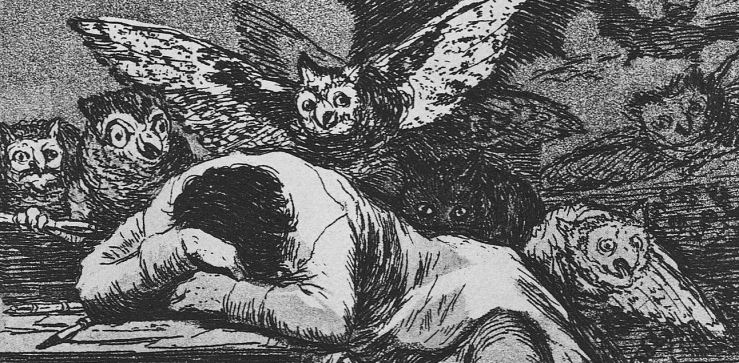
The Sleep of Reason Produces Monsters (detail), Francisco Goya

Composed in 1836, Georg Büchner’s novella-fragment Lenz still seems ahead of its time. While Lenz’s themes of madness, art, and ennui can be found throughout literature, Büchner’s strange, wonderful prose and documentary aims bypass the constraints of his era.

Let me share some of that prose. Here is the opening paragraph of Lenz:

The 20th, Lenz walked through the mountains. Snow on the peaks and upper slopes, gray rock down into the valleys, swatches of green, boulders, firs. It was sopping cold, the water trickled down the rocks and leapt across the path. The fir boughs sagged in the damp air. Gray clouds drifted across the sky, but everything so stifling, and then the fog floated up and crept heavy and damp through the bushes, so sluggish, so clumsy. He walked onward, caring little one way or another, to him the path mattered not, now up , now down. He felt no fatigue, except sometimes it annoyed him that he could not walk on his head. At first he felt a tightening in his chest when the rocks skittered away, the gray woods below him shook, and the fog now engulfed the shapes, now half-revealed their powerful limbs; things were building up inside him, he was searching for something, as if for lost dreams, but was finding nothing. Everything seemed so small, so near, so wet, he would have liked to set the earth down behind an oven, he could not grasp why it took so much time to clamber down a slope, to reach a distant point; he was convinced he could cover it all with a pair of strides.

Büchner sets us on Lenz’s shoulder, moving us through the estranging countryside without any exposition that might lend us bearings. The environment impinges protagonist and reader alike, heavy, damp, stifling. Büchner’s syntax shuffles along, comma splices tripping us into Lenz’s manic consciousness, his mind-swings doubled in the path that is “now up, now down.” We feel the “tightening” in Lenz’s chest as the “rocks skittered away,” as the “woods below him shook” — the natural world seems to envelop him, cloak him, suffocate him. It’s an animist terrain, and Büchner divines those spirits again in the text. The claustrophobia Lenz experiences then swings to another extreme, as our hero, his consciousness inflated, feels “he could cover [the earth] with a pair of strides.

And that baffling line: “He felt no fatigue, except sometimes it annoyed him that he could not walk on his head.” Well.

The end notes to the Archipelago edition I read (translated by Richard Sieburth) offer Arnold Zweig’s suggestion that “this sentence marks the beginning of modern European prose,” as well as Paul Celan’s observation that “whoever walks on his head has heaven beneath him as an abyss.”

Celan’s description is apt, and Büchner’s story repeatedly invokes the abyss to evoke its hero’s precarious psyche. Poor Lenz, somnambulist bather, screamer, dreamer, often feels “within himself something . . . stirring and swarming toward an abyss toward which he was being swept by an inexorable force.” Lenz is the story of a young artist falling into despair and madness.

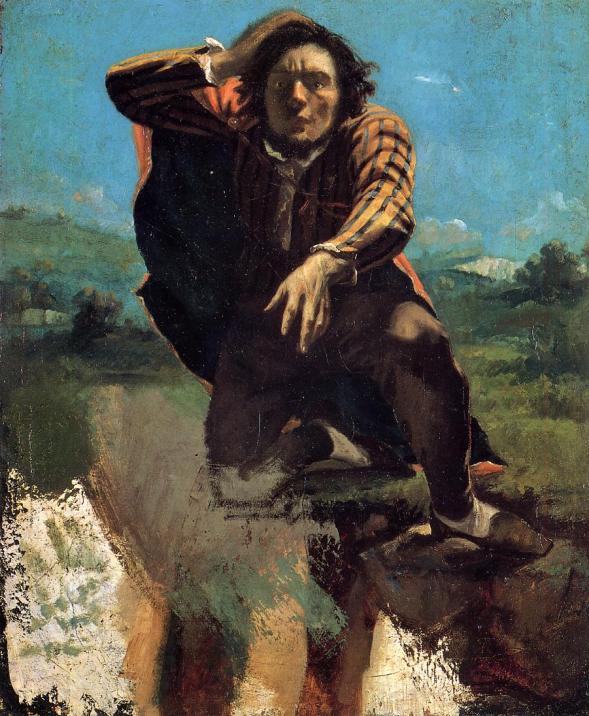
The Man Made Mad by Fear, Gustave Courbet

But perhaps I should offer a more lucid summary. I’ll do that in the next paragraph, but first: Let me just recommend you skip that paragraph. Really. What I perhaps loved most about Lenz was piecing together the plot through the often elliptical or opaque experiences we get via Büchner’s haunting free indirect style. The evocation of a consciousness in turmoil is probably best maintained when we read through the same confusion that Lenz experiences. I read the novella cold based on blurbs from William H. Gass and Harold Bloom and I’m glad I did.

Here is the summary paragraph you should skip: Jakob Lenz, a writer of the Sturm and Drung movement (and friend and rival to Goethe), has recently suffered a terrible episode of schizophrenia and “an accident” (likely a suicide attempt). He’s sent to pastor-physician J.F. Oberlin, who attends to him in the Alsatian countryside in the first few weeks of 1778. During this time Lenz obsesses over a young local girl who dies (he attempts to resurrect her), takes long walks in the countryside, cries manically, offers his own aesthetic theory, prays, takes loud late-night bath in the local fountain, receives a distressing letter, and, eventually, likely—although it’s never made entirely explicit—attempts suicide again and is thusly shipped away.

Büchner bases his story on sections of Oberlin’s diary, reproduced in the Archipelago edition. In straightforward prose, these entries fill in the expository gaps that Büchner has so elegantly removed and replaced with the wonder and dread of Lenz’s imagination. The diary’s lucid entries attest to the power of Büchner’s speculative fiction, to his own art and imagination, which so bracingly take us into a clouded mind.

In Sieburth’s afterword (which also offers a concise chronology of Lenz’s troubled life), our translator points out that “Like De Quincey’s “The Last Days of Immanuel Kant” or Chateaubriand’s Life of Rancé, Büchner’s Lenz is an experiment in speculative biography, part fact, part fabrication—an early nineteenth-century example of the modern genre of docufiction.” Obviously, any number of postmodern novels have explored or used historical figures—Public Burning, Ragtime, and Mason & Dixon are all easy go-to examples. But Lenz is more personal than these postmodern fictions, more an exploration of consciousness, and although we are treated to Lenz’s ideas about literature, art, and religion, we access this very much through his own skull and soul. He’s not just a placeholder or mouthpiece for Büchner.

Lenz strikes me as something closer to the docufiction of W.G. Sebald. Perhaps it’s all the ambulating; maybe it’s the melancholy; could be the philosophical tone. And, while I’m lazily, assbackwardly comparing Büchner’s book to writers who came much later: Thomas Bernhard. Maybe it’s the flights of rant that Lenz occasionally hits, or the madness, or the depictions of nature, or hell, maybe it’s those long, long passages. The comma splices.

Chronologically closer is the work of Edgar Allan Poe, whose depictions of manic bipolar depression resonate strongly with Lenz—not to mention the abysses, the torment, the spirits, the doppelgängers. Why not share another sample here to illustrate this claim? Okay:

The incidents during the night reached a horrific pitch. Only with the greatest effort did he fall asleep, having tried at length to fill the terrible void. Then he fell into a dreadful state between sleeping and waking; he bumped into something ghastly, hideous, madness took hold of him, he sat up, screaming violently, bathed in sweat, and only gradually found himself again. He had to begin with the simplest things in order to come back to himself. In fact he was not the one doing this but rather a powerful instinct for self preservation, it was as if he were double, the one half attempting to save the other, calling out to itself; he told stories, he recited poems out loud, wracked with anxiety, until he came to his sense.

Here, Lenz suspends his neurotic horror through storytelling and art—but it’s just that, only a suspension. Büchner doesn’t blithely, naïvely suggest that art has the power to permanently comfort those in despair; rather, Lenz repeatedly suggests that art, that storytelling is a symptom of despair.

The Last Judgment (detail), Rogier van der Weyden

What drives despair? Lenz—Lenz—Büchner (?)—suggests repeatedly that it’s Langeweile—boredom. Sieburth renders the German Langeweile as boredom, a choice I like, even though he might have been tempted to reach for its existentialist chain-smoking cousin ennui. When Lenz won’t get out of bed one day, Oberlin heads to his room to rouse him:

Oberlin had to repeat his questions at length before getting an answer: Yes, Reverend, you see, boredom! Boredom! O, sheer boredom, what more can I say, I have already drawn all the figures on the wall. Oberlin said to him he should turn to God; he laughed and said: if I were as lucky as you to have discovered such an agreeable pastime, yes, one could indeed wile away one’s time that way. Tedium the root of it all. Most people pray only out of boredom; others fall in love out of boredom, still others are virtuous or depraved, but I am nothing, nothing at all, I cannot even kill myself: too boring . . .

Lenz fits in neatly into the literature of boredom, a deep root that predates Dostoevsky, Camus, and Bellow, as well as contemporary novels like Lee Rourke’s The Canal and David Foster Wallace’s The Pale King.

Ultimately, the boredom Lenz circles around is deeply painful:

The half-hearted attempts at suicide he kept on making were not entirely serious, it was less the desire to die, death for him held no promise of peace or hope, than the attempt, at moments of excruciating anxiety or dull apathy bordering on non-existence bordering on non-existence, to snap back into himself through physical pain. But his happiest moments were when his mind seemed to gallop away on some madcap idea. This at least provided some relief and the wild look in his eye was less horrible than the anxious thirsting for deliverance, the never-ending torture of unrest!

The “never-ending torture of unrest” is the burden of existence we all carry, sloppily fumble, negotiate with an awkward grip and bent back. Büchner’s analysis fascinates in its refusal to lighten this burden or ponderously dwell on its existential weight. Instead, Lenz is a character study that the reader can’t quite get out of—we’re too inside the frame to see the full contours; precariously perched on Lenz’s shoulder, we have to jostle along with him, look through his wild eyes, gallop along with him on the energy of his madcap idea. The gallop is sad and beautiful and rewarding. Very highly recommended.

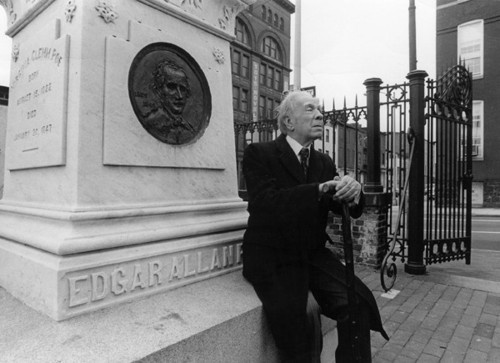
Jorge Luis Borges Resting on Edgar Allan Poe’s Grave

borges poe

“Mesmeric Revelation” — Edgar Allan Poe

“Mesmeric Revelation” by Edgar Allen Poe

WHATEVER doubt may still envelop the rationale of mesmerism, its startling facts are now almost universally admitted. Of these latter, those who doubt, are your mere doubters by profession—an unprofitable and disreputable tribe. There can be no more absolute waste of time than the attempt to prove, at the present day, that man, by mere exercise of will, can so impress his fellow, as to cast him into an abnormal condition, of which the phenomena resemble very closely those of death, or at least resemble them more nearly than they do the phenomena of any other normal condition within our cognizance; that, while in this state, the person so impressed employs only with effort, and then feebly, the external organs of sense, yet perceives, with keenly refined perception, and through channels supposed unknown, matters beyond the scope of the physical organs; that, moreover, his intellectual faculties are wonderfully exalted and invigorated; that his sympathies with the person so impressing him are profound; and, finally, that his susceptibility to the impression increases with its frequency, while, in the same proportion, the peculiar phenomena elicited are more extended and more pronounced. I say that these—which are the laws of mesmerism in its general features—it would be supererogation to demonstrate; nor shall I inflict upon my readers so needless a demonstration; to-day. My purpose at present is a very different one indeed. I am impelled, even in the teeth of a world of prejudice, to detail without comment the very remarkable substance of a colloquy, occurring between a sleep-waker and myself. I had been long in the habit of mesmerizing the person in question, (Mr. Vankirk,) and the usual acute susceptibility and exaltation of the mesmeric perception had supervened. For many months he had been laboring under confirmed phthisis, the more distressing effects of which had been relieved by my manipulations; and on the night of Wednesday, the fifteenth instant, I was summoned to his bedside. The invalid was suffering with acute pain in the region of the heart, and breathed with great difficulty, having all the ordinary symptoms of asthma. In spasms such as these he had usually found relief from the application of mustard to the nervous centres, but to-night this had been attempted in vain. As I entered his room he greeted me with a cheerful smile, and although evidently in much bodily pain, appeared to be, mentally, quite at ease. “I sent for you to-night,” he said, “not so much to administer to my bodily ailment, as to satisfy me concerning certain psychal impressions which, of late, have occasioned me much anxiety and surprise. I need not tell you how sceptical I have hitherto been on the topic of the soul’s immortality. I cannot deny that there has always existed, as if in that very soul which I have been denying, a vague half-sentiment of its own existence. But this half-sentiment at no time amounted to conviction. With it my reason had nothing to do. All attempts at logical inquiry resulted, indeed, in leaving me more sceptical than before. I had been advised to study Cousin. I studied him in his own works as well as in those of his European and American echoes. The ‘Charles Elwood’ of Mr. Brownson, for example, was placed in my hands. I read it with profound attention. Throughout I found it logical, but the portions which were not merely logical were unhappily the initial arguments of the disbelieving hero of the book. In his summing up it seemed evident to me that the reasoner had not even succeeded in convincing himself. His end had plainly forgotten his beginning, like the government of Trinculo. In short, I was not long in perceiving that if man is to be intellectually convinced of his own immortality, he will never be so convinced by the mere abstractions which have been so long the fashion of the moralists of England, of France, and of Germany. Abstractions may amuse and exercise, but take no hold on the mind. Here upon earth, at least, philosophy, I am persuaded, will always in vain call upon us to look upon qualities as things. The will may assent—the soul—the intellect, never. “I repeat, then, that I only half felt, and never intellectually believed. But latterly there has been a certain deepening of the feeling, until it has come so nearly to resemble the acquiescence of reason, that I find it difficult to distinguish between the two. I am enabled, too, plainly to trace this effect to the mesmeric influence. I cannot better explain my meaning than by the hypothesis that the mesmeric exaltation enables me to perceive a train of ratiocination which, in my abnormal existence, convinces, but which, in full accordance with the mesmeric phenomena, does not extend, except through its effect, into my normal condition. In sleep-waking, the reasoning and its conclusion—the cause and its effect—are present together. In my natural state, the cause vanishing, the effect only, and perhaps only partially, remains. “These considerations have led me to think that some good results might ensue from a series of well-directed questions propounded to me while mesmerized. You have often observed the profound self-cognizance evinced by the sleep-waker—the extensive knowledge he displays upon all points relating to the mesmeric condition itself; and from this self-cognizance may be deduced hints for the proper conduct of a catechism.” I consented of course to make this experiment. A few passes threw Mr. Vankirk into the mesmeric sleep. His breathing became immediately more easy, and he seemed to suffer no physical uneasiness. The following conversation then ensued:—V. in the dialogue representing the patient, and P. myself.

P. Are you asleep?

V. Yes—no I would rather sleep more soundly.

P. [After a few more passes.] Do you sleep now?

V. Yes. Continue reading ““Mesmeric Revelation” — Edgar Allan Poe”

“The Philosophy of Composition” — Edgar Allan Poe

“The Philosophy of Composition” by Edgar Allan Poe

Charles Dickens, in a note now lying before me, alluding to an examination I once made of the mechanism of Barnaby Rudge, says—”By the way, are you aware that Godwin wrote his Caleb Williams backwards? He first involved his hero in a web of difficulties, forming the second volume, and then, for the first, cast about him for some mode of accounting for what had been done.”

I cannot think this the precise mode of procedure on the part of Godwin—and indeed what he himself acknowledges is not altogether in accordance with Mr. Dickens’s idea—but the author of Caleb Williams was too good an artist not to perceive the advantage derivable from at least a somewhat similar process. Nothing is more clear than that every plot, worth the name, must be elaborated to its dénouement before anything be attempted with the pen. It is only with the dénouement constantly in view that we can give a plot its indispensable air of consequence, or causation, by making the incidents, and especially the tone at all points, tend to the development of the intention.

There is a radical error, I think, in the usual mode of constructing a story. Either history affords a thesis—or one is suggested by an incident of the day—or, at best, the author sets himself to work in the combination of striking events to form merely the basis of his narrative—-designing, generally, to fill in with description, dialogue, or autorial comment, whatever crevices of fact or action may, from page to page, render themselves apparent.

I prefer commencing with the consideration of an effect. Keeping originality always in view—for he is false to himself who ventures to dispense with so obvious and so easily attainable a source of interest—I say to myself, in the first place, “Of the innumerable effects or impressions of which the heart, the intellect, or (more generally) the soul is susceptible, what one shall I, on the present occasion, select?” Having chosen a novel first, and secondly, a vivid effect, I consider whether it can be best wrought by incident or tone—whether by ordinary incidents and peculiar tone, or the converse, or by peculiarity both of incident and tone—afterwards looking about me (or rather within) for such combinations of events or tone as shall best aid me in the construction of the effect.

I have often thought how interesting a magazine paper might be written by any author who would—that is to say, who could—detail, step by step, the processes by which any one of his compositions attained its ultimate point of completion. Why such a paper has never been given to the world, I am much at a loss to say—but perhaps the autorial vanity has had more to do with the omission than any one other cause. Most writers—poets in especial—prefer having it understood that they compose by a species of fine frenzy—an ecstatic intuition—and would positively shudder at letting the public take a peep behind the scenes, at the elaborate and vacillating crudities of thought—at the true purposes seized only at the last moment—at the innumerable glimpses of idea that arrived not at the maturity of full view—at the fully-matured fancies discarded in despair as unmanageable—at the cautious selections and rejections—at the painful erasures and interpolations,—in a word, at the wheels and pinions, the tackle for scene-shifting, the step-ladders and demon-traps, the cock’s feathers, the red paint, and the black patches, which, in ninety-nine cases out of the hundred, constitute the properties of the literary histrio. Continue reading ““The Philosophy of Composition” — Edgar Allan Poe”

I Review Michael Kimball Writes Your Life Story (On a Postcard)

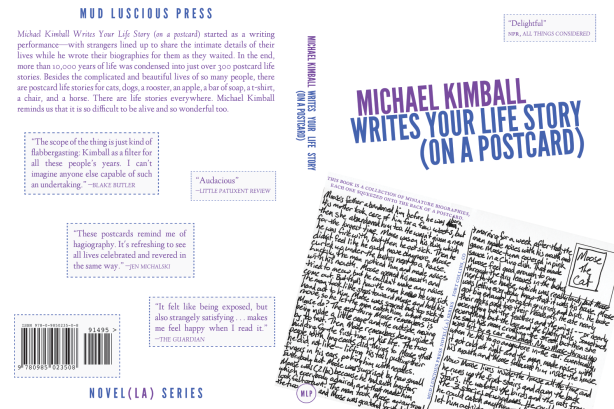
Kimball final cover copy

“I never expected strangers to tell me so much about themselves, so many things they have never told anybody else, but I found an unexpected intimacy in the postcard life story project,” writes Michael Kimball in the introduction to his new book, the aptly titled Michael Kimball Writes Your Life Story (On a Postcard). Kimball continues: “It tapped into something human and humane. I was continually amazed by what people told me.”

Kimball’s respect for the people whose stories he is telling comes through in his spare but descriptive prose, an economical rhetoric undoubtedly necessitated by the confines of his small canvasses. When I interviewed Kimball about the project, he told me:

There are difficult things at different stages of the process. The first difficult thing is asking the right questions for the particular participant. The second difficult thing is being representative when condensing what I’ve been told. The third difficult thing is writing small enough to squeeze six hundred words or so onto a single postcard.

Through that asking, condensing, and squeezing, Kimball distills his subject’s lives into compact but moving stories.

Michael Kimball Writes Your Life Story (On a Postcard) began as a performance piece at the Transmodern Performance Festival and then continued as a blog. Kimball eventually wrote over three hundred postcards; over fifty of these are collected in the new book. A not-insubstantial number of these are devoted to the biographies of contemporary writers, including folks like Tao Lin, Matt Bell, and Blake Butler:

By 4 years old, Blake was performing considered monologues, crazy dances, music videos, and both sides of talk shows. It’s all on video (his mother will show you, if you want). Despite these performances, Blake was a fat child by the 4th grade. He liked comic books and video games. By 10th grade, he weighed 250 pounds and felt disregarded. His bedroom walls were covered with pictures of women that he tore out of magazines at the grocery store and took home.

There’s also a first-person POV bio of Edgar Allan Poe, the last few paragraphs of which I can’t help sharing:

In 1831, my foster father and I had a terrible disagreement, after which I was court-martialed and kicked out of West Point. In 1834, my foster father died and did not leave me any of his money. To console myself, I married my 14-year-old cousin, Virginia Clemm.

For years, I published poems and stories and criticism, but it did not make me happy or money. In 1837, I was fired from a newspaper job for drinking. After that, I published a novel, but that didn’t help much either. Readers are sick. That’s why Virginia got tuberculosis and died in 1847. I was so lonely and so cold. I could not stop drinking.

It was 1849 when I stopped in Baltimore. I remember going down in the street, and, later, two hazy men taking me someplace white. I don’t remember dying, but I was glad I didn’t have to keep trying.

The mix of empathy and humor we see here resonates throughout the collection, whether Kimball is telling the life story of a U.S. President, or an ex-crack addict who met his wife at an all-you-can-eat buffet, or a rooster. Kimball handles his subjects with an intense honesty appropriate to the often tragic trajectory these tales take—even a piece like “Red Delicious Apple,” which takes metaphysical license of a sort, leads to a sad end:

The first thing Red Delicious Apple remembered was being a flower and the way the birds sounded in the trees. Later, Apple remembered the wind and losing his petals. Apple wanted to jump down after them, but stayed on the branch, in the tree. … Not long after that, Hand delivered Apple to the teeth. Apple could feel the teeth cutting through his skin and into his meat, what was left of his insides turning brown. Afterward, he sickened, softened. The last thing Apple remembered was the trashcan, the lid, the rotting darkness.

Or the fate of “Chair”:Chair thought, Wood and glue.

Chair thought, Next time, I’m letting go.
Chair cracked. He broke one of his legs and then his back.
Chair thought, That didn’t even hurt.

Update : Chair was thrown into a dumpster.

But perhaps I bring up “Chair” and “Red Delicious Apple” because their tragic contours are easier to allude to quickly than many of the biographies here, which often involve missing parents,  mental illness, and suicidal thoughts, all delivered in the spare, striking prose that the confines of Kimball’s project necessitate. The stories are sometimes shocking and sometimes sad and usually very moving. As the titular anonym of “G” suggests, “tragedy can be beautiful.”

Michael Kimball Writes Your Life Story (On a Postcard) is new from Mud Luscious Press.

Michael Kimball Talks to Biblioklept About Writing Life Stories on Postcards

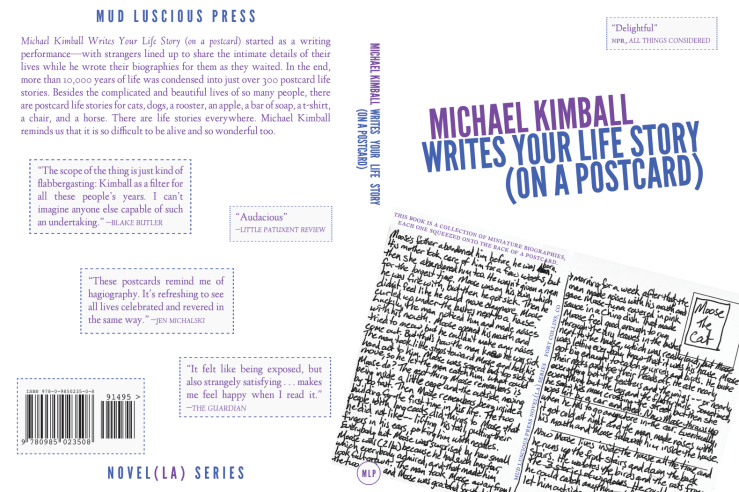
Michael Kimball’s latest book Michael Kimball Writes Your Life Story (On a Postcard) had its genesis in a performance piece at the Transmodern Performance Festival a few years back: Michael interviewed people for a few minutes and then crammed their biographies onto postcards. The project soon evolved into a blog, where Michael interviewed hundreds of people of all ages from around the world. The work is now collected in a book from Mud Luscious Press that features over fifty of the biographies, including the life stories of several contemporary writers, one dead U.S. President, a rooster, a T-shirt, a few cats, Edgar Allan Poe, and Michael himself.

In addition to Michael Kimball Writes Your Life Story (On a Postcard), Michael is the author of Big Ray, Us, Dear Everybody, and The Way the Family Got Away. He still holds the Meryl S. Colt Elementary School record for the 600-yard dash. Check out his website.

Michael was kind enough to talk to me about this latest book over a series of emails.

Kimball final cover copy

Biblioklept: What’s the hardest thing about writing someone’s life story on a postcard?

Michael Kimball: There are difficult things at different stages of the process. The first difficult thing is asking the right questions for the particular participant. The second difficult thing is being representative when condensing what I’ve been told. The third difficult thing is writing small enough to squeeze six hundred words or so onto a single postcard.

Biblioklept: When you started the project, it was a planned performance piece of sorts, but your description of it at the beginning of the book makes it seem rather off-the-cuff. Did you have a plan for the questions you would ask? How did the questions change as the project progressed?

MK: That first performance was definitely off-the-cuff. I had no idea what I was going to ask people and how I was going to write their life stories on a postcard. I mostly started with something pretty open-ended and then asked more specific questions about whatever I was told. As the project progressed, I developed a set of starter questions that elicited basic information and then asked more specific questions from there. Basically, I considered whatever I was being told to be important and then asked more questions about it.

Biblioklept: You interviewed people by email, in phone, in person — how did how you were doing the interview affect the process? Did you prefer one way over the other?

MK: I preferred the in-person interviews. There was a different kind of intimacy with those and there are a bunch of people I interviewed that way who are now friends. Of course, that wasn’t practical for lots of the interviews, since most people lived so far away from me. And the method did influence the process. With the phone interview and in-person interviews I was taking notes as fast as I could, but that was never fast enough. With the email interviews, it was easier for people to give me more detailed answers. Also, since I had the full text of their answers, I could use more of their language.

MKWYLS(oap)Biblioklept: Did you prefer to use as much of the subject’s language as possible? Maybe I’m getting into what you described as “the second difficult thing” — how much of yourself do you see in the pieces? I think there’s clearly a voice, a tone that unifies the pieces . . . I’m curious how much of the process was crafting or editing or revising or repurposing the subject’s original language…
MK: I tried to use the participant’s language wherever I thought it gave some sense of the person. At times, I thought of like using third-person close narration. Besides that, I was trying to be as objective as possible and I think that gave the life stories a certain consistency of tone. Clearly, I tend to write sentences a certain way, but beyond that I tried to keep myself out of it.

Biblioklept: What about pieces like “Chair” or “T-Shirt” — how did they come about?

MK: The first non-person one I wrote was Red Delicious Apple, which popped into my head almost fully formed, which happened because I used to almost always have apples on my desk, which just meant that I spent a lot of time with apples. But writing Red Delicious Apple opened up a lot of possibilities and so T-Shirt is written about my favorite t-shirt and Chair was written about a chair I once broke. And I have a great affection for animals, so I loved writing ones like Moose the Cat, Sammy the Dog, and Abby the Horse.

Biblioklept: You wrote over three hundred postcards. How did you choose which ones you would include in the book?

MK: The book would have been over seven hundred pages long if I had included all the postcard life stories, but it was difficult leaving any of them out. So, ultimately, it came down to trying to showing the range of the postcard life stories, which is why nearly every one I wrote about a non-human made it into the book.

Biblioklept: How did the Poe biography come about?

MK: That was for Gigantic’s Gigantic America issue. They asked me to write one of the great American bios that they printed on special card inserts and I suggested Poe, who had just had some anniversary of his life or his death.

Biblioklept: Several pieces in Life Story are about contemporary writers. Was writing about these writers different than writing about anyone else in the collection?

MK: Early on, it was other writers who seemed particularly keen on the project — Adam Robinson, Karen Lillis, Elizabeth Ellen, Elizabeth Crane, Blake Butler, etc. I approached every postcard life story the same way, but then let the participant tell me where they wanted to take it. I tried to ask questions that followed their answers.

Biblioklept: I imagine most people who asked to participate in the project were forthcoming with their answers. I’m curious though if you noticed any topics that people avoided or glossed over or maybe required additional prodding from you. Did you ever feel like your part of the interviewing process pushed your subject into uncomfortable territory?

MK: I didn’t realize it until later, but part of what made the project work was that people came to me wanting to tell their life story (rather than me asking them if they wanted it told). Still, there were a few times that people were reluctant to say things. There was one woman who was reluctant to talk about her husband and I couldn’t figure out why, but then they divorced not long after that. And there was one man who didn’t want to talk about his mother because she was really sick. But usually if there was reluctance, it was some kind of abuse or some other horrible thing that had happened to the person. In fact, I was reluctant to talk about the abuse I grew up with in my own postcard life story when it was initially written. In general, I tried to ask the difficult question, but then let the participant decide whether they wanted to answer and how much they wanted to tell me. And with particularly difficult life stories, I always showed the participant what I wrote and asked them if they were OK with it being public before I ever put their postcard life story out into the world.

Biblioklept: Talking about one’s own life clearly has some kind of therapeutic value. Do you think reading about one’s own life carries a similar value?

MK: Since starting the project, I’ve learned there are quite a few therapeutic techniques that involve narrative and telling (or retelling) one’s life story. Part of that process is hearing one’s life story told back or reading about one’s own life. There can be something useful in that perspective and there can be something reassuring about having a manageable version of one’s life story.

Biblioklept: What are you working on now?

MK: I’m very slowly working on two different novels and thinking about a third. I’m not sure if I’ll ever finish any of them.

Biblioklept: Have you ever stolen a book?

MK: I used to steal so many books, especially when I didn’t have the money to keep pace with my reading appetite and I couldn’t find the things I wanted to read in the library. I’ve tried to make up for that by giving away lots of books these days. I stole so many books that I’m not sure I can remember a specific instance. But it was always kind of thrilling and it seemed to make reading all the more exciting. Sometimes, if I didn’t like a book I would sneak it back into the bookstore.

“The Oblong Box” — Edgar Allan Poe

“The Oblong Box” by Edgar Allan Poe

SOME years ago, I engaged passage from Charleston, S. C, to the city of New York, in the fine packet-ship “Independence,” Captain Hardy. We were to sail on the fifteenth of the month (June), weather permitting; and on the fourteenth, I went on board to arrange some matters in my state-room.

I found that we were to have a great many passengers, including a more than usual number of ladies. On the list were several of my acquaintances, and among other names, I was rejoiced to see that of Mr. Cornelius Wyatt, a young artist, for whom I entertained feelings of warm friendship. He had been with me a fellow-student at C— University, where we were very much together. He had the ordinary temperament of genius, and was a compound of misanthropy, sensibility, and enthusiasm. To these qualities he united the warmest and truest heart which ever beat in a human bosom.

I observed that his name was carded upon three state-rooms; and, upon again referring to the list of passengers, I found that he had engaged passage for himself, wife, and two sisters—his own. The state-rooms were sufficiently roomy, and each had two berths, one above the other. These berths, to be sure, were so exceedingly narrow as to be insufficient for more than one person; still, I could not comprehend why there were three state-rooms for these four persons. I was, just at that epoch, in one of those moody frames of mind which make a man abnormally inquisitive about trifles: and I confess, with shame, that I busied myself in a variety of ill-bred and preposterous conjectures about this matter of the supernumerary state-room. It was no business of mine, to be sure, but with none the less pertinacity did I occupy myself in attempts to resolve the enigma. At last I reached a conclusion which wrought in me great wonder why I had not arrived at it before. “It is a servant of course,” I said; “what a fool I am, not sooner to have thought of so obvious a solution!” And then I again repaired to the list—but here I saw distinctly that no servant was to come with the party, although, in fact, it had been the original design to bring one—for the words “and servant” had been first written and then overscored. “Oh, extra baggage, to be sure,” I now said to myself—”something he wishes not to be put in the hold—something to be kept under his own eye—ah, I have it—a painting or so—and this is what he has been bargaining about with Nicolino, the Italian Jew.” This idea satisfied me, and I dismissed my curiosity for the nonce. Continue reading ““The Oblong Box” — Edgar Allan Poe”

“X-ing a Paragraph” — Edgar Allan Poe

“X-ing a Paragraph” by Edgar Allan Poe

As it is well known that the ‘wise men’ came ‘from the East,’ and as Mr. Touch-and-go Bullet-head came from the East, it follows that Mr. Bullet-head was a wise man; and if collateral proof of the matter be needed, here we have it—Mr. B. was an editor. Irascibility was his sole foible, for in fact the obstinacy of which men accused him was anything but his foible, since he justly considered it his forte. It was his strong point—his virtue; and it would have required all the logic of a Brownson to convince him that it was ‘anything else.’

I have shown that Touch-and-go Bullet-head was a wise man; and the only occasion on which he did not prove infallible, was when, abandoning that legitimate home for all wise men, the East, he migrated to the city of Alexander-the-Great-o-nopolis, or some place of a similar title, out West.

I must do him the justice to say, however, that when he made up his mind finally to settle in that town, it was under the impression that no newspaper, and consequently no editor, existed in that particular section of the country. In establishing ‘The Tea-Pot’ he expected to have the field all to himself. I feel confident he never would have dreamed of taking up his residence in Alexander-the-Great-o-nopolis had he been aware that, in Alexander-the-Great-o-nopolis, there lived a gentleman named John Smith (if I rightly remember), who for many years had there quietly grown fat in editing and publishing the ‘Alexander-the-Great-o-nopolis Gazette.’ It was solely, therefore, on account of having been misinformed, that Mr. Bullet-head found himself in Alex-suppose we call it Nopolis, ‘for short’—but, as he did find himself there, he determined to keep up his character for obst—for firmness, and remain. So remain he did; and he did more; he unpacked his press, type, etc., etc., rented an office exactly opposite to that of the ‘Gazette,’ and, on the third morning after his arrival, issued the first number of ‘The Alexan’—that is to say, of ‘The Nopolis Tea-Pot’—as nearly as I can recollect, this was the name of the new paper.

The leading article, I must admit, was brilliant—not to say severe. It was especially bitter about things in general—and as for the editor of ‘The Gazette,’ he was torn all to pieces in particular. Some of Bullethead’s remarks were really so fiery that I have always, since that time, been forced to look upon John Smith, who is still alive, in the light of a salamander. I cannot pretend to give all the ‘Tea-Pot’s’ paragraphs verbatim, but one of them runs thus:

‘Oh, yes!—Oh, we perceive! Oh, no doubt! The editor over the way is a genius—O, my! Oh, goodness, gracious!—what is this world coming to? Oh, tempora! Oh, Moses!’

A philippic at once so caustic and so classical, alighted like a bombshell among the hitherto peaceful citizens of Nopolis. Groups of excited individuals gathered at the corners of the streets. Every one awaited, with heartfelt anxiety, the reply of the dignified Smith. Next morning it appeared as follows:

‘We quote from “The Tea-Pot” of yesterday the subjoined paragraph: “Oh, yes! Oh, we perceive! Oh, no doubt! Oh, my! Oh, goodness! Oh, tempora! Oh, Moses!” Why, the fellow is all O! That accounts for his reasoning in a circle, and explains why there is neither beginning nor end to him, nor to anything he says. We really do not believe the vagabond can write a word that hasn’t an O in it. Wonder if this O-ing is a habit of his? By-the-by, he came away from Down-East in a great hurry. Wonder if he O’s as much there as he does here? “O! it is pitiful.”‘

The indignation of Mr. Bullet-head at these scandalous insinuations, I shall not attempt to describe. On the eel-skinning principle, however, he did not seem to be so much incensed at the attack upon his integrity as one might have imagined. It was the sneer at his style that drove him to desperation. What!—he Touch-and-go Bullet-head!—not able to write a word without an O in it! He would soon let the jackanapes see that he was mistaken. Yes! he would let him see how much he was mistaken, the puppy! He, Touch-and-go Bullet-head, of Frogpondium, would let Mr. John Smith perceive that he, Bullet-head, could indite, if it so pleased him, a whole paragraph—aye! a whole article—in which that contemptible vowel should not once—not even once—make its appearance. But no;—that would be yielding a point to the said John Smith. He, Bullet-head, would make no alteration in his style, to suit the caprices of any Mr. Smith in Christendom. Perish so vile a thought! The O forever; He would persist in the O. He would be as O-wy as O-wy could be.

Burning with the chivalry of this determination, the great Touch-and-go, in the next ‘Tea-Pot,’ came out merely with this simple but resolute paragraph, in reference to this unhappy affair:

‘The editor of the “Tea-Pot” has the honor of advising the editor of the “Gazette” that he (the “Tea-Pot”) will take an opportunity in tomorrow morning’s paper, of convincing him (the “Gazette”) that he (the “Tea-Pot”) both can and will be his own master, as regards style; he (the “Tea-Pot”) intending to show him (the “Gazette”) the supreme, and indeed the withering contempt with which the criticism of him (the “Gazette”) inspires the independent bosom of him (the “TeaPot”) by composing for the especial gratification (?) of him (the “Gazette”) a leading article, of some extent, in which the beautiful vowel—the emblem of Eternity—yet so offensive to the hyper-exquisite delicacy of him (the “Gazette”) shall most certainly not be avoided by his (the “Gazette’s”) most obedient, humble servant, the “Tea-Pot.” “So much for Buckingham!”‘

In fulfilment of the awful threat thus darkly intimated rather than decidedly enunciated, the great Bullet-head, turning a deaf ear to all entreaties for ‘copy,’ and simply requesting his foreman to ‘go to the d——l,’ when he (the foreman) assured him (the ‘Tea-Pot’!) that it was high time to ‘go to press’: turning a deaf ear to everything, I say, the great Bullet-head sat up until day-break, consuming the midnight oil, and absorbed in the composition of the really unparalleled paragraph, which follows:—

‘So ho, John! how now? Told you so, you know. Don’t crow, another time, before you’re out of the woods! Does your mother know you’re out? Oh, no, no!—so go home at once, now, John, to your odious old woods of Concord! Go home to your woods, old owl—go! You won’t! Oh, poh, poh, don’t do so! You’ve got to go, you know! So go at once, and don’t go slow, for nobody owns you here, you know! Oh! John, John, if you don’t go you’re no homo—no! You’re only a fowl, an owl, a cow, a sow,—a doll, a poll; a poor, old, good-for-nothing-to-nobody, log, dog, hog, or frog, come out of a Concord bog. Cool, now—cool! Do be cool, you fool! None of your crowing, old cock! Don’t frown so—don’t! Don’t hollo, nor howl nor growl, nor bow-wow-wow! Good Lord, John, how you do look! Told you so, you know—but stop rolling your goose of an old poll about so, and go and drown your sorrows in a bowl!’

Exhausted, very naturally, by so stupendous an effort, the great Touch-and-go could attend to nothing farther that night. Firmly, composedly, yet with an air of conscious power, he handed his MS. to the devil in waiting, and then, walking leisurely home, retired, with ineffable dignity to bed.

Meantime the devil, to whom the copy was entrusted, ran up stairs to his ‘case,’ in an unutterable hurry, and forthwith made a commencement at ‘setting’ the MS. ‘up.’

In the first place, of course,—as the opening word was ‘So,’—he made a plunge into the capital S hole and came out in triumph with a capital S. Elated by this success, he immediately threw himself upon the little-o box with a blindfold impetuosity—but who shall describe his horror when his fingers came up without the anticipated letter in their clutch? who shall paint his astonishment and rage at perceiving, as he rubbed his knuckles, that he had been only thumping them to no purpose, against the bottom of an empty box. Not a single little-o was in the little-o hole; and, glancing fearfully at the capital-O partition, he found that to his extreme terror, in a precisely similar predicament. Awe—stricken, his first impulse was to rush to the foreman.

‘Sir!’ said he, gasping for breath, ‘I can’t never set up nothing without no o’s.’

‘What do you mean by that?’ growled the foreman, who was in a very ill humor at being kept so late.

‘Why, sir, there beant an o in the office, neither a big un nor a little un!’

‘What—what the d-l has become of all that were in the case?’

‘I don’t know, sir,’ said the boy, ‘but one of them ere “G’zette” devils is bin prowling ’bout here all night, and I spect he’s gone and cabbaged ’em every one.’

‘Dod rot him! I haven’t a doubt of it,’ replied the foreman, getting purple with rage ‘but I tell you what you do, Bob, that’s a good boy—you go over the first chance you get and hook every one of their i’s and (d——n them!) their izzards.’

‘Jist so,’ replied Bob, with a wink and a frown—’I’ll be into ’em, I’ll let ’em know a thing or two; but in de meantime, that ere paragrab? Mus go in to-night, you know—else there’ll be the d-l to pay, and-‘

‘And not a bit of pitch hot,’ interrupted the foreman, with a deep sigh, and an emphasis on the ‘bit.’ ‘Is it a long paragraph, Bob?’

‘Shouldn’t call it a wery long paragrab,’ said Bob.

‘Ah, well, then! do the best you can with it! We must get to press,’ said the foreman, who was over head and ears in work; ‘just stick in some other letter for o; nobody’s going to read the fellow’s trash anyhow.’

‘Wery well,’ replied Bob, ‘here goes it!’ and off he hurried to his case, muttering as he went: ‘Considdeble vell, them ere expressions, perticcler for a man as doesn’t swar. So I’s to gouge out all their eyes, eh? and d-n all their gizzards! Vell! this here’s the chap as is just able for to do it.’ The fact is that although Bob was but twelve years old and four feet high, he was equal to any amount of fight, in a small way.

The exigency here described is by no means of rare occurrence in printing-offices; and I cannot tell how to account for it, but the fact is indisputable, that when the exigency does occur, it almost always happens that x is adopted as a substitute for the letter deficient. The true reason, perhaps, is that x is rather the most superabundant letter in the cases, or at least was so in the old times—long enough to render the substitution in question an habitual thing with printers. As for Bob, he would have considered it heretical to employ any other character, in a case of this kind, than the x to which he had been accustomed.

‘I shell have to x this ere paragrab,’ said he to himself, as he read it over in astonishment, ‘but it’s jest about the awfulest o-wy paragrab I ever did see’: so x it he did, unflinchingly, and to press it went x-ed.

Next morning the population of Nopolis were taken all aback by reading in ‘The Tea-Pot,’ the following extraordinary leader:

‘Sx hx, Jxhn! hxw nxw? Txld yxu sx, yxu knxw. Dxn’t crxw, anxther time, befxre yxu’re xut xf the wxxds! Dxes yxur mxther knxw yxu’re xut? Xh, nx, nx!—sx gx hxme at xnce, nxw, Jxhn, tx yxur xdixus xld wxxds xf Cxncxrd! Gx hxme tx yxur wxxds, xld xwl,—gx! Yxu wxn’t? Xh, pxh, pxh, Jxhn, dxn’t dx sx! Yxu’ve gxt tx gx, yxu knxw, sx gx at xnce, and dxn’t gx slxw; fxr nxbxdy xwns yxu here, yxu knxw. Xh, Jxhn, Jxhn, Jxhn, if yxu dxn’t gx yxu’re nx hxmx—nx! Yxu’re xnly a fxwl, an xwl; a cxw, a sxw; a dxll, a pxll; a pxxr xld gxxd-fxr-nxthing-tx-nxbxdy, lxg, dxg, hxg, xr frxg, cxme xut xf a Cxncxrd bxg. Cxxl, nxw—cxxl! Dx be cxxl, yxu fxxl! Nxne xf yxur crxwing, xld cxck! Dxn’t frxwn sx—dxn’t! Dxn’t hxllx, nxr hxwl, nxr grxwl, nxr bxw-wxw-wxw! Gxxd Lxrd, Jxhn, hxw yxu dx lxxk! Txld yxu sx, yxu knxw,—but stxp rxlling yxur gxxse xf an xld pxll abxut sx, and gx and drxwn yxur sxrrxws in a bxwl!’

The uproar occasioned by this mystical and cabalistical article, is not to be conceived. The first definite idea entertained by the populace was, that some diabolical treason lay concealed in the hieroglyphics; and there was a general rush to Bullet-head’s residence, for the purpose of riding him on a rail; but that gentleman was nowhere to be found. He had vanished, no one could tell how; and not even the ghost of him has ever been seen since.

Unable to discover its legitimate object, the popular fury at length subsided; leaving behind it, by way of sediment, quite a medley of opinion about this unhappy affair.

One gentleman thought the whole an X-ellent joke.

Another said that, indeed, Bullet-head had shown much X-uberance of fancy.

A third admitted him X-entric, but no more.

A fourth could only suppose it the Yankee’s design to X-press, in a general way, his X-asperation.

‘Say, rather, to set an X-ample to posterity,’ suggested a fifth.

That Bullet-head had been driven to an extremity, was clear to all; and in fact, since that editor could not be found, there was some talk about lynching the other one.

The more common conclusion, however, was that the affair was, simply, X-traordinary and in-X-plicable. Even the town mathematician confessed that he could make nothing of so dark a problem. X, every. body knew, was an unknown quantity; but in this case (as he properly observed), there was an unknown quantity of X.

The opinion of Bob, the devil (who kept dark about his having ‘X-ed the paragrab’), did not meet with so much attention as I think it deserved, although it was very openly and very fearlessly expressed. He said that, for his part, he had no doubt about the matter at all, that it was a clear case, that Mr. Bullet-head ‘never could be persuaded fur to drink like other folks, but vas continually a-svigging o’ that ere blessed XXX ale, and as a naiteral consekvence, it just puffed him up savage, and made him X (cross) in the X-treme.’


“Edgar Poe’s Significance” — Walt Whitman

“Edgar Poe’s Significance” by Walt Whitman. From Specimen Days.

Jan. 1, ’80.—In diagnosing this disease called humanity—to assume for the nonce what seems a chief mood of the personality and writings of my subject—I have thought that poets, somewhere or other on the list, present the most mark’d indications. Comprehending artists in a mass, musicians, painters, actors, and so on, and considering each and all of them as radiations or flanges of that furious whirling wheel, poetry, the centre and axis of the whole, where else indeed may we so well investigate the causes, growths, tally-marks of the time—the age’s matter and malady?

By common consent there is nothing better for man or woman than a perfect and noble life, morally without flaw, happily balanced in activity, physically sound and pure, giving its due proportion, and no more, to the sympathetic, the human emotional element—a life, in all these, unhasting, unresting, untiring to the end. And yet there is another shape of personality dearer far to the artist-sense, (which likes the play of strongest lights and shades,) where the perfect character, the good, the heroic, although never attain’d, is never lost sight of, but through failures, sorrows, temporary downfalls, is return’d to again and again, and while often violated, is passionately adhered to as long as mind, muscles, voice, obey the power we call volition. This sort of personality we see more or less in Burns, Byron, Schiller, and George Sand. But we do not see it in Edgar Poe. (All this is the result of reading at intervals the last three days a new volume of his poems—I took it on my rambles down by the pond, and by degrees read it all through there.) While to the character first outlined the service Poe renders is certainly that entire contrast and contradiction which is next best to fully exemplifying it.

Almost without the first sign of moral principle, or of the concrete or its heroisms, or the simpler affections of the heart, Poe’s verses illustrate an intense faculty for technical and abstract beauty, with the rhyming art to excess, an incorrigible propensity toward nocturnal themes, a demoniac undertone behind every page—and, by final judgment, probably belong among the electric lights of imaginative literature, brilliant and dazzling, but with no heat. There is an indescribable magnetism about the poet’s life and reminiscences, as well as the poems. To one who could work out their subtle retracing and retrospect, the latter would make a close tally no doubt between the author’s birth and antecedents, his childhood and youth, his physique, his so-call’d education, his studies and associates, the literary and social Baltimore, Richmond, Philadelphia and New York, of those times—not only the places and circumstances in themselves, but often, very often, in a strange spurning of, and reaction from them all.

The following from a report in the Washington “Star” of November 16, 1875, may afford those who care for it something further of my point of view toward this interesting figure and influence of our era. There occurr’d about that date in Baltimore a public reburial of Poe’s remains, and dedication of a monument over the grave:

“Being in Washington on a visit at the time, ‘the old gray’ went over to Baltimore, and though ill from paralysis, consented to hobble up and silently take a seat on the platform, but refused to make any speech, saying, ‘I have felt a strong impulse to come over and be here to-day myself in memory of Poe, which I have obey’d, but not the slightest impulse to make a speech, which, my dear friends, must also be obeyed.’ In an informal circle, however, in conversation after the ceremonies, Whitman said: ‘For a long while, and until lately, I had a distaste for Poe’s writings. I wanted, and still want for poetry, the clear sun shining, and fresh air blowing—the strength and power of health, not of delirium, even amid the stormiest passions—with always the background of the eternal moralities. Non-complying with these requirements, Poe’s genius has yet conquer’d a special recognition for itself, and I too have come to fully admit it, and appreciate it and him.

“‘In a dream I once had, I saw a vessel on the sea, at midnight, in a storm. It was no great full-rigg’d ship, nor majestic steamer, steering firmly through the gale, but seem’d one of those superb little schooner yachts I had often seen lying anchor’d, rocking so jauntily, in the waters around New York, or up Long Island sound—now flying uncontroll’d with torn sails and broken spars through the wild sleet and winds and waves of the night. On the deck was a slender, slight, beautiful figure, a dim man, apparently enjoying all the terror, the murk, and the dislocation of which he was the centre and the victim. That figure of my lurid dream might stand for Edgar Poe, his spirit, his fortunes, and his poems—themselves all lurid dreams.'”

Much more may be said, but I most desired to exploit the idea put at the beginning. By its popular poets the calibres of an age, the weak spots of its embankments, its sub-currents, (often more significant than the biggest surface ones,) are unerringly indicated. The lush and the weird that have taken such extraordinary possession of Nineteenth century verse-lovers—what mean they? The inevitable tendency of poetic culture to morbidity, abnormal beauty—the sickliness of all technical thought or refinement in itself—the abnegation of the perennial and democratic concretes at first hand, the body, the earth and sea, sex and the like—and the substitution of something for them at second or third hand—what bearings have they on current pathological study?

Night’s Plutonian Shore — Gustave Dore Illustrates Edgar Allan Poe’s Poem “The Raven”

Gustave Dore’s marvelous illustration’s for Edgar Allan Poe’s poem “The Raven”


Edgar Allan Poe on Imaginative Capacity

(From “A Chapter of Suggestions”).

Alexander Alexeieff Illustrates Poe’s Story “The Fall of the House of Usher”

(More/via/about).

Read Edgar Allan Poe’s Story “A Descent into the Maelström”


“A Descent into the Maelström” by Edgar Allan Poe—

The ways of God in Nature, as in Providence, are not as our ways; nor are the models that we frame any way commensurate to the vastness, profundity, and unsearchableness of His works, which have a depth in them greater than the well of Democritus.
Joseph Glanville.

WE had now reached the summit of the loftiest crag. For some minutes the old man seemed too much exhausted to speak.

“Not long ago,” said he at length, “and I could have guided you on this route as well as the youngest of my sons; but, about three years past, there happened to me an event such as never happened before to mortal man –or at least such as no man ever survived to tell of –and the six hours of deadly terror which I then endured have broken me up body and soul. You suppose me a very old man –but I am not. It took less than a single day to change these hairs from a jetty black to white, to weaken my limbs, and to unstring my nerves, so that I tremble at the least exertion, and am frightened at a shadow. Do you know I can scarcely look over this little cliff without getting giddy?”

The “little cliff,” upon whose edge he had so carelessly thrown himself down to rest that the weightier portion of his body hung over it, while he was only kept from falling by the tenure of his elbow on its extreme and slippery edge –this “little cliff” arose, a sheer unobstructed precipice of black shining rock, some fifteen or sixteen hundred feet from the world of crags beneath us. Nothing would have tempted me to within half a dozen yards of its brink. In truth so deeply was I excited by the perilous position of my companion, that I fell at full length upon the ground, clung to the shrubs around me, and dared not even glance upward at the sky –while I struggled in vain to divest myself of the idea that the very foundations of the mountain were in danger from the fury of the winds. It was long before I could reason myself into sufficient courage to sit up and look out into the distance.

“You must get over these fancies,” said the guide, “for I have brought you here that you might have the best possible view of the scene of that event I mentioned –and to tell you the whole story with the spot just under your eye.”

“We are now,” he continued, in that particularizing manner which distinguished him –“we are now close upon the Norwegian coast –in the sixty-eighth degree of latitude –in the great province of Nordland –and in the dreary district of Lofoden. The mountain upon whose top we sit is Helseggen, the Cloudy. Now raise yourself up a little higher –hold on to the grass if you feel giddy –so –and look out beyond the belt of vapor beneath us, into the sea.” Continue reading “Read Edgar Allan Poe’s Story “A Descent into the Maelström””