The Fall of the House of Usher — Edgar Allan Poe’s Tale Comes to Life in a Creepy Stop-Motion Film by Jan Svankmajer

Portrait of Edgar Allan Poe — Felix Vallotton

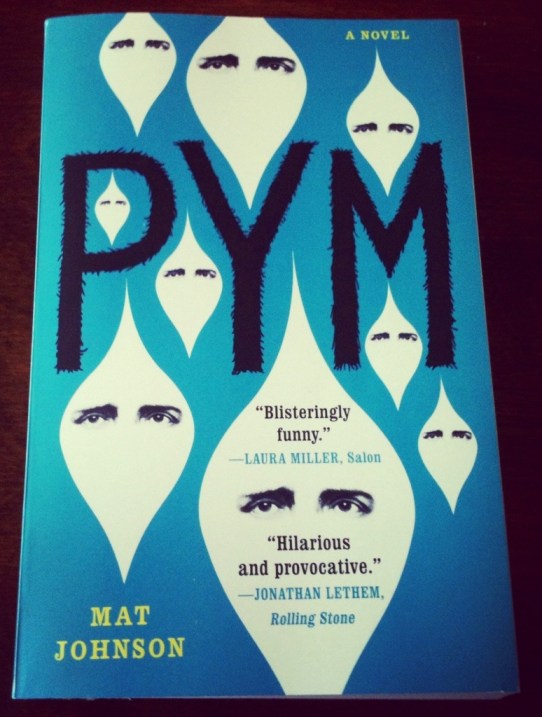
Pym (Book Acquired, 8.16.2012)


20120818-174043.jpg

I wanted to read Mat Johnson’s novel Pym when it came out last year, so I was pleased when Random House sent me a copy of the forthcoming trade paperback. Random House’s blurb:

Recently canned professor of American literature Chris Jaynes has just made a startling discovery: the manuscript of a crude slave narrative that confirms the reality of Edgar Allan Poe’s strange and only novel,The Narrative of Arthur Gordon Pym of Nantucket. Determined to seek out Tsalal, the remote island of pure and utter blackness that Poe describes, Jaynes convenes an all-black crew of six to follow Pym’s trail to the South Pole, armed with little but the firsthand account from which Poe derived his seafaring tale, a bag of bones, and a stash of Little Debbie snack cakes. Thus begins an epic journey by an unlikely band of adventurers under the permafrost of Antarctica, beneath the surface of American history, and behind one of literature’s great mysteries.


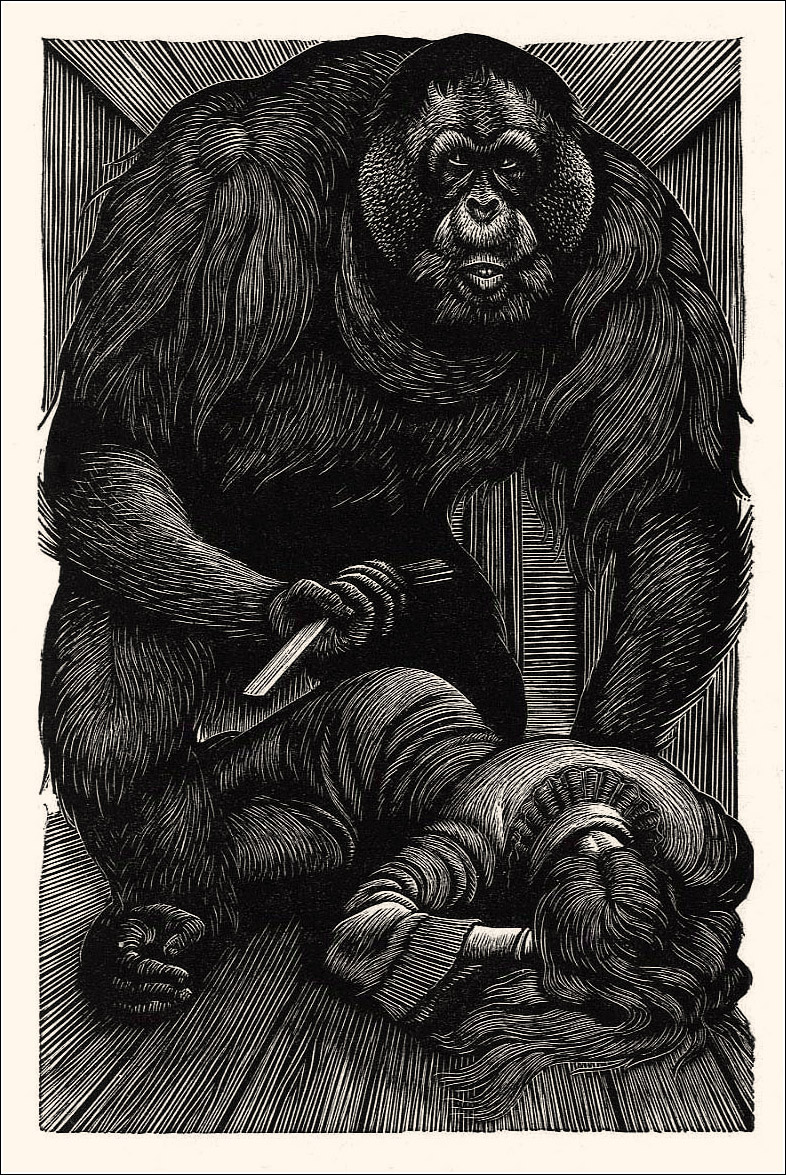
Poe Illustration (“Murders in the Rue Morgue”) — Fritz Eichenberg

(Via/more).

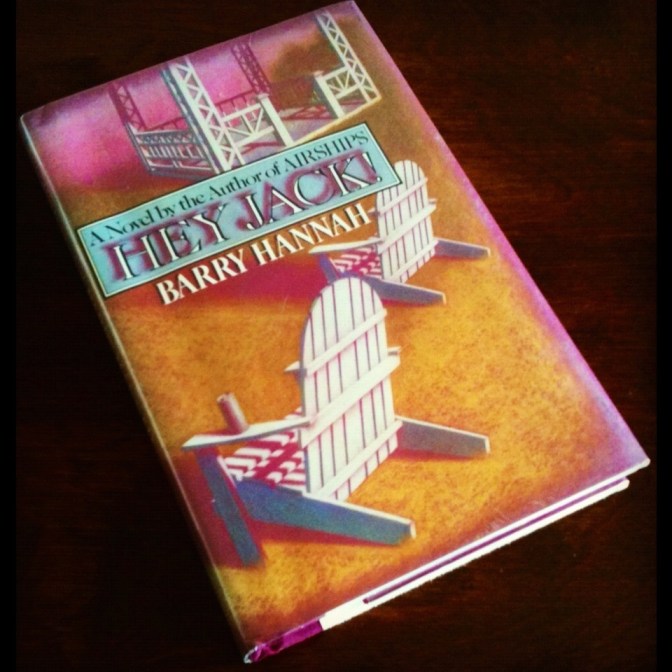
Barry Hannah’s Novella Hey Jack! Is a Loose, Hilarious Tragedy

20120410-174027.jpg

The loose, brief breeziness of Barry Hannah’s 1987 novella Hey Jack! belies the terror and rage at the heart of this hilarious tragedy. It’s a slim volume—133 pages in my hardback copy—with the same rambling flightiness that characterizes Hannah’s better known 1980 novel-in-vignettes, Ray.

Hey Jack! bears many comparisons with Ray: Like Ray, this novel is told from the perspective of a war vet (Korea this time, not ‘Nam); like the eponymous speaker of Ray, the narrator of Hey Jack!, Homer, finds himself frequently besotted, binged out, or horny; like Ray, Homer tries to make a marriage work; like Ray, Homer comes into conflict with a poor white trash family.

And like Ray, Hey Jack! tests the boundaries of what is and is not a “novel.” Hey Jack! is discontinuous and meandering; there’s a plot, sure, but Hannah’s apt to jump over place and time freely, tripping over months at a time, sparing not even a sentence to cue his readers in the right direction. No exposition here, folks. I suppose I should summarize the plot though: Homer, passing middle age, takes up a friendship with Jack, an older man, a former sheriff and fellow Korean War vet who runs a coffee shop popular with the college kids. Together, the pair (sort of) face off against Ronnie Foot, a local boy turned rock star who has the gall to begin an affair with Jack’s forty-year old daughter:

Ronnie Foot, the rock star had her. Or Jack thought he had her, he was sure he had her. Jack was mumbling. Jack was talking about ingratitude and pride and scum hanging on meat, things of that nature. It was astonishing to see him creep and rise suddenly, like a crazy old man. . . . “Nobody ever had a daughter like me. You want me to just her go, like a fart?” He was fingering the gun again.

Jack, once the lone bastion of sanity and order in Homer’s small, chaotic Mississippi town, begins to slide into the insanity and violence that marks the rest of the populace. Jack’s stability is the closest thing Hey Jack! offers as a slice of normalcy (to be clear though, Hannah’s characters skew grotesque, not quirky).

What unites the volume isn’t Jack’s slow slide to the dark side, but rather the narrative’s distinctive, ornery voice. It’s worth quoting Homer at length; here he condenses several of the novel’s themes in the sort of crazy-or-wise? rant indicative of the novella’s tone and rhythm:

In love, in love, in love. A mule can climb a tree if it’s in love. A man like me can look himself in the mirror and say, I’m all right, everything is beloved, I’m no stranger to anywhere any more. I’m a man full of life and a lot of time to kill, shoot every minute down with a straight blast of his eye across the bountiful landscape, from the minnow to the Alps. Something looks back at you with an eye of insane approval. Something looks back at you; out of belligerent ignorance of you it has come to a delighted focus on you and your love, together, sending up gasses of collision that make a rainbow over the poor masses who are changing a tire on the side of the road on a hot Saturday afternoon, felling like niggers. There is a law that every nigger spends a quarter of every weekend changing tires, my friend George, the biochemist, says. What do we know? What do we mere earthlings, unpublished and heaving out farts like puzzled sighs, know, but what is in our blood? I had broken up once with a woman who was in Europe, and coming out of the mall movie (I don’t even remember the movie) I gave out this private marvelous fart that was equal to a paragraph of Henry James, so churned were my guts and so lingering. And I was free. Free to discuss it. Delighted in the boundless ignorance and destruction that lay out there under the dumb lit cold moon. Enough about me and my poetry.

There’s so many shifts here. Hannah’s Homer comes off like a besotted barstool philosopher, gazing at his navel through an empty tumbler and finding both gut and abyss. We see the casual racism that so many of Hannah’s characters dip into; we see the conflation of art, spirit, and expulsion. Need I comment on the fart joke? It’s worth just repeating: “I gave out this private marvelous fart that was equal to a paragraph of Henry James” — if you don’t like that you’re not going to like Hey Jack!

Beyond that voice, there’s little to organize Hey Jack!—it’s a riff, sometimes a howl, often a jape, a joke, sometimes a verbal slap. This isn’t to say there isn’t a trajectory to the novella or a payoff at the end. Hannah seems unable to resist a tragic arc, the same one he pulls through the whiskey haze of  Ray. Perhaps he takes his cues from Edgar Allan Poe’s essay “The Philosophy of Composition“: ” . . . the death, then, of a beautiful woman is, unquestionably, the most poetical topic in the world.” (To be fair Poe is hardly the first fella to find a dead beauty such a worthy topic; also, I’ve never really been sure how to measure the tone of his essay—I can’t help but think he’s being somehow simultaneously tongue-in-cheek and deadly earnest. But enough about Poe).

But arcs be damned. The best bits of Hey Jack! are the stray little paragraphs that erupt from nowhere either to fizzle out or burn up in a bang. At its best, the novella offers bizarre little stories piecemeal that read equally absurd and true. To wit:

I began hollering at my wife for her shortcomings. She left the house, 11 P.M. I’d quit drinking and smoking. She brought me back a bottle of rye and a pack of Luckies, too. I hadn’t smoked for two weeks. I must have been a horrible nuisance.

I took a drink and a smoke.

Then I was normal. My lungs and my liver cried out: At last, again! The old abuse! I am a confessed major organ beater. I should turn myself in on the hotline to normalcy.

I hope by now that you have a sense of whether or not Hey Jack! is for you. It’s probably not going to gel with most readers: Too ugly, too loose, too nihilistic, perhaps; at heart a sloppy affair . . . but I loved it—it was the perfect book to riffle through over a few Saturday or Sunday afternoons on my back porch, its pages blotting up the condensation from a glass of sangria or can of beer, Homer’s consciousness as loose and discontinuous as my own. Not the best starting place for those interested in Hannah—that might be Airships—but great stuff.

All of David Markson’s References in The Last Novel to Walt Whitman

All of David Markson’s references in The Last Novel to Walt Whiman:

I am he that aches with amorous love.            Wrote Whitman.

Walter, leave off.

Wrote D. H. Lawrence.

Walt Whitman’s claim — never in any way verified — that he had fathered at least six illegitimate children.

Gerard Manley Hopkins, on realizing that he feels a certain kinship with Whitman:

As he is a very great scoundrel this is not a very pleasant confession.

A writer of something occasionally like English — and a man of something occasionally like genius.

Swinburne called Whitman.

Future generations will regard Bob Dylan with the awe reserved for Blake, Whitman, Picasso and the like.

Said an otherwise seemingly rational writer named Jonathan Lethem.

Before the Euro, the portrait of Yeats on Ireland’s twenty-pound note.

America’s Whitman twenty-dollar bill, when?

The Melville ten?

Twenty-five years after his death, Poe’s remains were disinterred from what had been little better than a pauper’s grave and reburied more formally.

Walt Whitman, who made the journey from Camden to Baltimore in spite of being disabled from a recent stroke, was the only literary figure to appear at the ceremonies.

Diddling Edgar Allan Poe

Edgar Allan Poe ponders diddling in his essay “Diddling Considered as One of the Exact Sciences“:

Diddling — or the abstract idea conveyed by the verb to diddle — is sufficiently well understood. Yet the fact, the deed, the thing diddling, is somewhat difficult to define. We may get, however, at a tolerably distinct conception of the matter in hand, by defining — not the thing, diddling, in itself — but man, as an animal that diddles. Had Plato but hit upon this, he would have been spared the affront of the picked chicken.

Very pertinently it was demanded of Plato, why a picked chicken, which was clearly “a biped without feathers,” was not, according to his own definition, a man? But I am not to be bothered by any similar query. Man is an animal that diddles, and there is no animal that diddles but man. It will take an entire hen-coop of picked chickeus [[chickens]] to get over that.

What constitutes the essence, the ware, the principle of diddling is, in fact, peculiar to the class of creatures that wear coats and pantaloons. A crow thieves; a fox cheats; a weasel outwits; a man diddles. To diddle is his destiny. “Man was made to mourn,” says the poet. But not so: — he was made to diddle. This is his aim — his object — his end. And for this reason when a man’s diddled we say he’s “done.”

“Love Can Be Terribly Obscene” — D.H. Lawrence on Edgar Allan Poe

D.H. Lawrence on Edgar Allan Poe. From Studies in American Literature

Poe had experienced the ecstasies of extreme spiritual love. And he wanted those ecstasies and nothing but those ecstasies. He wanted that great gratification, the sense of flowing, the sense of unison, the sense of heightening of life. He had experienced this gratification. He was told on every hand that this ecstasy of spiritual, nervous love was the greatest thing in life, was life itself. And he had tried it for himself, he knew that for him it was life itself. So he wanted it. And he would have it. He set up his will against the whole of the limitations of nature.

This is a brave man, acting on his own belief, and his own experience. But it is also an arrogant man, and a fool.

Poe was going to get the ecstasy and the heightening, cost what it might. He went on in a frenzy, as characteristic American women nowadays go on in a frenzy, after the very same thing: the heightening, the flow, the ecstasy. Poe tried alcohol, and any drug he could lay his hand on. He also tried any human being he could lay his hands on.

His grand attempt and achievement was with his wife; his cousin, a girl with a singing voice. With her he went in for the intensest flow, the heightening, the prismayic shades of ecstasy. It was the intensest nervous vibration of unison, pressed higher and higher in pitch, till the blood-vessels of the girl broke, and the blood began to flow out loose. It was love. If you call it love.

Love can be terribly obscene.

It is love that causes the neuroticism of the day. It is love that is the prime cause of tuberculosis.

The nerves that vibrate most intensely in spiritual unisons are the sympathetic ganglia of the breast, of the throat, and the hind brain. Drive this vibration over-intensely, and you weaken the sympathetic tissues of the chest – the lungs – or of the throat, or of the lower brain, and the tubercles are given a ripe held.

But Poe drove the vibrations beyond any human pitch of endurance.

Being his cousin, she was more easily keyed to him.

Edgar Allan Poe Reviews Nathaniel Hawthorne’s Twice-Told Tales

Edgar Allan Poe reviews Nathaniel Hawthorne’s Twice-Told Tales. Originally published in Graham’s Magazine, April, 1842—

We have always regarded the Tale (using this word in its popular acceptation) as affording the best prose opportunity for display of the highest talent. It has peculiar advantages which the novel does not admit. It is, of course, a far finer field than the essay. It has even points of superiority over the poem. An accident has deprived us, this month, of our customary space for review; and thus nipped in the bud a design long cherished of treating this subject in detail; taking Mr. Hawthorne’s volumes as a text. In May we shall endeavor to carry out our intention. At present we are forced to be brief.

With rare exception–in the case of Mr. Irving’s “Tales of a Traveller” and a few other works of a like cast–we have had no American tales of high merit. We have had no skilful compositions–nothing which could bear examination as works of art. Of twattle called tale-writing we have had, perhaps, more than enough. We have had a superabundance of the Rosa-Matilda effusions–gilt-edged paper all couleur de rose: a full allowance of cut-and-thrust blue-blazing melodramaticisms; a nauseating surfeit of low miniature copying of low life, much in the manner, and with about half the merit, of the Dutch herrings and decayed cheeses of Van Tuyssel–of all this,eheu jam satis!

Mr. Hawthorne’s volumes appear to us misnamed in two respects. In the first place they should not have been called “Twice-Told Tales”–for this is a title which will not bear repetition. If in the first collected edition they were twice-told, of course now they are thrice-told.–May we live to hear them told a hundred times! In the second place, these compositions are by no means all “Tales.” The most of them are essays properly so called. It would have been wise in their author to have modified his title, so as to have had reference to all included. This point could have been easily arranged.

But under whatever titular blunders we receive this book, it is most cordially welcome. We have seen no prose composition by any American which can compare with some of these articles in the higher merits, or indeed in the lower; while there is not a single piece which would do dishonor to the best of the British essayists.

“The Rill from the Town Pump” which, through the ad captandum nature of its title, has attracted more of public notice than any one other of Mr. Hawthorne’s compositions, is perhaps, the least meritorious. Among his best, we may briefly mention “The Hollow of the Three Hills;” “The Minister’s Black Veil;” “Wakefield;” “Mr. Higginbotham’s Catastrophe,” “Fancy’s Show-Box;” “Dr. Heidegger’s Experiment;” “David Swan;” “The Wedding Knell;” and “The White Old Maid.” It is remarkable that all these, with one exception, are from the first volume.

The style of Mr. Hawthorne is purity itself. His tone is singularly effective–wild, plaintive, thoughtful, and in full accordance with his themes. We have only to object that there is insufficient diversity in these themes themselves, or rather in their character. His originality both of incident and of reflection is very remarkable; and this trait alone would ensure him at least our warmest regard and commendation. We speak here chiefly of the tales; the essays are not so markedly novel. Upon the whole we look upon him as one of the few men of indisputable genius to whom our country has as yet given birth. As such, it will be our delight to do him honor; and lest,

The Third Reich: Part II — Roberto Bolaño

Literature has a unique power to echo not just from the past into the future, but also backwards through time—later works can somehow cast shadows on earlier ones, and later details of a writer’s biography sometimes seep into fiction that the writer produced earlier. Take for example Edgar Allan Poe. He published his long poem “The Raven,” about a man mourning his lost love, two years before the death of his wife, yet the autobiographical detail nevertheless freights the work with deeper emotional weight. Poe was a hero to Roberto Bolaño (“The honest truth is that with Edgar Allan Poe we would all have more than enough good material to read”), whose own early death seems to haunt the writing that came before it. In turn, the late opus 2666 seems to cast a huge shadow over the rest of Bolaño’s fiction, which of course preceded it. I’ve argued before that 2666 is the labyrinthine culmination of the Bolañoverse, a mirror-world of dread and paranoia and violence and literary criticism and strange beauty. The Third Reich, one of Bolaño’s earliest novels, now in its second part of a four-part serialization from The Paris Review, continues to show Bolaño gesturing toward the beast that would become 2666.

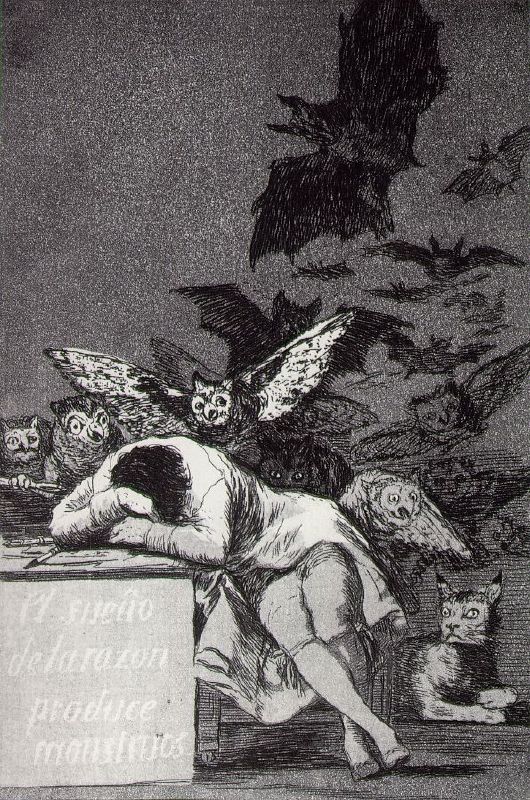
The Sleep of Reason Produces Monsters -- Goya (1797)

If 2666 impossibly haunts The Third Reich from the future, then paranoid Poe haunts it from the past. Last time we checked in, Udo Berger and his beautiful girlfriend Ingeborg had made tentative friends with another German couple while spending the summer at a seaside resort in Spain. Through this pair, they meet up with two nefarious locals, the Wolf and the Lamb; Udo also begins obsessing over a man named El Quemado, a burn victim who rents paddle boats to tourists. For Udo, the holiday is meant to be a working vacation—he’s a wargame enthusiast, and he plans to write a defining strategy for a new game called “The Third Reich” (implicitly, he plays the Nazi’s side). In the meantime, he’s also taken with the hotel’s owner, Frau Else, a German transplant who mysteriously disappears to take care of an ill husband who no one seems to see.

The first part of The Third Reich (published in the Spring ’11 issue) set the stage for dread, mystery, and extreme paranoia—all while on a sunny seaside holiday. The set-up recalls the seemingly innocuous first section of 2666, “The Part About the Critics,” where four European literature professors spend a vacation of sorts in sunny Mexico while ostensibly searching for a mysterious author. The Third Reich showcases the same sinister tension, describing—but never explaining—the stress between differing cultures, the radical alterity of “being on holiday,” of “vacating,” of being in a different place for a different purpose than what is usual, normal.

The second part of The Third Reich (in the new Summer ’11 issue) increases the dread and paranoia, all with a strange, mordant humor. The novel’s conceit is that the writing is Udo’s holiday’s journal; as such, he controls not only perspective and tone, but what details we learn—or don’t learn. It’s what Udo leaves out that becomes increasingly distressing and fascinating. Indeed, at a crucial point in the novel, Udo fails to explain to us why he remains in Spain after his holiday should be over, even as Ingeborg returns to Germany. There is an ostensible explanation—Charly has disappeared and Udo perhaps wants an answer to the mystery (I will withhold further details for fear of spoiling the plot). It seems more likely that Udo remains to work out his strategy for “The Third Reich”; he finds an unlikely gaming partner in El Quemado. Indeed, the wargame begins to define Udo’s perspective at all times—

When I saw from the balcony that the bathers were beating a mass retreat toward the hotels and campgrounds, I went down to the beach. It’s a sad time of day, and the bathers are sad: tired, sated with sun, they turn their gazes toward the line of buildings like soldier s already sure of defeat; with tired steps they cross the beach and the Paseo Maritimo, prudent but with a hint of scorn, of arrogance in the face of remote danger, their peculiar way of turning down side streets where they immediately seek out the shade leading them directly—they’re a tributue—toward the void.

German nihilism on holiday! Still, Udo finds perverse joy in his gaming sessions with El Quemado; in these episodes, his tone escalates to a manic pitch, reminiscent of some of Poe’s crazies (the narrator of “The Tell-Tale Heart” comes to mind in particular), as well as the mounting insanity of Oscar Amalfitano in 2666. And, just as in the early parts of 2666, The Third Reich begins to buzz with rumors of rape. Udo hints at these rumors, but is unwilling to explore them. Also mysterious is the identity of Frau Else’s husband, a pointedly Gothic conceit, of course, that nonetheless may be the beating heart of horror at the center of the story. He haunts Udo’s sleep—

I dreamed that someone was knocking at the door. It was nighttime and when I opened the door I saw someone slipping down the hall. I followed. Unexpectedly we came to a huge dark room filled with the outlines of heavy old furniture. The smell of mildew and dampness was strong. On a bed a shadowy figure was twisting and turning. At first I thought it was an animal. Then I recognized Frau Else’s husband. At last!

I’ve done my best to omit some of the sharp twists in this section of The Third Reich for fear of spoiling the book, but I will add that Part II ends with something of a subtle cliffhanger (as I write the term “subtle cliffhanger” I realize that it is pure oxymoron; mea culpa). In any case, I’m enjoying the serialization very much and look forward to reading Part III.

Romantic Remixes: We Look at Jane Goes Batty and The Raven’s Bride

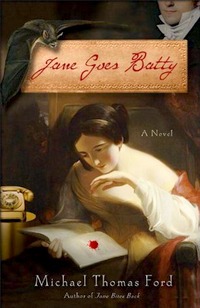
In the past few years we’ve seen a spate of books where public domain characters and historical figures feature in supernatural tales, usually written in an ironic, or at least parodic mode. It seems like a heavy percentage of these books are mixed up somehow with Jane Austen, whose legacy has become grist for a literary cottage industry, with a new “re-imagining” of Pride and Prejudice or Sense and Sensibility coming out every season. Last year, Michael Thomas Ford offered the public the mix of Jane Austen and vampires we had been so desperately clamoring for, Jane Bites Back. By way of a little more context (and pure laziness), I’ll quote Biblioklept’s review of Ford’s novel–
Jane Bites Back reveres its subject, Jane Austen, even as it blatantly cashes in on the very trend that it satirizes. The book’s program shouldn’t be confused with the absurdity behind Sense and Sensibility and Seamonsters (which we liked) or the wackiness of Pride and Prejudice and Zombies (which we didn’t like), but it does adhere to the same sense of fun. Ford seems to delight in corny, over the top passages, and we’ll take it for granted that his literary tongue is in his cheek . . .

Ford’s inevitable sequel Jane Goes Batty arrives this month, and showcases a willingness to take vamp-camp into new directions. Plot: big time Hollywood folks are out to “sex up” Jane’s latest manuscript; Jane’s editor decides to become an agent and leaves her with Jessica Abernathy (evil nemesis in Batty); Jane has to run constant interference on her wacky/charming friend Lord Byron (also a vampire, of course); etc., etc., etc. The most ridiculous/campiest plot device of all though is that Jane is converting to Judaism to please her boyfriend Walter’s judgmental mom. Yes. That’s right. We also learn that Jane played Magenta in a traveling production of The Rocky Horror Picture Show in the seventies, a minor detail to be sure, but one that seems to reinforce Ford’s whimsical kitsch. Batty aims for a kind of sassy brevity in its scene constructions, and while its certainly not a book for me, I think that those who want to see Jane Austen as a 21st century vampire will probably enjoy it quite a bit. Jane Goes Batty is new in trade paperback from Ballantine.
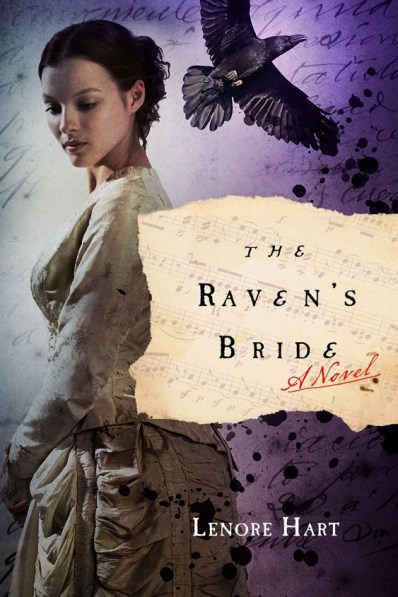
Lenore Hart’s novel The Raven’s Bride tells the story of the marriage of Edgar Allan Poe from the viewpoint of his child-bride/cousin Virginia “Sissy” Clemm. The decidedly tragic arc of their union is set against a supernatural backdrop — and an often morose tone. While The Raven’s Bride takes liberties with history, it seems well-researched and faithful enough to its subject. Compared to Ford’s campy take on the supernatural, Hart’s novel seems a bit too self-serious, but again, I’m hardly the audience for this book. Still, I suppose the tale of an alcoholic horror writer’s incestuous/underage marriage might have been easy fodder to exploit, yet Hart focuses a keen sensitivity on her characters, particularly her narrator Sissy, Poe’s muse demystified. While Poe buffs will know how the story turns out, those interested in reviewing Poe’s marriage through a new perspective may want to check out The Raven’s Bride, new in trade paperback from St. Martin’s Griffin.

Happy Halloween Links

A letter by Poe showcasing his prominent signature.

Make this cool Edgar Allan Poe toy.

Cannibal Man cover praised; plot summarized.

Seven horror novels masquerading in other genres.

H.P. Lovecraft’s creepy little short story “The Outsider.”

“Slicin’ up eyeballs / Oh oh oh oh.”

Excellent gallery of illustrated horror film posters.

Stephen King explains how to make vampires scary again.

Stephen King sucks.

Hot freaks.

28 Weeks Later is a good film, but it hates children.

Harry Clarke illustrates Faust.

The gang from The Office makes a slasher film.

On Michael Jackson’s Ghosts.

Brendon Small (Metalocalypse, Home Movies) schedules 24 hours of horror films.

“You are tearing me apart Lisa!”

Jack Nicholson.

Kate Mosse’s top 10 ghost stories.

Odds and Ends

Hamlet: The Facebook feed edition.

Every book mentioned on Mad Men so far.

Betting odds for the 2010 Nobel Prize for Literature (our boy Cormac McCarthy is at 8 to 1; Bob Dylan is at 150 to 1).

Folks are gettin’ hot and bothered about MFA programs.

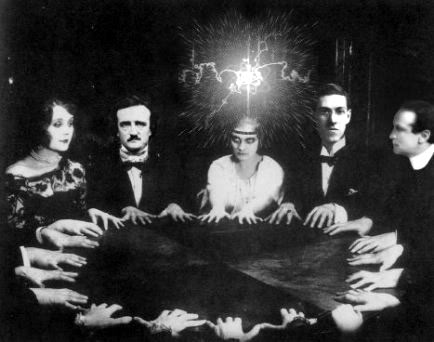
Linking to this post that is tangentially about Jean-Christophe Valtat’s awesome new book Aurorarama gives us an excuse to publish this weird pic of Edgar Allan Poe at a séance–

An inventory of opening sentences.

Raymond Carver Mad Libs.

Vintage Portuguese book covers at A Journey Round My Skull.

“—the bitter lapse into everyday life—the hideous dropping off of the veil” — Or, We Return from Vacation

After five five fun-filled (mostly) sun-soaked days on Florida’s glorious Gulf Coast, Biblioklept returns from July 4th reveries. I found time to finish Adam Langer’s The Thieves of Manhattan–full review forthcoming, but now, I’m still in a lazy-loungy mood: so, links and vids and so forth–

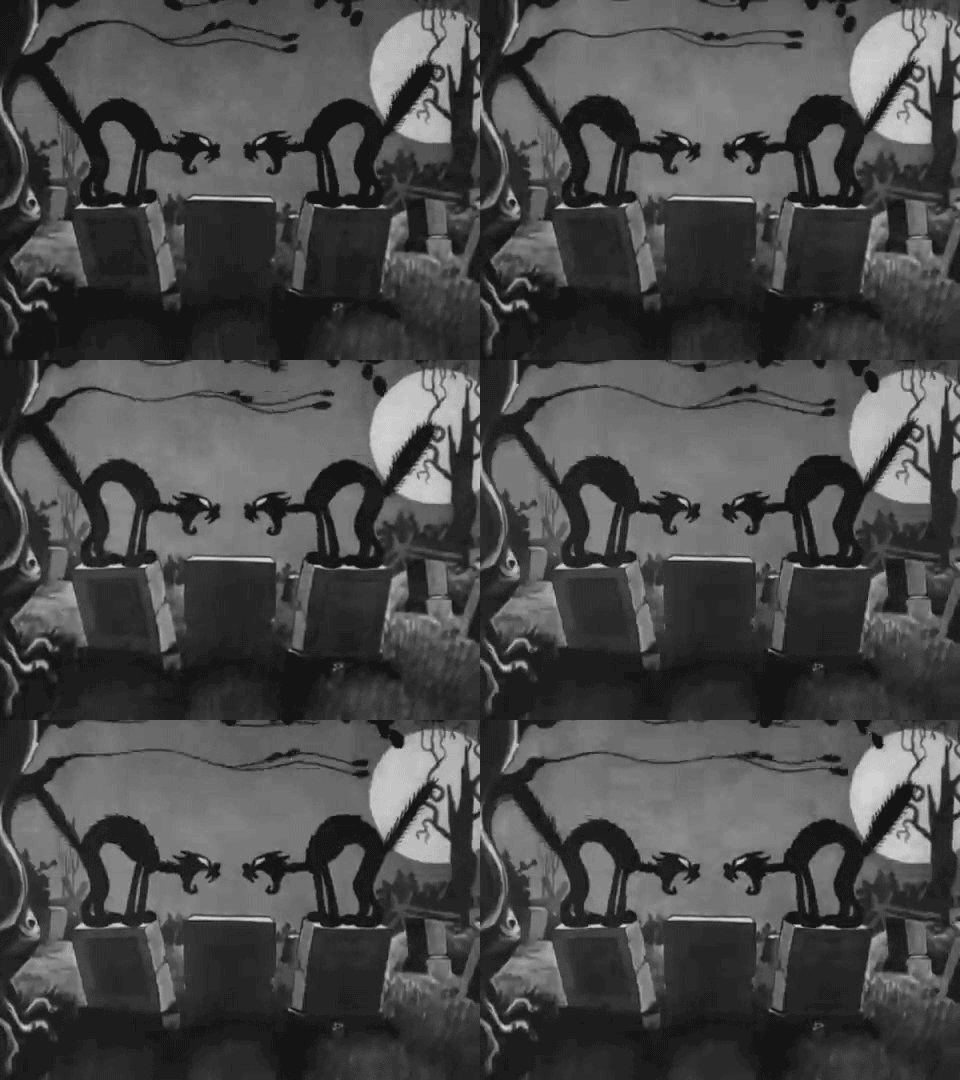
First, I ripped my title from Edgar Allan Poe’s “The Fall of the House of Usher,” which you obviously knew of course, gentle reader, because of course you’ve read it, but maybe you haven’t seen Jan Svankmajer’s 1981 film adaptation. Creepy stop motion that completely dispenses with actors. Ignore the subtitles.

Another great little film I saw this weekend is Oliver Laric’s Versions (2010), an essay that playfully updates Walter Benjamin’s “The Work of Art in the Age of Mechanical Reproduction.” Watch Versions. A choice line–perhaps appropriated?–from Laric’s essay: “There is more work in interpreting interpretations than in interpreting things and more books about books than any other subject.”

Still on film: watched John Huston’s 1956 adaptation of Moby-Dick on a lazy post-July 4th demi-hangover. Melville’s novel is unfilmable, really, but Huston’s effort isn’t half bad, although the tone of “high adventure” and the downright jaunty soundtrack hardly fit the grisly images of whale killing that permeate the work. The climax doesn’t really read as big as it should either. Key scene: Orson Welles delivers Father Mapple’s sermon–

Finally, I listened to a good chunk of the audiobook of David Mitchell’s new novel The Thousand Autumns of Jacob de Zoet. Good stuff so far (great stuff, really), and a full review forthcoming, but for now, here’s Dave Eggers’s review.

“The Philosophy of Furniture” — Edgar Allan Poe

“There is reason, it is said, in the roasting of eggs, and there is philosophy even in furniture — a philosophy nevertheless which seems to be more imperfectly understood by Americans than by any civilized nation upon the face of the earth.”

I started Roberto Bolaño’s faux-encyclopedia, Nazi Literature in the Americas last night. In the first section, Edelmira Thompson de Mendiluce creates a room based on Edgar Allan Poe’s essay “The Philosophy of Furniture.” I’d never read or even heard of that essay up until now, and, given Bolaño’s penchant for invention, I wondered for a moment if it even really existed. Edelmira recreates the room according Poe’s specifications and then writes Poe’s Room, her defining novel, in its rich confines. The essay exists outside of Bolaño, of course, as does the room–it’s part of the Edgar Allan Poe National Historic Site.

Doomed He Was

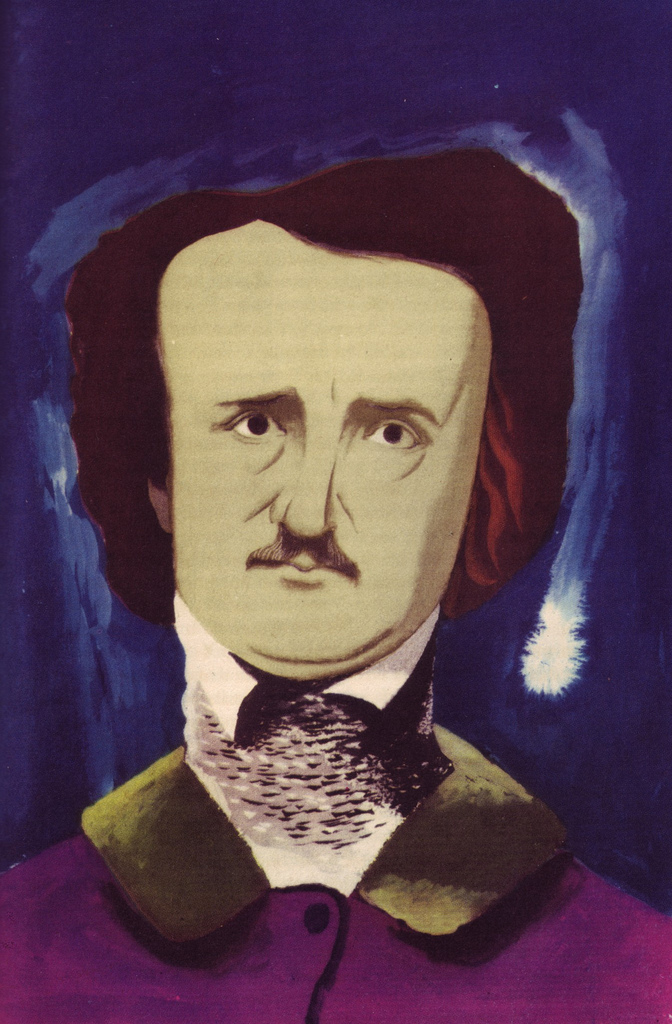
Image of Poe by Edward McKnight Kauffer, via A Journey Round My Skull

So, instead of grading essays like I should’ve today, I reread D. H. Lawrence’s essay on Edgar Allan Poe, collected in the former’s incomparable Studies in Classic American Literature. Lawrence asserts that Poe is “absolutely concerned with the disintegration-processes of his own psyche,” and goes on to try to prove this over a close-reading of some of Poe’s most famous tales, including “Ligeia” and “The Fall of the House of Usher.” Lawrence concludes his essay a bit melodramatically, but it seems to suit Poe’s depraved dilemmas:

But Poe knew only love, love, love, intense vibrations and heightened consciousness. Drugs, women, self destruction, but anyhow the prismatic ecstasy of heightened consciousness and sense of love, of flow. The human soul in him was beside itself. But it was not lost. He told us plainly how it was, so that we should know.

He was an adventurer into vaults and cellars and horrible underground passages of the human soul. He sounded the horror and warning of his own doom.

Doomed he was. He died wanting more love, and love killed him. A ghastly disease, love. Poe telling us of his disease: trying even to make his disease fair and attractive. Even succeeding.

Actually, a University of Maryland Medical Center study finds that rabies likely caused Poe’s death, not love, as Lawrence suggests. Rabies. Not drugs or women–or love–rabies. How’s that for a “disintegration-process”?

“The Tell-Tale Heart” — Edgar Allan Poe

Edgar Allan Poe’s “The Tell-Tale Heart” is one of our all-time favorite scary stories. Poe’s story explores the troubled mind of a murderer suffering from manic bipolar depression. Or maybe it’s all about the suppression of dark secrets. Is the Evil Eye an “evil I”? I think so! Dig this great animation from 1953, featuring the vocal talents of James Mason: