Blog about Martin Scorsese’s film The King of Comedy

Screenshot 2018-04-27 at 7.41.03 PM

I watched Martin Scorsese’s 1982 film The King of Comedy last weekend and then added it to a list of examples for a much bigger Thing I’ve been working on for a few years (and hence will never likely finish, unlike these Blog about posts). The much bigger Thing is about the relationship between Comedy and Horror—not purely the formal characteristics that belong to specific genres of literature, film, and art, but rather the relationship between the emotions themselves (with special attention to how literature, film, and art evoke that relationship).

The short thesis for this bigger Thing is that I think that comedy relies strongly on horror, and that the best provocations of horror are tempered in humor. There is a long list of examples in support of this thesis, including Goya and Bolaño and Larry David and Don Quixote and Candide  and Thomas Bernhard and Surrealism and Get Out and etc. —-but that’s all for said bigger Thing, and the title of this post seems to promise Something (not a big Thing) on Martin Scorsese’s 1983 film The King of Comedy, which I recently rewatched.

I first saw The King of Comedy in the spring of 1998. I was a freshman at the University of Florida and had quickly discovered their library of films on VHS, which I would imbibe over my four years there. I started with stuff I was already a bit familiar with though. Like every other stupid eighteen-year old, I thought Taxi Driver was A Work of Genius (without fully understanding it), and I’d seen Goodfellas and Casino approximately one thousand times by this point. I started UF’s collection of Scorsese tapes with the neo-neorealism of Raging Bull, a brutal and hence thoroughly comprehensible character study, an ugly film shot in gorgeous black and white. The King of Comedy was next.

The internet in 1998 was not the internet of 2018. What I mean is that we generally learned about films through books and journals and magazines, or really other films, or really, really by word of mouth. I don’t think I had any word of mouth on The King of Comedy—what I mean is that I think I thought the film was a comedy. Which it is. Sort of. I mean, it’s funny—-very funny sometimes. But it’s also very cruel, and often scary and off putting, and generally queasy.

The King of Comedy stars Robert De Niro as Rupert Pupkin. That ridiculous name is on one hand a running joke, but on the other hand a vein of horror that pulsates throughout the film—an aberrant twitching oddity, a sort of literal curse, both on poor Rupert (who bears that name) and on every person who encounters him. Rupert is a would-be comedian who dreams (literally and often from his mother’s basement) of stardom. He dreams that he’ll achieve this stardom through a spotlight gig on The Jerry Langford Show, a Carson-style late night show hosted by Jerry Langford, played by a wonderfully fed-up Jerry Lewis.

Rupert is an autograph hound, an obsessive type of fan who makes Jerry’s life a literal terror.  Rupert’s foil is Masha, a trust-fund baby played by Sandra Bernhard. Masha stalks Jerry with extreme competitive anxiety; her stalking is a lifestyle elevated to art. When Masha goes too far early in the film and hijacks Jerry’s limo, Rupert sees an opening—he saves the day, ousting Masha, but then he invades the limo (proving himself stalker supreme over Masha).  In the limo ride, Rupert asks Jerry for help in advancing his career, and Jerry gives generous if general advice, which amounts to Put the work in and pay your dues. Rupert complains that he simply doesn’t have time to invest in doing the real hard grinding work, and basically demands that Jerry give him a shortcut.

In showing a deranged would-be artist who feels he’s entitled to bypass the years of work involved in honing a skill, Scorsese anticipates our current zeitgeist. Rupert Pupkin desires fame, adoration, and applause, but he is far less interested in producing an art that would earn these accolades. The King of Comedy slowly shows us that Pupkin is mentally ill, and that his disease is radically exacerbated by a culture of mass media.

The King of Comedy’s most sarcastic bite is that Rupert is eventually rewarded for his deranged behavior. He and Masha kidnap Jerry as part of a plan to get Rupert an opening set of The Jerry Langford Show. The plan succeeds, and Rupert executes it so that he not only gets to land his dream gig, he also gets to watch himself do it in front of The Girl He Liked in High School:

Rupert’s audacious gambit is part and parcel of a postmodern mass media era that makes only the slightest distinction between fame and infamy. Rupert is famous for doing something famous—and something horrific, kidnapping a beloved TV host. It’s his one bit of work, but it’s enough to land him a book deal, celebrity, and money (and a fairly short prison sentence).

Parts of Rupert’s monologue are funny, but other parts read like the memoir of a damaged soul trying to recover from an abusive childhood. And maybe these parts mix. Again, horror underwrites comedy.

This horror repeats in Scorsese’s framing of Rupert’s routine. There’s a dream-like quality to the monologue, with its television tube frame. This is not the first time we’ve seen this framing in King of Comedy—we get similar TV fantasies via Rupert’s deranged mind—but this time the plot asks us to think of it as “real,” even as Scorsese’s aesthetics suggest that the ending of the film may all be in Pupkin’s warped mind, the unseen clapping audience just another delusion of grandeur.

The same gesture is present at the end of Taxi Driver, which is essentially the twin of The King of Comedy. Travis Bickle—another ridiculous name, another loser—improbably ends up the hero of the narrative. But the conclusion of Taxi Driver has always struck me as the internal fantasy of its reactionary (anti-)hero. Likewise, The King of Comedy concludes in yet another fantasy in Rupert Pupkin’s addled consciousness.

With its metatextual contours and its insinuations of reality-as-mediated-by-mass-media, The King of Comedy is perhaps Scorsese’s most formally postmodern film (although his smaller follow-up After Hours might be his most thematically postmodern). It’s no wonder that the film didn’t land with audiences in 1983. Beyond its postmodern rhythms, The King of Comedy is essentially repulsive—nothing good happens; there is no clear hero; the world it depicts is devoid of any meaning not centered in relation to fame. Its satire is so black no light escapes. In comparison, Scorsese’s later films like Goodfellas and The Wolf of Wall Street are laugh riots.

The genius of The King of Comedy is something best felt. The film disrupts genre conventions (and audience expectations), pushing a comedy into a horror. Or maybe The King of Comedy is a horror film with comedic overtones. Or, really—I mean, what I really want to say here is:

The King of Comedy isn’t a horror film or a comedy film—like many of Scorsese’s best films, it’s a character study—realistic and engrossing and grotesque in its utter realism. Time has caught up with it. If Rupert Pupkin seemed an extreme example of the kind of derangement and alienation that could be aggravated by a mass media culture in the early 1980s, by today’s standards he’s perhaps charming. And that’s horrifying.

Paul Thomas Anderson on writing Phantom Thread

Film Poster for The Big Lebowski — Andrzej Krajewski

Polish Poster

If a thing can be filmed, film is implied in the thing itself (Don DeLillo)

“Film is more than the twentieth century art. It’s another part of the twentieth-century mind. It’s the world seen from inside. We’ve come to a certain point in the history of film. If a thing can be filmed, film is implied in the thing itself. This is where we are. The twentieth century is on film. It’s the filmed century. You have to ask yourself if there’s anything about us more important than the fact that we’re constantly on film, constantly watching ourselves. The whole world is on film, all the time. Spy satellites, microscopic scanners, pictures of the uterus, embryos, sex, war, assassinations, everything.”

From Don DeLillo’s novel The Names.

Omelette à la Alma | Phantom Thread riff


title2bcard

Rambling Preamble 

Phantom Thread (2017) is the eighth feature film by writer-director Paul Thomas Anderson. I have been a fan of Anderson’s work since I saw Boogie Nights (1997) in my freshman year of college, and have watched each of his subsequent films in the theater. The theater is the proper place to watch Anderson’s lush, luscious films, although they are also so strong as narratives that they hold up just fine on, say, a 19″ Toshiba television with a built-in VCR, which is how I repeatedly watched Blockbuster-remaindered cassettes of Boogie Nights and Magnolia (1999) circa 1998-2001. But again: The theater is the proper place to see an Anderson film, and Phantom Thread is exceptionally lovely on the big screen—one doesn’t so much watch it as imbibe it, or perhaps, in a reversal of that metaphor, sink into it. What I’m saying is: Watch Phantom Thread in the theater.

Is “Watch it in the theater” not enough in the way of argument, reader? Perhaps you want, like, details?

Here are some details I knew going in to the film (I generally try to avoid reviews and any press on any film I plan to see): The film was written and directed by Paul Thomas Anderson; the film stars Daniel Day-Lewis portraying a fashion designer; the film is set sometime in the 1950s.

My wife and I went to see the film yesterday afternoon and we loved it, then discussed it at length at dinner, and then again this morning over breakfast (perhaps prompted by “breakfast” itself, one of the film’s motifs). It’s a strange, beautiful, perplexing romantic comedy that will disarm and unsettle audiences. I can’t wait to see it again.


Screenshot 2018-02-04 at 3.27.03 PM

The Plot and the Major Characters

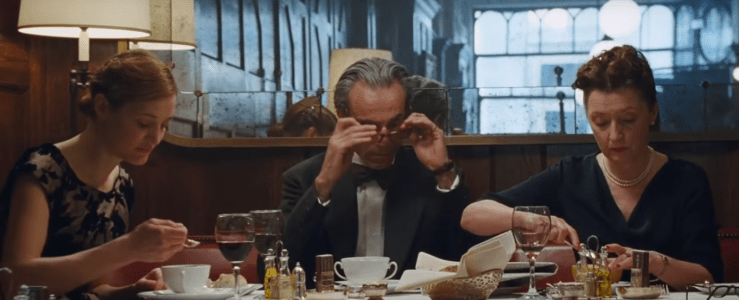
1950s. London and countryside environs. Reynolds Jeremiah Woodcock (Daniel Day-Lewis) is a famous fashion designer who dresses the highest of high in European society. He and his sister Cyril (Lesley Manville) run the House of Woodcock, following a precise, obsessive routine. At the film’s outset, Reynolds meets Alma (Vicky Krieps), a waitress in a countryside restaurant. He asks her to dinner that night, and from there the two enter into a strange relationship. The film’s trajectory explores the conflicts and confluences of that strange relationship, tracing how Reynolds’ and Alma’s romance intertwines with Cyril, business, design, and art. (Oh. And Reynolds’ and Cyril’s dead mother).


Cinematography, Score, Costume Design and Set Design

Gorgeous. Like I said, go see the film—the aesthetics are marvelous, rich, sumptuous. I’ve been writing about Paul Thomas Anderson as an auteur (and will continue to do so), but his production team is fantastic, and I think there’s an implicit argument in Phantom Thread itself against the whole auteur concept. (If you listen to or read interviews with Anderson, he will often use the pronoun “We” when discussing his work).


Screenshot 2018-02-04 at 3.26.09 PM

Phantom Thread’s Place in Paul Thomas Anderson’s Filmography

Phantom Thread might be Anderson’s “best” film to date: it is certainly one of the best-acted, best-shot, and best-directed, and its editing and pace move with a more precise rhythm than his looser and more sprawling films. I loved it, but it’s not necessarily my favorite Anderson film. If pressed to choose a favorite, I might point to the weird sprawl of Inherent Vice (2014) or the perfect imperfection of The Master (2012)—or just settle on There Will Be Blood (2007). Many Anderson fans point to Anderson’s shortest film, Punch-Drunk Love (2002) as his best.

In some ways, Phantom Thread has more in common with Punch-Drunk Love than his other films. They are both romantic comedies featuring emotionally-challenged leads who find their way to a strange resolution. In any case, Phantom Thread is an engaging character study focused on just a few intense personalities—like The MasterPunch-Drunk Love, or There Will Be Blood. It’s more focused in its vision than Boogie Nights or Magnolia, and more emotionally “true” than Anderson’s first feature, Hard Eight (1996). Those first three films seem to me particularly beholden to Martin Scorsese and Robert Altman, but Phantom Thread continues to show Anderson overcoming his anxiety of influence. (Although I’ll admit that I was occasionally reminded of Scorsese’s The Age of Innocence (1993) while watching Phantom Thread—probably because of the luxuriant imagery. And Daniel Day-Lewis. Anderson’s film is superior).


The Goddamn Movie Trailer


The discussion of the film that follows contains spoilers, including descriptions of the film’s ending 

Continue reading “Omelette à la Alma | Phantom Thread riff”

Thirty-point riff on Star Wars: The Force Awakens

Rey-Star-Wars-Episode-7-Force-Awakens

  1. Star Wars: The Force Awakens is a fun entertainment that achieves its goals, one of which is not to transcend the confines of its brand-mythos.
  2. SW: TFA takes Star Wars itself (as brand-mythos) as its central subject. The film is “about” Star Wars.
  3. To this end, SW: TFA is basically a remake of A New Hope. My saying this is not insightful and cannot be insightful.
  4. In the first Star Wars film, A New Hope (aka Episode IV, aka simply Star Wars), George Lucas synthesized Flash Gordon and Kurosawa, Joseph Campbell and WWII serials into a cultural product that was simultaneously new and old, hokey and profound, campy and heroic.
  5. SW: TFA is not a synthesis (and does not seek to be a synthesis); rather it is a transcription, repetition, and  replication of the previous Star Wars films—particularly the so-called “original trilogy” (Episodes IV, V, and VI).
  6. Hence, SW: TFA often feels like a greatest hits collection, its sequences and visuals (engaging and visually spectacular) cribbed from the previous films. I could spend the rest of the riff outlining the correspondences—major and minor—but why? The correspondences are intentionally obvious to anyone who has seen the film; furthermore, they are not allusions, but the formal structure of the film.
  7. And this formal technique, this replication—it’s all very enjoyable and often warm and unexpectedly humorous and at times awfully sad even.
  8. And I liked the new characters very much, which I was of course supposed to. They are all in some ways replications of previously existing characters, just as the set pieces and sequences they act in/out/upon are replications.
  9. Let’s consider Rey, the heroine of The Force Awakens really quickly: She is, in some ways, a synthesis, but only a synthesis of the principals of the Star Wars brand-mythos: She is at once Han, Luke, and Leia: A figuration in the foreground: A childhood fantasy.
  10. A childhood fantasy: Watching SW: TFA feels like watching a Star Wars film—which is the film’s intention, obviously.
  11. But not obviously and really quickly and not a gripe: Isn’t there a part of us, by which us I mean me, that wants something more than the feeling of (the feeling of) a Star Wars film? That wants something transcendent—something beyond which we have felt and can name? Something that we don’t know that we want because we haven’t felt it before?
  12. Re: Point 11: I already made an (awfully) oblique argument at some length almost three years ago about franchise films in general and Star Wars films in particular, arguing (maybe arguing) for, say, Wong Kar Wai to direct the next Star Wars film.
  13. In that riff I wrote that, “J.J. Abrams is a safe bet. I can more or less already imagine the movie he’ll make.” That prediction was incorrect only in that I enjoyed the product that he made more than I thought I would. That prediction was wholly correct in that I could imagine the product Abrams made. It was easy to imagine. I’d already seen the film dozens of times before he even made it.
  14. So, to return to point 11, the “not a gripe” point: Is the argument then that film as an art form allows us (the illusion of) a transcendent perspective? That film at its best, at its strongest and strangest, offers us a new way of seeing?
  15. (Yes).
  16. The Force Awakens is strong but not strange. Its major advancement (by which I mean break from previous films) evinces in its casting choices—but these reflect the progress of our own era, not the brand-mythos of Star Wars itself, which was of course always diverse.
  17. The Force Awakens is fun. Entertaining. Like I wrote in point 1.
  18. And, to repeat point 2 after repeating point 1: SW: TFA is “about” Star Wars.
  19. So what do I mean by this? Consider for a minute what the other Star Wars films are “about.”
  20. A New Hope is about escape and rescue, both in the literal, romantic, and metatextual sense.
  21. The Empire Strikes Back is about Oedipal anxieties and Oedipal violence, family entanglements, friendships and loyalties.
  22. Return of the Jedi is about restoration and redemption, a film about the genius of ecology over mechanization.
  23. And while the (so-called) prequels are generally reviled, I like them: They are “about” something.
  24. For example, Revenge of the Sith is about democracy and fascism, community and ego—and more of that Oedipal violence.
  25. Indeed the entire series is Oedipally structured—which The Force Awakens replicates and continues.
  26. Yet Abrams’s reverence for Star Wars bears no clear trace (at least on my first viewing) of Oedipal anxiety towards Lucas. No attempt to transcend or surpass—as such a move would entail a kind of critical (if metaphorical) violence directed at Lucas’s vision. (Notably, many of the criticisms of the so-called prequels rest on the way those films look beyond their predecessors (in a way that Abrams’s film doesn’t)).
  27. “In order to criticize a movie, you have to make another movie,” said Jean-Luc Goddard.
  28. And Harold Bloom: “Every poem is a misinterpretation of a parent poem. A poem is not an overcoming of anxiety, but is that anxiety…There are no interpretations but only misinterpretations, and so all criticism is prose poetry.”
  29. Abrams’s goal was not to criticize Star Wars or poetically engage it; his goal was to praise it—to praise it as stasis, to replicate its comforts, to avow and vindicate its forms and tropes. And he succeeded.
  30. And of course the biggest success of the film: I want to watch it again.


Ed. note–Biblioklept originally ran this riff in December, 2015. I’ll see the new film on Saturday. 

Hunter in the Snow I — Joshua Hagler

31d329272bda3ec6904d82d3d29df3ee

Hunter in the Snow I, 2016 by Joshua Hagler (b. 1979)

Mental Places: A Conversation with Gerald Murnane

You’ve probably already seen these Blade Runner short films, but I hadn’t because I’d been avoiding all coverage of the film before I could see it.

Friday the 13th film poster by Francesco Francavilla

francavilla-friday-the-13th


Lynch wasn’t somebody who you could schedule with

Like 25 minutes of Mulholland Dr. set footage

Hopelessly boring

img_7984


Barry Hannah in Hollywood

635610880019438411-barry-hannah-rsd-release-front-cover-artwork

“Pull Back and Reload: Barry Hannah in Hollywood,” a wonderful article by Will Stephenson, is new this week in Oxford American. The article focuses on Hannah’s time in Hollywood in the early 1980s, trying to develop a movie script called Power and Light with Robert Altman. Altman, (not-so-)fresh from making cult jam Popeye, was enchanted by Hannah’s 1980 novel Ray. The director invited Hannah to stay in his Malibu home to work on a script:

Hannah had driven out to Hollywood proudly on his Triumph motorcycle, he and Altman having settled on a meeting place, whereupon Altman was to guide him the rest of the way to his home in Malibu. But when Altman arrived, Hannah hadn’t showed. The filmmaker waited for an hour, increasingly frustrated, until he noticed, across the street, a peep show and adult video store. As Rapp remembers him putting it, Altman thought to himself, “That fucker would be just crazy enough . . .” He wandered inside the adult emporium and there found Hannah, deeply absorbed.

The article is pretty great, larded with nuggets from Hannah’s correspondence and not a few wild anecdotes. Check it out.


The Repo Code

RIP Harry Dean Stanton

maxresdefault1

RIP the great Harry Dean Stanton, 1926-2017

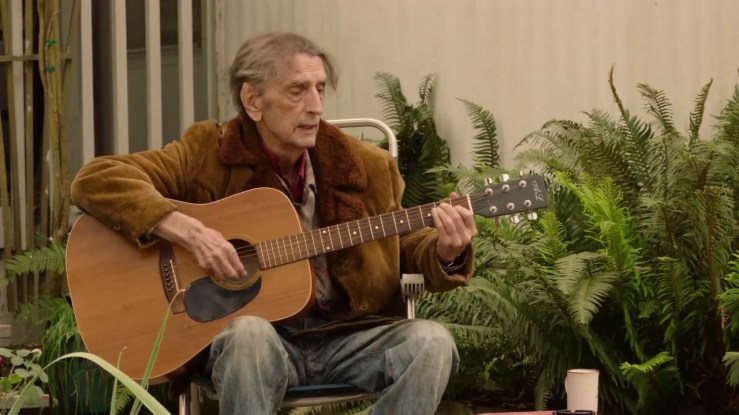
…Kelly’s HeroesTwo-Lane BlacktopPat Garrett & Billy the KidCockfighterRenaldo and ClaraAlienWise BloodEscape from New YorkChristineRepo Man, Paris, TexasRed DawnPretty in PinkThe Last Temptation of ChristWild at HeartFire Walk with MeFear and Loathing in Las VegasThe Straight StoryThe Green MileBig LoveInland EmpireTwin Peaks: The Return, and so many, many more.

Harry Dean Stanton elevated any film he was in, adding strange depth and soul to characters who may have otherwise been flat. Stanton was what people who write about film call a character actor, a subtly bizarre term, really, if you think about it, one that we use to easily distinguish between leading actors—“stars”—and the folks around them who are far more interesting. The greatest character actors are true artists, and Harry Dean Stanton was the greatest character actor. He did play the lead, occasionally though, as in Paris, Texas (dir. Wim Wenders), a cult film that look let me stop here and say, See Paris, Texas already if you haven’t, it’s amazing. And while he’s not exactly the lead in Repo Man (dir. Alex Cox), he’s certainly the weird bouncing gravity that both anchors the film and propels it forward. (I assume that Repo Man is still required cult film viewing for young folks?). It was a joy to see Stanton one last time this year in Twin Peaks: The Return, where his performance of “Red River Valley” was a standout scene in a show full of standout scenes. While I’ll miss seeing him in new films, Stanton’s long list of roles insures that we’ll still be able to wonder into a film or show and excitedly declare, Oh shit! Harry Dean Stanton is in this!

Tomorrow’s already the 10th