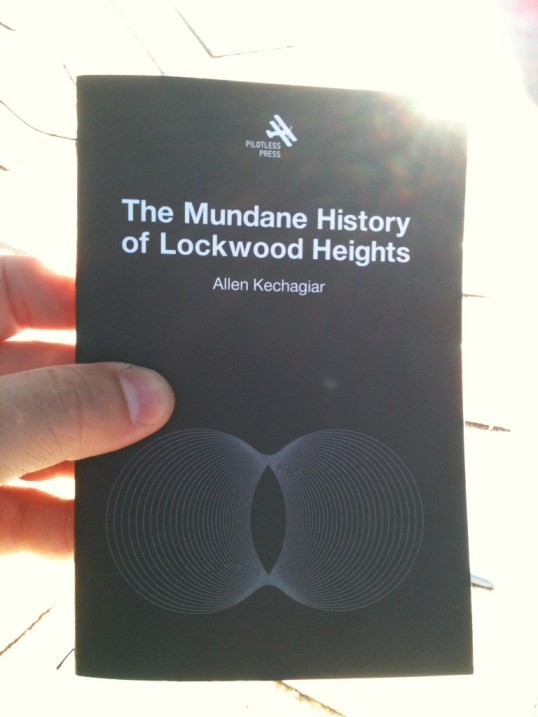
I Review The Mundane History of Lockwood Heights, a Chapbook by Allen Kechagiar

20121029-143421.jpg

“The Mundane History of Lockwood Heights” is a lovely little chapbook, new from Pilotless Press, an Athenian  outfit (uh, Greek, not Georgian) that  knows how to put together an aesthetically-pleasing text. “Lockwood Heights” is their first release. It’s by Allen Kechagiar, who, full disclosure, I’ve been email-friendly with for a several years now.

What’s “Lockwood Heights” about?

An unnamed narrator, a young man, returns to his hometown in California, the titular Lockwood Heights, “another far station, another dead end valley prone to fire, another far suburb with no other cause than the profit it would generate for its contractors.” With little going for it in a depressed economy, the citizens of Lockwood Heights allow porn production to become their town’s raison d’etre. Studios move in and the girls of Lockwood Heights soon find they can essentially auction off their virginity on camera:

They struggle to keep their virginity intact (or at any rate their parents struggle to keep it so) and hope that they will be chosen as the royal heir’s queen consort. Here, at Lockwood Heights, we had our very own race: at its finish line there was no prince to greet the winners, but a whole menagerie, or more accurately a bestiary, comprising of artificially tanned Californian would-have-beens, barely legal girls with gigantic strap-ons, transvestites and hermaphrodites, midgets and giants, obese, anorexic, effeminate, silicon-enhanced or not, all of them with a ticket to her body, standing in a metaphorical queue. A body that wasn’t hers to control anymore. The studio owned it from then on, through the unwritten contracts of promised fame that is rarely delivered.

They were also called the Treasurers or The Knights Who Say No. Their motto was non numquam. Their herald was a locked gate.

The various histories of these girls fill most of “The Mundane History of Lockwood Heights,” and as the narrator often uses the first-person plural “we” (that is, the high school boys), the story sometimes takes on a melancholy and wistful tone similar to Eugenides’s The Virgin Suicides. These are the finest moments of “Heights,” compact and precise narratives that relate the sad (and sometimes not-so-sad) lives of these girls who make porn (or, in some cases, refuse to).

It’s not just the girls of Lockwood Heights who sell their bodies on film—our protagonist comes home to sell all he has left, his “twin virginity” to be lost for a director who is sometimes called the Stanley Kubrick of porn. Scenes of the narrator meeting the casting director, his costar, and other workers on the film’s production are interspersed with the girl stories, as well as the backdrop of the narrator’s homecoming. His father has died, his mother is absent, and a strange little ersatz closet has been constructed in one of the house’s corridors. The interrelationship between these three elements is not as fully developed as it could be; I found myself wanting more. I also wanted more of the strange, aphoristic asides the narrator occasionally offers, like this one:

When we sleep we do not live in the full sense of the word. We rehearse death. Our dreams, the fallout of our daily lives, can only be remembered. They cannot be lived.

When they happen, we do not exist.

In its best moments (and there are plenty of those), “Heights” commands the reader’s attention with its bizarre mix of pathos and the pathetic, with sharp humor that threatens to tip into something more sinister. The southern California exurb Kechagiar crafts recalls the slightly off dystopias of George Saunders—the kind of place we wish were more removed from our immediate reality. “The Mundane History of Lockwood Heights” feels like the starting point of something bigger, more expansive, more detailed—and I’d want to read that something. Recommended.

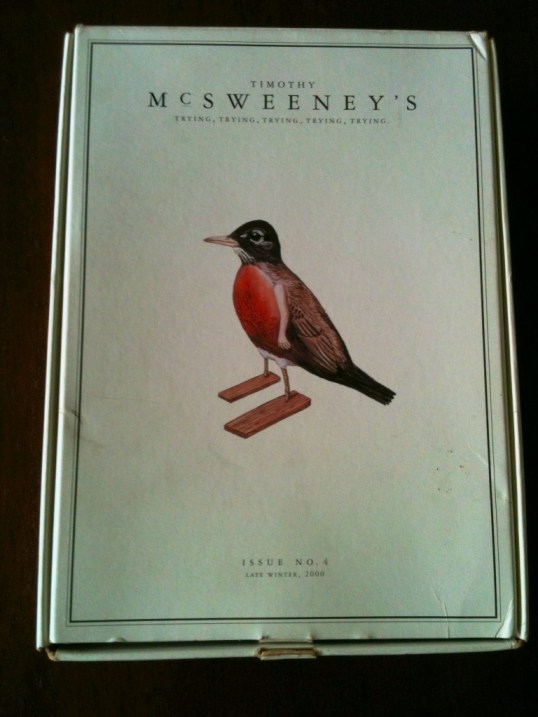
McSweeney’s #4 (Box of Books Acquired 6.14.2012)

20120626-095248.jpg

The novelist John Warner (The Funny Man), in an act of incredible kindness, sent me a copy of McSweeney’s #4, which he helped to put out years ago. In one of our emails, John offers the following:

It could be the best issue ever, a kind of platonic ideal of the McSweeney’s aesthetic before people started saying that things had a McSweeney’s aesthetic, a more innocent time if you will. My memory is that we were selling them at a live event at the Ethiopian Diamond restaurant in Chicago that we set up to help promote Neal Pollack’s book, and somehow the leftovers wound up in my trunk and I’ve been hauling them place to place ever since. . .

It’s a sort of fun artifact of the early/carefree days of McSweeney’s before Dave was DAVE, and the whole thing was still very haphazard.

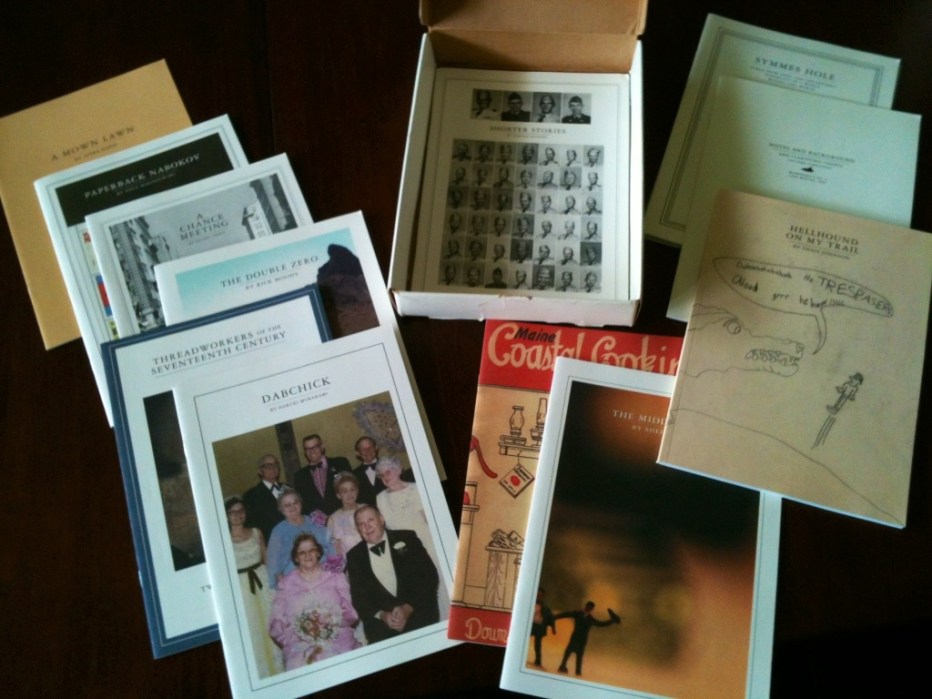
It’s difficult to overstate the range of writers here: Lydia Davis, Jonathan Lethem, George Saunders, Rick Moody, Haruki Murakami, a three-act play by Denis Johnson, and much, much more:

20120626-100530.jpg

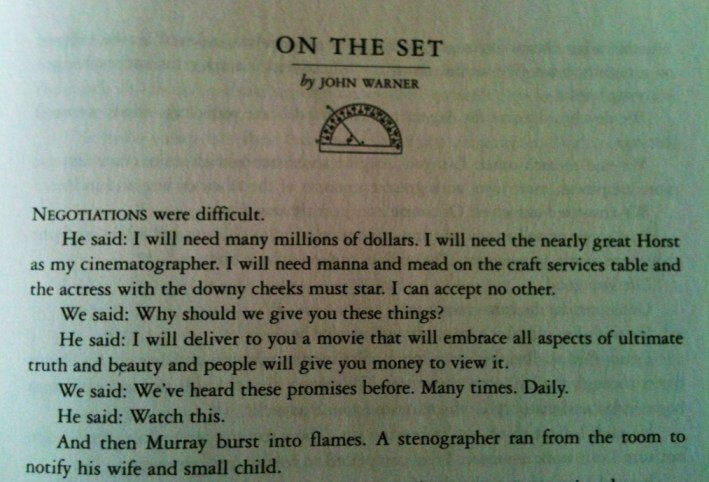
 There are also many short stories, including “On the Set” by John Warner, his second published story:

20120626-100545.jpg

It’s wonderfully absurd.

To read something hilarious and absurd and ultimately kind of touching, read John’s interview with critic Kevin Morris, who hated The Funny Man.

Book Shelves #7, 2.12.2012

20120210-203625.jpg

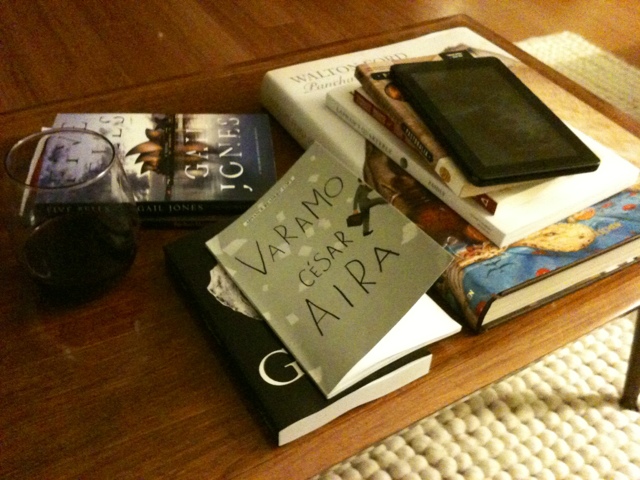
Book shelves series #7, seventh Sunday of 2012: In which I photograph a coffee table.

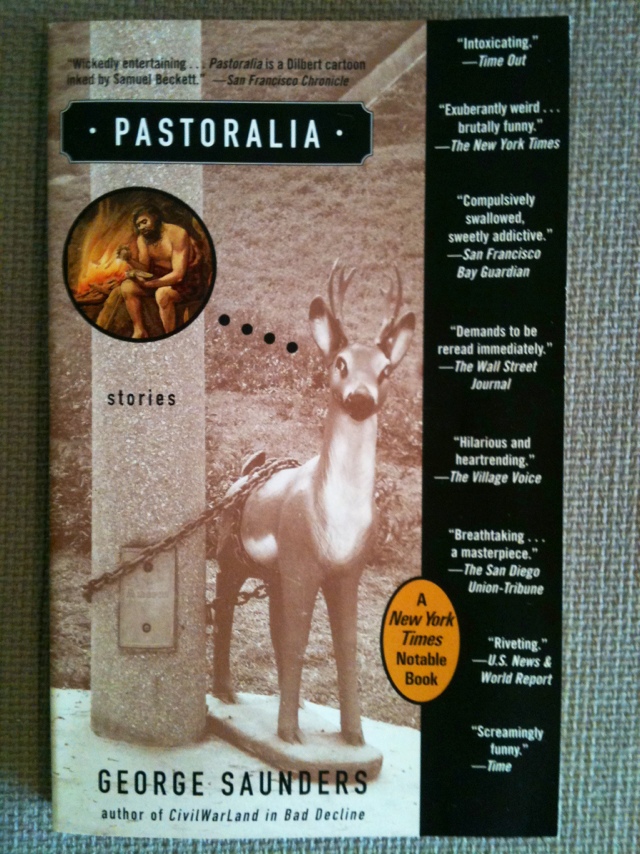
We have three coffee tables. This is one of them (it’s next to the unit I photographed last week). Like many folks’ coffee tables, I suppose, it gets littered with books; the books on this one tend to rotate. Pictured above: lots of recent books acquired, including the Aira on top and Stuart Kendall’s new translation of Gilgamesh. There’s also the new issue of Lapham’s Quarterly and, for some reason (can’t remember) George Saunders’s Pastoralia. The Kindle is also there: my daughter and I read the first three comics in a colorized version of Jeff Smith’s epic graphic novel Bone—amazing stuff, and the color adds depth and beauty to an already beautiful book. I took this photo on a Friday afternoon, or maybe Friday evening (or night). I was drinking wine.

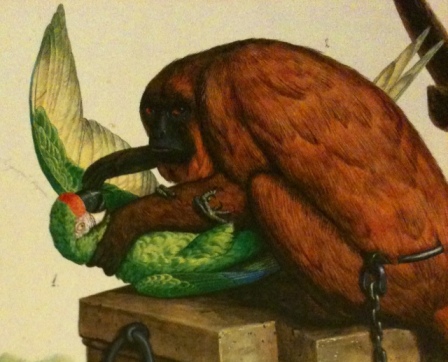
The big book is Walton Ford’s Pancha Tantra, which my lovely wife gave me for Christmas. Some images:

20120210-203648.jpg

20120210-203656.jpg

20120210-203704.jpg

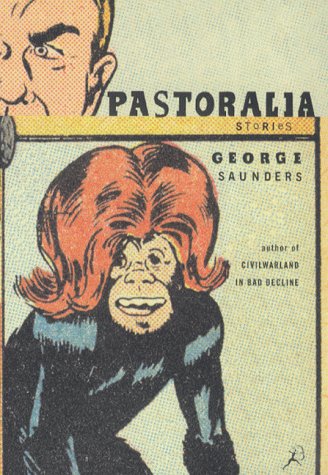
Pastoralia — George Saunders

I read Pastoralia, George Saunders’s 2000 collection of stories very quickly, consuming one or two of the book’s six stories a night, usually wedged between other readings. There was a flavor of respite to these readings, a sense of ease or relaxation or—dare I say it—simple pleasure. Frankly, I’m suspicious of any book that I’m able to read very quickly; perhaps I’m prejudiced against any book that doesn’t pose (or impose) its own learning curve on the reader.

I’m perhaps off to a very bad start in this review, veering on the appearance of condescension (when, to be clear, I think that Pastoralia is sharp and wise and wicked and well-written and very, very funny)—but I feel like I have to get this out of the way up front: George Saunders’s prose, plots, and dialogue all reminded me very much of the prose, plots, and dialogue of David Foster Wallace.

A bit of objective data: DFW and Saunders are/were of a similar age (born in ’62 and ’58, respectively) and Infinite Jest and Saunders’s first collection, CivilWarLand in Bad Decline were published the same year (’96). But, because of the simple mechanical truth that I read Wallace much, much earlier than Saunders, I find his influence unduly there. No doubt that when I detect Wallacian curves and contours and rhythms in Saunders—the coupling of officialese with imaginary slang, the depiction of a postmodern America which is slightly (but only slightly) not our own, the analyses of power and fear and duty—when I find these points of comparison, what I am really finding is the shared influences of Wallace and Saunders (no doubt postmodernists like Pynchon, Barth, Barthelme, et al). In short, if I find a suspicious ease or comfort in Saunders, it’s because Wallace already taught me to read him. But like I said before, this is not a great start. I should just review the book.

Short review: the six tales in Pastoralia are hilarious, tender, and depressingly predictive of the decade that came after their composition (not to mention the strange dark horizon ahead of us). The long opener “Pastoralia” features a hapless man who works long hours apart from his wife and children in a failing history park. His job is to simulate a caveman, but his partner, an older woman with a troubled son, makes the job difficult to perform with any level of, uh, historical accuracy. When employees must be downsized, one of the managers tries to convince the narrator to rat out his partner’s shortcomings. “Pastoralia”  is a study in how corporate power uses dehumanizing tactics to exploit workers. The communications the narrator receives from a nebulous plurality of managers are both hilarious and horrific, each one a contortion of logic that serves to strip the rights (and self-worth) of the workers. The story, depressingly, is more relevant than ever. (Readers familiar with CivilWarLand in Bad Decline will recognize “Pastoralia” as a revision of sorts to that earlier collection’s title story).

The next tale, “Winky,” moves along the same lines, exploring the clash between the Darwinian drives of self-protection and self-satisfaction set against the needs of others. In this story, the protagonist attends a self-help seminar (the scene is something so contemporaneous with Wallace that I’s tempted to write “straight out of DFW”), where the psychobabble and rationalizing of the speaker persuades him to ditch his weird, needy sister. Like the complex and funny managerial rhetoric we find in “Pastoralia,” the motivational lingo lulls and persuades not just the protagonist, but also the reader, into the easy trap of contemporary consumerism that centers the self as the ultimate telos of existence.

“Sea Oak” is the possible high point in the collection. It depicts an ersatz family living in a housing project that at one point we might have described as “on the margins of America” — only in Saunder’s vision (a vision increasingly realized) such housing projects are the reality for the majority of Americans. The middle class is not the norm. The (male) narrator strips to help bring money into the crappy apartment he shares with his aunt and two cousins and their two kids. A sample—

Sea Oak’s not safe. There’s an ad hoc crackhouse in the laundry room and last week Min found some brass knuckles in the kiddie pool. If I had my way I’d move everybody up to Canada. It’s nice there. Very polite. We went for a weekend last fall and got a flat tire and these two farmers with bright red faces insisted on fixing it, then springing for dinner, then starting a college fund for the babies. They sent us stock certificates a week later, along with a photo of all of us eating cobbler at a diner.

The hyperbolic vision of a Canada that cares for all of its citizens stands in sharp relief to the predatory Darwinism of the Sea Oak projects. As the story unfolds, Saunders uses his characters to examine just what exactly economic struggle in American is for—what does the American Dream mean when subsistence living alone is so difficult?

“The End of FIRPO in the World” is perfection, a sad, funny, rambling stream of consciousness that plumbs the mind of an alienated boy who imagines his future glories and the revenge that he will have for all the slights done him. “FIRPO,” sitauted in the middle of collection, moves the book from the familial and corporate to the individual, as the last few tales (“The Barber’s Unhappiness” and “The Falls”) inhabit the strange sad consciousness of ordinary, awful people. These are beautiful portraits, ones that explore the gravity of failure and the small glowing sparks of redemption that might be available to us.

If, as I remarked earlier, there’s a comfort in Saunders’s prose, it’s the strange uncomfortable comfort that there’s a perceptive and wise intelligence out there that can apprehend and satirize the sheer horrific injustice that pervades the modern condition. Pastoralia is great, and I picked up CivilWarLand in Bad Decline right after finishing it, so there’s an endorsement. Recommended.

Books Acquired, 11.08.2011

20111108-190207.jpg

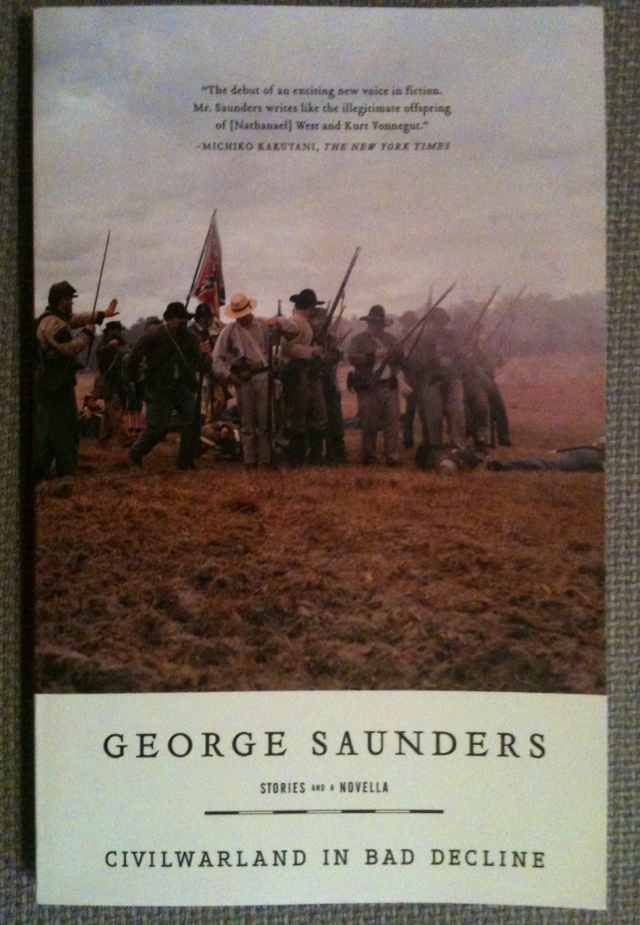
Swung by my favorite local bookstore this afternoon (and, for regular readers who wonder why I seem to do this so often, I might point out that said bookstore is like, 7/10ths of a mile from my house). I picked up George Saunders’s CivilWarLand in Bad Decline after numerous reader suggestions and more or less enjoying his later collection, Pastoralia (review this week?).

20111108-190214.jpg

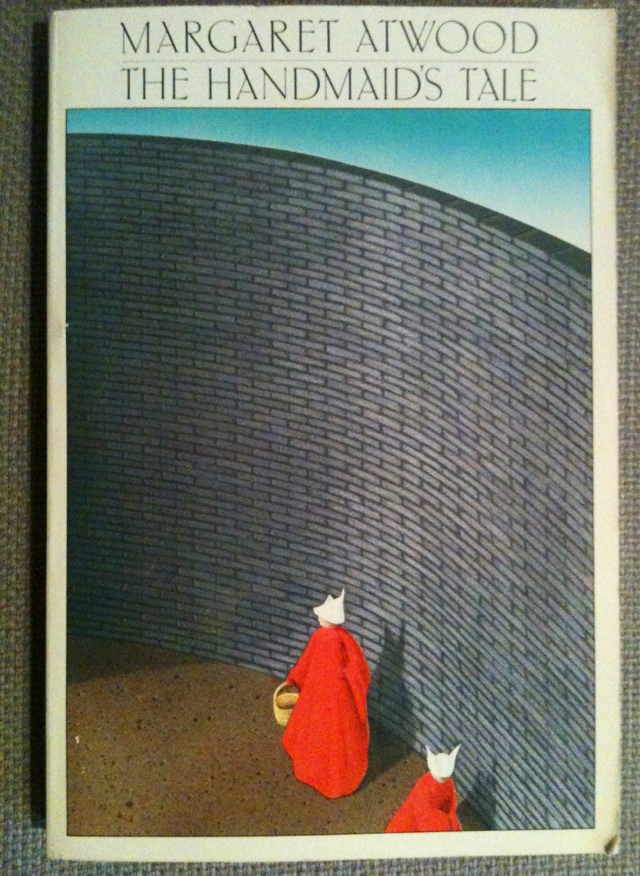
I don’t think the lousy iPhone pic conveys how aesthetically pleasing this tpb version of Margaret Atwood’s novel The Handmaiden’s Tale is. It’s an oversized version, really. I used to own the book but a student permanently “borrowed” it (yes, a guy who posts under the scaredynym “Biblioklept” shouldn’t complain about book theft, but still . . .), and anyway, the version I owned was a cheap mass market paperback copy that I got my mom to buy for me at an airport years ago in Australia, so of course it had no special sentimental value, right?

Books Acquired, Sometime Last Week (I Don’t Know, Maybe on Thursday or Friday)

I picked up a bevy of books at my favorite bookstore sometime last week ; can’t remember the day, exactly. Anyway, some of these selections come from reader recommendations re: nonconventional lit.

20111103-155310.jpg

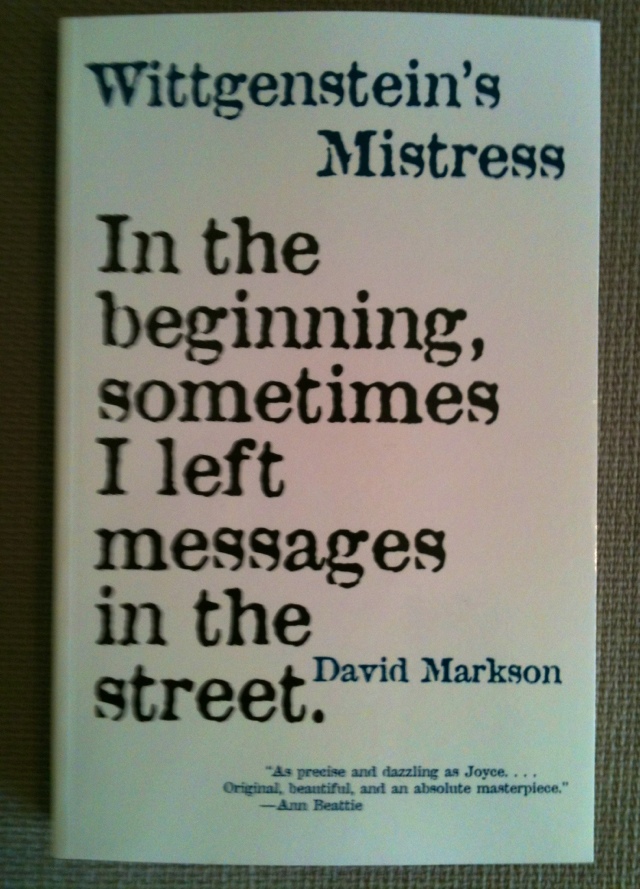
I ordered David Markson’s novel Wittgenstein’s Mistress, which I’ve been meaning to read for yonks but had never found used. Horrible, horrible cover

20111103-155319.jpg

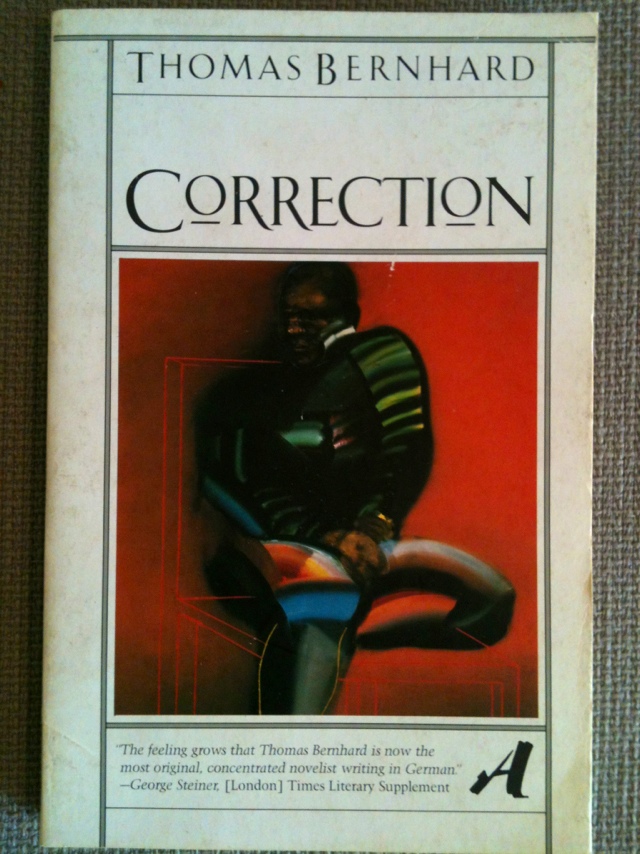
Bernhard’s Correction: Thomas Bernhard came recommended by a number of readers in the aforelinkedto post; dipping into Correction immediately recalled Sebald’s The Rings of Saturn for some reason.

20111103-155327.jpg

George Saunders: another reader recommendation. I actually read Pastoralia this week. I love short stories. Anyway, full review forthcoming. Short version: good stuff, but DFW casts a pretty big shadow.

20111103-155351.jpg

Georges Perec was another reader rec, but it was his novel Life: A User’s Manual that kept popping up. I found Species of Spaces and Other Pieces, his collection of essays and other stray bits, by sheer chance. I think I was looking for something by De Sade, actually. Anyway, I love, love, love this book—it kinda reminds me of Bolaño’s Between the Parentheses or even the Vollmann reader Expelled from Eden—the kind of book I see myself dipping into again and again, a little mini-labyrinth of ideas.

20111103-155359.jpg

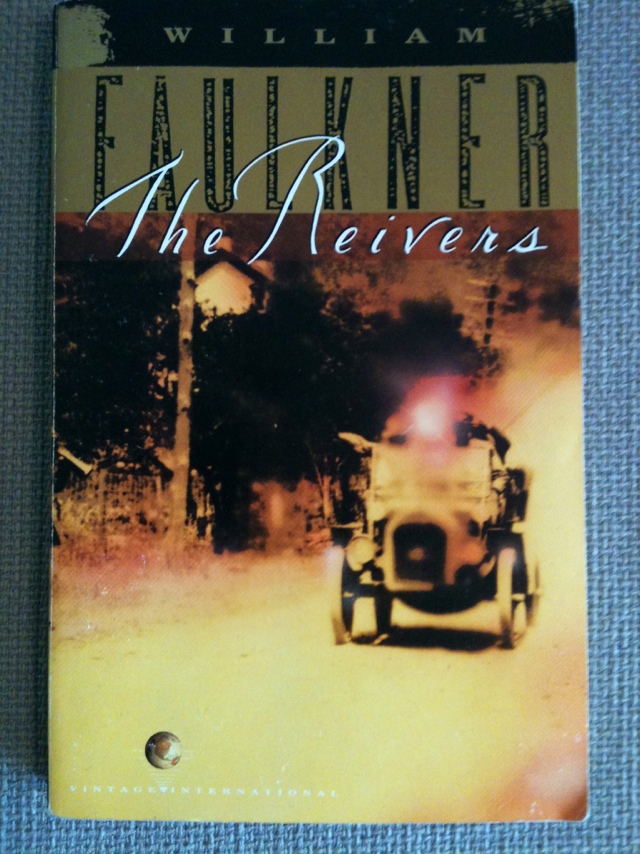
I also picked up Faulkner’s last novel, The Reivers; been wanting to read it for a long time now. I’ll try to get it in over the Christmas break.

“Home” — George Saunders

From “Home,” a new George Saunders story in The New Yorker—-

Like in the old days, I came out of the dry creek behind the house and did my little tap on the kitchen window.

“Get in here, you,” Ma said.

Inside were piles of newspapers on the stove and piles of magazines on the stairs and a big wad of hangers sticking out of the broken oven. All of that was as usual. New was: a water stain the shape of a cat head on the wall above the fridge and the old orange rug rolled up halfway.

“Still ain’t no beeping cleaning lady,” Ma said.

I looked at her funny.

“Beeping?” I said.

“Beep you,” she said. “They been on my case at work.”

It was true Ma had a pretty good potty mouth. And was working at a church now, so.

We stood there looking at each other.

Then some guy came tromping down the stairs: older than Ma even, in just boxers and hiking boots and a winter cap, long ponytail hanging out the back.

“Who’s this?” he said.

“My son,” Ma said shyly. “Mikey, this is Harris.”

“What’s your worst thing you ever did over there?” Harris said.

“What happened to Alberto?” I said.

“Alberto flew the coop,” Ma said.

“Alberto showed his ass,” Harris said.

“I hold nothing against that beeper,” Ma said.

“I hold a lot against that fucker,” Harris said. “Including he owes me ten bucks.”

“Harris ain’t dealing with his potty mouth,” Ma said.

“She’s only doing it because of work,” Harris explained.

“Harris don’t work,” Ma said.

“Well, if I did work, it wouldn’t be at a place that tells me how I can talk,” Harris said. “It would be at a place that lets me talk how I like. A place that accepts me for who I am. That’s the kind of place I’d be willing to work.”

“There ain’t many of that kind of place,” Ma said.

“Places that let me talk how I want?” Harris said. “Or places that accept me for who I am?”

“Places you’d be willing to work,” Ma said.

“How long’s he staying?” Harris said.

“Long as he wants,” Ma said.

“My house is your house,” Harris said to me.

“It ain’t your house,” Ma said.

“Give the kid some food at least,” Harris said.

“I will but it ain’t your idea,” Ma said, and shooed us out of the kitchen.

“Great lady,” Harris said. “Had my eyes on her for years. Then Alberto split. That I don’t get. You got a great lady in your life, the lady gets sick, you split?”

“Ma’s sick?” I said.

“She didn’t tell you?” he said.

He grimaced, made his hand into a fist, put it upside his head.

“Lump,” he said. “But you didn’t hear it from me.”

Ma was singing now in the kitchen.

“I hope you’re at least making bacon,” Harris called out. “A kid comes home deserves some frigging bacon.”

“Why not stay out of it?” Ma called back. “You just met him.”

“I love him like my own son,” Harris said.

“What a ridiculous statement,” Ma said. “You hate your son.”

“I hate both my sons,” Harris said.

“And you’d hate your daughter if you ever meet her,” Ma said.

Harris beamed, as if touched that Ma knew him well enough to know he would inevitably hate any child he fathered.

Ma came in with some bacon and eggs on a saucer.

“Might be a hair in it,” she said. “Lately it’s like I’m beeping shedding.”

“You are certainly welcome,” Harris said.

“You didn’t beeping do nothing!” Ma said. “Don’t take credit. Go in there and do the dishes. That would help.”

“I can’t do dishes and you know that,” Harris said. “On account of my rash.”

“He gets a rash from water,” Ma said. “Ask him why he can’t dry.”

“On account of my back,” Harris said.

“He’s the King of If,” Ma said. “What he ain’t is King of Actually Do.”

“Soon as he leaves I’ll show you what I’m king of,” Harris said.

“Oh, Harris, that is too much, that is truly disgusting,” Ma said.

Harris raised both hands over his head like: Winner and still champ.

“We’ll put you in your old room,” Ma said.

“The Reader Is a Person You Need to Charm” — Writing Advice from George Saunders

“Escape from Spiderhead” — George Saunders

The New Yorker has published a new George Saunders short story,“Escape from Spiderhead.” Read it here. A sample–

“Drip on?” Abnesti said over the P.A.

“What’s in it?” I said.

“Hilarious,” he said.

“Acknowledge,” I said.

Abnesti used his remote. My MobiPak™ whirred. Soon the Interior Garden looked really nice. Everything seemed super-clear.

I said out loud, as I was supposed to, what I was feeling.

“Garden looks nice,” I said. “Super-clear.”

Abnesti said, “Jeff, how about we pep up those language centers?”

“Sure,” I said.

“Drip on?” he said.

“Acknowledge,” I said.

He added some Verbaluce™ to the drip, and soon I was feeling the same things but saying them better. The garden still looked nice. It was like the bushes were so tight-seeming and the sun made everything stand out? It was like any moment you expected some Victorians to wander in with their cups of tea. It was as if the garden had become a sort of embodiment of the domestic dreams forever intrinsic to human consciousness. It was as if I could suddenly discern, in this contemporary vignette, the ancient corollary through which Plato and some of his contemporaries might have strolled; to wit, I was sensing the eternal in the ephemeral.

I sat, pleasantly engaged in these thoughts, until the Verbaluce™ began to wane. At which point the garden just looked nice again. It was something about the bushes and whatnot? It made you just want to lay out there and catch rays and think your happy thoughts. If you get what I mean.

Then whatever else was in the drip wore off, and I didn’t feel much about the garden one way or the other. My mouth was dry, though, and my gut had that post-Verbaluce™ feel to it.

“What’s going to be cool about that one?” Abnesti said. “Is, say a guy has to stay up late guarding a perimeter. Or is at school waiting for his kid and gets bored. But there’s some nature nearby? Or say a park ranger has to work a double shift?”

“That will be cool,” I said.

“That’s ED763,” he said. “We’re thinking of calling it NatuGlide. Or maybe ErthAdmire.”

“Those are both good,” I said.

“Thanks for your help, Jeff,” he said.

Which was what he always said.

“Only a million years to go,” I said.

Which was what I always said.

Then he said, “Exit the Interior Garden now, Jeff, head over to Small Workroom 2.”

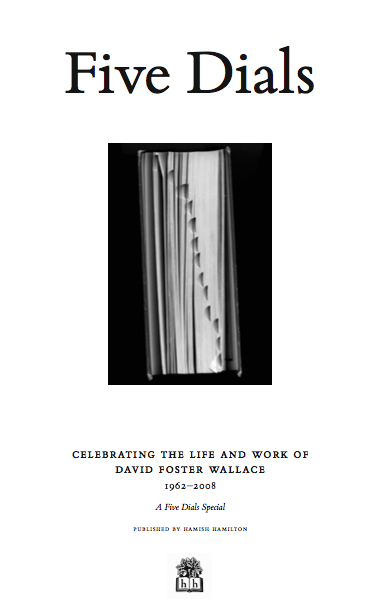
Five Dials Publishes DFW Memorials

Via Times Flow Stemmed: issue 10 of Five Dials magazine is available for easy-breezy pdf download. The issue collects all the testimonies from the October 2008 memorial service at NYU for the recently-deceased author David Foster Wallace, including moving pieces from his sister, editor, publisher, and writers Zadie Smith, George Saunders, Don DeLillo, and Jonathan Franzen. Here’s what we wrote when we found out about DFW’s death.