Jason Schwartz’s John the Posthumous Is a Dark, Disarming Novella

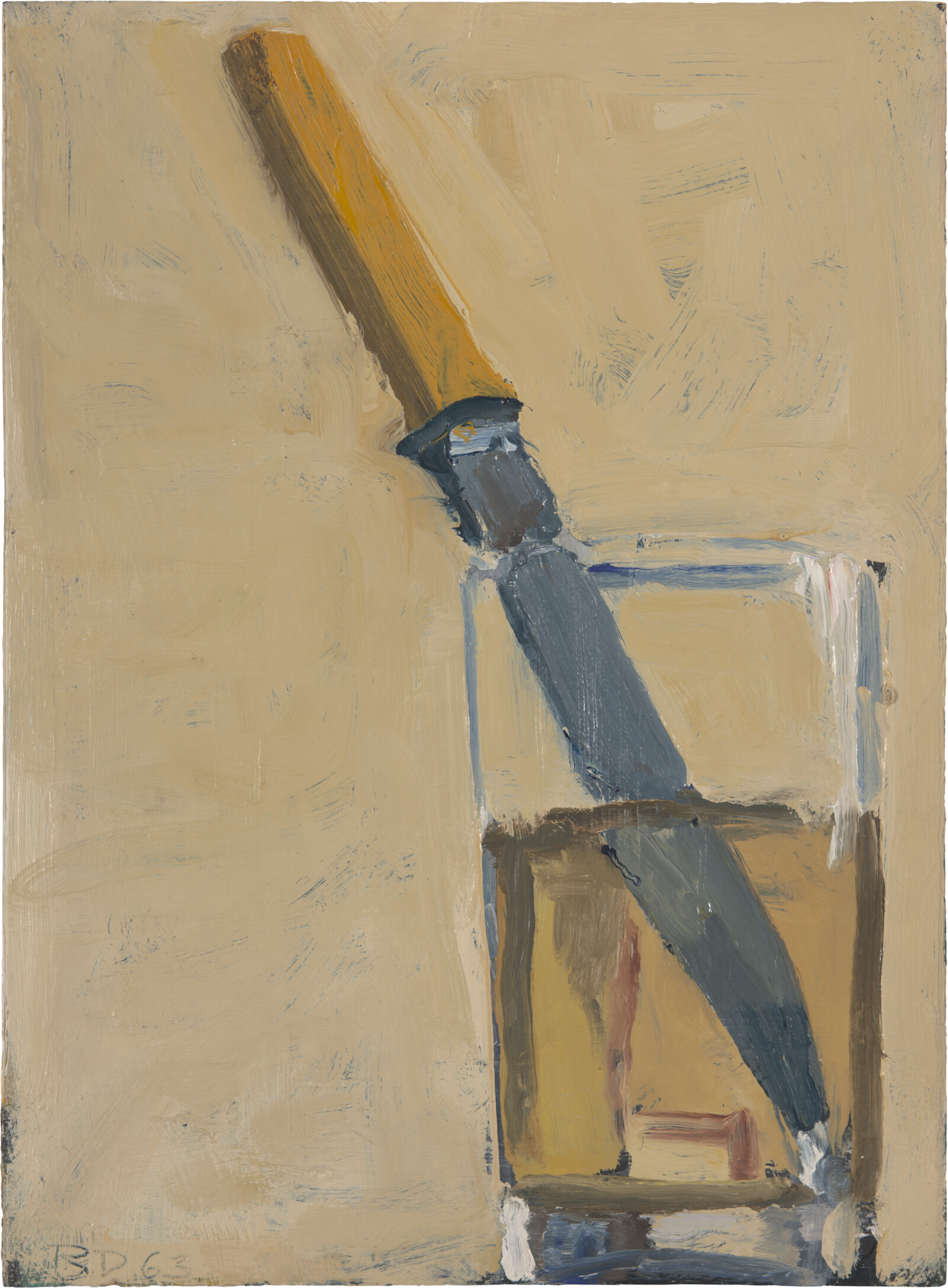
Knife and Glass, Richard Diebenkorn

The strongest and strangest literature usually has to teach its reader how to read it, and, consequently, to read in a new way. Jason Schwartz’s new novella John the Posthumous is strong, strange literature, a terrifying prose-poem that seizes history and folklore, science and myth—entomology, etymology, gardening, the architecture of houses, the history of beds, embalming practices, marital law, biblical citations, murder, drowning, fires, knives, etc.—and distills it to a sustained, engrossing nightmare.

What is the book about? Was my list too choppy? Our unnamed, unnameable narrator tells us, late in the book: “Were this a medical, rather than a marital history—you might then excuse so conspicuous a series.” (His series, of course, is different from mine—or perhaps the same. John the Posthumous, as I’ll suggest later, is a series of displacements). 

So, John the Posthumous is a marital history. There. That’s a summary, yes? Ah! But there’s conflict! Yes, this is a book about adultery, about cuckoldry! (“Cuckoldry, my proper topic . . .”). Adultery is threaded into the titles of the three sections Schwartz divides his novella into: “Hornbook” — “Housepost, Male Figure” — “Adulterium.” There’s something of a poem, or at least a poetic summary just there.

Do you sense my anxiety about writing about the book? Some need to deliver a summation? Perhaps I’m going about this wrong. How about a sustained passage of Schwartz’s beguiling prose. From the first book, the “Hornbook”:

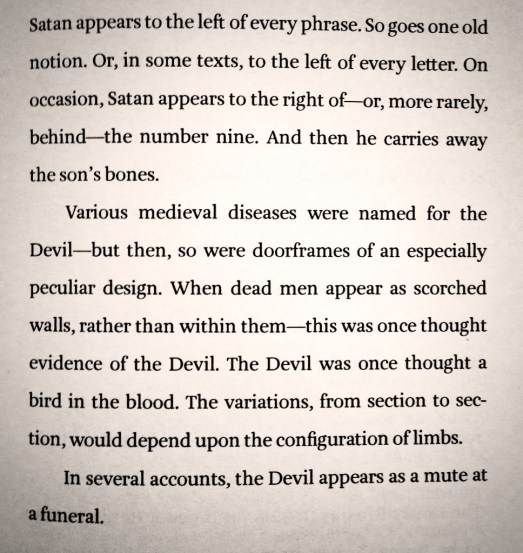
The lake is named for the town, or for an animal, and is shaped like a blade.

Adulterium, as defined by the Julian Statute, circa 13 B.C., offers fewer charms, given the particulars of winter, not to mention various old-fashioned sentiments concerning execution. Mutilation, for its part, is more common—the adulterous wife, or adultera, to use the legal term, surrenders her ears or nose, and, on occasion, her fingers—with divorce following in short order. Some transcriptions neglect the stranger, or adulterer, in place of graves—a simple matter of manners, this, not withstanding the disquisition upon the marriage bed. Others relate ordinary household details—dismantling the chairs, and visiting the windows, and departing the courtyard.

A gentleman, remember, always averts his eyes.

Cuckold’s Point, near Brockwell, in London, is most notable for its gallows—the red sticks recall horns—and for the drowning of dogs.

Schwartz’s narrator’s sentences do not seem to flow logically into or out of each other. They seem to operate on their own dream/nightmare logic, as if the words of John the Posthumous were the concordance to some other book. The single line paragraph about the lake (source of its name not entirely determined; its shape best expressed in simile) shifts into a horrific legal history of adultery and then into Cuckold’s Point, a bend in the Thames that owes its name to a simile.

Simile is perhaps the dominant mode of John the Posthumous. Schwartz’s narrator condenses and expands and displaces his objects, his characters, his themes. Sentences sometimes seem to belong to other paragraphs, as if multiple discursive discussions wind through the book at once. Our narrator tells us that

The common wasp measures roughly two hundred hertz. This is well below the frequency of, say, a human scream. Anderson compares the sound of a dying beetle with the sound of a dying fly. (The names of the families escape me at the moment.) The common bee, absent its wings, is somewhat higher in pitch. (Carpenter bees would swarm the porch in August.) The true katydid says “Katy did” — or, according to Scudder, “she did.” The false katydid produces a different phrase altogether, something far more fretful. Wheeler concludes with the house ant and the rasp of a pantry door. Douglas prefers a hacksaw drawn across a tin can. (We found termites in the bedclothes one year.) A sixteenth note, poorly formed, may be said to resemble a pipe organ or a hornet. The children set their specimens on black pins.

Here, entomologists (note how Schwartz always pulls his language from his reading, his research) try to describe the language of insects. Interspersed we get images of mutilation and impalement (“The common bee, absent its wings”; “The children set their specimens on black pins”) along with interjections of insects infesting intimate domestic spaces (“We found termites in the bedclothes”). The passage also picks up the novella’s motif of sharp objects (“a hacksaw drawn across a tin can”). There’s something simultaneously banal and horrifying about the tone of this passage, its language a juxtaposition of scientific observation and cloudy personal recollections—all contrasted with “the frequency of, say, a human scream.”

Infestation, violence, and betrayal shudder throughout John the Posthumous, erupting in strange moments of deferral and transference: “When the horse becomes a house, furthermore, termites appear on the floor,” reads one bizarre line. “A woman says ‘dear’ or perhaps ‘door,’ and then two names—or perhaps only one,” we’re told. “Even the earliest primers compare the heart’s shape to a fist or to a hand waving goodbye,” the narrator points out.

At one point, the narrator laments: “how I regret these grisly, inexpert approximations.” In context, he’s working through a series of etymologies (linking shroud to groom and wishing that dagger had some connection to dowager), but the phrase—“grisly, inexpert approximations”—approaches describing the narrator’s program of deferral and displacement.

Etymology repeatedly allows the narrator (an approximation of; an attempt at) a basis of description:

The doorframe disappoints the wall, as the wall disappoints the door. The mullions divide the yard into nine portions. But portions—or, if you like, portion—is an unlovely word. Guest and host, for their part, issue from the same root—ghostis. Which means strangervillainenemy—though naturally I had believed it to mean ghost. And the figure in the corner, lower right, is neither my daughter nor her hat, but just a paper bag in the grass.

The passage is remarkable. We begin with the mundane but symbolically over-determined image of a doorframe, along with an equally mundane wall and door—all connected, bizarrely, with the verb disappoints, producing an uncanny effect. The mundane mullions that divide the yard reveal the perspective of our narrator. He is looking out. He seems to be trapped in a house, but the house is always displaced, shifting—it’s many houses. Portion leads him etymologically to ghostis (a root I’ve long been obsessed with), a word that condenses a series of oppositions—and, as the narrator points out, provides its own imaginary ghost. The final sentence shifts us again; it seems to belong to another paragraph. But perhaps not. Perhaps we continue to survey the wall, the door, the mullions—do we look out the window and see the figure that is not (and thus, in the realm of the narrator’s program of imaginative displacement, is, or rather, approximates) his daughter or her hat? Is it a photo on the wall? Both?

I’m tempted to keep on in this manner, pulling out passages from John the Posthumous and riffing on them, but maybe that’s a disservice to its potential readers, who I think should like to be assimilated by its strange strength on their own terms. Schwartz’s narrative doesn’t cohere so much as it enmeshes the reader, who must learn a new way of reading, of grasping (or releasing) his series of objects and histories and rumors and rituals.

The novelist and editor Gordon Lish (who has championed Schwartz) famously advised: “Don’t have stories; have sentences.” Great writing happens at the syntactic level, which cannot be separated from plot—the language is the plot. John the Posthumous embodies this aesthetic, creating its own idiom, composed from the real and the imaginary and the symbolic, an idiom that refuses to yield a straightforward calculus or grammar. The effect is wonderfully frustrating; the novel nags at the reader, confounds the reader, haunts the reader.

Haunt has its own strange etymology, likely deriving from the Old Norse heimta, “to return home,” through to Old French hanter, “to be familiar with,” popping up in Middle English haunten, “to use, to reside.” We can take it all the way back to the Proto-Indo-European root kei — “lie down, sleep, settle, hence home, friendly, dear.” Etymologically, all houses are therefore haunted—the series of houses (all different, all the same) in John the Posthumous especially so. This is a horror story, a haunted house story, a story larded with killers and connivers and adulterers. Another passage (I promise just to share this time and withhold remarks):

In the cellar: a pull saw and a hasp, a jack plane, a wrecking bar, and a claw hammer. A tin contains a cap screw and a razor blade. A jar contains the remains of a carpet beetle.

I dismantle the chairs and place all the parts in a crate. I station the broom beside the garden spade.

The killer in the cellar, in folklore, is discovered by a mute child. The prisoner in the cellar survives a fire or a storm—but is later mauled by wolves.

There were fleas last year, and squirrels the year before that.

I feel like I’ve offered enough of Schwartz’s uncanny prose here to appropriately intrigue or repel readers. The vision here is dark and the prose imposes an alterity that the reader must work through. This book is Not For Everyone, but it might be for you—I loved it. Haunting, frustrating, and disturbing, John the Posthumous is one of the best new books I’ve read this year.

John the Posthumous is new in trade paperback and e-book from OR Books on August 6th, 2013.
Gordon Lish on John the Posthumous (Book Acquired, 6.26.2013)

20130630-091606.jpg

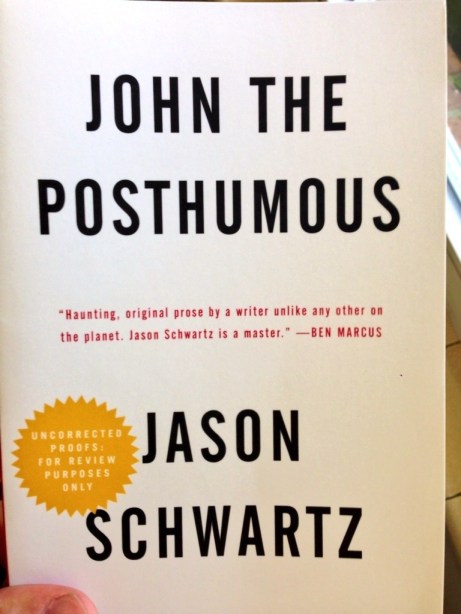
Some folks I know and whose taste I trust told me about Jason Schwartz, whose new novel (“novel” is not the right word) John the Posthumous is forthcoming from OR Books (the final cover art, which you can see via OR’s site, is much nicer than the reader copy above).

The book bears blurbs from Sam Lipsyte and Ben Marcus and Gordon Lish—so that should be enough for you. (It was enough to pique me).

What is it about? Violence. Cuckoldry. Murder. Satan. Ritual. Animals. Beds. Etc. I don’t know. I’m a little over half way through, and I keep rereading it compulsively, rereading the sentences. Schwartz’s prose approaches a dark, poetic logic of substitutions and omissions that is probably best left unexplicated, but I’ll do a write up after the Fourth of July anyway. Here’s Lish’s praise (a short story in itself):

 20130630-091646

And two samples from the book (context is unimportant; or, rather everything—that is, the context of the entire book, in that the book is its own idiom, if you follow (or don’t)):

20130630-091623.jpg

20130630-091641.jpg


Gordon Lish’s My Romance (Book Acquired, 2.22.2013)

20130225-173906

“How to Write a Novel” — Gordon Lish

“How to Write a Novel” by Gordon Lish

First make sure you have enough time. It is crucial that you have enough time to make things up. Myself, I do not have time enough for anything like that.

But I’ll tell you what’s what. It will not be hard for you to follow me doing it.

Just listen.

Just watch.

I’m composing these instructions on an I.B.M. Selectric. I got it back in 1961. I did not buy it. I finessed it or I finagled it or I stole it.

The person who is the unexpressed direct object of one or the other of these verbs was rich. He said you can borrow this thing, use it for a while. Then he stuck his other thing in my wife’s thing. They still have their things and I have this thing and I’m not giving it up.

It’s given tip-top service. I really loved it when I first saw it, and I still love it just as much.

I never cover it over with anything. I don’t cover it over with anything like a cover or anything—because I like to look at it—the shape.  I.B.M. is good at giving a thing a nice shape. I always look at the shape of things before I snap of the light in a room.

I think 1961 was the Selectric’s first year.

I talk to engineers whenever I get a chance. I don’t mean the kind that build bridges. I mean the fellows that service things. Those are the engineers I talk to.

You know what one of those fellows once told me once? Buy the first of whatever it is! He said buy the first one of whatever it is because the maker of it is never going to knock himself out like that again—making, you know, all of the others after that. That’s why this one’s still going fine after so many wonderful, wonderful years.

The same goes for the Polaroid camera I’ve got. I’ve got the oldest one there is. You know how old that is? Here’s how old it is. It’s called, they call it, the Polaroid Land Camera.

That’s how goddamn old it is!

No shit, it was a first one—it was the very first Polaroid the Polaroid people made!

You want to see pictures? Look at these pictures! Tell me when in your life you ever saw in your life pictures as sharp as these pictures!

Because they’e this big when I start out with them. You see how big? Next to nothing, right? But then what? But then I go get them all blown up as big as life! See them? Look at them all over the walls if you don’t know what I mean!

That’s resolution for you , isn’t it?

Well, that’s my second wife, okay?

They’re framed all over the place.

People come in here and then they look at them and then they smack their heads.

My God, they say, such pictures!

I say, original issue, a maker knows his game.

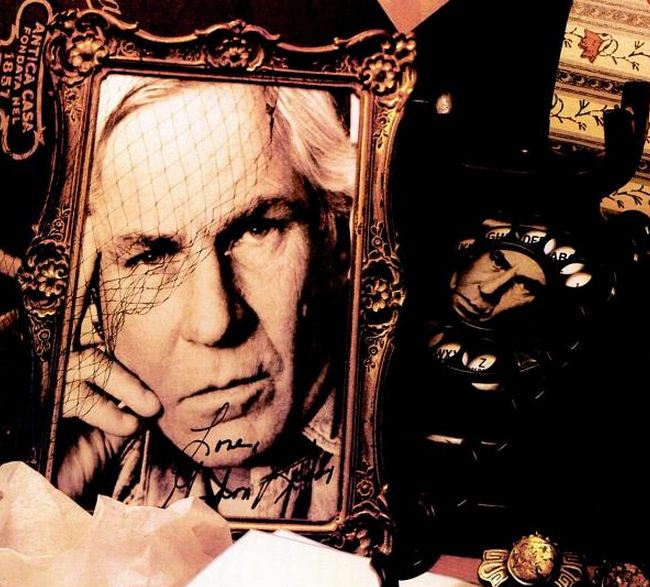
Gordon Lish: “Don’t Believe Me”

gl

From “A Conversation with Gordon Lish,” an outstanding interview between the writer/editor and Rob Trucks. The interview is really amazing—Lish talks at length about his writing process, his sense of competition, his friendships with Don DeLillo and Cynthia Ozick, his interest in Julia Kristeva, his feelings for Harold Brodkey and Barry Hannah—and Blood Meridian. Lots and lots of Blood Meridian.

I chose this little nugget because I think it reads almost like a perfect little Lish story—or at least, it seems to perfectly express Lish’s voice, which if you haven’t heard it, my god, get thee to his own reading of his Collected Fictions. Again, the whole interview is well worth your time if you have any interest in Lish. It includes this insight into the man’s fiction:

dickbook

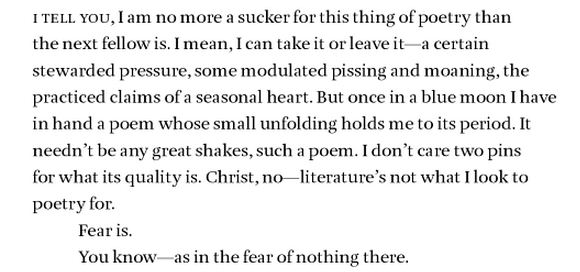
“Some Modulated Pissing and Moaning” (Gordon Lish on Poetry)


From Gordon Lish’s story “How to Write a Poem.”

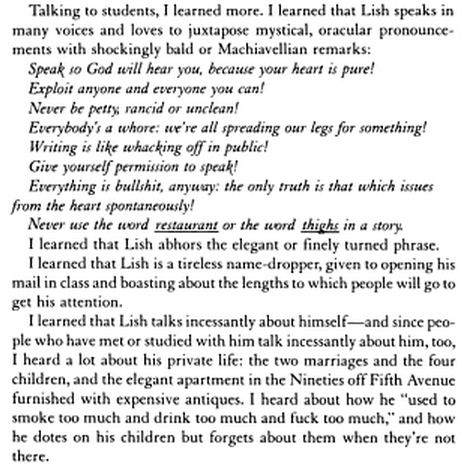
“What I Know About Gordon Lish” (1986 Spy Magazine Feature)

From a 1986 Spy magazine feature on editor/writer/hero Gordon Lish:

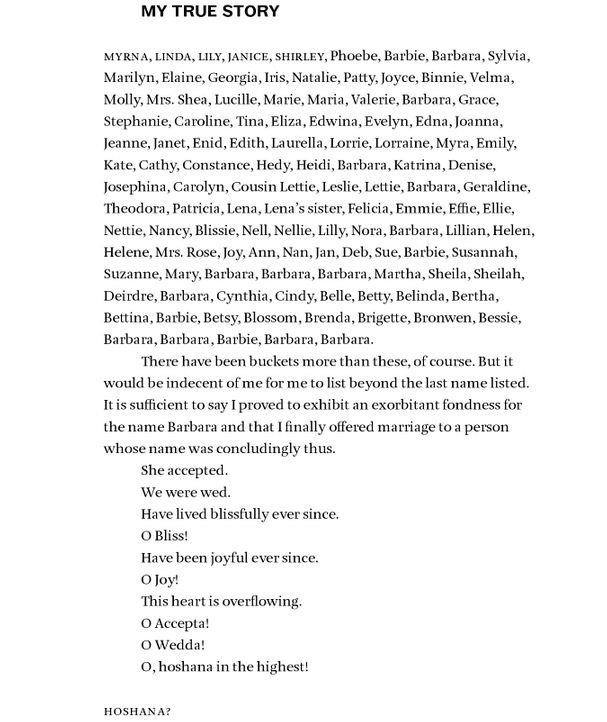
“My True Story” — Gordon Lish

Crews, Gaddis, Lish, Mutis (Books Acquired Late Last Week)

20120410-204343.jpg

I picked up Harry Crews’s novel The Knockout Artist, which I hadn’t read, after his recent death. I was not the only person to pick up Crews books: the Crews section of my favorite used bookstore, once swollen is now depleted (the omnibus and collections all snapped up).

William Gaddis’s last novel Agapē Agape was my occasion (as if I needed one) for visiting said store; I ordered it after finishing The Recognitions. I managed to bend the cover badly in the first five minutes of ownership. I started it over the weekend and then got distracted by a friend calling me to meet at a bar. I started it again last night and got about a third of the way in. Full review on the horizon.

I have no idea why I picked up Lish’s novel other than the fact that Lish is awesome; it’s a first edition paperback and the cover is awesome. Maybe that’s why. I have no idea when I’ll get around to reading it. Compulsive behaviors.

The Mutis novel, or collection of novellas, is half of the book that Dave Cianci aka Noquar reviewed on this blog  a few months ago. I wanted the full version, which collects six novellas, but I’ll settle for this (it’s used; I have store credit, etc.). Anyway, Noquar’s review made me want to read it, so I’ve slated it for summer reading (May?).

“What’s the Matter, Don’t You Love Me Anymore?” — Raymond Carver’s Correspondence with Gordon Lish

Today is Raymond Carver’s birthday. Read excerpts of Carver’s letters to his editor Gordon Lish at The New Yorker. A few highlights (the letter from July 8, 1980 is fantastic and should be read in full, by the way)—

July 15, 1970

Hombre, thanks for the superb assist on the stories. No one has done that for me since I was 18, I mean it. High time I think, too. Feel the stories are first class now, but whatever the outcome there, I appreciate the fine eye you turned on them. Hang tough.

February 1, 1979

I’m going to Mardi Gras with Tess; and the Fords are coming down in March for spring break and we’re going into Mexico by train for a week. . . . I’m happy, and I’m sober. It’s aces right now, Gordon. I know better than anyone a fellow is never out of the woods, but right now it’s aces, and I’m enjoying it.

July 8, 1980, 8 a.m.

Dearest Gordon,

I’ve got to pull out of this one. Please hear me. I’ve been up all night thinking on this, and nothing but this, so help me. I’ve looked at it from every side, I’ve compared both versions of the edited mss—the first one is better, I truly believe, if some things are carried over from the second to the first—until my eyes are nearly to fall out of my head. You are a wonder, a genius, and there’s no doubt of that, better than any two of Max Perkins, etc., etc. And I’m not unmindful of the fact of my immense debt to you, a debt I can simply never, never repay. This whole new life I have, so many of the friends I now have, this job up here, everything, I owe to you for “Will You Please.” You’ve given me some degree of immortality already.

January 21, 1983

What’s the matter, don’t you love me anymore? I never hear from you. Have you forgotten me already? Well, I’m going back to the [Paris Review] interview and take out all the good things I said about you.

Amy Hempel on Gordon Lish and Steve Martin

Amy Hempel talks about studying under Gordon Lish (and how Steve Martin influenced her) in her 2003 interview with The Paris Review

INTERVIEWER

Why Lish?

HEMPEL

At Esquire in the seventies and, later, at Knopf, he was publishing the voices that interested me most. I felt allied with his choices, so he was the one I wanted to work with. Writers like Raymond Carver, Barry Hannah, Mary Robison. These were the three who had the most effect on me when I started.

INTERVIEWER

What about their work interested you?

HEMPEL

They didn’t sound like anyone else I had read. For me, they redefined what a story could be—the thing happening off to the side of the story other writers were telling; they would start where someone else would leave off, or stop where someone else would start. As Hannah said later in Boomerang, a lot of people have their overview, whereas he has his “underview,” scouting “under the bleachers, for what life has dropped.”

INTERVIEWER

Do you remember the first class?

HEMPEL

Vividly. The assignment was to write our worst secret, the thing we would never live down, the thing that, as Gordon put it, “dismantles your own sense of yourself.” And everybody knew instantly what that thing, for them, was. We found out immediately that the stakes were very high, that we were expected to say something no one else had said, and to divulge much harder truths than we had ever told or ever thought to tell. No half-measures. He thought any of us could do it if we wanted it badly enough. And that, when I was starting out, was a great thing to hear from someone who would know.

INTERVIEWER

What was, if you can say, your “worst secret”?

HEMPEL

I failed my best friend when she was dying. It became the subject of the first story I wrote, “In the Cemetery Where Al Jolson Is Buried.”

INTERVIEWER

You stayed on in his workshop as a student for years. You must have been repeatedly humbled.

HEMPEL

I felt humbled by realizing how hard the job was. How hard it is to write a moving, worthwhile, memorable story. But more often I was inspired. It turned out that one of the most helpful things I did without knowing it would be helpful later was hang out with stand-up comics in San Francisco. I went to their shows night after night after night. I watched them performing, working through the same material. I saw some nights it killed and other nights it bombed. All that time I was observing nuance, inflection, timing, how the slightest difference mattered. How the littlest leaning on a word—or leaning away from it—would get the laugh, and this lesson was so valuable. And the improv work—they called it “being human on purpose,” this falling back on the language in your mouth—was hugely important. Just listening to what you’re saying. I learned this when my late friend Morgan Upton, an actor and member of the Committee, took me to a Steve Martin show at the Boarding House in San Francisco. Back in the green room, Steve Martin was sick, but preparing to do his show anyway. I told him I admired that, I said I couldn’t go out there and make people laugh if I were sick. And he said, Don’t be silly—you couldn’t do it if you were well. A brilliant reply on any number of levels. I based an early story, “Three Popes Walk into a Bar,” on that night. Then I ran into him about twenty years later and reminded him of our exchange. He laughed and said, “It sounds mean!” But I thought it was great.


Airships — Barry Hannah

In his 1978 collection Airships, Barry Hannah sets stories in disparate milieux, from the northern front of the Civil War, to an apocalyptic future, to the Vietnam War, to strange pockets of the late-twentieth century South. Despite the shifts in time and place, Airships is one of those collections of short stories that feels somehow like an elliptical, fragmentary novel. There are the stories that correspond directly to each other — the opener “Water Liars,” for instance, features (presumably, anyway), the same group of old men as “All the Old Harkening Faces at the Rail.” The old men love to crony up, gossip, tell tall tales. An outsider spoils the fun in “Water Liars” by telling a truth more terrible than any lie; in “Harkening,” an old man shows off his new (much younger) bride. These stories are perhaps the simplest in the collection, the homiest, anyway, or at least the most “normal” (whatever that means), yet they are both girded by a strange darkness, both humorous and violent, that informs all of Airships.

We find that humor and violence in an outstanding trio of Civil War stories (or, more accurately, stories set during the Civil War). The narrator of “Dragged Fighting from His Tomb,” a Confederate infantryman relates a tale of heroic slaughter with a hypberbolic, phallic force. Observe—

I knew the blueboys thought they had me down and were about ready to come in. I was in that position at Chancelorsville. There should be about six fools, I thought. I made the repeater, I killed four, and the other two limped off. Some histrionic plumehead was raising his saber up and down on the top of a pyramid of crossties. I shot him just for fun. Then I brought up another repeater and sprayed the yard.

Later, the narrator defects, switches to the Union, and claims he kills Jeb Stuart, a figure that towers over the Civil War tales. The narrator of “Dragged Fighting” hates Stuart; the narrator of “Knowing He Was Not My Kind Yet I Followed” is literally in love with the General. In contrast to the narrator of “Dragged Fighting,” the speaker in “Knowing” — an avowed “sissy” whom the other soldiers openly detest — hates the violence and madness of war—

We’re too far from home. We are not defending our beloved Dixie anymore. We’re just bandits and maniacal. The gleam in the men’s eyes tells this. Everyone is getting crazier on the craziness of being simply too far from home for decent return. It is like Ruth in the alien corn, or a troop of men given wings over the terrain they cherished and taken by the wind to trees they do not know.

He despairs when he learns of Jeb Stuart’s death. In the final Civil War story, “Behold the Husband in His Perfect Agony,” a Union spy is given the task to communicate news of Stuart’s death through enemy lines. Rather than offering further explication, let me instead point you, dear reader, to more of Hannah’s beautiful prose, of which I have not remarked upon nearly enough. From “Behold the Husband” —

Isaacs False Corn, the Indian, the spy, saw Edison, the Negro, the contact, on the column of an inn. His coat was made of stitched newspapers. Near his bare feet, two dogs failed earnestly at mating. Pigeons snatched at the pieces of things in the rushing gutter. The rains had been hard.

The short, descriptive passage rests on my ears like a poem. Hannah, who worked with Gordon Lish, evinces in his writing again and again that great editor’s mantra that writing is putting one sentence after another.

Although set in the Vietnam War, “Midnight and I’m not Famous Yet” seems an extension of the Civil War stories. In it, an officer from a small Southern town goes slowly crazy from all the killing, yet, like the narrator of “Dragged Fighting,” he presents himself as a warrior. Above all though, he laments that the war has robbed him of some key, intermediary phase of his late youth, a phase he can’t even name—

The tears were out of my jaws then. Here we shot each other up. All we had going was the pursuit of horror. It seemed to me my life had gone straight from teen-age giggling to horror. I had never had time to be but two things, a giggler and a killer.

This ironic sense of a “pursuit of horror” pervades Airships, particularly in the collection’s most apocalyptic visions. “Eating Wife and Friends” posits an America where food shortages and material scarcity leads people to eating leaves and grass — and then each other. In “Escape to Newark,” the environment is wildly out of balance—

In August it’s a hundred fifty degrees. In December it’s minus twenty-five and three feet of snow in Mississippi. In April the big trees explode.

A plan is made to “escape” these conditions via a rocket, but of course there’s not enough fuel to get past Newark. In Airships, modes of flight are transcendent but ultimately transient. Gravity’s pull is heavy stuff.

Just as Hannah’s war stories are not really war stories, his apocalypse tales are really about human relationships, which he draws in humor, pathos, and dark cynicism. In “Green Gets It,” an old man repeatedly attempts his suicide, only to fail again and again. His suicide note, written to his daughter, is scathing and shocking and sad and hilarious and wise–

My Beloved Daughter,

Thanks to you for being one of the few who never blamed me for your petty, cheerless and malign personality. But perhaps you were too busy being awful to ever think of the cause. I hear you take self-defense classes now. Don’t you understand nobody could take anything from you without leaving you richer? If I thought rape would change you, I’d hire a randy cad myself. I leave a few dollars to your husband. Bother him about them and suffer the curse of this old pair of eyes spying blind at the minnows in the Hudson.

Your Dad,

Crabfood

Although Hannah explores the darkest gaps of the soul in Airships, he also finds there a shining kernel of love in the face of waste, depravity, violence, and indifference. This love evinces most strongly perhaps in Airships trio of long stories. These tales, which hover around 30 pages, feel positively epic set against the other stories in the collection, which tend to clock in between five and ten pages. The first long story, “Testimony of Pilot,” details the development of a boyhood friendship over a few decades. It captures the strange affections and rivalries and unnameable bonds and distances that connect and disconnect any two close friends. The second of the long tales is “Return to Return,” a tragicomic Southern drama in the Oedipal vein (with plenty of tennis and alcoholism to boot). As in “Testimony of Pilot,” Hannah finds some measure of redemption, or at least solace, for his characters in their loving friendship, yet nothing could be more unsentimental. The final long story, which closes the collection, is “Mother Rooney Unscrolls the Hurt,” a daring work of stream of consciousness that seems to both respond to — and revise — Katherine Anne Porter’s “The Jilting of Granny Weatherall.” The story concludes (and of course concludes the volume) with a vision of love that corresponds to the imagery of The Pietà, a kind of selflessness that ironically confirms the self as an entity that exists in relation to the pain of others.

I could keep writing of course — I’ve barely touched on Hannah’s surrealism, a comic weirdness that I’ve never seen elsewhere; it is Hannahesque, I suppose. Nor have I detailed Hannah’s evocations of regular working class folk, fighting and drinking and divorcing and raising children (not necessarily in that order). Airships is a world too rich and fertile to unpack in just one review, and I’ve already been blathering too long, I fear, when what I really want  to do is just outright implore you, kind reader, to find it and start reading it immediately. Very highly recommended.

Read Gordon Lish’s Edit of Raymond Carver’s “What We Talk About When We Talk About Love”

Boy oh boy this is great (yes, I am that kind of nerd). A few years ago The New Yorker published an early draft of Raymond Carver’s short story “What We Talk About When We Talk About Love,” which was originally titled “Beginners.” The New Yorker simultaneously published a version of the story showing Gordon Lish’s edits. It’s a fascinating look at the Carver-Lish writing experience. In the sample that follows, strike-throughs are deletions and boldfaced words are Lish’s additions—

My friend Mel Herb McGinnis, a cardiologist, was talking. Mel McGinnis is a cardiologist, and sometimes that gives him the right. The four of us were sitting around his kitchen table drinking gin. It was Saturday afternoon. Sunlight filled the kitchen from the big window behind the sink. There were Mel Herb and me I and his second wife, Teresa—Terri, we called her—and my wife, Laura. We lived in Albuquerque, then. But but we were all from somewhere else. There was an ice bucket on the table. The gin and the tonic water kept going around, and we somehow got on the subject of love. Mel Herb thought real love was nothing less than spiritual love. He said When he was young he’d spent five years in a seminary before quitting to go to medical school. He He’d left the Church at the same time, but he said he still looked back on to those years in the seminary as the most important in his life.

Terri said the man she lived with before she lived with Mel Herb loved her so much he tried to kill her. Herb laughed after she said this. He made a face. Terri looked at him. Then Terri she said, “He beat me up one night, the last night we lived together. He dragged me around the living room by my ankles. He kept saying, , all the while saying, ‘I love you, don’t you see? I love you, you bitch.’ He went on dragging me around the living room. My , my head kept knocking on things.” TerriShe looked around the table at us and then looked at her hands on her glass. “What do you do with love like that?” she said. She was a bone-thin woman with a pretty face, dark eyes, and brown hair that hung down her back. She liked necklaces made of turquoise, and long pendant earrings. She was fifteen years younger than Herb, had suffered periods of anorexia, and during the late sixties, before she’d gone to nursing school, had been a dropout, a “street person” as she put it. Herb sometimes called her, affectionately, his hippie.

“My God, don’t be silly. That’s not love, and you know it,” Mel Herb said. “I don’t know what you’d call it, —madness is what I’d call it—but I sure know you wouldn’t call it it’s sure as hell not love.”

The Collected Fictions of Gordon Lish (as Read by Gordon Lish)

Listening to Gordon Lish read selections from Iambik Audio’s compendium of his Collected Fictions for the fourth time today, it occurred to me that I should just go ahead and review the damn thing. Quit stalling. Get to it. I hope that pointing out that I’ve listened to Lish narrate ten of his odd, funny, gut-wrenching tales four times now (and will surely listen again) is enough to motivate thee, gentle reader, to follow my example—but that’s lazy, wishful thinking, right? There needs to be a proper review. Here goes—

Lish is perhaps more famous as an editor than a writer of short fiction. He worked for years at Vanity Fair and later for Knopf, and the list of writers that he championed reads like a who’s-who of contemporary greats: Don DeLillo, Cynthia Ozick, Amy Hempel, Barry Hannah, David Leavitt, and Harold Brodkey, just to name a few. The writer he is perhaps most associated with though is Raymond Carver. By paring down sentence after sentence, Lish helped Carver develop his spare, minimalist style.

It’s that attention to sentences, to the truth of each sentence, to their individual force, that shines through in the collection. Consider this beauty, from “The Death of Me,” a story about a boy (surely Gordon Lish, hero of all Gordon Lish stories) who peaks too early, winning first place in all five field events at his summer camp one fine day in 1944, and then succumbing to the realization that this apex is, frankly, the end of it all–

I felt like going to sleep and staying asleep until someone came and told me that my parents were dead and that I was all grown up and that there was a new God in heaven and that he liked me better even than the old God had.

This sentence seems to me to be the expression of an emotion that I’ve felt for which I have no name. Lish’s sentences can move through tragedy and pathos to devastating comedy, a kind of comedy that collapses the auditor. Check out a line from “Mr. Goldbaum”–

What if your father was the kind of father who was dying and he called you to him and you were his son and he said for you to come lie down on the bed with him so that he could hold you and so that you could hold him so that you both could be like that hugging with each other like that to say goodbye before you had to actually go leave each other and did it, you did it, you god down on the bed with your father and you got up close to your father and you got your arms around your father and your father was hugging you and you were hugging your father and there was one of you who could not stop it, who could not help it, but who just got a hard-on?

Lish advised, “Don’t have stories — have sentences,” but “The Death of Me” and “Mr. Goldbaum” are more than the sum of their parts, more than just a collection of sculpted, scalpeled syntax. From the 1988 collection Mourner at the Door (the only Lish book I’d read before Collected Fictions), both stories announce Lish’s major theme of death, the absurdity of death, or the absurdity of life against the inevitability of death—but also the heavy truth of death, the ugly truth of death, the powerlessness of language against the finality of death. “Spell Bereavement,” also from Mourner, is essentially a prequel to “Mr. Goldbaum”: Gordon gets the news of his father’s death from his sister and mother. The story takes place over the phone as a sort of switch-hit interrogation, as mom and sis caustically berate the speechless man, who tells us, at the end, “There are not people in my heart of hears. There are just sentences in my heart of hearts.” Why does Gordon the narrator of “Spell Bereavement” fail to respond to the news of his father’s death? He is “too disabled to talk . . . going crazy with pencil and paper so as not to miss one word.”

Lish means to capture the ecstatic truth in death, and truth is at the core of all these stories, even when they are fables of a sort, like “After the Beanstalk,” which features a bewitched princess who has been transmogrified into a dog. The tale is hilarious and cutting and sad. There’s also “Squeak in the Sycamore,” which begins as a child’s list of fears and enumerations of death and longing and nature and ends in a joke and then an insult to the reader for laughing at the joke. (Best line: “Six is: the gardener died from digging up a basilisk”). “How to Write a Poem” is a caustic rant that argues that literary theft is really a matter of stern guts, of facing truth, and “Everything I Know” problematizes the very act of storytelling — it’s a story about how we tell stories, or our versions of stories. By far the most affecting piece that Lish reads though is “Eats with Ozick and Lentricchia,” about which he tells us, before reading it, “there is not a word of it that is not true.” It is a story that hovers around the death, or the dying of, more accurately, Lish’s wife Barbara; its details are almost too cruel, too true to bear.

Lish reads his tales in a bold voice that seems to challenge the auditor at all angles, as if his sentences were prodding you, poking you, pinching you even. He claims, in one of the many asides that precede these tales, to have never really read his work aloud before, and not to have really read the work in years, but his confidence seems to belie this notion; maybe, more accurately, it conveys the intense concentration of his intellect. His tone fascinates, and then he cracks out something like: “It always astonishes me I could have written such a thing” in such a dry honest voice that, while his quip hangs ambiguous, it remains utterly sincere. There’s a wonderful moment in the recording when he moves from reading “Mr. Goldbaum” to “Spell Bereavement” and seems to notice, as if for the first time, their close connection. He then remarks–

It shames me in one kind of way to see that my writing gathers itself into such a rut, but on the other hand it does please me to have spoken again and again and again about that which occurred to me at the time to be of consequence. I haven’t written fiction or anything else really for a great number of years and this occasion, reading these pieces, is an education for me and alien, foreign, in one kind of way, because the sentences are complex, but in another kind of way, I’m reminded of who I am.

Lish’s influence cannot be underestimated, from writers like David Foster Wallace to Denis Johnson to Sam Lipsyte, and all of those who will follow in turn. Readers have a fantastic (and incredibly inexpensive, I must add) starting place in Iambik’s wonderful collection. Do yourself a favor and check this out. Very highly recommended.

Gordon Lish on Beckett’s Boils and Other Matters of Literary Import

Hey. Do yourself a favor and listen to Iambik’s first podcast, a raucous, rambling conversation with legendary editor/short story author Gordon Lish. I finally got around to listening to the discussion between Lish and his publisher John Oakes. (Why the delay? I’ve been listening to and very much enjoying another Iambik recording, an audiobook of Lydia Millet’s Oh Pure and Radiant Heart, and I needed to get to a decent stopping place before the Lish (review of the Millet forthcoming)) . I had already listened to Lish reading a selection of his own stories which was nine kinds of awesome (thanks again to the good folks at Iambik, whose hooking me up with the sweet mp3age has in no way affected my fondness for their operation (review of the Lish selections forthcoming)).

Hearing Lish in this conversational, easy manner is revelatory. Wise and funny, erudite and crafty, you’ll learn something and be entertained:

Iambikcast #1a (mp3)
Iambikcast #1b (mp3)

What does he talk about? I’ll crib from Iambikist Miette’s write-up, which hardly sums it up but does a nice job of surveying the discussion–

In the first part of the conversation, Lish covers Beckett’s boils and other afflictions of our literary heroes, remembrances of Neal Cassady, and the writer as witch doctor.

The second part focuses on Lish’s (as always, uncensored) assertions on the state of contemporary American letters, in which we’re imparted with opinions on Allen Ginsberg and Philip Roth, achieving religious experience through DeLillo, the finer points of book blurbing, and encouraging the further crimes of Tao Lin.

Amy Hempel on Gordon Lish and Barry Hannah

Amy Hempel talks Gordon Lish and Barry Hannah (among other things) in a new interview with Vice. A taste–

Do you think about readers when you’re writing? Do you personify them?
I do. I always have, and it’s always been a handful of other writers. Sometimes it has changed, but yes, I really do think of a few actual people. It makes it a little bit easier since I know them, and I know that, well, if this person will find it funny, then I’ve succeeded, or some such thing. It makes it more like trading confidences. I think it’s daunting to think of writing for one’s readers, whoever they may be, so I bring it down to something manageable—a few people whose standards I know and whose work I very much admire—and that makes it more like, almost, a letter to the person. That helps me set the course.

So do you think like, “I’m going to change this here. I’m sure Gordon Lish would love it”?
[laughs] Well, I often have in mind Barry Hannah, and in fact when you phoned me just now, I was working on some remarks I’m going to make at a sort of memorial tribute to Barry, who died last March. This is something that will be held just outside Boston, two nights from now. A bunch of writers who adored him, just paying tribute to him. Barry Hannah was always on my list of people I knew, writers I admired immensely, and just thinking, you know, Barry Hannah might read this, it seemed to focus me when I was writing.

Writing is an extremely solitary activity, but at the same time it’s also very intense. One analogy that I always think of is swimming—it’s something that you do on your own, and the only standard of success you have is your last lap.
I agree 100 percent. And yet there are writers who hold themselves up and compare themselves to other writers. I think that’s useless. As you say, you’re only trying to beat your own best time. That’s the only relevant competition as far as I’m concerned.

Is your past with Lish something that still has an influence on you?
You know, it was a long time ago. I was a student of his at Columbia and then privately and then his author back in the early 80s. I did two books with him. Working with him was a crucial formative experience, but it was a long time ago. There are other writers who have sort of stepped in. Interestingly, Barry Hannah was one and Mary Robison is another, and they are both his authors, too, and were at the time that I was being published by him. So, yes, [Lish] had a terrific impact on my writing very early on. I don’t think he’s writing any more, but he’s still present among writers who really do care about writing at the sentence level. His impact there has certainly endured.

What about the so-called golden age of American short stories? I don’t really know if it’s accurate, or even intelligent, to define it that way.
Well, I think it was a phenomenon in publishing, with a lot of critics rightly going to Raymond Carver—who was also Gordon’s author—and people like Mary Robison. You know—some of the story writers who really, really opened things up again for stories as a commercially viable kind of writing as well as something that was important to a lot of readers.

A Gordon Lish Sentence That Cracked Me Up

Today, I listened to Iambik’s audiobook version of Collected Fictions, a selection of stories written and read by the inimitable Gordon Lish. Lish reads a few choice stories from four of his volumes in a wry, gruff tone; he’s got a wonderful rhythmic style, and he pauses to reflect on some of the selections before and after reading them. I’ll give the volume a proper review down the line, but I wanted to share a passage–a long sentence, really—that made me laugh out loud from the story “Mr. Goldbaum,” from the 1988 collection Mourner at the Door. I actually own Mourner at the Door, and had read “Mr. Goldbaum” sometime earlier this year or last year, but I don’t remember it being nearly as funny or touching. Must be Lish’s delivery. Anyway, the Lishness, which can be appreciated entirely out of context–

What if your father was the kind of father who was dying and he called you to him and you were his son and he said for you to come lie down on the bed with him so that he could hold you and so that you could hold him so that you both could be like that hugging with each other like that to say goodbye before you had to actually go leave each other and did it, you did it, you god down on the bed with your father and you got up close to your father and you got your arms around your father and your father was hugging you and you were hugging your father and there was one of you who could not stop it, who could not help it, but who just got a hard-on?

Or both did?

Picture that.

Not that I or my father ever hugged like that.