>intoxication o’r dizziness< | On "starting" Arno Schmidt's enormous novel Bottom's Dream

img_3817

Arno Schmidt’s 1970 novel Bottom’s Dream is finally available in English translation by John E. Woods. The book has been published by the Dalkey Archive.

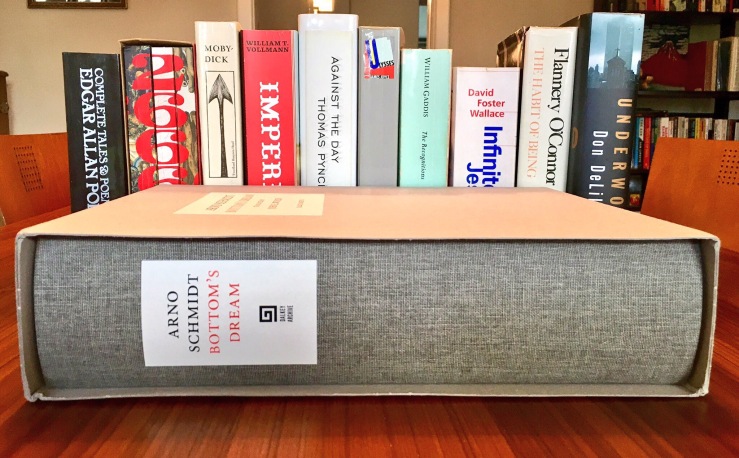
It is enormous.

As you can see in the picture above: Enormous.

But what’s Bottom’s Dream about? (This is the wrong question).

Dalkey’s blurb:

“I have had a dream past the wit of man to say what dream it was,” says Bottom. “I have had a dream, and I wrote a Big Book about it,” Arno Schmidt might have said. Schmidt’s rare vision is a journey into many literary worlds. First and foremost it is about Edgar Allan Poe, or perhaps it is language itself that plays that lead role; and it is certainly about sex in its many Freudian disguises, but about love as well, whether fragile and unfulfilled or crude and wedded. As befits a dream upon a heath populated by elemental spirits, the shapes and figures are protean, its protagonists suddenly transformed into trees, horses, and demigods. In a single day, from one midsummer dawn to a fiery second, Dan and Franzisca, Wilma and Paul explore the labyrinths of literary creation and of their own dreams and desires.

And Wikipedia’s summary:

The novel begins around 4 AM on Midsummer’s Day 1968 in the Lüneburg Heath in northeastern Lower Saxony in northern Germany, and concludes twenty-five hours later. It follows the lives of 54-year-old Daniel Pagenstecher, visiting translators Paul Jacobi and his wife Wilma, and their 16-year-old daughter Franziska. The story is concerned with the problems of translating Edgar Allan Poe into German and with exploring the themes he conveys, especially regarding sexuality.

Did I mention that it’s enormous?

Look, I know that dwelling on a book’s size probably has nothing to do with literary criticism, but Bottom’s Dream poses something of a special case. As an article on Bottom’s Dream at The Wall Street Journal points out, Schmidt’s opus is 1,496 pages long, contains over 1.3 million words, and weighs 13 pounds.

It’s a physical challenge as well as a mental challenge.

And, Oh that mental challenge!

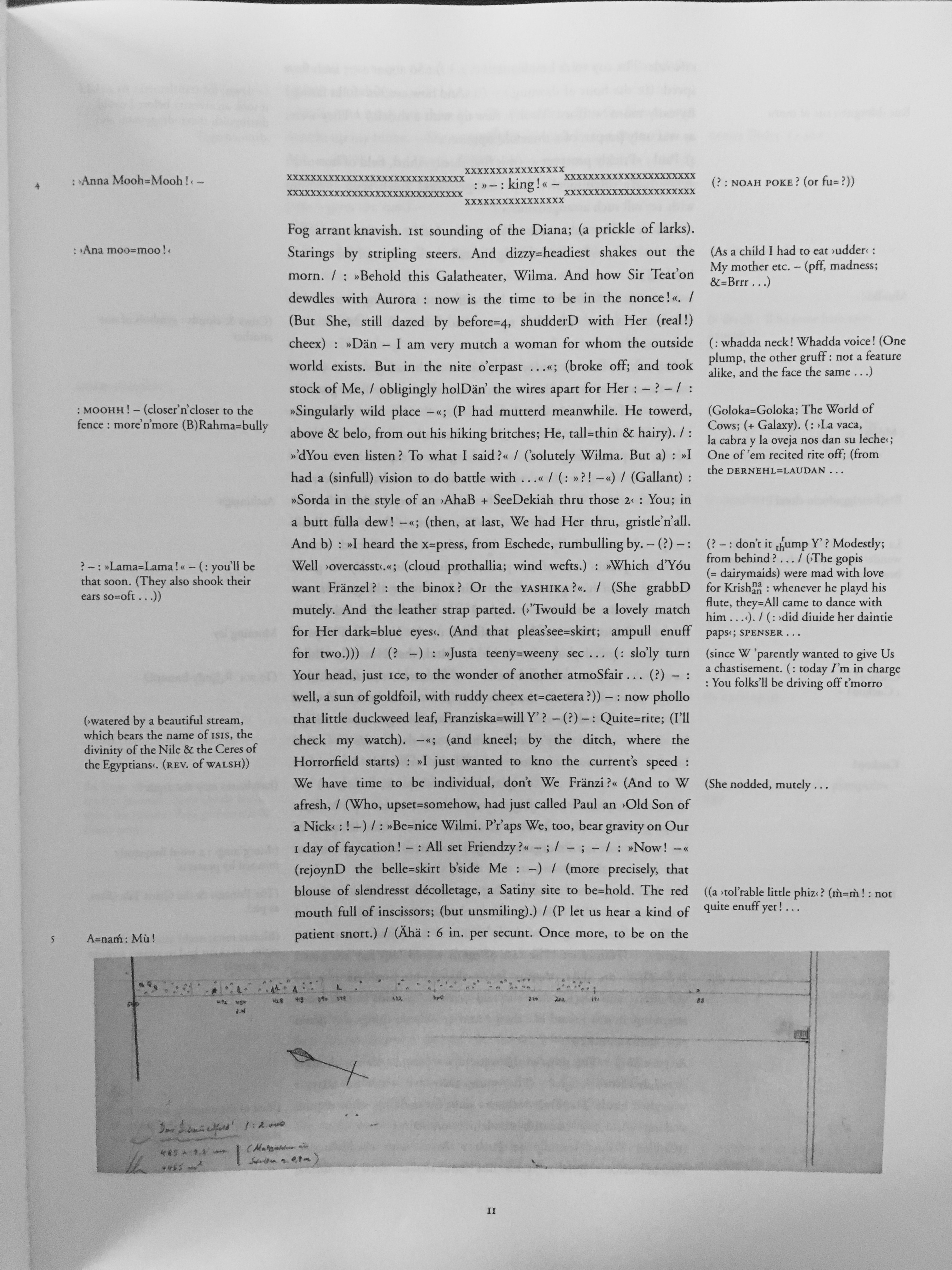
Here’s the first page of Bottom’s Dream (the pic links to a much larger image):
img_3901

Hmmm…? What do you think?

The obvious easy reference point here is Joyce’s Finnegans Wake, which indeed Schmidt was actively following, both in form and style: competing columns, a fragmentary and elusive/allusive style, collage-like metacommentary, an etymological explosion—words as paint, text as meaning. Etc.

(Did I mention it’s a lot longer than Finnegans Wake? Did I mention it’s enormous?)
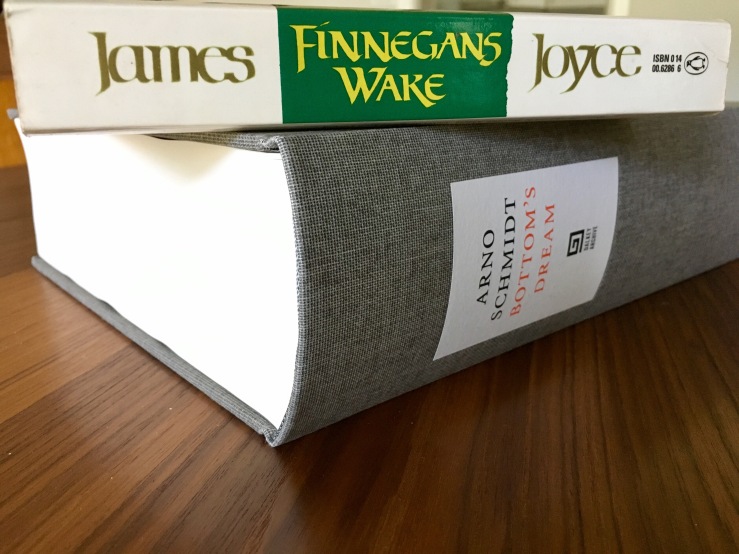
img_3841

Here’s a glimpse at two random pages (don’t be afraid to click on that image and get the full, y’knoweffect):

img_3811

I’ll never forget one of my graduate school professors warning us not to “peer too long into Finnegans Wake.” He called it an abyss. (The man loved Joyce’s work, by the way, and had studied under Hugh Kenner. I’m not sure if he meant abyss pejoratively. It was, like I say, a warning).

Bottom’s Dream seems like an abyss. As its title (a reference to A Midsummer Night’s Dream) suggests, “it hath no bottom.”

After nine days, I’m “on” page 21 of Schmidt’s novel now, and I have no idea what’s going on. And not just because it’s a primal gobbledygook wordmass. No, part of my incomprehension results from a very strong physical reaction to “reading” Bottom’s Dream. This physical reaction goes beyond the size of the volume—although there’s certainly something to the size. I more or less have to read the thing on my dining room table; it’s dreadfully uncomfortable on a couch, and probably impossible on my hammock or in the bathtub. I can’t really hold it while I read it. I think this matters, although I can’t really say how right now. The multiple columns, marginalia, images, etc. are engaging but also fragment my attention—and I generally find myself flicking through Bottom’s Dream, rather than sustaining the will to follow the “plot.” Right now, anyway, I find myself wrapped up in the aesthetics of reading Bottom’s Dream. It’s a tactile read. I enjoy it most when I smooth my hands over it, jump out of the stream, 20, 30, 100 pages forward, backwards. Relax a little.

Otherwise, Bottom’s Dream becomes a bit of a nightmare for me: I get all dizzy, thirsty, my eyes seem to thrum. Something going on in the inner-ear. It’s like a slow-motion panic attack. When that abyss-stress comes on, I jump ahead.

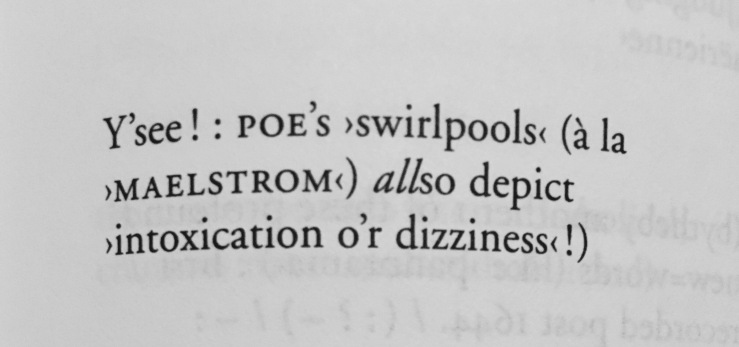
Which is how I found this bit of marginalia (I wish I’d recorded the page when I photographed it; but, also: the iPhone camera is a better recorder of Bottom’s Dream’s aesthetic textuality than any word-processing program. Even a scanner might straighten some of its bends and arcs, its voluminous volume):
img_3818

Yes! Poe’s >swirlpools<! >intoxication o’r dizziness<! — there’s a description for me of my own reaction to reading Bottom’s Dream.

Poe might be something of a guide for me if I do try to stick out wandering through Bottom’s Dream, and his story “A Descent into the Maelstrom,” referenced above, seems a particularly nice parallel to Schmidt’s bigass book.

“Descent” relates the tale of a sailor (a voyager!–a, like, metaphorical reader, y’know) transformed by his encounter with the “Moskoestrom” —a swirling abyss from which no one returns. This vortex, “absurd and unintelligible,” breaks the sailor, “body and soul.” He can’t comprehend the storm. It’s unknowable, un-nameable. At best, he is able to make a sidelong glance at it, but can never plumb its depths. And not only is his glance broken, but all of his senses are fragmented. He escapes the maelstrom, but is unrecognizable to the sailors who rescue him. He becomes the voice of the vortex, the metonymy of a force he can perceive but can’t comprehend.

The maelstrom—the vortex, the abyss—this, for Poe, was language.

I’m not sure how deep I’ll travel into Schmidt’s maelstrom. I managed large sections of Finnegans Wake—but I had a guide in Joseph Campbell’s Skeleton Key. Someone to map out the terrain, show me the ropes, etc.

Obviously, there isn’t much English-language scholarship on Bottom’s Dream right now (and in a very real and radical sense that I’m not touching on here, Woods’s translation is its own separate book). There are a few blogs taking on Schmidt’s monster though. The Untranslated has been writing (in English) about the original German text for over a year now. At Messenger’s Booker, Tony Messenger has been writing about Woods’s translation. There might be some other folks out there attempting the same—if you know let me know. For now, my updates from this maelstrom will be sporadic at best.
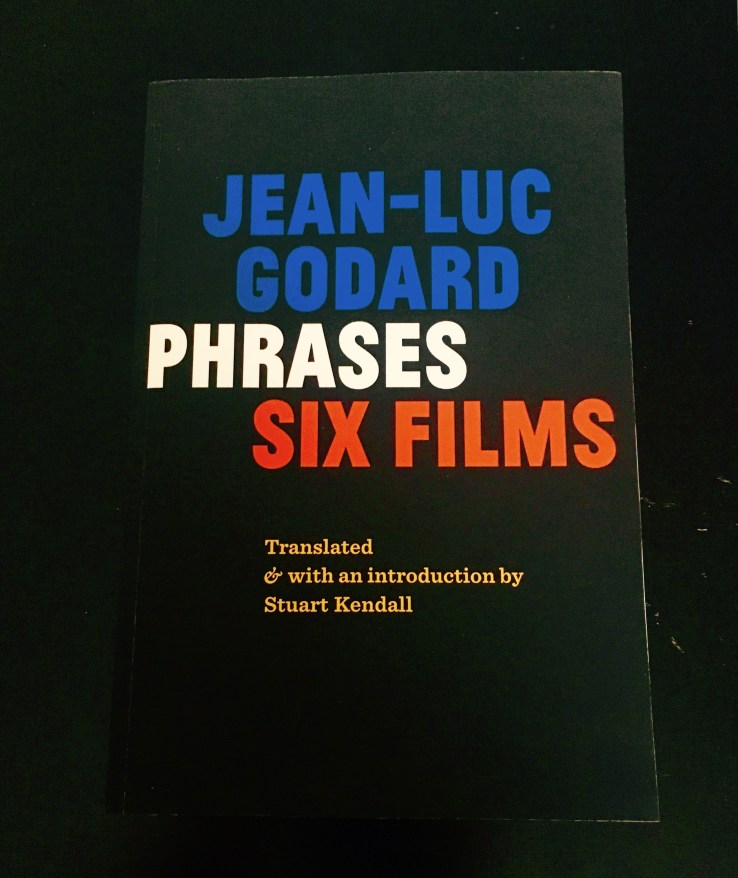
Jean-Luc Godard’s Phrases: Six Films (Book acquired, 8.17.2016)

img_3455

Jean-Luc Godard’s Phrases: Six Films is new in English translation by Stuart Kendall from Contra Mundum Press. Their blurb:

Phrases presents the spoken language from six films by Jean-Luc Godard: Germany Nine Zero, The Kids Play Russian, JLG / JLG, 2 x 50 Years of French Cinema, For Ever Mozart and In Praise of Love. Completed between 1991 and 2001, during what has been called Godard’s “years of memory,” these films and videos were made alongside and in the shadow of his major work from that time, his monumental Histoire(s) du cinema, complementing and extending its themes. LikeHistoire(s), they offer meditations on, among other things, the tides of history, the fate of nations, the work of memory, the power of cinema, and, ultimately, the nature of love.


Gathered here, in written form, they are words without images: not exactly screenplays, not exactly poetry, something else entirely. Godard himself described them enigmatically: “Not books. Rather recollections of films, without the photos or the uninteresting details… Only the spoken phrases. They offer a little prolongation. One even discovers things that aren’t in the films in them, which is rather powerful for a recollection. These books aren’t literature or cinema. Traces of a film…”


In our era of ubiquitous streaming video, ebooks, and social media, these traces of cinema raise compelling questions for the future of media, cinematic, literary, and otherwise.

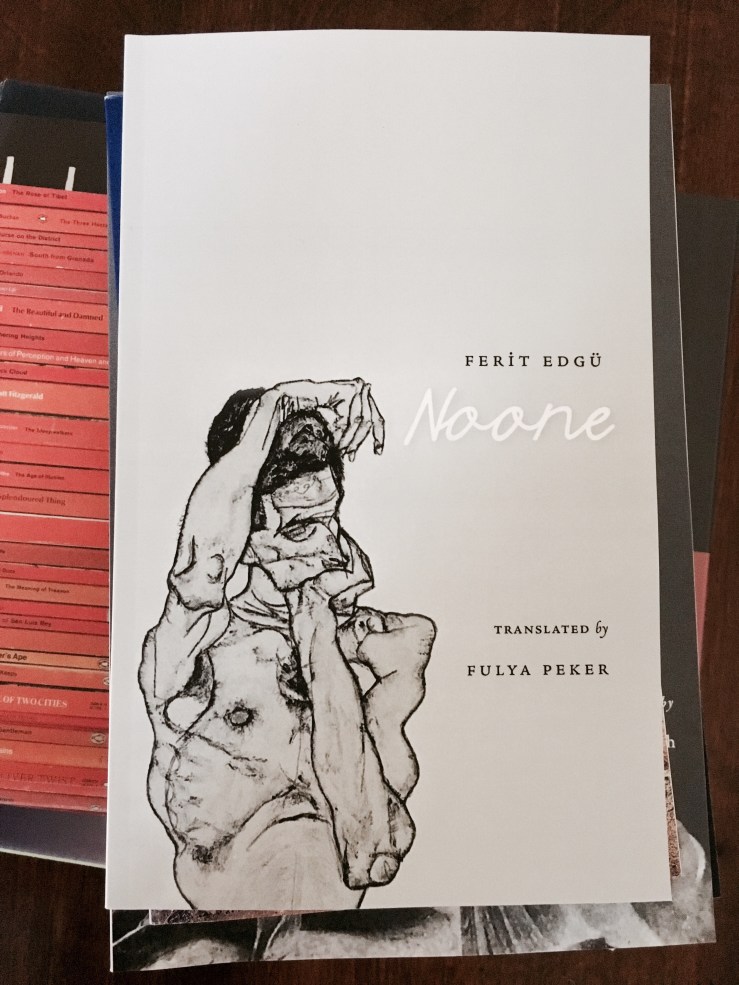
Ferit Edgü’s Noone (Book acquired, 8.17.2016)

img_3380

Ferit Edgü’s Noone is newish in English translation from Contra Mundum Press.

Here’s translator Fulya Peker’s introductory note to the volume:

Written between 1964 and 1974, between Paris and Hakkari, Ferit Edgü’s Noone approaches politics from a poetic standpoint and transforms a social-realist setting into a metaphor for a self that is in search of a subject for a sentence, or rather, that is subjected to a sentence.

As a record of history that is both personal and universal, Edgü depicts in Noone the severity of alienation, the difficulty of communication, the importance of memory, and the hidden rhyme of ‘existential’ and ‘survival,’ two grand words pronounced by pronouns suffering oppression and isolation. Noone compels us to consider the politically imposed idea of “the other” and how this “other” is not somewhere outside, external to us, but within. It prompts us to reflect on questions concerning the failure, or inability, to communicate, not only with others, but with one’s self due to man-made borders, whether lingual or geopolitical. Edgü’s acute and subtle observations about adverse living conditions that reduce humans to creatures of mere subsistence echo not only the current political climate in eastern Turkey, but also the general climate of despotism in many parts of the world.

While people are constantly forced to be ‘noone,’ the traces of history are buried (or frozen) under snow, and memory is dismantled, Noone reminds us of tomorrow, by re-momenting the past and keeping a record of the moment.

Read a sample of Noone.

Another short report from The Charterhouse of Parma

img_3114
Robert Andrew Parker’s ilustration to Ch. 4 of The Charterhouse of Parma

After many, many false starts, I’ve finished Stendhal’s 1839 cult classic The Charterhouse of Parma.  (I read Richard Howard’s 1999 Modern Library translation).

I really, really wanted to quit around Ch. 25 (of 28). I’ll admit at times I broke a rule I’d made nearly two decades ago, now: I allowed my mind to wander. I thought of other things: A variation on a muffin recipe I was planning to make for my kids. A possible review of William Friedkin’s 1977 film Sorcerer. Lunch. What book I might read next as an antidote to Charterhouse.

The end of the novel is an utter slog. No duels, no escapes. Just courtly intrigues and courtly romances. And ironic sermons. Then, in the last chapter, a new character shows up! Some dandy named Gonzo! Out of nowhere! To move the plot along! (Stendhal pulls a similar stunt in the back half of the novel, when it first starts to really drag—he brings in a lunatic-bandit-poet-assassin named Ferrante).

And then—okay, maybe this is something close to a spoiler, but I don’t think so—and then, Stendhal seems to get bored with his novel. In the last chapter, he skips a few years in a few sentences (this, in a novel where every damn decision each character frets over goes on and on for paragraphs) and then kills everyone (not really. But really, sorta. I mean, the last chapter of The Charterhouse of Parma almost feels like season six of Game of Thrones, where the action is accelerated at a pace that seems to ironize all the previous scheming and plotting).

Stendhal supposedly dictated Charterhouse over 50-something days (I think I read that somewhere…I’ve yet to read Howard’s afterword to the novel, or Balzac’s study…I’ll save those for later, after I remember the best bits of the novel more fondly). But where was I? Oh, yeah: Stendhal supposedly dictated Charterhouse over a two-month period, and I get the feeling he was getting bored with it there at the end. Which is in some ways appropriate, as The Charterhouse of Parma is all about boredom. Phrases like “boring,” “bored,” and “boredom” pop up again and again. There’s something wonderfully modernist (or Modernist) about that.

img_3115
Robert Andrew Parker’s ilustration to Ch. 11 of The Charterhouse of Parma

Of course all that boredom is punctuated with moments of wonderful action—battles and duels! Indeed, Charterhouse never really surpasses its fourth chapter, a strikingly modern depiction of the Battle of Waterloo.

Stendhal is great at conveying action and violence while stripping it from Romantic illusions—and at the same time, he presents those Romantic illusions, making them ironic (again—this is probably one of the first Modern novels, and I’m sure someone has already said that somewhere, but hey).

Stendhal is also wonderfully adept at capturing a human mind thinking. Whether it’s the Machiavellian machinations of Count Mosca, or our (ever)greenhorn hero Fabrizio, or the real hero of Charterhouse, Fabrizio’s aunt Gina, Stendhal takes pains to show his characters thinking through their problems and schemes. Not only do the heroes and villains of The Charterhouse of Parma think, they think about what other characters will think (about what they have thought…). The novel in some ways is about metacognition. But thought about thought may be a product of boredom. And it often produces boredom.

Balzac was a great admirer of Charterhouse, as was Italo Calvino, and countless writers too. Indeed, the novel is, I suppose, a cult favorite for writers, which makes sense: Stendhal crowds each page with such psychological realism, such rich life, that every paragraph seems its own novel. I’ll admit that by page 400 or so I was exhausted though.

I’ve noted here a few times that Charterhouse is a “Modernist” novel; perhaps “proto-Modernist” is the term I need. (Again—I’m sure that countless lit critics have sussed over this; pardon my ignorant American ass). And yet Charterhouse also points back at the novels before it, the serialized novels, the epistolary novels, the romances and histories and etceteras of the seventeenth and sixteenth centuries. My favorite lines of the novel were often our ironic narrator’s brief asides like, “Doubtless the reader grows tired…” or “The conversation went on for hours more in trivial detail…” or “The letter went on for pages more after the same fashion…” (These aren’t actual quotes, dear reader, but I think I offer a fair paraphrase here). Stendhal’s modernism, or Modernism, or proto-Modernism, or whatever, is his wily irony, his winking at the novel’s formal characteristics. My own failing, then, is to perhaps want more of this. As I wrote last time I riffed on it, what I suppose I want is a postmodern condensation of The Charterhouse of Parma, such as Donald Barthelme’s 1968 story “Eugénie Grandet,” which parodied Honoré de Balzac’s 1833 novel Eugénie Grandet. 

Screenshot 2016-07-25 at 5.08.00 PM

How much of Balzac’s novel is lovingly leapt through right here?!

This wish of mine is of course my failure, not the novel’s.

The Charterhouse of Parma is undoubtedly an oddity, a work of genius, often thrilling, and often an utter slog. I suppose I’m glad that I finally finished it after so many years of trying, but I’m not sure if I got what I wanted out of it. The failure is mine.

I’ll close with the novel’s final line though, which I adore:

TO THE HAPPY FEW

Two Brazilian sci-fi books (Books acquired, 7.21.2016)

img_3106

Yesterday, I spent over an hour browsing old sci-fi paperbacks at my favorite book store. I posted some pics of ones I didn’t pick up.

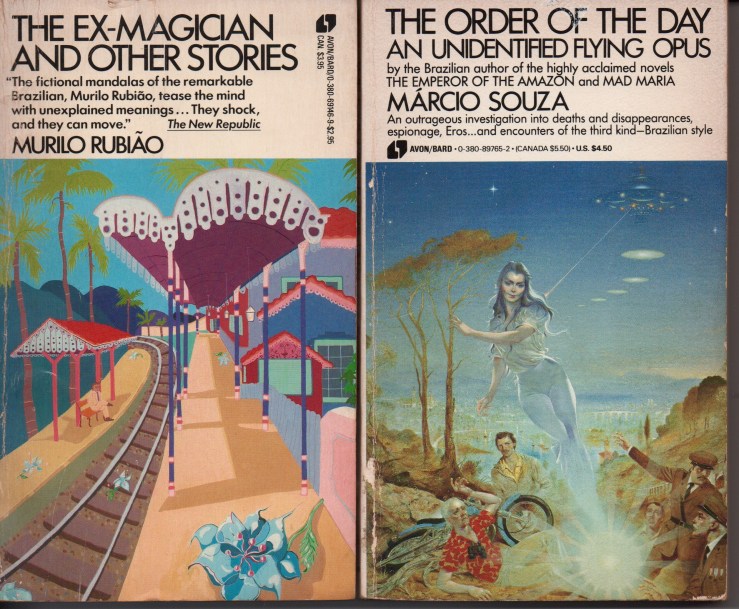
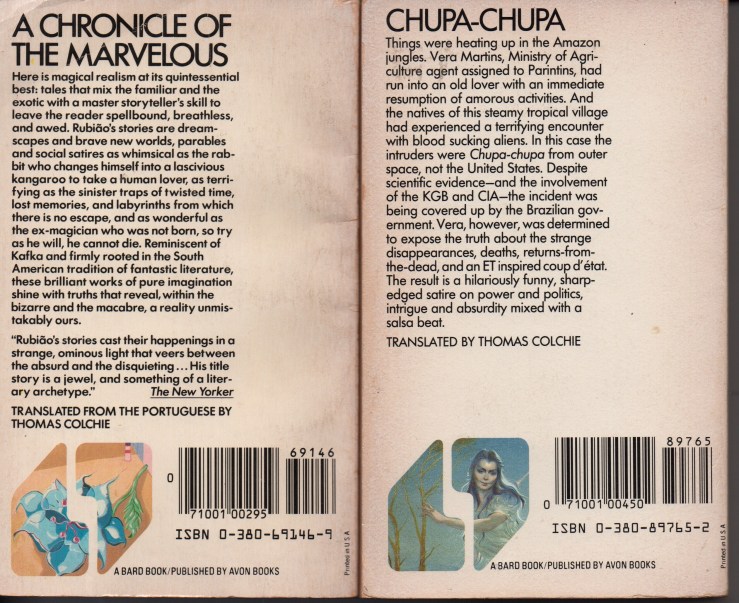
I couldn’t resist these two though, books by Brazilian authors I’d never heard of—The Order of the Day, a novel by Marcio Souza, and Murilo Rubiao’s collection The Ex-Magician and Other Stories.

img_3107

Bored of Hell

img_3055

I am bored of Hell, Henri Barbusse’s 1908 novel of voyeurism.

Maybe I should blame the 1966 English translation (from the French) by Robert Baldick, which often feels stuffily stuffy for a book about “childbirth, first love, marriage, adultery, lesbianism, illness, religion and death” (as our dear translator puts it in his brief preface). Maybe I should blame it on Baldick, but that seems rash and wrong, and I have no basis of comparison, do I?

So I blame it on myself, this boredom of Hell.

Why write then? Why not write it off, rather, which is to say, do not write—I don’t know.

I’m bored with Hell and there are half a dozen novels I’ve recently  read (or am reading) that I should commend, recommend, attempt to write about—but here I am bored of Hell, and writing about it. Maybe it’s—and the it here refers to writing about Hell, a book I confesss a boredom of—maybe it’s because I’ve allowed myself over the last few days to good lord skim the goddamned infernal thing, not skimming for a replenishing sustenance, but rather looking for the juicy fat bits, the best bits, in the same way a teenaged version of myself skimmed Henry Miller and Anaïs Nin in a powerful sweat.

(I was a teenage cliché).

Maybe it’s that the best bits of Hell weren’t juicy enough. (In this novel, an unnamed narrator espies all sorts of sensual (and nonsensual) shenanigans through a small hole in his hotel room). Or maybe the juicy bits were juicy, but the translation dried them out. So many of the sentences made me want to close the book. But it’s unfair for me to write this, I suppose, without offering a sample. Here, from early in the novel, is an excerpt that did make me want to keep going:

The mouth is something naked in the naked face. The mouth, which is red with blood, which is forever bleeding, is comparable to the heart: it is a wound, and it is almost a wound to see a woman’s mouth.

And I begin trembling before this woman who is opening a little and bleeding from a smile. The divan yields warmly to the embrace of her broad hips; her finely-made knees are close together, and the whole of the centre of her body is in the shape of a heart.

…Half-lying on the divan, she stretches out her feet towards the fire, lifting her skirt slightly with both hands, and this movement uncovers her black-stockinged legs.

And my flesh cries out…

Those last ellipses were mine. Did you want more? I did, I admit. And yet after 50 pages, I grew bored. The voyeurism was boring—sprawling. Perhaps I’m lazy. Perhaps I want my voyeurism condensed. Maybe…weirder. I don’t know. Reader, I skimmed. I skimmed, like I said, for morsels—but also to the end, the the final chapter, to the final exquisite not boring paragraph, which I’ll share with you now before “I have done,” as the narrator states in this final section. Promised paragraph:

I believe that confronting the human heart and the human mind, which are composed of imperishable longings, there is only the mirage of what they long for. I believe that around us there is only one word on all sides, one immense word which reveals our solitude and extinguishes our radiance: Nothing! I believe that the word does not point to our insignificance or our unhappiness, but on the contrary to our fulfillment and our divinity, since everything is in ourselves.

The quest is fun, the walking in the dark is fun | Yuri Herrera interviewed at 3:AM Magazine

img_2013

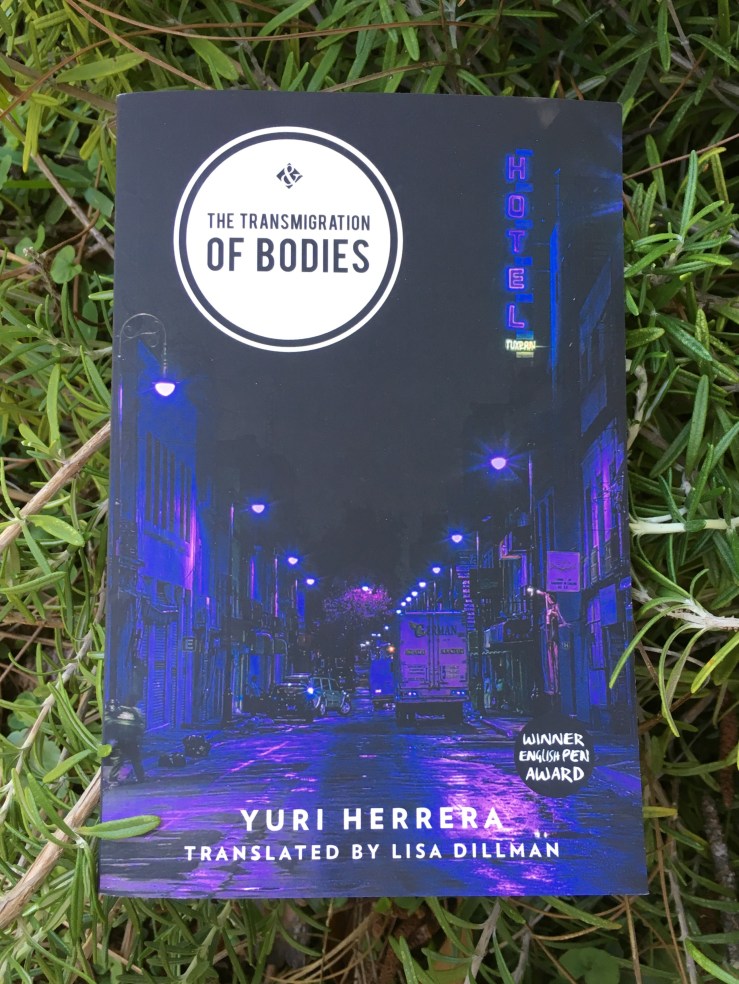
Yuri Herrera was interviewed by Tristan Foster at 3:AM Magazine a few weeks ago. Herrera’s new novella (or “new” in English translation by Lisa Dilman, anyway) is The Transmigration of Bodies and it’s really, really good. I read most of it in one sitting a few months back, and I owe it a proper review. Herrera’s previous novella, Signs Preceding the End of the World, was one of my favorite books published last year.

From the interview:

3:AM: Despite both the seriousness of its themes and the apocalyptic backdrop, Transmigration is full of an absurd kind of fun. I’m thinking here, for instance, of the scene at the strip club; the strippers have taken off everything except for their facemasks, but they use the allure of removing the masks to excite the men watching. Is this writing fun? Is fun crucial to this kind of writing?

YH: The quest is fun, the walking in the dark is fun. To create your own paths in a room without light. Of course, this sometimes is also frustrating, when you just keep bumping into things, most commonly into my own very clumsy self. Eventually you discover that you have not been walking completely in the dark but with some sort of intuitive sense of direction, some creative spine. But until you discover that, you alternate between the joy and the anxiety and puzzling with words.

A review of João Gilberto Noll’s surreal novella Quiet Creature on the Corner

img_2588

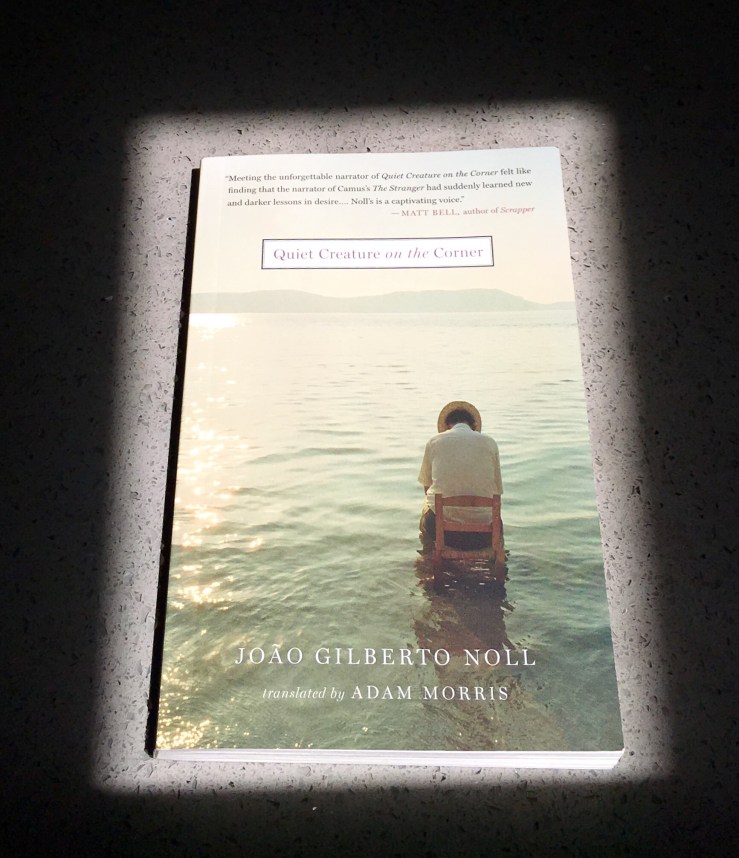
Brazilian writer João Gilberto Noll’s 1991 novella Quiet Creature on the Corner is new in English translation (by Adam Morris) from Two Lines Press.

The book is probably best read without any kind of foregrounding or forewarning.

Forewarning (and enthusiastic endorsement): Quiet Creature on the Corner is a nightmarish, abject, kinetic, surreal, picaresque read, a mysterious prose-poem that resists allegorical interpretation. I read it and then I read it again. It’s a puzzle. I enjoyed it tremendously.

So…what’s it about?

For summary, I’ll lazily cite the back of the book:

Quiet Creature on the Corner throws us into a strange world without rational cause and effect, where everyone always seems to lack just a few necessary facts. The narrator is an unemployed poet who is thrown in jail after inexplicably raping his neighbor. But then he’s abruptly taken to a countryside manor where all that’s required of him is to write poetry. What do his captors really want from him?

There’s a lot more going on than that.

So…what’s it about? What’s the “a lot more”?

Okay then.

Maybe let’s use body metaphors. Maybe that will work here.

We are constantly leaking. Blood, sweat, tears. Piss, shit, decay. Cells sloughing off. Snot trickling. Vomit spewing. Shuffling of this mortal etc.

(—Are we off to a bad start? Have I alienated you, reader, from my request that you read Noll’s novella?—)

What I want to say is:

We are abject: there are parts of us that are not us but are us, parts that we would disallow, discard, flush away. We are discontinuous, rotten affairs. Bodies are porous. We leak.

We plug up the leaks with metaphors, symbols, tricks, gambits, recollections,  reminiscences. We convert shame into ritual and ritual into history. We give ourselves a story, a continuity. An out from all that abjection. An organization to all those organs. We call it an identity, we frame it in memory.

What has this to do with Noll’s novella?, you may ask, gentle reader. Well. We expect a narrative to be organized, to represent a body of work. And Quiet Creature on the Corner is organized, it is a body—but one in which much of the connective tissue has been extricated from the viscera.

We never come to understand our first-person narrator, a would-be poet in the midst of a Kafkaesque anti-quest. And our narrator never comes to understand himself (thank goodness). He’s missing the connective tissue, the causes for all the effects. Quiet Corner exposes identity as an abject thing, porous, fractured, unprotected by stabilizing memory. What’s left is the body, a violent mass of leaking gases liquids solids, shuttling its messy consciousness from one damn place to the next.

Perhaps as a way to become more than just a body, to stabilize his identity, and to transcend his poverty, the narrator writes poems. However, apart from occasional brusque summaries, we don’t get much of his poetry. (The previous sentence is untrue. The entirety of Quiet Creature on the Corner is the narrator’s poem. But let’s move on). He shares only a few lines of what he claims is the last poem he ever writes: “A shot in the yard out front / A hardened fingernail scraping the tepid earth.” Perhaps Quiet Creature is condensed in these two lines: A violent, mysterious milieu and the artist who wishes to record, describe, and analyze it—yet, lacking the necessary tools, he resorts to implementing a finger for a crude pencil.  Marks in the dirt. An abject effort. A way of saying, “I was here.” A way of saying I.

Poetry perhaps offers our narrator—and the perhaps here is a big perhaps—a temporary transcendence from the nightmarish (un)reality of his environs. In an early episode, he’s taken from jail to a clinic where he is given a nice clean bed and decides to sleep, finally:

I dreamed I was writing a poem in which two horses were whinnying. When I woke up, there they were, still whinnying, only this time outside the poem, a few steps a way, and I could mount them if I wanted to.

Rest, dream, create. Our hero moves from a Porto Alegre slum to a hellish jail to a quiet clinic and into a dream, which he converts into a pastoral semi-paradise. The narrator lives a full second life here with his horses, his farm, a wife and kids. (He even enjoys a roll in the hay). And yet sinister vibes reverberate under every line, puncturing the narrator’s bucolic reverie. Our poet doesn’t so much wake up from his dream; rather, he’s pulled from it into yet another nightmare by a man named Kurt.

Kurt and his wife Gerda are the so-called “captors” of the poet, who is happy, or happyish, in his clean, catered captivity. He’s able to write and read, and if the country manor is a sinister, bizarre place, he fits right in. Kurt and Gerda become strange parent figures to the poet. Various Oedipal dramas play out—always with the connective tissue removed and disposed of, the causes absent from their effects. We get illnesses, rapes, corpses. We get the specter of Brazil’s taboo past—are Germans Kurt and Gerda Nazis émigrés? Quiet Creature evokes allegorical contours only to collapse them a few images later.

What inheres is the novella’s nightmare tone and rhythm, its picaresque energy, its tingling dread. Our poet-hero finds himself in every sort of awful predicament, yet he often revels in it. If he’s not equipped with a memory, he’s also unencumbered by one.

And without memory the body must do its best. A representative passage from the book’s midway point:

Suddenly my body calmed, normalizing my breathing. I didn’t understand what I was doing there, lying with my head in a puddle of piss, deeply inhaling the sharp smell of the piss, as though, predicting this would help me recover my memory, and the memory that had knocked me to the floor appeared, little by little, and I became fascinated, as what had begun as a theatrical seizure to get rid of the guy who called himself a cop had become a thing that had really thrown me outside myself.

Here, we see the body as its own theater, with consciousness not a commander but a bewildered prisoner, abject, awakened into reality by a puddle of piss and threatened by external authorities, those who call themselves cops.  Here, a theatrical seizure conveys meaning in a way that supersedes language.

Indeed our poet doesn’t harness and command language with purpose—rather, he emits it:

No, I repeated without knowing why. Sometimes a word slips out of me like that, before I have time to formalize an intention in my head. Sometimes on such occasions it comes to me with relief, as though I’ve felt myself distilling something that only once finished and outside me, I’ll be able to know.

And so, if we are constantly leaking, we leak language too.

It’s the language that propels Noll’s novella. Each sentence made me want to read the next sentence. Adam Morris’s translation rockets along, employing comma splice after comma splice. The run-on sentences rhetorically double the narrative’s lack of connecting tissue. Subordinating and coordinating conjunctions are rare here. Em dashes are not.

The imagery too compels the reader (this reader, I mean)—strange, surreal. Another passage:

Our arrival at the manor.

The power was out. We lit lanterns.

I found a horrible bug underneath the stove. It could have been a spider but it looked more like a hangman. I was on my knees and I smashed it with the base of my lantern. The moon was full. The low sky, clotted with stars, was coming in the kitchen window. December, but the night couldn’t be called warm—because it was windy. I was crawling along the kitchen tiles with lantern in hand, looking for something that Kurt couldn’t find. I was crawling across the kitchen without much hope for my search: he didn’t the faintest idea of where I could find it.

What was the thing Kurt and the narrator searched for? I never found it, but maybe it’s somewhere there in the narrative.

Quiet Creature on the Corner is like a puzzle, but a puzzle without a reference picture, a puzzle with pieces missing. The publishers have compared the novella to the films of David Lynch, and the connection is not inaccurate. Too, Quiet Creature evokes other sinister Lynchian puzzlers, like Roberto Bolaño’s 2666 (or Nazi Literature in the Americas, which it is perhaps a twin text to). It’s easy to compare much of postmodern literature to Kafka, but Quiet Creature is truly Kafkaesque. It also recalled to me another Kafkaesque novel, Alasdair Gray’s Lanark—both are soaked in a dark dream logic. Other reference points abound—the paintings of Francis Bacon, Leon Golub, Hieronymus Bosch, Goya’s etchings, etc. But Noll’s narrative is its own thing, wholly.

I reach the end of this “review” and realize there are so many little details I left out that I should have talked about–a doppelgänger and street preachers, an election and umbanda, Bach and flatulence, milking and mothers…the wonderful crunch of the title in its English translation—read it out loud! Also, as I reach the end of this (leaky) review, I realize that I seem to understand Quiet Creature less than I did before writing about it. Always a good sign.

João Gilberto Noll’s Quiet Creature on the Corner isn’t for everyone, but I loved it, and look forward to future English translations—Two Lines plans to publish his 1989 novel Atlantic Hotel in the spring of next year. I’ll probably read Quiet Creature again before then. Hopefully I’ll find it even weirder.

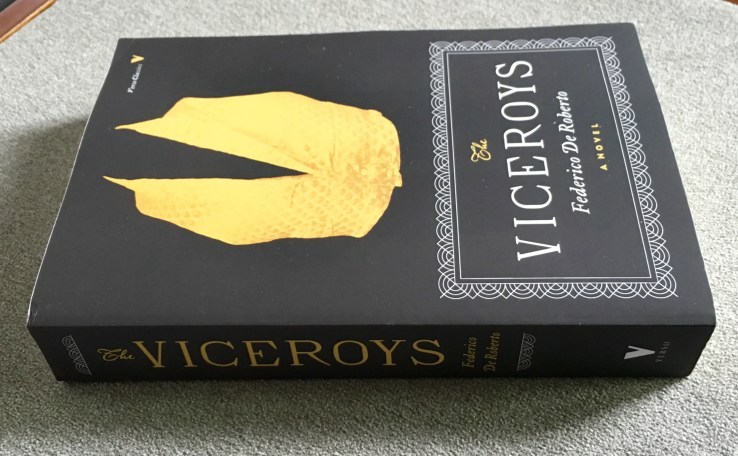
The Viceroys (Book acquired, 12.22.2015)

img_1195

Federico De Roberto 1894 novel The Viceroys is back in print again via the good people at Verso. This edition is translated by Archibald Colquhoun, with a foreword by Franco Moretti. Verso’s blurb:

A lost literary classic, written in 1894, The Viceroys is one of the most acclaimed masterworks of Italian realism.

The novel follows three generations of the aristocratic Uzeda family as it struggles to hold on to power in the face of the cataclysmic changes rocking Sicily. As Garibaldi’s triumphs move Italy toward unification, the Uzedas try every means to retain their position. De Roberto’s satirical and mordant pen depicts a cast of upper-class schemers, headed by the old matriarch, Donna Teresa, and exemplified by her arrogant and totally unscrupulous son, Consalvo, who rises to political eminence through lip service, double-dealing, and hypocrisy. The Viceroys is a vast dramatic panorama: a new world fighting to shrug off the viciousness and iniquities of the old.

Moretti’s blurb:
“A unique combination of naturalistic lucidity over the fate of impoverished aristocracies, and a Goya-like inventiveness in extracting from social disintegration a whole gallery of grotesques and monstrosities … a superb lesson in how coarse and rancid the collapse of a ruling class actually is.

Li Ang’s The Lost Garden (Book acquired, 11.20.2015)

IMG_0669

Li Ang’s novel The Lost Garden is new in English translation by Sylvia Li-chun Lin with Howard Goldblatt. Publisher Columbia University Press’s blurb:

In this eloquent and atmospheric novel, Li Ang further cements her reputation as one of our most sophisticated contemporary Chinese-language writers. The Lost Garden moves along two parallel lines. In one, we relive the family saga of Zhu Yinghong, whose father, Zhu Zuyan, was a gentry intellectual imprisoned for dissent in the early days of Chiang Kai-shek’s rule. After his release, Zhu Zuyan literally walled himself in his Lotus Garden, which he rebuilt according to his own desires.

Forever under suspicion, Zhu Zuyan indulged as much as he could in circumscribed pleasures, though they drained the family fortune. Eventually everything belonging to the household had to be sold, including the Lotus Garden. The second storyline picks up in modern-day Taipei as Zhu Yinghong meets Lin Xigeng, a real estate tycoon and playboy. Their cat-and-mouse courtship builds against the extravagant banquets and decadent entertainments of Taipei’s wealthy businessmen. Though the two ultimately marry, their high-styled romance dulls over time, forcing them on a quest to rediscover enchantment in the Lotus Garden. An expansive narrative rich with intimate detail, The Lost Garden is a moving portrait of the losses incurred as we struggle to hold on to our passions.

Read “Crow Mountain,” a new short story by Can Xue

“Crow Mountain” is a new short story by Can Xue in the July issue of Asymptote. Translation by Karen Gernant and Chen Zeping. The first few paragraphs:

I’d been waiting for a long time for Qinglian, who lived on the fifth floor, to take me to a place called “Crow Mountain.” It was a vacant five-story building on the brink of collapse. It used to be the municipal office. I had passed by it only once—the year I was four. I remembered Mama pointing at the large, tightly closed windows and saying to me, “This is ‘Crow Mountain’!” All kinds of questions occurred to me right away. “What do you mean, it’s a mountain?” I asked. “It’s obviously a building. Where are the crows? Are these windows shut so tightly because they’re afraid the crows inside will fly away?” Dad was standing beside me. I wanted to ask still more questions, but he cut me off: “Come on, let’s go!”

Later we moved to another part of the city. It was Qinglian who told me more about that building. Qinglian was only fourteen but already a beauty, and I envied her. She always frowned as she said to me, “Juhua, Juhua, how can you be so ugly? I’m embarrassed to be seen with you.” I knew she was kidding, so I didn’t get mad. We had been talking about “Crow Mountain” for a long time. Everything I knew about it came from Qinglian. Though I could still vaguely remember that large building outside the city, I hadn’t been back a single time. The city was too big. But Qinglian went every year because her uncle was a gatekeeper there.

“They’re always saying it’s going to collapse, but actually it isn’t. It’ll be fine for decades. It’s so much fun inside!” she said.

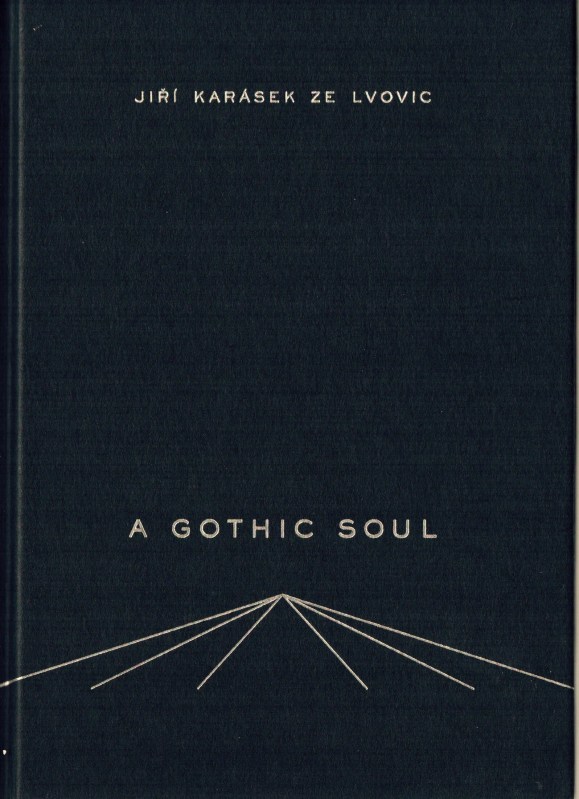
Jiří Karásek ze Lvovic’s A Gothic Soul (Book acquired, 3.30.2015)

image

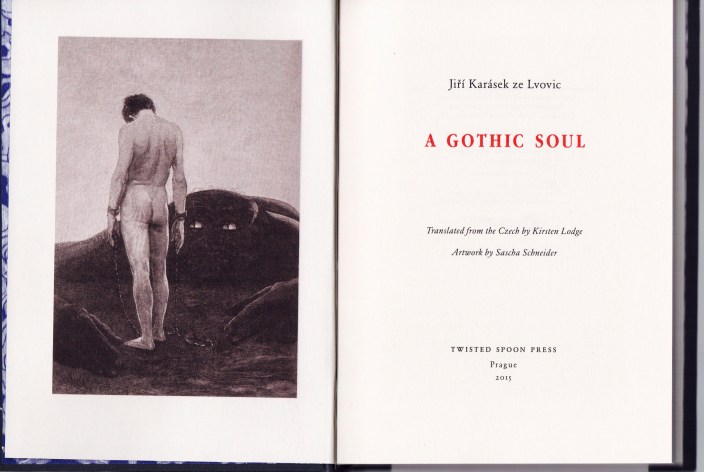
Another beautiful volume from Twisted SpoonA Gothic Soul by Jiří Karásek ze Lvovic, translated from the Czech by Kirsten Lodge, featuring prints by Sascha Schneider.

I dipped my toe in this weekend—strange, brooding stuff. More to come.

image

Twisted Spoon’s blurb:

A Gothic Soul is the most acclaimed work of Czech Decadent prose. Expressing concerns that are unique to the Czech movement while alluding creatively and ironically to Joris-Karl Huysman’s Against Nature, the novella is set in Prague, which is portrayed as a dead city, a city peopled by shades, who, like the protagonist — a nihilist and the “last scion of a noble line” — are only a dim reflection of the city’s medieval splendor. The man lives in a dreamworld, the labyrinth of his soul giving rise to visions. In his quest for meaning, he walks the city, often hallucinating, while pondering questions of religious fervor and loss of faith, the vanity of life, his own sense of social alienation, human identity and its relationship to a “nation,” the miserable situation of the Czechs under Habsburg rule, and Prague’s loss of its soul on the cusp of modernity as old sections, such as much of the squalid Jewish Quarter, are demolished to make way for gaudy new buildings and streets. With a history of madness running in the family and afraid the same fate awaits him, he ultimately retreats into seclusion, preferring the monastic way of life as the epitome of unity and wholeness and a tonic to present-day fragmentation. Yet Karásek eschews the mawkish, opting instead for darker tones that play with the tropes and motifs of Decadence while conflating the same-sex desires of his protagonist, the fatalism and futility of such an existence within the social construct of the day, with concerns for the dual fates of his nation and city.

Given his importance for Czech literature and for European Decadence, very little of Karásek’s work has been translated into English. Kirsten Lodge included translations of his poetry in Solitude, Vanity, Night: An Anthology of Czech Decadent Poetry, and we have made available her translations of some of his shorter prose here and here. This is the first time A Gothic Soul, or any full-length work of Karásek’s prose, has been translated into English.

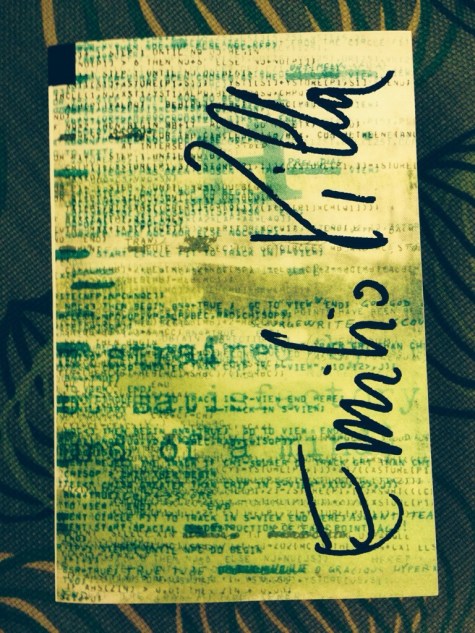
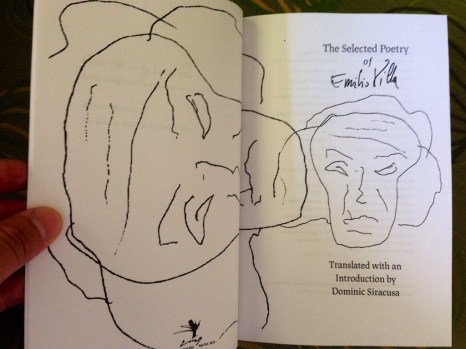
The Selected Poetry of Emilio Villa (Book Acquired, 6.27.2014)

20140707-150232-54152226.jpg

I had never heard of Emilio Villa until the kind people at Contra Mundum forwarded me some digital excerpts from their new collection, The Selected Poetry of Emilio Villa. Those excerpts were fascinating, but they don’t—can’t—capture how big and strange and beautiful the finished book is.

20140707-150237-54157430.jpg

Dominic Siracusa translates; he also provides a lengthy introduction, an essay that primes the reader to better understand Villa, a “a biblicist who composed experimental verse in over ten different languages.”

20140708-101510-36910695.jpg

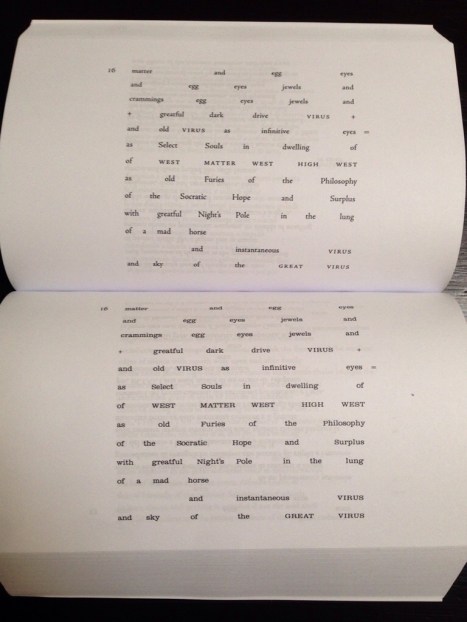
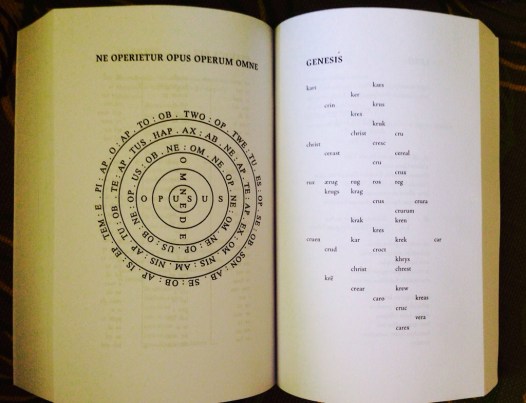
The variety of languages Villa composed in is complicated by his experimental techniques including fragmentation, the blending and splitting of morphemes, his use of graphemes, and other corruptions and disruptions.

20140707-150235-54155513.jpg

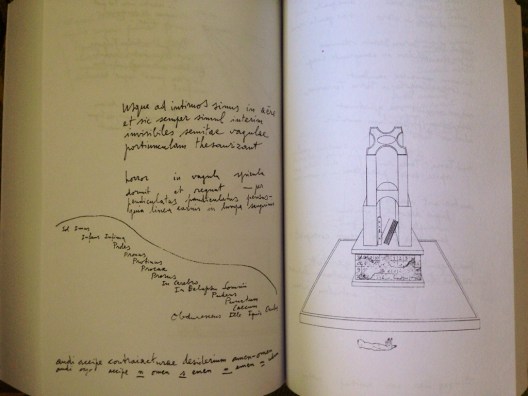
Villa’s poetry seems simultaneously to be a rich linguistic ooze, generative and messy, blending through myth and time, but also a refinement, a collection of criticism even. The book is really damn puzzling in a really fun way.

20140707-150233-54153921.jpg

More to come, for now, the lengthy jacket copy:

While Emilio Villa (1914–2003) was referred to as Zeus because of his greatness and Rabelais because of his mental voracity, for decades his work remained in oblivion, only recently surfacing to reveal him to be one of the most formidable figures of the Italian Novecento, if not of world culture. His marginalization was in part self-inflicted, due to his sibylline nature if not to his great erudition, which gave rise to a poetics so unconventional that few knew what to make of it: a biblicist who composed experimental verse in over ten different languages, including tongues from Milanese dialect and Italian to French, Portuguese, ancient Greek, and even Sumerian and Akkadian. As Andrea Zanzotto declared, “From the very beginning, Villa was so advanced that, even today, his initial writings or graphemes appear ahead of the times and even the future, suspended between a polymorphous sixth sense and pure non-sense.”

In merging his background as a scholar, translator, and philologist of ancient languages with his conception of poetics, Villa creates the sensation that, when reading his work, we are coming into contact with language at its origins, spoken as if for the first time, with endless possibilities. Whether penning verse, translating Homer’s Odyssey, or writing on contemporary or primordial art, Villa engages in a paleoization of the present and a modernization of the past, wherein history is abolished and interpretation suspended, leaving room only for the purely generative linguistic act, one as potent today as it was eons ago.

This volume of Villa’s multilingual poetry ranges across his entire writing life and also includes selections from his translation of the Bible, his writings on ancient and modern art, and his visual poetry. Presented in English for the very first time, The Selected Poetry of Emilio Villa also contains material that is rare even to Italian readers. In adhering to the original notion of poetry as making, Villa acts as the poet-faber in tandem with his readers, creating une niche dans un niche for them to enter and create within, as if language itself were an eternal and infinite void in which creation remains an ever possible and continuously new event.

Miruna, A Tale (Book Acquired, 6.24.2014)

20140707-150427-54267363.jpg

I had hoped to read Bogdan Suceavă’s Miruna, A Tale (translated from the Romanian by Alistair Ian Blyth and new from Twisted Spoon Press) over the July 4th weekend—it was the only physical book I took with me out of town—but alas swimming and sun and sand and booze and food and fireworks &c. blocked me.

Very cool little book—and beautiful. (My iPhone pic does no justice to the simple, gorgeous design).

Publisher’s blurb; more to come:

A village in the Carpathian Mountains, one of the last outposts of pre-modernity, an elderly man, sensing his time is short, tells his young grandchildren tales that weave a family saga covering the real history from the 1870s to the time of the telling. One of the children, now grown, is the re-teller of these tales, while the other, Miruna, perhaps has the gift of second sight. Incorporating elements of fantasy common to the storytelling traditions of the Balkans, historical characters mix with imaginary beings in a landscape that recreates the world of an isolated village bearing an unusual name : Evil Vale. Ancestors are talked about as if ancient heroes, and the novel shifts focus between telling about their lives and the storyteller’s own experiences through the prism of the village during both world wars. As past tragedies are presented in a way that the grandchildren might picture and remember them, the novel has been called a kind of meta-fairy tale, a story about the lost tradition of oral storytelling itself, the conveyance of a family history from one generation to the next via the spoken word. With the death of the grandfather, the children realize that confronted with the ubiquitous hand of modernity, which the village has managed to frustrate over a succession of regimes, a whole world of stories and the entire memory of a family and of its idiosyncratic way of life in the village might have been irrevocably lost.

“Physical books should be sublime, digital books should be free” |Haute Culture Publisher Luis de Miranda Interviewed

truth

Biblioklept: What is Haute Culture Press?

Luis de Miranda: Haute Culture is a new venture in luxury publishing with a mission to bring masterpieces of global literature to English-speaking readers around the world. Since your site is called “Biblioklept,” I’ll start by saying that we are a new kind of Robin Hood: we give to both the “poor” and the “rich.” We offer free e-books to the modern global reader interested in discovering hidden gems of classic European literature and, simultaneously, we offer individuals of greater means the opportunity to become mini-Medici’s, actively supporting culture while enjoying a luxurious limited edition book that will increase in value year after year.

This model is summed up in our slogan: Physical books should be sublime, digital books should be free. The sales of our limited luxury editions—each a distinctive art object—support the distribution of free e-books for each of our titles. Buyers of our limited editions, in effect, become benefactors—or “Book Angels,” as we call them. I believe this model will satisfy collectors and book lovers.

Furthermore, as e-books become cheaper and cheaper, I want to create a model that does not depend on the diminishing revenues of e-book sales and allows us to reach as many readers as possible, particularly younger readers.  If we want younger generations to read quality literature, and not just the latest bestsellers, free e-books are the way to go.

Biblioklept: Is the possible disconnect between electronic books and “luxury” an issue? Does this new publishing model privilege the book as an aesthetic object?

LdM: This model privileges the free distribution of quality literature and it reinvents the physical book as a cult object. I aim to create unique objects that make the poetry of texts tangible.  As we all spend more time in front of screens, I believe that the experiential aspect of the printed book will become more important, with readers looking for a higher quality object. I foresee the return of the “gentleman’s library” (or “gentlewoman’s library”), with fine leather volumes and limited editions—the polar opposite of e-books. Our limited editions will embody my great respect for the ritual of reading and for the craftsmanship of book making, while at the same time subsidizing the free distribution of our e-books and building a new global audience for iconic European literary masters.

Biblioklept: Is Haute Culture the first group to employ this model, to your knowledge?

LdM: Yes. We are innovating and experimenting. I don’t know if ours will be an economically viable model in the end, but it is definitely a desirable one. Since we are exploring uncharted territory, we have to take things step by step. We are avoiding the established highways over artificial ponds, and attempting to build our own bridge. We might fail or we might create a new path that the others will soon follow.

Biblioklept: Why did you choose A.H. Tammsaare’s Truth and Justice as the first book in this series?

LdM: Our first publication is actually a new translation and an ultra-limited bilingual edition of the Flaubert novella, Felicity: The Tale of the Simple Heart. In December 2013, it will be on sale at Assouline Boutiques in New York, Los Angeles, London, and Paris.

Volume I of Tammsaare’s Truth and Justice is planned for publication in 2014. It is a fine example of an untranslated classic. Tammsaare himself is an icon of 20th century Estonian literature. Two museums, a monument, and a park in the center of Tallinn are all dedicated to him. Unlike some traditional classics, which are widely referred to but rarely read, his masterpiece, Truth and Justice, still retains its place at the front of Estonian bookshelves and yet this epic work has never been translated into English. I also have some personal reasons for launching the press with an Estonian icon like Tammsaare. I wrote my last novel in Estonia three years ago and I wanted to pay homage to the land that inspired me.

Biblioklept: What is Tammasaare’s book about? Why is it important?

LdM: Truth and Justice is considered Tammsaare’s most important work. It was written during the rise of dictators—Hitler, Stalin, Mussolini—and it captures the evolution of Estonia from Tsarist province to independent state. Though it’s deeply rooted in Estonian peasant life, the first volume deals with timeless literary and philosophical issues, developing a vigorous, straightforward narrative that addresses the dual nature of the human psyche.

The book’s characters, storylines, and language continue to inform Estonia’s culture today. References to Truth and Justice are pervasive, and one hears its echoes in contemporary Estonian literature, as well as other art forms. One need only call two men “Andres and Pearu” for any Estonian to understand the nature of their relationship.

Volume I presents life in an Estonian village, as farmers battle against nature during the last quarter of the 19th century. The two main characters, both unique and powerful men, represent the essential conflicts of human nature: not only good vs. evil, but also hope vs. conservatism, conquest vs. pettiness. The saga explores how human impulses compete with each other and complete the characters.

Although the first volume seems entirely dedicated to peasant life in rural Estonia at the threshold of modernity, the book deals with fundamental issues that are quite relevant today. You might say this book reflects what we are trying to do at Haute Culture. Truth and Justice is a story of simple people who work the land endlessly, striving to build a world were truth and justice prevail, where good is fostered and protected, not killed by conformity or lack of courage. Beautiful things grow slowly like plants. Perhaps this is a lesson for all the capitalists of the world.

Luis de
Luis de Miranda

Biblioklept: What future plans do you have for Haute Culture? What other books would you like to publish?

LdM: We are currently translating a Russian book by the cult novelist Yuri Mamleyev, called Shatuny. We are working with one of the best Russian to English translators, Marian Schwartz, who translated Bulgakov and Berberova. Shatuny is a mind-blowing, hallucinatory story about the quest for absolute truth. Maybe we are obsessed by truth?

Bringing untranslated texts to English readers around the world is one aspect of a wider mission to bring singular, fine, original works to the global corpus. That has always been my goal—to democratize access to culture. I’ve been to the Frankfurt Book Fair many times and met with publishers and agents in New York. I’ve noticed not only that many great European works have not been translated to English, but also that the mainstream US and UK publishers tend to translate only genre bestsellers—thrillers for example.

English is now the international language and I believe it’s possible, and indeed essential to bring to the international psyche works that aren’t standardized and cliché, but truly represent a unique viewpoint. I plan to build a catalogue that only includes masterpieces. Publishers who rely on the old publishing model must often publish potential bestsellers they secretly despise, yet there are so many excellent contemporary classics waiting to be discovered and translated into English. With Haute Culture, I refuse to compromise. Literature has the potential to create a more diverse and interconnected world, but in order to reach that potential we must fight against a profit-driven culture.

Biblioklept: Have you ever stolen a book?

LdM: When I was 18, I had a summer job at a bookshop in the Pompidou Center in Paris. At the end of my first day, I took about 20 books home with me, feeling that I had found Ali Baba’s cave, but a few days later I felt guilty and replaced all the books on their shelves.


New Issue of Asymptote Features David Mitchell, László Krasznahorkai, Fady Joudah and More

The July issue of Asymptote, a journal devoted to literary translation, is chock-full of goodies, including a long interview with David Mitchell, a shorty from László Krasznahorkai translation, and an essay by Fady Joudah with the marvelous title  “Dear God, Your Message Was Received in Error.” Here’s the beginning of that essay:

In Borges’ story, “Averroës’ Search,” Averroës interrupts his long day of contemplating the problem that confronts him in Aristotle’s Poetics (how to translate ‘tragedy’ and ‘comedy’ into Arabic) and joins friends for dinner. The Andalusian philosopher seems to be listening (against hope or “without conviction” as Borges put it) for a solution to his problem in something that any of his guests might say. Maybe the answer is “near at hand” or, as in Lydia Davis’ “The Walk,” right “across the street.”

As the conversation meanders through various subjects about writing, God, and art, one of Averroës’ guests brings up the account of the seven sleepers:

“Let us imagine that someone shows a story instead of telling it—the story of the seven sleepers of Ephesus, say.* We see them retire into the cavern, we see them pray and sleep, we see them sleep with their eyes open, we see them grow while they are asleep, we see them awaken after three hundred nine years, we see them hand the merchant an ancient coin, we see them awaken with the dog.”

Borges’ mention of the seven sleepers comforts me, perhaps because I know the story from the Koran. Or perhaps because it serves as yet another cornerstone of what translation work can perform: transforming telling into seeing. Telling a story through seeing is also a gesture at what Averroës could not grasp when he encountered Aristotle’s ‘tragedy’ and ‘comedy’: theatre.

Lots of great stuff–check it out.


Made-up Flowers from Boris Vian’s Novel Heartsnatcher

In the order they appear:

Amizaltzes

Powaroses

Marienbud

Yellowplush

Dreamrape

Fenellacas

Ninastangas

Astrakhan

Marazardins

Seacrocus

Bruinzozos

Bazabobos

Petaleaves

Translated from the French by Stanley Chapman