I Review Tom McCarthy’s Essay “Transmission and the Individual Remix”

Telephone Picture EM 3 — Laszlo Moholy-Nagy

In an interview published back in 2010 (coinciding roughly with the release of his excellent novel C), Tom McCarthy evaluated his work:

I see what I’m doing as simply plugging literature into other literature. For me, that’s what literature’s always done. If Shakespeare finds a good speech in an older version of Macbeth or Pliny, he just rips it and mixes it. It’s like DJing.

McCarthy’s new essay “Transmission and the Individual Remix” explores the idea of artist as DJ, as remixer, as synthesizer. It’s a brief, fun read—28 pages on paper the publicity materials claim, but it’s only available as an etext, so its length is hard to measure in terms of pages. It took me less than an hour to read it on my Kindle Fire. Then I read it again. Although publisher Vintage kindly sent me a copy, I’d argue that it’s well worth the two bucks they’re asking.

“Transmission” is playful and discursive, as befits its subject. The essay is not nearly as pretentious as its subtitle (“How Literature Works”) might suggest. McCarthy riffs on a few subjects to illustrate his thesis: Kraftwerk, the Orpheus myth (and its many, many retellings and interpretations), Rilke, Alexander Graham Bell, “Blanchot, Barthes, or any other dubious French character whose names starts with B,” Ulysses, Kafka, Beckett, etc. But what is his thesis? What does he want? He tells us:

My aim here, in this essay, is not to tell you something, but to make you listen: not to me, nor Beckett and Kafka, but to a set of signals that have been repeating, pulsing, modulating in the airspace of the novel, poem, play—in their lines, between them and around them—since each of these forms began. I want to make you listen to them, in the hope not that they’ll deliver up some hidden and decisive message, but rather that they’ll help attune your ear to the very pitch and frequency of its own activity—in other words, that they’ll help attune your ear to the very pitch and frequency of its own activity—in other words, that they’ll enable you to listen in on listening itself.

McCarthy’s concern here is to point out that nothing is original, that all creation is necessarily an act of synthesis. To read a novel is to read through the novel, to read the novelist’s sources (or, to use McCarthy’s metaphor, to listen through). McCarthy’s insights here are hardly new, of course—Ecclesiastes 1:19 gives us the idea over 2000 years ago, and surely it’s just another transmitter passing on a signal. What makes “Transmission” such a pleasure is its frankness, its clarity. Unlike so much postmodern criticism, McCarthy doesn’t trip over jargon or take flights of fancy into obscure metaphor. And even when he does get a bit flighty, he manages to clarify so many ideas of basic deconstructive theory:

This is it, in a nutshell: how writing works. The scattering, the loss; the charge coming from somewhere else, some point forever beyond reach or even designation, across a space of longing; the surge; coherence that’s only made possible by incoherence; the receiving which is replay, repetition—backward, forward, inside out or upside down, it doesn’t matter. The twentieth century’s best novelist understood this perfectly. That’s why Ulysses’s Stephen Dedalus—a writer in a gestational state of permanent becoming—paces the beach at Sandymount mutating, through their modulating repetition, air- and wave-borne phrases he’s picked up from elsewhere, his own cheeks and jaw transformed into a rubbery receiver . . .

Amazingly, the name Derrida doesn’t show up in “Transmission,” even as McCarthy gives us such a clear outline of that philosopher’s major ideas, as in the above riff’s explication of différance and iterability (with twist of Lacanian lack to boot). Or here, where McCarthy deconstructs the notion of a stable self:

All writing is conceptual; it’s just that it’s usually founded on bad concepts. When an author tells you that they’re not beholden to any theory, what they usually mean is that their thinking and their work defaults, without even realizing it, to a narrow liberal humanism and its underlying—and always reactionary—notions of the (always “natural” and preexisting, rather than constructed self, that self’s command of language, language as vehicle for “expression,” and a whole host of fallacies so admirably debunked almost fifty years ago by the novelist Alain Robbe-Grillet.

So I read Derrida through McCarthy’s reading of Robbe-Grillet. This is all transmission, writing as remix, but also reading as remix.

I could go on, but I fear that I’ll simply start citing big chunks of McCarthy’s essay, which is supremely citable, wonderfully iterable. Recommended.

Tom McCarthy: “All Writing Is Conceptual”

From Tom McCarthy’s essay “Transmission and the Individual Remix”:

All writing is conceptual; it’s just that it’s usually founded on bad concepts. When an author tells you that they’re not beholden to any theory, what they usually mean is that their thinking and their work defaults, without even realizing it, to a narrow liberal humanism and its underlying—and always reactionary—notions of the (always) “natural” and preexisting, rather than constructed self, that self’s command of language, language as vehicle for “expression,” and a whole host of fallacies so admirably debunked almost fifty years ago by the novelist Alain Robbe-Grillet.

I Audit Hilary Mantel’s Bring Up the Bodies (Part 2 — In Which I Make Some Game of Thrones Comparisons and Share a Van Gogh Sketch)

1. For context/overview/summary/brief review, read part one.

2. I’m about three-quarters of the way through Bring Up the Bodies, and have thoroughly enjoyed it so far. Rich and detailed, full of ideas and keen perceptions. Mantel posits protagonist Thomas Cromwell as one of the first English Renaissance figures—pre-Elizabeth, pre-Shakespeare. The big payoff of this reading is to see the machinations of a character whose grand task is to make the rest of the world’s ideals (and illusions of those ideals) fit with his own emerging plans for a more egalitarian and democratic world. This isn’t to say that Cromwell is always a nice guy—he can’t be, he has to keep spoiled King Henry happy—but he’s generally sympathetic.

3. Mantel’s Cromwell recalls to me Tyrion Lannister, my favorite character of George R. R. Martin’s A Song of Ice and Fire epic (I enjoyed the first three books very much). In his role as Hand of the King (chronicled this season on the HBO adaptation Game of Thrones), Tyrion faces the thankless task of protecting the people (common and royal) of King’s Landing through a difficult time. Like Cromwell, Tyrion is seriously misunderstood and even hated; he does great good for the “small folk,” yet they will never understand or credit him with these efforts.

Tyrion is also extremely shrewd and cynical, yet also honorable—just like Cromwell. Both characters must play the game of thrones (a game, Martin’s characters remind us and Cromwell equally understands, that you either win or die), but they do not play solely for their own gain. Sure, Cromwell is making boatloads of money from his gig as Henry’s chief minister, but he ultimately has the good of his family and the good of the English people at heart. He and Tyrion want the best for average, common people, and these characters’ humble origins have ensured that they actually understand the needs and wants of average, common people.

4. Why am I belaboring a Game of Thrones comparison? I don’t know. It’s just what’s running through my head as I audit the Bring Up the Bodies audiobook. I guess I think a lot of Martin fans would dig Bring Up the Bodies (and vice versa). Mantel and Martin both do an excellent job at showing the plotting and the scheming, the crafty intrigue that underwrites politics. Both writers have a keen ear for sharp, ironic dialogue, and both writers know not to tip their hands too much to the reader, instead letting the reader puzzle out the shady circumstances for himself.

5. Perhaps off track: Here’s a sketch by Vincent van Gogh of Austin Friars, where Cromwell lived:

6. The thread of language that links Mantel and Martin in my reading is undoubtedly their sources: I am sure that when my ears perk to certain shared phrases (terms of heraldry, descriptions of a plague, “bedwarmer”), what’s really happening is that I’m reading through them, reading their origin texts.

7. Martin handles female perspectives in a patriarchal world with savage aplomb. His women transcend their limited circumstances (as well as the stock conventions that can beleaguer genre fiction). Mantel provides her own subtle critique of patriarchy in Bring Up the Bodies without tripping on historical reality. There’s a remarkable moment when one character—I don’t recall exactly who, but probably a member of Henry’s Privy Council—questions why God didn’t make women’s bellies transparent so that the important matters of succession, inheritance, and paternity might be made, well, clear to all. And while Anne Boleyn is hardly a sympathetic character in Bodies, keep in mind that we’re limited to Cromwell’s perspective. In Wolf Hall, Cromwell showed great concern for Thomas More’s wife and daughters, who were punished for (perceived) crimes that they had no possible agency in abetting. In Bodies, Cromwell shares similar concern for Jane Parker (among other women), wife of George Boleyn (Anne’s brother). Of course, Jane is going to help seal the case against Anne Boleyn for—

8. —brother/sister incest.

9.  And yes, bro-sis incest may be lurid (lurid enough, I’ll admit, to get its own tidy spot on this list)—but it’s to Mantel’s credit that she never exploits the lurid attraction of historical reality (see: Showtime’s The Tudors); she doesn’t have to. That’s not Cromwell’s bag and it’s not necessary anyway. (Here is an obligatory sentence pointing out that one of the major plot points of Game of Thrones rests on brother-sister incest: One of the major plot points of Game of Thrones rests on brother-sister incest ).

10. I’ll end by sticking to Bring Up the Bodies but obliquely suggesting that everything I say about Mantel’s book could apply to Martin’s books, but I’m not going to belabor this post through example (we can chat in the comments section, should you care to, gentle reader). Here’s that ending:

11. Some of my favorite passages in Bring Up the Bodies have to do with Thomas Cromwell’s imaginative capacity,which Mantel channels with fierce brilliance. Cromwell taps into his past in order to shape the present into the future he envisions (an episode with an aging Portuguese knight is especially entertaining). In a few wonderful scenes (perhaps coming to fruition at game’s end?) he imagines a dinner he’ll host with all the courtiers he’s pushing around like pawns; the way he imagines their interactions at table helps him to determine his course of action (or inaction). But the most chilly episodes of imaginative capacity involve Cromwell’s own understanding that his unnatural death is probably a foregone conclusion. He’s too perspicacious to not see that eventually his favor with Henry can only eventually fail. But that’s for the future—for Mantel’s last book in this trilogy, I’m sure, The Mirror and the Light.

List of Fictional Suicides (From David Markson’s Reader’s Block)

Emma Bovary.

Anna Karenina.

Othello.

Jocasta.

Brunnhilde.

Hedda Gabler.

Romeo and Juliet.

Werther.

Dido.

Cio-Cio-San.

Antigone and Haemon.

Miss Julie.

Axel Heyst.

Quentin Compson.

Aida.

Inspector Javert.

Mynheer Peeperkorn. Leo Naphta.

Smerdyakov.

Rudolf Virag.

Edna Pontellier.

Hero.

Manrico’s Leonora.

Cheri.

Goneril.

Richard Cory.

McWatt.

Tosca.

Stravrogin. Kirillov.

Martin Eden.

Hurstwood.

Pyramus and Thisbe.

Roithamer.

Pierre Glendinning.

Winnie Verloc.

George Wilson.

Hedvig Ekdal.

Christine Mannon. Orin Mannon.

Willy Loman.

Senta.

Maggie Johnson.

Peter Grimes.

Bess, the landlord’s black-eyed daughter.

Svidrigailov.

James O. Incandenza.

Konstantin Treplev.

Bartleby.

Septimus Smith.

Deirdre.

Seymour Glass.

Ophelia.

Samson.

Eustacia Vye.

Phaedra.

Alcetis.

Launcelot.

From David Markson’s Reader’s Block.  By my count, Markson references throughout the book 149 suicides (or near-suicides, or presumed suicides) of real, actual persons (i.e., not including the list above). This count does not include Markson’s reference to “Nine hundred and sixty Jews” who “committed suicide at Masada, in 73 A.D., rather than surrender to the Roman legions that had lately sacked Jersusalem.” It’s entirely possible I miscounted.

Five Favorite Fictional Fathers

Literature seems to have an ambivalence toward fatherhood that’s too complex to address in a simple blog post–so I won’t even try. But before I riff on a few of my favorite fathers from a few of my favorite books, I think it’s worth pointing out how rare biological fathers of depth and complexity are in literature. That’s a huge general statement, I’m sure, and I welcome counterexamples, of course, but it seems like relationships between fathers and their children are somehow usually deferred, deflected, or represented in a shallow fashion. Perhaps it’s because we like our heroes to be orphans (whether it’s Moses or Harry Potter, Oliver Twist or Peter Parker) that literature tends to eschew biological fathers in favor of father figures (think of Leopold Bloom supplanting Stephen Dedalus in Ulysses, or Merlin taking over Uther Pendragon‘s paternal duties in the Arthur legends). At other times, the father is simply not present in the same narrative as his son or daughter (think of Telemachus and brave Odysseus, or Holden Caulfield wandering New York free from fatherly guidance). What I’ve tried to do below is provide examples of father-child relationships drawn with psychological and thematic depth; or, to put it another way, here are some fathers who actually have relationships with their kids.

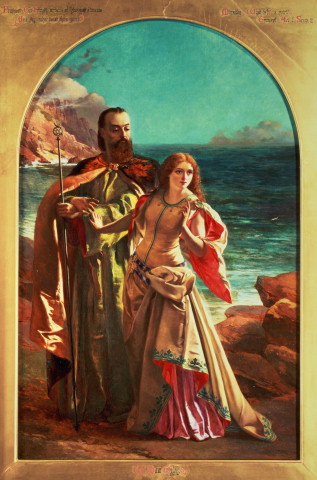
Prospero and Miranda--William Maw Egley
Prospero and Miranda–William Maw Egley

1. Prospero, The Tempest (William Shakespeare)

Prospero has always seemed to me the shining flipside to King Lear’s dark coin, a powerful sorcerer who reverses his exile and is gracious even in his revenge. Where Lear is destroyed by his scheming daughters (and his inability to connect to truehearted Cordelia), Prospero, a single dad, protects his Miranda and even secures her a worthy suitor. Postcolonial studies aside, The Tempest is fun stuff.

2. Abraham Ebdus, The Fortress of Solitude, (Jonathan Lethem)

Like Prospero, Abraham Ebdus is a single father raising his child (his son Dylan) in an isolated, alienating place (not a desert island, but 1970’s Brooklyn). After Dylan’s mother abandons the family, the pair’s relationship begins to strain; Lethem captures this process in all its awkward pain with a poignancy that never even verges on schlock. The novel’s redemptive arc is ultimately figured in the reconciliation between father and son in a beautiful ending that Lethem, the reader, and the characters all earn.

3. Jack Gladney, White Noise (Don DeLillo)

While Jack Gladney is an intellectual academic, an expert in the unlikely field of “Hitler studies” (and something of a fraud, to boot), he’s also a pretty normal dad. Casual reviewers of White Noise tend to overlook the sublime banality of domesticity represented in DeLillo’s signature novel: Gladney is an excellent father to his many kids and step-kids, and DeLillo draws their relationships with a realism that belies–and perhaps helps to create–the novel’s satirical bent.

4. Oscar Amalfitano, 2666 (Roberto Bolaño)

Sure, philosophy professor Amalfitano is a bit mentally unhinged (okay, more than a bit), but what sane citizen of Santa Teresa wouldn’t go crazy, what with all the horrific unsolved murders? After his wife leaves him and their young daughter, Amalfitano takes them to the strange, alienating land of Northern Mexico (shades of Prospero’s island?) Bolaño portrays Amalfitano’s descent into paranoia (and perhaps madness) from a number of angles (he and his daughter show up in three of 2666‘s three sections), and as the novel progresses, the reader slowly begins to grasp the enormity of the evil that Amalfitano is confronting (or, more realistically, is unable to confront directly), and the extreme yet vague danger his daughter is encountering. Only a writer of Bolaño’s tremendous gift could make such a chilling episode simultaneously nerve-wracking, philosophical, and strangely hilarious.

5. The father, The Road (Cormac McCarthy)

What happens when Prospero’s desert island is just one big desert? If there is a deeper expression of the empathy and bonding between a child and parent, I have not read it. In The Road, McCarthy dramatizes fatherhood in apocalyptic terms, positing the necessity of such a relationship in hard, concrete, life and death terms. When the father tells his son “You are the best guy” I pretty much break down. When I first read The Road, I had just become a father myself (my child was only a few days old when I finished it), yet I was still critical of McCarthy’s ending, which affords a second chance for the son. It seemed to me at the time–as it does now–that the logic McCarthy establishes in his novel is utterly infanticidal, that the boy must die, but I understand now why McCarthy would have him live–why McCarthy has to let him live. Someone has to carry the fire.


Apple, Calvino, Žižek (Books Acquired, 6.15.2012)

20120615-171630.jpg

Blah Blah Bloomsday

How to read Ulysses

A list of Irish heroes (from “The Cyclops” episode of Ulysses)

“Words,” a page from one of Joyce’s notebooks for Ulysses:

Another page of Joyce’s notes, plus links to more

James Joyce talks dirty

Filming Finnegans

James Joyce’s eye glasses prescription:

William Faulkner’s Joyce anxiety

Marilyn Monroe reads Molly 

Biblioklept’s lousy review (the review is lousy, not the book) of Dubliners

Joyce’s entry on the 1901 Irish Census

Joyce’s caricature of Leopold Bloom:

Biblioklept’s review (not so lousy, the review) of a superior full-cast audio recording of Ulysses

James Joyce explains why Odysseus is the most “complete man’ in literature

James Joyce’s passport:

Leopold’s Bloom’s recipe for burnt kidney breakfast

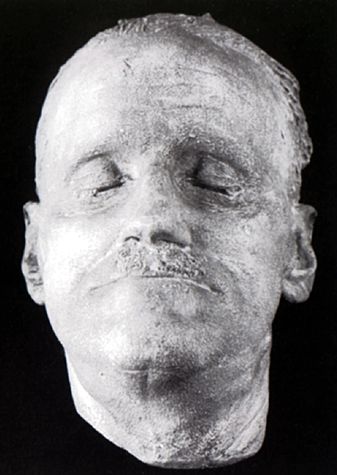
James Joyce’s death mask:


Reading (1932) — Pablo Picasso

Old Woman Reading — Rembrandt

Ben Marcus on David Markson’s Reader’s Block

 . . . when, for example, David Markson, an expository novelist who fired the starting gun for fictions of information and proved that pure exposition can be alarmingly moving, who purposefully tells instead of shows, is dismissed in The New York Times for failing to provide a story in his novelReader’s Block, no discussion follows about why, exactly, fiction must have one (at 150 words in the book review, how could any discussion follow?). Nor do we learn what a story might have looked like in such an exquisitely felt book that, to summarize, catalogs the various ways historical figures have hated whole races of people and/or died by their own hands. (Yes, you should read this book.)

Markson should have presumably, under the fiction-must-have-a-story criteria, zeroed in on one of his hundreds of characters and gone deep, doing that good old-time psychological work, the person-making stuff, dramatizing how such an interesting fellow had gone on to hate Jews and/or kill himself. Markson should have used more words like “then.” He should have sequenced. He seems to have forgotten that literature is supposedly a time-based art.

Markson’s amnesia is one of the happy accidents of the last decade of fiction writing. By eschewing a fetishistic, conventional interest in character, or a dutiful allegiance to moment creation, to occurrence itself, Markson accomplishes what a story, slogging through time and obedient to momentum, arguably could not: a commanding, obsessive portrait of single behaviors throughout history, a catalog of atrocity that overwhelms through relentless example. In truth, it’s a novel that can be read as an essay, but unlike most essays, it’s lyrically shrewd, poetry in the form of history, and it’s brave enough to provide creepy, gaping holes where we normally might encounter context (the burden of the conventional essayist).

From Ben Marcus’s essay “The Genre Artist,” published in a 2003 issue of The Believer.

“La Dama de Elche. Persephone’s thigh where Pluto clutches it in the Bernini. The right hand of Michelangelo’s David. The Ecstasy of St. Teresa.”

This slideshow requires JavaScript.

La Dama de Elche. Persephone’s thigh where Pluto clutches it in the Bernini. The right hand of Michelangelo’s David. The Ecstasy of St. Teresa.

–David Markson, Reader’s Block.

Denis Johnson’s Train Dreams Is a Perfect Novella

With blunt grace, Denis Johnson navigates the line between realism and the American frontier myth in his perfect novella Train Dreams. In a slim 116 pages, Johnson communicates one man’s life story with a depth and breadth that actually lives up to the book’s blurb’s claim to be an “epic in miniature.”  I read it in one sitting on a Sunday afternoon, occasionally laughing aloud at Johnson’s wry humor, several times moved by the pathos of the narrative, and more than once stunned at the subtle, balanced perfection of Johnson’s prose, which inheres from sentence to paragraph to resonate throughout the structure of the book.

The opening lines hooked me:

In the summer of 1917 Robert Grainier took part in an attempt on the life of a Chinese laborer caught, or anyway accused of, stealing from the company stores of the Spokane International Railway in the Idaho Panhandle.

Three of the railroad gang put the thief under restraint and dragged him up the long bank toward the bridge under construction fifty feet above the Moyea River. A rapid singsong streamed from the Chinaman voluminously. He shipped and twisted like a weasel in a sack, lashing backward with his one free fist at the man lugging him by the neck.

The matter-of-fact violence here complicates everything that follows in many ways, because Grainier it turns out is pretty much that rare thing, a good man, a simple man who tries to make a life in the Idaho Panhandle at the beginning of the 20th century. The rest of the book sees him trying—perhaps not consciously—to somehow amend for the strange near-lynching he abetted.

Grainier works as a day laborer, felling the great forests of the American northwest so that a network of trains can connect the country. Johnson resists the urge to overstate the obvious motifs of expansion and modernity here, instead expressing depictions of America’s industrial growth at a more personal, even psychological level:

Grainier’s experience on the Eleven-Mile Cutoff made him hungry to be around other such massive undertakings, where swarms of men did away with portions of the forest and assembled structures as big as anything going, knitting massive wooden trestles in the air of impassable chasms, always bigger, longer, deeper.

Grainier’s hard work keeps him from his wife and infant daughter, and the separation eventually becomes more severe after a natural calamity, but I won’t dwell on that in this review, because I think the less you know about Train Dreams going in the better. Still, it can’t hurt to share a lovely passage that describes Grainier’s courtship with the woman who would become his wife:

The first kiss plummeted him down a hole and popped him out into a world he thought he could get along in—as if he’d been pulling hard the wrong way and was now turned around headed downstream. They spent the whole afternoon among the daisies kissing. He felt glorious and full of more blood than he was supposed to have in him.

The passage highlights Johnson’s power to move from realism into the metaphysical and back, and it’s this precise navigation of naturalism and the ways that naturalism can tip the human spirit into supernatural experiences that makes Train Dreams such a strong little book. In the strange trajectory of his life, Grainier will be visited by a ghost and a wolf-child, will take flight in a biplane and transport a man shot by a dog, will be tempted by a pageant of pulchritude and discover, most unwittingly, that he is a hermit in the woods. In Johnson’s careful crafting, these events are not material for a grotesque picaresque or a litany of bizarre absurdities, but rather a beautiful, resonant poem-story, a miniature history of America.

Train Dreams is an excellent starting place for those unfamiliar with Johnson’s work, and the book will rest at home on a shelf with Steinbeck’s naturalist evocations or Cormac McCarthy’s Border Trilogy. I have no idea why the folks at FS&G waited almost a decade to publish it (Train Dreams was originally published in a 2002 issue of The Paris Review), but I’m glad they did, and I’m glad the book is out now in trade paperback from Picador, where it should gain a wider audience. Very highly recommended.

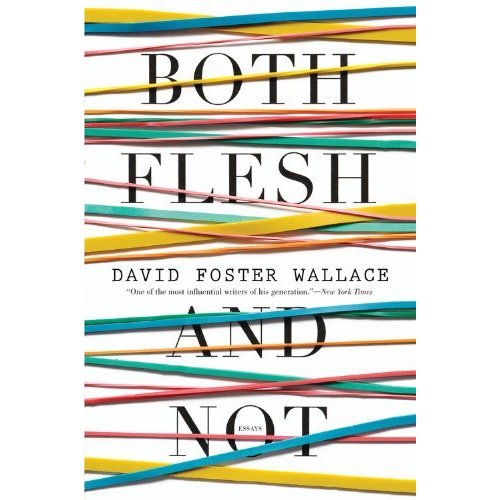
Cover Art for New David Foster Wallace Essay Collection Both Flesh and Not

Not really news, but I somehow missed this: Both Flesh and Not has a cover, apparently, as well as a product description:

Beloved for his epic agony, brilliantly discerning eye, and hilarious and constantly self-questioning tone, David Foster Wallace was heralded by both critics and fans as the voice of a generation. BOTH FLESH AND NOT gathers 15 essays never published in book form, including “Federer Both Flesh and Not,” considered by many to be his nonfiction masterpiece; “The (As it Were) Seminal Importance of Terminator 2,” which deftly dissects James Cameron’s blockbuster; and “Fictional Futures and the Conspicuously Young,” an examination of television’s effect on a new generation of writers.

Both Flesh and Not is due around Thanksgiving this year.

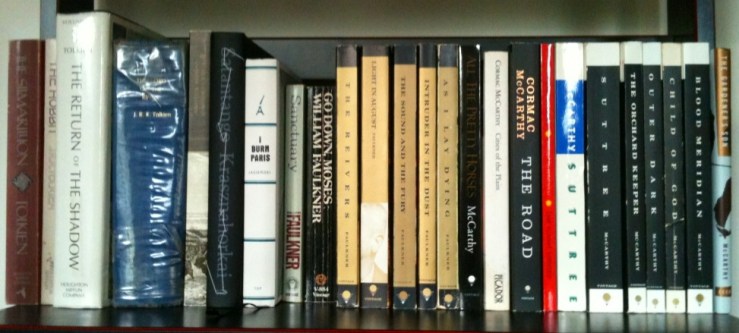
Book Shelves #22, 5.27.2012

20120527-111623.jpg

Book shelves series #22, twenty-second Sunday of 2012: Tolkien, Faulkner, McCarthy

As always, sorry for the glare. Shooting this case head on is almost impossible because of the windows on the other side of the room. Anyway.

I’ve read everything by Cormac McCarthy with the exception of his screenplay for The Gardener’s Son, which I found a week or two and picked it up. I don’t own a copy of No Country for Old Men because I haven’t found one that isn’t a movie tie-in.

20120527-111632.jpg

This copy of The Lord of the Rings—my first—was a kind gift from some friends we were staying with in Melbourne (the one in Australia, not Florida).

20120527-111642.jpg

I’ve read it at least four times; I have other copies of LoTR and have read them too. It’s probably the book I’ve read the most, although I haven’t read it since 2002. This copy is kindly inscribed:

20120527-111650.jpg

There’s a slim space on the shelf that currently holds a few books that I’ve been meaning to read:

20120527-111659.jpg

Survival Story (Fragment from Roberto Bolaño’s 2666)

A small story from Roberto Bolaño’s 2666. Context not important:

Instead of ghosts, now the passengers in front of him were talking about a person they called Bobby. This Bobby lived in Jackson Tree, Michigan, and had a cabin on Lake Huron. One time this Bobby had gone out in a boat and capsized. He managed to cling to a log that was floating nearby and waited for morning. But as night went on, the water kept getting colder and Bobby was freezing and started to lose his strength. He felt weaker and weaker, and even though he did his best to tie himself to the log with his belt, he couldn’t no matter how hard he tried. It may sound easy, but in real life it’s hard to tie your own body to a floating log. So he gave up hope, turned his thoughts to his loved ones (here they mentioned someone called Jig, which might have been the name of a friend or a dog or a pet frog he had), and clung to the branch as tightly as he could. Then he saw a light in the sky. He thought it was a helicopter coming to find him, which was foolish, and he started to shout. But then it occurred to him that helicopters clatter and the light he saw wasn’t clattering. A few seconds later he realized it was an airplane. A great big plane about to crash right where he was floating, clinging to that log. Suddenly all his tiredness vanished. He saw the plane pass just overhead. It was in flames. Maybe a thousand feet from where he was, the plane plunged into the lake. He heard two explosions, possibly more. He felt the urge to get closer to the site of the disaster and that’s what he did, very slowly, because it was hard to steer the log. The plane had split in half and only one part was still floating. Before Bobby got there he watched it sinking slowly down into the waters of the lake, which had gone dark again. A little while later the rescue helicopters arrived. The only person they found was Bobby and they felt cheated when he told them he hadn’t been on the plane, that he’d capsized his boat when he was fishing. Still, he was famous for a while, said the person telling the story.

“And does he still live in Jackson Tree?” asked the other man.

“No, I think he lives in Colorado now,” was the response.

Then they started to talk about sports. The man next to Fate finished his water and belched discreetly, covering his mouth with his hand.

“Lies,” he said softly.

“What?” asked Fate.

“Lies, lies,” said the man.

Right, said Fate, and he turned away and stared out the window at the clouds that looked like cathedrals or maybe just little toy churches abandoned in a labyrinthine marble quarry one hundred times bigger than the Grand Canyon.

William Gaddis’s Self-Portrait

John Steinbeck: “I have never been a title man”

I have never been a title man. I don’t give a damn what it is called. I would call it [East of Eden] Valley to the Sea, which is a quotation from absolutely nothing but has two great words and a direction. What do you think of that? And I’m not going to think about it anymore.

From John Steinbeck’s 1969 interview in The Paris Review.