

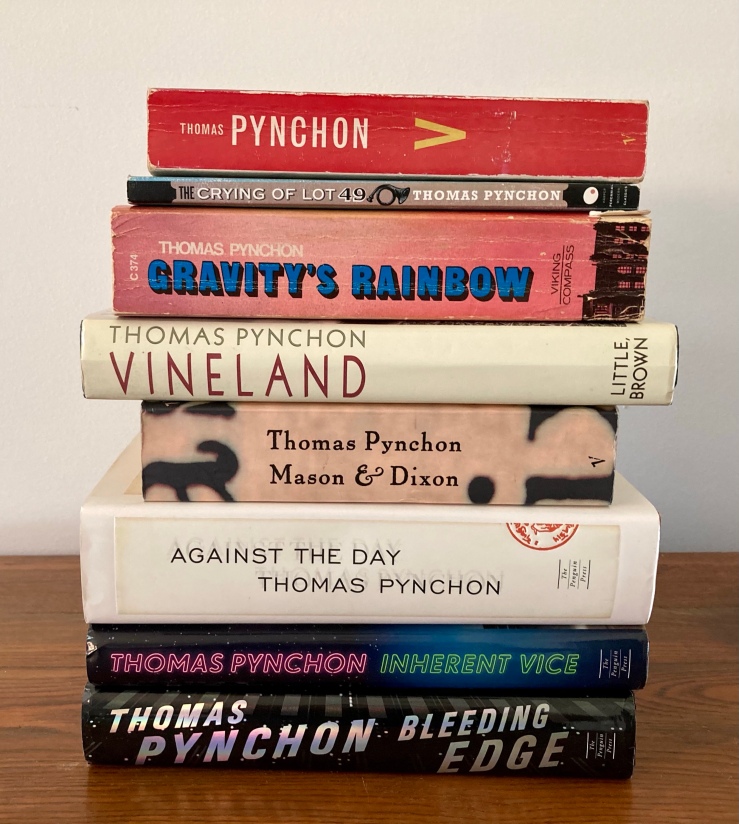
Thomas Pynchon’s ninth novel Shadow Ticket is out fifty days from now. In anticipation, there’s a piece today in The Guardian by John Keenan ranking Pynchon’s books to date.
I undertook a similar silly project just over a year ago on this blog in a post titled “A(nother) completely subjective and thoroughly unnecessary ranking of Thomas Pynchon’s novels” (this list was a correction to a previous 2018 list I foolishly compiled). Lists like these are obviously personal judgments (like, opinions man).
But Keenan’s list is wrong. So here are my annotations.
9. Keenan selects Slow Learner, writing,
A collection of early short stories that is chiefly of interest for the introduction, in which the author spells out why he thinks they fail. Pynchon does not spare himself but, unfortunately, he is right. For aficionados only.
I didn’t include Slow Learner in my rankings because it is not a novel. Pynchon’s intro to it is probably the best thing in it. I agree with Keenan’s assessment here.
8. Keenan selects Against the Day, writing,
Practically plotless, prolix and gargantuan, this novel landed with a thump following a nine-year gap. Characters fragment and double in a bewildering array, the style pastiches pulp novels, adventure stories and science fiction. It does not add up to more than the sum of its admittedly ingenious parts.
This assessment is egregious. Against the Day is perhaps the most directly political of Pynchon’s novels, and, in my estimation, the clearest (if not the most concise) expression of Pynchon’s political sympathies. I ranked it #3, writing: “I think this novel would make an excellent American history textbook. Its thesis: resist the military-industrial-entertainment-complex. Start here!”
7. Keenan selects Bleeding Edge, writing,
Pynchon’s most recent novel is a lightweight. The protagonist, Maxine Tarnow, mother of two, longsuffering partner to a feckless financier, finds herself chasing shadows around Manhattan’s Silicon Alley. Maxine’s skills as a fraud investigator are put to the test unravelling the machinations of the nasty controller of a computer security firm who will do anything to get his hands on a virtual reality simulator called DeepArcher (geddit?). There are plentiful puns, red herrings and surnames that serve as possibly unhelpful acronyms – the usual Pynchon ingredients, in other words. Here they fail to cohere into an entirely satisfying whole.
Bleeding Edge is not top-tier Pynchon, but it’s hardly lightweight. I ranked it #6, writing,
Reading Bleeding Edge helped evoke all the weirdness the 2000s were about to lay out for us. It made me angry again, or reminded me of the anger that I’d sustain for most of the decade. It reminded me of our huge ideological failure after 9/11, an ideological failure we are watching somehow fail even more today. But I also loved the novel’s unexpectedly sweet domestic plot, and found a kind of solace even in its affirmation of family, even as its final image pointed to the kind of radical inconclusiveness at the heart of being a parent.
6. Keenan selects Vineland, writing,
It is 1984, the year of Reagan’s re-election but for Zoyd Wheeler, Los Angeles-based veteran of the radical left, time has stopped. His wife, Frenesi, has left him to raise their daughter, Prairie, alone and he resorts to dismal acts of self-sabotage in order to qualify for government benefits. Prairie, in turn, flees the family coop to track down her mother, a subversive turned informant in league with federal baddy Brock Vond. Pynchon’s themes are prescient – surveillance, media saturation, generational miscommunication – but his aim is off.
I don’t think “Pynchon’s aim is off” is the best metaphor here. I think he hits what he shoots at — his targets are clear, and he’s an author, right? His characters are props he can set out where he likes, guaranteeing a bullseye. But that’s not always satisfying. I think the execution of Vineland is a bit slapdash. The book has always had cult status among Pynchon aficionados, perhaps stemming from a contrarian spirit. Paul Thomas Anderson’s (very) loose film adaptation, One Battle After Another, has also appeared to prompt a lot of reading, rereading, and online chatter about Vineland. I ranked it last in my list, at #8, writing that, “Vineland is ultimately depressing and easily my least-favorite Pynchon novel, but it does have some exquisite prose moments.”
5. Keenan selects V., writing,
Sincerity is not a quality readily associated with Pynchon, but his debut novel displays an affection for his characters that would later take second place to irony. The story bounces between Benny Profane, unemployed sailor, and Herbert Stencil, obsessive seeker of the elusive V. The language shows its age in places, but the plight of people determined to keep themselves in the dark is as relevant as ever.
I love V. and also had it at #5 on my list. Keenan is right that “sincerity” is not associated with Pynchon, but absolutely incorrect that Pynchon’s mode of affection is displaced by irony in the later novels. It’s clear that Pynchon loves Jeremiah Dixon, Charles Mason, Webb Traverse, Roger Mexico, Maxine Tarnow, etc. In my list, I wrote,
I’ll repeat my endorsement that “V. makes a good starting place for anyone new to Pynchon” and recommend that anyone interested in Pynchon but daunted by the scope check out the book from their library and read the ninth chapter, the story of of Kurt Mondaugen.
4. Keenan selects The Crying of Lot 49, writing,
The author regretted publishing this novel but he was being unduly harsh on himself. Short, funny and shot through with allusions you can choose to follow or ignore, the story of Oedipa Maas’s search for the meaning behind the supposed rivalry of postal companies is the literary equivalent of non-Euclidean geometry.
I also had Crying at #4. I wrote,
The Crying of Lot 49 is probably a better novel than V. but I think I like V. better. 49 is very funny and showcases Pynchon’s tonality of paranoia/hope wrapped up in zaniness/horror. It’s an excellent sophomore novel, but also dense, claustrophobic even. I guess I like the Pynchon sprawl a bit better.
3. Keenan selects Inherent Vice, writing,
Wilfully weird, often sordid and occasionally borderline unintelligible, Pynchon’s seventh novel was adapted for the big screen by Paul Thomas Anderson in 2014. The adaptation was nominated for an Oscar, making Pynchon as mainstream as he’s ever likely to get. Larry “Doc” Sportello is a private investigator with a broken heart and a huge appetite for marijuana. His ex-girlfriend reappears out of nowhere, implores Doc to find her married lover, then promptly vanishes again. At the heart of the murky tale lurks the sinister presence of the Golden Fang, a vessel that means, as Doc surmises, “a lot of things to a lot of people” – all of them unsavoury.
I love Inherent Vice, but it’s hardly top-three! I had it at #7, above Vineland.
2. Keenan selects Gravity’s Rainbow, writing,
This kaleidoscopic tour de force cemented Pynchon’s reputation as a writer of baffling, farcical and profound genius. A chief delight is his brilliant ear for dialogue which is given full rein in this twisted tale of allied intelligence officers, Nazis, scientists and seers united by a MacGuffin in the shape of a mysterious rocket. The action arcs from London under bombardment to a postwar zone of surrender. What is striking is how the themes explored here – forever wars, technological domination, uncontrollable cartels – have become staples of internet discourse.
I had Mason & Dixon at #2 and Gravity’s Rainbow at #1.
1 . Keenan selects Mason & Dixon, writing,
Pynchon gives the 18th-century novel a postmodern twist to explore the relationship between Charles Mason and Jeremiah Dixon. . . The author layers fact over anachronistic fiction, scientific inquiry over conspiratorial rumour, and tragedy over knockabout farce, in a virtuoso display of storytelling. . . It is a ripping yarn spun for the incredulous enjoyment of both the cleric’s family and the grateful reader.
Here’s what I wrote in my (thoroughly unnecessary) list:
2. Mason & Dixon (1997)
A measurement of the world and a story about friendship. It would be Pynchon’s best novel if he hadn’t written—
1. Gravity’s Rainbow (1973)
The best book.
Rankings are stupid fun, and I appreciate Keenan giving me an opening for some stupid fun on a Monday morning when I should really be prepping for the onset of the fall semester. I’ll close with a more honest ranking — all of these books are good, most are excellent, and at least two are American classics. It might be better to rank Pynchon’s oeuvre on one of those dorky tier lists.
So here is my dorky unnecessary Pynchon tier list:






 Biblioklept