After a minute of deliberate, restrained acoustic guitar phrases accompanied with a few touches of piano, Jim O’Rourke’s The Visitor unfolds suddenly into a warm, rich, full-band arrangement, humming with sinewy slide guitars and clippety-clop percussion. For ten short, gorgeous seconds, O’Rourke declares that, after having made listeners wait for over a decade for a follow up to his brilliant instrumental suite Bad Timing, he won’t delay the magic any longer. After those ten seconds, the music returns to that solitary guitar, but just a minute later, the full band is back again, establishing a rhythm that will permeate the disc.
Space, delay, and restraint have long been some of O’Rourke’s sharpest tools: fans of Bad Timing can attest to the sublime payoff in the record’s final moments, and his work in Gastr del Sol with David Grubbs often challenged audiences’ patience, rewarding them in oblique moments of beauty too strange to name. Not that O’Rourke’s music is wholly strange–in fact, I can’t think of another musician who makes recordings sound so damn good. He has an almost preternatural gift for sonic spaces, whether as a solo artist or as a producer (and auxiliary member) of groups like Stereolab and The High Llamas (or more obscure acts like Wilco and Sonic Youth). In short, we expect that a Jim O’Rourke record (a “proper” one–not one of his (many, many) forays into experimental/improvisational collaboration) will sound really fucking good. In this sense, The Visitor isn’t particularly revelatory: it’s a great-sounding, expertly-played, 38-minute suite of music. It affirms what we know about O’Rourke, and leaves us wanting more.
For a record with such a unified sound and vision, The Visitor is also paradoxically all over the place. It’s one complete track, at least in digital form, and while there are clearly discrete passages, it’s nearly impossible to find where they might distinctly begin or end. Unlike its most obvious predecessor, Bad Timing, an album divided into four tracks, there are no seams showing here. Neither is there any reliance on electronic trickery or production shenanigans (which O’Rourke followers know he could pull off standing on his head). The Visitor is pure musicianship, full of resonant organs, lovely acoustic guitars, and a host of other instruments in the Americana vein that O’Rourke so clearly cherishes (it’s impossible not to hear nods to heroes of his like Van Dyke Parks and John Fahey here, of course). There are amazing moments, like at 11:25 or so when O’Rourke channels Dickey Betts for a killer micro-solo, or does a Brian May send-up at 20:40. There are woodwinds, there are banjos, there are instruments working together that I cannot identify. And it all sounds very, very good.
Undoubtedly, The Visitor will have its detractors. Unlike O’Rourke’s 1999 pop masterpiece Eureka, it is not an album of songs to know and love; neither is it remotely close to 2001’s more aggressive Insignificance. It is, as I’ve stated a few times now, a single suite of instrumental music, perhaps too pleasant for some or too weird for others. And while I’m very enthusiastic about it–I’ve listened to it about 25 times over the past three days–I admit that it also whets my appetite for a follow-up to O’Rourke’s more pop-oriented records. I’d love to hear the guy’s imperfect voice sing those mean, mean lyrics again. And I hope he won’t make us wait another eight years for one. Final verdict: buy The Visitor, listen to it, love it.
Jim O’Rourke’s The Visitor is available September 8th, 2009 from Drag City (who will mail it to you postage-paid for a mere $14 vinyl, $12 CD) or your favorite record store.
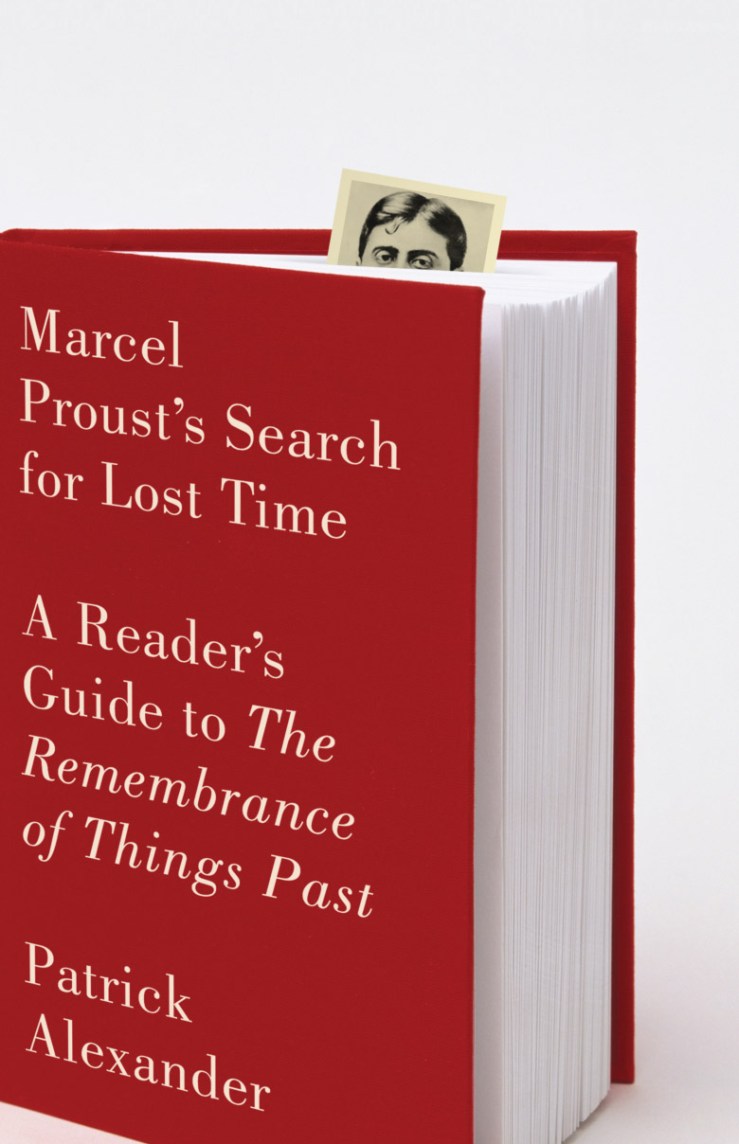
In his introduction to his reader’s guide to Proust’s In Search of Lost Time, Patrick Alexander observes that “Except for those fortunate enough to spend several years confined to a hospital bed, a federal prison, or to be stranded on a desert island with their preselected library, few modern readers have the time to tackle a novel with more than three thousand pages, a million and a half words, and more than four hundred individual characters.” Alexander goes on to point out that “Proust’s novel is increasingly read only by professional academics,” a trend he describes as a “great pity.” Alexander wants you to be able to access all the philosophical insight and rich humor of Proust, and his book Marcel Proust’s Search for Lost Time makes a great starting point for doing so.
The first of the three sections that comprise Alexander’s book, “What Happens in Proust,” summarizes the seven novels that form Proust’s great work In Search of Lost Time (sometimes translated as Remembrance of Things Past). This is easily the largest section of the book. Alexander summarizes the novels, and contextualizes their themes against their historical and social milieu. Alexander’s second section, “Who’s Who in Proust,” will likely be most useful for readers trying to keep track of the many (many, many) characters in this opus. The final section, “The World of Proust,” situates Proust’s place in Paris, French history, and modern literature. As Alexander points out himself, the book will appeal to three types of readers: those who want to read Proust but are daunted, those who are currently reading Proust and wish for a guide to keep track of all the places and names, and those who wish to return to Proust.
Alexander’s project is ambitious, and guidebooks are always an iffy business of course. I found Harry Blamires’s The New Bloomsday Book, probably the most famous guide for James Joyce’s Ulysses, to be an interminable bore, whereas Joseph Campbell’s lectures on the same subject are indispensable. There’s really a fine balance to be achieved I suppose. I’m currently making my way through another big book (okay, not as big as Proust’s), William Gaddis’s The Recognitions, and so far,Steven Moore’s A Reader’s Guide to William Gaddis’s The Recognitionshas proven to be a valuable resource when I need it. It manages to provide analytical insights and explications of all the many (many, many) allusions in Gaddis’s massive tome without ever being intrusive. Similarly, Alexander understands that a guide should never step on toes. His clean, lucid style is both humorous and realistic, and he’s never overly-reverential of Proust, but respectful at all times toward both his favorite author and his readers. Alexander’s real goal is not to paraphrase Proust, but, like all good critics, to try to get you to read the material. I never got past the first forty pages of Swann’s Way, the first book of Lost Time, but Alexander’s book makes me want to go back and give it another shot.
Marcel Proust’s Search for Lost Timeby Patrick Alexander is available from Vintage books on September 22nd, 2009.
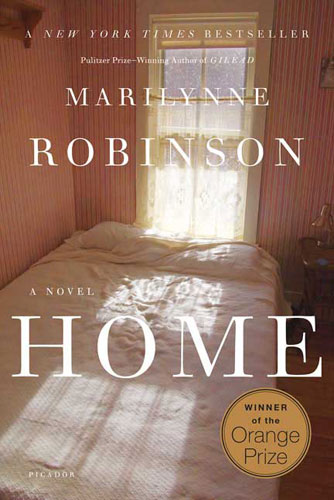
Home, Marilynne Robinson‘s follow-up to her 2004 Pulitzer Prize winning novel Gilead, tells the story of Jack Boughton, the miscreant prodigal son of Reverend Boughton (narrator of Gilead). Jack returns home after twenty years of petty theft and carousing to find his father dying and his sanctimonious sister Glory coping with a broken heart. Robinson handles the pain and secrets of the Boughton family in prose that is both spare and beautiful; there’s a simplicity here that belies the extraordinary spiritual puzzles into which Robinson’s characters delve. The result is that odd rarity: a literary novel of complexity and depth that’s also an ease and pleasure to digest, even in all its bitterness. Home is available in trade paperback from Picador September 8th, 2009.
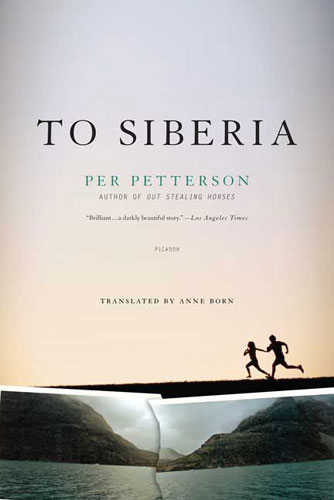
Also new in trade paperback from Picador on September 8th is Per Petterson’s novel To Siberia. Translated by Anne Born, To Siberia is the story of a Danish girl who lives in the isolated northernmost Jutland peninsula. Wishing to escape her neglectful parents and suicidal grandfather, she dreams of exotic Siberia. Set during the WWII Nazi occupation, To Siberia rhetorically mirrors the grim, cold reality of that era. Petterson delivers his tale in a crisp, almost brittle manner. There’s a translucence to the prose, a Nordic frankness that makes Petterson’s presentation of the girl’s infatuation with her older brother Jesper doubly strange. Her love and desire for him veers toward almost mythical incest, yet Petterson’s restraint reins in even the barest hints of hyperbole, leaving the reader to her own inferences. Like the grim story of Hans and Gretel, or the story of the tin soldier and his beloved ballerina, To Siberia is painful in its bleakness, but also beautiful in its imaginative underpinnings.
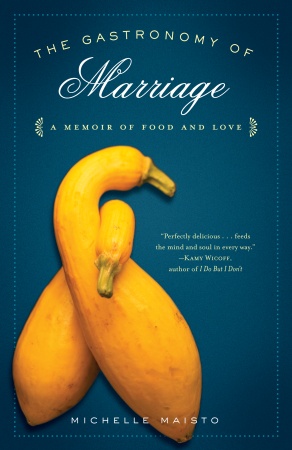
Michelle Maisto’s memoir The Gastronomy of Marriage, a Random House trade paperback original available September 8th, 2009, tells the story of Michelle’s courtship and marriage with her husband Rich, using the dining table as a lens to examine romantic relationships. Like many recent books about food, Gastronomy is interspersed with recipes, some of which sound pretty good (like the one for artichoke pie). Maisto’s is a memoir about planning for a wedding, told from a female perspective, and it might not have the widest appeal for many male readers, but it is well-written, if light, fare.
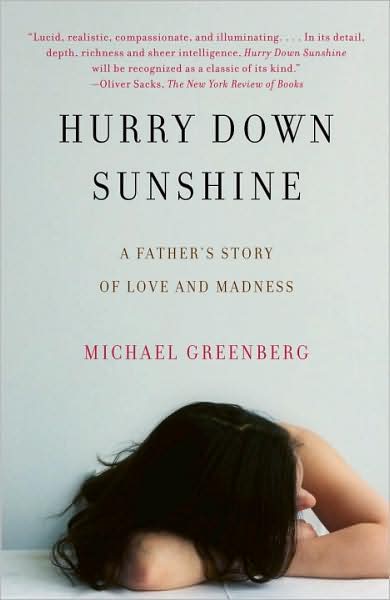
Far heavier is Michael Greenberg’s memoir Hurry Down Sunshine. Released in hardback last year to high critical acclaim, Greenberg’s memoir relates the true story of his daughter’s manic breakdown and subsequent committal to a mental hospital. Written in a spare, even terse style, with present-tense immediacy, Greenberg telegraphs his despair and frustration about his daughter’s condition with harrowing results. Greenberg even waxes a little on James Joyce’s own troubles with his daughter Lucia, as well as the poet Robert Lowell‘s bouts of manic depression.Literary angles aside, the book is not so much about his daughter’s mental condition, in the end, as it is about his own challenges as the parent of an ill child. Hurry Down Sunshine is available in trade paperback from Vintage books, September 8th, 2009.
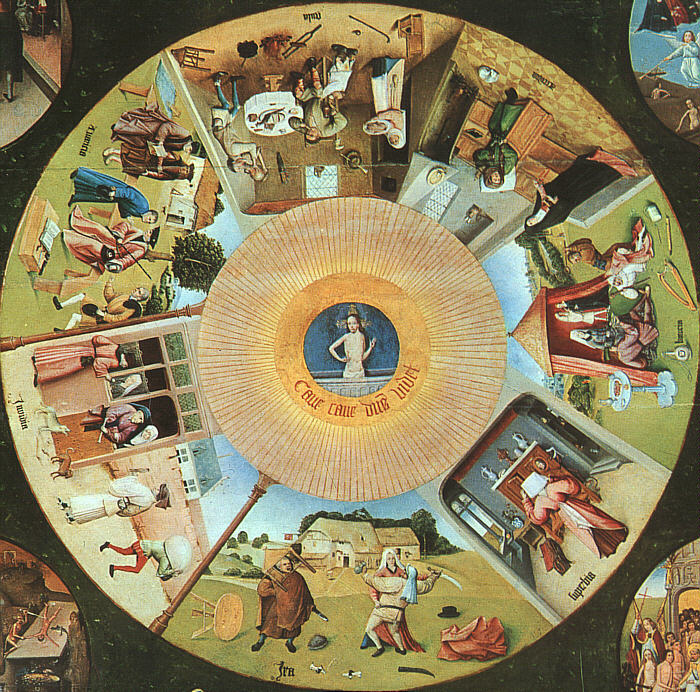
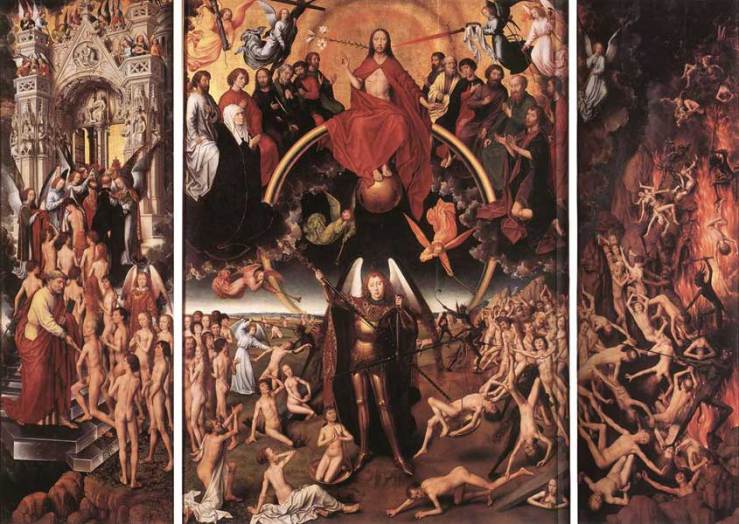
In William Gaddis‘s massive first novel, The Recognitions, Wyatt Gwyon forges paintings by master artists like Hieronymous Bosch, Hugo van der Goes, and Hans Memling. To be more accurate, Wyatt creates new paintings that perfectly replicate not just the style of the old masters, but also the spirit. After aging the pictures, he forges the artist’s signature, and at that point, the painting is no longer an original by Wyatt, but a “new” old original by a long-dead genius. The paintings of the particular artists that Wyatt counterfeits are instructive in understanding, or at least in hoping to understand how The Recognitions works. The paintings of Bosch, Memling, or Dierick Bouts function as highly-allusive tableaux, semiotic constructions that wed religion and mythology to art, genius, and a certain spectacular horror, and, as such, resist any hope of a complete and thorough analysis. Can you imagine, for example, trying to catalog and explain all of the discrete images in Bosch’s triptych, The Garden of Earthly Delights? And then, after creating such a catalog, explaining the intricate relationships between the different parts? You couldn’t, and Gaddis’s novel is the same way. I’ve finished the first of the novel’s three parts, 277 of 956 pages, and I’m going to go out on a limb and guess that the Gaddis has structured the novel as a triptych. The first part, like Bosch’s painting, The Seven Deadly Sins, is comprised of seven sections.
The Seven Deadly Sins – Hieronymous Bosch
Early in The Recognitions, teenage Wyatt copies The Seven Deadly Sins–his father owns the original, a painted table top he purchased in Europe. Wyatt replaces the original with his own and gets away with this strange crime–no small feat considering the genius of his father, the Rev. Gwyon, a New England priest who, after the death of his wife at sea, comes to reject the austere puritanism of his order and embrace (much to the consternation of his dwindling congregation) a pluralistic religious world view. In one of many stunning passages centering on Gwyon and religion, the congregation is “stirred with indignant discomfort after listening to the familiar story of virgin birth on December twenty-fifth, mutilation and resurrection, to find they had been attending, not Christ, but Bacchus, Osiris, Krishna, Buddha, Adonis, Marduk, Balder, Attis, Amphion, or Quetzalcoatl.” This series of substitutions enacts a chain of recognitions, and, in a sense, compartmentalizes much of the thematic material of the novel: What is it to be a hero, a redeemer, a savior? What is originality, and how does one recognize it? Who originates whom? What does it mean to create? How is art separate from religion? Clearly, these are not simple questions, and The Recognitions is not a simple book.
Triptych with the Martyrdom of St. Hippolytus — Dierck Bouts and Hugo van der Goes
In order to pose (and perhaps offer varying answers to) these questions, Gaddis employs daring, richly detailed prose, larded with esoteric (and not so esoteric) references to mythology, religion, art, music, and literature. Like the discrete sections of Bosch’s Sins, each of the chapters of the first section of The Recognitions has its own distinct idiom, comportment, and rhythm; yet, even as Gaddis’s approaches seem discontinuous from chapter to chapter, these coalesce to a larger picture.
The first chapter is the best first chapter of any book I can remember reading in recent years. It tells the story of Rev. Gwyon looking for solace in the Catholic monasteries of Spain after his wife’s death at sea under the clumsy hands of a fugitive counterfeiter posing as a doctor (already, the book posits the inherent dangers of forgery, even as it complicates those dangers by asking who isn’t in some sense a phony). There’s a beautiful line Gaddis treads in the first chapter between pain, despair, and melancholy and caustic humor, as Gwyon slowly realizes the false limits of his religion. The chapter continues to tell the story of young Wyatt, growing up under the stern care of his puritanical Aunt May, whose religious attitude is confounded by the increasingly erratic behavior of Wyatt’s often-absent father. While deathly ill, Wyatt teaches himself to paint by copying masterworks. He also attempts an original, a painting of his dead mother, but he cannot bear to finish it because, as he tells his father, “There’s something about . . . an unfinished piece of work . . . Where perfection is still possible. Because it’s there, it’s there all the time, all the time you work trying to uncover it.” This problem of originality, of Platonic perfection guides much of the novel’s critique on Modernism.
The Last Judgment – Hans Memling
Wyatt studies but ultimately rejects the ministry, opting instead to become an artist. The second chapter finds him in Paris, attempting to sell his original work. The chapter is a bravura shift into the sounds, sights, and consciousness of another world, another distinct mythology–ex-patriot Paris, Hemingway’s Paris, Woolf’s Paris. Gaddis shows a heavy debt to James Joyce‘s innovations in Ulysses here (and throughout the book, of course), although it would be a mistake to reduce the novel to a mere aping of that great work. Rather, The Recognitions seems to continue that High Modernist project, and, arguably, connect it to the (post)modern work of Pynchon, DeLillo, and David Foster Wallace. (In it’s heavy erudition, numerous allusions, and complex voices, the novel readily recalls both W.G. Sebald and Roberto Bolaño as far as I’m concerned). By the third chapter we find Wyatt married, quite unhappily, producing hack work, copies he lets his boss put his name on. The chapter is painful and often ugly, as we see his marriage disintegrate. In this chapter he meets Recktall Brown, the Mephistophelean business man who will arrange Wyatt’s future career as a counterfeiter of original paintings. As the chapter ends, Wyatt is no longer referred to by his name, a device that continues throughout the rest of part one (and perhaps the whole book). It’s as if he’s lost something intrinsic, some core originality in exchange for the ability to “become” the artist he is emulating. Wyatt now disintegrates into the background of the narrative, and is exchanged for a young Harvard grad named Otto. Otto follows Wyatt around like a puppy, writing down whatever he says, absorbing whatever he can from him, and eventually sleeping with his wife. Otto is the worst kind of poseur; he travels to Central America to finish his play only to lend the mediocre (at best) work some authenticity, or at least buzz. He fakes an injury and cultivates a wild appearance he hopes will give him artistic mystique among the Bohemian Greenwich Villagers he hopes to impress. In the fifth chapter, at an art-party, Otto, and the reader, learn quickly that no one cares about his play–everyone’s busy making their own original art. Gaddis’s evocation of a Village party in the late forties/early fifties here is wonderful, fly-on-the-wall stuff. His rhetoric captures the buzzing musicality of a raucous house party, and even if his mockery of the assembled artists, critics, and wannabes is savage, it’s also loving. Gaddis has an astute ear for the mid-twentieth century, where gossip infiltrates debate on aesthetics, and commercials punctuate classical scores on the radio.
Wyatt (unnamed) returns for the seventh (and longest) chapter of part one. He’s been very successful at his work, although he seems not to care at all for the money he’s making. Instead, he seems obsessed with channeling these ancient masters, for only in this pre-modern world is originality possible. Of course, the levels of irony are confounding here: Wyatt’s only access to originality is to pretend to be another person. The originality of the paintings he creates is subject to the condition that they be not original to him (their creator) but to another. While this attack on Modernity–namely, that originality is impossible–is severe, it’s also worth noting that Gaddis’s writing enacts originality, even as it cobbles together disparate sources. This is what makes the novel such an addictive pleasure to read. While I cannot make any final claims about a novel before finishing it, I will go out on another limb and suggest that those who already own this novel and have not yet made a crack at it for fear of its massive size and allusive structure should go ahead and take it up: it’s dark, erudite, sad, and very, very funny. It’s also not that hard to read, and if the allusions get too dense, there’s always Steven Moore‘s fantastic resource, A Reader’s Guide to William Gaddis’s The Recognitions, now available in its entirety online. Have at it. More when I finish Part II.
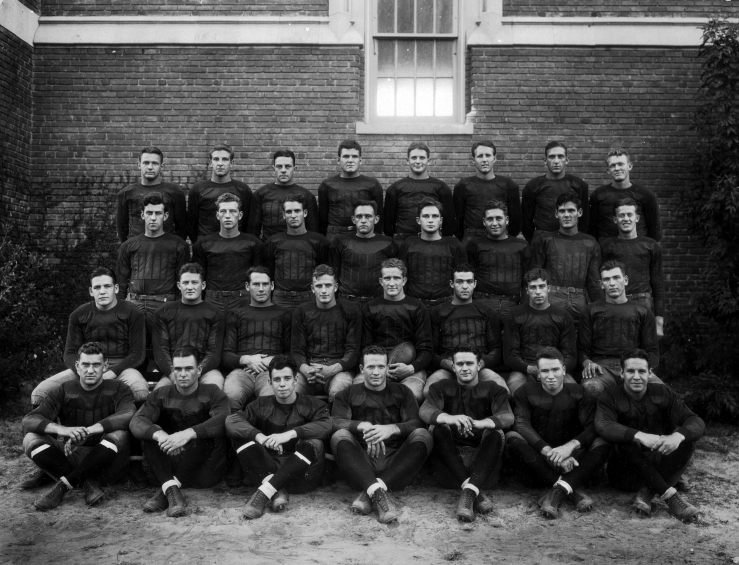
Prejudices up front: not only did I attend the University of Florida, but so did my parents, my wife, and many of my lifelong friends. I was raised on Gator football, and some of my family members, when cut, are known to bleed orange and blue. I think that Tebow is something of a national treasure (surely, had not Clinton succeeded in freeing journalists Euna Lee and Laura Ling from a North Korean labor camp, we would’ve sent Tebow), and I acted like a silly fool when I got to meet Urban Meyer last year (he was recruiting players at the high school where I teach English). Not only am I predisposed to liking a book like Historic Photos of University of Florida Football, I also happen to be a former student of the author, University of Florida professor Kevin McCarthy (I will never forget him calling me over to his desk after class one morning, poking me in the chest and commanding me, “Come to class!”).
So, yeah, it’s possible that I’m enthusiastically biased about a book combining archival photos of the Gators with insightful text and captions. Fans of the Florida State Seminoles probably know that this book isn’t for them upfront, but that’s okay. True Gator fans will not be disappointed. Historic Photos of University of Florida Football (new from Turner Publishing) is as much a history text is it is a survey of Gator football, following a team from its humble origins at the turn of last century (McCarthy informs us that “its 1904 team in Lake City was outscored 224-0,”) to its present glories as National Champions.
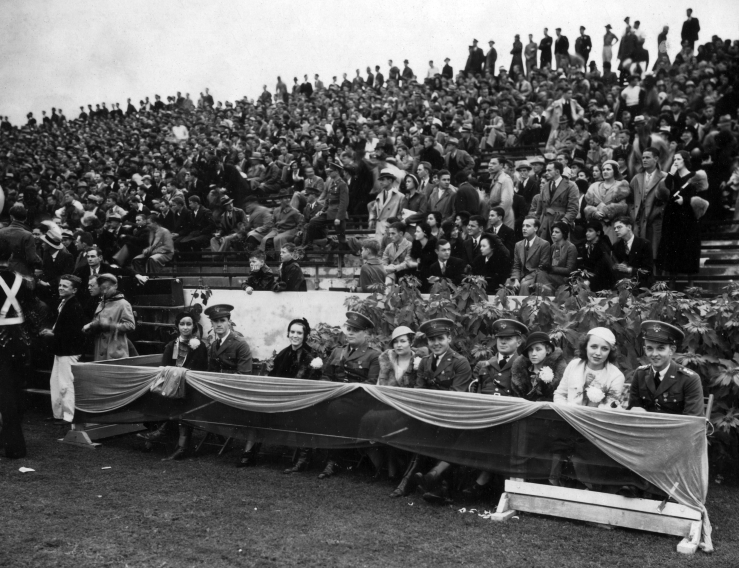
1930 UF Homecoming
Most of the book chronicles the early days of Florida football (over half of the 200 images date from before 1960), and while some fans might be disappointed in a lack of more recent photographs, it’s worth pointing out that in our current media-saturated age it’s not so hard to come by these. Far more interesting are pics of the old days, with sweatered all-male cheerleading squads, bulky leather helmets, and folks dressed up to the nines to go to a football game (if you’ve ever lived in Gainesville you know that even in October a suit jacket, let alone a tie and pants, are pretty uncomfortable). Many of these photos capture the energy and intensity of the game, as well as a sense of nostalgia for a time when college football wasn’t so commercialized.
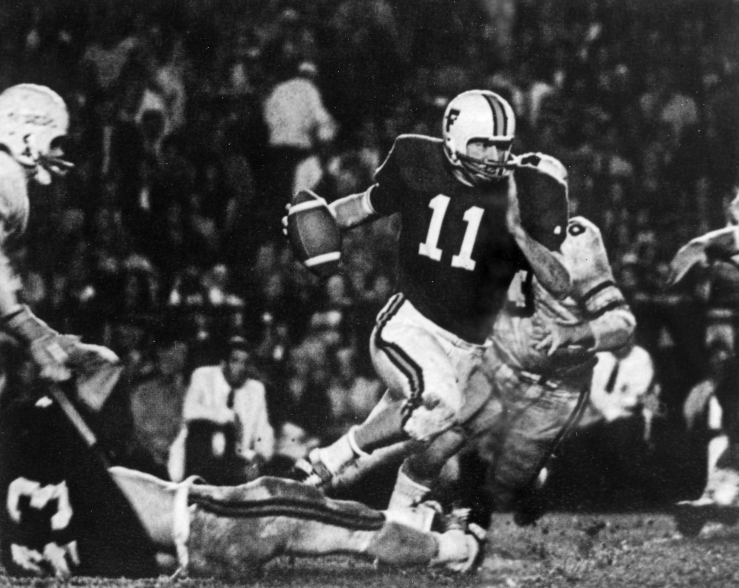
Steve Spurrier, 1965
The images collected here transmit a love for both the Florida Gators, as well as a sense of respect for the traditions of college football in general. As the Gators’ indomitable legacy grows, surely this book will one day be referred to as “Volume I,” as there are plenty more touchdowns to be scored, games to be won, and historical moments to be made. Recommended for Bull Gators everywhere.
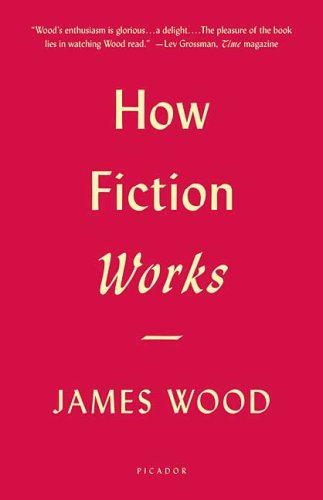
Literary critic and Harvard professor James Wood’s How Fiction Works, new in trade paperback from Picador, argues that “fiction is both artifice and verisimilitude, and that there is nothing difficult in holding together these two possibilities.” This thesis is rather broad, and really not so controversial; I’d certainly agree with it. It’s when Wood goes about showing how fiction successfully or unsuccessfully artfully represents reality that I find myself shouting at his text.
Not that I didn’t know that we were going to butt heads (to misapply a metaphor) before I began reading. After all, I was familiar enough with Wood’s aesthetic approach to literary criticism, one that eschews any notions of ideological underpinnings of a novel. In concrete terms, this means that all those discourses so (apparently) fashionable in English departments are out–you know, Marxist critiques, French deconstruction, post-colonial studies, gender readings, all that stuff. How wonderfully freeing for Wood to dispense with the baggage of history and ideology! Of course, certain novelists have felt the need to respond to these ideas, even if Wood hasn’t, leading our critic to deride a whole “genre” of “hysterical realism.” I happen to like a lot of this so-called “hysterical realism”: Pynchon, DeLillo, and David Foster Wallace spring to mind (Wood takes Wallace to task a few times in How Fiction Works, arguing that Wallace’s pseudo-business speak in “The Suffering Channel” is “fairly ugly, and a bit painful for more than a page or two”). Wood’s attack on “hysterical realism” centers on his claim that such novels privilege a (failed) attempt at a global, historical perspective at the cost of intimacy and human communication. The aesthetics here, for Wood, are precisely about how to accurately and intimately portray the world. To this end, Wood, favors writers like Henry James, Gustave Flaubert, and Chekov, and he spends much of How Fiction Works illustrating how marvelously these writers employ what he calls “free indirect style,” a type of narration where the lines between author’s and the character’s language are perfectly blended.
That Wood spends so much time on Flaubert and James (he devotes five pages to the latter’s ingenious use of the adverb “embarrassingly”) is telling when one considers the authors not represented in this book. While no literary critic should be condemned for not including every writer under the sun, it would be helpful if a book ostentatiously titled How Fiction Works took a look at something besides the work of dead white men. But there I go again, suggesting that ideology has some function in literature. Maybe I’m reaching here–to be fair, if Toni Morrison doesn’t even warrant a mention in Wood’s canon, then neither does Nathaniel Hawthorne (in fact, How Fiction Works is remarkably light on American writers in general–Melville only warrants a passing mention).
More disturbing than Wood’s limited pool of authors is his disingenuous claim that this book is for a common, everyday reader. With a hint of the anxiety of influence, he remarks that his hero Roland Barthes “does not write as if he expects to be read and comprehended by any kind of common reader,” but it must be noted that Wood will have lost anyone not fairly conversant with the history of literature by his first twenty pages.Hopefully, students new to literature will avoid Wood’s book and read something friendlier and more helpful, like Thomas C. Foster’sHow To Read Literature Like a Professor.
Did I forget to mention in all of this that I liked reading this book? Like most people who love to read, both academically and for pleasure, I like a good argument, and Wood’s aesthetic criticism is a marvelous platform for my ire, especially in a world that increasingly seems to not care about reading fiction. Wood is a gifted writer, even if his masterful skill at sublimating his personal opinion into a front of absolute authority is maddening. There’s actually probably more in his book that I agree with than not, but it’s those major sticking points on literary approaches that stick in my craw. It’s also those major sticking points that make the book an interesting read. I’d like to think that I’m not interested in merely having my opinions re-confirmed. I’d recommend How Fiction Works with the caveat that the reader not fall victim to Wood’s forceful rhetoric, to the erroneous assumption that Wood’s aesthetic values somehow trump one’s own. Read this book, but don’t mistake it for a substitute for the real education that great novels can provide. “I am really talking about the real, which is at the bottom of my inquiries,” writes Wood in his introduction, but make no mistake, Wood cannot transmit the real in his criticism. It can only be found in reading the sources yourself.
Thomas Pynchon’s latest novel, Inherent Vice is a detective-fiction genre exercise/parody set in a cartoonish, madcap circa-1970 L.A. redolent with marijuana smoke, patchouli, and paranoia. Navigating this druggy haze is private detective Doc Sportello, who, at the behest of his ex-girlfriend, searches for a missing billionaire in a plot tangled up with surfers, junkies, rock bands, New Age cults, the FBI, and a mysterious syndicate known as the Golden Fang–and that’s not even half of it. At a mere 369 pages, Inherent Vice is considerably shorter than Pynchon’s last novel Against the Day, not to mention his masterpieces Gravity’s Rainbow and Mason & Dixon, and while it might not weigh in with those novels, it does bear plenty of the same Pynchonian trademarks: a strong picaresque bent, a mix of high and low culture, plenty of pop culture references, random sex, scat jokes, characters with silly names (too many to keep track of, of course), original songs, paranoia, paranoia, paranoia, and a central irreverence that borders on disregard for the reader. And like Pynchon’s other works, Inherent Vice is a parody, a take on detective noir, but also a lovely little rip on the sort of novels that populate beaches and airport bookstores all over the world. It’s also a send-up of L.A. stories and drug novels, and really a hate/love letter to the “psychedelic 60s” (to use Sportello’s term), with much in common with Pynchon’s own Vineland (although comparisons to Elmore Leonard, Raymond Chandler, The Big Lebowski and even Chinatown wouldn’t be out of place either).
While most of Inherent Vice reverberates with zany goofiness and cheap thrills, Pynchon also uses the novel as a kind of cultural critique, proposing that modern America begins at the end of the sixties (the specter of the Manson family, the ultimate outsiders, haunts the book). The irony, of course–and undoubtedly it is purposeful irony–is that Pynchon has made similar arguments before: Gravity’s Rainbow locates the end of WWII as the beginning of modern America; the misadventures of the eponymous heroes of Mason & Dixon foreground an emerging American mythology; V. situates American place against the rise of a globally interdependent world. If Inherent Vice works in an idiom of nostalgia, it also works to undermine and puncture that nostalgia. Feeling a little melancholy, Doc remarks on the paradox underlying the sixties that “you lived in a climate of unquestioning hippie belief, pretending to trust everybody while always expecting be sold out.” In one of the novel’s most salient passages–one that has nothing to do with the plot, of course–Doc watches a music store where “in every window . . . appeared a hippie freak or a small party of hippie freaks, each listening on headphones to a different rock ‘n’ roll album and moving around at a different rhythm.” Doc’s reaction to this scene is remarkably prescient:
. . . Doc was used to outdoor concerts where thousands of people congregated to listen to music for free, and where it all got sort of blended together into a single public self, because everybody was having the same experience. But here, each person was listening in solitude, confinement and mutual silence, and some of them later at the register would actually be spending money to hear rock ‘n’ roll. It seemed to Doc like some strange kind of dues or payback. More and more lately he’d been brooding about this great collective dream that everybody was being encouraged to stay tripping around in. Only now and then would you get an unplanned glimpse at the other side.
If Doc’s tone is elegiac, the novel’s discourse works to undercut it, highlighting not so much the “great collective dream” of “a single public self,” but rather pointing out that not only was such a dream inherently false, an inherent vice, but also that this illusion came at a great price–one that people are perhaps paying even today. Doc’s take on the emerging postmodern culture is ironized elsewhere in one of the book’s more interesting subplots involving the earliest version of the internet. When Doc’s tech-savvy former mentor hips him to some info from ARPANET – “I swear it’s like acid,” he claims – Doc responds dubiously that “they outlawed acid as soon as they found out it was a channel to somethin they didn’t want us to see? Why should information be any different?” Doc’s paranoia (and if you smoked a hundred joints a day, you’d be paranoid too) might be a survival trait, but it also sometimes leads to this kind of shortsightedness.
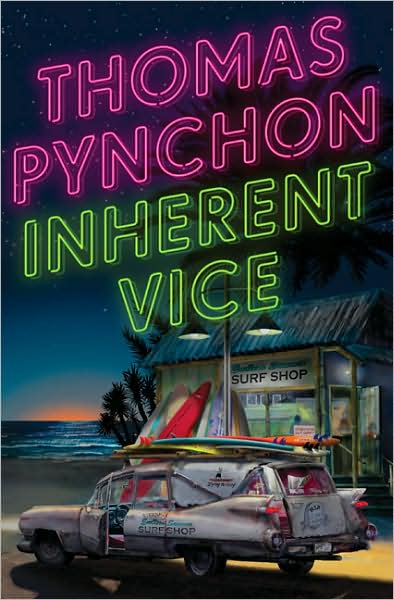
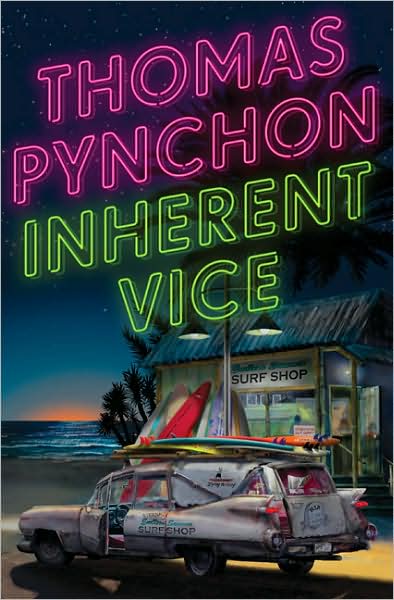
Intrinsic ironies aside, Inherent Vice can be read straightforward as a (not-so-straightforward) detective novel, living up to the promise of its cheesy cover. Honoring the genre, Pynchon writes more economically than ever, and injects plenty of action to keep up the pace in his narrative. It’s a page-turner, whatever that means, and while it’s not exactly Pynchon-lite, it’s hardly a heavy-hitter, nor does it aspire to be. At the same time, Pynchon fans are going to find plenty to dissect in this parody, and should not be disappointed with IV‘s more limited scope (don’t worry, there’s no restraint here folks–and who are we kidding, Pynchon is more or less critic-proof at this point in his career, isn’t he?). Inherent Vice is good dirty fun, a book that can be appreciated on any of several different levels, depending on “where you’re at,” as the hippies in the book like to say. Recommended.
Inherent Vice is available from Penguin August 4th, 2009.
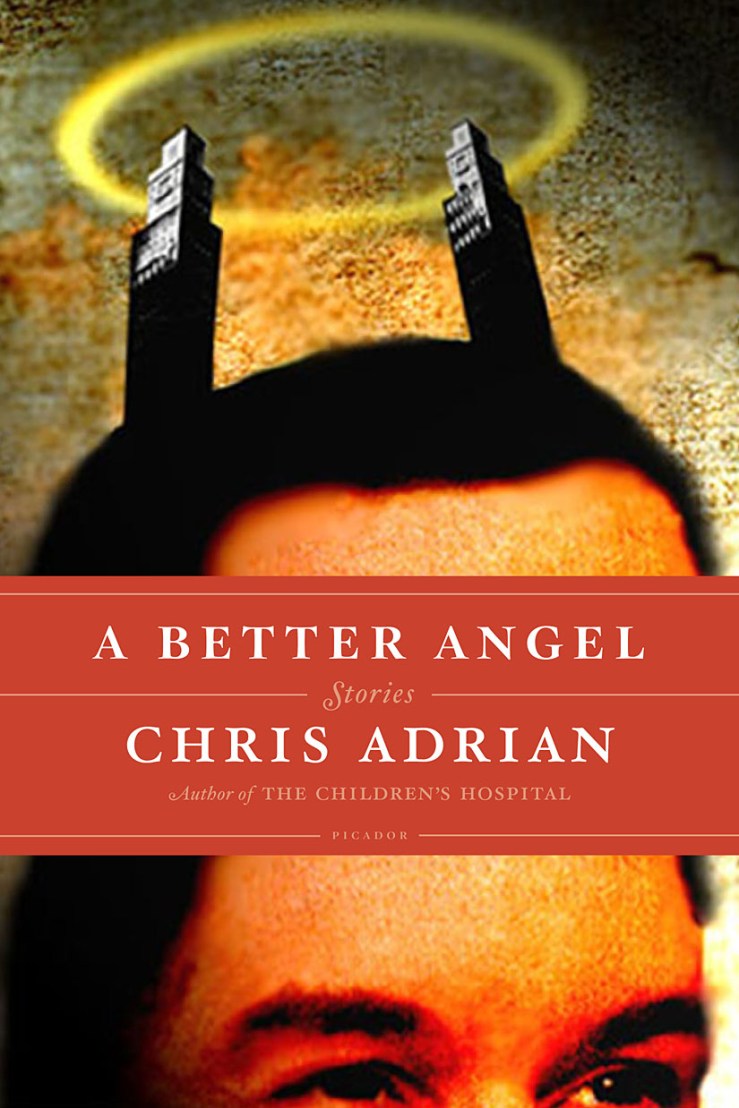
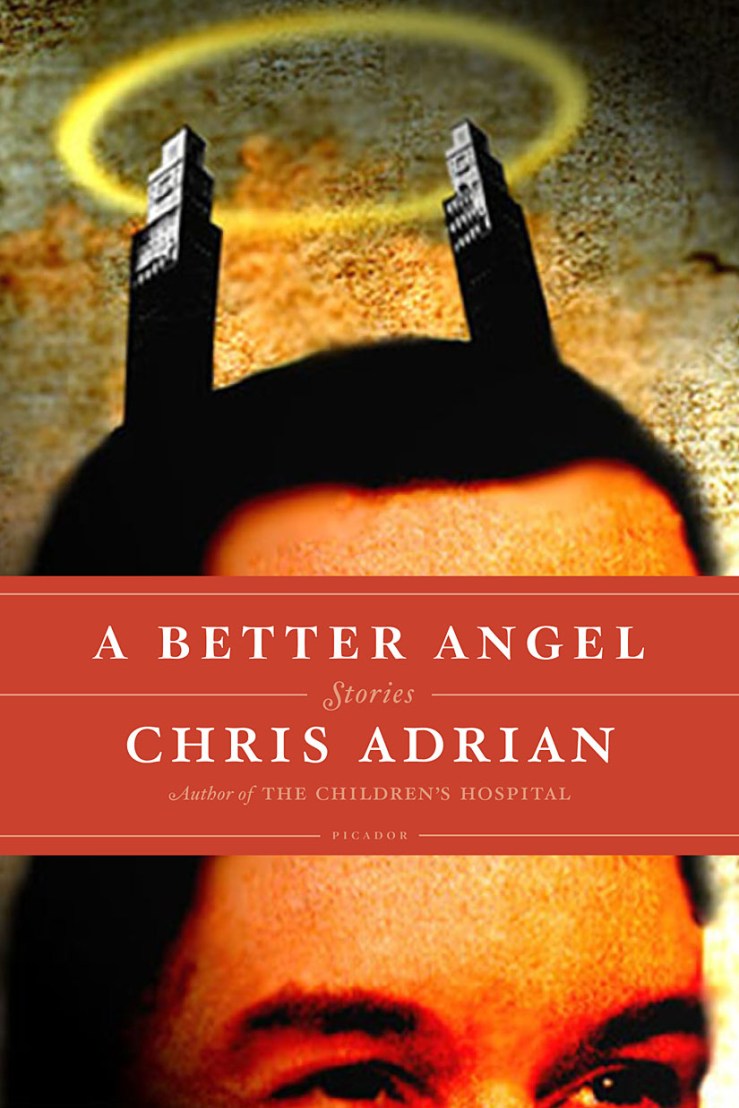
How does one grieve? This central question runs through the nine stories that comprise Chris Adrian’s A Better Angel (available now in trade paperback from Picador). For Adrian’s protagonists, mostly adolescents and children, the past is inescapable and insurmountable, and the future promises only depression at best and eternal suffering at worst. These are stories about hauntings. In Adrian’s world (and it is a fully-realized world in the same way that Tolkien’s Middle Earth is its own discrete place), ghosts, angels, and even wayward friends are all likely to to demonically possess some sad, troubled weird kid. Again and again, these stories force their protagonists–and their readers–to question how one might witness to death, disease, and disaster–and still keep a modicum of sanity.
Those who’ve read Adrian’s novels The Children’s Hospitaland Gob’s Grief will find that the stories in A Better Angel work to flesh out a distinctly Adrianesque milieu. There are hospitals and doctors and nurses, dead brothers and absent parents, events of epic destruction and personal crises of illness, drugs and alcohol, ouija boards, and plenty of angels and demons. Adrian’s narratives explore a fine line between metaphysics and pure biology that each protagonist has to navigate. In “The Sum of Our Parts,” nurses and doctors wonder how our body parts make us individuals as a ghost tries to escape her coma-bound body. The fraudulent doctor of “A Better Angel” uses drugs as a way of subduing the angel who haunts him. “I make my living praising the beauty of well children,” he says. “I love babies and I love ketamine, and that’s really why I became a pediatrician, not because I hate illnesses, or really ever wanted to make anybody better.” Indeed, Adrian’s characters seem doubtful that anyone can make anyone else better, but it doesn’t stop them from trying. There’s the father of “The Changeling,” whose son is possessed by the ghosts of those murdered in the 9/11 attacks on the World Trade Center, who parcels out his own body as a sacrifice to appease the dead. The story recognizes though that it’s not really the dead he is honoring–he’s really showing his love for his son–but this measure of love is not enough for the dead. “The Changeling” is one of three stories in A Better Angel addressing the 9/11 attacks (we’ll write more about this trio in an upcoming post, and we’ve already addressed one of the stories here), but the September 11th victims are hardly the only ghosts here. In “A Hero of Chickamauga,” Civil War re-enactors try to commune with the dead and somehow bring personal justice to something beyond comprehension. “A Child’s Book of Sickness and Death” posits disease as the ultimate affront to cosmic justice. Its protagonist Cindy, an ailing “short gut girl” who lives in semi-permanent residence at a children’s hospital, remarks to no one in particular after the death of a young child,
“It seems to me, who should really know better, that all the late, new sadness of the past twenty-four hours ought to count for something, out to do something, ought to change something, inside of me, or outside in the world. But I don’t know what it is that might change, and I expect that nothing will change–children have died here before, and hapless idiots have come and gone, and always the next day the sick still come to languish and be poked, and they will lie in bed hoping not for healing, a thing which the wise have all long given up on, but for something to make them feel better, just for a little while, and sometimes they get this thing, and often they don’t.”
Cindy’s is just one of many negative epiphanies here. It’s also worth noting that this Cindy is but one of several Cindys populating this book, and she also seems to be another version of a short gut syndrome Cindy who appears in The Children’s Hospital. In fact, most of the primary characters in “A Children’s Book of Sickness and Death” are also present in The Children’s Hospital, underscoring the sinew that connects Adrian’s milieu.
This holistic vision marks Adrian as an accomplished–and challenging–author. Adrian’s challenge is not so much an issue of readability; we found ourselves quickly devouring these stories. No, what we have here are tales that many will find hard to digest, the sort of stuff that some readers will find too bitter to ruminate and puzzle out. Adrian, through his protagonists’ bleak outlooks, doesn’t offer a cure or even much solace from the pain and sickness in the world, but he does offer some temporary, if mild, relief, a sort of reckoning with that pain and sickness. Although the angels and demons and ghosts of Adrian’s world cannot be ignored or dismissed, they can be confronted, even if that confrontation must repeat without solution. Instead of pandering to his readers with Panglossian platitudes or metaphysical escape hatches, Adrian dramatizes the realities of our mortality in a way that compels both sympathy and repulsion, and above all, some deep thinking. Highly recommended.
I’m about half way through two books right now: Chris Adrian’s A Better Angel, and Thomas Pynchon’s Inherent Vice. Pynchon’s latest novel–I’ll talk a little bit about it in a sec–comes out in hardback from Penguin August 4th. Picador will release the first trade paperback edition of Chris Adrian’s latest collection of short stories on August 3rd. I’m really digging A Better Angel so far, but before I talk about it, I just wanna shill for Picador. They put out really cool, great-looking books from really cool authors like Roberto Bolaño, J.G. Ballard, Denis Johnson, William Burroughs, and DJ Kool Herc, and they also have a sexy little imprint called BIG IDEAS//small books that puts out some killer jams. They’re also really nice about sending review copies. Shill shill shill. I’m a whore, but I’m an earnest whore.
Anyway. Back to Adrian. Just finished “The Vision of Peter Damien,” a 9/11 story set in what seems to be nineteenth century rural Ohio. Damien, and then the other children of his small rural community, catch an illness that gives them unexplained, vivid hallucinations of the 9/11 attacks on the World Trade Center towers. Adrian works in a mode of distortion throughout most of these stories so far, repeatedly employing metaphysical disruptions as well as playing with time and setting as a way of alienating his characters from each other and the reader. Adrian uses the temporal/metaphysical disruptions of “The Vision of Peter Damien” to respond to 9/11, creating an uncanny milieu for his readers. The cognitive dissonance here reminds me of other responses to 9/11, like DeLillo’s Falling Man, David Foster Wallace’s short story“The Suffering Channel,” and even Art Spiegelman’s In the Shadow of No Towers. Actually, Wallace’s essay “The View from Mrs. Thompson’s” does a really good job of capturing all the problems of witnessing to, understanding, reacting to (etc.) spectacular disaster. Adrian’s story recapitulates the same paradoxes, injecting a motif of illness and brotherhood, contagious decay and redemption that seems to run through all of the stories collected here. I don’t have a larger comment about literature’s response to 9/11 yet, but I think that it’s fascinating to watch such stories emerge and evolve. We’re still seeing the various shapes, tropes, strategies, etc. that authors will employ to tackle (or chip at, or remark upon, or even elide) such a big historical marker. Full review of A Better Angel at the end of this month.
Far less serious is Pynchon’s new novel, Inherent Vice, a detective noir painted in day-glo psychedelic swirls. Doc Sportello, at the behest of his ex-, is searching for a missing real-estate billionaire in the dope-haze of late 60s/early 70s LA (it appears to be set in 1969, as there are repeated references to “living in the sixties and seventies”). Pynchon’s new novel is a hard-boiled detective mystery, a psychedelic caper, an LA story, a comment on the decline of idealism and the emergence of media-unreality at the end of the 60s (because we needed another story about the 60s!), and probably a shaggy dog tale. The cover has gotten some criticism for its decidedly unliterary look, and last March I called it “horrendous.” I take it back: the campy cover, with its neon shock and beach-as-pastoral-idyll is lovingly ironic, satire that does not announce itself as satire and is thus always open to a straight-reading. Just like Pynchon’s novel, the cover can be read as an homage to both Dashiell Hammett and Elmore Leonard (with a sly nod to all the Leonard ripoffs out there (glancing your way, Jimmy Buffett). As its cover suggests, this is a Pynchon book you can read breezily on a beach or airplane. Sure, it’s got the usual Pynchon trademarks–it’s overcrowded with zany, one-dimensional characters, it operates on a Looney Toons system of logic, it’s full of linguistic goofs–but it’s also incredibly easy to read (unlike, say, just about everything else Pynchon has ever written). It’s also a lot of fun. And to prove it’s a beach read, I’ll finish it this week at St.Augustine Beach, inebriated by strong margaritas and even stronger sun. Full review when I get back.
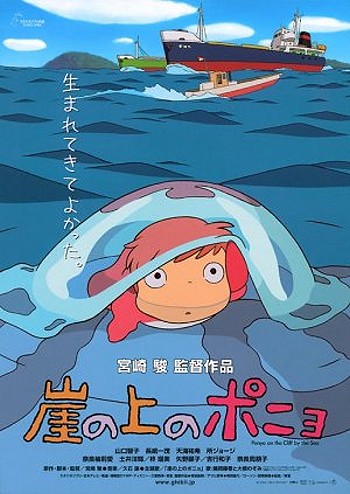
Before Hayao Miyazaki‘s latest opus, Ponyo on the Cliff by the Sea (Gake no Ue no Ponyo) gets Disneyfied this August, interested parties might wish to purloin one of the pirate copies floating around and get a sneak peek. I’m not advocating not going to the movies to see the film–one of the greatest pleasures of Miyazaki’s works is the sensory overload of his stunning visuals–but Disney’s dubbed versions tend to over-explicate Miyazaki’s mysteries, draining his films of some of the unsettling ambiguities that make them so interesting.
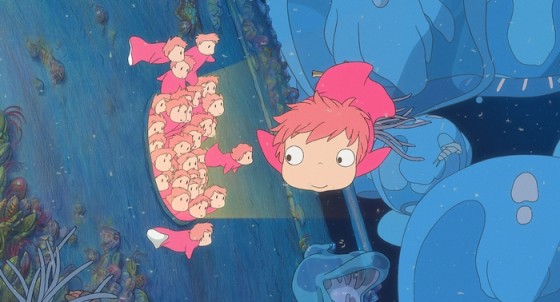
Ponyo tells the story of a little fish-girl (girl-fish?), a mermaid who escapes from her mad-scientist father and meets a boy named Sosuke. After tasting some of Sosuke’s blood, Ponyo begins to morph into a human. However, her transmutation causes bizarre and violent weather, including a giant tsunami resulting in a massive flood; even the moon starts to pull out of orbit. Sosuke and Ponyo navigate this surreal post-flood world, searching for Sosuke’s mother Lisa. The tale of these children is sweet but never maudlin, and like most Miyazaki films, Ponyo taps into sentimentality and pathos without ever becoming mawkish.
Visually, Miyazaki employs a sketchy, watery style here, painted in beautiful pastels and flashy complimenting brights. The look of this film is a significant departure from the fine detail and rich heaviness of Miyazaki’s masterpiece, Spirited Away (Sen to Chihiro no Kamikakushi), and might disappoint some, but we thought it was both beautiful and fitting. Of course, we were watching a pirated version that someone lovingly and bravely shot in a theater, undoubtedly inferior to the spectacle we expect from the theatrical release.
Perhaps the best critic of the film would be my two-year old daughter, who sat riveted and zombie-eyed throughout the whole film, only diverting her gaze occasionally to clarify some plot point. She loved the movie and talked about it the whole next morning, pretending that she was Ponyo (or, alternately, that someone else was Ponyo). Ponyo has more in common with Miyazaki’s lighter, kid-friendlier films like My Neighbor Totoro and Kiki’s Delivery Service than it does with his epic adventure films like Nausicaa and Princess Mononoke, but it retains enough adventure and glows with enough charm to keep longtime fans and newbies alike invested for all of its ninety minutes. Great good stuff. Here’s the trailer for the US release:
First thing’s first: if you’re looking for Harry Potter slash fiction, you’ll have to check out our original Harry Potter Sex Romp post for links, you dirty dawg (you’re weird but you’re welcome). Just like that post a few years ago, this post’s title is really kinda sorta mostly irrelevant to what this post is about. What is it about? I want to take a look at some of the homoerotic tension in the new Harry Potter movie, Harry Potter and the Half-Blood Prince. If you want to find a proper review of the film, with plot summary and insight, shop around. That’s not gonna happen here.
Also, there will be SPOILERS, okay? Fair warning.
#1 Stunnas
Okay. So, I saw the new film last night (henceforth HP6). And it was pretty good or whatever. But I noticed a subtext that cracked me up quite a bit, an underlying motif that might be lost on most summer blockbuster audiences. I’m talking about the implicit love between men and boys in this film.
At the beginning of the film, in an apparently insignificant scene, young Harry makes a date with an attractive young girl. However, old man Dumbledore shows up and dashes any hopes for a late sumer romance. Instead of meeting up with this lithe young thing, Harry has to grip hard to Dumbledore’s stiff arm to be apparated away to meet Horace Slughorn, an old potions master. Dumbledore uses Harry as fresh young bait for Slughorn, who has something the old wizard needs–a key memory about the development of Tom Riddle–Voldemort–a former protégé of Horace’s (lots of mentors and mentees here). Much of the narrative’s conflict revolves around the task Dumbledore has given Harry; it’s almost as if Dumbledore is pimping out the young wizard. These multiple man-boy relationships are doubled darkly in the failing bond between Snape and emo Draco.
In contrast, heterosexual relationships between the teens are treated with a lightness and even frivolity that codes such romances as ephemeral, or perhaps even inessential. Although the film solidifies the groundwork for the long-term relationships between the series’ principals (Harry-Ginny/Ron-Hermione), the real love story here is between older men and their young apprentices. HP6 depicts teen romance as silly without coloring any of its fragility with pathos. What the film really argues for is a sort of Greek or Platonic ideal of love; that love exists as a conduit for wisdom, passed from an older, experienced man to a younger boy in exchange for some of that youth’s beauty and vitality. Although moments of teenage adventure punctuate the film, the real scope of heroic encounters are shared between older men and their attendant lads (particularly Dumbledore and Harry, although even Snape, through the annotations of his old textbook, manages to plant part of himself into Harry).
The film reaches its climax with a lot of phallic wand waving and a bit of indecision over who gets to shoot off at whom. The climactic scene encodes the strange aggressions and series of shifting allegiances between the male wizards present. Dumbledore becomes the tragic figure; his death allows for Harry’s maturation, enacting a definitive arc in Harry’s Oedipal complex, where Dumbledore is both father figure and secret sex object. The weight of this tragedy initiates Harry into the adult world and adult responsibilities.
So why bother to write about this? No reason really, and I’m sure plenty of readers will find my analysis insupportable, silly, offensive, or just plain wrong. That’s fine. I guess I mostly find it remarkable that this motif should prevail so heavily in a summer blockbuster. There was also a whole drug motif going on–so many of the film’s plot development hinge on the ingestion of mind-altering substances–so maybe I just like the idea that the film is kinda sorta subversive.
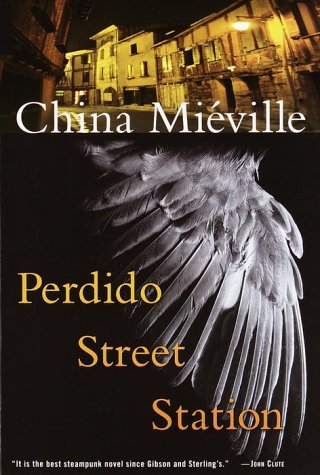
Despite being a bit too long, I enjoyed listening to Random House’s new audiobook recording of China Miéville‘s second novel, Perdido Street Station, read by John Lee. Perdido Street Station is Miéville’s first novel set in the steampunk world of Bas-Lag, a strange world populated by plenty of bizarre races and even more bizarre “Remades,” persons who have been forced (or in some instances have chosen) to restructure their biological makeup to perform (very) specific jobs. This sci-fi adventure story centers around protagonist Isaac Van der Grimnebulin, an overweight renegade scientist trying to perfect a new technology he calls “crisis energy.” Isaac is trying to help a Garuda named Yagherak who, as a form of punishment, has had his marvelous wings cut off. To this end, Isaac experiments with a strange caterpillar that feeds off of an hallucinogenic drug called “dreamshit.” Unfortunately, the caterpillar turns into a giant dream-feeding, brainsucking moth that, along with its relatives, terrorizes the city at night. Isaac tries to stop the moths and save his girlfriend, an artist with a bug’s head. Lots of picaresque adventuring ensues.
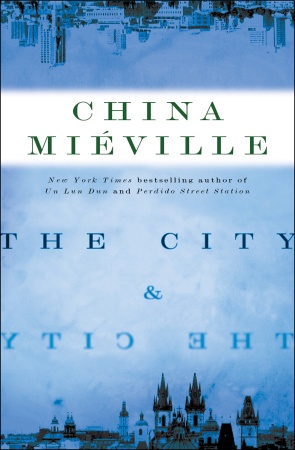
Miéville’s Bas-Lag world is finely detailed and richly imagined, and will no doubt appeal to anyone who digs H.P. Lovecraft or William Gibson. Miéville certainly has a handle on both of his many concepts (artificial intelligence, the nature of bodies, difference and (literal) alienation), and his story unfolds with the thrilling clip one expects from pulp fiction. Still, the book felt overwritten to me. Miéville never settles on just one adjective if two (or three) come to mind, and he’s in love with adverbs (oh the adverbs in this book! Is there a sentence without one?). And while exposition of a sort is certainly necessary in a novel about such a profoundly strange world, I think that Miéville would get a bigger payoff if he trusted his reader a bit more. Perdido Street Station feels rhetorically claustrophobic, as if Miéville is afraid to let his reader imagine even a little of Bas-Leg for him or herself. It’s a bit selfish, really. On the whole though, a great read (or listen, in this case), and it intrigued us enough to go straight into Miéville’s latest book, The City & The City(also newly released this summer from Random house, also read by John Lee).
The City & The City combines noir detective fiction with one of science fiction’s greatest gambits, namely, positing something utterly implausible, unimaginable, and then making it ordinary. In The City & The City, two cities, Beszel and Ul Qoma, occupy the exact same geographic space, yet their citizens are trained from birth to “unsee” and “unhear” all aspects of the other city. Inspector Tyador Borlu is drawn into the mysterious death of a beautiful young woman (is there an older trope? Edgar Allan Poe even wrote an essay on why and how you should use beautiful yong dead girls in your literature). His investigation leads him into crossing the border between the cities, an impossible border, of course, and yet the genius of the book here is that, through Borlu’s narration, the reader doesn’t experience this bordercrossing (and its attendant “unseeing”) as satirical or even ridiculous; rather, we witness the uncanny alienation of double consciousness. Miéville, a Marxist, is working in part from some of Althusser‘s ideas, and he’s not afraid to namedrop Foucault or Žižek. Thankfully, however, Miéville not only knows his theorists, he knows enough not to let theory get in the way of a Chandleresque murder mystery that explores themes of surveillance, alterity, and what it means to see someone seeing you seeing them seeing you (seeing them seeing you . . .). Great stuff.
Toward the end of the 130 page monologue that is Roberto Bolaño’s novella By Night in Chile, narrator Father Sebastián Urrutia Lacroix claims that “An individual is no match for history.” His statement neatly encapsulates (what might be) the dominant theme of By Night in Chile, namely an individual person’s capacity and ability to correctly–and sanely–somehow measure, attest to, confront, and witness the horror and brutality of history. In this case, Bolaño’s narrator, a Catholic priest–and conservative literary critic (and, of course, failed poet)–Father Urrutia, via a sweeping deathbed confession of sorts, recounts his life story, leading inexorably to Pinochet’s coup and its attendant subsequent draconian reforms and abuses. While it would be a mistake to reduce Bolaño’s rich novella to one conflict, I think the root of Urrutia’s struggle emanates from his inability to come to terms with his role as an intellectual (let alone an artist, critic, or priest) complicit somehow in Pinochet’s crimes. Throughout the book, from the very beginning, Urrutia blames his inner turmoil on a “wizened youth” (I don’t want to spoil this antagonist’s identity, but puzzling out that paradoxical appellation provides a major clue), a kind of idealist who stands apart from the dying priest, mocking and taunting him. After his claim that “An individual is no match for history,” Urrutia avers that “The wizened youth has always been alone, and I have always been on history’s side.” For Urrutia, this is of paramount importance, not just as a Catholic priest (which, it must be pointed out, is a role he doesn’t seem particularly suited for) but also as a literary critic and intellectual: Urrutia wants to systematize and critique history, to be “on the right side of history,” to quote Barack Obama. And yet his own attempt to narrativize his own life ironizes and critiques this very possibility at every turn–he is a sham, a charlatan, motivated and prompted by fear and even hate.
And on that attempt to narrativize a life: I would call By Night in Chile an anti-bildungsroman. Although Urrutia relates a life story, the free flow of psychic impressions that characterizes his telling slip and sail and rock and crash throughout years and over decades, often flowing backwards and forwards, sometimes spending pages on what could only be considered inconsequential minutiae, while at times glossing over the profoundest events with little more than a word or two. It is often what Urrutia does not remark upon that characterizes what is of the greatest importance in this work, and this is a testament to the power of Bolaño’s writing, to his command of voice. In one of the greatest performances of the novel, Urrutia describes the time right before, during, and after Pinochet’s coup. The passage is less than four pages, and for every contemporary action of immediate consequence, Urrutia seems to provide twice as many examples of his retreat into the past: ” . . . the first anti-Allende march was organized, with people banging pots and pans, and I read Aeschylus and Sophocles and Euripides, all the tragedies, and Alkaios of Mytilene and Aesop and Hesiod and Herodotus . . . .” Urrutia doesn’t bother to scrutinize or analyze the visceral reality of history in the making around him, regressing instead to the comfort of established philosophical tradition–the history of Herodotus in favor of the chaos, anarchy, and brutality happening around him. He’s really quite a terrible priest, and as an intellectual he refuses to be engaged. Confident that he will always be “on history’s side,” he refuses to actively even try come to terms with history until he’s dying. And thus we get the narrative of By Night in Chile.
This reckoning with the past takes the form of a long monologue but, as those familiar with Bolaño will attest, there are plenty of other voices here, stories nested within stories like Russian dolls. The force and vitality of Urrutia’s speech is astonishing; one envisions the monologue as a single immediate and discrete exhalation, a stream of memory, the living wail of a dying man. Bolaño’s rhetorical style here conveys this ironic energy. He employs long (very, very long) sentences, sometimes going on for several pages, and often uses little or no transitions between what should be major shifts of space and time. There are plenty of references to writers, of course, many obscure, and more motifs and leitmotifs than I can work out here (or elsewhere, to be honest). I’m going to go out on a limb and suggest that the book is probably even more intense in the original Spanish, although I think Chris Andrews has done a brilliant job translating here, just as he did in Last Evenings on Earth. And since I’ve brought up that book, I’m going to make another suggestion: if you’ve yet to read Bolaño, you should, and Last Evenings of Earth (or 2666 if nearly a thousand pages doesn’t seem too daunting)is probably the best place to start–which is kind of another way of saying that By Night in Chile is not the best entry point to Bolaño–at least not for anyone intimately familiar with Latin American history. It’s not that By Night is particularly challenging or hard to read. However, I think that this particular book will probably be better enjoyed with more context. As Rodrigo Fresán points out in his essay “The Savage Detective,” (published in the March 2007 issue of The Believer), By Night in Chile could be (should be?) read as part of one cohesive book along with Amuletand Distant Star. (I will read these once I get my grubby little fingers on them). Indeed, as many critics have pointed out, Bolaño’s works seem to coalesce into one great work, a secret universe parallel to Tolkien’s Middle Earth or Proust’s France. Urrutia’s voice enriches this universe, but one must have something of a foothold on Bolaño’s themes in order to appreciate the complex ironies of By Night in Chile. Or maybe not. Maybe this is a great entry point to Bolaño. Either way, great book. Highly recommended.
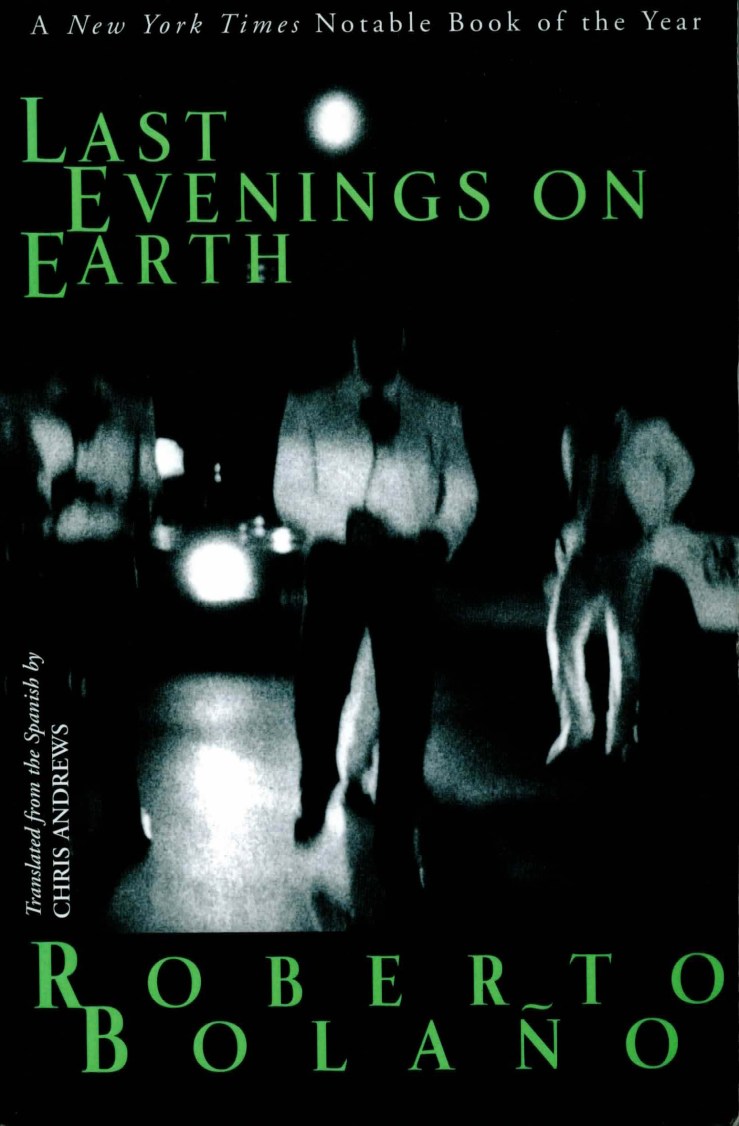
Although the fourteen stories in Roberto Bolaño‘s superb collection Last Evenings on Earthare the result of collating and translating two previously published volumes, Llamadas telefónicas and Putas asesinas–and therefore ostensibly have nothing to do with each other (other than being the work of a singularly gifted author)–I couldn’t help reading them, especially towards the end of the book, as a strange, fragmented novel. Beyond Bolaño’s inimitable style (more on that in a moment), the collection is unified by its protagonists, or protagonist, really, who really must be a stand-in for Bolaño himself. Tenets of New Criticism be damned! It’s impossible not to read Bolaño into these stories, whether his narrators or protagonists are young teens or middle-aged men, petulant sons or struggling writers. Scratch that last one. They’re all struggling writers; in fact, just about everyone in this book is a struggling writer, or an exile, or a vagabond, or on the run, or so enamored and wound up in Big Romantic Ideals that they make plenty of foolish decisions (one of my favorite things about this book is how easily Bolaño posits and then ironizes and the tears apart Big Romantic Ideals at the very same time he makes you feel wistful and nostalgic for those days when you believed in them yourself). Bolaño uses a character named only “B” for most of these stories; elsewhere, (anti-)hero (and obvious Bolaño stand-in) Arturo Belano of The Savage Detectives is revealed to be a narrator. In other stories the young male protagonist is simply not identified by any name, yet all of these characters are so fully realized, so psychologically real, that they must contain at least some part of Bolaño.
And these protatgonists are so very, very real, almost frighteningly so, like “B” in “A Literary Adventure,” whose paranoia over receiving a career jump-starting review from a writer–“A,” of course, who B has actually mocked in his book–poisons any enjoyment B might have had with his new success. B’s slow descent into a mild madness is perfectly drawn, the sort of thing you might see in your own life, the sort of anxiety that many of us feel but cannot communicate or explain because of the silly shame of it all. In “Last Evenings on Earth,” B (the same B? Must be) takes a vacation to Acapulco with his father. Bolaño’s rhetoric in this tale is masterful: he draws each scene with a reportorial, even terse distance, noting the smallest of actions, but leaving the analytical connections up to his reader. Even though B sees his holiday with his dad heading toward “disaster,” toward “the price they must pay for existing,” he cannot process what this disaster is, or what paying this price means. The story builds to a thick, nervous dread, made all the more anxious by the strange suspicion that no, things are actually fine, we’re all just being paranoid here. (Not true!)
That ebb and flow between dread and release, fear and humor, ironic detachment and romantic idealism works throughout each of the stories, even ones not specifically about B (or Belano, or, let’s be honest maybe, Bolaño). “Anne Moore’s Life” is an incredible (yet thoroughly credible) portrait. The story is both journalistic and personal; Anne’s life is at once banal and bizarre–like anyone’s life, perhaps, but not. “Mauricio (“The Eye”) Silva” relates the story of another Chilean exile (did I forget to mention that, in a way, this whole book is about Chilean exiles, that if Last Evenings on Earth is a fragmented novel, then it tells the fragmented story of these artists and activists fleeing from Pinochet’s coup? If I forgot to mention that, I suppose I didn’t want to over-politicize my review, or suggest that one had to have some contextual knowledge of the Chilean diaspora in order to enjoy this book, because I don’t think you have to–but where were we? “The Eye,” right), the titular Mauricio (AKA “The Eye”), a photographer whose travels take him to the depths of depravity in the poorest parts of India. What parts of India? Well, the narrator never finds a specific answer, because those don’t really exist in Bolaño’s universe. All claims are under suspicion. Things may or may not have happened, and if they did happen, they might have happened in myriad ways. But how is it then that Bolaño is never murky? How can a writer who posits so many possibilities, whose characters repeatedly aver that they don’t really remember exactly the way things happened (if they even happened at all), how can such a writer be at the same time so sharp and exacting? It’s one of Bolaño’s great gifts of course and we’re lucky to share in it.
It would be hard–impossible really–to pick the best story from the collection. They’re all great, they all demand to be reread, and they made me want to read more Roberto Bolaño. But if I had to pick one as a starting point, if I had to foist one on a friend, I suppose it would be “Enrique Martín,” the story of a failed poet that made me laugh out loud several times and then almost cry. Arturo Belano narrates this story with a wry, acerbic, deadpan humor that veers at times into unexpected and affecting poignancy. Poor Enrique only wants Belano’s respect, or at least Belano to read his poems with a modicum of dignity–a fact that Bolaño shares with his readers while still keeping his narrator in the dark. As the story plunges to its tragic end, Belano finally sees what the reader has already cottoned onto: our individual choices in relations to others might be far more impactful than we realize, and human empathy is in sorry supply in this world. “Life is mysterious as well as vulgar,” Belano nonchalantly suggests in the middle of the story, but Bolaño goes to exacting pains to show us that there can be a saving beauty and humor in all that strange visceral ugliness. One of the best stories I’ve ever read in one of the best collections I’ve ever read. Very highly recommended.
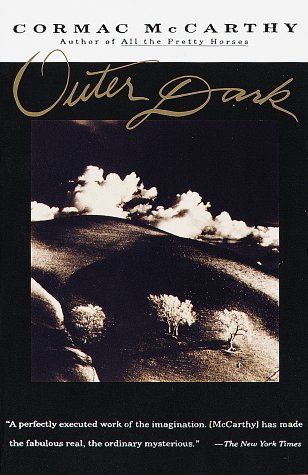
In Cormac McCarthy‘s second novel, Outer Dark, set in the backwoods and dust roads of turn-of-the-century Appalachia, Culla Holme hunts his sister Rinthy, who has abandoned the pair’s shack to find her newborn baby. Culla has precipitated this journey by abandoning the infant in the woods to die; a wandering tinker finds the poor child and absconds with it. As Rinthy and Culla independently scour the bleak countryside on their respective quests, a band of killers led by a Luciferian figure roams the wilderness, wreaking violence and horror wherever they go.
In a recent interview with the AV Club, critic Harold Bloom noted that Cormac McCarthy “tends to carry his influences on the surface,” pointing out that McCarthy’s major influence, William Faulkner, tends to proliferate throughout McCarthy’s early work to such an extent that those works (The Orchard Keeper, Outer Dark, Child of God, Suttree) suffer to a certain degree. Indeed, it’s hard not to read Outer Dark without the Faulkner comparison invading one’s perception. It’s not just McCarthy’s Appalachian milieu, populated with Southern Gothicisms, hideous grotesques, rural poverty, incest, and a general queasiness. It’s also McCarthy’s Faulknerian rhetoric, his elliptical syntax, his dense, obscure diction, his bricks of winding language that seem to obfuscate and resist easy interpretation. Like Faulkner, McCarthy’s language in Outer Dark functions as a dare to the reader, a challenge to venture to the limits of what words might mean when compounded. And while the results are sometimes (literally) startling, they often strain, if not outright break, the basic contract between writer and reader: at times, all cognitive sense is lost in the word labyrinth. Take the following sentence that ends the first chapter, where Culla looks back on the infant he has just abandoned:
It howled execration upon the dim camarine world of its nativity wail on wail while lay there gibbering with palsied jawhasps, his hands putting back the night like some witless paraclete beleaguered with all limbo’s clamor.
A “paraclete” is someone who offers comfort, an advocate. I’m thinking that the “jawhasps” must be a twisted mouth. No idea what “camarine” means. But it’s not just the obscure diction here: the whole action is obscure (how does one go about “putting back the night”?). This confusing passage is hardly an isolated incident in Outer Dark; instead McCarthy repeatedly employs long, dense, nearly unintelligible sentences, constructions that defy the reader’s ability to visualize the words he or she is being asked to decode. This unfortunate tendency alienates the reader in ways that are no doubt intentional, yet ultimately unproductive. More often than not, McCarthy’s long twisting hydras of obscurantism are not so much moving or thought-provoking as they are laughably ridiculous, and while his vocabulary is surely immense, it’s hard enough to get through such abstract sentences without having to run to a dictionary every other word.
Readers of mid-period, or even more recent McCarthy works will no doubt recognize this complaint, so it’s important to note that we’re not talking about the density and alienating syntax of Blood Meridian, the philosophical pontificating of The Border Trilogy, or the occasional run-to-a-thesaurus word choice one can find in The Road. No, Outer Dark is full-blown Faulkner-aping (Faulkner at his worst, I should add); over-written, ungenerous, and just generally hard to get into, especially the early part of the novel which is particularly guilty of these crimes. Which is a shame, because once one penetrates the wordy exterior of the first few chapters, there’s actually a pretty good novel there. While no one could accuse Outer Dark of having a tight, gripping plot, the intertwined tales of Culla and Rinthy–and the band of outlaws–gives McCarthy an excellent venue to showcase his biggest strength in the novel–the dialogue.
Spare and terse, the strange, strained conversations between McCarthy’s Appalachian grotesques are often funny, usually tense, and always awkward. Culla and Rinthy are outcasts who don’t quite understand the extent of their estrangement from the dominant social order. They frequently encounter fellow outcasts, often freaks of a mystical persuasion, like the witchy old woman who frightens Rinthy, or the old snake-trapper who freaks out Culla (a task not easily achieved). The dialogue between McCarthy’s characters reads with authenticity and intensity, and the author gets far more mileage out of the gaps in conversation, the elisions, the omissions–what is not said, what cannot be said. These odd characters culminate in the trio of outlaws who terrorize the fringes of Outer Dark. Their ominous black-clad leader prefigures many of McCarthy’s later antagonists, like the Judge of Blood Meridian or Chigurh in No Country for Old Men, but he pales in comparison to the former’s eloquent anarchy and the latter’s bloody intensity. McCarthy doesn’t really seem to know what to do with him, to tell the truth. Still, fans of Chigurh and the Judge will find the roots of those characters in this unnamed villain, and will probably have some interest in McCarthy’s evolution of this type.Indeed, it’s tracking this progression of themes and types throughout McCarthy’s body of work that was of the greatest interest to me, and in turn, I suspect that Outer Dark is probably going to be of greatest interest to those who’ve been reading McCarthy more or less chronologically backwards (like I have). It’s certainly not the starting place for this gifted author, and while its early dense prose will certainly provoke a few mournful groans, the end of the book redeems the bog of language at its outset.
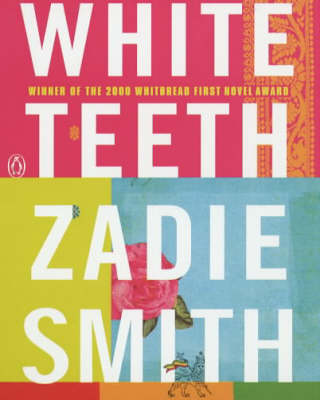
And so well with the help of Jenny Sterlin’s narration and my handy-dandy portable mp3-playing device, I finally made it through Zadie Smith‘s 2000 novel White Teeth, and, having digested all of it, am now fit to declare it hilarious in places, larded with moments of intensely brilliant prose, wildly ambitious, and ultimately hollow, overstuffed with flat characters who, despite Smith’s best efforts, do not manage to earn the Big Important Climax she shoves them toward. Smith succeeds in communicating the multicultural problematics of late-twentieth-century London, but her massive scope (the audiobook is 23 hours and my unfinished paperback runs to nearly 500 pages) is just too massive. Smith seems to think that loads of concrete detail will automatically conjure emotional force, but what we get instead verges on soap opera at times–more bathos than pathos.It doesn’t help reader expectations of course that White Teeth was wildly overpraised after its debut. While White Teeth‘s attempt to reconcile the personal traumas of a postcolonial world with the demands of family, tradition, and personal worth is admirable, its aim exceeds its grasp, and the end disappoints. Still, I enjoyed it as an audiobook–Jenny Sterlin mugs enthusiastically through the various accents and argots of a melting pot London, and Smith’s concrete emphasis on detail makes it an ideal listen for a few summer afternoons of gardening or housework. Not the Great Book we’ve been told it is, but a fine listen nonetheless.
Summer is, of course, a great time for audiobooks, and I’m thrilled that China Miéville‘s breakthrough second novel Perdido Street Station is finally available on mp3. I’ve been wanting to read Miéville for quite some time now, but the length of his dystopian tomes has made it difficult until now (I am a very busy, important man, with busy, important things to do). Perdido Street Station, set in a bizarre, gross world of humans, Re-mades, and other sundry races, is weird fiction at its finest (so far)–a great hybrid of Charles Dickens and PK Dick, HP Lovecraft and JG Ballard. It trawls the line between real and surreal, art and science, grime and enlightenment, in lovely, if dense prose, that could never be mistaken as genre fiction. Great stuff, so far.
Also great stuff, so far, is Roberto Bolaño‘s collection of short stories, Last Evenings on Earth. I read the first three tales in succession last night, unable to put the book down although it was well-past my well-established “you must go to bed now or your toddler daughter will wreak havoc on you in the AM” bedtime. The first three stories are about, get this, (big surprise if you’ve read Bolaño), writers–good, bad, indifferent writers, failed, semi-failed, miserable writers. Sad writers, mad writers. The opener “Sensini” tells the story of an epistolary relationship between a young writer and an aging, uncelebrated writer. It’s sad yet measured in its pathos, and it earns its happy ending by loading that ending with the seed of potential disaster. The next story, “Henri Simon Leprince,” is the hilarious (and sad) tale of a miserable writer, a hack who teams up with the Resistance in WWII France. Despite his best intentions, he’s roundly despised by all those he helps. And he’s a terrible writer. The third story, “Enrique Martín,” literally made me laugh out loud, several times, to the point of tears. Narrated by Arturo Belano, Bolaño’s literary stand-in, it tells the desperate story of the titular failed poet, a would-be artist and sometime UFO hunter who slowly watches his dreams disintegrate.
All of Bolaño’s stories so far have extended past the mad force of his own strong voice(s) and implanted themselves into my mind, reaching into my own past; his characters, in hashing out their strange young lives (from a bit of distance, now) repeatedly evoked my own youthful memories, stuff I hadn’t thought about in years. There’s a sad brilliance under all of Bolaño’s stuff, like bright noon sun perceived through an ambiguous tear resting on your eye. Reading the beginning of Last Evenings on Earth last night, it occurred to me for the first time that Bolaño had died, and he’d died really young, and there weren’t going to be anymore books from him. But that’s a bummer note to end on. Let’s leave it at this–Last Evenings on Earth is some seriously great stuff.
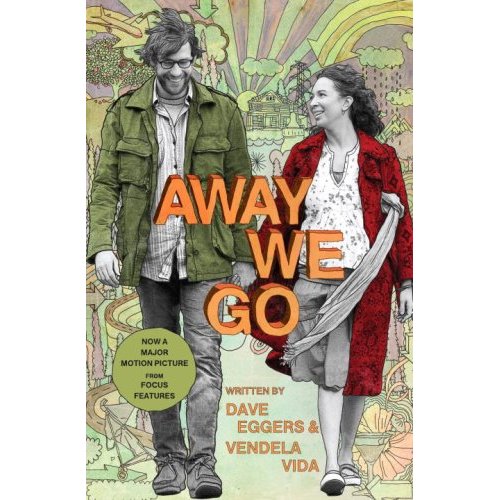
Away We Gois the story of Verona and Burt, an unmarried couple in their early thirties expecting a child. After discovering that the child’s only living grandparents will be moving to Belgium, Verona and Burt realize that there’s nothing anchoring them in Colorado. The pair set out on a cross country journey in their boxy old Volvo, meeting up with old friends and family in an attempt to find the right place to start their new family.
“We’ve attempted to make this readable to a non-screenwriting population, from whose ranks we’ve recently come,” write Dave Eggers and Vendela Vida in their introduction to their screenplay for Away We Go. Released last week in conjunction with the film, the screenplay, with its vivid cover and prestige trade format, seems to physically back up Eggers’s and Vida’s wish–they’re hoping that you’d want to, y’know, actually read it, like, a book, and not just watch Sam Mendes‘s filmed version. There’s that hopeful, informative introduction, for starters, and they really do make good on their claim of readability; stage directions and location shifts are clear but never overbearing, allowing the reader to engage the characters in his or her own imagination. The book also includes scenes (apparently) cut from the movie–should I mention now that I haven’t seen the movie?–as well as an alternate “admittedly radical Bush-era ending.” Still, it is a screenplay–not a novel, not a play, but a text intended for a movie, a movie out there getting reviewed now, a movie with physical entities playing the key roles. “Verona and Burt were written with Maya Rudolph and John Krasniski in mind,” Eggers and Vida state in their introduction, and, between this admission and press for the movie, its almost impossible to read the script without imagining these actors’ mannerisms and tics. Not that that’s a bad thing, it just limits any nuance in (and in between) the lines, and again brings up the question of why one might want to own this book.
The answer for many readers, of course, will simply be Eggers, a modern literary luminary. For the record, we’re a huge fan of Dave Eggers, even when his writing isn’t the best. Eggers is perhaps the most visible of a whole crop of post-David Foster Wallace writers (for lack of a better term), a linchpin of a (non-)movement whose literary house McSweeney’s, and its attendant magazines, Timothy McSweeney’s Quarterly Concern, The Believer, and the video journal Wholphin frequently feature some of the best writing and art out there today. His 2000 memoir A Heartbreaking Work of Staggering Genius might be a bit overrated, but it’s also one of the first post-DFW books to grapple with irony and earnestness in a moving discourse. Besides all of that, Eggers is the founder of 826 National, a nonprofit organization that tutors kids in writing and reading across the country. In short, Eggers is all about making reading and writing fun and cool and demystified for lots and lots of people, and because of that, he’s a hero of ours. Of course, he has his haters; there are many who claim that McSweeney’s is form without substance, all show, fancy design without good writing. This is a pretty silly argument, because all you have to do is sit down with an issue of McSweeney’s or The Believer and actually, y’know read it to realize that 99% of the writing is fantastic. Better yet, check out one of the books they’ve published, like Chris Adrian‘s The Children’s Hospital. Eggers’s haters generally don’t have a lucid argument because what they hate is an attitude, a vibe, a feeling. I’ll readily admit that I’m hip to what they’re describing, and something of that backlash has come out in reviews of the film–especially New York Times critic A.O. Scott’s overly-analytical takedown of Away We Go. There’s a preciousness, a smug quirkiness, an awareness that people simply do not have discussions in the manner that Verona and Burt do, and this puts people off. Of their fictional parents-to-be, Eggers and Vida–who were pregnant with their own child October when they wrote the screenplay–write: “When we conceived them, we thought of a couple who was as different from ourselves as we could muster.” People who read into things deeply might find it hard to believe that Verona and Burt are anything but stand-ins for Vida and Eggers, and that couples casual resistance to the extreme drama of having a child is, honestly, a bit offputting. (If you really want to see some visceral Eggers-hating/Eggers-defending, check out the comments on this recent A.V. Club interview with the pair).
But back to the screenplay, which I suppose was the occasion for this writing. I enjoyed it. It was funny. At times there was an irking quirk to the characters, a certain shallowness that doesn’t do justice to the intensity of pregnancy. I read it in two short sittings–less time than the film would take to watch, I suppose. It also made me want to watch the film, rather than putting me off. Eggers completists might want to add the screenplay for Away We Go to their collections; newbies interested in his work should check out his novel What Is the What, Eggers’s remarkable novelization of the life story of Valentino Achak Deng, one of the “lost boys” of Sudan.
Away We Go is now available in trade paperback from Vintage.




 Biblioklept