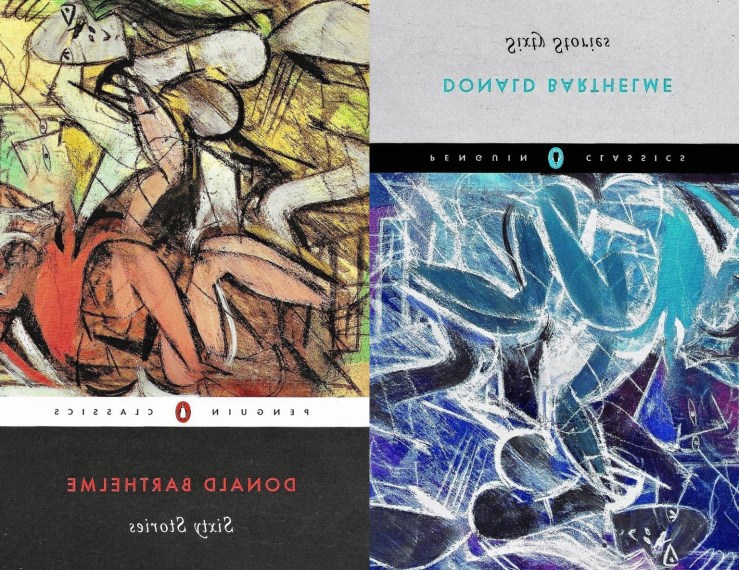
Donald Barthelme’s Sixty Stories in reverse, Part VII

I am rereading Donald Barthelme’s Sixty Stories, starting with the sixtieth story and working my way to the first and writing about it.

Previous entries:

Stories 60-55

Stories 54-49

Stories 48-43

Stories 42-37

Stories 36-31

Stories 30-25.

This post covers stories 24-19.

24. “Critique de la Vie Quotidienne” (Sadness, 1972)

A cruel cruel story bristling with venomous punchlines, “Critique de la Vie Quotidienne” takes its title from Marxist philosopher Henri Lefebvre’s 1947 book of the same name. The story is a caustic satire of quotidian domesticity, showing the dissolution of a marriage through the perspective of an alcoholic narrator who very much resembles Barthelme. It begins ugly:

While I read the Journal of Sensory Deprivation, Wanda, my former wife, read Elle. Elle was an incitement to revolt to one who had majored in French in college and now had nothing much to do with herself except take care of a child and look out of the window.

And continues ugly:

Our evenings lacked promise. The world in the evening seems fraught with the absence of promise, if you are a married man. There is nothing to do but go home and drink your nine drinks and forget about it.

There’s a deep anger and contempt toward domesticity that Barthelme’s narrator sustains throughout the story while also pulling the rhetorical trick of quickly retreating into the second-person you, a conceit that never fully absolves the narrator from his intrinsic horribleness:

Slumped there in your favorite chair, with your nine drinks lined up on the side table in soldierly array, and your hand never far from them, and your other hand holding on to the plump belly of the overfed child, and perhaps rocking a bit, if the chair is a rocking chair as mine was in those days, then it is true that a tine tendril of contempt – strike that, content – might curl up from the storehouse where the world’s content is kept, and reach into your softened brain and take hold there, persuading you that this, at last, is the fruit of all your labors, which you’d been wondering about in some such terms as, “Where is the fruit?”

The narrator quickly divides himself from the you, the horrible man who cannot live the quotidian life:

 …you look, as I say, to your wife, as the cocktail hour fades, there being only two drinks left of the nine (and you have sworn a mighty oath never to take more than nine before supper, because of what it does to you), and inquire in the calmest tones available what is for supper and would she like to take a flying fuck at the moon for visiting this outrageous child upon you.

Ultimately, “Quotidienne” is too mean and ugly (borderline misogynistic, perhaps); it lacks the kernel of heart that beats in Barthelme’s best satires.

23. “The Glass Mountain” (City Life, 1970)

Look, it might take you ten minutes to read it, so read it.

The story is a list numbered to one hundred. Most of the numbered points are a solitary sentence, with exceptions coming from a handful of citations Barthelme includes.

“The Glass Mountain” fits neatly into City Life. It’s a city story transported into the realm of the mock-heroic. With the aid of two plumber’s friends (plunger, you might call them), the narrator (a mock hero) climbs the titular mountain, which “stands at the corner of Thirteenth Street and Eighth Avenue.” It’s a skyscraper, of course:

7. I had strapped climbing irons to my feet and each hand grasped sturdy plumber’s friend.

8. I was 200 feet up.

9. The wind was bitter.

10. My acquaintances had gathered at the bottom of the mountain to offer encouragement.

11. “Shithead.”

12. “Asshole.”

13. Everyone in the city knows about the glass mountain.

His “acquaintances” continue to berate him as he climbs (“24. “Dumb motherfucker.” / 25. I was new in the neighborhood.”)

As he climbs, the heroic arc swells, enriched by a riff on symbolism and signs, which is the story’s main theme. And yet at the end, Barthelme’s “hero” rejects symbolism the minute it transubstantiates into sign:

97. I approached the symbol, with its layers of meaning, but when I touched it, it changed into only a beautiful princess.

98. I threw the beautiful princess headfirst down the mountain to my acquaintances.

99. Who could be relied upon to deal with her.

The mob rules.

22. “The Policemen’s Ball” (City Life, 1970)

In his Barthelme biography Hiding Man, Tracy Daugherty links “The Policeman’s Ball” to the eruptions and disruptions of May ’68:

In Don’s story, Horace, a policeman with the “crack of authority” in his voice, takes his girlfriend Margot to a policemen’s ball, hoping she will surrender to his force–the “force of the force.” At the balll, she is drawn to a fireman named Vercingetorix. Finally, though, she returns home with Horace and gives him what he wants…All the while, the “horrors lurk outside Horace’s apartment…The story’s smirk at authority is clear. The names Horace and Vercingetorix come to us from Roman history. Vercingetorix was a Gallic rebel noted for building barricades to thwart Roman soldiers. Shortly after vanquishing Vercingetorix, Caesar was assassinated. Horace, an irreverent poet and satirist, fell under Brutus’s sway, and joined him in a hopeless attempt to establish a republic.

The historical referents–to a decadent empire and rebellions against it–make Don’s story, in the context of the May Days, an extended utopian slogan, as playful, sly, and funny as much of the graffiti in the Latin Quarter.

(A version of) Vercingetorix shows up in “City Life” (in City Life).

I think “The Policemen’s Ball” is more relevant than ever, as we (who is we?) contest against the force of the force.

(Hear Barthelme read the story here.)

21. “The Falling Dog” (City Life, 1970)

Another story about writing a story—and again, Barthelme displaces the creative act to fine art—and again (in reverse), he chooses a sculptor as his artist. The sculptor achieved a thin bare fame with his YAWNING MAN statues, but when a dog falls on him, he finds new inspiration. (And puns. Lots of lots of puns.)

(I keep thinking about another Don here, although it’s in no way related—Don DeLillo’s Running Dog (1978) and Don DeLillo’s Falling Man (2007).)

(doG is God backwards—can you even fucking believe?)

20. “Kierkegaard Unfair to Schlegel” (City Life, 1970)

There’s a tension that runs throughout much of Barthelme’s short fiction: professed leftist idealism set against the writer’s urbane bourgeoisie (or bourgeoisie-proximal) reality as an arbiter and curator of Modernist culture. Barthelme’s aesthetic describes technological postwar American culture–often through a mythological lens, often through the spectacle of both pop art and Pop Art (which becomes American mythology in his writing). His satires, pastiches, and parodies set a funhouse mirror up to America’s hypermediated massculture reality. At the same time, Barthelme’s stories tend to eschew direct action, direct engagement with the realities of the age his stories (not so much document but) describe: the Civil Rights movement, the Vietnam War, and other social inequalities. A passage in the Q&A story “Kierkegaard Unfair to Schlegel” shows Barthelme perhaps a bit defensive about these elisions:

Q: You’re not political?

A: I’m extremely political in a way that does no good to anybody.

Q: You don’t participate?

A: I participate. I make demands, sign newspaper advertisements, vote. I make small campaign contributions to the candidate of my choice and turn my irony against the others.

Here, we get Barthelme declaring the political scope of his literature: it is an irony against the others. Much of the story is given over to the answerer’s summary and analysis of Kierkegaard’s The Concept of Irony, followed by a defense of Friedrich Schlegel’s novel Lucinde, which Kierkegaard regards as a moral failure because it does not instruct its readers how to live. The answerer says Kierkegaard fails to attend to the novel’s “objecthood” — its aesthetics. At the end he remains ambivalent: Kierkegaard is both fair and not fair to Schlegel:

…What is interesting is my making the statement that I think Kierkegaard is unfair to Schlegel. And that the whole thing is a damned shame! Because that is not what I think at all. We have to do here with my own irony. Because of course Kierkegaard . was “fair” to Schlegel. In making a statement to the contrary I am attempting to… I might have several purposes-simply being provocative, for example. But mostly I am trying to annihilate Kierkegaard in order to deal with his disapproval.

Q: Of Schlegel?

A: Of me.

(There’s also a deep strain of horniness to the story that I will not comment on at this time.)

19. “City Life” (City Life, 1970)

The title story of Barthelme’s 1970 collection is a weird, oblique love letter to a version of NYC. The Houston-native seems to finally earn his New Yorker stripes. It’s an unusually long story, rich with meanings that I won’t bother to plumb here, because I’ve had a long day, and I doubt anyone is actually reading this (I can live in doubt). The basic plot of “City Life” is the whole Virgin Birth thing, with the city-as-father—which is par for Barthelme’s oedipal course. It has some wonderful passages, including this one.

Summary thoughts: “City Life” and “Kierkegaard Unfair to Schlegel” strike me as seminal Barthelme texts, but neither make a good starting point to his fiction. “Critique de la Vie Quotidienne,” the story in this batch from Sadness is sad, mean stuff, and also likely relatable for any dad who’s ever wanted to hop in his car and go out for a pack of cigarettes or a carton of milk or whatever your deadbeat idiom is. “The Falling Dog” is okay. Both “The Policemen’s Ball” and “The Glass Mountain” would make nice starting places for anyone interested in Barthelme’s stuff.

Going forward (in reverse): A few more from City Life and then we crack into what might be Barthelme’s best collection, 1968’s Unspeakable Practices, Unnatural Acts.

Donald Barthelme’s Sixty Stories in reverse, Part VI

I am rereading Donald Barthelme’s Sixty Stories, starting with the sixtieth story and working my way to the first and writing about it.

Previous entries:

Stories 60-55

Stories 54-49

Stories 48-43

Stories 42-37

Stories 36-31

This post covers stories 30-25.

30. “The Party” (Sadness, 1972)

A messy bright drunken satire on academia and parties involving academics and pseudointellectuals in general. It opens with assholery, with unnecessary incorrect corrections:

I went to a party and corrected a pronunciation. The man whose voice I had adjusted fell back into the kitchen. I praised a Bonnard. It was not a Bonnard. My new glasses, I explained, and I’m terribly sorry, but significant variations elude me, vodka exhausts me, I was young once, essential services are being maintained.

Essential services are being maintained cracked me up this go around. (I too have been sometimes exhausted by vodka.)

King Kong shows up at the party! Barthelme pulls a few Robert Coover moves, but is less comfortable parodying film than he is parodying modern art (or Modern Art, I mean).

PK_15822_burke_img4
I Don’t Like to Look at Him, Jack by Walton Ford

“The Party” is a sad story, a bad scene with some good cruel jokes. Near the end, our narrator—some ironic extrapolation of Barthelme his own damn self—internally remarks:

What made us think that we could escape things like bankruptcy, alcoholism, being disappointed, having children?

Yuck.

29. “Daumier” (Sadness, 1972)

Probably my favorite story so far in this reverse re-read. “Daumier” is the best sort of metafictional postmodernism: wry, occasionally mean, and fun with a tight little heart, the story never displays its plumage or winks at the reader.

On the outside of “Daumier” is the ostensible narrator who is playing around with a psychological gadget he calls surrogation, a concept the rest of us would identify as identifying with characters we create, avatars we write into being. He causes to be, via surrogation, in his mind’s narrative eye, a Western scene. A band of misunderstood rustlers are herding a herd of French au pairs across the Western plains. There are chili dogs and villainous priests and at least one muskateer. In case we get confused, Barthelme’s narrator offers a resume of the plot:

Ignatius Loyola XVIII, with a band of hard-riding fanatical Jesuits under his command, has sworn to capture the herd and release the girls from the toils so-called of the Traffic, in which Daumier, Mr. Hawkins, and Mr. Bellows are prominent executives of long standing. Daumier meanwhile has been distracted from his proper business by a threat to the queen, the matter of the necklace (see Dumas, The Queen’s Necklace, pp. 76-1 05).

“Daumier” sees Barthelme quick switching between genres, moods, and registers. The story showcases some of the best bits of his midseventies ironic-epic mode. When his metatextual narrative moves back to the “ordinary,” contemporary world, Barthelme paints the scene with heroic bravado:

Immature citizens in several sizes were massed before a large factorylike structure where advanced techniques transformed them into true-thinking right-acting members of the three social classes, lower, middle, and upper middle. Some number of these were engaged in ludic agon with basketballs, the same being hurled against passing vehicles producing an unpredictable rebound. Dispersed amidst the hurly and burly of the children were their tenders, shouting. lnmixed with this broil were ordinary denizens of the quarter-shopmen, rentiers, churls, sellers of vicious drugs, stum-drinkers, aunties, girls whose jeans had been improved with applique rose blossoms in the cleft of the buttocks, practicers of the priest hustle, and the like.

The image of the children “engaged in ludic agon with basketballs” made me laugh aloud.

A penultimate section parodying modern food production surpasses this section, but also ends in a sweet if weird resolution—Barthelme’s surrogate commits to sweet marriage with a character. The last section, simply labeled “Conclusion” blows the phantasy apart. The narrator assures us that he has folded and wrapped up his characters and stuffed them tidily into desk drawers. He will take them out again in the future when he needs them again, “someday when my soul is again sickly and full of sores.” It is the exact same ending of Barthelme’s most-anthologized story, “The Balloon,” wherein the titular balloon is sent off to, what is it, West Virginia, to be stored for a future time, etc. etc. But this later story — “Daumier,” I mean — concludes in a strangely sadly depressive affirmation of life as doing, despite the pain of being:

The self cannot be escaped, but it can be, with ingenuity and hard work, distracted. There are always openings, if you can find them, there is always something to do.

28. “A City of Churches” (Sadness, 1972)

“A City of Churches” is one of Barthelme’s more straightforward satires. A woman named Cecelia plans to move to a new city where she hopes to open a car rental place. The name of the city, Prester, is likely an allusion to Prester John, the mythical Christian king of a lost Christian city. A certain Mr. Phillips shows Cecelia around, informing her that not only do all the citizens of Prester live in churches, but also all businesses are housed in churches. Irreligious Cecelia realizes that she cannot fit into such conformist confines.

27. “The Rise of Capitalism” (Sadness, 1972)

An essentially sad story in a book called Sadness, “The Rise of Capitalism” begins cryptically:

The first thing I did was make a mistake. I thought I had understood capitalism, but what I had done was assume an attitude — melancholy sadness — toward it. This attitude is not correct.

What follows is a pastiche of critical essay and parodic riffs; there’s no real plot but there are plenty of gags. In one memorable passage, capitalism becomes personified and literally rises, presumably to work. But the narration gives way to lamenting the alienation we feel under late capitalism, before shifting into absurdity:

Capitalism arose and took off its pajamas. Another day, another dollar. Each man is valued at what he will bring in the marketplace. Meaning has been drained from work and assigned instead to remuneration. Unemployment obliterates the world of the unemployed individual. Cultural underdevelopment of the worker, as a technique of domination, is found everywhere under late capitalism. Authentic self-domination by individuals is thwarted. The false consciousness created and catered to by mass culture perpetuates ignorance and powerlessness. Strands of raven hair floating on the surface of the Ganges…Why can’t they clean up the Ganges? If the wealthy capitalists who operate the Ganges wig factories could be forced to install sieves, at the mouths of their plants….And now the sacred Ganges is choked with hair, and the river no longer knows where to put its flow, and the moonlight on the Ganges is swallowed by the hair, and the water darkens. By Vishnu! This is an intolerable situation! Shouldn’t something be done about it?

I think something should be done about it.

26. “Träumerei” (Sadness, 1972)

Calling them “the most formally complex pieces” in Sadness, Barthelme’s biographer Tracy Daugherty notes that both “Träumerei” and “Sandman” were rejected by The New Yorker. I read “Träumerei” twice (reread, I suppose) and have no idea what it’s “about.” Formally, it’s a sort of monologue, a tirade even, addressed to “Daniel”:

So there you are, Daniel, reclining, reclining on the chaise, a lovely picture, white trousers, white shirt, red cummerbund, scarlet rather, white suede jacket, sunflower in buttonhole, beard neatly combed, let’s have a look at the fingernails. Daniel, your fingernails are a disgrace. Have a herring. We are hungry, Daniel, we could eat the hind leg off a donkey.

The narrator continues on and on, riffing on music and film and art, dropping composer names (Hadyn, Spontini, Glazunov), and decrying “the damned birds singing.” The title “Träumerei” is perhaps a reference to Schumann’s piece from Scenes from Childhood, as well as an invocation of the word’s translation as dream or reverie. It’s enjoyable as an accretion of images, but a bit frustrating if approached as a puzzle to figure out, which is not how one should necessarily approach it, but which, nevertheless, I did.

25. “The Sandman” (Sadness, 1972)

Another monologue, this time in epistolary form. The unnamed narrator writes a contempt-laden letter to his girlfriend’s psychoanalyst; she wants to terminate the analysis and buy a piano, but the shrink can only see this desire as a displacement. The narrator assures him that sometimes a piano is just a piano. In Hiding Man, Daugherty calls “The Sandman” an “unusually autobiographical story,” noting that the tale reflects Barthelme’s own disenchantment with analysis. The story also includes a scene cribbed from Barthelme’s early days writing for The Houston Post back in the mid-fifties. In it, the narrator describes police brutality:

There was a story that four black teenagers had come across a little white boy, about ten, in a vacant lot, sodomized him repeatedly and then put him inside a refrigerator and closed the door…and he suffocated. I don’t know to this day what actually happened, but the cops had picked up some black kids and were reportedly beating the shit out of them in an effort to make them confess.

The narrator makes a number of calls and finally gets enough pressure on the police force to hold them accountable:

So the long and short of it was that the cops decided to show the four black kids at a press conference to demonstrate that they weren’t really beat all to rags, and that took place at four in the afternoon. I went and the kids looked OK, except for one whose teeth were out and who the cops said had fallen down the stairs.

He concedes that “we all know the falling-down-the-stairs story,” but ultimately decides that,

Now while I admit it sounds callous to be talking about the degree of brutality being minimal, let me tell you that it was no small matter, in that time and place, to force the cops to show the kids to the press at all. It was an achievement, of sorts.

Barthelme’s work rarely—rarely is too big a word—almost never directly addressed the Civil Rights Movement in the same way that it engaged the Youth Movement, the Vietnam War, and second wave feminism. The notations here read almost like a mea culpa, a “this is the best we could do.” There’s no rage there (although there’s little rage in Barthelme—mostly melancholy). The only other story I recall directly addressing racial issues in America is the first story in the collection, “Margins” (which I should be getting to soon).

Another autobiographical detail that Daugherty unpacks in his biography Hiding Man comes from Karen Kennerly, a writer whom Barthelme had an affair with, “Don’s story ‘The Sandman’ is all true. I’m the woman in that story.” In the story, the woman receives a late-night call from another man she was seeing. Kennerly claims that that man was Miles Davis, whom she claimed to be involved with between 1966-1979. She describes an awkward meeting between the two at Elaine’s in NYC. Davis’s nickname for Barthelme was “Texas.” I don’t think it was affectionate.

Ultimately, the narrator of “The Sandman” realizes that the “world is unsatisfactory,” and that depressions are a fine response to this problem. There are solutions, including this one: “Put on a record.”

Summary thoughts:  The weakest story here is “Träumerei.” “A City of Churches” would be a nice starting point for anyone interested in Barthelme, but it’s a bit on-the-nose for me. Both “The Rise of Capitalism” and “The Sandman” seem like attempts at oblique mission statements. “Daumier” is the best of the bunch.

Going forward (in reverse): One more from “Sadness” (maybe the saddest one in the collection—and also an autobiographical jam, for sure), and then we get into 1970’s City Life.

Donald Barthelme’s Sixty Stories in reverse, Part V

I am rereading Donald Barthelme’s Sixty Stories, starting with the sixtieth story and working my way to the first and writing about it.

Previous entries:

Stories 60-55

Stories 54-49

Stories 48-43

Stories 42-37

This post covers stories 36-31.

36. “The Captured Woman” (Amateurs, 1976)

Simultaneously creepy and funny, “The Captured Woman is narrated by an unnamed man who has, as the title suggests, captured a woman. The story begins with a double capturing: “The captured woman asks if I will take her picture.” The narrator shoots four rolls of film and develops them in his darkroom. He and the woman have consensual sex. She demands to go to church. She writes a letter to her husband, offering him a once-in-a-lifetime chance to rescue her on a white horse. The husband refuses, and the angered captured woman commands the narrator to “Take me to my room and tie me up…I’m going to hate him for a while.”

In the meantime, the narrator commiserates with his pals who have also captured women. He lays out their techniques:

It is true that Q. will never get one. His way of proceeding is far too clumsy. He might as well be creeping about carrying a burlap sack.

P. uses tranquilizing darts delivered by a device which resembles the Sunday New York Times.

D. uses chess but of course this limits his field of operations somewhat.

S. uses a spell inherited from his great-grandmother.

F. uses his illness.

T. uses a lasso. He can make a twenty-foot loop and keep it spinning while he jumps in and out of it in his handmade hundred-and-fifty-dollar boots — a mesmerizing procedure.

C. has been accused of jacklighting, against the law in this state in regard to deer. The law says nothing about women.

X. uses the Dionysiac frenzy.

L. is the master. He has four now, I believe.

I use Jack Daniels.

Is “The Captured Woman” a faintly-sexist satire? Barthelme’s metaphor for his own repeated failures with women? No clue, but one of the story’s late punchlines suggest a depressive view of relationships:  “The trouble with capturing one is that the original gesture is almost impossible to equal or improve upon.”

35. “Rebecca” (Amateurs, 1976)

“Rebecca” is another melancholy “love story.” It begins with poor Rebecca Lizard “trying to change her ugly, reptilian, thoroughly unacceptable last name.” She then visits a dermatologist who can’t help her skin’s greenish hue, before going home to her girlfriend, Hilda:

Hilda is a very good-looking woman. So is Rebecca. They love each other–an incredibly dangerous and delicate business, as we know. Hilda has long blond hair and is perhaps a shade the more beautiful. Of course Rebecca has a classic and sexual figure which attracts huge admiration from every beholder.

Hilda’s been out for a drink with another woman—just a friend—spiking an argument between the pair that’s not ameliorated by drinking too many busthead cocktails. The resolution is simple and domestic—unusually sweet by Barthelme’s standards. He punctures it with a final note:

The story ends. It was written or several reasons. Nine of them are secrets. The tenth is that one should never cease considering human love, which remains as grisly and golden as ever, no matter what it tattooed upon the warm tympanic page.

34. “At the End of the Mechanical Age” (Amateurs, 1976)

Like“Our Work and Why We Do It,” another story from Amateurs, “At the End of the Mechanical Age” is another riff on Walter Benjamin’s seminal essay “The Work of Art in the Age of Mechanical Reproduction.” Both stories are successful, but “Mechanical Age” is divine—a phantasy-romance that turns the mundane into the heroic. The narrator meets Mrs. Davis, who owns a Mexican restaurant, in a supermarket. The pair takes up with each other, becoming first lovers, and then married partners. Meanwhile, God is in the basement, measuring the electric meter. There’s a flood, but our heroic couple survive it. They sing songs to each other recounting enormous mythical figures to come—giants with the mundane names Ralph and Maude. Like “Rebecca,” this story is a love story, but a melancholy one:

“The mechanical age is drawing to a close,” I said to her.

“Or has already done so,” she replied.

“It was a good age,” I said. “I was comfortable in it, relatively. Probably I will not enjoy the age to come quite so much. I don’t like its look.”

“One must be fair. We don’t know yet what kind of an age the next one will be. Although I feel in my bones that it will be an age inimical to personal well-being and comfort, and that is what I like, personal well-being and comfort.”

“Do you suppose there is something to be done?” I asked her.

“Huddle and cling,” said Mrs. Davis. “We can huddle and cling. It will pall, of course, everything palls, in time…”

Huddle and cling is an elegant, simple, and perhaps sad solution.

In Hiding Man, his Barthelme biography, Tracy Daugherty points out that Barthelme viewed an exhibition at the MoMA in 1968 called “The Machine, as Seen at the End of the Mechanical Age,” which likely influenced the title and content of the story.


2020-08-02_185600_1

33. “A Manual for Sons” (The Dead Father, 1975)

“A Manual for Sons” is the second-longest piece in Sixty Stories (after “The Emerald”), and reads like an oddity among oddities. It’s an excerpt from The Dead Father, but feels ancillary to that novel (possibly Barthelme’s best). And yet, like its progenitor novel, “A Manual for Sons” is a big fat webbed up concretization of the oedipal anxieties that course through so much of Barthelme’s work. There’s a section with three “sample” voices of fathers, all stern, cruel even. One of these fathers enlists his son’s aid in building a deck—an echo perhaps of Barthelme’s architect father:

Now run me a line down that form with the pencil. I gave you the pencil. What’d you do with the goddamn pencil? Jesus Christ kid find the pencil. OK go in the house and get me another pencil. Hurry up I can’t stand here holdin’ this all day. Wait a minute here’s the pencil. OK. I got it. Now hold it straight and run me a line down that form. Not that way dummy, on the horizontal. You think we’re buildin’ a barn? That’s right. Good. Now run the line. Good. OK, now go over there and fetch me the square. Square’s the flat one, looks like a L. Like this, look. Good. Thank you. OK now hold that mother up against the form where you made the line. That’s so we get this side of it square, see? OK now hold the board and lemme just put in the stakes. HOLD IT STILL DAMN IT. How you think I can put in the stakes with you wavin’ the damn thing around like that? Hold it still. Check it with the square again. OK, is it square? Now hold it still. Still. OK. That’s got it. How come you’re tremblin’? Nothin’ to it, all you got to do is hold one little bitty piece of one-by-six straight for two minutes and you go into a fit? Now stop that. Stop it. I said stop it. Now just take it easy. You like heppin’ me with the patio, don’tcha? Just think ’bout when it’s finished and we be sittin’ out here with our drinks drinkin’ our drinks and them jackasses ‘cross the street will be havin’ a hemorrhage. From green envy. Flee from the wrath to come, boy, flee from the wrath to come. He he.

The chuckle after the line Flee from the wrath to come is particularly menacing. For the most part though, “A Manual for Sons” balances the seriousness of its subject with humorous absurdity and swelling rhetoric:

Fathers are teachers of the true and not-true, and no father ever knowingly teaches what is not true. In a cloud of unknowing, then, the father proceeds with his instruction. Tough meat should be hammered well between two stones before it is placed on the fire, and should be combed with a hair comb and brushed with a hairbrush before it is placed on the fire. On arriving at night, with thirsty cattle, at a well of doubtful character, one deepens the well first with a rifle barrel, then with a pigsticker, then with a pencil, then with a ramrod, then with an icepick, “bringing the well in” finally with needle and thread. Do not forget to clean your rifle barrel immediately. To find honey, tie a feather or straw to the leg of a bee, throw him into the air, and peer alertly after him as he flies slowly back to the hive.


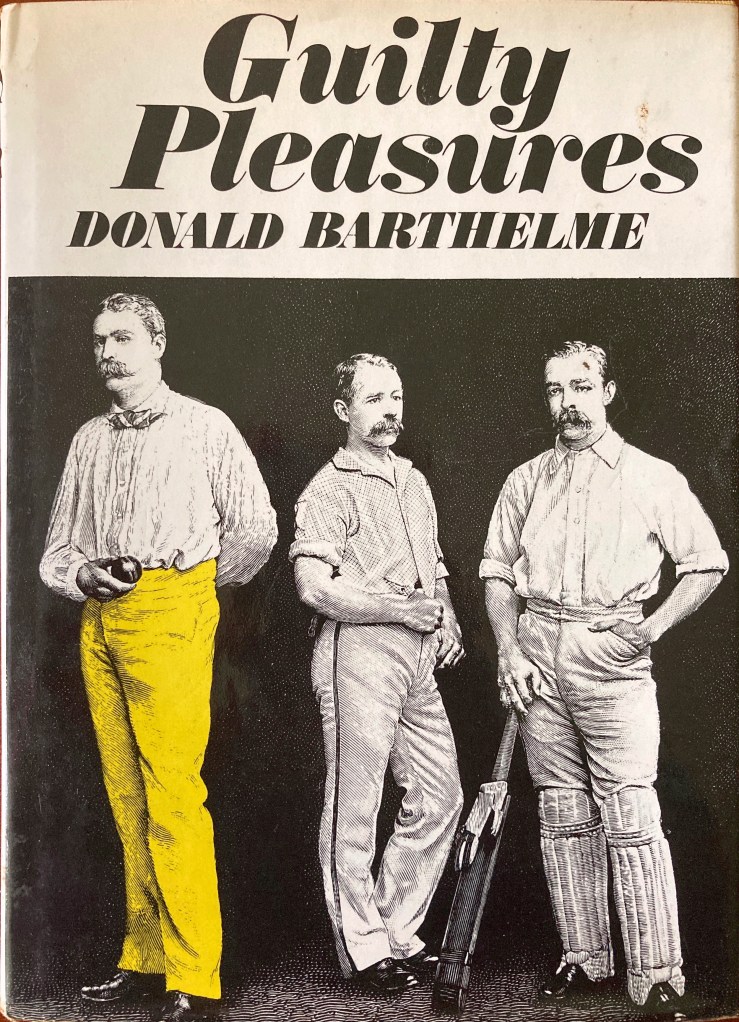
32. “Nothing: A Preliminary Account” (Guilty Pleasures, 1974)

In a 1982 interview, Barthelme described using this story in his writing classes:

Occasionally I’ll read something that has some pedagogic value. For example, there’s a story called “Nothing,” which I also use as an assignment. When somebody is stuck, I’ll say, well, do me a piece that describes “nothing.” Sometimes if I give that to a whole class, when they’re finished reading theirs, I’ll read mine just to show how I dealt with it.

“Nothing” is a list that tries to describe “nothing.” It begins thus:

It’s not the yellow-curtains. Nor curtain rings. Nor is it bran in a bucket, nor bran, nor is it the large, reddish farm animal eating the bran from the bucket, the man who placed the bran in the bucket, his wife, or the raisin-faced banker who’s about to foreclose on the farm. None of these is nothing.

(Rereading the lilt here, I’m reminded of Big Thief’s jam “Not.”)

The list is a mix of absurd fun, a few great punchlines (“Nor is it lobster protected from its natural enemies by its high price”), and a heavy dose of Barthelme’s beloved existentialists:

Heidegger points us toward dread. Having borrowed a cup of dread from Kierkegaard, he spills it, and in the spreading stain he finds (like a tea-leaf reader) Nothing.

Like much of Barthelme’s seventies stuff, “Nothing” is a piece that strives to find meaning in failure:

But if we cannot finish, we can at least begin. If what exists is in each case the totality of the series of appearances which manifests it, then nothing must be characterized in terms of its nonappearances, no-shows, incorrigible tardiness. Nothing is what keeps us waiting (forever).

31. “Eugénie Grandet” (Guilty Pleasures, 1974)

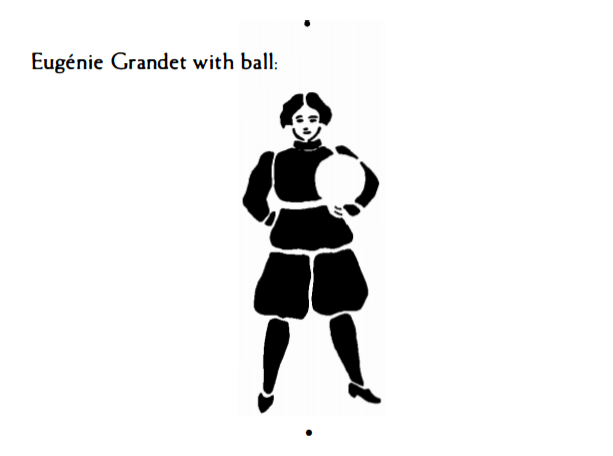
Eugénie Grandet” is the only story included in Sixty Stories that uses literal images—photographs and drawings—incorporating them into a collage distillation of Balzac’s 1833 novel of the same name. The story offers a parodic summary of a 200-page novel in just a few paragraphs, including this notorious one:

Butter butter butter butter butter butter butter butter butter
butter butter butter butter butter butter butter butter butter butter
butter butter butter butter butter butter butter butter

Here, the conflict between Eugénie and her miserly father over Eugénie’s using too much butter in preparing her cousin’s eclairs is compressed into 78 butters. 

“Eugénie Grandet” isn’t just a parodic summary though. It’s also a send-up of middle-twentieth century values. In Hiding Man, Daugherty spends two whole pages on the story, arguing that it should be read within the context of its composition—namely, after the fall out of May ’68.

Daugherty writes,

In parodying this particular novel in the context of May 1968, [Barthelme] composed a potent political document. It not only touched on the rebellion’s seminal issues, but invoked the reinvigorated Sartre…[the story], firmly attached to modernist history, and appearing, as it did, in a mainstream weekly, tucked among ads for glittering cars, watches, and diamonds, is a remarkable American artifact.”

Ultimately though, “Eugénie Grandet” is a strong enough story that one can appreciate it without any knowledge of Balzac or May ’68.

Summary thoughts:  “The Captured Woman” is apt for misreading and “Rebecca” is a bit of a trifle, but it’s a tender trifle. “At the End of the Mechanical Age” is as good as anything Barthelme ever wrote. “A Manual for Sons” is wonderful, and I guess I’m glad it’s included in Sixty Stories, but it does feel out of place–but maybe that’s just because I’ve read The Dead Father. “Nothing” might make a great starting place for anyone interested in Barthelme.” “Eugénie Grandet” is great stuff.

Going forward (in reverse): The next six stories are all from 1972’s Sadness—including a favorite of mine, “Daumier.”


Donald Barthelme’s Sixty Stories in reverse, Part IV

I am rereading Donald Barthelme’s Sixty Stories, starting with the sixtieth story and working my way to the first and writing about it.

Previous entries:

Stories 60-55

Stories 54-49

Stories 48-43

This post covers stories 42-37.

47. “The Crisis” (Great Days, 1979)

“The Crisis” is a bit of a toss off, a bricolage of the last decade (’69-’79) that never coheres into a duet, monologue, theme, or even punchline. Its plot, such as it is, details (details is not the correct verb) the circumstances of an absurd failed revolution. Ostensibly a dialogue (or is it a chorus?), “The Crisis” doesn’t add up to much, and is perhaps best summarized in one of its closing images:

Distant fingers from the rebel forces are raised in fond salute.

Is Barthelme shooting his readers the bird?

The story feels like a slapdash riff on Walker Percy’s weird and wonderful satirical novel Love in the Ruins. (Barthelme was a huge Percy fan.)

46. “Our Work and Why We Do It” (Amateurs, 1976)

“Our Work and Why We Do It” is self-consciously postmodern, a mash-up of Beckett’s absurdism, Benjamin’s seminal “The Work of Art in the Age of Mechanical Reproduction,” burgeoning Marxist aesthetic philosophy, and the modes and means of modernism. The opening line seems to satirize capital’s relationship between art, artist, and the means of production: “As admirable volume after admirable volume tumbled from the sweating presses . . . ” The ellipses are not mine; rather, Barthelme sets the stage here for a print economy of capitalist transactions. The Wells Fargo man arrives, gun in hand, to pick up the “bundle of Alice Cooper T-shirts we had just printed up.” He hurries the “precious product” — that’s all it is, product, content — to the “glittering fans”.

We then learn there’s a bit of conflict between the owners and the workers.

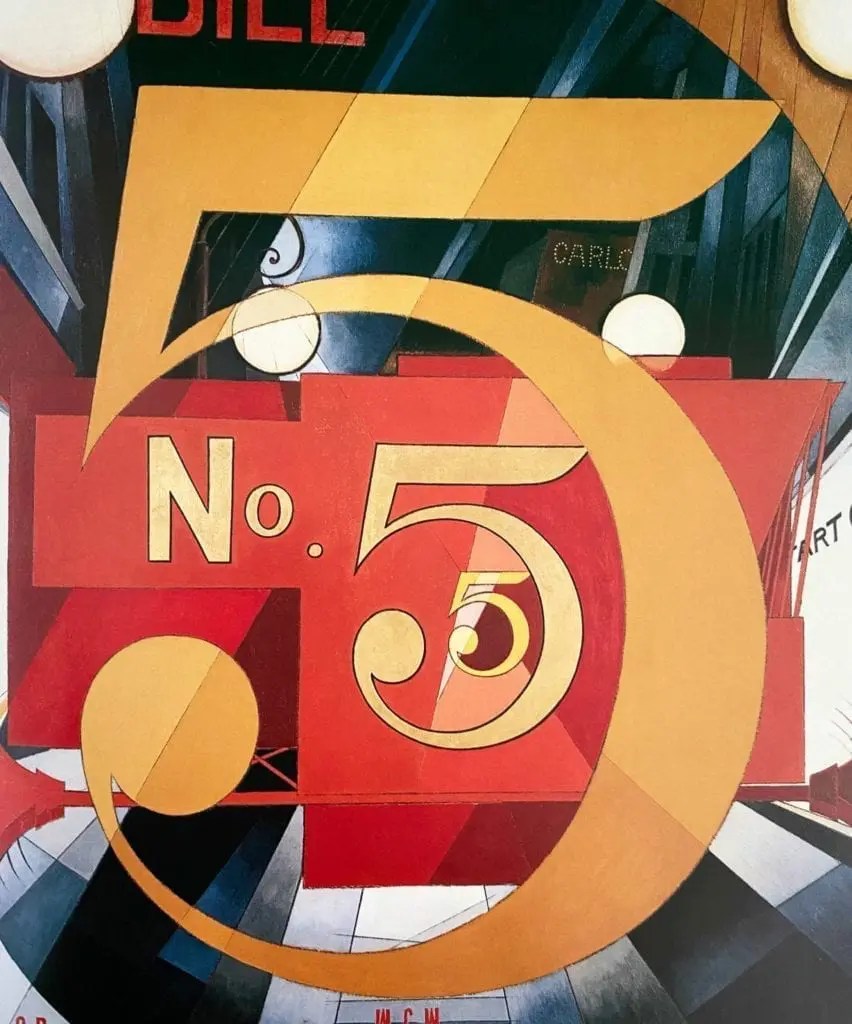
A few lines later, the narrator quips, “And I saw the figure 5 writ in gold.” Barthelme copies-cuts-pastes the modernists into his collage here—we get the visual of Charles Demuth’s painting, itself copying-cutting-pasting Willliam Carlos Williams’ “The Great Figure.”

Publication is a rough business: “If only we could confine ourselves to matchbook covers!” laments the narrator–

But matchbook covers are not our destiny. Our destiny is to accomplish 1. 5 million impressions per day. In the next quarter, that figure will be upped by twelve percent, unless

The hanging “unless” is Barthelme’s rhetorical trick and not my oversight—the punchline is “leather,” by the way.  “Leather is the way to accomplish more impressions. But the real hanging punchline is that word “impressions,” with its many connotations.

45. “The Great Hug” (Amateurs, 1976)

Such a great weird little story—is it about a toxic relationship between the Balloon Man and the Pin Lady? is it a metaphor for relationships in the modern era? is it an autobiographical riff, Barthelme’s love woes scribbled into a weird parody? —an oblique comment on e.e. cummings “in Just” — look, I don’t fucken know, maybe read it here. It’ll only take a few minutes, and then you can think about it for a week or so.

44. “The School” (Amateurs, 1976)

“The School” is wonderful stuff, and will take you like, what, 9, 10 minutes to read, if not less.

It’s a monologue I guess, delivered by a sorry educator whose schooling has killed off all manner of creatures. In the first three paragraphs we learn about the school’s failure to keep alive trees, snakes, and herb gardens, but then there’s a more drastic turn:

Of course we expected the tropical fish to die, that was no surprise. Those numbers, you look at them crooked and they’re belly-up on the surface. But the lesson plan called for a tropical fish input at that point, there was nothing we could do, it happens every year, you just have to hurry past it.

We weren’t even supposed to have a puppy.

We weren’t even supposed to have a puppy—goddammit Donald Barthelme. This line made me laugh out loud. And then it made me sad.

Reviewing my summary of the first three paragraphs, I’m tempted to make something religious out of it all—trees, snakes, gardens, and the like—but I don’t think that’s the gist. Or maybe it is the gist (Barthelme grew up Catholic). Is this a goof on the Eden thing? Humanity’s failure to be good stewards of the planet, etc. etc. etc.? I don’t know. Look, it’s a funny little story, read it.

43. “The Sergeant” (Amateurs, 1976)

“The Sergeant” reads like an oddity in Barthelme’s catalog—although not really, I guess, when that catalog is all oddity.

On one hand, “The Sergeant” is narrated in a seemingly-straightforward Hemingwayesque first-person I. This narrator is clearly based on a version of Barthelme. Barthelme served in the Korean War, but the real backdrop of “The Sergeant” is the Vietnam War–which was also the backdrop of much of Barthelme’s writing career (he arguably best addresses that folly in his 1968 story “The Indian Uprising,” which I’m still a ways from).

On the other hand, “The Sergeant” comes from the school of Kafka—it’s the bad dream we’ve all had, the nightmare repetitions of past duties we didn’t even sign up for. “The Sergeant” reads like a short blueprint for much of the Kafkaesque fiction that would follow it, including the labyrinths of Kazuo Ishiguro.

But Barthelme punctuates his nightmare-tale with a mythological touch: “Penelope!” cries the narrator, extending Barthelme’s anxiety riff into an ageless epic.

42. “I Bought a Little City” (Amateurs, 1976)

I Bought a Little City” is likely regarded as one of Barthelme’s greatest hits, possibly because it’s a more straightforward affair than his collages, pastiches, and oblique parodies. There’s a mean streak to this story about a rich man who buys Galveston, Texas. The story is about a lot things—control, desire, community, and creativity, maybe best summed up in two of its early lines: “What a nice little city, it suits me fine. It suited me fine so I started to change it.” People love to blow up their lives, but the asshole narrator citybuyer starts to blow up other people’s lives. He shoots six thousand dogs, for example. He humiliates a cop by making said cop buy him some fried chicken. He tries to steal another man’s wife, but it doesn’t work out. Maybe “I Bought a Little City” is about creative failures; maybe it’s a satire of capitalism. Or maybe it’s just another Barthelme goof.

Summary thoughts: Uh…the stories in Amateurs are generally better than those in Great Days. The weakest one here is “The Crisis,” from Great Days; the other stories feel more of a piece with each other. I enjoyed “The Sergeant” the most, but mostly because it has a different flavor from the other stories. “The School” is probably the best of the batch.

Going forward (in reverse): We continue backwards through the seventies, where we eventually hit (what I think might be a top-ten Barthelme hit) “Eugénie Grandet.”

Donald Barthelme’s Sixty Stories in reverse, Part III

I am rereading Donald Barthelme’s Sixty Stories, starting with the sixtieth story and working my way to the first. I wrote about stories 60-55 here and stories 54-49 here,

This post covers stories 48-43.

48. “The Death of Edward Lear” (Great Days, 1979)

Like many of the stories culled from Great Days, the humor in “The Death of Edward Lear” is tinged with melancholy. Perhaps it’s because of its subject matter, or perhaps it’s knowing that Great Days was the last collection of originals Barthelme would write, but “The Death of Edward Lear” feels like the work of a much older man. In fact, it was first published in The New Yorker in 1971, when Barthelme was forty, barely middle aged. (For whatever reasons, Barthelme didn’t include the piece in his collections Sadness (1972) or Amateurs (1976.))

The story begins in the most straightforward manner:

The death of Edward Lear took place on a Sunday morning in May 1888. Invitations were sent out well in advance. The invitations read:

Mr. Edward LEAR
Nonsense Writer and Landscape Painter
Requests the Honor of Your Presence
On the Occasion of his DEMISE.
San Remo 2:20 a.m.
The 29th of May Please reply

One can imagine the feelings of the recipients. Our dear friend! is preparing to depart! and such-like. Mr. Lear! who has given us so much pleasure! and such-like. On the other hand, his years were considered. Mr. Lear! who must be, now let me see… And there was a good deal of, I remember the first time I (dipped into) (was seized by)…But on the whole, Mr. Lear’s acquaintances approached the occasion with a mixture of solemnity and practicalness…

Lear treats his many guests to a strange spectacle of rants, rhymes, and mandolin-playing. He also delivers a “short homily on the subject of Friendship.” Then he dies.

His audience is initially confused, before realizing that Lear had crafted his death into a piece of absurdist art:

People who attended the death of Edward Lear agreed that, all in all, it had been a somewhat tedious performance. Why had he seen fit to read the same old verses, sing again the familiar songs, show the well-known pictures, run through his repertoire once more? Why invitations? Then something was understood: that Mr. Lear had been doing what he had always done and therefore, not doing anything extraordinary. Mr. Lear had transformed the extraordinary into its opposite. He had, in point of fact, created a gentle, genial misunderstanding.

And Lear’s performance engenders future performances:

The death of Edward Lear can still be seen, in the smaller cities, in versions enriched by learned interpretation, textual emendation, and changing fashion. One modification is curious; no one knows how it came about. The supporting company plays in the traditional way, but Lear himself appears shouting, shaking, vibrant with rage.

That final angry image is sad, haunting even. It recalls that other Lear, mad on the heath, as well as Dylan Thomas’s most famous villanelle.

In his biography Hiding Man, Tracy Daugherty speculates that the idea for “Lear” might be attributed in part to the “farewell parties” Susan Sontag hosted in the mid-seventies when she thought she might die from cancer. There’s a human reality coursing under the story’s apparent absurdity that makes it a memorable, enjoyable tale about making art out of life and death.

Edward Lear’s actual death sounds much sadder. According to the Edward Lear Society, “Lear’s funeral was said to be a sad, lonely affair by the wife of Dr. Hassall, Lear’s physician, not one of Lear’s many lifelong friends being able to attend.”

47. “Morning” (Great Days, 1979)

In Hiding Man, Daugherty claims that “Morning” is about “the limits of the educational system,” but I don’t see it. It’s an absurdist dialogue, almost impenetrable in its obliquity—which would be fine if the sentences were better. There had to have been better stories in Great Days than “Morning” — the superior “Concerning the Bodyguard” is from that collection, and eventually ended up in Forty Stories—but I’m sure Barthelme had his reasons for including it. Those reasons, like the story, are inscrutable to me.

46. “The King of Jazz” (Great Days, 1979)

A great little ditty told (almost) entirely in dialogue, “The King of Jazz” takes place over the first few minutes of Hokie Mokie’s reign as the new, um, king of jazz. Hokie’s tenure comes under threat almost immediately when Hideo Yamaguchi, a stranger from Tokyo, appears seemingly from nowhere to challenger the new king. A musical duel ensues, helpfully described by one of the musicians in attendance:

“What’s that sound coming in from the side there?”

“Which side?”

“The left.”

“You mean that sound that sounds like the cutting edge of life? That sounds like polar bears crossing Arctic ice pans? That sounds like a herd of musk ox in full flight? That sounds like male walruses diving to the bottom of the sea? That sounds like fumaroles smoking on the slopes of Mt. Katmai? That sounds like the wild turkey walking through the deep, soft forest? That sounds like beavers chewing trees in an Appalachian marsh? That sounds like an oyster fungus growing on an aspen trunk? That sounds like a mule deer wandering a montane of the Sierra Nevada? That sounds like prairie dogs kissing? That sounds like witchgrass tumbling or a river meandering? That sounds like manatees munching seaweed at Cape Sable? That sounds like coatimundis moving in packs across the face of Arkansas? That sounds like – ”

“Good God, it’s Hokie! Even with a cup mute on, he’s blowing Hideo right off the stand!”

Barthelme here and elsewhere excels at pushing and pulling language in ways with which we are unfamiliar. There’s a synesthetic quality to his best writing, writing which so frequently attempts to engage with and evoke other arts—visual, arts, poetry.

“The King of Jazz” also continues the thread of Oedipal anxiety that courses throughout Barthelme’s work. That anxiety here is not necessarily father-son oriented, but rather the anxiety of the outsider who becomes established, the experimenter who succeeds—and then finds his work challenged by new comers.

45. “The Zombies” (Great Days, 1979)

“The Zombies” is another fun story—and one of the rare late stories not told entirely in dialogue. I’m not really sure if “The Zombies” is a specific parody or just a goof, but it makes me laugh:

In a high wind the leaves fall from the trees. The zombies are standing about talking. “Beautiful day!” “Certainly is!” The zombies have come to buy wives from the people of this village, the only village around that will sell wives to zombies. “Beautiful day!” “Certainly is!” The zombies have brought many cattle. The bride price to a zombie is exactly twice that asked of an ordinary man. The cattle are also zombies and the zombies are in terror lest the people of the village understand this.

There are good zombies and bad zombies. Gris Grue is the hero of the good zombies. There’s a Bishop involved. Watch out: “The kiss of a dying animal, a dying horse or dog, transforms an ordinary man into a zombie.”

And watch out too for bad zombies: “If a bad zombie gets you, he will scarify your hide with chisels and rakes. If a bad zombie gets you, he will make you walk past a beautiful breast without even noticing.”

44. “The New Music” (Great Days, 1979)

“The New Music”: Another dialogue, another synesthetic excursion into Oedipal territories—this time focused on the mother:

–She had a lot on her mind. The chants. And Daddy of course.

–Let’s not do Daddy today.

Two brothers discuss “the new music,” which both is and is not music. As in much of Barthelme’s work, elements of art and culture might be patched and pasted in new designs, new collages.

–The new music burns things together, like a welder. The new music says, life becomes more and more exciting as there is less and less time.

–Momma wouldn’t have ‘lowed it. But Momma’s gone.

With their disallowing mother out of the way, the boys can now move forward into the new music.

43. “Cortés and Montezuma” (Great Days, 1979)

“Cortés and Montezuma” is the strongest tale in this batch. The story tells a version of the “friendship” between the Spanish conquistador and the Aztec emperor. Unlike the quippy, often absurd dialogue pieces, “Cortés and Montezuma” is told in a simple, direct (even flat) third-person voice. Here’s how the story opens:

Because Cortés lands on a day specified in the ancient writings, because he is dressed in black, because his armor is silver in color, a certain ugliness of the strangers taken as a group-for these reasons, Montezuma considers Cortés to be Quetzacoatl, the great god who left Mexico many years before, on a raft of snakes, vowing to return.

Montezuma gives Cortés a carved jade drinking cup.

Cortés places around Montezuma’s neck a necklace of glass beads strung on a cord scented with musk.

Montezuma offers Cortés an earthenware platter containing small pieces of meat lightly breaded and browned which Cortés declines because he knows the small pieces of meat are human fingers.

The story repeats the image of Cortés and Montezuma walking and holding hands, exchanging gifts, and not really trusting each other. There is plenty of intrigue and paranoia. Cortés is sleeping with his translator, but she’s also taken a high-ranking Aztec for a lover. The nobles are starting to turn on Montezuma. Various folks employ detectives to trail other folks. Assassination plots loom.

Much of the strength of “Cortés and Montezuma” derives from Barthelme’s decision to tactically employ the occasional anachronism. Consider the “powdered wigs” and “limousines” here:

Montezuma writes, in a letter to his mother: “The new forwardness of the nobility has come as a welcome relief. Whereas formerly members of the nobility took pains to hide among the general population, to pretend that they were ordinary people, they are now flaunting themselves and their position in the most disgusting ways. Once again they wear scarlet sashes from shoulder to hip, even on the boulevards; once again they prance about in their great powdered wigs; once again they employ lackeys to stand in pairs on little shelves at the rear of their limousines. The din raised by their incessant visiting of one another is with us from noon until early in the morning.”

These anachronisms highlight language’s inability to accurately translate reality. Barthelme gives us images that we identify with wealth and power — “powdered wigs” and “limousines” — but they do not fit within the historical context of Montezuma’s Aztec Empire, and they do not square historically with each other. The anachronisms do offer the contemporary reader an idea of the power of the Aztec aristocracy, and at the same time, their inclusion highlights how incomplete our picture of historical reality is—absurdly incomplete.

Indeed, Barthelme was working from a translation when he crafted “Cortés and Montezuma.” His fourth (and final) wife, the writer Marion Knox, had brought home a copy of Bernal Diaz del Castillo book about Spain’s invasion of the Aztec Empire. Barthelme translated that translation into a new translation, adding a postmodern wink to his story in the process: “Bernal Diaz del Castillo, who will one day write The True History of the Conquest of New Spain, stands in a square whittling upon a piece of mesquite.”

Behind the metatextual cleverness and intentionally-flat tone though, there is a strong, sympathetic core to “Cortés and Montezuma,” a deep sorrow summed up in the final line:

The pair walking down by the docks, hand in hand, the ghost of Montezuma rebukes the ghost of Cortés. “Why did you not throw up your hand, and catch the stone?”

Summary thoughts: It was a bit of an unexpected relief to get out of the dialogue stories. I appreciate what Barthelme did with them, but they are too often constrained but their form, despite highlights like “The Emerald,” “The Leap,” and “The King of Jazz,” which is the strongest dialogue in this batch. I found “Morning” an ugly irritation, some sub-Gertrude-Stein stuff, and “The New Music,” while better, is not especially strong. “Cortés and Montezuma” was the highlight of the six for me.

Going forward (in reverse): One last Great Days stories, and we get into the (stronger) collection Amateurs. 

Donald Barthelme’s Sixty Stories in reverse, Part I

I am rereading Donald Barthelme’s 1981 collection Sixty Stories.

I am reading the stories in reverse chronological order.

This reverse reading came about in this way: I read an intense, shocking, horrifying novel, and then I read it again. Then I tried to get into three or maybe four novels with no luck.

So I picked up the Barthelme book, a perfect book, a palate cleanser. Inside was a bookmark from a Catholic book store in St. Augustine, Florida; the bookmark marked the beginning of the final story in Sixty Stories, “Grandmother’s House.”

I recalled almost nothing about it. I read it, and kept going in reverse.

So here we go–thoughts on the last six stories in Sixty Stories:

60. “Grandmother’s House” (previously uncollected, 1981)

Like many of Barthelme’s late stories, “Grandmother’s House” consists entirely of dialogue. And, like many of Barthelme’s late stories, there’s an elegiac tone–mock-elegiac at times, but still tinged with a soft melancholy. The story begins in the by-now-traditional-postmodern mode of invoking fairy tales. One of the speakers alludes to figures from “Little Red Riding Hood” and “Beauty and the Beast.” They then move on to another trope of fairy tales—changelings, child thefts: “…we could steal a kid. A child. A kid. Steal one. Grab it and keep it. Raise it for our very own.” The dialogue is filled with non sequitur and oblique shifts, evoking the collage work of Barthelme’s prime work while also trundling along a more realistic course. The story ultimately conflates raising children with the creative arts; there’s something slightly sad about the two speakers’ desire to steal children so that they can start again, take a mulligan, improve on past failures. They want a new newness: “Of course this is not to say that what has been demystified cannot be remystified.”

59. “Bishop” (previously uncollected, 1981)

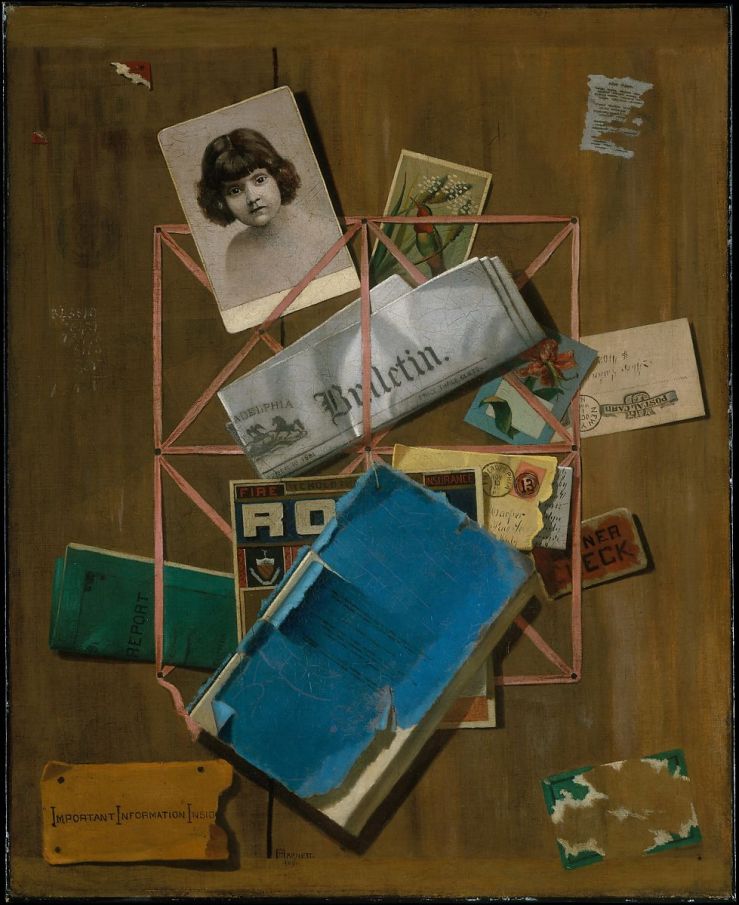
“Bishop” feels like it should be the last story in Sixty Stories. It’s a miniature portrait of an alcoholic writer, the titular Bishop who, in the course of writing a biography of the painter William Michael Harnett, discovers another painter,  John Frederick Peto.

Still Life with Three Castles Tobacco, 1880 by William Michael Harnett (1848-1892).

The story is easily one of Barthelme’s most straightforward, “realistic” pieces, employing very little of the rhetorical arsenal he’d built over the past two decades.

Old Souvenirs, c. 1881–1901 by John Frederick Peto (1854-1907)

However, his collage technique is on display throughout “Bishop,” where sentences jut brusquely against each other without the protection of transitions. Consider the economy of this opening salvo:

Bishop’s standing outside his apartment building.

An oil struck double-parked, its hose coupled with the sidewalk, the green-uniformed driver reading a paperback called Name Your Baby.

Bishop’s waiting for Cara.

The martini rule is not before quarter to twelve.

Eyes go out of focus. He blinks them back again.

He had a beer for breakfast, as usual, a Pilsner Urquell.

Imported beer is now ninety-nine cents a bottle at his market.

The oil truck’s pump shuts off with a click. The driver tosses his book into the cab and begins uncoupling.

Cara’s not coming.

The painter John Frederick Peto made a living Playing cornet in a camp meeting for the last twenty years of his life, according to Alfred Frankenstein.

Bishop goes back inside the building and climbs one flight of stairs to his apartment.

His bank has lost the alimony payment he cables twice a month to his second wife, in London. He switches on the FM, dialing past two classical stations to reach Fleetwood Mac.

Bishop’s writing a biography of the nineteenth-century American painter William Michael Harnett. But today he can’t make himself work.

Cara’s been divorced, once.

At twenty minutes to twelve he makes himself a martini.

Hideous bouts of black anger in the evening. Then a word or a sentence in the tone she can’t bear. The next morning he remembers nothing about it.

As Tracy Daugherty notes in Hiding Man, his biography of Barthelme, “it’s impossible to miss the parallels between author and character” in “Bishop”: “…same age, same physical appearance, same home city, same general profession.”

Barthelme himself protested the comparison in his 1981 Paris Review Interview:

…when [“Bishop”] appeared I immediately began getting calls from friends, some of whom I hadn’t heard from in some time and all of whom were offering Tylenol and bandages. The assumption was that identification of the author with the character was not only permissible but invited. This astonished me. One uses one’s depressions as one uses everything else, but what I was doing was writing a story. Merrily merrily merrily merrily.

There is nothing merry about “Bishop,” but there’s a lot of beauty in its odd realism.

58. “Heroes” (previously uncollected, 1981)

Another piece composed entirely in dialogue, this time between two dudes riffing on the relationship between the media, information, politics, democracy, and the average citizen. There’s a clever bit on TV screens as a “clear glass” through which we now see “darkly,” but the piece seems terribly dated in 2021.

57. “Thailand” (previously uncollected, 1981)

“Thailand” isn’t exactly a dialogue, but it’s again a piece with two speakers, an “old soldier” who served in the “Krian War” and the young man who listens to him—or, more to the point, doesn’t really listen to him. He’s introduced as “his hearer.” Instead of truly listening to the sweet old sergeant’s story about serving along the Thai military, the young hearer speaks to himself, his fragmented inner monologue intermixing with the vet’s exterior monologue, all along a similar vein: “I am young, thought the listener, young, young, praise the Lord I am young.” Again, it’s tempting to read autobiography into the story. Barthelme was drafted into the U.S. Army in 1953, but didn’t really see any action in his sixteen months there. And “Thailand” reflects that—it isn’t an old war story, but a gentle appreciation of time spent in another culture. In one memorable moment, the old soldier recalls a “golden revel” featuring thirty-seven washtubs of curry: “Beef curry, chicken curry, the delicate Thai worm curry, all your various fish curries and vegetable curries.” All the while, the young would-be interlocutor dismisses the old “demento,” culminating in the young man’s cruel final line: Requiescat in pace. The old man gets the punchline though: “They don’t really have worm curry, said the sergeant. I just made that up to fool you.” In my estimation, Thailand” isn’t so much a reminiscence of Barthelme’s army days as it is a story about an aging storyteller. Barthelme was a teacher, and while I’m sure most of his students were rapt, the older author had to know how that old Oedipal thing works.

56. “The Emperor” (previously uncollected, 1981)

A nice, precise little story of nine paragraphs. On one hand, it’s an accumulation of historical details (and some speculation) about China’s first emperor Ch’in Shih
Huang Ti, and his mad quest toward an unattainable perfection. At the same time, the story can be read as a take on the creative imagination at work, striving toward an ideal that the physical world can never quite accumulate. It can be read as a story about writing—writing as a means to attain immortality. Here’s Barthelme on the story, in his 1981 Paris Review interview:

I’ve just done a piece about a Chinese emperor, the so-called first emperor, Ch’in Shih Huang Ti. This came directly from my wife’s research for a piece she was doing on medical politics in Chinatown—she had accumulated all sorts of material on Chinese culture, Chinese history, and I began picking through it, jackdaw-like. This was the emperor who surrounded his tomb with that vast army of almost full-scale terra-cotta soldiers the Chinese discovered just a few years ago. The tomb, as far as I know, has yet to be fully excavated, but the scale of the discovery gives you some clear hints as to the size of the man’s imagination, his ambition. As I learned more about him—“learned” in quotation marks, much of what I was reading was dubious history—I got a sense of the emperor hurrying from palace to palace, I gave him two hundred some-odd palaces, scampering, almost, tending to his projects, intrigues, machinations. He’s horribly, horribly pressed for time, both actually and in the sense that many of his efforts are strategies against mortality. The tomb itself is a strategy, as is the imposition of design on the lives of his people, his specifications as to how wide hats shall be, how wide carriages shall be, and so forth.

55. “The Farewell” (previously uncollected, 1981)

A minor if entertaining dialogue between Maggie and Hilda, “The Farewell” is a sequel to “On the Steps of the Conservatory” (Great Days, 1979), and like that tale, it satirizes hierarchy in academia (and pseudo-intellectualism in general). And as silly as the whole thing is, there’s a kernel of pathos there in the story’s (off-centered center). Poor Hilda (who cannot for some reason see that she should tell her snooty snobby toxic friend Maggie to Fuck off) has finally made into the Conservatory, only to find that it’s old hat—it’s the Institution that folks are flocking to get into. And why not? As Maggie boasts, “The teachers are more dedicated, twice as dedicated or three times as dedicated.” The boasts continues. At the Institution,

Savory meals are left in steaming baskets outside each wickiup door. All meals are lobster, unless the student has indicated a preference for beautifully marbled beef. There are four Olympic-sized pool tables for every one student.

In the end though, poor Hilda comes up with that classic solution: Well, fuck it.

Summary thoughts: These late and previously-uncollected stories are tinged with melancholy and even resignation at time, and generally follow the same rhetorical mode of a two-person dialogue. Notable themes include anxiety over parenthood, writing, and one’s legacy. The weakest of the six is “Heroes” and the strongest is “Bishop.”

I will keep going (in reverse).

New Snake Creek comix from Drew Lerman

I’ve been a fan of Drew Lerman’s strip Snake Creek for a few years now. Reviewing Lerman’s first collection (simply titled Snake Creek) in The Comics Journal, Brian Nicholson wrote that,

Looking at these strips, you’re looking at something that recalls George Herriman, Harvey Kurtzman, Robert Crumb, Daniel Clowes, Matt Groening, but also thinking: What if Stanley Elkin drew a comic strip?

What if Elkin drew a comic strip indeed?

Like Elkin, Lerman plays with a variety of voices and rhythms in his work. There’s a zaniness to the Snake Creek world, but also an almost-melancholy seriousness to it as well. His main characters are Dav and Roy. Roy is something of a would-be tortured artist; Roy his familiar/foil, a spritely interlocutor to bounce ideas off of. Like the swamp-dwellers of Walt Kelly’s seminal strip Pogo, there’s a real affection between the two characters that anchors the surreal plasticity of Lerman’s work in genuine emotion.

I got three Snake Creek comix last week and tried not to read them too quickly on Sunday afternoon. I needed to get the bad taste of a Serious Contemporary Novel out of my brain, and Detective! Double Digest did the trick. There are two stories here: Lerman’s “Cryonic Pain: A Snake Creek Mystery” and on the literal flipside, Pete Faecke’s “The Big Love Triangle” (which has a scuzzy punk noir vibe).

From Pete Faecke’s “The Big Love Triangle.”

Lerman’s detective story is an existentialist affair—a goofing riff on the myth of Sisyphus and the burden of a consciousness constrained by mortality and time. It’s also full of verbal slapstick and surreal shenanigans.

From Drew Lerman’s “Cryonic Pain.”
Back cover of Drew Lerman’s Schtick

Schtick is a mini-comic in full color compromised of five vignettes, each one a riff or routine rooted in vaudevillian humor and composed in an original vernacular. The longest of the pieces, “Herbit and Sheiler,” is an extended play on linguistic misunderstandings—good stuff.

From Drew Lerman’s strip “Levi & Cohn,” Schtick

My favorite of the three comix is the most recent, “Head Trip,” the cover feature for the latest issue of the Miami-based comics journal Spiny Orb Weaver. (The issue also features an essay by comics critic Rob Clough, an autobiographical comic by Chris López, and a lengthy interview with Lerman, conducted by SOW editor Neil Brideau.)

Detail from Drew Lerman’s cover for Spiny Orb Weaver no. 2

“Head Trip” sees Dav and Roy trying to take Snake Creek’s most anguished character, Head on a Stone, on an adventure he can remember. Unable to move or communicate, but nevertheless burdened by consciousness, Head on a Stone is a tragic figure, a “pulsing node of dread,” as Dav puts it. Dav and Roy decide, in their wisely wisdom, to take the large rock seafaring. What follows is an ironic series of tragic-comic-tragic-etc. reversals of fortune (as well as some of Lerman’s most lyrical work to date with his strip). “Head Trip” is as linguistically loose and visually goofy as we might expect from anything set in the Snake Creek universe, and also achieves a level of poignancy we might not expect. Great stuff.

From Drew Lerman’s “Head Trip.”


Ann Quin’s novel Passages collapses hierarchies of center and margin

Ann Quin’s third novel Passages (1969) ostensibly tells the story of an unnamed woman and unnamed man traveling through an unnamed country in search of the woman’s brother, who may or may not be dead.

The adverb ostensibly is necessary in the previous sentence, because Passages does not actually tell that story—or it rather tells that story only glancingly, obliquely, and incompletely. Nevertheless, that is the apparent “plot” of Passages.

Quin is more interested in fractured/fracturing voices here. Passages pushes against the strictures of the traditional novel, eschewing character and plot development in favor of pure (and polluted) perceptions. There’s something schizophrenic about the voices in Passages. Interior monologues turn polyglossic or implode into elliptical fragments.

Quin repeatedly refuses to let her readers know where they stand. Indeed, we’re never quite sure of even the novel’s setting, which seems to be somewhere in the Mediterranean. It’s full of light and sea and sand and poverty, and the “political situation” is grim. (The woman’s brother’s disappearance may or may not have something to do with the region’s political instability.)

Passage’s content might be too slippery to stick to any traditional frame, but Quin employs a rhetorical conceit that teaches her reader how to read her novel. The book breaks into four unnamed chapters, each around twenty-five pages long. The first and third chapters find us loose in the woman’s stream of consciousness. The second and fourth chapters take the form of the man’s personal journal. These sections contain marginal annotations, which might be meant to represent actual physical annotations, or perhaps mental annotations–the man’s stream of consciousness while he rereads his journal.

Quin’s rhetorical strategy pays off, particularly in the book’s Sadean climax. This (literal) climax occurs at a carnivalesque party in a strange mansion on a small island. We see the events first through the woman’s perception, and then through the man’s. But I’ve gone too long without offering any representative language. Here’s a passage from the woman’s section, just a few paragraphs before the climax. To set the stage a bit, simply know that the woman plays voyeur to a bizarre threesome:

Mirrors faced each other. As the two turned, approached. Slower in movement in the centre, either side of him, turning back in the opposite direction to their first movement. Contours of their shadows indistinct. The first mirror reflected in the second. The second in the first. Images within images. Smaller than the last, one inside the other. She lay on the floor, wrists tied together. She bent back over the chair. He raised the whip, flung into space.

Later, the man’s perception of events at the party both clarify and cloud the woman’s account. As you can see in the excerpt above, the woman frequently refuses to qualify her pronouns in a way that might stabilize identities for her reader. Such obfuscation often happens in the course of a sentence or two:

I ran on, knowing I was being followed. She came to the edge, jumped into expanding blueness, ultra violet tilted as she went towards the beach. We walked in silence.

The woman’s becomes a She and then merges into a We. The other half of that We is a He, the follower (“He later threw the bottle against the rocks”), but we soon realize that this He is not the male protagonist, but simply another He that the woman has taken as a one-time lover.

The woman frequently takes off somewhere to have sex with another man. At times the sex seems to be part of her quest to find her brother; other times it’s simply part of the novel’s dark, erotic tone. The man is undisturbed by his lover’s faithlessness. He is passive, depressive, and analytical, while she is manic and exuberant. Late in the novel he analyzes himself:

How many hours I waste lying in bed thinking about getting up. I see myself get up, go out, move, drink, eat, smile, turn, pay attention, talk, go up, go down. I am absent from that part, yet participating at the same time. A voyeur in all senses, in my actions, non-actions. What a delight it might be actually to get up without thinking, and then when dressed look back and still see myself curled up fast asleep under the blankets.

The man longs for a kind of split persona, an active agent to walk the world who can also gaze back at himself dormant, passive.

This motif of perception and observation echoes throughout Passages. Consider one of the man’s journal entries from early in the book:

Above, I used an image instead of text to give a sense of what the journal entries and their annotations look like. Here, the man’s annotation is a form of self-observation, self-analysis.

Other annotations dwell on describing myths or artifacts (often Greek or Talmudic). In a “December” entry, the man’s annotation is far lengthier than the text proper. The main entry reads:

I am on the verge of discovering my own demoniac possibilities and because of this I am conscious I am not alone with myself.

Again, we see the fracturing of identity, consciousness as ceaseless self-perception. The annotation is far more colorful in contrast:

An ancient tribe of the Kouretes were sorcerers and magicians. They invented statuary and discovered metals, and they were amphibious and of strange varieties of shape, some like demons, some like men, some like fishes, some like serpents, and some had no hands, some no feet, some had webs between their fingers like gees. They were blue-eyed and black-tailed. They perished struck down by the thunder of Zeus or by the arrows of Apollo.

Quin’s annotations dare her reader to make meaning—to put the fragments together in a way that might satisfy the traditional expectations we bring to a novel. But the meaning is always deferred, always slips away. Passages collapses notions of center and margin. As its title suggests, this is a novel about liminal people, liminal places.

The results are wonderfully frustrating. Passages is abject, even lurid at times, but also rich and even dazzling in moments, particularly in the woman’s chapters, which read like pure perception, untethered by traditional narrative expectations like causation, sequence, and chronology.

As such, Passages will not be every reader’s cup of tea. It lacks the sharp, grotesque humor of Quin’s first novel, Berg, and seems dead set at every angle to confound and even depress its readers. And yet there’s a wild possibility in Passages. In her introduction to the new edition of Passages recently published by And Other Stories, Claire-Louise Bennett tries to capture the feeling of reading Quin’s novel:

It’s difficult to describe — it’s almost like the omnipotent curiosity one burns with as an adolescent — sexual, solipsistic, melancholic, fierce, hungry, languorous — and without limit.

Bennett, whose anti-novel Pond bears the stamp of Quin’s influence, employs the right adjectives here. We could also add disorienting, challengingabject and even distressing. While clearly influenced by Joyce and Beckett, Quin’s writing in Passages seems closer to William Burroughs’s ventriloquism and the hollowed-out alienation of Anna Kavan’s early work. Passages also points towards the writing of Kathy Acker, Alasdair Gray, and João Gilberto Noll, among others. But it’s ultimately its own weird thing, and half a century after its initial publication it still seems ahead of its time. Passages is clearly Not For Everyone but I loved it. Recommended.


A review of Berg, Ann Quin’s grimy oedipal comedy of horrors

ann_quinn_berg_hi_rgb

Ann Quin’s 1964 novel Berg begins with one of the best opening lines I’ve ever read:

A man called Berg, who changed his name to Greb, came to a seaside town intending to kill his father…

This opening line encapsulates the plot of Berg, its terminal ellipses pointing to the radical indecision that propels the novel’s central oedipal conflict—will Berg do it? Can he actually kill his father?

The “seaside town” mentioned in the opening line is presumably Brighton, where Quin was born and died. Quin’s Brighton is hardly a holiday-goer’s paradise though. Grimy and seedy, claustrophobic and cold, it’s populated by carousers and vagabonds. There’s a raucous, sinister energy to Quin’s seaside setting; her Brighton is a combative hamlet pinned against the monstrous swelling sea.

While we sometimes find ourselves in this seaside town’s drunken dancehalls, shadowy train stations, or under grubby piers, most of Berg takes place in a dilapidated boarding house. Here, Alistair Berg (going by Greb) has taken a room adjacent the room his father Nathaniel lives in with his younger mistress Judith. Nathan and Judith’s apartment is a strange horror of antiques and taxidermy beasts. Berg’s apartment is full of the wigs and hair tonics he ostensibly sells for a living. It’s all wonderfully nauseating.

Through the thin wall between these two spaces, Berg hears his father and mistress fight and fuck. He attends both animal grunting and human speech, an imaginative voyeur, and is soon entangled in their lives, as neatly summarized in a letter to his mother Edith, the fourth major character who is never-present yet always-present in the novel. Writing to thank Edith for a food parcel she’s mailed him (Berg is a mama’s boy), he reports:

How are you? Everything here is fine. I’ve seen my father, but so far haven’t revealed who I really am (how Dickensian can one get, and what can I really put—that he’s been fucking another woman next door, and probably a dozen others besides over the past fifteen years, is about to go on tour with some friend in a Vaudeville show, trailing a dummy around, that he’s in love with a budgie…?) Somehow I think you’re better off without him, he seems a bit the worse for wear, not at all like the photograph, or even like the ones you already have of him, and he still hasn’t any money, as far as I can make out he’s sponging left right and centre.

After promising to return home in time for Christmas, Berg signs off with this ambiguous and oedipal ending: “Meanwhile—meanwhile—well I’m going to fuck her too…”

As the novel progresses, the relationships tangle into a Freudian field day: Berg and his father Nathaniel; Berg and his mother; Berg and Judith; Judith and Nathaniel; Nathaniel and Edith. Desire is a funny floating thing in Berg, which plays at times like a horror story and at times like a demented closet farce. As the narrative voice tells us at one point, “no one is without a fetish or two.”

Berg’s desire to kill his father is explored, although his rationale is muddy. Certainly, Edith, whose voice ventriloquizes Berg’s memory, helps spur Berg’s oedipal impulse: “There you see that’s your father who left us both,” she tells him as a boy, pointing to a photograph, adding, “you’ll have to do a lot to overcome him Aly before I die.” So much is loaded into that word overcome. Quin’s novel is precise in its ambiguities, evoking a feeling of consciousness in turmoil.

Berg’s turmoil is indeed the central thrust of the novel. He can’t decide to patricide. Berg works through the justifications for murder, ultimately trying to root out the impetus of his desire to kill his father. “Of course it’s ridiculous to think the whole thing is simply a vehicle for revenge, or even resentment—hardly can it be called personal, not now, indeed I have never felt so objective,” he tells himself at one point, sounding like one of Poe’s maniacs. Quin’s narrative affords him several opportunities to go through with the murder, but, in the novel’s first half anyway, he stalls. “Yes, that’s what it amounts to, decide rather than desire,” he proclaims.

Like Prince Hamlet, Berg is terribly indecisive, spending much of the novel vacillating between action and inaction, letting his consciousness fly through every imaginative possibility. Indeed, the main setting of Berg is not really Brighton or the boarding house, but Alistair Berg’s mind. And yet consciousness is his biggest curse: “Definitely the supreme action is to dispose of the mind, bring reality into something vital, felt, seen, even smelt. A man of action conquering all.” Later, he tells us that “The conscience only sets in when one is static,” coaxing himself toward action. Berg aspires to more than Eliot’s Prufrock. He desires to be more than an attendant lord to swell a progress, start a scene or two.

Indeed, Berg is author, director, and star in this drama of his own creation—he just has to finally follow the call to action. When he finally does snap the mental clapperboard, he comes into the possession—or at least believes he comes into the possession—of his own agency: “How separated from it all he felt, how unique too, no longer the understudy, but the central character as it were, in a play of his own making.”

Throughout Berg, Quin employs a free-indirect style that emphasizes her character’s shifting consciousness. Whatever “reality” Berg experiences is thoroughly mediated by memories of his mother’s voice and his own projections and fantasies. Consider the shift from “he” to “I” in these two sentences:

Half in the light he stood, a Pirandello hero in search of a scene that might project him from the shadow screen on to which he felt he had allowed himself to be thrown. If I could only discover whether cause and effect lie entirely in my power.

Perhaps his dramatic flair comes from his father, a vaudevillian ventriloquist whose most prized possession is a dummy. The dummy is the tragicomic symbol at the heart of Berg, a totem of the way that other voices might inhabit our mouths and drive our desires in bizarre directions. Berg, desirer of the power to cause and effect, often sees others around him as mere props. “She’s not unlike a display dummy really,” he thinks about Judith, who accuses him as someone who’s “always playing a part.” Hefting (what he believes to be) his father’s body, Berg, “aware of the rubbery texture of the flesh,” thinks, “ah well the old man had never been a flesh and blood character really.”

Berg is both victim and hero in a mental-play that he aspires to make real. Consider this wonderful passage that collapses Berg’s monomania, prefigurations of guilt, and dramatic impulses into a courtroom trial:

Alistair Berg, alias Greb, commercial traveller, seller of wigs, hair tonic, paranoiac paramour, do you plead guilty? Yes. Guilty of all things the human condition brings; guilty of being too committed; guilty of defending myself; of defrauding others; guilty of love; loving too much, or not enough; guilty of parochial actions, of universal wish-fulfilments; of conscious martyrdom; of unconscious masochism. Idle hours, fingers that meddle. Alistair Charles Humphrey Greb, alias Berg, you are condemned to life imprisonment until such time you may prove yourself worthy of death.

Berg’s guilt fantasies are bound up in a sense of persecution as well as his notion that he is the real hero of this (his) world, in his belief that he is above “the rest of the country’s cosy mice in their cages of respectability”:

A parasite living on an action I alone dared committing, how can they possibly convict, or even accuse one who’s faced reality, not only in myself, but the whole world, that world which had been rejected, denounced, leaving a space they hardly dared interpreting, let alone sentence.

Although Berg takes place primarily in Our Boy Berg’s consciousness, Quin leavens the fantasy with a hearty ballast of concrete reality. Consider this icky sexual encounter between Berg and Judith, which involves hair tonic and a nosy landlady:

Berg shrank back, bringing Judith with him, she taking the opportunity of pressing closer; sticky, the tonic now drying—gum from a tree—almost making it impossible for Berg to tear himself away. He felt Judith’s warmth, her soft wet tongue in his ear, soon she became intent on biting all available flesh between hairline and collar. But the landlady’s demanding voice made her stop. Berg sank back, while Judith squirmed above him. But as soon as the landlady seemed satisfied that no one was about and closed the door, Judith began licking his fingers. He pulled sharply away, until he lay flat on the floor, his head resting against something quite soft. Judith began wiping his clothes down with a large handkerchief that distinctly smelt of wet fur and hard-boiled sweets. He tried getting up, but she leaned over him, and in the half light he saw her lips curl almost—yes almost—he could swear in a sneer, a positive leer, or was he mistaken and it was only the lustful gaze of a frustrated woman? He jerked sideways. Judith fell right across the body.

Ah, yes — “the body” — well, does Berg carry out his patricide? Of course, in his imagination, a million times—but does his mental-play map onto reality? Do you need to know? Read the book.

Read the book. There’s nothing I can do in this review that approaches the feeling of reading Ann Quin’s Berg. I can make lame comparisons, saying that it reminds me of James Joyce’s Ulysses (in its evocations of loose consciousness), or David Lynch’s Blue Velvet (in its oedipal voyeuristic griminess), or Luis Buñuel’s The Exterminating Angel (for its surreal humor and dense claustrophobia). Or I can point out how ahead of her time Quin was, how Berg bridges modernism to postmodernism while simply not giving a fuck about silly terms like modernism and postmodernism. Or I can smuggle in big chunks of Quin’s prose, as I’ve sought to do, and which I’ll do again, like, here, in this big passage wherein our hero dreams:

Two white-foaming horses with female heads and hooves of fire, with strands of golden mane—honey cones—bore him across a silken screen of sky, over many islands that floated away, and became clouds, a landscape of snow stretching below, and above a canopy of gold. But a harsh voice needled him, pin-pricked his heart, and three drops of blood poured out, extended across the canopy. From this whirlpool a shape formed, then a massive head appeared, without eyes. He turned to the horses, but they were now toads, squat and squeaking, leaping into the hissing pool. The face grew, the mouth opened, swallowing everything, nearer and nearer, until he felt himself being sucked in, down, down and yet farther down, into quicksands of fire and blood, only the dark mass left, as though the very centre of the earth had been reached. The sun exploded between his eyes. He stood up, practically hurling the rug over his shoulder, and jogged towards the station.

Or I can repeat: Read the book.

Of course Berg is Not for Everyone. Its savage humor might get lost on a first read, which might make the intense pain that underwrites the novel difficult to bear. Its ambiguities necessitate that readers launch themselves into a place of radical unknowing—the same space Berg himself enters when he comes to a seaside town, intending to kill his father.

But I loved reading Berg; I loved its sticky, grimy sentences, its wriggly worms of consciousness. I wanted more, and I sought it out, picking up The Unmapped Country, a collection of unpublished Quin stuff edited by Jennifer Hodgson and published by And Other Stories, the indie press that reissued BergHodgson is also a guest on the Blacklisted Podcast episode that focuses on Berg. That episode offers a rallying ringing endorsement, if you need voices besides mine. The Blacklisted episode also features a reading of most of novelist Lee Rourke’s 2010 appreciation for Ann Quin’s Berg. (Rourke had championed online as early as 2007.) Rourke should be commended for being ahead of the curve on resurfacing a writer who feels wholly vital in our own time. He concludes his 2010 piece, “Berg should be read by everyone, if only to give us a glimpse of what the contemporary British novel could be like.” Read the book. 

Quin wrote three other novels before walking into the sea in 1973 and never coming back. Those novels are Three (1966), Passages (1969), and Tripticks (1972). I really hope that And Other Stories will reissue these in the near future. Until then: Read the book. 

[Ed. note—Biblioklept first published this review in the summer of 2019.]

There’s no magic words. Not even I love you is magic enough | A short riff on (a short riff from) Thomas Pynchon’s first novel V.


img_2194

McClintic Sphere, an innovative jazz saxophonist, and Paolo Majistral, the Maltese “girl [who] lived proper nouns” are two minor characters in Thomas Pynchon’s first novel, V. I will get back to them in a second.

But—

A novel crammed with minor characters (hundreds of them, I’d guess) V. pulsates with intersections, drive-bys, concordances and discordance. Characters crisscross and quick-change in ways that both parody and honor the authorial sleight-of-hand in play in V.

Pynchon repeatedly challenges his readers’ credulity–while its intersections are never as neat and tidy as its titular vee angle might suggest, V. is still a confusion of happenstance that both confounds and sanctifies coincidence, even as it ironizes those winds of fate.

The mode is necessarily postmodern. Pynchon repeatedly evokes Modernist poets by name—Pound and Eliot, especially—but it’s the immediate postwar (post, war, world, two) that he’s most concerned with in V. The novel critiques Modernist critiques (through a double lens of a critique of colonialism).

The great concern here is for the divergent angle of the second half of the twentieth century. As such, much of V. is a loving parody of the Beat scene (much more loving than Gaddis’s sustained attack on art poseurs in The Recognitions). In V., Pynchon creates a non-chorus in The Whole Sick Crew, an outcast cast of losers and would-bes and pseudointellectuals.

The Whole Sick Crew lards V.’s enormous, hard-to-follow cast. Two members of the nebulous Crew are

McClintic Sphere, an innovative jazz saxophonist, and Paolo Majistral, the Maltese “girl [who] lived proper nouns.”

And so–

There’s a marvelous moment about two-thirds of the way through V. where McClintic and Paolo, erstwhile lovers (Paolo in the guise of “Ruby” — everyone here is a quick change artist)—where McClintic and Paolo transcend the quick-changing and irony and and sensory-cloggingness of the modern condition. They drive upstate, talk straight—the plot details don’t matter here, just read:

Maybe the only peace undisturbed that night was McClintic’s and Paola’s. The little Triumph forged along up the Hudson, their own wind was cool, taking away whatever of Nueva York had clogged ears, nostrils, mouths.

She talked to him straight and McClintic kept cool.

And then our man McClintic comes to something close to an epiphany, although epiphanies are always hedged, suspicious, constrained in Pynchon—but I think there’s something real here. Earlier in the novel, McClintic feels concern for the postwar “cool,” for the feeling that the world might flip or flop again, go from zero to binary in a weird heartbeat (that binary code theme pulsates through the rest of Pynchon’s work to date). Makes sense for machines, maybe, but people aren’t, or shouldn’t be, machines.

McClintic’s epiphany is a pragmatic resolution, and I take it to be Pynchon’s cautionary thesis:

…there came to McClintic something it was time he got around to seeing: that the only way clear of the cool/crazy flipflop was obviously slow, frustrating and hard work. Love with your mouth shut, help without breaking your ass or publicizing it: keep cool, but care. He might have known, if he’d used any common sense. It didn’t come as a revelation, only something he’d as soon not’ve admitted.

The epiphany is bitter, and Pynchon’s narrator refuses its epiphanic value (“It didn’t come as a revelation”), even as the narrative acknowledges its intrinsic power. A few lines later, McClintic addresses the Real Work to Be Done in the World:

Nobody is going to step down from Heaven and square away Roony and his woman, or Alabama, or South Africa or us and Russia. There’s no magic words. Not even I love you is magic enough. Can you see Eisenhower telling Malenkov or Khrushchev that? Ho-ho.”

“Keep cool but care,” he said. Somebody had run over a skunk a ways back. The smell had followed them for miles. “If my mother was alive I would have her make a sampler with that on it.”

The highway stinks, sticks skunky to fleeing motion, gummed up in the nostalgic emblems we’d imaginatively credit to our loving forebears. The grist, grit, and horror of the big postwar world will cling to the present. Nobody’s stepping down from heaven, or Heaven and there are no magic words—but there is a kind of love, a loving with your mouth shut, a kind of radical, earnest, transcendent love that Pynchon evokes, soils, and sanctifies here.

She made the world her book | On Danielle Dutton’s novel Margaret the First

Margaret Lucas Cavendish, Duchess of Newcastle-upon-Tyne was born to a wealthy aristocratic family who took the royalist side in the English Civil War. She spent her teen years attending the exiled Queen Henrietta Maria as a handmaiden. She soon married William Cavendish, the Marquess of Newcastle (and a steadfast royalist), and lived with him in exile in Antwerp. During this time, she began writing and publishing strange volumes on various topics—science, fashion, language, wit, and the act of writing itself. Her eccentric writing mirrored her eccentric habits. Simultaneously shy and fame-hungry, often depressed or elated and manic, Cavendish earned and maintained a notorious reputation over her lifetime.

Danielle Dutton somehow condenses Cavendish’s starbright life into a slim 160 pages in her novel Margaret the First. This imaginative near-biography borrows from Cavendish’s own writings as well as an essay on Cavendish by Virginia Woolf.  Woolf thought Cavendish a cautionary tale. In A Room of One’s Own, Woolf describes her as a brilliant but uneducated woman who “frittered her time away scribbling nonsense and plunging ever deeper into obscurity and folly.” Dutton captures that reputation early in the novel: “Mad Madge,” goes the cry among a crowd of onlookers at the novel’s outset (the crowd includes the diarist Samuel Pepys). However, Dutton is far more sympathetic toward Margaret, conjuring for us a natural composer. Consider these lines from Margaret the First’s opening paragraph:

She made the world her book, took a piece of coal and marked a blank white wall. Later, she made sixteen smaller books: untitled, sewn with yarn. Her girlhood heroes were Shakespeare, Ovid, Caesar. She wrote them in beside thinking-rocks and humming-shoes and her favorite sister, Catherine, who starred in all but five. Snow fell fast as she sat by the nursery fire; ink to paper, then she sewed. The last book told a tale of hasty gloom, teeming with many shades of green: emerald, viridian, a mossy black. In it we meet a miniature princess who lives in a seashell castle and sleeps in sheets woven from the eyelids of doves.

Dutton roped me in with “tale of hasty gloom,” but the images in that last sentence—sheets woven from the eyelids of doves!—propelled my reading on.

We see here Cavendish as a creator of both books and her own world. Dutton’s narrator notes Cavendish—or shall I use Margaret here?—Dutton’s narrator notes that our protagonist not only writes her books, but sews them. The image of creation as fashion—as literally fashioning objects and ideas—repeats throughout Margaret the First. Margaret tells her patient older husband William that “dressing is the poetry of women.” She finds near-epiphanic inspiration in a masquerade costume worn by Christina, Queen of Sweden, who dresses as an Amazon warrior, baring her breasts to the entire court. Later she wonders, “why must grammar be like a prison for the mind? Might not language be as a closet full of gowns? Of a generally similar cut, with a hole for the head and neck to pass, but filled with difference and a variety of trimmings so that we don’t grow bored?”

Critics of Cavendish attacked her spelling and grammar; Woolf declared her “crack-brained and bird-witted.” Dutton’s portrait though gives us something closer to Emily Dickinson or William Blake. Margaret’s an eccentric who turns her eccentricity into a strange new art that resisted grammar that would be “a prison for the mind.”

And yet Dutton is never too-beholden to her subject. We are never told that Margaret is a genius; rather, Dutton attunes us to Margaret’s own singular perceptions—we feel flashes of genius, but also feel Margaret’s frustrated inability to harness that genius into a form that seventeenth-century England can recognize. She is always at the margin of the circle, too eccentric to orbit neatly with the intellectual luminaries whom she encounters.

We also feel the tinges of Margaret’s melancholic mental instability. Alone in a carriage, she retreats into her mind’s eye:

I found myself in an unknown universe, whirling far into space. African servants, dogs in hats, platonic ideals, sparkling conversation, and ivy-coated quadrangles with womanizing captains, dueling earls, actors. I met Father Cyprien de Gamache, her majesty’s wily confessor; William, a poet, who claimed to be Shakespeare’s son; and a giggling dwarf called Jeffry, who’d been presented to the queen in a pie. I met the ladies-in-waiting, too, who hardly looked my way, busy as they were, bickering over who went where and when, who wore what and when, who fetched what and why, who said what and to whom, and who gave her the right to say that.

Tellingly, the cluttered images in Margaret’s fantasy dissolve into the too-banal reality of the grammar of manners: who can wear what, who can say what, and so on. To cop a phrase from Blake, those “mind-forg’d manacles” are hard to break. Indeed, mind-forg’d manacles tend to break those who resist them. “Much Madness is divinest Sense,” Emily Dickinson noted, but also pointed out that those who resist the grammar of manners are “straightway dangerous -/ And handled with a Chain.”

Margaret avoids the chain, and if the world is a bit too much for her to bear at time, she fashions it into Something Else. This is the joy of Margaret the First. Dutton could have crafted the tale as a tragedy, but instead she gives us something else—something rich, generative, imagistic, occasionally unsettling, and ultimately deeply endearing. Highly recommended.

Annotations on a list of books I read in full in 2020

2d27b454-7e45-4ffc-8faf-1c2ba9bda56a


Flight to Canada, Ishmael Reed

A frenetic, zany achronological satire of the American Civil War. I wrote about it here.

We Have Always Lived in the Castle, Shirley Jackson

Jackson gives us a quasi-idyllic-but-also-dystopian world delivered through narrator Merricat, an insane witch whom I adored. Merricat hates with beautiful intensity. The novel’s premise, prose, and mood are more important than its plot, which is littered with trapdoors, smoke and mirrors, and gestures toward some kind of greater gothic paranoia. It’s a slim novel that feels like 300 pages of exposition have been cut away, leaving only mystery, aporia, ghostly traces of maybe-answers.

Titus Groan, Mervyn Peake

The first of Mervyn Peake’s strange castle (and then not-castle trilogy (not really a trilogy, really)), Titus Groan is weird wonderful grotesque fun. Inspirited by the Machiavellian antagonist Steerpike, Titus Groan can be read as a critique of the empty rituals that underwrite modern life. It can also be read for pleasure alone.

926 Years, Tristan Foster and Kyle Coma-Thompson

The blurb on the back of 926 Years describes the book as “twenty-two linked stories,” but it read it not so much as a collection of connected tales, but rather as a kind of successful experimental novel, a novel that subtly and reflexively signals back to its own collaborative origin. My review is here.

Anasazi, Mike McCubbins and Matt Bryan

One of the best books I read (and reread) all year. The joy of Anasazi is sinking into its rich, alien world, sussing out meaning from image, color, and glyphs. This graphic novel has its own grammar. Bryan and McCubbins conjure a world reminiscent of Edgar Rice Burroughs’ Martian novels, Charles Burns’ Last Look trilogy, Kipling’s Mowgli stories, as well as the fantasies of Jean Giraud.

Machines in the Head, Anna Kavan

I have a longish review here.

Machines in the Head was the first book I was able to write about after the onset of the Great Quarantine of 2020.

Gormenghast, Mervyn Peake

Probably the best novel in Peake’s trilogy, Gormenghast is notable for its psychological realism, surreal claustrophobia, and bursts of fantastical imagery. We finally get to know Titus, who is a mute infant in the first novel, and track his insolent war against tradition and Steerpike. The novel’s apocalyptic diluvian climax is amazing.

Gringos, Charles Portis

Gringos was the last of Portis’s five novels. I read the other four greedily last year, and pulled them all out when he passed away in February. I started in on Gringos, casually, then just kept reading. Sweet and cynical, spiked with strange heroism, strange grace, and very, very funny, Gringos might just be my favorite Portis novel. But I’d have to read them all again to figure that out.

Titus Alone, Mervyn Peake

A beautiful mess, an episodic, picaresque adventure that breaks all the apparent rules of the first two books. The rulebreaking is fitting though, given that Our Boy Titus (alone!) navigates the world outside of Gormenghast—a world that doesn’t seem to even understand that a Gormenghast exists (!)—Titus Alone is a scattershot epic. Shot-through with a heavy streak of Dickens, Titus Alone never slows down enough for readers to get their bearings. Or to get bored. There’s a melancholy undercurrent to the novel. Does Titus want to get back to his normal—to tradition and the meaningless lore and order that underwrote his castle existence? Or does he want to break quarantine? 

The Wig, Charles Wright

Hilarious stuff. I read most of it on a houseboat in Jekyll Island, right before lockdown.

Nog, Rudolph Wurlitzer

 Rudolph Wurlitzer’s 1969 cult novel Nog is druggy, abject, gross, and shot-through with surreal despair, a Beat ride across the USA. Wurlitzter’s debut novel is told in a first-person that constantly deconstructs itself, then reconstructs itself, then wanders out into a situation that atomizes that self again.

I should’ve loved it, but I didn’t.

I reviewed it here.

Herman Melville, Elizabeth Hardwick

Typee, Herman Melville

Like a lot of people I was going out of my mind in April of 2020. Elizabeth Hardwick’s lit-crit bio of Melville isn’t necessarily great, but she does work in big fat slices of his texts, making it a kind of comfort read. It also led me to read Typee for the first time, a horny and good novel.

Fade Out, Rudolph Wurlitzer

I liked it more than Nog and wrote about it here.

Welcome Home, Lucia Berlin

A slight and unfinished collection of memoir-slices that will appeal to those already familiar with Berlin’s autofiction.

Reckless Eyeballing, Ishmael Reed

Reed’s 1986 novel skewers Reaganism, but there’s a marked shift from the surreal elastic slapstick anger of Reed’s earlier novels (like 1972’s Mumbo Jumbo). That elastick anger starts to harden into something far more bitter, harder to chew on.

Lake of Urine, Guillermo Stitch

A very weird book. I felt awful that I could never muster a proper review of it. Weird book, indie press, all that. I felt less bad when Dwight Garner praised it in The New York Times. What is Lake of Urine? That was my trouble in reviewing it. The plot is, uh, wild, to say the least. Zany, elastic, slapstick, and often surreal, Stitch’s novel is all over the place. He seems to do whatever he wants on each page with a zealous energy that’s difficult to describe. Great stuff.

Mr. Pye, Mervyn Peake

I recall enjoying it but thinking, Oh, this isn’t Gormenghast stuff.

Bleeding Edge, Thomas Pynchon

I wrote about it here. What may end up being the last Pynchon novel was also the last one I read. It turned out to be much, much better than I thought it would be. It also made me very, very sad. It reminded me of our huge ideological failure after 9/11, an ideological failure we are watching somehow fail even more today.

São Bernando,Graciliano Ramos; translation by Padma Viswanathan

I enjoyed São Bernardo  mostly for the narrator’s voice (which reminded me very much of Al Swearengen of Deadwood). Through somewhat nefarious means, Paulo Honorio takes over the run-down estate he used to toil on, restores it to a fruitful enterprise, screws over his neighbors, and exploits everyone around him. He decries at one point that “this rough life…gave me a rough soul,” which he uses as part confession and part excuse for his failure to evolve to the level his younger, sweeter wife would like him to. São Bernardo is often funny, but has a mordant, even tragic streak near its end. Ultimately, it’s Honorio’s voice and viewpoint that engages the reader. He paints a clear and damning portrait of himself and shows it to the reader—but also shows the reader that he cannot see himself.

The Unconsoled, Kazuo Ishiguro

Kazuo Ishiguro’s The Unconsoled is over 500 pages but somehow does not read like a massive novel, partly, I suppose, because the novel quickly teaches you how to read the novel. The key for me came about 100 pages in, when the narrator goes to a showing of 2001: A Space Odyssey starring Clint Eastwood and Yul Brynner. There’s an earlier reference to a “bleeper” that stuck out too, but it’s at the precise moment of this alternate 2001 that The Unconsoled’s just-slightly-different universe clicked for me. Following in the tradition of Kafka’s The CastleThe Unconsoled reads like a dream-fever set of looping deferrals. Our narrator, Ryder, is (apparently) a famous pianist who arrives at an unnamed town, where he is to…do…something?…to help restore the town’s artistic and aesthetic pride. (One way we know that The Unconsoled takes place in an alternate reality is that people care deeply about art, music, and literature.) However, Ryder keeps getting sidetracked, entangled in promises and misunderstanding, some dark, some comic, all just a bit frustrating. There’s a great video game someone could make out of The Unconsoled—a video game consisting of only side quests perhaps. Once the reader gives in to The Unconsoled’s looping rhythms, there’s an almost hypnotic pleasure to the book. Its themes of family disappointment, artistic struggle, and futility layer like musical motifs, ultimately suggesting that the events of the novel could take place entirely in Ryder’s consciousness, where he orchestrates all the parts himself. Under the whole thing though is a very conventional plot though—think a Kafka fanfic version of Waiting for Guffman.

The Counterfeiters, Hugh Kenner

I wanted to like it a lot more than I did.

Animalia, Jean-Baptiste Del Amo; translation by Frank Wynne

Animalia begins in rural southwest France at the end of the nineteenth century, and ends at the end of the twentieth century, chronicling the hardships of a family farm. The preceding sentence makes the novel sound possibly hokey: No, Animalia is a visceral, naturalistic, and very precise rendering of humans as animals. I had to read Animalia in stages, essentially splitting its four long chapters into novellas. Animalia made me physically ill at times. It’s an excellent novel.

The Prime of Miss Jean Brodie, Muriel Spark

Loved it! Can’t believe I hadn’t read Spark until 2020. Went on a binge.

The Girls of Slender Means, Muriel Spark

I liked it even more than PrimeSlender Means unself-consciously employs postmodern techniques to paint a vibrant picture of what the End of the War might feel like. The climax coincides with the bombings of Hiroshima and Nagasaki, the title takes on a whole new meaning, and the whole thing unexpectedly ends in a negative religious epiphany.

Loitering with Intent, Muriel Spark

My favorite of the four I read by Spark this year: funny, mean, angry postmodern perfection.

Memento Mori, Muriel Spark

A novel that about aging, memory, loss, and coming to terms with death. I was surprised to learn that this was Spark’s third novel, and that she would’ve been around 41—my age—when it was published. Most of the characters are over seventy, and Spark inhabits their consciousnesses with a level of acuity that surprised me. The weakest of the four I read, but still good.

Cherry, Nico Walker

I initially liked Walker’s war-drug-crime-romance-autoficition Cherry–the sentences are zappers and the wry, deadpan delivery approximates an imitation of Denis Johnson. Halfway through the charm starts to wear off; its native ugliness fails to compel, even Walker keeps pushing for the sublime in each chapter, only to puncture it in some way. I probably would’ve liked it at 20.

Skin Folk, Nalo Hopkinson

A mixed bag of fantasy and sci-fi stories based on Caribbean myth, some more successful than others. “A Habit of Waste” and “Slow Cold Chick” are standouts.

Zeroville, Steve Erickson

An excellent novel about film. Does in fiction what Peter Biskind’s history of New Hollywood, Easy Riders, Raging Bulls could not. Zeroville’s unexpectedly-poignant ending transcends the novel’s parodic parameters. It makes you want to go to the movies.

Citizen, Claudine Rankine

A discursive prose-poem-memoir-essay on racism, erasure, bodies, and more. I read it in two afternoons. Highly recommended.

The Divers’ Game, Jesse Ball

I kept waiting for the chapters of Ball’s “novel” to explicitly tangle together, but they never did. One of the very few cases where I feel there should be more pages in a book.

Nova, Samuel R. Delany

I couldn’t make it through Delany’s cult favorite Dhalgren a few years back, but Nova was easier sledding. The book is a riff on Moby-Dick, tarot, monoculture, and the grail quest. It’s jammed with ideas and characters, and if it never quite coheres into something transcendent, it’s a fun quick read (even if the ending, right from the postmodern metatextual playbook is too clever by half).

Zac’s Drug Binge, Dennis Cooper

I don’t know if Dennis Cooper’s gif novels are really novels or something else. I’m not sure if putting this gif novel on a list of books I read is any different than adding, say, a list of paintings by Mu Pan that I viewed over the year. The inclusion of ZDB also helps highlight the artificiality of a numbered list of books read in a year. (I know this list isn’t numbered, but it’s countable. I think it’s fifty-seven or fifty-eight.) It took me maybe 10 or 15 minutes to “read” ZBD while novels by Ishiguro, Pynchon, and Brunner are like 500 pages. The Ishiguro is actually pretty “easy” to read though, in a way that Zac’s Drug Binge is not. The Brunner is much “easier” than the many, many stories I read this year in The Complete Gary Lutz. The Lutz is 500 pages, and I read more of those pages than I did of some of the shorter works listed here like Rankine’s Citizen or Ball’s The Divers’ Game—but I didn’t “finish” the Lutz (and I don’t want to ever “finish” the Lutz), so its not on the list. Ditto Brian Dillon’s essay collection Suppose a Sentence, another collection that I’ve used to cleanse my palate between books. I could probably do a whole post on books like that (John Domini’s The Sea-God’s Herb, the Charles Portis MiscellanyThe Minus Times Collected, etc. etc.)

You can read Zac’s Drug Binge here (and, uh, careful who you’re around if you click this link!).

Oreo, Fran Ross

Loved loved loved Oreo. The novel is thoroughly overlooked as a metafictional masterpiece. In my review, I wrote:

“Fran Ross’s 1974 novel Oreo is an overlooked masterpiece of postmodern literature, a delicious satire of the contemporary world that riffs on race, identity, patriarchy, and so much more. Oreo is a pollyglossic picaresque, a metatextual maze of language games, raps and skits, dinner menus and vaudeville routines. Oreo’s rush of language is exuberant, a joyful metatextual howl that made me laugh out loud. Its 212 pages galloped by, leaving me wanting more, more, more.”

A Different Drummer, William Melvin Kelley

I read it after OreoOreo is neon zany polyglossic hijinks, crackling, zipping, and zapping. Kelley’s first novel, despite its rotating set of viewpoints (and conceit of an invented Southern state), was much more down to earth—modernist, not postmodernist—rendered in rusty oranges, dusty browns, muted greens. I enjoyed Kelley’s later novels dem and Dunfords Travels Everywheres more, but A Different Drummer could be his best book. I wrote about it here.

A Rage in Harlem, Chester Himes

Gonna read more Himes in 2021. Any tips? I loved loved loved it.

dem, William Melvin Kelley

From my review:

“As its subheading attests, dem is, like Drummer, a take on white people viewing black people, and over a half-century after its publication, many of the tropes Kelley employs here still ring painfully true. His “hero,” Mitchell Pierce is a lazy advertising executive, bored with his wife, a misogynist who occasionally longs to return to the “wars in Asia.” He’s also deeply, profoundly racist; structurally racist; the kind of racist who does not think of his racism as racism. At the same time, Kelley seems to extend little parcels of sympathy to Pierce, even as he reveals the dude to be a piece of shit, as if to say, What else could he end up being in this system but a piece of shit?

Sátántangó, László Krasznahorkai; translation by George Szirtes

Years ago I put Sátántangó on a list of books I started the most times without finishing.  This summer I listened to the audiobook version while I painted the interior of my house. The novel’s postmodern ending made me pick up the physical copy I acquired like eight years ago, making Sátántangó the only novel I re-read this year.

Edition 69, Jindřich Štyrský, Vítězslav Nezval, František Halas, and Bohuslav Brouk; translation by Jed Slast

Hey yo you like horny Czech interwar surrealism?

Lancelot, Walker Percy

The first Percy I read, and so far, my favorite–a postmodern Gothic screed against postmodernity. I reviewed it here.

The Moviegoer, Walker Percy

Percy’s first novel is probably much better than I credited in my review, but I was disappointed after the claustrophobic zany madness of Lancelot. I think if The Moviegoer were the first Percy I read it would have been the last.

Dunfords Travels Everywheres, William Melvin Kelley

My favorite of the three Kelley novels I read this year.

Edisto, Padgett Powell

 I read most of Padgett Powell’s 1984 debut Edisto in a few sittings, settling down easily into its rich evocation of a strange childhood in the changing Southern Sea Islands. I’d always been ambivalent about Powell, struggling and failing to finish some of his later novels (Mrs. Hollingsworth’s MenThe Interrogative Mood), but Edisto captured me from its opening lines. The story takes two simple tacks–it’s a coming of age tale as well as a stranger-comes-to-town riff. Powell’s sentences are lively and invigorating; they show refinement without the wearing-down of being overworked. The book is fresh, vital.

When I finished Edisto, I thought I’d go for some more early Padgett. I picked up his second novel, A Woman Named Drown, started it that afternoon, and put it down 70 pages later the following afternoon. There wasn’t a single sentence that made me want to read the next sentence. Worse, it was turning into an ugly slog, a kind of attempt to refine Harry Crews’s dirty south into something closer to grimy eloquence. I like gross stuff, but this wasn’t my particular flavor.

The Orange Eats Creeps, Grace Krilanovich

I remember buying this book very clearly. The yellow spine called to me; the fact it was a Two Dollar Radio title; the title itself; and then, the blurb from Steve Erickson. From my review:

“Krilanovich’s novel is coated in brown-grey paste, an accumulation of scum and cum and blood, a vampiric solution zapped by orange bolts of sex, pain, drugs, and rocknroll. It’s a riot grrrl novel, a psychobilly novel, a crustgoth novel. It’s a fragmented, ugly, revolting mess and I loved it. The Orange Eats Creeps is ‘A vortex of a novel,’ as Steve Erickson puts it in his introduction, that will alternately suck in or repel readers.”

The Silence, Don DeLillo

In my unkind review, I wrote:

“The Silence is a slim disappointment, a scant morality play whose thinly-sketched characters speak at (and not to) each other liked stoned undergrads. At least it’s short.”

Motorman, David Ohle

David Ohle’s lean mean mutant Motorman is a dystopia carved from strange stuff. Ohle’s cult novel leaves plenty of room for the reader to wonder and wander around in. Abject, spare, funny, and depressing, Motorman sputters and jerks on its own nightmare logic. Its hapless hero Moldenke anti-quests through an artificial world, tumbling occasionally into strange moments of agency, but mostly lost and unillusioned in a broken universe. I loved it.

Two Stories, Osvaldo Lamborghini; translation by Jessica Sequeira

Not sure if I found a book so baffling all year.

Stand on Zanzibar, David Brunner

John Brunner’s big fat dystopian novel Stand on Zanzibar frankly overwhelmed me and then sorta underwhelmed me there at the end. This sci-fi classic is a big weird shaggy dog that managed to predict the future in all kinds of ways, and it’s mean and funny, but it’s also bloated and booming, the kind of novel that sucks all the air out of the room. It’s several dozen essays dressed up as sci-fi adventure—not a bad deal in and of itself—but there’s very little space left for the reader

Fat City, Leonard Gardner

Fat City is about an “old” boxer (he’s not thirty) on the way out of his career and a young boxer on the rise. (Rise here is a really suspect term.) I really can’t believe I was 41 when I read this. I should’ve read it at 20. I wouldn’t have understood it the same way, of course, and the biggest sincerest compliment I can pin on the novel is that I would’ve loved it at 20 but I know that I would’ve appreciated it more 20 years later. There are plenty of novels that I read and think, Hmm, would’ve loved this years ago, but now, nah, but Fat City is wonderful. It’s a boxing story, sure, but it’s really a book about bodies breaking down, aging, getting stuck in dreams and fantasies. Gardner’s only novel (!) is simultaneously mock-tragic and real tragic, pathetic and moving, and very very moving. Great stuff.

Dog Soldiers, Robert Stone

I read Robert Stone’s Dog Soldiers on the late David Berman’s recommendation) and loved it. Set at the end of the Vietnam War, Dog Soldiers is about a heroin deal going sideways. The CIA is involved, some twisted Hollywood folks, and a fallen cult leader. Everyone’s a bit grimy. I guess it comes from the Hemingway tree, or really, maybe, the Stephen Crane tree—Denis Johnson’s tree, Leonard Gardner’s tree, Raymond Carver’s tree, etc. It reminded me a lot of Johnson’s Angels (and, to some extent, Tree of Smoke), but also Russell Banks’s 1985 novel Continental Drift—and Gardner’s Fat City.

Dog Soldiers gets better and better and ends with an ecstatic punchline—a big Fuck you to God in the whirlwind. Great stuff.

Nothing but the Music, Thulani Davis

In my review, I wrote:

Nothing but the Music cooks raw joy and raw pain into something sublime. I like poems best when they tell stories, and Davis is a storyteller. The poems here capture place and time, but most of all sound, sound, rhythm, and sound. Lovely stuff.”

Love in the Ruins, Walker Percy

Loved this one—more in line with the madness of Lancelot than the ennui of The MoviegoerLove in the Ruins posits a USA falling apart to reveal there never was a center.

The Hearing Trumpet, Leonora Carrington

From my review:

“Leonora Carrington’s novel The Hearing Trumpet begins with its nonagenarian narrator forced into a retirement home and ends in an ecstatic post-apocalyptic utopia “peopled with cats, werewolves, bees and goats.” In between all sorts of wild stuff happens. There’s a scheming New Age cult, a failed assassination attempt, a hunger strike, bee glade rituals, a witches sabbath, an angelic birth, a quest for the Holy Grail, and more, more, more.”

The Oyster, Dejan Lukic and Nik Kosieradzki

I still need to write a proper review of this one. It’s something between an essay and a prose-poem and an aesthetic object.

Heroes and Villains, Angela Carter

One of Carter’s earlier novels, Heroes and Villains takes place in a post-apocalyptic world where caste lines divide the Professors, the Barbarians, and the mutant Out People. After her Professor stronghold is raided, Marianne is…willingly abducted?…by the barbarian Jewel. Marianne goes to live with the Barbarians, and ends up in a weird toxic relationship with Jewel, marked by rape and violence. Heroes and Villains throws a lot in its pot—what is consent? what is civilization? what is language?—but it’s a muddled, psychedelic mess in the end.

Just Us, Claudia Rankine

A short, sometimes painful read, Just Us is a mix of essaying and poetry that documents the horrors of the past few years against the backdrop of the horrors of all American history, all in a personal, moving way.

Lolly Willowes, Sylvia Townsend Warner

Starts subtle and ends sharp. A mix of satire and earnestness, purely modern, wonderful stuff. Our hero surmises at the end that Satan might actually be quite stupid. I love her.


[Ed. note–some of the language of these annotations has been recycled from previous posts.]

A review of Leonora Carrington’s surreal novel The Hearing Trumpet

Leonora Carrington’s novel The Hearing Trumpet begins with its nonagenarian narrator forced into a retirement home and ends in an ecstatic post-apocalyptic utopia “peopled with cats, werewolves, bees and goats.” In between all sorts of wild stuff happens. There’s a scheming New Age cult, a failed assassination attempt, a hunger strike, bee glade rituals, a witches sabbath, an angelic birth, a quest for the Holy Grail, and more, more, more.

Composed in the 1950s and first published in 1974, The Hearing Trumpet is new in print again for the first time in nearly two decades from NYRB. NYRB also published Carrington’s hallucinatory memoir Down Below a few years back, around the same time as Dorothy issued The Complete Stories of Leonora Carrington. Most people first come to know Carrington through her stunning, surreal paintings, which have been much more accessible (because of the internet) than her literature. However, Dorothy’s Complete Stories brought new attention to Carrington’s writing, a revival continued in this new edition of The Hearing Trumpet.

Readers familiar with Carrington’s surreal short stories might be surprised at the straightforward realism in the opening pages of The Hearing Trumpet. Ninety-two-year-old narrator Marian Leatherby lives a quiet life with her son and daughter-in-law and her tee-vee-loving grandson. They are English expatriates living in an unnamed Spanish-speaking country, and although the weather is pleasant, Marian dreams of the cold, “of going to Lapland to be drawn in a vehicle by dogs, woolly dogs.” She’s quite hard of hearing, but her sight is fine, and she sports “a short grey beard which conventional people would find repulsive.” Conventional people will soon be pushed to the margins in The Hearing Trumpet.

Marian’s life changes when her friend Carmella presents her with a hearing trumpet, a device “encrusted with silver and mother o’pearl motives and grandly curved like a buffalo’s horn.” At Carmella’s prompting, Marian uses the trumpet to spy on her son and daughter-in-law. To her horror, she learns they plan to send her to an old folks home. It’s not so much that she’ll miss her family—she directs the same nonchalance to them that she affords to even the most surreal events of the novel—it’s more the idea that she’ll have to conform to someone else’s rules (and, even worse, she may have to take part in organized sports!).

The old folks home is actually much, much stranger than Marian could have anticipated:

First impressions are never very clear, I can only say there seemed to be several courtyards , cloisters , stagnant fountains, trees, shrubs, lawns. The main building was in fact a castle, surrounded by various pavilions with incongruous shapes. Pixielike dwellings shaped like toadstools, Swiss chalets , railway carriages , one or two ordinary bungalows, something shaped like a boot, another like what I took to be an outsize Egyptian mummy. It was all so very strange that I for once doubted the accuracy of my observation.

The home’s rituals and procedures are even stranger. It is not a home for the aged; rather, it is “The Institute,” a cult-like operation founded on the principles of Dr. and Mrs. Gambit, two ridiculous and cruel villains who would not be out of place in a Roald Dahl novel. Dr. Gambit (possibly a parodic pastiche of George Gurdjieff and John Harvey Kellogg) represents all the avarice and hypocrisy of the twentieth century. His speech is a satire of the self-important and inflated language of commerce posing as philosophy, full of capitalized ideals: “Our Teaching,” “Inner Christianity,” “Self Remembering” and so on. Ultimately, it’s Gambit’s constricting and limited patriarchal view of psyche and spirit that the events in The Hearing Trumpet lambastes.

Marian soon finds herself entangled in the minor politics and scheming of the Institute, even as she remains something of an outsider on account of her deafness. She’s mostly concerned with getting an extra morsel of cauliflower at mealtimes—the Gambits keep the women undernourished. She eats her food quickly during the communal dinner, and obsesses over the portrait of a winking nun opposite her seat at the table:

Really it was strange how often the leering abbess occupied my thoughts. I even gave her a name, keeping it strictly to myself. I called her Doña Rosalinda Alvarez della Cueva, a nice long name, Spanish style. She was abbess, I imagined, of a huge Baroque convent on a lonely and barren mountain in Castile. The convent was called El Convento de Santa Barbara de Tartarus, the bearded patroness of Limbo said to play with unbaptised children in this nether region.

Marian’s creative invention of a “Doña Rosalinda Alvarez della Cueva” soon somehow passes into historical reality. First, she receives a letter from her trickster-aid Carmella, who has dreamed about a nun in a tower. “The winking nun could be no other than Doña Rosalinda Alvarez della Cueva,” remarks Marian. “How very mysterious that Carmella should have seen her telepathically.” Later, Christabel, another member/prisoner of the Institute helps usher Marian’s fantasy into reality. She confirms that Marian’s name for the nun is indeed true (kinda sorta): “‘That was her name during the eighteenth century,’ said Christabel. ‘But she has many many other names. She also enjoys different nationalities.'”

Christabel gives Marian a book entitled A True and Faithful Rendering of the Life of Rosalinda Alvarez and the next thirty-or-so pages gives way to this narrative. This text-within-a-text smuggles in other texts, including a lengthy letter from a bishop, as well as several ancient scrolls. There are conspiracies afoot, schemes to keep the Holy Grail out of the hands of the feminine power the Abbess embodies. There are magic potions and an immortal bard. There is cross-dressing and a strange monstrous pregnancy. There are the Knights Templar.

Carrington’s prose style in these texts-within-texts diverges considerably from the even, wry calm of Marian’s narration. In particular, there’s a sly control to the bishop’s letter, which reveals a bit-too-keen interest in teenage boys. These matryoshka sections showcase Carrington’s rhetorical range while also advancing the confounding plot. They recall The Courier’s Tragedy, the play nested in Thomas Pynchon’s 1965 novel The Crying of Lot 49. Both texts refer back to their metatexts, simultaneously explicating and confusing their audiences while advancing byzantine plot points and arcane themes.

Indeed, the tangled and surreal plot details of The Hearing Trumpet recall Pynchon’s oeuvre in general, but like Pynchon’s work, Carrington’s basic idea can be simplified to something like—Resistance to Them. Who is the Them? The patriarchy, the fascists, the killers. The liars, the cheaters, the ones who make war in the name of order. (One resister, the immortal traveling bard Taliesin, shows up in both the nested texts and later the metatext proper, where he arrives as a postman, recalling the Trystero of The Crying of Lot 49.)

The most overt voice of resistance is Marian’s best friend Carmella. Carmella initiates the novel by giving Marian the titular hearing trumpet, and she acts as a philosophical foil for her friend. Her constant warning that people under seventy and over seven should not be trusted becomes a refrain in the novel. Before Marian is shipped off to the Institution, Carmella already plans her escape, a scheme involving machine guns, rope, and other implements of adventure. Although she loves animals, Carmella is even willing to kill any police dogs that might guard the Institution and hamper their escape:

Police dogs are not properly speaking animals. Police dogs are perverted animals with no animal mentality. Policemen are not human beings so how can police dogs be animals?

Late in the novel, Carmella delivers perhaps the most straightforward thesis of The Hearing Trumpet:

It is impossible to understand how millions and millions of people all obey a sickly collection of gentlemen that call themselves ‘Government!’ The word, I expect, frightens people. It is a form of  planetary hypnosis, and very unhealthy. Men are very difficult to understand… Let’s hope they all freeze to death. I am sure it would be very pleasant and healthy for human beings to have no authority whatever. They would have to think for themselves, instead of always being told what to do and think by advertisements, cinemas, policemen and parliaments.

Carmella’s dream of an anarchic utopia comes to pass.

How?

Well, there’s a lot to it, and I’d hate to spoil the surrealist fun. Let’s just say that Marian’s Grail quest scores a big apocalyptic win for the Goddess, thanks to “an army of bees, wolves, seven old women, a postman, a Chinaman, a poet, an atom-driven Ark, and a werewoman.” No conventional normies who might find Marian’s beard repulsive here.

With its conspiracy theories within conspiracy theories and Templar tales, The Hearing Trumpet will likely remind many readers of Umberto Eco’s 1988 novel Foucault’s Pendulum (or one of its ripoffs). The Healing Trumpet’s surreal energy also recalls Angela Carter’s 1972 novel The Infernal Desire Machines of Doctor Hoffman. And of course, the highly-imagistic, ever-morphing language will recall Carrington’s own paintings, as well as those of her close friend Remedios Varo (who may have been the basis for Carmella), and their surrealist contemporaries (like Max Ernst) and forebears (like Hieronymus Bosch).

This new edition of The Hearing Trumpet includes an essay by the novelist Olga Tokarczuk (translated by Antonia Lloyd-Jones) which focuses on the novel as a feminist text. (Tokarczuk also mentions that she first read the novel without knowing who Carrington was). The new edition also includes black and white illustrations by Carrington’s son, Pablos Weisz Carrington (I’ve included a few in this review). As far as I can tell, these illustrations seem to be slightly different from the illustrations included in the 2004 edition of The Hearing Trumpet published by Exact Change. That 2004 edition has been out of print for ages and is somewhat hard (or really, expensive) to come by (I found a battered copy few years ago for forty bucks). NYRB’s new edition should reach the wider audience Carrington deserves.

Some readers will find the pacing of The Hearing Trumpet overwhelming, too frenetic. It moves like a snowball, gathering images, symbols, motifs into itself in an ever-growing, ever-speeding mass. Other readers may have difficulty with its ever-shifting plot. Nothing is stable in The Hearing Trumpet; everything is liable to mutate, morph, and transform. Those are my favorite kinds of novels though, and I loved The Hearing Trumpet—in particular, I loved its tone set against its imagery and plot. Marian’s narration is straightforward, occasionally wry, but hardly ever astonished or perplexed by the magical and wondrous events she takes part in. There’s a lot I likely missed in The Hearing Trouble—Carrington lards the novel with arcana, Jungian psychology, magical totems, and more more more—but I’m sure I’ll find more the next time I read it. Very highly recommended.

Behind God’s back | On Thulani Davis’s poetry collection Nothing but the Music

Here are the first lines of Thulani Davis’s 1978 poem “Mecca Flats 1907”:

On this landscape

Like a thin air

Hard to breathe

Behind God’s back

I see the doors

I wanted to underline the line Behind God’s back—such an image! But the book itself is so pretty, lithe, lovely. Better to leave it unmarked?

The book is Nothing but the Music, a new collection of Thulani Davis’s poems. Its subtitle Documentaries from Nightclubs, Dance Halls, & a Tailor’s Shop in Dakar: 1974-1992 is a somewhat accurate description of the content here. These are poems about music—about Cecil Taylor and The Commodores and Thelonious Monk and Henry Threadgill and Bad Brains and more. “About” is not really the right word, and of course these poems are their own music; reading them aloud reveals a complexity of rhyme and rhythm that might be lost to the eye on the page.

But where was I—I wanted to underline the line Behind God’s back, but I didn’t. I didn’t even dogear the page. Instead, I went back to read Davis’s acknowledgements, a foreword by Jessica Hagedorn, and an introduction by Tobi Haslett. The material sets the stage and provides context for the poems that follow. Davis’s acknowledgments begin:

I have heard this music in a lot of clubs that no longer exist, opera houses in Italy that will stand another hundred years parks in Manhattan, Brooklyn, L.A., San Francisco, and Washington, DC as well as on Goree Island and in Harare, Zimbabwe. Some of it was in lofts in lower Manhattan now inhabited by millionaires, crowded bistros in Paris that are close, and legendary sites like Mandel Hall and the Apollo, radio studios, recording studios, and my many homes.

Acknowledging the weird times that have persisted (behind God’s back or otherwise), Davis touches on the COVID-19 lockdown that took the joy of live music from her—and then returned it in the strange form of “masked protesters massed in the streets singing ‘Lean on Me'” during the protests following the murder of George Floyd.

Poems in Nothing but the Music resonate with the protests against police violence and injustice we’ve seen this year. The speaker of “Back Stage Drama (For Miami)” (surely Davis herself?) repeats throughout the poem that “I was gonna talk about a race riot,” but the folks around her are absorbed in other, perhaps more minute affairs:

They all like to hang out

Thinking is rather grim to them.

Composed in 1980, the poem documents an attempt to attempt to address the riots in May of the same year in Miami, Florida, after several police officers were acquitted in the murder of Arthur McDuffie, a black man.

The speaker of the poem embeds a poetic plea, a poem-within-a-poem:

I said, ‘they’re mad, they’re on the the bottom going down/

stung by white justice in a white town

and then there’s other colored people

who don’t necessarily think they’re colored people

taking up the middle/leaving them the ground.’

But her would-be audience is weary:

I am still trying to talk about this race riot.

Minnie looked up and said, ‘We don’t have anywhere

to put any more dead.’

Snake put on his coat to leave, ‘We never did,

we never did.’

1992’s “It’s Time for the Rhythm Revue” takes for its erstwhile subject the riots that ensued after the acquittal of the LAPD officers who beat Rodney King. The subject is far more complex though—the speaker of the poem desires joy of course, not violence:

did they acquit somebody in LA?

will we burn it down on Saturday

or dance to the Rhythm Revue

the not too distant past

when we thought we’d live on?

Is God’s back turned—or do the protagonists just live behind it?:

…I clean my house

listening to songs from the past

times when no one asked anyone

if they’d seen a town burn

cause baby everybody had.

In Nothing but the Music, music is part and parcel of the world, entangled in the violence and injustice of it all, not a mere balm or solace but lifeforce itself, a point of resistance against it all. In “Side A (Sir Simpleton/Celebration), the first of two poems on Henry Threadgill’s 1979 album X-75, Vol. I, Davis’s narrator evokes

at the turning of the day

in these winters/in the city’s bottomless streets

it seems sometimes we live behind god’s back

we/the life blood

of forgotten places/unhallowed ground

sometimes in these valleys

turning the corner of canyons now filled with blinding light streams caught between this rock & a known hard place

sometimes in utter solitude

a chorale/a sweetness/makes us whole & never lost

And again there that line, a note from a previous jam—it seems sometimes we live behind god’s back—I’ll dogear it here, digitally, underline it in my little blog scrapbook.

I think seems is the right verb though, above. Does the star of “Lawn Chair on the Sidewalk” not remain in God’s gaze?

there’s a junkie sunning himself

under my front tree

that tree had to fight for life

on this Brooklyn street

disease got to its limbs

while still young

Typing the lines out, I wonder who I meant by star above.

Nothing but the Music is filled with stars. Here’s avant-piano great Cecil Taylor in “C.T. at the Five Spot”:

this is not about romance & dream

it’s about a terrible command performance of the facts

of time & space & air

In a synesthestic moment, the speaker merges her art with its subject:

the player plays/Mr. Taylor plays

delicate separate licks of poems

brushes in tones lighter & tighter/closer in space

In the end it’s one art:

I have heard this music

ever since I can remember/I have heard this music

There are plenty more famous musicians, of course, but more often than not minor players emerge with the greatest force. There’s the unknown hornplayer whose ecstatic playing inspired 1975’s “He Didn’t Give Up/He Was Taken.” In “Leaving Goree” there are the “two Bambara women…gold teeth gleaming” who “sit like mountains” and then explode in song.

Davis crafts here characters with deft economy. Here’s the aforementioned couple of “Back Stage Drama (For Miami)”:

Snake & Minnie

who love each other dearly

drink in different bars,

ride home in separate cars.

They like to kiss goodnight

with unexplored lips.

They go out of town

to see each other open.

Or the hero of 1982’s “Bad Brains, A Band”—

the idea that they think must scare people to death

the only person I ever met from southeast DC

was a genius who stabbed her boyfriend for sneaking up on her in the kitchen

she was tone deaf and had no ear for French


she once burned her partner in bid whist

for making a mistake

At the core of it all is Davis’s strong gliding voice, pure and clean, channeling miracle music and synthesizing it into new sounds. The speaker of “C.T. at the Five Spot” assessed Taylor’s performance as a work of physics, a transcendence beyond “romance & dream,” but the speaker of 1982’s “Zoom (The Commodores)” gets caught up in the aural romance of The Commodore’s pop magic:

zoom I love you

cause you won’t say no/cause you don’t want to go

cause it’s so cruel without love

give me the tacky grandeur of Atlantic City

on the Fourth of July

the corny promises of Motown

give me the romance & the Zoom.

I love those corny promises too. The romance and the zoom are not, at least in my estimation, behind God’s back, but rather, if you believe in that sort of thing, might be God’s special dream. Nothing but the Music cooks raw joy and raw pain into something sublime. I like poems best when they tell stories, and Davis is a storyteller. The poems here capture place and time, but most of all sound, sound, rhythm, and sound. Lovely stuff.

Nothing but the Music is forthcoming from Blank Forms Editions.

Blog about The Orange Eats Creeps, Grace Krilanovich’s Slutty Teenage Hobo Vampire Junkies novel

Hey, it’s Halloween, spooky times, dark times, right? So here’s a novel recommendation: Grace Krilanovich’s “Slutty Teenage Hobo Vampire Junkies” novel The Orange Eats Creeps.

Here is the first paragraph of The Orange Eats Creeps:

The sun is setting. The hobo vampires are waking up, their quest for crank and blood is just beginning. Over the course of the frigid night they will roam the area surrounding the train stop looking for warm bodies to suck, for cough syrup to fuel a night of debauched sexual encounters with fellow vampires and mortals alike. They distribute sexually transmitted diseases like the daily newspaper but they will never succumb, they will never die, just aging into decrepit losers inside a teenage shell. They have a sense of duty to their habit and their climax — twin addictions that inform their every move. They are lusty, sad creatures, these Slutty Teenage Hobo Vampire Junkies. They traverse the Pacific Northwest’s damp, shitty countryside, forests and big trees, the dusty fields and gravel pits clearing a path of desolation parallel to the rail lines of Oregon and Washington, the half-blown-out signs for supermarket chains in strip malls featuring exactly one nail place, one juice-slash-coffee place, and one freshmex-type grill chain restaurant. Here everything is coated in brown-grey paste like moss at the bottom of a crappy tree…

Krilanovich’s novel is coated in brown-grey paste, an accumulation of scum and cum and blood, a vampiric solution zapped by orange bolts of sex, pain, drugs, and rocknroll. It’s a riot grrrl novel, a psychobilly novel, a crustgoth novel. It’s a fragmented, ugly, revolting mess and I loved it. The Orange Eats Creeps is “A vortex of a novel,” as Steve Erickson puts it in his introduction, that will alternately suck in or repel readers.

The vortex of The Orange Eats Creeps recalls another black hole, Charles Burns’s Black Hole, also set in the Pacific Northwest, also crawling through subcultural punk detritus. Visually and thematically, there are also echoes of Kathryn Bigelow’s 1987 film Near Dark, Tim Hunter’s 1986 film River’s Edge, and Harmony Korine’s 1997 film Gummo. (And yeah, I’m sure a long essay could be worked out in the ways that this book grimes the gilt glam from Joel Schumacher’s 1987 film The Lost Boys.)

As a prose stylist, Krilanovich recalls Kathy Acker or William Burroughs, and the vomitiness and abject bodiness of it all is reminiscent of Julia Kristeva’s theory. Krilanovich’s style seems to have roots in punk rock, in zines, and cut-ups, in theft and weird Xerox collages. The novel is fragmentary, random. We’re trapped—trapped?—in the narrator’s ESP-consciousness, zipping through time and space, drugged out, immortal, wishing to nullify time and space, to achieve a comforting and insensate zero.

All the shooting galleries and basement punk shows and drugstore robberies and gallon buckets of cold coffee won’t be everyone’s cup of tea. Readers looking for a tightly-plotted vampire novel will find themselves frustrated. The lore here is a separate lore: foster families and parking lots and quick scores and quicker sex. The world is boxcars and group homes and 7-Elevens. But there’s plenty of weirdness: vampire boys, punk rock legends and would-be legends, a warlock, a serial killer called Dactyl, the Donner Party, and ESP, ESP, ESP. There’s a core quest: The narrator searches for her sister. Maybe the quest is a metaphor; hell, maybe vampirism itself is a metaphor in The Orange Eats Creeps. It doesn’t matter.

What matters is the aesthetic impression, a swirl of images, words, and motifs coagulating around the reader’s mind’s eye. The Orange Eats Creeps is a survey of consciousness in crisis—the crisis of late capitalism, with vampires making their way through a gig economy, addicted, transient, desperate, enthralled to a particularly Western weirdness. It doesn’t all work, but who cares? Good gross stuff.

Don DeLillo’s new book The Silence is a slim disappointment

Don DeLillo’s latest fiction The Silence is set on Super Bowl Sunday in the year 2022. The story, such as it is, takes place over the course of a few hours, focusing primarily on five characters who gather in a New York apartment to watch the big game. The quintet is unable to see the game though because, for reasons unknown and never really explored, contemporary communication systems and technologies fail worldwide. No email, no internet, no teevee.

“Seemingly all screens have emptied out, everywhere. What remains for us to see, hear, feel?” the narrator—or maybe one of the characters—wonders. Other characters insist that what’s happening is the beginning of World War III (The Silence opens with Einstein’s famous quote about World War IV being fought with sticks and stones). “The drone wars,” another quips blankly, worrying—is he worrying?—that the “drones have become autonomous.”

We’re told of chaos, panic, and “small riots” in response to this unexplained failure of technology, but DeLillo doesn’t show us any of the pandemonium, let alone evoke much of a sense of anxiety about the titular silence. Instead, the book plods along a course of droll ennui and flat utterances that I suppose are meant to sound profound. “What if we are not what we think we are?” asks a character, and if DeLillo is pulling our leg with such banal dialogue, there’s little in The Silence to signal that the book is open to an ironic reading.

Instead we get blank references to Einstein, deep time, mass surveillance, and Jesus of Nazareth, as if these would-be motifs can signal meaning (or, like, lack of meaning, man!?) on their own. Characters repeat buzzwords; a dude riffs on microplastics; another treats his auditor to a pre-coital definition of capitalism. “The woman realizes she is still in the thrall of cryptocurrencies” is a real sentence in this book.

The rhetorical moves here have long been staples of DeLillo’s toolkit, but the verbal obliquity of The Silence feels anemic. The sentences are thin, the book is thin. The ideas don’t stick. Or rather, the insights that DeLillo offers here seem, well, obvious.

I used the verb plods a few paragraphs above, which doesn’t seem like the obvious choice for such a skinny book. I checked out an ebook of The Silence from my library and read it in about 75 minutes. (I am not a fast reader.) DeLillo’s publisher Scribner lists the hardback at 128 pages. I imagine the font must be huge and the margins pretty wide. What I read could’ve fit neatly into 40 or 50 pages of a mass-market paperback. (The hardback retails for twenty US dollars.) The American cover insists that The Silence is a novel, but it sure doesn’t read like one.

Despite its brevity, The Silence plods. For a book with a plane crash, a football game, casual sex, planet-wide panic, and the maybe-advent of WW III, The Silence is notably listless. Perhaps that’s by design, but if so it’s a design I didn’t care for.

Reviews and descriptions of DeLillo’s last novel Zero K (2016) deterred me from reading it, even though I liked its predecessor Point Omega (2010) more than many reviewers. I was intrigued by The Silence’s brevity, hopeful that DeLillo might pack the narrative with rich sentences and deep thoughts. I was hoping that he might bring some of the magic that we got in Pafko at the Wall (1992), a wonderful novella that DeLillo repurposed as the prologue for Underworld (1997).

But no. The Silence is a slim disappointment, a scant morality play whose thinly-sketched characters speak at (and not to) each other liked stoned undergrads. At least it’s short.

A note to readers new to Infinite Jest

A note to readers new to Infinite Jest

David Foster Wallace’s 1996 novel Infinite Jest poses rhetorical, formal, and verbal challenges that will confound many readers new to the text. The abundance of (or excess of) guides and commentaries on the novel can perhaps have the adverse and unintentional consequence of making readers new to Infinite Jest believe that they can’t “get it” without help.  Many of the online analyses and resources for Infinite Jest are created by and targeted to readers who have finished the novel or are rereading the novel. While I’ve read many insightful and enlightening commentaries on the novel over the years, my intuition remains that the superabundance of analysis may have the paradoxical effect of actually impeding readers new to the text. With this in mind, I’d suggest that first-time readers need only a dictionary and some patience.

Infinite Jest is very long but it’s not nearly as difficult as its reputation suggests. There is a compelling plot behind the erudite essaying and sesquipedalian vocabulary. That plot develops around three major strands which the reader must tie together, with both the aid of—and the challenge of—the novel’s discursive style. Those three major plot strands are the tragic saga of the Incandenzas (familial); the redemptive narrative of Ennet House Drug and Alcohol Recovery House, with Don Gately as the primary hero (socicultural); and the the schemes of the Québécois separatists (national/international/political). An addictive and thus deadly film called Infinite Jest links these three plots (through discursive and byzantine subplots).

Wallace often obscures the links between these plot strands, and many of the major plot connections have to be intuited or outright guessed. Furthermore, while there are clear, explicit connections between the plot strands made for the reader, Wallace seems to withhold explicating these connections until after the 200-page mark. Arguably, the real contours of the Big Plot come into (incomplete) focus in a discussion between Hal Incandenza and his brother Orin in pages 242-58. Getting to this scene is perhaps a demand on the patience of many readers. And, while the scene by no means telegraphs what happens in IJ, it nonetheless offers some promise that the set pieces, riffs, scenes, lists, and vignettes shall add up to Something Bigger. 

Some of those earliest set pieces, riffs, scenes, lists, and vignettes function almost as rhetorical obstacles for a first-time reader. The  novel’s opening scene, Hal Incandenza’s interview with the deans at the University of Arizona, is chronologically the last event in the narrative, and it dumps a lot of expository info on the reader. It also poses a number of questions or riddles about the plot to come, questions and riddles that frankly run the risk of the first-time reader’s forgetting through no fault of his own.

The second chapter of IJ is relatively short—just 10 pages—but it seems interminable, and it’s my guess that Wallace wanted to make his reader endure it the same way that the chapter’s protagonist–Erdedy, an ultimately very minor character—must endure the agonizing wait for a marijuana delivery. The chapter delivers the novel’s themes of ambivalence, desire, addiction, shame, entertainment, “fun,” and secrecy, both in its content and form. My guess is that this where a lot of new readers abandon the novel.

The reader who continues must then work through 30 more pages until meeting the novel’s heart, Don Gately, but by the time we’ve met him we might not trust just how much attention we need to pay him, because Wallace has shifted through so many other characters already. And then Gately doesn’t really show up again until like, 200 pages later.

In Infinite Jest, Wallace seems to suspend or delay introducing the reading rules that we’ve been trained to look for in contemporary novels. While I imagine this technique could frustrate first-time readers, I want to reiterate that this suspension or delay or digression is indeed a technique, a rhetorical tool Wallace employs to perform the novel’s themes about addiction and relief, patience and plateaus, gratitude and forgiveness.

Where is a fair place to abandon Infinite Jest

I would urge first-time readers to stick with the novel at least until page 64, where they will be directed to end note 24, the filmography of J.O. Incandenza (I will not even discuss the idea of not reading the end notes. They are essential). Incandenza’s filmography helps to outline the plot’s themes and the themes’ plots—albeit obliquely. And readers who make it to the filmography and find nothing to compel them further into the text should feel okay about abandoning the book at that point.

What about a guide?

There are many, many guides and discussions to IJ online and elsewhere, as I noted above. Do you really need them? I don’t know—but my intuition is that you’d probably do fine without them. Maybe reread Hamlet’s monologue from the beginning of Act V, but don’t dwell too much on the relationship between entertainment and death. All you really need is a good dictionary. (And, by the way, IJ is an ideal read for an electronic device—the end notes are hyperlinked, and you can easily look up words as you read).

Still: Two online resources that might be useful are “Several More and Less Helpful Things for the Person Reading Infinite Jest,” which offers a glossary and a few other unobtrusive documents, and Infinite Jest: A Scene-by-Scene Guide,” which is not a guide at all, but rather a brief series of synopses of each scene in the novel, organized by page number and year; my sense is that this guide would be helpful to readers attempting to delineate the novel’s nonlinear chronology—however, I’d advise against peeking ahead. After you read you may wish to search for a plot diagram of the novel, of which there are several. But I’d wait until after.

An incomplete list of motifs readers new to Infinite Jest may wish to attend to

The big advantage (and pleasure) of rereading Infinite Jest is that the rereader may come to understand the plot anew; IJ is richer and denser the second go around, its themes showing brighter as its formal construction clarifies. The rereader is free to attend to the imagery and motifs of the novel more intensely than a first-time reader, who must suss out a byzantine plot propelled by a plethora of characters.

Therefore, readers new to IJ may find it helpful to attend from the outset to some of the novel’s repeated images, words, and phrases. Tracking motifs will help to clarify not only the novel’s themes and “messages,” but also its plot. I’ve listed just a few of these motifs below, leaving out the obvious ones like entertainment, drugs, tennis (and, more generally, sports and games), and death. The list is in no way definitive or analytic, nor do I present it as an expert; rather, it’s my hope that this short list might help a reader or two get more out of a first reading.

Heads

Cages

Faces

Masks

Teeth

Cycles

Maps

Waste

Infants

Pain

Deformities

Subjects

Objects

One final note

Infinite Jest is a rhetorical/aesthetic experience, not a plot.

[Ed. note: Biblioklept first posted a version of this note in the summer of 2015. Infinite Jest remains underread by overtalkers].