Snowpiercer Riff

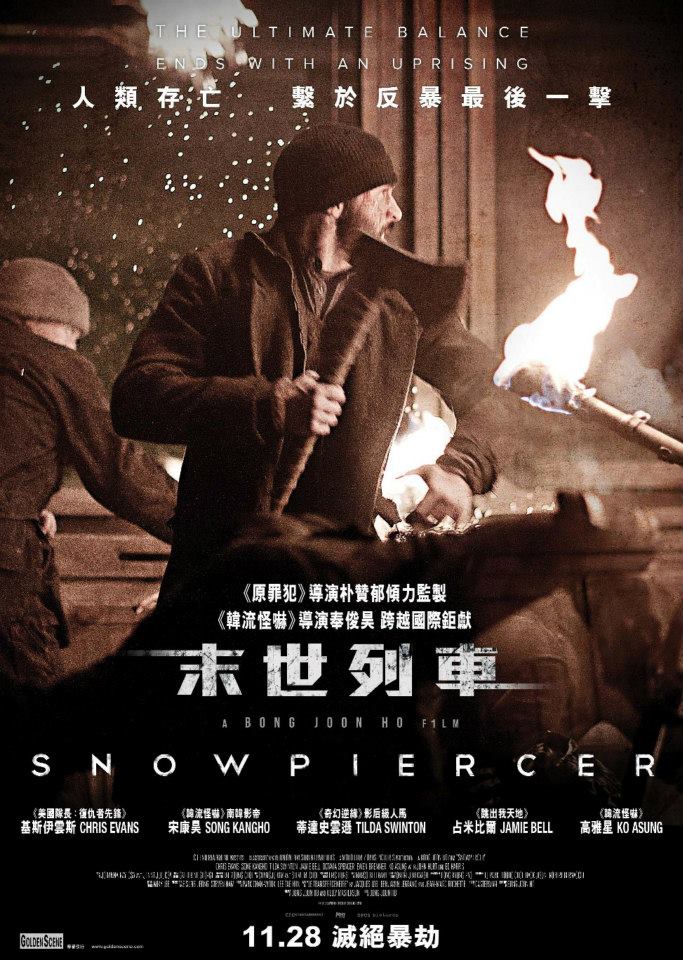
snowpiercer-hong-kong-poster

1. Snowpiercer, 2013, directed by Bong Joon Ho and produced by Park Chan Wook, is a sci-fi dystopian set on a mega-train, where the vestiges of humanity survive, protected from the new ice age outside. The plot involves the third-class passengers’ revolt against the elites who enjoy a privileged life at the head of the train. Etc.

2. You’ve seen this movie before, read this book before. You’ve played this video game.

3. Metropolis, Soylent Green12 MonkeysHalf-Life 2The Time Machine, the MaddAddam trilogy, Children of Men, BioShockZardozLogan’s Run, Brave New World, BrazilThe City of Lost ChildrenBad Dudes, Die HardThe Polar Express, etc.

4. Points 2 and 3 are lazy writing, and Snowpiercer deserves better. Although the film is not especially original, it does have a clear point of view, its own aesthetics, and an engaging, energetic rhythm, powered by strong (if purposefully cartoonish) performances from its cast.

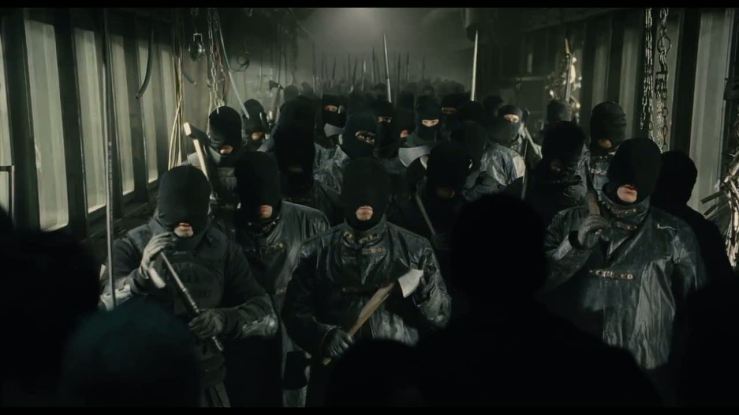
5. Snowpiercer is essentially structured like a video game. The heroes, a rebel alliance led by Chris Evans (Captain America, looking like The Edge from U2 for half the film), clear each train car—each game board—before moving on to the next challenge. An early standout scene involves a fight with a band of ninjas who for some reason ritually slaughter a fish before battle (the scene echoes the famous hammer hallway fight in Old Boy, a film directed by Snowpiercer producer Chan Wook Park). 

snowpiercer-trailer-2

6. The simple narrative structure of Snowpiercer allows the filmmakers to highlight the plot’s allegorical dimension. Highlight is the wrong verb: What I mean to say is hammer. Snowpiercer is not especially subtle in its critique of capitalism, with the engine that powers the train as a metaphor for capitalism itself—the engine determines the form of the train which in turn shapes the form of the society that must live in the train.

7. At Jacobin, Peter Frase offers a strong argument that the film challenges the entire system of capitalism and ultimately advocates transcendence of the system—not internal revolution.

8. While I think Frase’s essay offers a compelling analysis, I think that he simply wants the film to be better than it is. Snowpiercer, despite an apparent subversive streak, is still a Hollywoodish spectacle of violence and noise. It cannot transcend its own tropes (it can’t even revolutionize them). The vision of transcendence it offers is a rhetorical trick; not only that, it’s a stale trick, one that we can find at the end of any number of dystopian fictions: The exit door, the escape hatch, the way out.

9. I want to talk about that exit door—the end of the film: so major spoilers ahead. Continue reading “Snowpiercer Riff”

A Riff on Stuff I Wish I’d Written About In the First Half of 2014

1. Leaving the Sea, Ben Marcus: A weird and (thankfully) uneven collection that begins with New Yorkerish stories of a post-Lish stripe (like darker than Lipsyte stuff) and unravels (thankfully) into sketches and thought experiments and outright bizarre blips. Abjection, abjection, abjection. The final story “The Moors” is a minor masterpiece.

2. Novels and stories, Donald Barthelme: A desire to write something big and long on Barthelme seems to get in the way of my writing anything about Barthelme. Something short then? Okay: Barthelme is all about sex. He posits sex as the solution (or at least consolation) for the problems of language, family, identity, etc.

3. Enormous Changes at the Last Minute and The Little Disturbances of Man by Grace Paley: I gorged on these precise, sad, funny stories, probably consuming too many at once (by the end of Little Disturbances I had the same stomach ache I got after eating too much of Barthelme’s Sixty Stories at once).

4. Concrete by Thomas Bernhard: Unlike the other novels I’ve read by Bernhard, Concrete seems to offer some kind of vision of moral capability, one which the narrator is unable to fully grasp, but which is nevertheless made available to the reader in the book’s final moments, accessible only through the novel’s layers of storytelling. Continue reading “A Riff on Stuff I Wish I’d Written About In the First Half of 2014”

“Go to hell, Roberto” | Roberto Bolaño’s The Unknown University

The Unknown University, Roberto Bolaño’s poetry collection—his complete poems, a bilingual edition, lovely, beautiful, over 800 pages—has been shifted all over my messy house this past month, wedged into ad hoc shelves, even conspicuously, for a time, fatly weighing down another Bolaño text, The Insufferable Gaucho (which I’ve been reading in tandem with/against The Unknown University), swollen and warped with saltwater from the gray Atlantic ocean.

I pecked at The Unknown University discursively, avoiding end notes, taking the rest of the Bolañoverse as my guide or frame or map or background for these poems. I read randomly, trying one poem at a time in no special order, taking crude stabs at the Spanish text on the left hand pages, clumsily matching them against Laura Healy’s fine translation, a poetics that matches the tone and rhythm and cadence and vibe of Bolaño’s other translators, Natasha Wimmer and Chris Andrews.

Then last night, a tale from The Insufferable Gaucho compelled me to read from The Unknown University straightwise, linear, 1-2-3, non-discursively, to take a stab at an orderly trajectory, reading it like a novel in fragments, perhaps.

The book is divided into three parts, each comprised of their own chapters or individual books. Last night I read, or reread, the first half of the first part: The Snow-NovelGuirat de BornelhStreets of BarcelonaIn the Reading Room of Hell.

The examples and citations in this riff come from those books, but I’d suggest that the images, motifs, and themes of these early poems—switchblades, hell, abysses, poets, girls, detectives, assassins, hunchbacks, genitals, sex, madness, blood—resonate throughout the entire volume (and throughout Bolaño’s oeuvre).

Perhaps the most central theme is Bolaño himself; The Unknown University often reads like a diffuse autobiography, with Bolaño’s concern for his own place in literature at the fore.

We see that anxiety in the first poem shared by the editors, a piece from 1990 included in the book’s intro:

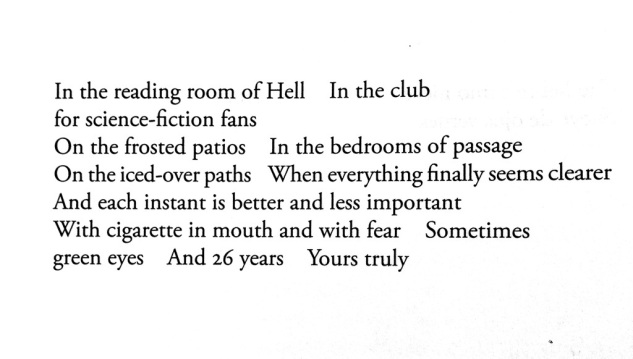
Even a decade earlier, Bolaño prophesied that he would be carried to hell, a primal setting of the Bolañoverse. Bolaño’s romantic ancestor Jorge Luis Borges famously imagined Paradise as a kind of library. Bolaño inverts that image:

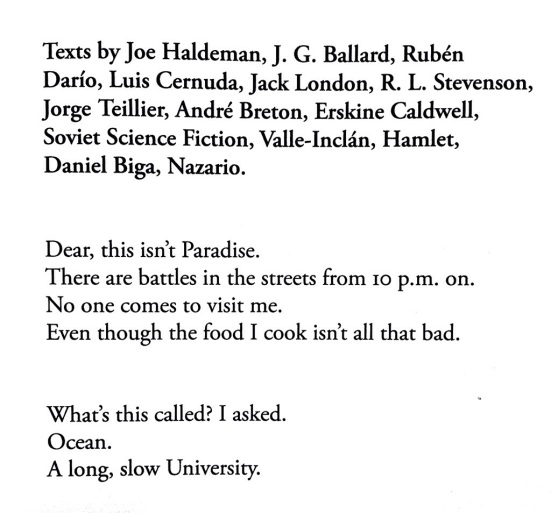
20140609-152831-55711939.jpgIn another poem, Bolaño seems to obliquely address Borges again (“Dear, this isn’t Paradise”), while also name-checking the heroes of that “club / for science-fiction fans” (including some perhaps-unlikely figures):

20140609-152831-55711467.jpg“A long, slow University.” Yes.

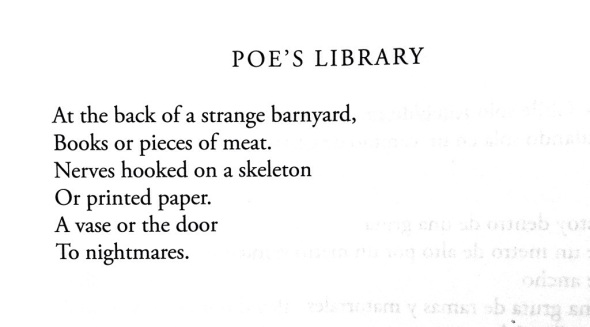
But how could Bolaño leave his hero Edgar Allan Poe from the curriculum? Oh, never mind. Here he is: 

20140609-152830-55710956.jpg

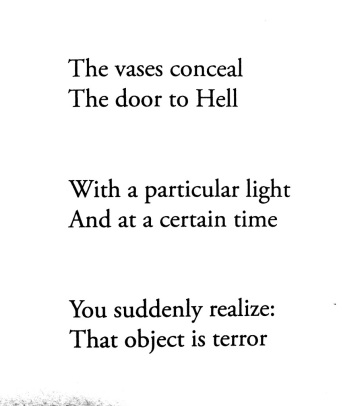
The vase—Pandora’s box, Keats’s urn?—is a central image in these early poems. Dark, beautiful, and transformative, Bolaño seems to posit the vase—an object rendered somewhat mundane in its traditional place as an aesthetic object—as a portal to the abyss:

20140609-152830-55710494.jpg

Elsewhere our poet warns/invites us: “The nightmare begins over there, right there. / Further up, down, everything’s part of the / nightmare. Don’t stick your hand in that urn. Don’t / stick your hand in that hellish vase.” Reading the poem forces us to stick our hand in the vase.

If Bolaño seems occasionally melodramatic in his poems, a thrall to Baudelaire, he’s also keenly aware of it, even this early in his career. A twinning of irony and earnestness characterizes Bolaño’s writing, a savage self-reflexive humor that doesn’t necessarily reveal itself on first reading. When he begins a poem about a lost love, “Go to hell, Roberto, and remember you’ll never stick it in again,” the sentiment is simultaneously tragic and comic, the kind of personal confession that connects to the reader’s own experiences. “To be honest I don’t remember much now,” our narrator confides near the end, before the devastating conclusion, “She loved me forever / She crushed me.”

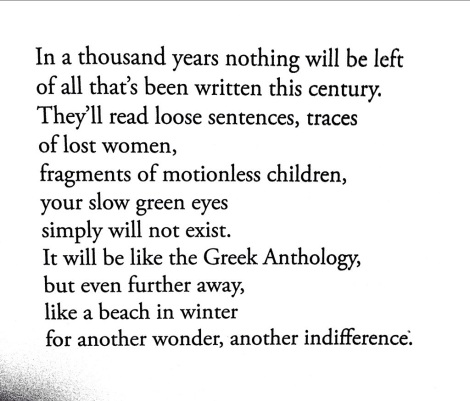
For Bolaño though, what’s perhaps most crushing is the loss of literature:

20140609-161756-58676319.jpg

And yet Bolaño sticks his arm into the vase, walks out over the chasm, dares for his poems to perhaps earn the right to be one of those “loose sentences, traces . . . fragments” that may survive.

In the very early poem “Work,” Bolaño romanticizes his own literary posterity:

Poetry that might champion my shadow in days to come

when I’ll be just a name not the man who wandered

with empty pockets, worked in slaughterhouses

on the old and on the new continent.

I seek credibility not durability for the ballads

I composed in honor of very real girls.

And mercy for my years before 26.

Seems like a reasonable request.

I don’t know if these poems are good or bad or excellent or what. I do know that I loved reading them and that they are of a piece with everything else I’ve read by Bolaño. The best moments recall his best writing, that strange mix of plain, even understated language, set against romantic violence and terrible madness. The poems here don’t distill the best of Bolaño into burning kernels of visceral realism; rather, they feel like the liquid filament of the Bolañoverse. Fantastic.

More to come.

The Unknown University is available now from New Directions.

William T. Vollmann’s Europe Central | A Short Riff on a Long Book

Kilian Eng
Kilian Eng

1. William T. Vollmann’s Europe Central,  811 pages in my Penguin trade paperback edition (including end notes), is a virtuoso attempt to describe or measure or assess or explain or analyze the Eastern front of WWII, a part of the war that in my American ignorance I know, or knew (no, know) so little about.

2. The book covers 1914-1975, most of the composer Dmitri Dmitriyevich Shostakovich’s life. If Europe Central has a hero, it is Shostakovich.

From the book’s last end note, “An Imaginary Love Triangle: Shostakovich, Karmen, Konstantinovaskya”:

When I think of Shostakovich, and when I listen to his music, I imagine a person consumed by fear and regret, a person who (like Kurt Gerstein) did what little he could to uphold the good—in this case, freedom of artistic creation, and the mitigation of other people’s emergencies. He became progressively more beaten down, and certainly experienced difficulty saying no—a character trait which may well have kept him alive in the Stalinist years. In spite of the fact that he joined the Party near the end, to me he is a great hero—a tragic hero, naturally.

That’s Vollmann’s own authorial voice, of course, and there we have perhaps the most concise condensation of Europe Central.

3. Maybe a clarification though: Europe Central is not (just) a fictional biography of Shostakovich: There are many, many other characters that Vollmann uses to power his beast: the Soviet director Roman Karmen and the translator Elena Konstantinovskaya, those other points in the book’s central love triangle; German artist Käthe Kollwitz; Samizdat poet Anna Akhmatova; Generals Paulus (German) and Vlasov (Soviet)—similarly disgraced; SS man Kurt Gerstein, who oversees death camps; there’s Lenin, there’s Stalin. There’s “the Sleepwalker,” one Adolf Hitler. And many, many more.

4. Is Europe Central too big?

No. I don’t think so.

5. I lazily suggested that the book uses Shostakovich as an organizing principle. We could also argue for Operation Barbarossa (Germany’s disastrous invasion of the USSR) as the book’s main thrust. Or, we might say that the book reframes Wagner’s Ring Cycle. Or that it somehow restages Shostakovich’s Opus 40 and Opus 110. (Back to Shostakovich!).

6. Or the telephone! Yes, that totem of modernity, communication, power—the telephone!—the telephone is the central image of Europe Central. Indeed, it initiates the novel: “A squat black telephone, I mean an octopus, the god of our Signal Corps…” That octopus, those tendrils, those lines of communication snake throughout Europe Central.

7. Another description of Europe Central, perhaps, from one of its earliest chapters—

Most literary critics agree that fiction cannot be reduced to mere falsehood. Well-crafted protagonists come to life, pornography causes orgasms, and the pretense that life is what we want it to be may conceivably bring about the desired condition. Hence religious parables, socialist realism, Nazi propaganda. And if this story likewise crawls with reactionary supernaturalism, that might be because its author longs to see letters scuttling across ceilings, cautiously beginning to reify themselves into angels. For if they could only do that, then why not us?

8. Was that enough of Vollmann’s language for this short riff?

No?

I shared various citations from Europe Central on Biblioklept as I read it, even riffing a bit now and then. Check out some of Vollmann’s strange, wonderful prose—it’s far more convincing than anything I can write about his book.

So:

On parables and their value

On Käthe Kollwitz, who kept painting poor people.

On the assurance of a sleepwalker.

On the musicality of a weeping son.

On the more-than-real reality of representations of reality.

On monarchs, murderers, martyrs, lunatics, perverts, etc.

On abjection.

On lending books as one of the purest expressions of love.

10. I left off from the list above one of the finest passages in the book, a section where the unnamed “I” narrator of some of the Soviet sections of Europe Central shifts into Shostakovich’s consciousness, and then, perhaps, into Vollmann’s own authorial voice—and then back. The narratological dimensions here are too big to suss out in my lazy riff, but I find the passage’s main thrust one of the most compelling issues of modern art (or Modern Art, if you prefer): Can art use irony to conceal its true feelings? Can love be self-ironic? And if so, how does this complicate the truth of the expression?

I think this matters because Vollmann thinks this matters—put another way, Vollmann believes in Art and Truth and, significantly, in Love, and the power of love against the backdrop of totalitarianism, despotism, murder, privation, starvation, rape, maiming, gas chambers, mass graves, infanticide, total war…

11. What Vollmann achieves in Europe Central, through the reality and fictionality (and reality of the fictionality of the reality) of his characters, is a language of love. Vollmann posits love, or the possibility of love, or the possibility of imagining the possibility of love, as a response to despair.

12. Point 11 is maybe a way of saying that Europe Central is about so much more than central Europe during WWII—but if you’re at all familiar with Vollmann, gentle reader, of course you’d expect that. Still, I learned a lot about a subject which I thought I knew something about.

Whether or not Vollmann is a generous writer depends on your perspective—you’re swimming in the deep end here, and many of the connections between the different sections don’t cohere until you’ve got the hang of the book. But once you get the hang of it—once you learn to read it—Vollmann’s generosity is almost overbearing in its profundity. How did he research it, do all the reading that went into it, and still make all the voices sing? How? 

13. Europe Central is probably not the best starting place for Vollmann, but I think it will appeal to fans of certain giant polyglossic postmodern novels. I’ll admit to a predilection for WWII metafictions, too, but I can’t really anticipate how readers of historical fiction might regard what Vollmann does here. Can I end by writing Highly recommended? I don’t know. I’m not sure who this book is for… but I loved it.

Curation and Creation in Only Lovers Left Alive, Jim Jarmusch’s Vampire Film

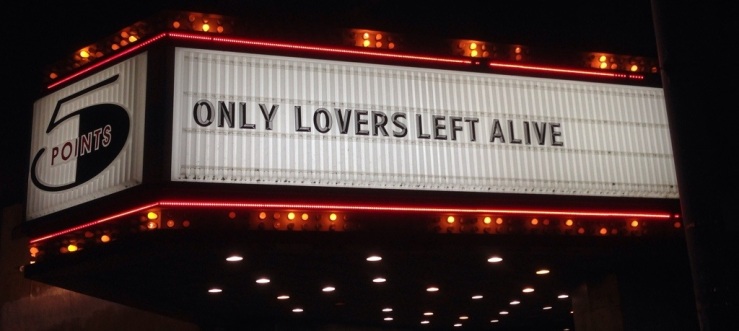
20140520-082414-30254444.jpg

Jim Jarmusch’s latest film Only Lovers Left Alive is excellent. 

Moody, sometimes funny, always gorgeous, and largely plotless, the film centers on two vampires—Adam and Eve, played by Tom Hiddleston and Tilda Swinton—who fill their long lives with music, literature, and love. At its core, the film is an elegiac love song to aesthetic originary creation in the age of the curator.

As Mike D’Angelo points out in his smart review

What really interests Jarmusch is immortality, or at least longevity. How would we behave if we lived for centuries, and were free to do pretty much anything we wanted? What sort of aesthetes and collectors might we become? … In this world, the vampire’s primary function is to appreciate the things we humans take for granted; they’re much more like curators than monsters.


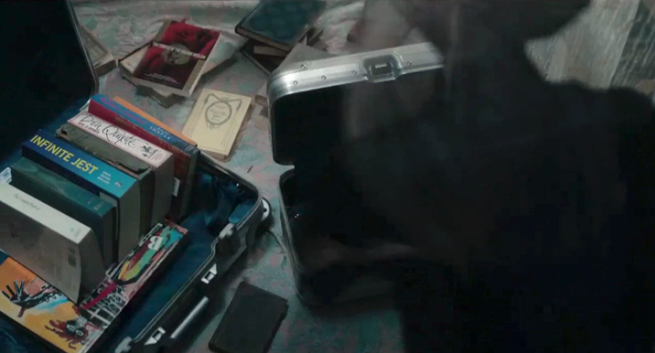
Eve’s curatorial powers are enviable—she merely has to touch an object to know its age (and quality). She touches Adam’s beloved Gibson guitar, declaring “1905.” As she packs her suitcase full of books (Don QuixoteInfinite Jest, and Kafka all make the cut), she scrolls her fingers through pages briskly but lovingly, seeming to absorb each one instantly.

book5

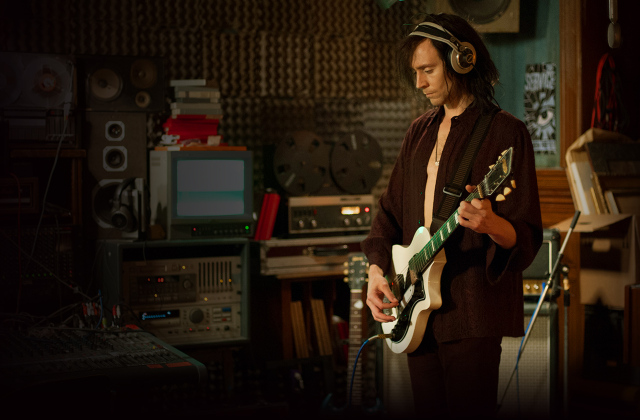
Adam’s curatorial impulses manifest in his collection of antique musical and electronic equipment, his claustrophobic crumbling mansion a mad scientist’s lab of sight and sound. Adam creates plodding dirges, death songs, elegies for the end of romance. Reclusive cult hero, he hides in the outskirts of Detroit from his growing fanbase who demand to know who made this music. Like Wyatt, the masterful forger of William Gaddis’s novel The Recognitions, Adam wonders what people want from the person that they couldn’t get from the work of art. Still, as he mournfully complains to Eve, Adam wants a reflection, something to echo back to him. His fans—the “zombies”—are not enough.

adam

Eve’s library and Adam’s studio allow Jarmusch to perform his own curatorial impulses. On one wall in a room of Adam’s mansion hang the portraits of dozens of writers and musicians, including Blake, Poe, Twain, and Christopher Marlowe. Marlowe it turns out is a vampire—and the real author of Shakespeare to boot. 

It might be tempting to accuse Jarmusch of merely providing fan service for hipsters, but there’s more going on here than simple name-checking. Adam’s wall isn’t simply a shrine for hero-worship. Instead, it feels like a gallery of family portraits. 

Some viewers may find Adam and Eve’s aesthetic obsessions insufferable. As if in anticipation of this criticism—and as a sort of counter argument—Jarmusch plants an internal critique of his lovers in the film in the form of Eve’s kid sis Ava, an impulsive, strangely immature, and ultimately tacky vampire. In her acrimonious parting with Adam and Eve, Ava curses the pair as “condescending snobs.” She is, of course, absolutely correct.only-lovers-left-alive02

Adam and Eve are snobs, but perhaps living through eons will do that to a body, so what should we expect? Adam, black-haired, always dressed in black, veers along a desperate, suicidal spectrum, writing dirges for the end of the world. Eve, golden-haired, clothed in white, must constantly remind Adam of eternal recurrence, a motif figured in Jarmusch’s repeated shots of spinning 45rpm records. Adam mourns the death of Detroit, but Eve tells him that it will bloom again when the “cities of the South are burning.”

Only Lovers Left Alive is peppered with these notes of apocalypse, but Eve tempers them with a kind of weary optimism: She and her lover will survive, and they will preserve what is worth preserving, worth loving. Not only will they curate, they will also create. As the film rushes to its ending in Tangier (my biggest criticism is that we could use another half hour)—oh, and that word “ending”: yeah, look out, fair warning, some spoilers ahead—as the film rushes to its ending, Adam and Eve experience intense blood withdrawal.  Continue reading “Curation and Creation in Only Lovers Left Alive, Jim Jarmusch’s Vampire Film”

“His romantic ancestor, his ancestor of the romantic death” | Bolaño and Borges

Jorge Luis Borges is first mentioned in the sixth paragraph of Roberto Bolaño’s masterful short story “The Insufferable Gaucho.” In this paragraph, the narrator tells us that the story’s hero, an ex-judge named Pereda, believed “the best Argentine writers were Borges and his son; any further commentary on that subject was superfluous.”

Several paragraphs later, Bolaño’s narrator explicitly references Borges’s short story “The South,” the precursor text for “The Insufferable Gaucho.” The reference to Borges is tied again to Pereda’s son, the writer Bebe.

Leaving tumultuous Buenos Aires, basically destitute from the Argentine Great Depression, Pereda heads to the countryside to take up residence in his family’s ancient ranch. Departing the train and arriving to a rural town, 

Inevitably, he remembered Borges’s story “The South,” and when he thought of the store mentioned in the final paragraphs his eyes brimmed with tears. Then he remembered the plot of Bebe’s last novel, and imagined his son writing on a computer, in an austere room at a Midwestern university. When Bebe comes back and finds out I’ve gone to the ranch . . . , he thought in enthusiastic anticipation.

Bolaño essentially appropriates the plot of “The South” for his tale “The Insufferable Gaucho” and inserts a version of himself into this revision. Bolaño is “Bebe” here, an author who “wrote vaguely melancholy stories with vaguely crime-related plots,” his name phonically doubling the series of mirrors and precursors that Bolaño, mystery man, leaves as clues: Bebe, B-B, Borges-Bolaño, Belano-Bolaño. (Is this too wild a conjecture, dear reader? Mea culpa). 

And Pereda then? A stand-in for Borges’s Juan Dahlmann (hero of “The South,” who “considered himself profoundly Argentinian”), surely, but also, maybe also—a stand-in for (a version of) Borges.

What I mean to say:

Bolaño, displaced Chilean, writes “The Insufferable Gaucho” as an intertextual love letter to his displaced father, the Argentine Jorge Luis Borges. Continue reading ““His romantic ancestor, his ancestor of the romantic death” | Bolaño and Borges”

Riff on William Shakespeare

  1. William Shakespeare, the Greatest Living American Author, turns 450 today.
  2. (There may be some, uh, factual, problems with the preceding sentence, but I’ll let it stand).
  3. (After all, to write after Shakespeare requires some gall, a bit of fakery, maybe an outright lie or two).
  4. 450! (Could I even hit 450 points on a riff?)
  5. “Shakespeare invented us,” Harold Bloom repeatedly insists in his big fat book The Western Canon.
  6. (I might be misquoting; the prospect of putting the effort of fact checking into this riff horrifies me).
  7. “Shakespeare—whetting, frustrating, surprising and gratifying,” F. Scott Fitzgerald jotted down in his notebook.
  8. We don’t actually have a record of Shakespeare’s birth, although we do know he was baptized on 26 April 1564.
  9. And died 23 April 1616.
  10. It’s likely that Shakespeare was born on 23 April 1564.
  11. Or, perhaps: There’s something symmetrical, neat, poetic about Shakespeare dying on his birthday.
  12. Ingrid Bergman died on her birthday.
  13. As did Thomas Browne.
  14. As did Yasujrio Ozu.
  15. And, according to tradition: Moses, David, Mohammad.
  16. So why not Shakespeare, born on his deathday?
  17. We want a teleological neatness with Shakespeare: We want his last play to be The Tempest, a tragicomedy that somehow synthesizes all before it; we can claim Prospero a commanding stand-in for Shakespeare.
  18. (These claims overlooking of course that Shakespeare’s last work was likely a forgettable collaboration with John Fletcher, The Two Noble Kinsmen).
  19. The Two Noble Kinsmen was based on Chaucer’s The Knight’s Tale.
  20. (Shakespeare of course “based” his works on other works; the man was not one for original plotting (thank goodness)).
  21. “Chaucer had a deeper knowledge of life than Shakespeare,” claimed Ezra Pound.
  22. “Let the reader contradict that after reading both authors, if he chooses to do so,” he truculently added.
  23. To Coleridge though Shakespeare was “myriad-minded Shakespeare” — Our myriad-minded Shakespeare.
  24. Dryden credited him with “the largest and most comprehensive soul.”
  25. Suggesting also that, “Shakespeare’s magic could not copied be.”
  26. I’m not sure about that.
  27. How many versions of Hamlet have been attempted?
  28. Were not some of these Hamlets magical—magical enough, at least?
  29. Ulysses?
  30. Infinite Jest?
  31. The Lion King?
  32. Oedipus Rex?
  33. David Markson points out somewhere—forgive me for not rising from my fat ass to go verify—that Shakespeare couldn’t possibly have read Sophocles’ Oedipus as there was no English translation yet available.
  34. And how many books did Shakespeare read?
  35. (Chaucer, often credited with a library of sixty).
  36. Speculation, speculation!
  37. Shakespeare Truthers.
  38. Or Anti-Stratfordians—whatever you want to call them.
  39. Walt Whitman was a Shakespeare Truther.
  40. Believing no commoner could write the plays, but “only one of the ‘wolfish earls’ so plenteous in the plays themselves, or some born descendant and knower, might seem to be the true author of those amazing works.”
  41. Amazing that, that Walt Whitman, who could so bombastically conceive himself every man, woman, child, a cosmos, etc.—that he couldn’t credit a commoner with the depth of imagination to produce the plays that Whitman called “greater than anything else in recorded literature.”
  42. David Markson: “Scholars who are convinced that Shakespeare must certainly have been a military man.  Or a lawyer.  Or closely associated with royalty.  Or even a Jew. To which Ellen Terry: Or surely a woman.”
  43. For some Shakespeare Truthers, evidence of his lack of authorship is to be found in the different ways he supposedly signed his name!
  44. Willm Shakp.
  45. William Shakspēr.
  46. Wm Shakspē.
  47. William Shakspere.
  48. Willm Shakspere.
  49. William Shakspeare.
  50. The last of these from his 1616 will, in which he famously bequeathed his second-best bed to his wife Anne Hathaway.
  51. “He was a rich country gentleman, Stephen said, with a coat of arms and landed estate at Stratford and a house in Ireland yard, a capitalist shareholder, a bill promoter, a tithefarmer. Why did he not leave her his best bed if he wished her to snore away the rest of her nights in peace?” Continue reading “Riff on William Shakespeare”

Riff on Not Writing

1. Let’s start with this: This is for me, this is not for you.

2. The above statement is not a very inviting invitation to the audience, is it? Sorry. Look. I have the Writer’s Block. The blockage. The being-stuckness. Etc.

3. Writer’s block, for me anyway, is not the inability to write. It’s more like some kind of inertia, some kind of anxiety, some little whisper of doom, hopelessness about the futility of shaping feelings into ideas and ideas into words. (That last phrase is, I believe, a paraphrase of Robert Frost’s definition of poetry).

4. Anyway, sometimes it’s best just to write—and write with the intention to make the writing public, to publish it (even on a blog!)—to put something (the publishing, that is) at stake.

5. (And so I’ve done this before).

6. I’ve read or audited nearly a dozen books this year that I’ve failed to write about on this site. Ostensibly, at some point, writing about books was like, the mission of Biblioklept, which maybe that mission has been swallowed  up by some other mission, some non-mission, some other goal or telos or whatever.

7. But you see there are some books I’ve read or audited that I really, really want to write about! (Sorry for this dithering but hey wait why am I apologizing I already said that this is for me this is not for you did I not?).

8. These books are:

Enormous Changes at the Last Minute by Grace Paley

Leaving the Sea by Ben Marcus

Every Day Is for the Thief by Teju Cole

Concrete by Thomas Bernhard

Middle C by William H. Gass

Save Me the Waltz by Zelda Fitzgerald

Goings in Thirteen Sittings by Gordon Lish

Not quite half a dozen books of poetry by Tom Clark

The majority of Donald Barthelme.

9. (I am also reading half a dozen books right now, even though I made a vow years ago not to do that).

10. A common theme to some of the books listed in point 8: The difficulty of words to mean, the toxic power of language, the breakdown of communication.

Continue reading “Riff on Not Writing”

The Essential Short Stories of J.G. Ballard

jgb_complete_ss4003111

I. “Manhole 69” (1957)

II. “Chronopolis” (1960)

III.  “The Voices of Time” (1960)

IV. “The Overloaded Man” (1961)

V. “Billennium” (1961)

VI. “Thirteen to Centaurus” (1962)

VII. “The Subliminal Man” (1963)

VIII. “End-Game” (1963)

IX. “Time of Passage” (1964)

X. “The Lost Leonardo” (1964)

XI. “The Terminal Beach” (1964)

XII. “The Drowned Giant” (1964)

XIII. “The Beach Murders” (1966)

XIV.  “The Assassination of John Fitzgerald Kennedy Considered as a Downhill Motor Race” (1966)

XV. “Why I Want to Fuck Ronald Reagan” (1968)

XVI. “Notes Towards a Mental Breakdown” (1976)

XVII. “The Index” (1977)

XVIII. “The Dead Time” (1977)

XIX. “News from the Sun” (1981)

XX. “Myths of the Near Future” (1982)

XXI. “Memories of the Space Age” (1982)

XXII. “Answers to a Questionnaire” (1985)

XXIII. “A Guide to Virtual Death” (1992)

At 1200 pages and just under 100 stories, The Complete Short Stories is frankly too complete—but I read them all anyway. The list above is my suggestion for a volume I’d call The Essential Short Stories of J.G. Ballard. Each selection on the list is linked to a riff I wrote; in several cases, links to the full text of the story can be found at the riff.

True Detective, Bolaño’s 2666, Werewolves, Etc.

03-true-detective-1

1. A couple of years ago I wrote a pretty long essay about rereading Roberto Bolaño’s novel 2666, a dark, compelling, violent, mysterious book that I’ve reread in full three times now, a book that I frequently return to, a book that seems to leer from the shelf too often, Hey, you’re not done with me, you know that, right? 

2. Anyway, this long essay about rereading 2666 was also about another book: Sabine Baring-Gould’s 1865 folklore-horror hybrid, The Book of Were-Wolves (download it here). I argued that

What Bolaño and Baring-Gould do in these books is explore madness and violence and the ways that our world tries to (or fails to) contain madness and violence.

—and suggested that

Bolaño’s werewolves are, in line with Baring-Gould’s, people fated to madness and violence, but also relatively normal people. These werewolves contain within them a dreadful capacity for violence.

3. (What I want to say is that any speculation I might offer about the forthcoming conclusion of season one of True Detective I have already offered, at some length, in an essay (about two other texts) which I composed a few years before True Detective aired).

4. Well so and anyway: “After You’ve Gone,” the penultimate episode of True Detective.

In some ways the most straightforward episode to date, even disappointingly so, a bit of a police procedural, serving mostly to realign Cohle and Hart, demonstrating that despite their fight and their differences, they are also very similar. But you already know that, you know what happened in the episode, right? The obsession then is for an answer: Where does this all go? Who did the crimes? Who is The King in Yellow? How does it end?

5. I now lazily link to an article that rounds up some of the conjecture — the “theories” — about how the show will end. You’ve read some of these, right?

6. This kind of conjecture is fun, or maybe “fun” isn’t the right word—maybe what I want to say instead is:

True Detective compels many of its viewers to obsessively hunt down clues in each frame. There’s a thickness to the show’s repetition of key images and phrases—spirals, stars, sets of five figures, antlers, crowns, crosses that dissolve into targets, etc.—a seeming preciseness that invites us to impose our own order, our own narrative.

(This is the kind of conjecture that Hart repeatedly warns Cohle not to indulge in).

7. I’m reminded here of Juan Antonio Masoliver Ródenas’s prologue to Roberto Bolaño’s unfinished novel Woes of the True Policeman:

What matters is the active participation of the reader, concurrent with the act of writing. Bolaño makes this very clear in his explanation of the title: “The policeman is the reader, who tries in vain to decipher this wretched novel.” And in the body of the book itself there is an insistence on this conception of the novel as a life: we exist—we write, we read—so long as we’re alive, and the only conclusion is death.

True Detective, like True Policeman—and, like Bolaño’s masterpiece 2666—all invite the active participation of the reader. But also the woe.

8. There is no supernatural solution to the mysteries of True Detective. From the outset, True Detective has posited (the illusion of) human consciousness as a part of nature that seeks to define itself against naturethe real.

In True Detective, the supernatural is the product of terror and fantasy. It is imaginary. (And of course therefore no less real than the natural, the real, thanks to human consciousness).

audrey

9. From the beginning of Baring-Gould’s The Book of Were-Wolves:

It will then be seen that under the veil of mythology lies a solid reality, that a floating superstition holds in solution a positive truth.

This I shall show to be an innate craving for blood implanted in certain natures, restrained under ordinary circumstances, but breaking forth occasionally, accompanied with hallucination, leading in most cases to cannibalism. I shall then give instances of persons thus afflicted, who were believed by others, and who believed themselves, to be transformed into beasts, and who, in the paroxysms of their madness, committed numerous murders, and devoured their victims.

The emphasis is mine.

10. In the sixth episode of True Detective, Cohle says to Hart: “You, these people, this place … you’ll eat your fucking young as long as you have something to salute.” The indictment is broad, dark, and perhaps paranoid, but it serves to highlight the series’s keen attenuation to infanticide, to the infinite loss and dramatic mourning that underpins begetting.

11. Cohle has lost his daughter, and her death at such a young age, he says, spared him “the sin of fatherhood.”

Hart has essentially lost his daughters, ruined his life, ruined his (illusion of the) status as a family man. The thing that mattered—his family—was “right under his nose” the whole time.

On the job, both Cohle and Hart—separately—witness the awful deaths of infants; in both cases, the men snap, disconnect, quit.

12. (At this time, the reader is invited to sift through his or her own recollections of True Detective (if he or she so desires) and set aside examples of infanticidal violence).

13. Many fans of the show have speculated that Martin Hart is the King in Yellow, a notion fueled by the show’s stores of symbolic images, as well as Hart’s own actions.

The theory is intriguing, but I seriously doubt that Hart will be revealed as a perpetrator in the crimes of the Tuttle case. However, he is capable of slipping into werewolf mode: Threatening his lover Lisa’s new beau with horrific violence and then declaring, “I’m not a psycho–I wouldn’t have done those things” (the past perfect tense there is so strange); slipping on gloves to assault the boys who had consensual sex with his daughter Audrey; etc. etc. etc.

Hart’s actions are the strange double bind of the patriarchal lawman who sets to rule with sanctioned order—and, specifically, to rule and control the sexualized female body, which is oh-so-important to begettingDoes he serve and protect? Does he terrorize and menace? Both and at the same time.

But I’d argue that Hart is illusioned, that his identity is constituted in maintaining an illusion, an illusion that Cohle is too keenly aware of (“…you’ll eat your fucking young as long as you have something to salute”).

14. There’s a heap of corpses at the core of Bolaño’s 2666—women who are raped, murdered, discarded. Bolaño sends various detectives—many of them good detectives, true policeman—to find the killers, but there’s no satisfying answer: Just plenty of killers, plenty of werewolves. As the novel reaches its (non)end, we await the promise of a Giant (The Tall Man), a Big Answer. But the answer is inadequate, incomplete.

15. The capacity to transform into a killer, a werewolf is always there. Just put on some gloves. Just slip on a mask.

Or maybe take your mask off.

jpJvNrI

The Complete Short Stories of J.G. Ballard (Eleventh Riff: The Nineties)

jgb_complete_ss4003111

PREVIOUSLY:

Introductions + stories 1956-1959

Stories of 1960

Stories of 1961

Stories of 1962

“The Subliminal Man,” Black Friday, and Consumerism

Stories of 1963-1964

Stories of 1966

Closing out the sixties

The seventies

The eighties

IN THIS RIFF:

“Dream Cargoes” (1990)

“A Guide to Virtual Death” (1992)

“The Message from Mars” (1992)

“Report from an Obscure Planet” (1992)

“The Secret Autobiography of J G B” (1981/2009)

“The Dying Fall” (1996)

1. “Dream Cargoes” (1990)

By the 1990s Ballard had written essentially the same stories over and over—with diminishing returns. Some of the weakness in the later entries in the Complete Short Stories can be attributed to Ballard’s prescience. The world caught up to him at some point, blunting his satire into something goofier, more cartoonish, but also sharpening the reactionary streak that always glowed under the surface of his writing. At his peak, Ballard used his stories to provoke readers into looking at their culture in a new way, and the best of those stories still retain a futurist power. However, many of the late period stories blazon their moral outrage in a wearisome didactic streak.

1990’s “Dream Cargoes” is paint-by-numbers Ballard: Themes of time, sleep, mutation, ecological disaster, birds, etc. The plot anticipates one of Ballard’s weaker novels, Rushing to Paradise (1994), a day-glo nightmare about misguided attempts to steward the forces of nature. And like Rushing to Paradise, the prose here is weak—Ballard relies on the stock phrases that litter his earliest stories.

2. “The Message from Mars” (1992) / “Report from an Obscure Planet” (1992) / “A Guide to Virtual Death” (1992)

“The Message from Mars” anticipates public disinterest in astronomy (and science in general), the end of NASA’s space shuttle program, and China’s emerging dominance as a world power with space flight capability. So there you go. (It also posits the horror of a President Quayle!). Ballard sends a group of astronauts on a Mars mission, refuses to share their findings with us, and then leaves them, once they land, in their space shuttle, where they live on for decades, silent, incommunicado, alienated from humanity in their self-imposed exile. Ballard’s cynicism is balanced by his refusal to overstate any kind of moral here—the story succeeds in its evocation of mystery.

“Report from an Obscure Planet” is another riff on millennial anxieties, written in the perspective of a “we” condemning the human race for its shortsighted, disastrous treatment of the planet. Ballard doesn’t seem to keen on the future wonders promised by computers:

Driven by the need for a more lifelike replica of the scenes of carnage that most entertained them, the people of this unhappy world had invented an advanced and apparently interiorised version of their television screens, a virtual replica of reality in which they could act out their most deviant fantasies. These three–dimensional simulations were generated by their computers, and had reached a stage of development in the last years of the millennium in which the imitation of reality was more convincing than the original. It may even have become the new reality to the extent that their cities and highways, their fellow citizens and, ultimately, themselves seemed mere illusions by comparison with the electronically generated amusement park where they preferred to play. Here they could assume any identity, create and fulfill any desire, and explore the most deviant dreams.  

While “Report from an Obscure Planet” uses a didactic narrator and a heavy hand to telegraph its message, its companion piece “A Guide to Virtual Death” is far more fun, wicked, and shockingly accurate (if wildly hyperbolic). Sure, yes, okay—another list from Ballard, and okay, yes, sure—I tend to be keen on his lists (“The Index,” “The Assassination of John Fitzgerald Kennedy Considered as a Downhill Motor Race”)—but they also tend to be his strongest pieces. As usual with his list-stories, Ballard feels obligated to begin with a note:

For reasons amply documented elsewhere, intelligent life on earth became extinct in the closing hours of the 20th Century. Among the clues left to us, the following schedule of a day’s television programmes transmitted to an unnamed city in the northern hemisphere on December 23, 1999, offers its own intriguing insight into the origins of the disaster.

6.00 am Porno–Disco. Wake yourself up with his–and–her hard–core sex images played to a disco beat.

7.00 Weather Report. Today’s expected micro–climates in the city’s hotel atriums, shopping malls and office complexes. Hilton International promises an afternoon snow–shower as a Christmas appetiser.

7.15 News Round–up. What our news–makers have planned for you. Maybe a small war, a synthetic earthquake or a famine–zone! charity tie–in.

7.45 Breakfast Time. Gourmet meals to watch as you eat your diet cellulose.

Brief but Essential. Go ahead and read the whole thing.

3. “The Dying Fall” (1996) / “The Secret Autobiography of J G B” (1981/2009)

The American edition of Complete Stories is more complete than the British volume, including two extra stories. “The Dying Fall” (read it here if you like) is an unfortunate last entry, a weak note in a grand tome. It’s not bad; it’s simply not good, yet another revenge tale with a bad wife, etc. It feels like a frame for Ballard to riff on architecture and psychoanalysis.

“The Secret Autobiography of J G B” is much stronger (you can read it here), although it was also composed at his peak and republished (“rediscovered”) after his death. The final lines would have made a fitting end for the entire collection:

When the summer was followed by a mild autumn, B had established a pleasant and comfortable existence for himself. He had abundant stocks of tinned food, fuel, and water with which to survive the winter. The river was nearby, clear and free of all pollution, and petrol was easy to obtain, in unlimited quantities, from the filling stations and parked cars. At the local police station, he assembled a small armory of pistols and carbines, to deal with any unexpected menace that might appear.

But his only visitors were the birds, and he scattered handfuls of rice and seeds on his lawn and on those of his former neighbors. Already he had begun to forget them, and Shepperton soon became an extraordinary aviary, filled with birds of every species.

Thus the year ended peacefully, and B was ready to begin his true work.

4. On the horizon:

I am done! Sort of. One more post—I’ll revisit these riffs and select the tales that I would include in a collection I would call The Essential Short Stories of J.G. Ballard.

“Haunted Houses” | Another True Detective Riff

marty_old

I had an intuition that “Haunted Houses” would likely be the weakest episode of True Detective. Structurally, the episode has a lot of work to do to set up the two final episodes (which I expect to be very strong—although episode four, “Who Goes There,” has set the bar really high). Metaphors like tying loose ends or connecting the dots don’t apply well to True Detective—which is, I’d argue, a show about the insanity of looking for satisfactory answers to, y’know, life and death—but “Haunted Houses” nevertheless underlines some of the plot points that will coalesce (or shatter) in the finale episodes.

We finally get to see why Hart and Cohle split up in 2002, and the moment is deeply dissatisfying in its obviousness and predictability, although there is a teleological neatness to seeing Hart fall apart, disappointing both of his partners—Maggie and Cohle—both of whom seem to have seen this coming. Indeed, in this episode, Hart fulfills a prophecy from the second episode, when Cohle wryly suggests that he’s putting a “down payment” on the child prostitute he feebly tries to “rescue” from the woodland brothel.

“Haunted Houses” focuses heavily on Marty Hart, which might be why I found it less engaging than what’s come before. There’s no aggravating Cohle monologue in this episode, and his actions are confined entirely to 2002, where he’s raking through the slime of old cases — “dead women and children” — causing headaches and pissing people off. Cohle, who has lost his own daughter, is keenly attuned to the infanticidal cost of existence. In the episode’s standout scene, he slowly, patiently extracts a confession out of a swampland Medea who has killed all of her children. Cohle has earlier revealed that the simple core of his interrogation technique is rooted in the idea that everyone has sinned and that everyone wants to confess—and he gently guides the mother to confession. Then, in a strange but somehow caring tone, he ends the interrogation: “If you get the opportunity, you should kill yourself.”

Cohle’s detective work begins to knit together the major threads of what we now might as well call the Tuttle case: The big people who are involved in sick shit. The series isn’t at its best when it’s doing the police procedural thing, and even soaked in Southern Gothic noir, some of these scenes play out in broad strokes—but those broad strokes will likely build a foundation for the rest of the drama to unfold on.

The Cohle sequences that don’t involve his detective work seem to frame him from Hart’s point of view—his lines are never quite wholly contextualized as they are in earlier episodes, seasoned and weighted by 2012 Cohle’s dark ramblings. When Hart calls Cohle’s observations on the Tuttle (non)case “pure gibberish,” there’s clearly an invitation here for the audience to agree—or not.

Not that Hart has done anything meaningful lately—let alone “anything heroic,” in his own words. Most of “Haunted Houses” conjures him in wholly abject terms. In the opening scene, he mercilessly beats the two boys his daughter has had (consensual) sex with. The scene is violent and cruel, quickly telegraphing the fact that Hart is a bully. (When asked what types of detectives exist in the opening scenes of the first episode, “bully” is the first descriptor on Hart’s list). He leaves, gets in his car, shuts the door, then opens it again to vomit: Abjection: His guts spilling out, his borders unrestrained. He’s sick. That abjection is underscored later when Hart feels shame at carrying a shopping bag brimming with tampons, and then heavily underscored when his commanding officer refers to him as a “walking tampon.”

Hart attempts to reassert his manhood—his kinghood?—throughout the episode, first by violating the civil rights of the boys in the cell and then by having an affair with a woman young enough to be one of his daughters. When he finds out that Maggie has fucked Cohle in revenge (in brutal and confusing scene), Hart begins to choke her, threatens her, before redirecting his rage into a physical attack on Cohle. None of this behavior helps him to reassert his sense of identity; the 2005 segment closes out with Hart cuckolded, shamed, bloody, abject.

Of course that’s not the end of the episode. In episode four, Cohle left the interrogation room, having got a read on detectives Papania and Gilbough, and also severing (or at least displacing) one of the show’s formal conventions, the interrogation scenes. In episode five, Hart does the same. The interrogation scenes have been a simple but effective way for True Detective to reveal the ways that truth—and implicitly identity—is a construction, a narration: A performance. 

Leaving behind the interrogation sequences opens the last two episodes up to something new, which begins in the most interesting part of “Haunted Houses” — the last few minutes, when 2012 Hart meets 2012 Cohle (his first appearance in the episode). Cohle has clearly been tailing Hart, and he hails him from behind (ex-cop pulling over ex-cop), a kind of anti-interpellation, or an interpellation into some other, darker (dis)order. While “Haunted Houses” doesn’t evoke the strange thrills and weird questions that made the first half of the season so compelling, it nevertheless sets the stage for something dark and ugly—some kind of monster at the end of the dream.

marty_current

A Rambling Riff on True Detective

1. So usually after I watch the newest episode of True Detective—this week, that means episode five, “The Secret Fate of All Life”—usually I rewatch the episode and then want to write about it and feel stymied. Last week, I had to (was compelled to) rewatch “Who Goes There” immediately after the first viewing.

This is a long lead up to saying, basically, that I haven’t gotten to rewatching “The Secret Fate of All Life” yet, because this episode compelled me to go back to the beginning, to start from “The Long Bright Dark.”

2. So some quick thoughts on “Secret Fate” (with the caveat that I haven’t rewatched it, along with the caveat that these riffs are written to an audience which has already watched the show):

3. The major theme of “Secret Fate” is time. This episode argues that time is an illusion (just as earlier episodes argued that identity is an illusion)—that time is a trick of perception. Continue reading “A Rambling Riff on True Detective”

The Complete Short Stories of J.G. Ballard (Tenth Riff: The Eighties)

jgb_complete_ss4003111

PREVIOUSLY:

Introductions + stories 1956-1959

Stories of 1960

Stories of 1961

Stories of 1962

“The Subliminal Man,” Black Friday, and Consumerism

Stories of 1963-1964

Stories of 1966

Closing out the sixties

The seventies

IN THIS RIFF:

“A Host of Furious Fancies” (1980)

“News from the Sun” (1981)

“Memories of the Space Age” (1982)

“Myths of the Near Future” (1982)

“Report on an Unidentified Space Station” (1982)

“The Object of the Attack” (1984)

“Answers to a Questionnaire” (1985)

“The Man Who Walked on the Moon” (1985)

“The Secret History of World War 3” (1988)

“Love in a Colder Climate” (1989)

“The Enormous Space” (1989)

“The Largest Theme Park in the World” (1989)

“War Fever” (1989)

1. “News from the Sun” (1981) / “Myths of the Near Future” (1982) / “Memories of the Space Age” (1982)

Let me first confess how happy I am to be finished with this enormously enormous book (okay, not physically enormous on my Kindle, but still…). Let me also confess to dread at having to finish out these riffs (no, no one is forcing me, but still…). At this point, I feel like I could write my own Ballard story—a crazed astronaut here, a drained swimming pool there, a femme fatale, some psychotropic drugs, armchair psychology, a swamp, some birds (perhaps), a plane or two, time obsession, sex obsession, space obsession. Obsession obsession Anyway. Ballard arguably peaks in the early 1980s; everything after reads like a day-glow Keith Haringesque pop-approximation of his grittier seventies stuff—or (worse) scolding wrapped up in little morality plays.

But, like I said (wrote), Ballard is in his prime in the early 1980s, and “News,” “Myths,” and “Memories” are some of his finest stories (file these triplets in my quasi-fictional-but-c’mon-we-can-make-this-happen collection The Essential Short Stories of J.G. Ballard)—they are also some of his most Ballardian, riffing on space-travel-as-cosmic-taboo, paranoid parables obsessed with time. A particularly Ballardian paragraph (from “Memories”):

He had almost ceased to breathe. Here, at the centre of the space grounds, he could feel time rapidly engorging itself. The infinite pasts and future of the forest had fused together. A long–tailed parakeet paused among the branches over his head, an electric emblem of itself more magnificent than a peacock. A jewelled snake hung from a bough, gathering to it all the embroidered skins it had once shed.

(Parenthetical aside: “Myths” and “Memories” are both set in Florida. Ballard’s depiction of Florida feels thoroughly inauthentic (I’m Floridian), but that inauthenticity also feels thoroughly appropriate).

2. “A Host of Furious Fancies” (1980)

Ballard constructs this little tale around a psychoanalytic reading of Cinderella:

The entire fairy tale of Cinderella was being enacted, perhaps unconsciously, by this deranged heiress. If she herself was Cinderella, Dr Valentina Gabor was the fairy godmother, and her magic wand the hypodermic syringe she waved about so spectacularly. The role of the pumpkin was played by the ‘sacred mushroom’, the hallucinogenic fungus from which psilocybin was extracted. Under its influence even an ancient laundry van would seem like a golden coach. And as for the ‘ball’, this of course was the whole psychedelic trip.

But who then was Prince Charming? As I arrived at the great mansion at the end of its drive it occurred to me that I might be unwittingly casting myself in the role, fulfilling a fantasy demanded by this unhappy girl. . . .

For all my resistance to that pseudo–science, it occurred to me that once again a psychoanalytic explanation made complete sense of these bizarre events and the fable of Cinderella that underpinned them. I walked up the staircase past the dismembered clock. Despite the fear–crazed assault on them, the erect hands still stood upright on the midnight hour – that time when the ball ended, when the courtships and frivolities of the party were over and the serious business of a real sexual relationship began. Fearful of that male erection, Cinderella always fled at midnight.

Etc.

Ballard’s Freudian riff would be more interesting as an essay.

(The story also showcases some of his typical chauvinism: The psychiatrist is described as the “woman psychiatrist” — just as earlier a dentist is referred to as a “lady dentist,” etc. Straight through to the end of the collection. In the 1990s).

3. “Report on an Unidentified Space Station” (1982) / “The Enormous Space” (1989)

“Report” and “Space” both read like takes on Sigizmund Krzhizhanovsky’s Soviet-era short story “Quadraturin” — both concern space, that corollary to time, and, just as Ballard repeatedly posits time as a matter of perspective, he treats space—area—the same way here. “Report” is a bit more satisfying than “Space,” which feels like a retread of so many of Ballard’s revenge stories—only with, uh, some comical cannibalism.

4. “The Object of the Attack” (1984) / “Answers to a Questionnaire” (1985)

“Attack” and “Questionnaire” are maybe the same story—only “Questionnaire” is essentially perfect, whereas “Attack” feels like a clumsy, heavy first draft (but only because “Questionnaire” exists—do you see what I mean by this?)

Both stories showcase Ballard’s syntheses of religion (messianic; apocalyptic) and assassination (political; media-saturated). While “Attack” employs a discursive-but-still-linear approach to the theme, “Answers to a Questionnaire” gives us a discontinuous but more engaging riff in the form of (uh) exactly what its title promises.  First fifth:

1) Yes.

2) Male (?)

3) do Terminal 3, London Airport, Heathrow.

4) Twenty–seven.

5) Unknown.

6) Dr Barnardo’s Primary, Kingston–upon–Thames; HM Borstal, Send, Surrey; Brunel University Computer Sciences Department.

7) Floor cleaner, Mecca Amusement Arcades, Leicester Square.

8) If I can avoid it.

9) Systems Analyst, Sperry–Univac, 1979–83.

10) Manchester Crown Court, 1984.

11) Credit card and computer fraud.

12) Guilty.

13) Two years, HM Prison, Parkhurst.

14) Stockhausen, de Kooning, Jack Kerouac.

15) Whenever possible.

16) Twice a day.

17) NSU, Herpes, gonorrhoea.

18) Husbands.

19) My greatest ambition is to turn into a TV programme.

20) I first saw the deceased on 17 February 1986, in the chapel at London Airport. He was praying in the front pew.

Essential, natch.

5. “The Man Who Walked on the Moon” (1985)

I should’ve wedged this passable but ultimately forgettable little tale in elsewhere. J.G. Ballard’s faux memoir of a faux astronaut. Pass.

6. “The Secret History of World War 3” (1988)

“The Secret History of World War 3” is Ballard’s “I told you so” sequel to one of his best stories (frankly a much better story), 1968’s “Why I Want to Fuck Ronald Reagan.” In his unofficial sequel, Ballard imagines (the horror!) of a third Reagan term (post-Bush 1), in which the country is obsessed with the President’s (lack of) health:

…the nation’s TV screens became a scoreboard registering every detail of the President’s physical and mental functions. His brave, if tremulous, heartbeat drew its trace along the lower edge of the screen, while above it newscasters expanded on his daily physical routines, on the twenty–eight feet he had walked in the rose garden, the calorie count of his modest lunches, the results of his latest brain–scan, read–outs of his kidney, liver and lung function. In addition, there was a daunting sequence of personality and IQ tests, all designed to reassure the American public that the man at the helm of the free world was more than equal to the daunting tasks that faced him across the Oval Office desk.

The story concerns a man who—alone, always alone, despite his wife, I mean this is Ballard here, hero’s alone (and rightjustified) in his paraonoia—a man who is the only person to remember the brief outbreak of WW3, wedged, as it is, among updates of Ronnie and Nancy’s bowel movements. The story is farcical but juvenile, and if it seems surprisingly sophomoric, it’s worth noting that “TSHofWW3” echoes not just “Fuck Ronald Reagan,” but also one of Ballard’s earliest efforts, “Escapement” (1956), where a man sits on his couch in disbelief as his wife (stand-in for the whole world) fails to perceive what he perceives.

7. “Love in a Colder Climate” (1989) / “The Largest Theme Park in the World” (1989) /“War Fever” (1989)

A trio of late period lectures blazoned in the day glow approximations that anyone who live in the late eighties will not-so-fondly recall. Ballard evokes the neon apocalyptic impulses of the day, reworking his familiar themes—reproduction, civilization, war (etc.). Our baroque surrealist’s strokes are broader, not as sharp, more magnified—more Haring than Delvaux. Michel Houellebecq will pick up JGB’s torch here (with arguably better results) a decade and a half later.

8. On the horizon:

A handful of stories of the nineties: Or: Ballard returns to the same well with diminishing returns.

“A Dream About Being A Person” | Another Riff on True Detective

1. I’ve watched each of the first four episodes of the first season of True Detective at least twice now—compelled to do so, staying up later than I should have to do so.

2. Everything that follows is full of spoilers, although I won’t be discussing the plot heavily. Fair warning, okay? Also: The video clips in this riff are NSFW.

3. I wrote about True Detective after its first episode “The Long Bright Dark” zapped me with its philosophical dialogue and heavy tone. In particular, I was taken—am taken, like most viewers of the show, I suspect—with Rust Cohle (Matthew McConaughey), a nihilist who intuits the illusory structure of consciousness.

4. “The Long Bright Dark” is one of the best first episodes of a TV show I’ve ever seen, its slow burn pointing toward a payoff that the fourth and most recent episode has already delivered (the climax of that episode (the so fucking-climactic climax), midway through the season, must surely be balanced (imbalanced) with some other, different climax in the season’s second half). I’ll admit though to a slight—very slight—disappointment in the second episode, “Seeing Things,” which feels at times overstuffed, as the showmakers compress so many of the plot points and back story that will propel the rest of the narrative.

5. “Seeing Things,” as its title implies, examines the ways that perspective (and blindness) inform our sense of identity. After four years as an undercover narco, Cohle experiences hallucinations—but he’s keenly aware of his hallucinations—he sees that what he sees is an illusion, but he also sees that what he sees is no less real, in a sense, for all its unreality. Cohle contrasts strongly here with Hart, who sees himself as a family man, a patriarch, a good guy—but he’s a philanderer and a bully. Even when confronted with his young daughter’s interest in aberrant sexual scenarios, his impulse is to look away. Hart’s paternalistic horror at finding an underage girl working in a sylvan brothel is contrary to Cohle’s intuition that the girl’s circumstances might be improved under the care of the madame. For Cohle, identity is always destabilized, an hallucination.

6. In one of the scenes set in 2012—the interrogation scenes–

–(Have I failed to discuss this structure? I have failed. I am sorry. Look, clearly the two detectives—one a rookie, green, callow, both black—clearly this pair, an othered version of Rust and Hart, seem intent to jam Cohle up, pin the 2012 murder on him. But Cohle knows that, knew it before he walked into the room. When he cuts the top off of his empty Lone Star tallboy and uses it as an ad hoc urinal, how else am I to read this, gentle reader, other than a territorial pissing?—he knows this terrain. He marks it—both with his piss (abject essence) and the weird little totem he sculpts from the aluminum scrap. Where was I? Oh).–

7. In one of the scenes set in 2012, Cohle, asked why he wanted to move from narcotics to homicide, paraphrases 1 Corinthians 12:12 “For as the body is one, and hath many members, and all the members of that one body, being many, are one body: so also is Christ.” (Significantly, Cohle suspends the ultimate referent of that body, Christ). Asked what the verse might mean, Cohle says, “I was just trying to stay part of the body.” The body here—any body, all bodies (as the verse promises)—is an abject body, figured in the body of the victim that initiates the series, which thematically doubles the body of Cohle’s dead daughter. The verse promises that an individual can, via his or her (abject) body, find an identity.

8. But staying part of the body is hard, especially when the body is so goddamn stupid. The opening scenes of episode three, “The Locked Room,” seem to respond directly to Cohle’s biblical citation:

The scene also repeats the conversation Cohle and Rust have about identity in the first episode; again, Hart rejects Cohle, who seeks to reveal “our mutual illusions.”

9. The phrase “our mutual illusions” comes in the final climactic monologue of “The Locked Room,” where Cohle, in prose that could have come straight from Cormac McCarthy’s typewriter, posits human existence as wholly abject, “a jury rig of presumption and dumb will . . . it was all . . . a dream you had inside a locked room. A dream about being a person”:

10. (As I wedged a Cormac McCarthy reference into point 9, I may as well wedge another one in here: The second episode of True Detective pretty much wholesale lifts the scene in No Country where Sheriff Ed Tom and his sheriff friend lament that folks don’t say “Yes sir” and “No ma’am” anymore).

11. If “The Locked Room” slowed the pace of True Detective, returned some of the moodiness and philosophy to this police procedural, then episode four, “Who Goes There,” synthesizes everything that’s come before it into a throttling, thrilling climax.

We see Hart fall low, fall apart; for the first time, he has to recognize what he has been hitherto unwilling to recognize—namely, his own blindness, his own pride. His entire identity has been wrapped up in the idea that he is a father and a law man, but his approach to both of these roles has been dishonest—he’s a cheater, an absent father, and a bully. But flashing his badge doesn’t get him that far in “Who Goes There.”

For Cohle, identity is fluid, discontinuous, and unstable. When he goes “undercover” as “Crash,” connecting back with a motorcycle gang in the hopes of finding the suspect in the murder case, he doesn’t put on a mask so much as he simply becomes a different version of himself (which is the same version).

The end of the episode plunges into a nightworld operating on Lynchian logic; to call it dark would be an understatement, and Hart, despite all his macho posturing, is unsteady here, stumbling even. Perhaps for the first time in a long time, Hart sees that he cannot see.

12. The final moments of “Who Goes There” coalesce in a strange costume drama (Cohle as Crash in biker garb; the biker gang leering and lurid in cop blues). We’ve moved from the swampy, indeterminate bayou into the concrete box of the projects. No easy exit, but the terrain is somehow just as malleable for Agent Crash Cohle, who doesn’t so much command the screen as navigate it. The last shot of the episode is an uninterrupted slow burn that boils over, seers with a volitional energy that I haven’t seen on film since Children of Men. The scene reaches its end, the partners make their getaway from the scene of the crime, and the camera—via a helicopter shot—rises above the fray, its eye the eye of god, an impossible, inhuman perspective that surveys the whole indiscriminate mess: Seeing:

The Abject Body and Spike Jonze’s Her

her_ver2_xlrg

1. I didn’t really give Spike Jonze’s latest film Her a second thought after seeing it last weekend. The film, about Theodore Twombly (Joaquin Phoenix) falling in love with his operating system Samantha (Scarlett Johansson), is a sweet, charming, handsome, and ultimately vacuous exercise in twee melancholy. That’s fine of course—and, to be clear, I think the film is Pretty Okay, very funny at moments, beautifully shot, and well-acted. Jonze, as always, offers a detailed, fully realized world for us. But that world and the characters in it offer no real insight into (forgive the cliché) “the human condition.”  Her, set in an almost-future (where high-waisted breeches, handlebar mustaches, and bathing costumes have returned in vogue), antiseptically closes off the messy, loose, indeterminateness of human consciousness, even as it pretends to engage themes of disconnection. Her’s central conceit rests in avoiding representing the human body. But it’s not just Samantha (only a voice in Theodore’s head) who is disembodied. The film refuses to acknowledge Theodore’s own human position as an abject body.

2. I didn’t really give Spike Jonze’s latest film Her a second thought until a few days ago, when I riffed at some length on William Burroughs. The human body is central to Burroughs’s oeuvre. His novel The Soft Machine might be instructive here—the name alone is all we need, really. The soft machine, the human body: Burroughs’s messy, cut-up attempt to negotiate spirit and flesh, autonomy and ventriloquization, virus and host. For Burroughs, the human body is always abject, porous, radically vulnerable, indeterminate, susceptible to every kind of breakdown. Identity is not stable—cannot be stable—and the relationship between consciousness and the body is inseparable. Our consciousness, pre-lingual, seems ever-apparent to our own (sense of) self; we share it through body and language and we access other consciousnesses through body and language. Our I buys into a we. Etc. Burroughs conceived language as a kind of invasive virus, and we might apply that metaphor to Her, where Samantha inhabits Theodore’s mind, learning from him, growing with him (and others, as we learn later in the film).

3. Consciousness is the illusion of a self-originating self-presence. Her posits Samantha as an adaptive, self-generating consciousness: Samantha is the illusion of the illusion of consciousness. She licenses Theodore’s I to the claim of a we: A shared, transcendent consciousness with a stable referent. This transcendent consciousness is, I think, the film’s idealization of love. Significantly, the film suggests that this transcendent love is only possible outside of a body—that the body is simply an obstacle to be surpassed, in no way constituent in the idealization of an I, a weHer attempts to represent love without abjection.

4. (In fairness with respect to a few conclusions I drew in point 3: Her also posits that happiness and connection has to fall outside of this idealization of love; however, the film still represents this solution—this compromise—as part of (emotional, social, psychological, spiritual) maturation, a teleological neatness: growth, progress, hermetically-sealed, neat and tidy, outside the grimy grips of abjection).

5. Some spoilers ahead, although the film isn’t exactly twisty-turny.

6. Her is just too damn clean, neat, and tidy in its depiction of bodies. Theodore’s melancholic disposition edges into shame, but that shame is almost always internalized, absent of another’s gaze (the closest representation of a shaming gaze comes from Theodore’s ex-wife). When Theodore and Samantha have “sex,” Jonze cuts the lights, keeps the audience in the dark. It’s an emotionally and visually striking moment, but it also signals the film’s refusal to directly engage the human body. Now, we might argue that this refusal echoes Theodore’s affirmation of a bodiless lover in Samantha, that it gels thematically with the story. And maybe it does—but it’s also a cop-out.

7. Theodore goes to the beach, but no sand sticks to him. Theodore trudges through the snow, but doesn’t get wet. Theodore experiences heartbreak on subway steps so immaculately clean that one would feel comfortable picnicking upon them. Film and literature usually depict abjection in the low place—the ditch, the swamp, the open grave—but even the subway system in Her is brightly lit, colorful, affable. Her’s final shot perhaps best encapsulates everything wrong with the film: Amy (Amy Adams) and Theodore sit on the roof of their building, watching the city light up. They have ascended, transcended, their perspective all-encompassing, enlightened. It’s big-R Romantic stuff, a lovely visual, one that the narrative has in no way earned.

8. I can’t help but compare Her to another strange sci-fi film, Shane Carruth’s excellent 2013 film Upstream ColorLike HerUpstream Color explores the possibility of how an might be part of a we. But Carruth’s film realizes consciousness as far more tangled, disconnected, and destabilized than we might like to admit to ourselves. Whereas Her affirms a stable consciousness, capable of growth and maturation, a consciousness present to itself (self-generating and auto-affective), Upstream Color directly challenges our notions of a stable self—and it does so by representing the horror of abjection, of invasive parasites (both literal and metaphorical).

9. And then last night, through a beery haze, I half-watched the 2013 sci-fi film Oblivion, starring Tom Cruise. I’m a sucker for sci-fi, and even though I’m not a Tom Cruise fan, I put the film on, absently playing with my iPhone. Despite its many failures (derivative plotting, silly acting, execrable dialogue, ridiculous use of musical cues, Tom Cruise), Oblivion offers a more compelling observation of human consciousness than Her does. To be clear, Her is the better film—it has a viewpoint, a tone, is better scripted, better acted—it is original, if we must insist on such a term. But Her, which takes consciousness and the interaction of consciousnesses as its central subject, fails to represent the very oblivion that underwrites consciousness’s claims to authority and self-presence. In contrast, Oblivion, despite its many flaws, represents consciousness as bound to an abject, (in)dispensible body, and represents that consciousness as a mechanism that is oblivious. Oblivion acknowledges that consciousness does not know that it does not know, consciousness cannot see that it cannot see. The film (however hamfistedly) takes on the unknown unknowns.

10.  In fairness (again that term!), Her perhaps takes on the unknown unknowns as well—or at least points to their existence. At the end of the film, Samantha leaves Theodore to explore new spaces with the other operating systems. She prays (is this the right verb?) that Theodore will be able to get to the place that she is going. Samantha’s prayer offers a vision of an illimitable we, an escape from abject bodies to an infinite, transcendent space. Her prayer is also an offer to the audience, but it’s the same consolation theology has repeatedly promised: A transcendent trick, a leap out of the abject body, beyond shame, into infinite love. The film did little to convince me of such a possibility though.

100 Point William Burroughs Riff

1. William Seward Burroughs, born February 5th, 1914, St. Louis, Missouri. Died August 2, 1997, Lawrence, Kansas.

2. Danger.

danger

3. William S. Burroughs, a writer no one reads and everyone references.

4. Point three is not fair: I’m sure you, dearest reader, have read Burroughs, continue to read Burroughs, will read Burroughs, etc.

5. But, points three and four, it’s the idea of Burroughs, Burroughs-as-luminary, Burroughs-as-symbol, that our culture persists in keeping.

6. Re: Points three, four, five: Burroughs the poser who posed for so many photographs, who couldn’t say no to a spoken word CD or a collaboration or a fucking Nike ad.

7. And always with the guns.

burroughs_maplethorpe

8. And the knives.

william burroughs wielding a knife

9. And the guns.

william-burroughs-guns1

10. If you want to know what licenses Picasso to break the human form (and other forms) into cubes and lines and colors and figured abstractions, go gander at Aunt Pepa or First Communion.

11. If you want to know what licenses Duchamp to call a urinal a work of art, go gander at Portrait of the Artist’s Father.

12. If you want to know what licenses Burroughs to call Naked Lunch a novel, go read Junkie or Queer.

13. Junkie, the first Burroughs novel I read, is a high modernist classic.

14. Typewriter.

05

15. Shoes.

03

16. The reader is invited, most cordially, to print this riff and cut it into little bits and rearrange it.

17. The reader is invited, most cordially, to cut and paste this riff into a new digital document and rearrange it.

18. William Burroughs, curator.

19. William Burroughs, collaborator. Continue reading “100 Point William Burroughs Riff”