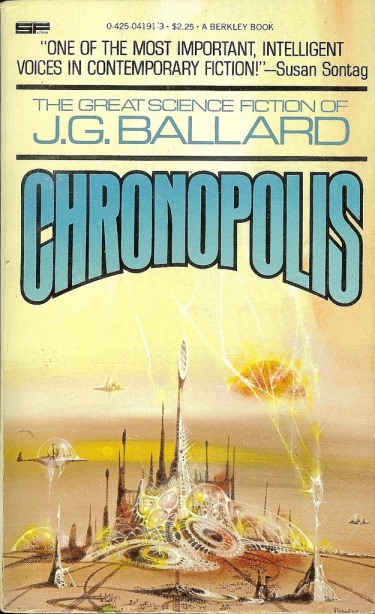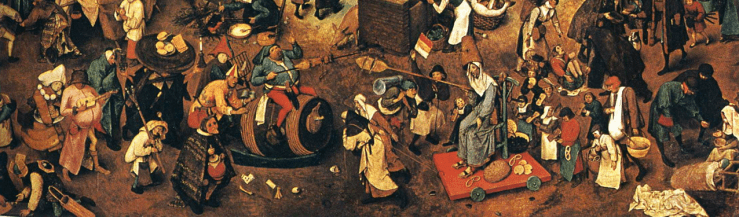
The Complete Short Stories of J.G. Ballard (Fourth Riff: Stories of 1962)

jgb_complete_ss400

PREVIOUSLY:

Introductions + stories 1956-1959

Stories of 1960

Stories of 1961

IN THIS RIFF:

Nine stories published in 1962:

“The Insane Ones”

“The Garden of Time”

“The Thousand Dreams of Stellavista”

“Thirteen to Centaurus”

“Passport to Eternity”

“The Cage of Sand”

“The Watch Towers”

“The Singing Statues”

“Man on the 99th Floor”

1. “The Insane Ones” (1962)

Psychology, and particularly subliminal psychology, remained a major theme throughout Ballard’s writing career. “The Insane Ones” is a thought-experiment that examines what might happen if libertarianism were taken to its most extreme:

The Mental Freedom legislation enacted ten years earlier by the ultraconservative UW government had banned the profession outright and enshrined the individual’s freedom to be insane if he wanted to, provided he paid the full civil consequences for any infringements of the law. That was the catch, the hidden object of the MF laws. What had begun as a popular reaction against ‘subliminal living’ and the uncontrolled extension of techniques of mass manipulation for political and economic ends had quickly developed into a systematic attack on the psychological sciences. Overpermissive courts of law with their condoning of delinquency, pseudo–enlightened penal reformers, ‘Victims of society’, the psychologist and his patient all came under fierce attack. Discharging their self–hate and anxiety onto a convenient scapegoat, the new rulers, and the great majority electing them, outlawed all forms of psychic control, from the innocent market survey to lobotomy. The mentally ill were on their own, spared pity and consideration, made to pay to the hilt for their failings. The sacred cow of the community was the psychotic, free to wander where he wanted, drooling on the doorsteps, sleeping on sidewalks, and woe betide anyone who tried to help him.

“The Insane Ones” isn’t a particularly good story—as is the case with many of the tales in The Complete Stories, it’s mostly an excuse to tease out a speculative notion—but its conceit of a lack of adequate health care set against the backdrop of reactionary politics seems particularly germane today. 

2. “The Garden of Time” (1962)

“The Garden of Time” is an oddity in Ballard’s oeuvre. Most of his short stories take cues from Edgar Allan Poe, but “The Garden of Time,” a direct allegory, is pure-Hawthorne territory, a dark fairy tale with fantasy tropes unusual for Ballard. Count Axel and his darling wife live in a perfect Edenic space that they maintain by picking flowers that “freeze” time. At the periphery, a mechanized mob approaches:

At first glance, the long ranks seemed to be progressing in orderly lines, but on closer inspection, it was apparent that, like the obscured detail of a Goya landscape, the army was composed of a vast throng of people, men and women, interspersed with a few soldiers in ragged uniforms, pressing forward in a disorganized tide. Some laboured under heavy loads suspended from crude yokes around their necks, others struggled with cumbersome wooden carts, their hands wrenching at the wheel spokes, a few trudged on alone, but all moved on at the same pace, bowed backs illuminated in the fleeting sun.

I’m not sure how to read the tale—it seems that Ballard identifies the horde, the mob, as a dumb, dim force of history, a consumer society that will destroy the last vestiges of High Culture embodied by the graceful Count and his wife, the aristocrats who understand Truth and Beauty and Art &c. I think there’s a streak of conservatism here, a tendency that we might not immediately think of when we think of Ballard the futurist.

3. “The Thousand Dreams of Stellavista” (1962)

Another Vermilion Sands story, “Stellavista” takes on architecture. This is basically a haunted house story; the Ballardian trick here is the psychotropic house, dwellings that echo “every shift of mood and position of the occupants.” Young couple buys house, house is haunted, etc. The conceit is interesting, but again, Ballard’s not particularly inclined to write it in anything outside of a standard pulp fiction (or doesn’t seem to know how to yet).

Ballard’s treatment of his female characters is what I find most interesting here. As always, they seem to be divided into just a few classes: The wife, an unimaginative nag; the mysterious (and impossible to understand) ingenue; the mad, abandoned old woman (shades of Miss Havisham); and the abject, consuming Villain-Woman. Ballard often combines the last three types, but they are always set in opposition to the housewife. More on this in a moment.

4. “Thirteen to Centaurus”

“Thirteen to Centaurus” belongs in what I’ve been calling The Essential Short Stories of J.G. Ballard, a collection of the best stuff here. Each Ballard story is essentially a trick or a thought experiment—the tale is just a delivery system, a frame. Ballard here employs a metaframe; sure, the story is still composed in the tropes and language of pulp fiction, but Ballard shows signs of breaking out. In some ways, “Thirteen to Centaurus” is a rewrite of “Manhole 69” (which I also suggested is Essential). I haven’t described the plot and won’t—I think the story is probably better read without preview or explication.

5. “Passport to Eternity” (1962)

“Passport to Eternity” highlights Ballard’s greatest imaginative failure. This is a guy who can conceive of every kind of fantasy trip—extraterrestrial adventures, private-war-as-vacation, space safari (the occasion for the story here is a list of surreal vacations; the story would read much, much better as just that list). Yes, Ballard can conceive of any kind of future, except one where a woman is something other than a house wife:

For several centuries now the managerial and technocratic elite had been so preoccupied with the work of government that they relied on the Templars of Aphrodite not merely to guard their wives from any marauding suitors but also to keep them amused and contented. By definition, of course, their relationship was platonic, a pleasant revival of the old chivalrous ideals…

Even if Ballard is poking ironic fun here (and I don’t think that’s the case), his framing is aggressively chauvinistic; not only does the “managerial and technocratic elite” appear to exclude women, the underlying anxiety of cuckoldry manifests in a social structure that must manage (and contain) women’s passions and sexualities. There’s something aggressively misogynistic here, a streak that finds its twin in Ballard’s abjectification of women elsewhere in the stories (I wrote above that he only conceives women as house wives—not quite true—they can also be consuming monsters in the Ballardverse).

6. “The Cage of Sand” (1962)

Astronauts. Ecology. Etc. Pass.

7. “The Watch-Towers” (1962)

“The Watch Towers” is basically an extended riff on how churches institutionalize power and regulate behavior. Ballard’s trick here is to elide or omit any language that would directly evoke religion or spirituality though. The story also gets its power comes from its bare simplicity, its lack of ornamentation—one can sense Ballard’s restraint here. The story would likely be more successful stripped even further—something closer to Shirley Jackson’s “The Lottery,” which it echoes. There are also shades here of a particularly English brand of hauntology—The Prisoner and The Wicker Man come to mind.

8. “The Singing Statues” (1962)

“The Singing Statues” feels like a rewrite of several of Ballard’s Vermilion Sands stories. I suppose collected together in their own volume, the Vermilion Sands tales might read like a novel-in-stories, a work through of central themes, images, and ideas—but dispersed in The Collected Stories they get swallowed. They read like repetitions. Stale.

9. “Man on the 99th Floor” (1962)

Ballard handles subliminal suggestion much better in the next tale, “The Subliminal Man.” So I’ll take a pass on this one in anticipation of one of Ballard’s best
The Complete Short Stories of J.G. Ballard (Third Riff: Stories of 1961)

jgb_complete_ss400

PREVIOUSLY:

Introductions + stories 1956-1959

Stories of 1960

IN THIS RIFF:

Stories published in 1961:

“Studio 5, The Stars”

“Deep End”

“The Overloaded Man”

“Mr. F Is Mr. F”

“Billennium”

“The Gentle Assassin”

1. “Studio 5, The Stars” (1961)

“Studio 5, The Stars” takes poetry as its subject and is the first story in The Complete Short Stories to focus on writing. Ballard’s tales usually concern some aspect of art, but up until now he’s been mainly concerned with music (and to a lesser extent visual art).

“Studio 5, The Stars” is the third tale in the collection set in “the crazy season at Vermilion Sands.” Our narrator is the editor of “Wave IX, an avant–garde poetry review.” Ballard constructs his story around the conceit that writing poetry has become (quite literally) a soulless, mechanical activity. Our narrator explains to his interlocutor:

I used to write a fair amount myself years ago, but the impulse faded as soon as I could afford a VT set. In the old days a poet had to sacrifice himself in order to master his medium. Now that technical mastery is simply a question of pushing a button, selecting metre, rhyme, assonance on a dial, there’s no need for sacrifice, no ideal to invent to make the sacrifice worthwhile –

Our narrator’s interlocutor is Aurora Day, a femme fatale who either is or believes she is “Melander,” an archetypal muse of poetry (invented  by Ballard, of course). Aurora is distraught over the state of poetry. And no wonder. Verse is now composed on a “VT set”:

‘Hold on,’ I told him. I was pasting down one of the Xero’s satirical pastiches of Rupert Brooke and was six lines short. I handed Tony the master tape and he played it into the IBM, set the metre, rhyme scheme, verbal pairs, and then switched on, waited for the tape to chunter out of the delivery head, tore off six lines and passed them back to me. I didn’t even need to read them.

The story can perhaps be condensed into this wonderful line:

Fifty years ago a few people wrote poetry, but no one read it. Now no one writes it either. The VT set merely simplifies the whole process.

In his introduction to the collection, Ballard insisted that he “was interested in the real future” he saw coming, not an invented one. The notion of machines recording art that no one will bother to read seems particularly resonant today. Reading “Studio 5, The Stars,” I was reminded of Kenneth Goldsmith’s recent “art” project/stunt of printing the internet. There’s also something in the VT that recalls Slavoj Žižek’s riff on VCRs, machines recording and storing films that the viewer will never actually watch.

“Studio 5, The Stars” takes aim at a commercial culture that pays lip service to the high ideals of “culture” while simultaneously insuring that “culture” can be consumed at no sacrifice—no work—on the part of the consumer.

2. “Deep End” (1961)

Humanity migrates to Mars after sucking all the resources from the Earth. “Deep End” is a brief tale (and another in the collection to feature one of Ballard’s signature images, the drained swimming pool). An ecological dystopia, “Deep End” feels like a sketch for something bigger—but it gains power from its brevity, and Ballard is content to focus his energies on just a few characters and one core idea here. The restraint pays off in the story’s nihilistic punchline, which I won’t spoil here.

The Overloaded Man

3. “The Overloaded Man” (1961)

“Faulkner was slowly going insane” is an excellent way to begin a story, and Ballard delivers on his promise. Faulkner can no longer stand his cookie-cutter life in a cookie-cutter house. To alleviate his alienation from modern living, Faulkner builds a strange defense mechanism—he learns that he can dissociate himself from objective reality:

Steadily, object by object, he began to switch off the world around him. The houses opposite went first. The white masses of the roofs and balconies he resolved quickly into flat rectangles, the lines of windows into small squares of colour like the grids in a Mondrian abstract. The sky was a blank field of blue. In the distance an aircraft moved across it, engines hammering. Carefully Faulkner repressed the identity of the image, then watched the slim silver dart move slowly away like a vanishing fragment from a cartoon dream.

How to overcome alienation in a Ballardian world? Even more radical alienation. While “The Overloaded Man” points to a nihilism even bleaker than that in “Deep End,” it also demonstrates a marked improvement in Ballard’s writing from the earlier stories in the collection. We see Ballard controlling metaphor and imagery with a much stronger command than in the first half-dozen stories of his career. He sets out his poor hero’s mechanized domestic milieu in one savage line:

Her kiss was quick and functional, like the automatic peck of some huge bottle–topping machine.

There’s perhaps a slight streak of misogyny in “The Overloaded Man,” which at its core might be described as a story of a man whose nagging wife depresses him. Any ambivalence or fear of the female body that we’ve seen so far in the collection—in the dull, bothersome wives of “The Overloaded Man” or “Escapement,” or the powerful femme fatales of “Prima Belladonna,” “Venus Smiles,” or “Studio 5, The Stars”—any such hint burns vividly in the next story in the collection.

4. “Mr. F Is Mr. F” (1961)

“Mr. F Is Mr. F” tells the story of Charles Freeman and his pregnant wife, a woman presented with an almost-bovine simplicity that quickly escalates into horror. Charles Freeman grows younger and younger until he’s eventually absorbed into the maternal body.

The story is so nakedly Freudian that even its narrator has no problem spelling out the subtext for readers slow on the uptake:

He was forty when he married Elizabeth, two or three years her junior, and had assumed unconsciously that he was too old to become a parent, particularly as he had deliberately selected Elizabeth as an ideal mother–substitute, and saw himself as her child rather than as her parental partner.

“Mr. F Is Mr. F” is, by my count, the first Ballard story that explicitly takes the human body as its major object of study. Time, of course, is the ever-present grand theme of Ballard’s work, but up until now he’s concentrated his attention on time’s impact on geology, psychology, and culture—but not the human body. The story doesn’t so much analyze a fear of the maternal body so much as it uses that trope to generate fear and abject disgust.

There’s a teleological neatness to “Mr. F Is Mr. F” that  one senses Ballard was trying to pull off in some of his stories of the late 1950s, but couldn’t quite achieve. His chops are stronger here, and, paradoxically perhaps, less slavishly beholden to Edgar Allen Poe, he actually turns in a tale worthy of his hero.

5. “Billennium” (1961)

“Billennium” sees Ballard returning to the themes of overpopulation and overcrowding that he began exploring in 1957’s “The Concentration City.” The world Ballard imagines is horrifying—moreso because his representation of it is in some ways so terribly banal:

As for the streets, traffic had long since ceased to move about them. Apart from a few hours before dawn when only the sidewalks were crowded, every thoroughfare was always packed with a shuffling mob of pedestrians, perforce ignoring the countless ‘Keep Left’ signs suspended over their heads, wrestling past each other on their way to home and office, their clothes dusty and shapeless. Often ‘locks’ would occur when a huge crowd at a street junction became immovably jammed. Sometimes these locks would last for days. Two years earlier Ward had been caught in one outside the stadium, for over forty–eight hours was trapped in a gigantic pedestrian jam containing over 20,000 people, fed by the crowds leaving the stadium on one side and those approaching it on the other. An entire square mile of the local neighbourhood had been paralysed, and he vividly remembered the nightmare of swaying helplessly on his feet as the jam shifted and heaved, terrified of losing his balance and being trampled underfoot. When the police had finally sealed off the stadium and dispersed the jam he had gone back to his cubicle and slept for a week, his body blue with bruises.

“Billennium,” like many of the stories of 1961, benefits from Ballard’s increasing restraint. While “The Concentration City” is overfreighted with too many ideas to succeed as a perfect short story, Ballard maintains a focus in “Billennium” that pays off. And if the story is predictable—and predictably nihilistic—it nevertheless offers a chilling vision of the future that could very likely come to pass.

6. “The Gentle Assassin” (1961)

“The Gentle Assassin” is basically Ballard’s mechanism to discuss the so-called “Grandfather Paradox,” a time-travel conundrum of causality and intent. The tale is as neat and tidy as “Mr. F,” but it also showcases a patience and restraint; Ballard slowly builds an ominous, ironic atmosphere before executing his narrative trick. “The Gentle Assassin” isn’t particularly memorable, and there are dozens and dozens of versions of it to be found throughout sci-fi. Still, we see here–and in the other stories of 1961—that Ballard is more confident and able in his prose and plotting.

7. On the horizon:

We’re still a long way out from the formal experimentation of “1966’s The Assassination of John Fitzgerald Kennedy Considered as a Downhill Motor Race” or 1968’s “Why I Want to Fuck Ronald Reagan,” but Ballard’s pulp fiction gets tighter—and weirder—as we go.

“eavesdropping on my own thoughts” | Passage from + One-Sentence Riff on Evan Dara’s Novel The Lost Scrapbook

. . . In fact, this happens often—when I feel as if words, others’ words, have crowded mine out, and have left me no place; I do not know why, through what mechanism, this occurs, but when it does, and it is often, I find that I developed a need, an earnest yearning, for words that have not become sour and strange—that is, for words that are my own, words that are uniquely mine amid this foreign wash; and yet I find, when I look for such words—my words—none seem to be there: all of my words, upon the slightest inspection, seem so foreign to me, so much the work of others; and so I wonder how I can claim that anything that occurs in my consciousness is mine, and not the product of some othernesses; often I feel that I am not thinking so much as eavesdropping on my own thoughts, listening in on the narrative being told between othernesses—that it is the otherness thinking me; because none of it, in truth, seems to issue from me; even my unplanned cries, my most heartfelt exclamations, have been determined by others: I have noticed that it is precisely at times of highest emotion—when I am going to the deepest regions of my responses, to the deepest particularity of me—that my words, which would then seem to be at their most personal and spontaneous, are in fact at their most derivative, just pure banal cliché: oh my God!, Will you look at that!, I don’t believe it!; but where are my words, I wonder, my own thoughts?; it seems, sometimes, that I am a conduit and not a content—a transfer point, a capacitor, a pattern in waves; or, at most, I am a bricklayer, combining chunks of accepted solidity to wall out fresh perception; is this adolescent thinking?—

From Evan Dara’s novel The Lost Scrapbook.

I am really loving this book so far, this novel that moves through consciousnesses in a (yes, I’ll use that cliché that book reviewers so often grab for) dazzling performance, shifting through minds, monologues, dialogues, always a few steps (or more) ahead of its reader, beckoning though, inviting, calling its reader to participate in discussions (or performances) of art, science, politics, psychology, education, loneliness, ecology, family, fireflies, radio plays, alienation, voting trends, Chomskyian linguistics, Eisensteinian montage, theft, Walkman Personal Stereos, semiotics, one-man shows, drum sets, being ventriloquized—a novel that takes ventriloquism as not just a theme (as we can see in the citation above) but also as a rhetorical device, a novel that ventriloquizes its reader, throws its reader into a metaphorical deep end and then dramatically shifts the currents as soon as the reader has learned to swim, a novel of othernesses, a novel that offers content through conduits, patterns that coalesce through waves, a novel composed in transfer points, each transfer point announcing the limitations of first-person perspective, the perspective that the reader is logically and spiritually and psychologically beholden to—and then, perhaps, transcending (or at least producing the affective illusion of transcendence of) first-person perspective, and this (illusion of) transcendence, oh my, what a gift, what a gift . . .

The Complete Short Stories of J.G. Ballard (Second Riff: Stories of 1960)

jgb_complete_ss400 PREVIOUSLY:

Introductions + stories 1956-1959

IN THIS RIFF:

Stories published in 1960:

“The Sound-Sweep”

“Zone of Terror”

“Chronopolis”

“The Voices of Time”

“The Last World of Mr. Goddard”

1. “The Sound-Sweep” (1960)

Ballard’s strong suit isn’t characterization. In his later writing, he transcends this apparent weakness, employing a style and rhetoric that dispenses with—or nakedly accepts, in some cases—the flatness of his characters. Ballard works in types: the scientist, the madman, the artist, the detective, the ingenue, the explorer, the has-been. Most of his characters are driven by very basic desires—curiosity, madness, revenge. There’s a thin line though between archetypal placeholders and hackneyed stereotypes, and Ballard occasionally stumbles over it in some of these early stories. “The Sound-Sweep” is one such story, plodding along over too many pages, asking its readers to care about characters that lack emotional or psychological depth. And while I don’t think we read Ballard for emotional depth, necessarily, we do read Ballard’s best work because it plumbs the contours of human psychology colliding into nascent technological changes that affect the most basic human senses.

As its title suggests, “The Sound-Sweep” is another early Ballard tale that takes on the sense of sound. The short version: This is a story about noise pollution, and also about how we might sacrifice an artistic way of listening in favor of apparent convenience. As is often the case in these early stories, Ballard constructs the tale to explore the fallout of one particular idea. In this case, that’s “ultrasonic music”:

Ultrasonic music, employing a vastly greater range of octaves, chords and chromatic scales than are audible by the human ear, provided a direct neural link between the sound stream and the auditory lobes, generating an apparently sourceless sensation of harmony, rhythm, cadence and melody uncontaminated by the noise and vibration of audible music. The re–scoring of the classical repertoire allowed the ultrasonic audience the best of both worlds. The majestic rhythms of Beethoven, the popular melodies of Tchaikovsky, the complex fugal elaborations of Bach, the abstract images of Schoenberg – all these were raised in frequency above the threshold of conscious audibility. Not only did they become inaudible, but the original works were re–scored for the much wider range of the ultrasonic orchestra, became richer in texture, more profound in theme, more sensitive, tender or lyrical as the ultrasonic arranger chose.

To tease out this idea, Ballard employs a washed-up opera singer, Madame Giaconda (a heavy base of Sunset Boulevard’s Norma Desmond with a heavy dash of Miss Havisham and cocaine), and Mangon, a mute orphan, the titular sound-sweep (should I wax on the Blakean undertones here? No? Okay).

“The Sound-Sweep” plods along over far too many pages, even divvying up the plot into chapters, asking us to care about the relationship between Giaconda and Mangon. The story would probably have made an excellent episode of The Twilight Zone, where performers might give life to some of the flat dialogue here and the constraints of television might compress the plot. The most interesting thing about “The Sound-Sweep”: The tale in some ways anticipates the mp3 and the ways in which music will be consumed:

But the final triumph of ultrasonic music had come with a second development – the short–playing record, spinning at 900 r.p.m., which condensed the 45 minutes of a Beethoven symphony to 20 seconds of playing time, the three hours of a Wagner opera to little more than two minutes. Compact and cheap, SP records sacrificed nothing to brevity. One 30–second SP record delivered as much neurophonic pleasure as a natural length recording, but with deeper penetration, greater total impact.

2. “Zone of Terror” (1960)

Edgar Allan Poe’s “William Wilson” is a much better doppelganger story. “Zone of Terror” reads like a very rough sketch for some of the stuff Ballard will do in his 1962 novel The Drowned World. (Both “Chronopolis” and “The Voices of Time” also clearly anticipate The Drowned World, each with much stronger results).

chronopolis

3. “Chronopolis” (1960)

“Chronopolis” offers an interesting central shtick: Clocks and other means of measuring and standardizing time have been banned. But this isn’t what makes the story stick. No, Ballard apparently tips his hand early, revealing why measuring time has been banned—it allows management to control labor:

‘Isn’t it obvious? You can time him, know exactly how long it takes him to do something.’ ‘Well?’ ‘Then you can make him do it faster.’

But our intrepid young protagonist (Conrad, his loaded name is), hardly satisfied with this answer, sneaks off to the city of the past, the titular chronopolis, where he works to restore the timepieces of the past. “Chronopolis” depicts a technologically-regressive world that Ballard will  explore in greater depth with his novel The Drowned World, but the details here are precise and fascinating (if perhaps ultimately unconvincing if we try to apply them as any kind of diagnosis for our own metered age). Ending on a perfect paranoid note, Ballard borrows just a dab of Poe here, synthesizing his influence into something far more original, far more Ballardian. Let’s include it in something I’m calling The Essential Short Stories of J.G. Ballard.

4.  “The Voices of Time” (1960)

“The Voices of Time” is easily the best of the early stories in the collection. Ballard allows himself to dispense almost entirely with plot, or at least the kind of plot he’s been thus-far constrained by. Instead of the neat concision of his nineteenth century forebears (Chekhov and Poe), Ballard moves to something far more Ballardian (excuse the repetition), opening his text to a range of images and phrases that will repeat throughout his career—the word terminal, drained vessels, cryptic designs and sequences, a kind of psychic detritus the reader is left to account for and monitor. The loose threads in “The Voices of Time” are too many to enumerate. There’s a mutant armadillo and a girl named Coma. Mass narcolepsy and cacti that absorb gold from the earth as a shield against radiation. And sleep. And de-evolution:

…thirty years ago people did indeed sleep eight hours, and a century before that they slept six or seven. In Vasari’s Lives one reads of Michelangelo sleeping for only four or five hours, painting all day at the age of eighty and then working through the night over his anatomy table with a candle strapped to his forehead. Now he’s regarded as a prodigy, but it was unremarkable then. How do you think the ancients, from Plato to Shakespeare, Aristotle to Aquinas, were able to cram so much work into their lives? Simply because they had an extra six or seven hours every day. Of course, a second disadvantage under which we labour is a lowered basal metabolic rate – another factor no one will explain. …

… It’s time to re–tool. Just as an individual organism’s life span is finite, or the life of a yeast colony or a given species, so the life of an entire biological kingdom is of fixed duration. It’s always been assumed that the evolutionary slope reaches forever upwards, but in fact the peak has already been reached, and the pathway now leads downward to the common biological grave. It’s a despairing and at present unacceptable vision of the future, but it’s the only one. Five thousand centuries from now our descendants, instead of being multi–brained star–men, will probably be naked prognathous idiots with hair on their foreheads, grunting their way through the remains of this Clinic like Neolithic men caught in a macabre inversion of time. Believe me, I pity them, as I pity myself. My total failure, my absolute lack of any moral or biological right to existence, is implicit in every cell of my body…

I harped on Ballard’s lack of characterization earlier, and “The Voices of Time” makes no strong case for its author’s ability to create deep, full characters. What Ballard does very very well though is harness, express, and communicate the intellect of his smart, smart characters—something many if not most other writers (contemporary or otherwise) can’t do, despite any technical prowess they may possess. “The Voices of Time” doesn’t just tell you that its heroes and antiheroes are brilliant (and/or mad)—it shows you.

Marvelous stuff. Include it in The Essential Short Stories of J.G. Ballard

5. “The Last World of Mr. Goddard” (1960)

More Twilight Zone stuff. God-dard. Lilliput, sort of. Doll’s house. Etc. A one-note exercise that I doubt is worth your time. Skip it.

6. On the horizon:

Ballard anticipates how hollow and stale contemporary writing will become in “Studio Five, The Stars.”

The Complete Short Stories of J.G. Ballard (First Riff: Introductions + Stories 1956-1959)

jgb_complete_ss400

IN THIS RIFF:

Introductions

Stories published between 1956 and 1959:

“Prima Belladonna”

“Escapement”

“The Concentration City”

“Venus Smiles”

“Manhole 69”

“Track 12”

“The Waiting Grounds”

“Now: Zero”

1. Introduction

I first read J.G. Ballard in high school. I found his work, somehow, after reading Burgess, Burroughs, and Vonnegut. I devoured many of his novels over the next few years, as well as several short story collections. One of these, The Best Short Stories of J.G. Ballard was particularly important to me. That collection—which I loaned to a friend who thought enough of it to never give it back—offers a concise overview of Ballard’s development as a writer, from the pulp sci-fi of his earliest days (“Chronopolis”) to his later evocations of ecological disaster and dystopia (“Billenium,” “The Terminal Beach”) to his more experimental work from The Atrocity Exhibition, stories that pointed toward one of his most famous books, Crash.

I hadn’t returned to Ballard since reading Super-Cannes when it came out a decade ago; at the time I recall being disappointed in the novel and filing it away with William Gibson’s recent efforts, which I found dull.

I’d been reading Donald Barthelme’s wonderful and strange short stories, and, rereading “Glass Mountain,” a story composed in a list, I remembered Ballard’s brilliant story “Answers to a Questionnaire” (from 1990’s War Fever). I tracked the story down in The Complete Short Stories of J.G. Ballard, read it, read a few more at random, and then decided to start at the beginning.

I’ll be reading and riffing on all 98 stories in the collection over the next few months—giving myself breaks for other stuff, of course (although Ballard’s stuff, especially the early stuff is really easy to read).

2. Another introduction

Martin Amis writes the introduction to the 2009 edition and of course manages to bring up his father Kingsley almost immediately. He talks about the times he (Martin) got to spend with Ballard. He points out that Ballard possessed “a revealingly weak ear for dialogue.” He suggests that Ballard could have been the love child of Saki and Jorge Luis Borges. He describes Ballard as “somehow uniquely unique.” He reminds me of why I usually skip introductions.

3. And Ballard’s introduction, from the 2001 first edition of the book

He situates his hero, his contemporary, and his forbear in the first paragraph:

Short stories are the loose change in the treasury of fiction, easily ignored beside the wealth of novels available, an over-valued currency that often turns out to be counterfeit. At its best, in Borges, Ray Bradbury and Edgar Allan Poe, the short story is coined from precious metal, a glint of gold that will glow for ever in the deep purse of your imagination.

He also tells us,

Curiously, there are many perfect short stories, but no perfect novels.

I agree, except for the adverb there.

Did Ballard’s sensibilities gel with the sci-fi fans who read the pulp mags his early stories were published in?

I was interested in the real future that I could see approaching, and less in the invented future that science fiction preferred.

In the final lines of his introduction he describes his oeuvre and addresses criticisms that there’s so much damn analog tech in his stuff:

Vermilion Sands isn’t set in the future at all, but in a kind of visionary present – a description that fits the stories in this book and almost everything else I have written. But oh for a steam-powered computer and a wind-driven television set. Now, there’s an idea for a short story.

Vermilion Sands, the strange resort town where Ballard set over a half-dozen of his tales, is the setting of the first and fourth tales in the collection.

4. “Prima Belladonna” (1956) / “Venus Smiles” (1957)

Ballard already had a distinct setting in mind to play out his future-nowisms. That early stories “Prima Belladonna” and “Venus Smiles” are both in set in Vermilion Sands is maybe the most interesting thing about them. “Prima Belladonna” is never better than its first line:

I first met Jane Ciracylides during the Recess, that world slump of boredom, lethargy and high summer which carried us all so blissfully through ten unforgettable years, and I suppose that may have had a lot to do with what went on between us.

Ballard has the good sense to leave that cryptic reference to “the Recess” unexplained, or at least underexplained throughout the story—exposition is usually the worst aspect of pulp sci-fi. Still, the story is hardly one of his best. I’m guessing Roger Corman must have read it though, as his film Little Shop of Horrors (1960) seems to owe it a certain debt.

vermilion_sands

“Venus Smiles” is also set in Vermilion Sands, and it also takes music—sound—as its major motif (several of Ballard’s early stories do). Ballard strives to do too much in the story—he wants to criticize public attitudes about art, sculpture, music, etc., and also name drop John Cage to bolster his avant garde bona fides. Both stories drag, weighed down by Ballard’s clunky similes and bad dialogue (dear lord I’m agreeing with Amis here!). What’s most frustrating is knowing that Ballard is just a decade away from finding a rhetorical style to match the content of his ideas.

5. “Escapement” (1956)

The story of a man who realizes he is stuck in a time loop, repeating the same actions, “Escapement” is particularly frustrating. The stakes are incredibly low—the domestic scene of a married couple watching TV on a couch begs for darker treatment—and the reader figures out what’s going on way before the narrator. Time is clearly a major motif for Ballard, but his earliest published treatment of it is not especially inspiring. (I realize writing this what an ass I sound like: look, I know this is early work, pulp fiction—my frustration is that I want it to be better—or at least more abbreviated.

6. “The Concentration City” (1957)

“The Concentration City” finally sees Ballard in stronger territory, here exploring one of his favorite dystopic tropes—overpopulation—via one of his favorite conceits—the intrepid and intellectually curious young man. “The Concentration City” also showcases some early experimental touches in its opening paragraphs:

Noon talk on Millionth Street:

‘Sorry, these are the West Millions. You want 9775335th East.’

‘Dollar five a cubic foot? Sell!’

‘Take a westbound express to 495th Avenue, cross over to a Redline elevator and go up a thousand levels to Plaza Terminal. Carry on south from there and you’ll find it between 568th Avenue and 422nd Street.’

‘There’s a cave–in down at KEN County! Fifty blocks by twenty by thirty levels.’

‘Listen to this – “PYROMANIACS STAGE MASS BREAKOUT! FIRE POLICE CORDON BAY COUNTY!”

‘It’s a beautiful counter. Detects up to .005 per cent monoxide. Cost me three hundred dollars.’

‘Have you seen those new intercity sleepers? They take only ten minutes to go up 3,000 levels!’

‘Ninety cents a foot? Buy!’

The story follows up on these early notes, using the initially-estranging material to tell the story of a seemingly-infinite city; our young hero of course wants to bust out. Ballard also gives us an early prototype of what will be one of his major conventions: the green-zone/danger-zone split:

‘City Authority are starting to seal it off,’ the man told him. ‘Huge blocks. It’s the only thing they can do. What happens to the people inside I hate to think.’ He chewed on a sandwich. ‘Strange, but there are a lot of these black areas. You don’t hear about them, but they’re growing. Starts in a back street in some ordinary dollar neighbourhood; a bottleneck in the sewage disposal system, not enough ash cans, and before you know it a million cubic miles have gone back to jungle. They try a relief scheme, pump in a little cyanide, and then – brick it up. Once they do that they’re closed for good.’

No exit!

7. “Manhole 69” (1957)

Despite its unfortunate name, “Manhole 69” is perfect early Ballard. The story follows three men in an experimental group who have undergone a surgery that eliminates their ability to sleep. The story is precise and concise; Ballard seems comfortable here (“comfortable” is not a very Ballardian word, but hey…)—he sets up his experiment and then lets his principals carry it out. The story’s heavy Jungian vibe resurfaces a few years later in Ballard’s early novel The Drowned World

“Manhole 69” is the first of the 98 stories here I’d put in a collection I’ll tentatively call The Essential Short Stories of J.G. Ballard

8. “Track 12” (1958)

While “Track 12” is hardly perfect, its concision and focus do it many favors. Again, we find Ballard playing with sound—particularly something called “microsonics”:

Amplified 100,000 times animal cell division sounds like a lot of girders and steel sheets being ripped apart – how did you put it? – a car smash in slow motion. On the other hand, plant cell division is an electronic poem, all soft chords and bubbling tones. Now there you have a perfect illustration of how microsonics can reveal the distinction between the animal and plant kingdoms.

As is often the case, Ballard has an idea that fascinates him (“microsonics,” here) and simply constructs a story to deliver that idea. Or, rather, rips off a story—and Ballard has the good sense to steal from the best. “Track 12” is a fairly straightforward Edgar Allan Poe ripoff, a revenge tale recalling “The Cask of Amontillado,” and if the reader seems to guess where everything is going before the victim, well, it works here.

9. “The Waiting Grounds” (1959)

Ballard is better at inner space than outer space. “The Waiting Grounds” seems like a bait and switch, or at least I imagine many meat and potatoes SF fans might have felt that way. Ballard has his hero head to some distant planet, only to spend most of that trip in his own mind. And oh what a trip! The story’s central set piece anticipates the final scenes of Kubrick’s 2001: A Space Odyssey as Ballard sends his hero through “deep time”:

Deep Time: 10,000,000,000 mega–years. The ideation–field has now swallowed the cosmos, substituted its own dynamic, its own spatial and temporal dimensions. All primary time and energy fields have been engulfed. Seeking the final extension of itself within its own bounds the mantle has reduced its time period to an almost infinitesimal 0.00000000… n of its previous interval. Time has virtually ceased to exist, the ideation–field is nearly stationary, infinitely slow eddies of sentience undulating outward across its mantles.

The frame Ballard builds to deliver his idea is clunky, but I suppose in those days one could make a sort of living writing stories for magazines, and maybe more words meant more moolah. Again, this story points to the Jungian themes that Ballard would explore in greater depth in The Drowned World.

10. “Now: Zero” (1959)

Here is the first paragraph of “Now: Zero,” the last story of Ballard’s to be published in the 1950s:

You ask: how did I discover this insane and fantastic power? Like Dr Faust, was it bestowed upon me by the Devil himself, in exchange for the deed to my soul? Did I, perhaps, acquire it with some strange talismanic object – idol’s eyepiece or monkey’s paw – unearthed in an ancient chest or bequeathed by a dying mariner? Or, again, did I stumble upon it myself while researching into the obscenities of the Eleusinian Mysteries and the Black Mass, suddenly perceiving its full horror and magnitude through clouds of sulphurous smoke and incense?

No doubt, dear reader, you immediately detect Edgar Allan Poe all over this piece, and you’re not wrong. The story is mostly interesting as a style exercise—namely, Ballard doing Poe—but its cheesiness and predictability drowns out any humor. But again, these are the complete short stories—not just the perfect exercises.

11. On the horizon:

The early 1960s! “Chronopolis”! “The Overloaded Man”! “Billenium”! You are encouraged to play along.

“…in the direction of increasing entropy” (Another Riff on Pynchon’s Novel Against the Day)

1. So in the final pages of Against the Day, Thomas Pynchon takes us back to those heroes of the ether who initiated the book, the Chums of Chance. They’ve been absent for a long stretch, with only the occasional mention here or there to assure us that yes, they are still in the narrative, but under its surface, or, rather—invisible (this, in a novel full of invisibility).

2. Example: in a maddening moment, we learn that, via Pugnax’s girlfriend, a dog named Ksenija, “the Chums of Chance had been invisibly but attentively keeping an eye on the progress of Reef’s family exfiltration from the Balkan Peninsula.”

3. Several chapters later, Pynchon makes our sky-heroes visible again; they’ve dramatically expanded the size of their ship Inconvenience and have essentially declared independence from Chums headquarters.

They learn of a strange “updraft” over the Sahara desert that spells new adventure—

Tonight’s meeting was about whether or not to take the Inconvenience into the great updraft over the Sahara without somebody paying for it in advance. Miles called the session to order by bashing upon a Chinese gong acquired years before from an assassination cult active in that country, during the boys’ unheralded but decisive activities in the Boxer Rebellion (see The Chums of Chance and the Wrath of the Yellow Fang), and wheeled around a refrigerated Champagne cart, refilling everyone’s glass from a Balthazar of ’03 Verzenay.

4. And so of course they go, and we get this remarkable passage:

 And as they entered and were taken, Chick Counterfly thought back to his first days aboard the Inconvenience, and Randolph’s dark admonition that going up would be like going north, and his own surmise that one could climb high enough to descend to the surface of another planet. Or, as the commander had put it then, “Another ‘surface,’ but an earthly one . . . all too earthly.”

—and jeez I hate to break in, but I just have to point out that Pynchon is citing himself here, that the lines that Chick Counterfly recollects go all the way back to page nine, to the first chapter of the book.

5. Continuing:

The corollary, Chick had worked out long ago, being that each star and planet we can see in the Sky is but the reflection of our single Earth along a different Minkowskian spacetime track. Travel to other worlds is therefore travel to alternate versions of the same Earth. And if going up is like going north, with the common variable being cold, the analogous direction in Time, by the Second Law of Thermodynamics, ought to be from past to future, in the direction of increasing entropy.

So the great grand theme of bilocation gets tied in here to the novel’s hard sci-fi tropes, all pointing to “increasing entropy.” There are other Chums on other Earths, bilocating into other systems that are breaking “in the direction of increasing entropy.”

6. Which is a fairly accurate description of both the plot and the structure of Against the Day. The novel is shaggy and seemingly fails to cohere because it is a stylistic approximation of entropy.

7. And a few paragraphs later, we get a demonstration of this program. Miles Blundell, the most mystical and reflective Chum, is able to perceive the violence and terror of The Great War that rages below the Chums—who, bilocated, displaced cannot see it—it’s invisible. 

Blundell:

“Those poor innocents,” he exclaimed in a stricken whisper, as if some blindness had abruptly healed itself, allowing him at last to see the horror transpiring on the ground. “Back at the beginning of this . . . they must have been boys, so much like us. . . . They knew they were standing before a great chasm none could see to the bottom of. But they launched themselves into it anyway. Cheering and laughing. It was their own grand ‘Adventure.’ They were juvenile heroes of a World-Narrative—unreflective and free, they went on hurling themselves into those depths by tens of thousands until one day they awoke, those who were still alive, and instead of finding themselves posed nobly against some dramatic moral geography, they were down cringing in a mud trench swarming with rats and smelling of shit and death.”

“Miles,” said Randolph in some concern. “What is it? What do you see down there?”

Miles points out that the “boys” fighting in the war are “so much like” the Chums — “juvenile heroes of a World-Narrative” on their “own grand ‘Adventure'” and then punctures the high heroic rhetoric that marked the Chums episode up until this point, his analysis culminating in the abject image of “a mud trench swarming with rats and smelling of shit and death.” The language and sentiment of the Chums is bilocated, unraveling in the direction of increasing entropy.

Borges Riff/Borges Anxiety

borgesscan
Art by Roman Muradov

1. Jorge Luis Borges is 115 today.

2. I’ve shared clips from my scattered readings of Borges on this blog (receiving the occasional takedown notice as well)—but I’ve never mustered the energy to try to say anything about him or describe his writing or try to situate it or analyze it or anything—

3. Because that’s what Borges does: He situates, analyzes, condenses, clarifies, expands, complicates, archives, curates, cultivates, teaches, improves literature.

4. And he does it in a way that makes following him with my own mealy mottled words seem superfluous (or maybe futile is the word I want—although I think Borges is unrelentingly positive and futile is such an ugly word).

5. I read a book of Borges’ essays this summer, a collection entitled Other Inquisitions. I read most of it in the Great Smoky Mountains, where the crisp morning air was perfect for Borges. Or for me to read Borges. It was lovely.

6. I wanted to write about Borges’ book—or, rather, and more exactly, I wanted to have written Borges’ book.

7. In one essay—I’ve put the book aside for now and can’t recall exactly which essay (maybe on FitzGerald and Omar Khayyam?); nor will I go look; if I had it out I’d only cite it, recycle it here; the book would kill this riff immediately, put a stake through its heart—Borges suggests that “A great writer creates his precursors.” — This, years, decades before Harold Bloom makes a career out of the same notion.

8. And Borges’ essays are a canon-making: His own canon–the formation and creation of his own precursors: Whitman, Kafka, DeQuincey, Carlyle, Becher, Valery, Wilde, Poe, Hawthorne…

9. The shock I experienced reading Borges’ essay on Nathaniel Hawthorne. That Borges had set about to riff on Hawthorne’s Note-Books, the same note-books I’d been reading since the early spring, the same note-books that seemed and still seem so generative to me, so full of entire worlds, so rich, so much fuller and richer than Hawthorne’s novels or his stories, so full in their singularity and off-focus, these notes, these Borgesian notes. Oh and that Borges had written the essay that I wished I could write!

10. Borges, who never wrote a novel, whose entire work might be some kind of postmodern novel.

11. Borges, whose short stories often seem like pretexts to an essay he’d like to write—and here pretext is not the right word, again—-so maybe the short stories, so many of them so brilliant, act as some kind of surface text that illuminates and yet simultaneously hides an essay underneath.

12. The great joy of reading Borges: We read through Borges: Borges the librarian grants us access to so many minds. We get to share his perceptions, read over his shoulder, or maybe through his glasses—we get to glance over his annotations, his notes. But that’s not accurate—he’s so much more lucid than that scatter-shot image suggests, even when he’s at his most Borgesian, which is to say his most labyrinthine, mirrored, winding, forking, decentering and recentering, deferring, echoing, prefiguring…

13. I’ve written more than I intended to and have yet barely edged into all the thicket of anxieties that guard Borges’ oeuvre from poseurs like myself. It’s enough to know that his works exist, will exist.

“…the Mask’s desire was to be invisible, unthreatening, transparent yet mercilessly deceptive…” / Another Pynchon Riff

Capture

IT WAS MIDAPRIL, Carnevale had been over for weeks, and Lent was coming to a close, skies too drawn and pallid to weep for the fate of the cyclic Christ, the city having slowly regained a maskless condition, with a strange dull shine on the paving of the Piazza, less a reflection of the sky than a soft glow from regions below. But the silent communion of masks was not quite done here.

On one of the outer islands in the Lagoon, which had belonged to the Spongiatosta family for centuries, over an hour away even by motor craft, stood a slowly drowning palazzo. Here at midnight between Holy Saturday and Easter Sunday began the secret counter-Carnevale known as Carnesalve, not a farewell but an enthusiastic welcome to flesh in all its promise. As object of desire, as food, as temple, as gateway to conditions beyond immediate knowledge.

With no interference from authority, church or civic, all this bounded world here succumbed to a masked imperative, all hold on verbatim identities loosening until lost altogether in the delirium. Eventually, after a day or two, there would emerge the certainty that there had always existed separately a world in which masks were the real, everyday faces, faces with their own rules of expression, which knew and understand one another—a secret life of Masks. It was not quite the same as during Carnevale, when civilians were allowed to pretend to be members of the Maskworld, to borrow some of that hieratic distance, that deeper intimacy with the unexpressed dreams of Masks. At Carnevale, masks had suggested a privileged indifference to the world of flesh, which one was after all bidding farewell to. But here at Carnesalve, as in espionage, or some revolutionary project, the Mask’s desire was to be invisible, unthreatening, transparent yet mercilessly deceptive, as beneath its dark authority danger ruled and all was transgressed.

1. Okay—I know it’s been like forever since I riffed on Thomas Pynchon’s novel Against the Day (here, “forever” = a few weeks), but I took a week off from the novel, which turned into two weeks, which is a bad habit, yes, but here we are, and I’m nearing the end of the shaggy beast. I don’t think Pynchon is going to tie all the loose threads  into some perfect picture for me, but I don’t think I’d want that anyway.

2. Where I am in the book: Cyprian, Cyprian, Cyprian. The beginning of The Great War. Just waaaaaay too much going on to even bother to begin to try to summarize.

3. Cyprian is surely the most fascinating character of Against the Day, but his somewhat late arrival in the text feels, I don’t know, lumpy or something. Something about reading such a long book—we make a kind of investment in certain plots, figures, characters, and Pynchon here sort of moves them into the background, or disappears them completely, for long, long stretches. I’m thinking about The Chums of Chance in particular, but also Lew Basnight, the Tunguska event, the Vibes vs. the Traverses, etc. Thematically it’s all there, but this stretch with Cyprian’s dark adventures, while fantastic, also feels almost like a novella shoehorned into the final chapters of an epic. This is not a complaint.

4. I’ve shared a few citations from Against the Day since my last riff, but the one above (my Kindle tells me its at the 82% mark, if that means anything to you) seems to resonate with what I take to be the major themes and motifs of the novel.

I’m thinking specifically of the final line: “But here at Carnesalve, as in espionage, or some revolutionary project, the Mask’s desire was to be invisible, unthreatening, transparent yet mercilessly deceptive, as beneath its dark authority danger ruled and all was transgressed.”

Invisible is obviously a key word in Against the Day, and the novel turns on concepts of doubling, masking, transgression, themes that the Carnevale-Carnesalve disjunction highlights (flesh vs. spirit, visible vs. invisible, etc.).

5. Actually, now that I think about it, Cyprian probably most embodies, or, rather, embodies most complexly, Pynchon’s themes of doubling, masking, and transgression. He’s his own doppelganger. (Even the name suggest a kind of bilocation — Cyprus, that ancient crossroads of East and West).

6. And —

The Carnesalve chapter culminates in a truly salacious sex scene, an S&M-fueled ménage à trois that somehow simultaneously punctures the novels structure of doubling (cause, uh, a three-way) at the same time it reinforces it (Cyprian as self-double). I’m not sure if any of this that I’m saying makes any sense at all.

7. The image at the top of this riff is a detail from The Fight Between Carnival and Lent by Pieter Bruegel.

“—boys to your bellybone and chuck a chum a chance!” — Pynchon Riff + Joyce + Moebius + Chloral Hydrate Party

75883c2d61c7b1ea157f39a036480922

1. Here is a rambling riff if ever I rambled and riffed:

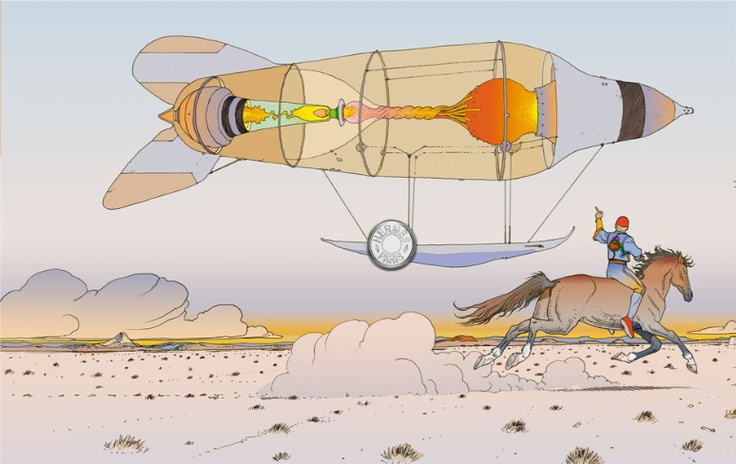
2, First, look, that lovely image—it’s by Jean Giraud, aka Moebius. I came across it a week or two ago and digitally nabbed it.

I love Moebius’s work in general and something about the image reminds me of Thomas Pynchon’s Against the Day, although maybe I’m too immersed in the thick novel to not have much of what I see recall it in some ways.

Something about the airship and the horseman recalls an early passage where Reef Traverse, in the American West, dream-reads the airship adventures of The Chums of Chance into existence. (There are parts of Against the Day that recall to me Cormac McCarthy’s westerns (sometimes—often—called anti-westerns, but come, let’s be adults)…where was I going here? It’s Friday and I’ve consumed the better part (aka “all”) of a bottle of rosé and now I’m circling round some odd notes here—yes—the western/Western thing: Manifest Destiny, etc. — I see it in the Moebius illustration, but of course I bring it with me like a sickness. I move on).

3. ” . . . boys to your bellybone and chuck a chum a chance!” — This is from James Joyce’s Finnegans Wake (85.8). Pointed out to me by Roman Tsivkin, this seems like a most reasonable/splendid source for the namesake of our aeronaut adventurers (who seem rather, uh, absent of late in the final moments of the Bilocations book I’m in right now).

4. Data, perhaps imperfect (again, digitally nabbed)—

In Against the Day:

—Some form of the word invisible appears 173 times—

—The word inconvenience or inconvenient — 84 times—

—The phrase the day — 213 times (usually in a cadence suggestive of the book’s title—some kind of rhythm to it, anyway)—

—The phrase against the day — once (unless you count the chapter (book, really) called “Against the Day,” or the colophon, or what-have-you)—

5. I’m a few sections past this, but a nice passage to end on of a Friday night:

Among students of mathematics here, chloral hydrate was the preferred drug. Sooner or later, whatever the problem being struggled with, having obsessed themselves into nightly insomnia, they would start taking knockout drops to get to sleep—Geheimrat Klein himself was a great advocate of the stuff—and next thing they knew, they were habitués, recognizing one another by the side-effects, notably eruptions of red pimples, known as “the dueling scars of chloralomania.” On Saturday nights in Göttingen, there was always sure to be at least one chloral party, or Mickifest.

It was a peculiar gathering, only intermittently, as you’d say, brisk. People were either talking wildly, often to themselves and without seeming to pause for breath, or lounging draped in pleasurable paralysis across the furniture or, as the evening went along, flat on the floor in deep narcosis.

Explication/Confusion of Pacific Rim in Ten Images

Delacroix
Goya
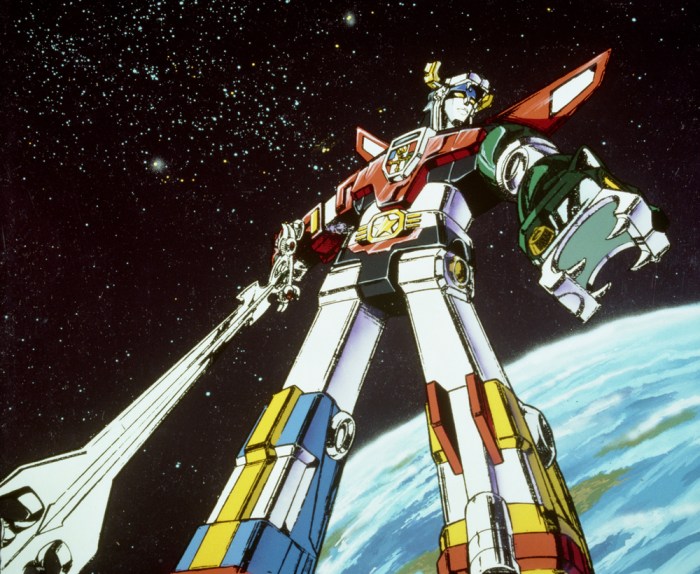
Voltron
Voltron
Dürer
Blake
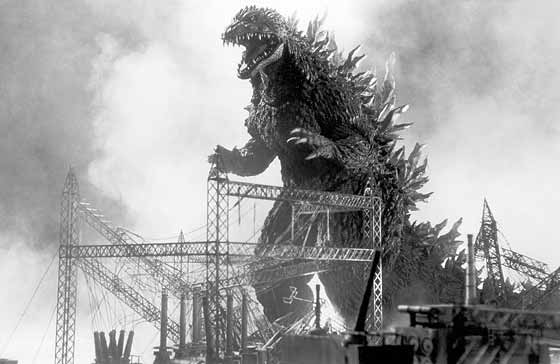
original-godzilla
Godzilla
Matejko
Burne-Jones
Adams
Adams
Corinth

The Collective Dream of the Chums of Chance (A Short Pynchon Riff)

1. This is one of the most extraordinary passages I’ve read so far in Pynchon’s Against the Day (pages 422-24 of my Penguin hardback).

It comes almost at the end of Iceland Spar, the second of the AtD’s five books, working as a surreal, dream-logic climax to the chapter.

Our heroes the Chums of Chance experience an existential identity crisis, one that makes them wonder if they themselves were mere dreamers, readers of the dime novels that chronicled their adventures, and not, y’know, actual adventurers:

Meantime, now and then in the interstices of what was after all not a perpetual midwestern holiday, the former crew of the Inconvenience became aware of doubts creeping in. What if they weren’t harmonica players? really? If it was all just some elaborate hoax they’d chosen to play on themselves, to keep distracted from a reality too frightening to receive the vast undiscriminating light of the Sky, perhaps the not-to-be-spoken-of betrayal now firmly installed at the heart of the . . . the Organization whose name curiously had begun to escape them . . . some secret deal, of an unspecified nature, with an ancient enemy . . . but they could find no entries in any of the daily Logs to help them remember. . . .

Had they gone, themselves, through some mutation into imperfect replicas of who they once were? meant to revisit the scenes of unresolved conflicts, the way ghosts are said to revisit places where destinies took a wrong turn, or revisit in dreams the dreaming body of one loved more than either might have known, as if whatever happened between them could in that way be put right again? Were they now but torn and trailing afterimages of clandestine identities needed on some mission long ended, forgotten, but unwilling or unable to be released from it? Perhaps even surrogates recruited to stay behind on the ground, allowing the “real” Chums to take to the Sky and so escape some unbearable situation? None of them may really ever have been up in a skyship, ever walked the exotic streets or been charmed by the natives of any far-off duty station. They may only have once been readers of the Chums of Chance Series of boys’ books, authorized somehow to serve as volunteer decoys. Once, long ago, from soft hills, from creekside towns, from libraries that let kids lie on the floor where it’s cool and read the summer afternoons away, the Chums had needed them . . . they came.

WANTED Boys for challenging assignments, must be fit, dutiful, ready, able to play the harmonica (“At a Georgia Camp Meeting” in all keys, modest fines for wrong notes), and be willing to put in long hours of rehearsal time on the Instrument. . . Adventure guaranteed!

So that when the “real” Chums flew away, the boys were left to the uncertain sanctuary of the Harmonica Marching Band Training Academy. . . . But life on the surface kept on taking its usual fees, year by year, while the other Chums remained merrily aloft, kiting off tax-free to assignments all over the world, perhaps not even remembering their “deps” that well anymore, for there was so much to occupy the adventurous spirit, and the others— “groundhogs” in Chums parlance—had known, surely, of the risks and the costs of their surrogacy. And some would drift away from here as once, already long ago, from their wholesome heartland towns, into the smoke and confusion of urban densities unimagined when they began, to join other ensembles playing music of the newer races, arrangements of Negro blues, Polish polkas, Jewish klezmer, though others, unable to find any clear route out of the past, would return again and again to the old performance sites, to Venice, Italy, and Paris, France, and the luxury resorts of old Mexico, to play the same medleys of cakewalks and rags and patriotic airs, to sit at the same café tables, haunt the same skeins of narrow streets, gaze unhappily on Saturday evenings at the local youngsters circulating and flirting through the little plazas, unsure whether their own youth was behind them or yet to come. Waiting as always for the “true” Chums to return, longing to hear, “You were splendid, fellows. We wish we could tell you about everything that’s been going on, but it’s not over yet, it’s at such a critical stage, and the less said right now the better. But someday . . .”

“Are you going away again?”

“So soon?”

“We must. We’re just so sorry. The reunion feast was delicious and much appreciated, the harmonica recital one we shall never forget, especially the ‘coon’ material. But now . . .”

So, once again, the familiar dwindling dot in the sky.

“Don’t be blue, pal, it must’ve been important, they really wanted to stay this time, you could tell.”

“What are we going to do with all this extra food?”

“And all the beer nobody drank!”

“Somehow I don’t think that’ll be a problem.”

But that was the beginning of a certain release from longing, as if they had been living in a remote valley, far from any highways, and one day noticed that just beyond one of the ridge-lines all this time there’d been a road, and down this road, as they watched, came a wagon, then a couple of riders, then a coach and another wagon, in daylight which slowly lost its stark isotropy and was flowed into by clouds and chimney smoke and even episodes of weather, until presently there was a steady stream of traffic, audible day and night, with folks beginning to venture over into their valley to visit, and offering rides to towns nearby the boys hadn’t even known existed, and next thing anybody knew, they were on the move again in a world scarcely different from the one they had left. And one day, at the edge of one of these towns, skyready, brightwork gleaming, newly painted and refitted and around the corner of a gigantic hangar, waiting for them, as if they had never been away, there was their ship the good old Inconvenience. And Pugnax with his paws up on the quarterdeck rail, tail going a mile a minute, barking with unrestrained joy.

2. Long passage, so short riff:

3. First (or third, if my enumeration is honest), let me point out that this passage recalls a similar identity transference that happened earlier in the novel to Reef Traverse when he reads a Chums of Chance novel.

4. Which, to rehash the point of the riff I linked to in point 3 above, is to say that the passage is very much about reader-identification, about the ways that we dream ourselves into the novels we read—that the places they occupy are very real.

So much of Against the Day is about doubling, about secret identities, secret powers, secret lives—the invisible (the word “invisible” pops up again and again and again in this book)—that we can lead these whole other lives in our imagination, and that books fuel these lives, etc.

5. This book of Against the Day is named for Iceland spar, a crystal with double-refraction properties. Earlier, the stage magician/minor character Luca Zombini (“Light Zombie”?) reveals that he’s actually split people into two versions of themselves (evidence of such doppelgangers are scattered throughout the novel) using the mineral in his shows.

When our Chums finally reassume the mantles of their “true identities” we’re told that “they were on the move again in a world scarcely different from the one they had left” — are these the same Chums, the same aircrew, the same adventurers? The adverb “scarcely” seems to work some strange magic here.

6. In any case, their loyal hound Pugnax identifies them as the real McCoy, his “tail going a mile a minute, barking with unrestrained joy.”

I’ll admit to feeling some of that joy myself.

“…a spectral cavalry, faces disquietingly wanting in detail, eyes little more than blurred sockets…” (Another Riff on Thomas Pynchon’s Against the Day)

  1. Another riff on/citation from Thomas Pynchon’s Against the Day.
  2. In this episode, our heroes, Chums of Chance Chick Counterfly (chief science officer) and Darby Suckling (chief horndog) have found their way to an off-brand time machine, managed and (shoddily) maintained by Dr. Zoot (whose doctorate seems unlikely). Dr. Zoot sends the boys (ostensibly) to the future for a brief glimpse:

They seemed to be in the midst of some great storm in whose low illumination, presently, they could make out, in unremitting sweep across the field of vision, inclined at the same angle as the rain, if rain it was—some material descent, gray and wind-stressed—undoubted human identities, masses of souls, mounted, pillioned, on foot, ranging along together by the millions over the landscape accompanied by a comparably unmeasurable herd of horses. The multitude extended farther than they could see—a spectral cavalry, faces disquietingly wanting in detail, eyes little more than blurred sockets, the draping of garments constantly changing in an invisible flow which perhaps was only wind. Bright arrays of metallic points hung and drifted in three dimensions and perhaps more, like stars blown through by the shock waves of the Creation. Were those voices out there crying in pain? sometimes it almost sounded like singing. Sometimes a word or two, in a language almost recognizable, came through. Thus, galloping in unceasing flow ever ahead, denied any further control over their fate, the disconsolate company were borne terribly over the edge of the visible world. . . .

The chamber shook, as in a hurricane. Ozone permeated its interior like the musk attending some mating dance of automata, and the boys found themselves more and more disoriented. Soon even the cylindrical confines they had entered seemed to have fallen away, leaving them in a space unbounded in all directions. There became audible a continuous roar as of the ocean—but it was not the ocean—and soon cries as of beasts in open country, ferally purring stridencies passing overhead, sometimes too close for the lads to be altogether comfortable with—but they were not beasts. Everywhere rose the smell of excrement and dead tissue.

Each lad was looking intently through the darkness at the other, as if about to inquire when it would be considered proper to start screaming for help.

“If this is our host’s idea of the future—” Chick began, but he was abruptly checked by the emergence, from the ominous sweep of shadow surrounding them, of a long pole with a great metal hook on the end, of the sort commonly used to remove objectionable performers from the variety stage, which, being latched firmly about Chick’s neck, had in the next instant pulled him off into regions indecipherable. Before Darby had time to shout after, the Hook reappeared to perform a similar extraction on him, and quick as that, both youngsters found themselves back in the laboratory of Dr. Zoot. The fiendish “time machine,” still in one piece, quivered in its accustomed place, as if with merriment. (403-04)

  1. I think the most obvious interpretation here is that our Chums witness part of a battle of the Great War, which is where Against the Day seems to be heading.

  1. What I find most fascinating, though, is the way that Pynchon moves from the physical to the metaphysical in the series of images the Chums witness.

We get an image of “undoubted human identities, masses of souls, mounted, pillioned, on foot, ranging along together by the millions over the landscape accompanied by a comparably unmeasurable herd of horses” seems simultaneously concrete and metaphysical, specific but also hyperbolic.

The scene continues to tread this line—we witness “a spectral cavalry, faces disquietingly wanting in detail, eyes little more than blurred sockets, the draping of garments constantly changing in an invisible flow which perhaps was only wind.”

On one hand, our disoriented Chums (to whose perspective Pynchon limits us) perceive ghosts here (almost cartoonish ghosts, I might add, of the holes-cut-out-for-eyes variety); on the other hand, the “blurred sockets” suggest gas masks and the “constantly changing” garments could perhaps be the variety of uniforms (and armor) of the soldiers.

Continuing: “Bright arrays of metallic points hung and drifted in three dimensions and perhaps more” — Bullets? Bayonets? Missiles? The concrete image is then likened to “stars blown through by the shock waves of the Creation.” The physical shifts into the metaphysical again as Pynchon sends “the disconsolate company . . . terribly over the edge of the visible world.”

  1. Here, the Chums seem to experience the Great War as an intensely compressed allegorical sensation.
  • The second paragraph in the above citation moves the boys into “a space unbounded in all directions” where they perceive “a continuous roar as of the ocean—but it was not the ocean—and soon cries as of beasts in open country, ferally purring stridencies passing overhead, sometimes too close for the lads to be altogether comfortable with—but they were not beasts.”

  • The Chums have no language to describe what they hear; Pynchon has to mediate the similes available to them in negation. But we (and Darby and Chick, of course) know that this place is no bueno: “Everywhere rose the smell of excrement and dead tissue.”

    1. Where have they gone? Are they still in the midst of war—are the sounds planes, bombs? World War I? WWII, site of that other giant Pynchon novel? Hiroshima? Vietnam? The WTC on 9/11? Where? When?

    1. I take the second paragraph to be a brief homage to the penultimate chapter of H.G. Wells’s slim novel The Time Machine (frequently and directly invoked throughout this particular episode of AtD, btw). At the end of that novella, the time traveler, dispensing with Eloi and Morlock alike, takes his machine to the brink of time, to witness the end of the earth and our solar system: “A horror of this great darkness came on me. The cold, that smote to my marrow, and the pain I felt in breathing, overcame me. I shivered, and a deadly nausea seized me.” The Chums of Chance seem to witness a similar extinction.
    2. Ah, but this is Pynchon, of course—so and how does the episode end? With a gag. In a vaudevillian twist, our players are removed from the stage via hook as the time machine, their audience, quivers “as if with merriment.”

    Despite the zaniness of this exit, keep in mind that our heroes are hooked around their necks, lassoed by a noose of sorts—Pynchon saves them, but at the same time visually suggests their death, linking back to the image of mass extinction at the core of the passage.

    1. The paintings in this riff are by the late Polish artist Zdzisław Beksiński; like all of his work they are untitled.

    “Smite early and often” (Another Riff on Thomas Pynchon’s Against the Day)

    rb
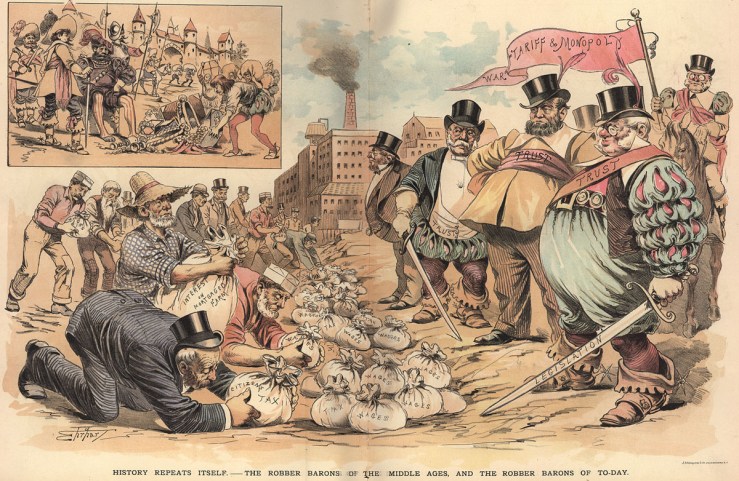
    Image by Samuel Ehrhardt, 1889

    1. The passage I’ll be riffing on today is hardly the funniest or most dazzling piece of writing I’ve encountered so far in Thomas Pynchon’s massive, shaggy novel Against the Day. However, I think this stretch of writing neatly and concisely illustrates the perspective (maybe world view is a better term; hell, we could even go with fancy-pants Weltanschauung here) of who I take to be the novel’s most prominent villain, ruthless robber baron Scarsdale Vibe.

    More significantly, I think this passage illustrates the ways that Pynchon’s big novel analyzes American history and illuminates the contemporary American zeitgeist.

    2. The block quote citations are continuous, although I’ll be interrupting. The passage starts at the very bottom of page 331 and goes through 334 in my hardback Penguin first edition.

    3. Okay, so a bit of context:

    Our scene is mostly a dialogue, or a monologue really, between Scarsdale Vibe and his Other, Foley Walker, who took Scarsdale’s place in the Civil War, took a bullet to the brain, and now, like so many of the characters in Against the Day, has special powers (he can hear voices that tell him how to invest (Scarsdale’s) money in the market).

    Back at Pearl Street, the two Vibes were sitting over brandy and cigars.

    “A tough one to figure, that kid,” Foley opined. “Sure hope we ain’t got another Red in the root cellar like his old man.”

    The “kid” here is hero Kit Traverse, and his old man — the “Red in the root cellar” — is the recently-deceased-on-Scarsdale’s-orders Webb Traverse, the Kieselguhr Kid, enemy of the captains of industry.

    Scarsdale is backing Kit in the hopes that he’ll become “the next Edison” — and not, significantly, the next Tesla.

    5. (Tesla v. Edison—another set of doubles in the book.

    Tesla, Serbian-American, mad magician, prophet of science, seer of the invisible, wants to provide free power for all is clearly allied (in Pynchon’s book, that is) with the unions, the Traverses, labor—the good guys.

    His double, Edison: American-American, reputed idea-thief, dog-electrocuter; Edison, a hustler who sweated out idea after idea, perhaps gracelessly; Edison, whose methods and inventions could generate corporate profits.

    Tesla remarked of Edison, after his death: “he had a veritable contempt for book learning and mathematical knowledge, trusting himself entirely to his inventor’s instinct and practical American sense”).

    6. Note that Scarsdale wouldn’t hesitate to kill Kit:

    “Our duty would be no less clear. There are hundreds of these abscesses suppurating in the body of our Republic,” an oratorical throb creeping into Scarsdale’s voice, “which must be removed, wherever they are found. No other option. The elder Traverse’s sins are documented—once they were brought to light, he was as good as lost. Should there be moral reservations, in a class war, about targeting one’s enemies? You have been in this game long enough to appreciate how mighty are the wings we shelter beneath. How immune we are kept to the efforts of these muckraking Reds to soil our names. Unless—Walker, have I missed something? you aren’t developing a soft spot.”

    As Scarsdale’s was not the only voice Foley had to attend to, he erred, as usual, on the side of mollification. He held out his glowing Havana. “If you can find a soft spot, use it to put this out on.”

    “What happened to us, Foley? We used to be such splendid fellows.”

    “Passage of Time, but what’s a man to do?”

    “Too easy. Doesn’t account for this strange fury I feel in my heart, this desire to kill off every damned socialist and so on leftward, without any more mercy than I’d show a deadly microbe.”

    “Sounds reasonable to me. Not like that we haven’t bloodied up our hands already here.” Scarsdale gazed out his window at a cityscape once fair but with the years grown more and more infested with shortcomings. “I wanted so to believe. Even knowing my own seed was cursed, I wanted the eugenics argument to be faulty somehow. At the same time I coveted the bloodline of my enemy, which I fancied uncontaminated, I wanted that promise, promise unlimited.”

    Foley pretended his narrowing of gaze was owing to cigarsmoke. “Mighty Christian attitude,” he commented at last, in a tone as level as he could make it.

    Here we see Scarsdale’s hatred of organized labor, of anything that impedes on his profits, get tangled into the ideology that underwrites this conflict. He even cites the conflict as “a class war.”  This class war interweaves into his personal life: he is usurping the coveted “bloodline of my enemy” by attempting to adopt Kit.

    7. The scene then takes on a religious dimension, exploring a “Mighty Christian attitude”:

    “Foley, I’m as impatient with religious talk as the next sinner. But what a burden it is to be told to love them, while knowing that they are the Antichrist itself, and that our only salvation is to deal with them as we ought.”

    Pynchon’s villain here sounds like so many figures on the contemporary American Evangelical right, who repeatedly conflate their political/cultural enemies with “Antichrist” as a means to avoid the Jesusian imperative to love the Other.

    8. Remember, wealthy Scarsdale—his father, really—was able to buy a deferment from the Civil War; Foley took his place:

    It did not help Foley’s present mood that he had awakened that morning from a recurring nightmare of the Civil War. The engagement was confined to an area no bigger than an athletic field, though uncountable thousands of men had somehow been concentrated there. All was brown, gray, smoky, dark. A lengthy exchange of artillery had begun, from emplacements far beyond the shadowy edges of the little field. He had felt oppressed by the imminence of doom, of some suicidal commitment of infantry which no one would escape. A pile of explosives nearby, a tall, rickety wood crib of shells and other ammunition began to smolder, about to catch fire and blow up at any moment, a clear target for the cannonballs of the other side, which continued to come in, humming terribly, without pause. . . .

    Foley has actually fought and been wounded and risked. He’s literally put skin in the game.

    In contrast, Scarsdale Vibe was able to continue amassing and controlling wealth—just like other robber barons who bought deferments and then profited from the war (Andrew Carnegie, J.D. Rockefeller, and Jay Gould, just to name a few).

    (Hey, can you think of any wealthy American men in contemporary times who avoided serving in a war but made ludicrous sums as war profiteers?)

    9. Note how Scarsdale, claiming “My civil war has yet to come,” pitches the conflict between capital and labor in terms of a holy war:

    “I didn’t have my war then,” Scarsdale had been saying. “Just as well. I was too young to appreciate what was at stake anyway. My civil war was yet to come. And here we are in it now, in the thick, no end in sight. The Invasion of Chicago, the battles of Homestead, the Coeur d’Alene, the San Juans. These communards speak a garble of foreign tongues, their armies are the damnable labor syndicates, their artillery is dynamite, they assassinate our great men and bomb our cities, and their aim is to despoil us of our hard-won goods, to divide and subdivide among their hordes our lands and our houses, to pull us down, our lives, all we love, until they become as demeaned and soiled as their own. О Christ, Who hast told us to love them, what test of the spirit is this, what darkness hath been cast over our understanding, that we can no longer recognize the hand of the Evil One?

    Note the xenophobia here, the fear that the dark Other with their “garble of foreign tongues” will try “to pull us down, our lives, all we love.” Good thing this poor rich captain of industry will fight for Real America!

    10. Scarsdale, weary from carrying his White Man’s Burden:

    “I am so tired, Foley, I have struggled too long in these thankless waters, I am as an unconvoyed vessel alone in a tempest that will not, will never abate. The future belongs to the Asiatic masses, the pan-Slavic brutes, even, God help us, the black seething spawn of Africa interminable. We cannot hold. Before these tides we must go under. Where is our Christ, our Lamb? the Promise?”

    Seeing his distress, Foley meant only to comfort. “In our prayers—”

    “Foley, spare me that, what we need to do is start killing them in significant numbers, for nothing else has worked. All this pretending—’equality,’ ‘negotiation’—it’s been such a cruel farce, cruel to both sides. When the Lord’s people are in danger, you know what he requires.”

    “Smite.”

    “Smite early and often.”

    And there it is: The ideological veneer of demagoguery quickly gives way to the violent impulses seething underneath. Scarsdale’s Real America has no place for equality and negotiation. Just smiting.

    11. And then quoth Foley:

    “Hope there’s nobody listening in on this.”

    I can’t help but read this as a joke, an echo (pre-echo?) of Nixonian paranoia. The direct recognition that there is a gap between intention at the core and the way that intention is represented (hidden) on the surface (in language, in gesture).

    12. But Scarsdale is unafraid:

    “God is listening. As to men, I have no shame about what must be done.” A queer tension had come into his features, as if he were trying to suppress a cry of delight.

    “But you, Foley, you seem kind of—almost—nervous.” Foley considered briefly. “My nerves? Cast iron.” He relit his cigar, the matchflame unshaking. “Ready for anything.”

    Scarsdale’s God is the god of the white man robber baron Real American capitalist, and “God is listening” not because he is omnipresent but because he is on Scarsdale’s side.

    13. Foley doesn’t quite buy this resolve:

    Aware of the Other Vibe’s growing reluctance to trust reports from out in the field, Foley, who usually was out there and thought he had a good grasp on things, at first resentful and after a while alarmed, had come to see little point these days in speaking up. The headquarters in Pearl Street seemed more and more like a moated castle and Scarsdale a ruler isolated in self resonant fantasy, a light to his eyes these days that was not the same as that old, straightforward acquisitive gleam. The gleam was gone, as if Scarsdale had accumulated all the money he cared to and was now moving on in his biography to other matters, to action in the great world he thought he understood but—even Foley could see—was failing, maybe fatally, even to ask the right questions about anymore.

    Foley, who actually served in war, “who usually was out there,” can see that Scarsdale can only see what he wants to see—the Other Vibe lives in “a moated castle” as a “ruler isolated in self resonant fantasy,” blinded by the lights of his xenophobic ideology, which has moved beyond mere money to pursue some other greater power.

    14. Foley, so far anyway, proves an important contrast, a balance even, to Scarsdale’s zealous evil. Through his eyes we can see the effects that isolation have taken on Scarsdale, who is becoming increasingly paranoid, anxious—crazy even. Scarsdale is completely divided from the men and women who create his wealth—he doesn’t understand (let alone empathize with) the average American—yet he sees himself as the God-appointed, self-created savior of America (an America with no place for equality or negotiation). The ways in which this passage diagnoses certain attitudes in contemporary American politics/big-business strikes me as so transparent that I won’t remark on them at further length. Pynchon’s novel documents the tail-end of the Gilded Age through the end of the Great War, showing us that the conflicts of the past are the conflicts of today—and tomorrow. 

    Pleasure and Sorrow in Álvaro Mutis’s Novella The Tramp Steamer’s Last Port of Call

    The Tramp Steamer — Edward Hopper

    1. Biblioklept has already published a review of Álvaro Mutis’s collection of novellas, The Adventures and Misadventures of MaqrollI didn’t write that review—my friend Dave Cianci did—but the review prompted me to read the book—or rather, to read Maqroll: Three Novellas, which I found used, wrote about here, and passed on to a friend before getting the NYRB edition with all seven novellas.

    2. So I read The Tramp Steamer’s Last Port of Call last week. At 66 pages (in a tiny font), it’s the shortest novella in the book. It’s also the first story where we don’t really get an adventure or misadventure of Maqroll, who more or less sits this one out. Instead, an unnamed narrator—a writer of mundane tracts but also poems—tells the story. And of course, because this is Mutis, there is a second storyteller embedded in this tale, a Basque sailor, captain of the titular steamer. The shifting, labyrinthine connections between the steamer, the narrator, the Basque sailor, and a Lebanese woman named Warda frame the plot of The Tramp Steamer’s Last Port of Call.

    3. Even though Maqroll the Gaviero is on the margins of this tale, the text resonates with his weary, picaresque spirit. And even though his name doesn’t even appear until the novella’s second half, we nevertheless get one of the more lucid descriptions of our anti-hero thus far in the collection:

    The other man, whose name he never understood clearly but who was also called Gaviero, was treated by Bashur with unreserved familiarity and listened to with the greatest attention in matters relating to commercial shipping and the operation of freighters in the most remote corners of the world. The Basque could not determine if Gaviero was a nickname, a surname, or simply a designation left over from the time he was a lookout in his youth. A man of few words, with a rather odd, corrosive sense of humor, he was extremely attentive and sensitive in his friendships, knowledgeable about the most unexpected professions, and, while not a womanize, very conscious of, one might say dependent on, a feminine presence.

    4. As fate—and fate is the major theme of The Tramp Steamer’s Last Port of Call (and maybe all of Maqroll, and maybe all of Latin American literature, and maybe all of literature, but specifically the major theme of The Tramp Steamer’s Last Port of Call, which organizes itself around the interconnections between its narrator and the Basque captain)—as fate would have it, the narrator knows the Gaviero,

    an old friend whose confidences and tales I have been collecting for many years, considering them of some interest to those who enjoy hearing about the unusual, contrary lives of people who do not follow the common path of gray routine in an age of mindless conformity.

    (The above citation is, of course, a wonderful metatextual review of Mutis’s big book).

    The narrator doesn’t reveal that he knows the Gaviero though; he doesn’t wish to pollute the Basque captain’s story.

    5. Back to fate and chance for a moment: “Chance is always suspect, and much that is fraudulent imitates it.” This might be the thesis statement of The Tramp Steamer’s Last Port of Call. Maybe.

    6. The Tramp Steamer’s Last Port of Call, much like the novellas that precede it, is very much a study of heterogeneity, depicting of a world of shifting identities and ever-changing motivations and outcomes. Words like labyrinthmaze, and intertwine repeat in the text, whether Mutis is describing rivers or cultures or individuals. The text is larded with blends and syntheses, but I’ll grab one simple example, one of the rare times this particular novella returns to the Gaviero. Talking to the narrator, the Basque captain says:

    I realized that my own provincial and national prejudices had kept me from seeing the enormous wealth of experience and the solid, warm humanity of this man, whose nationality I never learned, as I never learned the correct pronunciation of his name, which sounded vaguely Scottish but could also have been Turkish or Iranian. I found out later that he carried a Cypriot passport. But that doesn’t mean anything, because he himself hinted I should not put too much faith in its authenticity.

    7. What is most authentic in the ever-shifting world Mutis depicts? I think it’s food. I can’t think of another writer who depicts scenes of gustation with such sybaritic pleasure. Mutis never neglects to describe a meal, even on a humble tugboat:

    Each tug had two cabins for passengers, who shared with the captain the food prepared by two Jamaican women whose culinary talents we never tired of celebrating. The pork in plum sauce, the rice with coconut and fried plantains, the succulent stews made of river fish, and, and indispensable and always welcome complement to the meals, the miraculously refreshing pear juice with vodka that left us splendidly disposed to enjoy the constantly changing panorama of the river and its banks; thanks to the magic of that imponderable drink, everything took place in a velvety, contented distance that we never attempted to decipher.

    8. Okay, authentic might not be right word. Everything in Mutis’s novella is authentic, true even when it’s not true. I suppose I mean stable. But: Our narrator warns us that if we try to replicate the pear and vodka drink we’ll fail, like all the others who try.

    9. Let me try again: What is most authentic—I realize I’ve already employed the superlative; mea culpa—what is most authentic in the world that Mutis depicts is the strange intersections of pleasure and sorrow, the way these modes intertwine the labyrinths of our lives.

    The Tramp Steamer’s Last Port of Call is a beautiful, dark, sad love story.

    10. I realize that I’ve failed to summarize the plot. Do you want that—a plot summary? I don’t have it in me, and someone did it way better. I’ll close with a long excerpt from John Updike’s thorough, excellent review of The Adventures and Misadventures of Maqroll (in a 2003 issue of The New Yorker):

    Possibly alert to the dangers of doting on his hero, Mutis next provides a tale in which Maqroll hardly appears, except as a cherished acquaintance of the principals. In “The Tramp Steamer’s Last Port of Call,” the shortest of the lot and one of the best, the narrator relates an experience he himself has had, in a voice close to what we know of Mutis’s own life: “I had to go to Helsinki to attend a meeting of directors of internal publications for various oil companies.” In Helsinki, he asks to be driven to the point from which he can see across the Gulf of Finland to St. Petersburg, a shimmering sight passingly eclipsed by the transit of a decrepit tramp steamer:

    The captain’s bridge, and the row of cabins on the deck for crew members and occasional passengers, had been painted white a long time before. Now a coat of grime, oil, and urine gave them an indefinite color, the color of misery, of irreparable decadence, of desperate, incessant use. The chimerical freighter slipped through the water to the agonized gasp of its machinery and the irregular rhythm of driving rods that threatened at any moment to fall silent forever.

    He sees the wretched, plucky ship, which fragmentary letters on its bow identify as the Halcyon, three more times—in Costa Rica, in Jamaica, and in the delta of the Orinoco River. Its apparition invades his dreams. While on another errand for the oil company, travelling downriver to a strike-threatened seaport refinery, he occupies one of the two cabins in a small tugboat; the other is occupied by a Basque sea captain called Jon Iturri, who, it turns out, was the captain of the ghostly tramp steamer, which broke up and sank in the Orinoco. Its owner, Iturri relates, was a Lebanese woman, a younger sister of Abdul Bashur, named Warda. At their first meeting, he says, he was stunned by her “almost Hellenic” beauty:

    “Her blue-black hair was as dense as honey and fell to shoulders as straight as those of the kouros in the Athens Museum. Her narrow hips, curving gently into long, somewhat full legs, recalled statues of Venus in the Vatican Museum and gave her erect body a definitive femininity that immediately dispelled a certain boyish air. Large, firm breasts completed the effect of her hips.”

    As he got to know her better, his admiration intensified: “Warda, when she was naked, acquired a kind of aura that emanated from the perfection of her body, the texture of her moist, elastic skin, and that face: seen from above, when we were in bed, it took on even more of the qualities of a Delphic vision.” But the lovestruck captain was fifty, and a non-Muslim, and Warda was twenty-four and, the longer she lived in Europe, ever more approving of the conservative ways of her native Lebanon. The tramp steamer, which she inherited from an uncle, was financing her European sojourn with its hard-won profits; she flew to Iturri’s ports of call and spent rapturous days in hotels with him, but their romance could last only as long as the fragile tramp steamer did. Warda’s perfect, elastic, symmetrical beauty was one with the listing, disintegrating body of the ship as it conveyed her aging lover from port to port. The story, Mutis tells us at the outset, “has something of the eternal legends that have bewitched us over the centuries”; he ends by assuring us that “there has been only one love story since the beginning of time.” Not a happy one.

    Riff on Goya’s Painting Highwaymen Attacking a Coach

    highwaymen-attacking-a-coach-1787

    1. Francisco Goya’s Asalto de ladrones — Highwaymen Attacking a Coach in Ingles, 1786-87. Oil on canvas. 169 by 127 cm. Currently in some lucky soul’s private collection.

    2. I love this painting.

    3. It’s easy—and probably correct—to call Goya’s work dark. We can see that in his engraving series The Disasters of War and Caprichos, or his famous works Third of May 1808 or Saturn Devouring His Son. And the darkness, the heaviness, in these works, isn’t just in the subject but also on the canvas, in the grooves of the etchings. The blacks and browns blister; the acid goes to work.

    4. It would be wholly wrong to suggest that Goya only painted the dark—but even his most joyful paintings, like Playing at Giants or The Swing contain a dark kernel. (Or, perhaps, maybe I find that kernel there, suggested by his oeuvre).

    5. The blue skies of Playing at Giants and The Swing both pale in comparison to the top third of Highwaymen Attacking a Coach.

    1

    That beautiful bright blue sky is somehow the darkest aspect of this very dark painting, a terrible, terrible joke, an ironic reminder of glorious nature’s inglorious indifference to misery, suffering, murder, rape.

    6. Moving down—the tree: long, twisting, phallically jutting into the blue sky. It seems to crookedly shift in the wind. Softly echoed by those happy little clouds it takes us down to the vernal forest floor, where we seem to be just-off-the-beaten-path.

    2

    7. I’ll admit to a certain fascination with the concept of highway robbery—the perils of the path, the road as a dangerous place, Barry Lyndon, Robin Hood, etc.—but what Goya gives us here is shock and horror.

    8. If we continue to move our eyes down from that blue sky, we find, just off-center, a gun-wielding usurper perched on a lovely gilded carriage, its mules patiently stalled.

    3

    9. Left to right: Murder victim number one, his jacket open, torn, his ribs and breast bloodied—he’s already a corpse, but his naked skin suggests something even more sinister.

    4

    10. Just beside victim number one, a passenger fights for his life against a bandit brandishing a knife. Their twisted, violent grappling prefigures the threat of rape that lurks under the painting.

    5

    11. To the right of this strange couple, another couple—aristocratic mother-father team—plead for their lives, their palms facing up to that blue sky. The man’s cloak is earth-brown, and the woman’s cape black, but between them rests—I don’t know? Some pink bundle. The hem of the woman’s dress? Something bloodied? The suggestion of infanticide?

    6

    12. We find their guard uselessly sprawled to the right, his worthless sword neatly parallel to the gun under the grappling couple, blood trickling from under his blood-red coat. As Robert Hughes points out in his long biography of Goya, the guard’s corpse figures “the same pose that Goya would repeat several times in future drawings and paintings to indicate a dead body, so that it became part of his shorthand for death”; Hughes goes on to remind us that this sprawl is the same one we can see of “the dead man facedown to the left of the French firing squad in the Tres de Mayo, his hands scrabbling palms-down to the earth.”

    7

    13. Immediately above the guard, and to the viewer’s left of him, stands his likely assassin, his chest bared and his gun (jutting from the pelvis) now confidently trained on our hapless couple.

    8

    14. Gunman #2 is not half so menacing though as his partner who occupies the low dark center of the painting.

    9

    His hat cocked ever-so-slightly to the right, this central bandit, clothed in greenish-gold garb, raises a rope in his left hand. The rope signifies every awful kind of horror the viewer cares (“cares” is not the right verb) to imagine, but it’s the action that bandit performs with his right hand that is somehow the most menacing gesture of the painting: We can almost hear him coo, “Shhhhhhhh…”

    15. And our poor victims? Their hands up, in supplication, what do they have to look to? Perhaps, like the attendant viewer, they return to the sky blue sky.

    z

    The Chums of Chance vs The Legion of Gnomes (Citation from + Riff on Thomas Pynchon’s Against the Day)

    At first the “noise” seemed no more than the ensemble of magnetoatmospheric disturbances which the boys had long grown used to, perhaps here intensified by the vastly resonant space into which they were moving ever deeper. But presently the emission began to coalesce into human timbres and rhythms—not speech so much as music, as if the twilit leagues passing below were linked by means of song.

    Lindsay, who was Communications Officer, had his ear close to the Tesla device, squinting attentively, but at last withdrew, shaking his head. “Gibberish.”

    “They are calling for help,” ~delared Miles, “clear as day and quite desperately, too. They claim to be under attack by a horde of hostile gnomes, and have set out red signal lamps, arranged in concentric circles.”

    “There they are!” called Chick Counterfly, pointing over the starboard quarter.

    “Then there is nothing to discuss,” declared Randolph St. Cosmo. “We must put down and render aid.”

    They descended over a battlefield swarming with diminutive combatants wearing pointed hats and carrying what proved to be electric crossbows, from which they periodically discharged bolts of intense greenish light, intermittently revealing the scene with a morbidity like that of a guttering star.

    “We cannot attack these fellows,” protested Lindsay, “for they are shorter than we, and the Rules of Engagement clearly state—”

    “In an emergency, that choice lies at the Commander’s discretion,” replied Randolph.

    They were soaring now close above the metallic turrets and parapets of a sort of castle, where burned the crimson lights of distress. Figures could be discerned below gazing up at the Inconvenience. Peering at them through a nightglass, Miles stood at the conning station, transfixed by the sight of a woman poised upon a high balcony. “My word, she’s lovely!” he exclaimed at last.

    Their fateful decision to land would immediately embroil them in the byzantine politics of the region, and eventually they would find themselves creeping perilously close to outright violation of the Directives relating to Noninterference and Height Discrepancy, which might easily have brought an official hearing, and perhaps even disfellowshipment from the National Organization. For a detailed account of their subsequent narrow escapes from the increasingly deranged attentions of the Legion of Gnomes, the unconscionable connivings of a certain international mining cartel, the sensual wickedness pervading the royal court of Chthonica, Princess of Plutonia, and the all-but-irresistible fascination that subterranean monarch would come to exert, Circelike, upon the minds of the crew of Inconvenience (Miles, as we have seen, in particular), readers are referred to The Chums of Chance in the Bowels of the Earth—for some reason one of the less appealing of this series, letters having come in from as far away as Tunbridge Wells, England, expressing displeasure, often quite intense, with my harmless little intraterrestrial scherzo.

    After their precipitate escape from the ill-disposed hordes of thickset indigenous, over another night and day, as time is reckoned on the surface, the Chums swept through the interior of the Earth and at last out her Northern portal, which they beheld as a tiny circle of brightness far ahead. As before, all remarked the diminished size of the planetary exit. It was a tricky bit of steering, as they emerged, to locate the exact spot, on the swiftly dilating luminous circumference, where they might with least expenditure of time find themselves in the vicinity of the schooner Etienne-Louis Malus, carrying the Vormance Expedition toward a fate few of its members would willingly have chosen.

    1.The above citation comprises the final paragraphs of The Light Over the Ranges, the first book in Thomas Pynchon’s massive, byzantine novel Against the Day, which is perhaps too massive and too byzantine for me to approach in any way other way than the occasional riff and citation as I read it.

    2. The Light Over the Ranges both begins and ends by focusing on The Chums of Chance, an intrepid band of adventurers who sail their skyship Inconvenience into every manner of trouble. The passage above—which, hey, don’t worry, there are no real spoilers there—-the passage above showcases a jocular, jaunty voice that Pynchon employs frequently throughout the book, a voice appropriate to pulp fiction, to serialized “boy’s novels,” to speculative fiction narratives, etc. The voice is somehow simultaneously engaged and detached, urging its listener to care about the heroes in peril, but also acknowledging its own formal artificiality, the flatness of its characters, their position as placeholders or checkerboard pieces in Pynchon’s big project.

    3. The voice that relates the Chums of Chance episodes is wonderfully didactic, its earnest, moral tone buoying the narrative into adventure (and fun!); at the same time, everything else in the novel—its violence, its class warfare, its analysis of exploitation—-ensures that this voice is to be read and interpreted with dark irony.

    4. And yet the spirit of adventure, of fun—of imagination—inheres (and not just in the episodes with the Chums).

    5. The Chums of Chance: Miles Blundell, Chick Counterfly, Lindsay Noseworth,  Darby Suckling, and commander Randolph St. Cosmo. The names are Pynchonian, tautologies be damned! (They also remind me of porn aliases). I am remiss: Let me include Pugnax, a dog of discerning literary taste, his ability to read just one of many seemingly-metaphysical powers Pynchon grants his characters in Against the Day.

    6. My favorite paragraph in the above citation is the penultimate one, where we find our heroes “creeping perilously close to outright violation of the Directives relating to Noninterference and Height Discrepancy” by diving into a strange underworld adventure and battling The Legion of Gnomes. Pynchon (or Pynchon’s adventure-voice, if’n ya’ll permit me) offers us a too-brief peek at “the royal court of Chthonica, Princess of Plutonia, and the all-but-irresistible fascination that subterranean monarch would come to exert, Circelike, upon the minds of the crew of Inconvenience” and then refers us to The Chums of Chance in the Bowels of the Earth, a book we cannot read because it doesn’t exist.

    7. But what am I saying? Of course The Chums of Chance in the Bowels of the Earth exists!—we just have to imagine it.

    A Short Riff on Shane Carruth’s Film Upstream Color

    tumblr_mii1iuUhjR1qzdglao1_500

    1. I managed to avoid reading anything about Shane Carruth’s new film Upstream Color before I saw it.

    I just knew that this was the guy who did Primer, this was his new film, and I wanted to see it because Primer was so strange and engaging.

    2. Two immediate responses after viewing Upstream Color:

    i). The desire to see Upstream Color again and

    ii). The desire to read what other people thought about Upstream Color.

    3. (My wife and I, reading the credits, pausing the credits, reassessing the film against the backdrop of the credits, arguing about the film, discussing the film, etc.).

    4. I think it’s better that if you have any interest at all in Upstream Color that you just see it cold [update/warning: the comments section of this post is full of spoilers]. But I know that 100 minutes is an investment of time, so maybe you’d like some kind of précis or at least description. So, a loose attempt, which surely will devolve into fragments and references:

    Upstream Color is a sci-film, sort of.

    Or maybe its a mystery film about ethics and biology.

    Maybe a nature film, sort of.

    Henry David Thoreau’s Walden.

    Worms—parasites.

    Theft.

    Pigs.

    Shades of Philip K. Dick, David Cronenberg, Terence Malick, but also something utterly original.

    Mind control.

    Trauma.

    Ambient music.

    Orchids.

    Sampling nature.

    Memory.

    Swimming.

    Drowning.

    Creation: knitting, paper chains, music, seeds, life, children, etc.

    A film that can and should be described as poetic.

    It’s a love story, too.

    5. It occurs to me that there’s a trailer for the film. I haven’t seen it yet. Should we watch it?

    6. Does that do it for you? I don’t know how to do this anymore. Recommend things. I don’t know, the trailer makes the film perhaps look more pretentious than it is. It isn’t pretentious. It isn’t even confusing—just perplexing, haunting, troubling.

    7. (Wanted: Quinoa Valley Record Co., complete discography).

    8. My take on Upstream Color, spoiler-free, supporting-detail-free:

    The film is about agency, about drive, about how the characters (and, implicitly, uswe, the audience, who identify with the characters on the screen) may be driven by something beyond us, something controlling us like a parasite (internal) or from afar like a ventriloquist (external). That even when we do assert agency the effect, the fallout, the shape lays beyond us, upstream.

    9. (This morning, my wife telling me about her dream, a nightmare that our young daughter had ingested hallucinogenic mushrooms, clearly a response to the film).

    10. I haven’t done a good job of really saying anything about the film. So, lazily:

    I think Caleb Crain provides a perceptive and persuasive reading of the film in his essay “The Thoreau Poison.” He reads the film through the American transcendentalists, particularly Thoreau, of course, but also Emerson and Hawthorne. 

    There’s also a piece at Slate by Forrest Wickman that perhaps over-explicates but nonetheless offers perspective, including elements of Carruth’s own take.

    11. (I will avoid Carruth’s explanation of the film until I’ve seen it a second time. Maybe I’ll avoid his explanation forever).

    12. A take on Upstream Color that I don’t quite buy into (the take is my own): The film perhaps invites us to find metaphysical entities in two of its secondary characters, both of whom exert influence (creative and destructive) over the primary characters. Something something godlike, something something devillike.

    I like that the film offers this simple duality and then crushes it, shows something far more complicated, suggests a cycle far more strange.

    13. (White orchid. Blue orchid. Yellow orchid).

    14. Upstream Color features minimal dialogue and nothing approaching traditional exposition, but we still learn about its characters, come to feel for them, feel their desires and traumas. The film is cerebral and philosophical, but it’s also emotional, offering an aesthetic that sublimely overwhelms the viewer.

    15. Carruth wrote, produced, directed, scored, photographed, cast and starred in Upstream Color. (I’m sure he did a lot of other stuff too). He also distributed the film himself. The entire filmmaking process was untouched by the Hollywood system. There’s so much hope for film as an art form in this knowledge.

    16. Parting thoughts: See Upstream Color. Resist imposing whatever film grammar you usually bring with you to the movies. Resist the temptation to see the film as a puzzle to figure out. See Upstream Color.