“Titian Paints a Sick Man” — Roberto Bolaño

“Titian Paints a Sick Man”

by

Roberto Bolaño

translated by Natasha Wimmer


At the Uffizi, in Florence, is this odd painting by Titian. For a while, no one knew who the artist was. First the work was attributed to Leonardo and then to Sebastiano del Piombo. Though there’s still no absolute proof, today the critics are inclined to credit it to Titian. In the painting we see a man, still young, with long dark curly hair and a beard and mustache perhaps slightly tinged with red, who, as he poses, gazes off toward the right, probably toward a window that we can’t see, but still a window that somehow one imagines is closed, yet with curtains open or parted enough to allow a yellow light to filter into the room, a light that in time will become indistinguishable from the varnish on the painting.

1

The young man’s face is beautiful and deeply thoughtful. He’s looking toward the window, if he’s looking anywhere, though probably all he sees is what’s happening inside his head. But he’s not contemplating escape. Perhaps Titian told him to turn like that, to turn his face into the light, and the young man is simply obeying him. At the same time, one might say that all the time in the world stretches out before him. By this I don’t mean that the young man thinks he’s immortal. On the contrary. The young man knows that life renews itself and that the art of renewal is often death. Intelligence is visible in his face and his eyes, and his lips are turned down in an expression of sadness, or maybe it’s something else, maybe apathy, none of which excludes the possibility that at some point he might feel himself to be master of all the time in the world, because true as it is that man is a creature of time, theoretically (or artistically, if I can put it that way) time is also a creature of man.

2

In fact, in this painting, time — sketched in invisible strokes — is a kitten perched on the young man’s hands, his gloved hands, or rather his gloved right hand which rests on a book: and this right hand is the perfect measure of the sick man, more than his coat with a fur collar, more than his loose shirt, perhaps of silk, more than his pose for the painter and for posterity (or fragile memory), which the book promises or sells. I don’t know where his left hand is.

How would a medieval painter have painted this sick man? How would a non-figurative artist of the twentieth century have painted this sick man? Probably howling or wailing in fear. Judged under the eye of an incomprehensible God or trapped in the labyrinth of an incomprehensible society. But Titian gives him to us, the spectators of the future, clothed in the garb of compassion and understanding. That young man might be God or he might be me. The laughter of a few drunks might be my laughter or my poem. That sweet Virgin is my friend. That sad-faced Virgin is the long march of my people. The boy who runs with his eyes closed through a lonely garden is us.

From Between Parentheses.

I also remember him talking to me about the structure of 2666 and a novel about bullfighters that he never finished (as far as I know), and which, he said, would be called Corrida

We are in December of 1997. I’m living in Barcelona, but I’ve gone to Girona to write an article for El País about an exhibition of work by a childhood friend, David Sanmiguel. At the same time as the opening, in Llibreria 22—right across the street from the art gallery—Ponç Puigdevall is presenting the book Last Evenings on Earth, by Roberto Bolaño. By now, Bolaño has in quick succession published Nazi Literature in the Americas and Distant Star, and his name is beginning to resonate in certain literary circles. But I, who am totally outside these circles despite having published three novels, have not yet read him, and have heard of him only from Enrique Vila-Matas, who is a mutual friend. Before the exhibition opens, I have a coffee with Bolaño and Puigdevall. Bolaño tells me he lives in Blanes, that all he does is write, that he makes a living—“a very modest one,” he emphasizes—through literature. Suddenly, while listening to him talk, I have a hunch. I ask Bolaño if he was living in Girona in the early eighties; he says he was. I ask him if he knew Xavier Coromina; he says yes. Then I tell him of our fleeting encounter outside the Bistrot and, once inside the Llibreria 22, I show him the passage in my second novel where a character says his thesis is going, but who knows where it’s really headed. Bolaño laughs; I laugh too.

From Javier Cercas’s memory-essay “Bolaño in Girona: A Friendship.”

“Daniela de Montecristo” — Roberto Bolaño

“Daniela de Montecristo”

by

Roberto Bolaño

translated by Chris Andrews

from Nazi Literature in the Americas


Daniela de Montecristo

Buenos Aires, 1918–Córdoba, Spain, 1970

Daniela de Montecristo was a woman of legendary beauty, surrounded by an enduring aura of mystery. The stories that have circulated about her first years in Europe (1938-1947) rarely concur and often flatly contradict one another. It has been said that among her lovers were Italian and German generals (including the infamous Wolff, SS and Police Chief in Italy); that she fell in love with a general in the Rumanian army, Eugenio Entrescu, who was crucified by his own soldiers in 1944; that she escaped from Budapest under siege disguised as a Spanish nun; that she lost a suitcase full of poems while secretly crossing the border from Austria into Switzerland in the company of three war criminals; that she had audiences with the Pope in 1940 and 1941; that out of unrequited love for her, a Uruguayan and then a Colombian poet committed suicide; and, that she had a black swastika tattooed on her left buttock.

Her literary work, leaving aside the juvenilia lost among the icy peaks of Switzerland, never to appear again, consists of a single book, with a rather epic title: The Amazons, published by Quill Argentina, with a preface by the widow Mendiluce, who could not be accused of restraint when it came to lavishing praise (in one paragraph, relying solely on her feminine intuition, she compared the legendary poems lost in the Alps to the work of Juana de Ibarbourou and Alfonsina Storni).

The Amazons is a torrential and anarchic blend of all the literary genres: romance, spy novel, memoir, play (there are even some passages of avant-garde dramatic writing), poetry, history, political pamphlet. The plot revolves around the life of the author and her grandmothers and great-grandmothers, sometimes going back as far as the period immediately following the foundation of Asunción and Buenos Aires.

The book contains some original passages, especially the descriptions of the Women’s Fourth Reich—with its headquarters in Buenos Aires and its training grounds in Patagonia—and the nostalgic, pseudo-scientific digressions about a gland that produces the feeling of love.

Have a weird Xmas (Blog about books acquired in Dec. 2023)

Maybe an hour ago, browsing in a used bookstore, I opened a worn and some might say dirty copy of Iain Banks’s 1985 novel Walking on Glass. The very first page of this old book was inscribed with the following:

Have a weird Xmas ’90

                 John

This copy of Iain Banks’s 1985 novel Walking on Glass—a 1990 Abacus trade paperback printed in London, the embossing on its cover yellowed by wear on its cover and back near its spine—this particular copy was addressed to no named person, its inscription signed by a name so anonymous we apply it to unidentified cadavers and prostitute clients.

I take myself to be the unidentified person being addressed by the identified generic John, wishing me weird wellness, a ghost of Xmas past.

Earlier this year I made the tragic mistake of not pulling the trigger on first-edition hardbacks of Banks’s first two novels, The Wasp Factory and Walking on Glass. I hadn’t read Banks at that point, and my familiarity with his work came almost entirely of his proximity to the J.G. Ballard titles I routinely perused. I ended up reading and loving The Wasp Factory this summer (reviewed it here), and the blurb on the back of Walking on Glass promising further perversions intrigues me too, of course.

Today, I also came across a first-edition, first-U.S.-printing of Roberto Bolaño’s opus 2666It was marked at a third of the original cover price and has never been read. I could not leave it behind.

I actually traded some books in today, including my trade paperback of Alasdair Gray’s Poor Things. I had recently reread the novel in anticipation of Yorgos Lanthimos’ film adaptation, and, during that reread, oddly came across an inexpensive pristine first edition of the novel while browsing for something else. Maybe a week or two after finding that hardback of Poor Things, I found a hardback first edition of Gray’s 1990 novel Something Leather. Unlike Poor Things, which features lots of art and typographic adventures, Something Leather is pretty standard (apart from a few chapter heading illustrations)—but it does have a lovely cover under its cover:

Maybe a week after that, I was browsing with my son, who wanted a collection of Harlan Ellison short stories. I was shocked that we couldn’t find any—I had given away two mass market collections to some students maybe seven or eight years ago in a purge. Apparently a lot of it is out of print, but a “greatest hits” collection is coming out this spring. Anyway, I ended up finding hardback editions of Robert Coover’s Whatever Happened to Gloomy Gus of the Chicago Bears? Denis Johnson’s novel Fiskadaro. 

The Johnson is a British edition, Chatto & Windus, and while it’s hardly my favorite novel by him, I found its form too attractive to pass (and it was, like, cheaper than a beer in the same bookstore). I also picked up a book by Lewis Nordan, a slim collection of short stories called Welcome to the Arrow-Catcher Fair. I picked it up because I love those horrid lovely wonderful gross stylish Vintage Contemporaries editions, and then acquired it based on the blurb, which compared it to Flannery O’Connor, Ellen Gilchrist, and Harry Crews. Here it is next to my Vintage Contemporaries copy of Denis Johnson’ Fiskadaro:

I hope you have a weird Xmas. And I hope that John, wherever they are, has a weird Xmas too.

Roberto Bolaño’s Brussels sprouts with lemon

In Roberto Bolaño’s sprawling opus 2666 (specifically, in “The Part About Fate”), founding member of the Black Panthers/cookbook author Barry Seaman offers the following recipe during a lecture at a Detroit church–

The name of the recipe is: Brussels Sprouts with Lemon. Take note, please. Four servings calls for: two pounds of brussels sprouts, juice and zest of one lemon, one onion, one sprig of parsley, three tablespoons of butter, black pepper, and salt. You make it like so. One: Clean sprouts well and remove outer leaves. Finely chop onion and parsley. Two: In a pot of salted boiling water, cook sprouts for twenty minutes, or until tender. Then drain well and set aside. Three: Melt butter in frying pan and lightly sauté onion, add zest and juice of lemon and salt and pepper to taste. Four: Add brussels sprouts, toss with sauce, reheat for a few minutes, sprinkle with parsley, and serve with lemon wedges on the side. So good you’ll be licking your fingers, said Seaman. No cholesterol, good for the liver, good for the blood pressure, very healthy.

Under the Volcano and elsewhere (Books acquired, week of 10 March 2023)

My family and I had a wonderful time vacationing in Mexico City last week. We rented an apartment in Condesa, a friendly, walkable neighborhood marked by shade trees, lush gardens, and robust parks. And dogs. Lots of lovely dogs. Over eight days, we took in as much of the city as we could (as well as some excellent day trips to Grutas Tolantongo in Hidalgo and Teotihuacán in Edomex). The city is huge, with more than 150 museums, and the food is excellent. While the four members of our family share common interests (including a love of art), making sightseeing somewhat streamlined, I left Mexico City feeling like I had barely scratched the surface. It reminded me in disparate ways of New York City, Bangkok, and New Orleans. Like those cities, there’s not a single aspect that intrigues me, but rather a vibe. But this is not a travel blog, it is a book blog, so:

The first thing I noticed is that the selection of titles in the several bookstores I visited (a few just very briefly) was generally excellent. Shops tended to feature big-ell Literature titles in lieu of bestsellers and airport novels, with new releases like Mircea Cartarescu’s Solenoid and Yuri Herrera’s La estación del pantano getting prominent displays.

I visited both locations of Cafebrería El Péndulo, and picked up an inexpensive Debolsillo edition of Roberto Bolaño’s La literatura nazi en America, resisting the urge to grab one of the big novels. I’ve read Chris Andrews’ translation of Nazi Literature in the Americas a few times, and I figured that it would be better for me to attempt reading and comparing the shorter sketches here than to jump into 2666 in Spanish. Although I practiced my Spanish for a year in preparation for the trip (it helps to have a Spanish professor friend whose office is down the hall from mine), my vocabulary is still limited and my conjugations are a mess.

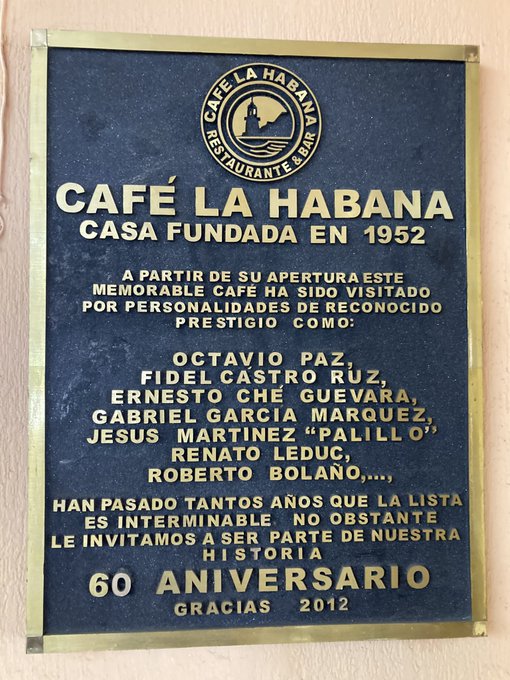
Also Bolaño-related: We lunched at Café la Habana, a charming restaurant boasting a history as a salon for poets, politicians, theorists and other bullshitters. In Bolaño’s Mexican opus The Savage Detectives, Café la Habana appears as Café Quito.

I also visited Under the Volcano, a tiny and charming bookstore in Condesa that carries English-language books–mostly literature. The store is named for Malcolm Lowry’s excellent novel, but there didn’t appear to be any of his books there the day I visited. There was a first-edition hardback copy of Robert Coover’s Pricksongs and Descants, but it was jacketless and out of my price range. There was also a standalone magazine-sized Dalkey Archive edition of William H. Gass’s story Willie Master’s Lonesome Wife, which, based on its price, the owner seemed to believe the most valuable item in the store. I also spied a copy of Jay McInerney’s 1984 novel Ransom, notable because it’s the first and so-far only hardcover of a Vintage Contemporaries edition I’ve ever seen.

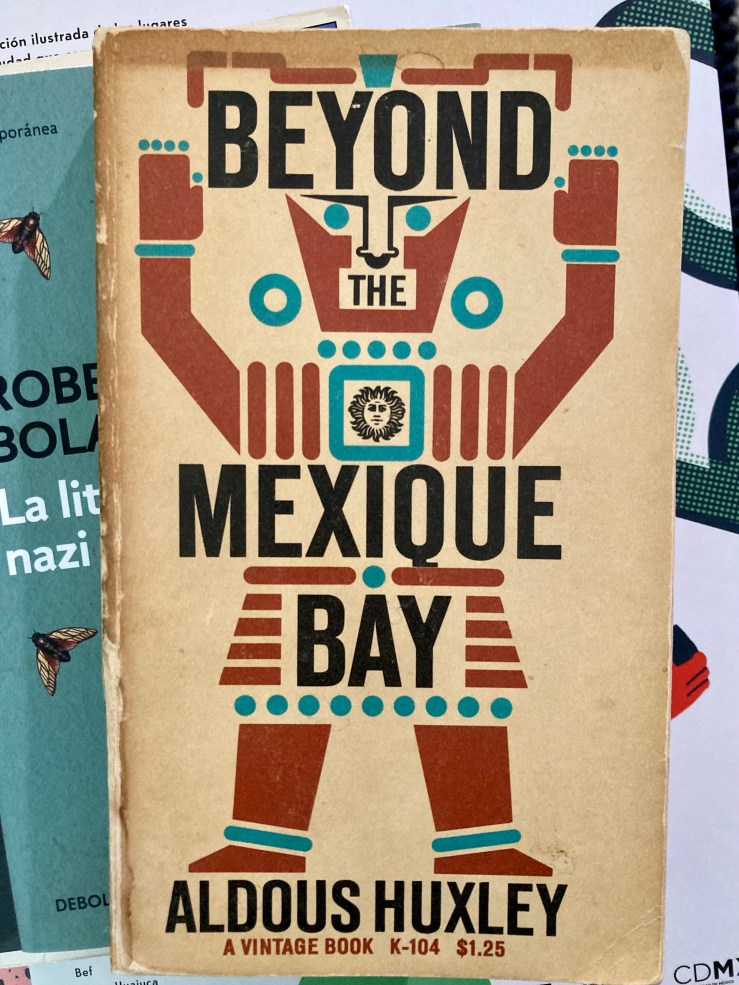
I wound up with two books from Under the Volcano: a Europa Editions of Steven Erickson’s Zeroville and Vintage edition of Aldous Huxley’s Beyond the Mexique Bay. I listened to the audiobook of Zeroville a few years ago, loved it, and have kept an eye out for a reasonably-priced copy ever since. I admit that I picked up Huxley’s essay collection in large part because of its title and its cover design (by Bradbury Thompson). I only found it because I was looking for a copy of Huxley’s The Devils of Loudun. I’ve been falling asleep to an audiobook version of Devils for about three weeks now.

I stopped into a La Increíble Librería at random while walking through Condesa. It’s a charming store that specializes in art books and arty children’s books. They also sell a small but excellent selection of Latin American titles in English translation. I picked up a coffee table book there called 50 íconos de la Ciudad de México. The book is in both Spanish and English, and features lovely illustrations of iconic Mexico City locations by ten different artists. Here’s a detail from Diego Huacuja’s illustration of the Auditorio Nacional:

As we looked through this book this morning, my wife remarked on just how few of the fifty icons presented we missed seeing on this trip. And although we saw a lot that’s not in the book, it nevertheless confirmed my feeling that we need to visit Mexico City again.

Noise like crumpled pages, noise like burned books, and over 100 other similes from Roberto Bolaño’s novel 2666

    1. black eyes like two deep wells
    2. He seemed less like a child than like a strand of seaweed.
    3. little particles of his own filth floated, tiny bits of skin that traveled like submarines toward an inlet the size of an eye, a calm, dark cove, although there was no calm, and all that existed was movement
    4. watching the fragments of his body drift away in all directions, like space probes launched at random across the universe
    5. a region very like hell
    6. he moved across the surface of the earth like a novice diver along the seafloor
    7. strands that really did look like fingers
    8. The Poles look like chickens, but pluck four feathers and you’ll see they’ve got the skin of swine.
    9. They look like starving dogs but they’re really starving swine, swine that’ll eat anyone, without a second thought, without the slightest remorse.
    10. They’re like swine disguised as Chihuahuas.
    11. A churning gray like pus.
    12. like ghost towns
    13. like blood and rotting meat
    14. moving like a diver
    15. like a night diver
    16. What was it about the boy that made him look like seaweed?
    17. that dark sea, a sea like a pack of wolves
    18. dark waves like forest beasts
    19. the body of young Reiter floating like uprooted seaweed, upward, a brilliant white in the underwater space
    20. sometimes the baby looked like a bag of rubbish left on a pebbly beach
    21. other times like Petrobius maritimus, a marine insect that lives in crevices and rocks and feeds on scraps, or Lipura maritima, another insect, very small and dark slate or gray, its habitat the puddles among rocks
    22. like prophecies
    23. “My son,” said the one-legged man.
      “He looks like a giraffe fish,” said the former pilot, and he laughed.
    24. that weekend was like a month
    25. samurais were like fish in a waterfall but the best samurai in history was a woman
    26. an eternity, like the minutes of those condemned to die
    27. like the minutes of women who’ve just given birth and are condemned to die
    28. like luxurious excrescences or heartbeats
    29. go forth like the keeper of a swarm of bees, except that this beekeeper wasn’t protected by a mesh suit or a helmet and woe betide the bee that tried to sting him, even if only in thought.
    30. like the eyes of a hawk that flies and delights in its flight, but that also maintains a
      watchful gaze
    31. noise like crumpled pages, noise like burned books
    32. cavorted like a mermaid
    33. he watched the sunrise as it washed like a wave over the city, drowning them all
    34. darts along like a squirrel
    35. the village, like a black lump set or encrusted in the darkness
    36. like a box from some scientific research center where glove-wearing German scientists pack away something with the power to destroy the world and Germany too
    37. like seeing a giraffe go off in a pack of wolves, coyotes, and hyenas
    38. the seaweed jungle was like the locks of a dead giant
    39. like sheep or little goats
    40. He saw hills or rocky outcroppings that looked like ships about to sink, prows lifted, like enraged horses, nearly vertical
    41. the towers of the castle like two gray candles on a deserted altar
    42. being here is like being buried alive
    43. like a shadow
    44. more like a horse than a man
    45. like an engraving of a worker or artisan, an innocent passerby suddenly blinded by a ray of moonlight
    46. swaying back and forth, like a little shepherdess gone wild in the vastness of Asia
    47. reality was increasingly vague, more like a dream
    48. d her eyes, a washed-out blue, like the eyes of a blind woman
    49. strolling like philosophers
    50. woods like dark islands in the middle of endless wheat fields
    51. a black fog rose before his eyes, full of granulated dots like a rain of meteors
    52. he fired and walked, like someone strolling and taking photographs, until the
      fort exploded
    53. looking as if they were starving or like pupils at a reform school
    54. the sergeant looked like an ant that gradually grew bigger and bigger
    55. already approaching old age, like the biblical Abraham and Sarah
    56. drank like a condemned woman
    57. more like a strand of seaweed than a human being
    58. the seaweedlike extraterrestrial
    59. like a burning doll
    60. a rending violence, like a claw, but not a claw that did any damage
    61. like a claw that pounces and floats in the middle of the room, like a helium balloon, a selfconscious claw, a claw-beast that wonders what in God’s name it’s doing in this rather untidy room, who that old man is sitting at the table, who that young man is standing with tousled hair, then falls to the floor, deflated, returned once more to nothing.
    62. like something rotting
    63. like an orphan, a self-designated orphan
    64. On the subject of art, a politician with power is like a colossal pheasant, able to crush mountains with little hops, whereas a politician without power is only like a village priest, an ordinary-sized pheasant.
    65. They lived like garbagemen. They were the garbagemen of the jungle
    66. like birds
    67. like a horror painting
    68. other poets shun them like lepers
    69. the sudden appearance of this incredible woman is like a miracle
    70. inspecting the dead like someone who inspects a lot for sale or a farm or a country house
    71. like madmen escaped from an asylum
    72. From a hill he saw a column of German tanks moving east. They looked like the coffins of an extraterrestrial civilization.
    73. feeling something very strange that sometimes seemed like happiness and other times like a guilt as vast as the sky
    74. the bottom of the river was like a gravel road
    75. a vague noise, like the clatter of furniture, as if sick people were moving furniture around
    76. the full moon filtered through the fabric of the tent like boiling coffee through a sock
    77. my name has grown like a malignant tumor and now it turns up on the most unlikely documents
    78. the light sweeping the tent like a bird’s wing or a claw
    79. dreamlike
    80. they seemed less like children than like the skeletons of children, abandoned sketches, pure will and bone
    81. like girls who’ve just woken from a terrible nightmare
    82. like the habitues of racetracks who commit suicide in cheap rented rooms or hotels tucked away on back-streets frequented by gangsters
    83. like a murderer
    84. like a ragpicker’s room
    85. he drank like a Cossack
    86. the killer will open the window of my room and come tiptoeing in like a nurse
      and slit my throat, bleed me dry
    87. I would never manage to create anything like a masterpiece.
    88. He writes like someone taking dictation.
    89. his old man’s neck, like the neck of a turkey or a plucked rooster
    90. his gray temples like a stormy sea
    91. deep eyes that at the slightest tilt of his head seemed at times like two endless tunnels, two abandoned tunnels on the verge of collapse.
    92. a kind of crepuscular lethargy crept from under the doors like poison gas
    93. Mickey, like the mouse
    94. Everything is burning. It looks more like the moon than Normandy.
    95. like the living dead, zombies, cemetery dwellers, soldiers without eyes or mouths, but with penises
    96. like the soldier who was trapped under a pile of corpses and there, beneath the corpses and the snow, he dug a little cave with his regulation shovel, and
      to pass the time he jerked off, more boldly each time, because once the fear and surprise of the first few instants had vanished, all that was left was the fear of death and boredom, and to stave off boredom he began to masturbate, first timidly, as if he were seducing a peasant girl or a little shepherdess, then with increasing determination, until he managed to bring himself off to his full satisfaction, and he went on like that for fifteen days, in his little cave of corpses and snow, rationing his food and indulging his urges, which didn’t make him weaker but rather seemed to retronourish him, as if he had drunk his own semen or as if after going mad he had found a forgotten way back to a new sanity, until the German troops counterattacked and discovered him
    97. not dirty or like shit or urine, nor like rot or worm meat
    98. like Ali Baba’s cave
    99. like a doll’s house, a cabin, a hut, a place that existed on the edge of time and remained fixed in a willed and imaginary childhood, comfortable and unspoiled.
    100. like something out of a fairy tale
    101. Then he began to talk, still pacing, about Europe, Greek mythology, and something
      vaguely like a police investigation
    102. like something out of a PreRaphaelite painting
    103. a little white-chocolate house with beams like slabs of dark chocolate, surrounded by a little garden in which the flowers looked like paper cutouts and a lawn trimmed with mathematical precision
    104. all human beings are obliged to bear until their deaths, like the rock of Sisyphus
    105. throbbed like the ripped-out heart of an Aztec victim
    106. typewriter was like a heart, a giant heart beating in the middle of the fog and chaos
    107. the stain of blood was like a giant rose in full bloom
    108. and the mountains multiplying in the night, all white, like nuns with no worldly ambitions.
    109. a laugh that sounded to Archimboldi like a cascade of ice
    110. she didn’t weigh a thing anymore, it was like climbing up with a bundle of sticks
    111. like a couple of vagabonds
    112. buildings propping each other up like little old Alzheimer’s patients, a jumble of houses and mazelike passageways where distant voices could be heard, worried voices asking questions and offering answers with great dignity
    113. Like the final surroundings of Sisyphus
    114. like a phantom
    115. He smiled like a father
    116. the place looked like a graveyard
    117. the old man in pajamas looked less like a vanished novelist than like a justly forgotten novelist, the typical hard-luck bad French novelist, most likely born at the wrong time
    118. a sweet and chirping voice, like the water of a brook that runs over a bed of flat stones
    119. The essayist looked like a cigarette covered with a handkerchief.
    120. arm in arm like two ex-lovers who no longer have many secrets to tell
    121. a car like a hearse awaited her
    122. the days were like nights and the nights like days
    123. sometimes the days and nights were unlike anything, everything was a continuum of blinding brightness and explosions
    124. Mouths like carrots, with peeling lips, and noses like wet potatoes
    125. like women who haven’t yet begun to menstruate
    126. he preferred someone decent and hardworking, who wouldn’t suck his blood like a
      vampire
    127. Her suffering was like the screech of chalk on a blackboard. As if a boy were dragging a piece of chalk across a blackboard on purpose to make it screech.
    128. like looking for a needle in a haystack
    129. slept like a baby
    130. The sounds she heard were like the sounds of the abyss.

These similes are from “The Part About Archimboldi,” the fifth part of 2666, a novel by Roberto Bolaño, in English translation by Natasha Wimmer.

A giant plume of dust, like the tail of a hallucinogenic coyote, and ninety-nine other similes from Roberto Bolaño’s novel 2666

  1. The knife sharpener’s eyes narrowed until they looked like two lines drawn with charcoal.
  2. music like water tumbling over smooth stones
  3. like a child trying not to vomit
  4. he looked like a madman
  5. Like a child on the verge of tears.
  6. children scattering through the countryside like defeated soldiers
  7. a giant plume of dust, like the tail of a hallucinogenic coyote
  8. The sidewalk was gray but the sun coming through the branches of the trees made it look bluish, like a river.
  9. like a pig staring into the sun
  10. the tops of trees were visible like a green-black carpet
  11. he drifted like a ghost
  12. eyes were a brown so light they looked yellow like the desert
  13. letting the buckle dangle like a bell
  14. La Vaca stood motionless, waiting, like someone who walks down a random street and suddenly hears her favorite song, the saddest song in the world, coming from a window
  15. She fucks like someone on the brink of death
  16. like a hummingbird
  17. mazelike mountains
  18. like a gold nugget in a trash heap
  19. like a doll lost and found in a heap of somebody else’s trash
  20. like a procession of penitents with their purple or fabulous vermilion or checkered hoods
  21. Reinaldo felt a shiver descend his spine like an elevator, or maybe rise, or both at once
  22. A goddamn gash, like the crack in the earth’s crust they’ve got in California, the San Bernardino fault
  23. like a melon-colored pyramid, its sacrificial altar hidden behind smokestacks and two enormous hangar doors though which workers and trucks entered
  24. the world was like a creaky coffin
  25. like the stars
  26. corpselike pallor
  27. like dogs
  28. like extraterrestrials
  29. On the rare occasions when he laughed he sounded like a donkey and only then did his face seem bearable.
  30. Lying there with his ass in the air, Farfan looked like a sow, but Gomez fucked him regardless and they resumed their friendship.
  31. his eyes like a hawk’s as he strode that labyrinth of snores and nightmares
  32. For me, being in prison was exactly like being dumped on a Saturday at noon in a neighborhood like Colonia Kino, San Damian, Colonia Las Flores. A lynching. Being torn to pieces. Do you understand? The mob spitting on me and kicking me and tearing me to pieces. With no time for explanations.
  33. It’s like a noise you hear in a dream. The dream, like everything dreamed in enclosed spaces, is contagious.
  34. like a mosquito around a campfire
  35. paths off the highway that melted away like dreams, without rhyme or reason
  36. like a skull
  37. There were Cessna planes flying low over the desert like the spirits of Catholic Indians ready to slit everyone’s throats.
  38. like a madman
  39. He carried the amphetamines everywhere, like a tiny talisman that would protect him from evil.
  40. like commandos lost on a toxic island on another planet
  41. Gomez scooped the balls off the floor and remarked that they looked like turtle eggs. Nice and tender, he said.
  42. what it was like to be in purgatory
  43. like a flock of vultures
  44. the policemen, moving wearily, like soldiers trapped in a time warp who march over and over again to the same defeat, got to work
  45. like a free man
  46. she would go everywhere wrapped in bandages, like a mummy, not an Egyptian mummy but a Mexican mummy
  47. like an archaeologist who has just discovered an incredible bone
  48. like a girl who carefully unwraps, bit by bit, a present that she wants to make last, forever
  49. all the bandages slither like snakes, or all the bandages open their sleepy eyes like snakes, although she knows they aren’t snakes but rather the guardian angels of snakes
  50. they talked about freedom and evil, about the highways of freedom where evil is like a Ferrari
  51. like a troupe of gypsies heading into the unknown
  52. like a worm or an insomniac mole
  53. like a baby bird
  54. the steam was tinted green, an intense green, like a tropical forest, and when Garibay saw it he invariably said: fuck, that’s pretty
  55. they slunk out like vultures
  56. a long coffee shop like a coffin, with few windows
  57. like a squash ball
  58. women are like laws
  59. the slope of a hill that looked like a dinosaur or a Gila monster
  60. witchlike language and manner
  61. Living in this desert, thought Lalo Cura as the car, with Epifanio at the wheel, left the field behind, is like living at sea.
  62. like a fast-acting tranquilizer
  63. Sometimes he felt like a shepherd misunderstood by the very stones.
  64. like children hearing the same story for the thousandth time
  65. like somebody talking about medieval history or politics
  66. the night like a glove over the hotel
  67. that toadlike creature, that dumb, helpless greasy illegal, that lump of coal who in some other reincarnation could have been a diamond
  68. like someone talking in his sleep
  69. He could feel the Sonora night brushing his back like a ghost.
  70. And most surprising of all: tied around her head, like a strange but not entirely implausible hat, was an expensive black bra.
  71. like looking for a phantom
  72. Being a criminologist in this country is like being a cryptographer at the North Pole.
  73. It’s like being a child in a cell block of pedophiles.
  74. It’s like being a beggar in the country of the deaf.
  75. It’s like being a condom in the realm of the Amazons
  76. his neck long like a turkey’s
  77. we got out of there like a bomb was about to go off
  78. sinking like crocodiles in the swamp
  79. they spend money like water
  80. like a queen
  81. night crept like a cripple toward the east
  82. like a giant chapel
  83. like two whores allowed for the first time to dress their pimp
  84. like boiled fruit
  85. like a plaster cast
  86. like a statue
  87. ranches empty like shoe boxes
  88. like a puzzle repeatedly assembled and disassembled
  89. like a gift
  90. like a double spinal cord
  91. The truth is like a strung-out pimp.
  92. The truth is like a strung-out pimp in the middle of a storm, said the congresswoman.
  93. smiling and sniveling like a lap dog
  94. like an eternity
  95. trading puns like a couple of zombies
  96. like someone in a trance
  97. like a rat
  98. like Satan’s helpers
  99. like a mirror image
  100. like black holes

These similes are from “The Part About the Crimes,” the fourth part of 2666, a novel by Roberto Bolaño, in English translation by Natasha Wimmer.

Roberto Bolaño’s 2666 | Rambling notes around a very long audiobook

img_3357

I listened to Roberto Bolaño’s opus 2666 on audiobook (in English translation by Natasha Wimmer) over the last month,

I listened while I took long early walks in my neighborhood before the big sun burned me back home; I listened while I gardened; I listened while I undertook a list of summer chores that included painting the interior of the house.

I was listening to the book when our fire alarm gave alarum to an accidental fire in our kitchen, which I put out quickly (I was hearing but not listening to the book during this exercise). I was walking, listening to the audiobook of 2666 when I started getting texts from friends about the Supreme Court’s overturning Roe. I was walking, listening to the audiobook of 2666 when my neighbor waved me down, approached me, told me while crying (she was walking her dog) that her ex-husband, who I was very close to, loved, frankly, a kind man who I spent a few hours a week drinking wine and discussing x and y and z, but especially discussing literature and civics film and local raptors, this man, my friend, had died unexpectedly the previous morning. I turned the audiobook off, finished my walk, and drove four hours to the Gulf shore, a nice place I take every July 4th holiday with my extended family. I took a week off 2666.

I finished the 2666 audiobook yesterday. This audiobook is 39 hours and 15 minutes long. A different reader reads each of the novel’s five distinct parts. (The readers are John Lee, Armando Durán, G. Valmont Thomas, Scott Brick, and Grover Gardner.)

Should someone who hasn’t read 2666 before try it on audiobook first?

I have no idea.

(Try it and tell me.)

I don’t think it would have worked for me, an audiobook on the first go around, for a lot of reasons, but the main one is that there are so so so many voices in the novel, and not all of the five readers necessarily fully capture those voices. (G. Valmont Thomas and Grover Gardner do; Armando Durán gets close; John Lee fares well for the most part; Scott Brick tries too hard at times and not hard enough at others).

Some people are pretty good at auditing audiobooks; other people have a difficult time zoning in. Forty hours is a long time, and if I opened with a list of “I” statements, related to the book, it was because it felt like a sharp chunk of life passed as I listened to 2666. (Sorry.)

img_3356

As for the actual novel, the story, the prose, whatever—it’s great. Just amazing. These are poor adjectives for a giant work. This was my fourth full trip through 2666, and it only confirms my impression that the novel is a labyrinthine masterpiece, sinister, brave, lurid, abject, often very funny, and stuffed with so much life and experience. I’ve written several “reviews” of the novel on this site over the years, if you want to be persuaded in greater detail. Probably the better of these riffs was a piece on intertextuality in the novel. There’s also my first review in early 2009 and one from my reread it in late 2009. I wrote about abjection and horror in 2666. At some point I wrote about werewolves and 2666 and argued that Dracula is a secret character in the book.

I probably also connected 2666 in some way to many, many other things while writing on this blog over the past thirteen years. I think it’s great, more than great, grand, gargantuan, giant stuff. I felt all sad and hollowed out when I got to the end yesterday, deflated, punctured, the final images of Archimboldi eating Neapolitan ice cream with a descendant of its creator, Fürst Pückler, kinda breaking my brain.

Put forty more hours in my ears.

If you follow this blog semi-regularly, you might’ve seen (and I hope read) excerpts I’ve posted from 2666 over the past few weeks. Something that initially caught me off guard, but that I soon came to predict, was that I would audit a section, and jot down notes, something like, Post this as an excerpt on the blog—and then it would turn out that I’d posted the same excerpt a decade ago.

I also remembered specific moments where I’d read some of the selections — on airplanes, or in hotel beds, or even on the beach of the Gulf, ten or eleven years ago over a July 4th vacation that wasn’t set against such a oh-wow-we’re-sliding-into-overt-authoritarian-oligarchy-dang backdrop. But also in blank or banal places, a black couch a now-dead cat clawed up, a chair my wife threatened to axe. Two different beds. And so much of what I audited the past month is blended into my experiences of the past month. (I will never ever forget that the moment when I found out about Roe, I was listening to a painful litany of misogynistic “jokes” told by a crooked cop to an audience of other cops in “The Part About the Crimes” — the section goes on and on, a little echo or prefiguration of the litany of rapes that formalize that particular section. I am looking for a way to use the word indelible here.)

(And while I’m in parentheses: Something I would have tuned out while reading 2666 that I certainly noticed while auditing it is how often Bolaño (and his translator Wimmer, of course) uses the phrase Around this time to begin a new paragraph.)

And so well anyway: A few remarks on the readers, translators all in their own right of the material:

John Lee reads “The Part About the Critics.” His posh British twang is well-suited to conveying the semi-serious/semi-ironic tone of this section, and if he sounds annoying as shit at times, that can be forgiven. Lee, who is often too arch, shows more restraint than in other audiobooks I’ve audited that he’s read.

Armando Durán reads “The Part About Amalfitano.” He’s perfect when conveying Amalfitano’s voice, as well as consciousness, but centers too closely to that consciousness. This is a very specific and petty criticism that is more about how I hear certain other voices in the novel. Great voice.

G. Valmont Thomas reads “The Part About Fate.” He inhabits the various voices the journalist Fate speaks to with aplomb, characterizing each voice with its own unique phrasing while staying true to the tone of the “Fate” section, which tip-toes to full-blown abject madness. My only gripe, and it’s not really even a gripe, is that he voices Fate himself as a total weirdo, a weirdo who simultaneously realizes he’s out of sync with everyone around him, but also doesn’t see to register that fact as a functioning human being might. Good interpretation, I guess, but still a bit of a bold choice.

Scott Brick reads “The Part About the Crimes.” Brick has the longest and arguably most-arduous section of 2666. I think the direction he takes (or the direction he was given) is a bit too intense — again this is a case of my own reading of the voices in the novel — I think the main narrative voice of “The Part About the Crimes” should be flat, affectless, reportorial, and that all drama and verve in that section should come from characters who ventriloquize the narrative — and Brick does a good job there.

Grover Gardner reads “The Part About Archimboldi” and I loved what he did, but I’m a big fan of his voice in general. And I love that particular section.

img_3360

If I have quibbled with these voices it comes from a place of love—I loved getting to reread 2666 through their voices. And, like I said above, they are ultimately translators too of the work. So I’ll close with Bolaño himself on translation (via his 2666 translator, Natasha Wimmer, from his essay “Translation Is an Anvil,” collected in Between Parentheses):

How to recognize a work of art? How to separate it, even if just for a moment, from its critical apparatus, its exegetes, its tireless plagiarizers, its belittlers, its final lonely fate? Easy. Let it be translated. Let its translator be far from brilliant. Rip pages from it at random. Leave it lying in an attic. If after all of this a kid comes along and reads it, and after reading makes it his own, and is faithful to it (or unfaithful, whichever) and reinterprets it and accompanies it on its  voyage to the edge, and both are enriched and the kid adds an ounce of value to its original value, then we have something before us, a machine or a book, capable of speaking to all human beings; not a plowed field but a mountain, not the image of a dark forest but the dark forest, not a flock of birds but the Nightingale.

I love the mountain, the forest, the Nightingale.
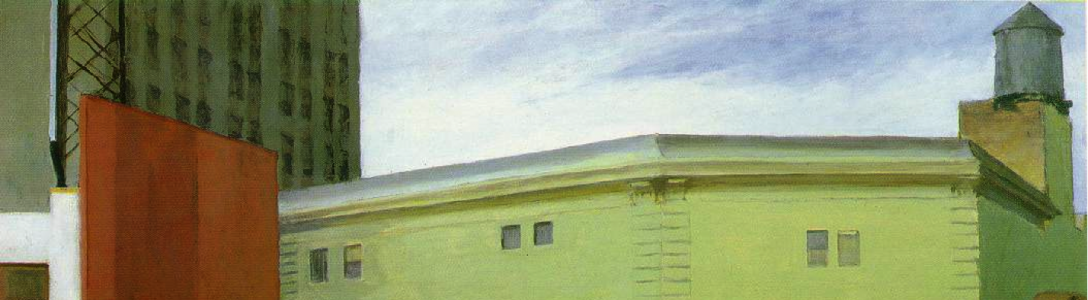
My poor father. I was a writer, I was a writer, but my indolent, voracious brain gnawed at my own entrails | From Roberto Bolaño’s 2666

“My poor father. I was a writer, I was a writer, but my indolent, voracious brain gnawed at
my own entrails. Vulture of my Prometheus self or Prometheus of my vulture self, one day I understood that I might go so far as to publish excellent articles in magazines and newspapers, and even books that weren’t unworthy of the paper on which they were printed. But I also understood that I would never manage to create anything like a masterpiece. You may say that literature doesn’t consist solely of masterpieces, but rather is populated by so-called minor works. I believed that, too. Literature is a vast forest and the masterpieces are the lakes, the towering trees or strange trees, the lovely, eloquent flowers, the hidden caves, but a forest is also made up of ordinary trees, patches of grass, puddles, clinging vines, mushrooms, and little wild-flowers. I was wrong. There’s actually no such thing as a minor work. I mean: the author of the minor work isn’t Mr. X or Mr. Y. Mr. X and Mr. Y do exist, there’s no question about that, and they struggle and toil and publish in newspapers and magazines and sometimes they even come out with a book that isn’t unworthy of the paper it’s printed on, but those books or articles, if you pay close attention, are not written by them.

“Every minor work has a secret author and every secret author is, by definition, a writer of
masterpieces. Who writes the minor work? A minor writer, or so it appears. The poor man’s
wife can testify to that, she’s seen him sitting at the table, bent over the blank pages, restless
in his chair, his pen racing over the paper. The evidence would seem to be incontrovertible.
But what she’s seen is only the outside. The shell of literature. A semblance,” said the old
man to Archimboldi and Archimboldi thought of Ansky. “The person who really writes the
minor work is a secret writer who accepts only the dictates of a masterpiece.

“Our good craftsman writes. He’s absorbed in what takes shape well or badly on the page.
His wife, though he doesn’t know it, is watching him. It really is he who’s writing. But if his wife had X-ray vision she would see that instead of being present at an exercise of literary creation, she’s witnessing a session of hypnosis. There’s nothing inside the man who sits there writing. Nothing of himself, I mean. How much better off the poor man would be if he devoted himself to reading. Reading is pleasure and happiness to be alive or sadness to be alive and above all it’s knowledge and questions. Writing, meanwhile, is almost always empty. There’s nothing in the guts of the man who sits there writing. Nothing, I mean to say, that his wife, at a given moment, might recognize. He writes like someone taking dictation. His novel or book of poems, decent, adequate, arises not from an exercise of style or will, as the poor unfortunate believes, but as the result of an exercise of concealment. There must be many books, many lovely pines, to shield from hungry eyes the book that really matters, the wretched cave of our misfortune, the magic flower of winter!

“Excuse the metaphors. Sometimes, in my excitement, I wax romantic. But listen. Every
work that isn’t a masterpiece is, in a sense, a part of a vast camouflage. You’ve been a soldier, I imagine, and you know what I mean. Every book that isn’t a masterpiece is cannon fodder, a slogging foot soldier, a piece to be sacrificed, since in multiple ways it mimics the
design of the masterpiece. When I came to this realization, I gave up writing. Still, my mind
didn’t stop working. In fact, it worked better when I wasn’t writing. I asked myself: why does a masterpiece need to be hidden? what strange forces wreath it in secrecy and mystery?

“By now I knew it was pointless to write. Or that it was worth it only if one was prepared to
write a masterpiece. Most writers are deluded or playing. Perhaps delusion and play are the
same thing, two sides of the same coin. The truth is we never stop being children, terrible children covered in sores and knotty veins and tumors and age spots, but ultimately children, in other words we never stop clinging to life because we are life. One might also say: we’re theater, we’re music. By the same token, few are the writers who give up. We play at believing ourselves immortal. We delude ourselves in the appraisal of our own works and in our perpetual misappraisal of the works of others. See you at the Nobel, writers say, as one might say: see you in hell.

From Roberto Bolaño’s 2666, in Natasha Wimmer’s translation.

The novel, so unanimously acclaimed, was called Twilight | From Roberto Bolaño’s 2666

The following excerpt of Roberto Bolaño’s 2666 (in Natasha Wimmer’s translation) is more or less self-contained, or at least as self-contained as anything in that labyrinth. It’s the summary of a character named Ansky’s novel; Hans Reiter (aka Archimboldi) is reading Ansky’s diaries while hiding during the war–

The novel, so unanimously acclaimed, was called Twilight and its plot was very simple: a boy of fourteen abandons his family to join the ranks of the revolution. Soon he’s engaged in combat against Wrangel’s troops. In the midst of battle he’s injured and his comrades leave him for dead. But before the vultures come to feed on the bodies, a spaceship drops onto the battlefield and takes him away, along with some of the other mortally wounded soldiers. Then the spaceship enters the stratosphere and goes into orbit around Earth. All of the men’s wounds are rapidly healed. Then a very thin, very tall creature, more like a strand of seaweed than a human being, asks them a series of questions like: how were the stars created? where does the universe end? where does it begin? Of course, no one knows the answers. One man says God created the stars and the universe begins and ends wherever God wants. He’s tossed out into space. The others sleep. When the boy awakes he finds himself in a shabby room, with a shabby bed and a shabby wardrobe where his shabby clothes hang. When he goes to the window he gazes out in awe at the urban landscape of New York. But the boy finds only misfortune in the great city. He meets a jazz musician who tells him about chickens that talk and probably think.

“The worst of it,” the musician says to him, “is that the governments of the planet know it and that’s why so many people raise chickens.”

The boy objects that the chickens are raised to be eaten. The musician says that’s what the chickens want. And he finishes by saying:

“Fucking masochistic chickens, they have our leaders by the balls.”

He also meets a girl who works as a hypnotist at a burlesque club, and he falls in love. The girl is ten years older than the boy, or in other words twenty-four, and although she has a number of lovers, including the boy, she doesn’t want to fall in love with anyone because she believes that love will use up her powers as a hypnotist. One day the girl disappears and the boy, after searching for her in vain, decides to hire a Mexican detective who was a soldier under Pancho Villa. The detective has a strange theory: he believes in the existence of numerous Earths in parallel universes. Earths that can be reached through hypnosis. The boy thinks the detective is swindling him and decides to accompany him in his investigations. One night they come upon a Russian beggar shouting in an alley. The beggar shouts in Russian and only the boy can understand him. The beggar says: I fought with Wrangel, show some respect, please, I fought in Crimea and I was evacuated from Sevastopol in an English ship. Then the boy asks whether the beggar was at the battle where he fell badly wounded. The beggar looks at him and says yes. I was too, says the boy. Impossible, replies the beggar, that was twenty years ago and you weren’t even born yet.

Then the boy and the Mexican detective set off west in search of the hypnotist. They find her in Kansas City. The boy asks her to hypnotize him and send him back to the battlefield where he should have died, or accept his love and stop fleeing. The hypnotist answers that neither is possible. The Mexican detective shows an interest in the art of hypnosis. As the detective begins to tell the hypnotist a story, the boy leaves the roadside bar and goes walking under the night sky. After a while he stops crying.

He walks for hours. When he’s in the middle of nowhere he sees a figure by the side of the road. It’s the seaweedlike extraterrestrial. They greet each other. They talk. Often, their conversation is unintelligible. The subjects they address are varied: foreign languages, national monuments, the last days of Karl Marx, worker solidarity, the time of the change measured in Earth years and stellar years, the discovery of America as a stage setting, an unfathomable void—as painted by Dore—of masks. Then the boy follows the extraterrestrial away from the road and they walk through a wheat field, cross a stream, climb a hill, cross another field, until they reach a smoldering pasture.

In the next chapter, the boy is no longer a boy but a young man of twenty-five working at a Moscow newspaper where he has become the star reporter. The young man receives the assignment to interview a Communist leader somewhere in China. The trip, he is warned, is extremely difficult, and once he reaches Peking, the situation may be dangerous, since there are lots of people who don’t want any statement by the Chinese leader to get out. Despite these warnings, the young man accepts the job. When, after much hardship, he finally gains access to the cellar where the Chinese leader is hidden, the young man decides that not only will he interview him, he’ll also help him escape the country. The Chinese leader’s face, in the light of a candle, bears a notable resemblance to that of the Mexican detective and former soldier under Pancho Villa. The Chinese leader and the young Russian, meanwhile, come down with the same illness, brought on by the pestilence of the cellar. They shake with fever, they sweat, they talk, they rave, the Chinese leader says he sees dragons flying low over the streets of Peking, the young man says he sees a battle, perhaps just a skirmish, and he shouts hurrah and urges his comrades onward. Then both lie motionless as the dead for a long time, and suffer in silence until the day set for their flight.

Each with a temperature of 102 degrees, the two men cross Peking and escape. Horses and provisions await them in the countryside. The Chinese leader has never ridden before. The young man teaches him how. During the trip they cross a forest and then some enormous mountains. The blazing of the stars in the sky seems supernatural. The Chinese leader asks himself: how were the stars created? where does the universe end? where does it begin? The young man hears him and vaguely recalls a wound in his side whose scar still aches, darkness, a trip. He also remembers the eyes of a hypnotist, although the woman’s features remain hidden, mutable. If I close my eyes, thinks the young man, I’ll see her again. But he doesn’t close them. They make their way across a vast snow-covered plain. The horses sink in the snow. The Chinese leader sings. How were the stars created? Who are we in the middle of the boundless universe? What trace of us will remain?

Suddenly the Chinese leader falls off his horse. The young Russian examines him. The Chinese leader is like a burning doll. The young Russian touches the Chinese leader’s forehead and then his own forehead and understands that the fever is devouring them both. With no little effort he ties the Chinese leader to his mount and sets off again. The silence of the snow-covered plain is absolute. The night and the passage of stars across the vault of the sky show no signs of ever ending. In the distance an enormous black shadow seems to superimpose itself on the darkness. It’s a mountain range. In the young Russian’s mind the certainty takes shape that in the coming hours he will die on that snow-covered plain or as he crosses the mountains. A voice inside begs him to close his eyes, because if he closes them he’ll see the eyes and then the beloved face of the hypnotist. It tells him that if he closes his eyes he’ll see the streets of New York again, he’ll walk again toward the hypnotist’s house, where she sits waiting for him on a chair in the dark. But the Russian doesn’t close his eyes. He rides on.

Fifty similes, really more than fifty similes, from Roberto Bolaño’s novel 2666

  1. She looks like a nun, thought Quincy, or like she belongs to a dangerous cult.
  2. the movie in the dream was like a negative of the real movie
  3. clouds that looked like cathedrals or maybe just little toy churches abandoned in a labyrinthine marble quarry one hundred times bigger than the Grand Canyon
  4. like the work of a lunatic
  5. like a miniature Russian Orthodox church
  6. what it was most like was an enchanted island
  7. like the lilies that bloom and die in a single day
  8. a dream that breaks away from another dream like one drop of water breaking away from a bigger drop of water
  9. a metaphor is like a life jacket
  10. there are life jackets that float and others that sink to the bottom like lead
  11. I went through books like they were barbecue.
  12. friendly words that sounded like obscenities to my ear and that, thinking about it now, might actually have been obscene
  13. Reading is like thinking, like praying, like talking to a friend, like expressing your ideas, like listening to other people’s ideas, like listening to music (oh yes), like looking at the view, like taking a walk on the beach.
  14. gestured and bobbed like a rapper
  15. Hollows in the ground, like World War I bomb craters
  16. Fate headed down the stairs, taking them in threes as if he were dashing for the street, like a boy heading out for a free afternoon with his friends.
  17. smiling a catlike smile
  18. everyone, I mean everyone, is like the ancient Christians in the Roman circus
  19. Sunsets in the desert seem like they’ll never end, until suddenly, before you know it, they’re done. It’s like someone just turned out the lights
  20. She had a hoarse, nasal voice and she didn’t talk like a New York secretary but like a
    country person who has just come from the cemetery.
  21. like butterflies summoned by his prayers
  22. something like happiness
  23. stood to attention like a soldier
  24. the story grows like a snowball until the sun comes out and the whole damn ball melts and everybody forgets about it and goes back to work
  25. The fucking killings are like a strike, amigo, a brutal fucking strike.
  26. “It’s like a dream,” said Guadalupe Roncal. “It looks like something alive.”
  27. it looks like a woman who’s been hacked to pieces. Who’s been hacked to pieces but is still alive. And the prisoners are living inside this woman.”
  28. two Mexican reporters who stared at him like dying men
  29. the knowledge slipped like water through his fingers
  30. she smiled like a goddess
  31. This place is like hell
  32. A black sky like the bottom of the sea.
  33. like fucking a man who isn’t exactly a man
  34. like becoming a little girl again
  35. like being fucked by a rock. A mountain.
  36. it’s like you’re fucking a mountain but you’re fucking inside a cave
  37. In other words it’s like being fucked by a mountain in a cave inside the mountain itself
  38. Well, it feels like being fucked by the air. That’s exactly how it feels.
  39. So fucking a policeman is like being fucked by a mountain and fucking a narco is like being fucked by the air.
  40. like a tour guide with an eye for local color
  41. he treated her like his slave
  42. like a joke
  43. like the title of a David Lynch film
  44. narrow room like a monk’s cell
  45. the shadows dispersed by the flashes of car lights like comet tails in the dark
  46. It’s odd that someone would hang a book out like a shirt
  47. like a huge hearse
  48. She looked like an athlete from the 1940s.
  49. All of this is like somebody else’s dream
  50. the highway was like a river

These similes are from “The Part About Fate,” the third part of 2666, a novel by Roberto Bolaño, in English translation by Natasha Wimmer.

A metaphor is like a life jacket | From Roberto Bolaño’s 2666

Really, when you talk about stars you’re speaking figuratively. That’s metaphor. Call someone a movie star. You’ve used a metaphor. Say: the sky is full of stars. More metaphors. If somebody takes a hard right to the chin and goes down, you say he’s seeing stars. Another metaphor. Metaphors are our way of losing ourselves in semblances or treading water in a sea of seeming. In that sense a metaphor is like a life jacket. And remember, there are life jackets that float and others that sink to the bottom like lead. Best not to forget it. But really, there’s just one star and that star isn’t semblance, it isn’t metaphor, it doesn’t come from any dream or any nightmare. We have it right outside. It’s the sun. The sun, I am sorry to say, is our only star. When I was young I saw a science fiction movie. A rocket ship drifts off course and heads toward the sun. First, the astronauts start to get headaches. Then they’re all dripping sweat and they take off their spacesuits and even so they can’t stop sweating and before long they’re dehydrated. The sun’s gravity keeps pulling them ceaselessly in. The sun begins to melt the hull of the ship. Sitting in his seat, the viewer can’t help feeling hot, too hot to bear. Now I’ve forgotten how it ends. At the last minute they get saved, I seem to recall, and they correct the course of that rocket ship and turn it around toward the earth, and the huge sun is left behind, a frenzied star in the reaches of space.

From “The Part About Fate,” the third part of 2666, a novel by Roberto Bolaño, in English translation by Natasha Wimmer.

47 or so similes from Roberto Bolaño’s novel 2666

These similes are from “The Part About Amalfitano,” the second part of 2666, a novel by Roberto Bolaño, in English translation by Natasha Wimmer.

  1. It’s like a fetus
  2. he held the letter in his two hands like a life raft of reeds and grasses
  3. a doglike fervor
  4. a Turkish carpet like the threadbare carpet from the Thousand and One Nights, a battered carpet that sometimes functioned as a mirror, reflecting all of us from below
  5. standing there like a tiny and infinitely patient Amazon
  6. like pilgrims
  7. like mendicants or child prophets
  8. like someone who’s burned himself
  9. like sucking a small to medium dick
  10. like shooting a Zen arrow with a Zen bow into a Zen pavilion
  11. The lunatic, who was sitting down again, took it in the chest and dropped like a little bird.
  12. those days were like a prolonged parachute landing after a long space flight
  13. back and forth like a sleepwalker
  14. marched from the west like a ragtag army whose only strength was its numbers
  15. dropped down from the Pyrenees like the ghosts of dead beasts
  16. the floor waxer like a cross between a mastiff and a pig sitting next to a plant
  17. like a trick photograph that isn’t a trick, floating, floating pensively in the skies of Paris, weary
  18. like a memory rising up from glacial seas
  19. The University of Santa Teresa was like a cemetery that suddenly begins to think, in vain.
  20. It also was like an empty dance club.
  21. like a feudal lord riding out on horseback to survey his lands
  22. like provincial intellectuals
  23. like deeply self-sufficient men
  24. like a zombie
  25. like a medieval squire
  26. like a medieval princess
  27. Her hand was like a blind woman’s hand.
  28. like a cloud cemetery
  29. like a thick chili whose last simmer was fading in the west
  30. the coffinlike shadow
  31. purple like the skin of an Indian woman beaten to death
  32. laughing in a whisper, like a fly
  33. like an endoscopy, but painless
  34. slept like a baby
  35. I feel like a nightingale, he thought happily.
  36. like a lover whose embrace maddened the horse as well as the rider, both of them dying of fright or ending up at the bottom of a ravine, or the colocolo, or the chonchones, or the candelillas, or so many other little creatures, lost souls, incubi and succubi, lesser demons that roamed between the Cordillera de la Costa and the Andes
  37. very tan, like a singer or a Puerto Rican playboy
  38. A confident, mocking smile, like the smile of a cocksure sniper.
  39. like a joke
  40. something like laughter but also something like sorrow
  41. like the Greek state
  42. like an arrowhead
  43. burst out from a corner like someone playing a bad joke or about to attack him
  44. the slight shadow, like a hastily dug pit that gives off an alarming stench
  45. Something like the smoke signals
  46. military men behaved like writers, and writers, so as not to be outdone,
    behaved like military men, and politicians (of every stripe) behaved like writers and like military men, and diplomats behaved like cretinous cherubim, and doctors and lawyers behaved like thieves
  47. You’re like me and I’m like you. We aren’t happy.

A list of 81 (or more) similes from Roberto Bolaño’s novel 2666

  1. a horrible and notably unhygienic bathroom that was more like a latrine or cesspit
  2. A rather ordinary picture of a student in the capital, but it worked on him like a drug, a drug that brought him to tears, a drug that (as one sentimental Dutch poet of the nineteenth century had it) opened the floodgates of emotion, as well as the floodgates of something that at first blush resembled self-pity but wasn’t (what was it, then? rage? very likely)
  3. the quadrangular sky looked like the grimace of a robot or a god made in our own likeness
  4. their incomprehensible words like crystallized spiderwebs or the briefest crystallized vomitings
  5. went on the attack like Napoleon at Jena
  6. demolished the counterattack like a Desaix, like a Lannes
  7. old Hanseatic buildings, some of which looked like abandoned Nazi offices
  8. like people endlessly analyzing a favorite movie
  9. the parade of immigrants like ants loading the flesh of thousands of dead cattle into the ships’ holds
  10. the little gaucho sounded like the moon, like the passage of clouds across the moon,
    like a slow storm
  11. his eyes shining with a strange intensity, like the eyes of a clumsy young butcher
  12. the lady would begin to howl like a Fury
  13. like an ice queen
  14. news spreading like wildfire, like a nuclear conflagration
  15. a rock jutting from the pool, like a dark and iridescent reef
  16. like a painting by Gustave Moreau or Odilon Redon
  17. I suffered like a dog
  18. now the fucking mugs are like samurais armed with those fucking samurai swords
  19. the appearance of the park, which looked to him like a film of the jungle, the colors wrong, terribly sad, exalted
  20. The words old man and German he waved like magic wands to uncover a secret
  21. like drudge work, like the lowest of menial tasks
  22. that abyss like hour
  23. Like the machine celibataire.
  24. Like the bachelor who suddenly grows old, or like the bachelor who, when he returns from a trip at light speed, finds the other bachelors grown old or turned into pillars of salt.
  25. like a howling Indian witch doctor
  26. like talking to a stranger
  27. like a whisper that he later understood was a kind of laugh
  28. like a hula-hooping motion
  29. you’re behaving like stupid children
  30. they attended like sleepwalkers or drugged detectives
  31. like missionaries ready to instill faith in God, even if to do so meant signing a pact with the devil
  32. they behaved not like youths but like nouveaux youths
  33. drifted through Bologna like two ghosts
  34. who once said London was like a labyrinth
  35. he could soar over the beach like a seagull
  36. which circled in their guilty consciences like a ghost or an electric charge
  37. they were so happy they began to sing like children in the pouring rain
  38. Their remorse vanished like laughter on a spring night.
  39. smiling like squirrels
  40. like a fifteenth-century fortress
  41. circles that faded like mute explosions
  42. Coincidence, if you’ll permit me the simile, is like the manifestation of God at every moment on our planet.
  43. a voice that didn’t sound like his but rather like the voice of a sorcerer, or more specifically, a sorceress, a soothsayer from the times of the Roman Empire
  44. like the dripping of a basalt fountain
  45. he and the room were mirrored like ghostly figures in a performance that prudence and fear would keep anyone from staging
  46. Aztec ruins springing like lilacs from wasteland
  47. like a river that stops being a river or a tree that burns on the horizon, not knowing that it’s burning
  48. the city looked to them like an enormous camp of gypsies or refugees ready to pick up and move at the slightest prompting
  49. the missing piece suddenly leaped into sight, almost like a bark
  50. It’s like hearing a child cry
  51. a kind of speed that looked to Espinoza like slowness, although he knew it was only the slowness that kept whoever watched the painting from losing his mind
  52. brief moans shooting like meteorites over the desert
  53. The words tunneled through the rarefied air of the room like virulent roots through dead flesh
  54. The word freedom sounded to Espinoza like the crack of a whip in an empty classroom.
  55. The light in the room was dim and uncertain, like the light of an English dusk.
  56. Literature in Mexico is like a nursery school, a kindergarten, a playground, a kiddie club
  57. the movement of something like subterranean tanks of pain
  58. The stage is really a proscenium and upstage there’s an enormous tube, something like a mine shaft or the gigantic opening of a mine
  59. like a bad joke on the part of the mayor or city planner
  60. like pure crystal
  61. like the legs of an adolescent near death
  62. his eyes were just like the eyes of the blind
  63. clung to the Chilean professor like a limpet
  64. grimaced like a madman
  65. like a reflection of what happened in the west but jumbled up
  66. The sky, at sunset, looked like a carnivorous flower.
  67. For the first time, the three of them felt like siblings or like the veterans of some shock troop who’ve lost their interest in most things of this world
  68. a smell of meat and hot earth spread over the patio in a thin curtain of smoke that enveloped them all like the fog that drifts before a murder
  69. long roots like snakes or the locks of a Gorgon
  70. like a shirt left out to dry
  71. reality for Pelletier and Espinoza seemed to tear like paper scenery
  72. lectures that were more like massacres
  73. feeling less like butchers than like gutters or disembowellers
  74. the boy on top of the heap of rugs like a bird, scanning the horizon
  75. She was like a princess or an ambassadress
  76. cry like a fool
  77. I felt like a derelict dazzled by the sudden lights of a theater.
  78. drew me like a magnet
  79. a cement box with two tiny windows like the portholes of a sunken ship
  80. a very soft voice, like the breeze that was blowing just then, suffusing everything with the scent of flowers
  81. The cement box where the sauna was looked like a bunker holding a corpse.

These similes are from “The Part About the Critics,” the first part of 2666, a novel by Roberto Bolaño, in English translation by Natasha Wimmer. I was originally going to try to record 666 similes, but then I didn’t. I’ll record similes from the other four parts of the novel though.

Talk to me about your family history, said the bastards | Roberto Bolaño

A passage from “The Part About The Crimes” from 2666 by Roberto Bolaño in translation by Natasha Wimmer


Talk to me about your family history, said the bastards. Explain your family tree, the assholes said. Self-sucking pieces of shit. Lalo Cura didn’t get angry. Faggot sons of bitches. Tell me about your coat of arms. That’s enough now. The kid’s going to blow. Stay calm. Respect the uniform. Don’t show you’re scared or back down, don’t let them think they’re getting to you. Some nights, in the dim light of the tenement, when he was done with the books on criminology (don’t lose it now, man), dizzy from all the fingerprints, blood and semen stains, principles of toxicology, investigations of thefts, breaking and entering, footprints, how to make sketches and take photographs of the crime scene, half asleep, drifting between sleep and wakefulness, he heard or remembered voices talking to him about the first Exposito, the family tree dating back to 1865, the nameless orphan, fifteen years old, raped by a Belgian soldier in a one-room adobe house outside Villaviciosa. The next day the soldier got his throat cut and nine months later a girl was born, called Maria Exposito. The orphan, the first one, said the voice, or several voices taking turns, died in childbirth and the girl grew up in the same house where she was conceived, which became the property of some peasants who took her in and treated her like another member of the family. In 1881, when Maria Exposito was fifteen, on the feast day of San Dimas, a drunk from another town carried her off on his horse, singing at the top of his lungs: Que chingaderas son estas I Dimas le dijo a Gestas. On the slope of a hill that looked like a dinosaur or a Gila monster he raped her several times and disappeared. In 1882, Maria Exposito gave birth to a child who was baptized Maria Exposito Exposito, said the voice, and the girl was the wonder of the peasants of Villaviciosa. From early on she showed herself to be clever and spirited, and although she never learned to read or write she was known as a wise woman, learned in the ways of herbs and medicinal salves. In 1898, after she had been away for seven days, Maria Exposito appeared one morning in the Villaviciosa plaza, a bare space in the center of town, with a broken arm and bruises all over her body. She would never explain what had happened to her, nor did the old women who tended to her insist that she tell. Nine months later a girl was born and given the name Maria Exposito, and her mother, who never married or had more children or lived with any man, initiated her into the secret art of healing. But the young Maria Exposito resembled her mother only in her good nature, a quality shared by all the Maria Expositos of Villaviciosa. Some were quiet and others liked to talk, but common to them all was their good nature and the fortitude to endure periods of violence or extreme poverty. But young Maria Exposito’s childhood and adolescence were more carefree than her mother’s and grandmother’s had been. In 1914, at sixteen, her thoughts and actions were still those of a girl whose only tasks were to accompany her mother once a month in search of rare herbs and to wash the clothes, not at the public washhouse, which was too far away, but behind the house, in an old wooden trough. That was the year Colonel Sabino Duque (who in 1915 would be shot to death for cowardice) came to town looking for brave men—and the men of Villaviciosa were famous for being braver than anyone—to fight for the Revolution. Continue reading “Talk to me about your family history, said the bastards | Roberto Bolaño”

We’ve gotten used to death | from Roberto Bolaño’s 2666

So, wanting the thick feeling and flavor of a long book but committed to so many skinny books, I started listening to the audiobook of Roberto Bolaño’s 2666 this week. I’m about twelve hours in (it’s something like forty hours), and it’s activated so many memories and thoughts. I don’t think I’d recommend 2666 as an audiobook on the first read—it helps to know the novel’s abyssal shapes and strategies. I’ve read 2666 three times, including a back-to-back reading, and so much of the novel has stuck with me more than many other novels I’ve read. This morning—early for me—I went for a walk and listened in the baking Florida heat, sun blazing, and, in the book titled “The Part About Fate,” I heard a passage that resonated with me. I pulled my chunky body ‘neath a magnolia’s shade and opened up a note app on my phone to type some of the language, thinking I’d share it on this blog. When I got home I googled the phrases I’d recorded, and realized that I’d shared the passage on this blog eleven years ago.

I’ll put together some thoughts on revising 2666 after a decade, but here’s the passage.

From Roberto Bolaño’s 2666, “The Part About Fate, pages 266-267:

“We’ve gotten used to death,” he heard the young man say.

“It’s always been that way,” said the white-haired man, “always.”

In the nineteenth century, toward the middle or the end of the nineteenth century, said the white-haired man, society tended to filter death through the fabric of words. Reading news stories from back then you might get the idea that there was hardly any crime, or that a single murder could throw a whole country into tumult. We didn’t want death in the home, or in our dreams and fantasies, and yet it was a fact that terrible crimes were committed, mutilations, all kinds of rape, even serial killings. Of course, most of the serial killers were never caught. Take the most famous case of the day. No one knew who Jack the Ripper was. Everything was passed through the filter of words, everything trimmed to fit our fear. What does a child do when he’s afraid? He closes his eyes. What does a child do when he’s about to be raped and murdered? He closes his eyes. And he screams, too, but first he closes his eyes. Words served that purpose. And the funny thing is, the archetypes of human madness and cruelty weren’t invented by the men of our day but by our forebears. The Greeks, you might say, invented evil, the Greeks saw the evil inside us all, but testimonies or proofs of this evil no longer move us. They strike us as futile, senseless. You could say the same about madness. It was the Greeks who showed us the range of possibilities and yet now they mean nothing to us. Everything changes, you say. Of course everything changes, but not the archetypes of crime, not any more than human nature changes. Maybe it’s because polite society was so small back then. I’m talking about the nineteenth century, eighteenth century, seventeenth century. No doubt about it, society was small. Most human beings existed on the outer fringes of society. In the seventeenth century, for example, at least twenty percent of the merchandise on every slave ship died. By that I mean the dark-skinned people who were being transported for sale, to Virginia, say. And that didn’t get anyone upset or make headlines in the Virginia papers or make anyone go out and call for the ship captain to be hanged. But if a plantation owner went crazy and killed his neighbor and then went galloping back home, dismounted, and promptly killed his wife, two deaths in total, Virginia society spent the next six months in fear, and the legend of the murderer on horseback might linger for generations. Or look at the French. During the Paris Commune of 1871, thousands of people were killed and no one batted an eye. Around the same time a knife sharpener killed his wife and his elderly mother and then he was shot and killed by the police. The story didn’t just make all the French newspapers, it was written up in papers across Europe, and even got a mention in the New York Examiner. How come? The ones killed in the Commune weren’t part of society, the dark-skinned people who died on the ship weren’t part of society, whereas the woman killed in a French provincial capital and the murderer on horseback in Virginia were. What happened to them could be written, you might say, it was legible. That said, words back then were mostly used in the art of avoidance, not of revelation. Maybe they revealed something all the same. I couldn’t tell you.