Fantastic Planet (Full Film)

RIP Ray Bradbury

RIP Ray Bradbury, 1920-2012.

Thanks for helping teach me how to read.

Here’s Bradbury sharing some writing advice:

William Friedkin Interviews Fritz Lang

Book Shelves #2, 1.08.2012

. . . it’s not too difficult, very obviously, to keep ten or twenty or let’s say even a hundred books; but once you start to have 361, or a thousand, or three thousand, and especially when the total starts to increase every day or thereabouts, the problem arises, first of all of arranging all these books somewhere and then of being able to lay your hand on them one day when, for whatever reason, you either  want or need to read them at last or even to reread them.

Thus the problem of a library is twofold: a problem of space, first of all, then a problem of order.

—Georges Perec, from “Brief Notes on the Art and Manner of Arranging One’s Books” (1978)

Book shelves series #2, second Sunday of 2012. Master bedroom: Corner piece bookshelf in the southwest corner; two tiers + top shelf.

I didn’t take a picture of the entire bookshelf, a humble little two-tier piece that abuts the corner of any room with corners. Actually, I did take a picture—a few—but they just looked awful. Like I said in the first installment of this series, it’s not my goal to present aesthetically pleasing portraits of bookshelves.

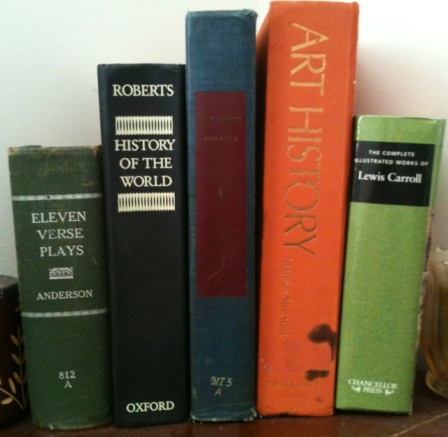
This corner bookshelf was my grandmother’s and I’ve had it for at least 10 years. The top shelf holds five books that rest there for entirely aesthetic purposes; looking at them now I realize that, with the exception of the Audubon volume in the middle and the Lewis Carroll on the end, I’ve never even bothered to flick through them. They look strange photographed here without the framed photographs, plants, and tchotchkes that attend most shelves in the house:

20120107-141429.jpg

At one point, this entire piece of furniture was double shelved (is this a term? Do you know what I mean here?) with cheap mass market paperbacks, the kind of books that I bought and received for years. I rarely buy mass markets anymore; nor do I like hardbacks. I’m a trade paperback man. Still, some of the sci-fi/dystopian lit here was fundamental to my early reading habits, to the point where I even pick up newer volumes (like Philip Pullman’s books) in mass market paperback.

We also see here the first of many cameras scattered throughout the books in this house. This particular Polaroid is likely the least antiquated; I think it’s from 1999 or 2000. I took all these photos with an iPhone:

20120107-141441.jpg

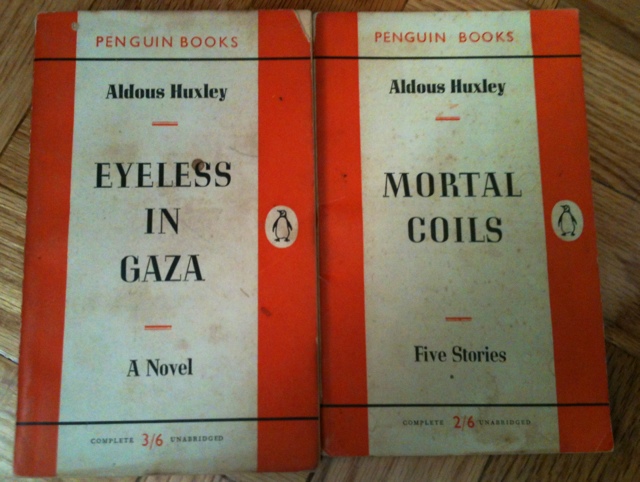
The shot is blurry, so you might not make out the cracked spines, but there are many Huxley books there (although it occurs to me now how odd it is that only one Vonnegut volume is there, when I know that I have so many more somewhere). Two noteworthy Huxleys:

20120107-141453.jpg

We have children. There are children’s books everywhere in the house, organized in no particular fashion. The drawing and painting books belonged to my grandmother, who was an amateur painter. I am fairly familiar with these books.

20120107-141500.jpg

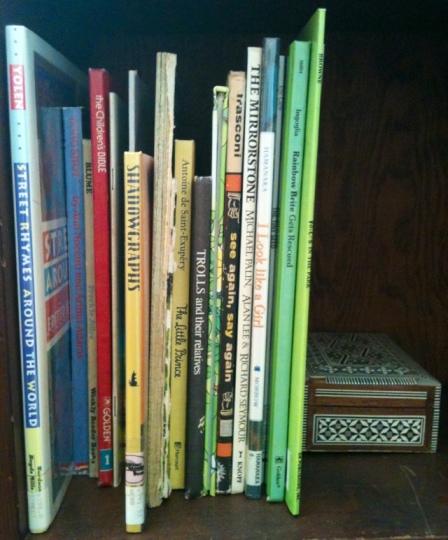
More kids books. They were probably stuffed here after piling up on the floor one night. The box is full of homemade dice and preserved insects:

20120107-141508.jpg

And more mass markets—sci-fi and fantasy. Many of these were, uh, “borrowed” and never returned, either from a school that I used to work for (The Left Hand of Darkness; Alas Babylon, the aforementioned Pullman volumes), or from dear friends (I’m looking at you, William Gibson books). There are probably 50 more books like this in a secret stash in the back of the house, out of sight:

20120107-141519.jpg

The Lord of the Rings trilogy is an early paperback edition, sporting Tolkien’s original illustrations. My aunt gave me these. I’ve probably read The Lord of the Rings more than any other book, and I’m almost certain that I’ve owned it in more editions than any other book:

20120107-141526.jpg

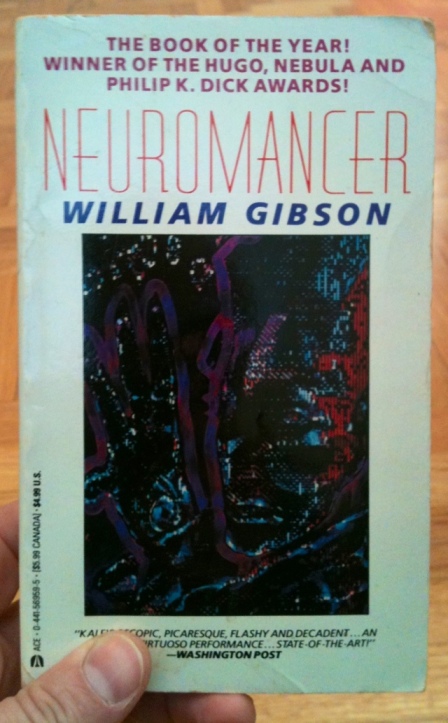
 A dear friend lent me Gibson’s Neuromancer years ago; I know Gibson’s other early books (the first two trilogies) must be somewhere around the house, unless I passed them on, but I’ve always been fond of this book, which taught me how to read in some ways:

20120107-141534.jpg

So we’ve made it out of my bedroom—I chose not to take a picture of my wife’s night stand, for her privacy, I suppose, although she might not have cared. (She doesn’t read this blog and is likely unaware of this weird project). There was a Hayao Miyazaki adaptation she was reading to our daughter there, and Hemingway’s novel The Garden of Eden, which I think she finished just the other night.

David Lynch Talks About Making Dune (1985 Interview)

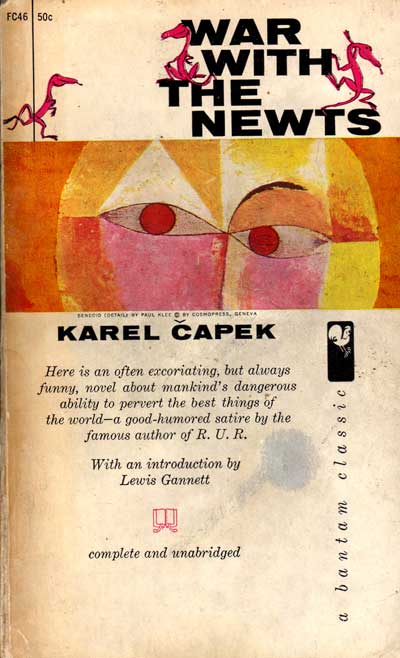
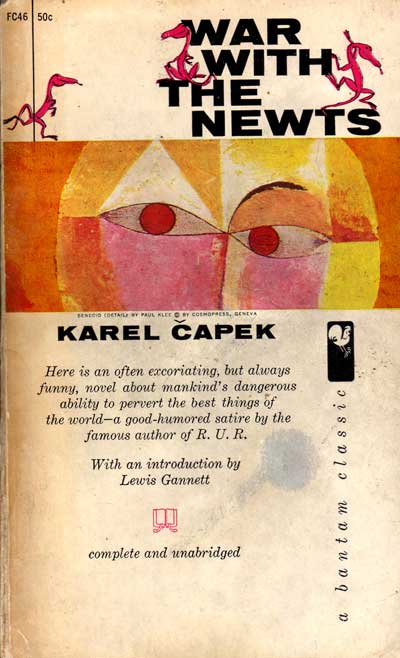
War With the Newts — Karel Capek


Even though the plot of War with the Newts may not shock audiences accustomed to its “human-invention-intended-for- good-becomes-in-the-end-not-so-good” story, readers shouldn’t neglect this often-overlooked science-fiction classic from 1937 by notable Czech writer and satirist Karel Capek.  Humans, motivated by a range of impulses: greed, curiosity, and sometimes even the best of intentions, have created an uncontrollable menace and brought about the end to their dominion over the planet.  Computers, robots, even monkeys have spelled doom for mankind, but Capek warned, in this short and sparkling book, that while masses of intelligent amphibians must be dealt with cautiously, true danger arises from our manipulation of the natural world, the unceasing capitalist drive to increase production by exploiting the weakest, and our inability to foresee the consequences of our actions.

The action begins when a drunk but benevolent sea captain discovers a new species of amphibians inhabiting the waters near an isolated island in the Pacific Ocean.  These docile creatures are able to breathe on land, walk on their hind legs, and communicate using rudimentary sounds and gestures.  The captain trains them to speak a pidgin English and dive for pearls before arming them so that they might fend off the sharks that prey on their young.  Once he receives generous financial backing from a Dutch conglomerate, he ships them to similar islands where pearl harvests have been been impossible or unproductive.  Eventually big business determines that the tireless and fecund newts are valuable for the expansion and development of economic activities near the coasts and under the seas and develop a global marketplace for trade in their labor and bodies.  Educated, well-equipped, and trained to use with the most advanced technologies, the newts produce the greatest expansion of wealth in the history of the world before taking it all for themselves, returning the continents to the bottom of the ocean while requiring a small cadre of humans, relocated to the mountains, to produce the steel and weapons required to support their new Atlantis.

Written as a history book, Capek brilliantly footnotes his narrative with carefully crafted primary sources: newspaper reports, academic studies, religious tracts, political manifestos and corporate minutes in order to illustrate human reaction to new, unsettling circumstance.  A nimble author blessed with the knowledge and skill to write comfortably about a wide variety of subjects, Capek captures both the progressive and cautious voices that shape human reaction to the slow advancement of a new and underestimated intelligence.  He shows that agreement against economic interest is impossible;  labor, for instance, bemoans loss of work to newt hordes while agriculture comes to rely on the millions of new mouths that have to be fed.  Scholars measure, analyze, and categorize; anonymous tract-writers urge an uneasy populace to take up arms against sea-dwelling usurpers while the young and fashionable flock to newt cults, giving themselves up to sexual licentiousness they relish the mysterious and taboo.

But though Capek capably documents trivialities, most of his accounts reflect the time in which he lived and wrote, between the two great European wars, situated between Stalin’s Russia and Hitler’s new Germany, at the height of colonial exploitation, not yet separated by a century from the horrors of the trans-Atlantic slave trade and the American Civil War.  In a report written by the “Salamander Syndicate,” the organization responsible for the organization and dissemination of the world trade in newts justifies the “humane” husbandry, categorization, and sale of newts according to their physical attributes.  Exemplary newts are invited to join committees and expound on their visions for a future shared with humans.  Echoes of American abolitionist thought appear in the debates waged in the media regarding the existence of newt art and culture, their assumed “soullessness,” and the minimal levels of education required for their lives as workers.

The newts, masters of human technology, eventually take over.  Humans, fleeing to higher ground,  are incapable of bringing the fight to the seas.   War with the Newts is an indictment not only of our ability to take without question unearned economic value, but also of our inability to halt the mechanisms by which we accrue those benefits once it becomes evident that the process of enrichment, by itself, is detrimental to the common good.  This is a very good book, a satire of the institutions that will fail when we need them the most, created by a writer whose demonstrated virtuosity deserves more attention.

“The novel, so unanimously acclaimed, was called Twilight” — An Excerpt from Roberto Bolaño’s 2666

The following excerpt of Roberto Bolaño’s 2666 is more or less self-contained, or at least as self-contained as anything in that labyrinth. It’s the summary of a character named Ansky’s novel; Hans Reiter (aka Archimboldi) is reading Ansky’s diaries while hiding during the war–

The novel, so unanimously acclaimed, was called Twilight and its plot was very simple: a boy of fourteen abandons his family to join the ranks of the revolution. Soon he’s engaged in combat against Wrangel’s troops. In the midst of battle he’s injured and his comrades leave him for dead. But before the vultures come to feed on the bodies, a spaceship drops onto the battlefield and takes him away, along with some of the other mortally wounded soldiers. Then the spaceship enters the stratosphere and goes into orbit around Earth. All of the men’s wounds are rapidly healed. Then a very thin, very tall creature, more like a strand of seaweed than a human being, asks them a series of questions like: how were the stars created? where does the universe end? where does it begin? Of course, no one knows the answers. One man says God created the stars and the universe begins and ends wherever God wants. He’s tossed out into space. The others sleep. When the boy awakes he finds himself in a shabby room, with a shabby bed and a shabby wardrobe where his shabby clothes hang. When he goes to the window he gazes out in awe at the urban landscape of New York. But the boy finds only misfortune in the great city. He meets a jazz musician who tells him about chickens that talk and probably think.

“The worst of it,” the musician says to him, “is that the governments of the planet know it and that’s why so many people raise chickens.”

The boy objects that the chickens are raised to be eaten. The musician says that’s what the chickens want. And he finishes by saying:

“Fucking masochistic chickens, they have our leaders by the balls.”

He also meets a girl who works as a hypnotist at a burlesque club, and he falls in love. The girl is ten years older than the boy, or in other words twenty-four, and although she has a number of lovers, including the boy, she doesn’t want to fall in love with anyone because she believes that love will use up her powers as a hypnotist. One day the girl disappears and the boy, after searching for her in vain, decides to hire a Mexican detective who was a soldier under Pancho Villa. The detective has a strange theory: he believes in the existence of numerous Earths in parallel universes. Earths that can be reached through hypnosis. The boy thinks the detective is swindling him and decides to accompany him in his investigations. One night they come upon a Russian beggar shouting in an alley. The beggar shouts in Russian and only the boy can understand him. The beggar says: I fought with Wrangel, show some respect, please, I fought in Crimea and I was evacuated from Sevastopol in an English ship. Then the boy asks whether the beggar was at the battle where he fell badly wounded. The beggar looks at him and says yes. I was too, says the boy. Impossible, replies the beggar, that was twenty years ago and you weren’t even born yet.

Then the boy and the Mexican detective set off west in search of the hypnotist. They find her in Kansas City. The boy asks her to hypnotize him and send him back to the battlefield where he should have died, or accept his love and stop fleeing. The hypnotist answers that neither is possible. The Mexican detective shows an interest in the art of hypnosis. As the detective begins to tell the hypnotist a story, the boy leaves the roadside bar and goes walking under the night sky. After a while he stops crying.

He walks for hours. When he’s in the middle of nowhere he sees a figure by the side of the road. It’s the seaweedlike extraterrestrial. They greet each other. They talk. Often, their conversation is unintelligible. The subjects they address are varied: foreign languages, national monuments, the last days of Karl Marx, worker solidarity, the time of the change measured in Earth years and stellar years, the discovery of America as a stage setting, an unfathomable void—as painted by Dore—of masks. Then the boy follows the extraterrestrial away from the road and they walk through a wheat field, cross a stream, climb a hill, cross another field, until they reach a smoldering pasture.

In the next chapter, the boy is no longer a boy but a young man of twenty-five working at a Moscow newspaper where he has become the star reporter. The young man receives the assignment to interview a Communist leader somewhere in China. The trip, he is warned, is extremely difficult, and once he reaches Peking, the situation may be dangerous, since there are lots of people who don’t want any statement by the Chinese leader to get out. Despite these warnings, the young man accepts the job. When, after much hardship, he finally gains access to the cellar where the Chinese leader is hidden, the young man decides that not only will he interview him, he’ll also help him escape the country. The Chinese leader’s face, in the light of a candle, bears a notable resemblance to that of the Mexican detective and former soldier under Pancho Villa. The Chinese leader and the young Russian, meanwhile, come down with the same illness, brought on by the pestilence of the cellar. They shake with fever, they sweat, they talk, they rave, the Chinese leader says he sees dragons flying low over the streets of Peking, the young man says he sees a battle, perhaps just a skirmish, and he shouts hurrah and urges his comrades onward. Then both lie motionless as the dead for a long time, and suffer in silence until the day set for their flight.

Each with a temperature of 102 degrees, the two men cross Peking and escape. Horses and provisions await them in the countryside. The Chinese leader has never ridden before. The young man teaches him how. During the trip they cross a forest and then some enormous mountains. The blazing of the stars in the sky seems supernatural. The Chinese leader asks himself: how were the stars created? where does the universe end? where does it begin? The young man hears him and vaguely recalls a wound in his side whose scar still aches, darkness, a trip. He also remembers the eyes of a hypnotist, although the woman’s features remain hidden, mutable. If I close my eyes, thinks the young man, I’ll see her again. But he doesn’t close them. They make their way across a vast snow-covered plain. The horses sink in the snow. The Chinese leader sings. How were the stars created? Who are we in the middle of the boundless universe? What trace of us will remain?

Suddenly the Chinese leader falls off his horse. The young Russian examines him. The Chinese leader is like a burning doll. The young Russian touches the Chinese leader’s forehead and then his own forehead and understands that the fever is devouring them both. With no little effort he ties the Chinese leader to his mount and sets off again. The silence of the snow-covered plain is absolute. The night and the passage of stars across the vault of the sky show no signs of ever ending. In the distance an enormous black shadow seems to superimpose itself on the darkness. It’s a mountain range. In the young Russian’s mind the certainty takes shape that in the coming hours he will die on that snow-covered plain or as he crosses the mountains. A voice inside begs him to close his eyes, because if he closes them he’ll see the eyes and then the beloved face of the hypnotist. It tells him that if he closes his eyes he’ll see the streets of New York again, he’ll walk again toward the hypnotist’s house, where she sits waiting for him on a chair in the dark. But the Russian doesn’t close his eyes. He rides on.

A Map of Philip K. Dick’s The Man in the High Castle

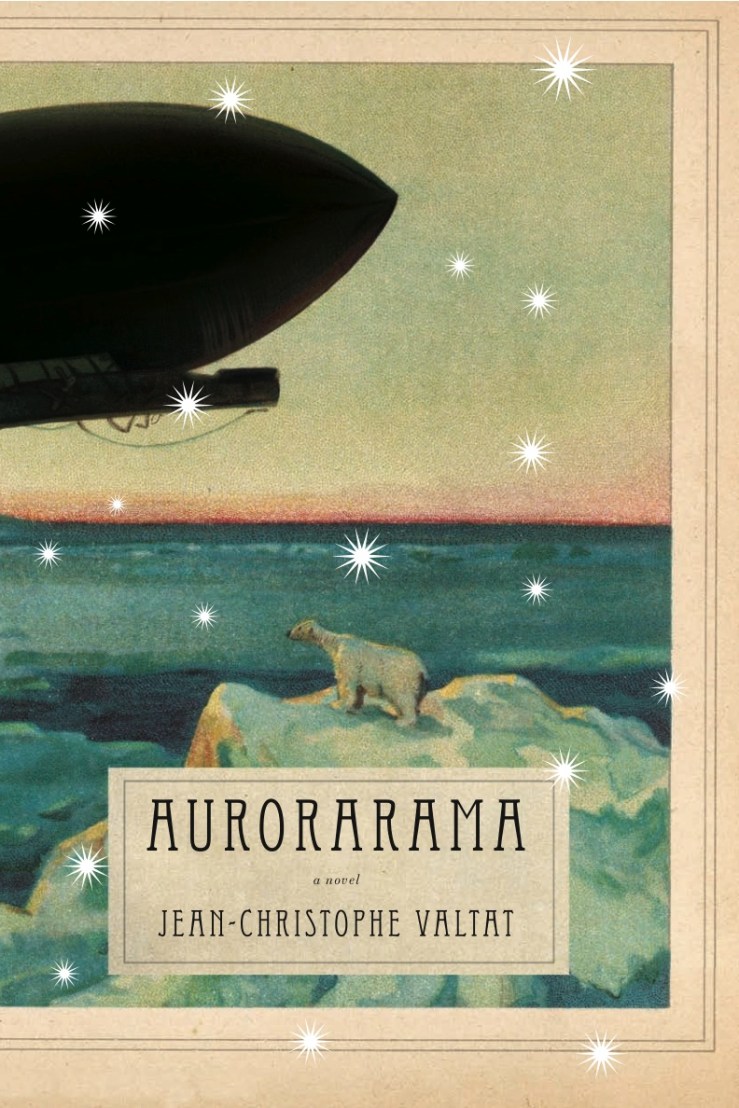
Aurorarama — Jean-Christophe Valtat

In Aurorarama, Jean-Christophe Valtat imagines an alternate world where the strange wilderness of the Arctic north has been colonized. The centerpiece of this world is New Venice, a bizarre metropolis on ice, bustling with a hodgepodge of cultures and brimming with dire conspiracies. New Venice showcases a kind of steampunk technology that surpasses its otherwise post-Victorian-era manners and mores: there are airships and pneumatic tubes, dream chambers and psychedelic drugs (lots and lots of drugs). Those drugs are part of New Venice’s underground, a subculture that also features a “Polar Pop” scene (although most of the groups seem to make art-noise-dirge-weird music, not pop). Beyond the subversive art scene, however, more sinister forces are at work in New Venice. The city lies under the shadow of a mysterious black zeppelin; a samizdat Utopian text is circling the underground, challenging the establishment’s authority–and causing the secret police, the Gentlemen of the Night, to shake down suspects left and right; the native Inuit are preparing to revolt; the secretive Scavengers have found a dead woman in a mysterious automotive sled. If this sounds awfully complex, it is. Thrown into the middle of the mess are the book’s protagonists. Duke Brentford Orsini, a reserved and idealistic man, is ostensibly the director of the city’s greenhouse–although he seems to spend most of his time juggling the various political (or, in the book’s terms, “poletical”) problems that surge and resurge in New Venice. Brentford’s levelheadedness contrasts with his friend Gabriel d’Allier’s rakish charm. Gabriel is a literature professor on the edge of collapse–not that that gets in the way of his frequent drug binges and sexual escapades. Valtat alternates his chapters between the pair, forwarding the plot via Brentford’s mounting political (and supernatural!) problems and Gabriel’s libertine snags.

Valtat’s world is as thick as polar ice, with its own history, mythology, culture, and political science. The events in Aurorarama are essentially in media res; the adventure begins at the tail-end of a previous disaster. Valtat has given himself plenty of space here to expand the story–both in sequels and prequels (a novel detailing the founding of New Venice, an event alluded to in Aurorarama, would be fascinating). Valtat also exhibits a playful sense of humor, both in the story’s plot, but also in his tone, which often plays off of stodgy Victorian tropes in humorous ways, particularly in the chapters featuring Gabriel. At the same time, Valtat’s book is quite serious, as he labors to evoke a wholly-realized, wholly-strange world. Sometimes his sentences strain under this pressure, no doubt in part because Valtat is a native French speaker; this is his first novel composed in English. The occasionally over-long or clunky phrase does not, however, detract much from the pleasures of Aurorarama, which rest rather in Valtat’s vital imagination. This is an intelligent work of speculative fiction, steeped in the tradition of Jules Verne and H.G. Wells; it also readily recalls The Difference Engine (by William Gibson and Bruce Sterling), Philip Pullman’s His Dark Materials trilogy, and even, in some of its strong imagery, the steampunk visions of Hayao Miyazaki. Recommended.

Aurorarama is new in hardback from Melville House.

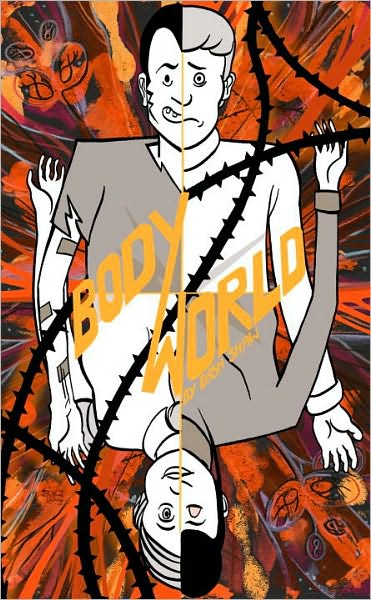
BodyWorld — Dash Shaw

In the future Dash Shaw proposes in his graphic novel BodyWorld, the Second Civil War and rapid industrial growth have left most of America a concrete sprawl by 2060. An exception is Boney Borough, a (literal) green zone somewhere on the Atlantic seaboard. This small secluded town is a new Eden in an otherwise gray world. Enter Professor Paulie Panther, a fuck-up par excellence. He goes to Boney Borough as part of a freelance mission to find out about a new, strange plant he’s found there via the internet. Professor Panther, you see, is a botanist and poet, a would-be scientist who finds out about the psychopharmacological properties of plants by smoking them up in big fat joints (when he’s not too busy trying to commit suicide or stumbling around on one or more of the various drugs to which he’s addicted). Professor Panther is the perfect acerbic foil to the homogeneous folk of Boney Borough. He gets hot for teacher Jem Jewel, turns-on Peach Pearl, the small town girl who wants to go to the big city, and pisses off and confuses her dumb jock boyfriend Billy-Bob Borg. The alliterative names (along with Shaw’s sharp, cartoonish style) recall–and subvert–the classic all-Americanism of Archie comics. Professor Panther soon discovers that the mystery plant, when smoked, grants the user strange telepathic abilities–namely, users sense the “body-mind” of the bodies of others around them.

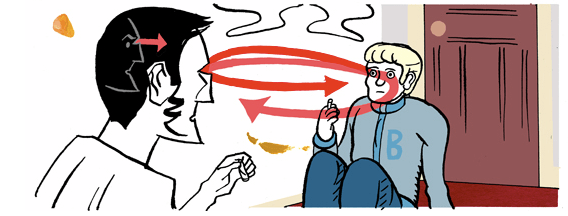
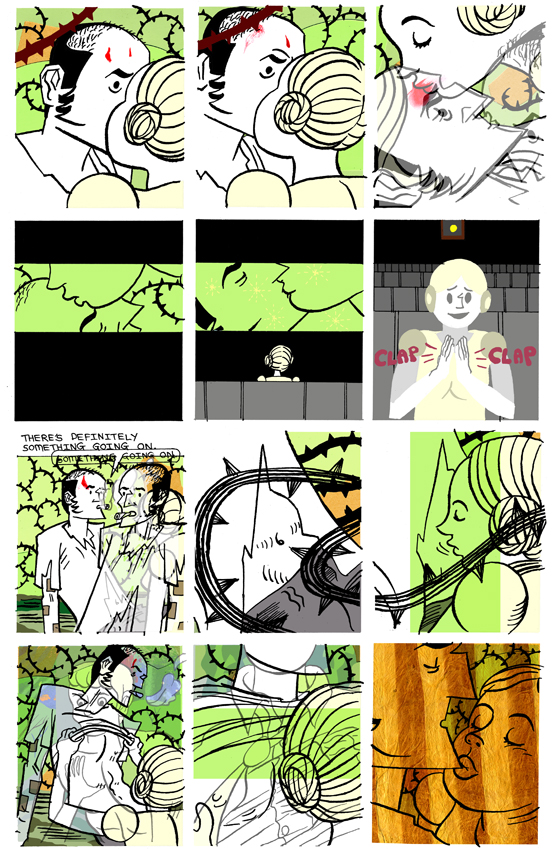
The plant’s telepathic effects allow Shaw to explore what happens within a literalized I-see-you-seeing-me-seeing-you-seeing-me (seeing-y0u-seeing-me . . .) structure. His bright Pop Art goes Cubist in psychedelic trip scenes, superimposing images to show a surreal conflation of not just the melding of two people’s pasts and presents, but those people’s perceptions of past and present. Very heady stuff–but seeing Shaw’s work is superior to my description, of course. Observe, as Panther sees Pearl seeing Panther seeing Pearl idealizing their attempt at romance:

BodyWorld is sardonically humorous in its psychoanalytic visions, guided in no small part by Professor Panther’s hilarious outsider perspective, but also tempered by Shaw’s larger project, a sci-fi satire of American exurbanist insularity. We wrote earlier this month about science fiction’s tendency to work within the dichotomy of wastelands and green zones, and Shaw’s work is no exception. His marvelous trick is to keep us within the green zone of Boney Borough the whole time and to make us identify with a waster, Panther. The greatest irony is that in this futurist vision, the zombies are the ones in the green zone.

Not everyone’s a conformist though. There are exceptions, of course, especially in the seedy Outer Rim where Panther takes up transient residence. We meet a psychotic latter-day Johnny Appleseed who certainly shares Panther’s weirdo proclivities. The episode is a marvelous spoof on the corny “origin stories” standard in Golden and Silver Age comics, with Shaw’s treatment more loving than mocking. To tell more about this weirdo might spoil the climax of Shaw’s graphic novel, and we don’t want to do that, of course, because you’re going to want to read it, aren’t you? Suffice to say that it’s part and parcel of Shaw’s program, a sweet and sour subversion of the 1950s comics and contemporary conformist groupthink politics. Shaw owes some debt to the neat precision, spacing, and rhythm of Chris Ware, as well as the haunting inks and sharp wit of Charles Burns but it would be a mistake to see this young talent as anything but original. Still, while we’re making comparisons: Richard Kelly could make a messy, sprawling treasure of a film out of BodyWorld.

You can read all of BodyWorld now at Shaw’s website, or you can do what I did and read Pantheon’s new graphic novel version (Pantheon, you will remember, brought us the David Mazzucchelli’s outstanding graphic novel Asterios Polyp). Either way, you should read it. Highly recommended.

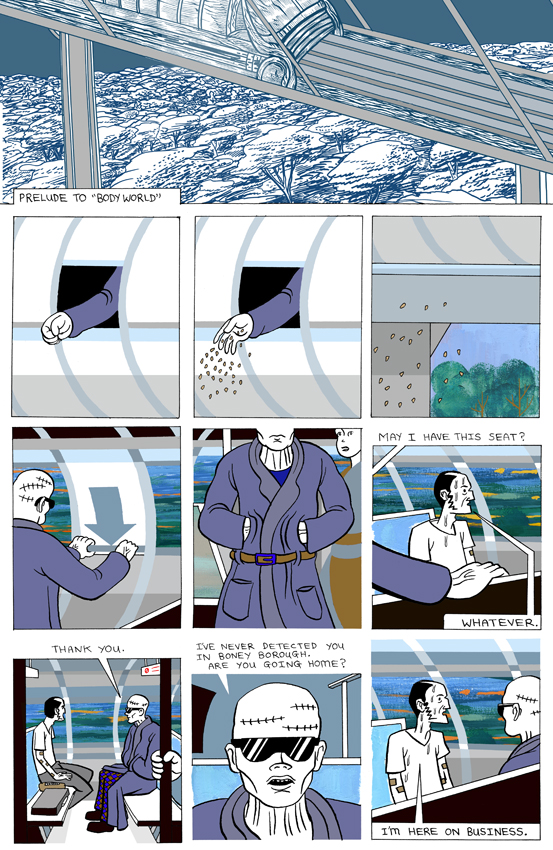
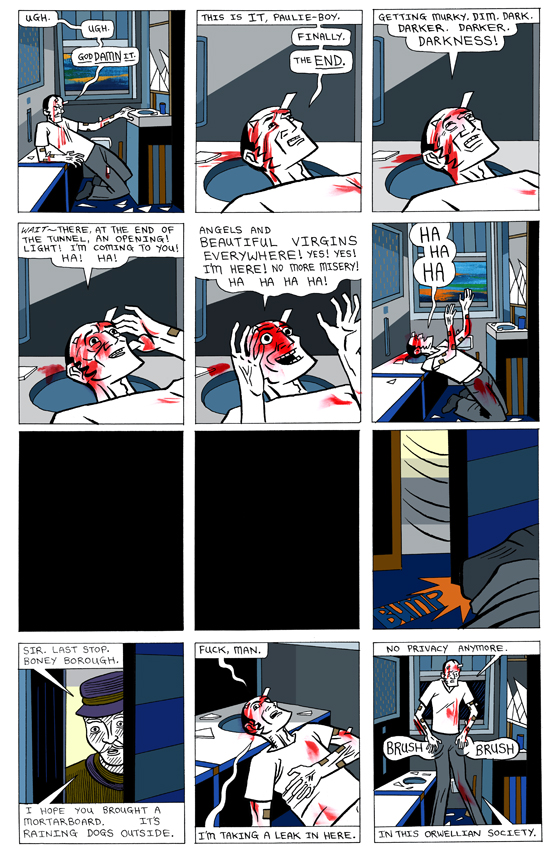
Prelude to Dash Shaw’s BodyWorld

I’m finishing up Pantheon’s gorgeous new edition of BodyWorld, Dash Shaw’s graphic novel. Shaw originally serialized BodyWorld on his website from 2007-2009, but it’s nice to have it a big heavy physical form. Full review forthcoming, but in the meantime, check out the prelude (and go to Shaw’s website for more)–

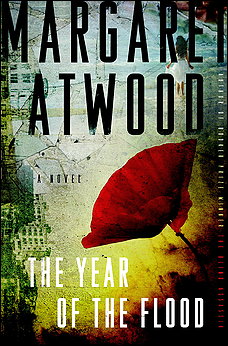
Two Visions of Apocalypse: Margaret Atwood’s The Year of the Flood and Martin Bax’s The Hospital Ship

I finished Martin Bax’s surreal dystopian romance The Hospital Ship last night and then finished the audiobook version of Margaret Atwood’s hyperreal dystopian anti-romance The Year of the Flood today. Both books take their cues from that first apocalypse story, the story of Noah and his ark, and continue that tradition imagining a version of the end of the world. Despite their mythical-biblical origins, such books tend to get ghettoized into a certain genre of science fiction — let’s call it apocalypse fiction — despite the artistic power or literary merit of the author’s prose itself. Apocalypse books like Kurt Vonnegut’s satire Cat’s Cradle, Cormac McCarthy’s The Road, and Aldous Huxley’s Ape and Essence diverge in style, tone, and execution. It’s their subject that compels us, each vision a proposition, a promise of some kind of future, a future after the future. Many of these apocalypse books remain prescient today. However, others feel dated simply because so much of what the author wrote twenty or fifty or more years ago more or less came true. For instance, is the homogenized, greenzoned aristocracy of Brave New World who lavish in the trivial culture of the feelies and centrifugal bumblepuppy all that different from contemporary exurbanites who basically live in walled-off compounds, little homogenized townships that strive to exist outside of civic reality and history? Robert Siegel’s recent report for NPR on the The Villages, an eerie Florida compound for senior citizens, illustrates how willing people are to buy into a company-owned, company-governed greenzone. The Villages even has its own whimsical fake “history,” complete with markers and plaques. It’s like The Prisoner or something. But enough about real life. We have apocalypse lit to tell us about the present.

The heroes of Atwood’s The Year of the Flood are not, for the most part, from the corporate-controlled compounds that keep the rest of the world at bay. There’s Toby, the orphan who grows up tough yet learns the healing arts. There’s Ren, a young girl trying to find her identity wherever she can. There’s their would-be spiritual guide, Adam One, and his lieutenant/rival Zeb. They are outsiders, members of an eco-cult called The Gardeners who worship saints like Rachel Carson, Ernest Shackleton, and Sojourner Truth. Flood is the sprawling companion to Atwood’s 2003 novel, Oryx and Crake, which I enjoyed very much. Both take place in a world where the “Waterless Flood,” a SARS/mega-flu type virus brought about via genetic tinkering, has turned most people into zombie-goo. I could go and on about the world Atwood shapes here, one full of genetic modification, eco-terrorism, religious fervor, and radical disparity, but other folks have already done it. So, in the grand tradition of internet laziness, I point you to excellent reviews here and here, which do a better job explicating the plot than I’m willing to do now (and it was an audiobook, remember, so I don’t exactly have it in front of me. Mea culpa). Apocalypse lit isn’t so much predictive as it is descriptive of the contemporary world, and Atwood’s dystopian vision is no exception. Viscerally prescient, Flood paints our own society in bold, vibrant colors, magnifying the strange relationships with nature, religion, and our fellow humans that modernity prescribes. Atwood ends her book in media res, with Toby and a handful of other characters somehow still alive, ready, perhaps, to become stewards of a new world. Flood concludes tense and, in a sense, unresolved, but Atwood implies hope: Toby will lead her small group to cultivate a new Eden. Despite all the ugliness and cruelty and devastation, people can be redeemed. The audiobook rendition of The Year of the Flood is very good, employing three actors to play the three principal roles, Ren, Toby, and Adam One. There are also terribly cheesy full-band versions of the hippy-dippy songs the Gardeners like to sing on certain Saint Days that are witty as parody but ultimately distracting. Atwood’s prose sometimes relies on placeholders and stock expressions common to sci-fi and YA fiction, and her complex plot (disappointingly) devolves to a simple adventure story in the end, but her ideas and insights into what our society might look like in a few decades are compelling reading (or, uh, listening in this case). Recommended.

The doctors, specialists, sailors, and patients of the titular vessel in Martin Bax’s The Hospital Ship are afloat in their own greenzone of sorts, a moving compound that seeks to treat the troubled world. What’s the trouble with the world? No one’s sure, exactly–there’s permanent all-out-war, of course, famine perhaps, insanity for sure. There’s also a bizarre army of bureaucrats going from continent to continent crucifying men and raping women for no clear reason. The ship’s psychiatrists diagnose it “The Crucifixion Disease.” Euan, Bax’s erstwhile lead, tries to figure out how to love and how to heal in the middle of hate and extinction. Aided by the eccentric, Falstaffian Dr. Maximov Flint, Euan conducts an experimental therapy between a Moi prostitute named V and a suicidal Wall Street broker named W. He also finds a lover and partner in an American girl named Sheila. About half of The Hospital Ship comprises citations from a variety of non-fiction texts, including medical textbooks, psychiatric studies, sociology texts, travelogues, war diaries, and more. The technique is bizarre and jarring, and Bax often imitates the style of such texts, most of which linger on sex or death. There’s also an obsession with the Vietnam War, which makes sense as the book was published in 1976. There’s a lovey-hippie type vibe to the hospital ship’s personnel, and like Atwood with her Gardeners, Bax is satirical and loving to his heroes at the same time. He mocks some of the silly idealism of the movement even as he finds solace in their vision of love and healing in an apocalyptic world. Bax’s book is wholly weird, disconnected, lurching and farcical, a madcap dystopian Love Boat on peyote. I spotted it at my favorite used bookstore, intrigued first by the (now retro-)futurist font, then the name, echoing Chris Adrian’s The Children’s Hospital, another book about a hospital-as-ark. If the black-and-white collage cover art didn’t seal the deal, then the blurb from J.G. Ballard comparing Bax favorably to William Burroughs did. Burroughs is an appropriate reference point, with the sexual alienation and the medical flavor and the cut-up technique and all, but Bax’s writing is utterly Ballardian (he even directly cites Ballard among other authors–like, you know APA style in-text citations). The Hospital Ship is a cult novel which might not have a big enough cult. It definitely belongs in print again; until then, pick up a copy if you can find one.

Perdido Street Station/The City & The City — China Miéville

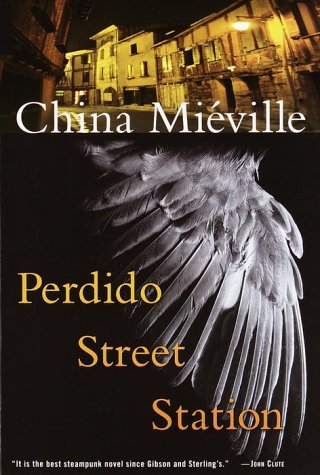
perdido_street_station_us

Despite being a bit too long, I enjoyed listening to Random House’s new audiobook recording of China Miéville‘s second novel, Perdido Street Station, read by John Lee. Perdido Street Station is Miéville’s first novel set in the steampunk world of Bas-Lag, a strange world populated by plenty of bizarre races and even more bizarre “Remades,” persons who have been forced (or in some instances have chosen) to restructure their biological makeup to perform (very) specific jobs. This sci-fi adventure story centers around protagonist Isaac Van der Grimnebulin, an overweight renegade scientist trying to perfect a new technology he calls “crisis energy.” Isaac is trying to help a Garuda named Yagherak who, as a form of punishment, has had his marvelous wings cut off. To this end, Isaac experiments with a strange caterpillar that feeds off of an hallucinogenic drug called “dreamshit.” Unfortunately, the caterpillar turns into a giant dream-feeding, brainsucking moth that, along with its relatives, terrorizes the city at night. Isaac tries to stop the moths and save his girlfriend, an artist with a bug’s head. Lots of picaresque adventuring ensues.

Miéville’s Bas-Lag world is finely detailed and richly imagined, and will no doubt appeal to anyone who digs H.P. Lovecraft or William Gibson. Miéville certainly has a handle on both of his many concepts (artificial intelligence, the nature of bodies, difference and (literal) alienation), and his story unfolds with the thrilling clip one expects from pulp fiction. Still, the book felt overwritten to me. Miéville never settles on just one adjective if two (or three) come to mind, and he’s in love with adverbs (oh the adverbs in this book! Is there a sentence without one?). And while exposition of a sort is certainly necessary in a novel about such a profoundly strange world, I think that Miéville would get a bigger payoff if he trusted his reader a bit more. Perdido Street Station feels rhetorically claustrophobic, as if Miéville is afraid to let his reader imagine even a little of Bas-Leg for him or herself. It’s a bit selfish, really. On the whole though, a great read (or listen, in this case), and it intrigued us enough to go straight into Miéville’s latest book, The City & The City (also newly released this summer from Random house, also read by John Lee).

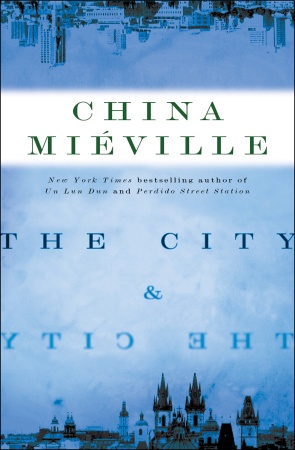
the city and the city

The City & The City combines noir detective fiction with one of science fiction’s greatest gambits, namely, positing something utterly implausible, unimaginable, and then making it ordinary. In The City & The City, two cities, Beszel and Ul Qoma, occupy the exact same geographic space, yet their citizens are trained from birth to “unsee” and “unhear” all aspects of the other city. Inspector Tyador Borlu is drawn into the mysterious death of a beautiful young woman (is there an older trope? Edgar Allan Poe even wrote an essay on why and how you should use beautiful yong dead girls in your literature). His investigation leads him into crossing the border between the cities, an impossible border, of course, and yet the genius of the book here is that, through Borlu’s narration, the reader doesn’t experience this bordercrossing (and its attendant “unseeing”) as satirical or even ridiculous; rather, we witness the uncanny alienation of double consciousness. Miéville, a Marxist, is working in part from some of Althusser‘s ideas, and he’s not afraid to namedrop Foucault or Žižek. Thankfully, however, Miéville not only knows his theorists, he knows enough not to let theory get in the way of a Chandleresque murder mystery that explores themes of surveillance, alterity, and what it means to see someone seeing you seeing them seeing you (seeing them seeing you . . .). Great stuff.

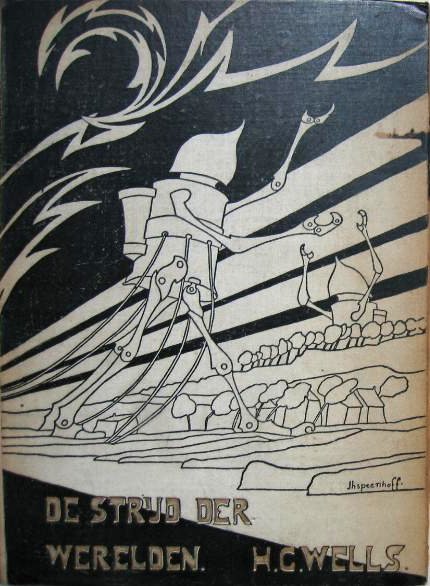
The War of the Worlds Cover Gallery

Chez Zeus has a very thorough and thoroughly fun cover gallery for H.G. Wells’s sci-fi classic The War of the Worlds. We’ve picked a few of our favorite covers here, but the full collection is great. For full artist credits and dates, check out Zeus’s complete gallery.

0003

Continue reading “The War of the Worlds Cover Gallery”

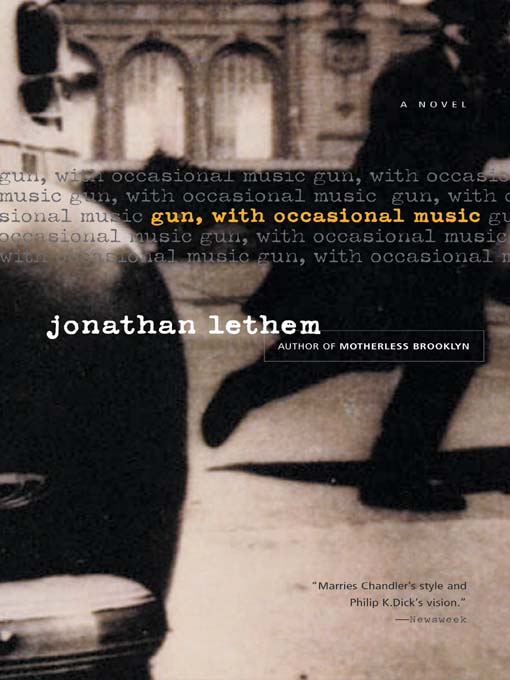
Gun, with Occasional Music–Jonathan Lethem

Jonathan Lethem’s novel Gun, with Occasional Music blends hardboiled crime noir with trippy sci-fi to examine the ethical ramifications of murder in a dystopian future where evolved animals work along side humans, mind altering drugs are not only free but encouraged by the authorities, and asking questions requires a license. Conrad Metcalf is a Private Inquisitor trying to solve a murder case involving a urologist, a baby-head (a failed evolved baby), and a gun-wielding kangaroo.

Two of the blurbs for Lethem’s debut describe the work as a marriage of Philip K. Dick and Raymond Chandler, but for my taste their wasn’t enough PKD. The details involving the “make” that Metcalf compulsively snorts, the genetic evolution techniques society now uses to produce children, and the genital nerve-ending swaps that people now enjoy are never fully explored. Sometimes bizarre details left unexplained create the dramatic immersion that the best SF achieves; Gun seems to throw ideas up against a wall to see if any stick. Many of the SF tropes that Lethem evokes are simply under-utilized. His ideas are playful, so why doesn’t he play with them more?

On the noir, end, the book also disappoints a little. The case is solved, but Metcalf’s solution–delivered entirely in a brief chapter crammed with exposition–seems hardly believable, or even really that interesting. This isn’t to suggest that Lethem’s/Conrad’s Chandlerisms aren’t enjoyable, and at times downright genius. Even when Lethem cranks out a clunker of a simile–and there’s more than one here–the rhetoric comes across more as satire of the genre as opposed to bad writing. The book also moves at a nice clip, with short, snappy chapters that always propel the narrative action. Eventually though, it just runs out steam. The story doesn’t really add up, and towards the end, it becomes clear that Lethem’s not going to fill us in on all of the cool ideas he initiated. I recommend those new to Lethem start with Motherless Brooklyn or The Fortress of Solitude instead. Or Men and Cartoons. Or The Disappointment Artist. Avoid You Don’t Love Me Yet like the plague.

His Dark Materials Trilogy — Philip Pullman

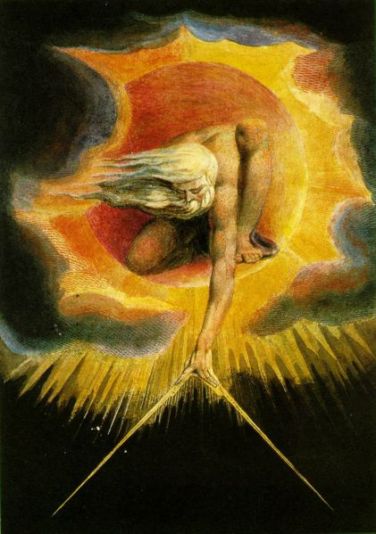
421px-blake_ancient_of_days.jpg
William Blake, “Ancient of Days”

Over the past three weeks, I read, and, alternately listened to, Philip Pullman’s fantastic His Dark Materials trilogy–The Golden Compass, The Subtle Knife, and The Amber Spyglass. Here’s the short review:

If it’s necessary to critically situate and compare a fantasy or sci-fi series against precursor series–namely, The Lord of the Rings, The Chronicles of Narnia, The Chronicles of Prydain, Harry Potter, etc.–and I don’t think it is necessary to critically situate and compare a fantasy or sci-fi series against its precursors, but that’s generally how these things are done–(this is turning into a monster of a “short review”)–but if it is necessary to critically situate and compare a fantasy or sci-fi series against precursor series, I think that Pullman’s His Dark Materials must be considered a new classic, an instantly-canonizable contribution to children’s literature, imaginative fiction, sci-fi, fantasy, or whatever genre you want to affix to these marvelous books.

His Dark Materials follows Lyra and Will, two children from different worlds (literally) who must work together to repair a damaged multiverse. Lyra comes from a world where people travel side by side with their daemons, spirit-images of their souls who take animal shapes. Will is an outsider in “our” world, a young fatherless boy who must take care of his mentally ill mother. The novels, in their simplest sense, detail the coming of age of these two as the traverse multiple parallel universes. In the backdrop there are witches and zeppelins, armored bears and dark specters, a compass that can point to the truth and a knife that can open all worlds, angels and scientists, and Lyra’s cruel and terrible parents, the cunning Mrs. Coulter, and Lord Asriel, whose will to kill God–The Authority–precipitates the action of the narrative.

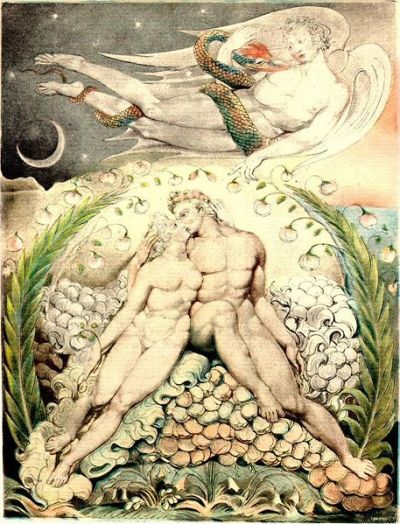
blake_satan_adam_eve.jpg
William Blake, “Satan Watching the Caress of Adam and Eve”

As many critics have pointed out, His Dark Materials recapitulates Milton’s Paradise Lost (the series takes its name from a line from that epic poem). However, the series really reinterprets the British Romantics’ assessment of Paradise Lost. Pullman engages a host of Romantic writers, foregrounding Keats’s idea of negative capability, and prefacing many of the chapters with quotes from Romantic poetry. In particular, Pullman cites William Blake. Indeed, it seems to me that His Dark Materials effectively synthesizes many of Blake’s poems and ideas, The Marriage of Heaven and Hell and Songs of Innocence and of Experience in particular. The novel also engages a number of Nietzsche’s ideas, and even, I believe, alludes to several concepts of Derrida’s (in particular, the idea of the gift of death). Additionally, Pullman weaves in the many-worlds theory, extended discussions of evolutionary anthropology, rampant infanticide, and auto-trepanation. Good stuff.

When the film of The Golden Compass (I didn’t see it) came out last year, it ignited a small controversy about the books. According to the Baptist Press, Pullman presents “a fantasy universe where witches are good, the church is bad, and at the end of it all, God dies.” This really isn’t the case, if you want to go with a precise reading of Pullman’s actual words, but, consider the source. I’m sure the controversy is healthy for Pullman’s sales; it certainly piqued my interest in the book, and I’m guessing that there are plenty of kids who, once their private Christian schools banned the books, couldn’t wait to get their hands on the verboten goods. And that’s a good thing.

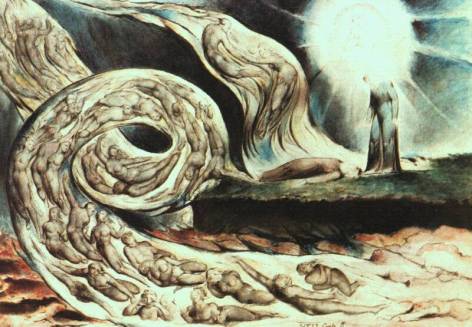
blake2.jpg
William Blake, “Whirlwind of Lovers”

His Dark Materials meets and surpasses my notions of good fantasy/sci-fi/imaginative fiction: the books engage multiple complex ideas in a new and often unsettling way. Unlike the Harry Potter series, which simply operates within familiar, preexisting archetypes of fantasy, Pullman’s work consistently disrupts reader expectations, pushing set ideas about religion and science, art and fantasy into new and fantastic places. Ultimately, although many will seek to suppress this book as an “amoral” work, His Dark Materials proposes a very real set of ethics inscribed in a world of moral relativity. The characters grow up and make good, selfless choices, decisions they make independent of absolute moral authority.

I very highly recommend these books.

William Gibson

Just out of high school, I had a mild obsession with William Gibson’s so-called cyberpunk novels. The first and most famous of these is Neuromancer, an incredibly prescient book that the Wachowski Bros. shamelessly ripped off in The Matrix. Neuromancer is the first in “The Sprawl” trilogy; Count Zero and Mona Lisa Overdrive followed. I borrowed and never returned Neuromancer from Tilford; a few years ago I lent it, along with Burning Chrome, Gibson’s collection of short stories, to a student who in turn never returned them. I read Count Zero and Mona Lisa Overdrive at the same time as my college roommate Jordan. I don’t know who has these books now.

In 1990 Gibson co-authored a book called The Difference Engine with Bruce Sterling. The Difference Engine posits a Victorian England where computers have already been created and are in use. The novel explores the consequences of a technological revolution coming a 100 years early. This book launched what is sometimes called the “steampunk” genre. After TDE, Gibson spent the 90s writing three novels often referred to as “The Bridge” trilogy: the first, Virtual Light, was pretty good (it had a really cool idea about “organic computers”); the second, Idoru, was pretty bad, really; the last, All Tomorrow’s Parties, was downright awful (I couldn’t finish it–I was embarrassed for one of my favorite authors!) At the beginning of the new millenium, technology had caught up to Gibson’s cyberpunk visions, making some of the details of his Bridge trilogy seem outdated or just plain hokey.

I knew our time together was up when I passed on a $4 copy of 2003’s Pattern Recognition at Barnes & Noble a few years ago. Despite his fiction taking a dip, Gibson’s blog, as well as his essays (often published in Wired magazine–check out what is probably his most famous piece, “Disneyland with the Death Penalty”) remain relevant and entertaining. Maybe his forthcoming novel, Spook Country, will prove more entertaining; until then, at least we have the Sprawl Trilogy.

(Check out more William Gibson covers at this gallery)