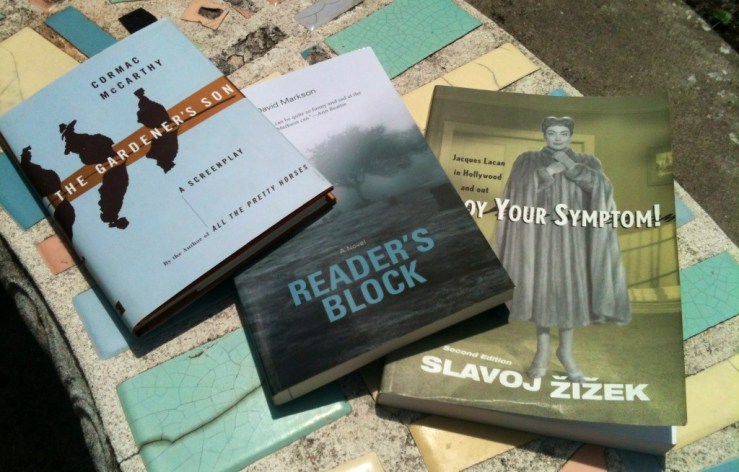
David Markson, Cormac McCarthy, Slavoj Žižek (Books Acquired, 5.19.2012)

20120521-122339.jpg

I ordered David Markson’s Reader’s Block from my local book shop, and intended to get it—and only it—this Saturday. Somehow I took a detour through the film section and picked up the Žižek and didn’t put it back; in the same section I also picked up McCarthy’s screenplay The Gardener’s Son, which is the only thing I haven’t read by him to date, so I picked it up too. So there you go.

“Alexander Stole an Ear from a Morgue” (Tom McCarthy on the Haunted Telephone)

If technology in general is at once a form both of self-extension and of amputation, then the branch of it that concerns itself with information and its relay—communication technology—is a true field-hospital operating -theater floor of hacked-off limbs, of bereaved bodies. A quick glance at the history of almost any comm.tech device will illustrate this perfectly.

Take the telephone: Alexander Bell, its inventor, grew up in the shadow of his father who ran a school for deaf-mutes and was continually inventing machines to substitute their powers of hearing and speaking. As a student, Alexander stole an ear from a morgue so that he could try to reproduce its inner workings mechanically; a few years later he brought home another defunct ear and, attached to it, the woman he’d marry, deaf like his mother. After his first brother died when his lungs gave out on him, he made a pact with the remaining one that if a second of them should die, the survivor would invent a device capable of receiving messages from the afterlife, should such a thing turn out to exist. The second brother did die, and Bell invented the telephone. He would probably have invented it anyway, and in fact remained a sceptic vis-a-vis the question of existence after death—but only because his brother never called. The desire for the call was there, wired into the very apparatus, haunting it.

From Tom McCarthy’s forthcoming essay “Transmission and the Individual Remix.”

May Day? Labour Day? Loyalty Day?

The following is excerpted from one of our favorite freely-found books, Alice van Straalen’s The Book of Holidays Around the World:

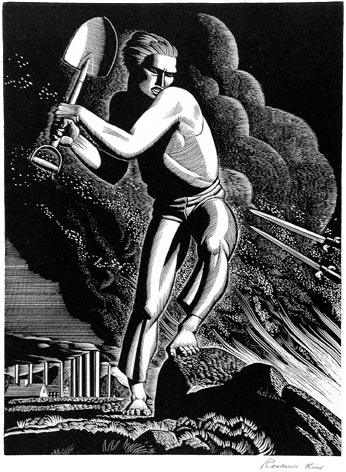
May Day: Worldwide —  In a festival that lasted from April 28 to May 3, the Romans offered flowers to Flora, their goddess of spring. They brought the custom to all the European lands they conquered; and by the Middle Ages it became especially popular in England. People rose early in the morning to “bring in the May.” They gathered flowers and tree branches to decorate their homes and later went to the town square where the maypole–often over 100 feet tall–was raised, and a woman representing the May Queen presided over the celebrations. Dancers held the streamers that fell from the top of the pole and, as they circled around it, wove them into tight patterns. When they changed directions the streamers untangled again and blew free, a tradition that some towns in England and America have continued. In 1889 the Second Internationale, an association of French socialists, dedicated May Day to working people, and today in many countries it is celebrated as a labor day. The Soviet Union marks the day with a military parade in Moscow.

Soviet Union…yeah, the bookover 25 years old…

Workers of the World Unite -- Rockwell Kent

But don’t worry, God-fearing Americans! It turns out that, in order to reclaim May Day from pinkos and anarchists, the U.S. government declared May 1st “Loyalty Day.” From 36 US Code §115:

(a) Designation.— May 1 is Loyalty Day.

(b) Purpose.— Loyalty Day is a special day for the reaffirmation of loyalty to the United States and for the recognition of the heritage of American freedom.

(c) Proclamation.— The President is requested to issue a proclamation—

(1) calling on United States Government officials to display the flag of the United States on all Government buildings on Loyalty Day; and
(2) inviting the people of the United States to observe Loyalty Day with appropriate ceremonies in schools and other suitable places.

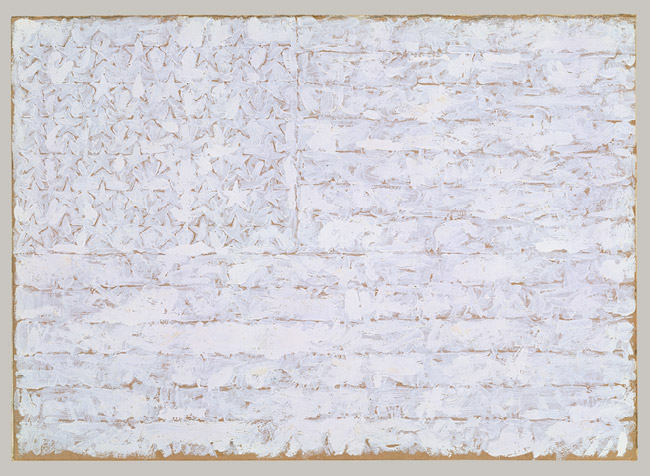
Loyalty Day? Okay, sure, why not? But are the two perspectives on this ancient festival–the concept of workers standing up for the right to control the means of production, etc., and the idea of being loyal to America–are they so different?

Flag -- Jasper Johns

Five Rules of Wisdom (From Flann O’Brien’s The Third Policeman)

‘Tell me this much,’ I ventured. ‘What sort of readings were those in the policeman’s black book?’

The Sergeant gave me a keen look which felt almost hot from being on the fire previously.

‘The first beginnings of wisdom,’ he said, ‘is to ask questions but never to answer any. You get wisdom from asking and I from not answering. Would you believe that there is a great increase in crime in this locality? Last year we had sixty-nine cases of no lights and four stolen. This year we have eighty-two cases of no lights, thirteen cases of riding on the footpath and four stolen. There was one case of wanton damage to a three-speed gear, there is sure to be a claim at the next Court and the area of charge will be the parish. Before the year is out there is certain to be a pump stolen, a very depraved and despicable manifestation of criminality and a blot on the county.’

‘Indeed,’ I said.

‘Five years ago we had a case of loose handlebars. Now there is a rarity for you. It took the three of us a week to frame the charge.’

‘Loose handlebars,’ I muttered. I could not clearly see the reason for such talk about bicycles.

‘And then there is the question of bad brakes. The country is honeycombed with bad brakes, half of the accidents are due to it, runs in families.’

I thought it would be better to try to change the conversation from bicycles.

‘You told me what the first rule of wisdom is,’ I said. ‘What is the second rule?’

‘That can be answered,’ he said.

‘There are five in all. Always ask any questions that are to be asked and never answer any. Turn everything you hear to your own advantage. Always carry a repair outfit. Take left turns as much as possible. Never apply your front brake first.’

‘These are interesting rules,’ I said dryly.

‘If you follow them,’ said the Sergeant, ‘you will save your soul and you will never get a fall on a slippy road.’

‘I would be obliged to you,’ I said, ‘if you would explain to me which of these rules covers the difficulty I have come here today to put before you.’

‘This is not today, this is yesterday,’ he said, ‘but which of the difficulties is it? What is the crux rei?’

‘Yesterday? I decided without any hesitation that it was a waste of time trying to understand the half of what he said. I persevered with my inquiry.

‘I came here to inform you officially about the theft of my American gold watch.’

He looked at me through an atmosphere of great surprise and incredulity and raised his eyebrows almost to his hair.

‘That is an astonishing statement,’ he said at last.

‘Why?’

‘Why should anybody steal a watch when they can steal a bicycle?’

From Flann O’Brien’s surreal comic masterpiece, The Third Policeman.

Denis Johnson, Malcolm Lowry, Ben Marcus (Books Acquired, 4.18.2012)

20120418-144738.jpg

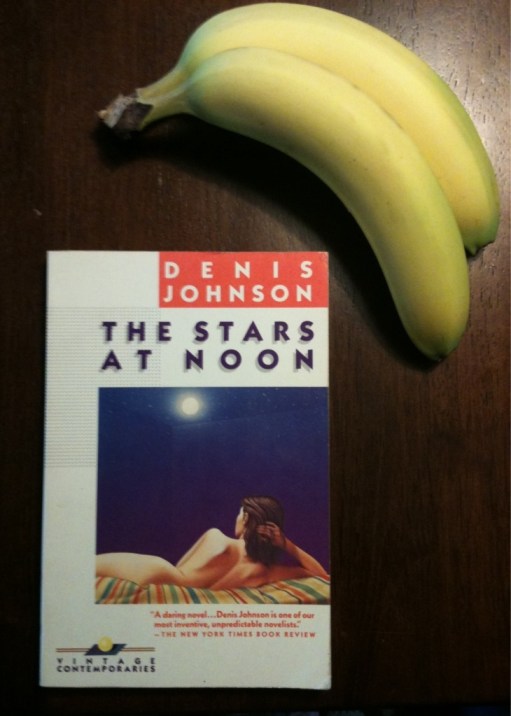
I went to the bookstore to pick up a graduation present and then spent too much time wandering the stacks. While looking for Mat Johnson’s Pym, I found a first printing paperback of Denis Johnson’s The Stars at Noon and had to have it—haven’t read it yet, and it makes a nice sister for my copy of Angels—but honestly, I’m just in love with these 1980s Vintage Contemporary editions with awful, awful covers.

20120418-144806.jpg

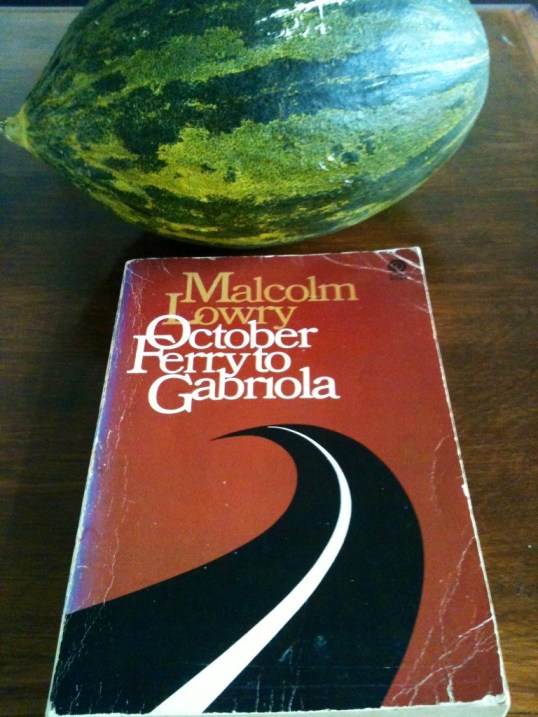
Malcolm Lowry’s last novel, the posthumously published October Ferry to Gabriola. Kind of a hideous cover.

20120418-144816.jpg

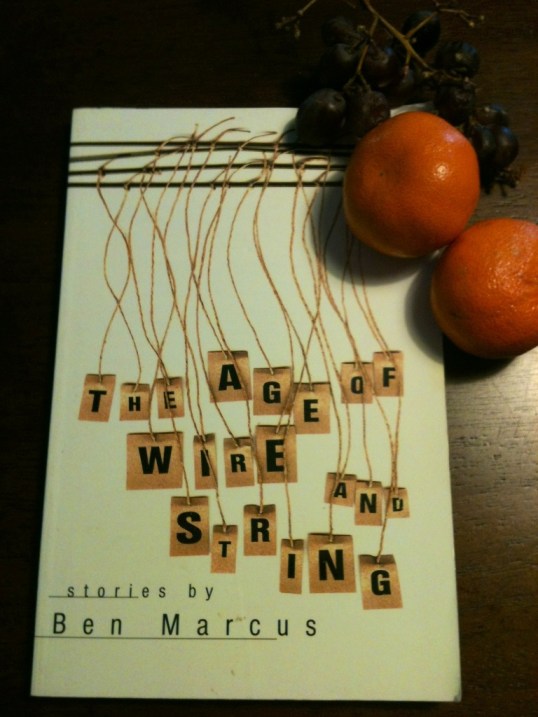
 I was looking for something by David Markson (no dice) when I came across The Age of Wire and String by Ben Marcus; I’ve been meaning to check out Marcus’s stuff, and a few minutes with the volume sold me—short vignettes, sort of like Lydia Davis or DFW or Dennis Cooper or William Burroughs (but probably not; I’m just using these as a short hand reference).

The Word of the Day Is “Doh”

Your word for today is: doh, int.

doh, int.
Pronunciation: Brit. /dəʊ/,  U.S. /doʊ/
Forms:  19– d’oh,   19– doh,   19– dooh.
Etymology:Imitative. Compare oh int.duh int.

Popularized by the American actor Dan Castellaneta who provides the voice for the character Homer Simpson in the U.S. cartoon series The Simpsons. The quotation below is his own description of its origin:

1998 Daily Variety (Nexis) 28 Apr., The D’oh came from character actor James Finlayson’s “Do-o-o-o” in Laurel & Hardy pictures. You can tell it was intended as a euphemism for “Damn”. I just speeded it up.

Although the word appears (in the form D’oh) in numerous publications based on The Simpsons, the scripts themselves simply specify annoyed grunt (as did the very earliest). Unofficial transcripts of the programme suggest the first spoken use was in a short episode, Punching Bag, broadcast on 27 Nov. 1988 as part of The Tracey Ullman Show. Its earliest occurrence in the full-length series was in the first episode Simpsons roasting on an Open Fire, broadcast on 17 Dec. 1989.

colloq.

  Expressing frustration at the realization that things have turned out badly or not as planned, or that one has just said or done something foolish. Also (usu. mildly derogatory): implying that another person has said or done something foolish (cf. duh int.).

1945  T. Kavanagh It’s That Man Again (B.B.C. radio script) 8th Ser. No. 166, Tom: Yes, out of the nest–Diana: What nest? Tom: In those whiskers–Diana: Dooh! Its [sic] no good talking to you.
1945  T. Kavanagh It’s That Man Again (B.B.C. radio script) 8th Ser. No. 167, Diana: The man I marry must be affectionate and call me ‘Dear’–Tom: Oh you’re going to be a stag’s wife–Diana: Doh!Tom: Same thing.
1952  A. Buckeridge Jennings & Darbishire xii. 183 ‘Doh!’ An anguished gasp of exasperation rang out loud and clear as Mr Wilkins found his voice again.
1989 Beano 11 Feb. 23  (caption) [Speaker is a man who is knocked against a bus stop.] Doh!
1991 Chicago Tribune (Nexis) 15 Nov. (Friday section) Pg-h, ‘The movie had one good point: It wasn’t the worst movie I’ve ever seen.’ ‘It was the worst movie I’ve ever seen.’ ‘Doh!’
1993 HP Professional (Nexis) July 28 Along their long path ISO sort of missed local area networks and network management, which gave the market over to TCP/IP and related technologies. As Homer Simpson would say: ‘Doh!’
1996  A. Fein et al.  Simpsons Comics strike Back! 14/2 ‘Look out, you dern fool! You’re gonna cut off your…’ ‘D’oh!!!’
1998  N. Jones Hollyoaks (Mersey TV transmission script) Episode 256. 44 Cindy: What are we doing here, anyway? PaulDoh! Use your head, eh?
–From today’s OED “Word of the Day” email.

Book Acquired, 4.14.2012

20120417-113551.jpg

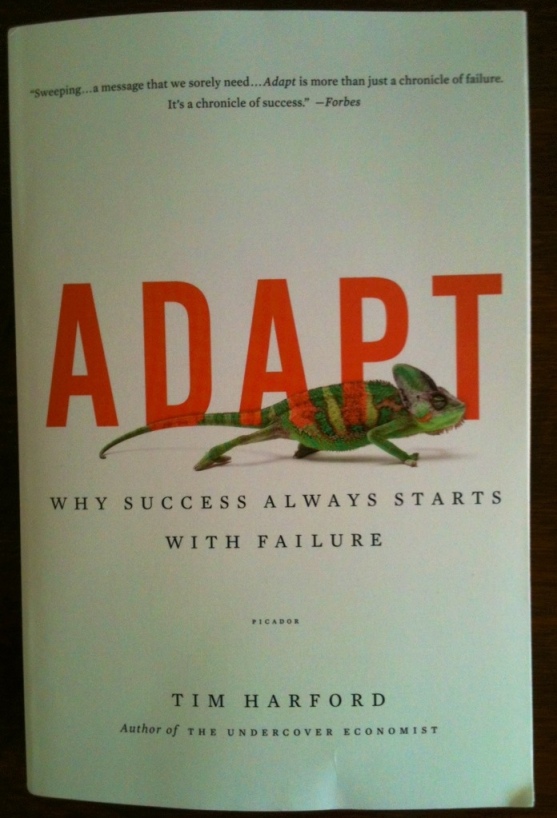
Adapt by Tim Harford. New from Picador. Their description:

In this groundbreaking book, Tim Harford, the Undercover Economist, shows us a new and inspiring approach to solving the most pressing problems in our lives. When faced with complex situations, we have all become accustomed to looking to our leaders to set out a plan of action and blaze a path to success. Harford argues that today’s challenges simply cannot be tackled with ready-made solutions and expert opinion; the world has become far too unpredictable and profoundly complex. Instead, we must adapt.

Deftly weaving together psychology, evolutionary biology, anthropology, physics, and economics, along with the compelling story of hard-won lessons learned in the field, Harford makes a passionate case for the importance of adaptive trial and error in tackling issues such as climate change, poverty, and financial crises—as well as in fostering innovation and creativity in our business and personal lives.

Taking us from corporate boardrooms to the deserts of Iraq, Adapt clearly explains the necessary ingredients for turning failure into success. It is a breakthrough handbook for surviving—and prospering— in our complex and ever-shifting world.

Oscar Wilde’s Letter to Walt Whitman

Partial transcript from The Library of Congress:

Before I leave America I must see you again–there is no one in this wide great world of America whom I love and honour so much. With warm affection, and honourable admiration, Oscar Wilde.

The Walt Whitman Archive fleshes out the story:

On 18 January 1882 Wilde visited Walt Whitman in Camden, where the poet was then living with his brother and sister-in-law. Wilde told Whitman that his mother had purchased a copy of Leaves of Grass when it was first published, that Lady Wilde had read the poems to her son, and that later, at Oxford, he and his friends carried Leaves to read on their walks. Flattered, Whitman offered Wilde, whom he later described as “a fine large handsome youngster,” some of his sister-in-law’s homemade elderberry wine, and they conversed for two hours. Asked later by a friend how he managed to get the elderberry wine down, Wilde replied: “If it had been vinegar I would have drunk it all the same, for I have an admiration for that man which I can hardly express”

Hawthorne and Thoreau Dine Together Then Take a Stroll

From Nathaniel Hawthorne’s journal (via):

September 1, 1842. Mr. Thoreau dined with us yesterday…. He is a keen and delicate observer of nature–a genuine observer–which, I suspect, is almost as rare a character as even an original poet; and Nature, in return for his love, seems to adopt him as her especial child, and shows him secrets which few others are allowed to witness. He is familiar with beast, fish, fowl, and reptile, and has strange stories to tell of adventures, and friendly passages with these lower brethren of mortality. Herb and flower, likewise, wherever they grow, whether in garden or wildwood, are his familiar friends. He is also on intimate terms with the clouds, and can tell the portents of storms. It is a characteristic trait that he has a great regard for the memory of the Indian tribes, whose wild life would have suited him so well; and strange to say, he seldom walks over a ploughed field without picking up an arrow-point, a spearhead, or other relic of the red men–as if their spirits willed him to be the inheritor of their simple wealth.

With all this he has more than a tincture of literature,–a deep and true taste for poetry, especially for the elder poets, and he is a good writer,–at least he has written a good article, a rambling disquisition on Natural History, in the last Dial, which, he says, was chiefly made up from journals of his own observations. Methinks this article gives a very fair image of his mind and character,–so true, innate, and literal in observation, yet giving the spirit as well as letter of what he sees, even as a lake reflects its wooded banks, showing every leaf, yet giving the wild beauty of the whole scene. Then there are in the article passages of cloudy and dreamy metaphysics, and also passages where his thoughts seem to measure and attune themselves into spontaneus verse, as they rightfully may, since there is real poetry in them. There is a basis of good sense and of moral truth, too, throughout the article, which also is a reflection of his character; for he is not unwise to think and feel, and I find him a healthy and wholesome man to know.

After dinner (at which we cut the first watermelon and muskmelon that our garden has ripened) Mr. Thoreau and I walked up the bank of the river; and, at a certain point, he shouted for his boat. Forthwith, a young man paddled it across the river, and Mr. Thoreau and I voyaged farther up the stream, which soon became more beautiful than any picture, with its dark and quiet sheet of water, half shaded, half sunny, between high and wooded banks. The late rains have swollen the stream so much that many trees are standing up to their knees, as it were, in the water, and boughs, which lately swung high in air, now dip and drink deep of the passing wave. As to the poor cardinals which glowed upon the bank a few days since, I could see only a few of their scarlet hats, peeping above the tide. Mr. Thoreau managed the boat so perfectly, either with two paddles or with one, that it seemed instinct with his own will, and to require no physical effort to guide it. He said that, when some Indians visited Concord a few years since, he found that he had acquired, without a teacher, their precise method of propelling and steering a canoe. Nevertheless he was desirous of selling the boat of which he is so fit a pilot, and which was built by his own hands; so I agreed to take it, and accordingly became possessor of the Musketaquid. I wish I could acquire the aquatic skill of the original owner.

from American Notebooks (1835-42)

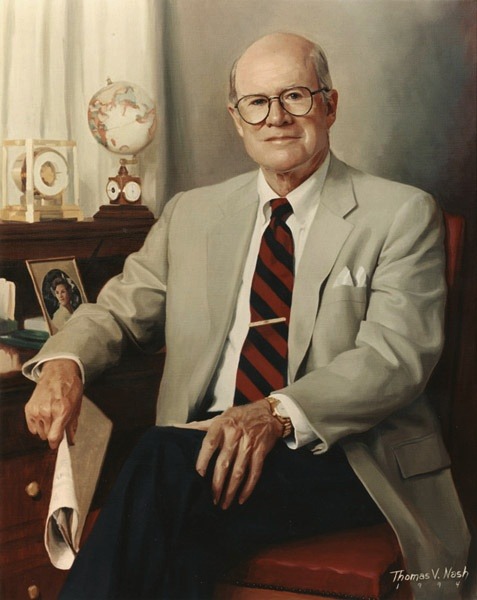
Newt Gingrich (And Other Portraits of Old, Rich White Men) by Thomas V. Nash

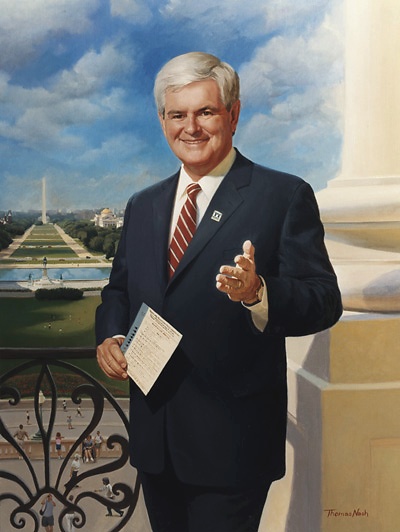
I recently saw this portrait of current Republican nomination candidate/constant font of regressive ideas Newt Gingrich on an image board I frequent. It’s by Georgia-based portrait artist Thomas Nash, whose website I had to visit after seeing this picture.

For some reason I can’t quite articulate, Nash’s portraits are surreal to me. I don’t think it’s purposeful, of course—he’s clearly a technically competent artist whose oil paintings are meant to confer a sense of power twinned in benevolence.

It must be my own sense of history, of power, of irony, that makes me feel thoroughly creeped out by this portrait of Newt—the manically glib glint in his eye (his left eyebrow ever-so slightly arched in cocky condescension), the sinister light that seems to emanate from his upraised, extended left hand, the mysterious document casually clutched in his right, the phallic authority of the Washington Monument jutting out from the Mall in the background as tiny tourists mill about, one even pausing to aim his camera from behind the scroll work at the viewer . . .

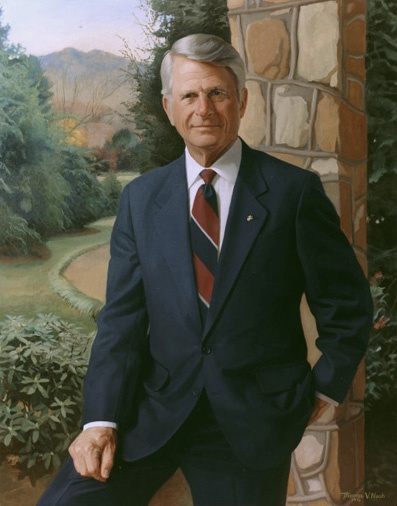
It’s odd, malevolent, and engrossing, but when paired against the other portraits in Nash’s collection of “Men,” like former Democratic Senator (and George W. Bush supporter) Zell Miller, it seems even more sinister and ironic to me, as if some evil scream lurked in the background, suppressed, detained, a black hood over its metaphorical head:

Or these guys:

In some sense, these paintings strike me as the strange dry twins of the work of sensualist John Currin, a subjective claim that is perhaps unsupportable but nevertheless seems true to me.

Thomas Pynchon’s Banana Breakfast

Another literary recipe to celebrate Thanksgiving—

At the beginning of Thomas Pynchon’s massive tome Gravitys Rainbow, Captain Geoffrey “Pirate” Prentice cooks up a bodacious banana breakfast for a bunch of hung over army officers—

Routine: plug in American blending machine won from some Yank last summer, some poker game, table stakes, B.O.Q. somewhere in the north, never remember now….Chop several bananas into pieces. Make coffee in urn. Get can of milk from cooler. Puree ‘nanas in milk. Lovely. I would coat all the booze-corroded stomachs of England. . . . Bit of marge, still smells all right, melt in the skillet. Peel more bananas, slice lengthwise. Marge sizzling, in go long slices. Light oven whoomp blow us all up someday oh, ha, ha, yes. Peeled whole bananas to go on broiler grill soon as it heats. Find marshmallows. . . .

Here’s how it all turns out–

With a clattering of chairs, upended shell cases, benches, and ottomans, Pirate’s mob gather at the shores of the great refectory table, a southern island well across a tropic or two from chill Corydon Throsp’s mediaeval fantasies, crowded now over the swirling dark grain of its walnut uplands with banana omelets, banana sandwiches, banana casseroles, mashed bananas molded into the shape of a British lion rampant, blended with eggs into batter for French toast, squeezed out a pastry nozzle across the quivering creamy reaches of a banana blancmange to spell out the words C’est magnifique, mais ce n’est pas la guerre (attributed to a French observer during the Charge of the Light Brigade) which Pirate has appropriated as his motto . . . tall cruets of pale banana syrup to pour oozing over banana waffles, a giant glazed crock where diced bananas have been fermenting since the summer with wild honey and muscat raisins, up out of which, this winter morning, one now dips foam mugsfull of banana mead . . . banana croissants and banana kreplach, and banana oatmeal and banana jam and banana bread, and bananas flamed in ancient brandy Pirate brought back last year from a cellar in the Pyrenees also containing a clandestine radio transmitter. . . .

Herman Melville’s Whale Steaks

Another entry in our ongoing series of literary recipes to celebrate Thanksgiving.

In Chapter LXIV of Herman Melville’s Moby-Dick, Stubb, second mate of the Pequod, demands whale steaks for dinner. He’s not happy with how the cook has prepared the steaks though, complaining they are too tender and overdone — his taste is closer to the sharks who are making a racket outside the ship–

“Cook,” said Stubb, rapidly lifting a rather reddish morsel to his mouth, ” don’t you think this steak is rather overdone? You’ve been beating this steak too much, cook; it’s too tender. Don’t I always say that to be good, a whalesteak must be tough? There are those sharks now over the side, don’t you see they prefer it tough and rare? What a shindy they are kicking up! Cook, go and talk to ’em; tell ’em they are welcome to help themselves civilly, and in moderation, but they must keep quiet. Blast me, if I can hear my own voice. Away, cook, and deliver my message. Here, take this lantern,” snatching one from his sideboard; ” now, then, go and preach to ’em! “

Stubb then instructs the cook on the best way to prepare whale steaks, a process involving a hot live coal. Oh, and he likes his fins pickled and his flukes soused–

“Well then, cook, you see this whale-steak of yours was so very bad, that I have put it out of sight as soon as possible; you see that, don’t you? Well, for the future, when you cook another whale-steak for my private table here, the capstan, I’ll tell you what to do so as not to spoil it by overdoing. Hold the steak in one hand, and show a live coal to it with the other; that done, dish it; d’ye hear? And now to-morrow, cook, when we are cutting in the fish, be sure you stand by to get the tips of his fins; have them put in pickle. As for the ends of the flukes, have them soused, cook. There, now ye may go.”

Eleven Authors Who Were Also Veterans of War

Eleven Authors Who Were Also Veterans of War

1. Stendahl (Napoleonic Wars)

2. Ambrose Bierce (Union Army, American Civil War)

3. Erich Maria Remarque (German Army, WWI)

4. George Orwell (Republican Army, Spanish Civil War)

5. Kurt Vonnegut (U.S. Army, WWII)

6. Joseph Heller (U.S. Air Force, WWII)

7. Eveyln Waugh (British Royal Marines, WWII)

8. Norman Mailer (U.S Army, WWII)

9. Gore Vidal (U.S. Army, WWII)

10. Tim O’Brien (U.S. Army, Vietnam War)

11. Anthony Swofford (U.S. Marine Corps, Persian Gulf War)

“Just Asking” — David Foster Wallace’s 9/11 Thought Experiment

Here’s David Foster Wallace’s “Just Asking,” from the November, 2007 issue of The Atlantic

Are some things still worth dying for? Is the American idea* one such thing? Are you up for a thought experiment? What if we chose to regard the 2,973 innocents killed in the atrocities of 9/11 not as victims but as democratic martyrs, “sacrifices on the altar of freedom”?* In other words, what if we decided that a certain baseline vulnerability to terrorism is part of the price of the American idea? And, thus, that ours is a generation of Americans called to make great sacrifices in order to preserve our democratic way of life—sacrifices not just of our soldiers and money but of our personal safety and comfort?

In still other words, what if we chose to accept the fact that every few years, despite all reasonable precautions, some hundreds or thousands of us may die in the sort of ghastly terrorist attack that a democratic republic cannot 100-percent protect itself from without subverting the very principles that make it worth protecting?

Is this thought experiment monstrous? Would it be monstrous to refer to the 40,000-plus domestic highway deaths we accept each year because the mobility and autonomy of the car are evidently worth that high price? Is monstrousness why no serious public figure now will speak of the delusory trade-off of liberty for safety that Ben Franklin warned about more than 200 years ago? What exactly has changed between Franklin’s time and ours? Why now can we not have a serious national conversation about sacrifice, the inevitability of sacrifice—either of (a) some portion of safety or (b) some portion of the rights and protections that make the American idea so incalculably precious?

In the absence of such a conversation, can we trust our elected leaders to value and protect the American idea as they act to secure the homeland? What are the effects on the American idea of Guantánamo, Abu Ghraib, Patriot Acts I and II, warrantless surveillance, Executive Order 13233, corporate contractors performing military functions, the Military Commissions Act, NSPD 51, etc., etc.? Assume for a moment that some of these measures really have helped make our persons and property safer—are they worth it? Where and when was the public debate on whether they’re worth it? Was there no such debate because we’re not capable of having or demanding one? Why not? Have we actually become so selfish and scared that we don’t even want to consider whether some things trump safety? What kind of future does that augur?

FOOTNOTES:
1. Given the strict Gramm-Rudmanewque space limit here, let’s just please all agree that we generally know what this term connotes—an open society, consent of the governed, enumerated powers, Federalist 10, pluralism, due process, transparency … the whole democratic roil.

2. (This phrase is Lincoln’s, more or less)

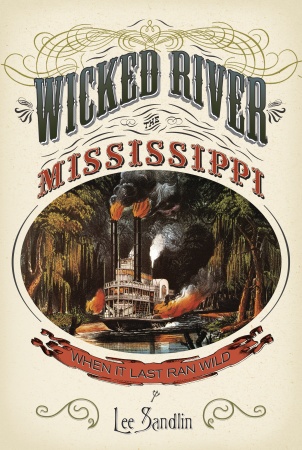
Wicked River: The Mississippi When It Last Ran Wild — Lee Sandlin

The mighty Mississippi River remains perhaps the signal geographical symbol of the United States of America. It divides our country neatly into East and West, flowing down from the industrial North to the agricultural South, and in this sense, the Mississippi is the major artery of America’s heart. We find in the Mississippi a rich mythos, one that both informs and reflects our national character. And while plenty of writers have striven to capture and express the river’s culture and character, it is Mark Twain who more or less invented our idea of the Mississippi. In his fascinating new history Wicked River, Lee Sandlin observes that, “There is a pretty much universal idea that Twain has a proprietary relationship to the Mississippi. It belongs to him, the way Victorian London belongs to Dickens or Dublin belongs to Joyce.” Sandlin’s goal in Wicked River is not to wrest the Mississippi from Twain; rather, he aims to show us the gritty turbulence swelling under Twain’s romantic myth–a myth that many Americans have come to hold as a received truth. Sandlin points out that Twain’s “Mississippi books are works of memory, even of archaeology”;  they point to a vibrant river culture in a prelapsarian past, one “with its own culture and its own language and its own unspoken rules.” Sandlin’s own book plumbs that culture, revealing strange, wild tales of river pirates and con-men, fiddlers and gamblers, road agents and robbers, politicians and drunkards, and Indians and would-be “civilizers.” Sandlin’s canny observations come from a myriad of first-hand accounts–always the sign of a legitimate history–but Wicked River is never dry or dusty, but rather brims with vigor and intensity, whether we’re learning about the earthquakes that shook up New Madrid, the tornado that smashed Natchez, the sinking of the Sultana, or the ice floe that destroyed the St. Louis Harbor. Sandlin’s writing is concise, lively, and often wry and earthy–although always grounded in fact. (One colorful passage begins, “There was one simple explanation for the wildness of river culture: everybody was drunk”). Wicked River does a marvelous job conveying the tumultuous and eclectic history of an American frontier in the nineteenth century. Recommended.

Wicked River is new in hardback this month from Pantheon.

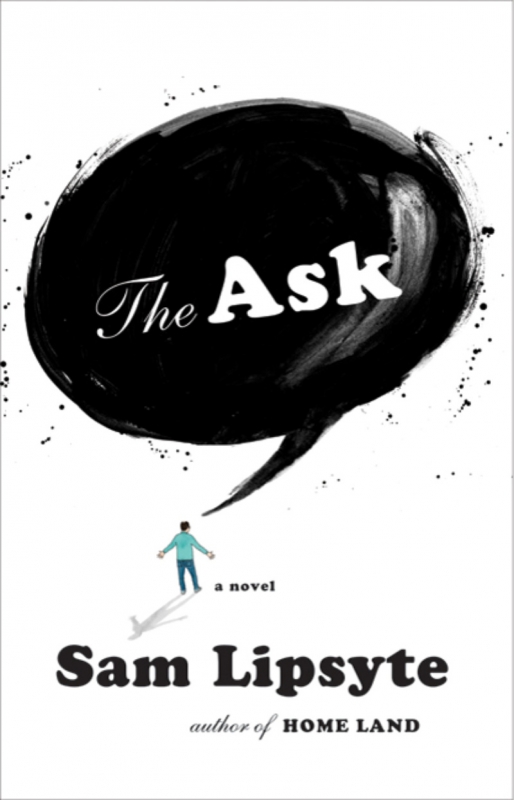
The Ask — Sam Lipsyte

I listened to the audiobook version of Sam Lipsyte’s hilarious, wistful, mean, and devastating novel The Ask last week. I invented chores and took any scenic route available when driving to get more of the book faster, frequently laughing out loud, or grimacing, or even feeling weird and shameful pangs of remorseful identification with the book’s protagonist and narrator, Milo Burke. I’m going to do my best to unpack the book’s themes–particularly the way it simultaneously eulogizes, valorizes, and mocks the American Dream–but first I need to get something out-of-the-way, a mea culpa of sorts.

As I mentioned, I listened to the book, but I don’t have a copy, so, shamefully, I can’t really quote any of Lipyste’s marvelous sentences. He is a master stylist, capable of zapping our dead modern idioms with the kind of alarming twists that highlight just how vacant language has become. Lipsyte also has a gift for rhythm, tone, and cadence, and he’s a master of the deadpan punchline. While the sentences in his last novel Home Land sometimes felt overly fussed over, straining under their own polish, The Ask showcases an effortless style that both seduces and repels. Lipsyte reads The Ask audiobook himself, yet lets the tone and cadence of his words dictate the tone and timbre of his voice. It’s all very good. And you’ll have to just take my word for all that as I have nothing to quote now (I’m sure I’ll re-review the book when I pick it up in paperback, though).

The plot is rather thin: Milo Burke, who once aspired to being a celebrated painter, now works for the grants department of a mediocre liberal arts college. His job, essentially, is to beg wealthy parents and alumni to donate massive gifts of cash to the school — this is “the ask.” Or rather, that was his job before he got fired for losing his cool with the spoiled brat daughter of a major patron. This leaves Milo moping around Queens, drinking too much, and pissing off the wife he is slowly becoming estranged from. Which is a shame, because he’s trying to be a good husband and father to his young son; despite his own shitty childhood–boozing, philandering father, emotionally absent mother–Milo is doing his best to give his family the American Dream. He’s more or less abandoned his own dreams of being a painter, and along with it, the weird faith he located in the various theorists–Marxists, feminists, deconstructionists, etc.–who informed his art school years. Much of the novel finds Milo pondering not just on the value (or lack thereof) in his liberal arts education, but also on the friends and anti-friends who he slummed with in those days. Just as the narrator of Home Land dwells on his high school days, Milo Burke can’t quit thinking about his college years in The Ask.

That past returns in the form of Purdy, a rich kid who slummed with Milo and his druggy art kid friends back in their college days. Purdy is incredibly wealthy even after the stock market crashes of the late 2000s, and has Milo specifically reinstated by the university to officiate an intended “give” (the answer to “the ask”). Purdy’s real intention though is to turn Milo into a kind of bag man, a go-between to deliver large sums of cash to Purdy’s caustically embittered illegitimate son Don, an Iraq War vet who’s lost both his legs to an IED. This arrangement thrusts Milo into Purdy’s surreal world of privilege and power, but also puts him into contact with a deranged, maimed, and deeply, deeply hurt young man who will, essentially, change the way that he examines the world and his role in it.

I’m now going to gloss over much of the book: there are many, many very funny situations, strange characters, and wonderful little insights. And now that theme I mentioned: the death of the American Dream.

Late in the novel, Milo calls America “Dead America.” Earlier in the novel, he complains that America never got to be Rome; that America is a dying, crumbling empire that never even got to revel in its hedonist excesses. Milo is keenly aware that his own white, white-collar, privileged, urban existence as a liberal-arts-educated American puts him in a position of greater material comfort than 99.9% of the rest of the people in the world, yet this fact does nothing to assuage his despair–in fact, it exacerbates it. Milo is ashamed of his despair, too-cognizant of its implications. His shame becomes a meta-, self-referential shame, and it leads to Milo essentially surrendering any power or agency he might have claimed in the universe. His liberal arts education and his own sensitivities render him feckless and bitter, always grumbling over the cosmic injustice of modern, Dead America. He is a walking, rambling critique of power, yet–as his wife likes to point out–he never does anything about the injustice he perceives. It’s only after interacting with Don that Milo begins to see an inroad to agency.

Don is, it must be said, a miserable, caustic human being, a racist blackmailer, and perennially cruel to anyone who extends a hand. He’s also performed the most real “give” in the novel–he’s lost his legs for Dead America, sacrificing his own mobility and freedom (those constituents of the dream) for the freedom of others, or at least for the illusion of other people’s freedom. Don’s toxic behavior makes him utterly repellent and thoroughly anti-heroic, but in Milo’s identification with the young man–and in Milo’s willingness to lose financial security and familial stability by essential siding with Don over Purdy– there is a glimmer (just a glimmer) of redemption and agency for Milo. Don embodies everything about America that Milo (and presumably Lipsyte) hates, yet he has also answered “the ask,” both literally and symbolically. The novel invokes then not just scathing ironic attack on the American Dream, but also a pity that reveals an intrinsic (and perhaps childish) wish to believe, a wish to make Dead America live again. The novel ends with Milo reclaiming (or maybe just claiming) some degree of agency, beginning with getting back an old war knife his father had given him, a clear symbol of paternal, phallic power (the kind that his liberal arts education told him was bad, bad, bad). And yet there’s no resolution, no pat answers–how could there be? Instead, the novel ends in another crisis–not Milo’s this time, but Don’s. But I won’t spoil that, because, hey, you’re going to read this now, aren’t you? Very highly recommended.

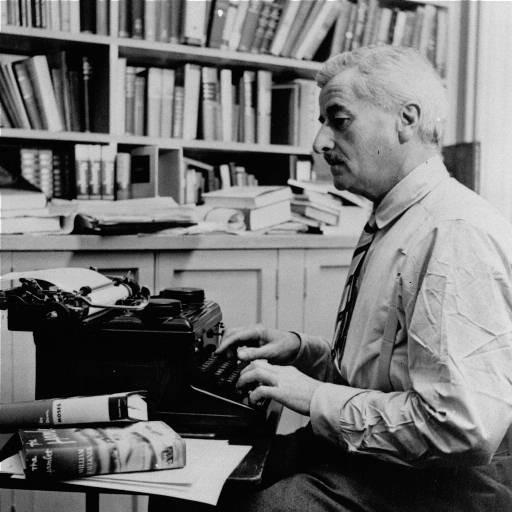
William Faulkner, As I Lay Dying, The Perils of Assigned Reading, and A Call for Second Chances

WKD WILLIAM FAULKNER

Not quite two years ago, I wrote some pretty awful things about William Faulkner on this blog. In a review of his first published novel Sancutary, I argued, quite ineffectually, that, “Faulkner as an American Great is nothing but a scam.” Elsewhere, I proffered this ignorant nugget:

“…it seems that a few critics–notably Malcolm Cowley and Cleanth Brooks–decided either that a. Faulkner is really great and/or b. America needs a new master of literary fiction, and it might as well be Faulkner. It seems amazing to me that these two critics conned a whole generation into believing that someone whose books were so unbelievably poorly written was actually, like, a totally awesome and important writer.”

Ouch. At the time I wrote that rant, I was still in grad school, which is to say I was still being assigned reading by well-intentioned professors. I was also laboring under a cruel miscalculation, the mistaken belief that I had actually read most of Faulkner’s great works–As I Lay Dying, The Sound and the Fury, and Absalom, Absalom!–in my high school and undergraduate courses–where said books were assigned reading. The truth, I realize now, is that while Faulkner’s strange, dense, elliptical prose might have passed under my eyes, I completely failed to read his books when I was a young man. It wasn’t until last spring, when I read one of Faulkner’s last novels, Go Down, Moses, that I came to understand the genius of his writing, which is to say I came to learn to read his voices in a non-academic, non-studied fashion, intuitively and rhythmically. Go Down, Moses is strange and sad and funny and truly an achievement, a book that works as a sort of time machine, an attempt to undo or recover the racial and familial (in Faulkner, these are the same) divides of the past.

So. Skip ahead a year.

After reading Bolaño’s stunning 2666, I strategically read Cormac McCarthy’s Child of God, knowing that I’d need a voice at least equal to Bolaño’s in order to not get totally bummed out and sort of paralyzed with that “What do I read next?” feeling. The strategy worked, but of course I needed a follow up book. So I picked up As I Lay Dying, the story of a poor rural family who labor to return their dead matriarch to her family’s home town for burial. I’d “read” the book in high school; I remembered the plot, but I could not in any way comment on it. This time, with the freedom to choose to read it–and perhaps, older, better equipped–I truly entered the book, entered into each of the character’s heads, their eyes, their voices. I “got” it.

as-i-lay-dying

I read As I Lay Dying in essentially three or four long sittings, sustained by Faulkner’s incomparable, engrossing language. I realize now that as a high school student, and then again as an undergrad, I resisted the book, attempted to impose my own consciousness into the narrative in order to “understand” the plot, rather than letting the book happen to me–which I believe is how one must read Faulkner. I was amazed how quickly I read the book once I attuned myself to Faulkner’s rhythm, and I was equally amazed at how conflicted and confused I felt about the story. I can’t recall a novel whose characters I’ve ever felt so hateful and sympathetic toward at the same time. Great, great book.

Anyway. The point of this post is to say, “Hey, I was wrong, mistaken, terribly wrong about Faulkner when I said he wasn’t a Great American Writer.” I suppose I’m also implicitly arguing that the necessary evil of assigned reading can sometimes be less necessary and more evil: How many kids are we turning away from the really great stuff forever by forcing it upon them when they are too young, too unequipped to appreciate it? The other side of this logic, of course, is to point out that often assigned reading can turn us on to great writers forever; this was the case for me, with most of what I read in high school. Still, as an English teacher I do worry that in assigning and then dissecting literature–under the pretense of explaining it and appreciating it and learning from it–we always run the risk of killing it, draining it of the very vitality that was the rationale for reading it in the first place. Of course, there’s a simple, simple antidote to reconciling yourself to all those books you hated in high school, those books you were supposed to love and be moved by and learn important and meaningful lessons from–you can read them again for the first time. The worst that could happen is a confirmation of your own prejudice; far more likely, in assigning your own reading, you’ll find something truly great and meaningful.