

Hilary Mantel on Thomas Cromwell; James Wood on Thomas More

I’m coming to the end of Hilary Mantel’s brilliant treatment of the Tudor saga, Wolf Hall. Sign of a great book: when it’s finished, I will miss her characters, particularly her hero Thomas Cromwell, presented here as a self-made harbinger of the Renaissance, a complicated protagonist who was loyal to his benefactor Cardinal Wolsey even though he despised the abuses of the Church. Mantel’s Cromwell reminds us that the adjective “Machiavellian” need not be a pejorative, applied only to evil Iago or crooked Richard III. The Cromwell of Wolf Hall presages a more egalitarian–modern–extension of power. Cromwell here is not simply pragmatic (although he is pragmatic), he also has a purpose: he sees the coming changes of Europe, the rise of the mercantile class signaling economic power over monarchial authority. Yet he’s loyal to Henry VIII, and even the scheming Boleyns. “Arrange your face” is one of the book’s constant mantras; another is “Choose your prince.” Mantel’s Cromwell is intelligent and admirable; the sorrows of the loss of his wife and daughter tinge his life but do not dominate it; he can be cruel when the situation merits it but would rather not be. I doubt that many people wanted yet another telling of the Tudor drama–but aren’t we always looking for a great book? Wolf Hall demonstrates that it’s not the subject that matters but the quality of the writing. Highly recommended.

Cromwell’s greatest foil in Wolf Hall is Thomas More, who is also the subject of the first essay in James Wood’s collection The Broken Estate. I got my review copy in the mail late last week, so it was pure serendipity that I should read “Sir Thomas More: A Man for One Season” after a full day of listening to Wolf Hall (did I neglect to mention that I listened to the audio book? Sorry). Wood is harsher on More than Mantel; whereas she lets us despise him within the logic and framework of the Tudor court, Wood aims to find a contemporary secular standard from which to judge him. He finds license to do so through the work of John Stuart Mill, citing the influential essay On Liberty. Wood writes:

So it is enough for secular criticism to argue that More should have acted differently, and in asserting only this, secular criticism gives birth to itself. It is enough for the secularist to say that there are categories and modes of being which possess a transhistorical and universal status equivalent to sainthood’s, and by which it is therefore permissible to judge More’s actions.

I think in some ways Mantel’s work performs a kind of transhistorical secularist critique of More, albeit one that steps outside of historical or literary criticism or philosophy, one that remains in the logical limits of historical fiction. Mantel does not ask her Thomases to be something that we in the 21st century want them to be, but by centering on Cromwell, she engenders a sharp critique of More’s hypocrisy, a hypocrisy endemic to his time. Cromwell is a humanist (who does not know that he is a humanist, perhaps) and his complicated view of More forms the thrust of any critique we might choose to find in Wolf Hall. Cromwell admires More’s erudition but despises his arrogance; he respects More as a family man but resents his attitudes toward women. In Mantel’s London, Cromwell works to save More’s life not because he wants to avoid creating a martyr, but because he feels genuine compassion and pity for the man’s family. More’s selfishness is all the more apparent in light of this. Further reflection Wood’s book to come; this second printing (the first in a decade) of Wood’s essays debuts in June, 2010 from the good folks at Picador.


David Foster Wallace Reading from A Supposedly Fun Thing I’ll Never Do Again at the MOCA, San Diego

This video, Another Random Bit: The Perspective of David Foster Wallace, is hardly new, but I hadn’t seen it before, so, you know, there you go. David Foster Wallace reads excerpts from one of my favorite books ever, A Supposedly Fun Thing I’ll Never Do Again.

Vice Interviews Bret Easton Ellis

Vice interviews Bret Easton Ellis at length. Topics include troublesome editors, that “Cranky old bastard” J.D. Salinger (“who hated us all, by the way”), the weirdness of L.A., and his forthcoming novel Imperial Bedrooms, the sequel to his first big hit Less Than Zero. Here’s a taste of the interview, where BEE talks (mild smack) about Jonathan Franzen, Michael Chabon, and former classmate Jonathan Lethem:

Vice: [I]t seems like people will never get tired of probing you about how much of your fiction is autobiographical.
BEE: I wonder why? No other authors, when I read about them, get asked this. Michael Chabon doesn’t get asked this. Jonathan Franzen doesn’t get asked this. Jonathan Lethem doesn’t get asked this. I get asked this. Maybe because I’m just not as good a writer as they are.

Vice: No. You’re as good or better than all of them. But I don’t know, I don’t want to get off topic too much. Never mind.
BEE: I want you to just briefly get off topic. You can say anything you want to me. I really don’t know any of them. I mean, I know them kind of, but I’m not friends with any of them.

Vice: I like Chabon, but I get this weird sense that I wouldn’t like him as a person. Not that that matters, of course.
BEE: No, it doesn’t matter. Always look at the art, not the artist.

Vice: But it’s difficult for me sometimes. I think there’s something kind of too cute about Lethem, or at least something too cute about his last novel, Chronic City.
BEE: I really like The Fortress of Solitude. That’s the only book of his I’ve liked. And the only book of Michael Chabon’s that I really liked was Kavalier & Clay.

Vice: That was great.
BEE: And I really don’t like anything by Jonathan Franzen but The Corrections, which I think is a great American novel.

Vice: Those are kind of their inarguable books I guess, those three.
BEE: Yeah, but everything else by those three is just, you know, I go, “Grrrrrr.” You know, I went to school with Jonathan Lethem.

Vice: Oh, really?
BEE: We were in the same class at Bennington.

Vice: I didn’t know that. What was he like in school?
BEE: Nice. He was a nice guy. I had no idea that he wanted to be a writer. He wasn’t in any of the main workshops. Like Donna Tartt would be in there, and Jill Eisenstadt. You know, the people who really wanted to write were the people who always managed to get into the major workshop that term. And Jonathan never got into any of them. And then I got a galley in the mail a long time after we graduated, and it was for a novel by Jonathan Lethem about talking animals or something. And I was like, “What the hell is this?”

Brontë Sisters Power Dolls!

“The Wasted Land” — A 1996 David Foster Wallace Profile Unearthed

Big kudos to Craig Ferman who tracked down and posted an obscure 1996 Details magazine profile on David Foster Wallace by David Strietfield.  You can read the full profile here. Here are a few (heartbreaking) excerpts:

He doesn’t want Infinite Jest to be seen as autobiography, which it’s not. On the other hand, if Wallace hadn’t been hospitalized in 1988 and put on a suicide watch, he might not have written so accurately about Kate, a character in Infinite Jest who keeps trying to die: “It’s like something horrible is about to happen,” she explains to her doctor, “there’s the feeling that there’s something you have to do right away to stop it but you don’t know what it is you have to do, and then it’s happening, too, the whole horrible time, it’s about to happen and also it’s happening all at the same time.” . . .

Unlike some of his characters, Wallace managed to extricate himself from the downward spiral before the damage became permanent—these days, he won’t even drink beer. Moreover, he got the raw impetus for a new book. By this point, Wallace was living in upstate New York, in an apartment so small that he had to move everything onto the bed when he wanted to write. “It was,” he says, “like spending two years in a submarine.”

Recently he found a Mennonite house of worship, which he finds sympathetic even if the hymns are impossible to sing. “The more I believe in something, and the more I take something other than me seriously, the less bored I am, the less self-hating. I get less scared. When I was going through that hard time a few years ago, I was scared all the time.” It’s not a trip he ever plans to take again.

“They Just Want to Look in the Mirror” — William T. Vollmann

Vice Magazine has published an excerpt from William T. Vollmann’s new book Kissing the Mask: Beauty, Understatement, and Femininity in Japanese Noh Theater. Read the excerpt here. The picture above is Mr. Vollmann in drag, one of the themes of his new book. Here is an excerpt from Vice‘s excerpt:

The best mask of my self (never mind my soul) may well be a chujo; my forehead will soon begin to wrinkle in a pattern like roots, and I often bear the sparse mustache, gaping mouth, and blackened teeth of the loyal bewildered lieutenant; perhaps I belong to the Komparu school. What the artist inscribed on the back of my face I will never know, being unable to see myself objectively the way a professional Noh actor would. Most of the time I am a sturdy man who wears the same clothes often, preferring garments of lifelong reliability; I shave carelessly and shrug off my latest wrinkles, because anyhow I never possessed even a waki’s hope of being beautiful, nor felt the loss.

Nietzsche’s Draconian Law Against Writers

From Human, All Too Human (aphorism 193):

Draconian law against writers. One should regard a writer as a criminal who deserves acquittal or clemency only in the rarest cases: that would be a way to keep books from getting out of hand.

William T. Vollman’s Self-portrait

David Foster Wallace on Book Tour Sex, Blue Velvet, and Bandanas

Flavorwire has compiled a fantastic collection of David Foster Wallace quotes from David Lipsky’s new book, Although Of Course You End Up Becoming Yourself. A few excerpts:

On book tour sex:
“I didn’t get laid on this tour. The thing about fame is interesting, although I would have liked to get laid on the tour and I did not….People come up, they kind of slither up during readings or whatever. But it seems like, what I want is not to have to take any action. I don’t want to have to say, ‘Would you like to come back to the hotel?’ I want them to say, ‘I am coming back to the hotel. Where is your hotel?’ None of ‘em do that….I just can’t stand to look like I’m actively trading on this sexually. Even though of course that’s—I would be happy to do that.”

On Blue Velvet:
“I remember going to see Blue Velvet. . . . It absolutely made me shake. And I went back and saw it again the next day. And there was somethin’ about…it was my first hint that being a surrealist, or being a weird writer, didn’t exempt you from certain responsibilities. But it in fact upped them. . . . David Lynch, Blue Velvet coming out when it did, I think saved me from droppin’ out of school. And saved me maybe even from quittin’ as a writer. ‘Cause I’d always—if I could have made a movie, right at that time? That would have been it. I mean, I vibrated on every frequency.”

On the origin of the trademark bandana:
“I started wearing bandannas in Tucson because it was a hundred degrees all the time. When it’s really hot, I would perspire so much that I would drip on the page. Actually, I started wearing it that year, and then it became a big help in Yaddo in ’87 because I would drip into the typewriter, and I was worried that I would get a shock. And then I discovered that I felt better with them on. And then I dated a woman who…said there were these various chakras, and one of the big ones was what she called the spout hole, at the very top of your cranium. And in a lot of cultures, it was considered better to keep your head covered. And then I began thinking about the phrase, Keeping your head together, you know? …. It’s a security blanket for me. . . . It makes me…feel kind of creepy that people view it as an affectation or trademark or something. It’s more just a foible, it’s the recognition of a weakness, which is that I’m just kind of worried my head’s going to explode.”


Sam Lipsyte Interviewed at ReadRollShow

ReadRollShow‘s Dave Weich interviews Sam Lipsyte. Great little short clips, perfect for internet viewing. They have three up so far, all embedded below–

Granta 110 Features Roberto Bolaño, Tom McCarthy, Dave Eggers, Sex

Subtly titled Sex, issue 110 of the long-running literary journal Granta hits stands this week, and it looks like a doozy. There’s a story by Roberto Bolaño called “The Redhead” about “a disturbing encounter between an eighteen-year-old girl and a narcotics cop.” Charming. No description for Tom McCarthy’s “The Spa,” but presumably it will involve sex, and Dave Eggers’s drawings “Four Animals Contemplating Sex” promises to be self-descriptive. Lots of other stuff too, of course. Order Granta 110 here. The journal has also produced short videos for four of the pieces in Sex, all directed by Luke Seomore and Joseph Bull. You can see them at the oh-so-cleverly titled website This is not a purse; the vid for Bolaño’s “The Redhead” is embedded below.

The Five Geekiest Ways to Celebrate Shakespeare’s Birthday

Want to celebrate William Shakespeare’s birthday (Shakes would be 446 today)? Sure you do. And, undoubtedly, you wish to do so in the geekiest way possible, right? Check out Geekosystem’s post, The Five Geekiest Ways to Celebrate Shakespeare’s Birthday.

In Brief: Beach’s Epistles, Vollmann’s Mummy Sex, and Eggers’s Wild Things

Sylvia Beach was the nexus point for Modernist and ex-pat literature for much of the first half of the twentieth century, running the Left Bank bookstore Shakespeare & Company until the Nazi occupation of Paris in 1941. She was the first publisher of Joyce’s Ulysses, she translated Paul Valéry into English, and was close friends to a good many great writers, including William Carlos Williams, Ezra Pound, H.D., and Ernest Hemingway. In The Letters of Sylvia Beach, editor Keri Walsh compiles many of Beach’s letters from 1901 to just before her death in 1962. Framed by a concise biographical introduction and a useful glossary of correspondents, Letters reveals private insights into a fascinating literary period. There’s a sweetness to Beach’s letters, whether she’s inviting the Fitzgeralds to come to a dinner party or asking Richard Wright (“Dick”) how much he thinks a fair price for a record player is. The Letters of Sylvia Beach is out now from Columbia UP.
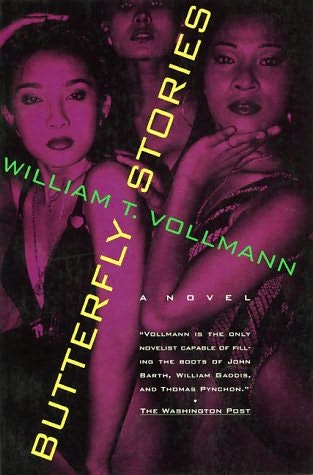
I’m a couple of chapters into William T. Vollmann’s 1993 novel Butterfly Stories, one of his (three? four? Dude’s prolific) books about prostitution. The bullied butterfly grows up to be a boy who wants to be a journalist and then a journalist/inept sex tourist in southeast Asia. Good stuff. Here’s a mordantly elegant passage:
Once he began to combine cutting his wrists and half-asphyxiating himself he believed that he’d found the ideal. Afterwards he’d dream of mummy sex with the gentle girl, by which he meant her body being suspended ropelessly above him, then slowly drifting down; when her knee touched his leg he jerked and then went limp there; her hands reached his hands, which died; her breasts rolled softly upon his heart which fibrillated and stopped; finally she lay on top of him, quite docile and still soft . . . He knew that the others didn’t like mummy sex, but that was because they didn’t understand it; they thought that it must be cold; they thought that she must paint her mouth with something to make it look black and smell horrible and soften like something rotten . . . He wanted to open her up until the pelvis snapped like breaking a wishbone. Would that be mummy sex?

Here’s a one-star review of the book from Amazon: “This book is a sordid collection of junk. I picked it out at random from a library shelf and did not enjoy/like/sympathize with even one thing about it. Don’t waste your time.” Guy didn’t like the mummy sex, I guess.

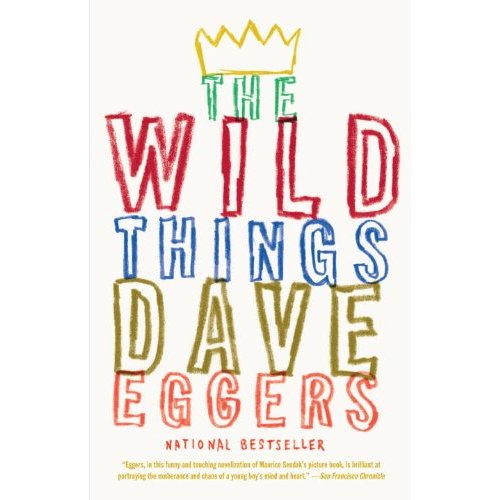
Been working through my reader’s copy of Dave Eggers’s The Wild Things, new in trade paperback from Vintage. I’m having a hard time envisioning a kind of review of the book that escapes the context of the book; that it’s a novelization of a movie script of a Maurice Sendak book of maybe a few dozen words. I loved that book growing up, so no reason that it should be adapted into a feature film, but hoped for the best due to Eggers’s involvement and the fact that the incomparable Spike Jonze was at the rudder. Or helm. Or whatever naval metaphor you wish. Anyway, I absolutely hated the movie–it was mostly melancholy and downright depressing at times. Whereas Sendak’s book channels the joys of transgressive energy while reiterating the need for stable familial order, Jonze’s movie was all sorrow and loss, the hangover of youth, each ecstasy overshadowed in darkness. Too much yin, not enough yang. Anyway. I’ll try to give the book its proper, fair due on its own terms without all that baggage. Full review forthcoming.
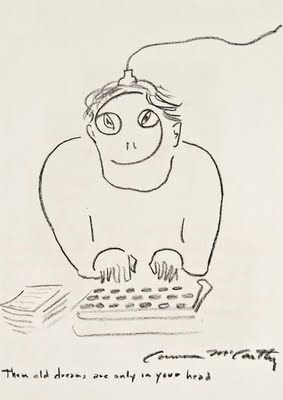
Cormac McCarthy’s Self-portrait

From Burt Britton’s collection of self-portraits, um, Self-portrait. McSweeney’s 34 has taken the work as inspiration. See a full gallery here, including portraits from Jorge Luis Borges, Maurice Sendak, and Margaret Atwood, among others. This goofy Cormac McCarthy self-portrait is priceless, especially from a guy famous for images of trees hanging with dead babies.

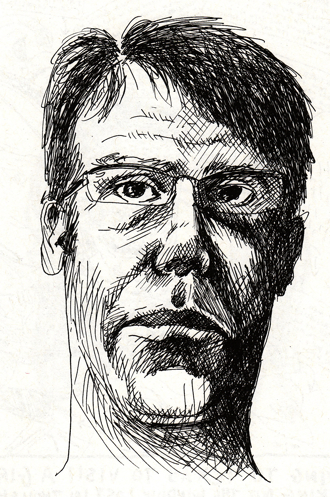
Jonathan Lethem’s Self-portrait

From McSweeney’s 34, out now.

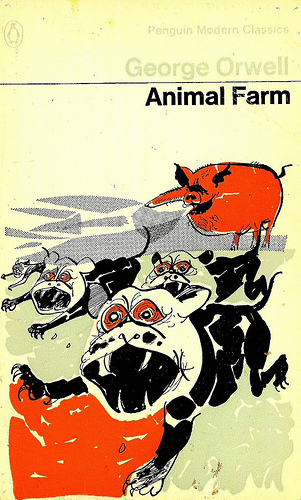
Christopher Hitchens on Orwell’s Animal Farm

Christopher Hitchens on George Orwell’s Animal Farm in this weekend’s issue of The Guardian. From the essay:

It is sobering to consider how close this novel came to remaining unpublished. Having survived Hitler’s bombing, the rather battered manuscript was sent to the office of TS Eliot, then an important editor at Faber & Faber. Eliot, a friendly acquaintance of Orwell’s, was a political and cultural conservative, not to say reactionary. But, perhaps influenced by Britain’s alliance with Moscow, he rejected the book on the grounds that it seemed too “Trotskyite”. He also told Orwell that his choice of pigs as rulers was an unfortunate one, and that readers might draw the conclusion that what was needed was “more public-spirited pigs”. This was not perhaps as fatuous as the turn-down that Orwell received from the Dial Press in New York, which solemnly informed him that stories about animals found no market in the US. And this in the land of Disney . . .

Denis Johnson’s Nobody Move and the Pleasures of Postmodern Crime Fiction

There’s an admirable precision to Denis Johnson’s Nobody Move, a dark and funny crime caper originally serialized in Playboy over four months in 2008, now available in trade paperback from Picador. Johnson limits himself to a handful of characters, a span of a few days, and four fifty-page segments to tell his story. Johnson’s economy resonates from his tight plotting and structure down to his cool, concise sentences. He works in noir archetypes, to be sure–there’s the hard-luck loser in over his head, the femme fatale with a troubled past (and present), the sadistic thug and his moll, and the sinister mastermind. Johnson’s feat here is to present all of this in a manner that’s simultaneously invigorating to the genre but also a confirmation of its pleasures.

Consider Johnson’s erstwhile protagonist, Jimmy Luntz. The name alone seems to tell us everything about this guy, a lousy gambler who spends much of his time on the run. He owes money to the wrong guys, and when a gorilla appropriately named Gambol comes to collect, Luntz makes the mistake of shooting but not killing him. Johnson traffics in immediacy in Nobody Move–there’s not a lot of backstory or dwelling on psychological motivation, thankfully–but he does offer up the occasional nugget, like this one:

Early in his teens Luntz had fought Golden Gloves. Clumsy in the ring, he’d distinguished himself the wrong way–the only boy to get knocked out twice. He’d spent two years at it. His secret was that he’d never, before or since, felt so comfortable or so at home as when lying on his back listening to the far-off music of the referee’s ten-count.

And that’s all the personal history we really need about Luntz. It’s the gaps in the story that are so engaging, that force the reader to play the role of detective in this crime story. To this end, Johnson starts the story in media res, with Luntz leaving a disappointing competition performance of his barbershop chorus. He spends much of the novel’s first half still in his white tux. The novel’s end — well, I won’t spoil the end, of course — but let’s just say that the end of the novel finds our characters poised for further nefarious adventures. But there I go, getting ahead of myself. A little more on plot: Gambol, wounded by Jimmy, finds himself being nursed by a woman named Mary. Their nascent relationship is one of the highlights of the book, funny and cruel, a bizarre study in unlikely romance. Meanwhile, Jimmy hooks up with Anita Desilvera, a dark-eyed bombshell with a serious drinking problem and a series of upcoming court dates. They complicate their problems by going on the lam together. Gambol eventually comes looking for Jimmy (he wants to literally eat his testicles) and drama and danger ensue.

Denis Johnson is arguably among the best living American writers today, having produces no fewer than two masterpieces (Tree of Smoke, one of my favorite books of the past ten years, and Jesus’ Son, one of my favorite books ever). So when he wrote a genre fiction piece under a deadline for Playboy, many critics and readers wondered what he was up to. Was he serious? How serious were we supposed to take the work? Did he need the money? The book itself offers some answers. Nobody Move is fantastic as a genre exercise, witty, dark, lean, and hard-boiled, transcending the bad or formulaic writing that can plague the genre’s novels but never trying to transcend its tropes. Put another way, Johnson here demonstrates that he can master a genre that is not his, and that he can do it under the constraints of space and time. That’s quite a feat, if you think about it, especially if you compare Nobody Move to Thomas Pynchon’s recent genre exercise, Inherent Vice, or the detective-centered works of Jonathan Lethem like Motherless Brooklyn and Gun, With Occasional Music. Pynchon’s work is in many ways a covert, loving goof on the genre, but it’s still more or less a “Thomas Pynchon” book. Lethem likes the idea of writing crime noir, but he wants to subvert it, mash it up with sci-fi, see it as a form of post-modern allegory. Roberto Bolaño is almost painfully aware of this in his fiction–his narrator in Distant Star gets to play at being a detective for a bit, but finds that it’s not nearly as fun as he would like it to be. The Savage Detectives views literature and art as a crime scene to puzzle out. And 2666 . . . well, you know about 2666 (hang on wait, you don’t know about 2666? You should really get that taken care of). Or take James Ellroy’s postmoderinst crime fiction, which owes, unwittingly or not, as much to Don DeLillo as it does to Raymond Chandler. These are all great writers, of course. But I think contrasting what they are trying to do with what Johnson is trying to do is instructive.

There’s a purity to Nobody Move, to its utter willingness to simply be what it is–and many folks won’t like that; they may even accuse Johnson of slumming. Perhaps they think it’s easy to write a tight, funny crime novel. Perhaps they know it’s not, and they think that Johnson is being solipsistic, or even mercenary. In any case, Nobody Move will probably stand outside of Johnson’s canon. And that’s unfair. Cinematic and highly visual, it recalls some of the Coen brothers’ finest work, like Blood Simple and The Man Who Wasn’t There, and even Tarantino’s Jackie Brown (minus the messy sprawl). Perhaps the best thing about Nobody Move–other than the sheer pleasure of reading it over a few afternoons, of course–is that it might motivate readers to pick up Jesus’ Son or even Tree of Smoke. For many readers, especially young readers, genre is a vital gateway to what many of us prejudicially call “more serious” literature. So pick up Nobody Move, read it, love it, and then pass it on to someone who needs to know about Denis Johnson. Recommended.

Nobody Move is available in trade paperback from Picador on April 24, 2010.