Henry David Thoreau’s Walden: The Video Game

(About; via Scott Esposito).

E-Books of the Future! (Retrofuture Fun from 1959)

(Via Disonancia, which is probably my favorite thing on the internet right now).

Ezra Pound Shares Poetry Tips from Hardy, Yeats, Ford, and Bridges

Ezra Pound’s poetry tips; from The Paris Review interview:

INTERVIEWER

You once wrote that you had four useful hints from living literary predecessors, who were Thomas Hardy, William Butler Yeats, Ford Madox Ford, and Robert Bridges. What were these hints?

POUND

Bridges’s was the simplest. Bridges’s was a warning against homophones. Hardy’s was the degree to which he would concentrate on the subject matter, not on the manner. Ford’s in general was the freshness of language. And Yeats you say was the fourth? Well, Yeats by 1908 had written simple lyrics in which there were no departures from the natural order of words.

Ben Marcus Talks About His Novel The Flame Alphabet

Life: “A Queer Contraption, Very Dangerous, a Certain Death-trap” (A Passage from Flann O’Brien’s The Third Policeman)

I started Flann O’Brien’s novel The Third Policeman yesterday, on the recommendation of a few readers who commented on a post last week. Just a few chapters in, I felt the thrill of really great, strange writing, coupled with the bizarre, almost unwieldy disbelief that I hadn’t read the novel before, or more to the point, and most ashamedly, that it wasn’t even on my radar. I felt a strange antipathy to the name Flann O’Brien whenever I came across it in the past—too close to Flannery O’Connor, if I’m being honest. This is all silly and I’m embarrassed to write it now. Anyway, the novel is amazing so far. Here’s a passage that maybe stands alone. We have the (as yet?) unnamed narrator, his soul (in italics), and an old man (who may or may not be a version of the narrator?):

I smiled at him in good-humoured and said:

‘Tricky-looking man, you are hard to place and it is not easy to guess your station. You seem very contented in one way but then again you do not seem to be satisfied. What is your objection to life?’ He blew little bags of smoke at me and looked at me closely from behind the bushes of hair which were growing about his eyes.

‘Is it life?’ he answered. ‘I would rather be without it,’ he said, ‘for there is a queer small utility in it. You cannot eat it or drink it or smoke it in your pipe, it does not keep the rain out and it is a poor armful in the dark if you strip it and take it to bed with you after a night of porter when you are shivering with the red passion. It is a great mistake and a thing better done without, like bed-jars and foreign bacon.’

‘That is a nice way to be talking on this grand lively day,’ I chided, ‘when the sun is roaring in the sky and sending great tidings into our weary bones.’

‘Or like feather-beds,’ he continued, ‘or bread manufactured with powerful steam machinery. Is it life you say? Life?’

Explain the difficulty of life yet stressing its essential sweetness and desirability.

What sweetness?

Flowers in the spring, the glory and fulfilment of human life, bird-song at evening – you know very well what I mean. I am not so sure about the sweetness all the same.

‘It is hard to get the right shape of it,’ I said to the tricky man, ‘or to define life at all but if you identify life with enjoyment I am told that there is a better brand of it in the cities than in the country parts and there is said to be a very superior brand of it to be had in certain parts of France. Did you ever notice that cats have a lot of it in them when they are quite juveniles?’

He was looking in my direction crossly.

‘Is it life? Many a man has spent a hundred years trying to get the dimensions of it and when he understands it at last and entertains the certain pattern of it in his head, by the hokey he takes to his bed and dies! He dies like a poisoned sheepdog. There is nothing so dangerous, you can’t smoke it, nobody will give you tuppence-halfpenny for the half of it and it kills you in the wind-up. It is a queer contraption, very dangerous, a certain death-trap. Life?’

N + 2 — Ivan Maximov

“On Getting Started” — John Steinbeck Shares Writing Tips

From John Steinbeck’s 1969 “interview” in The Paris Review (the piece reads more like a series of short writings than a conventional interview):

ON GETTING STARTED

It is usual that the moment you write for publication—I mean one of course—one stiffens in exactly the same way one does when one is being photographed. The simplest way to overcome this is to write it to someone, like me. Write it as a letter aimed at one person. This removes the vague terror of addressing the large and faceless audience and it also, you will find, will give a sense of freedom and a lack of self-consciousness.

Now let me give you the benefit of my experience in facing 400 pages of blank stock—the appalling stuff that must be filled. I know that no one really wants the benefit of anyone’s experience which is probably why it is so freely offered. But the following are some of the things I have had to do to keep from going nuts.

1. Abandon the idea that you are ever going to finish. Lose track of the 400 pages and write just one page for each day, it helps. Then when it gets finished, you are always surprised.

2. Write freely and as rapidly as possible and throw the whole thing on paper. Never correct or rewrite until the whole thing is down. Rewrite in process is usually found to be an excuse for not going on. It also interferes with flow and rhythm which can only come from a kind of unconscious association with the material.

3. Forget your generalized audience. In the first place, the nameless, faceless audience will scare you to death and in the second place, unlike the theater, it doesn’t exist. In writing, your audience is one single reader. I have found that sometimes it helps to pick out one person—a real person you know, or an imagined person and write to that one.

4. If a scene or a section gets the better of you and you still think you want it—bypass it and go on. When you have finished the whole you can come back to it and then you may find that the reason it gave trouble is because it didn’t belong there.

5. Beware of a scene that becomes too dear to you, dearer than the rest. It will usually be found that it is out of drawing.

6. If you are using dialogue—say it aloud as you write it. Only then will it have the sound of speech.

“When Uncle Bill Quit Dope” — Johnny Cash

St. Michael Fighting the Dragon — Albrecht Dürer

“He Squatted Among the Soft Womansmelling Garments” — A Strange Sex Scene from Faulkner

A strange, gross sex scene from William Faulkner’s  novel Light in August. As a child, the book’s anti-hero,Joe Christmas, an orphan of unclear parentage, sneaks off to suck sweet toothpaste from a tube. There, he surreptitiously witnesses a clandestine meeting between the orphanage’s dietitian and another worker:

In the quiet and empty corridor, during the quiet hour of early afternoon, he was like a shadow, small even for five years, sober and quiet as a shadow. Another in the corridor could not have said just when and where he vanished, into what door, what room. But there was no one else in the corridor at this hour. He knew that. He had been doing this for almost a year, ever since the day when he discovered by accident the toothpaste which the dietitian used.

Once in the room, he went directly on his bare and silent feet to the washstand and found the tube. He was watching the pink worm coil smooth and cool and slow onto his parchmentcolored finger when he heard footsteps in the corridor and then voices just beyond the door. Perhaps he recognised the dietitian’s voice. Anyway, he did not wait to see if they were going to pass the door or not. With the tube in his hand and still silent as a shadow on his bare feet he crossed the room and slipped beneath a cloth curtain which screened off one corner of the room. Here he squatted, among delicate shoes and suspended soft womangarments. Crouching, he heard the dietitian and her companion enter the room.

The dietitian was nothing to him yet, save a mechanical adjunct to eating, food, the diningroom, the ceremony of eating at the wooden forms, coming now and then into his vision without impacting at all except as something of pleasing association and pleasing in herself to look at—young, a little fullbodied, smooth, pink-and-white, making his mind think of the diningroom, making his mouth think of something sweet and sticky to eat, and also pink-colored and surreptitious. On that first day when he discovered the toothpaste in her room he had gone directly there, who had never heard of toothpaste either; as if he already knew that she would possess something of that nature and he would find it. He knew the voice of her companion also: It was that of a young interne from the county hospital who was assistant to the parochial doctor, he too a familiar figure about the house and also not yet an enemy.

He was safe now, behind the curtain. When they went away, he would replace the toothpaste and also leave. So he squatted behind the curtain, hearing without listening to it the woman’s tense whispering voice: “No! No! Not here. Not now. They’ll catch us. Somebody will—No, Charley! Please!” The man’s words he could not understand at all. The voice was lowered too. It had a ruthless sound, as the voices of all men did to him yet, since he was too young yet to escape from the world of women for that brief respite before he escaped back into it to remain until the hour of his death. He heard other sounds which he did know: a scuffing as of feet, the turn, of the key in the door. “No, Charley! Charley, please! Please, Charley!” the woman’s whisper said. He heard other sounds, rustlings, whisperings, not voices. He was not listening; he was just waiting, thinking without particular interest or attention that it was a strange hour to be going to bed. Again the woman’s fainting whisper came through the thin curtain: “I’m scared! Hurry! Hurry!”

He squatted among the soft womansmelling garments and the shoes. He saw by feel alone now the ruined, once cylindrical tube. By taste and not seeing he contemplated the cool invisible worm as it coiled onto his finger and smeared sharp, automatonlike and sweet, into his mouth. By ordinary he would have taken a single mouthful and then replaced the tube and left the room. Even at five, he knew that he must not take more than that. Perhaps it was the animal warning him that more would make him sick; perhaps the human being warning him that if he took more than that, she would miss it. This was the first time he had taken more. By now, hiding and waiting, he had taken a good deal more. By feel he could see the diminishing tube. He began to sweat. Then he found that he had been sweating for some time, that for some time now he had been doing nothing else but sweating. He was not hearing anything at all now. Very likely he would not have heard a gunshot beyond the curtain. He seemed to be turned in upon himself, watching himself sweating, watching himself smear another worm of paste into his mouth which his stomach did not want. Sure enough, it refused to go down. Motionless now, utterly contemplative, he seemed to stoop above himself like a chemist in his laboratory, waiting. He didn’t have to wait long. At once the paste which he had already swallowed lifted inside him, trying to get back out, into the air where it was cool. It was no longer sweet. In the rife, pinkwomansmelling, obscurity behind the curtain he squatted, pinkfoamed, listening to his insides, waiting with astonished fatalism for what was about to happen to him. Then it happened. He said to himself with complete and passive surrender: ‘Well, here I am.’

When the curtain fled back he did not look up. When hands dragged him violently out of his vomit he did not resist. He hung from the hands, limp, looking with slackjawed and glassy idiocy into a face no longer smooth pink-and-white, surrounded now by wild and dishevelled hair whose smooth bands once made him think of candy. “You little rat!” the thin, furious voice hissed; “you little rat! Spying on me! You little nigger bastard!”

The Joy of Living — Max Ernst

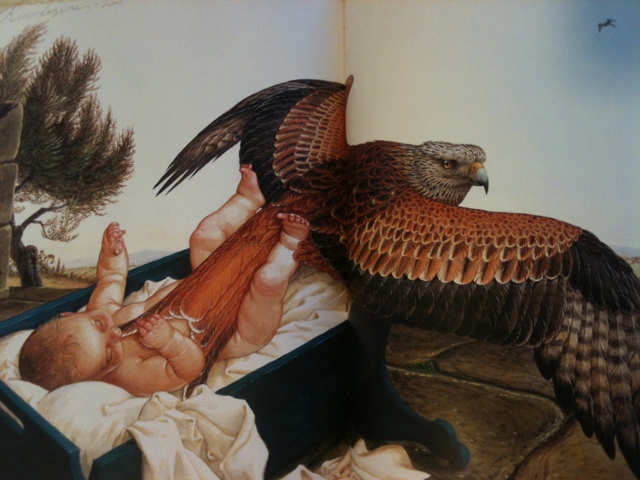
Freud’s Psychosexual Study of Leonardo da Vinci’s Vulture Fantasy

Excerpts from Sigmund Freud’s Leonardo da Vinci: A Psychosexual Study of an Infantile Reminiscence 

As far as I know Leonardo only once interspersed in his scientific descriptions a communication from his childhood. In a passage where he speaks about the flight of the vulture, he suddenly interrupts himself in order to follow up a memory from very early years which came to his mind. “It seems that it had been destined before that I should occupy myself so thoroughly with the vulture, for it comes to my mind as a very early memory, when I was still in the cradle, a vulture came down to me, he opened my mouth with his tail and struck me a few times with his tail against my lips.”

Ricordazione by Walton Ford

We have here an infantile memory and to be sure of the strangest sort. It is strange on account of its content and account of the time of life in which it was fixed. That a person could retain a memory of the nursing period is perhaps not impossible, but it can in no way be taken as certain. But what this memory of Leonardo states, namely, that a vulture opened the child’s mouth with its tail, sounds so improbable, so fabulous, that another conception which puts an end to the two difficulties with one stroke appeals much more to our judgment. The scene of the vulture is not a memory of Leonardo, but a phantasy which he formed later, and transferred into his childhood. The childhood memories of persons often have no different origin, as a matter of fact, they are not fixated from an experience like the conscious memories from the time of maturity and then repeated, but they are not produced until a later period when childhood is already past, they are then changed and disguised and put in the service of later tendencies, so that in general they cannot be strictly differentiated from phantasies.

. . .
When we examine Leonardo’s vulture-phantasy with the eyes of a psychoanalyst then it does not seem strange very long; we recall that we have often found similar structures in dreams, so that we may venture to translate this phantasy from its strange language into words that are universally understood. The translation then follows an erotic direction. Tail, “coda,” is one of the most familiar symbols, as well as a substitutive designation of the male member which is no less true in Italian than in other languages. The situation contained in the phantasy, that a vulture opened the mouth of the child and forcefully belabored it with its tail, corresponds to the idea of fellatio, a sexual act in which the member is placed into the mouth of the other person.
Strangely enough this phantasy is altogether of a passive character; it resembles certain dreams and phantasies of women and of passive homosexuals who play the feminine part in sexual relations.
. . .
The origin of Leonardo’s vulture phantasy can be conceived in the following manner: While reading in the writings of a church father or in a book on natural science that the vultures are all females and that they know to procreate without the coöperation of a male, a memory emerged in him which became transformed into that phantasy, but which meant to say that he also had been such a vulture child, which had a mother but no father. An echo of pleasure which he experienced at his mother’s breast was added to this in the manner as so old impressions alone can manifest themselves. The allusion to the idea of the holy virgin with the child, formed by the authors, which is so dear to every artist, must have contributed to it to make this phantasy seem to him valuable and important. For this helped him to identify himself with the Christ child, the comforter and savior of not alone this one woman.

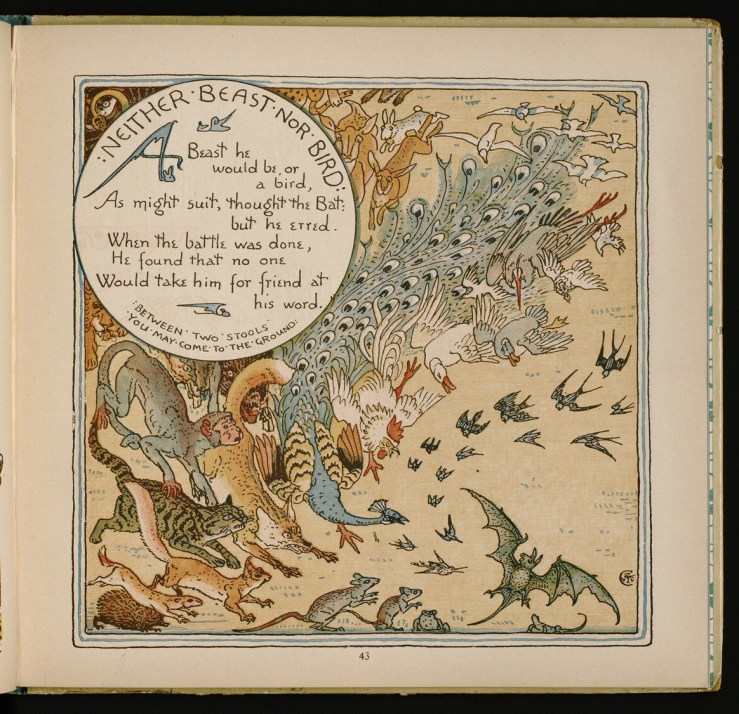
“Neither Beast Nor Bird” (Illustrated Fable, 1887)

(From The Baby’s Own Aesop: Being the Fables Condensed in Rhyme, With Portable Morals Pictorially Pointed by Walter Crane. Engraved and Printed in Colours By Edmund Evans. 1887. Via the LOC).

Slavoj Žižek: “We Are Approaching a Certain Zero Point”

“Effect of Quantity” (Nietzsche on Shakespeare)

162. Effect of Quantity. —The greatest paradox in the history of poetic art lies in this: that in all that constitutes the greatness of the old poets a man may be a barbarian, faulty and deformed from top to toe, and still remain the greatest of poets. This is the case with Shakespeare, who, as compared with Sophocles, is like a mine of immeasurable wealth in gold, lead, and rubble, whereas Sophocles is not merely gold, but gold in its noblest form, one that almost makes us forget the money-value of the metal. But quantity in its highest intensity has the same effect as quality. That is a good thing for Shakespeare.

From Human, All Too Human, Part II by Friedrich Nietzsche.

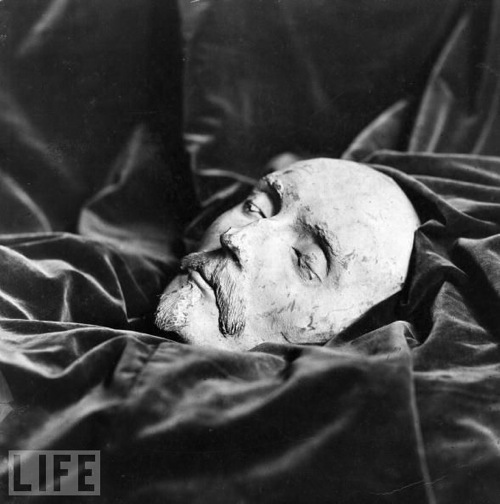
William Shakespeare’s Death Mask (Happy Birthday/Deathday!)