A few weeks ago, for some reason beyond my ken, I stumbled into Finnegans Wake, read on the gentle glow of my Kindle Fire. I’ve been poking into the book for years now, but that particular night I read it with an ease—not an ease of understanding, but an ease of spirit, or of mind. Or ear, really. I had fun with it. I went back each night since then, sometimes only going through a page or two before slipping into slumbers.
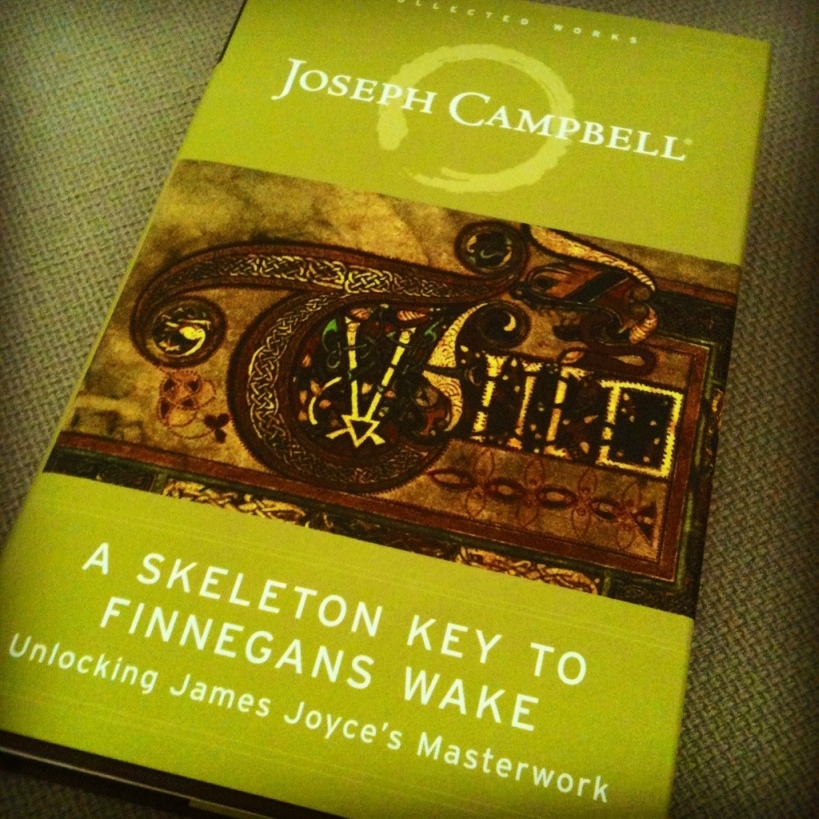
Anyway, I’ve been searched for a used copy of Joseph Campbell’s Skeleton Key to the Wake for years, but I finally just broke down and ordered a new copy through my bookstore. My plan is to read Finnegans Wake next year. It’s not a plan, so much as something I’ve just typed.
“John Mortonson’s Funeral,” a very short story by Ambrose Bierce
John Mortonson was dead: his lines in ‘the tragedy “Man”‘ had all been spoken and he had left the stage.
The body rested in a fine mahogany coffin fitted with a plate of glass. All arrangements for the funeral had been so well attended to that had the deceased known he would doubtless have approved. The face, as it showed under the glass, was not disagreeable to look upon: it bore a faint smile, and as the death had been painless, had not been distorted beyond the repairing power of the undertaker. At two o’clock of the afternoon the friends were to assemble to pay their last tribute of respect to one who had no further need of friends and respect. The surviving members of the family came severally every few minutes to the casket and wept above the placid features beneath the glass. This did them no good; it did no good to John Mortonson; but in the presence of death reason and philosophy are silent.
As the hour of two approached the friends began to arrive and after offering such consolation to the stricken relatives as the proprieties of the occasion required, solemnly seated themselves about the room with an augmented consciousness of their importance in the scheme funereal. Then the minister came, and in that overshadowing presence the lesser lights went into eclipse. His entrance was followed by that of the widow, whose lamentations filled the room. She approached the casket and after leaning her face against the cold glass for a moment was gently led to a seat near her daughter. Mournfully and low the man of God began his eulogy of the dead, and his doleful voice, mingled with the sobbing which it was its purpose to stimulate and sustain, rose and fell, seemed to come and go, like the sound of a sullen sea. The gloomy day grew darker as he spoke; a curtain of cloud underspread the sky and a few drops of rain fell audibly. It seemed as if all nature were weeping for John Mortonson.
When the minister had finished his eulogy with prayer a hymn was sung and the pall-bearers took their places beside the bier. As the last notes of the hymn died away the widow ran to the coffin, cast herself upon it and sobbed hysterically. Gradually, however, she yielded to dissuasion, becoming more composed; and as the minister was in the act of leading her away her eyes sought the face of the dead beneath the glass. She threw up her arms and with a shriek fell backward insensible.
The mourners sprang forward to the coffin, the friends followed, and as the clock on the mantel solemnly struck three all were staring down upon the face of John Mortonson, deceased.
They turned away, sick and faint. One man, trying in his terror to escape the awful sight, stumbled against the coffin so heavily as to knock away one of its frail supports. The coffin fell to the floor, the glass was shattered to bits by the concussion.
From the opening crawled John Mortonson’s cat, which lazily leapt to the floor, sat up, tranquilly wiped its crimson muzzle with a forepaw, then walked with dignity from the room.
The only thing Wallace knew for sure was that he desperately wanted to be a novelist again but some piece of him still felt too fragile to attempt an effort so key to his well-being. The problem, he felt, was not really the words on the page; he had lost confidence not in his ability to write so much as the need to have written. Jonathan Franzen, with whom he had struck up an epistolary friendship, offered to get together that April when he was in Boston. Wallace said fine but stood him up after they made plans. But because one tenet of recovery is to make amends to those you have wronged, he wrote to his friend explaining his behavior. “The bald fact is that I’m a little afraid of you right now,” he wrote. He begged to be allowed to bow out of their embryonic competition, to declare a truce against this writer who was so “irked by my stuff,” because Wallace was no longer “a worthy opponent in some kind of theoretical chess-by-mail game from which we can both profit by combat.”
He went on: “Right now I am a pathetic and very confused young man, a failed writer at 28, who is so jealous, so sickly searingly envious of you and Vollmann and Mark Leyner and even David F–kwad Leavitt and any young man who is right now producing pages with which he can live … that I consider suicide a reasonable—if not at this point a desirable—option with respect to the whole wretched problem.”
From D.T. Max’s forthcoming David Foster Wallace biography Every Love Story Is a Ghost Story. Read the rest of the excerpt.
So this weekend I started auditing William Gass’s novel The Tunnel on mp3, read by the author: Sonorous, strange, ugly, beautiful, poetic, abyssal, phallic, anal, fragmented, rich. Here he is in 2007 reading from the beast of a book at The Village Voice Bookshop in Paris (RIP). More on The Tunnel.
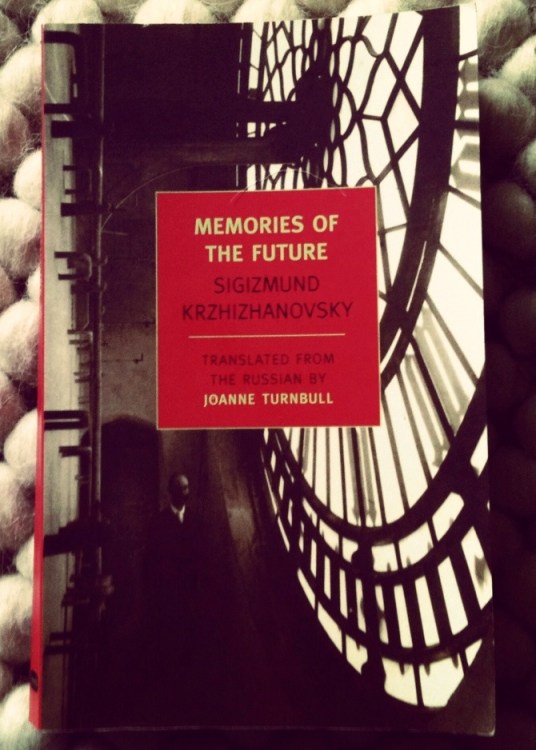
I saw Sigizmund Krzhizhanovsky’s at the bookstore last week, read the first few pages of the first story, and had to have it. (Although the NYRB logo is always enticement enough). From Liesl Schillinger’s review in the NYT:
Krzhizhanovsky’s stories are more like dream diaries than fiction. Quite intentionally, he blurs the line between sleep and waking, real and unreal, life and death. While his translators admirably convey the whirligigging quality of his narratives, Krzhizhanovsky’s peregrinations demand unstinting focus and frequent compass checks. His characters often seem half, or wholly, asleep. Sometimes, as in “The Thirteenth Category of Reason,” they are dead — which doesn’t stop them from boarding city trams and chatting with commuters. “Alive or dead, they didn’t care.” Their only concern is whether such conduct is “decrimiligaturitized” — that is, legal. “In “Quadraturin,” the man with the proliferspansion ointment never exits a state of benumbed grogginess. Lying on his bed, “unable to part eyelids stitched together with exhaustion,” he tries to sleep through the night, “mechanically, meekly, lifelessly.” When inspectors from the Remeasuring Commission drop by to make sure he hasn’t exceeded his allotted 86 square feet of space, he hovers, terror-stricken, at the door, hoping they won’t spot his infraction. It’s an archetypal nightmare, reminiscent of Kafka.
Biblioklept has already published two reviews of Roberto Bolaño’s big novel The Savage Detectives.
In the first review, from 2008, I suggested that the book was technically impressive but ultimately “unmoving.” In the second review, from 2010, Dave Cianci argued that my first review “was unfair and premature.”
I tend to agree with Cianci’s criticism of my early review, although in my defense I struggled with a first reading of The Savage Detectives because I was ignorant of the history of Latin America, Central America, and Mexico, a history that provides much of the context for the Bolañoverse. I was like the auditor in The Savage Detectives who listened as Ulises Lima
reeled off a story that I had trouble following, a story of lost poets and lost magazines and works no one had ever heard of, in the middle of a landscape that might have been California or Arizona or some Mexican region bordering those states, a real or imaginary place, bleached by the sun and lost in the past, forgotten, or at least no longer of the slightest importance here . . . A story from the edge of civilization . . .
The citation above more or less pins down some of the problems first time readers to Bolaño might have with The Savage Detectives. More so than the rest of his oeuvre, Detectives dwells on “lost poets and magazines and works no one had ever heard of.” These poets and writers are mixed in with famous poets (like Octavio Paz, who appears as a character in one segment), and parsing the various characters’ attitudes toward these writers can be a perplexing challenge, and at times a turn off.
And it’s not just the names of poets and writers that can addle a reader: Many of Bolaño’s narrators share an obsessive compulsion to name every avenue, street, or alley they walk on or past, details that become frankly boring over an extended period. It’s a novel of names and places: canonizing, map-making.
Why the map-making? Because this is a book about being lost. Its first section is titled “Mexicans Lost in Mexico.” Notice how many times the word “lost” crops up in the citation above. Indeed, The Savage Detectives is not only about what it means to be lost, but also about what it means to lose—one’s friends, one’s group, one’s country, one’s mind. It’s a book about exiles.
Maybe, dear reader, you’re looking for a bit of plot summary, a morsel at least—that is, maybe you haven’t read The Savage Detectives and you want to know if you should or shouldn’t. I suggest reading Cianci’s review in that case. In any case, I don’t suggest starting Bolaño with The Savage Detectives (although I’m sure plenty of folks might disagree with me here). A better starting place might be the short story collection Last Evenings on Earth. Or really just jump into the beast at the abyssal heart of the Bolañoverse, 2666.
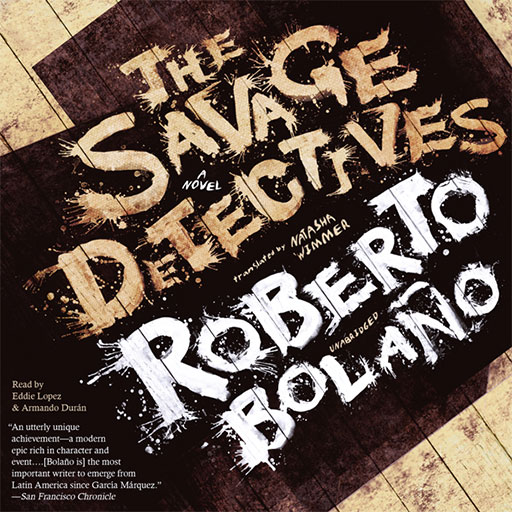
I reread 2666 this summer and immediately knew I had to reread The Savage Detectives, knew I had to parse some of what I missed in my first “unfair and premature” reading. I ended up checking out Blackstone Audio’s recording of the book, featuring the voice talents of Eddie Lopez and Armando Duran.
The audio production is excellent: Lopez, surely a very young man, reads the narratives of Juan García Madero that bookend the central section, “The Savage Detectives,” which is read with a startling depth of range by Duran. Lopez’s García Madero comes across as the naïve pretender to cynicism, the would-be artist faking a life of romance. In Duran’s handling, the myriad characters in the middle of the novel come to life with humor and pathos. He animates the characters, showcasing the irony and pain and sadness and small moments of lunatic joy that erupt in the book. The Savage Detectives makes for a surprisingly excellent audiobook. (Quick note anticipating a query those familiar with the novel may have: The cryptic pictograms that show up late in the novel are included in the audiobook; they displayed on my iPod in tandem with their sections, and I imagine they would pop up on any player with a screen).
I enjoyed The Savage Detectives much, much more this second time. I still found parts of it boring (perhaps purposefully boring, but boring nonetheless), and the episodes I enjoyed most on the first reading (the duel, the cavern, the Liberian segment, the Israeli prison, the campers in Spain) were the ones I enjoyed the most on the second round. Better equipped for this reading, I appreciated the riches of Detectives, the way its fragments, intertextual, metatextual, reach out through the Bolañoverse to couple with other fragments, other texts.
My metaphors above are all wrong—the texts don’t reach or couple—the reader does this work, this reaching, this coupling, this detecting.
In my first reading, not up to playing detective, I surely blew through this passage near the end of the novel, a passage that ripples with strange significance for anyone puzzling over 2666:
And Cesárea said something about days to come, although the teacher imagined that if Cesárea had spent time on that senseless plan it was simply because she lived such a lonely life. But Cesárea spoke of times to come and the teacher, to change the subject, asked her what times she meant and when they would be. And Cesárea named a date, sometime around the year 2600. Two thousand six hundred and something. And then, when the teacher couldn’t help but laugh at such a random date, a smothered little laugh that could scarcely be heard, Cesárea laughed again, although this time the thunder of her laughter remained within the confines of her own room.
Here we have lost poet Cesárea Tinajero, object of the savage detectives’ quest, holed up in her room in Santa Teresa, the central setting for the murders of 2666, a map of a factory (a maquiladora, like the ones the murdered women work at in 2666?) pinned to her wall; here we have Cesárea Tinajero, who keeps “a switchblade with a horn handle and the word Caborca engraved on the blade” by her side, believing she is “under threat of death.” Cesárea Tinajero is prophet to the horrors at the core of 2666.
2666’s Benno von Archimboldi twins Cesárea Tinajero. Just as a quartet of savage detectives search for Tinajero, so to a quartet of literary critics seek out the lost Prussian writer. (Archimboldi even shows up a few times in The Savage Detectives, albeit under the pseudopseudonym “J.M.G. Arcimboldi,” identified as a “Frenchman,” the author of The Endless Rose, his second novel in 2666). Cesárea Tinajero is also repeated in 2666’s Florita Almada, a psychic medium who not only testifies to, but also tries to stop, the unrelenting violence in Santa Teresa.
I suppose I could keep teasing out these intertextual meetings. I could point out that Detectives character Joaquín Font winds up in an insane asylum babbling about fate (fate and insanity being two major themes of 2666). I could point out that Auxilio Lacouture, narrator of Bolaño’s novella Amulet, gets to tell her story in miniature in Detectives. I could point out that the central figures (“central” is not the right word of course) of Detectives, Arturo Belano and Ulises Lima are everywhere in the Bolañoverse—even unnamed, it is clear that one of the duo fathers the bastard Lalo Cura, one of the good detectives of 2666. But what would be my point in elaborating detail after detail here? Or, and perhaps this is the real question I mean to ask here—is a full reading of The Savage Detectives ultimately dependent on intertextual relationships with other Bolaño books?
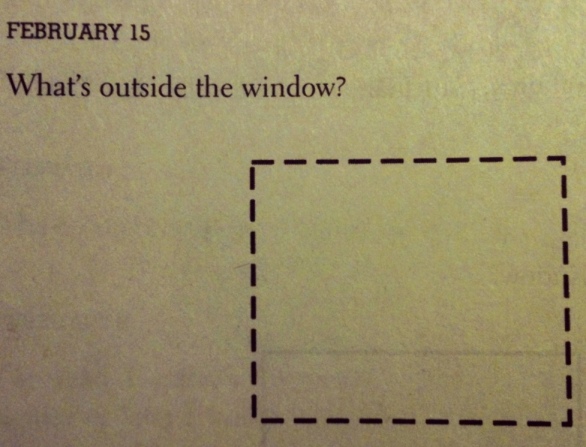
Maybe a better way to finish here is to hash out the last few pages of the novel, which find our narrator García Madero driving around Sonora with Lupe, on the run from the law (maybe). The last few entries of the book—in diary form—are simply a list of place names, obscure places in the Sonora desert the pair presumably drive to. García Madero takes up the mantle of exile and reads Cesárea Tinajero’s notebooks, which perhaps influence him—the last three entries of Detectives feature pictographic riddles that recall Tinajero’s visual poem “Sion.” Here is the final entry, which is also the final page of the book—
I suppose there are plenty of answers to Bolaño’s final riddle. What’s outside the window? Abyss, void, uncertainty. Aporia. And also: Possiblity, openness, freedom. Certainty. And also: The perforated suggestions of a shape, lines to guide our scissors, form. And also: It’s to be taken literally, a literal dare to the reader to get up, to look out, to see. I could probably keep going.
If we know Bolaño’s detective games, we know that the mysteries are really labyrinths, mazes where we might get trapped and go insane. (The Savage Detectives is in large part a novel that outlines the risks—mental, physical, emotional—of literature). How do I read the gaps in the visual riddle? The gesture is visual ambiguity, paradox. The dashes open to void and close to make form; they define yet are indefinite; the window is there and is not there. So what we’re left with is a way of seeing, or at least an invitation to a way of seeing, which is to say a way of reading. So, if you like—and I like—what’s outside the window is the rest of the Bolañoverse—or at least an offer to play detective.
British filmmaker Tony Scott committed suicide by jumping off of a bridge in San Pedro, California yesterday. He was 68.
Scott’s films were rarely critical favorites, although they were generally big hits. Scott’s films share, for the most part, a frenetic energy and a highly stylized visual flair.
His biggest hit was probably Top Gun, although he was also the man responsible for Beverly Hills Cop 2, Enemy of the State, Days of Thunder, The Last Boy Scout, and Crimson Tide.
My favorite Tony Scott film is True Romance, which I sneaked into a theater to see in ninth grade, and which changed my life to a small degree. Quentin Tarantino penned True Romance, and I think Scott was at his best with an offbeat writer, as when he worked with Richard Kelly on the very weird and unfairly maligned film Domino, which I’ve always loved.
Tony Scott is brother to Ridley Scott. For years I’ve had a game with a friend about the two, a game where I stick up for Tony, insist Tony is the real talent in the Scott family.
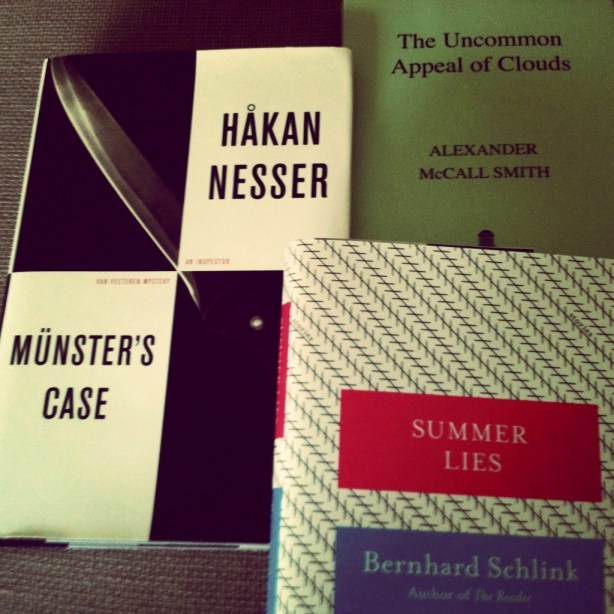
A trio from Pantheon came in last week. There’s a new one from mystery writer Håkan Nesser, called Müenster’s Case, featuring Inspector Van Veeteren. Alexander McCall Smith’s The Uncommon Appeal of Clouds is also a mystery, also part of a series, this one featuring Isabel Dalhousie. I don’t really read these kind of books—I mean mystery series—but I know lots of people dig them, and some of the folks in my English department really dig McCall Smith.
Bernhard Shchlink’s new collection of stories seems interesting. Pantheon’s blurb—
From Bernhard Schlink, the internationally best-selling author of The Reader, come seven provocative and masterfully calibrated stories. A keen dissection of the ways in which we play with truth and less-than-truth in our lives. Summer Lies brims with the delusions, the passions, the outbursts, and the sometimes irrational justifications people make within a mélange of beautifully rendered relationships. In ”After the Season,” a man falls quickly in love with a woman he meets on the beach but wrestles with his incongruous feelings of betrayal after he learns she’s rich. In “Johann Sebastian Bach on Ruegen,” a son tries to put his resentment toward his emotionally distant father behind him by proposing a trip to a Back festival but soon realizes, during his efforts to reconnect, that it wasn’t his father who was the distant one. A philandering playwright is accused to infidelity by his wife in “The Night in Baden-Baden,” but he sees her accusations as nothing more than a means to exculpate himself of his guilt as he carries on with his ways. And in “Stranger in the Night,” an obliging professor becomes an accomplice—not entirely unwittingly—to the temporary escape of a charismatic fugitive on a delayed flight from New York to Frankfurt.
The truth, as once character puts it, is “passionate, beautiful sometimes, and sometimes hideous, it can make you happy and it can torture you, and it always sets you free.” Tantalizingly, so is the act of telling a lie—to others and to ourselves.







 Biblioklept