Modernism at the Barricades (Book Acquired, Some Weeks Ago)


20120924-140107.jpg

I’ve been digging Stephen Eric Bronner’s tight synthesis of modernism, Modernism at the Barricades, which traces the historical rise of expressionism, futurism, surrealism and more against the political, social, and historical backdrop of the emerging 20th century. Bronner’s book is a sharp but concise primer of sorts, using examples like the correspondence between Schoenberg and Kandinsky and the paintings of Emil Nolde to illuminate the big concepts and cultural aims of different modernist movements. Photographs, prints, and posters (like the proclamation below) help to illustrate Bronner’s chapters as well.
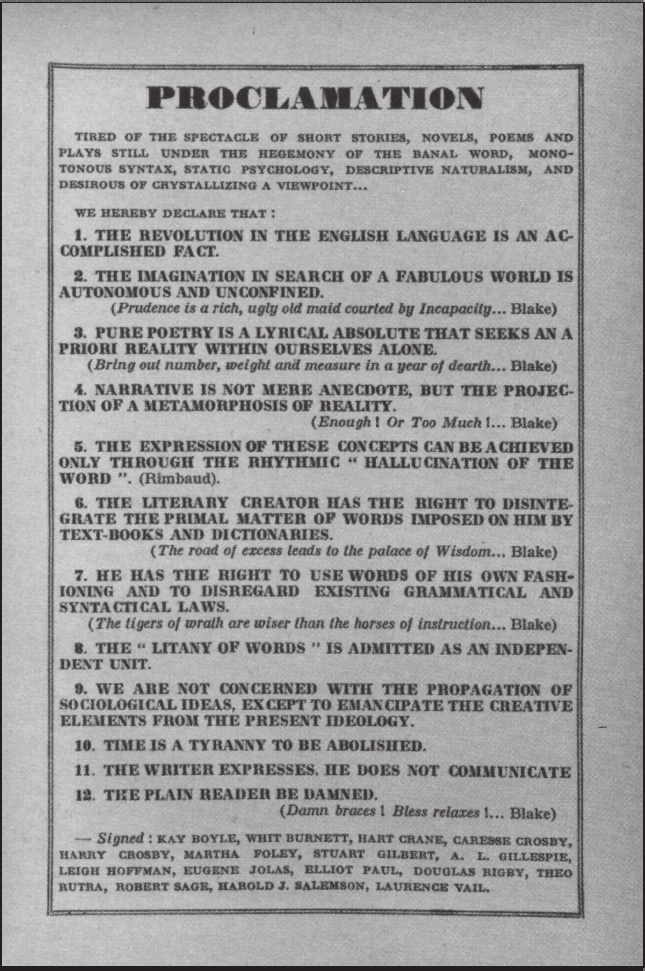
The Revolution of the World Proclamation — Eugene Jolas (1929)

Bronner’s book would make a handy starting point to any student beginning a study of modernism. It doesn’t try to exhaustively account for each and every modernist, but neither does it forsake specificity in favor of a broad overview. Best of all, Bronner is clear and concise, an attribute which unfortunately is all too rare in academic writing. There’s a lucid sensibility that seems to govern the book, which we can see from its earliest chapter. Here Bronner delineates modernism’s cultural project and at the same time points out some of modernism’s own shortsightedness:

Modernism would call into question every aspect of modern life, from the architecture through which our apartments are designed, to the furniture in which we sit, to the comic books our children read, to the films we watch and the museums we visit, to the experience of time and individual possibility that mark our lives. Modernists may have believed that they were contesting modernity, but their efforts and their hopes were shaped by it. Their activities legitimated what they intended to oppose. Their critique, in short, presupposed its object. Modernists believed that they were contesting tradition in the name of the new and the constraints of everyday life in the name of multiplied experience and individual freedom. These artists were essentially anarchists imbued with what Georg Lukács termed “romantic anti-capitalism.”

They opposed the “system” without understanding how it worked or what radical political transformation required and implied. Oddly, they never understood how deeply they were enmeshed in what they opposed. Modernists envisioned an apocalypse that had no place for institutions or agents generated within modernity. Theirs was less a concern with class consciousness than an opposition to the alienating and reifying constraints of modernity. Unfettered freedom of expression and a transformation in the experience of everyday life were the modernists’ goals. Even when seduced by totalitarian movements, whether of the left or the right, most of them despised what Czeslaw Milosz called the“captive mind.” Not all the problems that they uncovered—sexual repression and generational conflicts, among others—required utopian solutions. But their utopian inclinations were transparent from the beginning. Modernists believed that the new would not come from within modernity, but would appear as an external event or force for which, culturally, the vanguard would act as a catalyst.

Good stuff. Modernism at the Barricades is new in hardback from Columbia University Press.


A Young Woman Reading — Gustave Courbet

“Map Ref. 41°N 93°W” — Wire (Live on German TV in 1979)

Maverick Jetpants in the City of Quality (Book Acquired, 9.21.2012)

20120923-131146.jpg

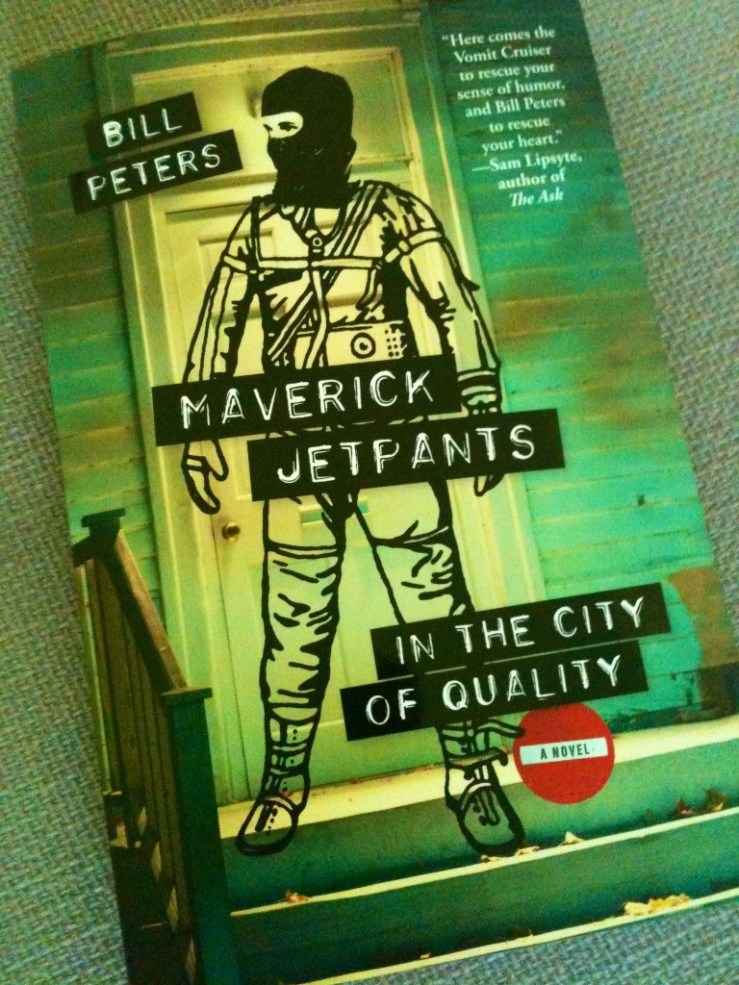
Bill Peters — Maverick Jetpants in the City of Quality. Not sure if that title is brilliant or awful. This one comes out from Black Balloon next month. Their blurb:

Rochester, New York, 1999: An arsonist is loose on the streets of a city in decline. Gone are the days of Rioting in the Vomit Cruiser, searching for a possible Tokyo Rocking Horse. In this hilarious, wildly original debut novel, Nathan Gray and best friend Necro live by the code of Joke Royalty, a system of in-jokes known only to a select few. But as the reality of full-time employment, possible spouses, and Neo-Nazis encroaches, their friendship unravels, threatening their dreams of becoming Kodak Park Winjas.
Among the gravest Hellstacheries: Necro’s strangely vicious drawings and his sudden interest in a group of weapons enthusiasts who may or may not be responsible for the fires erupting through downtown. With no Holy Grail Points left to his name, Nate ventures into Rochester’s strangest corners to find out if his best friend is a domestic terrorist Pinning Bow Ties on the Dead or simply Maverick Jetpantsing on with his life–perhaps even beyond The City of Quality.

Biblioklept fave Sam Lipsyte also provides a blurb:

Do you want laughter, suffering, and friendship, Rochester-style? Do you want to marinate in raucous sadness? I know you do. So be ready, everybody. Here comes the Vomit Cruiser to rescue your sense of humor, and Bill Peters to rescue your heart.

The Pennants of Passive Attitudes and Emotions (William H. Gass)

(From William Gass’s 1995 novel The Tunnel; The Quarterly Conversation will lead a Big Read of The Tunnel starting next week).

David Lynch Interview (The Guardian Lectures, 1985)

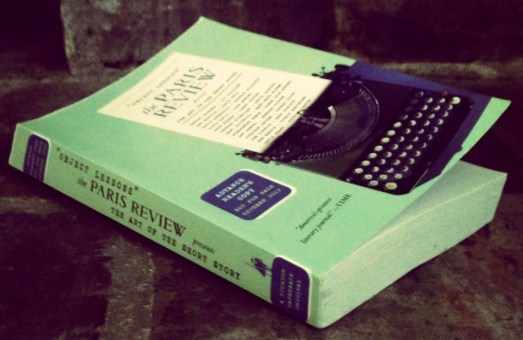
I Review Object Lessons, Where 20 Contemporary Authors Select and Introduce 20 Short Stories from The Paris Review

20120902-135314.jpg

Object Lessons anthologizes 20 stories published in the Paris Review over the past fifty years. “It is not a greatest hits anthology,” advises the brief editor’s note, “Instead, we asked twenty masters of the genre to choose a story from the Paris Review archives—a personal favorite—and to describe the key to its success as a work of fiction.” Hence, we get Ann Beattie introducing Craig Nova’s “Another Drunk Gambler,” Amy Hempel introducing Bernard Cooper’s “Old Birds,” and Sam Lipsyte introducing Mary Robinson’s “Likely Lake.”

Most of the introductions are short—most are fewer than three pages—and each author approaches his or her selection differently. Ben Marcus, prefacing “Several Garlic Tales,” tells us that, “Donald Barthelme was a magician of language, and it would be most respectful, perhaps even ethical, not to look too closely into the workings of his magic.” Marcus proposes a few approaches to find meaning in Barthelme’s surreal tale, but never over-explicates. In contrast, Lydia Davis’s surprisingly long intro to Jane Bowles’s “Emmy Moore’s Journal” is a sentence-to-paragraph close reading; Davis interrogates Bowles’s diction and syntax and concludes her little essay by situating Bowles’s (underappreciated) place in the canon. Davis’s insights are compelling, but one wonders if they wouldn’t be better appreciated after reading the story.

Davis also appears as author of one of the selected stories—Ali Smith picks Davis’s excellent number “Ten Stories from Flaubert.” Smith’s intro is wonderful, explaining the genesis of “Ten Stories,” which “came about when Davis (who is also a translator) was working on a a new translation of Madame Bovary and reading through Flaubert’s letters to his friend and lover Louise Colet.” I’m a huge fan of Lydia Davis, whose work defies easy definition. Smith wonders about her selection: “Are they translations? Are they by Flaubert? Are they by Davis?” The questions are better than answers.

Occasionally an author veers close to spoiling the story he introduces, as does Jeffrey Eugenides when he gracelessly steps all over Denis Johnson’s already-much-anthologized classic “Car Crash While Hitch Hiking.” Elsewhere, Jonathan Lethem mashes and minces misplaced metaphors in his confusing and forgettable introduction to Thomas Glynn’s story “Except for the Sickness I’m Quite Healthy Now. You Can Believe That.” Lethem’s sloppy, unrestrained attempt to dazzle is regrettable. He’s like the warm-up act that tries too hard to show up the headliner and winds up falling on his face.

For the most part though, the introductions simply allow readers new ways to see a story they’ve perhaps read before, as in Aleksandar Hemon’s preface to Jorge Luis Borges’s “Funes the Memorious” or David Means’s preface to Raymond Carver’s “Why Don’t You Dance.” Means suggests that “A great story is like an itch that has to be scratched eternally . . . We’re left with more questions than answers, and more answers than questions; therefore, the paradoxical quality of a good story is that it seems to give us everything we need and yet not quite enough to fulfill a sense of having been shown a full life.” Surprisingly good is Dave Eggers’s intro to James Salter’s “Bangkok,” which reads almost like a loose riff of notes that a harried but talented adjunct might bring to his Creative Writing 101 workshop. Eggers showcases keen intuition about Salter’s narrative coupled with an eagerness that makes one want to read the story.

And what about those stories? If I’ve focused more on the introductions than the stories themselves, it’s perhaps because I’ve taken for granted that the selections are solid for an anthology. Sure, any reader might have his or her gripes, but the range of talent here is undeniable, and the spectrum of stories is satisfying. Object Lessons would make a fine addition to the syllabus of any beginning writing course, and any young person interested in honing her craft could do worse than attending the examples collected here. To be clear, Object Lessons is in no way some master course in How to Write a Short Story, but it does provide the most valuable writer’s tool—good reading.

The Babysitter — Norman Rockwell

The Stranger — Orson Welles (Full Film)

Highwaymen Attacking a Coach — Francisco Goya

Untitled List from the Fall of 1949 — Susan Sontag


From Susan Sontag’s notebooks, collected in Reborn

effete

noctambulus

perfervid

detumescence

disheveled

so alluring, so cerebral

sodden

intriguing

corrupt dignity

lotophagous

elegiac

Meleager

disponibility

pardine

demotic

Harriette Wilson

garbure

satura

succulent

competent intellectual vulgarity of Aldous Huxley

Yellow Book preciousness

secretive

sturdy

pedantry + lechery

spleen

ribaldry

ilex

Klaxon


Book Shelves #39, 9.23.2012

20120923-130233.jpg

Book shelves series #39, thirty-ninth Sunday of 2012

Too many beers yesterday. Can’t write anything good.

Can’t even take a decent pic.

Ten of these shelves hold books; hence books shelves #40-49.

And then there’s another bookcase in this weird workshop space, so that’ll be #50.

And then I’ll revisit the thing that I keep review copies in. And then my nightstand, which was #1.

So that’ll be like, #s 51 and 52.

And since there are 53 Sundays in 2012 I’ll do some kind of summary post.

And then I’ll be done thank God.

“The Image of the Lost Soul” — Saki


“The Image of the Lost Soul” by Saki—

There were a number of carved stone figures placed at intervals along the parapets of the old Cathedral; some of them represented angels, others kings and bishops, and nearly all were in attitudes of pious exaltation and composure. But one figure, low down on the cold north side of the building, had neither crown, mitre, not nimbus, and its face was hard and bitter and downcast; it must be a demon, declared the fat blue pigeons that roosted and sunned themselves all day on the ledges of the parapet; but the old belfry jackdaw, who was an authority on ecclesiastical architecture, said it was a lost soul. And there the matter rested.

One autumn day there fluttered on to the Cathedral roof a slender, sweet-voiced bird that had wandered away from the bare fields and thinning hedgerows in search of a winter roosting-place. It tried to rest its tired feet under the shade of a great angel-wing or to nestle in the sculptured folds of a kingly robe, but the fat pigeons hustled it away from wherever it settled, and the noisy sparrow-folk drove it off the ledges. No respectable bird sang with so much feeling, they cheeped one to another, and the wanderer had to move on.

Only the effigy of the Lost Soul offered a place of refuge. The pigeons did not consider it safe to perch on a projection that leaned so much out of the perpendicular, and was, besides, too much in the shadow. The figure did not cross its hands in the pious attitude of the other graven dignitaries, but its arms were folded as in defiance and their angle made a snug resting-place for the little bird. Every evening it crept trustfully into its corner against the stone breast of the image, and the darkling eyes seemed to keep watch over its slumbers. The lonely bird grew to love its lonely protector, and during the day it would sit from time to time on some rainshoot or other abutment and trill forth its sweetest music in grateful thanks for its nightly shelter. And, it may have been the work of wind and weather, or some other influence, but the wild drawn face seemed gradually to lose some of its hardness and unhappiness. Every day, through the long monotonous hours, the song of his little guest would come up in snatches to the lonely watcher, and at evening, when the vesper-bell was ringing and the great grey bats slid out of their hiding-places in the belfry roof, the brighteyed bird would return, twitter a few sleepy notes, and nestle into the arms that were waiting for him. Those were happy days for the Dark Image. Only the great bell of the Cathedral rang out daily its mocking message, “After joy . . . sorrow.”

The folk in the verger’s lodge noticed a little brown bird flitting about the Cathedral precincts, and admired its beautiful singing. “But it is a pity,” said they, “that all that warbling should be lost and wasted far out of hearing up on the parapet.” They were poor, but they understood the principles of political economy. So they caught the bird and put it in a little wicker cage outside the lodge door.

     That night the little songster was missing from its accustomed haunt, and the Dark Image knew more than ever the bitterness of loneliness. Perhaps his little friend had been killed by a prowling cat or hurt by a stone. Perhaps . . . perhaps he had flown elsewhere. But when morning came there floated up to him, through the noise and bustle of the Cathedral world, a faint heart-aching message from the prisoner in the wicker cage far below. And every day, at high noon, when the fat pigeons were stupefied into silence after their midday meal and the sparrows were washing themselves in the street-puddles, the song of the little bird came up to the parapets — a song of hunger and longing and hopelessness, a cry that could never be answered. The pigeons remarked, between mealtimes, that the figure leaned forward more than ever out of the perpendicular.

One day no song came up from the little wicker cage. It was the coldest day of the winter, and the pigeons and sparrows on the Cathedral roof looked anxiously on all sides for the scraps of food which they were dependent on in hard weather.

“Have the lodge-folk thrown out anything on to the dust-heap?” inquired one pigeon of another which was peering over the edge of the north parapet.

“Only a little dead bird,” was the answer.

There was a crackling sound in the night on the Cathedral roof and a noise as of falling masonry. The belfry jackdaw said the frost was affecting the fabric, and as he had experienced many frosts it must have been so. In the morning it was seen that the Figure of the Lost Soul had toppled from its cornice and lay now in a broken mass on the dustheap outside the verger’s lodge.

     “It is just as well,” cooed the fat pigeons, after they had peered at the matter for some minutes; “now we shall have a nice angel put up there. Certainly they will put an angel there.”

“After joy . . . sorrow,” rang out the great bell.


St. Antony of Padua – El Greco

Charlie Chaplin’s City Lights (Full Film)

Fable of the Fox and the Heron — Frans Snyders

Iceberg Slim Talks About His Novel Trick Baby