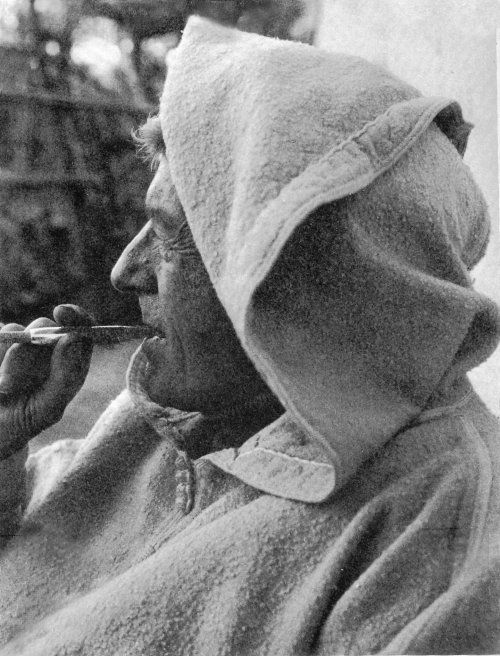
John Berryman at the Brockport Writers Forum in October of 1970

Truth — Marc Dennis

marc-dennis-truth_2017_oil_on_linen_51x54_inches.jpg

Truth, 2017 by Marc Dennis (b. 1971)

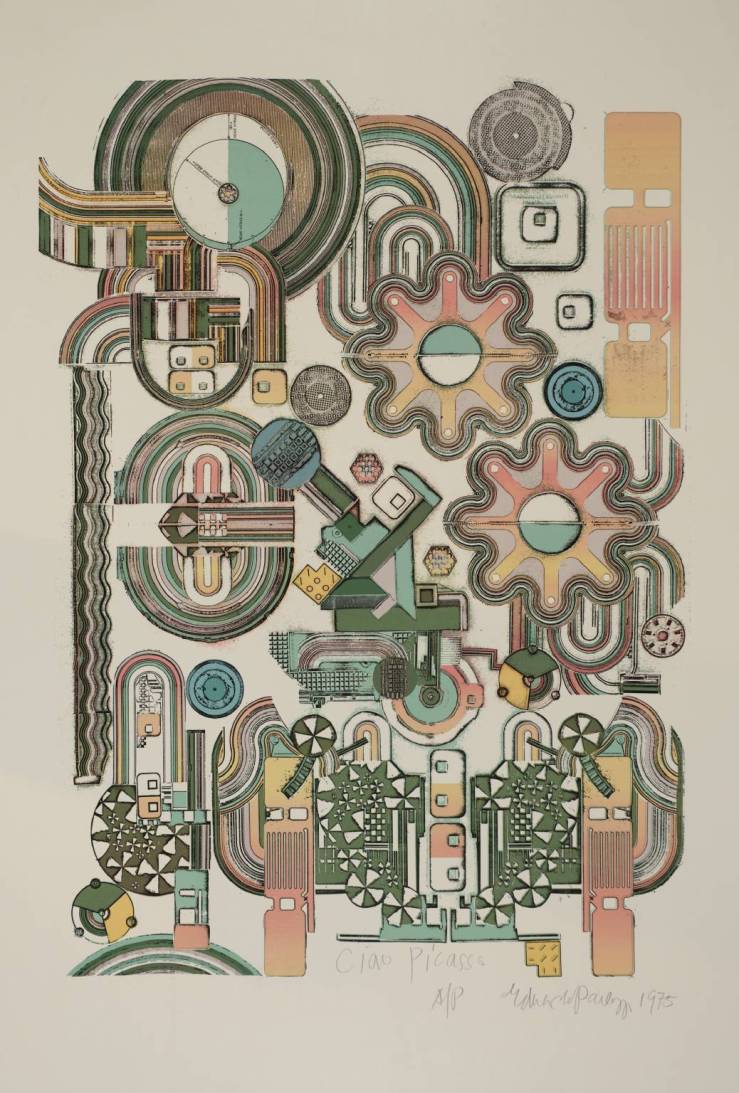
Ciao Picasso — Eduardo Paolozzi

Ciao Picasso 1975 by Sir Eduardo Paolozzi 1924-2005

Ciao Picasso, 1975 by Eduardo Paolozzi  (1924–2005)

Bacchus and Ariadne (Detail) — Titian

1

Bacchus and Ariadne (detail),1522–23 by Titian (c. 1488-1576)

Sketch from Titian’s Bacchus and Ariadne — Frank Auerbach

Sketch from Titian's 'Bacchus and Ariadne' 1970-71 by Frank Auerbach born 1931

Sketch from Titian’s Bacchus and Ariadne, 1970–1 by Frank Auerbach (b. 1931)

Let me recommend Antonio di Benedetto’s overlooked novel Zama

Let me recommend a novel for you.

The novel is Antonio di Benedetto’s Zama.

Zama was first published in Argentina in 1956.

NYRB published Esther Allen’s English translation in 2016. It is excellent.

What is Zama about?

Zama tells the brutally funny and often sad story of Don Diego de Zama, a bored and horny americano wasting away in the provincial backwaters of Paraguay. It’s the end of the world at the end of the 18th century, and there’s not a lot to do. Zama fills his time with schemes of lust and petty pride, shirking his job as a nominal governmental authority. He longs to be reunited with his wife and family in Buenos Aires, but seems to sabotage every opportunity to get back to them. He also longs for his glory days as a corregidor, putting down “the native rebellion” in the service of Spain’s imperial project. Zama is a confusing and confused character, frequently frustrating but also oddly sympathetic. He is a loser who does not seem to see that he is a loser, although life gives him every opportunity to come to this conclusion. As South African novelist J.M. Coetzee’s  puts it in his excellent in-depth review of the novel:

[Zama] is vain, maladroit, narcissistic, and morbidly suspicious; he is prone to accesses of lust and fits of violence, and endowed with an endless capacity for self-deception.

He is also the author of himself, in a double sense. First, everything we hear about him comes from his own mouth, including such derogatory epithets as “swaggering” and “dogslayer,” which suggest a certain ironic self-awareness. Second, his day-to-day actions are dictated by the promptings of his unconscious, or at least his inner self, over which he makes no effort to assert conscious control. His narcissistic pleasure in himself includes the pleasure of never knowing what he will get up to next, and thus of being free to invent himself as he goes along.

Coetzee captures the joy of reading Zama in those last few lines: It’s the joy in watching a first-person perspective invent itself in shambling picaresque adventures born of sheer boredom. It’s the pleasure of seeing an asshole who refuses to acknowledge that he is an asshole try to pretend that he is not an asshole—all in a kind of language that is simultaneously romantic and flat.

Let me give you a taste of that language, reader. Here are the opening bars of the novel:

I left the city and made my way downriver alone, to meet the ship I awaited without knowing when it would come.

I reached the old wharf, that inexplicable structure. The city and its harbor have always been where they are, a quarter-league farther upriver.

I observed, among its pilings, the writhing patch of water that ebbs between them.

A dead monkey, still whole, still undecomposed, drifted back and forth with a certain precision upon those ripples and eddies without exit. All his life the water at forest’s edge had beckoned him to a journey, a journey he did not take until he was no longer a monkey but only a monkey’s corpse. The water that bore him up tried to bear him away, but he was caught among the posts of the decrepit wharf and there he was, ready to go and not going. And there we were.

There we were: Ready to go and not going.

The ship that won’t come in, the floating dead monkey, the state of unknowing—these abject and negative motifs are the paradoxical genesis of the novel. The clipped repetitions, culminating in “Ready to go and not going” recall Samuel Beckett, whom translator Esther Allen acknowledges as “a perfect counterpoint to the prose voice of Zama” in her introduction.

In addition to Beckett, easy points of comparison are Dostoevsky, Camus, Borges, and especially Kafka. In his perceptive analysis of Zama, critic Benjamin Kunkel points out the novel’s existential core, absurdist peripheries, and realistic contours:

As with novels by Kafka, Camus, Sartre, and Beckett, the story’s preoccupation is the tension between human freedom and constraining circumstance. Zama, a man as impetuous as he is stuck, resembles other existentialist antiheroes as he swings between spellbound passivity and sudden lunges into action. But Don Diego never seems like a figure in an allegory, like K. in The Castle; or an ambulatory philosophical argument, like Roquentin in Nausea. Zama induces a rare feeling—to put it as naïvely as possible—of the main character’s realness. Don Diego is consistently surprised by his own behavior, but not as much as he would like. His abrupt acts and swerving meditations have an air of unplotted inevitability about them. He is a character more convincing than coherent, and more persuasive than intelligible.

These lifelike moments of “unplotted inevitability” are enthralling. Di Benedetto doesn’t just show us Zama seeing, he shows us Zama seeing what he is seeing. He shows us consciousness at work—or rather, consciousness in distress. In a representative passage which can stand alone as a bizarre parable in search of a moral, Zama, having lost all his money betting on horses, awakes from a drunken stupor to witness a spider crawling on a fellow drunkard: 

The spider approached the drunk. From a quarter vara away, these spiders can leap and bite so that if taken by surprise, even a man who’s awake has no time to defend himself. I had no wish to move. I could crush it with my boot but would postpone until the last.

The spider moved toward the sleeping head and I watched to see whether anything out of the ordinary would transpire. Would the man—obedient to some mysterious warning instinct—suddenly awaken and kill it? He did not. Now the insect was crawling in his hair. I didn’t see it climb up; I saw it there on him and then I was quite certain I should do nothing.

The episode continues in this way, building in tension as the large spider crawls over the man’s face while Zama remains inert and fascinated by his own inertia—until the drunken man absently bats the spider from his face. Zama is paradoxically stunned by this anticlimax:

I reviewed the episode. At no point had I felt any emotion, except when I imagined the man had wakened and was about to deliver himself of an entirely justified diatribe against me.

The passage is representative of Di Benedetto’s rhetorical skill—he gives us a deceptively lucid first-person narrator who articulately elides key information, both from the reader and himself. Zama refuses to name his intense desire to see the spider bite the man. Additionally, his emotional identification is bound to righteous anger, the righteous anger appropriate to the would-be-bitten drunkard. Instead of genuine pathos, Zama would usurp this man’s self-righteous anger, the anger that he feels all the time at his (literal and figurative) position in life. But the spider bite that would license self-righteousness never comes. Basically, Zama just wants something to happen.

And that’s the plot of Zama, more or less. Our (anti-)hero’s picaresque jabs at adventure and romance are sent awry or thwarted, usually by his own loutish passions. Zama’s would-be escapades unravel, that is, until the book’s final section, 1799

–Okay, let me digress momentarily: Zama, a slim 200 pages, is structured into three sections: 17901794, and 1799. The connective tissue between these sections hangs transparent, nearly invisible, but nevertheless accessible via small clues, motifs, scant threads. Di Benedetto gives us modernism in the last decade of the 18th century, boredom that tiptoes around the abyss of insanity. Rereading the three sections is a joy. But let me return to the central thread—

Zama’s would-be adventures unravel or collapse until the book’s final section, 1799, when Di Benedetto puts our hero in genuine harm’s way (and cunningly exfiltrates any opportunity for overt heroism on Zama’s part). The novel earns its drive toward what I take to be its central question: “Do you want to live?”

Di Benedetto hides his answer to this question not so much in the central figure Zama, but rather in Zama’s put-upon secretary, his mozo Manuel Fernández. Fernández is, at least for me, the secret star of the novel. When we first meet Fernández, Zama joins in gently mocking him at the lead of their boss, the governor. They tease Fernández when he tells them that he is writing a novel. “Make sons, Manuel, not books,” admonishes the governor, but the clerk replies: “I want to realize myself in myself…Children realize themselves, but whether for good or ill we don’t know. Books are made only for truth and beauty.” Later, Zama, in more of a ruse than in good faith, asks Fernández to read some of his book. He finds the “entangled” prose “incomprehensible,” to which Fernández replies: “the first man and the first lizard were each incomprehensible, as well, to all those who surrounded them.” Fernández declares that he writes for “no master.” If he has no audience today, his pages will be understood by his “grandchildren’s grandchildren…Things will be different then.” Later, Fernández reveals that he’s given away his manuscript to an old man, a stranger suffering boredom while waiting for a delayed ship to take him somewhere other than the end of the world.

Fernández sees himself as an author doomed to obscurity in the present, an author who awaits a future that will catch up to his originary vision. Perhaps it’s a bit much to suggest he’s a stand-in for Di Benedetto, but there are traces here. Above, I cited Benjamin Kunkel’s essay on Zama“A Neglected South American Masterpiece,” and J.M. Coetzee’s review, “A Great Writer We Should Know.” Those titles point to the novel’s obscurity, an obscurity which I sense is now being (if in increments) reversed. Esther Allen’s English translation obviously opens Zama to an even wider audience, and Argentine director Lucrecia Martel is apparently adapting the novel to film. But it’s perhaps Roberto Bolaño, a writer who time caught up to, however too late, who helped guide new readers—however obscurely—to Zama. In Bolaño’s 1997 short story “Sensini,” the titular character is a clear transposition of Di Benedetto, a cult author, a writer’s writer:

The novel was the kind of book that circulates by word of mouth. Entitled Ugarte, it was about a series of moments in the life of Juan de Ugarte, a bureaucrat in the Viceroyalty of the Rio de la Plata at the end of the eighteenth century. Some (mainly Spanish) critics had dismissed it as Kafka in the colonies, but gradually the novel had made its way, and by the time I came across Sensini’s name in the Alcoy anthology, Ugarte had recruited a small group of devoted readers, scattered around Latin America and Spain, most of whom knew each other, either as friends or as gratuitously bitter enemies.

Thank goodness, or thank evil, or thank boredom: thanks for word of mouth, for friends and enemies alike (as long as they have good taste); thanks for writer’s writers (and writer’s writer’s writers) and the cult books they transmit to us—like Zama.

Zama is a cult novel that deserves a larger cult. After two false starts (I admit I misread the voice, missing the humor), I read Di Benedetto’s novel in a kind of hunger. Then I read it again. Then I wrote this thing, to tell you, dear reader, that you should read it too. Very highly recommended.

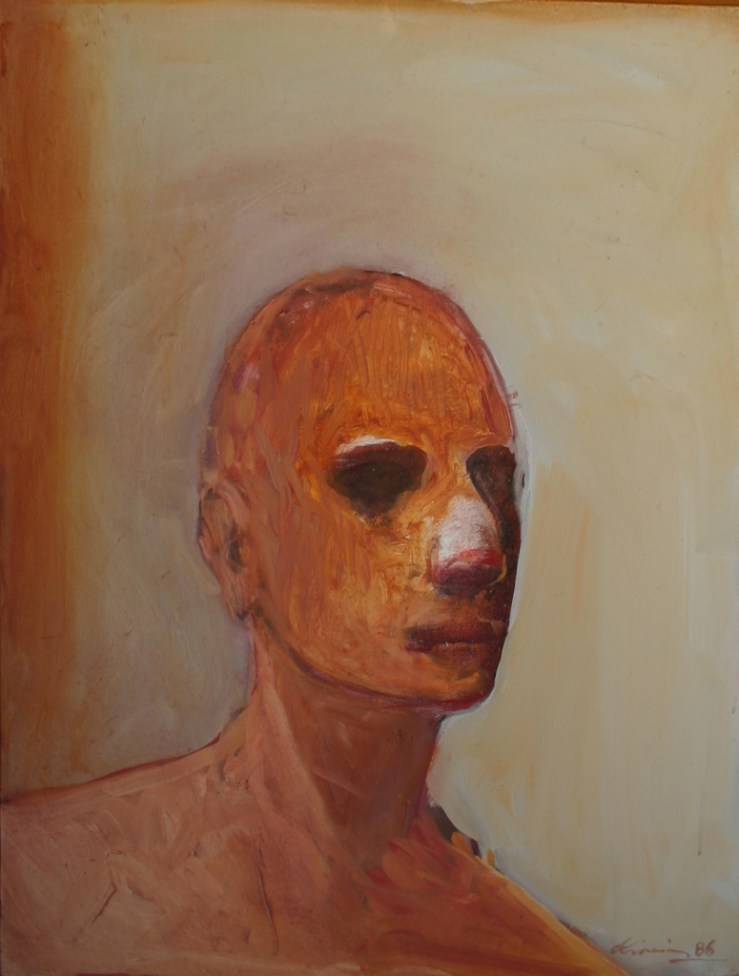
Golden Head — Nathan Oliveira

tumblr_n3wly8viIA1rpvjjio1_1280.jpg

Golden Head, 1986 — Nathan Oliveira (1928-2010)

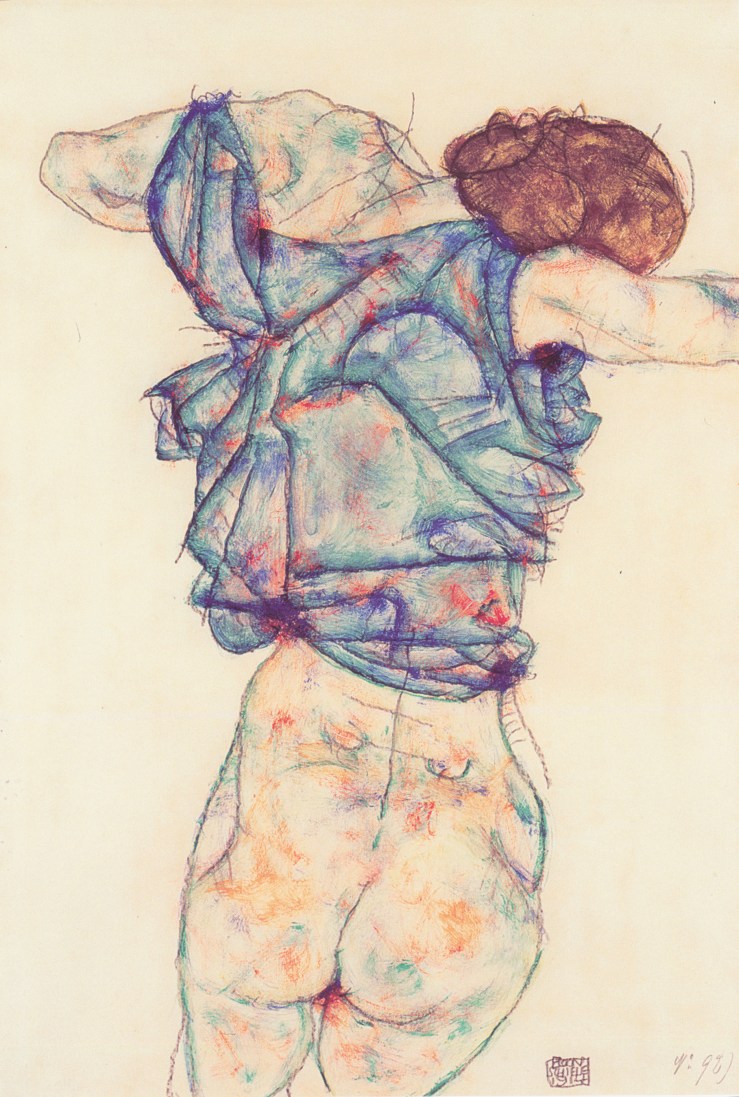
Woman Undressing — Egon Schiele

Egon_Schiele_-_Sich_entkleidende_Frau_-_1914

Sich entkleidende Frau (Woman Undressing), 1914 — Egon Schiele (1890-1918)

My variegated face looks somewhat more human to-day | Nathaniel Hawthorne’ journal entry for Monday, April 10th, 1843

Monday, April 10th.–I sat till eight o’clock, meditating upon this world and the next, . . . and sometimes dimly shaping out scenes of a tale. Then betook myself to the German phrase-book. Ah! these are but dreary evenings. The lamp would not brighten my spirits, though it was duly filled, . . . This forenoon was spent in scribbling, by no means to my satisfaction, until past eleven, when I went to the village. Nothing in our box at the post-office. I read during the customary hour, or more, at the Athenæum, and returned without saying a word to mortal. I gathered from some conversation that I heard, that a son of Adam is to be buried this afternoon from the meeting-house; but the name of the deceased escaped me. It is no great matter, so it be but written in the Book of Life.

My variegated face looks somewhat more human to-day; though I was unaffectedly ashamed to meet anybody’s gaze, and therefore turned my back or my shoulder as much as possible upon the world. At dinner, behold an immense joint of roast veal! I would willingly have had some assistance in the discussion of this great piece of calf. I am ashamed to eat alone; it becomes the mere gratification of animal appetite,–the tribute which we are compelled to pay to our grosser nature; whereas, in the company of another it is refined and moralized and spiritualized; and over our earthly victuals (or rather vittles, for the former is a very foolish mode of spelling),–over our earthly vittles is diffused a sauce of lofty and gentle thoughts, and tough meat is mollified with tender feelings. But oh! these solitary meals are the dismallest part of my present experience. When the company rose from table, they all, in my single person, ascended to the study, and employed themselves in reading the article on Oregon in the “Democratic Review.” Then they plodded onward in the rugged and bewildering depths of Tieck’s tale until five o’clock, when, with one accord, they went out to split wood. This has been a gray day, with now and then a sprinkling of snow-flakes through the air. . . . To-day no more than yesterday have I spoken a word to mortal. . . . It is now sunset, and I must meditate till dark.

Nathaniel Hawthorne’ journal entry for Monday, April 10th, 1843. From Passages from the American Note-Books.

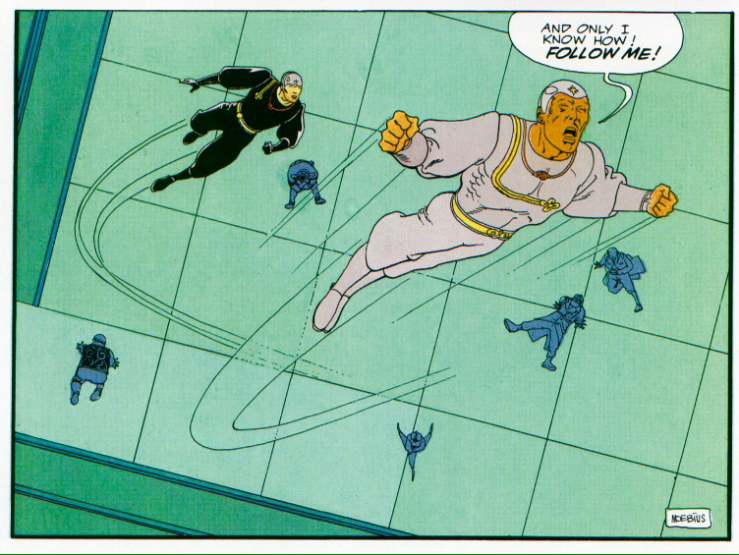
Sunday Comics

img_0513img_0515img_0514

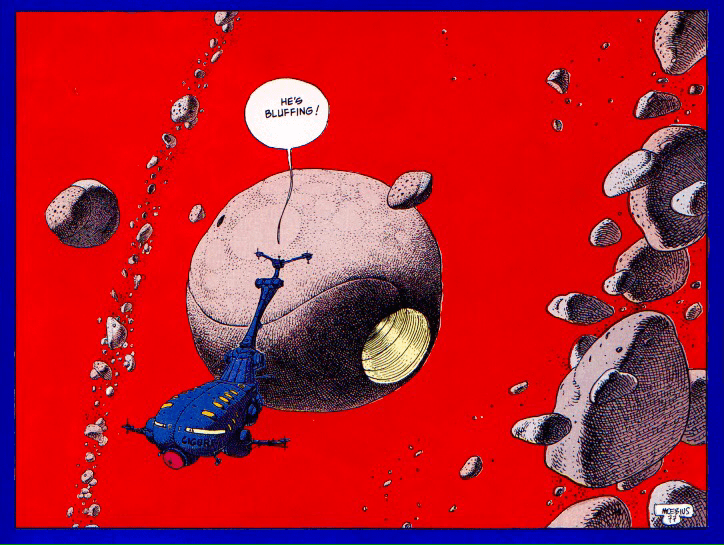
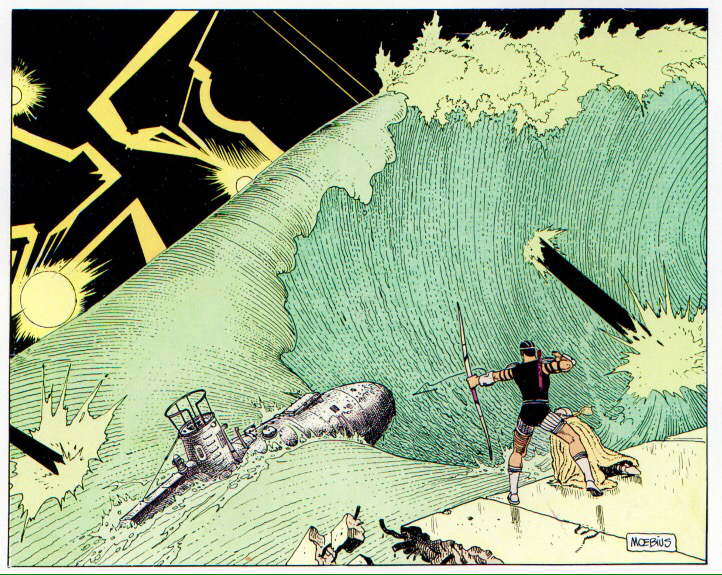
Three (noncontiguous, nonconsecutive, unrelated) panels by Moebius from various comics in Moebius 3: The Airtight Garage (Epic Comics/Marvel).

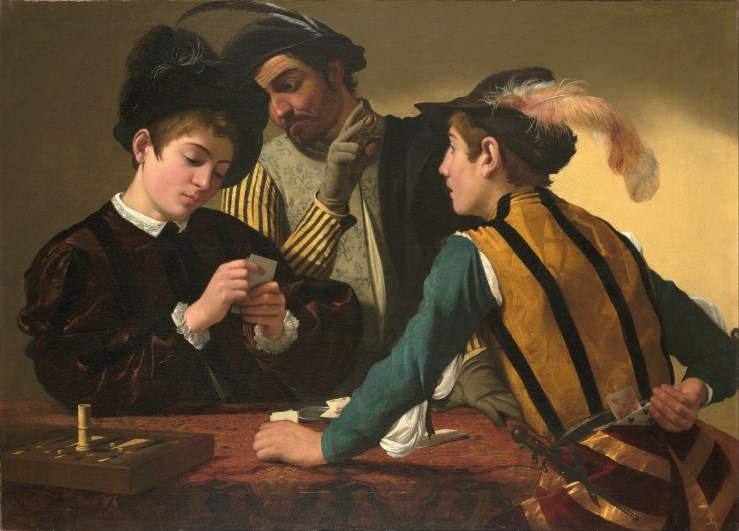
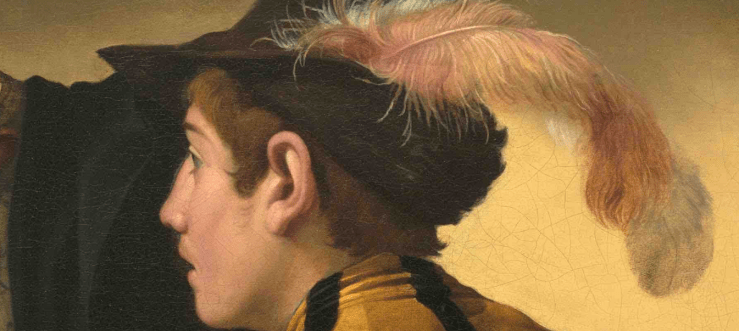
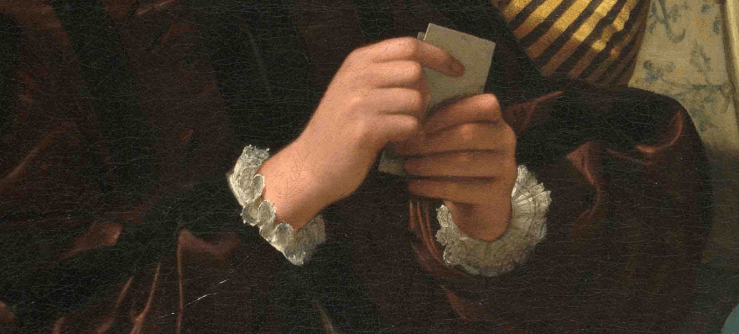
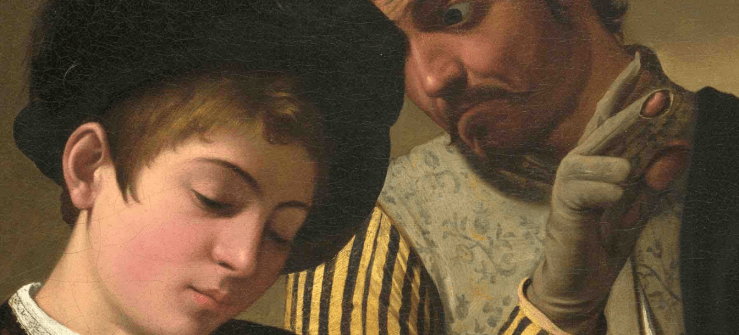
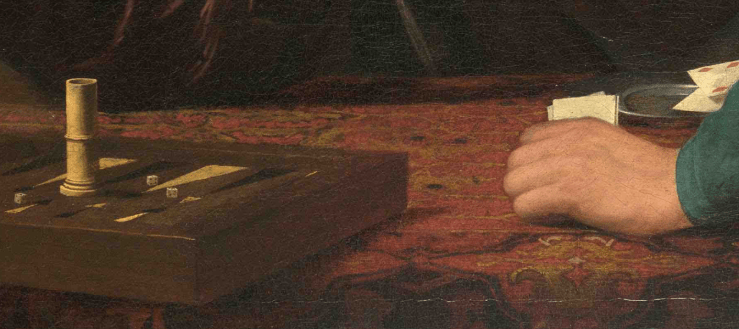
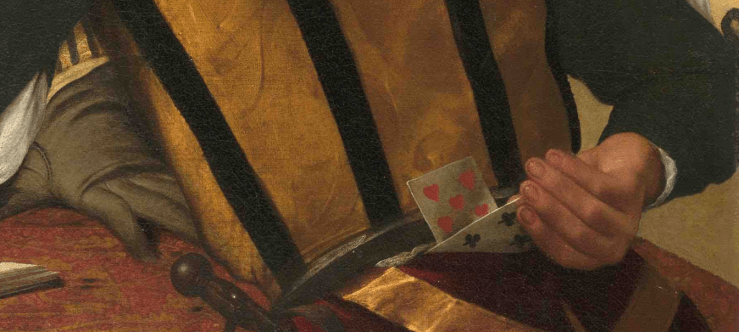
The Cardsharps — Caravaggio

Caravaggio_(Michelangelo_Merisi)_-_The_Cardsharps_-_Google_Art_ProjectScreenshot 2017-04-09 at 4.43.34 PMScreenshot 2017-04-09 at 4.44.00 PMScreenshot 2017-04-09 at 4.43.15 PMScreenshot 2017-04-09 at 4.44.42 PMScreenshot 2017-04-09 at 4.44.14 PM

Bari (The Cardsharps), c. 1594 by Michelangelo Merisi da Caravaggio (1571-1610)

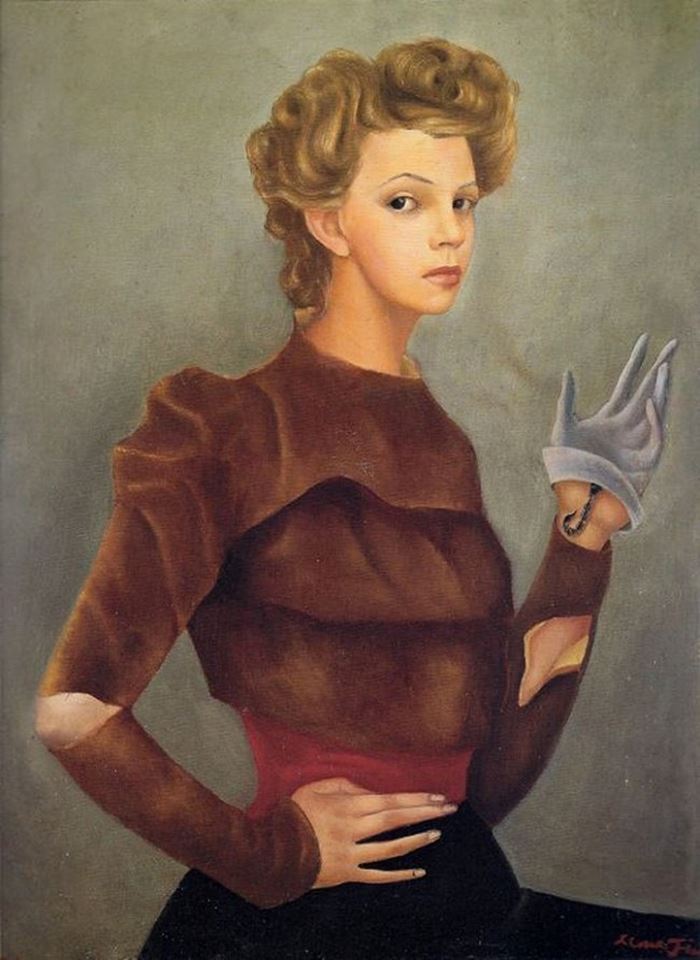
Self Portrait with Scorpion — Leonor Fini

Fini Autoportrait au Scorpion 1938

Self Portrait with Scorpion, 1938 by Leonor Fini (1908-1996)

Female Runner II — Willi Baumeister

tumblr_okwg9qbnqE1v1k5edo1_1280

Female Runner II, 1925 by Willi Baumeister (1889-1955)

Drowsed over Voltaire’s “Candide,” occasionally refreshing myself with a tune from Mr. Thoreau’s musical-box | Nathaniel Hawthorne’s journal entry for Saturday, April 8th, 1843

Saturday, April 8th.–After journalizing yesterday afternoon, I went out and sawed and split wood till teatime, then studied German (translating “Lenore”), with an occasional glance at a beautiful sunset, which I could not enjoy sufficiently by myself to induce me to lay aside the book. After lamplight, finished “Lenore,” and drowsed over Voltaire’s “Candide,” occasionally refreshing myself with a tune from Mr. Thoreau’s musical-box, which he had left in my keeping. The evening was but a dull one.

I retired soon after nine, and felt some apprehension that the old Doctor’s ghost would take this opportunity to visit me; but I rather think his former visitations have not been intended for me, and that I am not sufficiently spiritual for ghostly communication. At all events, I met with no disturbance of the kind, and slept soundly enough till six o’clock or thereabouts. The forenoon was spent with the pen in my hand, and sometimes I had the glimmering of an idea, and endeavored to materialize it in words; but on the whole my mind was idly vagrant, and refused to work to any systematic purpose. Between eleven amid twelve I went to the post-office, but found no letter; then spent above an hour reading at the Athenæum. On my way home, I encountered Mr. Flint, for the first time these many weeks, although he is our next neighbor in one direction. I inquired if he could sell us some potatoes, and he promised to send half a bushel for trial. Also, he encouraged me to hope that he might buy a barrel of our apples. After my encounter with Mr. Flint, I returned to our lonely old abbey, opened the door without the usual heart-spring, ascended to my study, and began to read a tale of Tieck. Slow work, and dull work too! Anon, Molly, the cook, rang the bell for dinner,–a sumptuous banquet of stewed veal and macaroni, to which I sat down in solitary state. My appetite served me sufficiently to eat with, but not for enjoyment. Nothing has a zest in my present widowed state. [Thus far I had written, when Mr. Emerson called.] After dinner, I lay down on the couch, with the “Dial” in my hand as a soporific, and had a short nap; then began to journalize.

Mr. Emerson came, with a sunbeam in his face; and we had as good a talk as I ever remember to have had with him. He spoke of Margaret Fuller, who, he says, has risen perceptibly into a higher state since their last meeting. [There rings the tea-bell.] Then we discoursed of Ellery Channing, a volume of whose poems is to be immediately published, with revisions by Mr. Emerson himself and Mr. Sam G. Ward. . . . He calls them “poetry for poets.” Next Mr. Thoreau was discussed, and his approaching departure; in respect to which we agreed pretty well, . . . We talked of Brook Farm, and the singular moral aspects which it presents, and the great desirability that its progress and developments should be observed and its history written; also of C. N—-, who, it appears, is passing through a new moral phasis. He is silent, inexpressive, talks little or none, and listens without response, except a sardonic laugh and some of his friends think that he is passing into permanent eclipse. Various other matters were considered or glanced at, and finally, between five and six o’clock, Mr. Emerson took his leave. I then went out to chop wood, my allotted space for which had been very much abridged by his visit; but I was not sorry. I went on with the journal for a few minutes before tea, and have finished the present record in the setting sunshine and gathering dusk. . . .

Nathaniel Hawthorne’ journal entry for Saturday, April 8th, 1843. From Passages from the American Note-Books.


Fortress — Jeremy Geddes

Fortress2000Screenshot 2017-04-06 at 8.18.17 AMScreenshot 2017-04-06 at 8.18.47 AM

Fortress, 2014 by Jeremy Geddes (b. 1974)

Little Magazine, World Form (Book acquired, 5 April 2017)

img_5662

Eric Bulson’s Little Magazine, World Form is new from Columbia University Press. It looks pretty cool. Their blurb:

Little magazines made modernism. These unconventional, noncommercial publications may have brought writers such as James Joyce, T. S. Eliot, Ezra Pound, Marianne Moore, Mina Loy, and Wallace Stevens to the world but, as Eric Bulson shows in Little Magazine, World Form, their reach and importance extended far beyond Europe and the United States. By investigating the global and transnational itineraries of the little-magazine form, Bulson uncovers a worldwide network that influenced the development of literature and criticism in Africa, the West Indies, the Pacific Rim, and South America.

In addition to identifying how these circulations and exchanges worked, Bulson also addresses equally formative moments of disconnection and immobility. British and American writers who fled to Europe to escape Anglo-American provincialism, refugees from fascism, wandering surrealists, and displaced communists all contributed to the proliferation of print. Yet the little magazine was equally crucial to literary production and consumption in the postcolonial world, where it helped connect newly independent African nations. Bulson concludes with reflections on the digitization of these defunct little magazines and what it means for our ongoing desire to understand modernism’s global dimensions in the past and its digital afterlife.

At any moment they could could swell and become something other than what they were | A riff on Paul Bowles

f2732e1055081c794cb4a8fbcc6009fe

I was too young the first time I took a crack at Paul Bowles’ 1949 debut novel The Sheltering Sky. I was maybe 15 or 16 I think, reading a lot of Hemingway, Vonnegut, and William Burroughs at the time. I couldn’t click with Bowles.

Two decades later—by which I mean this January—I read/audited The Stories of Paul Bowles and fell in a weird love with them: Spare but sharp, wild but obscure, his fables refuse to square with our expectations. They are menacing, awful, loaded with strangers and travelers and outcasts. The characters do not know what is happening to them—indeed, they do not even know that they do not know what is happening to them. Sometimes the story’s narrator does not seem to know what is happening, and if the narrator does know what is happening, he’s not going to throw anything but the barest bones to the reader to piece together.

The best of the stories are wonderfully confusing, like “Tapiama,” the surreal, abject tale of a photographer’s picaresque journey into a mad foreign night. Bowles’ style succeeds in lucidly conveying the murk of a crashing consciousness:

The photographer had begun to suspect that something had gone very wrong inside him. He felt sick, but since he was no longer a living creature he could not conceive it in those terms. He had shut his eyes and put his hand over his face. “It’s going around backward,” he said. The undrunk cumbiamba was in his other hand.

Saying the sentence had made it more true. It was definitely going around backward. The important thing was to remember that he was alone here and that this was a real place with real people in it. He could feel how dangerously easy it would be to go along with the messages given him by his senses, and dismiss the whole thing as a nightmare in the secret belief that when the breaking-point came he could somehow manage to escape by waking himself up.

“Tapiama” is probably my favorite thing by Bowles, or at least the tale that best exemplifies what I like best in Bowles—the alienation of a stranger in a strange land, the creepy ickiness of realizing the unreal. Bowles’ characters are frequently tourists who wish to be more than tourists, who make ironic-romantic claims towards becoming travelers. He awakens these travelers to reality’s nightmare. There’s a quality here that I love, that dread noir thing that other storytellers like David Lynch and Roberto Bolaño evoke so well.

Bowles’ early stories succeed in evoking anxious, uncanny dread — “The Scorpion,” “By the Water,” “You Are Not I” are all easy go-to examples. I found the later tales in The Stories of Paul Bowles less intriguing, but emotionally richer. Sadder. Bowles’ later stuff grows more bitter, more resentful. The earlier tales are strange, sharp, and driven by weird nightmare alienation and sinister surrealism. But they also open into possibility, exploration, and radical newness. The later tales, composed in the 1980s, seem to me a closing off, not just in themes and tone, but also in style. They retreat into formalist modernism. There’s a palpable resistance to postmodernism in the later stories, an elegiac tone that romanticizes (even through multiple ironies) the post-War colonial past.

After I read The Stories of Paul Bowles, I read The Sheltering Sky, the fan favorite of this cult author. I’ll admit I was disappointed, although I probably failed the novel, not the other way around. I liked it best in its rawest moments, its looser strands creeping out like tendrils in another direction; often these tendrils were cut off in the service of a more formally organized novel—a novel that sags heavily in the middle, but explodes into a weird nightmare in the end as Kit, the book’s true hero, travels in a way her husband Port fails to.

The Sheltering Sky is larded with fantastic moments and meditations though, like the one below. Here, Bowles shows that to be human is to invest an aesthetic (and simultaneously anesthetic) viewpoint into one’s daily life—and that to invest in this viewpoint is to calculate psychic and emotional costs and payoffs:

He did not look up because he knew how senseless the landscape would appear. It takes energy to invest life with meaning, and at present this energy was lacking. He knew how things could stand bare, their essence having retreated on all sides to beyond the horizon, as if impelled by a sinister centrifugal force. He did not want to face the intense sky, too blue to be real, above his head, the ribbed pink canyon walls that lay on all sides in the distance, the pyramidal town itself on its rocks, or the dark spots of oasis below. They were there, and they should have pleased his eye, but he did not have the strength to relate them, either to each other or to himself, he could not bring them into any focus beyond the visual. So he would not look at them.


While I was admittedly disappointed in The Sheltering Sky, I found much in it to propel me on into more of Bowles’ writing. I next read Up Above the World—mostly because of its title. Phrases and iterations of “out in the world” repeat through Bowles’ writing, so it intrigued me. This 1966 novel has a reputation as being one of Bowles’ lesser novels, but I enjoyed it more than The Sheltering Sky—perhaps my expectations were lower.

Up Above the World’s reputation as a slighter work might have to do with the fact that it’s something of a genre fiction—a slow-burn thriller, a crime story really. There’s a cinematic structure to it, and a plainness to its tone that belies a murderous intensity. I won’t spoil the trick of the novel, but it twists in sinister, delightful ways, leaving loose threads for the reader to tie together.

I’ll close by sharing my favorite passage from Up Above the World. This moment comes in the crux of the novel, in its middle when Dr. Slade—a tourist who perhaps had the pretensions of being a traveler—shifts from one dimension to the next:

He reached out his hand and pressed the door handle, took two or three steps on the spongy grass, and raised his head. In front of him, not three feet away, there was a face—a muzzle, rather, for it surely belonged to an animal—looking at him with terrible intensity. It was unmoving, fashioned from a nameless, constantly dripping substance. Unmoving, yet it must have moved, for now the mouth was much farther open; long twisted tendons had appeared in each cheek. He watched, frozen and unbelieving, while the whole jaw swiftly melted and fell away, leaving the top part of the muzzle intact. The eyes glared more savagely than before; they were telling him that sooner or later he would have to pay for having witnessed that moment of its suffering. He took a step backward and looked again. There were only leaves and shadows of leaves, no muzzle, no eyes, nothing. But the leaves were pulsating with energy. At any moment they could could swell and become something other than what they were.

At any moment they could could swell and become something other than what they were: This is the monstrous power of Bowles’ best moments—his ability to evoke visceral reality, his ability to show how consciousness transforms the real into the surreal, even as it tries to navigate that reality. He shows that we are all tourists in our own heads.