Having a spare hour, I searched my favorite local used book store again for a copy of Thomas S. Klise’s 1974 cult novel The Last Western. I’d like to write about The Last Western more, and I only have a samizdat digital copy (clearly made by someone who deeply loves this out of print novel). It’d be nice to check the digital copy against an actual book of course. Anyway, I didn’t find the Klise, despite extending my search to, um, westerns. (I see interlibrary loan in my future). Really, any indie press that brings The Last Western back into print will find plenty of readers (and champions for the book).
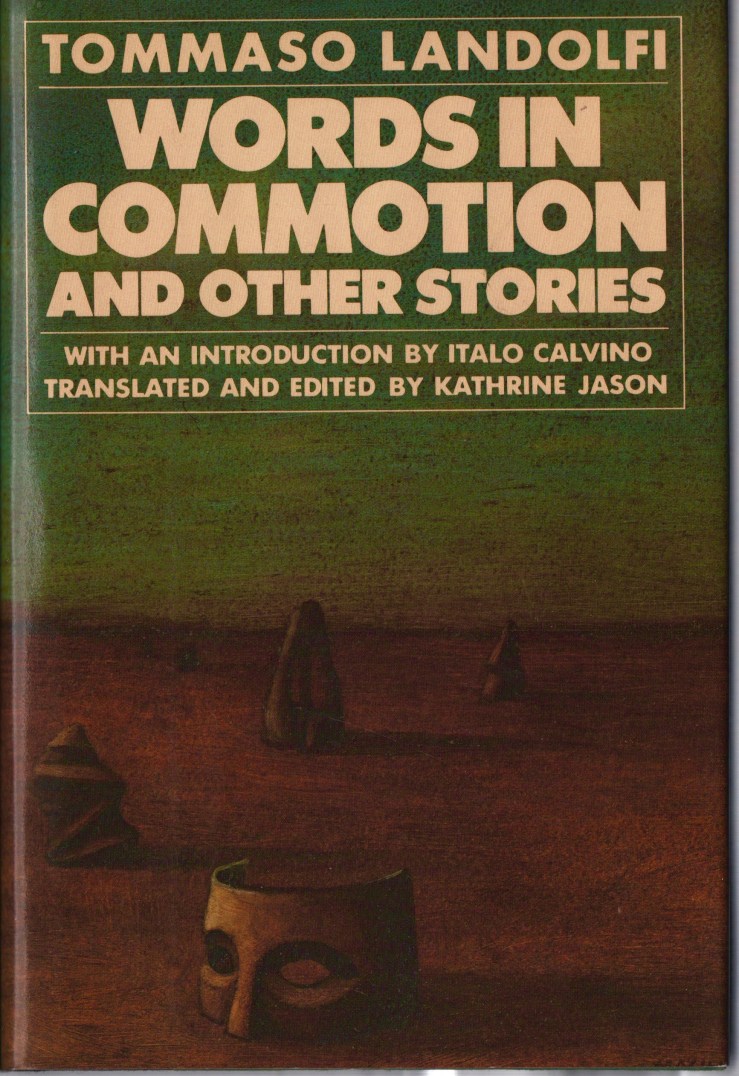
I did find a hardback Viking copy of a Tommaso Landolfi collection Words in Commotion, and read one of the shorter stories, “The Werewolf,” in the shop and then picked it up. Here’s Publisher’s Weekly’s 1986 review:
Little known in this country when he died in 1979, Landolfi is scarcely better recognized today, a situation this collection of 24 stories, with an introduction by Italo Calvino, is intended to remedy. Landolfi did not aspire to amuse or entertain in the usual sense; he preferred to confound and mystify. Even in his relatively conventional stories he scarcely bothered to inquire into motive or seek resolution. In “Uxoricide,” for example, a wife-murderer sets out to kill the shrew for reasons that do not seem quite sufficient, so that the act itself appears brutal and sadistic. In “A Woman’s Breast,” a man lusts after that part of a stranger until he attains it, is thereupon sickened by the sight and discovers odd morbidities within himself. Landolfi’s overriding interests–language and its literary possibilities, metaphysics, literary criticism—necessarily limit his audience. He saw the writer as one who spits words (see the title story), and he set himself against the critics who accused him of being “utterly indecipherable and mysterious.” That is, however, a challenge hurled at the reader.
You can read “Gogol’s Wife,” probably Landolfi’s most famous story, here.
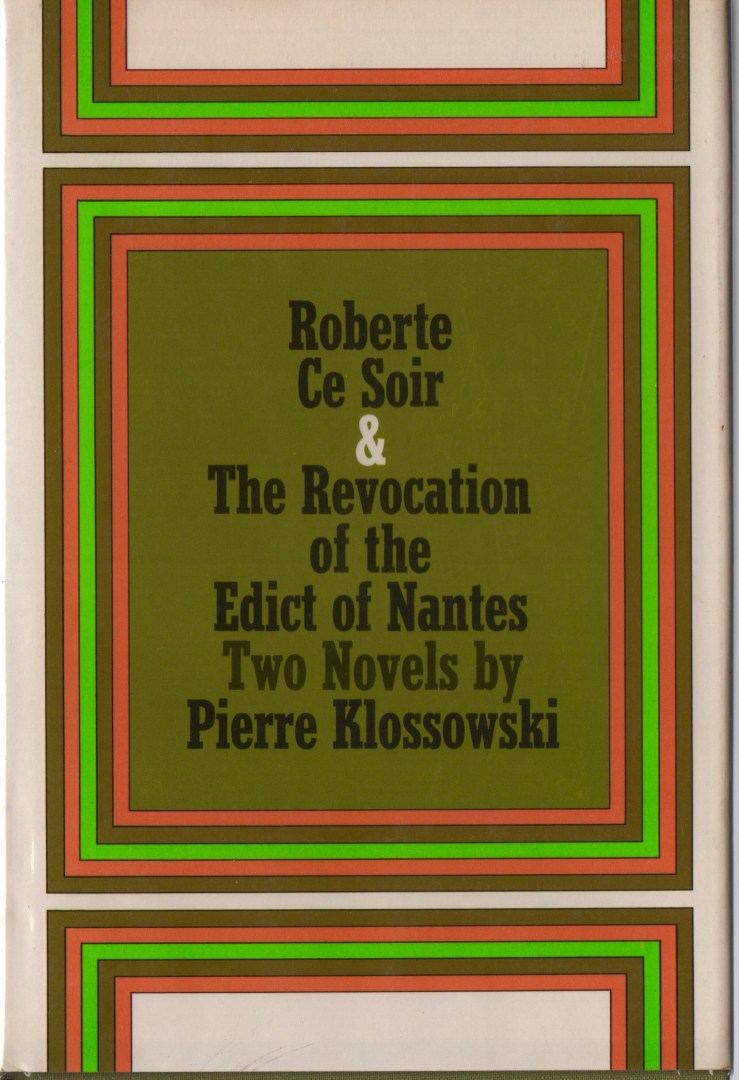
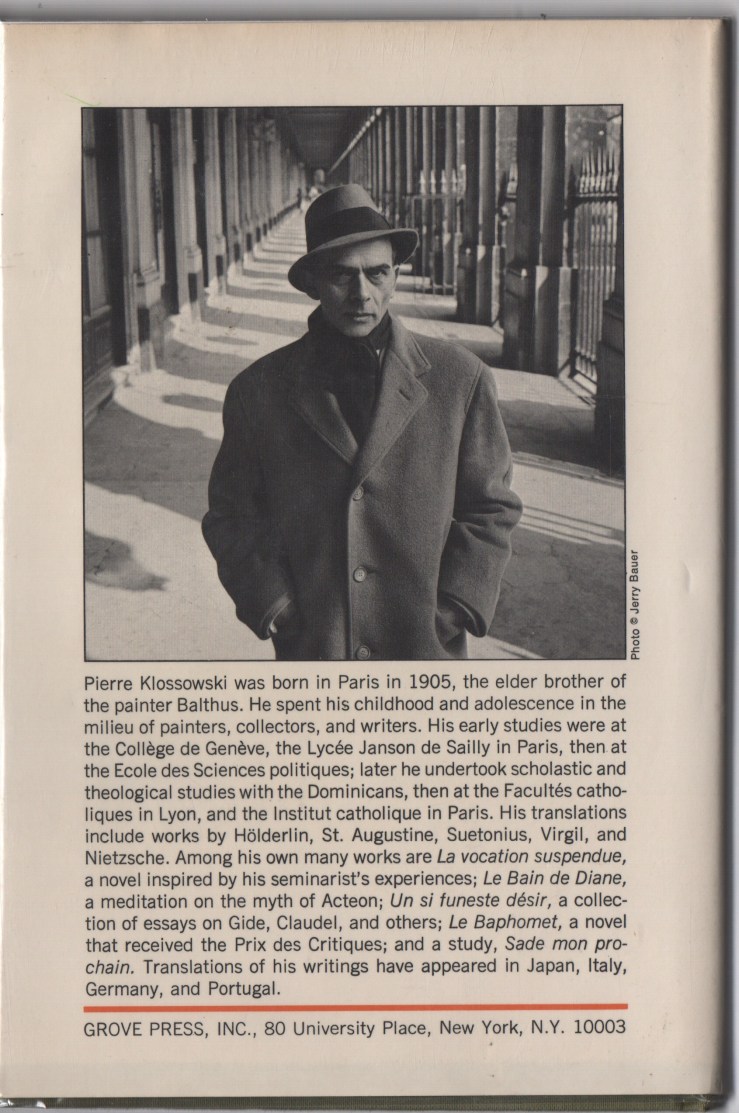
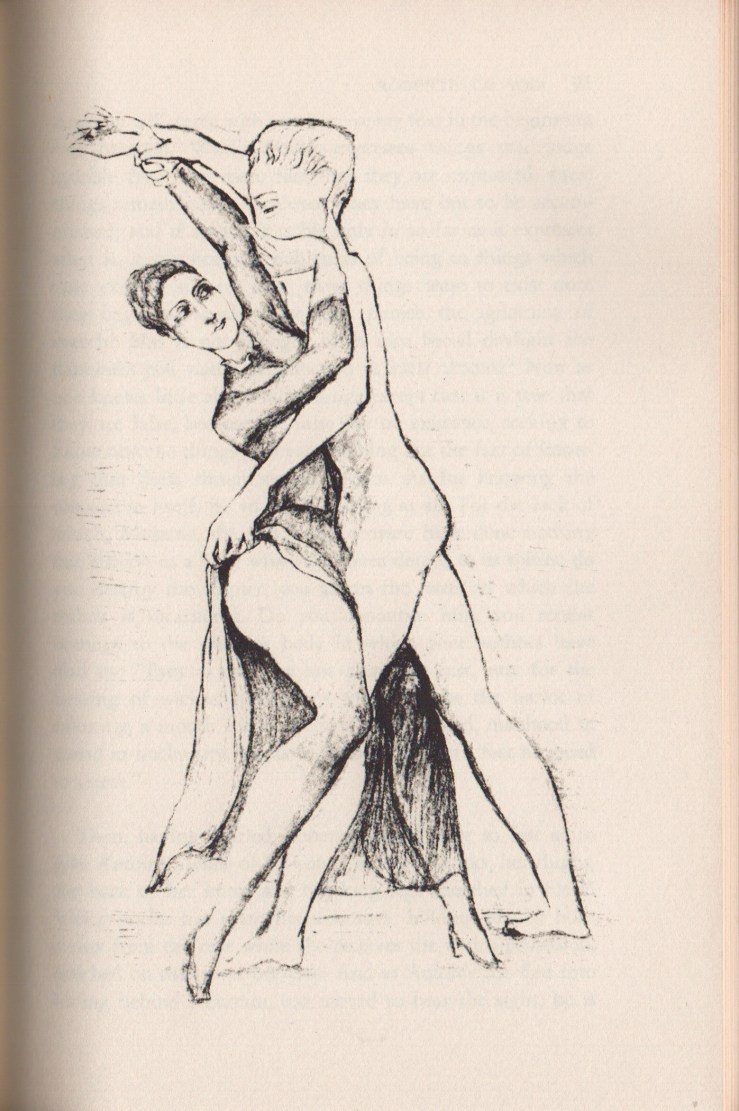
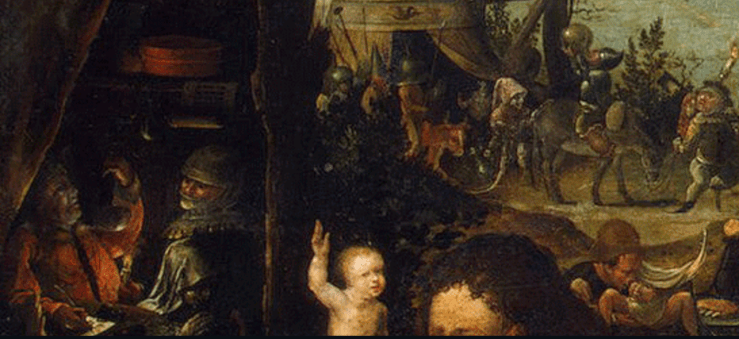
I also picked up a Grove Press first edition of Pierre Klossowski’s Roberte Ce Soir & The Revocation of the Edict of Nantes, two midcentury erotic novels. Austryn Wainhouse translates. Klossowski was the elder brother of the painter Balthus. Here’s the back cover, and an illustration of Klossowski’s (I’ll post the rest of the illustrations later):
Thursday,July 13th.–Two small Canadian boys came to our house yesterday, with strawberries to sell. It sounds strangely to hear children bargaining in French on the borders of Yankee-land. Among other languages spoken hereabouts must be reckoned the wild Irish. Some of the laborers on the mill-dam can speak nothing else. The intermixture of foreigners sometimes gives rise to quarrels between them and the natives. As we were going to the village yesterday afternoon, we witnessed the beginning of a quarrel between a Canadian and a Yankee,–the latter accusing the former of striking his oxen. B—- thrust himself between and parted them; but they afterwards renewed their fray, and the Canadian, I believe, thrashed the Yankee soundly–for which he had to pay twelve dollars. Yet he was but a little fellow.
Coming to the Mansion House about supper-time, we found somewhat of a concourse of people, the Governor and Council being in session on the subject of the disputed territory. The British have lately imprisoned a man who was sent to take the census; and the Mainiacs are much excited on the subject. They wish the Governor to order out the militia at onceand take possession of the territory with the strong hand. There was a British army-captain at the Mansion House; and an idea was thrown out that it would be as well to seize upon him as a hostage. I would, for the joke’s sake, that it had been done. Personages at the tavern: the Governor, somewhat stared after as he walked through the bar-room; Councillors seated about, sitting on benches near the bar, or on the stoop along the front of the house; the Adjutant-General of the State; two young Blue-Noses, from Canada or the Provinces; a gentleman “thumbing his hat” for liquor, or perhaps playing off the trick of the “honest landlord” on some stranger. The decanters and wine-bottles on the move, and the beer and soda founts pouring out continual streams, with a whiz. Stage-drivers, etc., asked to drink with the aristocracy, and my host treating and being treated. Rubicund faces; breaths odorous of brandy-and-water. Occasionally the pop of a champagne cork.
Returned home, and took a lesson in French of Mons. S—- . I like him very much, and have seldom met with a more honest, simple, and apparently so well-principled a man; which good qualities I impute to his being, by the father’s side, of German blood. He looks more like a German–or, as he says, like a Swiss–than a Frenchman, having very light hair and a light complexion, and not a French expression. He is a vivacious little fellow, and wonderfully excitable to mirth; and it is truly a sight to see him laugh;–every feature partakes of his movement, and even his whole body shares in it, as he rises and dances about the room. He has great variety of conversation, commensurate with his experiences in life, and sometimes will talk Spanish, ore rotundo,—sometimes imitate the Catholic priests, chanting Latin songs for the dead, in deep, gruff, awful tones, producing really a very strong impression,–then he will break out into a light, French song, perhaps of love, perhaps of war, acting it out, as if on the stage of a theatre: all this intermingled with continual fun, excited by the incidents of the passing moment. He has Frenchified all our names, calling B—- Monsieur Du Pont, myself M. de L’Aubépine, and himself M. le Berger, and all, Knights of the Round-Table. And we live in great harmony and brotherhood, as queer a life as anybody leads, and as queer a set as may be found anywhere. In his more serious intervals, he talks philosophy and deism, and preaches obedience to the law of reason and morality; which law he says (and I believe him) he has so well observed, that, notwithstanding his residence in dissolute countries, he has never yet been sinful. He wishes me, eight or nine weeks hence, to accompany him on foot to Quebec, and then to Niagara and New York. I should like it well, if my circumstances and other considerations would permit. What pleases much in Mons. S—- is the simple and childlike enjoyment he finds in trifles, and the joy with which he speaks of going back to his own country, away from the dull Yankees, who here misunderstand and despise him. Yet I have never heard him speak harshly of them. I rather think that B—- and I will be remembered by him with more pleasure than anybody else in the country; for we have sympathized with him, and treated him kindly, and like a gentleman and an equal; and he comes to us at night as to home and friends.
I went down to the river to-day to see B—- fish for salmon with a fly,–a hopeless business; for hesays that only one instance has been known in the United States of salmon being taken otherwise than with a net. A few chubs were all the fruit of his piscatory efforts. But while looking at the rushing and rippling stream, I saw a great fish, some six feet long and thick in proportion, suddenly emerge at whole length, turn a somerset, and then vanish again beneath the water. It was of a glistening, yellowish brown, with its fins all spread, and looking very strange and startling, darting out so lifelike from the black water, throwing itself fully into the bright sunshine, and then lost to sight and to pursuit. I saw also a long, flat-bottomed boat go up the river, with a brisk wind, and against a strong stream. Its sails were of curious construction: a long mast, with two sails below, one on each side of the boat, and a broader one surmounting them. The sails were colored brown, and appeared like leather or skins, but were really cloth. At a distance, the vessel looked like, or at least I compared it to, a monstrous water-insect skimming along the river. If the sails had been crimson or yellow, the resemblance would have been much closer. There was a pretty spacious raised cabin in the after part of the boat. It moved along lightly, and disappeared between the woody banks. These boats have the two parallel sails attached to the same yard, and some have two sails, one surmounting the other. They trade to Waterville and thereabouts,–names, as “Paul Pry,” on their sails.
The following are lines from Henry David Thoreau’s (then) unpublished manuscripts, compiled by Ralph Waldo Emerson and subjoined to the end of Emerson’s “Biographical Sketch” that introduces Thoreau’s Excursions.
Some circumstantial evidence is very strong, as when you find a trout in the milk.
The chub is a soft fish, and tastes like boiled brown paper salted.
The youth gets together his materials to build a bridge to the moon, or, perchance, a palace or temple on the earth, and at length the middle-aged man concludes to built a wood-shed with them.
The locust z-ing.
Devil’s-needles zigzagging along the Nut-Meadow brook.
Sugar is not so sweet to the palate as sound to the healthy ear.
I put on some hemlock-boughs, and the rich salt crackling of their leaves was like mustard to the ear, the crackling of uncountable regiments. Dead trees love the fire.
The bluebird carries the sky on his back.
The tanager flies through the green foliage as if it would ignite the leaves.
If I wish for a horse-hair for my compass-sight, I must go to the stable; but the hair-bird, with her sharp eyes, goes to the road.
Immortal water, alive even to the superficies.
Fire is the most tolerable third party.
Nature made ferns for pure leaves, to show what she could do in that line.
No tree has so fair a bole and so handsome an instep as the beech.
How did these beautiful rainbow-tints get into the shell of the fresh-water clam, buried in the mud at the bottom of our dark river?
Hard are the times when the infant’s shoes are second-foot.
We are strictly confined to our men to whom we give liberty.
Nothing is so much to be feared as fear. Atheism may comparatively be popular with God himself.
Of what significance the things you can forget? A little thought is sexton to all the world.
How can we expect a harvest of thought who have not had a seed-time of character?
Only he can be trusted with gifts who can present a face of bronze to expectations.
I ask to be melted. You can only ask of the metals that they be tender to the fire that melts them. To nought else can they be tender.
Rainer J. Hanshe’s new book Shattering the Muses is comprised of citations, short histories, poems, complaints and lamentations, anecdotes, essays, etchings, manipulated photographs, photographs of old documents, ink and enamel drawings, coal and ash pictures, and other media. His co-conspirator on the project is Federico Gori who provides original art for Shattering the Muses. Here are two of nine depictions by Gori of muses that open (in a sense) the narrative:
The books is ten inches tall, seven inches wide, and one inch thick. It contains 370 pages, many of them illustrated, several blank, and five that are completely black. There are at least four fonts (and more languages than that, although the book is primarily in English).
Have I lingered over form too long here? It’s difficult to describe the content of Shattering the Muses (which often foregrounds the “narrative’s” form).
Or maybe description isn’t so difficult—perhaps we can rely on the book to name its own central problem. The question that threads through Shattering the Muses is “Beware the Book?”
Let’s look at a few examples:
Above, we read an account—with its own embedded quotation—of The First Emperor of Qin’s ordering, two hundred years or so before the birth of Christ, a grand burning of a great many books. The account ends with the question: “Beware the book?”
(Some historians remark that Quin Shi Huang caused to be buried alive 460 Confucian scholars).
On the opposing/facing page, a 1493 German woodcut depicts Jews being buried and burned alive, scapegoats for the Black Death plague. The woodcut provides an answer to the question: “Beware the book?”: No, beware the burners. The space between the two pages is a gap for the reader to cross. Put the pieces together.
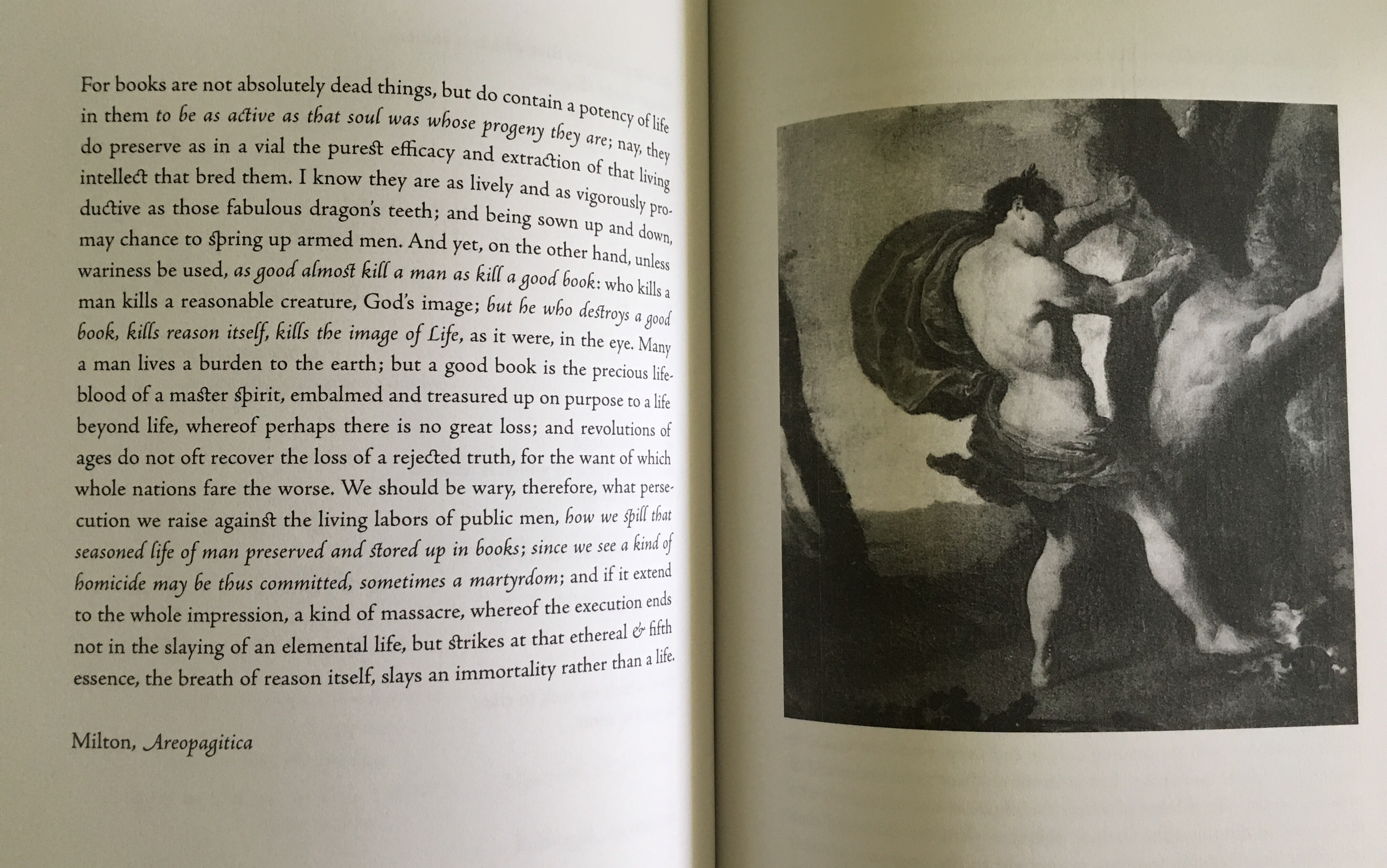
Indeed, it is the reader’s task (task is not quite the right word) to put the pieces of Shattering together. Take the pages above, for example. A passage from Areopagitica, Milton’s defense of free speech, contends that books are “not absolutely dead things,” but rather extractions of the soul’s intellect. He compares them to “those fabulous dragon’s teeth” that Cadmus scattered by Athena’s command. Milton warns that “he who destroys a good book kills reason itself, kills the image of Life.”
The next page reproduces Johan Liss’s painting Apollo and Marsyas (c. 1627). The satyr Marsyas found and mastered the first aulos, an double-reed wind instrument cast away by Athena. (She didn’t like the shape her invention brought to her virgin cheeks). Marsyas challenged Apollo to an aulos contest and lost, natch. (Apollo’s daughters the Muses were the judges). Marsyas was subsequently flayed alive, his hide nailed to a tree. Victim for art’s sake.
(The first page of Shattering the Muses is a quote from Ovid’s Fasti. The lines describe Athena discarding her aulos: “Art is not worth this to me,” she says, seeing her reflected face deformed in the river as she produces the “sublime” music).
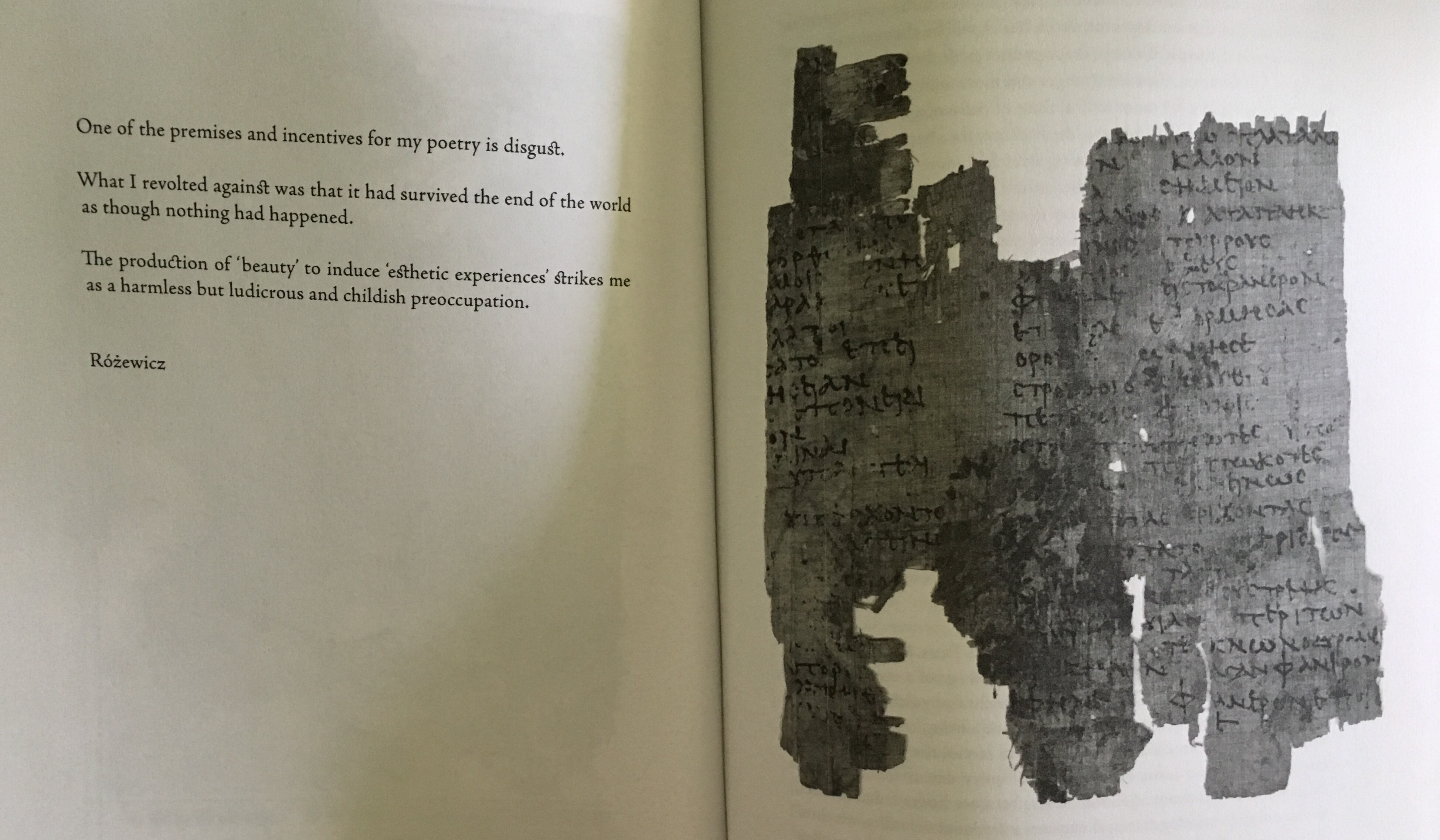
One more set of two pages, then. (It’s easier to show the book than to properly describe it in words. This is not a review). Above: Tadeusz Różewicz was a Polish poet who fought in the resistance movement against the Nazi occupation. He survived the war. His brother Janusz, also a poet, did not. He was executed by the Gestapo in 1944.
The facing page is a photograph of a scrap of one of the Oxyrhynchus Papyri manuscripts (specifically, P.Oxy. 67.4633). This scrap contains commentary on Homer’s Iliad, but is mostly famous because someone used it to wipe their ass. (A literary critic?)
However, Shattering the Muses is not entirely composed of loosely arranged but discontinuous fragments. Several narratives strand through the book. The most straightforward of these is the story of Renato Naso, who is the closest thing to a main character we’ll find here. When we’re introduced to him, we’re told that he’s “unknowingly putting his life in suspension…living in an eternal between.” He’s a hero (?) ripe for “rupture, fracture, and shattering.” (Perhaps if we take Shattering the Muses as a “novel” we could imagine that the events within take place in Naso’s stretched consciousness—a more secure place for such horrors than, uh, historical reality). When we first meet him, he’s leaving New York for Berlin, forced to abandon most of his books and store them in his brother’s garage. His brother’s house and garage are flooded by Hurricane Sandy, but his library miraculously survives. And yet the historical accounts of book burnings (and human burnings) cataloged in Shattering the Music attest that no library is ever safe. As Milton suggests, libricide and homicide are intertwined.
Hence, other background “characters” emerge more prominently than others in Shattering the Muses: Hitler, Mussolini, the Gestapo. The specter of the Nazis and the Holocaust weigh heavily here, heavier than the (many) other libriciders documented. Against this evil Hanshe gives us a resistance—a wonderful chapter lingers on Samuel Beckett, who’s escaped Occupied Paris to hide in the small village of Roussillon. There, “separated from his library…literary freedom erupts” for Beckett. Absence is a generative power.
Other figures resist through art, even if they perish in the horror, like Hungarian poet Miklós Radnóti, murdered by the Nazis near Győr and tossed into a mass grave. In a poetic turn, Hanshe notes “it is a daring Marsyas that he becomes, risking his flesh doubly before a merciless & savage Apollo, for he will not cast his aulos to the turf of the riverbank.” Deft touches like these link this “novel’s” motifs of beauty and destruction, art and murder.
One Day I’m Going to Grow Wings #2, 2016, Federico Gori
A narrative forms too from more oblique strategies—a plague of mutating billboards, for instance, or spiderwebs of poetry. Handbills, demands, stray bits of philosophy. But maybe I’m back where I started—go all the way back to the title here: This is not a review of Shattering the Muses. I can’t properly parse it, really. It’s overwhelming—linguistically, philosophically, typographically, aesthetically. Intellectually is a word to use here. Hell. It’s a lot to digest all at once. Let me admit that I’m more interested in picking at it slowly. Hanshe’s put a lot of material on the table. It’s a rich meal.
Who is Shattering the Muses for? I hope that I’ve shared enough snippets to give you a sense of what (might be) happening here. I enjoyed it, and enjoy it more in the sense of a text to return to. At the same time, this book is clearly Not For Everyone. Shattering the Muses is an encyclopedic poem, a Choose Your Own Adventure story of aesthetic horror and loss. It’s not likely to cohere for you quickly and neatly, but it’s a weird joy to think (and feel) through.









 Biblioklept