Blog about book browsing on a Friday afternoon (and mostly looking at covers)

I’ve made a habit of prowling around my own shelves each week, trying to build a small stack of books I can part with. I then head up the street to trade the books in. Lately, I’ve done a decent job of leaving with far fewer books than I brought in to trade—hell, last Friday I came back with no books.

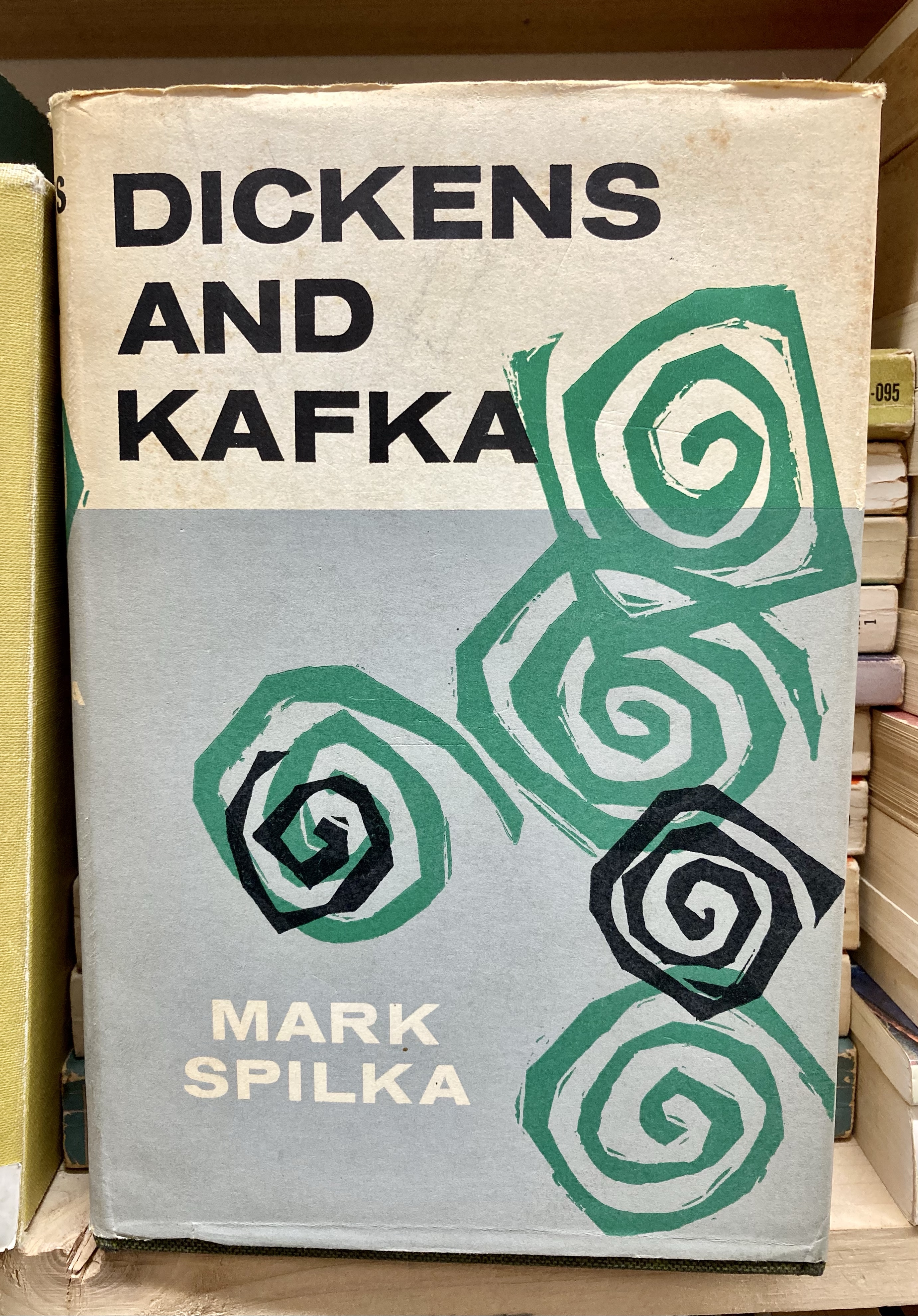
I always have a little mental checklist of books I’m hoping to come across. It mutates and swells, and I get lucky a lot of times. Sometimes I grab stuff at near-random. And other week’s are stale. Increasingly, I search for first editions and interesting mass market paperbacks, a reversal of a previous version of myself who found hardbacks clunky and mass market paperbacks cheap. Mass market editions tend to have wilder art, more interesting designs, and generally take more risks than contemporary, respectable trade paperbacks, as do older hardbacks. I ended up with three first editions. I was not especially looking for any of the books I acquired.

I was looking for certain books of course. Here are some interesting book covers I saw while looking for what I did not find.

I was looking for Walker Percy’s second novel Love Among the Ruins. I’d found a copy at this same book store last year—a first edition in beautiful condition with a really cool cover. I almost bought it (I think it was seven bucks) and now regret not having done so. I’m sure I’ll regret skipping on both of these Percy books, both of which have cover designs by Janet Halverson.

I wasn’t looking for anything in particular when I saw this hardback copy of Nevil Shute’s On the Beach, but the font on the spine attracted me. Love the cover painting, which is by Richard Powers (I assume this is a different Richard Powers than the American novelist).

I wasn’t looking for anything in particular when I picked up this Bantam collection of Mark Twain stories, which has a very cool uncredited Giuseppe Arcimboldoesque cover. Not sure why I picked it out. But I love the cover.

I was hoping to score a cheap paperback copy of one of David Marskon’s early novels when I came across this edition of Thomas Mann’s Buddenbrooks with a cover by Ben Shahn.

I was looking for anything by Gerald Murnane when I found this beautiful edition of Robert Musil’s Young Torless.

The bookshop I frequent separates “Classic Fiction” from “General Fiction” (with some somewhat arbitrary distinctions, in my opinion)—so I checked under the “PE” section in general fiction for a stray Walker Percy (no luck). Never heard of J.Abner Peddiwell’s The Saber-Tooth Curriculum but I love the simple expressive cover.

Walking past “PE,” “PI,” “PL” etc. I stopped at section on James Purdy to check out this edition of The Nephew. I’ve never been able to get into Purdy—seems so sad—but I love this cover.

I was looking for an original edition of Charles Wright’s 1973 novel Absolutely Nothing to Get Alarmed About; I have it in an omnibus, but I’d love a stand alone if I could find one. I did see this edition of The Messenger. The cover is terrible and boring and has way too much text on it. I found a copy of The Messenger a few months ago with a far more interesting cover.

I was looking for one of the William Melvin Kelley novels I don’t have. I found a bunch of mass market copy paperback versions of his first novel, A Different Drummer. The copy on the left has a cool cover. I think I like my new reissue better though.

I always look for a copy of David Ohle’s cult novel Motorman and I never find it. I do like this vibrant cover for Chad Oliver’s The Shores of Another Sea.

While I was in the sci-fi section, I passed by the Gene Wolfe area, and spied a complete hardback set of his seminal The Book of the New Sun tetralogy. I couldn’t pass up on a first hardback edition of the first in the series, The Shadow of the Torturer:

I also picked up a pristine first edition hardback copy of William Gaddis’s 1994 novel A Frolic of His Own. It’s the only Gaddis novel I’ve yet to read and buying a second copy seems like a good motivation to finally dig in.

I also came across a first edition hardback copy of Padgett Powell’s first novel Edisto. I’ve always felt ambivalent about Powell. He was the writer in residence at the University of Florida when I was an undergrad there in the late nineties. He’d taken the post over from Harry Crews, and I always resented that for some reason, brought that resentment to the few readings I attended, never made it through anything but a few stories. But this copy of Edisto was only four bucks. And check out the blurbs on the back:

There’s my guy Barthelme. And then Percy, who brought me to the store today. I’ll give it a shot.


I like to write uncanonical things | William H. Gass

I would worry about being on such a list, because I like to write uncanonical things, things that oppose the general flow of the culture. I would certainly be happy to believe that I could share the same halls or bookcase or something with some of the writers whom I admire so much, but I would feel very insecure about my place there…I”m not sure that I want my books to be patted on the back by lots of scholars in the academy and told, “There, there, these are okay.” …My feelings about things like this are more the sort of thing I have about my children: I would be a little disturbed if everybody loved them.

From a sidebar in “The Next Big Lit-Crit Snit” by Rebecca Mead in New York Magazine (15 Aug. 1994). The article is about the publication of Harold Bloom’s The Western Canon. The sidebar quotes a number of authors who were included and omitted. William H. Gass was included in Bloom’s canon for both his first novel, Omensetter’s Luck, and his follow-up of long short stories, In the Heart of the Heart of the Country. In the New York article, Bloom, says that he was encouraged to make the list by his editor, wavering “I’m not so sure it was a good idea.” He was more forceful in a 2008 interview in Vice, claiming that,

The list was not my idea. It was the idea of the publisher, the editor, and my agents. I fought it. I finally gave up. I hated it. I did it off the top of my head. I left out a lot of things that should be there and I probably put in a couple of things that I now would like to kick out.

Peter Brooks’s Balzac’s Lives (Book acquired 29 Sept. 2020)

Peter Brooks’s study of Balzac is newish from NRYB.

The only thing I’ve read by Balzac is Donald Barthelme’s short story “Eugénie Grandet.”

NRYB’s blurb:

Balzac, more than anyone, invented the nineteenth-century novel, and Oscar Wilde went so far as to say that Balzac had invented the nineteenth century. But it was above all through the wonderful, unforgettable, extravagant characters that Balzac dreamed up and made flesh—entrepreneurs, bankers, inventors, industrialists, poets, artists, bohemians of both sexes, journalists, aristocrats, politicians, prostitutes—that he brought to life the dynamic forces of an era that ushered in our own. Peter Brooks’s Balzac’s Lives is a vivid and searching portrait of a great novelist as revealed through the fictional lives he imagined.

Daikon, Rats, and Carrot — Shotei Takahashi

Daikon, Rats, and Carrot, 1930 by Shotei Takahashi (1871-1945)

Too late to be any of the things I never wanted to be | William Gaddis

From “How Writers Live Today,” and article curated by Tom Jenks in the August, 1985 “Summer Reading” issue of Esquire.

The article also features Joy Williams, Gordon Lish, Tom Wolfe, Annie Dillard, Raymond Carver, Tobias Wolff, and many, many other writers. Gaddis got the last word though.

Thonet — Cinta Vidal

Thonet by Cinta Vidal (b. 1979)

All the wolves in the wolf factory paused at noon, for a moment of silence | “Laughing Gravy,” John Ashbery

Danger on the Stairs — Pierre Roy

Danger on the Stairs, c. 1928 by Pierre Roy (1880–1950)

Flannery O’Connor congratulates Walker Percy

From The Habit of Being: Letters of Flannery O’Connor

Not our fault! | Donald Barthelme

A page of Donald Barthelme’s story “The Expedition.” From 1974’s Guilty Pleasures. Read “The Expedition” here.


Manuscript Illustration of Flay — Mervyn Peake

“Olives” — Donald Hall

“Olives”

by

Donald Hall


“Dead people don’t like olives,”
I told my partners in eighth grade
dancing class, who never listened
as we fox-trotted, one-two, one-two.

The dead people I often consulted
nodded their skulls in unison
while I flung my black velvet cape
over my shoulders and glowered
from deep-set, burning eyes,
walking the city streets, alone at fifteen,
crazy for cheerleaders and poems.

At Hamden High football games, girls
in short pleated skirts
pranced and kicked, and I longed
for their memorable thighs.
They were friendly—poets were mascots—
but never listened when I told them
that dead people didn’t like olives.

Instead the poet, wearing his cape,
continued to prowl in solitude
intoning inscrutable stanzas
as halfbacks and tackles
made out, Friday nights after football,
on sofas in dark-walled rec rooms
with magnanimous cheerleaders.

But, decades later, when the dead
have stopped blathering
about olives, obese halfbacks wheeze
upstairs to sleep beside cheerleaders
waiting for hip replacements,
while a lascivious, doddering poet,
his burning eyes deep-set
in wrinkles, cavorts with their daughters.

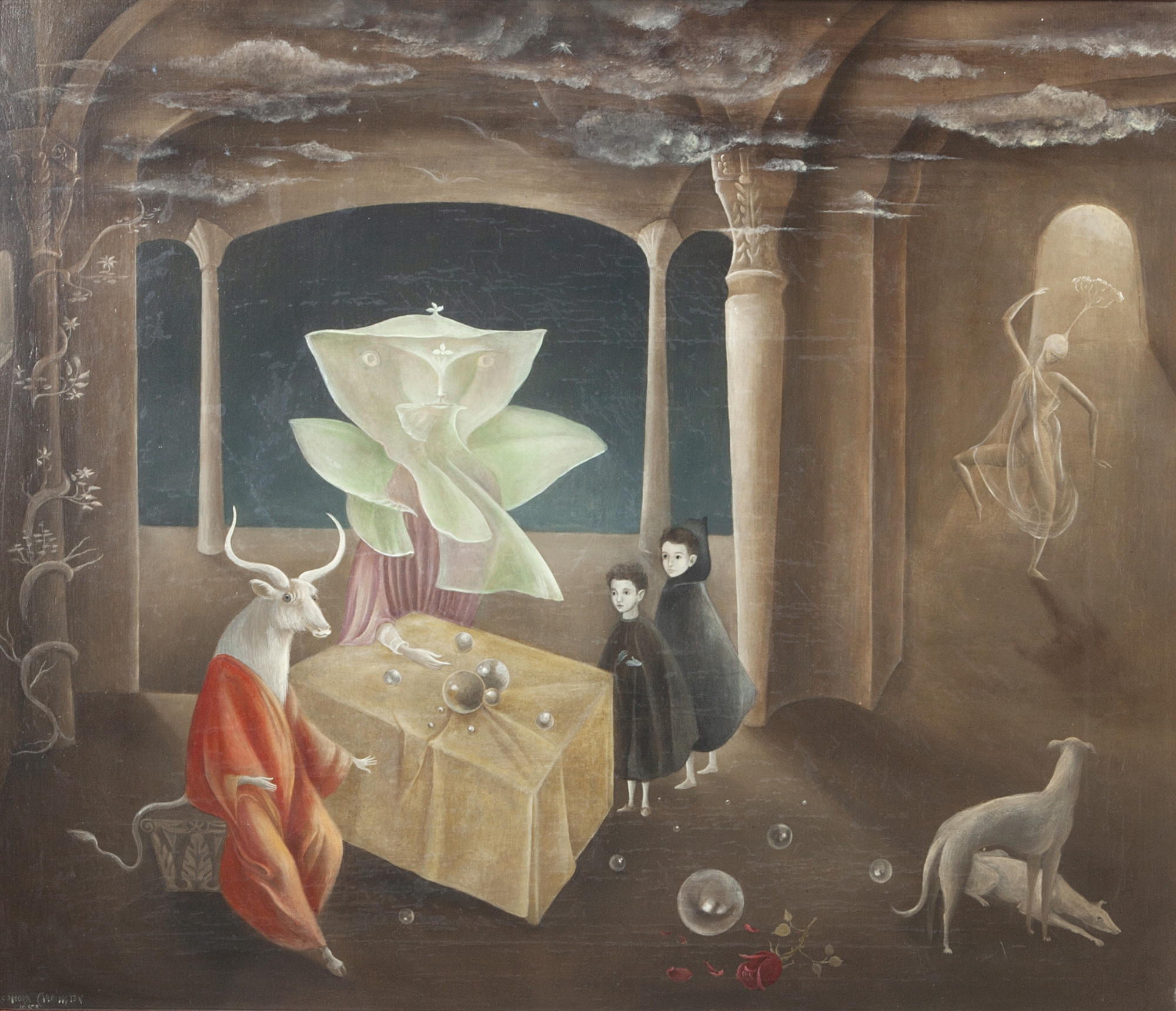
Aurora — Remedios Varo

Aurora, 1962 by Remedios Varo (1908-1963)

“Some Bright Paintings” — Gilbert Sorrentino

The Sophists — Jeffrey Chong Wang

The Sophists, Jeffrey Chong Wang

Lady Macbeth of Mtsensk: Selected Stories of Nikolai Leskov (Book acquired, 19 Sept. 2020)

NRYB has a forthcoming collection of Nikolai Leskov stories (novellas, really) called Lady Macbeth of Mtsensk. The collection features new translations from Donald Rayfield, Robert Chandler, and William Edgerton. NYRB’s blurb:

Nikolai Leskov is the strangest of the great Russian writers of the nineteenth century. His work is closer to the oral traditions of narrative than that of his contemporaries, and served as the inspiration for Walter Benjamin’s great essay “The Storyteller,” in which Benjamin contrasts the plotty machinations of the modern novel with the strange, melancholy, but also worldly-wise yarns of an older, slower era that Leskov remained in touch with. The title story is a tale of illicit love and multiple murder that could easily find its way into a Scottish ballad and did go on to become the most popular of Dmitri Shostakovich’s operas. The other stories, all but one newly translated, present the most focused and finely rendered collection of this indispensable writer currently available in English.

The collection includes six novellas: Lady Macbeth of Mtsensk, The Sealed Angel, The Enchanted Wanderer, The Steel Flea, The Unmercenary Engineers, and The Innocent Prudentius.

I read a few of these stories some years back in a Borzoi collection of Leskov stories called The Enchanted Wanderer and Other Stories; those translations were by Richard Pevear and Larissa Volokhonsky (and included some much shorter tales).

I also highly highly recommend Lady Macbeth, director William Oldroyd and writer Alice Birch’s 2016 film adaptation of Leskov’s Lady Macbeth of Mtsensk, which I reviewed on this blog a few years ago.

L’Annunciata — Agostino Arrivabene

L’Annunciata, 2016 by Agostino Arrivabene (b. 1967)