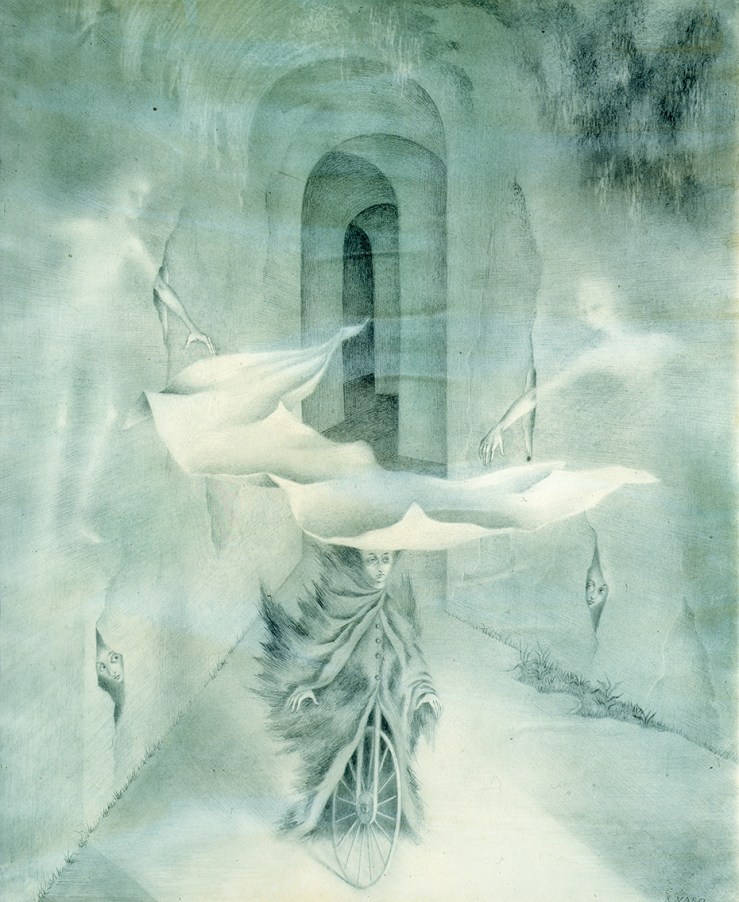
Hanging Wall — Gregory Thielker

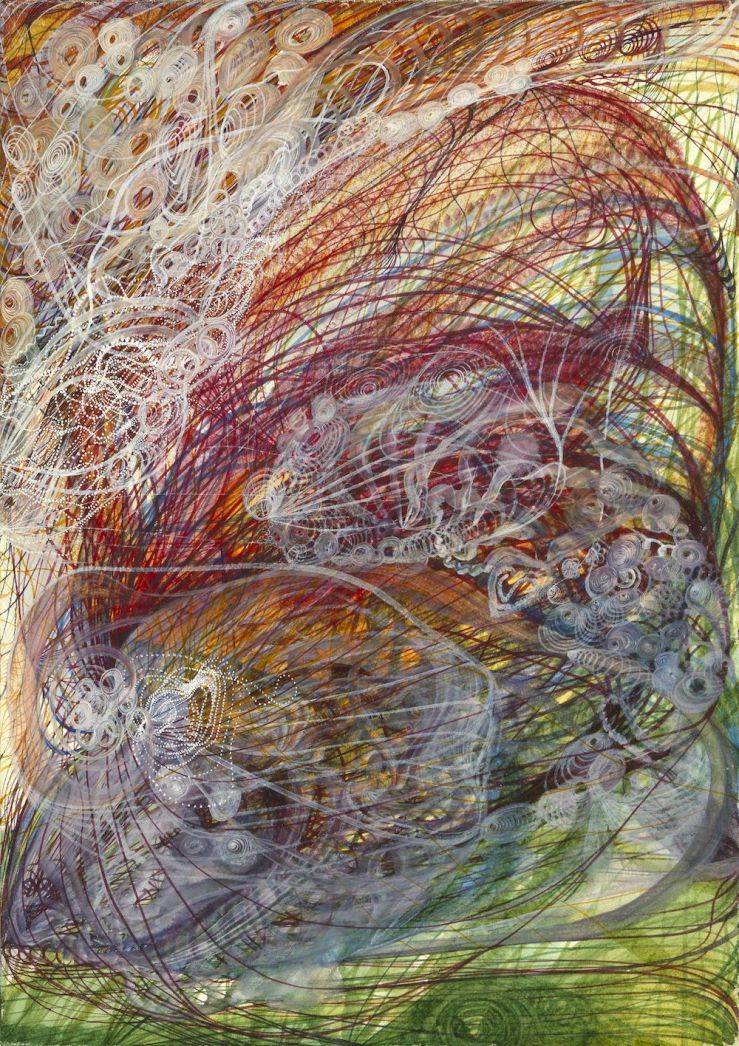
04hangingwall-1807x1280

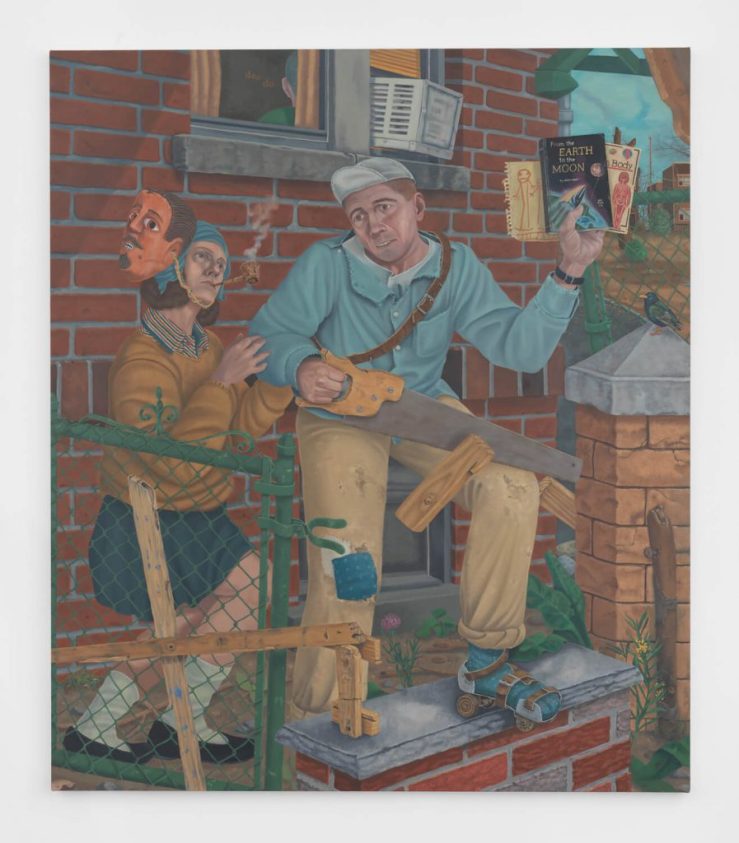
Hanging Wall, 2013 by Gregory Thielker (b. 1979)

Screenshot 2018-10-15 at 6.39.46 PMScreenshot 2018-10-15 at 6.39.32 PMScreenshot 2018-10-15 at 6.39.21 PM

Something in this sunny autumnal atmosphere | Nathaniel Hawthorne’s journal entry for October 14th, 1837

Characteristics during the walk–Apple-trees with only here and there an apple on the boughs, among the thinned leaves, the relics of a gathering. In others you observe a rustling, and see the boughs shaking and hear the apples thumping down, without seeing the person who does it. Apples scattered by thewayside, some with pieces bitten out, others entire, which you pick up and taste, and find them harsh, crabbed cider-apples, though they have a pretty, waxen appearance. In sunny spots of woodland, boys in search of nuts, looking picturesque among the scarlet and golden foliage. There is something in this sunny autumnal atmosphere that gives a peculiar effect to laughter and joyous voices,–it makes them infinitely more elastic and gladsome than at other seasons. Heaps of dry leaves tossed together by the wind, as if for a couch and lounging-place for the weary traveller, while the sun is warming it for him. Golden pumpkins and squashes, heaped in the angle of a house till they reach the lower windows. Ox-teams, laden with a rustling load of Indian corn, in the stalk and ear. When an inlet of the sea runs far up into the country, you stare to see a large schooner appear amid the rural landscape; she is unloading a cargo of wood, moist with rain or salt water that has dashed over it. Perhaps you hear the sound of an axe in the woodland; occasionally, the report of a fowling-piece. The travellers in the early part of the afternoon look warm and comfortable as if taking a summer drive; but as eve draws nearer, you meet them well wrapped in topcoats or cloaks, or rough, great surtouts, and red-nosed withal, seeming to take no great comfort, but pressing homeward. The characteristic conversation among teamsters and country squires, where the ascent of a hill causes the chaise to go at the same pace as an ox-team,–perhaps discussing the qualities of a yoke of oxen. The cold, blue aspects of sheets of water. Some of the country shops with the doors closed; others still open as in summer. I meet a wood-sawyer, with his horse and saw on his shoulders, returning from work. As night draws on, you begin to see the gleaming of fires on the ceilings in the houses which you pass. The comfortless appearance of houses at bleak and bare spots,–you wonder how there can be any enjoyment in them. I meet a girl in a chintz gown, with a small shawl on her shoulders, white stockings, and summer morocco shoes,–it looks observable. Turkeys, queer, solemn objects, in black attire, grazing about, and trying to peck the fallen apples, which slip away from their bills.

From Nathaniel Hawthorne’s journal entry for October 14th, 1837. From Passages from the American Note-Books.


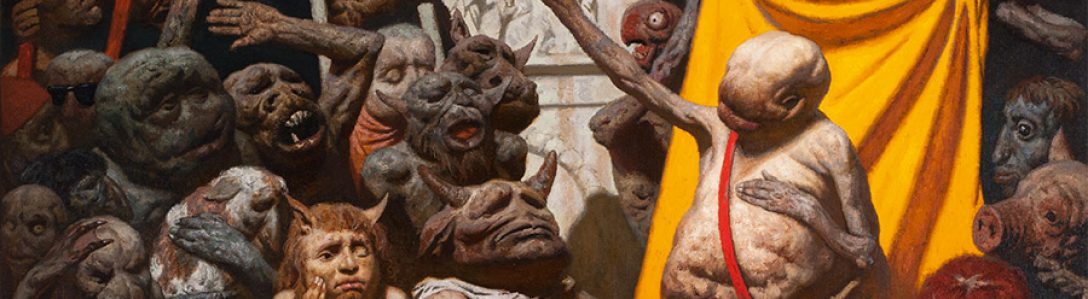
Dulle Griet (detail) — David Ryckaert III

Screenshot 2018-10-14 at 5.31.00 PM

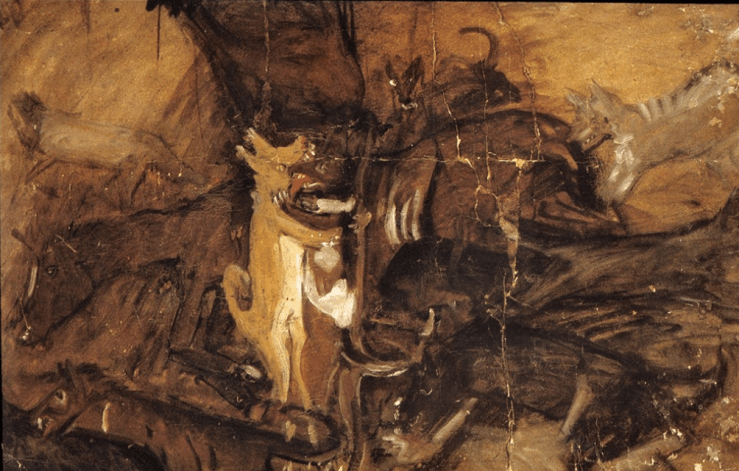
 Dulle Griet, 1658 by David Ryckaert III (1612-1661)

Pack of Hounds — Francisco Goitia

Screenshot 2018-10-14 at 4.14.55 PM

Pack of Hounds by Francisco Goitia (1882–1960)

Saul and the Witch of Endor (detail) — Benjamin West

Screenshot 2018-10-11 at 8.00.05 PM

Detail from Saul and the Witch of Endor, 1777 by Benjamin West (1738-1820)

Set up a mirror on Alpha Centauri then sit right here with your telescope watching yourself (William Gaddis)

—but did you ever think? She was up on that elbow again, turned to him so his hand fell still on the white of the sheet, —about light years?

—About what?

—I mean if you could get this tremendously powerful telescope? and then if you could get far enough away out on a star someplace, out on this distant star, and you could watch things on the earth that happened a long time ago really happening? Far enough away, he said, you could see history, Agincourt, Omdurman, Crécy… How far away were they she wanted to know, what were they, stars? constellations? Battles he told her, but she didn’t mean battles, she didn’t want to see battles, —I mean seeing yourself… Well as far as that goes he said, get a strong enough telescope you could see the back of your own head, you could —That’s not what I meant. You make fun of me don’t you.

—Certainly not, why would…

—I mean seeing what really happened back when…

—All right, set up a mirror on Alpha Centauri then, you’d sit right here with your telescope watching yourself four, about four and a half years ago is that what you…

—No.

—But I thought…

—Because I don’t want to see that! She pulled away, pulled up the sheet, staring up at the ceiling. —But you’d just see the outside though, wouldn’t you. You’d just see the mountain you’d see it go down and you’d see all the flames but you wouldn’t see inside, you wouldn’t see those faces again and the, and you wouldn’t hear it, a million miles away you wouldn’t hear the screams… What screams, he wanted to —No, no that one’s too close, find one further away… and he subsided, looking at the sheet clenched to her throat and the length of her gone under it, recommending Sirius, setting up business on the Dog Star, the brightest of them all, watching what happened eight and a half? nine years ago? —I told you what happened… the sheet clenched firm, —I told you last night no, twenty, twenty five years away when it was all still, when things were still like you thought they were going to be?

From the beginning of the fifth chapter of William Gaddis’s 1985 novel Carpenter’s Gothic. I’d never heard of this thought experiment until now.

img_1155

Deer Skull (Georgia O’Keeffe) — Todd Webb

Screenshot 2018-10-11 at 7.46.11 PM

Deer Skull (Georgia O’Keeffe), 1961 by Todd Webb (1905-2000)

Blog about some books and some book covers and acquiring some books and not acquiring some books

img_1179

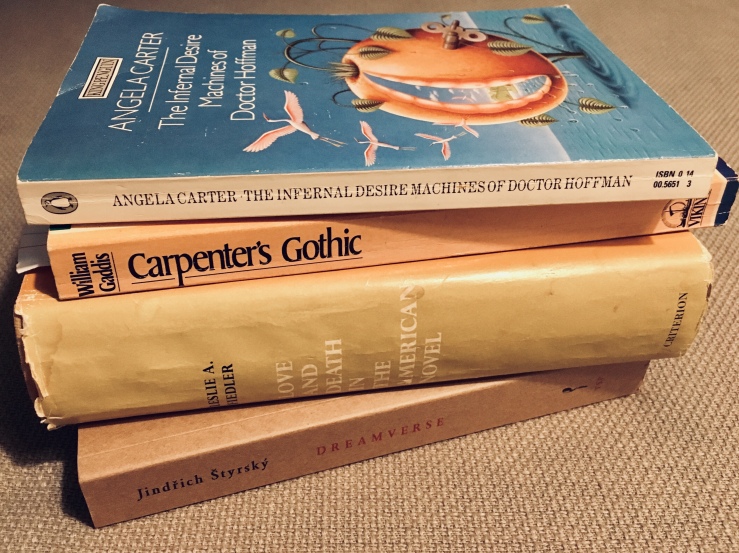
I went to the book store this afternoon to pick up a copy of the latest graphic novel in by Kazu Kibuishi’s Amulet series for my kids, and of course I browsed a while. Looking for a copy of Anne Carson’s Plainwater, I ended up finding Angela Carter’s 1972 novel Infernal Desire Machines of Doctor Hoffman. It’s a British edition, 1985, Penguin, with a lovely Boschian cover by James Marsh. Here’s a detail from the cover:

img_1180

I’ve wanted to pick up Carter’s novel since I read about it on a silly good dystopian fiction list last year, and I’m thrilled that I was able to get one with a Marsh cover. This particular cover, along with Marsh’s cover for The Bloody Chamber, are included in Phil Baines lovely book Penguin by Design.

Baines’s book doesn’t include any of Marsh’s fantastic covers of J.G. Ballard novels, opting instead to include Dave Pelham’s versions. I love both Pelham and Marsh’s Ballard covers, and would love to get my mitts on one at some point. I always browse for old mass market paperbacks of sci-fi authors I like — Philip K. Dick, Ursula K. LeGuin, the Strugatsky Brothers, J.G. Ballard — hoping to find an interesting cover, something inventive and fun, something from before their works were, under the cloak of awful respectability, given safe, boring literary covers. I didn’t find any Ballard editions with Marsh or Pelham covers, but I did come across this lovely pair of mass market paperback:

img_1176

They’re US Vintage versions, 1985, with covers by Chris Moore. There’s like a proto-Cherry 2000 thing going on here that I kinda love, but I already own these novels, and I don’t love the covers quite enough. So instead, this post. Here are the covers of my copies of Crash and Concrete Island:

img_1181

While Henry Sene Yee’s cover design for my copy of Concrete Island (using a photograph by Kevin Laubacher) isn’t terrible, it is a good example of what I mean by boring respectable literary covers. Still, this trade edition (Picador, 2001) is really readable—I mean, it’s easy to read. The pages are nice, the typeset is great, etc. (And the book is killer). I actually like the cover of my copy of Crash, a lot (design by Michael Ian Kaye and Melissa Hayden), but it’s also trying just a little too hard. (Again—very readable version from FS&G’s Noonday Press imprint, 1994).

While I had to pass today on the mass market copies of Crash and Concrete Island today—not because they would have set me back five bucks in store credit, but because I don’t need them, because I hope some kid goes in there and picks them up—while I had to pass on those lurid beauties, I did pick up a mass market 1967 copy of The Crystal World. Publisher Berkley Medallion didn’t bother to name the cover designer/artist, and I haven’t been able to track it down, but it is, I admit, a bit disappointing—an early pulp bid for literary respectability. At least I can be on the look out for a weirder one in the future.

Skull with Candle — Gerhard Richter

eb51e335dd696bebde2f9f2d1bad73a7

Skull with Candle, 1983 by Gerhard Richter (b. 1932)

Hide and Seek — Pavel Tchelitchew

stufftoblowyourmind-23-2014-01-hide-and-seek

Hide and Seek, 1945 by Pavel Tchelitchew (1898-1957)

Headless Horseman — William Gropper

1956_55_9_l

Headless Horseman, 1953 by William Gropper (1897-1977)

Circe Punishes Glaucus by Transforming Scylla into a Monster (detail) — Eglon van der Neer

circe

Detail from Circe Punishes Glaucus by Transforming Scylla into a Monster, 1695 by Eglon van der Neer (1636–1703)

The Night’s Plutonian Shore — William Heath Robinson

Capture

The Night’s Plutonian Shore, 1909 by William Heath Robinson (1872-1944)

Blog about Gordon Lish’s claim that he was infatuated with Wallace Steven’s wife, or at least her profile, on the dime, on the half dollar, from the time he was five or six or seven years old

dnei093vsaafypf

This afternoon I was reading, or really, I now know, rereading Gordon Lish’s 1996 interview with Rob Trucks, and while reading (rereading) this interview, I experienced terrible déjà vu, the kind of déjà vu that upsets one like a bad itch tucked away and wriggling in an unscratchable little alcove in the back of one’s mind. Only of course now I know that I wasn’t necessarily experiencing what can rightfully be called déjà vu; rather, I was simply failing to fully remember having read something several years prior—in this case, Gordon Lish’s 1996 interview with Rob Trucks.

Early bits of the interview set me tingling. Stuff about Julia Kristeva’s Powers of Horror. Stuff about DeLillo. Lots of Lish’s anxiety about Blood Meridian.  But my (non)déjà vu exploded when Lish shared the following story while discussing his (anxiety of) influences:

I read Wallace Stevens a lot, since you asked about influence. I read Stevens’s letters a lot. I’m eager to find all sorts of connections between Stevens’s life and my own, right down to, and I’ll put this to you, my extraordinary discovery not long ago that the face on the coin, on the half dollar coin, and on the dime that I gazed at so often as a child in honor o my idea of an American woman, since I come from an immigrant family, what a great American woman looked like, the one that you would have to bed in lieu of all other women you could not bed, turns out to have been modeled for a sculptor who was a landlord in Chelsea. he was, in fact, Stevens’s landlord when he and Elsie Kachel, his wife, were living in Chelsea, and the design on the coin was modeled by Stevens’s wife, so that it’s fair to make the claim that I was infatuated with Steven’s wife, or at least her profile, from the time I was five or six or seven years old. You looked at the dime, you looked at the half dollar, and you saw Stevens’s wife, amazingly.

When I read this amazingly amazing anecdote the déjà vu had passed pulsating—it was humming, whirring in the background, trying to attach to something, eventually coming up with, “David Markson? Is this something you read in a David Markson novel?” Instead of trying to search through Markson’s work (where I’m sure, or now not really sure, but rather somewhat sure, I read the anecdote of Wallace Stevens getting into a fistfight with a much younger Ernest Hemingway off the coast of Key West) for this Elsie Kachel Stevens reference, I simply did a basic internet search to get some more background on Lish’s claim that the poet Wallace Stevens’s wife served as the profile model on at least two coins of U.S. currency. The story more or less checks out (with a lot of passive voice).

Here is a photograph of the dime in question, which was designed by Adolph Weinman and minted in 1916:


800px-1943d_mercury_dime_obverse

And here is a photograph of Elsie Kachel Stevens:

elsie-stevens-by-bridge-in-elizabeth-park

And here is a photograph of the bust that Adolph Weinman made of Elsie Kachel Stevens:

elsie-stevens

Anyway. I went back to the interview, still tingling a little, but also a bit preoccupied—I needed to prepare our dinner of tacos, kids needed to get to piano lessons, the dog need walking, etc. And as I hurtled through the interview, I got to a moment when Lish tells his interlocutor, “I use my dick, mainly, to write the first time, and I’m using my brains to do the revisions. I mean, not my brain. I’m using rather practiced sequences of motions that have to do chiefly with mind or chiefly with know-how. I’m trying to stick it into the page the first time out.” And then, a few paragraphs later, this nugget:

Q: So Self-Imitation is still a dick book?

A: It’s a dick book. All my books are dick books.

And then I laughed out loud and then I remembered that I had not only read this interview, but I had even written about it years ago on this idiot blog of mine. And so my itch was scratched.

I read—by which I mean reread—Gordon Lish’s 1996 interview with Rob Trucks in Conversations with Gordon Lish (edited by David Winters and Jason Lucarelli), a collection chocked full of tingly bits and fat juicy morsels and etc.


Saint Bernard Crushing a Demon (detail) — Marcello Venusti

Capture

 Saint Bernard Crushing a Demon, 1563 by Marcello Venusti (1512–1579)

Breakfast — Eteri Chkadua

0222

Breakfast, 2011 by Eteri Chkadua

Hop-Frog’s Revenge — James Ensor

r32125_2012_a_73_hopfrog_001

Hop-Frog’s Revenge, 1898 by James Ensor (1860-1949)

Ensor’s illustration was inspired by Edgar Allan Poe’s 1849 tale “Hop-Frog.”


“Hop-Frog”

by

Edgar Allan Poe


I NEVER knew anyone so keenly alive to a joke as the king was. He seemed to live only for joking. To tell a good story of the joke kind, and to tell it well, was the surest road to his favor. Thus it happened that his seven ministers were all noted for their accomplishments as jokers. They all took after the king, too, in being large, corpulent, oily men, as well as inimitable jokers. Whether people grow fat by joking, or whether there is something in fat itself which predisposes to a joke, I have never been quite able to determine; but certain it is that a lean joker is a rara avis in terris.

About the refinements, or, as he called them, the ‘ghost’ of wit, the king troubled himself very little. He had an especial admiration for breadth in a jest, and would often put up with length, for the sake of it. Over-niceties wearied him. He would have preferred Rabelais’ ‘Gargantua’ to the ‘Zadig’ of Voltaire: and, upon the whole, practical jokes suited his taste far better than verbal ones.

At the date of my narrative, professing jesters had not altogether gone out of fashion at court. Several of the great continental ‘powers’ still retain their ‘fools,’ who wore motley, with caps and bells, and who were expected to be always ready with sharp witticisms, at a moment’s notice, in consideration of the crumbs that fell from the royal table.

Our king, as a matter of course, retained his ‘fool.’ The fact is, he required something in the way of folly–if only to counterbalance the heavy wisdom of the seven wise men who were his ministers–not to mention himself. Continue reading “Hop-Frog’s Revenge — James Ensor”