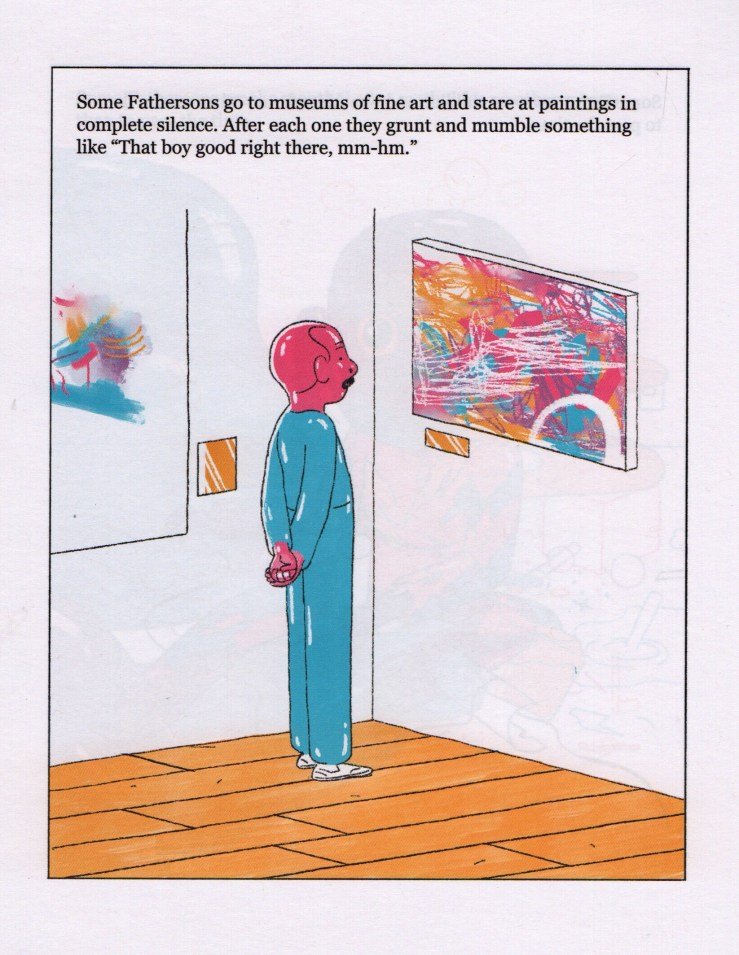
Richie Pope’sFatherson showed up in today’s mail—it’s issue #13 of Youth in Decline’s monograph series Frontier. It’s so, so good—I’ve gone through it a few times now, and its immediate vibrancy and apparently simplicity slips into richer and richer territory each time.
It reminded me at first of a book my wife brought back to me years ago from San Francisco—a kids book called The Daddy Book by Todd Parr (she took our son when he was like, what—six months old?—left me with our daughter, alone, when she was like, what—twoish? Everything was fine and dandy cotton candy). And then, simultaneously, Fatherson reminded me of Donald Barthelme’s novel The Dead Father—particularly the “Manual for Sons” section.
And Fatherson reminded me of other stuff too, but mostly I loved it because of the stuff it didn’t remind me of. Highly recommended.
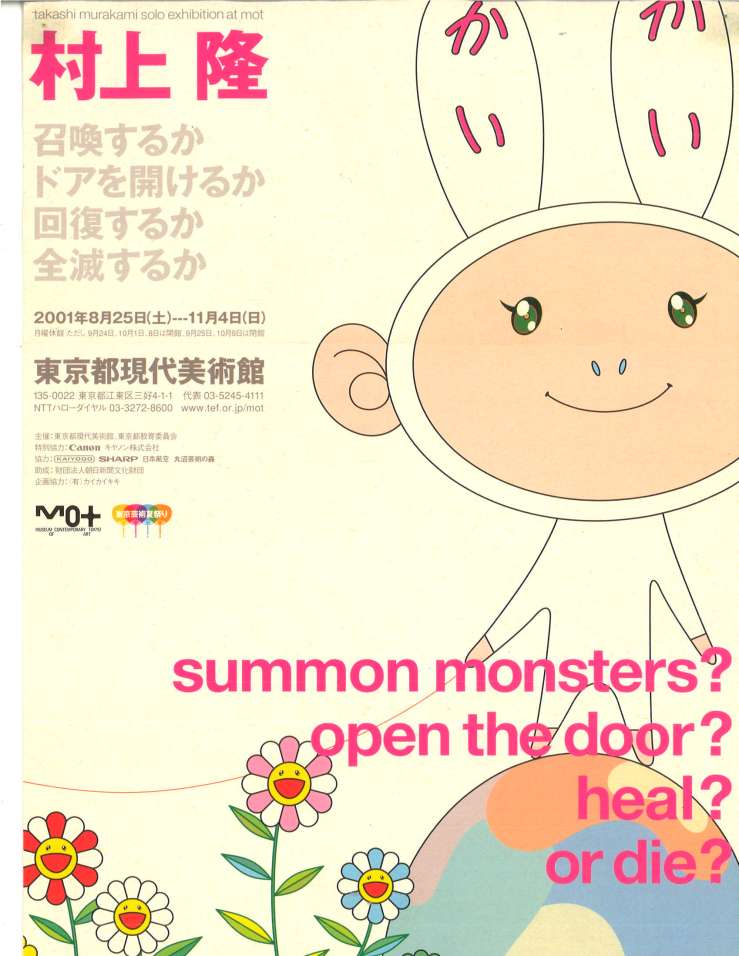
I found this flyer for a 2001 Takashi Murakami show somewhere in Tokyo. I never made it to the exhibition. I just found the flyer again in an old folder of old stuff.
Today, I somehow ended up listening to a “rare” 1996 David Foster Wallace interview on Boston’s The Connection (I was purging a bunch of old stuff, student work, in my office, and, as I often do, put on YouTube as a distraction—the interview popped up after another vid I can’t recall, but one that featured DFW reading too). Here’s the audio:
The interview is pretty good, especially as it happens right before Infinite Jest explodes, but also in the midst of IJ’s marketing buzz, which posits Wallace-as-next-Pynchon, “voice of Gen X,” etc.
I consider myself Generation X, and I have to admit that although I know that much of how a generation is defined boils down to fucking marketing trends (look at how Millennial has been steadily pushed younger and younger over the last ten years), I’m still fascinated by broad-stroke characteristics. (I’m also just generally mad at boomers, as is my Gen X right).
Anyway, some of my favorite bits of the interview circle over Gen X and what it is or is not (prompted by caller “Don,” who wonders whether DFW is a Gen X Tom Pynchon).
Wallace, born in 1962, would be a late Baby Boomer according to many demographers and cultural analysts. (So would Douglas Coupland, author of the 1991 “novel” Generation X, born just a few months before Wallace. So too, for that matter, would be the members of Sonic Youth, born between 1953 and 1962).
Christopher Lydon: David Foster Wallace is our guest, his new novel — it’s his second novel and his third book — is this huge doorstop of a post-modern, experimental, funny, dark, incredibly compelling… my taste does not run to avant-garde fiction generally, but this is an irresistible book. I was dreading it, and then I didn’t want it to stop. Don is calling from Rockport.
Don: I have a short question. Just talking on your program months ago with John Updike about Thomas Pynchon, who gave a kind plaudit to him… is Mr. Wallace the Generation X’s Tom Pynchon?
Christopher Lydon: David Wallace, what do you think?
David Foster Wallace: I’d need some kind of cogent explanation of what Generation X is. I hear the term a lot and I’ve honestly never understood what it means. I don’t know Pynchon as well as you do, but for me Pynchon is a quintessentially sixties writer. His sensibility comes out of the late Beats of the sixties. One of the things that I think my generation misses is that real sense of unity and community in the sixties. One of the things I find amusing about Generation X is that it’s kind of a clumsy attempt to form some kind of rubric or community out of our generation. I’m 34, so we’re talking mostly about people who are younger than I, but I think one of the difficulties of my generation is that there’s a great amount of atomism and anomie, and there doesn’t feel like a whole lot of a community. There aren’t a whole lot of shared values. There aren’t a whole lot of shared ideals. I mean [Generation X] seems silly. It seems like it’s trying to impose some kind of sixties type agenda on a generation that as far as I can see is essentially very lost and lonely.
Christopher Lydon: There is an incredibly lost and lonely feeling running through this whole book, I’ve got to say, running through maybe all of American life at the end of this century. Can you talk about the lost and lonely piece?
David Foster Wallace: When I started the book the only idea I had is I wanted to do something about America that was sad but wasn’t just making fun of America. Most of my friends are extremely bright, privileged, well-educated Americans who are sad on some level, and it has something, I think, to do with loneliness. I’m talking out of my ear a little bit, this is just my opinion, but I think somehow the culture has taught us or we’ve allowed the culture to teach us that the point of living is to get as much as you can and experience as much pleasure as you can, and that the implicit promise is that will make you happy. I know that’s almost offensively simplistic, but the effects of it aren’t simplistic at all. I don’t have children but I’m sort of obsessed with the idea of what my children will think of me, and of us, and of what we’ve done with all we’ve been given, and why we are so sad.
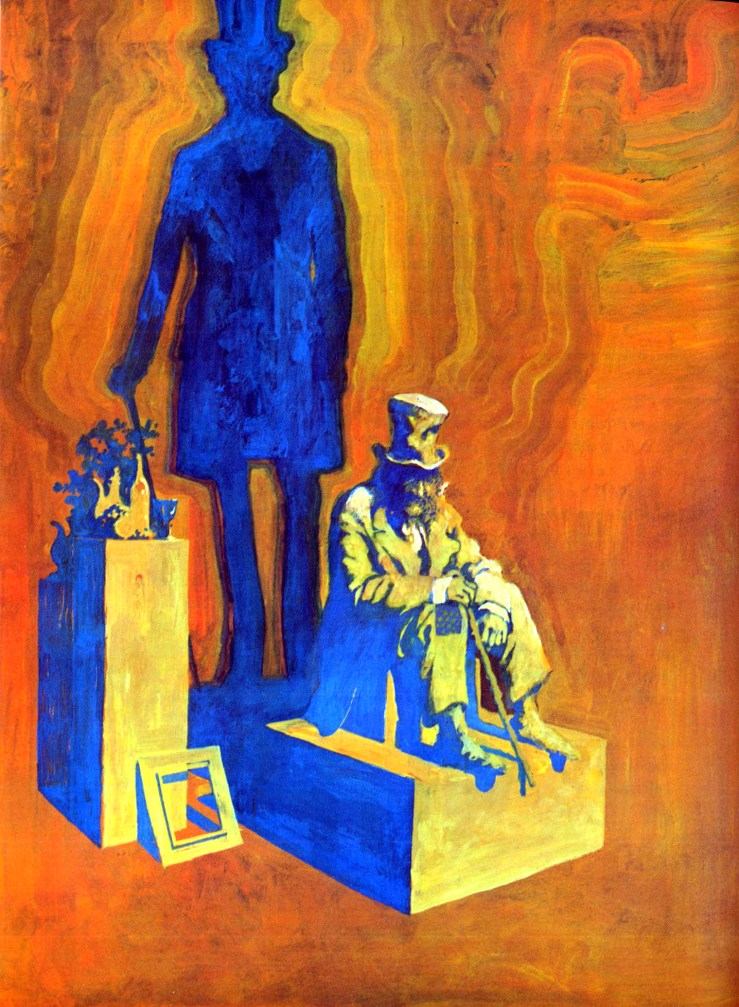
James Hill’s illustration for “The Model Millionaire” by Oscar Wilde. From The Short Stories of Oscar Wilde, Heritage Press, 1968.
“The Model Millionaire”
by
Oscar Wilde
Unless one is wealthy there is no use in being a charming fellow. Romance is the privilege of the rich, not the profession of the unemployed. The poor should be practical and prosaic. It is better to have a permanent income than to be fascinating. These are the great truths of modern life which Hughie Erskine never realised. Poor Hughie! Intellectually, we must admit, he was not of much importance. He never said a brilliant or even an ill-natured thing in his life. But then he was wonderfully good-looking, with his crisp brown hair, his clear-cut profile, and his grey eyes. He was as popular with men as he was with women, and he had every accomplishment except that of making money. His father had bequeathed him his cavalry sword, and a History of the Peninsular War in fifteen volumes. Hughie hung the first over his looking-glass, put the second on a shelf between Ruff’s Guide and Bailey’sMagazine, and lived on two hundred a year that an old aunt allowed him. He had tried everything. He had gone on the Stock Exchange for six months; but what was a butterfly to do among bulls and bears? He had been a tea-merchant for a little longer, but had soon tired of pekoe and souchong. Then he had tried selling dry sherry. That did not answer; the sherry was a little too dry. Ultimately he became nothing, a delightful, ineffectual young man with a perfect profile and no profession.
To make matters worse, he was in love. The girl he loved was Laura Merton, the daughter of a retired Colonel who had lost his temper and his digestion in India, and had never found either of them again. Laura adored him, and he was ready to kiss her shoe-strings. They were the handsomest couple in London, and had not a penny-piece between them. The Colonel was very fond of Hughie, but would not hear of any engagement.
Just before dawn knocking comes very loud, hard as steel. Slothrop has the sense this time to keep quiet.1
“Come on, open up.”
“MPs 2 , open up.”
American voices, country voices, high-pitched and without mercy. He lies freezing, wondering if the bedsprings will give him away. For possibly the first time he is hearing America as it must sound to a non-American 3. Later he will recall that what surprised him most was the fanaticism, the reliance not just on flat force but on the rightness 4 of what they planned to do… he’d been told long ago to expect this sort of thing from Nazis, and especially from Japs —we 5 were the ones who always played fair—but this pair outside the door now are as demoralizing as a close-up of John Wayne (the angle emphasizing how slanted his eyes are, funny you never noticed before) screaming “BANZAI!” 6.
“Wait a minute Ray, there he goes—”
“Hopper! You asshole, come back here—”
“You’ll never get me in a strait jacket agaaaaain… .” Hopper’s voice goes fading around the corner as the MPs take off in pursuit.
It dawns on Slothrop, literally, through the yellowbrown window shade, that this is his first day Outside. His first free morning. He doesn’t have to go back. Free? What’s free? He falls asleep at last. A little before noon a young woman lets herself in with a passkey and leaves him the papers. He is now an English war correspondent named Ian Scuffling 7.
1 Slothrop has fled the clutches of The White Visitation and made out for Nice, where he hooks up with Blodgett Waxwing’s contacts in a squalid safehouse…the safehouse is actually closer to a madhouse though, or a halfway house.
2 Military Police—a concept that perplexed me when I was five or six, watching MASH reruns with my father. MASH is kinda sorta (slightly) Pynchonian, actually.
3 A fascinating notation.
Some jingoists would insist, of course, that no decent American (i.e., a Real American) ought to hear America the way it must sound to a non-American. Slothrop has already posed as an Englishman, but there’s a bit of a conversion here, I think—a shift for our shifter, who’s moving from not simply performing a double-agency to actually existing (or non-existing) one.
Cf. Walt Whitman’s 1860 poem “I Hear America Singing”:
I hear America singing, the varied carols I hear,
Those of mechanics, each one singing his as it should be blithe and strong,
The carpenter singing his as he measures his plank or beam,
The mason singing his as he makes ready for work, or leaves off work,
The boatman singing what belongs to him in his boat, the deckhand singing on the steamboat deck,
The shoemaker singing as he sits on his bench, the hatter singing as he stands,
The wood-cutter’s song, the ploughboy’s on his way in the morning, or at noon intermission or at sundown,
The delicious singing of the mother, or of the young wife at work, or of the girl sewing or washing,
Each singing what belongs to him or her and to none else,
The day what belongs to the day—at night the party of young fellows, robust, friendly,
Singing with open mouths their strong melodious songs.
To which, Langston Hughes, in 1926 replied in “I Too”:
I, too, sing America.
I am the darker brother.
They send me to eat in the kitchen
When company comes,
But I laugh,
And eat well,
And grow strong.
Tomorrow,
I’ll be at the table
When company comes.
Nobody’ll dare
Say to me,
“Eat in the kitchen,”
Then.
Besides,
They’ll see how beautiful I am
And be ashamed—
I, too, am America.
4 When we most believe we are right we are most susceptible to being wrong. Unconsidered belief is terrifying.
5 Pynchon is too often accused of obscurity; his critique of blind patriotism and government propaganda is so clear that it hardly warrants this footnote. So I’ll comment, rather, on his brilliant modernist style—note the shift here, via free indirect speech, from third-person to first-person, from “he” to “we.”
6 I’m admittedly confused here—does the narrator attribute the expression BANZAI! to the MPs, or to John Wayne? I think what we have here is a conflation of both (which is to say a conflation of the third-person “he” with the first-person “I”—in other words, Slothrop, now attuned (or detuned) to “hearing America as it must sound to a non-American” can recast his country’s jingoistic martial fantasies and see/hear the Hero of the Military-Industrial-Entertainment Complex (John Wayne) as a cartoonish, racialized war trope).
In Japanese, the term banzai translates as ten thousand years, but basically means, as I’m sure you know, something like “Hooray.” During WWII, banzai was an attack cry for Japanese soldiers (review the independent clause after the ellipses in Pynchon’s original sentence).
Is BONZAI! here a strange transposition of GERONIMO!, an exclamation cribbed by U.S. Army parachutists from a 1939 film of the same name?
The ironic notation of John Wayne’s “slanted…eyes”seems like a nod to the notorious 1956 flop The Conqueror, which featured John Wayne as…Genghis Khan.
And speaking of BANZAI—
Have you seen the Pynchonesque 1984 film The Adventures of Buckaroo Banzai Across the 8th Dimension? It is good fun.
(W.D. Richter, director of Buckaroo Banzai, also co-wrote Big Trouble in Little China, in which Kurt Russell did a good/bad John Wayne impression).
7 Slothrop’s always shuffling off identities—or shuffling into them. Here, we get Ian Scuffling, his English journalist identity (for a few dozen pages). Scuffling…shuffling…? Let’s get the etymology.
From Joseph T. Shipley’s The Origin of English Words: A Discursive Dictionary of Indo-European Roots (1984):
I recently re-read all of Jeff Smith’s massive comic Bone—this time to my son, and this time in the Scholastic color reprints. (I read Bone in full with my daughter years ago through the unwieldy 1,300 page single-volume single edition; I read bits and pieces of it earlier in the late nineties, when Dave Sim (of Cerebus fame/infamy) was an early champion of Smith’s cartooning charms).
Anyway, we enjoyed the read, and the fourth book, The Dragonslayer, seemed particularly timely.
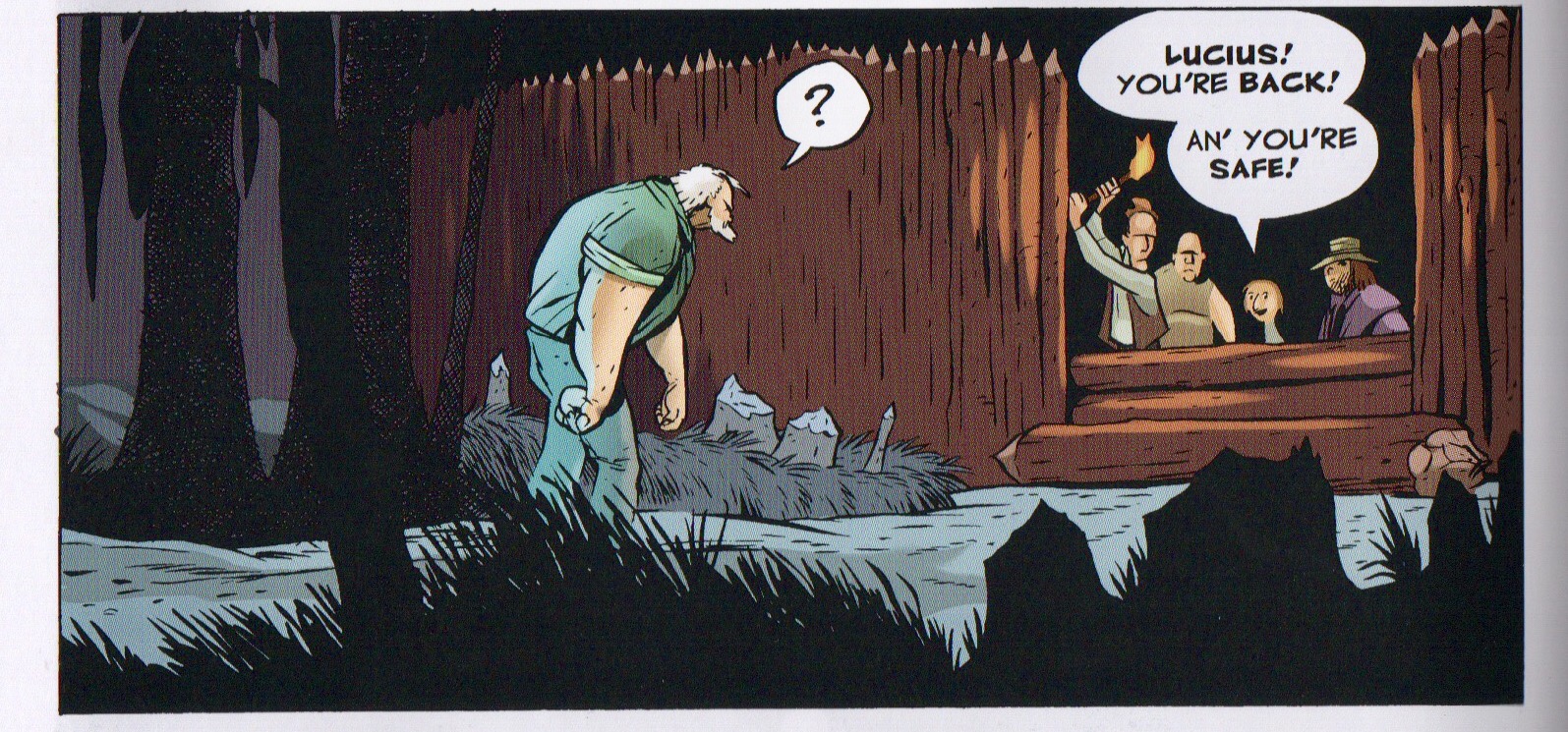
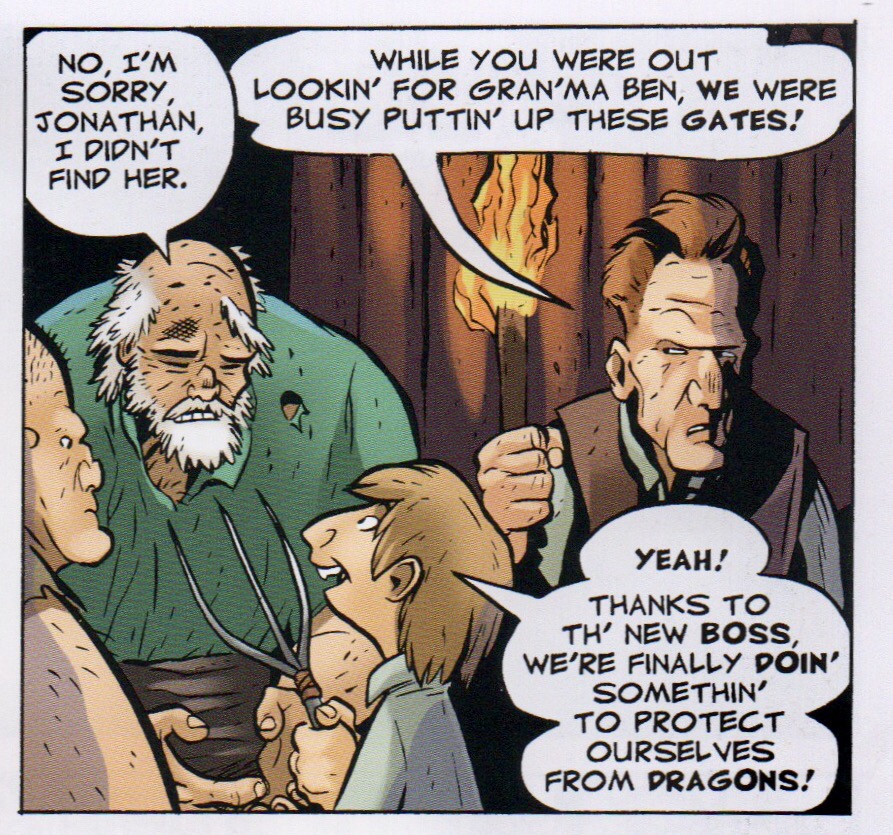
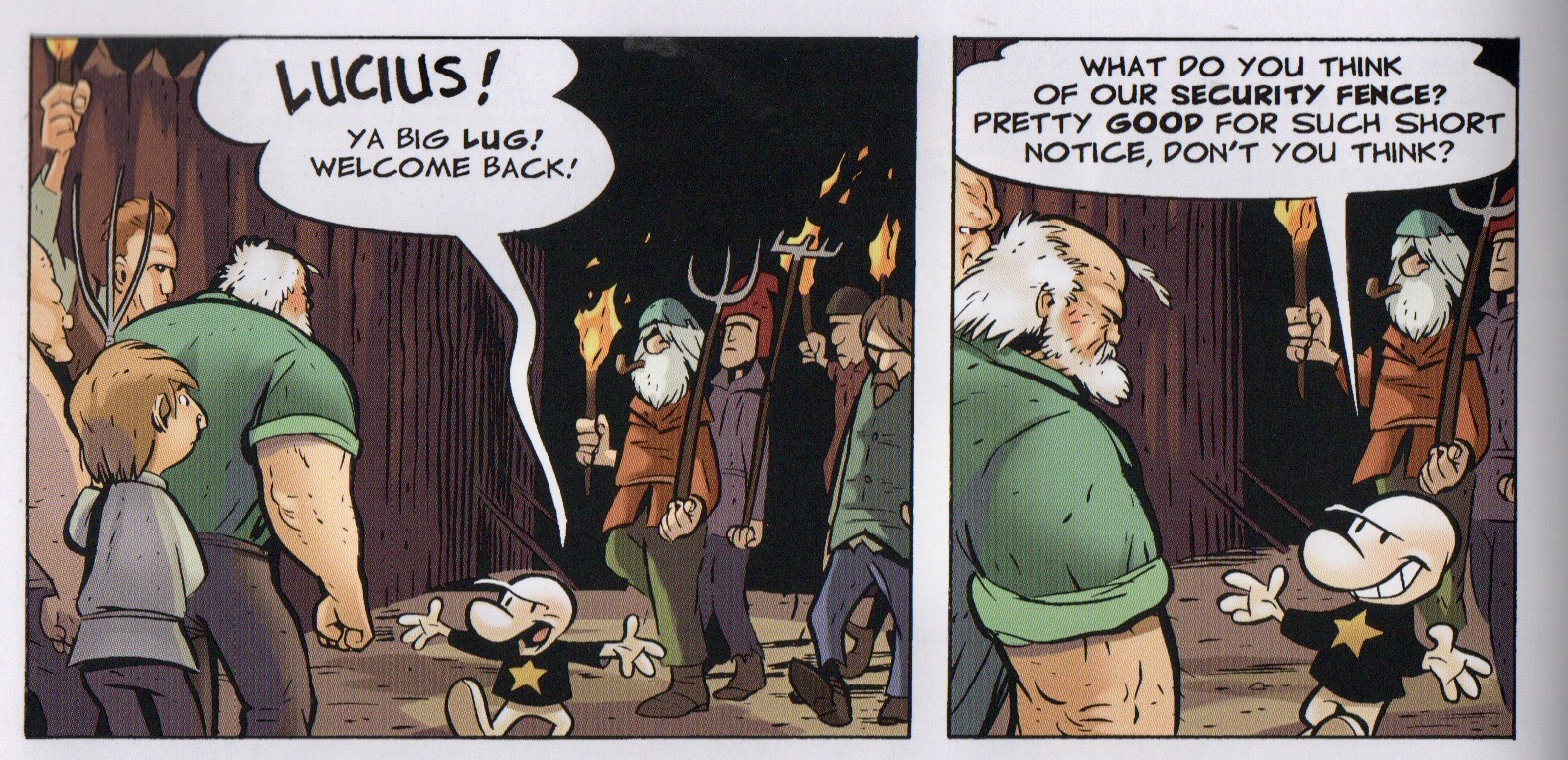
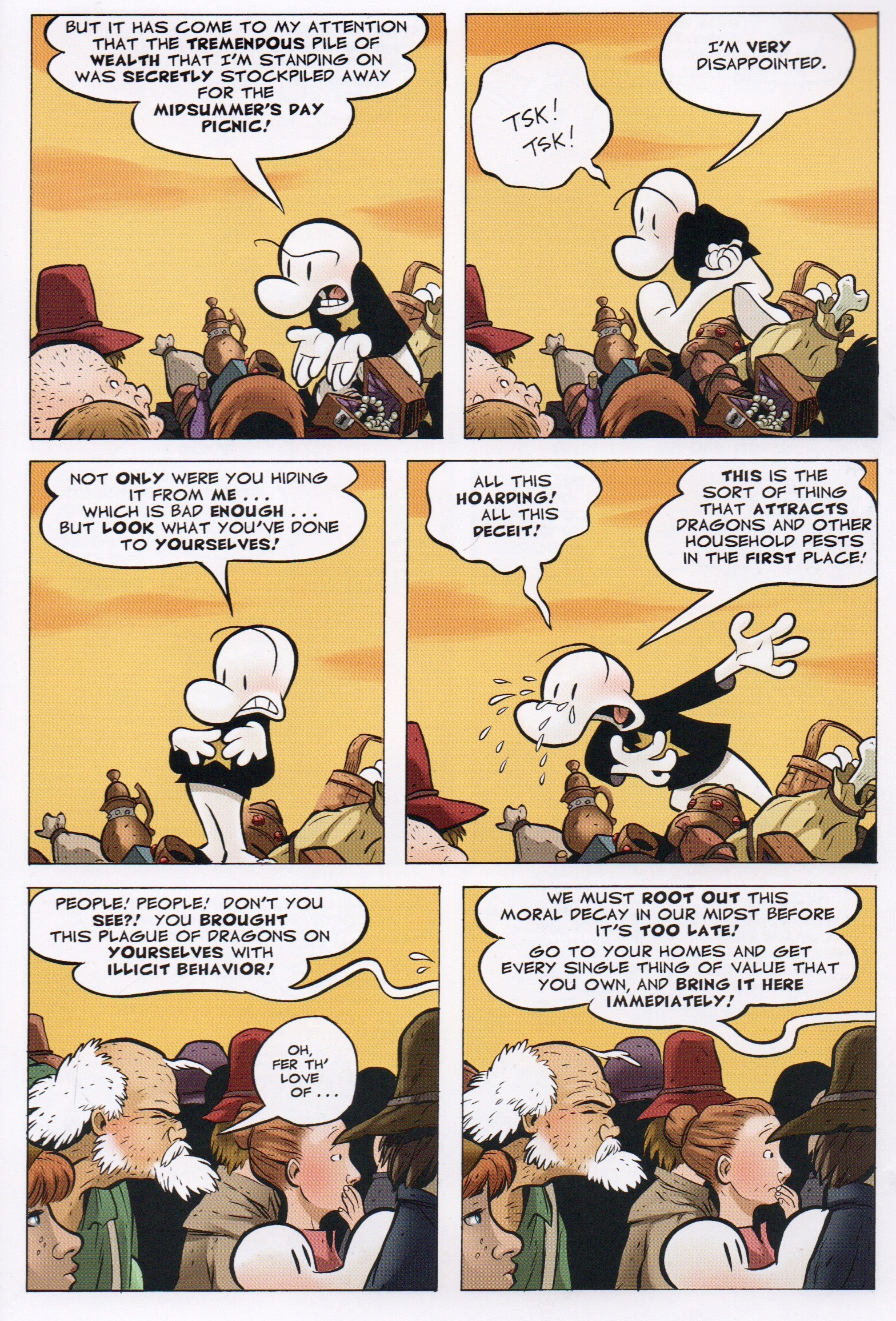
In this volume, Phoncible P. Bone—aka Phoney Bone—manipulates the fears of the populace of Barrelhaven. A natural conman, Phoney instructs the townspeople to build a wall to keep “dragons” out. Only sensible Lucius Down (and Phoney’s cousins, who know he’s a scammer) realize that Phoney is driven by egomania and greed.
Perhaps the most infuriating moment in the story comes when Phoney—a gifted pitchman—cloaks his greed in the language of ethics and morality.
Of course Phoney doesn’t win in the end. And Bone is just a comic; it’s not real life. It’s not like a xenophobic conman could really take sway over the zeitgeist.
He 1 gets back to the Casino just as big globular raindrops, thick as honey, begin to splat into giant asterisks 2 on the pavement, inviting him to look down at the bottom of the text 3 of the day 4, where footnotes will explain all 5. He isn’t about to look. Nobody ever said a day has to be juggled into any kind of sense at day’s end 6. He just runs. Rain grows in wet crescendo. His footfalls send up fine flowers of water, each hanging a second behind his flight. It is flight. He comes in speckled, pied with rain, begins a frantic search through the great inert Casino, starting again with the same smoky, hooch-fumed bar, proceeding through the little theatre 7, where tonight will play an abbreviated version of L’Inutil Precauzione (that imaginary opera with which Rosina seeks to delude her guardian in The Barber of Seville) 8, into its green room where girls, a silkenness of girls 9, but not the three 10 Slothrop wants most to see, tease hair, arrange garters, glue on eyelashes, smile at Slothrop. No one has seen Ghislaine, Françoise, Yvonne. From another room the orchestra rehearses a lively Rossini tarantella. The reeds are all something like a half tone flat. At once Slothrop understands that he is surrounded by women who have lived a good fraction of their lives at war and under occupation, and for whom people have been dropping out of sight every day… yes, in one or two pairs of eyes he finds an old and European pity, a look he will get to know, well before he loses his innocence and becomes one of them… . 11
So he drifts 12 through the bright and milling gaming rooms, the dining hall and its smaller private satellites, busting up tête-à-têtes, colliding with waiters, finding only strangers wherever he looks. And if you need help, well, I’ll help you… . 13
1 The “he” here is again Our Boy Tyrone Slothrop, and again, these annotations pick up right damn exactly where the last set left off. (Do not worry. I will not be annotating the entire novel paragraph by paragraph. I hope). Slothrop returns to the Casino Hermann Goering after an unsuccessful search for his friend Tantivy Mucker-Maffick.
2 What a wonderful series of transformations here, as the phenomenological world — “rain” — is converted via simile into “honey,” which transforms again into typographical representation — “asterisks.”
3 …and then the phenomenological world—which is to say here, the phenomenological world’s representation in literature—is converted into text. This is, uh, whattayoucall it, that metafiction? Slothrop’s family, recall, made their non-fortune in paper, a fact foregrounded near his introduction. We learn the Slothrops turned the natural world into a medium for text:
…green reaches were converted acres at a clip into paper—toilet paper, banknote stock, newsprint—a medium or ground for shit, money, and the Word. (28)
Shit, money, and the Word—key themes in Gravity’s Rainbow.
4 The phrase “the day” appears like a signature note not just throughout Gravity’s Rainbow but throughout Pynchon proper.
5 “….the bottom of the text of the day, where footnotes will explain all”—well, um. Lovely to look for answers, I suppose.
6 I’ll spell the line out in full again: “Nobody ever said a day has to be juggled into any kind of sense at day’s end.” Lovely on its own, but again, a concise if incredibly oblique gloss on Gravity’s Rainbow’s own end some 556 pages from now.
7 Cf. the fourth line of the novel (page 3): “The Evacuation still proceeds, but it’s all theatre.”
8 Weisenburger’s gloss from A Gravity’s Rainbow Companion:
The opera-within-an-opera is a kind of meta-textual, self-referencing recursion—what André Gide termed a mise en abyme.
Consider, by way of example, Velázquez’s meta-paintingLas Meninas, with its blurring of frame, gaze, reflection, self-reflection, and meta-reflection.
Las Meninas (detail), Diego Velázquez, 1656
You’re undoubtedly familiar with The Murder of Gonzago, the play-within-a-play in Hamlet, which Shakespeare uses to satirize and comment on the “text” proper of his great tragedy.
The Play Scene in Hamlet, Daniel Maclise, 1842
Pynchon posits a play-within-a-play in his earlier novel The Crying of Lot 49 (1969), when he includes a summary performance of The Courier’s Tragedy.
Mise en abyme reaches a sort of apotheosis in Charlie Kaufman’s film Synecdoche, New York (2008):
9A silkenness of girls is the correct and proper term (if overlooked by some, if not most, linguistic authorities). English terms of venery are the best.
Cf. James Lipton’s An Exaltation of Larks (1968).
A Shrivel of Critics, James Lipton, 1968
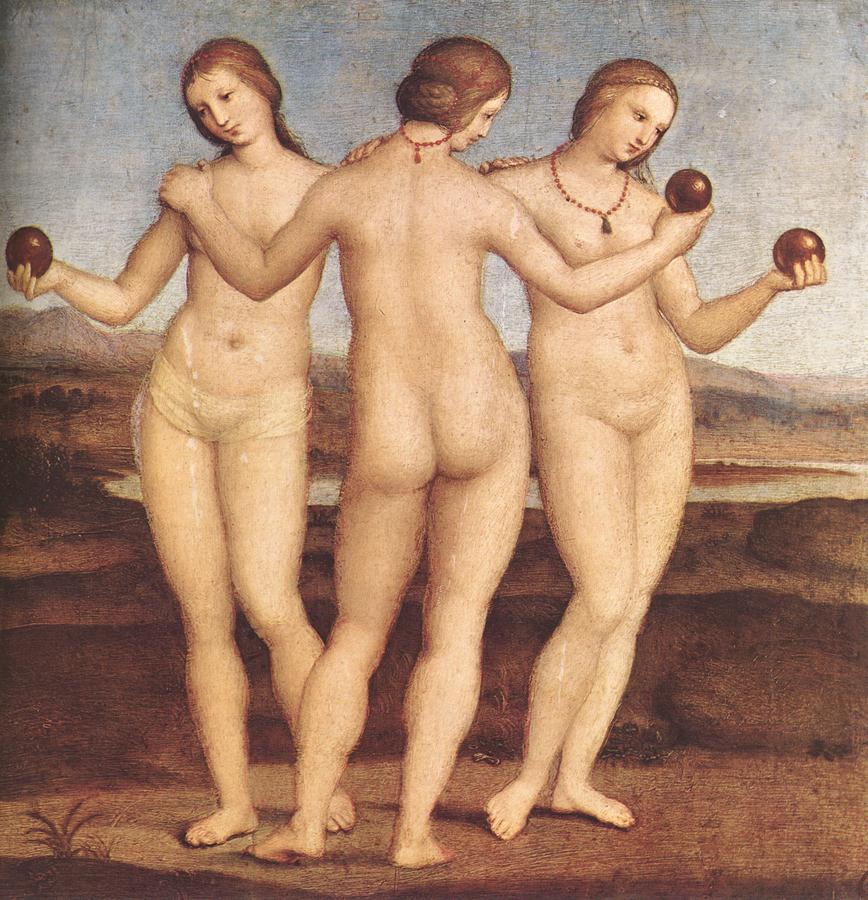
10 The three…Graces? Fates? Furies?
The Three Graces, Raphael, 1504-1505
…or just Ghislaine, Françoise, and Yvonne?
11 Slothrop among the women.
What is the antecedent for the sentence-final pronoun “them”—what does the text promise Slothrop will become once he “loses his innocence”? (And how ironic is this reference to Slothrop the Innocent?)
Possible referents for the “them” included the implied antecedent “European” (later, Slothrop will become the European folk hero Plechazunga the Pig), “pairs of eyes” (not likely), and “women” (also not likely). No, the “them” to which Slothrop shall eventually be elected are those “people [who] have been dropping out of sight every day.” Slothrop the Invisible. Note that Pynchon hides the referent in a tangle.
12 “He drifts”—a key verb for Our Drifter Slothrop.
13 Slothrop alone. The final italicized line are Tantivy’s last words.







 Biblioklept