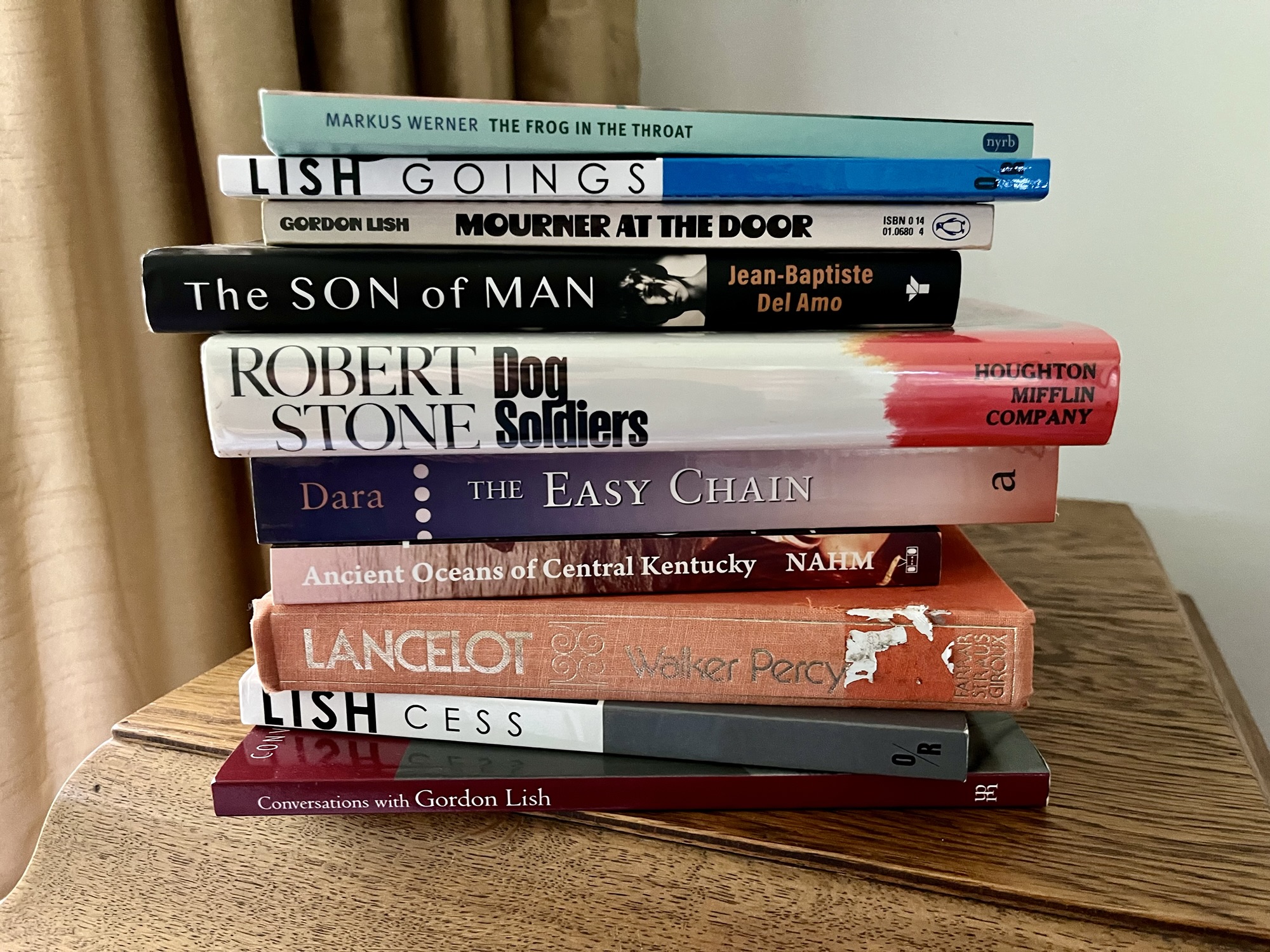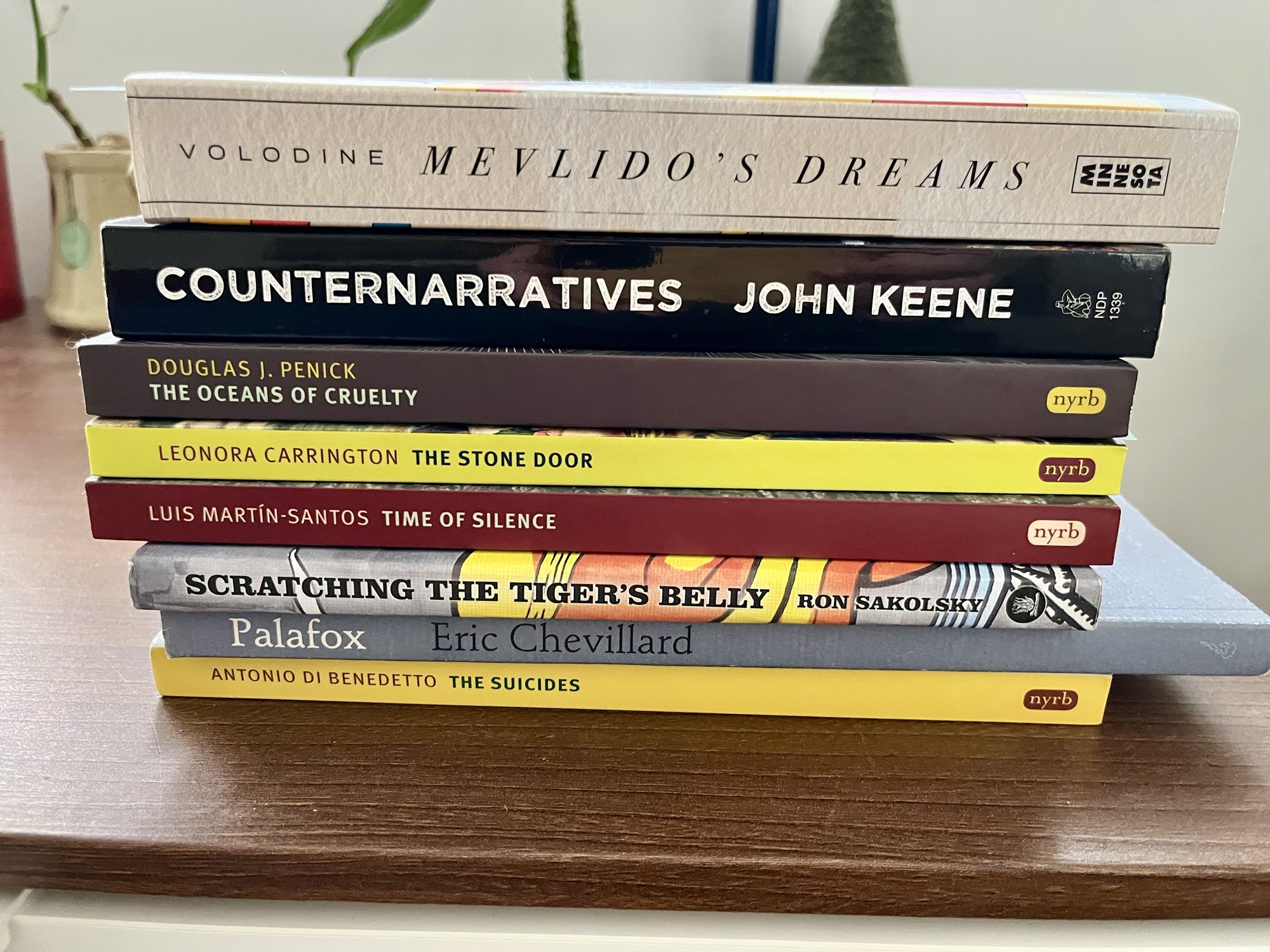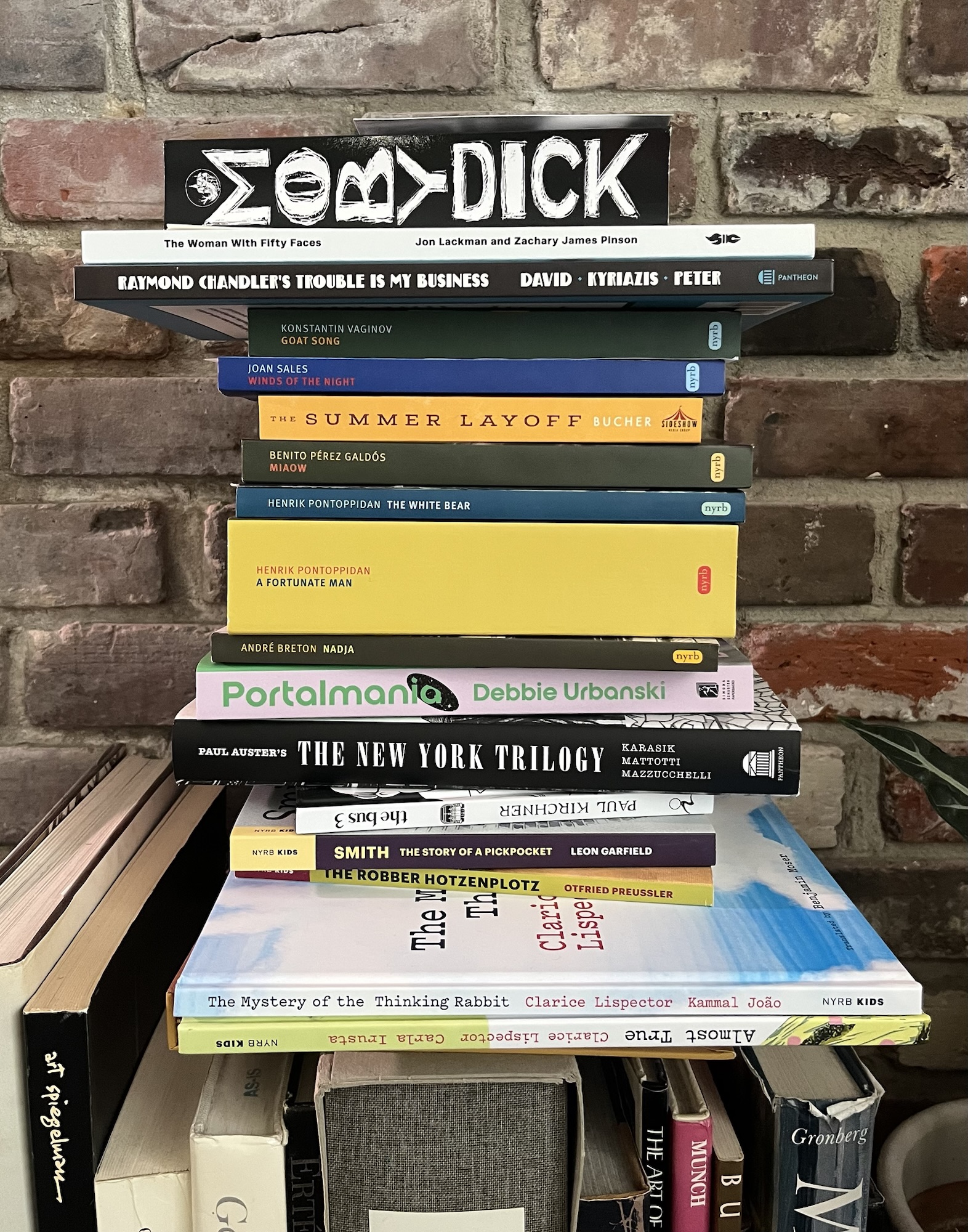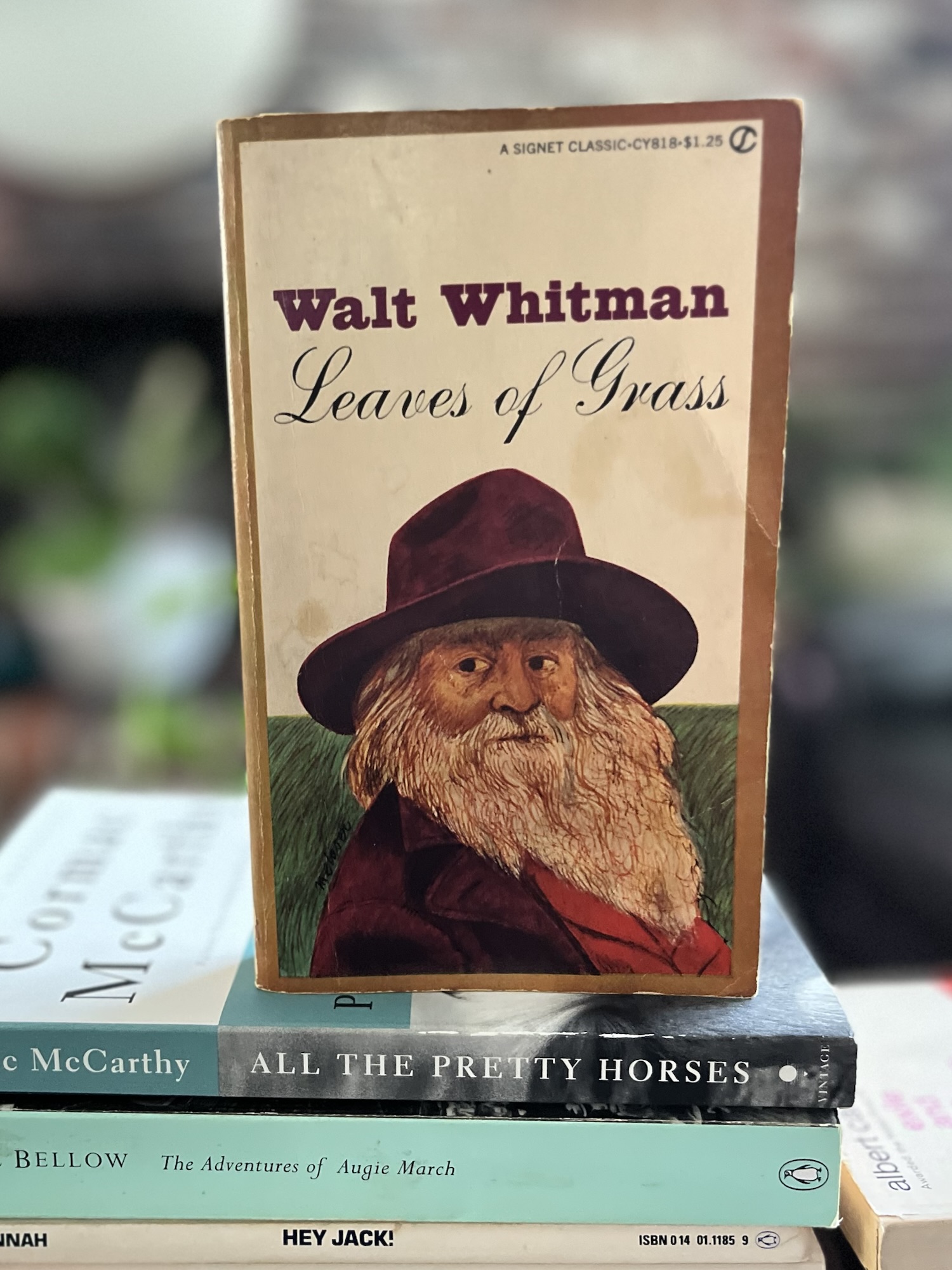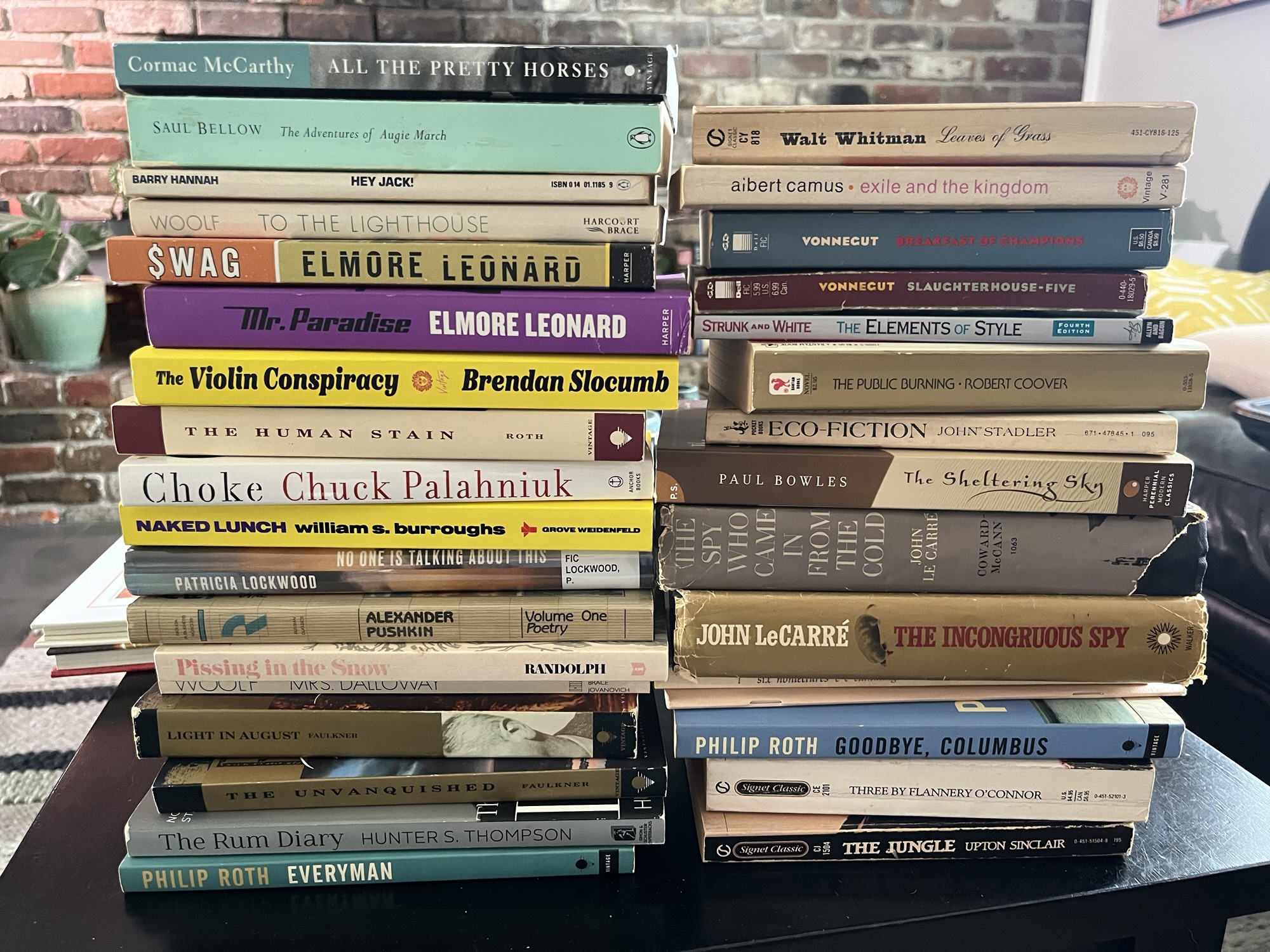
Not really a blog about books acquired, May 2025

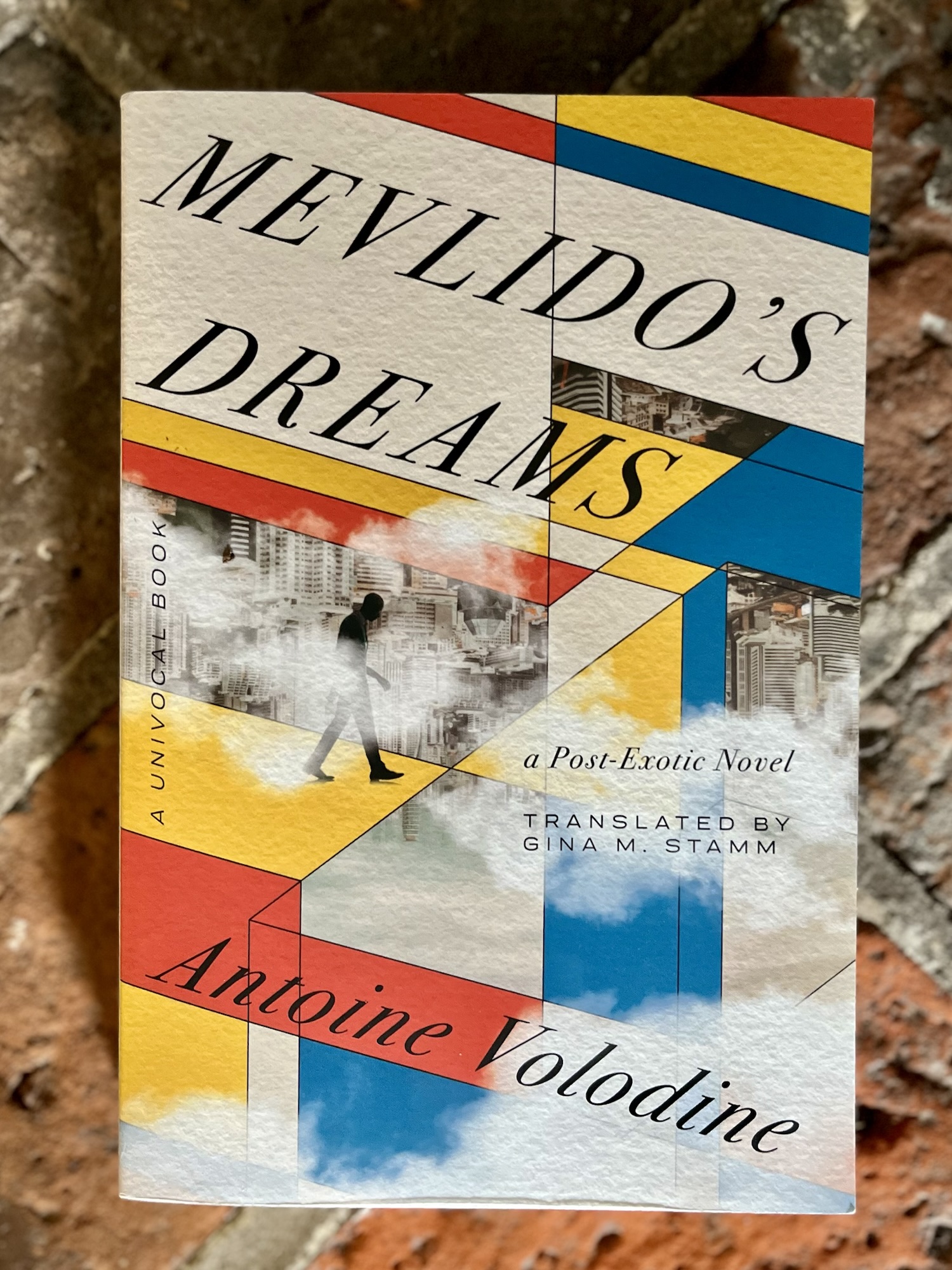
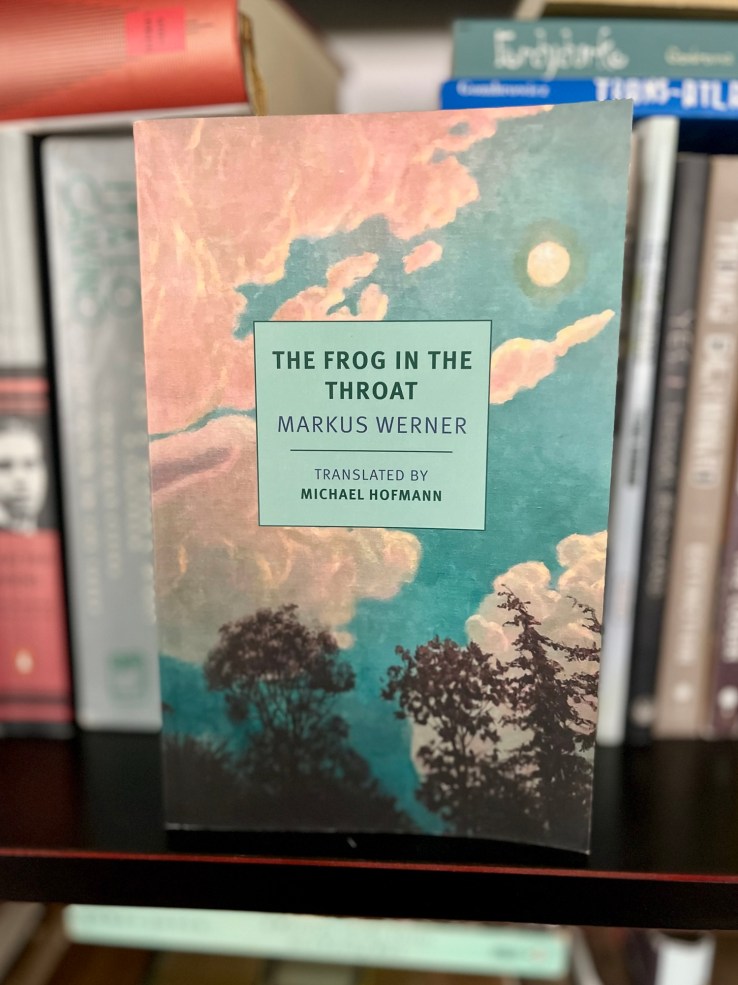
The afternoon my best friend died, three review titles arrived at Biblioklept World Headquarters. That was the first Monday in May 2025.

The next day, the first Tuesday in May 2025, a lovely new copy of Moby-Dick arrived, designed and illustrated by my old internet friend Dmitry Samarov. I was regularly breaking down into a kind of horrified shaking disbelief throughout this day. My best friend read Moby-Dick before I did. He told me it was funny and that I could read it, “No problem man.” He loaned me his copy of Pierre when I had to read it in grad school. I never gave it back.

On Wednesday–do I need to clue you in that this was the first Wednesday of May 2025? I seem to have lost my sense of time and scale this month, untethered from the Spring semester, which ended right as May began, unencumbered from any normalizing duty other than fatherhood and husbandry and just generally trying to be a good citizen–also generally numb in my nascent grief to the daily horrors of the what we call news or current events or what-have-you–but, yeah, I seem to have lost some days here… (maybe they’ve been colonized by the “Asiatick Pygmies” of Thomas Pynchon’s Against the Day, who colonized the “eleven missing days” of September 1752)… So well anyway on this first Wednesday of May 2025 the growing book pile took a silly turn, with the arrival of a massive book and a not-so-massive book, both by Henrik Pontoppidan. Other books arrived too. It’s the Spring catalog, or maybe the Summer catalog, I guess.

I managed to write something about my friend on Wednesday. I simply had to.

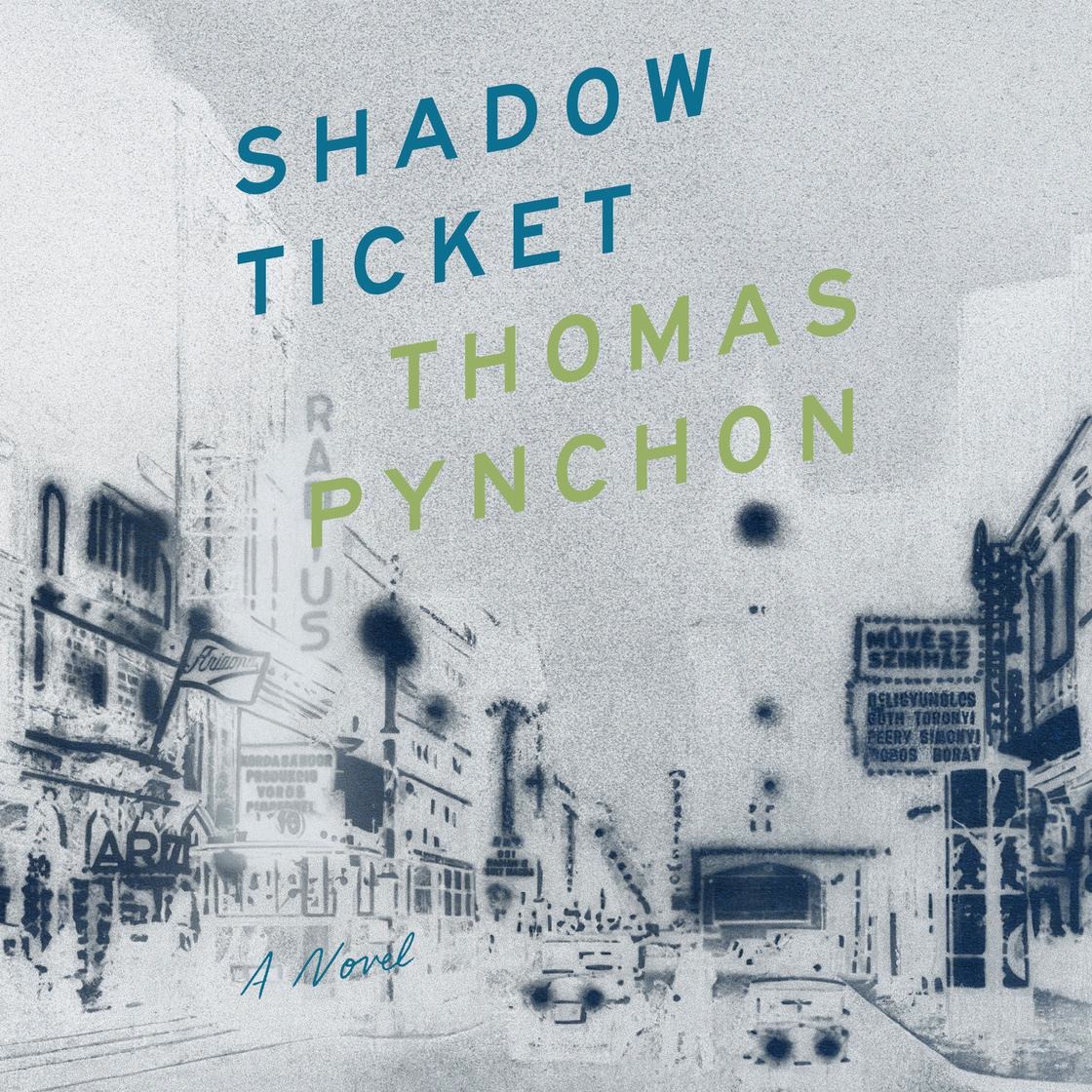
Thursday was the second Thursday of May, 2025, making it 8 May 2025, the 88th birthday of Thomas Pynchon. For over a decade now, I’ve celebrate my favorite author’s birthday on this blog as part of the Pynchon in Public “tradition,” but I couldn’t muster what I had planned (a riff on the forthcoming Vineland adaptation and the new novel, Shadow Ticket). The notes I sketched in late April for the piece strike me as silly, glib even.

That Thursday afternoon my friend’s wife (widow? fuck!) called me to ask me to deliver the eulogy at his “Celebration of Life Ceremony” at the beach the following Thursday. I started working on it. It was painful but somehow easy to write. It was very, very difficult to edit.

On Friday, Jon Lackman and Zack Pinson’s biography The Woman with Fifty Faces: Maria Lani and the Greatest Art Heist That Never Was arrived at Biblioklept World Headquarters. My daughter had seven girls over to make their own pizzas that night. I read The Woman with Fifty Faces in one sitting; it was wonderful. It was the first thing I’d read that was not in some way connected to my friend’s death. I loved the experience of reading it. It offered relief.

This Friday, the second one of May, 2025 was the first day I hadn’t broken down at some point. I was absorbed in a study of grief. I was trying to shape my memories into something tangible, or at least something having a form, which is to say, something formal. I was googling things like, how long should eulogy be words. I was on the phone with old friends, replying to emails and messages from old friends. I was also contending with acquaintances I barely recalled, and none too fondly, who luridly “reached out” wanting details under the guise of “offering condolences.” I was amassing words.

More review copies on Saturday. Friends from out of town came over and we all drank far too much. There was another grief to attend to, a dead father, a man we had all adored, a fantastic storyteller, a raconteur even, if we’re feeling grand with our words, and I miss him too. My dead friend was a huge fan.

Sunday was Mother’s Day and I had forgotten about it. My own mother and father were both suffering from acute bronchitis, and I had held off on delivering the news of my friend, worried that they would worry for me and his family and his young young children. Sorrow is bad for health. But when family members reached out to me with sincere concern, prompted by the trickle of news on social media about the upcoming Celebration of Life — forgive me, I’m just gonna call it a funeral, it was a funeral, no matter what we want to say — anyway, the trickle turned into a stream, and then I called my mom with the news. I don’t have any physical proof like a recording, but her wailing immediate refusing disbelieving repeated NO sounded exactly like my own. But from a chronological position, it seems that I must have inherited that cry from her, no?

The next day she called me to tell me a story I’d never heard from either her or my friend — years ago, when I was living in Tokyo and he was still in Jacksonville, he stopped by my parents house, unannounced, simply because he was driving by and wanted to share some of my latest emailed updates with my parents and hoped that they would share some too. “We had spaghetti dinner together. It was so nice,” my mother said. My bones turned into jelly and my eyes took to sweating.

This next day was of course the second Monday of May, 2025, the one week mark. The document I’d titled “eulogy” was a massive incoherent patchwork of memories, good times, riffs, and material cribbed from friends, including an entire email so beautifully-written from a friend that I thought about just passing it off as my own. The document also included five Langston Hughes poems, several lines from Moby-Dick, two longish quotes from Emerson (neither of which I understood or understand), a chapter on mourning rites from an early-twentieth century anthropology book, numerous David Berman and David Bowie lyrics, and the entirety of Elizabeth Bishop’s “One Art.” It was at least 9,000 words longer than it should be.

I don’t remember anything about that Tuesday or Wednesday. Two or three books came in the mail, I think, and I finally drove in a car, I think. I think I remembered to attend the houseplants. I must have actually written the eulogy those days. What I remember mostly is sweating from the back of my legs, stripping away all the ornament and artifice I’d borrowed from literature and poetry and philosophy. I practiced reading it a few times. Some of my oldest, dearest, bestest friends arrived from the other side of the country that night.

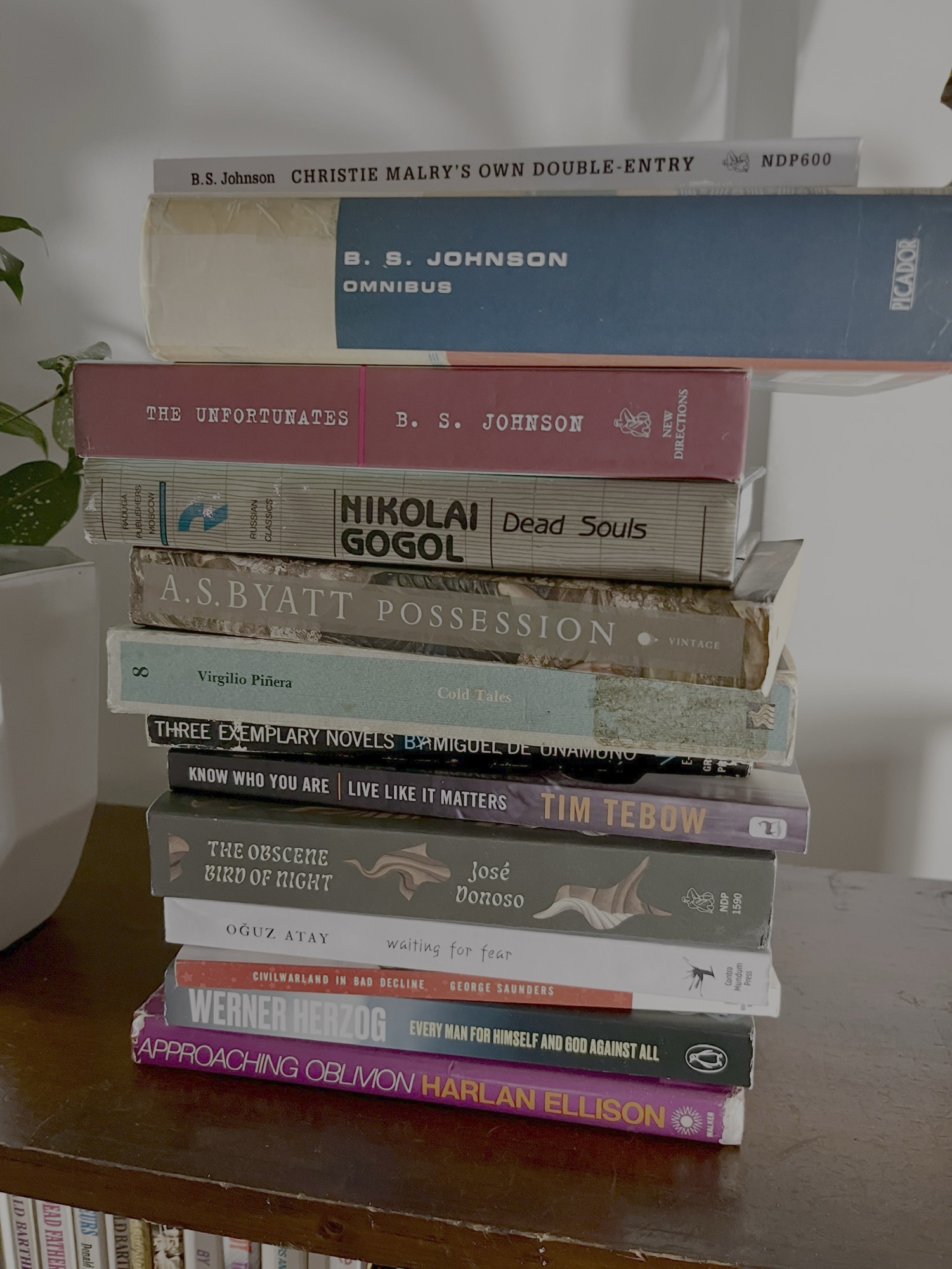
On Thursday those friends came over. My wife would drive us all out to the beach for the funeral. We started in on a few cheap watery domestics, maybe a little too early. The drive seemed interminable. I can’t really capture the vibe in the pavilion—and while I’m here not capturing things, I apologize if you’ve made it this far–I suppose this post is a bait-and-switch, what with the picture of a stack of books, right? The “Not really” in the blog’s title should really not be there at all, right? But the thing is, I need to get this all out, just like the thing I needed to write two weeks ago. If I don’t write it here I feel like I’ll never write anything here again. This is ostensibly a blog dedicated to art and literature, but it’s really more like a pastebook, a form of emotional and aesthetic recordkeeping that I’ve kept up for almost two decades now. The books in the picture above didn’t pile up as neatly as the photo suggests, but they did pile like that, causing me anxiety all month, reminding me that my attention was too thinned out. I was not as attentive to my children as I should have been in those weeks. My houseplants suffered. But so I have to let all that anxiety out here, and I’m sorry if it’s alienating to a potential audience, and I’m sorry to write that I am really writing this for me, for writing that If I don’t get these words out of my body I will not be able to write other words on this blog ever again

—but the vibe in the pavilion. Very strange, moving from hysterical laughing to crying. Lots of great stories. The mic or PA went out in the middle of my eulogy so I ended up delivering it in the loudest voice I could muster. The pavilion was crammed, literally standing room only, such that the fire marshal or the marshal’s deputy or the person nominally in charge of these duties decreed that the doors be opened and about half of the people should mill about. The Atlantic breeze was lovely, even if it was in the high eighties. I saw and spoke to people I hadn’t seen in fifteen years, twenty years, thirty years. I was struck by how fucking old we all looked. My best friend’s brother looked exactly the same as their father had looked when we were thirteen, fourteen. I have felt iterations of oldtiredadult in my life; I’ve even felt mature and occasionally even wise (knowing that any trickle of wisdom I purchased through mistake and incaution). But I have never really felt grown up until last Thursday. I don’t really know what any of those words mean. We tossed flowers into the Atlantic’s chill waves.

I knew I’d have sand in my loafers all night. About a dozen of us went to a dive bar a mile away and got plastered. I had forgotten that there were still bars that people smoked in. A musician played four Seger covers in a row, keeping the beat with his prosthetic leg. The bar’s owner had a school desk set up right by the stage, where he was apparently attending to the bookkeeping, a pen in one hand, a menthol in the other. A vendor in a special vest kept trying to give us vape products. An older woman showed up after midnight and established an ad hoc outdoor kitchen where she fried lumpia, which we ate in large quantities. She told us several dirty jokes where the punchlines were, without variation, oral sex. We missed our friend; he would’ve had a great time that night.

My sweet wife, designated driver, got me and the boys over the river and back home, putting up with our arguing over Zappa. She fell into our mistake back at home though, committing herself to vodka while we polished off a bottle of bourbon.

Friday was an agony overcome in small measures by barbecue and beers, a slow stretching anti-wake of sorts where folks drifted in and out of our house. It was a strange party, but also so wonderful, so full of love and support and all things corny, I suppose. I gave away a copy of Moby-Dick (a Norton Crit) and my backup copy of Gravity’s Rainbow. I foisted a redundant Barry Hannah novel on a friend. Folks drifted off in lacy jags, or at least that’s how I’ll choose to characterize it here. A few stayed the night, sleeping on couches in a half-remembered skill perfected and then promptly abandoned over twenty years ago.

I didn’t really sleep, again. I had only really slept one night out of the past lost eleven days, and then I suppose on the point of exhaustion. I had not eaten healthily and over three days and nights had overindulged in alcohol in a way I had not in years. I drove my friend to the airport so he could return to his family in Portland, got out of my car around 11am on Saturday, aiming myself for my bed. I was having difficulty breathing, or not so much difficulty breathing, as sharp pain when breathing. This pain was enormously exacerbated when I lay down and relieved somewhat when I stood. The pain intensified throughout the day; it was something new. I weird dull pain in my neck and the back of my throat. Not esophageal, exactly. By three it was almost impossible to breathe anything but the most shallow breaths without intense pain; I could not lie down because of the pain, despite being exhausted. My wife insisted we visit an urgent care clinic in a CVS; the nice doctor there insisted with caring urgency that I go to the closest emergency room. Six hours and lots of tests later I was back at home in even worse pain but with a diagnosis of pericarditis, likely brought on from stress, and a prescription for prednisone.

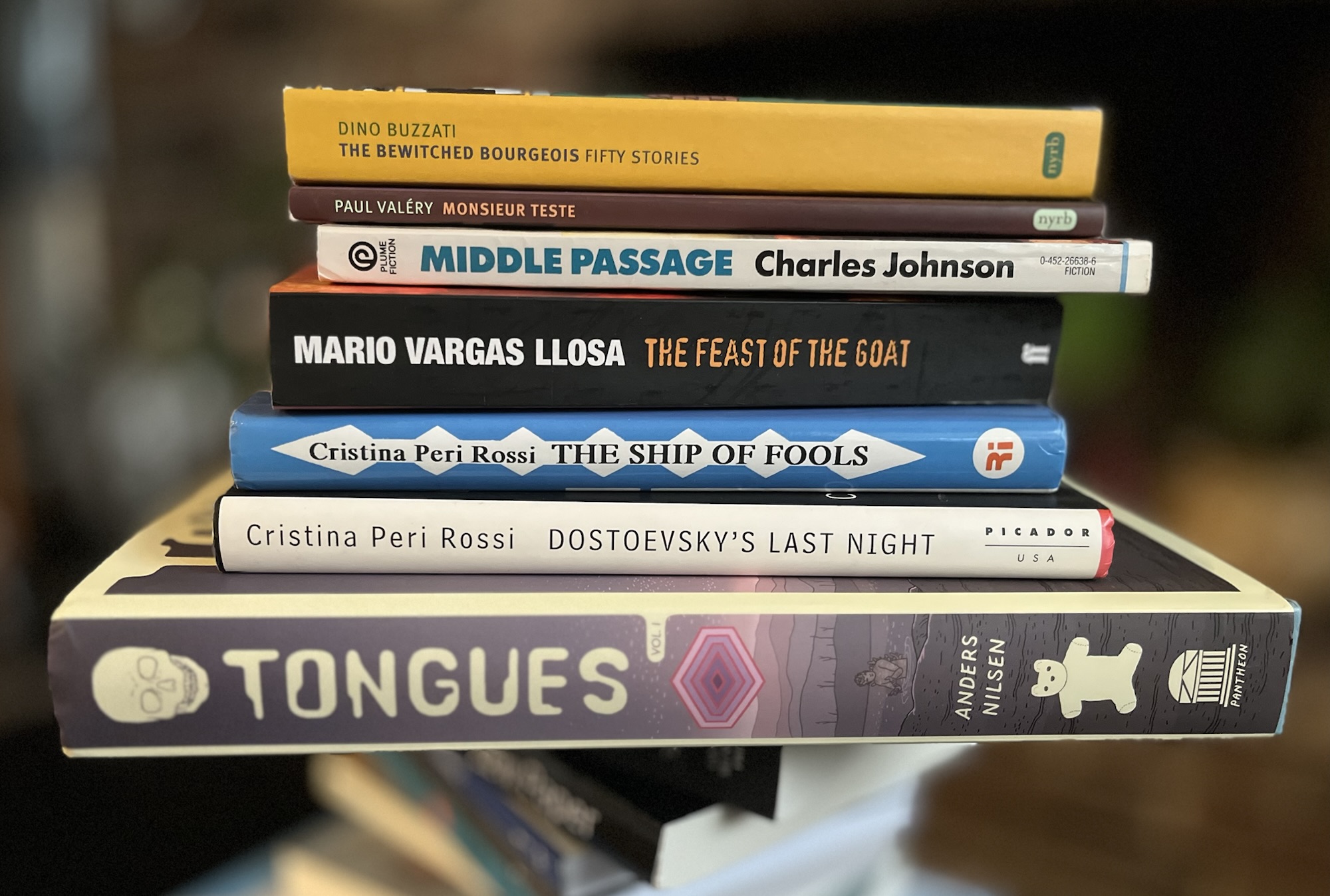
On the third Sunday of March, 2025, I was finally able to truly fall asleep for the first time in weeks. I felt a bit better on Monday, although the steroids have made me feel a little loco I’ll admit. Today was the first day I’ve felt anything close to normal in a while–I mowed the lawn, which had gotten a bit wild, and attended many of my poor neglected houseplants. And then I exorcised the stack of books that had stackingly stacked up, a pillar of publishers’ good will that radiated anxiety-inducing waves. Let this post be a totem against that. I look forward to peeking in to some and reading others in full and maybe even ignoring one or two (not yours if somehow yours is included in the stack; not yours). And all my apologies again.

I feel better now. Just different.


Riff on some Friends of the Library Sale acquisitions

My move over the last few years when I go to a Friends of the Library Sale is to fill the ten dollar paper bag with a handful of pristine trade paperbacks I think will recoup the ten bucks in trade at my local used bookstore. I then pick through for titles to bolster my children’s growing personal libraries and for books that I might want to give away to friends, family, and students. And maybe I might get lucky with some overlooked gem — a first edition, a rarity, an oddity.

Most of what I picked up today was for my son to pick through. He took the Camus, Vonnegut, O’Connor, Palahniuk, and McCarthy. My daughter had zero interest in any of the haul.

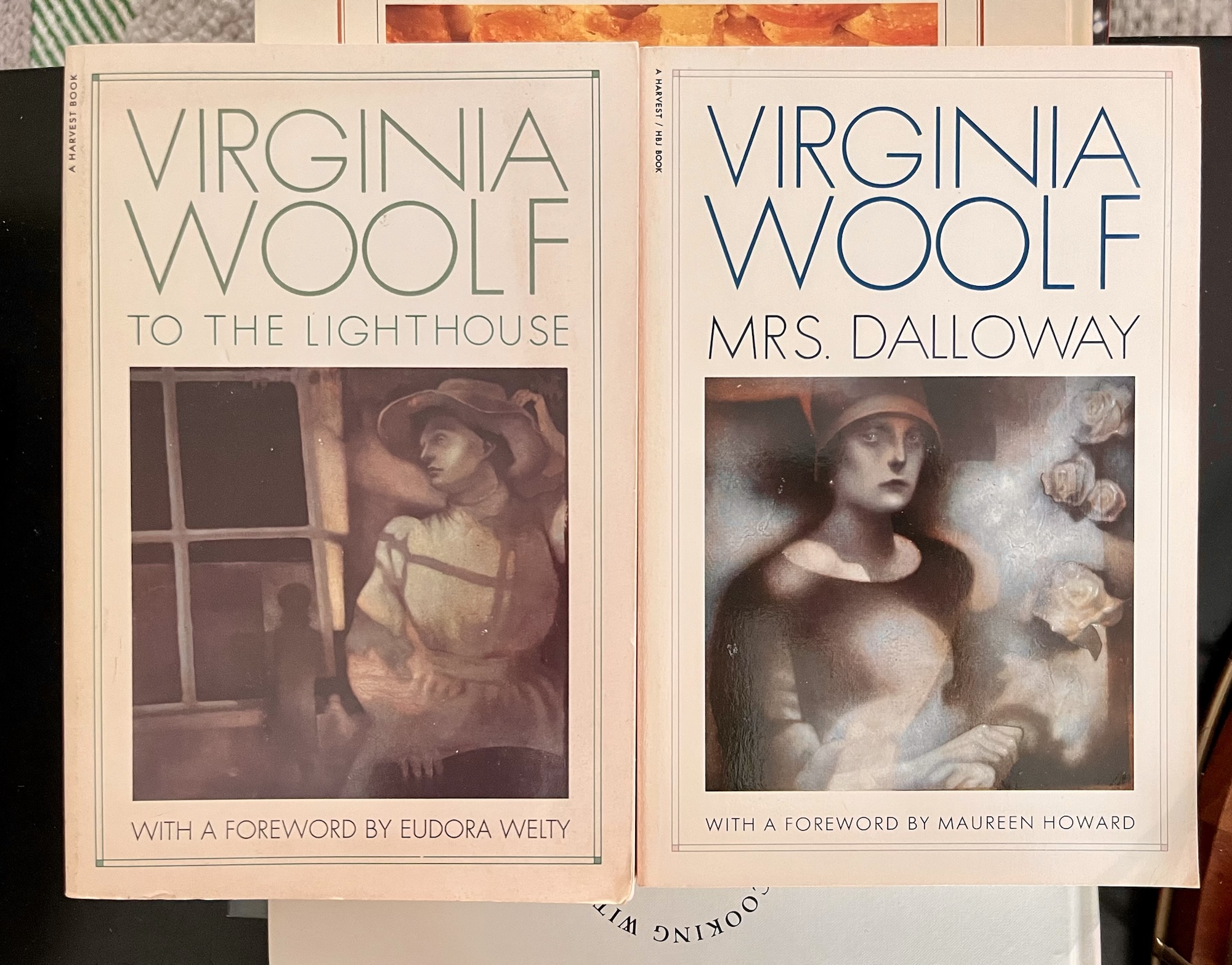
I wound up with several of the exact same editions of titles I already own (Camus’ Exile and Kingdom; Faulkner’s A Light in August; William Burroughs’ Naked Lunch) and lots of books we already have in other editions, most of which I’ll give away or trade. But I’ll be happy to trade out the cheap mass markets of Mrs. Dalloway and To the Lighthouse I’ve had forever in favor of these HBJ Woolfs (Wolves?):

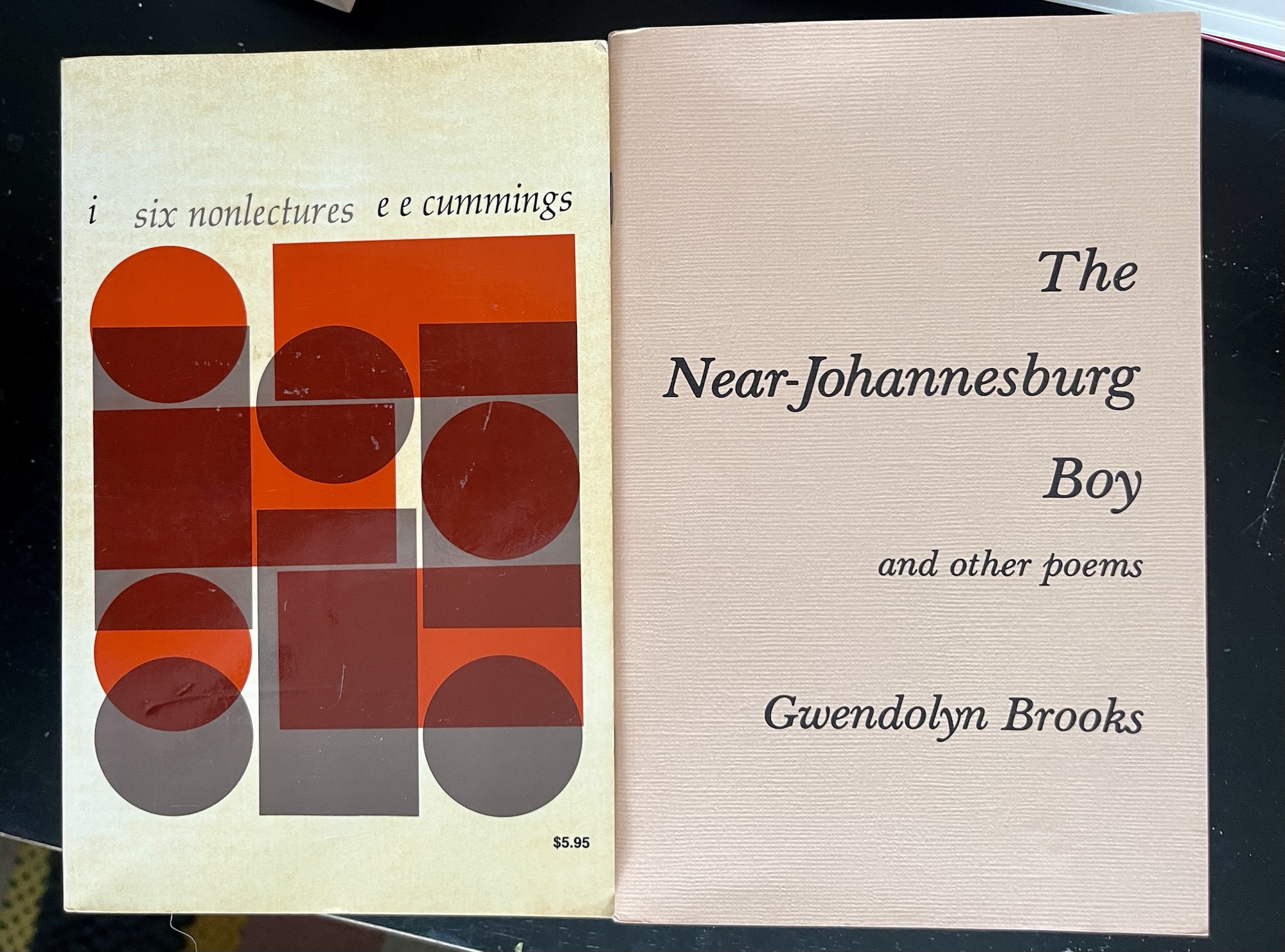
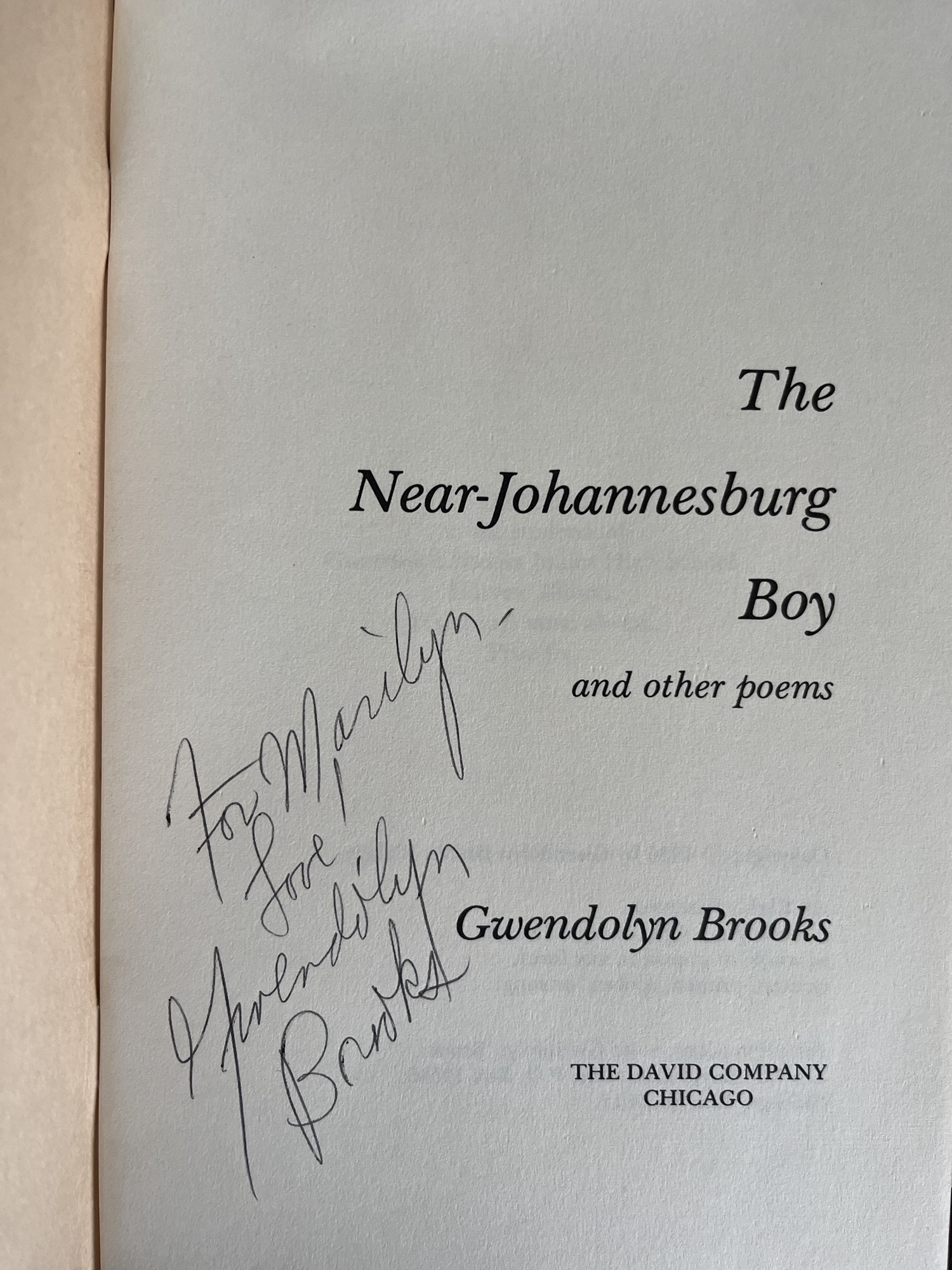
My two favorite finds today were cummings’ six nonlectures (the midcentury cover is lovely) and a Gwendolyn Brooks chapbook, The Near-Johannesburg Boy:

It wasn’t until I got home that I realized the Brooks’ chapbook was signed:

I had actually found two signed Brooks’ books at my favorite local used shop, also both inscribed to “Marilyn” (one was Blacks; I can’t remember the other one; they were both priced a bit beyond my casual range).

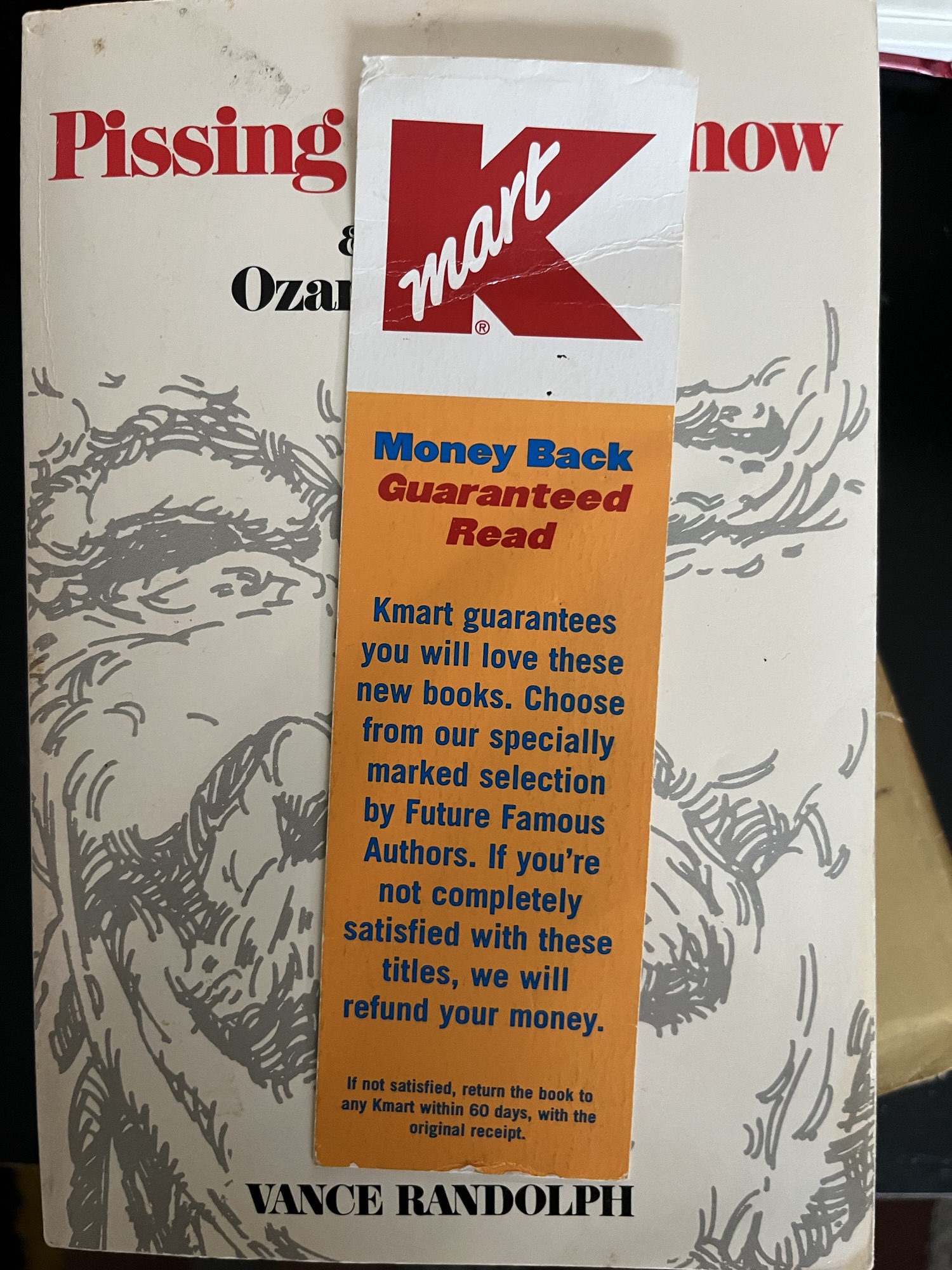
But maybe my favorite find was this Kmart bookmark:

The Kmart bookmark was tucked into a trade paperback University of Illinois Press copy of Randolph’s Pissing in the Snow. I doubt the collection of Ozark folktales was originally purchased at Kmart. But who knows.

Pissing in the Snow was one of the first books I wrote about on this blog, nearly twenty years ago. I look forward to passing it on to a student sooner or later.


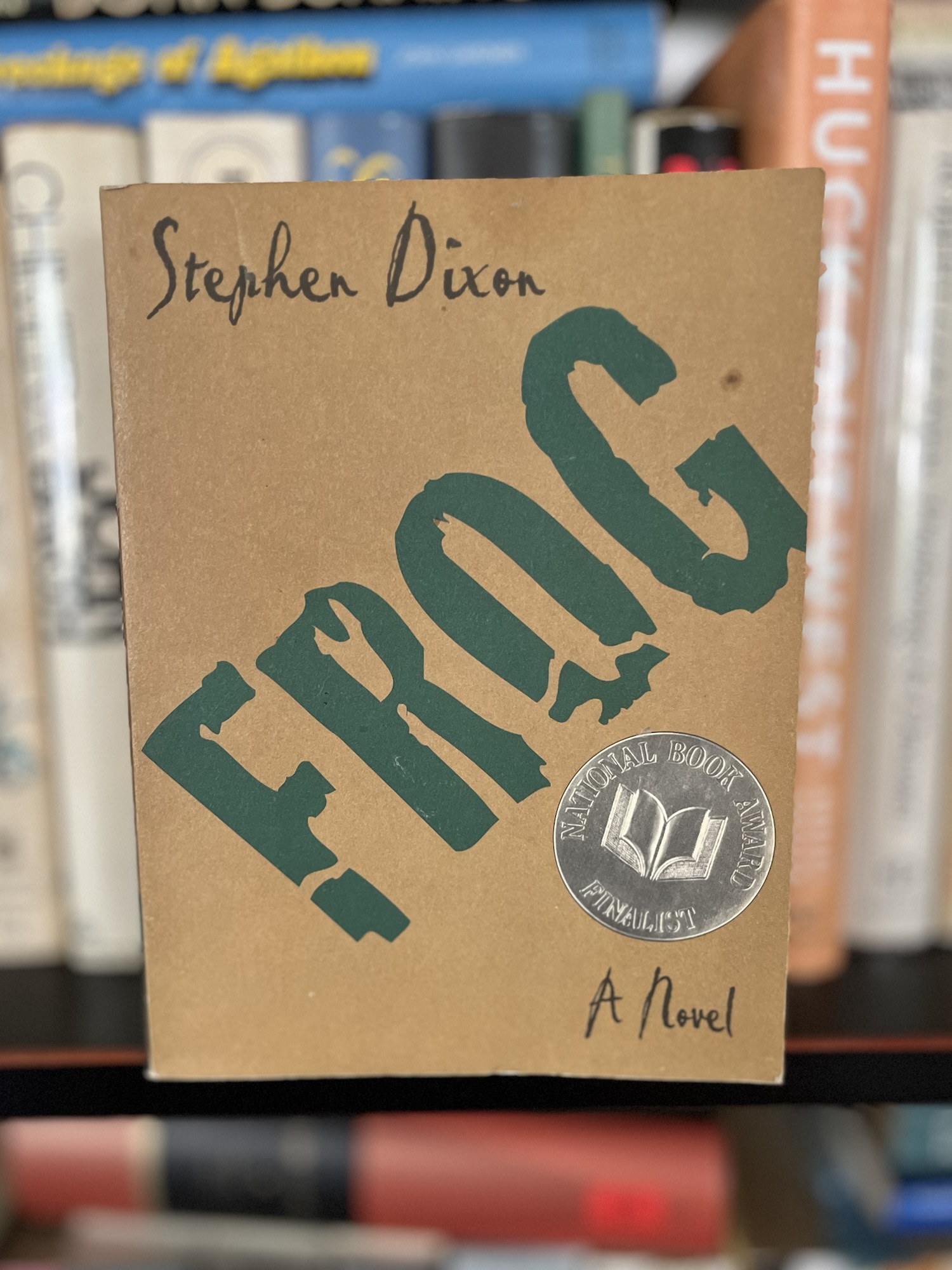
873 words from Stephen Dixon’s 1991 novel Frog, followed by 469 words on Stephen Dixon’s 1991 novel Frog

Here are 873 words from Stephen Dixon’s long looping loopy lucid antilaconic 1991 novel Frog; the words are a segment of the ninth chapter, “Frog’s Brother”:

Alex was the only passenger on the freighter. His father’s patient called his son in England and asked as a favor to the man who’s treated his family’s teeth for forty years if he could take Alex aboard free. Alex was in London then, wanted to get back home, had little money, could have borrowed plane or ocean liner fare from his parents or Jerry, wanted the experience of being on a freighter during a long crossing. Though he got free passage, he asked to work without pay at any job the captain wanted him to. He’ll clean latrines, even, he said in his last letter to Howard. Anything the lowest-grade seaman does, just to get the full feel of it and perhaps seaman’s papers for a paid trip later. He was a newsman turned fiction writer. Two months after the ship disappeared a parcel of manuscripts arrived at their parents’ apartment from England by surface mail. Maybe the manuscripts he didn’t much care about. Maybe the ones he cared most about he took with him on the ship. Howard read the stories and vignettes soon after and then some of them every three or four years till about ten years ago. He never found them very good, but Alex was just starting. Two diaries and some oriental figurines in the parcel also, and lots of letters from his parents, brothers, friends. He’d traveled around the world. Saved up for three years to do it. Did it for a year. A prostitute in a dilapidated hut in a small village outside Bangkok. Why’s that experience come to mind first? It was in a letter to Howard, not the diaries. He searched the diaries for it, thinking an elaboration of it might be interesting, revealing, sexually exciting. She was fourteen years old. That made Alex sad. She asked him to marry her. She said she’d be devoted, would learn to cook and make love American, bear him many children if he wanted, all boys if he wanted (she knew how), would return to grade school. He gave her his silver ID bracelet, pleaded with her to give up prostitution. Then he did it a third time with her the same day and came back the next. Talk about hypocrisy! he said. What’s the trick of turning a customer into a suitor? he asked. But one who’ll be good to her and an adequate provider. If he knew, he’d give it to her. Sent her a pearl necklace from Manila. If he got a venereal disease from her he’d worry more about her than himself. He might go back for her before he leaves for India, or send for her once he gets back to America, and maybe even marry her when she comes of age. Keep this between them just in case it does happen. Taught English to Malaysian businessmen for a month. Met two old men in New Guinea—Canadians—who were living the primitive jungle life. They were good friends of his till they tried to drug and rape him. He’s afraid he had to kick them both in the balls to get out of there and then steal their canoe to get back to town. Fell in love with a witch. Read Proust’s Remembrances in five nearly sleepless days, an experience that’s left him dreaming of the books every night for the last six weeks. A Goan fortuneteller told him his trip would end badly. He said to go home by plane, don’t sail. Remind him when the time comes, for the man wouldn’t take any money. Had a fifteen-year-old girl in Nairobi. What can he tell Howard?—he likes young girls. It’s more than just the way their hair blows and breasts point and bellybuttons dimple and thighs are so even. Maybe it’s because of all the girls who barely let him pet them when he was a teenager. Rode a camel through part of the Sahara. Ate lizard, locusts, grasshoppers, grubs. Never felt very Jewish before till he started hitting all the old synagogues and Jewish cemeteries he could find in the Orient and Middle East. Wait’ll he gets to Poland and Prague and also tries to look the old families up. He’s afraid it’s converted him, but not to the point of wearing a skullcap. Hitchhiked with a sixteen-year-old sabra through Turkey and Yugoslavia, though she might have been younger. When she had to go back she said she thinks he got her pregnant—her device wasn’t put in right a few times, she was so new at it. He told her he’s heard that one before, but if she has the baby and the calendrical configurations fix it as his, or just if she still says it is, he’ll love and provide for it, adopt it if she wishes and take it to America with or without her or emigrate to Israel if she prefers, marry her if that’s what she wants—she’s quite striking and clever and potentially very artistic and smart. He’s written what he thinks is fairly decent work recently, he said in his last letter. He’s glad he’s found something he wants to do for the next twenty to thirty years, has Howard?

The titular “Frog’s Brother” is Alex. (“Frog,” by the way, is “Howard,” the protagonist of Frog.) Alex’s freighter goes missing in the North Atlantic; the ship is never recovered nor are lifeboats. No bodies. The only evidence of the disaster is absence.

In this absence, Frog imagines and reimagines Alex’s death at sea in different looping cycles; these reimaginings are also framed within Frog’s attempt to accurately recall his receiving the news that his brother Alex is lost at sea–was it by phone, that he received this awful news? in his other brother’s apartment? what were the specific conditions of this heartbreak?

Imagining and then reimagining the specific details of a horrifying, horrible, horrendous event is the rhetorical gist of Dixon’s 1995 follow-up to Frog, Interstate, a fucked-up eight-way riff on the narrator’s daughter’s murder by way of random highway violence.

I have read around 120 of Fog’s near 800 pages, and many of those pages feature the same rhetorical and narratological techniques or repetitions with differences that were so off-centered in Interstate: fraying phrases, looping tics, paranoid passages. In the absence of the one thing, Dixon’s narrators pony up iteration after iteration, something after something. But the narrators know that there’s not enough somethings to ever even come close to approximating everything. The iterations sharpen and highlight the beauty of the absence’s abyss.

That abyss was real, or true, or True, for Stephen Dixon, whose brother “Jimmy, a magazine writer, died in 1960 when the freighter he was on in the North Atlantic disappeared,” as the New York Times reported in Dixon’s 2019 obituary. The Times obituary continued: “Mr. Dixon felt that he was continuing his brother’s work. Jimmy Dixon had a short story published after his death.” If Jimmy Dixon was prototype to Alex Frogbrother, what are we to make of the fantastic paraphrase of his letters, above? The passage reads like a bizarre failed adventure tale, something we might expect from William T. Vollmann, who, with his heart of gold, tried to “free” sex workers. It’s also quite queasy when it comes to sex (a constant I’ve noticed in Dixon): “What can he tell Howard?—he likes young girls,” our narrator flatly, grossly reports.

The saddest and realest bit might be this though, the admission that “Howard read the stories and vignettes soon after and then some of them every three or four years till about ten years ago. He never found them very good, but Alex was just starting.” But Alex was just starting. The last bit of the section, “He’s glad he’s found something he wants to do for the next twenty to thirty years, has Howard?” seems both boon and curse, a door that opens and shuts simultaneously, cursing our Stephen Dixon, our Frog, to write write write write write write write write write…


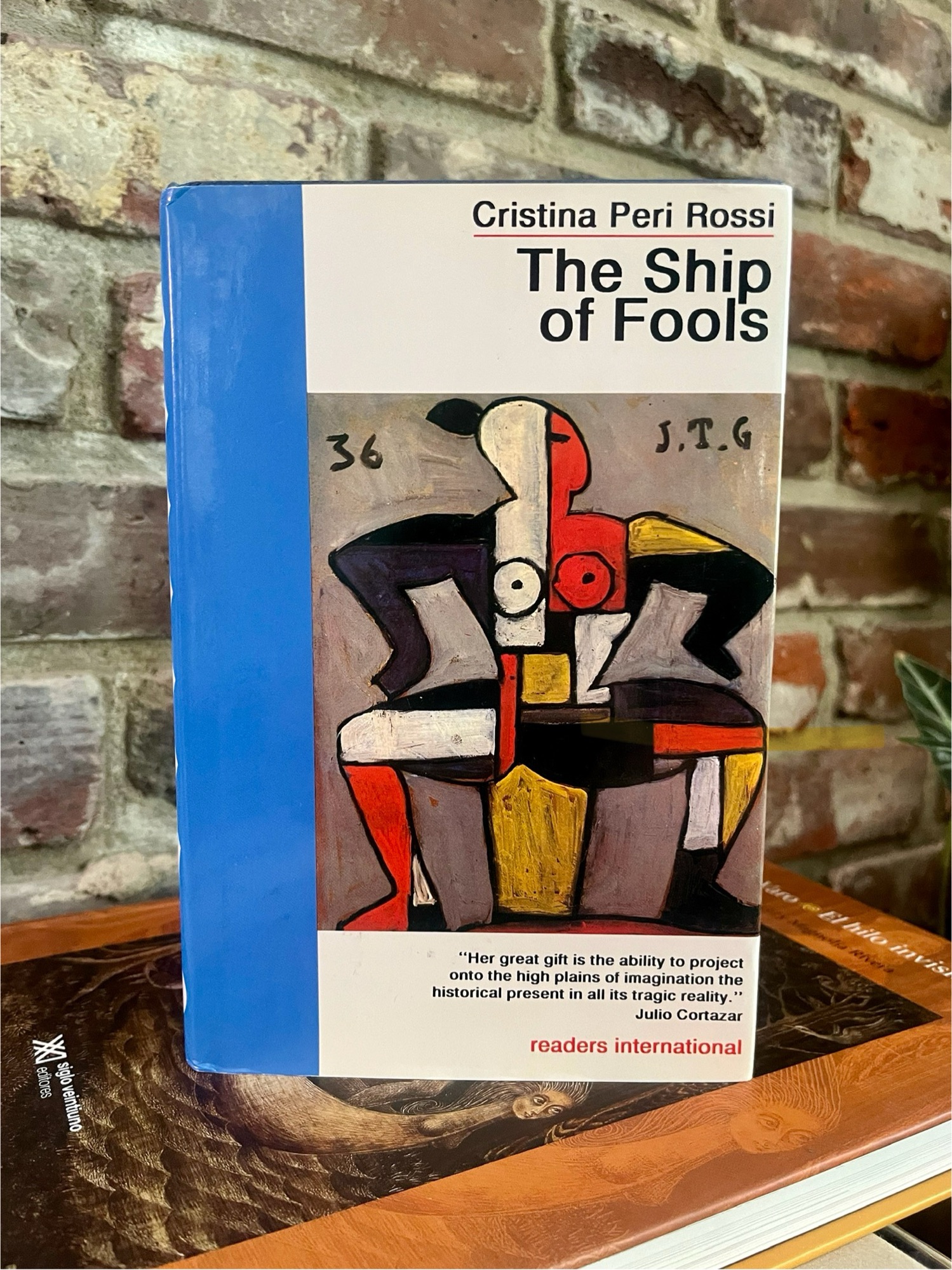
Cristina Peri Rossi’s The Ship of Fools is a surreal novel of exile and dislocation

The Ship of Fools by Cristina Peri Rossi, first published in 1984 and released in English translation by Psiche Hughes in 1989, is a novel of dislocation—political, psychological, and existential. Its protagonist, Ecks, drifts from place to place in a world that feels suspended between dream and memory, never quite solid: “He felt he was travelling not in space but backwards in time.” That sense of slippage—temporal, emotional, narrative—is central to the book’s effect.

Plot is secondary, if it exists at all. The novel drifts like a bottle at sea: beautiful, opaque, marked by the presence of something urgent inside—but sealed, floating, unmoored. Like Renata Adler’s Speedboat or Ann Quin’s Passsages, this is a novel that prefers jump cuts to journeys, broken signals to neat resolutions. It unfolds in fragments, circular musings, moments of stasis that shimmer with strange possibility. At one point, a character suggests that “conversation is more a question of style than ideas,” a description of the novel itself. Style is idea in The Ship of Fools. The syntax itself seems to think.

There are recurring characters, loose thematic arcs, and strange moments of connection, but the novel often seems to turn away from linearity. It’s what the book itself calls “a story without progress,” or perhaps a tapestry of passing encounters and unresolved longings. There’s a Bolañoesque sense of drift to it, too—a wandering narrator collecting impressions like scars, haunted by disappearances that resist explanation. At the same time, there’s something in the intensity of The Ship of Fools—its visceral depictions of trauma and social rupture—that evokes the furious lyricism of Fernanda Melchor’s Hurricane Season. Both authors understand that political horror isn’t always best addressed by realism—it seeps in more disturbingly through atmosphere, voice, and repetition.

Peri Rossi was herself an exile, having fled the civic-military dictatorship of Uruguay in 1972. She fled the regime, first to Barcelona and later Paris, and this personal history pulses quietly through every page. The Ship of Fools isn’t autobiographical in the conventional sense, but its texture is soaked with the disorienting logic of exile: the sense of being always elsewhere, never quite present, both seen and unseen.

One of the pleasures of The Ship of Fools is the way it captures fleeting impressions in striking, lyrical language. Descriptions of people and places often feel like fragments from a half-remembered dream. The narrator describes a girl “bursting with youth; with that radiant beauty which, more than a quality of feature or of line, is the result of organic perfection that only later would begin to fall apart, breaking its essential but precarious harmony.” Elsewhere, the sea is evoked with the precision of a surrealist painting: “Green eyes and wide sea, swinging hips and plunging necklines. The sea was rolling like the water in a glass. Or the ship was. The ship was a glass floating on the high tide.” It’s not hard to imagine Jodorowsky filming this image—bodies on a tilting horizon, symbolic without being decipherable.

Beneath the dreamlike surface runs a steady current of political urgency. Ecks is an exile, and many of the novel’s characters—some named, some merely sketched—are displaced or disappeared. “To disappear is no longer voluntary,” the narrator tells us, “but acquires passive form: ‘We are being disappeared.’” It’s a haunting line that collapses grammar and violence in a single breath. One character, laboring in a sinister “camp for the disappeared,” wonders “if there was still any point in measuring time by the clock, when it seemed like ten years to him and twenty to his friend suffering agonies about him.” These grim lines are delivered without sentimentality, but with unmistakable clarity. The book never lectures. It haunts instead.

The novel’s philosophical core is found in its reflections on art, memory, and identity. One of the longest and most striking passages describes the medieval Tapestry of Creation:

There the missing parts unfurl, fragments intimating the larger harmony of the universe. What we love in any structure is a vision of the world that gives order to chaos, an hypothesis which is comprehensible and restores our faith, atoning for our having fled and scattered before life’s brutal disorder. We value in art the exercise of mind and emotion that can make sense of the universe without reducing its complexity. Immersed in such art one could live one’s life, engaged in a perfectly rational discourse whose meaning cannot be questioned because it resides in an image containing the whole universe.

What surprises and will always surprise is the notion that a single mind could conceive of such a convincing and pleasing structure, moreover a happy one, a structure which as well as being a metaphor is also a reality.

This longing for order—however temporary or illusory—is deeply felt throughout the novel, even as its own structure resists resolution. The moment we seek meaning, it slips sideways. Identity, like narrative, fractures under pressure.

That same ambiguity runs through the book’s treatment of gender. Lucía, one of the more vivid figures in Ecks’s drifting life, is described as “dressed in men’s clothes,” her appearance perfectly androgynous. Ecks is both drawn to and overwhelmed by her. “He saw the unfolding of two parallel worlds… yet inseparably connected in such a way that the triumph of one would cause the death of both.” Later, another character remarks, “Don’t we all attribute ourselves a sex? And spend our lives proving it?” Gender is not a stable identity but a performative act—one repeated until it congeals into something that passes for truth.

Memory and history, too, are always in motion. “Ship captains and sailors of the past were those who best knew the universe,” the narrator reflects. Their journals once held the world’s accumulated knowledge: “One referred…to these journals” to understand distant plants, animals, and stars. But now, “they stopped writing and their main tasks became trade and war…Their journeys are now shorter and safer. But also less interesting.” It’s a quiet lament for a world that’s abandoned curiosity for control.

Ecks himself seems increasingly hollowed out by this world. “I stopped my work. Since then wheat and chaff have mixed. Under the grey sky the horizon is a smudge, and no voice answers.” His sense of loss—of self, of direction, of connection—is profound. “I shall lose,” he thought, and then: “I’ve already lost.” Like a Bolaño narrator spiraling through half-empty towns or an Ann Quin character trying to read meaning into chaos, he is less a man than a vessel for disappearance.

And yet, The Ship of Fools still finds a kind of poetry in this fragmentation:

Dreams have their own logic; only in the ambiguity of daylight do we need to reason and compare, to pin down the weft of things. Dreams are so persuasive, they need no argument.

Peri Rossi’s novel lives in that twilight logic, where estrangement becomes its own kind of truth. Exile, here, is not just a matter of borders—it is a way of seeing. “Those who live always in the same place… do not realize that to be a stranger is a temporary situation, one that can be altered; in fact they assume that some men are strangers and others not. They believe that one is born — and does not become — a stranger.” In The Ship of Fools, everyone becomes a stranger, even to themselves.

In the end, the novel is both deeply political and deeply personal. It captures what it feels like to live under systems that make life feel increasingly unreal, to grasp for meaning in a world of exiles and silence, to lose and keep losing—and yet keep imagining, keep remembering, keep writing. Our days, the novel suggests, “are no different from the past, except in the number of tyrants, their systematic methods and the cold logic with which they lead the world to madness.”

Although it is often bitterly funny, The Ship of Fools is not a cheerful book. But it lingers like a half-remembered dream, like the texture of a forgotten language, like a map you keep reading even after the landmarks have vanished. Very highly recommended.

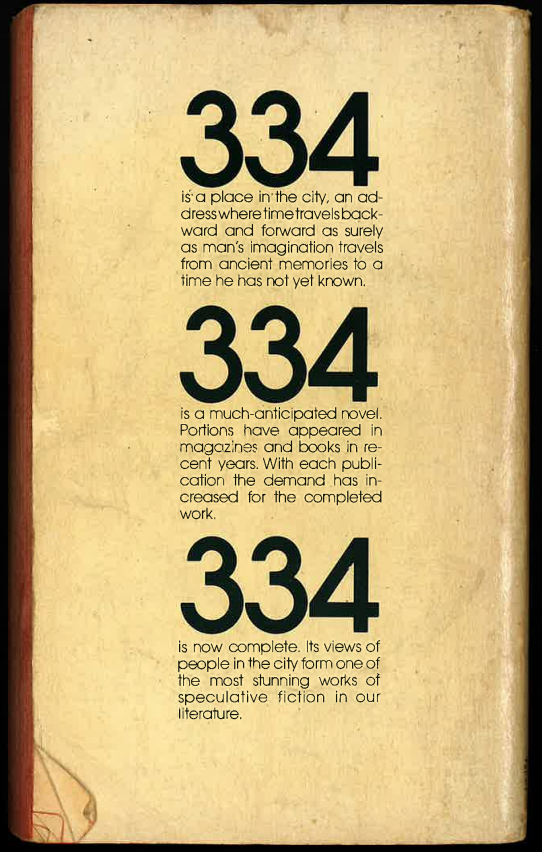
Mass-market Monday | Thomas M. Disch’s 334

334, 1972, Thomas M. Disch. Avon Bard (1974). No cover designer or artist credited. 269 pages.

Disch’s dystopian novel 334 is comprised of five separate but related novellas. The stories are set in and around the year 2025. Here’s “The Teevee,” the first vignette of the last novella in the collection, 334:

“The Teevee (2021)”

Mrs. Hanson liked to watch television best when there was someone else in the room to watch with her, though Shrimp, if the program was something she was serious about—and you never knew from one day to the next what that might be—, would get so annoyed with her mother’s comments that Mrs. Hanson usually went off into the kitchen and let Shrimp have the teevee to herself, or else to her own bedroom if Boz hadn’t taken it over for his erotic activities. For Boz was engaged to the girl at the other end of the corridor and since the poor boy had nowhere in the apartment that was privately his own except one drawer of the dresser they’d found in Miss Shore’s room it seemed the least she could do to let him have the bedroom when she or Shrimp weren’t using it.

With Boz when he wasn’t taken up with l‘amour, and with Lottie when she wasn’t flying too high for the dots to make a picture, she liked to watch the soaps. As the World Turns. Terminal Clinic. The Experience of Life. She knew all the ins and outs of the various tragedies, but life in her own experience was much simpler: life was a pastime. Not a game, for that would have implied that some won and others lost, and she was seldom conscious of any sensations so vivid or threatening. It was like the afternoons of Monopoly with her brothers when she was a girl: long after her hotels, her houses, her deeds, and her cash were gone, they would let her keep moving her little lead battleship around the board collecting her $200, falling on Chance and Community Chest, going to Jail and shaking her way out. She never won but she couldn’t lose. She just went round and round. Life.

But better than watching with her own children she liked to watch along with Amparo and Mickey. With Mickey most of all, since Amparo was already beginning to feel superior to the programs Mrs. Hanson liked best—the early cartoons and the puppets at five-fifteen. She couldn’t have said why. It wasn’t just that she took a superior sort of pleasure in Mickey’s reactions, since Mickey’s reactions were seldom very visible. Already at age five he could be as interior as his mother. Hiding inside the bathtub for hours at a time, then doing a complete U-turn and pissing his pants with excitement. No, she honestly enjoyed the shows for what they were—the hungry predators and their lucky prey, the good-natured dynamite, the bouncing rocks, the falling trees, the shrieks and pratfalls, the lovely obviousness of everything. She wasn’t stupid but she did love to see someone tiptoeing along and then out of nowhere: Slam! Bank! something immense would come crashing down on the Monopoly board scattering the pieces beyond recovery. “Pow!” Mrs. Hanson would say and Mickey would shoot back, “Ding-Dong!” and collapse into giggles. For some reason “Ding-Dong!” was the funniest notion in the world.

“Pow!”

“Ding-Dong!” And they’d break up.

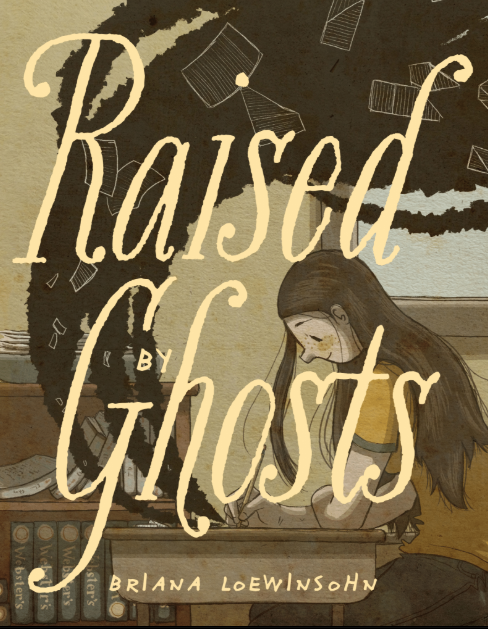
Briana Loewinsohn’s graphic novel Raised by Ghosts turns absence into haunting art

A decade ago I finally tossed out most of the contents of an old shoebox crammed with high-school nostalgia. Notes from ex-girlfriends, summer postcards, flyers from local shows, a handful of choice mixtapes. Some Polaroids. Our stupid band’s stupid lyrics, which we usually forgot or simply abandoned live. There was even a pair of fat shoelaces. The pain of return always hits me hard at such times, and I got dizzy. That box was crammed the scraps of an older life.

The preceding paragraph is an unfair opening to a review of Briana Loewinsohn’s excellent graphic memoir Raised by Ghosts. Reading Raised by Ghosts felt like opening that old shoebox: painful, dizzying, beautiful. Loewinsohn is one of usone of us to borrow a chant from Tod Browning’s Freaks. “Sometimes I feel like I am an alien at this school…But there are other aliens here,” protagonist Briana writes in her diary.

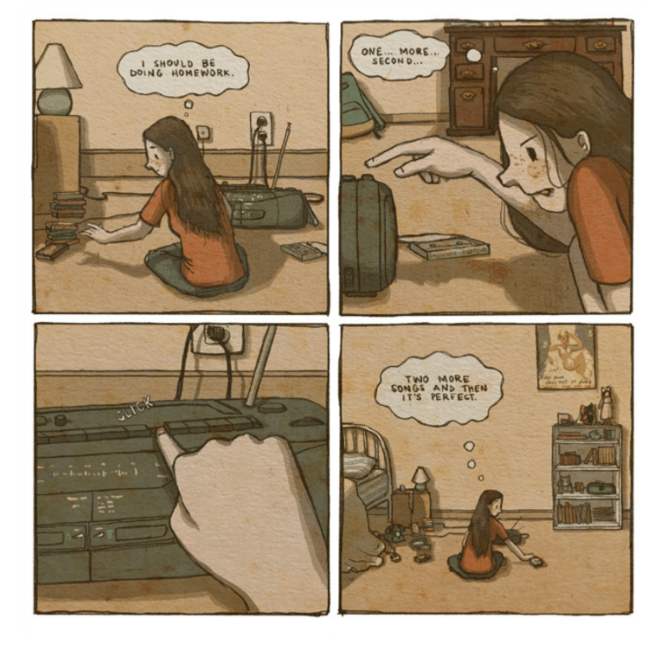
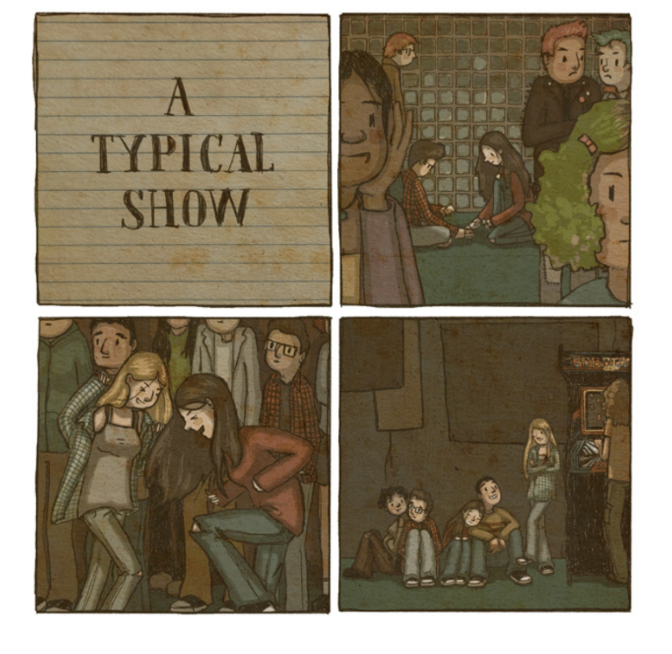
Raised by Ghosts covers Briana’s seven rough years through middle and high school. These are the gay nineties. The narrator, like Loewinsohn herself, is about my age, which makes reading Raised by Ghosts an eerie act of self-recognition. It’s not a conventional memoir—it doesn’t hold your hand or deliver a clean, linear narrative. Instead, it moves like memory does: in flashes, in vignettes, in small sensory moments that coalesce into something greater than the sum of their parts. Everything here feels true. We have here the relics of a teenage moondream, those little ghosts of the past that flicker through memory like frayed photos freed from the rubberbanded bundle in an old Converse box. Briana’s adolescence unfurls as an ebb and flow of loneliness and acceptance among fellow weirdos. She finds her people, but never quite makes the scene; she dances at the live show but finds as much fun in playing cards in the back.

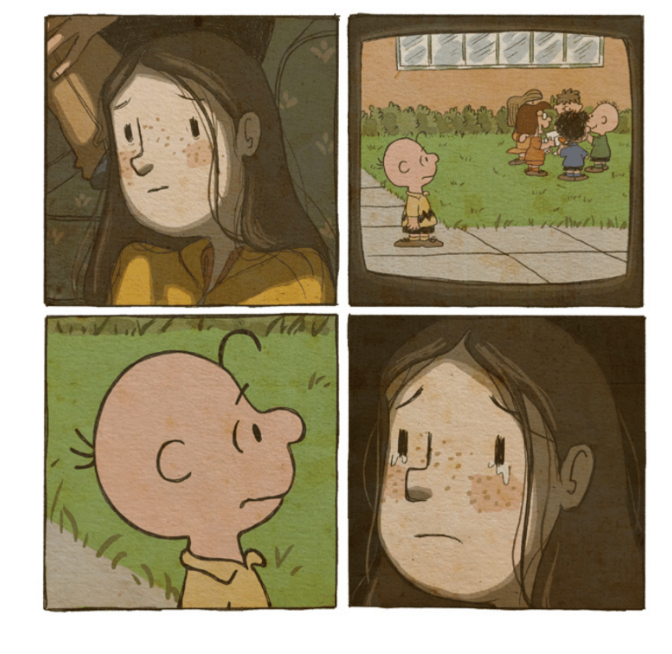
Loewinsohn’s art conveys Raised by Ghosts’ emotional weight. Soft, muted tones in drab olive and rust hues fill square panels that often resemble fading Polaroids. Candids and close-ups capture the messiness of high school. Briana is a sympathetic and endearing character, her sensitivity registering in ways she cannot understand herself, as when she skips out on a living-room VHS double feature. Oliver Stone’s Natural Born Killers would be way too much after the tragedy of You’re a Good Man, Charlie Brown.

Loewinsohn includes full handwritten pages to accompany the traditional comic strips in Raised by Ghosts. These handwritten pages serve as a kind of diary, but often take on subtle visual changes that suggest other media. Often, the handwritten pages mimic the form of the long notes bored Briana composes in class to pass to friends. A passage composed on graph paper praises the note-writing skills of a particular friend; the technique suggests this friend prefers squares to lines. A passage on a brown paper lunch bag reflects on how Briana’s father always takes the time to write her name in detailed, expressive lettering. The variations of handwritten pages enrich the narrative and subtly inform us of Briana’s artistic development.

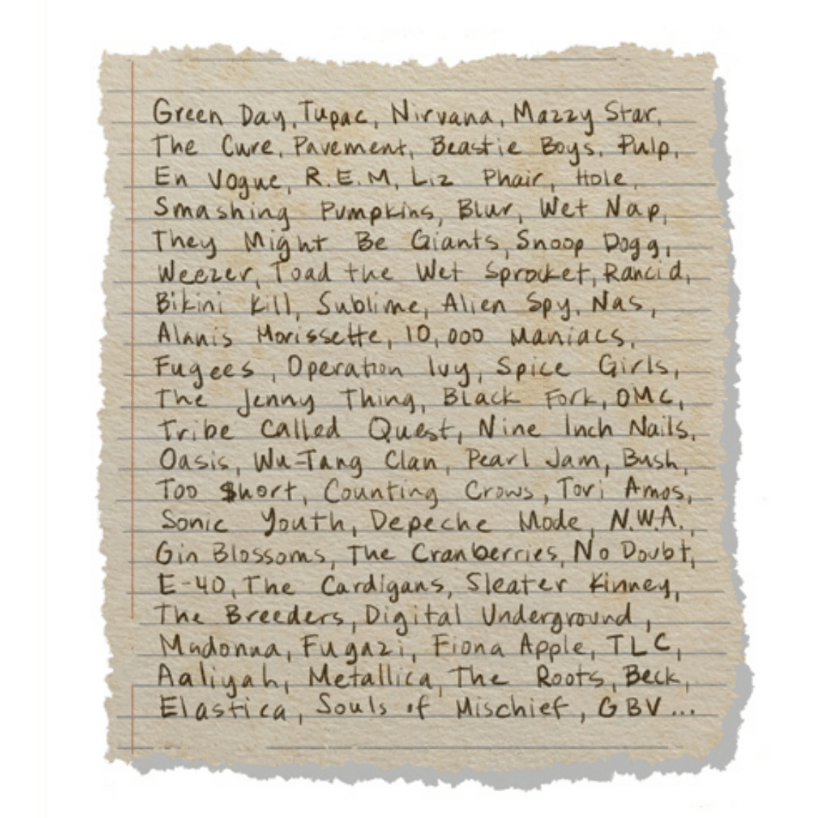
My favorite of the handwritten passages though is simply a list of bands scrawled on lined paper. When I got to that page, about a third of the way into Raised by Ghosts, I was already persuaded by the book–but the page of band names seemed so utterly true, so beautiful and banal. We used to do that, I thought, and: Why did we used to do that? knowing the answer has no good intellectual answer.

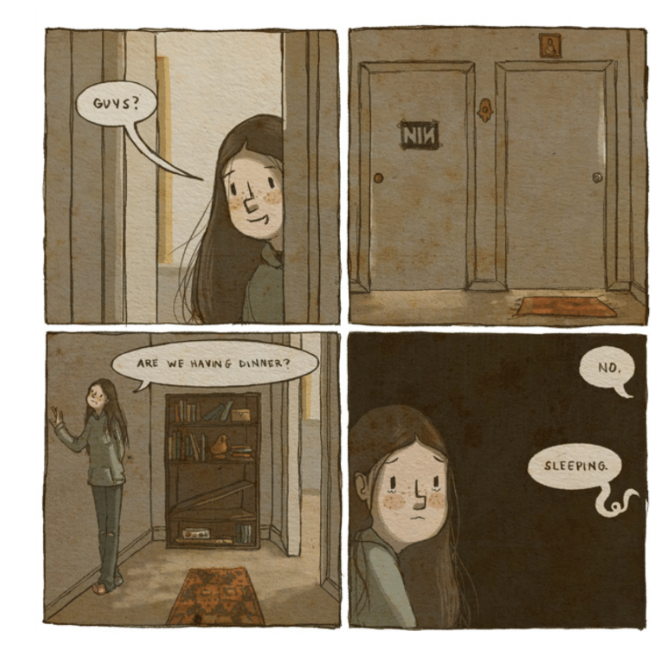
But let’s get to the ghosts. Loewinsohn never “shows” us Briana’s parents, yet the picture we get of them is hardly incomplete: a distant, detached mother and a father in arrested development. “I would say I was raised in an AA meeting,” Briana remarks of her mother, noting that it’s often hard for single mothers to find childcare. Of her father’s abode: “My pop’s house is a combination of Indiana Jones’ office, Pee Wee’s playhouse, and an opium den. I am kinda like a roommate here.”

Briana’s parents exist in Raised by Ghosts the way memories of the absent often do—fragmented, elusive, more felt than seen. Loewinsohn never lets them fully materialize, yet their presence, or lack thereof, shapes Briana’s interactions with her world. Neither parent offers Briana guidance. She’s a latchkey kid left to cobble her own sense of belonging among friends, music, and the small rituals of adolescence. In the absence of stability, she builds meaning from mixtapes, handwritten notes, and fleeting moments of connection.

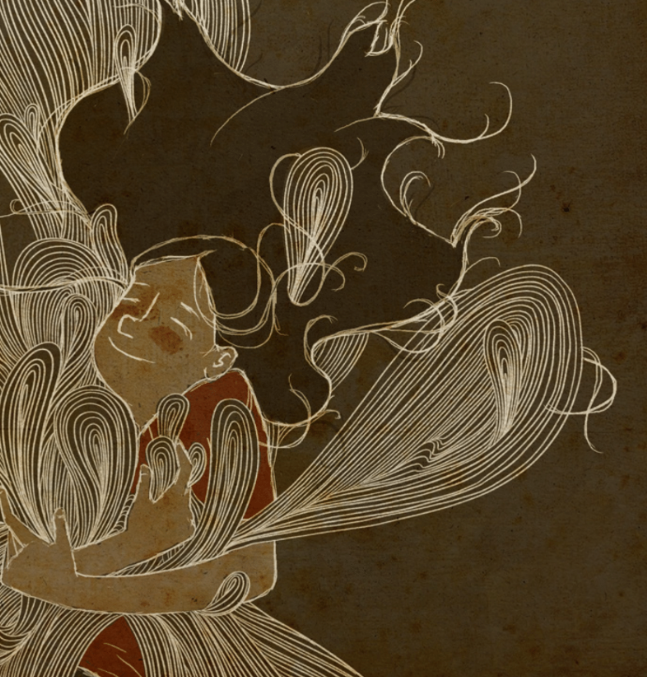
And art. The memoir climaxes in a moment of transformation—an act of self-possession and, ultimately, self-creation. Throughout Raised by Ghosts, Briana moves through a world shaped by absence, by the ghosts of parents who are physically present but emotionally distant. Yet, in the book’s remarkable penultimate sequence, she steps beyond that absence, beyond memory’s hazy grip, into a space that is entirely her own. The panels swirl into a dreamscape of shifting lines—formless and chaotic at first—until Briana gathers them together, lassoing meaning from the void. It is a moment of artistic alchemy, where creation becomes a form of agency, a way to shape her own narrative rather than just mimic one. When she carries those lines from dream to waking life, the transition is profound: she is no longer just a kid collecting relics of meaning from the world around her—she is an artist, making meaning herself.

Publisher Fantagraphics labels Raised by Ghosts as a “young adult graphic novel,” and teenagers will likely identify with Briana’s story—the loneliness, the search for belonging, the quiet acts of self-definition. They may also feel a strange twinge of envy for a world that no longer exists. Being a latchkey kid could be lonely, but it was not without its freedoms. Those of us who were teenage weirdos in the nineties will see in Loewinsohn’s memoir not a young adult novel, but rather a reflective elegy composed by a mature artist in control of her talent. Raised by Ghosts lingers like the echo of an old song in your dim memory — you know the one, right? It’s a memoir about growing up in the margins, about finding meaning in scraps and silence, about turning absence into something tangible. It haunts, in the very best way.

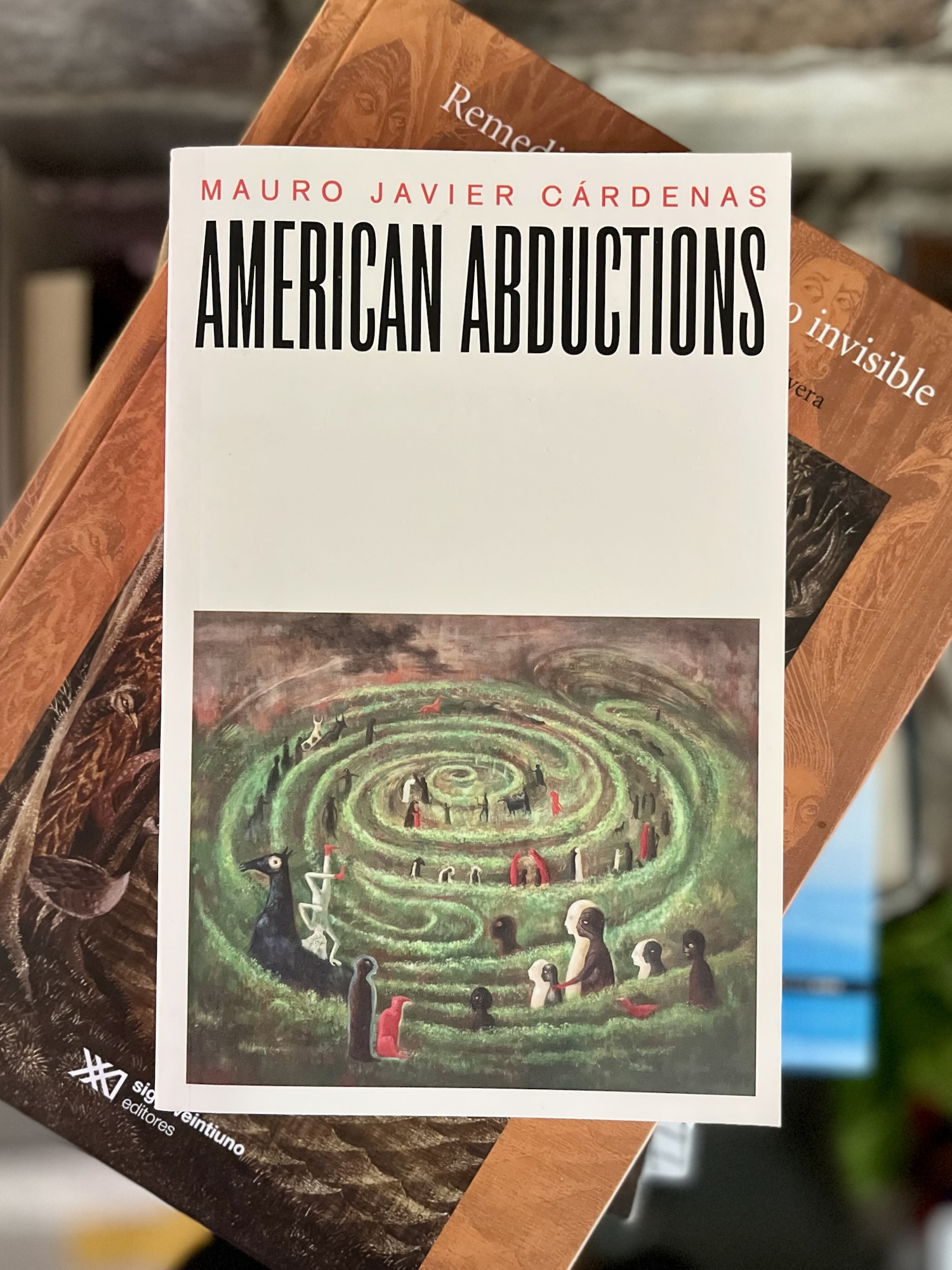
Statements of missingnessness | On Mauro Javier Cárdenas’s prescient novel American Abductions

Mauro Javier Cárdenas’s American Abductions is a novel of relentless, layered consciousness, its immersive, labyrinthine sentences pulling the reader into a fugue of voices, memories, and anxieties. American Abductions takes place in a proximal version of the United States, a digital carceral state where palefaced goons kidnap Latin Americans. Sometimes the abductees are deported; sometimes they are disappeared. Sometimes they tell stories.

The dystopia here is hardly a YA world-building exercise full of hope and heroics. Instead, the novel moves through fragmented, fevered perspectives, primarily those of sisters Ada and Eva their disappeared father, Antonio, a novelist abducted by the Pale Americans, the faceless bureaucratic enforcers of this new regime. The novel oscillates between Ada and Eva’s attempts to reconstruct what happened, Antonio’s own recursive, metafictional writing, and interjections from various other voices—family members, interrogators, digital surveillance logs—until the narrative itself becomes a reflection of the fragmented reality the characters are trapped within.

Yes, American Abductions is bleak, but it is not merely dystopian horror. Cárdenas builds his world through a dizzying interplay of language, wielding the long, unspooling sentence with the precision of Bernhard, Krasznahorkai, and Sebald. Each chapter is a single winding comma splice that careens from realism to surrealism. Cárdenas’s run-ons layer and loop back on themselves, rhetorically mirroring the characters’ attempts to make sense of their unraveling world.

The book moves forward with an absurdist energy that resists despair, its rhythms and repetitions building not just a critique of authoritarian power but something stranger, something more human—an exploration of consciousness itself, an attempt, perhaps, to make a grand “statement of missingnessness,” to borrow one of the character’s phrases.

The effect is hypnotic, dreamlike, sometimes nightmarish, but often, surprisingly, very funny. There is a dark, absurdist humor in the way bureaucratic jargon collides with intimate grief, in the way digital surveillance reports are laced with banal observations, in the way Antonio’s own metafictional writing seems to both clarify and obscure the truth of his disappearance. The novel is not just about authoritarian violence but about how language itself is manipulated under such regimes—how it obfuscates, justifies, betrays, resists. At times, American Abductions reads like a political thriller rewritten as a fever dream, at others, like a linguistic experiment that spirals into a meditation on memory, exile, and state terror.

American Abductions is not just unsettlingly prescient. Rather, it obliquely underscores the U.S. surveillance state’s direct lineage to Latin America’s Dirty Wars. Governments systematically disappeared those deemed threats to the state—intellectuals, activists, ordinary people unlucky enough to be caught in the wrong place at the wrong time. Cárdenas’s dystopia does not just critique contemporary American immigration policies; it situates them within a long history of state-sanctioned violence in the Americas.

The novel’s themes take on chilling immediacy when considered alongside the real-world abductions of those who speak truth to power, like Mahmoud Khalil and Rumeysa Ozturk. Indeed, the disturbing video footage of Ozturk’s kidnapping by masked men this week has gone viral, echoing the opening of American Abductions, wherein we learn that Ada has captured “that moment when the American abductors captured her father as he was driving her and her sister to school, which she recorded on her phone.” Ada’s video goes viral, mutates, becomes its own beast:

…and later, after her father had been captured and hundreds of thousands of people around the world were watching her video of her father asking what have I done, officer, the supervisory official probably watched it too and left an anonymous comment below it that said ice / ice baby great job ICE, illegal is illegal and wrong is wrong bye you forgot the crybaby in the backseat, for years Ada arguing in her mind with the thousands of messages berating her and her father, even after she discovered some of the comments had been manufactured by bots controlled by a Pale American in Salt Lake City — twelve million to go please continue to remove the illegal alien infestation — except the comments by Doctor Sueño, of course, which made no sense to anyone but her, just as it made no sense to anyone but her to feel, for no more than a few seconds, proud that the supervisory official of the supervisory official of the supervisory official in an agency building had taken time out of his busy schedule to focus on her father — if enough time passes, Doctor Sueño says, even the most preposterous possibilities will navigate the sea of your mind — cry like an eagle / to the sea — just as it made no sense to anyone but her to laugh at some of the videos her video had spawned for instance the video of her video but with sappy music instead of her sister politely asking the abductors where were they taking her father, as if someone figured hey no one’s going to feel sorry enough for you people let me add sad violin music to the video of your father saying I’ve done nothing wrong, officer, or how about the video from a self proclaimed irreverent news organization from China that, via computer animation as if from an obsolete video game, replicated the trajectory from her house to the sensitive location as if it were a car chase, the abductors rushing to drag her father out of the car as if it were a drug bust, the video game representation of Ada recording her father’s capture with her phone from the backseat of the car, waterfalls of tears surging from her eyes, no not waterfalls, more like someone’s comical representation of lawn sprinklers superimposed on the eyes of the video game representation of me…

Apologies if I’ve let the run-on run on too long — but you’ll have wanted a taste of Cárdenas’s style, no? His sentences, unbroken and unrelenting, mimic the inexorability of history itself—cycles of erasure, resistance, recovery, and repetition. American Abductions is not just a novel about the present; it is a novel that recognizes the past has never ended. Its characters, trapped in linguistic torrents of grief and absurdity, seem painfully aware that history is repeating itself. And yet, as despairing as that recognition might be, American Abductions refuses to be silent. It makes its “statement of missingnessness” loud, insistent, impossible to ignore, resisting erasure, demanding we listen. Very highly recommended.

Blog about some recent reading, books acquired, a mini-review of The Hard Quartet live, etc.

I’ve been lucky over the last decade or so that my little college’s spring break almost always coincides with my children’s spring break. We aimed again this year at Georgia, spending a few days in a cabin outside the unfortunately named Whitesburg. Spring had not yet really sprung there yet. There was very little green about, but the hikes along and around Snake Creek through 20th century ruins were pleasant enough, and the kids enjoyed ziplining and aerial obstacle courses. In one of their sessions, I sneaked away to Harvey’s House of Books.

Harvey’s is, as far as I can tell, a Friends of the Library venture run by volunteers. I didn’t expect much, but the fiction section was surprisingly well populated. For around five bucks I picked up Charles Johnson’s Middle Passage, Mario Vargas Llosa’s The Feast of the Goat, and two by Cristina Peri Rossi — The Ship of Fools and Dostoevsky’s Last Night.

I was happy and surprised to find Rossi’s The Ship of Fools (in translation by Psiche Hughes); I’ve had it on a mental list for a few months now. I started it that night and it’s really odd–reminds me a bit of Ann Quin’s stuff, very odd but fun. More thoughts to come.

The Ship of Fools proved a nice antidote to the books I’d brought with me, Paul Valéry’s Monsieur Teste, (in translation by Charlotte Mandell) and a Dino Buzzati collection translated by Lawrence Venuti, called The Bewitched Bourgeois. I’ve enjoyed the Buzzati stories, but piled up there’s a sameness here that cries for interruption. I love Borgesian riffs on “Before the Law” as much as the next nerd, but too many in a row (six, in my case this week) feels, I dunno, like, I get it. But to be clear, I’ve really liked most of The Bewitched Bourgeois. I think it’s better parceled out though. Monsieur Teste on the other hand…look, I don’t know, maybe I misunderstood the book entirely, but I really kinda sorta hated it. Was I supposed to hate the central persona, Mister Teste, who aims for precision in language but comes off as a bore? At least it was short.

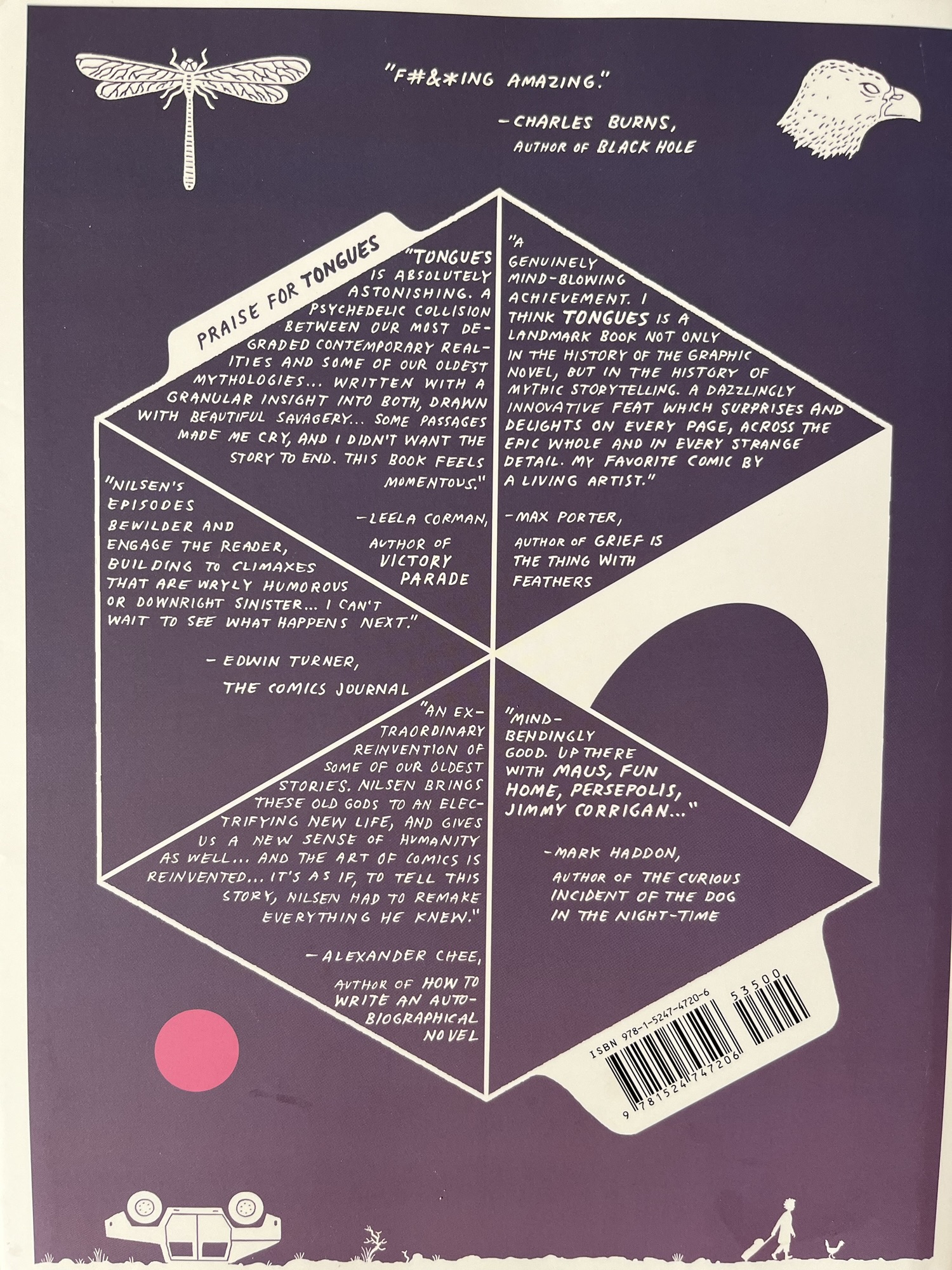
While I didn’t have the time in Atlanta to hit multiple bookstores (like in past trips), I made a point to hit up A Capella Books, a well stocked indie joint with a great used collection. I didn’t score anything there, although I was thrilled to see Anders Nilsen’s Tongues prominently featured in the graphic novel section. The book is great — I got a review copy right before we left. Some asshole named Edwin Turner landed a blurb on the back under his hero Charles Burns’s much shorter, pithier, better blurb:

Our spring break culminated Saturday night at the Variety Playhouse in Little Five Points, where we saw the so-called indie supergroup The Hard Quartet play all of their songs. I really dig The Hard Quartet’s self-titled debut, and dragged my wife and son along. (My daughter declined but played taxi driver.) Some interesting looking children were exiting the theater (really more of a club, let’s be honest) as we were entering, assuring the concerned security guard that they’d be right back, they just needed to get some Gatorade at a corner store. These were Sharp Pins, or The Sharp Pins, or Thee Sharp Pins, a Chicago power pop trio fronted by a kid named Kai Slater. They played a tight thirty minute set (including a Byrds cover); young Slater knows how to tuck away middle eight. The band’s youth invigorated the crowd of indie oldheads, and if Sharp Pins were occasionally a little out of tune or a step behind on the count, what came through was a true joy for the pop song. My son went bananas from them, saying something like, I know that they aren’t as good at playing their instruments as the Hard Quartet guys, but I liked their songs more. He bought their album and their t-shirt.

I liked The Hard Quartet’s live show very much — these are some old, or let’s just say older guys — look, pretty much everyone at the show was old, older, etc., except the Sharp Pins, my son, and some other teens there with their folks — these guys, the HQ, are veterans of disorder, coming up in club shows and theaters and big stages and big big stages and so on. They seemed very comfortable in the quasi-theater club. It was a joy to watch and listen to them.

They are, as I mentioned before, a so-called “supergroup.” Stephen Malkmus was the sideman for David Berman in The Silver Jews; Matt Sweeney, a popular YouTube influencer, was a member of another infamous supergroup — David Pajo’s short-lived side project Zwan; Emmett Kelly is a former gang member and circus performer; Jim White is the best drummer I’ve ever seen live (I have no stupid joke here; he is amazing and I listened to Ocean Songs every night for two years in a row when I was 22 and that’s not an exaggeration.)

The Hard Quartet are clearly a “real” band and not anyone’s side project. Sonics live were richer, fuller, more expansive than on disc. Emmett Kelly sang his new song, which, as far as I can tell, is the only update to their setlist in the past year — basically the record played straight through — but they seemed to never remember who was playing bass on which song when. No one used a pick, ever, as far as I could tell. Sweeney broke a string and then claimed he’d never broken a string on stage, ever. (Dubious.) Malkmus said he was thinking about “The Devil Went Down to Georgia,” but, what if it was, like, “The Devil Went Down on George.” Sweeney jokingly referred to Charlie Daniels as Chuck Daniels and at least two Atlanta audience members hissed foolish rejoinders. (Could’ve been those big beers, bald boys!) Jim White is both a gentle percussionist and a rawk gawd drummer. Malkmus’s, Kelly’s, and Sweeney’s singing in unison were some of the finest moments of the night, as in “Rio’s Song” and “Heel Highway.” The band’s weathered implementation of silence and space was also delicious and judicious in numbers like “Six Deaf Rats,” “Action for the Military Boys,” and “Hey.” Skronk and noodling were measured but never mannered. (Or the manners were there but they weren’t bad, unless they were meant to be bad.) Matt Sweeney’s left foot was the boss of the band, the bandleader, the clapper clopping down the count in a leopard print.

The Hard Quartet finished before eleven, having played all their songs. I think we all had a good time.

Jim White
Matt Sweeney
Stephen “SM” Malkmus
Emmett Kelly

A run-on sentence on Gabriel García Márquez’s delirious novel The Autumn of the Patriarch

Gabriel García Márquez’s The Autumn of the Patriarch isn’t so much a novel as it is a delirium, a swamp fever, a sun-bleached hallucination stretched across centuries, a beast that coils and uncoils, bloated with its own rot, a thing that does not begin or end but only festers, looping back on itself in great, heaving tides of unpunctuated or undepunctuated or mispunctuated thought, García Márquez dragging us under, drowning us in the mind or minds of the titular dictator, a paranoid consciousness so swollen with its own power that it warps reality itself, a man who reigns forever and is always dying, whose past rewrites itself with every breath, whose power is infinite and yet always slipping, slipping, slipping through his fingers like the stolen sea, parceled off and shipped to Arizona, because why not, because what is truth if not what he declares it to be, because when you have lived for centuries, when your general is served up at a Thyestean feast, when your nation’s children are disappeared to an island, never to return, when the cattle are branded with your mark, when the very hour itself is subject to your whim, then nothing is real, nothing but the fear, the violence, the rape, the predation, the endless grinding machinery of power that must sustain itself, and so we cycle, we spiral, we convulse through six sections, six deaths, six endless iterations of his reign, six grotesque confirmations that absolute power is an ouroboros swallowing its own tail, devouring itself, erasing itself, until nothing is left but the silence of his ruin, the empty palace where his corpse will be found again and again, where his legacy is nothing but absence, and translator Gregory Rabassa—mad saint, linguistic necromancer—renders it all in English without breaking the spell, his translation a relentless incantation that doesn’t just mimic the novel’s crushing, hypnotic cadence but becomes it, suffocating, pressing, forcing you to inhabit the mind of this eternal, rotting god-tyrant, this cosmic mistake, this doomed and doom-dealing beast whose power, no matter how total, will crumble, will fade, will rot, will vanish into nothing, just like everything else.

Maggie Umber’s Chrysanthemum Under the Waves blends horror, surrealism, and poetic fragmentation into a haunting vision of the uncanny

Maggie Umber calls the nine pieces collected in Chrysanthemum Under the Waves “comics,” so I will call them comics too. The term “comics” has long encompassed a wide range of visual storytelling techniques, resisting attempts to confine it to rigid structures, and Chrysanthemum Under the Waves shows the form’s expansive potential, blending horror, surrealism, and poetic fragmentation to tap into the alienation, paranoia, and repression that lurks under the surface of everyday life.

The stories here resist conventional narrative logic, which will likely confound any reader expecting something traditional. Umber eschews the common building blocks of the medium: there are no speech bubbles, no thought balloons, no panels stacking up into a coherent sequence. In fact, the few pages that use multiple panels feel like an anomaly. Most of the work in Chrysanthemum is confined to single, expansive images. Yet, these full-page spreads do not recall the bombastic splash pages of Jack Kirby or other Golden Age comics. Instead, they underscore the inherent incompleteness of storytelling. No artwork, no story, can ever present a full picture of reality—there are always gaps, always gutters. And in these gaps, dread and unease fester.

Umber’s comics aren’t so much about exploring the fragmentation of storytelling; rather, they showcase it as an aesthetic choice. It’s a choice that generates a palpable tension, a constant refusal to return to any resolution. There is no resolving tonic chord here. The uncanny permeates these pages—not in the sense of something foreign intruding upon the familiar, but as if the familiar itself has been subtly warped. Maybe this horror is “real,” maybe it’s not—but what is certain is its presence. The world Umber paints is one of perpetual strangeness, captured in black-and-white, shaded with grays. Pen and ink, printmaking, and watercolor all blur together in a form that makes us feel the unease before we can even articulate it.

And while Umber’s work is refreshing in its uniqueness, it is by no means sui generis, but rather part of  a clear tradition. As Umber notes in her introduction, Chrysanthemum started as a one-off “adaptation” of Shirley Jackson’s 1949 story “The Tooth.” If you have read “The Tooth” (and if you haven’t, do yourself a favor and resolve that problem) — if you have read “The Tooth,” you will likely recognize the uncanny unease that permeates Chrysanthemum. In her intro, Umber identifies James Harris as the agent of this unease: “James Harris snuck up on me when I was distracted by other things.” James Harris is a strange character who wanders in and out of not only “The Tooth,” but several of the other stories in Jackson’s The Lottery. Indeed, the original subtitle of The Lottery was not and Other Stories, but rather The Adventures of James Harris. This is the James Harris of the 17th century ballad “The Daemon Lover”; he is also the oblique star of Chrysanthemum Under the Waves. Look and you will find him in each of Umber’s tales, sliding like a shadow in and out of panels and gaps.

You will find so much more there as well–there are direct allusions to Goya’s Caprichos and Black Paintings, as well as nods to Toulouse-Lautrec and Sylvia Plath. There’s also a strong echo of Jackson’s American Gothic precursors and successors: Nathaniel Hawthorne, Edgar Allan Poe, Emily Dickinson, David Lynch, Kathy Acker — and, far less famously, Jason Schwartz. Chrysanthemum Under the Waves most reminded me of Schwartz’s prose-poem John the Posthumous, so much so that I read it again to confirm my notion.

I’ve failed to remark so far on the apparent plots of the tales here. I found myself arrested by the ominous vibes in my first readings, and I still could not pin down a summary. At the same time, I feel that Umber clearly knows “what’s happening” in her stories, even if she keeps that information in the gaps and margins, out of the panel, but still, maybe, hidden in the pictures. The lead story, “Those Fucking Eyes,” is a collision of horror and beauty, twisting the artist’s gaze  into something self-possessed and austere. “Rine” plays with fragmentation and distortion while evoking a ghostly presence. We get a gentleman caller, a broken bridge, a bouquet of flowers that flickers between reality and illusion. “Intoxicated” takes on a Gothic Toulouse-Lautrec aesthetic, unraveling into surreal rage and rejection. “The Devil Is a Hell of a Dancer” retells the “James Harris” ballad; it’s the first time written language infiltrates one of the stories.

The title track, “Chrysanthemum” is a surreal noir fantasia punctured by a cup of coffee, with daemon lover James Harris hovering menacingly in the background. It seems to reinterpret Shirley Jackson as does the aforementioned “The Tooth” — itself a revision of Charlotte Perkins Gilman’s suffocating 1892 classic, “The Yellow Wall-Paper.” The shortest comic, “There Is Water” unfolds like a koan, enigmatic and meditative. Standout “The Witch” returns to Goya but also channels the American Gothic vein. The piece might be a nightmare one of Hawthorne’s characters endures. There are clouds, castles, dreams, doors, flickering horror. Is that a witch burning? And do the flames morph into a glimpse of Goya’s Saturn, only to resolve into the shadowed face of a woman? Shadows and erasures pulse through the imagery. It is both the strongest and longest piece in the collection. The book ends with “The Rock,” another riff on the the ballad “James Harris.” It’s a fitting end, conclusive but elusive. What remains rattles: unsettled, open, and always strange.

Chrysanthemum Under the Waves is a haunting, layered work that defies easy categorization. Umber’s pieces blend literary, artistic, and Gothic influences into a unique vision that expands the possibilities her chosen medium’s conventions. With its distinctive style and  careful attention to space and detail, Chrysanthemum Under the Waves is a compelling read. Highly recommended.

Mass-market Monday | J.G. Ballard’s Hello America

Hello America, 1981, J.G. Ballard. Triad Grenada (1983). Cover illustration by Tim White. 236 pages.

Today’s mass-market Monday selection was inspired by last night’s rewatch of David Cronenberg’s 1975 film Shivers. Shivers’ first fortyish minutes play as one of the more persuasive Ballardian commitments to film—more Ballardian than Cronenberg’s Crash (2016) or Ben Wheatley’s High-Rise (2015). Indeed, Shivers is an aesthetic foster twin to Ballard’s novel High-Rise, born the same year. High-Rise is far superior to Hello America, but I think Hello America is probably better than it comes off in my short review from 2022:

You’d think a novel where President Manson wants to make America great Again would feel more prescient, but Ballard’s so in love here with the sparkle and pop of Pop Art America that he fails to attend to the dirt, grease, and grime that make the machine run. A fun novel, but its contemporary currency is squashed not so much by historical reality as the weight of Ballard’s oeuvre before it.

Blog about some February acquisitions

A weeks-long back-and-forth with a colleague about certain flavors of Modernist novels led to this colleague, a friend really, to come by my office with a stack of about 80 pages he’d printed, front and back, demanding that I take a look at some utter nonsense, probably the kind of nonsense I’d abide. This particular nonsense was a printed .pdf of Camilo José Cela’s 1988 novel Cristo versus Arizona in the original Spanish. “It’s all just one long sentence!” my colleague declared. I was immediately intrigued, and am still on the lookout for Martin Sokolinsky’s 2007 English translation. Wikipedia, cribbing the Publisher’s Weekly review of that translation describes Christ Versus Arizona as “set in the American Old West during the gunfight at the O.K. Corral in 1881. It consists of a monologue in one long sentence, inside the head of Wendell Liverpool Espana, who is the son of a prostitute and observes the gunfight.” I expressed my delight with the concept. My colleague then reverted to his argument, which, I will badly summarize as something like, All these Modernists tried this nonsense and some point just to show off at the expense of the reader. He extolled again the virtues of Dubliners over Ulysses, a book with its head in its ass; he decried Faulkner’s worst tendencies—a gifted writer who could offer up a perfect novel and then birth an abomination like The Sound and the FuryCristo versus Arizona, he assured me, was Cela’s abomination; he then urged me to read Cela’s masterpiece, La colmena, which he translated as The Beehive. And then I had an 11:00am class to attend to.

Driving home I realized that I might actually have a copy of an English translation of La colmena. I did: Anthony Kerrigan’s translation, The Hive. I pulled it out, started reading, and kept going. I love it! The next day my colleague brought in two Cela novels he’d read (and annotated the hell out of) in graduate school: La colmena and La familia de Pascual Duarte. I think that was on a Thursday. On Friday I browsed a used bookstore and picked up Kerrigan’s translation of Cela’s The Family of Pascual Duarte (with a cool Milton Glaser cover). I also picked up Ivan Ângelo’s novel The Celebration (in translation by Thomas Colchie); I’ve gotten to the point where I just scoop up any of the Avon Bard Latin American translations when I come across them — which is what I did a week later when I browsed a different used bookstore (or, really, a different location of the same booksellers; I was right next to this location because several of my son’s paintings were exhibited in a gallery nearby as part of a contest he had entered a few months ago without telling us (these details are not important to the story; my son is a talented painter though and I am proud).

Which is what I did a week later, scoop up another Avon Bard Latin American translation — this time Macho Camacho’s Beat by Luis Rafael Sánchez, in translation by Gregory Rabassa. I also picked up Juan Rulfo’s Pedro Páramo (trans. Lysander Kemp), which I’ve been meaning to read for a while now, and another Cela — Mrs. Caldwell Speaks to Her Son (trans. by J. S. Bernstein).

And so well back to Camilo José Cela then–I’m almost finished with The Hive, delayed at times by checking in against the original La colmena, mostly to get a sense of some of choices the translator made, a process I’m looking forward to repeating again with The Family of Pascual Duarte, a process that’s included riffing on the writing with my colleague, my friend who brought by a big stack of papers, a ridiculous pile of papers, that one-word sentence of a novel, Cristo versus Arizona, the novel I would love to acquire soon.

Eight notes on Stephen Dixon’s novel Interstate

1,  It upset me deeply, reading Stephen Dixon’s 1995 novel Interstate. It fucked me up a little bit, and then a little bit more, addicted to reading it as I was over two weeks in a new year.

2,  What is it about, Stephen Dixon’s 1995 novel Interstate? I mean, you probably won’t like it, but that wasn’t the stupid rhetorical question that led this point. (And also but maybe like, you will like it.) Interstate was a finalist for the 1995 National Book Award. It didn’t win. The NBA’s website’s one-sentence summary fucks up: “In the author’s first novel since Frog, a Finalist for the National Book Award, a father mentally replays, in eight variations, the shooting of his daughters on an interstate highway.”

3,  There is (or is it are?) one too many esses in the NBA’s summary of Stephen Dixon’s 1995 novel Interstate—there are two daughters, plural, but only one is shot, and shot tragically, awfully, fatally—and really, as its variations play out, it’s not entirely clear if anyone was shot, if anyone was even on the highway, if anyone was even real. Are all the so-called events of the novel simply (there’s no simply about it) in the narrator’s imagination? “…but there I go again, the world’s easiest and most desirable copy out, the dream,” muses the narrator at one point. Not even a dream though, it’s all just words.

4,  It’s all “just” words, and if someone told me they read and hated Stephen Dixon’s 1995 novel Interstate, I’d shrug and ask if they made it all the way through all the words and still hated it. If someone told me that they made it all the way through Interstate and found it to be a strange and unappealing writing experiment, I’d mildly agree with them, and then tell them that I loved that particular flavor and if they didn’t like that particular flavor, well, cool.

5,  If someone read all the words in Stephen Dixon’s 1995 novel Interstate and concluded that it seemed like an ambitious and highly-achieved creative writing exercise — writing experiment, rather — I’d likely initially agree and then hedge a bit before mumbling something like, I don’t think it was an exercise or experiment on the author Stephen Dixon’s part. It might make for experimental reading, but I think he absolutely knew what he was doing; this wasn’t practice or exercise — it was the real thing.

6, I have, thus far, done a lousy job, not even really a job, of describing the force of language in Stephen Dixon’s 1995 novel Interstate. Normally I’d crib a few choice passages—and to be clear, Interstate s fat and juicy with choice passages—but we are talking about long, twisty, tangled passages, sentences that go on for pages, sentences that find the predicate verb sundered for a few paragraphs from its eventual object, sentences that move us through thought, how divergent thought can be how, how imprecise, indirect, yet still sharp and often painful. An easy, lazy comparison would be to liken Dixon’s paragraphs to Thomas Bernhard’s (although Dixon denied the influence, much like William Gaddis did in his final novel)—there’s a different flavor here but our guys are working in a similar mode. (Think too of László Krasznahorkai or Gabriel García Márquez or Faulkner or Mauro Javier Cárdenas or any number of practitioners of the long paragraph). John Domini, in his contemporary review in the Portland Oregonian (reprinted in his excellent collection The Sea-God’s Herb) does a better job of describing Dixon’s style than I can do:

Characters talk themselves through backwaters of memory (sometimes creating comic relief) or sail into dreamy what-ifs, all in order to put off some looming and drear inevitability. In conversation, one may mention an important insight that he or she has to share, then spiral away through a half-dozen distractions before revealing what matters. The format feels like a natural fit to the shuttered claustrophobia of worry and loss. So do the jam-packed paragraphs, sometimes running several pages without a break. Better still, these blocks of talky phrasing flicker with light, even (every now and again) with happier possibilities.”

(Maybe I just wanted to quote that lovely phrase of Domini’s, “blocks of talky phrasing flicker with light.”)

7,  “Better still, these blocks of talky phrasing flicker with light, even (every now and again) with happier possibilities,” Domini wrote of Stephen Dixon’s 1995 novel Interstate. The last of Dixon’s eight Interstates is an unexpected gift — a happy ending, or, rather a banal ending, a plain ending, an ending without tragedy or comedy or epic heroism. An ending where everyone gets to bed in time to fit in a little light reading before shuteye. It sounds hokey when I write it out, but there’s nothing trite about the conclusion. The reader purchases this moment of catharsis from all the terror (and horrifying comedy, which I’ve neglected in this riff and will continue to neglect) — the reader purchases the cathartic conclusion from the preceding horror.

8,  I wonder how I might have reacted to Stephen Dixon’s 1995 novel Interstate if I had read it, say, when it was first published, back when I was a junior in high school. Or how would I have reacted to it ten years after that, not yet a parent? (And writing these thoughts out now, I realize that, more than anything by Bernhard or Krasznahorkai or Faulkner or the other Dixon I’ve read, Interstate most reminds me of (at least at this moment that I write) of Frank Capra’s 1946 film It’s a Wonderful Life. I’ve watched It’s a Wonderful Life once a year for the past four decades, finding it strangely different every few years — first baffling and even a bit scary, then boring, then exasperating, infuriating even, then schmaltzy, sentimental, ludicrous, and then magical, endearing, heartbreaking, perfect–I’ve veered off course, where was I?) I wonder how being a parent has colored my psychic engagement with the novel Interstate? I was not so much manipulated by the tragedy of losing a child through violent, chaotic, meaningless death but rather the more banal tragedy the novel repeatedly engages — losing a child through half-neglect, through half-listening, through selfishness, through an inability to focus on now — not really so much losing a child but losing out on connections, memories, time you’ll never get back. It fucked me up, Interstate, and I don’t think I’d like to go down its road again — but I loved it. Very highly recommended.

Blog about some recent reading

What an interesting few weeks it’s been! Here’s (some of) what I’ve been reading so far this year:

I’m in the middle of Stephen Dixon’s novel Interstate. It is a devastating, ugly, addictive, beautiful novel; I have no idea if it is “good” or not but I love it. I can’t really think of a single person I know (in real life) I could recommend it to. We played cards with some friends and one of them asked about what I was reading, and I said a novel called Interstate by this guy Stephen Dixon, and she asked of course What’s it about? and I said something, Well, this guy’s driving on the interstate with his daughters and two guys in a van pull up along side him and start shooting at them, killing his younger daughter–this happens in like, the first few paragraphs–and then we see how this event destroys his life–but then Dixon repeats the initial scenario like seven more times with different (but all really tragic so far) outcomes–and it’s written in this addictive vocal style that might be really off-putting to many readers, and it also makes really fascinating use of the coordinating conjunction for, which may just be a verbal tic –and it’s also really funny at times? I am not trying to sell this novel to anyone but I love it.

My reading experience of Briana Loewinsohn’s graphic novel Raised by Ghosts was kinda sorta the opposite of Dixon’s Interstate in that after I finished it I immediately pressed it on my wife and then my kids and then texted some of my oldest friends about it (oldest in the previous clause should be understood to modify the friendship, not the actual friend’s years–although we’re all getting older). We’re all getting older, all the time, and Raised by Ghosts provoked an aged nostalgia in me. I’m about half a year older than Loewinsohn and so much of her semi-autobiographical novel resonated with me. She gets everything right about what it was like to be a little bit of a weirdo at school in the nineties. There’s this wonderful passage on how important it was to get a handwritten note from a friend; there’s a page that’s nothing but a notebook page filled with band names; there’s a marvelous scene where our hero loses her shit watching You’re a Good Man, Charlie Brown. I should have a proper review this week or next, but great stuff. (The whole family loved it, by the way.)

I’ve been reading a collection of Dino Buzzati short stories translated by Lawrence Venuti; my technique is to read one of the shorter stories when I feel a bit of dread or anxiety from, like, reading something else. (The collection is called The Bewitched Bourgeois by the way.) I’ve enjoyed reading them, and have especially enjoyed allowing myself to read them at random instead of following the collection’s chronological trajectory. Very Kafka, very Borges, but also very original.

Not in the picture above, but I’ve also been working my way through a digital copy of Vladimir Sorokin’s short story collection Dispatches from the District Committee, in translation by Max Lawton (and illustrated by Gregory Klassen). Great gross stuff.

I picked up a collection of Jane Bowles’ sketches, letters, and other ephemera a few weeks ago–I love her stuff, but really it was that these were contained in the somewhat-rare Black Sparrow Press edition Feminine Wiles. I’m pretty sure all of the stuff here is collected in My Sister’s Hand in Mine, but I’ve enjoyed dipping into this one more. It’s slim, not bulky, but that bulky boy’s around her (My Sister’s) if I need him.

My uncle sent me a copy of Werner Herzog’s 2022 memoir Every Man for Himself and God Against All for Christmas (in translation by Michael Hofmann). I devoured the first few chapters and then a colleague hipped me to the fact that there’s an audiobook of Herzog reading his memoir (available on Spotify and other platforms) — so on my commute I’ve been listening to him read his own memoir, which is just amazing. Like fucking amazing. Hearing him say phrases like “the escapades of Christopher Robin, Winnie-the-Pooh, Piglet, and Eeyore” or that “chipmunks…have something consoling about them” is surreal. There are like fifty insane things that happen in every chapter, and if Dwight Garner of the failing New York Times attested that he didn’t “believe a word” of the memoir, I take the opposite tack. Everything is true, everything is permitted.

Finally, I can’t really say I’ve been “reading” Remedios Varo: El hilo invisible by Jose Antonio Gil and Magnolia Rivera. My grasp of Spanish cannot graspingly grasp too much of the Spanish (although my iPhone’s picture-text-translate thing works fine when I’m really curious), but the book is a lovely visual catalog of not just one of my favorite artist’s works (including many pieces I haven’t seen before), but also documents her visual influences. I picked it up at the Museo de Arte Moderno in Mexico City back in January, still floating on the high of seeing many of Varo’s lovely paintings there that afternoon.

Mass-market Monday | William Gibson’s Neuromancer

Neuromancer, William Gibson. Ace Books (1984 imprint; 29th printing). No cover designer or artist credited. 271 pages.

ISFDB gives the cover artist as Rick Berry.

I borrowed and never returned Neuromancer from one of my best friends. We were best friends in middle school, but I stole this book like senior year of high school or maybe the year after. 1997ish, when the world seemed fairly settled.

According to a blog I wrote in 2006 (JFC), I lost my friend’s copy to one of my students, who took it and never returned it. Did I buy this 29th printing to replace the copy that I’d sorta-kinda-stolen years ago? I can’t recall. I vaguely recall doing so, but it’s also possible I’ve fabricated the past, creating memories like a man wielding large shears and bolts of felt might create strange stupid felt shapes.

Tilford, I’m sorry. You probably can’t have your book back, but you can have this one. Just let me know.

I would love to bottle the feeling of reading those first three Gibson novels and to sip from that bottle, but that’s nostalgia, and fuck nostalgia. 

Mass-market Monday | J.G. Ballard’s Billenium

Billenium, J.G. Ballard. Berkley Medallion Books (1962). No cover designer or artist credited. 159 pages.

ISFDB credits Richard Powers as the cover artist.

Ten years ago I read The Complete Short Stories of J.G. Ballard and wrote about them on this blog. At the end of the (exhausting) project (about 1200 pages and just under 100 stories), I made a shortlist of 23 “essential” J.G. Ballard short stories. I included two of the ten stories from Billenium in that list: the title track “Billenium” and “Chronopolis.” Of the latter, I wrote:

“Chronopolis” offers an interesting central shtick: Clocks and other means of measuring and standardizing time have been banned. But this isn’t what makes the story stick. No, Ballard apparently tips his hand early, revealing why measuring time has been banned—it allows management to control labor:

‘Isn’t it obvious? You can time him, know exactly how long it takes him to do something.’ ‘Well?’ ‘Then you can make him do it faster.’

But our intrepid young protagonist (Conrad, his loaded name is), hardly satisfied with this answer, sneaks off to the city of the past, the titular chronopolis, where he works to restore the timepieces of the past. “Chronopolis” depicts a technologically-regressive world that Ballard will  explore in greater depth with his novel The Drowned World, but the details here are precise and fascinating (if perhaps ultimately unconvincing if we try to apply them as any kind of diagnosis for our own metered age). Ending on a perfect paranoid note, Ballard borrows just a dab of Poe here, synthesizing his influence into something far more original, far more Ballardian. Let’s include it in something I’m calling The Essential Short Stories of J.G. Ballard.

Donald Barthelme’s Forty Stories in reverse, Part V

Previously,

Stories 40-36

Stories 35-32

Stories 31-28

Stories 27-24

23 . “A Few Moments of Sleeping and Waking” (Unspeakable Practices, Unnatural Acts, 1968)

I’ve been reading the stories in Forty Stories as kinda-sorta palate cleansers, usually ingesting one or two between novels; my method is to take a few initial notes to come back to, cross-reference against Tracy Daugherty’s Barthelme biography Hiding Man, and then riff on my general impression. Sometimes a few weeks go by from the time I’ve read or reread one of these stories and the time I actually get around to writing about them. Until now, the title alone has activated some memory or aesthetic impression about the story, but “A Few Moments of Sleeping and Waking” was a total blank for me. I suppose in my memory it simply segued out of the story that preceded it in Barthelme’s excellent 1968 sophomore collection, Unspeakable Practices, Unnatural Acts. That story was “Edward and Pia,” metapseudoautobiographical stand-ins for Barthelme and his third wife Birgit. “A Few Moments” is more droll low-stakes tension between the pair; there’s a little here on films and dreams and their interpretations. The best bit of the story is a moment on cabbage:

Pia was chopping up an enormous cabbage, a cabbage big as a basketball. The cabbage was of an extraordinary size. It was a big cabbage.
“That’s a big cabbage,” Edward said.
“Big,” Pia said.
They regarded the enormous cabbage God had placed in the world for supper.

22 . “The Flight of Pigeons from the Palace” (Sadness, 1972)

A lovely little story, so short and sweet it really can’t be summarized! But I’ll give it a shot: “The Flight” is a comic riff on the audience’s addiction to novelty and sensation. The third-person “we” who narrates “Flight” is a kind of postmodern carnival barker, barking new wonders into existence:

The lineup for opening night included:

A startlingly handsome man

A Grand Cham

A tulip craze

The Prime Rate

Edgar Allan Poe

A colored light

We asked ourselves: How can we improve the show?

We auditioned an explosion.

Barthelme’s not really a moralist, hardly a Hawthorne, but I think he does offer oblique lessons, or warnings really, to his reader. “Flight” culminates thus:

The supply of strange ideas is not endless.

The development of new wonders is not like the production of canned goods. Some things appear to be wonders in the beginning, but when you become familiar with them, are not wonderful at all.

The story concludes in the threatening specter of newly-contracted volcano.

21 . “At the Tolstoy Museum” (City Life, 1970)

Like “Flight,” “At the Tolstoy Museum” is one of Barthelme’s literal cut-and-paste collage stories — that is, a story to include the author’s own visual collages, juxtaposed against his verbal collages. In “Flight,” the collages seem incidental. They aren’t exactly affectations, and they don’t add anything to the story–but they don’t detract either. The visual collages in “At the Tolstoy Museum” are deployed more judiciously, serving as punchlines that resound off of the narrator’s flat, affectless pose:

I was eating a sandwich at the Tolstoy Museum. The Tolstoy Museum is made of stone—many stones, cunningly wrought Viewed from the street, it has the aspect of three stacked boxes: the first, second, and third levels. These are of increasing size. The first level is, say, the size of a shoebox, the second level the size of a case of whiskey, and the third level the size of a box that contained a new overcoat. The amazing cantilever of the third level has been much talked about. The glass floor there allows one to look straight down and provides a “floating” feeling. The entire building, viewed from the street, suggests that it is about to fall on you. This the architects relate to Tolstoy’s moral authority.

Tolstoy’s Coat

In Hiding Man, Daugherty relates that after “At the Tolstoy Museum” was published in The New Yorker (24 May 1969) “a family from Holly Hill, Florida [wrote to the magazine to learn the location of the Tolstoy Museum.” About two weeks later, Tolstoy’s daughter, the Countess Alexandra L. Tolstoy sent a more indignant letter to the magazine, referring to the story as “Donald Barthelme’s absurd article…What is the aim of such an article? To make people laugh? … How funny! Ha, ha, ha.” Great stuff all around.

20 . “The Wound” (Amateurs, 1976)

A surreal sketch featuring a bullfighter, his mother, his mistress, a bishop, and a famous aficionado (of, implicitly, bullfighting, and, explicitly, breasts), as well as a cast of grumbling minions and peons. Barthelme’s stories are often collage-like, anti-real, hyper-real, or outright absurd, but they are, at least in my estimation, rarely dreamlike. But “The Wound” moves like a dream — a brief, stifled dream, one that reveals something about himself to the dreamer, who later might lament, But I already knew that, like the Bishop who laments his therapy:

The Bishop begins to talk about his psychoanalysis: “I am a different man now,” the Bishop says. “Gloomier, duller, more fearful. In the name of the Holy Ghost, you would not believe what I see under the bed, in the middle of the night.” The Bishop laughs heartily. The torero joins him. The torero’s mistress is filming the Bishop. “I was happier with my whiskey,” the Bishop says, laughing even harder.

The Queen of Gypsies arrives, claiming wounds. There’s “An ecstasy of shrinking” and the final vision of “an immense black bull” blocking the door way. It “begins to ring, like a telephone.”

“The Wound” is a short example that might be handed off to any young person clamoring for meaning or theme or symbolism from every text they read. Sometimes it’s just a dream, a goof, an aesthetic gesture. Sometimes there’s just a surreal punchline that needs to erupt, like a giant black bull ringing like a telephone, blocking the only exit in sight.