Statements of missingnessness | On Mauro Javier Cárdenas’s prescient novel American Abductions

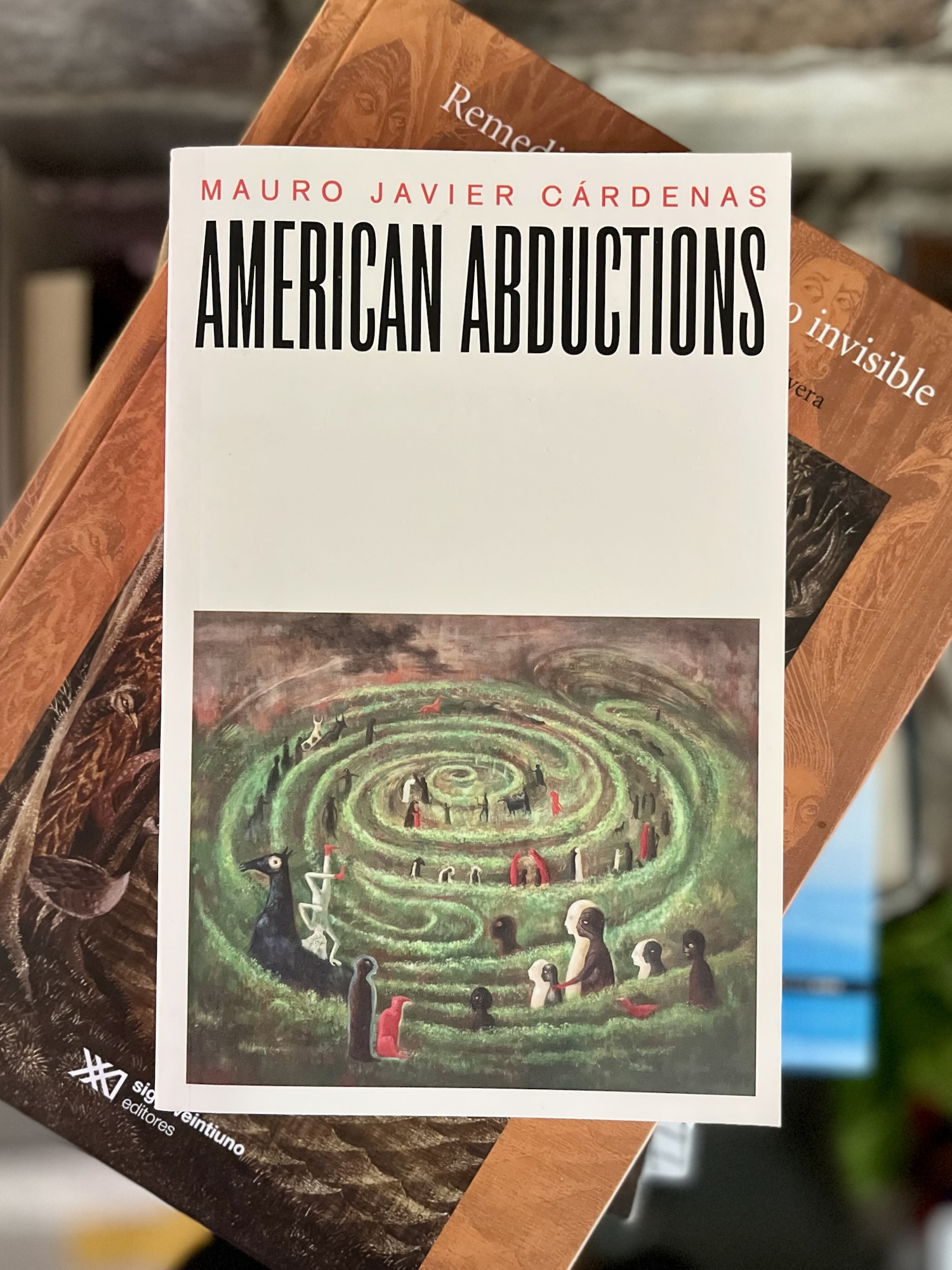
Mauro Javier Cárdenas’s American Abductions is a novel of relentless, layered consciousness, its immersive, labyrinthine sentences pulling the reader into a fugue of voices, memories, and anxieties. American Abductions takes place in a proximal version of the United States, a digital carceral state where palefaced goons kidnap Latin Americans. Sometimes the abductees are deported; sometimes they are disappeared. Sometimes they tell stories.

The dystopia here is hardly a YA world-building exercise full of hope and heroics. Instead, the novel moves through fragmented, fevered perspectives, primarily those of sisters Ada and Eva their disappeared father, Antonio, a novelist abducted by the Pale Americans, the faceless bureaucratic enforcers of this new regime. The novel oscillates between Ada and Eva’s attempts to reconstruct what happened, Antonio’s own recursive, metafictional writing, and interjections from various other voices—family members, interrogators, digital surveillance logs—until the narrative itself becomes a reflection of the fragmented reality the characters are trapped within.

Yes, American Abductions is bleak, but it is not merely dystopian horror. Cárdenas builds his world through a dizzying interplay of language, wielding the long, unspooling sentence with the precision of Bernhard, Krasznahorkai, and Sebald. Each chapter is a single winding comma splice that careens from realism to surrealism. Cárdenas’s run-ons layer and loop back on themselves, rhetorically mirroring the characters’ attempts to make sense of their unraveling world.

The book moves forward with an absurdist energy that resists despair, its rhythms and repetitions building not just a critique of authoritarian power but something stranger, something more human—an exploration of consciousness itself, an attempt, perhaps, to make a grand “statement of missingnessness,” to borrow one of the character’s phrases.

The effect is hypnotic, dreamlike, sometimes nightmarish, but often, surprisingly, very funny. There is a dark, absurdist humor in the way bureaucratic jargon collides with intimate grief, in the way digital surveillance reports are laced with banal observations, in the way Antonio’s own metafictional writing seems to both clarify and obscure the truth of his disappearance. The novel is not just about authoritarian violence but about how language itself is manipulated under such regimes—how it obfuscates, justifies, betrays, resists. At times, American Abductions reads like a political thriller rewritten as a fever dream, at others, like a linguistic experiment that spirals into a meditation on memory, exile, and state terror.

American Abductions is not just unsettlingly prescient. Rather, it obliquely underscores the U.S. surveillance state’s direct lineage to Latin America’s Dirty Wars. Governments systematically disappeared those deemed threats to the state—intellectuals, activists, ordinary people unlucky enough to be caught in the wrong place at the wrong time. Cárdenas’s dystopia does not just critique contemporary American immigration policies; it situates them within a long history of state-sanctioned violence in the Americas.

The novel’s themes take on chilling immediacy when considered alongside the real-world abductions of those who speak truth to power, like Mahmoud Khalil and Rumeysa Ozturk. Indeed, the disturbing video footage of Ozturk’s kidnapping by masked men this week has gone viral, echoing the opening of American Abductions, wherein we learn that Ada has captured “that moment when the American abductors captured her father as he was driving her and her sister to school, which she recorded on her phone.” Ada’s video goes viral, mutates, becomes its own beast:

…and later, after her father had been captured and hundreds of thousands of people around the world were watching her video of her father asking what have I done, officer, the supervisory official probably watched it too and left an anonymous comment below it that said ice / ice baby great job ICE, illegal is illegal and wrong is wrong bye you forgot the crybaby in the backseat, for years Ada arguing in her mind with the thousands of messages berating her and her father, even after she discovered some of the comments had been manufactured by bots controlled by a Pale American in Salt Lake City — twelve million to go please continue to remove the illegal alien infestation — except the comments by Doctor Sueño, of course, which made no sense to anyone but her, just as it made no sense to anyone but her to feel, for no more than a few seconds, proud that the supervisory official of the supervisory official of the supervisory official in an agency building had taken time out of his busy schedule to focus on her father — if enough time passes, Doctor Sueño says, even the most preposterous possibilities will navigate the sea of your mind — cry like an eagle / to the sea — just as it made no sense to anyone but her to laugh at some of the videos her video had spawned for instance the video of her video but with sappy music instead of her sister politely asking the abductors where were they taking her father, as if someone figured hey no one’s going to feel sorry enough for you people let me add sad violin music to the video of your father saying I’ve done nothing wrong, officer, or how about the video from a self proclaimed irreverent news organization from China that, via computer animation as if from an obsolete video game, replicated the trajectory from her house to the sensitive location as if it were a car chase, the abductors rushing to drag her father out of the car as if it were a drug bust, the video game representation of Ada recording her father’s capture with her phone from the backseat of the car, waterfalls of tears surging from her eyes, no not waterfalls, more like someone’s comical representation of lawn sprinklers superimposed on the eyes of the video game representation of me…

Apologies if I’ve let the run-on run on too long — but you’ll have wanted a taste of Cárdenas’s style, no? His sentences, unbroken and unrelenting, mimic the inexorability of history itself—cycles of erasure, resistance, recovery, and repetition. American Abductions is not just a novel about the present; it is a novel that recognizes the past has never ended. Its characters, trapped in linguistic torrents of grief and absurdity, seem painfully aware that history is repeating itself. And yet, as despairing as that recognition might be, American Abductions refuses to be silent. It makes its “statement of missingnessness” loud, insistent, impossible to ignore, resisting erasure, demanding we listen. Very highly recommended.

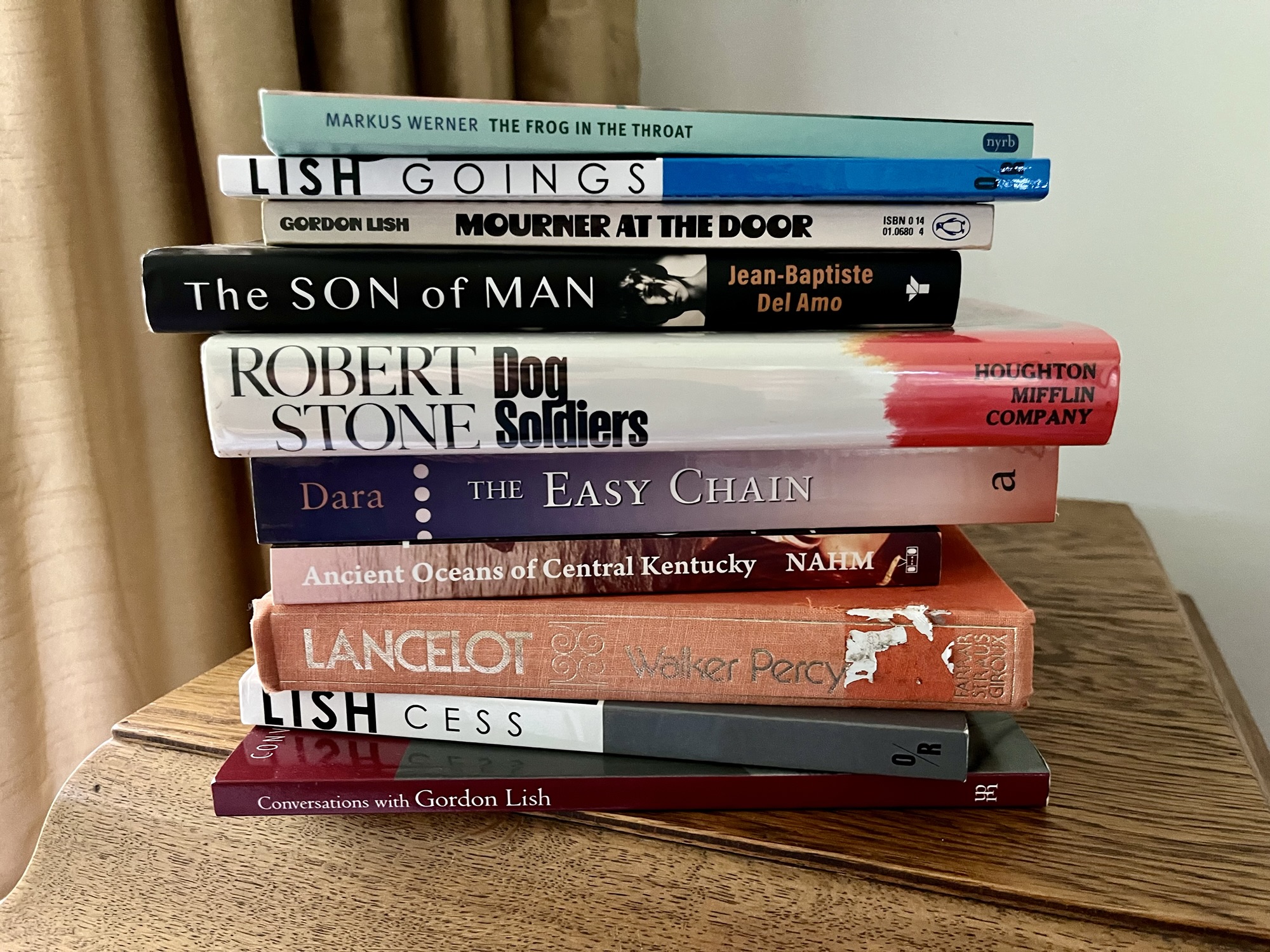
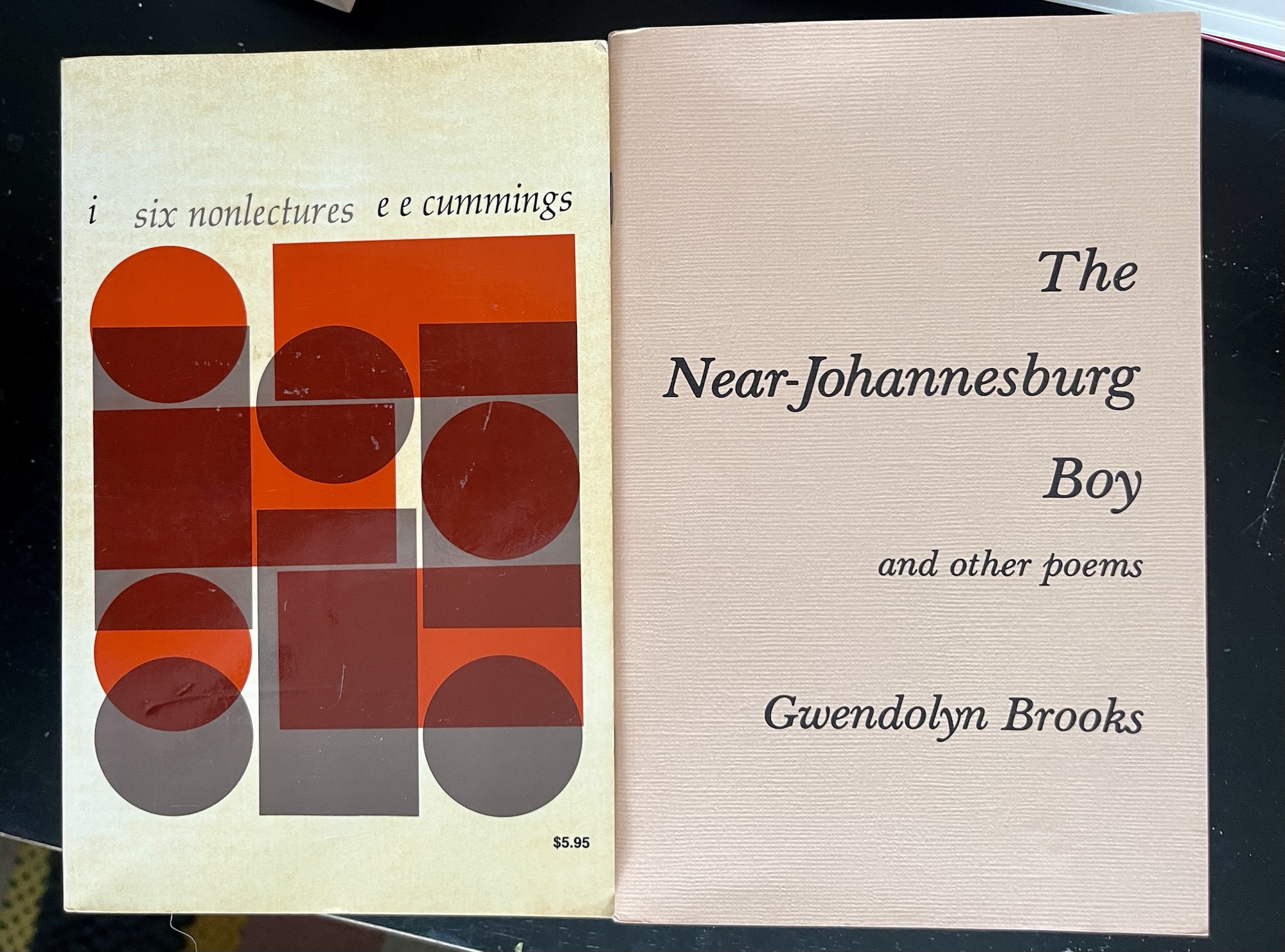
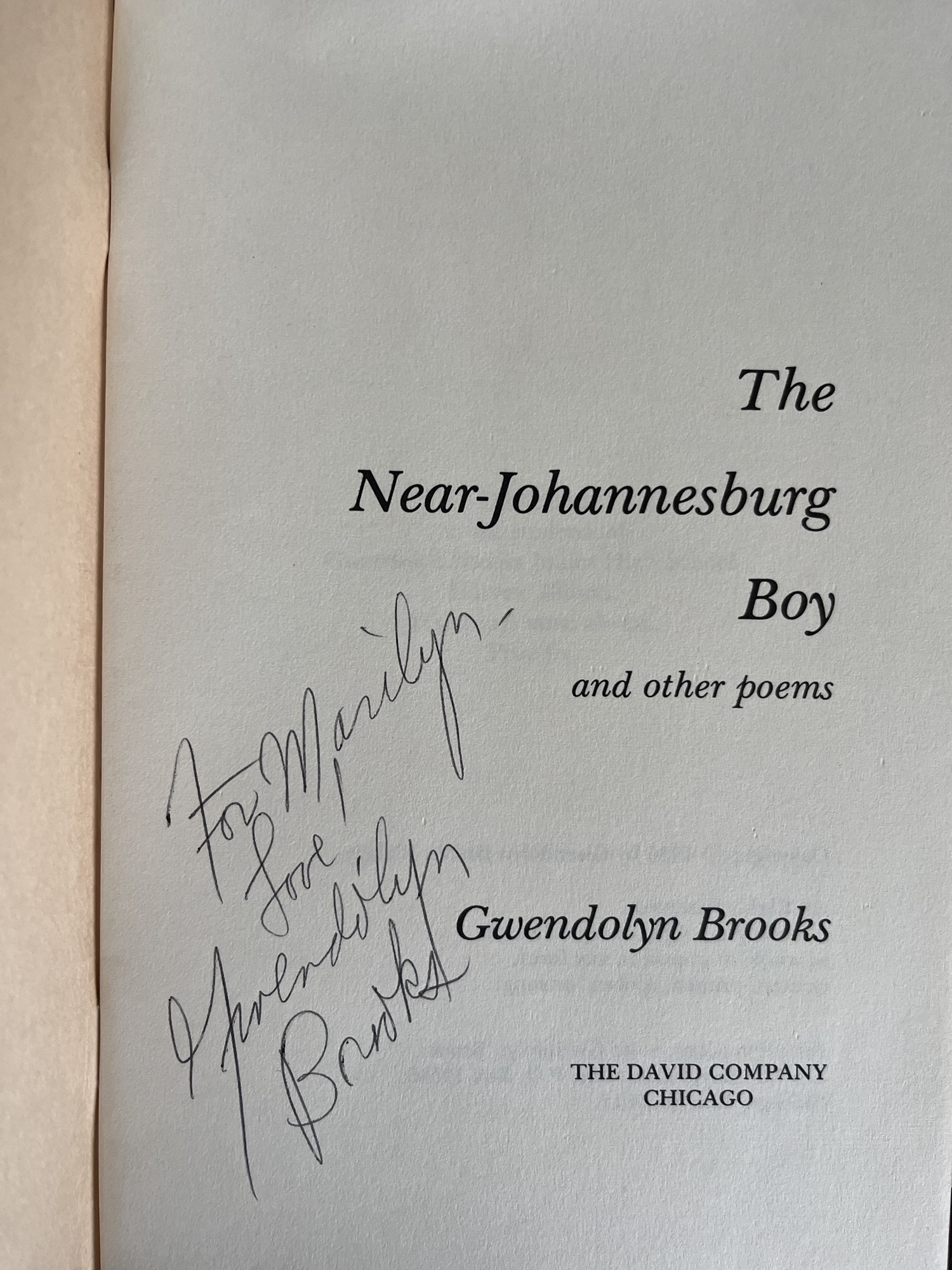
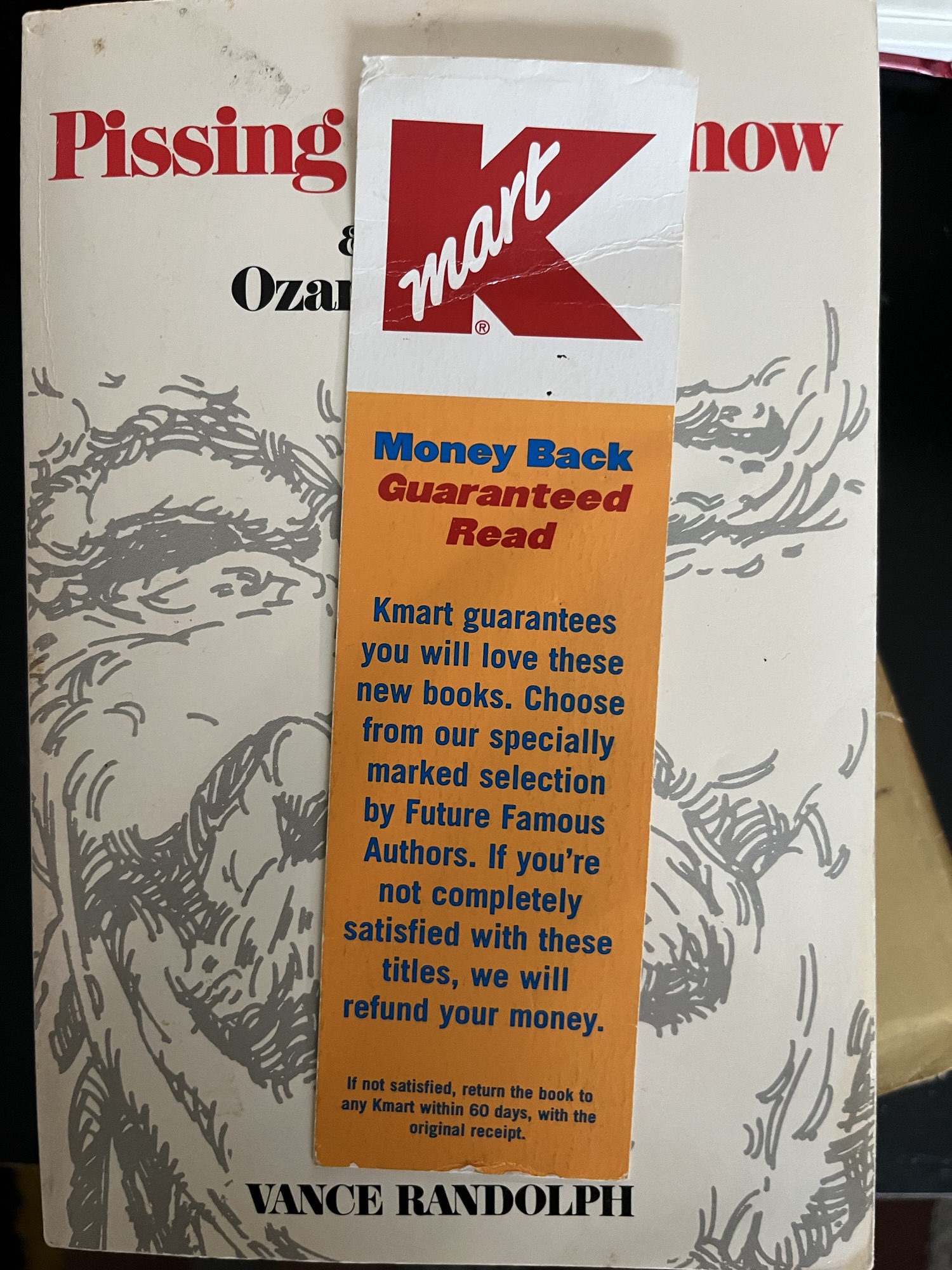
Blog about some recent reading, books acquired, a mini-review of The Hard Quartet live, etc.

I’ve been lucky over the last decade or so that my little college’s spring break almost always coincides with my children’s spring break. We aimed again this year at Georgia, spending a few days in a cabin outside the unfortunately named Whitesburg. Spring had not yet really sprung there yet. There was very little green about, but the hikes along and around Snake Creek through 20th century ruins were pleasant enough, and the kids enjoyed ziplining and aerial obstacle courses. In one of their sessions, I sneaked away to Harvey’s House of Books.

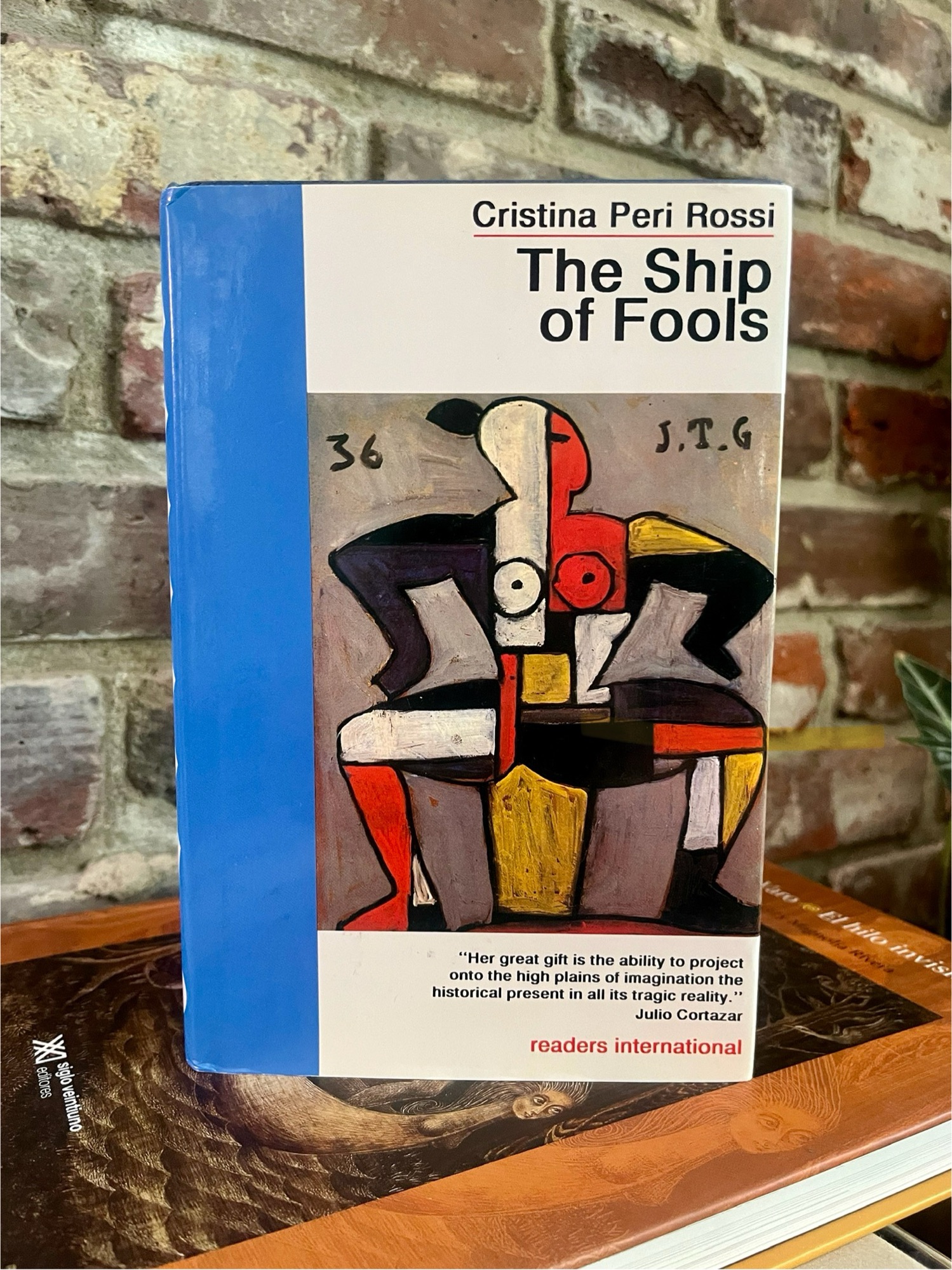
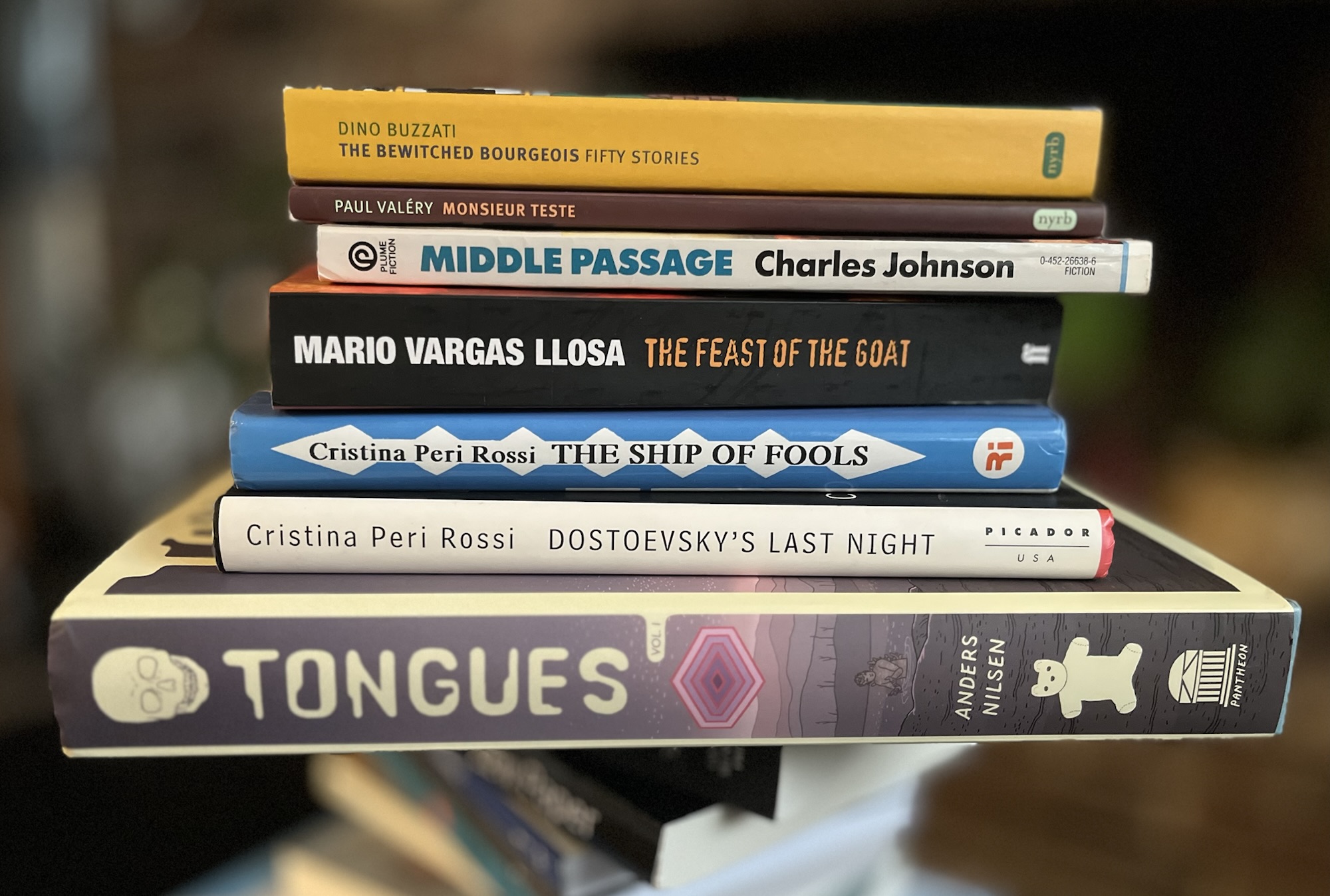
Harvey’s is, as far as I can tell, a Friends of the Library venture run by volunteers. I didn’t expect much, but the fiction section was surprisingly well populated. For around five bucks I picked up Charles Johnson’s Middle Passage, Mario Vargas Llosa’s The Feast of the Goat, and two by Cristina Peri Rossi — The Ship of Fools and Dostoevsky’s Last Night.

I was happy and surprised to find Rossi’s The Ship of Fools (in translation by Psiche Hughes); I’ve had it on a mental list for a few months now. I started it that night and it’s really odd–reminds me a bit of Ann Quin’s stuff, very odd but fun. More thoughts to come.

The Ship of Fools proved a nice antidote to the books I’d brought with me, Paul Valéry’s Monsieur Teste, (in translation by Charlotte Mandell) and a Dino Buzzati collection translated by Lawrence Venuti, called The Bewitched Bourgeois. I’ve enjoyed the Buzzati stories, but piled up there’s a sameness here that cries for interruption. I love Borgesian riffs on “Before the Law” as much as the next nerd, but too many in a row (six, in my case this week) feels, I dunno, like, I get it. But to be clear, I’ve really liked most of The Bewitched Bourgeois. I think it’s better parceled out though. Monsieur Teste on the other hand…look, I don’t know, maybe I misunderstood the book entirely, but I really kinda sorta hated it. Was I supposed to hate the central persona, Mister Teste, who aims for precision in language but comes off as a bore? At least it was short.

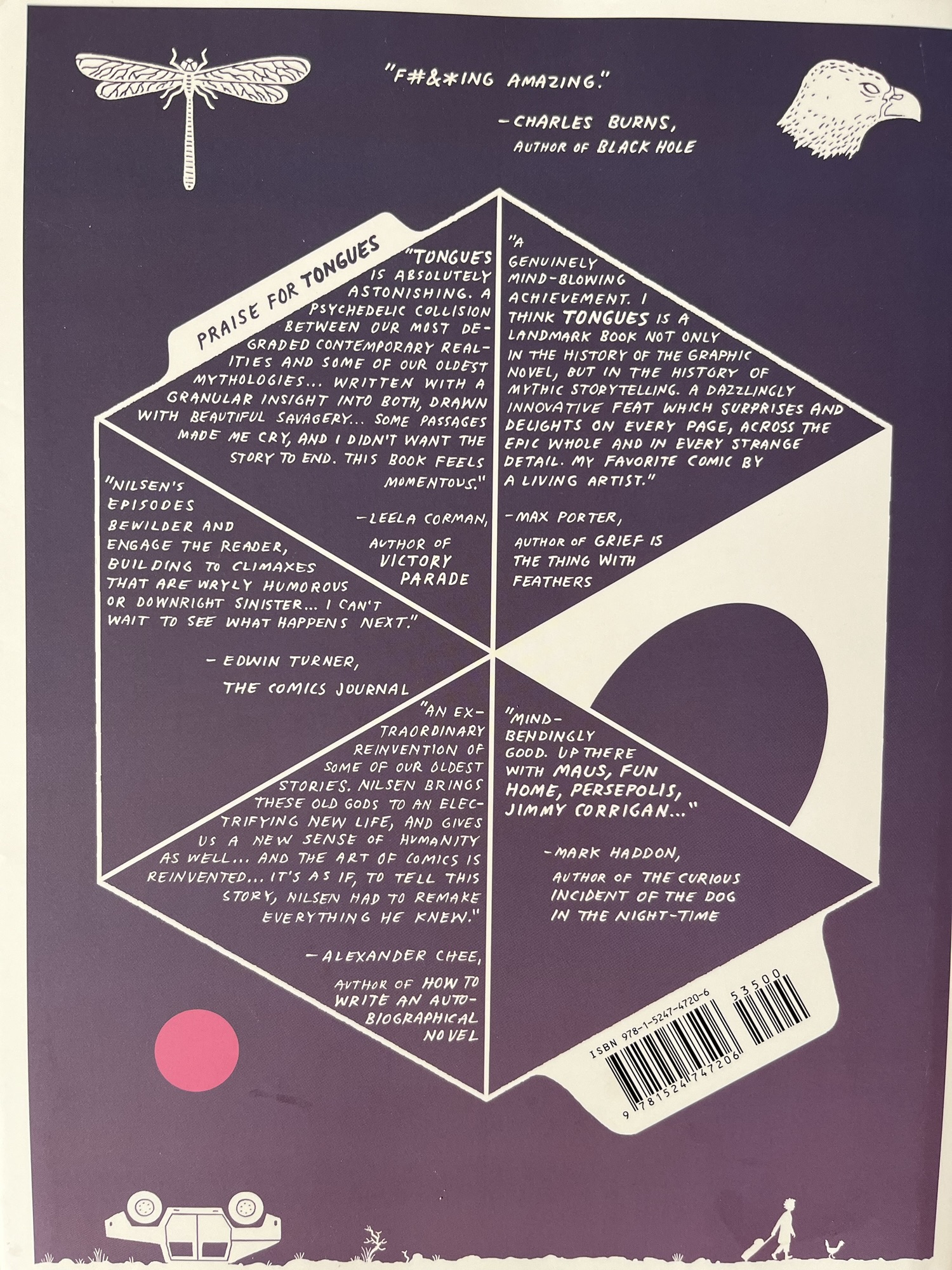
While I didn’t have the time in Atlanta to hit multiple bookstores (like in past trips), I made a point to hit up A Capella Books, a well stocked indie joint with a great used collection. I didn’t score anything there, although I was thrilled to see Anders Nilsen’s Tongues prominently featured in the graphic novel section. The book is great — I got a review copy right before we left. Some asshole named Edwin Turner landed a blurb on the back under his hero Charles Burns’s much shorter, pithier, better blurb:

Our spring break culminated Saturday night at the Variety Playhouse in Little Five Points, where we saw the so-called indie supergroup The Hard Quartet play all of their songs. I really dig The Hard Quartet’s self-titled debut, and dragged my wife and son along. (My daughter declined but played taxi driver.) Some interesting looking children were exiting the theater (really more of a club, let’s be honest) as we were entering, assuring the concerned security guard that they’d be right back, they just needed to get some Gatorade at a corner store. These were Sharp Pins, or The Sharp Pins, or Thee Sharp Pins, a Chicago power pop trio fronted by a kid named Kai Slater. They played a tight thirty minute set (including a Byrds cover); young Slater knows how to tuck away middle eight. The band’s youth invigorated the crowd of indie oldheads, and if Sharp Pins were occasionally a little out of tune or a step behind on the count, what came through was a true joy for the pop song. My son went bananas from them, saying something like, I know that they aren’t as good at playing their instruments as the Hard Quartet guys, but I liked their songs more. He bought their album and their t-shirt.

I liked The Hard Quartet’s live show very much — these are some old, or let’s just say older guys — look, pretty much everyone at the show was old, older, etc., except the Sharp Pins, my son, and some other teens there with their folks — these guys, the HQ, are veterans of disorder, coming up in club shows and theaters and big stages and big big stages and so on. They seemed very comfortable in the quasi-theater club. It was a joy to watch and listen to them.

They are, as I mentioned before, a so-called “supergroup.” Stephen Malkmus was the sideman for David Berman in The Silver Jews; Matt Sweeney, a popular YouTube influencer, was a member of another infamous supergroup — David Pajo’s short-lived side project Zwan; Emmett Kelly is a former gang member and circus performer; Jim White is the best drummer I’ve ever seen live (I have no stupid joke here; he is amazing and I listened to Ocean Songs every night for two years in a row when I was 22 and that’s not an exaggeration.)

The Hard Quartet are clearly a “real” band and not anyone’s side project. Sonics live were richer, fuller, more expansive than on disc. Emmett Kelly sang his new song, which, as far as I can tell, is the only update to their setlist in the past year — basically the record played straight through — but they seemed to never remember who was playing bass on which song when. No one used a pick, ever, as far as I could tell. Sweeney broke a string and then claimed he’d never broken a string on stage, ever. (Dubious.) Malkmus said he was thinking about “The Devil Went Down to Georgia,” but, what if it was, like, “The Devil Went Down on George.” Sweeney jokingly referred to Charlie Daniels as Chuck Daniels and at least two Atlanta audience members hissed foolish rejoinders. (Could’ve been those big beers, bald boys!) Jim White is both a gentle percussionist and a rawk gawd drummer. Malkmus’s, Kelly’s, and Sweeney’s singing in unison were some of the finest moments of the night, as in “Rio’s Song” and “Heel Highway.” The band’s weathered implementation of silence and space was also delicious and judicious in numbers like “Six Deaf Rats,” “Action for the Military Boys,” and “Hey.” Skronk and noodling were measured but never mannered. (Or the manners were there but they weren’t bad, unless they were meant to be bad.) Matt Sweeney’s left foot was the boss of the band, the bandleader, the clapper clopping down the count in a leopard print.

The Hard Quartet finished before eleven, having played all their songs. I think we all had a good time.

Jim White
Matt Sweeney
Stephen “SM” Malkmus
Emmett Kelly

A run-on sentence on Gabriel García Márquez’s delirious novel The Autumn of the Patriarch

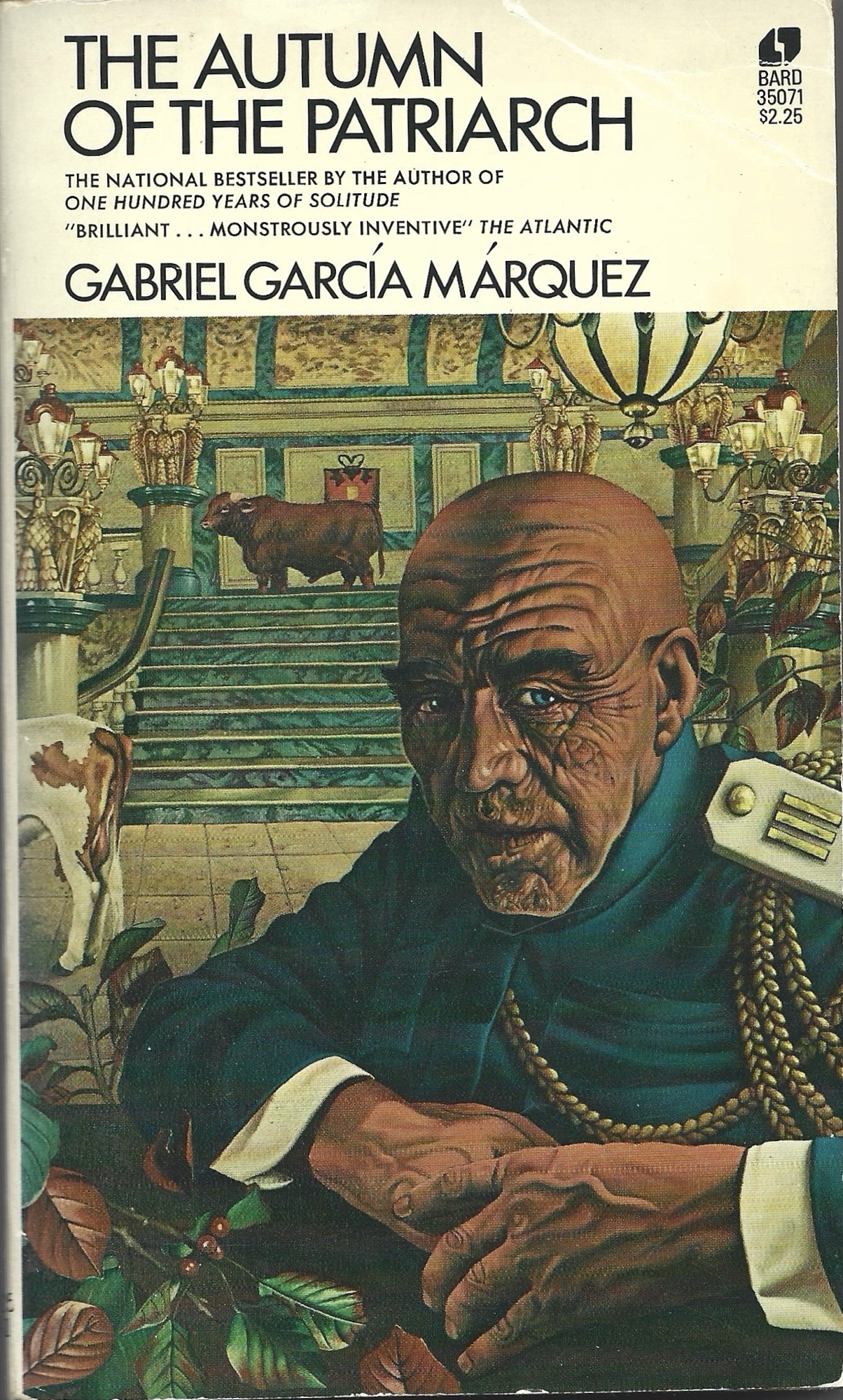
Gabriel García Márquez’s The Autumn of the Patriarch isn’t so much a novel as it is a delirium, a swamp fever, a sun-bleached hallucination stretched across centuries, a beast that coils and uncoils, bloated with its own rot, a thing that does not begin or end but only festers, looping back on itself in great, heaving tides of unpunctuated or undepunctuated or mispunctuated thought, García Márquez dragging us under, drowning us in the mind or minds of the titular dictator, a paranoid consciousness so swollen with its own power that it warps reality itself, a man who reigns forever and is always dying, whose past rewrites itself with every breath, whose power is infinite and yet always slipping, slipping, slipping through his fingers like the stolen sea, parceled off and shipped to Arizona, because why not, because what is truth if not what he declares it to be, because when you have lived for centuries, when your general is served up at a Thyestean feast, when your nation’s children are disappeared to an island, never to return, when the cattle are branded with your mark, when the very hour itself is subject to your whim, then nothing is real, nothing but the fear, the violence, the rape, the predation, the endless grinding machinery of power that must sustain itself, and so we cycle, we spiral, we convulse through six sections, six deaths, six endless iterations of his reign, six grotesque confirmations that absolute power is an ouroboros swallowing its own tail, devouring itself, erasing itself, until nothing is left but the silence of his ruin, the empty palace where his corpse will be found again and again, where his legacy is nothing but absence, and translator Gregory Rabassa—mad saint, linguistic necromancer—renders it all in English without breaking the spell, his translation a relentless incantation that doesn’t just mimic the novel’s crushing, hypnotic cadence but becomes it, suffocating, pressing, forcing you to inhabit the mind of this eternal, rotting god-tyrant, this cosmic mistake, this doomed and doom-dealing beast whose power, no matter how total, will crumble, will fade, will rot, will vanish into nothing, just like everything else.

Maggie Umber’s Chrysanthemum Under the Waves blends horror, surrealism, and poetic fragmentation into a haunting vision of the uncanny

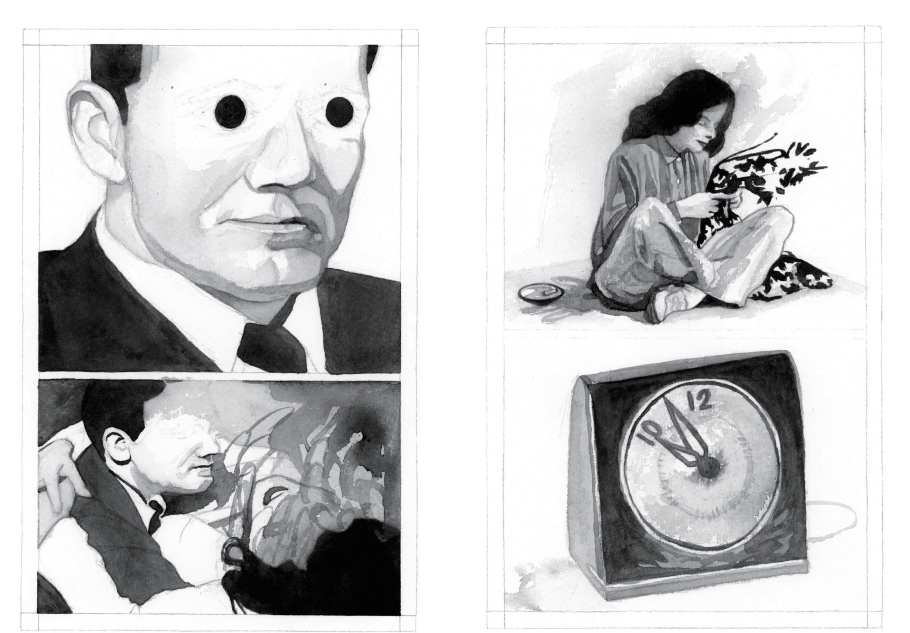
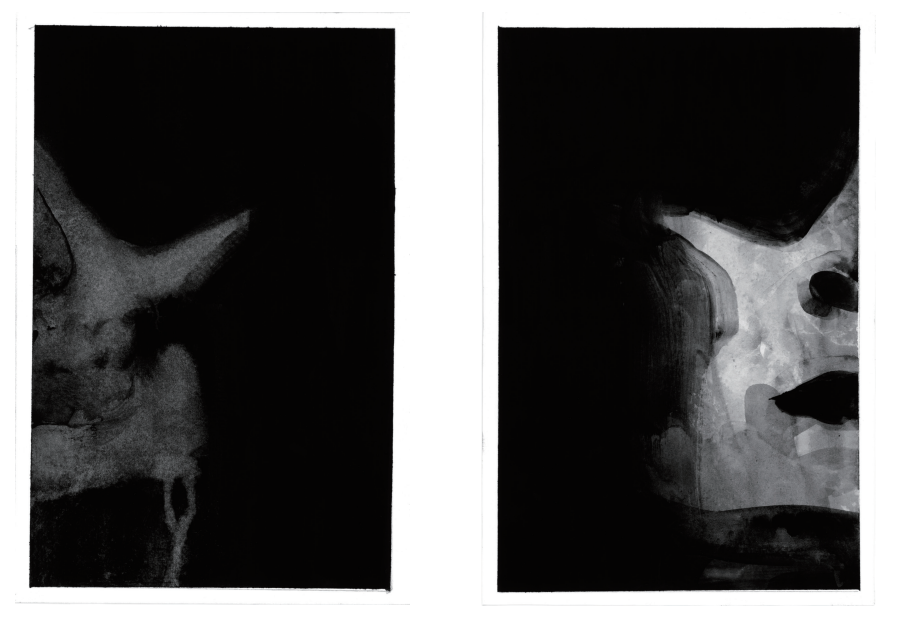
Maggie Umber calls the nine pieces collected in Chrysanthemum Under the Waves “comics,” so I will call them comics too. The term “comics” has long encompassed a wide range of visual storytelling techniques, resisting attempts to confine it to rigid structures, and Chrysanthemum Under the Waves shows the form’s expansive potential, blending horror, surrealism, and poetic fragmentation to tap into the alienation, paranoia, and repression that lurks under the surface of everyday life.

The stories here resist conventional narrative logic, which will likely confound any reader expecting something traditional. Umber eschews the common building blocks of the medium: there are no speech bubbles, no thought balloons, no panels stacking up into a coherent sequence. In fact, the few pages that use multiple panels feel like an anomaly. Most of the work in Chrysanthemum is confined to single, expansive images. Yet, these full-page spreads do not recall the bombastic splash pages of Jack Kirby or other Golden Age comics. Instead, they underscore the inherent incompleteness of storytelling. No artwork, no story, can ever present a full picture of reality—there are always gaps, always gutters. And in these gaps, dread and unease fester.

Umber’s comics aren’t so much about exploring the fragmentation of storytelling; rather, they showcase it as an aesthetic choice. It’s a choice that generates a palpable tension, a constant refusal to return to any resolution. There is no resolving tonic chord here. The uncanny permeates these pages—not in the sense of something foreign intruding upon the familiar, but as if the familiar itself has been subtly warped. Maybe this horror is “real,” maybe it’s not—but what is certain is its presence. The world Umber paints is one of perpetual strangeness, captured in black-and-white, shaded with grays. Pen and ink, printmaking, and watercolor all blur together in a form that makes us feel the unease before we can even articulate it.

And while Umber’s work is refreshing in its uniqueness, it is by no means sui generis, but rather part of  a clear tradition. As Umber notes in her introduction, Chrysanthemum started as a one-off “adaptation” of Shirley Jackson’s 1949 story “The Tooth.” If you have read “The Tooth” (and if you haven’t, do yourself a favor and resolve that problem) — if you have read “The Tooth,” you will likely recognize the uncanny unease that permeates Chrysanthemum. In her intro, Umber identifies James Harris as the agent of this unease: “James Harris snuck up on me when I was distracted by other things.” James Harris is a strange character who wanders in and out of not only “The Tooth,” but several of the other stories in Jackson’s The Lottery. Indeed, the original subtitle of The Lottery was not and Other Stories, but rather The Adventures of James Harris. This is the James Harris of the 17th century ballad “The Daemon Lover”; he is also the oblique star of Chrysanthemum Under the Waves. Look and you will find him in each of Umber’s tales, sliding like a shadow in and out of panels and gaps.

You will find so much more there as well–there are direct allusions to Goya’s Caprichos and Black Paintings, as well as nods to Toulouse-Lautrec and Sylvia Plath. There’s also a strong echo of Jackson’s American Gothic precursors and successors: Nathaniel Hawthorne, Edgar Allan Poe, Emily Dickinson, David Lynch, Kathy Acker — and, far less famously, Jason Schwartz. Chrysanthemum Under the Waves most reminded me of Schwartz’s prose-poem John the Posthumous, so much so that I read it again to confirm my notion.

I’ve failed to remark so far on the apparent plots of the tales here. I found myself arrested by the ominous vibes in my first readings, and I still could not pin down a summary. At the same time, I feel that Umber clearly knows “what’s happening” in her stories, even if she keeps that information in the gaps and margins, out of the panel, but still, maybe, hidden in the pictures. The lead story, “Those Fucking Eyes,” is a collision of horror and beauty, twisting the artist’s gaze  into something self-possessed and austere. “Rine” plays with fragmentation and distortion while evoking a ghostly presence. We get a gentleman caller, a broken bridge, a bouquet of flowers that flickers between reality and illusion. “Intoxicated” takes on a Gothic Toulouse-Lautrec aesthetic, unraveling into surreal rage and rejection. “The Devil Is a Hell of a Dancer” retells the “James Harris” ballad; it’s the first time written language infiltrates one of the stories.

The title track, “Chrysanthemum” is a surreal noir fantasia punctured by a cup of coffee, with daemon lover James Harris hovering menacingly in the background. It seems to reinterpret Shirley Jackson as does the aforementioned “The Tooth” — itself a revision of Charlotte Perkins Gilman’s suffocating 1892 classic, “The Yellow Wall-Paper.” The shortest comic, “There Is Water” unfolds like a koan, enigmatic and meditative. Standout “The Witch” returns to Goya but also channels the American Gothic vein. The piece might be a nightmare one of Hawthorne’s characters endures. There are clouds, castles, dreams, doors, flickering horror. Is that a witch burning? And do the flames morph into a glimpse of Goya’s Saturn, only to resolve into the shadowed face of a woman? Shadows and erasures pulse through the imagery. It is both the strongest and longest piece in the collection. The book ends with “The Rock,” another riff on the the ballad “James Harris.” It’s a fitting end, conclusive but elusive. What remains rattles: unsettled, open, and always strange.

Chrysanthemum Under the Waves is a haunting, layered work that defies easy categorization. Umber’s pieces blend literary, artistic, and Gothic influences into a unique vision that expands the possibilities her chosen medium’s conventions. With its distinctive style and  careful attention to space and detail, Chrysanthemum Under the Waves is a compelling read. Highly recommended.
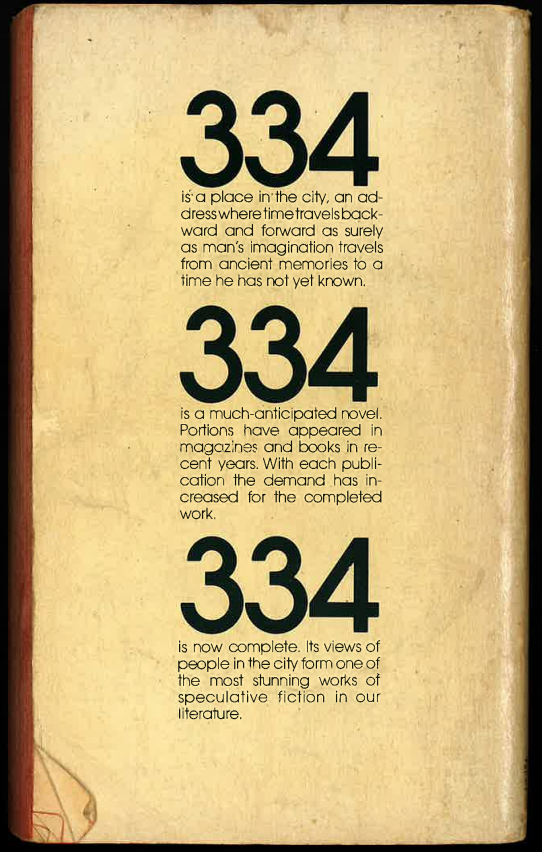
Mass-market Monday | J.G. Ballard’s Hello America

Hello America, 1981, J.G. Ballard. Triad Grenada (1983). Cover illustration by Tim White. 236 pages.

Today’s mass-market Monday selection was inspired by last night’s rewatch of David Cronenberg’s 1975 film Shivers. Shivers’ first fortyish minutes play as one of the more persuasive Ballardian commitments to film—more Ballardian than Cronenberg’s Crash (2016) or Ben Wheatley’s High-Rise (2015). Indeed, Shivers is an aesthetic foster twin to Ballard’s novel High-Rise, born the same year. High-Rise is far superior to Hello America, but I think Hello America is probably better than it comes off in my short review from 2022:

You’d think a novel where President Manson wants to make America great Again would feel more prescient, but Ballard’s so in love here with the sparkle and pop of Pop Art America that he fails to attend to the dirt, grease, and grime that make the machine run. A fun novel, but its contemporary currency is squashed not so much by historical reality as the weight of Ballard’s oeuvre before it.

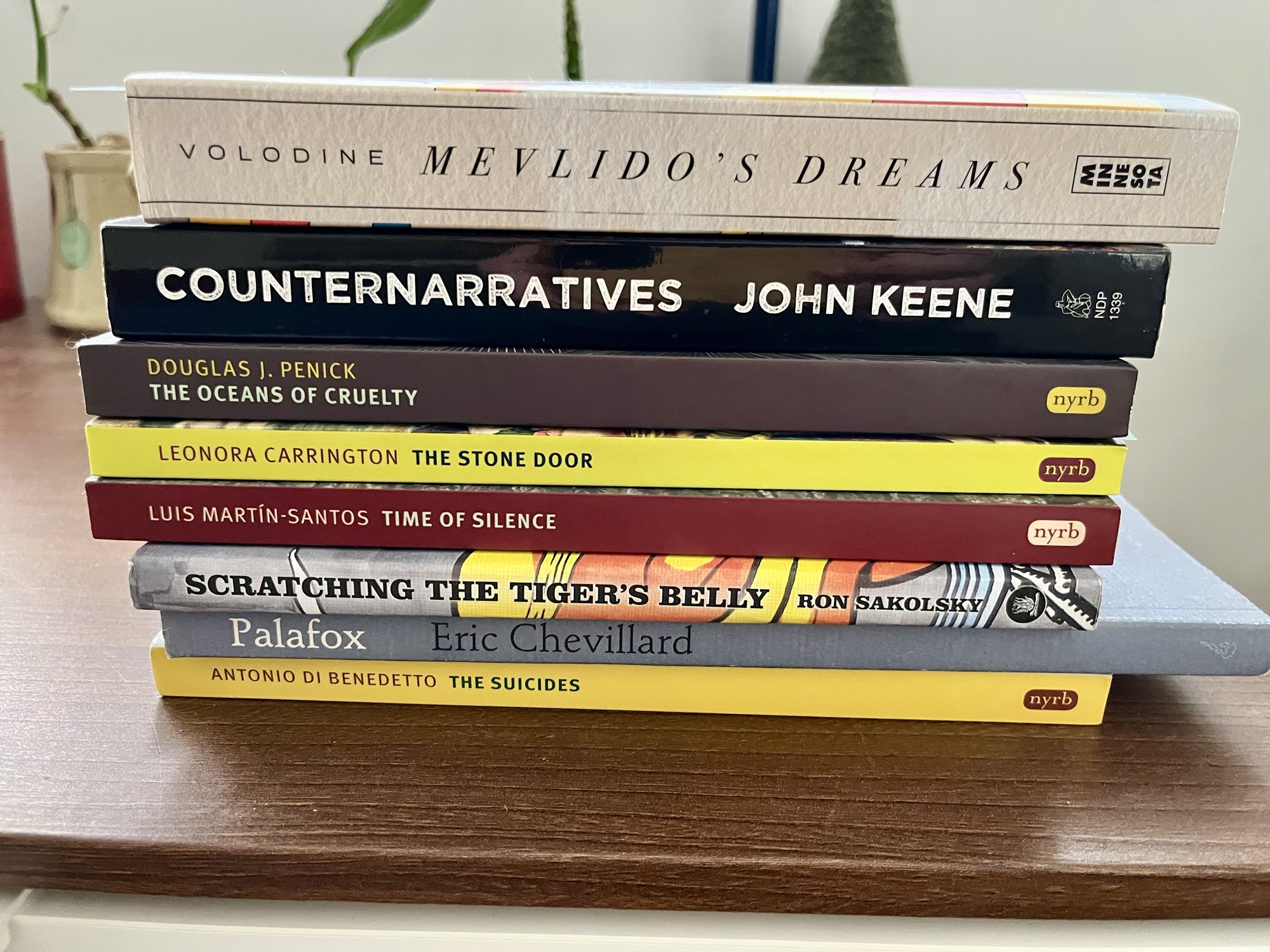
Blog about some February acquisitions

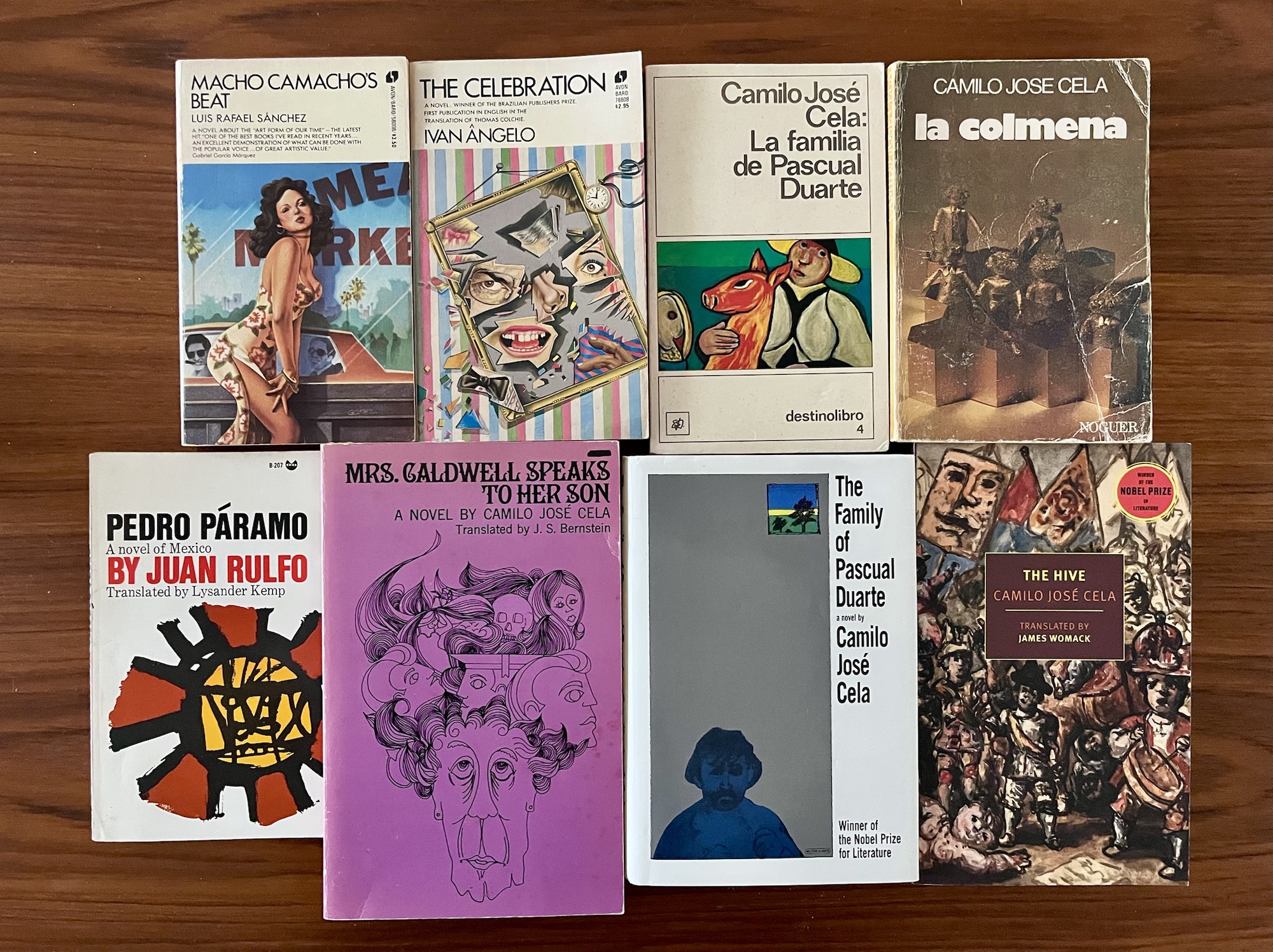
A weeks-long back-and-forth with a colleague about certain flavors of Modernist novels led to this colleague, a friend really, to come by my office with a stack of about 80 pages he’d printed, front and back, demanding that I take a look at some utter nonsense, probably the kind of nonsense I’d abide. This particular nonsense was a printed .pdf of Camilo José Cela’s 1988 novel Cristo versus Arizona in the original Spanish. “It’s all just one long sentence!” my colleague declared. I was immediately intrigued, and am still on the lookout for Martin Sokolinsky’s 2007 English translation. Wikipedia, cribbing the Publisher’s Weekly review of that translation describes Christ Versus Arizona as “set in the American Old West during the gunfight at the O.K. Corral in 1881. It consists of a monologue in one long sentence, inside the head of Wendell Liverpool Espana, who is the son of a prostitute and observes the gunfight.” I expressed my delight with the concept. My colleague then reverted to his argument, which, I will badly summarize as something like, All these Modernists tried this nonsense and some point just to show off at the expense of the reader. He extolled again the virtues of Dubliners over Ulysses, a book with its head in its ass; he decried Faulkner’s worst tendencies—a gifted writer who could offer up a perfect novel and then birth an abomination like The Sound and the FuryCristo versus Arizona, he assured me, was Cela’s abomination; he then urged me to read Cela’s masterpiece, La colmena, which he translated as The Beehive. And then I had an 11:00am class to attend to.

Driving home I realized that I might actually have a copy of an English translation of La colmena. I did: Anthony Kerrigan’s translation, The Hive. I pulled it out, started reading, and kept going. I love it! The next day my colleague brought in two Cela novels he’d read (and annotated the hell out of) in graduate school: La colmena and La familia de Pascual Duarte. I think that was on a Thursday. On Friday I browsed a used bookstore and picked up Kerrigan’s translation of Cela’s The Family of Pascual Duarte (with a cool Milton Glaser cover). I also picked up Ivan Ângelo’s novel The Celebration (in translation by Thomas Colchie); I’ve gotten to the point where I just scoop up any of the Avon Bard Latin American translations when I come across them — which is what I did a week later when I browsed a different used bookstore (or, really, a different location of the same booksellers; I was right next to this location because several of my son’s paintings were exhibited in a gallery nearby as part of a contest he had entered a few months ago without telling us (these details are not important to the story; my son is a talented painter though and I am proud).

Which is what I did a week later, scoop up another Avon Bard Latin American translation — this time Macho Camacho’s Beat by Luis Rafael Sánchez, in translation by Gregory Rabassa. I also picked up Juan Rulfo’s Pedro Páramo (trans. Lysander Kemp), which I’ve been meaning to read for a while now, and another Cela — Mrs. Caldwell Speaks to Her Son (trans. by J. S. Bernstein).

And so well back to Camilo José Cela then–I’m almost finished with The Hive, delayed at times by checking in against the original La colmena, mostly to get a sense of some of choices the translator made, a process I’m looking forward to repeating again with The Family of Pascual Duarte, a process that’s included riffing on the writing with my colleague, my friend who brought by a big stack of papers, a ridiculous pile of papers, that one-word sentence of a novel, Cristo versus Arizona, the novel I would love to acquire soon.

Eight notes on Stephen Dixon’s novel Interstate

1,  It upset me deeply, reading Stephen Dixon’s 1995 novel Interstate. It fucked me up a little bit, and then a little bit more, addicted to reading it as I was over two weeks in a new year.

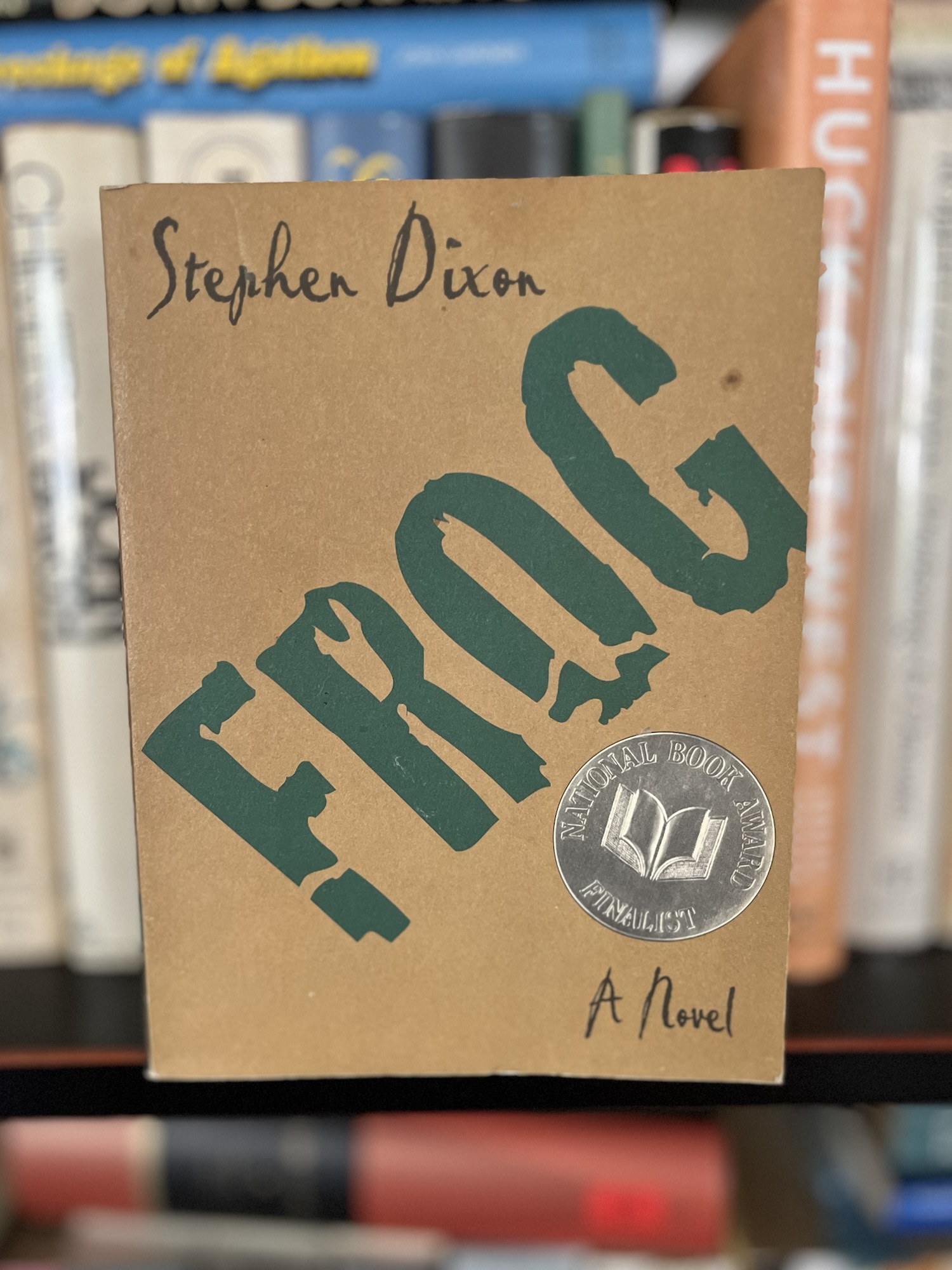
2,  What is it about, Stephen Dixon’s 1995 novel Interstate? I mean, you probably won’t like it, but that wasn’t the stupid rhetorical question that led this point. (And also but maybe like, you will like it.) Interstate was a finalist for the 1995 National Book Award. It didn’t win. The NBA’s website’s one-sentence summary fucks up: “In the author’s first novel since Frog, a Finalist for the National Book Award, a father mentally replays, in eight variations, the shooting of his daughters on an interstate highway.”

3,  There is (or is it are?) one too many esses in the NBA’s summary of Stephen Dixon’s 1995 novel Interstate—there are two daughters, plural, but only one is shot, and shot tragically, awfully, fatally—and really, as its variations play out, it’s not entirely clear if anyone was shot, if anyone was even on the highway, if anyone was even real. Are all the so-called events of the novel simply (there’s no simply about it) in the narrator’s imagination? “…but there I go again, the world’s easiest and most desirable copy out, the dream,” muses the narrator at one point. Not even a dream though, it’s all just words.

4,  It’s all “just” words, and if someone told me they read and hated Stephen Dixon’s 1995 novel Interstate, I’d shrug and ask if they made it all the way through all the words and still hated it. If someone told me that they made it all the way through Interstate and found it to be a strange and unappealing writing experiment, I’d mildly agree with them, and then tell them that I loved that particular flavor and if they didn’t like that particular flavor, well, cool.

5,  If someone read all the words in Stephen Dixon’s 1995 novel Interstate and concluded that it seemed like an ambitious and highly-achieved creative writing exercise — writing experiment, rather — I’d likely initially agree and then hedge a bit before mumbling something like, I don’t think it was an exercise or experiment on the author Stephen Dixon’s part. It might make for experimental reading, but I think he absolutely knew what he was doing; this wasn’t practice or exercise — it was the real thing.

6, I have, thus far, done a lousy job, not even really a job, of describing the force of language in Stephen Dixon’s 1995 novel Interstate. Normally I’d crib a few choice passages—and to be clear, Interstate s fat and juicy with choice passages—but we are talking about long, twisty, tangled passages, sentences that go on for pages, sentences that find the predicate verb sundered for a few paragraphs from its eventual object, sentences that move us through thought, how divergent thought can be how, how imprecise, indirect, yet still sharp and often painful. An easy, lazy comparison would be to liken Dixon’s paragraphs to Thomas Bernhard’s (although Dixon denied the influence, much like William Gaddis did in his final novel)—there’s a different flavor here but our guys are working in a similar mode. (Think too of László Krasznahorkai or Gabriel García Márquez or Faulkner or Mauro Javier Cárdenas or any number of practitioners of the long paragraph). John Domini, in his contemporary review in the Portland Oregonian (reprinted in his excellent collection The Sea-God’s Herb) does a better job of describing Dixon’s style than I can do:

Characters talk themselves through backwaters of memory (sometimes creating comic relief) or sail into dreamy what-ifs, all in order to put off some looming and drear inevitability. In conversation, one may mention an important insight that he or she has to share, then spiral away through a half-dozen distractions before revealing what matters. The format feels like a natural fit to the shuttered claustrophobia of worry and loss. So do the jam-packed paragraphs, sometimes running several pages without a break. Better still, these blocks of talky phrasing flicker with light, even (every now and again) with happier possibilities.”

(Maybe I just wanted to quote that lovely phrase of Domini’s, “blocks of talky phrasing flicker with light.”)

7,  “Better still, these blocks of talky phrasing flicker with light, even (every now and again) with happier possibilities,” Domini wrote of Stephen Dixon’s 1995 novel Interstate. The last of Dixon’s eight Interstates is an unexpected gift — a happy ending, or, rather a banal ending, a plain ending, an ending without tragedy or comedy or epic heroism. An ending where everyone gets to bed in time to fit in a little light reading before shuteye. It sounds hokey when I write it out, but there’s nothing trite about the conclusion. The reader purchases this moment of catharsis from all the terror (and horrifying comedy, which I’ve neglected in this riff and will continue to neglect) — the reader purchases the cathartic conclusion from the preceding horror.

8,  I wonder how I might have reacted to Stephen Dixon’s 1995 novel Interstate if I had read it, say, when it was first published, back when I was a junior in high school. Or how would I have reacted to it ten years after that, not yet a parent? (And writing these thoughts out now, I realize that, more than anything by Bernhard or Krasznahorkai or Faulkner or the other Dixon I’ve read, Interstate most reminds me of (at least at this moment that I write) of Frank Capra’s 1946 film It’s a Wonderful Life. I’ve watched It’s a Wonderful Life once a year for the past four decades, finding it strangely different every few years — first baffling and even a bit scary, then boring, then exasperating, infuriating even, then schmaltzy, sentimental, ludicrous, and then magical, endearing, heartbreaking, perfect–I’ve veered off course, where was I?) I wonder how being a parent has colored my psychic engagement with the novel Interstate? I was not so much manipulated by the tragedy of losing a child through violent, chaotic, meaningless death but rather the more banal tragedy the novel repeatedly engages — losing a child through half-neglect, through half-listening, through selfishness, through an inability to focus on now — not really so much losing a child but losing out on connections, memories, time you’ll never get back. It fucked me up, Interstate, and I don’t think I’d like to go down its road again — but I loved it. Very highly recommended.
Blog about some recent reading

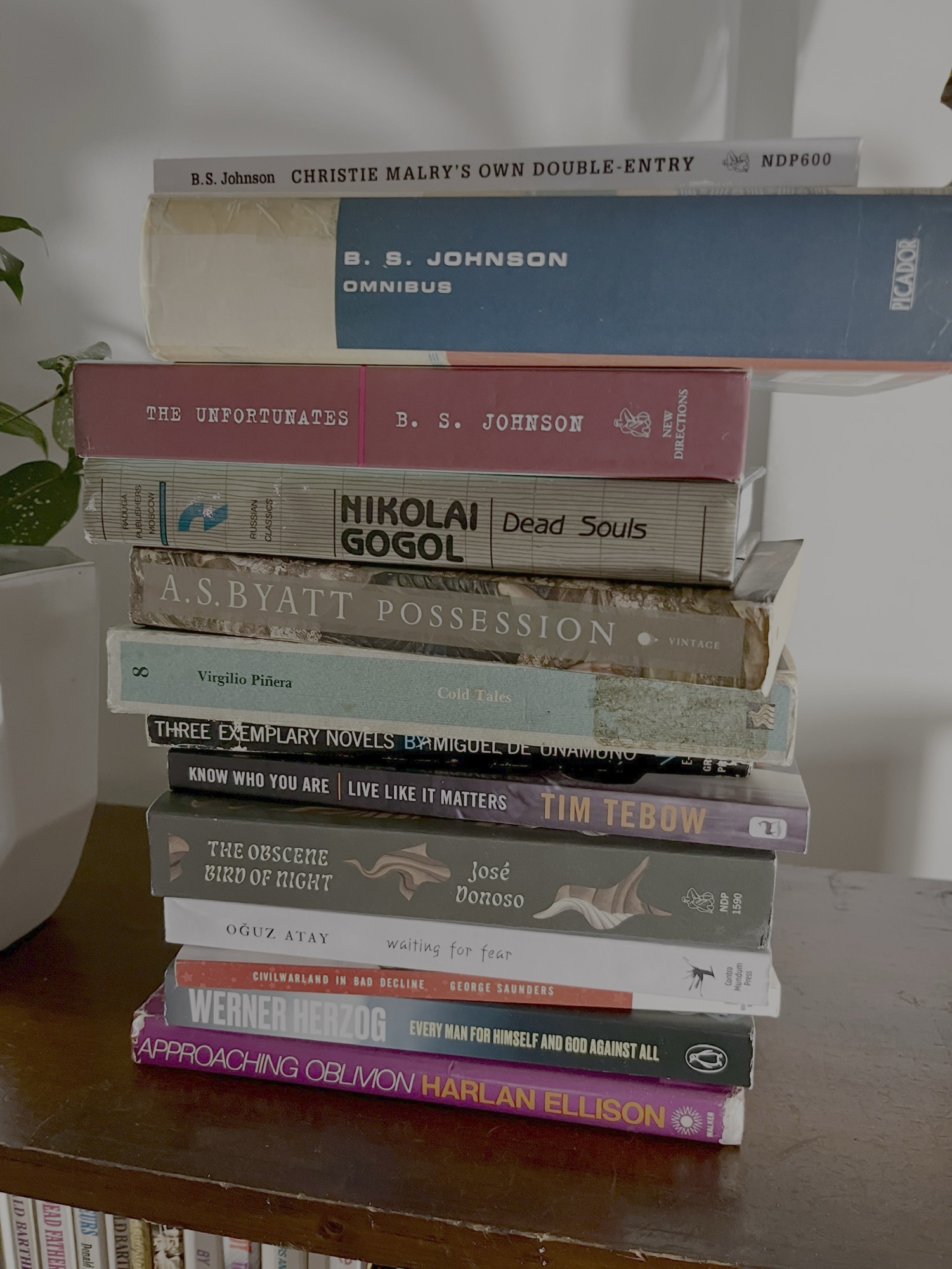
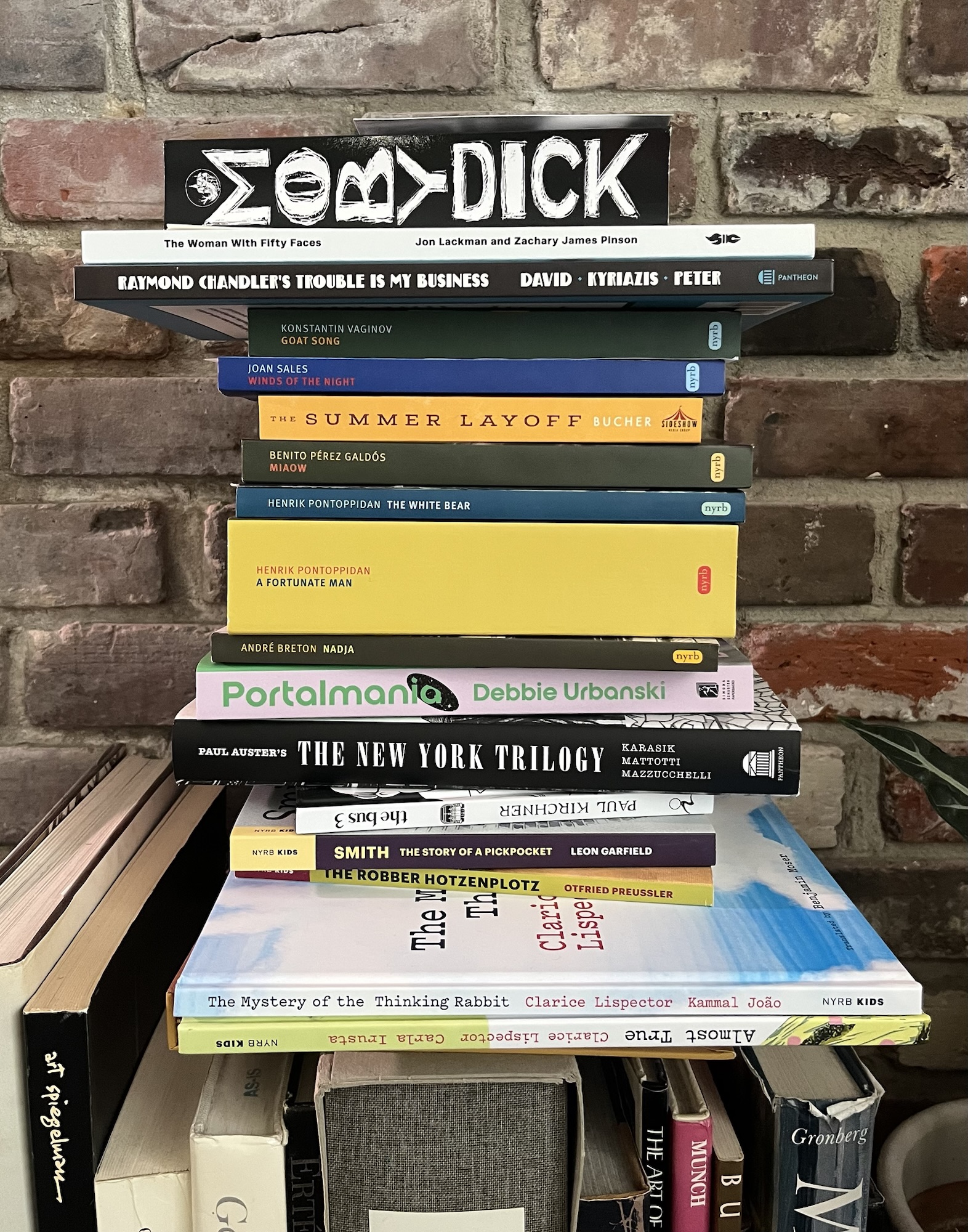
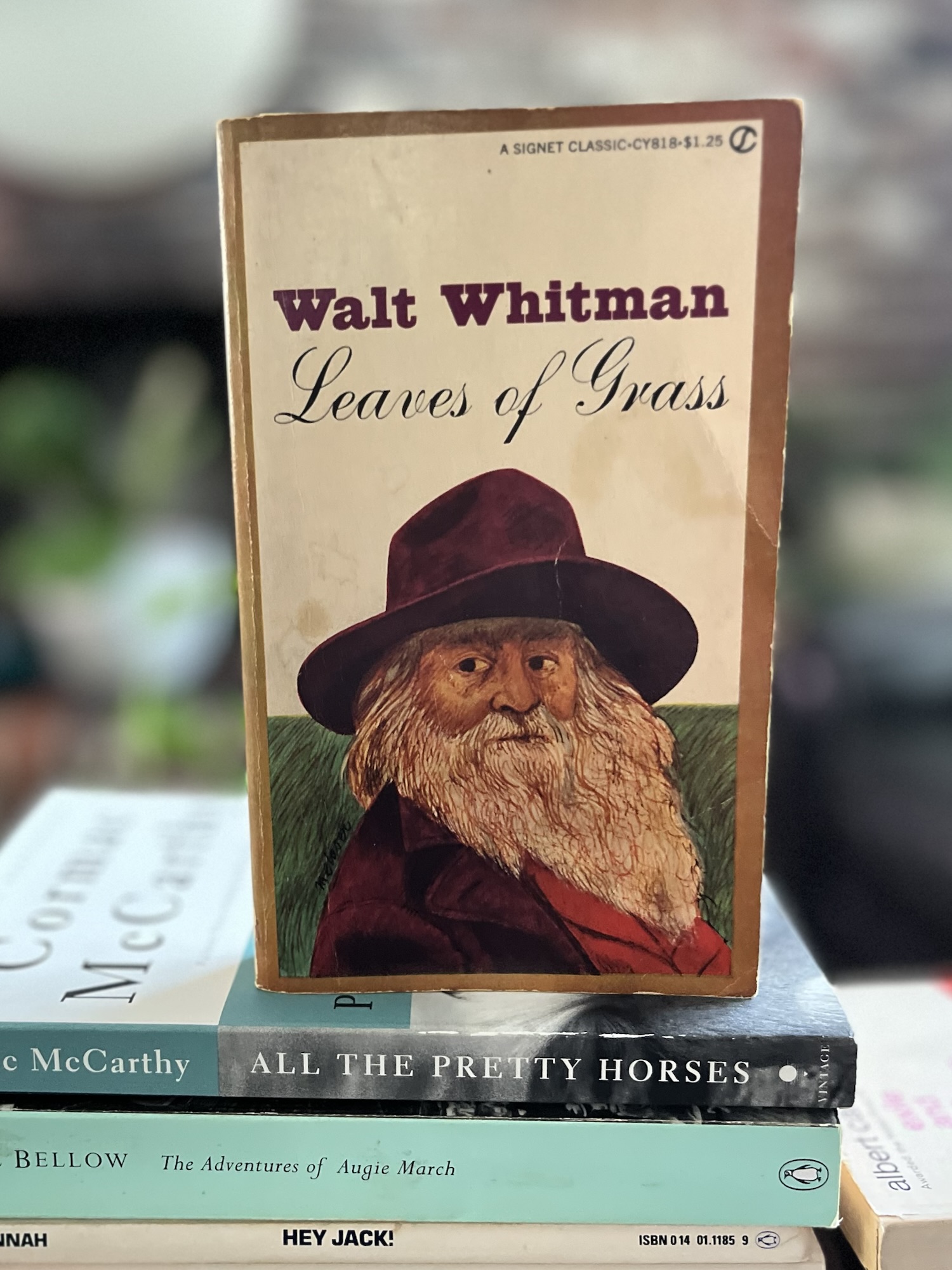
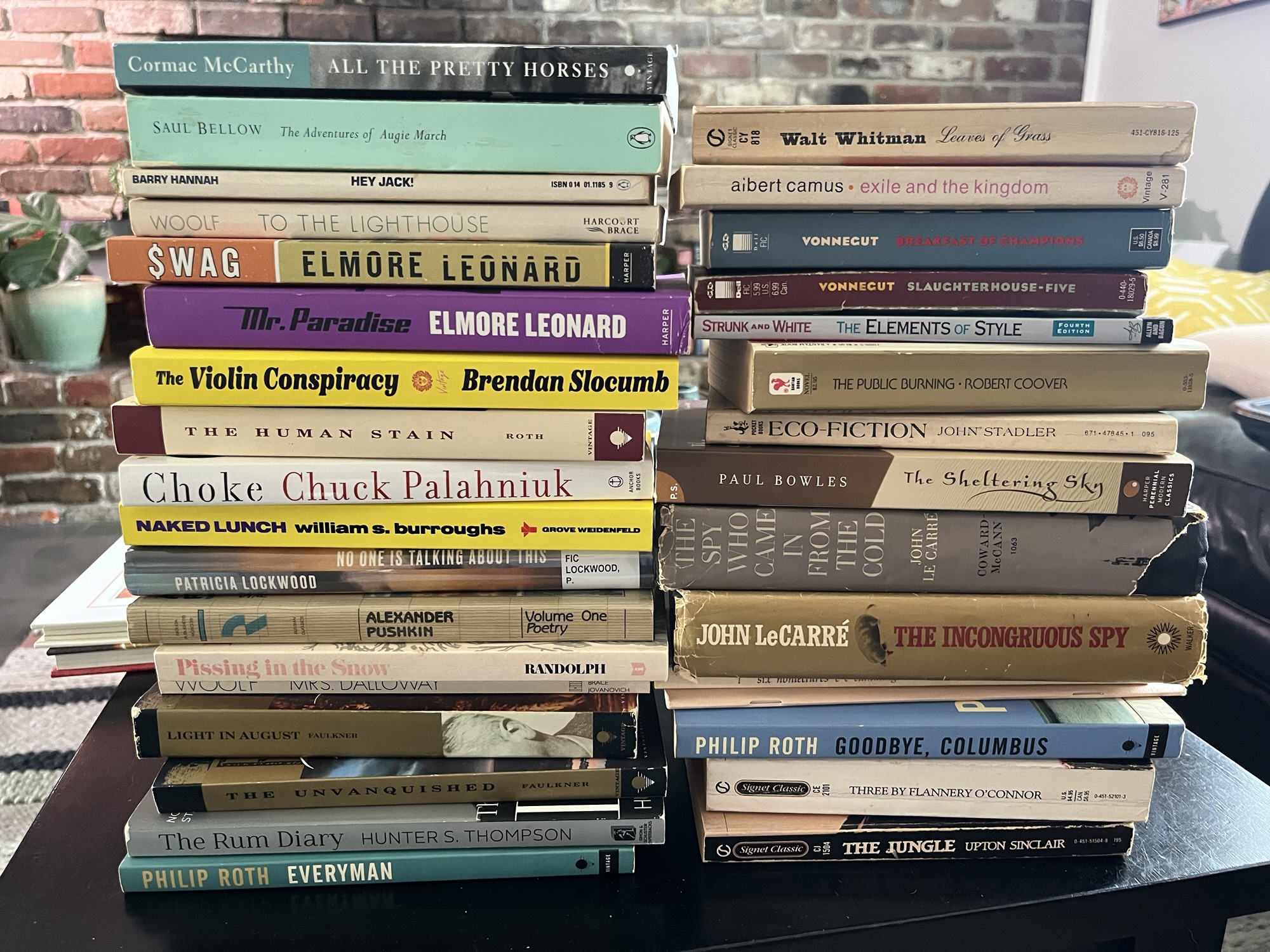
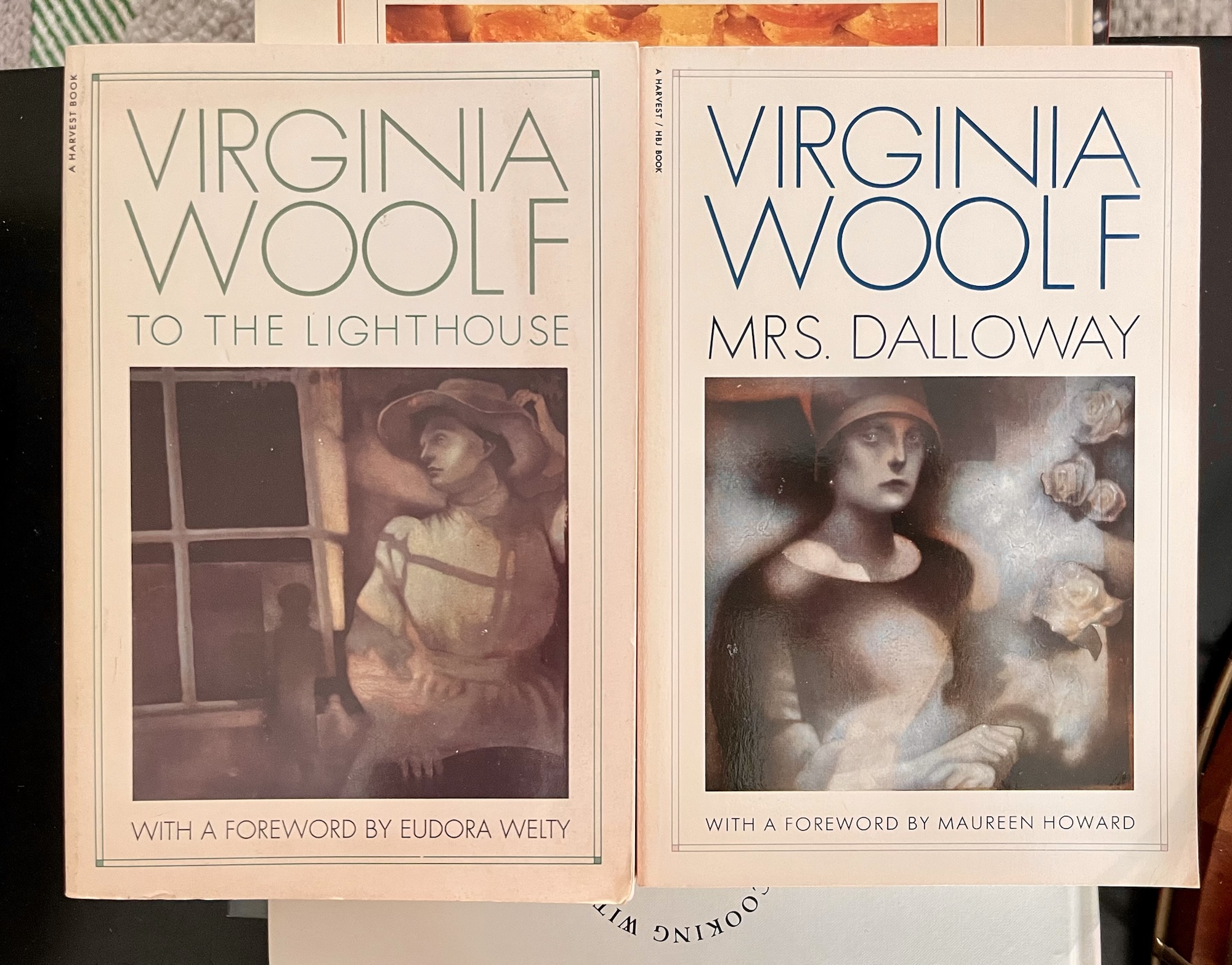
What an interesting few weeks it’s been! Here’s (some of) what I’ve been reading so far this year:

I’m in the middle of Stephen Dixon’s novel Interstate. It is a devastating, ugly, addictive, beautiful novel; I have no idea if it is “good” or not but I love it. I can’t really think of a single person I know (in real life) I could recommend it to. We played cards with some friends and one of them asked about what I was reading, and I said a novel called Interstate by this guy Stephen Dixon, and she asked of course What’s it about? and I said something, Well, this guy’s driving on the interstate with his daughters and two guys in a van pull up along side him and start shooting at them, killing his younger daughter–this happens in like, the first few paragraphs–and then we see how this event destroys his life–but then Dixon repeats the initial scenario like seven more times with different (but all really tragic so far) outcomes–and it’s written in this addictive vocal style that might be really off-putting to many readers, and it also makes really fascinating use of the coordinating conjunction for, which may just be a verbal tic –and it’s also really funny at times? I am not trying to sell this novel to anyone but I love it.

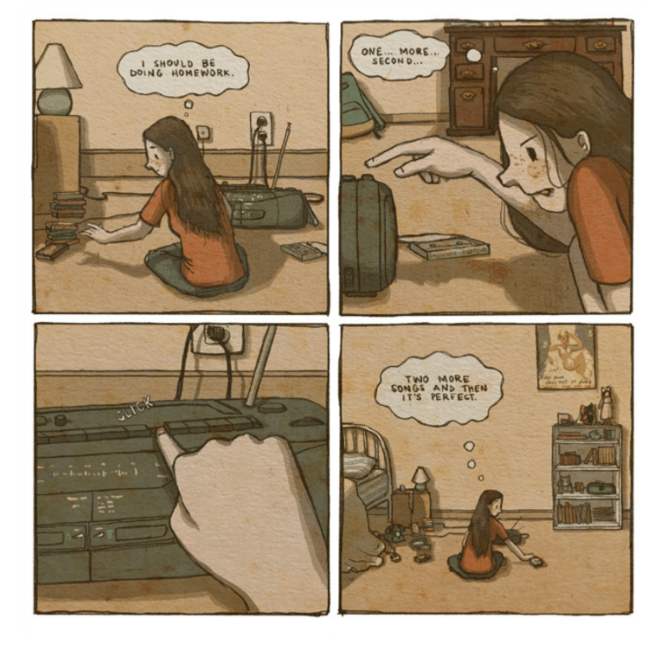
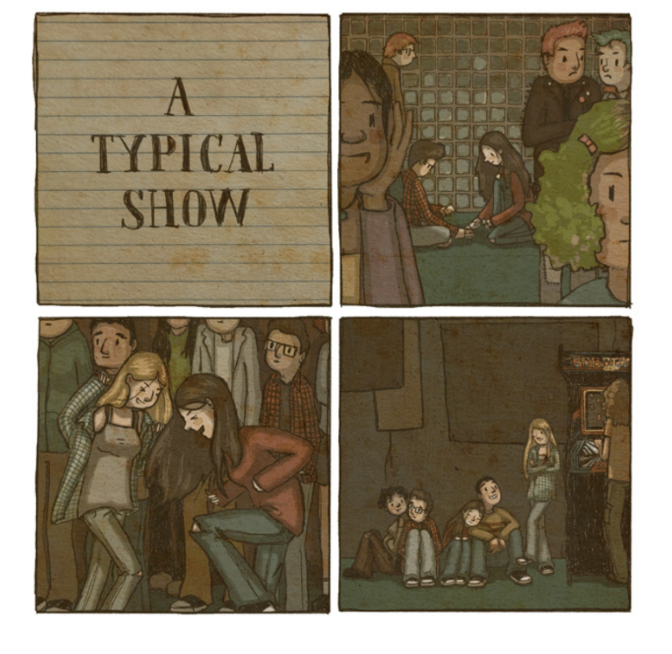
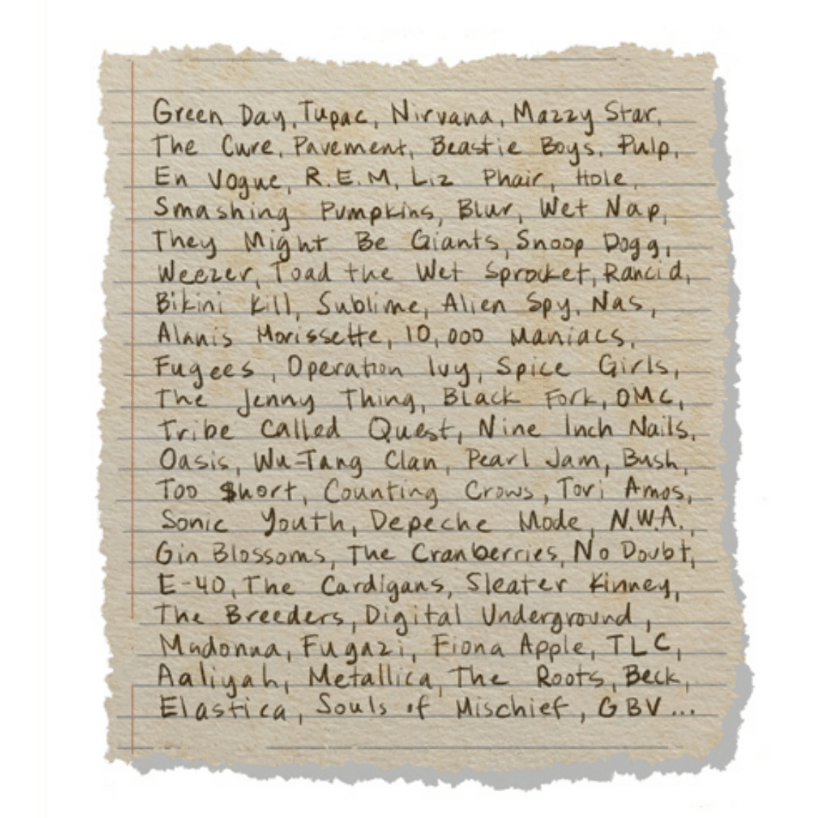
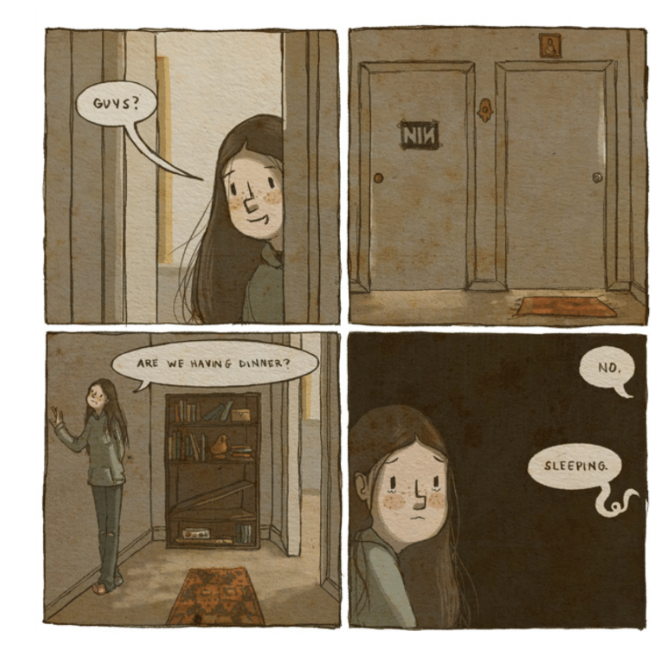
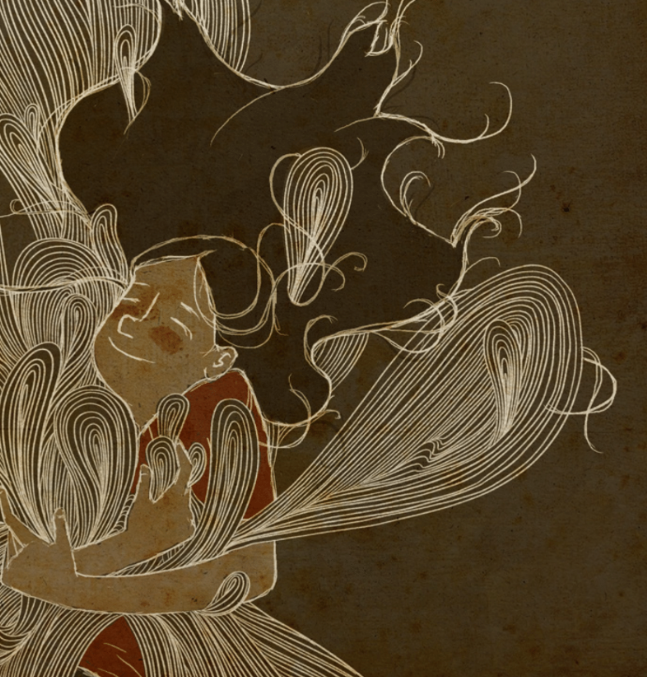
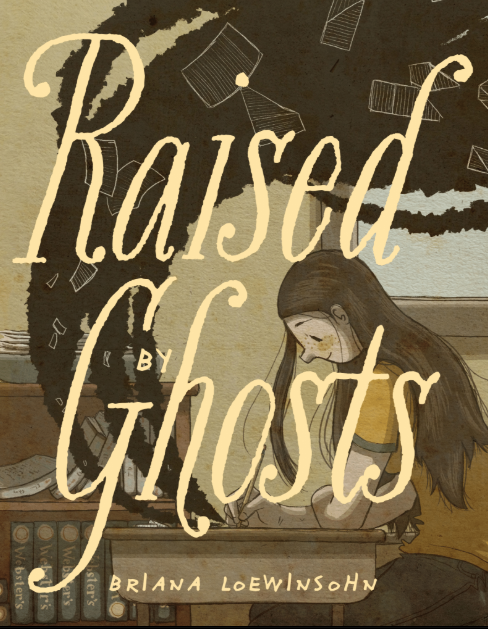
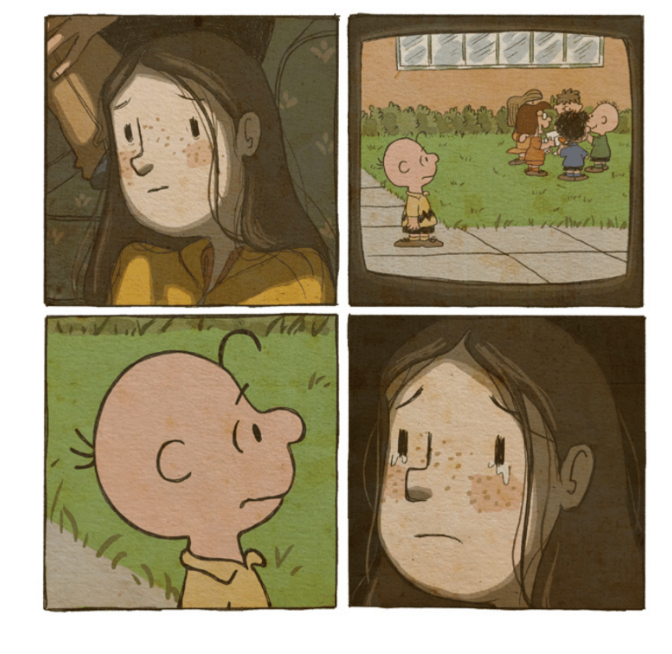
My reading experience of Briana Loewinsohn’s graphic novel Raised by Ghosts was kinda sorta the opposite of Dixon’s Interstate in that after I finished it I immediately pressed it on my wife and then my kids and then texted some of my oldest friends about it (oldest in the previous clause should be understood to modify the friendship, not the actual friend’s years–although we’re all getting older). We’re all getting older, all the time, and Raised by Ghosts provoked an aged nostalgia in me. I’m about half a year older than Loewinsohn and so much of her semi-autobiographical novel resonated with me. She gets everything right about what it was like to be a little bit of a weirdo at school in the nineties. There’s this wonderful passage on how important it was to get a handwritten note from a friend; there’s a page that’s nothing but a notebook page filled with band names; there’s a marvelous scene where our hero loses her shit watching You’re a Good Man, Charlie Brown. I should have a proper review this week or next, but great stuff. (The whole family loved it, by the way.)

I’ve been reading a collection of Dino Buzzati short stories translated by Lawrence Venuti; my technique is to read one of the shorter stories when I feel a bit of dread or anxiety from, like, reading something else. (The collection is called The Bewitched Bourgeois by the way.) I’ve enjoyed reading them, and have especially enjoyed allowing myself to read them at random instead of following the collection’s chronological trajectory. Very Kafka, very Borges, but also very original.

Not in the picture above, but I’ve also been working my way through a digital copy of Vladimir Sorokin’s short story collection Dispatches from the District Committee, in translation by Max Lawton (and illustrated by Gregory Klassen). Great gross stuff.

I picked up a collection of Jane Bowles’ sketches, letters, and other ephemera a few weeks ago–I love her stuff, but really it was that these were contained in the somewhat-rare Black Sparrow Press edition Feminine Wiles. I’m pretty sure all of the stuff here is collected in My Sister’s Hand in Mine, but I’ve enjoyed dipping into this one more. It’s slim, not bulky, but that bulky boy’s around her (My Sister’s) if I need him.

My uncle sent me a copy of Werner Herzog’s 2022 memoir Every Man for Himself and God Against All for Christmas (in translation by Michael Hofmann). I devoured the first few chapters and then a colleague hipped me to the fact that there’s an audiobook of Herzog reading his memoir (available on Spotify and other platforms) — so on my commute I’ve been listening to him read his own memoir, which is just amazing. Like fucking amazing. Hearing him say phrases like “the escapades of Christopher Robin, Winnie-the-Pooh, Piglet, and Eeyore” or that “chipmunks…have something consoling about them” is surreal. There are like fifty insane things that happen in every chapter, and if Dwight Garner of the failing New York Times attested that he didn’t “believe a word” of the memoir, I take the opposite tack. Everything is true, everything is permitted.
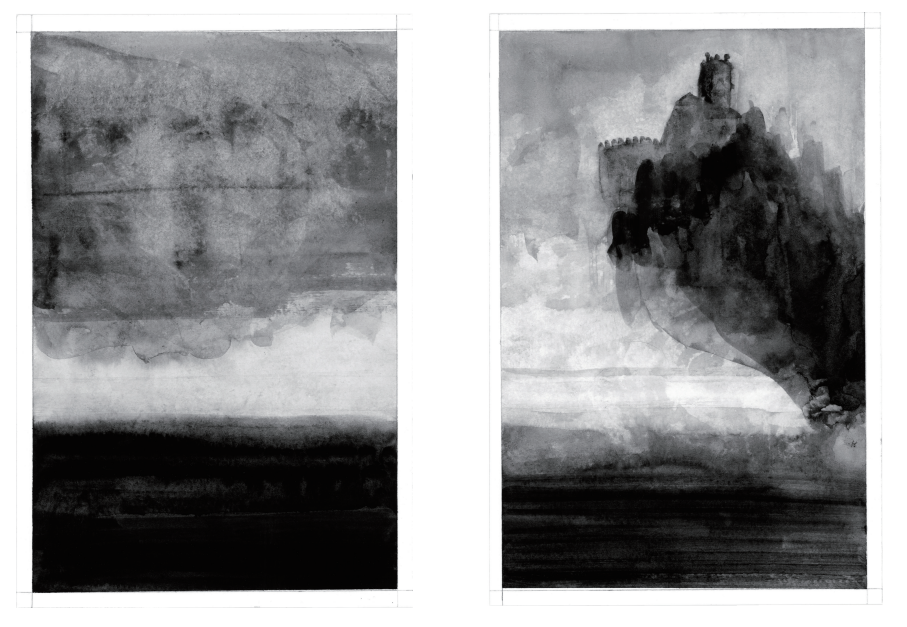
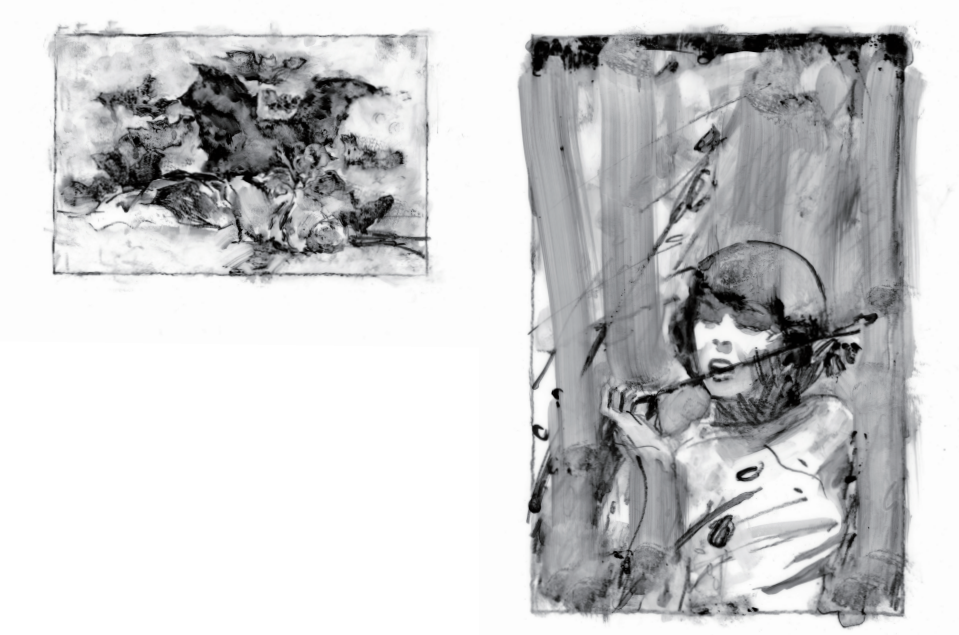
Finally, I can’t really say I’ve been “reading” Remedios Varo: El hilo invisible by Jose Antonio Gil and Magnolia Rivera. My grasp of Spanish cannot graspingly grasp too much of the Spanish (although my iPhone’s picture-text-translate thing works fine when I’m really curious), but the book is a lovely visual catalog of not just one of my favorite artist’s works (including many pieces I haven’t seen before), but also documents her visual influences. I picked it up at the Museo de Arte Moderno in Mexico City back in January, still floating on the high of seeing many of Varo’s lovely paintings there that afternoon.

Mass-market Monday | William Gibson’s Neuromancer

Neuromancer, William Gibson. Ace Books (1984 imprint; 29th printing). No cover designer or artist credited. 271 pages.
ISFDB gives the cover artist as Rick Berry.

I borrowed and never returned Neuromancer from one of my best friends. We were best friends in middle school, but I stole this book like senior year of high school or maybe the year after. 1997ish, when the world seemed fairly settled.

According to a blog I wrote in 2006 (JFC), I lost my friend’s copy to one of my students, who took it and never returned it. Did I buy this 29th printing to replace the copy that I’d sorta-kinda-stolen years ago? I can’t recall. I vaguely recall doing so, but it’s also possible I’ve fabricated the past, creating memories like a man wielding large shears and bolts of felt might create strange stupid felt shapes.

Tilford, I’m sorry. You probably can’t have your book back, but you can have this one. Just let me know.

I would love to bottle the feeling of reading those first three Gibson novels and to sip from that bottle, but that’s nostalgia, and fuck nostalgia. 

Mass-market Monday | J.G. Ballard’s Billenium

Billenium, J.G. Ballard. Berkley Medallion Books (1962). No cover designer or artist credited. 159 pages.

ISFDB credits Richard Powers as the cover artist.

Ten years ago I read The Complete Short Stories of J.G. Ballard and wrote about them on this blog. At the end of the (exhausting) project (about 1200 pages and just under 100 stories), I made a shortlist of 23 “essential” J.G. Ballard short stories. I included two of the ten stories from Billenium in that list: the title track “Billenium” and “Chronopolis.” Of the latter, I wrote:

“Chronopolis” offers an interesting central shtick: Clocks and other means of measuring and standardizing time have been banned. But this isn’t what makes the story stick. No, Ballard apparently tips his hand early, revealing why measuring time has been banned—it allows management to control labor:

‘Isn’t it obvious? You can time him, know exactly how long it takes him to do something.’ ‘Well?’ ‘Then you can make him do it faster.’

But our intrepid young protagonist (Conrad, his loaded name is), hardly satisfied with this answer, sneaks off to the city of the past, the titular chronopolis, where he works to restore the timepieces of the past. “Chronopolis” depicts a technologically-regressive world that Ballard will  explore in greater depth with his novel The Drowned World, but the details here are precise and fascinating (if perhaps ultimately unconvincing if we try to apply them as any kind of diagnosis for our own metered age). Ending on a perfect paranoid note, Ballard borrows just a dab of Poe here, synthesizing his influence into something far more original, far more Ballardian. Let’s include it in something I’m calling The Essential Short Stories of J.G. Ballard.

Donald Barthelme’s Forty Stories in reverse, Part V

Previously,

Stories 40-36

Stories 35-32

Stories 31-28

Stories 27-24

23 . “A Few Moments of Sleeping and Waking” (Unspeakable Practices, Unnatural Acts, 1968)

I’ve been reading the stories in Forty Stories as kinda-sorta palate cleansers, usually ingesting one or two between novels; my method is to take a few initial notes to come back to, cross-reference against Tracy Daugherty’s Barthelme biography Hiding Man, and then riff on my general impression. Sometimes a few weeks go by from the time I’ve read or reread one of these stories and the time I actually get around to writing about them. Until now, the title alone has activated some memory or aesthetic impression about the story, but “A Few Moments of Sleeping and Waking” was a total blank for me. I suppose in my memory it simply segued out of the story that preceded it in Barthelme’s excellent 1968 sophomore collection, Unspeakable Practices, Unnatural Acts. That story was “Edward and Pia,” metapseudoautobiographical stand-ins for Barthelme and his third wife Birgit. “A Few Moments” is more droll low-stakes tension between the pair; there’s a little here on films and dreams and their interpretations. The best bit of the story is a moment on cabbage:

Pia was chopping up an enormous cabbage, a cabbage big as a basketball. The cabbage was of an extraordinary size. It was a big cabbage.
“That’s a big cabbage,” Edward said.
“Big,” Pia said.
They regarded the enormous cabbage God had placed in the world for supper.

22 . “The Flight of Pigeons from the Palace” (Sadness, 1972)

A lovely little story, so short and sweet it really can’t be summarized! But I’ll give it a shot: “The Flight” is a comic riff on the audience’s addiction to novelty and sensation. The third-person “we” who narrates “Flight” is a kind of postmodern carnival barker, barking new wonders into existence:

The lineup for opening night included:

A startlingly handsome man

A Grand Cham

A tulip craze

The Prime Rate

Edgar Allan Poe

A colored light

We asked ourselves: How can we improve the show?

We auditioned an explosion.

Barthelme’s not really a moralist, hardly a Hawthorne, but I think he does offer oblique lessons, or warnings really, to his reader. “Flight” culminates thus:

The supply of strange ideas is not endless.

The development of new wonders is not like the production of canned goods. Some things appear to be wonders in the beginning, but when you become familiar with them, are not wonderful at all.

The story concludes in the threatening specter of newly-contracted volcano.

21 . “At the Tolstoy Museum” (City Life, 1970)

Like “Flight,” “At the Tolstoy Museum” is one of Barthelme’s literal cut-and-paste collage stories — that is, a story to include the author’s own visual collages, juxtaposed against his verbal collages. In “Flight,” the collages seem incidental. They aren’t exactly affectations, and they don’t add anything to the story–but they don’t detract either. The visual collages in “At the Tolstoy Museum” are deployed more judiciously, serving as punchlines that resound off of the narrator’s flat, affectless pose:

I was eating a sandwich at the Tolstoy Museum. The Tolstoy Museum is made of stone—many stones, cunningly wrought Viewed from the street, it has the aspect of three stacked boxes: the first, second, and third levels. These are of increasing size. The first level is, say, the size of a shoebox, the second level the size of a case of whiskey, and the third level the size of a box that contained a new overcoat. The amazing cantilever of the third level has been much talked about. The glass floor there allows one to look straight down and provides a “floating” feeling. The entire building, viewed from the street, suggests that it is about to fall on you. This the architects relate to Tolstoy’s moral authority.

Tolstoy’s Coat

In Hiding Man, Daugherty relates that after “At the Tolstoy Museum” was published in The New Yorker (24 May 1969) “a family from Holly Hill, Florida [wrote to the magazine to learn the location of the Tolstoy Museum.” About two weeks later, Tolstoy’s daughter, the Countess Alexandra L. Tolstoy sent a more indignant letter to the magazine, referring to the story as “Donald Barthelme’s absurd article…What is the aim of such an article? To make people laugh? … How funny! Ha, ha, ha.” Great stuff all around.

20 . “The Wound” (Amateurs, 1976)

A surreal sketch featuring a bullfighter, his mother, his mistress, a bishop, and a famous aficionado (of, implicitly, bullfighting, and, explicitly, breasts), as well as a cast of grumbling minions and peons. Barthelme’s stories are often collage-like, anti-real, hyper-real, or outright absurd, but they are, at least in my estimation, rarely dreamlike. But “The Wound” moves like a dream — a brief, stifled dream, one that reveals something about himself to the dreamer, who later might lament, But I already knew that, like the Bishop who laments his therapy:

The Bishop begins to talk about his psychoanalysis: “I am a different man now,” the Bishop says. “Gloomier, duller, more fearful. In the name of the Holy Ghost, you would not believe what I see under the bed, in the middle of the night.” The Bishop laughs heartily. The torero joins him. The torero’s mistress is filming the Bishop. “I was happier with my whiskey,” the Bishop says, laughing even harder.

The Queen of Gypsies arrives, claiming wounds. There’s “An ecstasy of shrinking” and the final vision of “an immense black bull” blocking the door way. It “begins to ring, like a telephone.”

“The Wound” is a short example that might be handed off to any young person clamoring for meaning or theme or symbolism from every text they read. Sometimes it’s just a dream, a goof, an aesthetic gesture. Sometimes there’s just a surreal punchline that needs to erupt, like a giant black bull ringing like a telephone, blocking the only exit in sight.

Thank you David Lynch

RIP David Lynch, 1946-2025

We weirdos lost a spiritual uncle today.

Lose isn’t exactly the right word–the work is still there, the tremendous body of works, the films and images that I’ve returned to for so much of my life, films and images my fourteen-year-old son has recently been drawn to himself, wholly independent of me, getting there through his own weird back channels, my son who asked me just the other day if we could watch Eraserhead, and I said, Not yet, although I was the same age as he is now when I watched Eraserhead and let it do something weird to me. Maybe we’ll start with The Elephant Man instead, let it break his heart a little. Keep him away from Fire Walk With Me until he can handle it (you can never really handle it). I saw them all too young. Was way too young when my older cousin showed me Blue Velvet; I think it imprinted on me. Rewatching it (for the fifth? tenth?) time a decade and a half later, I realized I was Kyle M’s Jeffrey Beaumont peering through the closet in horror at the Adult World. Maybe I wasn’t too young. But I’ve loved them all, again and again—Lost Highway, the first one I got to see in a theater, Mulholland Dr. (the best one?), Inland Empire (really the best one). Even Dune, the first one I saw, perplexed as hell. My parents let us watch it again and again on VHS and it always refused to cohere. I think they thought it was like Star Wars, which it both was and very much wasn’t. Even the straight one he made for the normies (especially the one he made for the normies–although I don’t know if they appreciated it). But really, especially, when he Got the Old Gang Back Together for Twin Peaks: The Return—it was such a gift, a gift that seemed to come out of nowhere, unexpected, but I think even then we could recognize what a beautiful gift it was — even if it broke my heart all over again at the end, in the best possible way (“What year is this?” / “Laura!” / HOWL). I think we all knew to say Thank you then; I think we showed our love in return for the artist’s gifts. I’m thankful now, sad, selflishly sad that there won’t be one more gift, one more vision that could never come from another mind. But thankful.

Best Books of 1975?

Previously:

Best Books of 1972?

Best Books of 1973?

Best Books of 1974?

Not-really-the-rules recap:

I will focus primarily on novels here, or books of a novelistic/artistic scope.

I will include books published in English in 1975; I will not include books published in their original language in 1975 that did not appear in English translation until years later. So for example, Thomas Bernhard’s Korrektur will not appear on this list because although it was published in German in 1975, Sophie Wilkins’ English translation Correction didn’t come out until 1979.

I will not include English-language books published before 1975 that were published that year in the U.S.

I will fail to include titles that should be included, either through oversight or ignorance but never through malice. For example, I failed to include Dinah Brooke’s excellent 1973 novel Lord Jim at Home in my Best Books of 1973? post because I didn’t even know it existed until 2024. Please include titles that I missed in the comments.

So, what were some of the “Best Books of 1975?”

William Gaddis’s novel J R, one of the greatest 20th c. American novels, was published in 1975. I’ll make note of it first as an artistic ballast against the commercial list I’m about to offer up: The New York Times Best Seller list for 1975.

James Michener’s 1974 novel Centennial dominates the NYT list through winter and spring of 1975 (save for a brief one-week blip when Joseph Heller’s 1974 novel Something Happened published in paperback). By the summer, Arthur Hailey’s The Moneychangers rose to the top of the bestseller, the first novel of 1975 to do so. Judith Rossner’s Looking for Mr. Goodbar and E.L. Doctorow’s Ragtimcompeted for the top slot throughout the fall of ’75, with Agatha Christie’s final Poirot novel Curtain taking over in the winter.

My sense is that of these bestsellers, Ragtime‘s critical reputation has probably endured the strongest. The editors of the NYT Book Review included Ragtime in their 28 Dec. 1975 year-end round-up, along with Donald Barthelme’s The Dead Father, Saul Bellow’s Humboldt’s Gift, Peter Handke’s A Sorrow Beyond Dreams, Peter Matthiessen’s Far Tortuga and V. S. Naipaul’s Guerrillas

William Gaddis’s J R won the 1976 National Book Award for fiction; Paul Fussell’s The Great War and Modern Memory took the NBA for nonfiction; the NBA for poetry went to John Ashberry’s Self-Portrait in a Convex Mirror, and Walter D. Edmond’s Bert Breen’s Barn won the NBA for children’s literature. NBA finalists that year included Bellow’s Humboldt’s GiftVladimir Nabokov’s story collection Tyrants DestroyedJohnanna Kaplan’s Other People’s LivesLarry Woiwode’s Beyond the Bedroom Walland The Collected Stories of Hortense Calisher. (Robert Stone’s excellent 1974 novel Dog Soldiers won the 1975 NBA, if you’re keeping track).

If Bellow was sore about losing the NBA to Gaddis, he could console himself with the 1976 Pulitzer Prize for Literature (for Humboldt’s Gift). The 1975 Nobel Prize in Literature went to Eugenio Montale “for his distinctive poetry, which, with great artistic sensitivity, has interpreted human values under the sign of an outlook on life without illusions.” Montale did not publish a book in 1975.

The 1975 Booker Prize shortlisted only two of eighty-one novels (both published in 1975):  Ruth Prawer Jhabvala’s Heat and Dust and Thomas Keneally’s Gossip From the Forest. Heat and Dust took the prize.

The American Library Association’s Notable Books of 1975 list echoes many of the titles we’ve already seen, as well as some interesting outliers: Andre Brink’s self-translation of Looking on Darkness (banned by South Africa’s apartheid government), Alan Brody’s Coming ToBen Greer’s prison novel Slammer, Dagfinn Grønoset’s Anna (translated by Ingrid B. Josephson), Donald Harrington’s The Architecture of the Arkansas Ozarks, Anne Sexton’s The Awful Rowing toward God, and Mark Vonnegut’s memoir The Eden Express.

The National Book Critics Circle Awards for 1975 were Doctorow’s Ragtime, R.W.B. Lewis’s biography Edith Wharton, Ashbery’s Self-Portrait in a Convex Mirror, and Fussell’s The Great War and Modern Memory.

The 1975 Nebula Awards long list is particularly interesting. Along with sci-fi stalwarts like Poul Anderson, Alfred Bester, and Roger Zelzany, the Nebulas expanded their reach to include Doctorow’s Ragtime and Italo Calvino’s Invisible Cities. William Weaver’s translation of Invisible Cities was actually published in 1974 — as was the Nebula winner for 1975, Joe Haldeman’s The Forever War. Significant Nebula Awards shortlist titles published in 1975 include Joanna Russ’s The Female Man, Robert Silverberg’s The Stochastic Man, and Tanith Lee’s The Birthgrave. Most notable though is the inclusion of Samuel R. Delaney’s cult classic Dhalgren.

The 1976 Newberry Award went to Susan Cooper’s 1975 novel The Grey King; the Newberry Honor Titles were Sharon Bell Mathis’s The Hundred Penny Box (illustrated by Diane and Leo Dillon) and Laurence Yep’s DragonwingsOther notable books for children and adolescents published in 1975 include Natalie Babbitt’s Tuck EverlastingBeverly Cleary’s Ramona the Brave, and Roald Dahl’s Danny, the Champion of the World. 

Awards aside, commercial successes for 1975 included Stephen King’s Salem’s Lot, Joseph Wambaugh’s The Choirboys, Jack Higgins’s The Eagle Has Landed, James Clavell’s Shōgun, Michael Crichton’s The Great Train Robbery, Lawrence Sanders’s Deadly Sins, and Anthony Hope’s The Prisoner of Zenda.

Some critical/cult favorites (and genre exercises) from 1975 include: Martin Amis’s Dead Babies, J.G. Ballard’s High-Rise, Malcolm Bradbury’s The History Man, Charles Bukowski’s Factotum, Rumer Godden’s The Peacock Spring, Xavier Herbert’s insanely-long epic Poor Fellow My Country, Gayl Jones’s Corregidora, David Lodge’s Changing Places, Bharati Mukherjee’s Wife, Gary Myers’s weirdo fiction collection The House of the Worm, Tim O’Brien’s debut Northern Lights, James Purdy’s In a Shallow Grave, James Salter’s Light Years, Anya Seton’s Smouldering Fires, Gerald Seymour’s Harry’s Game, Robert Shea and Robert Anton Wilson’s The Illuminatus! Trilogy, Glendon Swarthout’s The Shootist, and Jack Vance’s Showboat World.

I’ve only read about fifteen books mentioned here (although I’ve abandoned several of them more than once (I’m looking at you Illuminatus! Trilogy and Dhalgren), so my own “best of 1975” list is uninformed and provisional, and frankly pretty obvious to anyone who checks in on this blog semi-regularly. My picks for ’75: J R, William Gaddis; The Dead Father, Donald Barthelme; High-Rise, J.G. Ballard.

A few sentences on every book I read or reread in 2024

☉ indicates a reread.

☆ indicates an outstanding read.

In some cases, I’ve self-plagiarized some descriptions and evaluations from my old tweets and blog posts.

I have not included books that I did not finish or abandoned.


Cake & Prostheses, Gerhard Rühm; trans. Alexander Booth

Sexy, surreal, silly, and profound. Lovely little thought experiments and longer meditations into the weird.

Abel Sanchez and Other Stories, Miguel de Unamuno; trans. Anthony Kerrigan

Both sad and funny, Abel Sanchez, the 1917 novella that makes up the bulk of this volume, feels contemporary with Kafka and points towards the existentialist novels of Albert Camus

After World, Debbie Urbanski

Debbie Urbanski’s debut novel After World reimagines the end of humanity—or perhaps the beginning of a new digital existence. The narrator, [storyworker] ad39-393a-7fbc, reconstructs the life of Sen Anon, the last human archived in the Digital Human Archive Project, using sources like drones, diaries, and other materials. Drawing on tropes from dystopian and post-apocalyptic literature, this metatextual novel references authors like Octavia Butler and Margaret Atwood while nodding to works such as House of Leaves and Station Eleven. Urbanski’s spare, post-postmodern approach also reminded me of David Markson’s Wittgenstein’s Mistress—good stuff.

Walking on Glass, Iain Banks

Walking on Glass weaves together three narrative threads: an art student’s infatuation, a paranoid-schizophrenic secret agent, and two ancient warriors trapped in a castle playing bizarre games. While the novel has some wonderful and funny moments, Banks’s debut The Wasp Factory is the stronger effort.

Red Pyramid, Vladimir Sorokin; trans. Max Lawton

If you’re interested in reading Sorokin but aren’t sure if you want to jump into the deep end with Blue Lard (or abject hell with Their Four Hearts), the collection Red Pyramid is a good starting place. In her blurb for the NYRB collection, Joy Williams describes Sorokin’s writing as “Extravagant, remarkable, politically and socially devastating, the tone and style without precedent, the parables merciless, the nightmares beyond outrance, the violence unparalleled.”

Ava, Carole Masso

The controlling intelligence of Carole Masso’s 1991 novel is the titular Ava, dying too young of cancer. Ava spools out in an elliptical assemblage of quips, quotes, observations, dream thoughts, and other lovely sad beautiful bits. Masso creates a feeling, not a story; or rather a story felt, intuited through fragmented language, experienced.

Dune, Frank Herbert☉

I have always remembered liking the first half of the first Dune novel and thinking that the book’s pacing, depth, and characterization falls apart in the second half. I thought the second of Villeneuve’s Dune films was so bad that I ended up listening to the audiobook to confirm if there was anything in the original material. The audit confirmed my suspicion that the first half of Dune is good—there’s a dinner scene that’s excellent—but the novel falls apart under its epic ambitions. Herbert is very good at writing about deceit, mind games, spycraft; he’s awful with action, legend, and myth.

Escape Velocity, Charles Portis

Charles Portis wrote five novels, all of which are excellent. He may have a perfect oeuvre. Escape Velocity collects some of his early journalism (he was on the Elvis beat for awhile, and then he covered the Civil Rights movement); there are also some short stories, a play, a few odds and ends. For completists only.

I Am Not Sidney Poitier, Percival Everett☆

A brilliant, picaresque satire that follows its absurdly named protagonist on a series of misadventures, washing the surreal in acid social commentary. A Candide for the cable teevee age.

The Einstein Intersection, Samuel R. Delaney

Shambolic and mythic, Delaney’s novel retells the story of Orpheus in a narrative style that mirrors the musician’s dismemberment and fragmentation.

Blue Lard, Vladimir Sorokin; trans. Max Lawton☉☆

I ended up writing seven riffs on this novel this spring. 

Telephone, Percival Everett

I don’t know which version I read, but it was sad.

How to Set a Fire and Why, Jesse Ball

I reviewed it here, writing, that the narrator “Lucia’s voice is the reason to read How to Start a Fire. It’s compelling and funny and persuasive and hurt. It seems authentic, and I admire the risk Ball has taken—it’s not easy to write a teenage girl who is also a maybe-genius-and-would-be-arsonist.”

The Pepsi-Cola Addict, June-Alison Gibbons☆

Loved this one. From my review:The Pepsi-Cola Addict is a strange and unsettling tale of teen angst that stands on its own as a small burning testament of adolescent creativity unspoiled by any intrusive ‘adult’ editorial hand.”

James, Percival Everett☆

James will likely end up on everyone’s year-end “best of”; to be clear it is mine. Everett’s novel joins a shortlist of strong responses to Adventures of Huckleberry Finn that includes Leslie Fiedler’s Love and Death in the American Novel, Cormac McCarthy’s Suttree, and Robert Coover’s Huck Out West.

Gravity’s Rainbow, Thomas Pynchon☉☆

The key to reading Gravity’s Rainbow is to read it once and then read it immediately again and post a series of silly annotations on your literary blog and then to read it again a year or two later and then a few years after that to listen to it on audiobook while you pressure wash your house and the shed you built a few years ago (with the help of your father-in-law and brother-in-law) and then repaint the house’s shutters and then invent a few other chores so you finish the audiobook. And then write two more annotation blogs about it, eight years after the first series.

Progress, Max Lawton

The Abode, Max Lawton

I’m the sliverest slightest bit wary to include Max Lawton’s novels here, as the versions I’ve read are not necessarily the ones that will publish—but they are big, bold, ambitious, and strange, and they left an incisor-sharp impression upon me this year. Progress is a “maybe-this-is-the-end-of-the-world?” catalog of horrors; The Abode is a self-deconstructing catalog of catalogs, bildungsroman, a (self-)love story.

Demian, Herman Hesse; trans. Michael Roloff and Michael Lebeck

We’ve all had a good great bad evil friend.

Strange Case of Dr Jekyll and Mr Hyde, Robert Louis Stevenson☉☆

I made my family listen to Ian Holm read RLS’s Jekyll and Hyde on a four-hire drive and learned that “Jekyll” is pronounced with a long e and not the accustomed schwa — it rhymes with “treacle” not “freckle.” The book is much better and weirder than I remembered.

One Hundred Years of Solitude, Gabriel García Márquez; trans. Gregory Rabassa☉☆

Much, much sadder than I’d remembered. I’d registered One Hundred Years of Solitude as rich and mythic, its robust humor tinged with melancholy spiked with sex and violence. That memory is only partially correct—García Márquez’s novel is darker and more pessimistic than my younger-reader-self could acknowledge.

On Homo rodans and Other Writings, Remedios Varo; trans. Margaret Carson☉

I enjoyed my discussion with Margaret Carson on her expanded translation of Remedios Varo’s fiction and letters.

The Son of Man, Jean-Baptiste Del Amo; trans. Frank Wynne

Enjoyed this one. From my review: “Del Amo gives us phenomena and response to that phenomena, but withholds the introspective logic of cause-and-effect or analysis that often dominates novels. Instead, he allows us to see what his characters see and to take from those sights our own interpretations.”

The Stars at Noon, Denis Johnson☉

A reread, but I honestly didn’t remember much about The Stars at Noon other than its premise and the fact that its narrator was an alcoholic journalist-cum-prostitute in Nicaragua. (That’s actually the premise.) It hadn’t made the same impression on me as other Johnson novels had when I went through a big Johnson jag in the late nineties and early 2000s, and I think that assessment was correct—it’s simply not as strong as AngelsFiskadoro, or Jesus’ Son.

Radiant Terminus, Antoine Volodine, trans. Jeffrey Zuckerman☆

Excellent stuff; a highlight read of the year. From my review:

“Antoine Volodine’s novel Radiant Terminus is a 500-page post-apocalyptic, post-modernist, post-exotic epic that destabilizes notions of life and death itself. Radiant Terminus is somehow simultaneously fat and bare, vibrant and etiolated, cunning and naive. The prose, in Jeffrey Zuckerman’s English translation, shifts from lucid, plain syntax to poetical flights of invention. Volodine’s novel is likely unlike anything you’ve read before—unless you’ve read Volodine.”

Gringos, Charles Portis☉☆

Portis wrote five novels and all of them are perfect—but I think Gringos, his last, might be my favorite.

Lord Jim at Home, Dinah Brooke☆

Loved it. From my review:

Lord Jim at Home is squalid and startling and nastily horrific. It is abject, lurid, violent, and dark. It is also sad, absurd, mythic, often very funny, and somehow very, very real for all its strangeness. The novels I would most liken Lord Jim at Home to, at least in terms of the aesthetic and emotional experience of reading it, are Ann Quin’s BergAnna Kavan’s Ice, Mervyn Peake’s Gormenghast novels, Virginia Woolf’s Mrs. Dalloway, and James Joyce’s Portrait (as well as bits of Ulysses). (I have not read Conrad’s Lord Jim, which Brooke has taken as something of a precursor text for Lord Jim at Home.)”

American Abductions, Mauro Javier Cárdenas☆

Another favorite novel this year. From a riff back in October:

“If I were to tell you that Mauro Javier Cárdenas’s third novel is about Latin American families being separated by racist, government-mandated (and wholly fascist, really) mass deportations, you might think American Abductions is a dour, solemn read. And yes, Cárdenas conjures a horrifying dystopian surveillance in this novel, and yes, things are grim, but his labyrinthine layering of consciousnesses adds up to something more than just the novel’s horrific premise on its own. Like Bernhard, Krasznahorkai, and Sebald, Cárdenas uses the long sentence to great effect. Each chapter of American Abductions is a wieldy comma splice that terminates only when his chapter concludes—only each chapter sails into the next, or layers on it, really. It’s fugue-like, dreamlike, sometimes nightmarish. It’s also very funny. But most of all, it’s a fascinating exercise in consciousness and language—an attempt, perhaps, to borrow a phrase from one of its many characters, to make a grand ‘statement of missingnessness.'”

Attic, Katherine Dunn☆

Truck, Katherine Dunn

Katherine Dunn’s first novel Attic is seriously fucked up—like William Burroughs-Kathy Acker fucked up—an abject rant from a woman in prison in the mode of Ginsberg’s Howl. The narrator seems to be an autofictional version of Dunn herself, which is perhaps why Eric Rosenblum, in his 2022 New Yorker review described it as “largely a realist work in which Dunn emphasizes the trauma of her protagonist’s childhood.” Rosenblum uses the term realism two other times to describe Attic and refers to it at one point as a work of magical realism. If Attic is realism then so is Blood and Guts in High School. Her second novel Truck is equally weird, but it was maybe too much for me by the end.

Soldier of Mist, Gene Wolfe

Great premise, poor execution.

Final Cut, Charles Burns☆

In my review, I wrote that Final Cut served up “all the sinister dread and awful beauty that anyone following Burns’ career would expect, synthesized into his most lucid exploration of the inherent problems of artistic expression.”

Wise Children, Angela Carter

An enjoyable and maybe old-fashioned effort from Carter. I breezed through it, and remember it fondly.

Garbage, Stephen Dixon☆

I think Stephen Dixon’s novel Garbage was my favorite read of the year. I don’t know if it’s the best novel I read this year, but it was the most compelling—by which I mean it compelled me to keep reading, way too late some nights. From a thing I wrote a few months ago:

“I don’t know if Dixon’s Garbage is the best novel I’ve read so far this year, but it’s certainly the one that has most wrapped itself up in my brain pan, in my ear, throbbed a little behind my temple. The novel’s opening line sounds like an uninspired set up for a joke: ‘Two men come in and sit at the bar.’ Everything that unfolds after is a brutal punchline, reminiscent of the Book of Job or pretty much any of Kafka’s major works. These two men come into Shaney’s bar—this is, or at least seems to be, NYC in the gritty seventies—and try to shake him down to switch up garbage collection services. A man of principle, Shaney rejects their ‘offer,’ setting off an escalating nightmare, a world of shit, or, really, a world of garbage. I don’t think typing this description out does any justice to how engrossing and strange (and, strangely normalGarbage is. Dixon’s control of Shaney’s voice is precise and so utterly real that the effect is frankly cinematic, even though there are no spectacular pyrotechnics going on; hell, at times Dixon’s Shaney gives us only the barest visual details to a scene, and yet the book still throbs with uncanny lifeforce. I could’ve kept reading and reading and reading this short novel; its final line serves as the real ecstatic punchline. Fantastic stuff.”

Graffiti on Low or No Dollars, Elberto Muller☆

A weirdo novel-in-riffs that I loved: bohemian hobo freight hopping, drug lore, art. Muller’s storytelling chops are excellent—he’s economical, dry, sometimes sour, and most of all a gifted imagist.

Galaxies, Barry N. Malzberg

Southern Comfort, Barry N. Malzberg (as “Gerold Watkins”)

A Satyr’s Romance, Barry N. Malzberg (as “Gerold Watkins”)

I really wanted to get into Galaxies, but I couldn’t. Malzberg’s faux-sci-fi metatextualist experiment carries his postmodernist anxiety of influence like a lance tilted against the would-be contemporaries who were more likely to get covered in The New York Times. His metamuscle is as strong as those folks, but you have to tell a story. I preferred the “erotic” novels I read that he wrote under the pseudonym Gerrold Watkins, 1969’s Southern Comfort and 1970’s A Satyr’s Romance.

The Singularity, Dino Buzzati; trans. Anne Milano Appel

From my review of The Singularity:

“Ultimately, The Singularity feels less like a novella than it does a short story stretched a bit too thin. Buzzati adroitly crafts an atmosphere of suspense and foreboding, but the characters are underdeveloped. Like a lot of pulp fiction, Buzzati’s book often reads as if it were written very quickly (and written expressly for money). Still, Buzzati’s intellect gives the book a philosophical heft, even if it sometimes comes through awkwardly in forced dialogue. Anne Milano Appel’s translation is smooth and nimble; it’s a page turner, for sure, and if it seems like I’ve been a bit rough on it in this paragraph in particular, I should be clear: I enjoyed The Singularity.”

Waiting for the Fear, Oğuz Atay; trans. Ralph Hubbell

A book of cramped, anxious stories. Atay, via Hubbell’s sticky translation, creates little worlds that seem a few reverberations off from reality. These are the kind of stories that one enjoys being allowed to leave, even if the protagonists are doomed to remain in the text (this is a compliment). Standouts include “Man in a White Overcoat,” “The Forgotten,” and “Letter to My Father.”

Making Pictures Is How I Talk to the World, Dmitry Samarov

Making Pictures spans four decades of Samarov’s career, showcasing his diverse styles—sketches, inks, oils, and more—through a thematically organized collection. His art, like his writing, emphasizes perspective over adornment, vividly depicting Chicago’s bars, coffee shops, and indie clubs.

Magnetic Field(s), Ron Loewinsohn☆

A hypnotic, fugue-like triptych exploring crime and art as overlapping intimacies. Through a burglar, a composer, and a novelist, it frames imagining another life as a taboo act of trespass.

Body High, Jon Lindsey

A breezy drug novel that’s funny, gross, and abject but tries to do too much too quickly. The narrator, a medical-experiment subject, dreams of writing pro-wrestling scripts, but spirals even further into mania when his underage aunt enters his life and stirs some disturbing desires. Body High is at its best when at its grimiest.

Sunday, Olivier Schrauwen☆

An achievement for slackers the world over. Sunday is a true graphic novel, by which I mean a real novel. Maybe I’ll get to a proper review of it; maybe The Comics Journal will ask me to come back to write reviews again. Anyway. Great stuff, a real achievement to those of us willing to drink a few beers before noon and fail to open the door when neighbors ring the bell.

Tinker Tailor Soldier Spy, John le Carré☉☆

Perfect book.

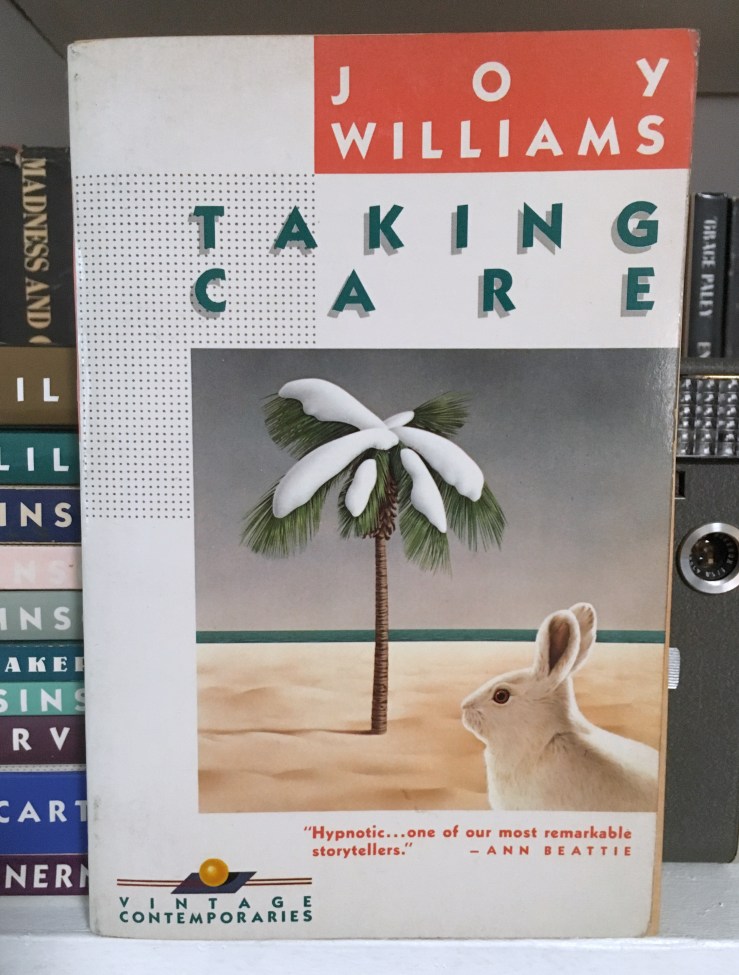
Breaking and Entering, Joy Williams☆

Joy Williams’ fourth novel, 1988’s Breaking and Entering zigs when you expect it to zag. It ends up in a place no reader would expect, and I don’t mean that there’s some weird twist. It twists weirdly like life. The sentences are excellent, but so are the paragraphs. Breaking and Entering is very, very Florida, crammed with weirdos and tragedies, farcical, ironic, and thickly sauced in the laugh-cry flavor. I’m not sure exactly where it’s set, but I do know that I do know the general area, the barrier islands, skinny shining strips of weird between the Gulf and the Tampa Bay.

Hyperion, Dan Simmons

The Fall of Hyperion, Dan Simmons

I listened to Simmons’ mass-cult favorites as audiobooks—Hyperion was good; Fall was pretty terrible! But seriously, the first one is a nice postmodernist sci-fi take on Canterbury Tales. 

Three Trapped Tigers, G. Cabrera Infante; trans. Donald Gardner and Suzanne Jill Levine with collaboration by Infante☆

Language! Language! Language! Bombastic, bullying, buzzing, braying, bristling— Infante’s dizzying mosaic of the fifties at night (and some hungover mornings) in Havana boxes you on your ear before kissing it, your ear, nipping the lobe even, showing off some neat tricks and other twisters of its fat vibrant tongue. A delight.

The Rest Is Silence, Augusto Monterroso; trans. Aaron Kerner

A quick clever slim novel that riffs on literary failure. A nugget from the so-called Latin Boom that surely (don’t call me Shirley!) influenced Roberto Bolaño.

The Obscene Bird of Night, José Donoso; trans. Hardie St. Martin, Leonard Mades, Megan McDowell☆

Heavy and gross, twisted and twisting, I loved Donoso’s The Obscene Bird of Night–reminded me of Goya’s Caprichos and William Faulkner and Anna Kavan soaked in Salò and Aleksei German’s adaptation of Hard to Be a God. About half way through I realized I needed to go back and put together some of the plot strands I’d missed; I think this novel is more coherent than its surreal and grotesque flourishes initially suggest.

Small dents, big books (tl;dr)

I usually finish reading a novel if I stick with it for, say thirty-to-fifty pages. However, as is the case with many readers, I suspect, very long novels foil me; or, rather, time foils me. Obligations intercede. Here are some long novels that I had to put aside for another time. From the top:

Lies and Sorcery, Elsa Morante (775 pages)

If the bookmark I left in Jenny McPhee’s translation Lies and Sorcery is not lying (or ensorcelled), I got seventy pages into it before getting sidetracked with something else. I remember liking what I was reading but also that the book seemed very heavy over my head at night.

The Strudlhof Steps, Heimito von Doderer (840 pages)

I’ve really enjoyed the first fifty pages of Heimito von Doderer’s The Strudlhof Steps (in translation by Vincent Kling). I’ve enjoyed them so much that I’ve read them at least four times over the past three years. The longest I’ve waded into the Steps was to page 99. Again, a slimmer model comes round and I lose my focus—but of the four novels I’ve listed here, von Doderer’s is the one that’s made the biggest impression on me. My bites may have been shallow but I keep going in for seconds.

A Bended Circuity, Robert S. Stickley (637 pages)

Although it’s the shortest novel on this list, my edition of RSS’s ABC feels cramped and constrained. I think the novel would like a bigger home. The pages are too bright, the font too small, the margins too narrow. It’s a cramped reading experience. I suppose I could break down and buy the Corona\Samizdat edition, which may be easier to ease into. Or an e-book? RSS, please agree to an e-book! Some of us have aging eyes. Oh, I got to page 48.

Miss MacIntosh, My Darling, Marguerite Young (1321 pages)

I cracked into Marguerite Young’s Miss MacIntosh, My Darling twice this year; once in the Spring and once in the Fall. Maybe I’ll try again in the Winter. I stalled out 78 pages in, at the end of chapter 3.

More New Cult Canon

(Context, entries 1-8)

(9-14)

15. Battle Royale, Kinji Fukasaku (2000)

I actually rewatched Battle Royale just the other week. In retrospect, it’s difficult to assess the film against the influence it’s had, especially on video games. In his 2008 New Cult Canon entry, Scott Tobias described the film as “Lord Of The Flies meets The Most Dangerous Game meets perhaps the cruelest year of teenage life.” I think what many of us remember about Battle Royale is first the concept, so widely imitated, and then the violence—but it’s actually a gentler film, with hints of Rebel without a Cause (Nicholas Ray, 1955). It’s also kinda goofy and disjointed.

6/10

Alternate: I don’t think they’re widely available as legal streams, but you could track down Kinji Fukasaku’s early 1970’s crime films, the Battles without Honor or Humanity series.

Alternate alternate: 10 minutes of Friedkin on Fukasaku:

16. Dead Man, Jim Jarmusch (1995)

A perfect film, one that seems better every time I see it. Gary Farmington is amazing as William Blake’s spiritual guide (“Stupid fucking white man” is a sublime line reading), and Jarmusch has a loaded bench to bounce pretty boy Depp off of (Iggy Pop is particularly scary, but Robert Mitchum seems an embodiment of evil from a truly different time—magnificent).

10/10

Alternate: El Topo, Alejandro Jodorowsky (1970)

17. Wet Hot American Summer, David Wain (2001)

I have no idea if Wet Hot American Summer holds up well—I think I was always part of its intended audience, part of the tail end of the “Reagan-era latchkey kids who grew up watching” the kind of films Wain’s movie is—satirizing?—on television. I watched Wet Hot American Summer approximately 100 times in 2003; it was one of a handful of DVDs on repeat at my best friend’s childhood house, where my unemployed unstructured ass spent a few nights a week crashing. His folks were in the beginning of a (permanent) separation, and the house seemed to have been ceded to a loose configuration of a dozen or so of us. We’d drink tallboys on the beach, stumble in, and fall asleep to The Royal Tenenbaums (Wes Anderson, 2001) or Reign of Fire (Rob Bowman, 2002) or Human Nature (Michel Gondry, 2001) or Wet Hot American Summer. There were probably others, but those are the ones I remember.

10/10

Alternate: Porky’s, Roy Clark (1981)

18. The Boondock Saints, Troy Duffy (1999)

The Boondock Saints is a truly awful film. It is relentlessly stupid and when it is funny, it is funny by accident—except when Willem Dafoe’s charm takes over one of the scenes he’s chewing up. The viewer can almost sense Dafoe rewriting Duffy’s sketchy, shoddy, nonsensical script in real time. For all its retrograde bluster (and poor filmmaking), The Boondock Saints actually has a viewpoint.

3/10

Alternate: Payback, Brian Helgeland (1999)

19. Punch-Drunk Love, Paul Thomas Anderson (2002)

Another perfect film. In his original New Cult Canon, Tobias suggested that,

Punch-Drunk Love marked the moment when Anderson threw away the stylistic
crutches of forbears like Martin Scorsese and Robert Altman, and came into his
own as an original filmmaker. That doesn’t mean he’s discarded these and other
influences altogether, which isn’t something he could or would want to do. But Punch-Drunk
Love
has a unique texture that’s unmistakably Anderson’s, marked by a wired, coked-up
intensity and a yen for discord. It’s a film that sets viewers on edge from the
start, almost daring you not to like it.

Philip Seymour Hoffman might have stolen the film from Sandler, had he been in it more than the few minutes he’s actually on screen (he’s looming larger in our memory, as always).

10/10

Alternate: Popeye, Robert Altman (1980)

20. Wild Things, John McNaughton (1998)

This is another film that I watched because Tobias wrote about it. I had actually seen McNaughton’s film Henry: Portrait of a Serial Killer entirely by mistake at a “party”; this probably happened around the same time that Wild Things released to theaters. But I never would have connected the two. I thought Wild Things was a different kind of trash than the trash it actually is. Tobias’s write-up makes an argument for Wild Things as high camp, a film told entirely within a set of quotation marks. I think he’s a bit too generous in his admiration for McNaughton’s film, but I ultimately enjoyed it.

6/10

Alternate: Bad Lieutenant: Port of Call New Orleans, Werner Herzog (2009)

Mass-market Monday | Guillermo Cabrera Infante’s Three Trapped Tigers

Three Trapped Tigers, G. Cabrera Infante. Translated by Donald Gardner and Suzanne Jill Levine with Guillermo Cabrera Infante. Avon Bard (1985). No cover artist or designer credited. 473 pages.

A busy buzzy book honking and howling and hooting, I am loving loving loving Three Trapped Tigers—it sings and shouts and hollers. The novel starts with a  polyglossic emcee announcing the parade of honorable horribles who will strut through the novel (if it is indeed a “novel”). Very funny, very engrossing, grand stuff, love it.

Here’s Salman Rushdie, reviewing the novel in the LRB back in 1981 (he’s just fumbled around answering “What is this crazy book actually about?”:

So much for the plot. (Warning: this review is about to go out of control.) What actually matters in Three Trapped Tigers is words, language, literature, words. Take the title. Originally, in the Cuban, they were three sad tigers, Tres tristes tigres, the beginning of a tongue-twister. For Cabrera, phonetics always come before meaning (correction: meaning is to be found in phonetic associations), and so the English title twists the sense in order to continue twisting the tongue. Very right and improper. Then there is the matter of the huge number of other writers whose influence must be acknowledged: Cabrera Infante calls them, reverently, Fuckner and Shame’s Choice. (He is less kind to Stephen Spent and Green Grams, who wrote, as of course you know, Travels with my Cant.) Which brings us to the novel’s most significant character, a sort of genius at torturing language called Bustrofedon, who scarcely appears in the story at all, of whom we first hear when he’s dying, but who largely dominates the thoughts of all the Silvestres and Arsenios and Codacs he leaves behind him. This Bustromaniac (who is keen on the bustrofication of words) gives us the Death of Trotsky as described by seven Cuban writers – a set of parodies whose point is that all the writers described are so pickled in Literature that they can’t take up their pens without trying to wow us with their erudition. Three Trapped Tigers, like Bustrofedon’s whole life, is dedicated to a full frontal assault on the notion of Literature as Art. It gives us nonsense verses, a black page, a page which says nothing but blen blen blen, a page which has to be read in the mirror: Sterne stuff. But it also gives us Bustrolists of ‘words that read differently in the mirror’: Live/evil, drab/bard, Dog/God; and the Confessions of a Cuban Opinion Eater; and How to kill an elephant: aboriginal method ... the reviewer is beginning to cackle hysterically at this point, and has decided to present his opinion in the form of puns, thus: ‘The Havana night may be dark and full of Zorro’s but Joyce cometh in the morning.’ Or: ‘Despite the myriad influences, Cabrera Infante certainly paddles his own Queneau.’