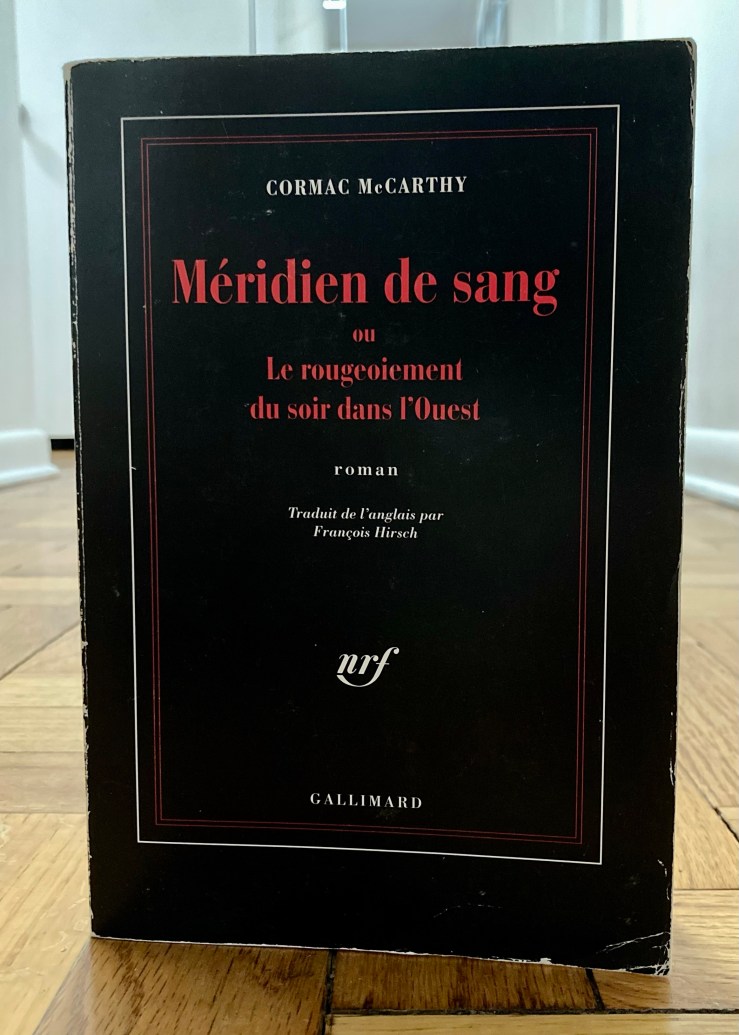
Selections from One-Star Amazon Reviews of Cormac McCarthy’s Blood Meridian

[Editorial note: The following citations come from one-star Amazon reviews Cormac McCarthy’s novel Blood MeridianI’ve preserved the reviewers’ original punctuation and spelling. More one-star Amazon reviews.].


It may be art.

Damn McCarthy.

I find him boring.

unrelenting nihilism

The story is thin at best.

Are we supposed to enjoy it?

I felt abused by Blood Meridian

not a traditionally enjoyable book

this book is simply just not “all that”

wordy, over the top speechy dialogue

endless streams of dependent clauses

I am a devout fan of Cormac McCarthy.

The characters are not really sympathetic

He is obviously a sick man psychologically.

all about violence and no plot what so ever.

if I was a trained geologist I might like it better.

too many words that are not in standard dictionary

I guess people think he is cool because he writes so violent.

This one guy peed on some clay stuff to create a bomb like thing

murder, slaughter, killing, massacre, beating, stabbing, shooting, scalping

It consists of a series of almost unconnected scenes of unspeakable violence.

Esoteric words, eccentric expressions, pedantic philosophizing, arcane symbolism

I have to believe that he must be embarrassed to have this book back on the market.

A bunch of guys ride around Mexico killing everyone they come across for no particular reason

If you’re a fan of babies, quotation marks, and native americans, then avoid this book like the plague.

The reception he has had shows how tone deaf America has become to moral values, any moral values.

This book was written long before McCarthy had mastered the style that has brought him so much fame and credit.

the unrelenting amount of violence and cruelty in Blood Meridian strikes me as having crossed the line to pornography

It seemed like Cormac McCarthy wrote this with a dictionary in his lap trying to find words that he had never used before

Many of the words have to have been made up or are contractions of words and/or non-words, including much Spanish dialogue

Eliminate five words from the English language (“They rode on” and “He spat”)and this book would have been about 25 pages long

In this book, one sees him trying hard to hone his now-extraordinary powers of observation and description, and failing badly.

The standards for writing have clearly fallen far if all the praise heaped upon this inchoate, pompous mess of a novel is to be taken seriously.

Everything died: mules, horses, chickens, plants, rivers, snakes, babies, toddlers, boys, girls, women, men, ranchhands, bartenders, cowboys, good guys, bad guys…

I dont think the writer knows very much about AMERICAN history, the way he makes all the scalping get done by the AMERICANS and never by the indians, nor do I think he a PATRIOT

Wherein a company of men wander northern Mexico and the West killing, maiming, raping, and/or torturing everyone they meet, all described in gory, endless detail, led by the symbolic characters Glanton and his advisor, ‘the judge’, and supposedly illustrating that war and bloodletting are the only things that count, and the rest of life is just a meaningless dance.

Some kid with a few guys and a spattering of mans rambling through some part of the US or Mexico or a post-apocalyptic Australian desert seeing scores of gruesome, pointless scenes of violence, inhumanity, and death.

Holden is the sort of overt child defiling character who in real life wouldn’t last a month in a state penitentiary, because someone would rightly dispatch him as soon as possible.

Self-consciously faux-baroque linguistic stylings make this fetus-hurtin’ Treatise a feast for weakest link readers fascinated by the mark of the beast.

This book has some wonderful flowery language, and some beautiful descriptions of the southwest countryside.

They say that this book contains BIBLICAL themes, but I’ve read it and I don’t see how that could be so.

The author seems as if he is somehow trying to make some kind of “statement” about AMERICA

In a well ordered society McCarthy would be serving a life term or he would not exist at all.

there are times when it even seems as though English were not McCarthy’s first language

this book cannot be called a novel because it does not have character development

Would you let Cormac McCarthy look after your child for the night?

McCarthy is the most evil person because he is a talented writer

the author likes to use pronouns without establishing a subject

Who are the good guys and the bad guys, everyone is bad.

read Lonesome Dove instead, it’s a hundred times better

rampant nonstop mindless violence and depravity

I can’t dislike a book more than I dislike this one

This is a great writer being lazy and skating

good if you enjoy violence and nonsense

Theres lots of scalping of indians

Was there a quota on similes?

this booked scarred me

sociopath killers

It’s pure bunk.

a moral blight

utter trash

Ugh

Suttree, Cormac McCarthy’s Grand Synthesis of American Literature

In his 1992 interview with The New York Times, Cormac McCarthy said, “The ugly fact is books are made out of books. The novel depends for its life on the novels that have been written.” McCarthy’s fourth novel, 1979’s Suttree is such a book, a masterful synthesis of the great literature — particularly American literature — that came before it. And like any masterful synthesis, Suttree points to something new, even as it borrows, lifts, and outright steals from the past. But before we plumb its allusions and tropes and patterns, perhaps we should overview the plot, no?

The novel rambles over several years in the life of Cornelius Suttree. It is the early 1950s in Knoxville, Tennessee, and Suttree ekes out a mean existence on the Tennessee River as a fisherman, living in a ramshackle houseboat on the edge of a shantytown. This indigent life is in fact a choice: Suttree is the college-educated son of an established, wealthy family. His choice is a choice for freedom and self-reliance, those virtues we like to think of, in our prejudicial manner, as wholly and intrinsically American. Suttree then is both Emersonian and Huck Finnian, a reflective and insightful man who finds his soul via a claim to agency over his own individuality, an individuality poised in quiet, defiant rebellion against the conforming forces of civilization. These forces manifest most pointedly in the Knoxville police, a brutal, racist organization, but we also see social constraint in the form of familial duty. One thinks of the final lines of Huckleberry Finn: “I reckon I got to light out for the Territory ahead of the rest, because Aunt Sally she’s going to adopt me and sivilize me and I can’t stand it. I been there before.”

Like Huck, Suttree aims to resist all forces that would “sivilize” him. His time on the river and in the low haunts of Tennessee (particularly the vice-ridden borough of McAnally) brings him into close contact with plenty of other outcasts, but also his conscience, which routinely mulls over its place in the world. Suttree is punctuated by–perhaps even organized by–several scenes of hallucination. Some of these psychotrips result from drunkeness, one comes from accidentally ingesting the wrong kind of mushrooms (or, the right kind, if that’s your thing), and the final one, late in the novel, sets in as Suttree suffers from a terrible illness. In his fever dream, a small nun–surely a manifestation of the guilt that would civilize us–accuses him–

Mr. Suttree it is our understanding that at curfew rightly decreed by law in that hour wherein night draws to its proper close and the new day commences and contrary to conduct befitting a person of your station you betook yourself to various low places within the shire of McAnally and there did squander several ensuing years in the company of thieves, derelicts, miscreants, pariahs, poltroons, spalpeens, curmudgeons, clotpolls, murderers, gamblers, bawds, whores, trulls, brigands, topers, tosspots, sots and archsots, lobcocks, smellsmocks, runagates, rakes, and other assorted and felonious debauchees.

The passage is a marvelous example of McCarthy’s stream-of-consciousness technique in Suttree, moving through the various voices that would ventriloquize Suttree, into the edges of madness, strangeness, and the sublimity of language. The tone moves from somber and portentous into bizarre imagery that blends humor and pathos. This is the tone of Suttree, a language that gives voice to transients and miscreants, affirming the dignity of their humanity even as it details the squalor of their circumstance.

It is among these criminals and whores, transvestites and gamblers that Suttree affirms his own freedom and humanity, a process aided by his comic foil, Gene Harrogate. Suttree meets Harrogate on a work farm; the young hillbilly is sent there for screwing watermelons. After his release, Harrogate moves to a shantytown in Knoxville. He’s the country mouse determined to become the city rat, the would-be Tom Sawyer to Suttree’s older and wiser Huck Finn. Through Harrogate’s endless get-rich-quick schemes, McCarthy parodies that most-American of tales, the Horatio Alger story. Simply put, the boy is doomed, on his  “way up to the penitentiary” as Suttree constantly admonishes. In one episode, Harrogate tries to buy arsenic from “a grayhaired and avuncular apothecary” to poison bats he hopes to sell to a hospital (don’t ask)–

May I help you? said the scientist, his hands holding each other.

I need me some strychnine, said Harrogate.

You need some what?

Strychnine. You know what it is dont ye?

Yes, said the chemist.

I need me about a good cupful I reckon.

Are you going to drink it here or take it with you?

Shit fire I aint goin to drink it. It’s poisoner’n hell.

It’s for your grandmother.

No, said Harrogate, craning his neck suspectly. She’s done dead

Suttree, unwilling father-figure, eventually buys the arsenic for the boy against his better judgment. The scene plays out as a wonderful comic inversion of William Faulkner’s “A Rose for Emily,” from which it is so transparently lifted. McCarthy borrows liberally from Faulkner here, of course, most notably in the language and style of the novel, but also in scenes like this one, or a later episode that plays off Faulkner’s comic-romantic story of a man and a woman navigating the aftermath of a flood, “Old Man.” Unpacking the allusions in Suttree surpasses my literary knowledge or skill, but McCarthy is generous, if oblique, with his breadcrumb trail. Take, for example, the following sentence: “Suttree with his miles to go kept his eyes to the ground, maudlin and muttersome in the bitter chill, under the lonely lamplight.” The forced phrase “miles to go” does not immediately present itself as a reference to Robert Frost’s famous poem, yet the direction of the sentence retreats into the history of American poetry; with its dense alliteration and haunted vowels, it leads us into Edgar Allan Poe territory. Only a few dozen pages later, McCarthy boldly begins a chapter with theft: “In just spring the goatman came over the bridge . . .” The reference to e.e. cummings explicitly signifies McCarthy’s intentions to play with literature. Later in the book, while tripping on mushrooms in the mountains, Suttree is haunted by “elves,” the would-be culprits in Frost’s poem “Mending Wall.” The callback is purposeful, but tellingly, McCarthy’s allusions are not nearly as fanciful as their surface rhetoric might suggest: the goatman does not belong in Knoxville–he’s an archaic relic, forced out of town by the police; the elves are not playful spirits but dark manifestations of a tortured psyche.

Once one spots the line-lifting in Suttree it’s hard to not see it. What’s marvelous is McCarthy’s power to convert these lines, these riffs, these stories, into his own tragicomic beast. An early brawl at a roadhouse recalls the “Golden Day” episode of Ralph Ellison’s Invisible Man; a rape victim’s plight echoes Hubert Selby’s “Tralala”; we find the comic hobos of John Steinbeck’s Cannery Row–we even get the road-crossing turtle from The Grapes of Wrath. A later roadhouse chapter replays the “Circe/Nighttown” nightmare in James Joyce’s Ulysses. Ulysses is an easy point of comparison for Suttree, which does for Knoxville what Joyce did for Dublin. Suttree echoes Ulysses’s language, both in its musicality and appropriation of varied voices, as well as its ambulatory structure, its stream-of-consciousness technique, its rude earthiness, and its size (nearly 600 pages). But, as I argued earlier, there’s something uniquely American about Suttree, and its literary appropriations tend to reflect that. Hence, we find Mark Twain, Herman Melville, Ernest Hemingway, Walt Whitman, Emerson and Thoreau, Emily Dickinson, and William Carlos Williams, to name just a few writers whose blood courses through this novel (even elegant F. Scott Fitzgerald is here, in an unexpected Gatsbyish episode late in the novel).

Making a laundry list of writers is weak criticism though, and these sources–all guilty of their own proud plagiarisms–are mentioned only as a means to an end, to an argument that what McCarthy does in Suttree is to synthesize the American literary tradition with grace and humor, while never glossing over its inherent dangers and violence. So, while it appropriates and plays with the tropes of the past, Suttree is still pure McCarthy. Consider the following passage, which arrives at the end of a drunken, awful spree, Suttree locked up for the night–

He closed his eyes. The gray water that dripped from him was rank with caustic. By the side of a dark dream road he’d seen a hawk nailed to a barn door. But what loomed was a flayed man with his brisket tacked open like a cooling beef and his skull peeled, blue and bulbous and palely luminescent, black grots his eyeholes and bloody mouth gaped tonguless. The traveler had seized his fingers in his jaws, but it was not alone this horror that he cried. Beyond the flayed man dimly adumbrate another figure paled, for his surgeons move about the world even as you and I.

Suttree’s dark vision points directly toward the language of McCarthy’s next novel, 1985’s Blood Meridian, roundly considered his masterpiece. Critics who disagree tend to point to Suttree as the pinnacle of McCarthy’s writing. I have no interest at this time in weighing the books against each other, nor do I think that doing so would be especially enlightening. For all of their sameness, they are very different animals: Suttree provides us intense access to its hero’s consciousness, where Blood Meridian always keeps the reader on the outside of its principals’ souls (if those grotesques could be said to have souls). And while Blood Meridian does display some humor, it is the blackest and driest humor I’ve ever read. Suttree is broader and more compassionate; it even has a fart joke. Blood Meridian, at least in my estimation (and many critics will contend this notion) has no flawed episodes; much of this results from the book’s own internal program–it resists love, compassion, and even human dignity. In contrast, Suttree is punctuated by two deaths the audience is meant to read as tragic, yet I found it impossible to do so. The first is the death of Suttree’s child, whom he has abandoned, along with its mother. As such, he is not permitted to take part in the funeral, observing the process rather from its edges. The second tragedy is the death of Suttree’s young lover in a landslide. The book begs us to empathize with Suttree, just as he often empathizes with the marginal figures in the novel, but ultimately these tragedies are a failed ploy. They underwrite a sublime encounter with death for Suttree, an encounter that deepens and enriches his character while paradoxically freeing him from the burdens of social duty and familial order. McCarthy is hardly alone in such a move; indeed, it seems like the signature trope of American masculine literature to me. It’s the move that Huck Finn wishes to make when he promises to light out for the Territory to escape the civilizing body of Aunt Sally; it’s the ending that Hemingway was compelled to give to Frederic Henry at the end of A Farewell to Arms; it’s all of Faulkner, with his mortification of fatherhood and the dramatic responsibility fatherhood entails. It is a cost analysis that neglects any potential benefits.

But these are small criticisms of a large, beautiful, benevolent novel, a book that begs to be reread, a rambling picaresque of comic and tragic proportions. “I learned that there is one Suttree and one Suttree only,” our hero realizes, but this epiphany is set against a larger claim. Near the end of the novel, Suttree goes to check on an old ragman who he keeps a watchful eye on. He finds the man dead, his shack robbed, his body looted. Despairing over the spectacle’s abject lack of humanity, Suttree cries, “You have no right to represent people this way,” for “A man is all men. You have no right to your wretchedness.” Here, Suttree’s painful epiphany is real and true, an Emersonian insight coded in the darkest of Whitman’s language. If there is one Suttree and one Suttree only, he is still beholden to all men; to be anti-social or an outcast is not to be anti-human. Self-hood is ultimately conditional on others and otherness. To experience the other’s wretchedness is harrowing; to understand the other’s wretchedness and thus convert it to dignity is life-affirming and glorious. Suttree is a brilliant, bold, marvelous book. Very highly recommended.

[Ed. note—Biblioklept originally published a version of this review on November 27, 2010].
 

They had given robots to the world with the lie that they would save us from labor or relieve us from drudgery so that we could grow and develop inwardly | From Walter Tevis’s Mockingbird

I had never looked at a robot that closely before, having been brought up to fear and respect them. And I became aware, looking at his stupid, manufactured face, that I was seeing for the first time what the significance of this dumb parody of humanity really was: nothing, nothing at all. Robots were something invented once out a blind love for the technology that could allow them to be invented. They had been made and given to the world of men as the weapons that nearly destroyed the world had once been given, as a “necessity.” And, deeper still, underneath that blank and empty face, identical to all the thousands of faces of its make, I could sense contempt—contempt for the ordinary life of men and women that the human technicians who had fashioned it had felt. They had given robots to the world with the lie that they would save us from labor or relieve us from drudgery so that we could grow and develop inwardly. Someone must have hated human life to have made such a thing—such an abomination in the sight of the Lord.

From Walter Tevis’s 1980 novel Mockingbird.

This is not a review of Fernanda Melchor’s This Is Not Miami

  1. This is not a review of Fernanda Melchor’s collection This Is Not Miami.
  2. First published in 2013, This Is Not Miami is now available in English translation by Sophie Hughes.
  3. Hughes previously translated Melchor’s two novels, the recent shorty Paradais and the superb 2017 novel Hurricane Season.
  4. Melchor composed the twelve pieces collected in This Is Not Miami between 2002 and 2011.
  5. In her introduction to the collection, Melchor declares that the pieces in This Is Not Miami are not properly tales or stories or works of journalism, but rather relatos—reports “based on events that really happened.”
  6. Melchor crafts her relatos from eyewitness accounts.
  7. (There’s also some journalistic research in there.)
  8. Like Paradais and Hurricane Season, the relatos of This Is Not Miami all take place in Melchor’s native Veracruz.
  9. Like Paradais and Hurricane Season, the relatos of This Is Not Miami describe and explore violent crime.
  10. Some characters: narcos, corrupt cops, crackheads, corrupt judges, petty drug dealers, petty drug users, an infanticidal beauty queen, a child rapist, a ufologist, a lynch mob, starving stowaways, scared cadets, a demon-possessed teen, a healer, a priest, an older couple clinging to the floor of their apartment as bullets fly through the walls, etc.
  11. (And Melchor’s “I” of course.)
  12. (Oh, and there’s a brief appearance by Mel Gibson.)
  13. Most of Melchor’s relatos are short. There are two significantly longer pieces: “Queen, Slave, Woman” and “The House on El Estero.”
  14. “Queen, Slave, Woman” tells the story of Evangelina Tejera Bosada, queen of the 1983 Veracruz Carnival who killed her children and cut them into pieces.
  15. In the previous sentence, the phrase “tells the story” is imprecise. In “Queen” and in most of the relatos in the collection, Melchor is telling the story of the witnesses who are telling the story.
  16. “The House on El Estero,” the longest piece, is a haunted house/exorcism riff that ends up being a kind of love story, a story about falling in love with a storyteller.
  17. “The House on El Estero” began to to wear thin for me, its premise stretched farther than my interest.
  18. However, William T. Vollmann singled out “The House on El Estero” as a favorite in his New York Times review of This Is Not Miami, a review I read a few minutes before I decided not to write a review of This Is Not Miami.
  19. While I don’t think “El Estero” is one of the better pieces in the collection, I generally agree with Vollmann’s assessment of the book’s trajectory.
  20. Vollmann points out that “because the relatos are arranged mostly in order between 2002 and 2011, during which time the author was obviously working hard at her craft, the style rapidly improves, in Sophie Hughes’s translation, into something natural, careful and smooth.”
  21. And, I’d add, rough when necessary.
  22. I hate to say that I was disappointed in This Is Not MiamiI mean, I was, disappointed, but also deeply interested.
  23. The sketches here are not sketchy; they are ballast, the raw and vivid material that points to the Hurricane Season’s masterful hallucinatory language explosion.
  24. As such, This Is Not Miami reads like a minor work, but one nonetheless vital to its creator’s artistic maturation.
  25. For me, This Is Not Miami is most appreciable as an apprenticeship work that points toward the Bigger Thing to come.
  26. And of course I want more.

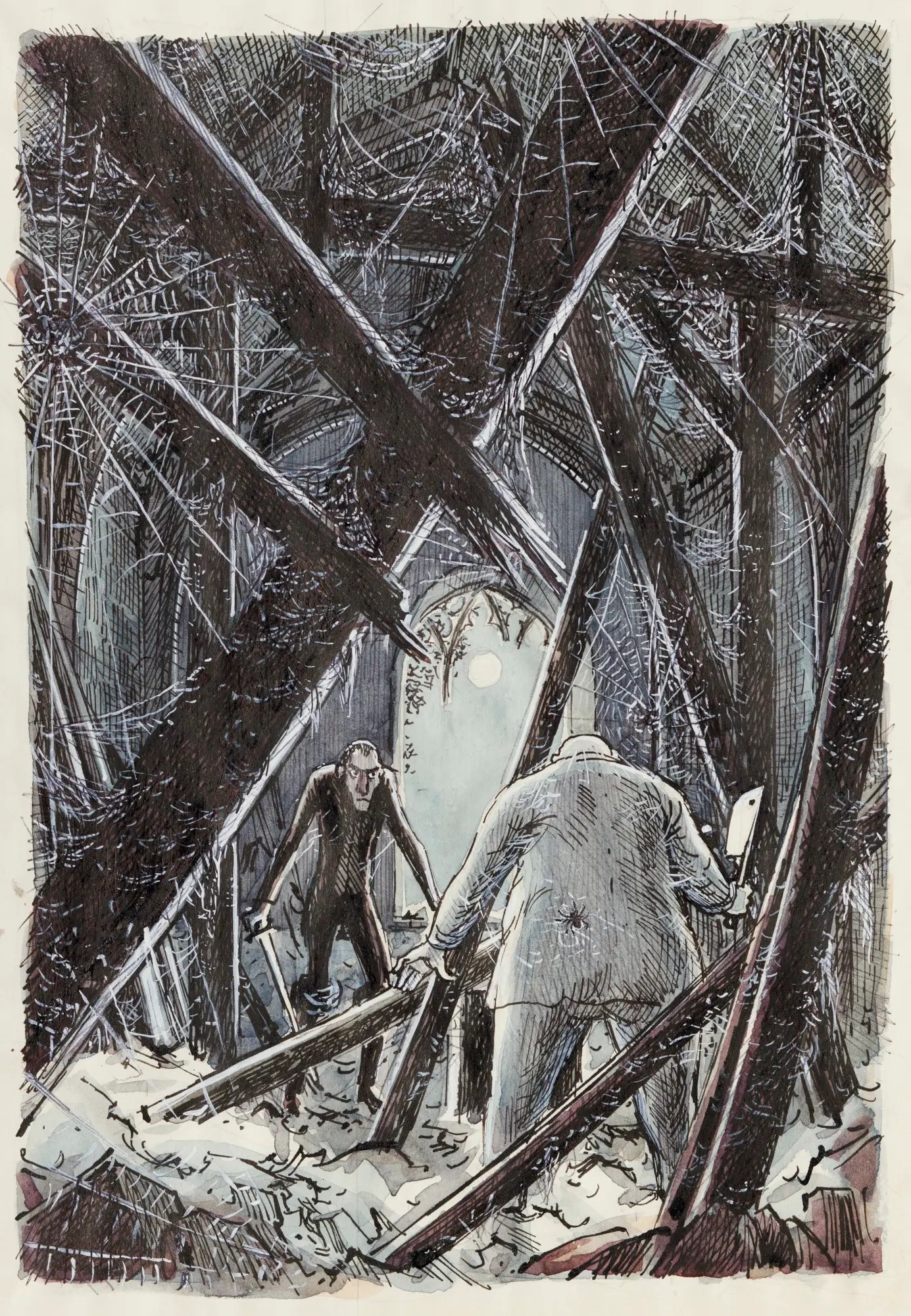
The Hall of Spiders (An Illustration for Mervyn Peake’s Gormenghast) — Charles W. Stewart

On the Way to the Doctor, 1974 by Charles W. Stewart (1915 – 2001).

Part of a series of unpublished illustrations that were to illustrate Mervyn Peake’s 1950 novel, Gormenghast. (More here.)

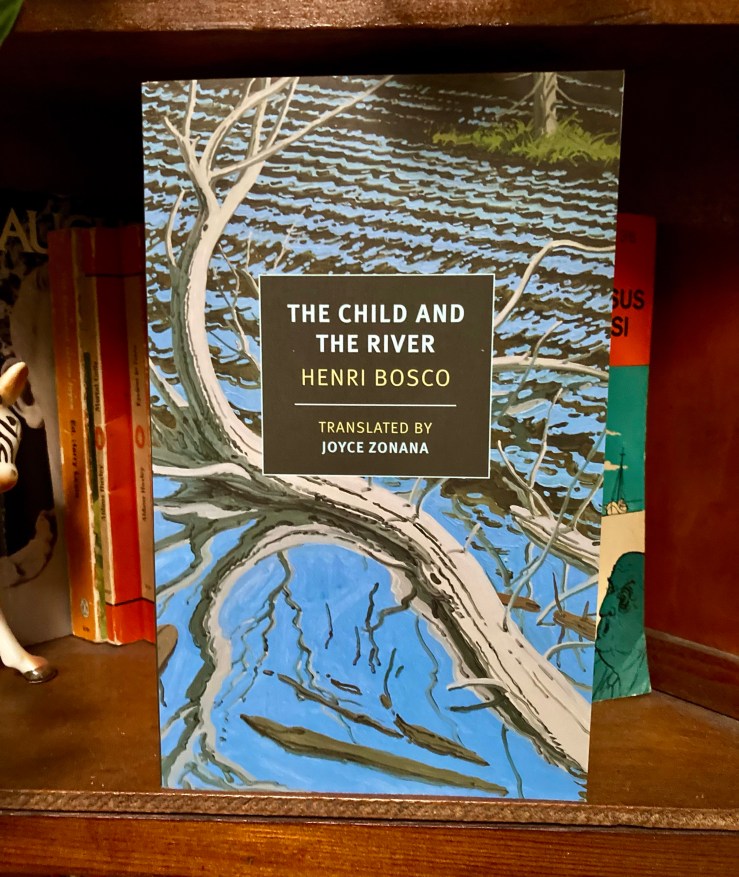
On Henri Bosco’s lovely brief novel, The Child and the River

Last week or maybe the week before last, I received in the mail a review copy of Henri Bosco’s slim 1945 novel The Child and The River. This new translation by Joyce Zonana is available now from publisher NYRB. I picked up The Child and the River this week twice: once before bed, and then again immediately upon waking the next morning, where I finished it before rising.

Set some years before either of the Big Wars, The River and the Child takes place in the countryside somewhere in the south of France (likely Bosco’s native Provence). Narrator Pascalet, now an older man, looks back on a transformational episode in his youth. He relates how as a young boy, he was free to roam the countryside wherever he pleased, excepting the river, where, according to his parents, “there are black holes where you can drown; there are snakes in the reeds and Gypsies on the banks.”

When his parents go on a trip, leaving him in the care of sweet Tante Martine, young Pascalet makes his way to the forbidden river posthaste, blaming any mischief on newly-arrived Spring:

…one fine April morning, temptation caught me unawares. It knew how to speak to me. It was a springtime temptation, one of the sweetest there is, I think, for anyone who is open to clear skies, tender leaves, and newly-blossomed flowers.

That is why I succumbed.

Pascalet’s adventure quickly goes awry, or improves in intensity, depending on how you like to think of it. He falls asleep in an old rowboat, drifts downriver, and ends up on an island inhabited by Gypsies. Hungry, he spies them from behind the brush. Near their cauldron they keep a dog and a bear—and a bound prisoner: “He was a handsome child, sturdy, taller than me and stronger, most likely a Gypsy.” The men in the group beat the young prisoner with a whip, but he endures it. Late in the night, under cover of darkness, Pascalet frees this boy, Gatzo; they then steal a boat and escape to live out a boyhood fantasy of utter freedom—for a few days, at least.

The Child and the River brims with lovely nostalgic pleasures. The boys playact their boyish fantasies, forging crude bows and arrows of reed and pretending that they might have to fend off monsters or “headhunters, cannibals.” Pascalet describes the wonderful sensation of escalating these fantasies:

Then I would feel a mock terror. I enjoyed it. Because when you scare yourself through make-believe, you know well enough that you are not in any danger, but still you are afraid. It is one of the most delicious pleasures.

And yet the boys are not merely playacting—they are surviving: fishing, foraging, strategically moving and mooring their boat to avoid detection. They make fire; they cook. In a lovely little scene, they dig a spring to enjoy fresh water:

We made a hole near a bulge in the clay. Water was seeping through. We continued to dig and fashioned a little basin. Through a breach in the clay, the water moistened a bed of sand. We flattened one side of our hole and stuck in a hollow reed. At first the reed stayed dry. We were aching with impatience, even more than for the fire. At long last, a droplet formed and grew round; for a long time, it hung, uncertain. Suddenly it fell. Another drop came, and slowly, at the tip of the green reed, the spring was born.

This passage exemplifies the simple precision of Bosco’s prose via Zonana’s clean, clear translation. The joy of The Child and the River comes from Pascalet’s gentle, limpid observations of his time on the river, which are generally free of intrusive, muddy “adult” meditations. Instead, we experience what the boys experience:

Everywhere, plants and waters, shorelines and trees, came alive at nightfall with a confused, mysterious life. A duck would flap its wings in the reeds; an owl would screech on a black poplar; a brutal badger would rummage in a bush; a weasel, gliding from branch to branch, would cause two or three leaves to tremble lightly; a roving fox would yelp in the distance.

“It is a sad animal,” Gatzo told me. “It is thinking

The adventures of Pascalet and Gatzo culminate in a strange, dreamlike encounter with “the Puppeteer of Souls.” I won’t remark on the episode at any length, only add that it provides a nearly-mystical, memorable climax to the book. I’ll also add that the novel’s last two sentences are some of the sweetest I’ve read in a while.

I loved reading The Child and the River; I loved the feeling of reading it. It took me back to books I’d loved as a child: Arthur Ransome’s Swallows and Amazons, abridged and bowdlerized versions of Moby-Dick and Huckleberry Finn, and countless Robinsades. In a letter to a friend, Bosco suggested that The Child and the River was “a novel very good, I think, for children, adolescents, and poets.” Is there a better audience?

The Child and the River is one of two Bosco books in publication now from NYRB; they released Zonana’s translation of his 1948 novel Malicroix in early March of 2020. I have it on my shelf, still unread, but not for long. I hope NYRB and Zonana will do a few more Bosco titles. Recommended.

I’ve sat down many times and tried to write a bestseller but something always goes wrong | William S. Burroughs

BOCKRIS: Do you ever get worried that being a writer provides a pretty thin income?

BURROUGHS: It’s gotten very thin. I’ve sat down many times and tried to write a bestseller but something always goes wrong. It isn’t that I can’t bring myself to do it or that I feel I’m commercializing myself or anything like that, but it just doesn’t work. If your purpose is to make a lot of money on a book or film, there are certain rules to observe. You’re aiming for the general public, and there are all sorts of things the general public doesn’t want to see or hear. A good rule is never ask the general public to experience anything they cannot easily experience. You don’t want to scare them to death, knock them out of their seats, and above all, you don’t want to puzzle them.

From With William Burroughs: A Report from the Bunker by Victor Bockris. The selection is from Bockris’s recording of a 1978 dinner with Maurice Girodias, Gerard Malanga, and Glenn O’Brien.


“Mothers” — William Gaddis

“Mothers”

by

William Gaddis

When Ralph Waldo Emerson informed—or rather, perhaps, warned us—that we are what our mothers made us, we might dismiss it as received opinion and let it go at that, like the broken clock which is right twice a day, like the self-evident answer contained in Freud’s oft-quoted query “What do women want?” when, as nature’s handmaid, she must want what nature wants which is, quite simply, More. But which woman? Whose mother, Emerson’s? A woman so in thrall to religion that we confront another dead end; or Freud’s? or even one’s own, even mine, offering an opportune bit of wisdom to those of us engaged in the creative arts, where paranoia is almost an occupational hazard: “Bill, just try to remember,” she said, “there is much more stupidity than there is malice in the world,” an observation lavish with possibilities recalling Anatole France finding the fool more dangerous than the rogue because “the rogue does at least take a rest sometimes, the fool never.”

This is hardly to see stupidity and malice as mutually exclusive: look at your morning paper, where their combined forces explode exponentially (women and children first) from Bosnia to Belfast, unlike the international “intelligence community” so self-contained in its malice-free exercises that it generally ensnares only its own dubious cast of players. Of further importance is the distinction between stupidity and ignorance, since ignorance is educable, while stupidity’s self-serving mission is the cultivation and exploitation of ignorance, as politicians are keenly aware.

How, then, might Emerson’s mother have seen herself stumbling upon Thomas Carlyle’s vision of her son as a “hoary-headed and toothless baboon”? Or Freud’s, in the gross unlikelihood of her reading the Catholic World’s review of her son’s book Moses and Monotheism as “poorly written, full of repetitions . . . and spoiled by the author’s atheistic bias and his flimsy psychoanalytic fancies”? Goethe’s Wilhelm Meister dismissed as “sheer nonsense” by the Edinburgh Review and, a good century later, the hero of Saul Bellow’s Dangling Man ridiculed as a “pharisaical stinker” in Time magazine, John Barth’s The End of the Road recommended by Kirkus Reviews “for those schooled in the waste matter of the body and the mind,” and William Faulkner’s Absalom, Absalom! shrugged off as the “final blowup of what was once a remarkable, if minor, talent” by The New Yorker magazine where, just forty years later, “a group of avant-garde critics has put forward the idea that books should be made unreadable. This movement has manifest advantages. Being unreadable, the text repels reviewers, critics, anthologists, academic literati, and other parasitical forms of life,” indicting the author of the novel J R wherein “to produce an unreadable text, to sustain this foxy purpose over 726 pages, demands rare powers. Mr. Gaddis has them.” “You’re a fool, a fool!” the distraught mother of Dostoevski’s ill-fated hero Nikolay Stavrogin cries out at the “parasitical forms of life” surrounding her. “You’re all ungrateful fools. Give me my umbrella!”

(“Mothers” is collected in The Rush to Second Place).

Pynchon book titles embedded in other Pynchon books

IMG_5725

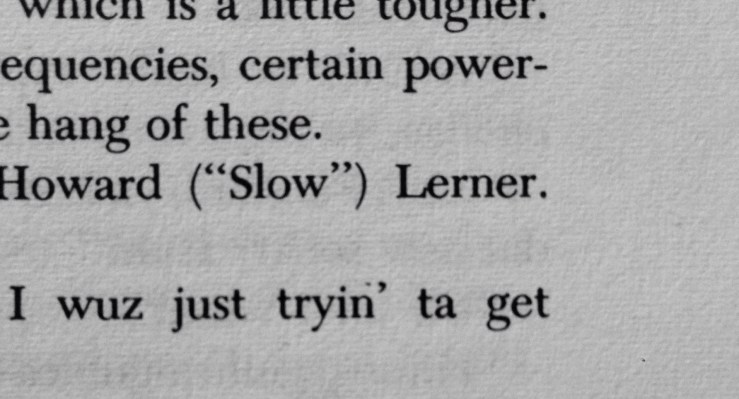
Slow Learner. From page 641 of Gravity’s Rainbow.

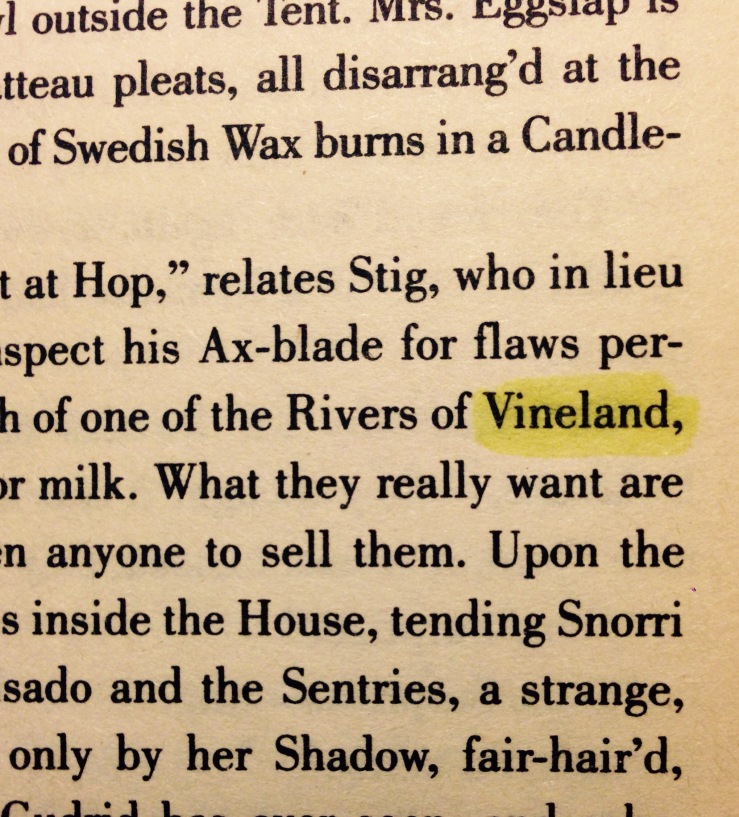
IMG_4503

Vineland. From the beginning of ch. 66 of Mason & Dixon.

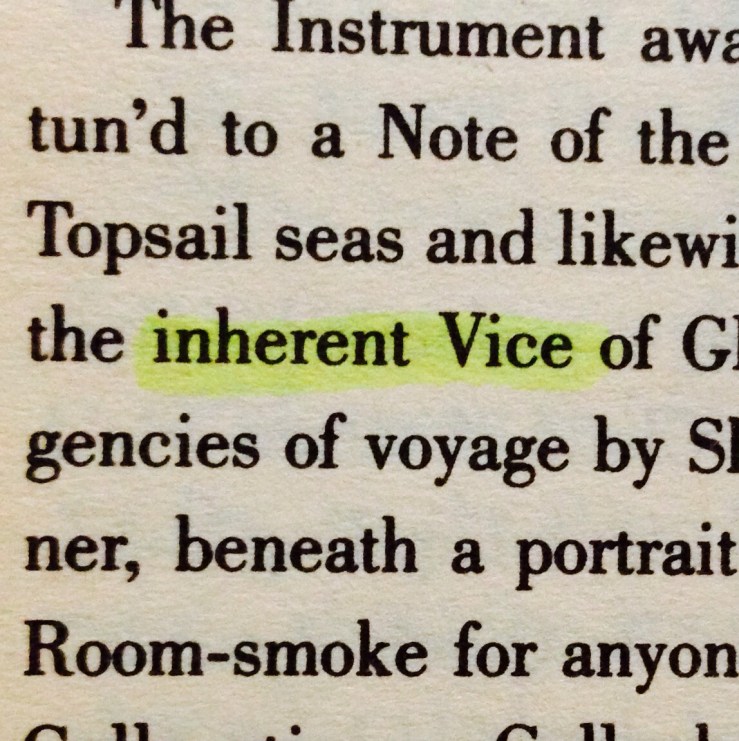
IMG_4191

Inherent Vice. From page 272, chapter 27 of Mason & Dixon. 

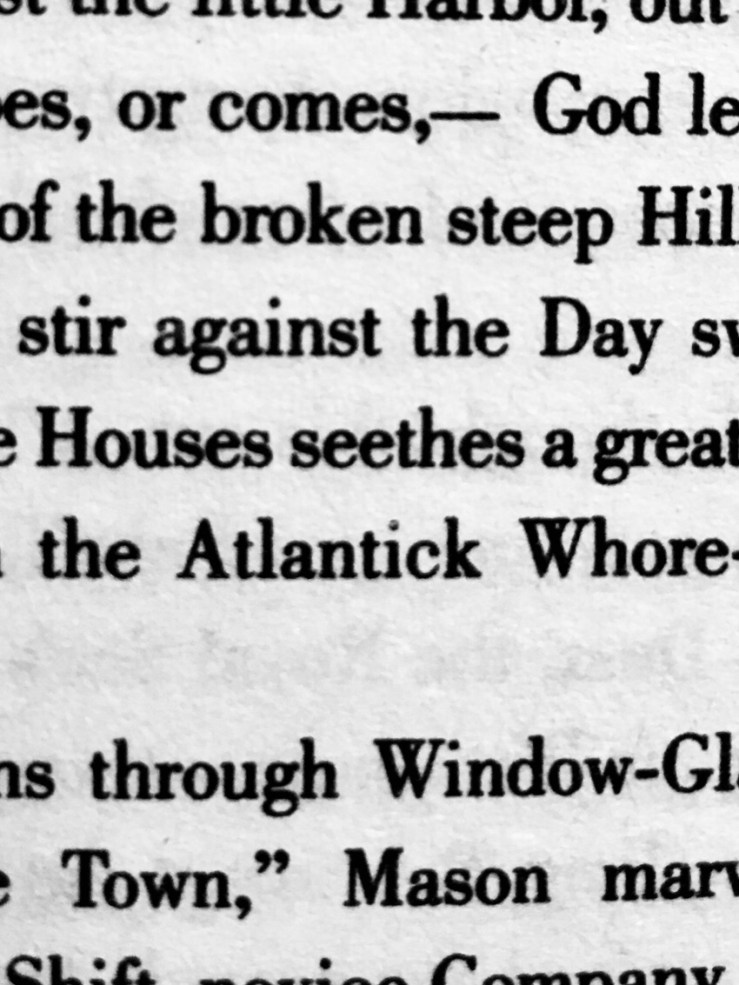
img_9859

Against the Day. From page 125, chapter 13 of Mason & Dixon.

Way too cheap (From Thomas Pynchon’s Vineland)

“Whole problem ’th you folks’s generation,” Isaiah opined, “nothing personal, is you believed in your Revolution, put your lives right out there for it—but you sure didn’t understand much about the Tube. Minute the Tube got hold of you folks that was it, that whole alternative America, el deado meato, just like th’ Indians, sold it all to your real enemies, and even in 1970 dollars—it was way too cheap. . . .”

A critique (by Gen X punker Isaiah Two Four) of the Baby Boomers. From Thomas Pynchon’s 1990 novel Vineland.  The “Tube” is television, of course, but might be a placeholder for any passively-consumed entertainment.

Culte de la mayonnaise (Thomas Pynchon)

THE NEXT TIME he saw Pléiade Lafrisée was at a café-restaurant off the Place d’Armes. It would not occur to him until much later to wonder if she had arranged the encounter. She was in pale violet peau de soie, and a hat so beguiling that Kit was only momentarily surprised to find himself with an erection. It was still early in the study of these matters, only a few brave pioneers like the Baron von Krafft-Ebing had dared peep into the strange and weirdly twilit country of hat-fetishism—not that Kit noticed stuff like that ordinarily, but it happened actually to be a gray toque of draped velvet, trimmed with antique guipure, and a tall ostrich plume dyed the same shade of violet as her dress. . . .

“This? One finds them in every other midinette’s haunt, literally for sous.”

“Oh. I must’ve been staring. What happened to you the other night?”

“Come. You can buy me a Lambic.”

The place was like a museum of mayonnaise. This being just at the height of the culte de la mayonnaise then sweeping Belgium, oversize exhibits of the ovoöleaginous emulsion were to be encountered at every hand. Heaps of Mayonnaise Grenache, surrounded by plates of smoked turkey and tongue, glowed redly as if from within, while with less, if any, reference to actual food it might have been there to modify, mountains of Chantilly mayonnaise, swept upward in gravity-impervious peaks insubstantial as cloud, along with towering masses of green mayonnaise, basins of boiled mayonnaise, mayonnaise baked into soufflés, not to mention a number of not entirely successful mayonnaises, under some obscure attainder, or on occasion passing as something else, dominated every corner.

“How much do you know of La Mayonnaise?” she inquired.

He shrugged. “Maybe up to the part that goes ‘Aux armes, citoyens’—”

But she was frowning, earnest as he had seldom seen her. “La Mayonnaise,” Pléiade explained, “has its origins in the moral squalor of the court of Louis XV—here in Belgium the affinity should not be too surprising. The courts of Leopold and Louis are not that different except in time, and what is time? Both monumentally deluded men, maintaining their power through oppression of the innocent. One might usefully compare Cleo de Mérode and the marquise de Pompadour. Neuropathists would recognize in both kings a desire to construct a self-consistent world to live inside, which allows them to continue the great damage they are inflicting on the world the rest of us must live in.

“The sauce was invented as a new sensation for jaded palates at court by the duc de Richelieu, at first known as mahonnaise after Mahon, the chief port of Minorca, the scene of the due’s dubious ‘victory’ in 1756 over the illfated Admiral Byng. Basically Louis’s drug dealer and pimp, Richelieu, known for opium recipes to fit all occasions, is also credited with the introduction into France of the cantharides, or Spanish fly.” She gazed pointedly at Kit’s trousers. “What might this aphrodisiac have in common with the mayonnaise? That the beetles must be gathered and killed by exposing them to vinegar fumes suggests an emphasis on living or recently living creatures—the egg yolk perhaps regarded as a conscious entity—cooks will speak of whipping, beating, binding, penetration, submission, surrender. There is an undoubtedly Sadean aspect to the mayonnaise. No getting past that.”

Kit was a little confused by now. “It always struck me as kind of, I don’t know . . . bland?”

“Until you look within. Mustard, for example, mustard and cantharides, n’estce pas? Both arousing the blood. Blistering the skin. Mustard is the widelyknown key to resurrecting a failed mayonnaise, as is the cantharides to reviving broken desire.”

“You’ve been thinking about mayonnaise a lot, mademoiselle.”

“Meet me tonight,” a sudden fierce whisper, “out at the Mayonnaise Works, and you shall perhaps understand things it is given only to a few to know. There will be a carriage waiting.” She pressed his hand and was gone in a mist of vetiver, abruptly as the other evening.

A passage from Thomas Pynchon’s novel Against the Day; I don’t think you need any context to appreciate this passage.


Mail call | Thomas Pynchon

A great shout went up near the doorway, bodies flowed toward a fattish pale young man who’d appeared carrying a leather mailsack over his shoulder.

“Mail call,” people were yelling. Sure enough, it was, just like in the army. The fat kid, looking harassed, climbed up on the bar and started calling names and throwing envelopes into the crowd. Fallopian excused himself and joined the others.

Metzger had taken out a pair of glasses and was squinting through them at the kid on the bar. “He’s wearing a Yoyodyne badge. What do you make of that?”

“Some inter-office mail run,” Oedipa said.

“This time of night?”

“Maybe a late shift?” But Metzger only frowned. “Be back,” Oedipa shrugged, heading for the ladies’ room.

On the latrine wall, among lipsticked obscenities, she noticed the following message, neatly indited in engineering lettering:

“Interested in sophisticated fun? You, hubby, girl friends. The more the merrier. Get in touch with Kirby, through WASTE only. Box 7391. L. A.”

WASTE? Oedipa wondered. Beneath the notice, faintly in pencil, was a symbol she’d never seen before, a loop, triangle and trapezoid, thus:

img_5980

It might be something sexual, but she somehow doubted it. She found a pen in her purse and copied the address and symbol in her memo book, thinking: God, hieroglyphics. When she came out Fallopian was back, and had this funny look on his face.

“You weren’t supposed to see that,” he told them. He had an envelope. Oedipa could see, instead of a postage stamp, the handstruck initials PPS.

“Of course,” said Metzger. “Delivering the mail is a government monopoly. You would be opposed to that.”

Fallopian gave them a wry smile. “It’s not as rebellious as it looks. We use Yoyodyne’s inter-office delivery. On the sly. But it’s hard to find carriers, we have a big turnover. They’re run on a tight schedule, and they get nervous. Security people over at the plant know something’s up. They keep a sharp eye out. De Witt,” pointing at the fat mailman, who was being hauled, twitching, down off the bar and offered drinks he did not want, “he’s the most nervous one we’ve had all year.”

“How extensive is this?” asked Metzger.

“Only inside our San Narciso chapter. They’ve set up pilot projects similar to this in the Washington and I think Dallas chapters. But we’re the only one in California so far. A few of your more affluent type members do wrap their letters around bricks, and then the whole thing in brown paper, and send them Railway Express, but I don’t know . . .”

“A little like copping out,” Metzger sympathized.

“It’s the principle,” Fallopian agreed, sounding defensive. “To keep it up to some kind of a reasonable volume, each member has to send at least one letter a week through the Yoyodyne system. If you don’t, you get fined.” He opened his letter and showed Oedipa and Metzger.

Dear Mike, it said, how are you? Just thought I’d drop you a note. How’s your book coming? Guess that’s all for now. See you at The Scope.

That’s how it is,” Fallopian confessed bitterly, “most of the time.”

“What book did they mean?” asked Oedipa.

Turned out Fallopian was doing a history of private mail delivery in the U. S., attempting to link the Civil War to the postal reform movement that had begun around 1845. He found it beyond simple coincidence that in of all years 1861 the federal government should have set out on a vigorous suppression of those independent mail routes still surviving the various Acts of ’45, ’47, ’51 and ’55, Acts all designed to drive any private competition into financial ruin. He saw it all as a parable of power, its feeding, growth and systematic abuse, though he didn’t go into it that far with her, that particular night. All Oedipa would remember about him at first, in fact, were his slender build and neat Armenian nose, and a certain affinity of his eyes for green neon.

So began, for Oedipa, the languid, sinister blooming of The Tristero.


From The Crying of Lot 49 by Thomas Pynchon.

In which I read Playboy for the Thomas Pynchon article

A few years ago I posted a brief excerpt from Jules Siegel’s March 1977 Playboy profile “Who is Thomas Pynchon… And Why Did He Take Off With My Wife?” The excerpt came from an excerpt posted on the Pynchon-L forum, but most of the article had been removed at the (apparent) request by Siegel. A few people sent me the whole article though (thanks!) and I read it.

Pick Pynchon’s feet. Or don’t!

Jules Siegel was briefly a Cornell classmate of Pynchon’s in 1954, and they remained friends (in Siegel’s recollection) for at least two decades after. During this time, Siegel claims that Pynchon wrote him dozens of letters, which were ultimately sold at auction (along with much of Siegel’s property) to help pay for a hip replacement. Material from the letters soak into Siegel’s sketch of Pynchon’s progress, along with several stoned/drunken adventures that would not be out of place in V. or Mason & Dixon or Gravity’s Rainbow, or really, any person’s young life.

A competitive anxiety reverberates under the piece. “We were friends, maybe at some points best friends, very much alike in some important ways,” Siegel writes. “We were both writers,” he boldly writes. Siegel reminds us that “In Mortality and Mercy in Vienna, Pynchon’s first published short story, the protagonist is one Cleanth Siegel,” but protests he doesn’t see himself in that hero.

The competitive anxieties culminate in the big reveal that (spoiler!) Thomas Pynchon had an affair with Siegel’s second wife Chrissie. There’s probably a Freudian reading we can append to the details that Siegel offers about Pynchon’s sexual prowess: “He was a wonderful lover, sensitive and quick, with the ability to project a mood that turned the most ordinary surroundings into a scene out of a masterful film—the reeking industrial slum of Manhattan Beach would become as seen through the eye of Antonioni, for example.”

Or maybe these unsexy details are just a sign of Playboy’s editorial hand. Wedged gracelessly between ads for vibrators and nude greeting cards, Siegel’s lines often reek of 1970’s Playboy’s rhetorical house style, a kind of frank-but-(attempted)-sensual glossiness that contrasts heavily with Pynchon’s own sex writing. At times I found myself reading Siegel’s prose in one of Will Ferrell’s more pompous accents.

Even worse is the casual sexism of the piece—which again, may be attributable to Playboy’s editors. Siegel, on his first wife (sixteen when he married her): “She was so wonderful a lover, generous and easily aroused, but I was too callow then to appreciate her.” Of his second wife: “It is easy to underestimate her intelligence, but it is a mistake. She is obviously too pretty to be serious, conventional wisdom would have you believe.” Of one of Pynchon’s girlfriends: “Susan has red hair and is breathtakingly beautiful, with the voluptuous body of a showgirl. Like Chrissie, she is much brighter than she looks.”

More interesting, obviously, are the (supposedly) real-life details that inform Pynchon’s fiction. Siegel notes some of the contents of Pynchon’s Manhattan Beach apartment: “A built-in bookcase had rows of piggy banks on each shelf and there was a collection of books and magazines about pigs.” Pigs, of course, are a major motif of Gravity’s Rainbow. Another detail that seems to connect to GR: “On the desk, there was a rudimentary rocket made from one of those pencil-like erasers with coiled paper wrappers that you unzip to expose the rubber. It stood on a base twisted out of a paper clip.” Siegel lets us know that he knocked the rocket down. Pynchon puts it back together; Siegel knocks it down again.

(Parenthetically: Siegel’s evocation of Pynchon’s Manhattan Beach days fits neatly into my picture of Inherent Vice).

In accounting details of Pynchon’s alleged affair with his wife, Chrissie, Siegel shares the following:

Once, out on the freeway, she told him that we had all gone naked at the commune, he professed to find that incredible and dared her to take off her blouse right there. She did. A passing truck hooted its horn in lewd applause. He loved her Shirley Temple impersonations—On the Good Ship Lollipop sung and danced like a kid at a birthday party. They talked about running away together.

It is hardly possible here not to recall the episode early in Gravity’s Rainbow wherein Jessica Swanlake removes her blouse in the car on a dare from Roger Mexico. Is Siegel daring the reader to extrapolate further? Extrapolation, paranoid connections—isn’t this part of Pynchonian fun?

In that spirit, I’ll close with my favorite moment from the article.

“You know the W.A.S.T.E. horn in The Crying of Lot 49? The symbol of the secret message service? Every weirdo in the world is on my wave length. You cannot understand the kind of letters I get. Someone wrote to tell me that the very same horn was the symbol of a private mail system in medieval times. I checked it out at the library. It’s true. But I made it up myself before the book was ever published, before I ever got that letter.”

The lines are supposedly from Pynchon himself. Siegel even puts them in quotation marks—so they must be real, right?

[Ed. note: Biblioklept ran a version of this post in 2015. Enjoy Pynchon in Public Day tomorrow!]

Blog about some recent reading

With the end of the spring term (and, frankly, a renewed commitment to weeknight sobriety), I’ve been reading a lot more and a lot faster the past few weeks. Top to bottom:

I pulled Kathy Acker’s Great Expectations out a few nights ago and ended up reading all of it over two nights and two mornings. Not the best starting point for Acker but strangely super, super readable.

Bernardo Zannoni’s My Stupid Intentions: I actually haven’t even done one of those silly “book acquired” posts for this one: I picked it up and just kept reading. Totally zapped me, fantastic stuff: a brash, sharp, sardonic animal rant against god his own self. Loved loved loved it.

I’ve got about a third left of Trey Ellis’s first 1988 novel Platitudes, and it’s really good—reminds me a lot of Ishmael Reed’s middle period stuff, Fran Ross’s Oreo, David Foster Wallace’s early fiction, and even Bret Easton Ellis. Platitudes is a send up of coming-of-age novels conveyed through linguistic channel surfing.

I finished the audiobook of Olga Tokarczuk’s novel The Books of Jacob (translated by Jennifer Croft) this afternoon. I’d been switch-hitting between the novel and audiobook, but gave over to my earplugs during a week of long commutes and longer chores—but returning to the print version for the images, maps, and, uh names. This is a novel larded with names and names and names. The Books of Jacob is a (and I don’t use this hackneyed bookworld word lightly) kaleidoscopic biopic of the 18th-c. messianic cult leader Jacob Frank. Close to 1000 pages/36 hours, The Books of Jacob is exhaustive, exhilarating, and exhaustive. Best of all, at the end of all, we don’t really know Jacob—we just get picture after perspective after point of view on the self-proclaimed savior.

I wrote about Drew Lerman’s Escape from the Great American Novel yesterday, right?

I also managed to get out a review of Lawrence Venuti’s new English translation of Dino Buzzati’s novel The Stronghold, which is strong holding the bottom of the stack above.

A review of The Stronghold, Dino Buzzati’s novel of deferred hope and ecstatic boredom

Dino Buzzati’s 1940 novel Il deserto dei Tartari (retitled The Stronghold in Lawrence Venuti’s new English translation) takes place in an unidentified time in an unidentified country. Our protagonist is Giovanni Drogo, freshly graduated from an unspecified military academy and ready for a thrilling life of combat and adventure at his new post, Fortezza Bastiani, a fortress at the border of the Tartar steppe. He and his fellow soldiers wait in the hope of attaining glory.

And they continue to wait.

The nebulous Tartars repeatedly fail to appear, offering only the vaguest hints of their alien existence. The soldiers of Fortezza Bastiani live a life of anxious monotony, their desires and hopes for the heroics of war flattened by the boredom of day to day life. It’s all very existentialist.

From the opening pages of The Stronghold, Buzzati conjures a strange but familiar world, usually telegraphed in brisk, unadorned prose (a style he honed in his career as a journalist). Everything is slightly off, slightly anxious. Initially, a reader might chalk the disquieting style up to our viewpoint-character Drogo’s own hesitancy as he enters into a new life as a military officer, but we soon find ourselves in an uncanny realm.

The world of the fortezza is somehow simultaneously dull and enthralling. Consider Drogo’s first glimpse of the fortress:

Fortezza Bastiani was neither imposing, with its low walls, or beautiful in any  way. Its towers and ramparts weren’t picturesque. Absolutely nothing alleviated its starkness or recalled the sweet things of life. Yet Drogo gazed at it, hypnotized, as on the previous night at the base of the gorge. And an inexplicable ardor penetrated his heart.

This “inexplicable ardor” is nevertheless ambiguous in its penetration; after learning he is nominally free to choose a different, perhaps more invigorating post, Drogo elects to transfer from the fort. However, his commanding officer suggests that he stay for four months to avoid bureaucratic problems with the higher ups. That four-month season of waiting turns into a lifetime of waiting. And then waiting some more.

Drogo and his fellow soldiers hunger for the glory of contesting the Tartars, an enemy they know utterly nothing about. Like almost every sociopolitical, cultural, and even technological detail in The Stronghold, the specific nature of the Tartar enemy is collapsed into something closer to a fairy tale or a rumor. Vague and dreamlike, the Tartars are not a geopolitical entity; they are not even an other, but rather the figment of an other, the kernel of a dream that promises action. And this dim promise keeps the soldiers waiting at the Fortezza:

From the northern desert would arrive their fortune, the occasion of their exploits, the miraculous hour that befalls everyone at least once. Because of this vague eventuality, which grew increasingly uncertain with time, grown men wasted the best part of their lives there.

The narrator, hovering in Drogo’s consciousness, imagines an interlocutor explaining to one of these soldiers that his “entire life will be the same, utterly the same, till the very last moment” — and then imagines the hypothetical soldier’s response: “Something else must come to pass, something truly worthy.” Drogo here believes he has grasped the “transparent secret” of the soldiers of the Fortezza, but also imagines himself an “uncontaminated onlooker.” But it’s too late. Drogo too has committed to waiting for something else to come to pass.

Nothing comes to pass—or nearly nothing. (One might read The Stronghold as an extended riff on Kafka’s wonderful parable “Before the Law.“) However, this is not to say though that Buzzati’s portraiture of tedium is itself tedious. The boredom he conjures is an ecstatic boredom, anxious and writhing, exploding in strange, magical moments of hallucinations and night terrors.

In one of the novel’s most extraordinary sequences, “fragile apparitions, quite like fairies” enter Drogo’s dreams, bearing away to some spectacular land Drogo’s fallen comrade who is now converted to a child dressed in a rich velvet suit. In another episode, a mysterious horse appears from the desert, sending the men into fits of hope and despair culminating in a horrific incident that underscores the absurdities of military rigor. Late in the novel, a much-older Drogo’s desire for action, for something to come to pass, tips into near-comic paranoia, as he and a younger officer fool around with a telescope to no avail.

After all this waiting in hope, The Stronghold concludes with a devastating Kafkaesque punchline which I shall not spoil here.

It will be clear to most seasoned readers that Kafka was an influence on Buzzati even without Venuti’s afterword, which details Buzzati’s admiration for the Bohemian writer. Buzzati does not ape the older master so much as evoke the same state of anxious alterity we find in texts like “The Great Wall of China” and The Castle. Stepping into The Stronghold, one is reminded of other branches of the Kafka tree, like Kazuo Ishiguro’s The Unconsoled, Kobo Abe’s The Woman in the Dunes, Alasdair Gray’s Lanark, and Albert Camus’ The Stranger, among many others.

Like many Kafkaesque works, one might be inclined to fob his own allegorical readings onto The Stronghold. In his afterword, Venuti points out that early English-language readings of Buzzati’s novel tended to interpret Il deserto dei Tartari as an anti-totalitarian tract. Il deserto dei Tartari was first translated as The Tartar Steppe by Stuart Hood in 1952, and many of its contemporary critics read the novel against the backdrop of the Cold War.

While praising the “remarkable accomplishment” of Hood’s translation, Venuti differentiates his own “historically oriented interpretation” of the novel; namely, his attempt to more emphatically underline Il deserto dei Tartari’s “latent critique” of fascism. Venuti points out that “Hood had twice rendered the generic ‘stivali’ (boots) with the politically marked term ‘jackboots,'” adding, “I tripled its use.”

Venuti also discusses at some lengths his choice to change Hood’s title. He writes that Buzzati initially wanted to title the book La fortezza, but this name was rejected by the novel’s publisher who worried it might be misunderstood by the reading public. In his attempt to further historicize his translation (and differentiate it from Hood’s), Venuti elected to remove Steppe from the title fearing it “might be taken as an anachronistic reference to the Soviet Union.” He also avoided The Fort or The Fortress as a possible titles, worried they might underscore Buzzati’s “debt to Kafka’s The Castle.” Venuti eventually settled on The Stronghold, suggesting that this title helps to emphasize the “cult of virility championed during the Fascist period” while also “conveying the sheer tenaciousness of the soldier’s heroic fantasies, as well as their inability to escape their debilitating obsession.”

I haven’t read Hood’s translation of Il deserto dei Tartari, but I appreciated Venuti’s, which, as I pointed out above, takes place in an unidentified time in an unidentified country. The novel’s eerie, fable-like quality—a quality that resists historicity—is what most engages me. Buzzati’s book captures the paradox of a modern life that valorizes the pursuit of glory (or at least happiness) while simultaneously creating a working conditions that crush the human spirit. We can find this paradox in Herman Melville’s Bartleby or Mike Judge’s Office Space; we can find it in Antonio di Benedetto’s Zama or Mike Judge’s Enlightened; we can find if in David Foster Wallace’s The Pale King or Dan Erickson’s recent show Severance. I could go on of course.

Some of these boredom narratives seek to assuage us, or make us laugh or cry—in recognition, spite, pity, despair, or hope. Some of these boredom narratives find resistance in art, or in just plain resistance. Buzzati’s novel offers something more like a warning. It is not possible to be an “uncontaminated onlooker” in one’s own life. It’s not enough to wait forever, even if we wait in hope.

The Stronghold is available now from New York Review Books.

The other project was a scheme for entirely abolishing all words whatsoever

We next went to the school of languages, where three professors sat in consultation upon improving that of their own country.

The first project was, to shorten discourse, by cutting polysyllables into one, and leaving out verbs and participles, because, in reality, all things imaginable are but norms.

The other project was, a scheme for entirely abolishing all words whatsoever; and this was urged as a great advantage in point of health, as well as brevity. For it is plain, that every word we speak is, in some degree, a diminution of our lungs by corrosion, and, consequently, contributes to the shortening of our lives. An expedient was therefore offered, “that since words are only names for things, it would be more convenient for all men to carry about them such things as were necessary to express a particular business they are to discourse on.” And this invention would certainly have taken place, to the great ease as well as health of the subject, if the women, in conjunction with the vulgar and illiterate, had not threatened to raise a rebellion unless they might be allowed the liberty to speak with their tongues, after the manner of their forefathers; such constant irreconcilable enemies to science are the common people. However, many of the most learned and wise adhere to the new scheme of expressing themselves by things; which has only this inconvenience attending it, that if a man’s business be very great, and of various kinds, he must be obliged, in proportion, to carry a greater bundle of things upon his back, unless he can afford one or two strong servants to attend him. I have often beheld two of those sages almost sinking under the weight of their packs, like pedlars among us, who, when they met in the street, would lay down their loads, open their sacks, and hold conversation for an hour together; then put up their implements, help each other to resume their burdens, and take their leave.

But for short conversations, a man may carry implements in his pockets, and under his arms, enough to supply him; and in his house, he cannot be at a loss. Therefore the room where company meet who practise this art, is full of all things, ready at hand, requisite to furnish matter for this kind of artificial converse.

Another great advantage proposed by this invention was, that it would serve as a universal language, to be understood in all civilised nations, whose goods and utensils are generally of the same kind, or nearly resembling, so that their uses might easily be comprehended. And thus ambassadors would be qualified to treat with foreign princes, or ministers of state, to whose tongues they were utter strangers.

From Jonathan Swift’s novel Gulliver’s Travels.

Hawthorne is a writer | From Kathy Acker’s Blood and Guts in High School

Hawthorne is a writer

Writers create what they do out of their own frightful agony and blood and mushed-up guts and horrible mixed-up insides. The more they are in touch with their insides the better they create. If you like a writer’s books read his books, the books aren’t pure suffering; if you want to publish/help the writer, do it business-like, but don’t get into the writer’s personal life thinking if you like the books you’ll like the writer. A writer’s personal life is horrible and lonely. Writers are queer so keep away from them. I live in pain, but one day, Hawthorne said, I’m going to be happy I’m going to be so happy even if I’m not alive anymore. There’s going to be a world where the imagination is created by joy not suffering, a man and a woman can love each other again they can kiss and fuck again (a woman’s going to come along and make this world for me even though I’m not alive anymore).

From Kathy Acker’s novel Blood and Guts in High School.