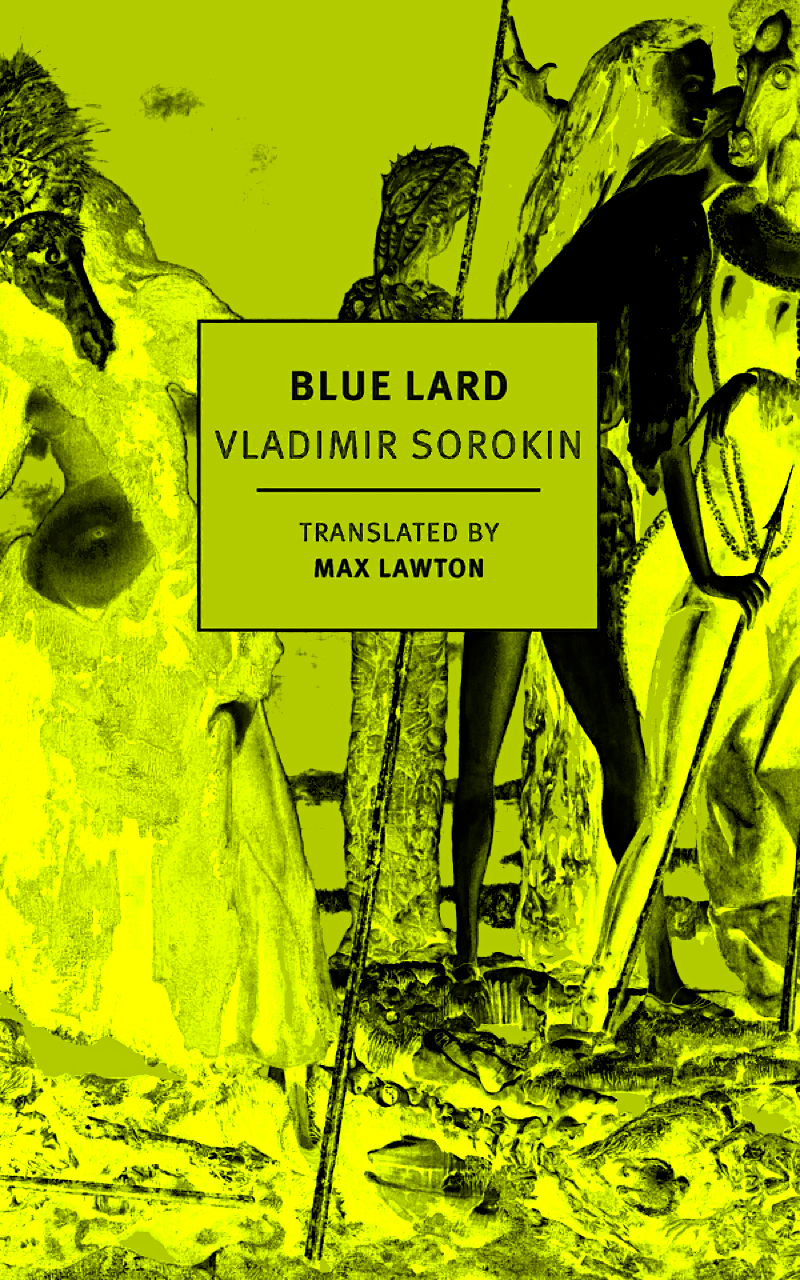
The following discussion of Vladimir Sorokin’s novel Blue Lard (in translation by Max Lawton) is intended for those who have read or are reading the book. It contains significant spoilers; to be very clear, I strongly recommend entering Blue Lard cold.
The first hundred or so pages of Sorokin’s Blue Lard switch between Boris Gloger’s letters to his lover and the narratives of seven cloned Russian writers (the clone-narratives are, textually speaking, included in Boris’s letters).
The shifts between these layered texts are initially quite disarming. Boris’s letters are filled with invented futurese, neologisms, and Chinese slang; the clone-narratives each impose their own linguistic taxes (and rewards) on the reader.
However, these first hundred pages do establish some of the baselines one might expect of a traditional novel: setting (a futuristic laboratory in frozen northeast Siberia), characters (scientists with a military guard—and seven clones), and a basic mission (cloning Russian writers who, in writing their compositions, produce an enigmatic substance called blue lard).
That mission is a clear success by the time we get to Boris’s last letter (dated 8 April for those keeping track), and our team, “the arbiters of the BL-3 Project, have total L-rights to relax.” So they decide to throw a cocktail party. (“It’s sometimes necessary to drink cocktails all day. Not, of course, for L-harmony, rips ni ma de, but JUST ‘CAUSE,” bold Boris boasts boldly.)
As in some of the previous scenes of hard-drinking downtime, the BL-3 Project’s futuristic cocktail party feels like something from a pop sci-fi film. Much of the dialogue seems inscrutable in a first run through the novel, but the jargon and bickering and bantering over political and cultural circumstances alien to the reader are simply texture–verbal adornment to fill out the scene.
Sorokin does bolster his futurese with occasional asides of historical analysis though:
Everything is working out for the Chinese now, just as it did for the Americans in the twentieth century, the French in the nineteenth century, the English in the eighteenth century, the Germans in the seventeenth century, the Italians in the sixteenth century, the Russians in the fifteenth century, the Italians in the fourteenth century, and the Jews in the first (I think) century.
That “I” is Boris, although the style of the party section has subtly but significantly shifted from the flirtatious and gossipy tone of his love letters home.
But enough with style! Back to the party!
There is drinking and dancing and drinking and drinking and drinking. The ol’ fashioned colonel whips up a batch of whiskey sours (“A drink for lonely men who test AEROSEX once a month and prefer books to holo-bubbles,” a geneticist opines), and from there, the BL-3 Project crew goes to town in inventing ever-more daring cocktails.
Here is the recipe for Fan Fei’s CHINA 21:
5 measures of tomato juice
3 measures of spiritus vini
2 measures of red ants
1 measure of salty ice
1 pod of red pepper
Our party is in full drunken swing, abject sweat flung from the dancefloor, another round of cocktails called for, when all of a sudden the novel’s perspective upends itself (again).
The disruptive narrative event here would, again, not be out of place in a sci-fi actioner. A band of rebels (the “Brothers,” as they refer to themselves) breach the laboratory’s bunker, exchange gunshots with the soldiers, and kill everyone but our heretofore main character, Boris.
But the stylistic shift is intense—we go from the strange comfort of Boris’s letters to a new style, one utterly outside of Boris’s consciousness. Indeed, it’s through the eyes of these invading “Brothers” that we actually see Boris for the first time: The Brothers-centered narrator informs us he is “rail-thin… His face was narrow and swarthy skin clung to the bones of his skull. Metal plates in complicated shapes were visible beneath the skin of his temples.” He is the last living witness to the BL-3 Project—but not for long.
Again, the scene plays out as a cinematic trope, the scientist interrogated before his death. Boris isn’t much use explaining just what the blue lard is for or how it works. But he does tell us there’s
something called the MINOBO Project. I don’t know the details… [but] they’re building a reactor on the moon, a constant-energy reactor. They’re building it in the shape of pyramids… pyramids made of fifth-generation superconductors and blue lard… layers… layers and layers of it… and that allows them to plus-directly solve the problem of perpetual energy.
Our one-time narrator is then summarily executed, his brains ironically sprayed over a safety placard.
We are now firmly in the narrative purview of the Brothers. They harvest the blue lard from the bodies of the clones and head back to their lair, mumbling about their poor diet and their ever-constant war with “the whorish” who populate the surface of the earth. They are of the Earth-Fuckers, a bizarre monastic sect dwelling in a strange hierarchical series of underground caverns that seem to descend infinitely into the earth.
The narrative too moves with these earth-fucking brothers, as does the blue lard, a vibrant constant in a constantly-changing scene. Along the way we are treated to ever-stranger rituals and routines. Sorokin, in Lawton’s deft translation, gives us a surreal but limpid portrait of this subterrestrial monastery, where sacred cloister gives way to another sacred cloister:
The descent was quick––the staircase led into a large, dusky hall with a marble floor and marble walls. In the hall, there were ten marble desks, at which bald men in black suits were sitting. Green lamps were burning atop their desks. On the wall, a sigil made of rock crystal, jasper, and granite was illuminated in green light: a man copulating with the earth.
The blue lard slowly makes its way down to “the magister” who informs the reader that when he looks at his hands, he sees tiny golden children’s hands on his wrist. These tiny golden children’s hands speak to him through a language based on wrist rotations. He has transcribed some of these communications, including something called “The Swim,” a very short story about a group of military swimmers who hold torches aloft to create a constellation of language. They are swimming raft of lighted language, passing by crowds who read from afar the quotations they have created—quotations that the swimmers themselves cannot rightly read. They are, quite literally, marks. The story “The Swim” is actually a version of an older Sorokin short story, underscoring the intertextual nature of Blue Lard’s internal and external composition. This is a novel about writing; or, a novel about writing writing.
The Earth-Fuckers section of Blue Lard is probably where, on first reading, I truly gave into the novel’s strange wave and just went with it. After all, my dear epistolarian Boris Gloger was now deceased and I found myself far from the false stability of the BL-3 Project’s base. The section plays out as a series of wonderful deferrals, stories that descend into new stories as one Earth-Fucker descends to a new level of their strange subterranean labyrinth. There’s the infanticidal Nadelina, who gives birth to a child by a different father every year–twenty-six children in total in Max’s translation (one for each letter of the English-language alphabet?). She sacrifices the children so that she might always be able to “water the earth with her milk.” There are three mischievous “babes” — devilishly horny little cherubs who float around in what could be the set of a nightmarish technicolor Hollywood musical. There’s the history lesson of the great schism between the Northern and Southern Earth-Fuckers. There are enormous genitals.
The Earth-Fuckers section is larded with surreal episodes (all anchored in precise, clear imagery), but a re-read reveals that Sorokin is not solely interested in throwing bizarre satirical scenarios at his reader. Traditional novel-making elements are in play here, even if it’s easy to miss them in a dazzled first read. As Sorokin prepares to transition to a new sequence, he offers his readers a recap of the story so far, a blunt summary from an Earth-Fucker’s perspective. After declaring the blue lard an “eternal substance” that will never burn or freeze but “shall forever be exactly as warm as the blood of man,” we get this exchange:
And how did the whorish manage to produce this substance?
By accident, oh my father. They were doing whorish experiments restoring and regrowing people from the memories in their bones. These were people of various professions. But only those people who had at some point written down their fantasies on paper turned out to be capable of producing blue lard.
Again, Blue Lard is writing about writing (about writing about writing…). And, soon, another writer will enter the text and deliver the textual tissue between Blue Lard’s lobes: “The Indigo Pill.”
The following discussion of Vladimir Sorokin’s novel Blue Lard (in translation by Max Lawton) is intended for those who have read or are reading the book. It contains significant spoilers; to be very clear, I strongly recommend entering Blue Lard cold.
Previously on Blue Lard…We enjoyed the first of our clone narratives, Dostoevsky-2’s “Count Reshetovsky” (our dear correspondent Boris brag’s that the tale’s composition will yield “up to 6 kg. of blue lard”).
It is now Akhmatova-2’s turn to whip up some blue lard. Boris reports that “During the script-process, the object didn’t become at all deformed. Just heavy bleeding: vaginal and nasal.” Sorokin mixes abjection with creation. The Anna Akhmatova clone composes the song-poem “Three Nights.” I confess much of my idea of Ann Akhmatova’s poetry is informed by her sympathetic characterization in William T. Vollmann’s novel Europe Central—I’ve read fewer than a dozen of her poems, I’d guess—but nevertheless I found “Three Nights” very, very funny. Sorokin skewers Akhmatova in his parodic evocation of her earnest declaiming, perhaps lovingly, perhaps not, but with a fine ear, as telegraphed in Max Lawton’s translation. The plaintive sincerity of Akhmatova-2’s poem culminates in a riff on the old “farmer’s daughters” joke:
They rubbed sheep’s fat over his hard plow,
So that he could better plow the girls,
The three kolkhoznitsas-in-arms stripped down to their skin,
They lay down next to Comrade Akhmat.
Oh my!
Comrade Akhmat plowed them all night,
Gaptieva––three times,
Gazmanova––three times,
Khabibulina––three times.
Oh my!
Oh my! (A few pages later we’re treated (treated?) to the image of Lenin’s “heavy balls…crimson balls…shaggy balls… his hunchbacked balls.)
The clone narratives take over the text proper of Blue Lard (at least for now) and Boris’s tender letters to his tender bastard dwindle in length. (Boris does note in a letter dated 15 January that he’s reading Romance of the Three Kingdoms (attributed to Luo Guanzhong); perhaps the 14th-century historical novel , with its real-life figures and its epic sweep, signals a precursor text for Blue Lard.)
Our next clone is Platonov-3. Of all the cloned writers, Andrei Platonov was the one with whom I was most unfamiliar. That didn’t stop me from enjoying the scenario the first time I encountered it. It’s an actioner, featuring fight scenes on a train—uh, excuse me, a proletarian lumpomotive. Our hero is Bubnov, a stoker, machinist, engineer (and fighter) who takes on a new mission. The passenger who gives him this mission has to yell these new orders over “the class roar of the furnace with his bourgeois voice.” Such satirical lines riddle Platonov-3’s episode; later after digging a mass grave (I suppose such a scene shouldn’t be so slapstick, but it is), Bubnov’s comrade “got ready to say something sentimental, but was only able to growl because of the poverty of a human language that had entirely dried up in revolutionary winds.” I won’t spoil the trick of Platonov-3’s story, but it’s of a piece with Snowpiercer or The Train to Busan; one can easily reimagine Sorokin’s cloned Platonov-3’s riff as a sci-fi horror flick.
Another letter from Boris to bastard transitions to our next clone narrative, a one-act play by Chekhov-3 called “The Burial of Attis” (I should clarify that Boris includes the clone compositions in his letters). On my first reading of Blue Lard, I tuned into the depravity and linguistic difficulty of Boris’s letters. In the letter of 16 January that precedes Chekhov-3’s story, for instance, he complains that the colonel makes a pass at him while they are both drunk, tempting him to “test” some drug called “3 plus Caroline.” Boris’s letters are filled with futurese along with Chinese slang (he describes the colonel as a “hangkong mujian,” for example). A reread reveals more straightforward plotting elements–the letter of the 19th reminds us that this isn’t just a science mission but a military operation; the base is loaded with soldiers. And guns!
But on to Chekhov-3’s play, “The Burial of Attis.” The titular character is a beloved borzoi, now deceased. Attis belonged to Viktor Nikolayevich Polozov, a young aristocrat who seems to be barely maintaining his ancestral estate. He’s aided Anton, an aging footman. A former lover shows up at the burial, but he shouts her away in disgust after she declares that unlike dead people, “Dead dogs look just like dogs that are alive.” Later, an alcoholic neighbor, Dr. Schtange comes by to tie one on; in his drunkenness he urges Polozov to sell the ancestral manse: “Sell everything, sell it all! And as soon as possible! All this junk, all this decay, all this graveside garbage. A Chinese vase, a stuffed shark, these crystal goblets, what the devil are they to you?!” He does recommend keeping the weapons collection though, including a certain Mexican throwing knife. Chekhov-3’s Mexican throwing knife? Again, no spoilers, but the monologue that Polozov delivers at the end of the play is something else. A selection:
All things correspond to their names. The Chinese vase was, is, and shall always be a Chinese vase. Crystal is crystal and shall be thus until the day the moon falls to earth. You stood amidst these dead things––a living, warm-blooded man––and you alone did not correspond to your name. It wasn’t to do with the properties of your soul, not because of your decency or your wickedness, your honesty or your deceitfulness, not because of the good or the evil that was inside of you. You simply did not have a name… A person cannot have a name… They’re mere titles. We have no name. And never shall.
“There’s something M-unpleasant in this script,” muses Boris, “But I can’t figure out just what.” Something to return to later?
Nabokov-7’s “Kardosso’s Way” is up next. The clone has composed this text “in blood,” which, as Boris archly notes, “the original [Nabokov] couldn’t quite manage.” The linguistic fussiness of Nabokov-7’s composition is soaked in some of the foulest culinary abjection since Roger Mexico and Pig Bodine served snot soup, vomit vichyssoise wart waffles in Gravity’s Rainbow. “I only eat white meat!” the golddigger Svetalana exclaims before digging into a “silver dish filled with the prostates of catamites baked in grated cheese and generously sprinkled with lemon juice.” Later, “having nepresnified herself,” Svetlana “immersed her feet in a vase filled with ferret pâté.” And what to order when dining out?
The spouses never betrayed their gastronomic preferences, as they always ordered an 1889 Tokay, a swamp grass salad, the roots of elderly proletarians’ wisdom teeth, marengo made from bolonkas, parchment with toad caviar, and the menisci of third league Belarussian football players under a pile of vomit. For dessert, Svetlana would have rock crystal with whipped bull saliva or “Lair.” Having eaten their fill, they would move on to the jointer-inlaid tabernacle, wipe the prisms and trample the hamsters for forty minutes, then slide down the larded chute into the cloakroom.
The diction above is obscure, to be sure, but it’s possible to figure out what a marengo made of bolonkas might look like (you might not want to imagine what it would taste like, natch). Beyond obscurantism though, Nabokov-7 lards his narrative with terms that seem utterly alien to any known language: geobnorobdy, sodictio, nepresenified, half-gronzezily… In his recent interview on this blog, translator Max Lawton stated that he “worked in a few of Nabokov’s pet words,” but I’m not sure if jebraifying was one of those.
“I’m sending this one without comment,” Boris begins his letter of 18 January, referring to Pasternak-1’s 13-stanza poem “Pussy.” “You know I can’t stand Russcenities. Because of this, I offer no commentary,” he appends. I too will withhold commentary on the Pasternak pastiche, but will note that Boris’s brief letter reminds us that their experiment is part of a military operation: a certain Sgt. Prut allows him to shoot off a Cyclops-238 MC, a “slaughtersome thing” that Boris notes “could easily hew a clearing into our taiga all the way to the ocean.”
The last of the clone narratives, Tolstoy-4’s, is my favorite of the group. We get three chapters from the middle of an unnamed novel set in what seems to be 17th-century Russia. In media res, we find out that, “Having spent the whole winter in Pospelov, the old prince Mikhail Savvich found out about Boris’s duel too late, after his son’s wound had already closed up, and, along with it, so too had the whole business of his quarrel with Nesvitsky closed up and scabbed over.” So prodigal Boris returns home, where he will relax by bear hunting with his father and his father’s retainers. These scenes are richly-detailed and wonderful to walk through. Sorokin doesn’t seem to parody or skewer Tolstoy, nor does he mimic or mock him (at least to my ear)—instead the Tolstoy-4 passages evoke what I sense is a tempered if contested respect for the old master. Of all the clones, this narrative points to Sorokin’s intertextual competition with Tolstoy, which Sorokin enters into not with barbed neologisms or depraved abjection (although there is a bit of that here!), but with strange pop-fantasy eruptions. Accompanying the aristocrats and their retinue on their hunt are three “crushers,” a bizarre Cerberus troop of beasts who also seem to be men. The crushers speak in cracked, harsh voices and possess hands, yet walk leashed and lick their master’s lardshined boots. (Tatyana Tolstoya’s 2000 novel The Slynx (in English translation by Jamey Gambrell) would expand on these “crushers,” reinventing them as “degenerators,” human hybrid slaves used as beasts of burden.) Later, as Boris recuperates in a bathhouse, the wound he received in the duel reopens and one of the crushers gently licks it clean. Sorokin weaves abjection and purity in this strange bathhouse tableaux. The wound/scabbing motif here at the end of Tolstoy-4’s narrative echoes a remarkable passage from the section’s outset:
How does an awakened person differ from one who is awakened a s i t w e r e ? An awakened individual, that is to say, an individual who has been awakened by their conscience once and for all, has shaken off the evil of indifference to the lives of other people, as if it were a scab strongly and tightly clinging to the body, which, like a shell or suit of armor, clings to the conscience of every contemporary person living in contemporary society, which is based on the lawful oppression of certain people, the weak and the poor, by other people, the strong and the rich; this awakened individual will always evaluate all his deeds and misdeeds based on his new, young conscience, which has just awoken from its slumber. A person who is awakened, a s i t w e r e, shall continue to evaluate his deeds and misdeeds based not on his conscience, but on the shape of the scab of socially legitimized deception that clings to his conscience, continuing to flatter himself as before.
I would read an entire novel by Tolstoy-4; at the same time, I love that we only get three chapters, reifying Blue Lard’s apparently discontinuous structure. The writing of the section is evocative enough that we can imagine our own befores and afters if we like.
The first six clone narratives included linguistic aberrations–mechanical repetitions, scatological eruptions, perverted interludes, abject impossibilities–but the only real syntactical tic throughout Tolstoy-4’s story are three iterations of a sentence that might best be understood as “Sonya, get the hammer out of the cupboard” — although we see those words recombined, repeated, and inverted. Is this the Sonya of War and Peace? A version of Sofiya Tostoya? Is this Sonya merely (merely!) the verbal tic of cloned version of a nineteenth-century Russian realist whose erregen object is a stuffed albino panther? Does it matter?
Ahead: cocktail hour, dance party, armed combat, earthfuckers, THE SWIM, THE INDIGO PILL…
I first read Max Lawton’s translation of Vladimir Sorokin’s novel Blue Lard in the summer of 2022. It totally fucked me up. I was in the middle of a nice fat interview with Max at the time, ostensibly about his translation of Telluria. He sent his digital manuscript of Blue Lard and insisted I read it asap. To say it zapped me is an understatement. I’d loved the polyglossic twists and turns and the hypercolored surrealism of Telluria—and still do—but Blue Lard was something different. Reading it late into the night on my oldass iPad I’d sometimes find myself breaking into a weird sweat. Sometimes I’d disrupt my sweet wife’s sweet sleep when something Sorokin conjured made me get up out of the bed and walk around my house in the dark, agitated and anxious. I’d go back to the screen in morning’s light, maybe making a few notes, maybe reading some of its stranger passages aloud just to hear the sound Max had made from Sorokin’s prose.
By the time I got to the end, I was pretty sure I’d read a real masterpiece, some beast that had invented its own skeleton and scales, its own stripes, claws and tusks. A muscular beast distilling sci-fi tropes, Soviet history, nineteenth and twentieth-century Russian-language literature, and aesthetic taste in general into glowing pulp fiction, searing satire, something new. I was and am in love.
Max was kind enough to undertake a second interview with me; the occasion this time the red/blue NYRB publications of Blue Lard and his translation of a collection of Sorokin’s stories published under the name Red Pyramid. During that interview process, I was lucky enough again to sample some of Max’s forthcoming Sorokin translations (The Norm is particularly far out, while The Sugar Kremlin will appeal to anyone who dug Telluria). That interview needs a few edits, but it’ll run in a day or so. In it, Max suggests that when approaching Blue Lard, we should “surf its wave and not expect full comprehension.”
As a reading experience Blue Lard offers a hell of a wave: strange image after strange image; strange word after strange word; surreal sequences snaking into even more surreal sequences, often presented in the clearest of detail—pristine or sharp or ugly or beautiful, collapsing feelings and flavors and rhythms and registers. It coos and howls and jabs and tickles. It spits and prances.
When I started rereading Blue Lard—that is, reading the finished, printed NYRB edition of Max’s translation; that is reading, or rereading, in anticipation of reviewing or blogging about or riffing on or otherwise writing about Blue Lard—
—when I started rereading Blue Lard, I realized that not only am I not capable of distilling my thoughts (or maybe more accurately impressions, feelings) into a review or blog post, but also that I did not want to even approach the text in that way. There will be reviews in the proper places. I will keep Biblioklept messy.
In that spirit, I will be writing about Blue Lard in sections, none of these sections especially defined or neat or parceled out (unless that happens by chance), but rather when I am so moved or motivated to write. My goal is not to summarize, analyze, or explain Blue Lard, but rather to surf its wave, share some of its flavor, riff a little, blog a bit. And so—
Blue Lard is prefaced by two epigraphs: the first from Rabelais’ Gargantua and Pantagruel, the second from Nietzsche’s Twilight of the Idols. The epigraph from Rabelais (in Burton Raffel’s translation) finds Pantagruel tossing “handfuls of frozen words” to his companions as they travel the frozen northern sea. The words thaw and the crew can hear them—but they do not understand them. The epigraph from Nietzsche (in English translation by Kaufmann and Hollingdale) is brief enough to share in full: “There are more idols than realities in the world: that is my ‘evil eye’ upon this world; that is also my ‘evil ear.'”
Blue Lard proper is then underway. The first section might be summarized, which I said I wouldn’t be doing, as “letters n’ clones.” Pages 5-30 comprises seven letters from a certain “Boris” to his presumable lover, his “heavy little boy,” his “tender bastard,” his “divine and vile top-direct.” Not sure what the term “top-direct” might mean, nestled there in only the second sentence of the novel? Rips laowi, honey, don’t fret—fretting’s bad for your L-harmony. You don’t wanna get your M-balance out of whack (not to mention your BORBO-LIDE). If the verbiage confuses, don’t worry—I’m sure the helpful glossary in the back of the book will help you parse meaning.
Boris’s letters to his tender bastard might be encountered as a linguistic barrier to be hurdled, but again, and forgive my mixing metaphors–-surf the wave. The letters are funny, and we can quickly glean basic context from them if we just relax a little: setting (way way up there in northeast Siberia sometime in a future January–we’ll find out exactly when much later in the book, but for now, we’re several generations removed from now), characters (a cadre of scientists with a military escort), and a purpose (the cadre is harvesting a mysterious substance from a bunch of clones). But need we fuss too much with plot when Sorokin gives us such evocative imagery and characterization? Here’s our letter writer Boris describing some of the crew:
“The geneticists: Bochvar is a ruddy, prolix Russkiy with about a dozen marmalon plates around his lips, Witte is a gray German, Martha Karpenkoff is a corpulent woman with a history of TEO-Amazonianism who loves: horse-clones, old-hero-techno, aeroslalom, and conversations about M-balance.”
Do you too love horse-clones and aeroslalom?
Sorokin continues to parcel out the cloning motif in small doses. Sharing the daily dining details of their Siberian science base life, Boris reports that “Yesterday at lunch they served turkey-clone with red ants, which provoked a fit of violet nostalgia in me.” Is this food satisfactory? “The L-harmony coefficient of such a menu is between 52 and 58 units on the Gerashenko scale. Not bad, huh?” our hero informs us. A few paragraphs later he praises the sleepless clone-pigeon for its tenacity and ferocity.
And then: the clones: “There are seven objects: Tolstoy-4, Chekov-3, Nabokov-7, Pasternak-1, Dostoevsky-2, Akhmatova-2, and Platonov-3.” We will soon enjoy some of these clones blue-lard-producing narratives; Doestoevsky-2’s begins on p. 31, and hence falls into this riff—so let’s enjoy Boris’s description of our cloned author:
Dostoevsky-2.
An individual of indeterminate gender, medium height, with a pathology of the rib cage (it sticks out like a fin) and of the face (the temporal bone is fused with the nose in the shape of a saw handle). His felt cubicle is illuminated with soffit. His erregen-object is a jasper casket filled with diamond dust.
Oh! To have a jasper casket filled with diamond dust! I’m tempted to share some of the other clone’s erregen-objects, but, like: read the book. Enjoy Blue Lard’s highly-imagistic pop-art distortions. Its larder is full, crammed with improbable figments that nevertheless spring to life. It transmutes the old materials, casts the frozen words in a primal cauldron, sets them bubbling.
But before we get to the business of those marvelous clones and their drafts (let alone a “BL-business-trip,” as our Boris puts it—have I mentioned that he’s a “biophilologist,” some kind of linguist I suppose, studying that, uh, what did WS Burroughs call it?—virus from outer space was it?)—where was I?—
Before we get to the business of clones and their drafts (really, Dostoevsky-2 and his/its draft), there’s a bit of pop cinematic set piecing to attend to. Scientists and soldiers, off duty, do a bit of hard drinking in their cool arctic lair, bickering and bantering in Sorokin’s late-21st-century patois. The futurey room buzzes with Chinese slang and jabberwocky jargon. Such scenes recall the techno-militarist fantasies of late-twentieth century Hollywood films; one could mentally transpose such episodes through the lens of an imaginary James Cameron shooter, its dialogue and set design translated through Alejandro Jodorowsky’s frontal lobe.
But back to our Boris’s biophilological games—our letter writer informs us (and, uh, his “tender little boy”) that Dostoevsky-2 has successfully completed the “script-process” which should yield “up to 6 kg. of blue lard.” Hurrah! (Do not worry, surf the wave.)
We are then treated to “Count Reshetovsky,” a 14-page story by Dostoevsky-2. The clone’s tale begins with this paragraph:
At the very end of July, past two in the afternoon, during a spell of extremely rainy weather that was all too dank for summer, a shabby carriage with a removable roof, spattered in dirt from the road and harnessed to a pair of homely horses, rolled over A– Bridge and stopped on G– Street in front of the entrance to a gray, three-story home, and all of this was, to the point of extremity, as if by no means, sir, and about the chicken’s word about the chicken’s word already by no means good.
Notice those odd avian tics at the end? Fear not: our clone jerks and spins but doesn’t completely unravel. I won’t add more, except to offer up another nugget from my interview with Max: “The Dostoevsky parody was especially fun to translate, as it allowed me to indulge the worst instincts of a Dostoevsky translator. I leave it to you to figure out what that might mean.”
You don’t really have to figure it out to surf the wave. Lots more to come.
At the next class meeting, Everett informed us that we would be taking an essay examination that day.
“You said ‘no tests,’ ” one of the women said.
“This is an examination,” Everett said.
“That doesn’t make sense,” she said.
“Well, be that as it may.” He passed around the exam. “There are three questions, and I urge you to divide your time unevenly on them, as they are of equal value. Since one hundred is not divisible by three, there is no way for you to achieve a perfect score. Unless of course we decide that ninety-nine is a perfect score, and I wouldn’t mind that at all.”
The examination:
1) Imagine a radical and formidable contextualism that derives from a hypostatization of language and that it anticipates a liquefied language, a language that exists only in its mode of streaming. How is a speaker to avoid the pull into the whirl of this nonoriented stream of language?
2) Is the I one’s body? Is fantasy the specular image? And what does this have to do with the Borromean knot? In other words, why is there no symptom too big for its britches?
3) How might it feel to burn with missionary zeal? Don’t be shy in your answer.
We students looked at each other with varying degrees of confusion, panic, and anger. And like idiots, we set to work. At least they did. I read the questions over and over and after the numbers 1 and 2 on my paper I wrote, I don’t know. After the number 3 I wrote, Awful, then added, damn it.
From Percival Everett’s novel I Am Not Sidney Poitier.
Faust: We still need an essay tracing the importance of Faust to Gaddis. Some critics have mentioned it, of course, but they’ve only skimmed the surface. Faust obviously plays a role in The Recognitions, which started off as a parody of it, but there’s a need to explore the Faust references in J R via Schramm’s Western (i.e. Gaddis’s screenplay Dirty Tricks). A Frolic of His Own too: In a 1988 letter, Gaddis compares Judge Crease’s law clerk to Faust’s assistant Wagner. Gaddis repeatedly cites both Marlowe’s Doctor Faustus and Goethe’s Faust; Dostoevsky cites the latter, so those two could be tied together. Gaddis even owned a signed copy of George Haimsohn’s The Bedside Faust, which is apparently a graphic novel version. Faust was also paramount in the nonfiction Gaddis was reading when he was composing The Recognitions: he is especially prominent in Spengler’s book, and to a lesser extent in Toynbee. The Faust figure was big in postwar fiction: Thomas Mann’s novel Doktor Faustus came out in 1947 (and was treated in one early dissertation on Gaddis), and Faustian man (via Spengler) was a recurring topic among the Beats: the subtitle to Jack Kerouac’s novel Dr. Sax, written in the early ’50s, is Faust Part Three, all of which could be brought in to widen the scope of a paper. Gaddis had a perhaps unique take on the subject: in a 1973 letter, he confessed to a “preoccupation with the Faust legend as pivotal posing the question: what is worth doing?” That question might even be the unifying theme of all of Gaddis’s work; all his novels can be regarded as dramatized responses to that question.
(The spectator, at this point, is certain to wonder whether he must now endure a football game in print — the author’s way of adding his own neat quarter-notch to the scarred bluesteel of combat writing. The game, after all, is known for its assault-technology motif, and numerous commentators have been willing to risk death by analogy in their public discussions of the resemblance between football and war. But this sort of thing is of little interest to the exemplary spectator. As Alan Zapalac says later on: “I reject the notion of football as warfare. Warfare is warfare. We don’t need substitutes because we’ve got the real thing.” The exemplary spectator is the person who understands that sport is a benign illusion, the illusion that order is possible. It’s a form of society that is rat free and without harm to the unborn; that is organized so that everyone follows precisely the same rules; that is electronically controlled, thus reducing human error and benefiting industry; that roots out the inefficient and penalizes the guilty; that tends always to move toward perfection. The exemplary spectator has his occasional lusts, but not for warfare, hardly at all for that. No, it’s details he needs — impressions, colors, statistics, patterns, mysteries, numbers, idioms, symbols. Football, more than other sports, fulfills this need. It is the one sport guided by language, by the word signal, the snap number, the color code, the play name. The spectator’s pleasure, when not derived from the action itself, evolves from a notion of the game’s unique organic nature. Here is not just order but civilization. And part of the spectator’s need is to sort the many levels of material: to allot, to compress, to catalogue. This need leaps from season to season, devouring much of what is passionate and serene in the spectator. He tries not to panic at the final game’s final gun. He knows he must retain something, squirrel some food for summer’s winter. He feels the tender need to survive the termination of the replay. So maybe what follows is a form of sustenance, a game on paper to be scanned when there are stale days between events; to be propped up and looked at — the book as television set — for whatever is in here of terminology, pattern, numbering. But maybe not. It’s possible there are deeper reasons to attempt a play-by-play. The best course is for the spectator to continue forward, reading himself into the very middle of that benign illusion. The author, always somewhat corrupt in his inventions and vanities, has tried to reduce the contest to basic units of language and action. Every beginning, it is assumed, must have a neon twinkle of danger about it, and so grandmothers, sissies, lepidopterists and others are warned that the nomenclature that follows is often indecipherable. This is not the pity it may seem. Much of the appeal of sport derives from its dependence on elegant gibberish. And of course it remains the author’s permanent duty to unbox the lexicon for all eyes to see — a cryptic ticking mechanism in search of a revolution.)
YES, THE saint was underrated quite a bit, then, mostly by people who didn’t like things that were ineffable. I think that’s quite understandable—that kind of thing can be extremely irritating, to some people. After all, everything is hard enough without having to deal with something that is not tangible and clear. The higher orders of abstraction are just a nuisance, to some people, although to others, of course, they are quite interesting. I would say that on the whole, people who didn’t like this kind of idea, or who refused to think about it, were in the majority. And some were actually angry at the idea of sainthood—not at the saint himself, whom everyone liked, more or less, except for a few, but about the idea he represented, especially since it was not in a book or somewhere, but actually present, in the community. Of course some people went around saying that he “thought he was better than everybody else,” and you had to take these people aside and tell them that they had misperceived the problem, that it wasn’t a matter of simple conceit, with which we are all familiar, but rather something pure and mystical, from the realm of the extraordinary, as it were; unearthly. But a lot of people don’t like things that are unearthly, the things of this earth are good enough for them, and they don’t mind telling you so. “If he’d just go out and get a job, like everybody else, then he could be saintly all day long, if he wanted to”—that was a common theme. There is a sort of hatred going around for people who have lifted their sights above the common run. Probably it has always been this way.
For this reason, in any case, people were always trying to see the inside of the saint’s apartment, to find out if strange practices were being practiced there, or if you could discern, from the arrangement of the furniture and so on, if any had been, lately. They would ring the bell and pretend to be in the wrong apartment, these people, but St. Anthony would let them come in anyhow, even though he knew very well what they were thinking. They would stand around, perhaps a husband-and-wife team, and stare at the rug, which was ordinary beige wall-to-wall carpet from Kaufman’s, and then at the coffee table and so on, they would sort of slide into the kitchen to see what he had been eating, if anything. They were always surprised to see that he ate more or less normal foods, perhaps a little heavy on the fried foods. I guess they expected roots and grasses. And of course there was a big unhealthy interest in the bedroom, the door to which was usually kept closed. People seemed to think he should, in pursuit of whatever higher goals he had in mind, sleep on the floor; when they discovered there was an ordinary bed in there, with a brown bedspread, they were slightly shocked. By now St. Anthony had made a cup of coffee for them, and told them to sit down and take the weight off their feet, and asked them about their work and if they had any children and so forth: they went away thinking, He’s just like anybody else. That was, I think, the way he wanted to present himself, at that time.
Last Friday, I drove across a bridge to a library on the other side of the city for a Friends of the Library sale. I was hoping for a nice leisurely afternoon browse, figured I’d find a few titles worth my efforts, and I’d fill out the 10 dollar brown paper grocery bag with books I could trade for store credit elsewhere. I ended up filling the bag almost immediately, mostly with heavy hardbacks, resulting in my weak arm quickly settling into a painful fatigue that killed my browsing vibe.
Here are the books I picked up:
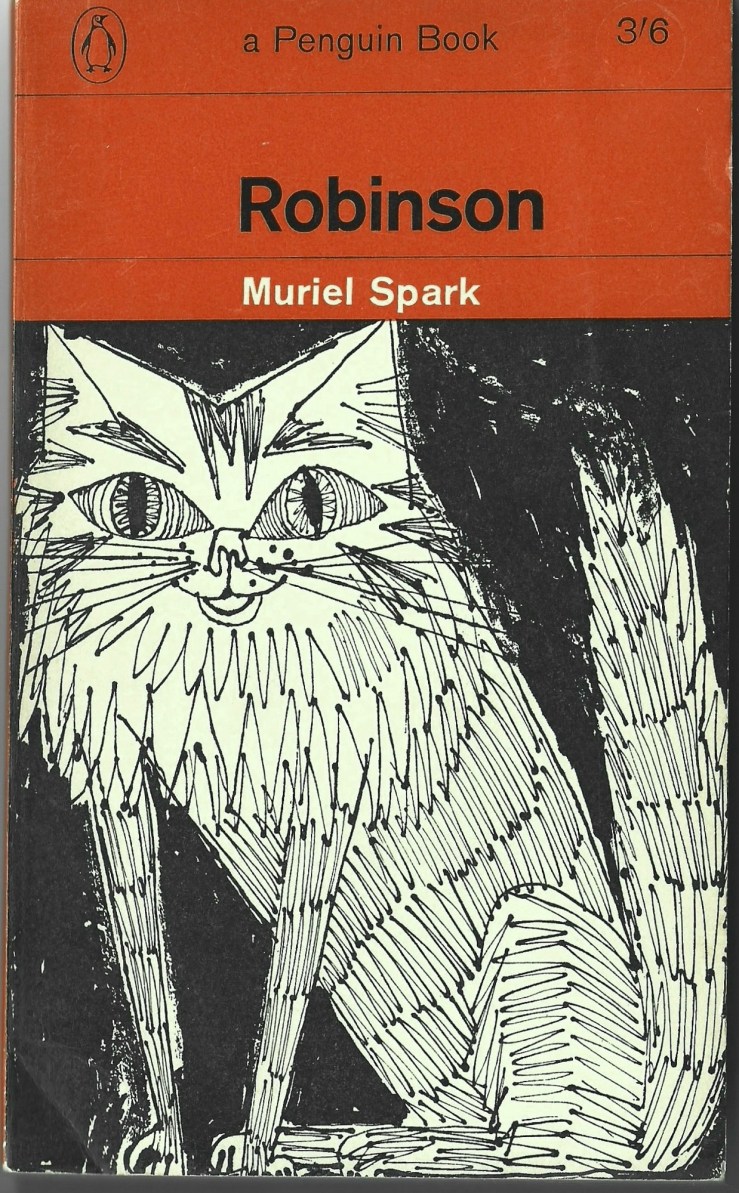
–A paperback copy of Thomas S. Klise’s cult classic The Last Western. It was in the “nonfiction” section, which I didn’t really browse that studiously, but its cover nevertheless stood out to me. I bought a copy of it from an online used bookseller online six years ago (and was very disappointed that the seller had appended a retail barcode sticker to its cover).
–A paperback omnibus of Salem Kirban’s early seventies “prophecy” apocalypse novels 666 and its sequel 1000. I’d thumbed through a worn copy of 666 sometime last year—the title of and its cracked spine calling to me from the shelf of the sci-fi section. Kirban’s “novel” is a millennialist screed conveyed in a tawdry postmodern manner, and it didn’t seem worth the eight bucks the used bookstore was asking at the time—but I didn’t mind snuggling it into the paper bag last Friday, oddity that it is.
–A hardback copy of Don DeLillo’s novel Zero K. I skipped it when it came out, and I don’t think DeLillo’s done anything good since Point Omega.
–A hardback copy of John Barth’s novel Every Third Thought. I think that Barth’s best work is decades behind him, but every now and then I try something newer, and this 2011 novel is one of his shorter recentish efforts.
–A hardback copy of Leni Zumas’ novel Red Clocks. I had never heard of this book, but the spine enticed me enough to pick it up when I was browsing the “sci fi” section at the booksale, and the premise–America has outlawed and criminalized abortion–seemed depressingly dystopian enough to take it with me.
–A hardback copy of Sven Birkert’s collection of literary criticism, An Artificial Wilderness. Includes chapters on Thomas Bernhard, Umberto Eco, Borges, and “The School of Gordon Lish” among many, many others.
–A Vintage Contemporaries Edition of Raymond Carver’s Where I’m Calling From, a collection I have not read in over two decades.
–A hardback copy of Jesse Ball’s novel How to Set a Fire and Why. I liked his 2011 novel The Curfew, so maybe I’ll like this?
–A hardback copy of Jeanette Winterson’s novel Frankisstein; reviews of this 2019 novel intrigued me at the time it was published (and I do like a good Frankenstein riff).
–A hardback copy of Robert Coover’s novel Huck Out West. An amazing sequel to Twain’s novel; I reviewed it on this site years ago. This handsome edition shall replace the ugly advance copy I got years ago. I might need to revisit it in anticipation of Percival Everett’s take on Twain’s Huck’s Jim—James.
–A Library of America edition of The Complete Novels of Eudora Welty. I hate to admit what I will now admit: I love love love Welty’s short stories, but have never read one of her novels.
–A hardback copy of Walker Percy’s Thanatos Syndrome. Again, a late-period work by old master, likely not his finest stuff, but hey. I burned through his first four novels a few years ago—Lancelot was my favorite.
When young and full of fellow feeling, Professor Joseph Skizzen had been tormented by the thought that the human race (which he naïvely believed was made up of great composers, a few harmlessly lecherous painters, maybe a mathematician or a scientist, a salon of writers, all aiming at higher things however they otherwise carried on) … that such an ennobled species might not prosper, indeed, might not survive in any serious way—symphonies sinking like torpedoed ships, murals spray-canned out of sight, statues toppled, books burned, plays updated by posturing directors; but now, older, wiser—more jaundiced, it’s true—he worried that it might (now that he saw that the human world was packed with politicians who could not even spell “scruple”; now that he saw that it was crammed with commercial types who adored only American money; now that he saw how it had been overrun by religious stupefiers, mountebanks, charlatans, obfuscators, and other dedicated misleaders, as well as corrupt professionals of all kinds—ten o’clock scholars, malpracticing doctors, bribed judges, sleepy deans, callous munitions makers and their pompous generals, pedophilic priests, but probably not pet lovers, not arborists, not gardeners—but Puritans, squeezers, and other assholes, ladies bountiful, ladies easy, shoppers diligent, lobbyists greedy, Eagle Scouts, racist cops, loan sharks, backbiters, gun runners, spies, Judases, philistines, vulgarians, dumbbells, dolts, boobs, louts, jerks, jocks, creeps, yokels, cretins, simps, pipsqueaks—not a mensch among them—nebbechs, scolds, schlemiels, schnorrers, schnooks, schmucks, schlumps, dummkopfs, potato heads, klutzes, not to omit pushers, bigots, born-again Bible bangers, users, conmen, ass kissers, Casanovas, pimps, thieves and their sort, rapists and their kind, murderers and their ilk—the pugnacious, the miserly, the envious, the litigatious, the avaricious, the gluttonous, the lubricious, the jealous, the profligate, the gossipacious, the indifferent, the bored), well, now that he saw it had been so infested, he worried that the race might … might what? … the whole lot might sail on through floods of their own blood like a proud ship and parade out of the new Noah’s ark in the required pairs—for breeding, one of each sex—sportscasters, programmers, promoters, polluters, stockbrokers, bankers, body builders, busty models, show hosts, stamp and coin collectors, crooners, glamour girls, addicts, gamblers, shirkers, solicitors, opportunists, insatiable developers, arrogant agents, fudging accountants, yellow journalists, ambulance chasers and shysters of every sleazy pursuit, CEOs at the head of a whole column of white-collar crooks, psychiatrists, osteopaths, snake oilers, hucksters, fawners, fans of funerals, fortune-tellers and other prognosticators, road warriors, chieftains, Klansmen, Shriners, men and women of any cloth and any holy order—at every step moister of cunt and stiffer of cock than any cock or cunt before them, even back when the world was new, now saved and saved with spunk enough to couple and restock the pop … the pop … the goddamn population.
A few years ago, spurred by a conversation with a colleague, I decided to blog about the best books from half a century ago. I enjoyed riffing on the possible “Best Books of 1972” so much that I did repeated the project last year with the possible “Best Books of 1973.”
As in the previous two posts, I’m again primarily interested in novels here, or books of a novelistic/artistic scope. I’ve also focused on books published in English in 1974, and will not be including books published in their original language in 1974 that did not appear in English translation until years later. (For example, while Georges Perec’s excellent Species of Spaces was first published in 1974, it was not published in English translation until the late nineties, and thus will not appear in this blog post, other than in this parenthetical example.)
I also will not be counting English-language books published before 1974 that were published that year in the U.S. So, for example, Richard Adams’s wonderful novel Watership Down dominated The New York Times bestsellers list in the summer of 1974, when it was released in U.S.—but the book was first published in the U.K. in 1972 (and thus appears in my “Best Books of 1972” post). Richard Adams’s follow-up Shardik was released in 1974 though. I tried reading it in my teens and never finished.
I brought up the NYT bestsellers list. I think it’s an interesting barometer to consider a book’s value fifty years after publication. Just four titles dominated the 1974 list: Gore Vidal’s Burr (published in the previous year), followed by Watership Down, then John le Carré’s Tinker, Tailor, Soldier, Spy, and finally James Michener’s Centennial. Two of these titles I think have made their case over the decades.
While the four novels essentially split the NYT fiction bestsellers list by season, the nonfiction list was dominated by Carl Bernstein and Bob Woodward’s All the President’s Men, a work that still remains culturally important (despite Woodward’s best efforts to ruin his legacy).
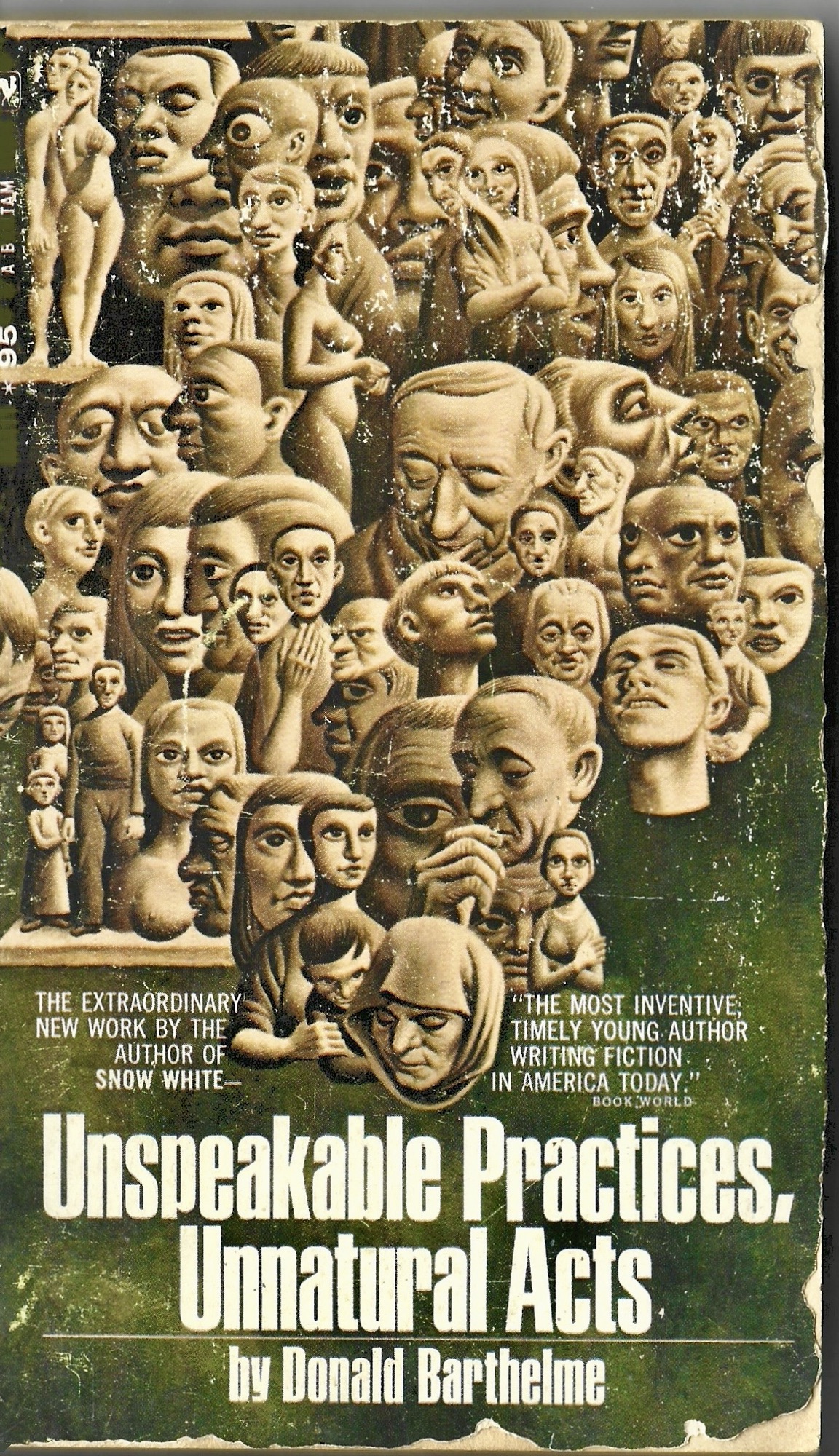
In their year-end round up of 1974, the editors of The New York Times include plenty of titles that didn’t sniff the bestsellers list, like John Hawkes’s Death, Sleep & the Traveler, Donald Barthelme’s collection Guilty Pleasures (“Barthelme’s easiest book,” the editors suggest), Grace Paley’s collection Enormous Changes at the Last Minute. The English translation of Italo Calvino’s Invisible Cities makes the list, but translator William Weaver is left out. James Baldwin’s If Beale Street Could Talk makes the cut, as do Patrick White’s The Eye of the Storm, Iris Murdoch’s The Sacred and Profane Love Machine, and Joseph Heller’s Catch-22 follow-up, Something Happened. My favorite pick from their list is Robert Stone’s Dog Soldiers. (The editors also include Toni Morrison’s Sula, which was actually published in 1973—likely a make-up call for its absence from the previous year’s round-up.)
Some of the strongest entries from the NYT 1974 notables list come in the “Young Readers” section, which boast three bona fide classics: Robert Cormier’s The Chocolate War, Virginia Hamilton’s M.C. Higgins the Great, and Shel Silverstein’s Where the Sidewalk Ends.
In his personal round-up at the NYT, critic John Leonard discusses how the book review section came to their selections before adding some of his favorites, including works by his critical brethren (Elizabeth Hardwick’s Seduction and Betrayal, Irving Howe’s The Critical Point, and Dwight Macdonald’s Discriminations). For fiction, Leonard includes heavy hitters like Vladimir Nabokov (Look at the Harlequins) and Philip Roth’s My Life as a Man, two novels I haven’t ever heard of until now. He also praises James Welch’s Winter in the Blood and Gail Godwin’s The Odd Woman.
Godwin’s The Odd Woman also appears on the American Library Associations’s list of notable books for 1974, along with other titles duplicated in the NYT list. The ALA list also includes Wendell Berry’s The Memory of Old Jack in their slim fiction selection, and Robert M. Pirsig’s Zen and the Art of Motorcycle Repair in their nonfiction selection. (I don’t think we would count Zen as a work of nonfiction today, right?)
The Booker Prize winners and finalists for 1974 offer a less USAcentric list: Nadine Gordimer (The Conservationist) and Stanley Middleton (Holiday) split the prize for the first time ever. The shortlist included Kingsley Amis’s Ending Up, Beryl Bainbridge’s The Bottle Factory Outing, and C.P. Snow’s In Their Wisdom.
In other literary prize news of the day, Michael Shaara’s 1974 Civil War novel The Killer Angels won the Pulitzer for Fiction in 1975. In 1974, no Pulitzer was awarded; infamously, the Pulitzer board opted not to follow the jury’s recommendation to give the prize to Thomas Pynchon’s 1973 novel Gravity’s Rainbow.
Like the Booker, the 1975 National Book Award split its fiction prize as well: Robert Stone’s Dog Soldiers shared the prize with Thomas Williams’ The Hair of Harold Roux. Virginia Hamilton’s M.C. Higgins, The Great won the NBA for children’s literature. Hamilton’s book also won the Newberry Medal that year.
The Nebula Awards short list for the best novels of 1974 included Philip K. Dick’s Flow My Tears, The Policeman Said, T.J. Bass’s The Godwhale, and Ursula K. Le Guin’s The Dispossessed—which won top honors. (I am likely to give The Dispossessed top honors too by the time I get to the end of this post.)
J.G. Ballard’s 1974 novel Concrete Island did not make Nebula’s short list, but to be fair it’s not really sci-fi. But it is pretty good. (Also, not a sci-fi, but an island book, Gary Snyder’s Turtle Island was published in 1974). Leonora Carrington’s excellent surrealist novel The Hearing Trumpet also is sci-fi adjacent, but is again overlooked. Oddball novels in general I suppose have to find their way to a cult—fifty years later, novels like Gerald Murnane’s Tamarisk Row, Ishmael Reed’s The Last Days of Louisiana Red, and Fran Ross’s Oreo have all found wider and more dedicated audiences in the last half century.
Speaking of cult books: Vincent Bugliosi’s Helter Skelter: The True Story of the Manson Murders was published in 1974. Bugliosi’s book was part of a select library we passed surreptitiously around in high school (along with Stephen Davis’s Led Zeppelin biography Hammer of the Gods, William Burroughs’ Naked Lunch, Go Ask Alice, and Thompson’s Fear and Loathing in Las Vegas—the aforementioned Zen and the Art of Motorcycle Repair and Kerouac’s On the Road were part of the underground informal book loan, but I never really cottoned to them). Eve Babitz’s Eve’s Hollywood—published too in 1974—could have been in that secret library if we had known about it.
And 1974 spit out some books would-be hipsters would likely eschew, Peter Benchley’s beach read Jaws and Stephen King’s Carrie. (Both novels spawned fantastic films.)
As I mentioned above, 1974 was a standout year it seems for children and adolescent literature–Robert Cormier’s The Chocolate War, Virginia Hamilton’s M.C. Higgins the Great, and Shel Silverstein’s Where the Sidewalk Ends, of course, but also James Lincoln Collier’s My Brother Sam Is Dead, Madeleine L’Engle’s A Wind in the Door, and Judy Blume’s Blubber. I loved all of these.
A few other books of note: J. M. Coetzee’s debut Dusklands (haven’t read it), Muriel Spark’s The Abbess of Crewe by Muriel Spark (read it when I was devouring Spark in 2020), Annie Dillard’s Pilgrim at Tinker Creek (haven’t read it), and James Herbert’s The Rats (guess who read their mom’s copy of this novel in secret when he was about ten years old?).
I have undoubtedly missed many, many books of note that were published in 1974. I wonder how available, say in 1999 at the 25-year mark, a novel like Ross’s Oreo or Carrington’s The Hearing Trumpet might have been. Again, my fun in this project comes down to a basic idea I have about literature—we really don’t know what books will retain their importance (or gain importance) until decades after their publication. None of this is to discount year-end lists of new books—I had four on my list this year!—I just aim to say something like: Books aren’t time capsules, they are time machines.
My list of the best books of 1974:
Blubber, Judy Blume
The Chocolate War, Robert Cormier
Concrete Island, J.G. Ballard
The Dispossessed, Ursula K. Le Guin
Dog Soldiers, Robert Stone
Enormous Changes at the Last Minute, Grace Paley
Flow My Tears, The Policeman Said, Philip K. Dick
Guilty Pleasures, Donald Barthelme
The Hearing Trumpet, Leonora Carrington
Invisible Cities, Italo Calvino, trans. William Weaver
In some cases, I’ve self-plagiarized some descriptions and evaluations from my old tweets and blog posts.
Night Business, Benjamin Marra
Sleazy, crude violent fun cribbed from the best seventies and eighties action flix you vaguely remember watching in a closet-sized room with six other kids you didn’t know while the adults drank themselves into merriment.
Terror Assaulter: O.M.W.O.T., Benjamin Marra
One of the better satires on The War on Terror™ I’ve read, Marra’s comic assaults the flimsy veil of morality that the neocons threw over their two-front Near Eastern misadventures in mass death.
Benjamin Marra, from Terror Assaulter: O.M.W.O.T.
A Funny Little Dirty War, Osvaldo Soriano, trans. Nick Caistor
A Funny Dirty Little War will in no way explain the Dirty War to those unfamiliar with its history. The causes and effects here unfold in the most basic way (all in a neat Aristotelian unity of action, place, and time). There is no introspection, no analysis—the violence just escalates. Absurd farce hurtles into absurd tragedy. Yet for all their outlandish, grotesque contours, Soriano’s characters are ultimately sympathetic. Or at least pathetic. In any case, this short novel will reward those who don’t mind their black humor extra bitter, with a heavy dose of violence.
The Crossing, Cormac McCarthy☉☆
Cormac McCarthy published his last two novels in the Fall of 2022 and died in the Summer of 2023. Over the last twelve months I’ve reread pretty much all of his novels (going through a fourth or fifth reread of Suttree just a few weeks ago). The Crossing is one of his best, and it might be understood as the bridge piece of a literary career from the acme of Suttree to the capstone of The Passenger. I also think that The Crossing is the perfect starting place for those interested in McCarthy’s oeuvre. I wrote about rereading it here.
A.V. Marraccini’s book is generative, creative, fruitful, a hybrid that points to something beyond the lyric essay. It is stuffed with art and poetry and life; it is erudite and frequently fun; it is moody and sometimes melodramatic, but tonally consistent.
CardinalNumbers, Hob Broun☆
I picked up Hob Broun’s underread, underappreciated 1988 collection Cardinal Numbers a few years ago, ate up most of the stories, and then shelved it with just two tales left, a move I’ve done many times in the past for reasons I can’t fully explain. I guess that I want to leave something in the bag, so to speak. Anyway, I read the whole thing straight through earlier this year—Broun is one of the funniest writers I’ve ever read. Fans of Barry Hannah, David Berman, and Charles Portis will appreciate his stuff.
Cities of the Plain, Cormac McCarthy☉
About thirty pages into the final book of his so-called “Border Trilogy,” McCarthy devotes two entire pages to a description of changing a tire. Beautiful.
The Road, Cormac McCarthy☉
Blood Meridian, Cormac McCarthy☉☆
Child of God, Cormac McCarthy☉
The Orchard Keeper, Cormac McCarthy☉
Like I mentioned above, I spent a lot of the last year rereading McCarthy. I did not find his death a shock or especially sad, or even really, a loss, I think, because of this fact: I was so grounded in all that he’d given us. The man really left all that he had out there, I believe. In an appreciation written after his death, I wrote that I had recently reread so much McCarthy because
The Passenger left me wanting more McCarthy–not in an unsatisfied way, but rather to confirm my intimations about its status as a career capstone. I reread All the Pretty Horses in the lull before Stella Maris arrived. I went on to reread The Crossing (much, much stronger than I had remembered), Cities of the Plain (weaker than I had remembered), The Road (about exactly as I remembered), Child of God (ditto), and The Orchard Keeper (as funny as I had remembered but also much sadder than I had remembered).
Gina Siciliano, from I Know What I Am
I Know What I Am, Gina Siciliano☆
Siciliano’s comix biography of Artemisia Gentileschi is a wonderful achievement—a rich, evocation of genius at work, genius in defiance against the social dicta that sought to suppress her light. Lovely stuff.
The Letters of William Gaddis, William Gaddis, ed. Steven Moore
I read most of the Dalkey edition a few years back; NYRB’s updated edition prompted a full read. I had initially planned to cover the book in a series of posts, but only managed one, covering our man’s youth. The Letters prompted me to finally read A Frolic of His Own, which I’d been “saving” for over a decade now.
Solenoid, Mircea Cărtărescu, trans. Sean Cotter
Unwieldy, uneven, wonderfully surreal and gross at times, simultaneously encyclopedic and introspective, plodding and thrilling, abject and ecstatic. The conclusion splits the elect from the preterite in a literary trick ultimately made ambiguous by everything that’s preceded it. It’s satisfying unless you think too hard about it.
Our Band Could Be Your Life, Michael Azerrad☉
An entire generation passed between my first reading of Azerrad’s well-researched semi-oral history of 1980s American indie rock and listening to a newish audiobook recording of it, read primarily by people inspired these bands. The conceit for the audiobook is gimmicky but works: a different musician reads a chapter on bands they love (Dirty Projectors’ Dave Longstreth reads the Black Flag chapter; Jeff Tweedy does The Minutemen; Jon Wurster does The Replacements, etc.) What most fascinated me was how my tastes have changed—mellowed maybe? I still love Sonic Youth, Fugazi, and Hüsker Dü, but I’m more inclined to listen to The Replacements these days.
Blood and Guts in High School, Kathy Acker☉☆
Fever dreaming holds up.
The Stronghold, Dino Buzzati, trans. Lawrence Venuti
…takes place in an unidentified time in an unidentified country. The novel’s eerie, fable-like quality—a quality that resists historicity—is what most engages me. Buzzati’s book captures the paradox of a modern life that valorizes the pursuit of glory (or at least happiness) while simultaneously creating a working conditions that crush the human spirit. We can find this paradox in Herman Melville’s Bartleby or Mike Judge’s Office Space; we can find it in Antonio di Benedetto’s Zama or Mike Judge’s Enlightened; we can find if in David Foster Wallace’s The Pale King or Dan Erickson’s recent show Severance. I could go on of course.
My Stupid Intentions, Bernardo Zannoni, trans. Alex Andriesse☆
Absolutely loved My Stupid Intentions. It’s a coming-of-age novel narrated by a stone marten, a picaresque howl that seeks to find meaning in being a creature. It’s full of cruelty and heroism and humor and pathos, and, like I said, I absolutely loved it.
Escape from the Great American Novel, Drew Lerman☆
Escape from the Great American Novel is the latest collection of Drew Lerman’s Snake Creek strips, and the most cohesive collection to date. The strips collected here span August 2019 through August 2021; it ends up being an unintentional pandemic novel (while not about the Covid-19 pandemic at all, to be clear). In my review, I wote:
The strips collected in Escape from the Great American Novel span two years that often felt in “real time” like an eternity. Many of us were separated from friends and family over these months. Lerman’s gambit, intentional or otherwise, is to keep his central characters separated, which adds real tension to a comic novel that otherwise might be a loose collection of funny riffs. As I stated before, Roy and Dav are the heart of Snake Creek, so when Lerman finally reunites them the moment is not just cathartic, it’s literarily metaphysical. For all its sardonic jags, ribald japes, and erudite allusions, Escape from the Great American Novel is in the end a sweet, even heartwarming read (Dav and Roy would find a way to mock this sentiment, I’m sure). I loved it. Highly recommended.
Drew Lerman, from Escape from the Great American Novel
The Books of Jacob, Olga Tokarczuk, trans. Jennifer Croft ☆
I’d been interested in Tokarczuk’s historical fiction 900-pager since hearing about it in English translation a few years ago (via Fitzcarraldo Editions). The US edition came out in 2022, but I never came across it used. I have a habit of browsing my campus library before the end of each term though, and at the end of our Spring session there it was, big and fat and propped outward. I didn’t expect to sink into the book the way I did, but quickly gave into its many characters, its simultaneous alienating qualities and deep humanity. Fantastic stuff.
Platitudes, Trey Ellis
Ishmael Reed praised Ellis’s 1988 debut as “delightfully rad,” noting that he was zapped by it. I felt the same. My review here.
Great Expectations, Kathy Acker☉
Bits and bobs, bites and pieces, unpeaceful, savage, a splatterpunk recapitulation of Dickens’ classic.
The River and the Child, Henri Bosco, trans. Joyce Zonana☆
If someone were to have described the simple plot of Henri Bosco’s 1945 novel The River and the Child to me, I might have passed on it—too rustic, too naive, too tender. But, having been sent a review copy of Joyce Zonana’s new translation, I opened it, began reading, and just kept reading. From my review:
I loved reading The Child and the River; I loved the feeling of reading it. It took me back to books I’d loved as a child: Arthur Ransome’s Swallows and Amazons, abridged and bowdlerized versions of Moby-Dick and Huckleberry Finn, and countless Robinsades. In a letter to a friend, Bosco suggested that The Child and the River was “a novel very good, I think, for children, adolescents, and poets.” Is there a better audience?
Inside the Dream Palace, Sherill Tippins☆
This summer, my wife and I celebrated our anniversary by staying at the venerable Hotel Chelsea in Manhattan. There, we were lucky to enjoy a visit and brief tour of room 629, the former residence of the artist Vali Myers. The current resident, photographer Tony Notarberardino was hosting a party later that night, and the theater curtains outside of his door, accompanied by ethereal music, attracted us to peer in as we were looking around the hotel. Tony graciously invited us for a brief peek before his party, and the rooms are simply otherworldy, covered in murals by Myers along with beautiful paintings, furniture, and other sundries. Among other books, he recommended Sherill Tippins’ history of the hotel, Inside the Dream Palace. Tippins’ book can be read as a history 20th c. modernism focused around one locale. Heroes include Harry Smith, Patti Smith, and Andy Warhol. Fantastic stuff.
This Is Not Miami, Fernanda Melchor
This is not to say that I was disappointed by This Is Not Miami, but in my not review of the collection, I wrote that
This Is Not Miami reads like a minor work, but one nonetheless vital to its creator’s artistic maturation. For me, This Is Not Miami is most appreciable as an apprenticeship work that points toward the Bigger Thing to come. And of course I want more.
Excellent and slight. Did Williams mean to mix Kafka and David Markson, or just arrive at her own place? (She arrived at her own place.) From her collection, a piece called “Nevertheless”:
At some point, Kafka became a vegetarian.
Afterwards, visiting an aquarium in Berlin, he spoke to the fish through the glass.
“Now at last I can look at you in peace, I don’t eat you anymore.”
I saw a very interesting-looking person reading an actor’s edition of Philip Ridley’s play Mercury Fur on a train. The title of the play was interesting too, so I picked it up and read it (not the interesting-looking person’s edition.) The play was fine; perhaps actors might have enlivened its dystopian hysterics. Maybe my inner-voice was a poor director. I worked with the script I had.
Mockingbird, Walter Tevis
Tevis’s dystopian novel, published in 1980 and set centuries in the future, posits a future where humanity has basically forgotten everything, letting cyborgs and robots run the world for them. The premise and sentiment exceed the prose and execution.
Rubicon Beach, Steve Erickson
Three strange strands tangle together in a surreal mess. The parts together do not synthesize, exactly; the whole is not greater than the parts. But Rubicon Beach is vital and odd and singular.
A Frolic of His Own, William Gaddis☆
After a few years of false starts, I finally finished the last Gaddis I hadn’t yet read. I wrote a kinda long riffed onA Frolic, concluding that,
Many contemporary reviewers suggested that A Frolic of His Own was Gaddis’s most accessible novel to date, and it might be. Whereas J R and Carpenter’s Gothic are composed almost entirely in dialogue, Gaddis provides more stage direction and connective tissue in A Frolic. There are also the fragments of other forms: legal briefs, depositions, TV news clips, Oscar’s play… A Frolic of His Own is not the best starting point for anyone interested in William Gaddis’s fiction, although I don’t think that’s where most people start. It is rewarding though, especially read contextually against his other works, in which it fits chaotically but neatly, underscoring the cranky themes in a divergent style that still feels fresh three decades after its original publication. Highly recommended.
Stone Junction, Jim Dodge☆
I just went back and read the review of Stone JunctionI wrote this summer. I put the little star guy up there, because my impression of the novel was that it was one of the best things I read this year—I remember the plot, the imaginative contours that it opened up; I remember the paths it took me on—rereading The Once in Future King, in particular, as well as Riddley Walker. But my actual review hedges a bit more: “In its strongest moments, Stone Junction reads like a YA Pynchon novel; in its weakest moments, it reminded me of Tom Robbins,” I wrote. I think it’s stronger than YA Pynchon, I think I think! But I continued:
The stronger moments prevail, however—Stone Junction is a fun, flighty, and at times unexpectedly heavy summer read. The novel might also be read in (stoned) conjunction with Pynchon’s 1990 twin Vineland. Both novels diagnose the fallout of the 1960s counterculture wave crashing against the Reagan eighties; both seem attempts to, at least in the world of letters, check the burgeoning nostalgic romanticization of that turbulent decade. Pynchon’s is the more flawed, sillier, and better-written effort; Dodge’s is likely his magnum opus… I called Stone Junction “YA Pynchon” above, but I didn’t mean it as an insult—it’s YA in an older sense, in the sense of the novels handed me when I was young, hardly adult, novels that etched their own versions of reality onto our own banal reality; realities more real: Adventures of Huckleberry Finn, The Outsiders, The Once and Future King, The Lord of the Rings, Hatchet…Stone Junction is about youth, but it’s also about maturation, and the ache and melancholy of aging out of the game…
The Wind’s Twelve Quarters is not a great starting place for anyone interested in Le Guin’s worlds. Interested parties would do better to start with The Dispossessed, The Lathe of Heaven, or The Left Hand of Darkness—but interested parties are probably aware of that. The book is better suited for folks like me—folks who tore through the Hainish cycle and the Earthsea books and collections, and still wanted a little more. The Wind’s Twelve Quarters is ultimately most interesting as a document of a writer coming into the prime of her powers, and, as such, is indispensable for hardcore Le Guin fans.
Family Lexicon, Natalia Ginzburg, trans. Jenny McPhee
Listened to the audiobook; great stuff, my first Ginzburg.
The Once and Future King, T.H. White☉☆
A perfect book, made perfectly imperfect when capped with its posthumous footnote, The Book of Merlyn—a didactic screed tacked on to a grand Modernist epic, which I hadn’t previously read. It’s probably been thirty years since I’d read The Once and Future King in full; I’d read the first book, The Sword in the Stone, to both of my children when they were young, and before that in my teens, and before that as a kid (big thank you to my cousin Tripp who gave me a paperback copy for Christmas decades ago). But reading the four + one epic (I don’t think Merlyn counts) as a “real” adult was a different matter—I missed so much of what makes The Ill-Made Knight so tragic and what makes the final moments of The Candle in the Wind so unbearably sad and moving. I urge anyone who remembers the contours of this book to return to its rich prose.
Beasts is little big: each of its nine chapters might be read as a short story in which we get a glimpse from one perspective at a balkanized, dystopian post-USA. A species of genetic hybrid called leos are corralled on reservations or outright hunted by the militant Union for Social Engineering; what remains of the Federal Government vies for control with various Autonomous zones; utopian cultists try to hide from the world; slavery has returned under the guise of contractual indentured servitude. A mutant fox, the trickster Reynard, plays kingmaker behind the scenes. The nine chapters refuse to explicitly connect the pieces of the world the present; that is the job of the reader.
Episode in the Life of a Landscape Painter, César Aira, trans. Chris Andrews☆
A perfect little book, which ends, or nearly ends, with this lovely little line: “The artist, as artist, could always be already dead.”
My Death, Lisa Tuttle
A creepy, cozy literary mystery that blooms into an abyssal loop. I reviewed it here.
Based on a True Story, Norm Macdonald☆
I was not expecting Norm Macdonald’s fake-not-fake-memoir-cum-novel Based on a True Story to be as good as it was. I listened to Norm read his book, which in its finest moments is painfully funny and terribly sad, and in its worst, just goofy—the kind of self-sabotage one might expect from a genius who made sure to derail every track he was otherwise sailing along.
I love how it’s written; I love its themes, its layering, its construction. It’s a dense book that feels light; it’s serious and erudite but also psychologically drawn. Ford eschews exposition. In fact, at times he even sets the reader up to look the wrong way. And this fits with a lot of the themes and motifs and bits of the novels—illusionists, forgers, secret agents, disguises, spies, thieves, and so on. So it’s not just happening in the plot; it’s also happening at the rhetorical level.
Schattenfroh, Michael Lenz, trans. Max Lawton ☆
…
….
…..
…….
…
…
Sonic Life, Thurston Moore☆
“I really loved reading Sonic Life. It’s not a perfectly-written or balanced book, but it feels real,” I wrote in my review of Moore’s memoir.
Yaroslav Schwarzstein, from The Sugar Kremlin
The Sugar Kremlin, Vladimir Sorokin, trans. Max Lawton
This forthcoming collection of Sorokin’s novel-in-stories unfolds like a horror-comedy on power, coercion, and Russian soul.
Atticus Lish, from Life Is with People
Life Is with People, Atticus Lish
Doodles.
Poor Things, Alasdair Gray☉
A nice reread. Still haven’t seen the film. My review here.
Aladair Gray, from Poor Things
Suttree, Cormac McCarthy☉☆
Possibly the best book.
(Or at least the best book by an American published in 1979.)
A late year reread—I can’t believe how many connections to The Passenger I’d missed (for example, Sutt has an Aunt Alice he visits in a mental ward). Such a rich, fertile thing, this novel, especially in the way it refuses to be grander than it is, but also is much, much grander than it pretends not to be.
Lapvona, Ottessa Moshfegh
I listened to the audiobook of Moshfegh reading her 2022 novel over my Xmas break. I hadn’t read anything by Moshfegh before; I was aware of her hit novel My Year of Rest and Relaxation though. A colleague had suggested I read Lapvona though, promoting it in the most enticing way: “I really, really hated this, Ed, but I think you’d like it a lot.” She was right—Lapvona is a grimy mix of faux-medieval evil fabulism and insane comedy (I think?) — and wholly abject. A story where Nothing Good Happens—except that’s not right. I loved the end.
The Norm, Vladimir Sorokin, trans. Max Lawton ☆
An intense abject antitotalitarian antiauthoritarian howl against language itself. Fun, funny, gross, grand.
Inside the bowl, the two goldfish are making a Pisces sign, head-to-tail and very still. Penelope sits and peers into their world. There is a little sunken galleon, a china diver in a diving suit, pretty stones and shells she and her sisters have brought back from the sea.
Aunt Jessica and Uncle Roger are out in the kitchen, hugging and kissing. Elizabeth is teasing Claire in the hallway. Their mother is in the W.C. Sooty the cat sleeps in a chair, a black thundercloud on the way to something else, who happens right now to look like a cat. It’s Boxing Day. The evening’s very still. The last rocket bomb was an hour ago, somewhere south. Claire got a golliwog, Penelope a sweater, Elizabeth a frock that Penelope will grow into.
The pantomime Roger took them all to see this afternoon was Hansel and Gretel. Claire immediately took off under the seats where others were moving about by secret paths, a flash of braid or of white collar now and then among the tall attentive uncles in uniform, the coat-draped backs of seats. On stage Hansel, who was supposed to be a boy but was really a tall girl in tights and smock, cowered inside the cage. The funny old Witch foamed at the mouth and climbed the scenery. And pretty Gretel waited by the Oven for her chance. . . .
Then the Germans dropped a rocket just down the street from the theatre. A few of the little babies started crying. They were scared. Gretel, who was just winding up with her broom to hit the Witch right in the bum, stopped: put the broom down, in the gathering silence stepped to the footlights, and sang:
Oh, don’t let it get you,
It will if they let you, but there’s
Something I’ll bet you can’t see—
It’s big and it’s nasty and it’s right over there,
It’s waiting to get its sticky claws in your hair!
Oh, the greengrocer’s wishing on a rainbow today,
And the dustman is tying his tie . . .
And it all goes along to the same jolly song,
With a peppermint face in the sky!
“Now sing along,” she smiled, and actually got the audience, even Roger, to sing:
With a peppermint face in the sky-y,
And a withered old dream in your heart,
You’ll get hit with a piece of the pie-ie,
With the pantomime ready to start!
Oh, the Tommy is sleeping in a snowbank tonight,
And the Jerries are learning to fly—
We can fly to the moon, we’ll be higher than noon,
In our polythene home in the sky. . . .
Pretty polythene home in the sky,
Pretty platinum pins in your hand—
Oh your mother’s a big fat machine gun,
And your father’s a dreary young man. . . .
(Whispered and staccato):
Oh, the, man-a-ger’s suck-ing on a corn-cob, pipe,
And the bank-ers are, eat-ing their, wives,
All the world’s in a daze, while the orchestra plays,
So turn your pockets and get your surprise—
Turn your pockets and get-your surpri-ise,
There was nobody there af-ter all!
And the lamps up the stairway are dying,
It’s the season just after the ball . . .
Oh the palm-trees whisper on the beach somewhere,
And the lifesaver’s heaving a sigh,
And those voices you hear, Boy and Girl of the Year,
Are of children who are learning to die. . . .
From Thomas Pynchon’s 1973 novel Gravity’s Rainbow.
Maybe an hour ago, browsing in a used bookstore, I opened a worn and some might say dirty copy of Iain Banks’s 1985 novel Walking on Glass. The very first page of this old book was inscribed with the following:
Have a weird Xmas ’90
John
This copy of Iain Banks’s 1985 novel Walking on Glass—a 1990 Abacus trade paperback printed in London, the embossing on its cover yellowed by wear on its cover and back near its spine—this particular copy was addressed to no named person, its inscription signed by a name so anonymous we apply it to unidentified cadavers and prostitute clients.
I take myself to be the unidentified person being addressed by the identified generic John, wishing me weird wellness, a ghost of Xmas past.
Earlier this year I made the tragic mistake of not pulling the trigger on first-edition hardbacks of Banks’s first two novels, The Wasp Factory and Walking on Glass. I hadn’t read Banks at that point, and my familiarity with his work came almost entirely of his proximity to the J.G. Ballard titles I routinely perused. I ended up reading and loving The Wasp Factory this summer (reviewed it here), and the blurb on the back of Walking on Glass promising further perversions intrigues me too, of course.
Today, I also came across a first-edition, first-U.S.-printing of Roberto Bolaño’s opus 2666. It was marked at a third of the original cover price and has never been read. I could not leave it behind.
Maybe a week after that, I was browsing with my son, who wanted a collection of Harlan Ellison short stories. I was shocked that we couldn’t find any—I had given away two mass market collections to some students maybe seven or eight years ago in a purge. Apparently a lot of it is out of print, but a “greatest hits” collection is coming out this spring. Anyway, I ended up finding hardback editions of Robert Coover’s Whatever Happened to Gloomy Gus of the Chicago Bears? Denis Johnson’s novel Fiskadaro.
The Johnson is a British edition, Chatto & Windus, and while it’s hardly my favorite novel by him, I found its form too attractive to pass (and it was, like, cheaper than a beer in the same bookstore). I also picked up a book by Lewis Nordan, a slim collection of short stories called Welcome to the Arrow-Catcher Fair. I picked it up because I love those horrid lovely wonderful gross stylish Vintage Contemporaries editions, and then acquired it based on the blurb, which compared it to Flannery O’Connor, Ellen Gilchrist, and Harry Crews. Here it is next to my Vintage Contemporaries copy of Denis Johnson’ Fiskadaro:
I hope you have a weird Xmas. And I hope that John, wherever they are, has a weird Xmas too.
Somnolent city, cold and dolorous in the rain, the lights bleeding in the streets. Cutting through the alley off Commerce he saw a man huddled among the trash and he knelt to see about him. The face came up and the eyes closed. An oiled mask in black against the bricks.
Suttree took him by one arm. Ab, he said.
Can you get me home? A voice from the void, dead and flat and divested of every vanity. Suttree raised up one of the great arms and got it across his shoulder and braced his feet to rise. Sweat stood on his forehead. Ab, he said. Come on.
He opened his eyes and looked about. Are they huntin me? he said.
I dont know. Come on.
He lurched to his feet and stood there reeling while Suttree steadied him by one arm. Their shadows cast by the lamp at the end of the alley fell long and narrow to darkness. As they tottered out of the mouth of the alley a prowlcar passed. Ab sagged, swung back and slammed against the building.
Goddamnit Ab. Straighten up now. Ab.
The cruiser had stopped and was backing slowly. The spotlight came on and sliced about and pinned them against the wall.
Go on, Youngblood.
No.
I aint goin.
You’ll be all right in a minute.
With them I aint goin. Go on.
No damnit. Ab. I’ll talk to them.
But the black had begun to come erect with a strength and grace contrived out of absolute nothingness and Suttree said: Ab, and the black said: Go on.
All right, said the officer. What’s this?
I’m just getting him home, said Suttree. He’s all right.
Is that so? He dont look so all right to me. What are you doin with him? He your daddy?
Fuck you, said Ab.
What?
There were two of them now. Suttree could hear the steady guttering of the cruiser’s exhaust in the empty street.
What? said the officer.
The black turned to Suttree. Go on now, he said. Go on while ye can.
Officer this man’s sick, said Suttree.
He’s goin to be sicker, said the cop. He gestured with his nightstick. Get his ass in there.
Bullshit on that, said the other one. Let me call the wagon. That’s that big son of a bitch …
Jones lurched free and swung round the corner of the alley at a dead run. The two cops tore past Suttree and disappeared after him. The flat slap of their shoes died down the alley in a series of diminishing reports and then there was only the rough drone of the idling cruiser at the curb. Suttree stepped to the car, eased himself beneath the wheel and shut the door. He sat there for a moment, then he engaged the gearbox and pulled away.
He drove to Gay Street and turned south and onto the bridge. The radio crackled and a voice said: Car Seven. He turned left at the end of the bridge, past the abandoned roller rink, a rotting wooden arena that leaned like an old silo. He went down Island Home Pike toward the river. The radio fizzled and crackled. Calling any car in area B. Area B. Come in.
We’ve got a report of some kind of disturbance at Commerce and Market.
Suttree drove along the lamplit street. There was no traffic. The lights at Rose’s came up along his left and the lights from the packing company. The radio said: Car Nine. Car Nine. Suttree turned off down an old ferry road, going slowly, the car rocking and bumping over the grou
nd, out across a field, the headlights picking up a pair of rabbits that froze like plaster lawn figures. The dead and lightly coiling back of the river moving beyond the grass. The sparsely lit silhouette of the city above. The headlights failed somewhere out over the water in a gauzy smear. He brought the car to a stop and shifted it into neutral and stepped out into the wet grass. He pulled the hoodlatch under the dash and walked to the front of the cruiser and raised the hood. He came back to the car and sat in the seat and removed his shoelace. He looked out at the river and the city. One of the rabbits began to lope slowly through the light ground mist toward the dark of the trees.
The radio popped. Wagner? What’s the story down there?
Suttree got out and walked around to the front of the car and bent into the motor compartment and pulled back the throttle linkage. The motor rose to a howl and he tied the linkage back with the shoelace, fastening it to the fuel line where it entered the pump. Live flame was licking from the end of the tailpipe. He climbed in and pushed the clutch to the floor and shifted the lever hard up into second in a squawk of gearteeth. The rabbits were both gone. He eased off the seat and stood with one foot on the ground and the other on the clutch. Then he leaped back and slapped the door shut.
For a moment it didnt move. The tires cried in the grass and smoking clods went rifling off through the dark. Then it settled slightly sideways, dished back again, and in a shower of mud and grass moved out across the field. It went low and fast, the headlights rigid and tilting. It tore across the field and ripped through the willows at the river’s edge and went planing out over the water in two great wings of spray that seemed pure white and fanned upward twenty feet into the air. When it came to rest it was far out in the river. The headlights began to wheel about downstream. Then they went out. For a while he could see the dark hump of it in the river and then it slowly subsided and was gone. He squatted in the damp grass and looked out. There was no sound anywhere along the river. After a while he rose and started home.
A clear night over south Knoxville. The lights of the bridge bobbed in the river among the small and darkly cobbled isomers of distant constellations. Tilting back in his chair he framed questions for the quaking ovoid of lamplight on the ceiling to pose to him: Supposing there be any soul to listen and you died tonight?
They’d listen to my death.
No final word?
Last words are only words.
You can tell me, paradigm of your own sinister genesis construed by a flame in a glass bell.
I’d say I was not unhappy.
You have nothing.
It may be the last shall be first.
Do you believe that?
No.
What do you believe?
I believe that the last and the first suffer equally. Pari passu.
Equally?
It is not alone in the dark of death that all souls are one soul.
Of what would you repent?
Nothing.
Nothing?
One thing. I spoke with bitterness about my life and I said that I would take my own part against the slander of oblivion and against the monstrous facelessness of it and that I would stand a stone in the very void where all would read my name. Of that vanity I recant all.
From Cormac McCarthy’s novel Suttree.
I first read Suttree around thirteen years ago. I’m not sure how many times I’ve waded into it since then. At least two more times in full, plus another two times on audiobook, via Richard Poe’s marvelous narration. I checked the audiobook out from my library again (via Hoopla, which has about everything Audible has, I reckon) a few weeks ago, and fell asleep to Buddy Suttree’s various McAnally misadventures, often not falling asleep as quickly as I planned to. The novel is incredibly rich and fertile, filled with pockets that seem to reverberate stronger from the past viewed through the strange glass of having read McCarthy’s final novel The Passenger late last year, a capstone novel, a novel of insane sobriety that answers to Suttree’s oversoul drunkenness. The Passenger is perhaps Suttree’s secret sequel. Poe’s Suttree narration dipped into my daytime hours—drives and chores, and then just listening and doing nothing else. I forgot so many things: How fucking funny the novel is (I knew this but forgot it, remembering all its bumbling and baffling tragedies); all the shenanigans Suttree and his boys get into (he, I suspect the deferred narrator of his own manic enterprises, always allows himself a measure of impartiality as a witness). I forgot how many of Suttree’s McAnally pals die. I forgot how sad the novel is. Anyway. I was finishing up some domestic chore—let’s call it squeezing the late fall lemons from the lemon tree into a concentrate to freeze, we’ve given all we can away, and they’ll spoil otherwise; or maybe I was finishing kneading a loaf of bread; or maybe something mundane as folding towels and rags hot from the dryer—anyway, I was finishing some or other chore when this passage floated through my ears, caught a bit of purchase, seemed worth sharing. Read Suttree!
After hearing some positive murmurs praising its erudite maximalism and general zaniness, I caved and bought a copy of Robert S. Stickley’s 2020 novel A Bended Circuity. My copy arrived with a ballpoint flower and the front page signed with a scrawled “R S S.” I can’t really find anything about Big Box Publishing, the purported publisher of this edition, but I do know that the copies of the European reprint at Corona Samizdat sold out pretty quickly. (They have a second printing under way).
Here is the copy from the back of my edition:
There are screams in the night. Interlopers are afoot, have taken hold. Wildfires are burning the countryside and the gentry are running for cover. Fortunes are at stake. The South will not sleep.
A Bended Circuity opens on a midsummer’s afternoon with preparations being made for a soirée at the glamorous Hobcaw Barony. But not all goes according to plan. We soon find Charleston abruptly aroused from her slumber by the playful first smites of an unknown enemy waging a heinous prank war.
Calling his confederates to arms, one Bradley Pinçnit — heir to Marigold Manor and writer for revived southern mouthpiece, The Mercury — afternoon with preparations being made for a soirée at the glamorous Hobcaw Barony. But not all goes according to plan. We soon find Charleston abruptly aroused from her slumber by the playful first smites of an unknown enemy waging a heinous prank war.
Calling his confederates to arms, one Bradley Pinçnit — heir to Marigold Manor and writer for revived southern mouthpiece, The Mercury – organizes and helms a “Junto of Condign Men” then drives them to action. Offsetting her husband’s violent movement is Gabuirdine Lee, a housewife struggling to find her voice as the din of war encompasses her.
Ciphered into everything — the new roadways, the scars of the people, the tracts torn through ravaged plantations — there emerges one clear symbol: The Red Radical. Following the hints offered up by this cryptic motif, an army is mustered and pointed toward north so as to seek justice for the pernicious acts being committed upon an old way of life. But the army will first have to get out of its own way if it is to stand a chance of making it out of the South.